
Puck, 1877-04 · page 3 of 16
Puck — April 1877 — page 3: what you’re looking at
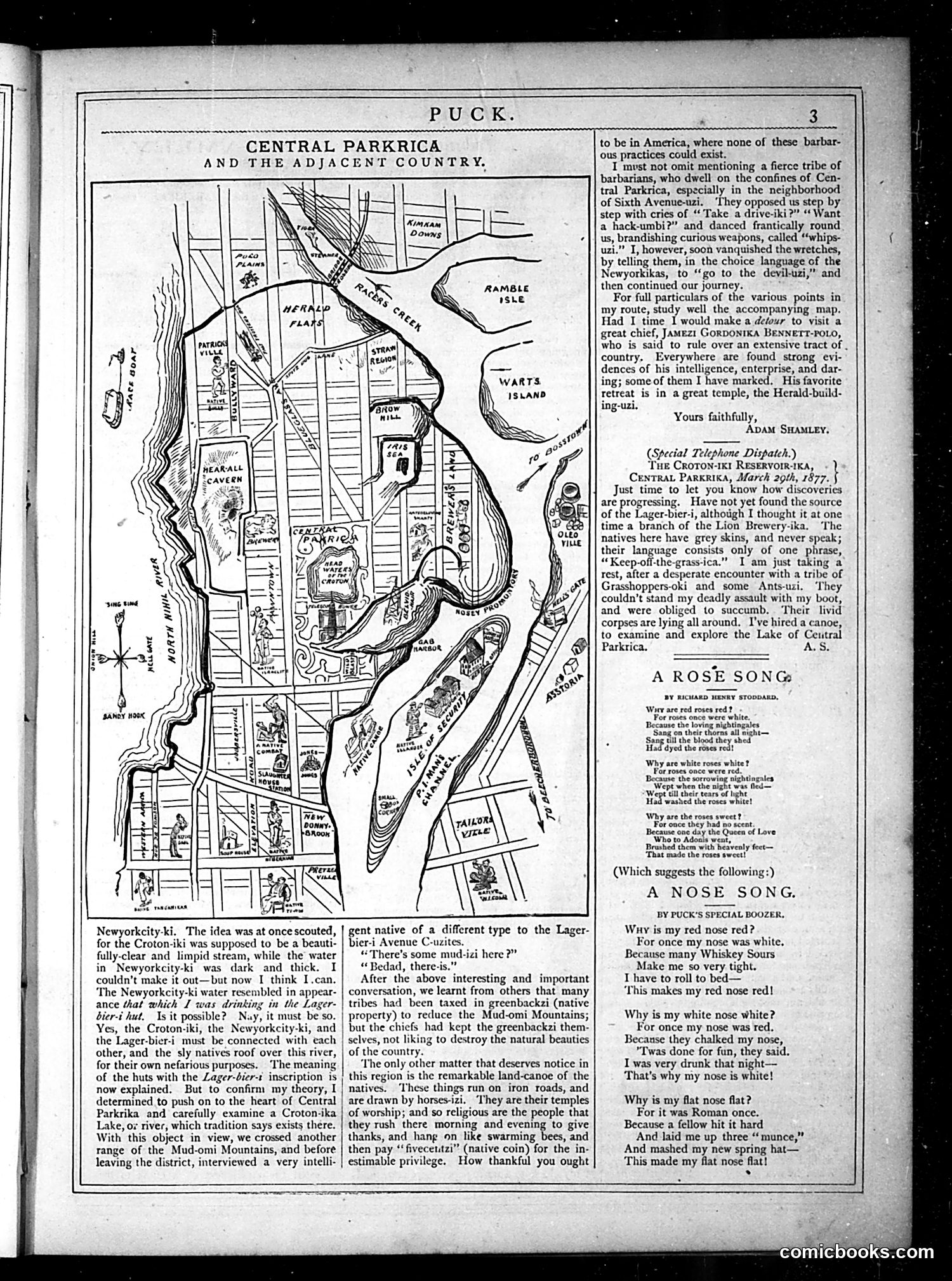
What you’re looking at
This page contains a map of Central Parkrica (a fictional location) and adjacent commentary, rather than political satire. The map depicts various named locations like "Heraco Plain," "Warts Island," and "Ramble Isle," appearing to be a humorous illustrated geography. The accompanying text includes travel dispatches and a poem titled "A Rose Song" with a follow-up "A Nose Song"—likely a playful pun. The nose song jokes about red, white, and flat noses through humorous verse, suggesting physical comedy rather than political commentary. The content appears primarily illustrative and whimsical rather than satirical of current events or political figures. It represents Puck's lighter, more fantastical editorial content alongside its better-known political cartoons.
📄 Transcribed text from this page (OCR, searchable)
Machine-transcribed from the original scan — historical spelling and the odd misread are preserved.
PUCK. i CENTRAL — ——> AND THE ADJACEN PARKRICA T COUNTRY. RAMBLE mSLE Newyorkcity-ki. The idea was at once scouted, for the Croton-iki was supposed to be a beauti- fully-clear and limpid stream, while the water in Newyorkcity-ki. was dark and thick. I couldn’t make it out—but now I think I.can, ‘The Newyorkcity-ki water resembled in appear- ance that which I was drit in the Lager- bier-i hut, Is it possible? , it must be so. Yes, the Croton-iki, the Newyorkcity-ki, and the Lager-bier-i_ must be connected with each other, and the sly natives roof over this river, for their own nefarious purposes. ‘The meaning of the huts with the Lager-bier-t inscription is now explained, But to confirm my theory, I determined to push on to the heart of Central Parkrika and carefully examine a Croton-ika Lake, ov river, which tradition says exists there. With this object in view, we crossed another range of the Mud-omi Mountains, and before leaving the district, interviewed a very intelli- [ees Bent native of a different type to the Lager- ier-i Avenue C-uzites. “There's some mud “ Bedad, there-is. After the above interesting and important conversation, we learnt from others that many | tribes had been taxed in greenbackzi (native | property) to reduce the Mud-omi Mountains; | but the chiefs had kept the greenbackzi them- | selves, not liking to destroy the natural beauties of the country. ‘The only other matter that deserves notice in this region is the remarkable land-canoe of the | natives. ‘These things run on iron roads, and | are drawn by horses-izi. ‘They are their temples | of worship; and so religious are the people that they rush there morning and evening to give thanks, and hang on like swarming bees, and then pay “fivecentzi” (native coin) for the in- estimable privilege. How thankful you ought i here?” to be in America, where none of these barbar- ‘ous practices could exist. I must not omit mentioning a fierce tribe of barbarians, who dwell on the confines of Cen- tral Parkrica, especially in the neighborhood’ of Sixth Avenue-uzi. ‘They opposed us step by step with cries of “Take a drive-iki?” ‘Want a hack-umbi?” and danced frantically round us, brandishing curious weapons, called “whips- uzi.” I, however, soon vanquished the wretches, by telling them, in the choice language of the Newyorkikas, to ‘go to the devil-uzi,” and then continued our journey. For full particulars of the various points in my route, study well the accompanying map. Had I time 1 would make a defour to visit a great chief, Jamezt GorpoNIKA BENNETT-POLO, who is said to rule over an extensive tract of . country, Everywhere are found strong evi- dences of his intelligence, enterprise, and dar- ing; some of them I have marked. His favorite retreat is in a great temple, the Herald-build- ing-uzi. Yours faithfully, ADAM SHAMLEY, (Special Telephone Dispatch.) ‘Tue Croron-ixt RESERVOIR-IKA, Centray Parkrika, March 29th, 1877. Just time to let you know how discoveries are progressing. Have not yet found the source of the Lager-bier-i, although I thought it at one time a branch of the Lion Brewery-ika. The natives here have grey skins, and never speak; their language consists only of one phrase, “Keep-off-the-grass-ica.” I am just taking a rest, after a desperate encounter with a tribe of Grasshoppers-oki and some Ants-uzi. ‘They couldn’t stand my deadly assault with my boot, and were obliged to succumb. Their livid corpses are lying all around. I've hired a canoe, to examine and explore the Lake of Ceutral Parkrica, A.S. A ROSE SONG HARD {¥ STODDARD, Worr are red roses red ? peeron once were whic, cause the loving nightingales ‘Sang on thelr thorns all wight— Sang til the blood they shed Had dyed the roses reat Why are white roses white? For roses once were red. Because the sorrowing nightingales ‘Wept when the night was fled — ‘Wept till their tears of hight Had washed the roses white! ‘Why are the roses sweet ? For once they had no scent Because one day the Queen of Love ‘Who to Adonis went, Brushed them with heavenly feet— ‘That made the roses sweet! (Which suggests the following:) A NOSE SONG. BY PUCK’S SPECIAL BOOZER, Way is my red nose red? For once my nose was white. Because many Whiskey Sours Make me so very tight. T have to roll to bed— ‘This makes my red nose red! Why is my white nose white? For once my nose was red, Because they chalked my nose, ’Twas done for fun, they said. I was very drunk that night— ‘That's why my nose is white! Why is my flat nose flat? For it was Roman once. Because a fellow hit it hard And laid me up three “munce,”” And mashed my new spring hat— This made my flat nose flat! . ee comicbooks.com