
Puck, 1877-04 · page 11 of 16
Puck — April 1877 — page 11: what you’re looking at
What you’re looking at
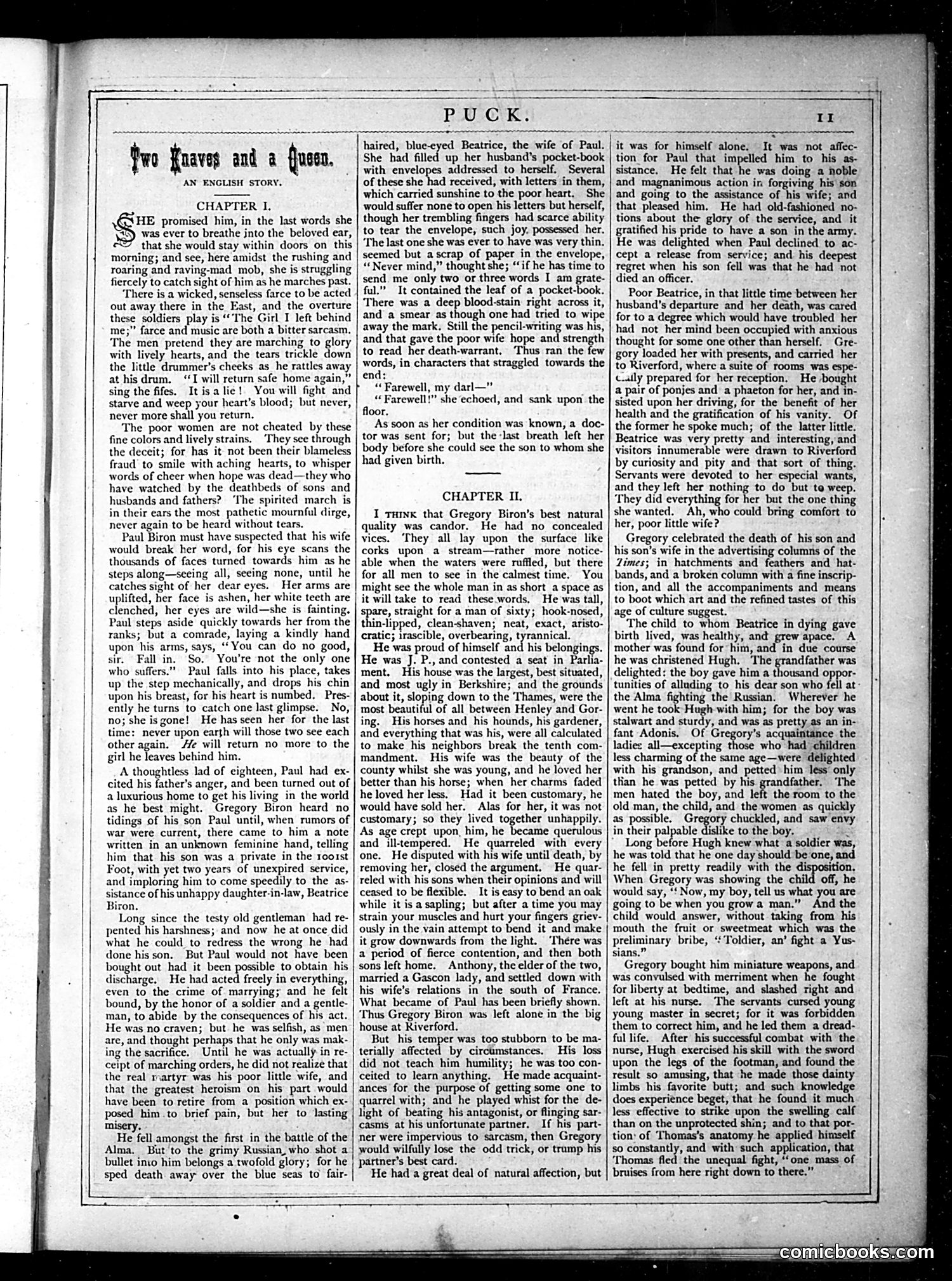
This page contains the opening chapters of a serialized fiction story, not a political cartoon. "Two Knaves and a Queen" is labeled "AN ENGLISH STORY" and tells of Paul Biron, a soldier, and his wife Beatrice during what appears to be the Napoleonic Wars era. The narrative concerns domestic tensions: Paul receives mysterious letters, his wife grows anxious about his activities, and he eventually leaves for military service. A secondary character, Gregory Biron, is introduced as Paul's brother—a proud, quarrelsome man living in Berkshire. This appears to be serialized entertainment fiction typical of Puck magazine's content, rather than political satire. The "knaves and queen" likely refer to the main characters in this domestic drama.
📄 Transcribed text from this page (OCR, searchable)
Machine-transcribed from the original scan — historical spelling and the odd misread are preserved.
eo foaves and a es, CHAPTER I. Xe HE promised him, in the last words she S) was ever to breathe jnto the beloved ear, < that she would stay within doors on this morning; and see, here amidst the rushing and roaring and raving-mad mob, she is struggling fiercely to catch sight of him as he marches past. ‘There is a wicked, senseless farce to be acted out away there in the t, and the overture these soldiers play is ‘The Girl I left behind me;” farce and music are both a bitter sarcasm. The men pretend they are marching to glory with lively hearts, and the tears trickle down the little drummer’s cheeks as_he rattles away at his drum. ‘I will return safe home again,” sing the fifes. It isa lic! You will fight and starve and weep your heart’s blood; but never, never more shall you return. The poor women are not cheated by these fine colors and lively strains. They see through the deceit; for has it not been their blameless fraud to smile with aching hearts, to whisper words of cheer when hope was dead—they who have watched by the deathbeds of sons and husbands and fathers? ‘The spirited march is in their ears the most pathetic mournful dirge, never again to be heard without tears. Paul Biron must have suspected that his wife would break her word, for his eye scans the thousands of faces turned towards him as he steps along—seeing all, seeing none, until he catches sight of her dear eyes. Her arms are uplifted, her face is ashen, her white teeth are clenched, her eyes are wild—she is fainting. Paul steps aside quickly towards her from the ranks; but a comrade, laying a kindly hand upon his arms, says, “You can do no good, sir, Fall in. So. You're not the only one who suffers.” Paul falls into his place, takes up the step mechanically, and drops his chin upon his breast, for his heart is numbed. Pres- ently he turns to catch one last glimpse. No, no; she isgone! He has seen her for the last time: never upon earth will those two see each other again. He will return no more to the girl he leaves behind him. A thoughtless lad of eighteen, Paul had ex- cited his father’s anger, and been turned out of a luxurious home to get his living in the world as he best might. Gregory Biron heard no tidings of his son Paul until, when rumors of war were current, there came to him a note written in an unknown feminine hand, telling him that his son was a private in the roost Foot, with yet two years of unexpired service, and imploring him to come speedily to the as- sistance of his unhappy daughter-in-law, Beatrice Biron. Long since the testy old gentleman had re- pented his harshness; and now he at once did what he could to redress the wrong he had done his son. But Paul would not have been bought out had it been possible to obtain his discharge. He had acted freely in everything, even to the crime of marrying; and he felt bound, by the honor of a soidier and a gentle- man, to abide by the consequences of his act. He was no craven; but he was selfish, as men are, and thought perhaps that he only was mak- ing the sacrifice. Until he was actually in re- ceipt of marching orders, he did not realize that the real martyr was his poor little wife, and that the greatest heroism on his part would have been to retire from a. position which ex- posed him.to brief pain, but her to lasting misery, He fell amongst the first in the battle of the Alma. But ‘to the grimy Russian, who shot a bullet into him belongs a twofold glory; for he sped death away over the blue seas to fair- haired, blue-eyed Beatrice, the wife of Paul. | She had filled up her husband's pocket-book with envelopes addressed to herself. Several of these she received, with letters in them, which carried sunshine to the poor heart. She would suffer none to open his letters but herself, though her trembling fingers had scarce ability to tear the envelope, such joy. d_ her. ‘The last one she was ever to have was very thii seemed but ascrap of paper in the envelope, “Never mind,” thought she; “if he has time to send. me only two or three words I am grate- ful.” It contained the leaf of a pocket-book. There was a deep blood-stain right across it, and a smear as though one had tried to wi away the mark. Still the pencil-writing was his, and that gave the poor wife hope and strength to read her death-warrant, Thus ran the few ‘As soon as her condition was known, a doc- tor was sent for; but the-last breath left her body before she could see the son to whom she had given birth. CHAPTER II. I rurnx that Gregory Biron’s best natural quality was candor. He had no concealed vices. ‘They all lay upon the surface like corks upon a stream—rather more notice- able when the waters were ruffled, but there for all men to see in the calmest time. You might see the whole man in as short a space as it will take to read these.words, He was tall, spare, straight for a man of sixty; hook-nosed, thin-lipped, clean-shaven; neat, exact, aristo- cratic; irascible, overbearing, tyrannical. He was proud of himself and his belongings. He was J. P., and contested a seat in Parlia- ment. His house was the largest, best situated, and most ugly in Berkshire; and the grounds about it, sloping down to the Thames, were the most beautiful of all between Henley and Gor- ing. His horses and his hounds, his gardener, and everything that was his, were all calculated to make his neighbors break the tenth com- mandment. His wife was the beauty of the county whilst she was young, and he loved her better than his horse; when her charms faded he loved her less. Had it been customary, he would have sold her. Alas for her, it was not customary; so they lived together unhappily. As age crept upon, him, ke becaite querulous and ill-tempered. He quarreled with every one. He disputed with his wife until death, by removing her, closed the argument. He quar- reled with his sons when their opinions and will ceased to be flexible. It is easy to bend an oak while it is a sapling; but after a time you may strain your muscles and hurt your fingers griev- ously in the vain attempt to bend it and make it grow downwards from the light. ‘Thére was a period of fierce contention, and then both sons left home. Anthony, the elder of the two, married a Gascon lady, and settled down with his wife’s relations in the south of France. What became of Paul has been briefly shown. ‘Thus Gregory Biron was left alone in the big house at Riverford. But his temper was too stubborn to be ma- terially affected by circumstances. His loss did not teach him humility; he was too con- ceited to learn anything. He made acquaint- ances for the purpose of getting some one to quarrel with; and he played whist for the de- light of beating his antagonist, or flinging sar- casms at his unfortunate partner. If his part- ner were impervious to sarcasm, then Gregory would wilfully lose the odd trick, or tramp his Ppartner’s best card. He had a great deal of natural affection, but it was for himself alone. It was not affec- tion for Paul that impelled him to his as- sistance. He felt that he was doing a hoble and magnanimous action in. forgiving his son and going to the assistance of his wife; and that pleased him. He had old-fashioned no- tions about the glory of the service, and it gratified his pride to have a son in the army. He was delighted when Paul declined to ac- cept a release from service; and his di regret when his son fell was that he had not died an officer. Poor Beatrice, in that little time between her husband's departure and her death, was cared for to a degree which would have troubled her had not her mind been occupied with anxious thought for some one other than herself. Gre- gory loaded her with presents, and carried her to Riverford, where a suite of rooms was espe- cally prepared for her reception. He bought a pair of ponjes and a phaeton for her, and in- sisted upon her driving, for the benefit of her health and the gratification of his vanity. Of the former he spoke much; of the latter little. Beatrice was very pretty and interesting, and visitors innumerable were drawn to Riverford by curiosity and pity and that sort of thing. Servants were devoted to her especial wants, and they left her be S to do but te weep. They did verything for ‘er but the one thing she wanted. Ah, who could bring comfort to her, poor little wife? Gregory celebrated the death of his son and his son’s wife in the advertising columns of the Zimes; in hatchments and feathers and hat- bands, and a broken column with a fine inscrip- tion, and all the accompaniments and means to boot which art and the refined tastes of this age of culture suggest. The child to whom Reatrice in dying gave birth lived, was healthy, and grew apace. A mother was found for him, and in due course he was christened Hugh. The \dfather was delighted: the boy gave him a thousand oppor- tunities of alluding to his dear son who fell at the Alma fighting the Russian. Wherever he went he took Boe with him; for the boy was stalwart and sturdy, and was as pretty as an in- fant Adonis. Of Gregory’s acquaintance the ladies all—excepting those who had children less charming of the same age—were delighted with his grandson, and petted him less’ only than he was petted by his. dfather. The men hated the boy, and left the room to the old man, the child, and the women as quickly as possible. Gregory chuckled, and saw envy in their palpable dislike to the boy. 5 Long before Hugh knew what a soldier was, ne rd told that he one day should be one, and ¢ fell in pretty readily with the eisposit ition. When Gregory was ahowtae the cl off, he would say, ‘t Now, my boy, tell us what you are going to be when you grow a man.” And the child would answer, without taking from his mouth the fruit or sweetmeat which was the preliminary bribe, “Toldier, an’ fight a Yus- sians.” Gregory bought him miniature weapons, and was conyulsed with merriment when he fought for liberty at bedtime, and slashed right and left at his nurse. The servants cursed young young master in secret; for it was forbidden them to correct him, and he led them a dread- ful life. After his successful combat with the nurse, Hugh exercised his skill with the sword upon the legs of the footman, and found the result so amusing, that he made those dainty limbs his favorite butt; and such knowledge does experiénce beget, that he found it much less effective to strike upon the swelling calf than on the unprotected shin; and to that por- tion: of Thomas's anatomy he applied himself so constantly, and with such application, that ‘Thomas fled the unequal fight, ‘‘one mass of bruises from here right down to there.” |