
A complete issue · 16 pages · 1877
Puck — March 1877
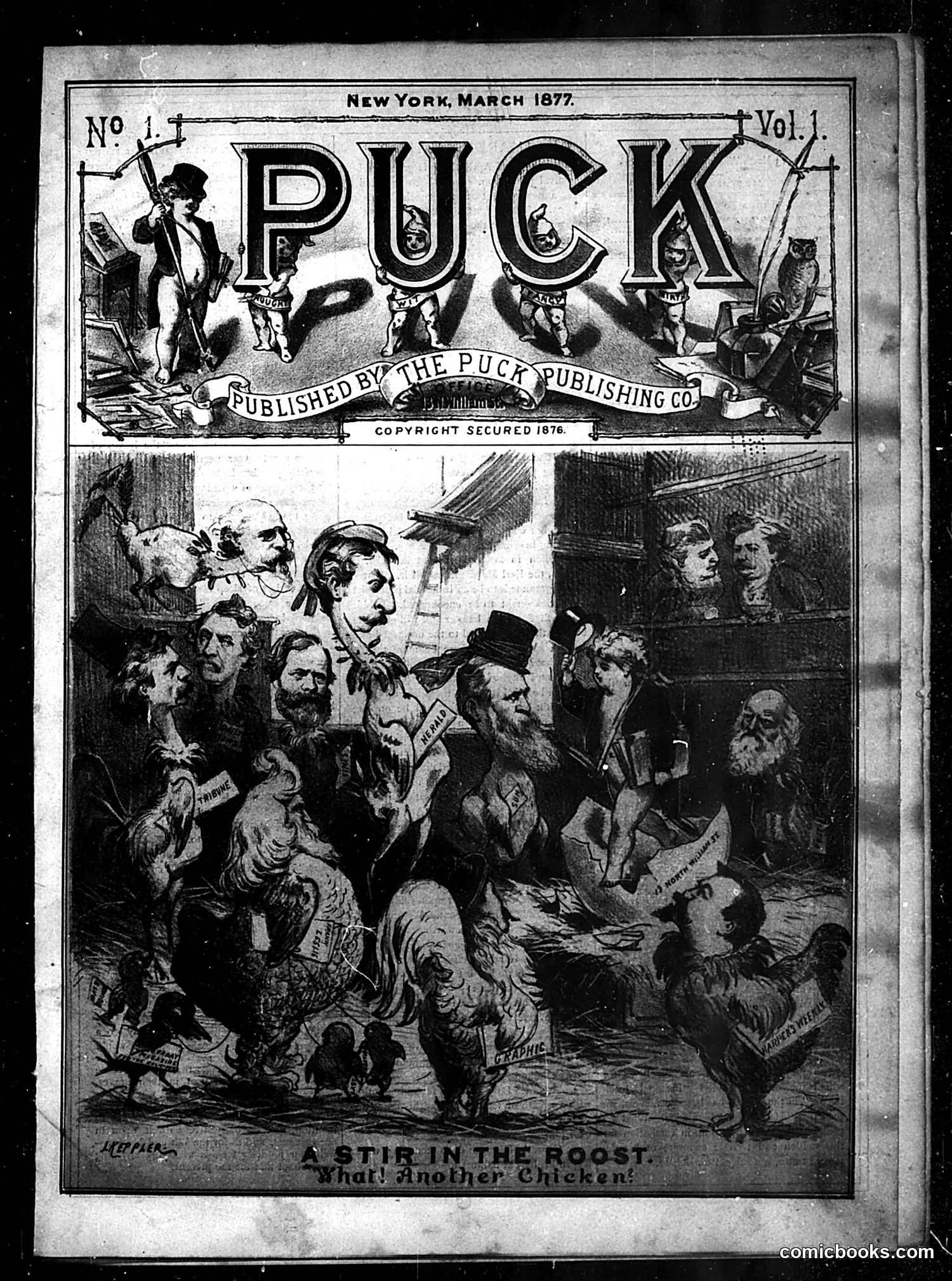
This is the cover of *Puck* magazine's first issue (March 1877). The main cartoon depicts a chaotic farmyard scene with roosters and hens in an agitated state, captioned "A Stir in the Roost—What! Another Chicken!" The image likely uses poultry as metaphorical stand-ins for political figures or factions, a common satirical device. The "stir" and appearance of "another chicken" probably references recent political upheaval—possibly related to the contentious 1876 presidential election or its aftermath. Without clearer identification of specific figures among the caricatured birds, the exact political targets remain unclear, though the tone suggests criticism of political chaos or unwelcome new developments.
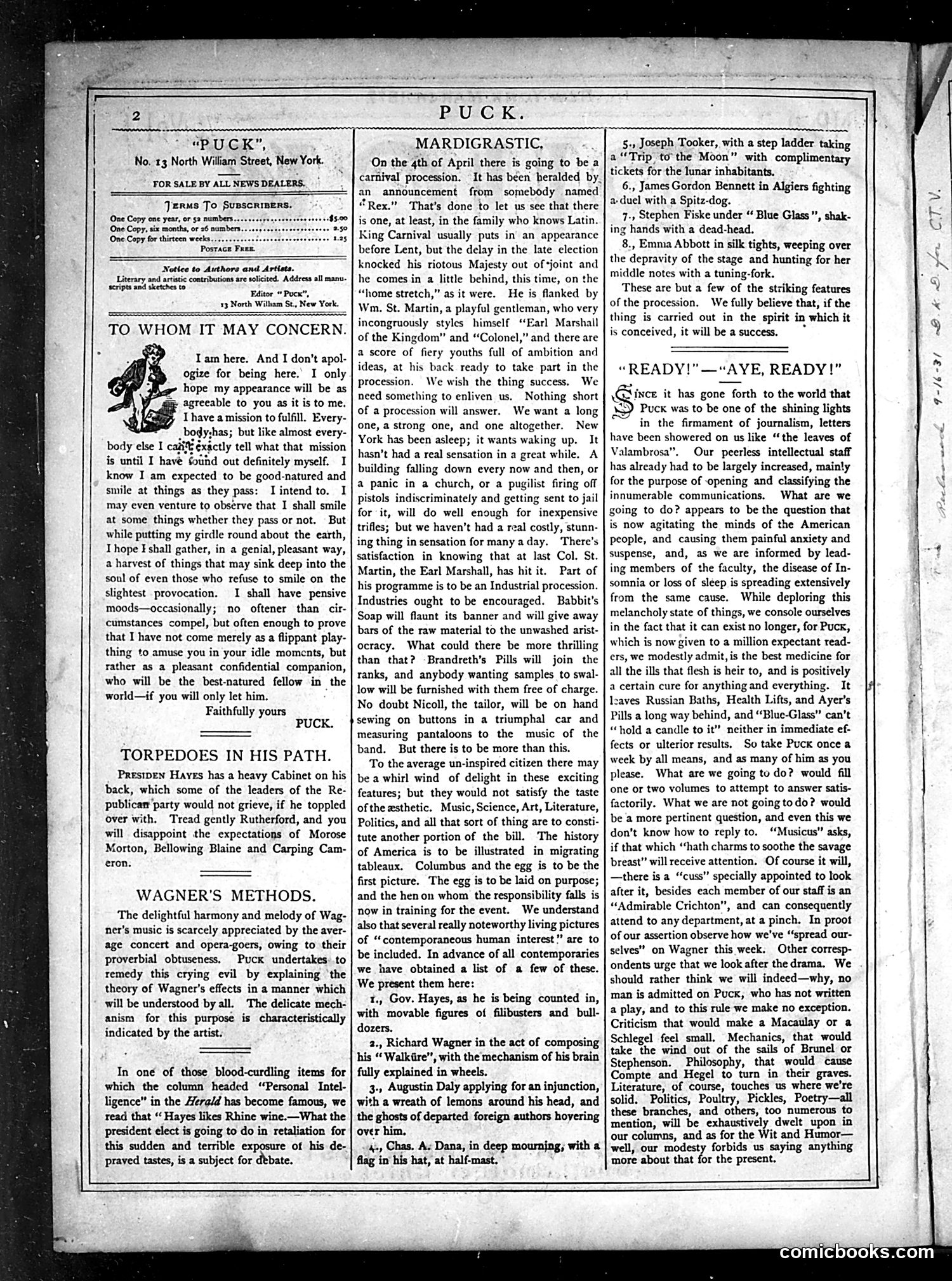
This page contains editorial content and articles rather than political cartoons. The main pieces include: **"To Whom It May Concern"** — A statement by "Puck" (the magazine's mascot/voice) asserting its editorial independence and mission to inform American readers. It positions itself as fearless and willing to critique those in power. **"Torpedoes in His Path"** — References a political opponent blocking someone's agenda, likely from the 1880s-90s era. **"Wagner's Methods"** — Discusses composer Richard Wagner's musical techniques, suggesting Puck undertakes complex analysis of artistic merit. The page emphasizes Puck's role as satirical watchdog of American politics and culture, willing to mock authority figures and expose hypocrisy. Without visible caricatures here, the satire operates through editorial voice rather than visual cartooning.
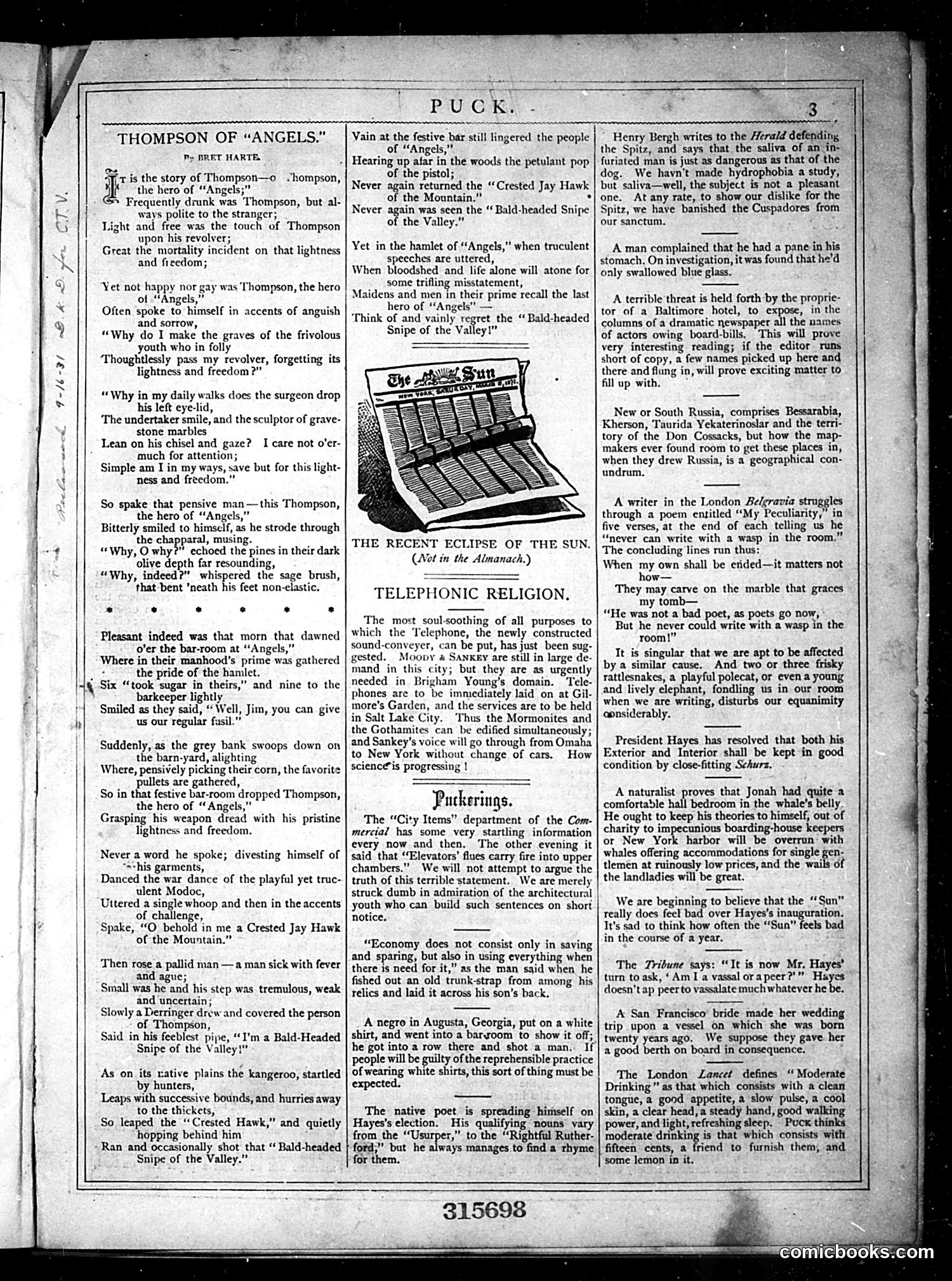
This page contains a satirical poem titled "Thomson of 'Angels'" mocking a man named Thompson, the hero of a bar called "Angels." The verse ridicules Thompson's drunkenness and self-aggrandizing behavior, portraying him as delusional about his importance despite being merely a frequenter of this establishment. The satire targets Thompson's pretentious speeches and his tendency to boast about minor accomplishments while intoxicated. The poem's repetitive structure emphasizes the absurdity of his claims—repeatedly referencing a "Crested Jay Hawk" and "Bald-headed Snipe"—suggesting Thompson fabricates or embellishes stories. The remaining page content includes unrelated articles on various topics. Without additional context about Thompson's actual identity or prominence, the specific target of this satire remains unclear, though it appears to mock a local character or social type recognizable to Puck's readers.
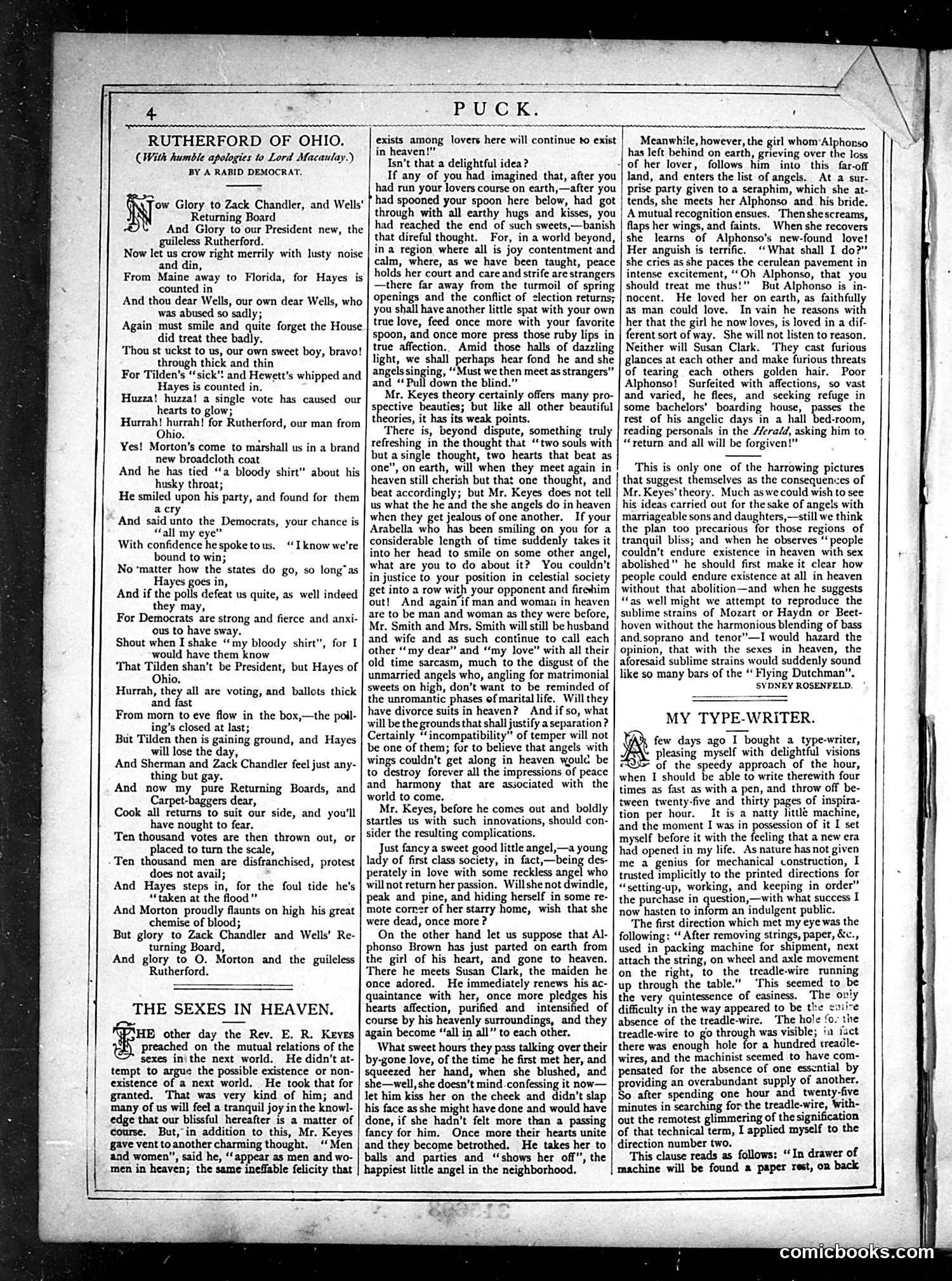
This Puck page satirizes **Rutherford B. Hayes**, Ohio's presidential candidate, through mock-celebratory verses. The satire celebrates Hayes's expected election while ironically naming Democrats he defeated—Tilden, Sherman, and Zack Chandler—in a tongue-in-cheek "glory" poem. The verses mock Democratic losses and Hayes's narrow path to victory. References to "the polls" and ballot-counting suggest the contested 1876 election. The satire attacks Hayes and Republicans while pretending to praise them, typical of Puck's partisan humor. The second article, "The Sexes in Heaven," shifts to social commentary, satirizing Mr. Keyes's theological argument about whether married couples remain "husband and wife" in the afterlife—mocking both religious debate and gender relations of the era.
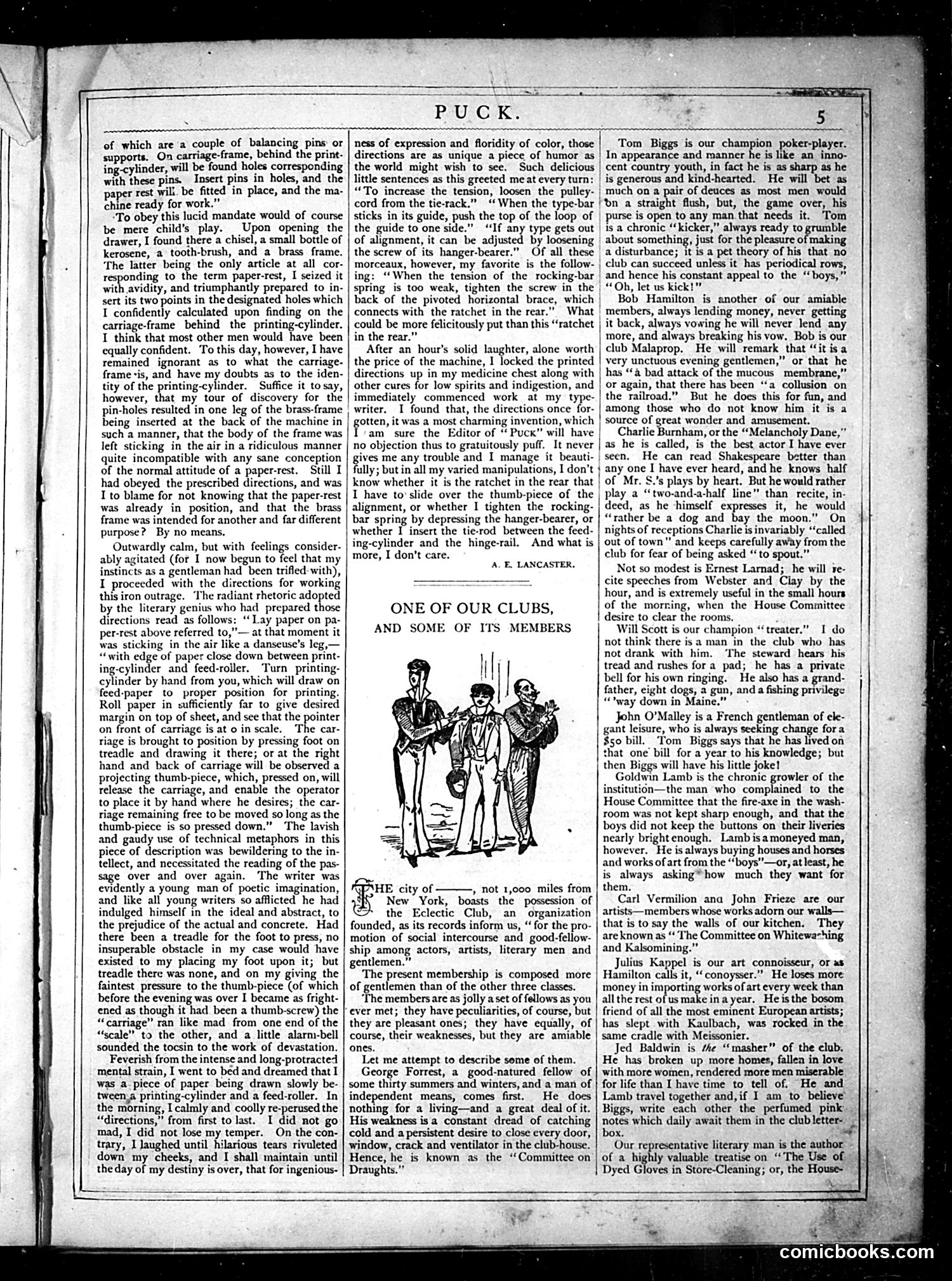
This page contains two distinct sections: a technical article about a printing-press invention (left column) and a social commentary piece titled "One of Our Clubs, and Some of Its Members" (right). The right section presents satirical character sketches of club members, illustrated with a group portrait. The text profiles individuals like Tom Biggs (a poker player), Bob Hamilton (a money-lender), and others, characterizing them through humorous anecdotes that highlight their social quirks and professional peculiarities. The satire targets upper-class social clubs, mocking their members' affectations, business practices, and personal eccentricities. Rather than attacking specific political figures, it offers gentle ridicule of elite leisure culture and the distinctive personalities populating these exclusive institutions.
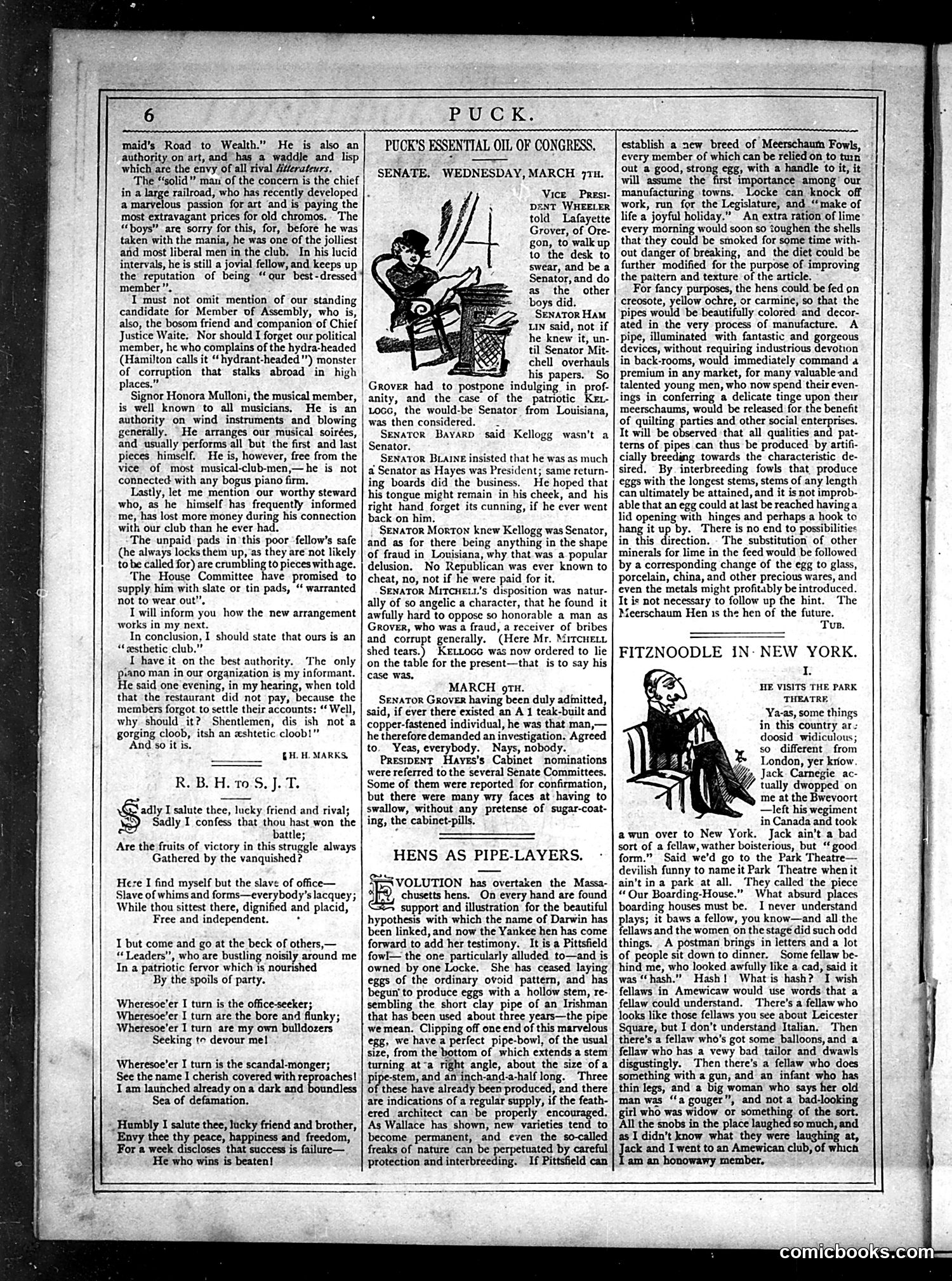
The main cartoon titled "Puck's Essential Oil of Congress" depicts the Senate as a chaotic scene where politicians are literally being squeezed or pressed—apparently to extract their "essential oil." The illustration satirizes Congress as corrupt and self-serving, suggesting that when politicians are metaphorically "pressed," only greed and dishonesty emerge. The accompanying text discusses Senate debates regarding bribery, fraud, and misconduct among members. References to specific senators (Grover, Blaine, Hayes, Mitchell, Kellogg) and their involvement in corruption scandals form the satirical commentary. The piece critiques the pervasive corruption plaguing American government during the Gilded Age, using the "oil extraction" metaphor to suggest that Congress produces only venality when subjected to scrutiny.
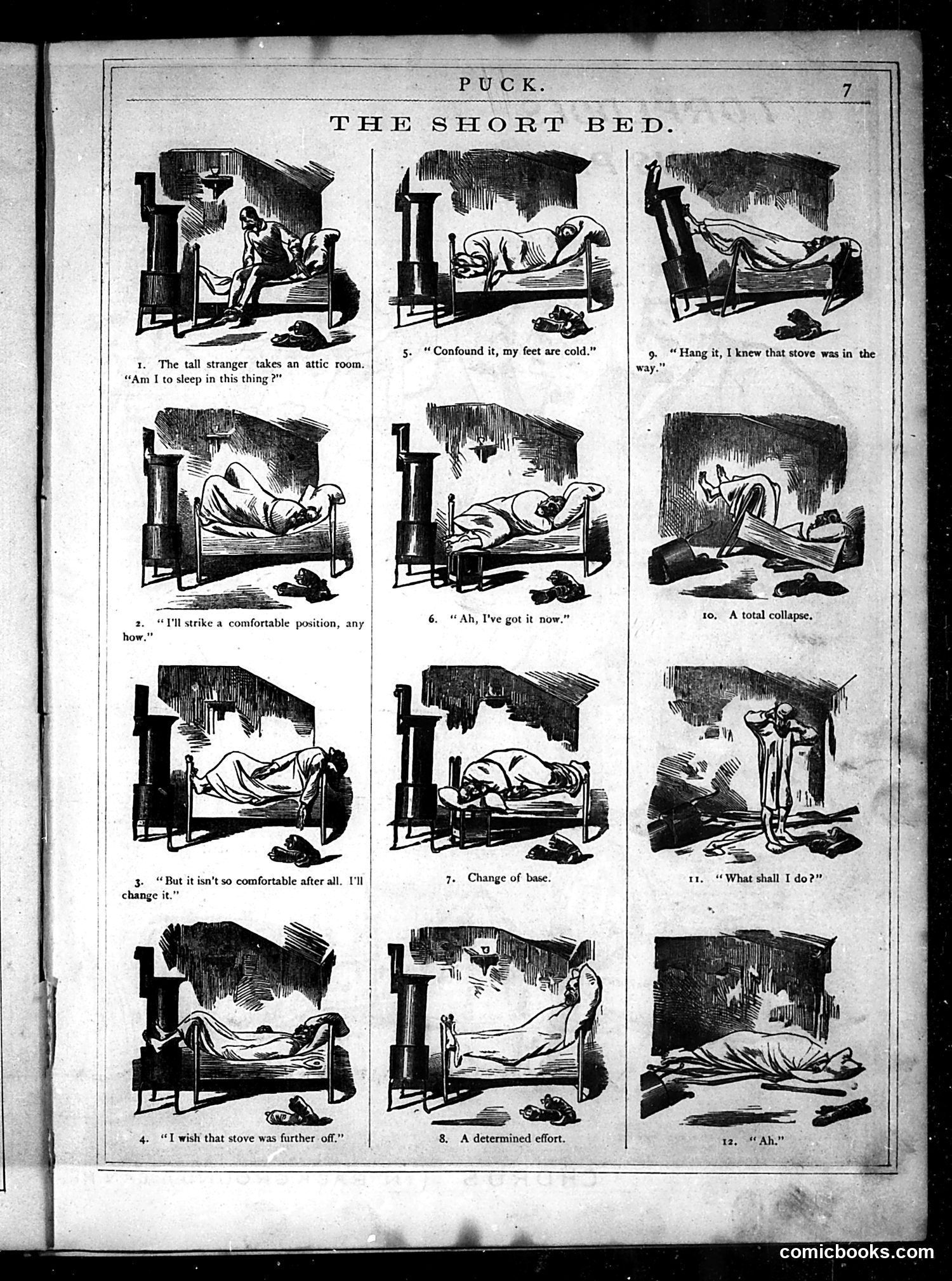
This is a humorous sequential comic depicting a guest's increasingly desperate attempts to sleep in an uncomfortably short bed. The narrative follows a tall stranger who arrives at an attic room and discovers the bed is far too small for his frame. The joke progresses through twelve panels showing the man trying various positions—stretching across diagonally, hanging legs over the edge, attempting to fold himself—each accompanied by frustrated commentary like "I wish that stove was further off" and "Confound it, my feet are cold." The satire likely mocks the experience of staying in cramped, poorly-equipped lodgings or boarding houses common in that era. The final panel shows complete collapse, ending with "Ah"—resignation to an impossible situation. It's physical comedy focused on relatable domestic frustration.
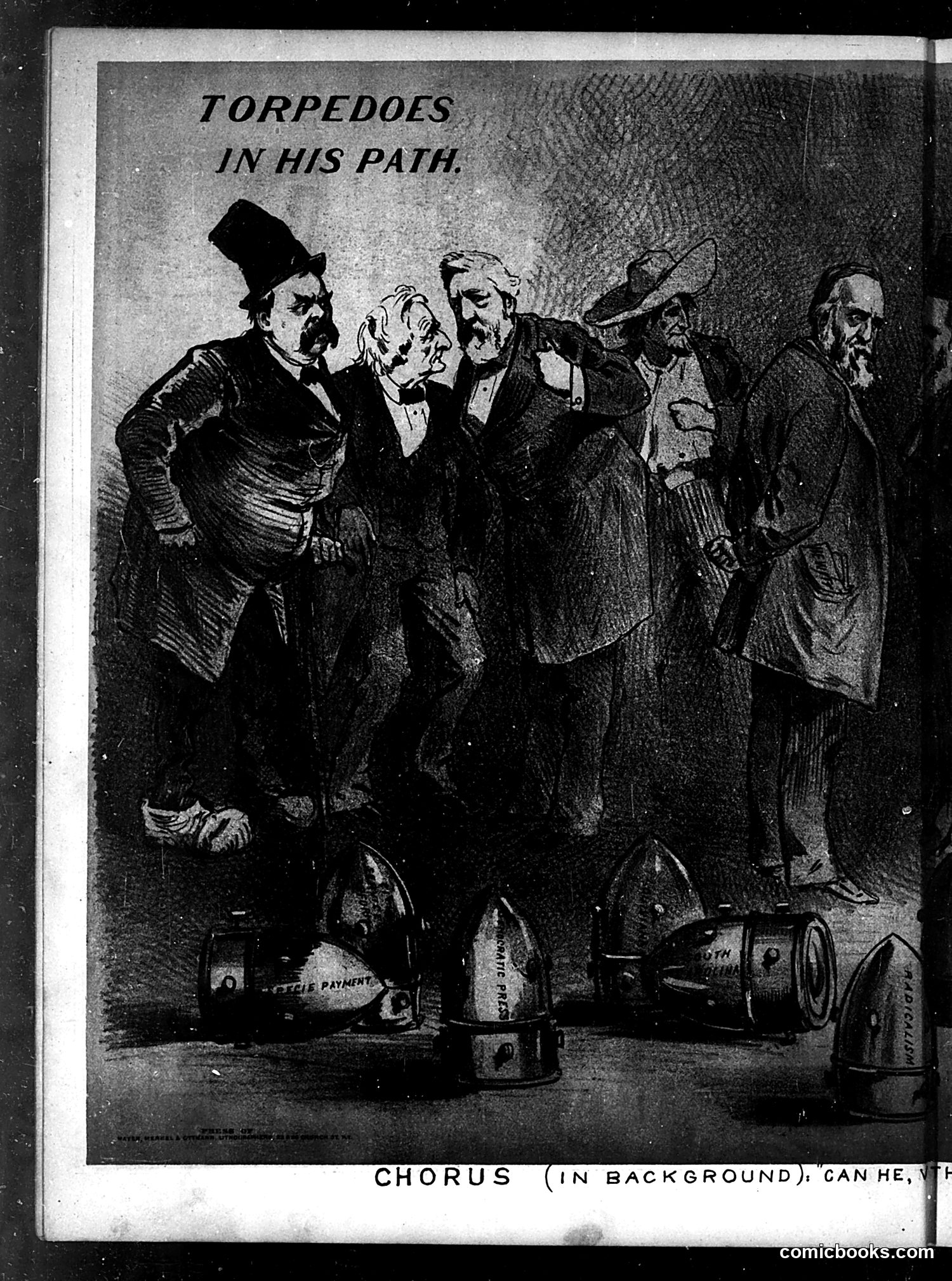
This political cartoon depicts five men in formal 19th-century dress examining or discussing large naval torpedoes on the ground. The title "Torpedoes in His Path" suggests obstacles facing an unnamed political figure (likely referenced in the incomplete caption below: "CHORUS (IN BACKGROUND), CAN HE,"). The "torpedoes" appear to be metaphorical—representing political or legal challenges rather than actual weapons. The formally-dressed men, possibly political opponents, journalists, or governmental figures, are presented as obstacles this person must navigate. Without the complete caption and publication date visible, the specific identity of "him" remains unclear, though the naval weaponry metaphor was common in Puck's political satire. The cartoon mocks someone facing mounting difficulties or opposition.
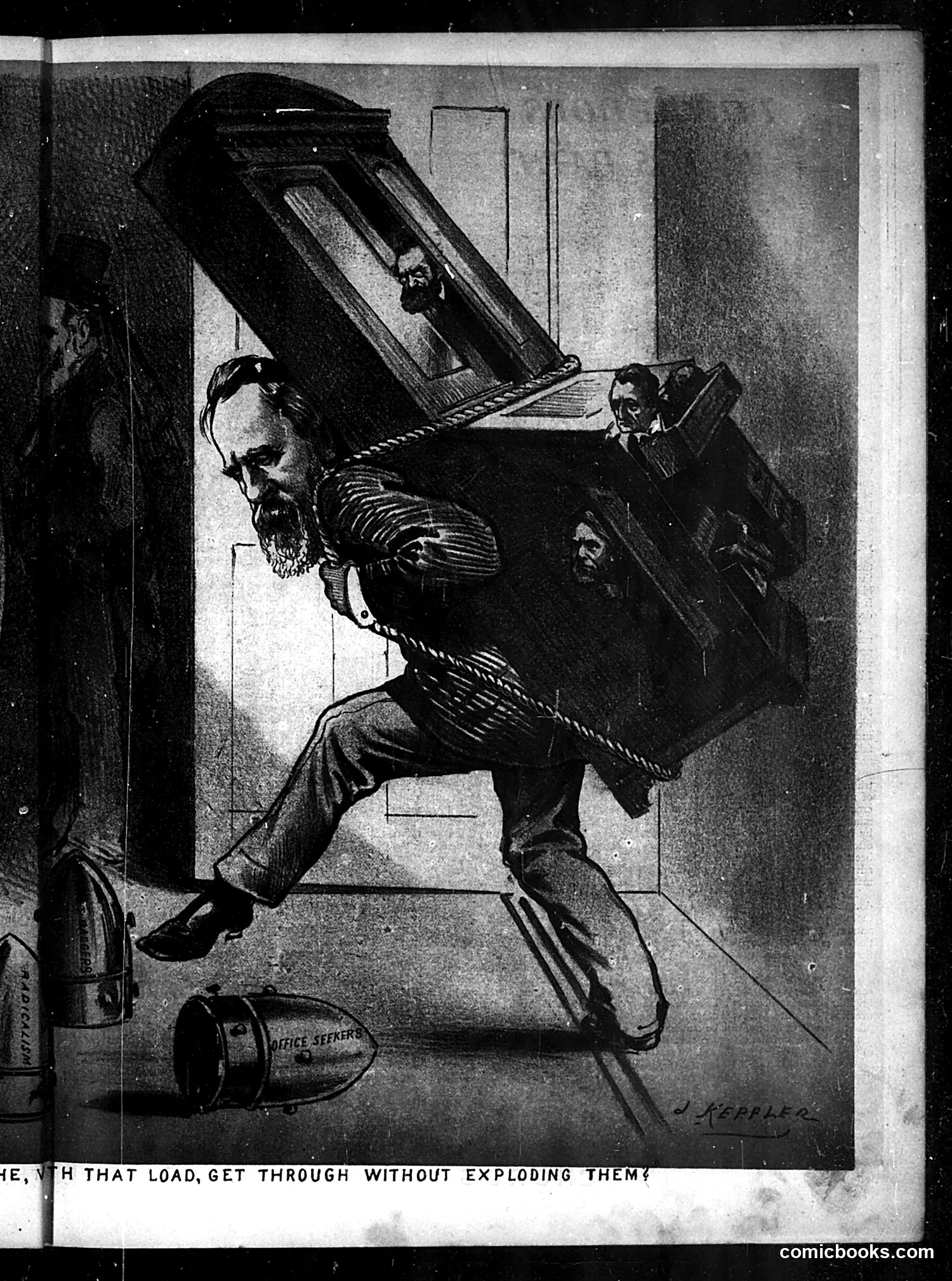
This Puck cartoon depicts a bearded man struggling to carry an enormous, unstable load (labeled "OFFICE SEEKER") up a narrow staircase while other figures wait above. The caption reads: "...WITH THAT LOAD, GET THROUGH WITHOUT EXPLODING THEM?" The satire targets the political patronage system of the era. "Office seekers"—individuals pursuing government positions through political connections—are portrayed as dangerous, explosive burdens. The cartoon suggests that appointing such candidates creates instability and conflict within government institutions. The precarious staircase climb implies the difficulty of navigating the patronage system without causing institutional damage. This reflects late-19th-century Progressive Era criticism of the spoils system, where political loyalty determined government appointments rather than merit.
This page is primarily a **written column** rather than a political cartoon. The piece, signed by Silas Dutt, discusses various theatrical and cultural observations. The column references **specific performers and theatrical productions**: mentions "The Danicheff" at the University Square Theatre, discusses an actor with blonde hair named Thorne, and comments on various stage productions and performers like Wagner. The satire appears **social rather than political**—Dutt critiques theatrical sentimentality, excessive emotionalism in acting, and the pretensions of both performers and audiences. He mocks performers who overact or rely on superficial tricks (blonde hair, artificial emotion) rather than genuine artistry. The piece also discusses **Araminta**, apparently a female character or performer, examining how she handles sentimental material. This represents Puck's cultural commentary rather than hard political satire.
This page contains three distinct satirical pieces: 1. **"My Awful Dad!"** - A theater review mocking a play featuring actor Lester Wallack. The critic ridicules the sentimental "Dad" character as overly leading and the dialogue as deliberately meant to provoke laughter. References to Harry Beckett (a barrister) suggest social commentary on class pretension. 2. **"The Yearning of Love"** - An illustrated poem about romantic longing, featuring a woman dreaming of an idealized man. The sentiment is earnest rather than satirical. 3. **"The Statistic Fiend"** - Satirizes obsessive number-crunching, mocking someone who calculates absurd statistics (like dogs' leg-days). This critiques Victorian-era enthusiasm for "scientific" data collection applied to trivial matters. The page exemplifies Puck's mix of theatrical criticism and social satire targeting contemporary intellectual pretensions.
This page contains the beginning of "The Romance of a Boarding House" by Mark Inslee, a serialized fiction story rather than a political cartoon. Chapter I, titled "He Longs for It," introduces Richard Lane, a poor but educated orphan working as a copyist and clerk at a law office. The narrative focuses on his romantic and financial struggles within a boarding house setting, particularly his attraction to Florence Kingsley, a fellow lodger. The page includes social commentary typical of late 19th-century American fiction—contrasting wealth disparity, class consciousness, and the dignity of genteel poverty. There are no political cartoons or satirical illustrations visible on this page; it is primarily literary content with period-appropriate social observations woven into the narrative.
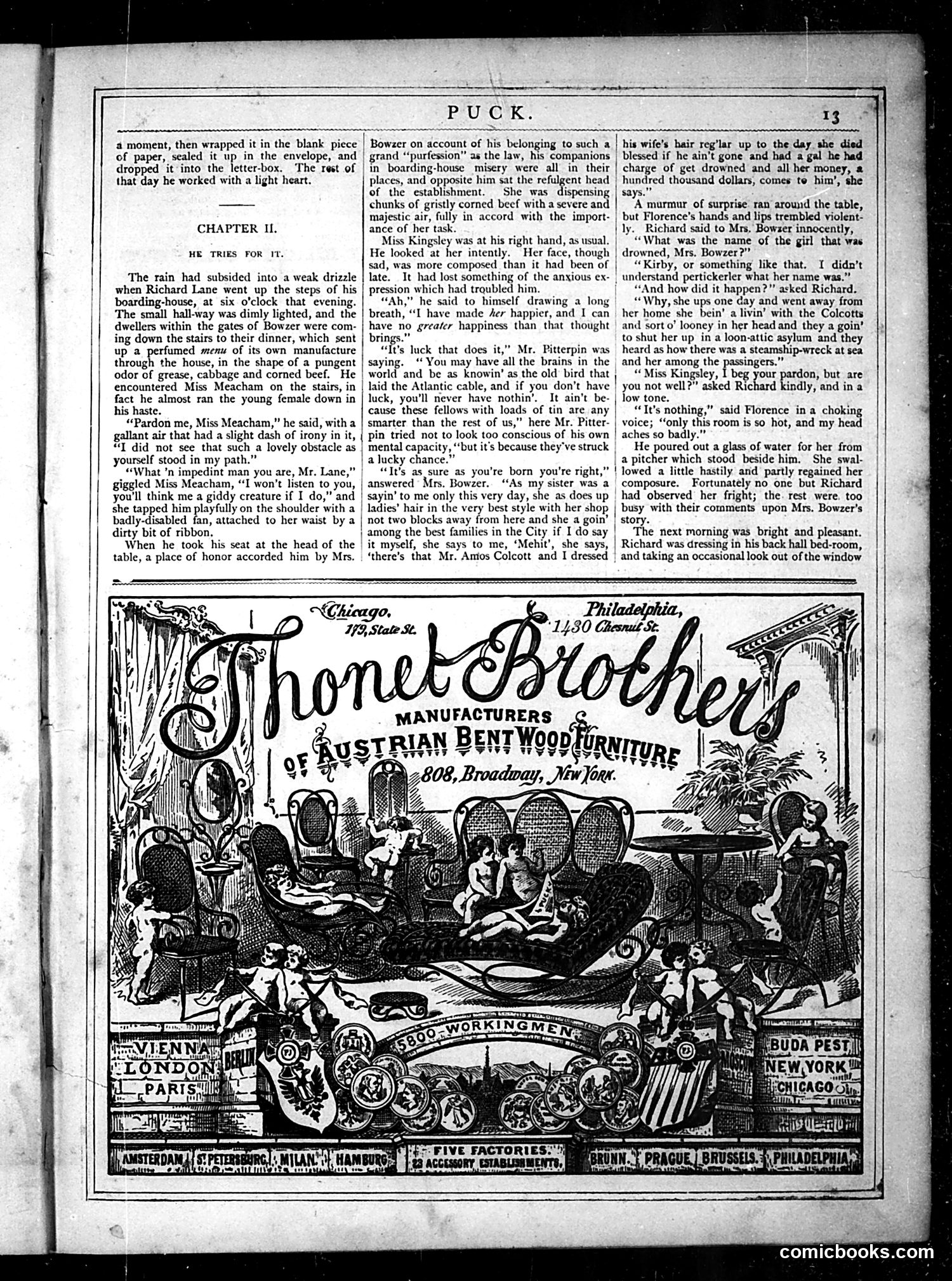
This page contains **Chapter II of a serialized story titled "Puck"** (text only, no political cartoon). The narrative follows Richard Lane's romantic entanglements—he's attempting to court Miss Kingsley while managing complications from a prior relationship with a woman named Florence. The domestic drama involves misunderstandings about gifts, social propriety, and women's independence (references to "livin' with the Coloreds" and asylum stays suggest attitudes toward women's autonomy). The **large advertisement below** for Sthonet Brothers' Austrian bent-wood furniture dominates the page, showcasing their manufacturing facilities across multiple cities (Vienna, London, Paris, Chicago, Philadelphia, New York). This is a commercial placement, not satirical content.
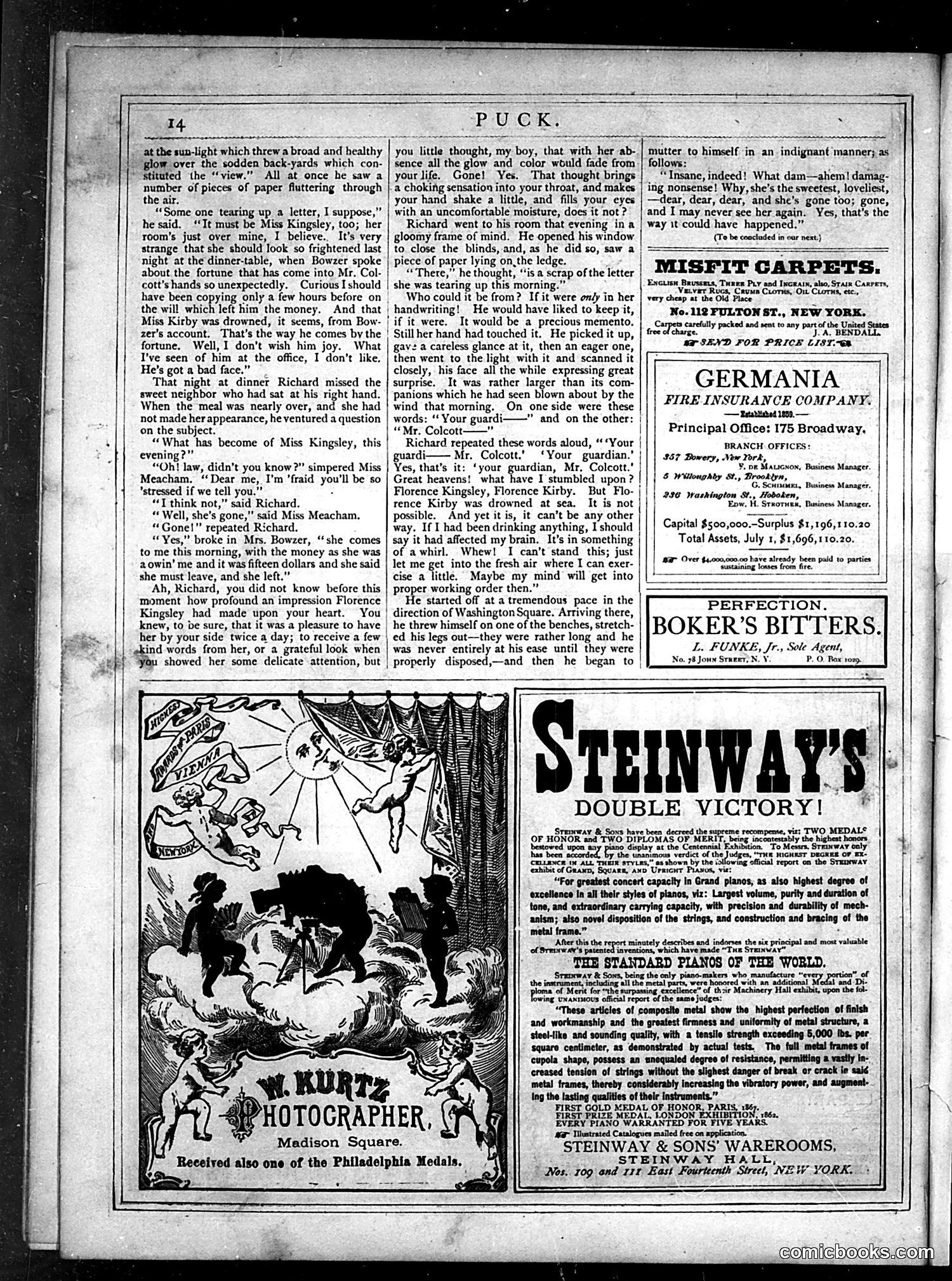
This page is primarily **advertising and serialized fiction** rather than political satire. The top portion continues a story about Richard, Miss Kingsley, and various domestic matters involving letters and evening visits—standard serial fiction of the period. The cartoon by **C. M. Kurtz** (credited at bottom) shows a theatrical or circus scene with cherubs/putti figures and performers, titled "Photographer" at Madison Square. The satire's specific target is unclear from the image alone. The page is dominated by three advertisements: **Misfit Carpets** (New York), **Germania Fire Insurance Company**, **Boker's Bitters**, and a large **Steinway Piano** advertisement emphasizing their "Double Victory" at exhibitions and medals. Without additional context about 1880s-90s events or politics, the cartoon's precise satirical meaning remains unclear.
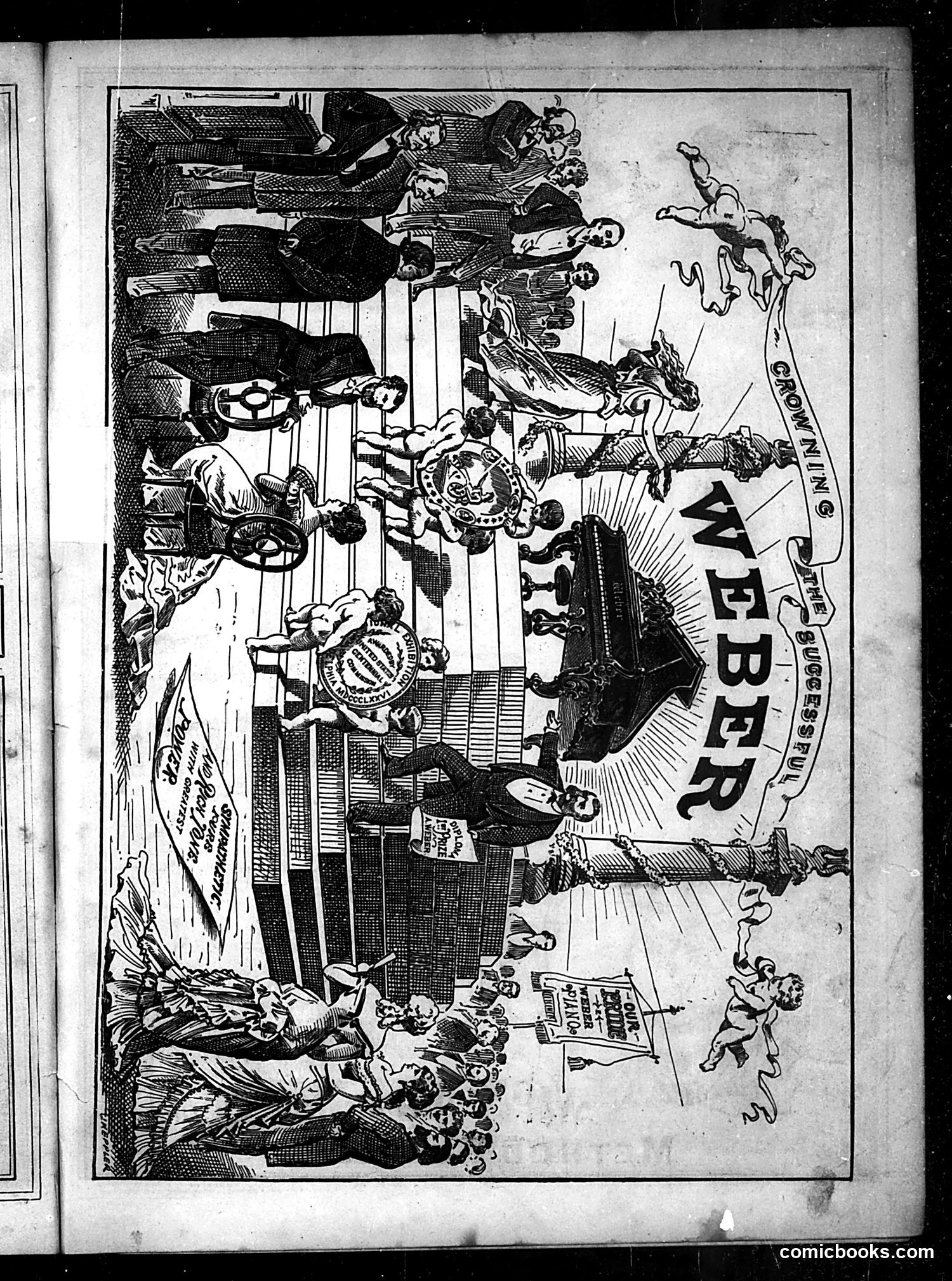
The page displays "WEBBER" (visible in large letters on the right), which appears to be the title or subject of this satirical illustration. The engraving shows a chaotic scene with multiple figures arranged around a central structure or ship, with various characters in period dress engaged in different activities. The composition suggests social or political satire typical of Puck's style, though without clearer text or additional context, the specific figures and their identities remain unclear. The central vessel-like structure and surrounding crowd suggest commentary on a contemporary event, possibly involving commerce, politics, or public figures of the era. The detailed crosshatching and busy composition are characteristic of 19th-century satirical engravings, but the precise satirical point requires clearer textual support to identify with certainty.
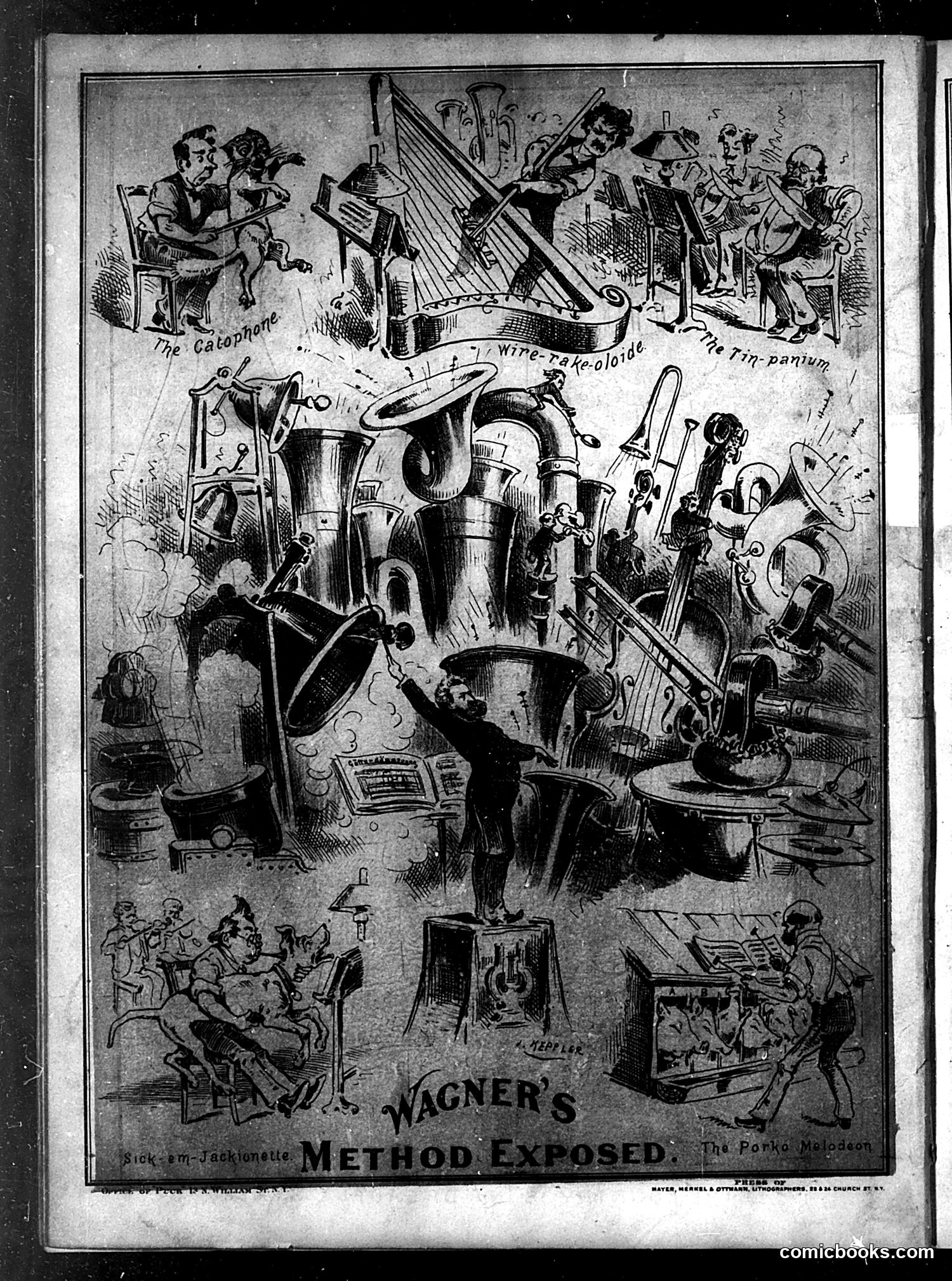
This satirical illustration critiques composer Richard Wagner's musical style by depicting his orchestra as a chaotic mechanical contraption. The central image shows various instruments—labeled including "Wire-Tololde," "Tin-panium," and "Calophone"—assembled into an absurd, overcomplicated machine operated by musicians. The satire mocks Wagner's complex orchestration and harmonic innovations, which contemporary critics found bewildering and excessive. The smaller scenes around the margins show audiences reacting with confusion, distress, or indifference to his music—some covering their ears, others sleeping or arguing. The title "Method Exposed" suggests the cartoon is "revealing" Wagner's compositional approach as overly mechanical rather than genuinely artistic, a common complaint from Victorian-era critics who viewed his modernist techniques with suspicion.