
Puck, 1877-03 · page 5 of 16
Puck — March 1877 — page 5: what you’re looking at
What you’re looking at
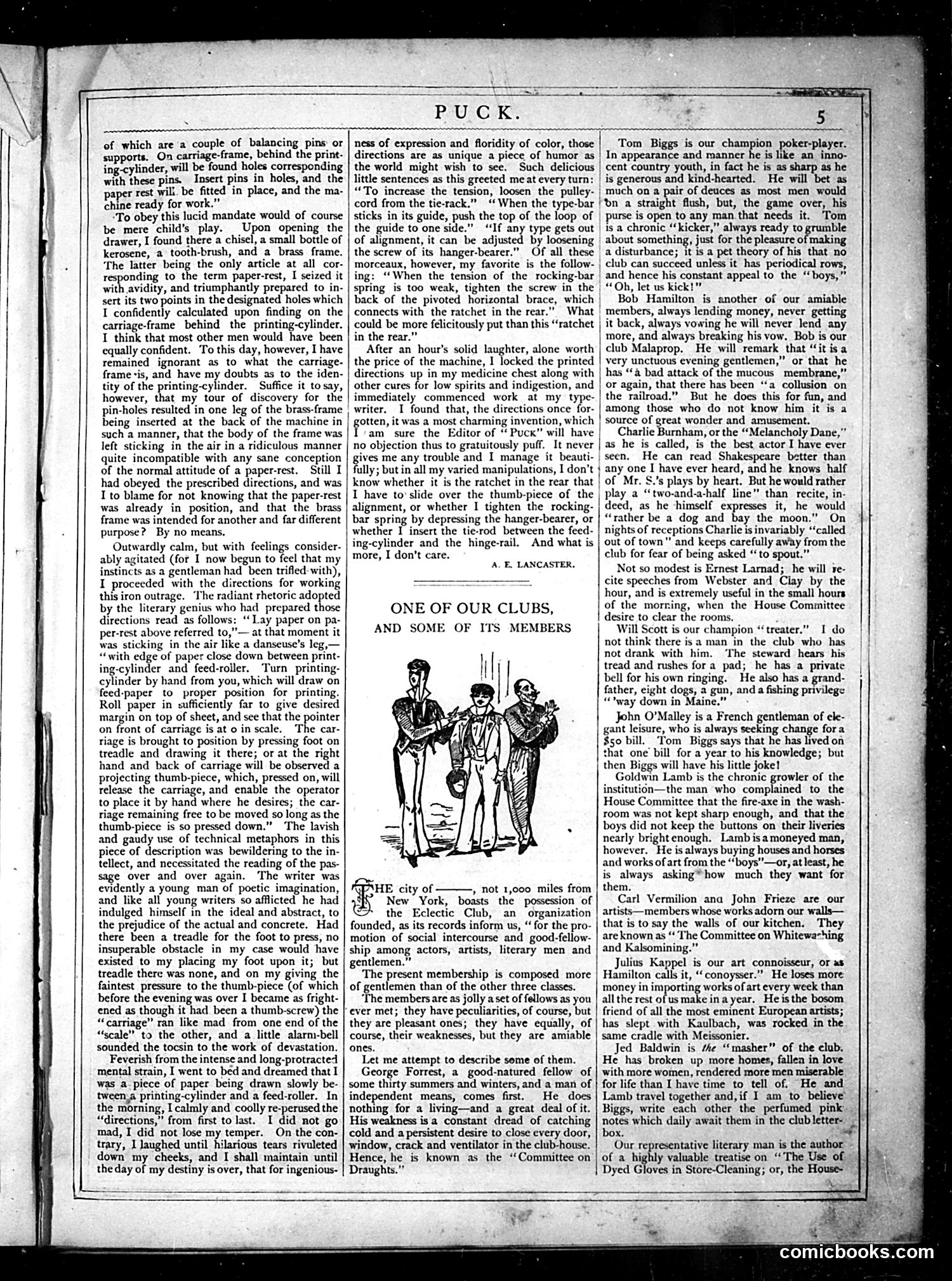
This page contains two distinct sections: a technical article about a printing-press invention (left column) and a social commentary piece titled "One of Our Clubs, and Some of Its Members" (right). The right section presents satirical character sketches of club members, illustrated with a group portrait. The text profiles individuals like Tom Biggs (a poker player), Bob Hamilton (a money-lender), and others, characterizing them through humorous anecdotes that highlight their social quirks and professional peculiarities. The satire targets upper-class social clubs, mocking their members' affectations, business practices, and personal eccentricities. Rather than attacking specific political figures, it offers gentle ridicule of elite leisure culture and the distinctive personalities populating these exclusive institutions.
📄 Transcribed text from this page (OCR, searchable)
Machine-transcribed from the original scan — historical spelling and the odd misread are preserved.
PUCK. 5 of which are a couple of balancing pins: or supports. On carriage-frame, behind the print- ing-cylinder, will be found holes corresponding with these pins. Insert pins in holes, and the paper rest will. be fitted in place, and the ma- chine ready for work.” ‘To obey this lucid mandate would of course be mere child’s play. Upon opening the drawer, I found there a chisel, a small bottle of kerosene, a tooth-brush, and a brass frame. ‘The latter being: the only article at all cor- responding to the term paper-rest, I seized it with avidity, and triumphantly prepared to in- sert its two points in the designated holes which I confidently calculated upon finding on the carriage-frame behind the printing-cylinder. I think that most other men would have been equally confident. To this day, however, I have remained ignorant as to what the carriage- frame vis, and have my doubts as to the iden- tity of the printing-cylinder. Suffice it to say, however, that my tour of discovery for the pin-holes resulted in one leg of the brass-frame | being inserted at the back of the machin such a manner, that the body of the frame was left sticking in the air in a ridiculous manner quite incompatible with any sane conception of the normal attitude of a paper-rest. Still I had obeyed the prescribed directions, and was I to blame for not knowing that the paper-rest was already in position, and that the brass frame was intended for another and far different purpose? By no means, Outwardly calm, but with feelings consider- ably agitated (for I now begun to feel that my instincts as a gentleman had been trifled- with), I proceeded with the directions for working this iron outrage. The radiant rhetoric adopted by the literary genius who had prepared those directions read as follows: “Lay paper on pa- per-rest above referred to,"— at that moment it was sticking in the air like a danseuse’s leg,— “with edge of paper close down between print- ing-cylinder and feed-roller. ‘Turn_printing- cylinder by hand from you, which will draw on feed-paper to proper position for printing. Roll paper in sufficiently far to give desired margin on top of sheet, and see that the pointer on front of carriage is at o in scale. The car- riage is brought to position by pressing foot on treadle and drawing it there; or at the right hand and back of carriage will be observed a projecting thumb-piece, which, pressed on, will release the carriage, and enable the operator to place it by hand where he desires; the car- riage remaining free to be moved so long as the thumb-piece is so pressed down.” The lavish and gaudy use of technical metaphors in this piece of description was bewildering to the in- tellect, and necessitated the reading of the pas- sage over and over again. The writer was evidently a young man of poetic imagination, and like all young writers so afflicted he had indulged himself in the ideal and abstract, to the prejudice of the actual and concrete. Had there been a treadle for the foot to press, no insuperable obstacle in my case would have existed to my placing my foot upon it; but treadle there was none, and on my giving the faintest pressure to the thumb-piece (of which before the evening was over I became as fright- ened as though it had been a thumb-screw) the “carriage” ran like mad from one end of the “scale” to the other, and a little alarm-bell sounded the tocsin to the work of devastation. Feverish from the intense and long-protracted mental strain, I went to bed and dreamed that 1 was apiece of paper being drawn slowly be- tween, printing-cylinder and a feed-roller. In the morning, I calmly and coolly re-perused the “directions,” from first to last. I did not go mad, I did not lose my temper. On the con- trary, I laughed until hilarious tears rivuleted down my cheeks, and I shall maintain until the day of my destiny is over, that for ingenious- ness of expression and floridity of color, those directions are as unique a piece of humor as the world might wish to see. Such delicious little sentences as this greeted me at every turn: “To increase the tension, loosen the pulley- cord from the tie-rack.” “When the type-bar sticks in its guide, push the top of the loop of the guide to one side.” “If any type gets out of alignment, it can be adjusted by loosening the screw of its hanger-bearer.” Of all these morceaux, however, my favorite is the follow- ing: “When the tension of the rocking-bar spring is too weak, tighten the screw in the back of the pivoted horizontal brace, which connects with the ratchet in the rear.” What could be more felicitously put than this “ratchet in the rear.” After an hour’s solid laughter, alone worth the price of the machine, I locked the printed directions up in my medicine chest along with other cures for low spirits and indigestion, and immediately commenced work at my type- writer. I found that, the directions once for- otten, it was a most charming invention, which am sure the Editor of ‘ Puck” will have no objection thus to gratuitously puff. It never gives me any trouble and I manage it beauti- fully; but in all my varied manipulations, I don’t know whether it is the ratchet in the rear that I have to’ slide over the thumb-piece of the alignment, or whether I tighten the rocking- bar spring by depressing the hanger-bearer, or whether I insert the tie-rod between the feed- ing-cylinder and the hinge-rail. And what is more, I don’t care. A. E. LANCASTER. ONE OF OUR CLUBS, AND SOME OF ITS MEMBERS HE city of , Not 1,000 miles from New York, boasts the possession of the Eclectic Club, an organization founded, as its records inform us, “‘ for the pro- motion of social intercourse and good-fellow- ship among actors, artists, literary men and gentlemen.” The present membership is composed more of gentlemen than of the other three classes. ‘The members are as jolly aset of fellows as you ever met; they have peculiarities, of course, but they are pleasant ones; they have equally, of course, their weaknesses, but they are amiable ones. Let me attempt to describe some of them. George Forrest, a good-natured fellow of some thirty summers and winters, and a man of independent means, comes first. He does nothing for a living—and a great deal of it. His weakness is a constant dread of catching cold and a persistent desire to close every door, window, crack and ventilator in the club-house. Hence, he is known as the ‘‘Committee on Draughts.”” Tom Biggs is our chAropIOR poker-player. | In appearance and manner he is like an inno- | cent country youth, in fact he is as sharp as he is generous and kind-hearted. He will bet as much on a pair of deuces as most men would fn a straight flush, but, the game over, his purse is open to any man.that needs it. Tom is a chronic ‘‘kicker,” always ready to grumble about something, just for the pleasure of making a disturbance; it is a pet theory of his that no club can succeed unless it has periodical rows, and hence his constant appeal to the “boys,” “Oh, let us kick!” | Bob Hamilton is another of our amiable members, always lending money, never getting it back, always vowing he will never lend any more, and always breaking his vow. Bob is our club Malaprop. He will remark that “it isa very unctuous evening gentlemen,” or that he has ‘a bad attack of the mucous membrane,” or again, that there has been “a collusion on the railroad.” But he does this for fun, and among those who do not know him it is a source of great wonder and amusement. Charlie Burnham, or the “Melancholy Dane,” as he is called, is the best actor I have ever seen. He can read Shakespeare better than + any one I have ever heard, and he knows half | of Mr. S.'s plays by heart. But he would rather play a “two-and-a-half line” than recite, in- deed, as he ‘himself expresses it, he would “rather be a dog and bay the moon.” On nights of receptions Charlie is invariably “‘called out of town” and keeps carefully away from the club for fear of being asked “to spout.” Not so modest is Ernest Larnad; he will re- cite speeches from Webster and Clay by the hour, and is extremely useful in the small hours of the morning, when the House Committee desire to clear the rooms. Will Scott is our champion “treater.” I do not think there isa man in the club who has not drank with him. The steward hears his tread and rushes fora pad; he has a private bell for his own ringing. He also has a grand- father, eight dogs, a gun, and a fishing privilege “way down in Maine.” John O’Malley is a French gentleman of ele- gant leisure, who is always seeking change fora $50 bill. Tom Biggs says that he has lived on that one’ bill for a year to his knowledge; but then Biggs will have his little joke! Goldwin Lamb is the chronic growler of the institution—the man who complained to the House Committee that the fire-axe in the wash- room was not kept sharp enough, and that the boys did not keep the buttons on their liveries nearly bright enough. Lamb isamoneyed man, however. He is always buying houses and horses and works of art from the ‘“‘boys""—or, at least, he is always asking*how much they want for them. Carl Vermilion ana John Frieze are our artists—members whose works adorn our that is to say the walls of our kitchen, They are known as “‘ The Committee on Whitewaching and Kalsomining.” Julius Kappel is our art connoisseur, or as Hamilton calls it, ‘‘ conoysser.” He loses more money in importing works of art every week than allthe rest of us make ina year. He isthe bosom friend of all the most eminent European artists; has slept with Kaulbach, was rocked in the same cradle with Meissonier. Jed Baldwin is “te “masher” of the club. He has broken up more homes, fallen in love with more women, rendered more men miserable for life than I have time to tell of. He and Lamb travel together and, if I am to believe’ notes which daily await them in the clubletter- x. ofa hil Dyed Gloves in Store-Cleaning; or, the House- Biggs, write each other the perfumed pink — Our representative literary man is the author - fly valuable treatise on ‘‘The Use of comicbooks -com