
Puck, 1877-03 · page 11 of 16
Puck — March 1877 — page 11: what you’re looking at
What you’re looking at
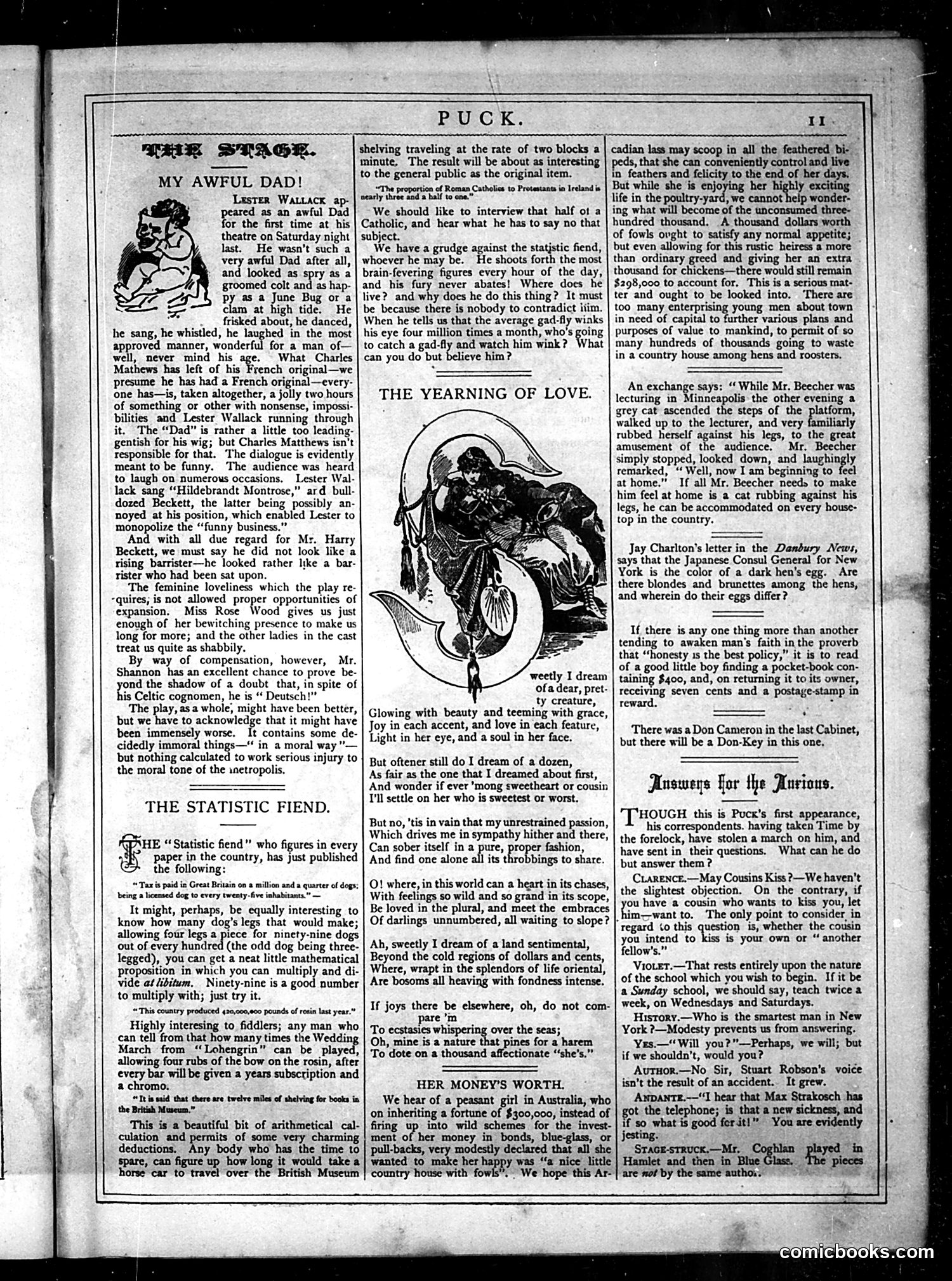
This page contains three distinct satirical pieces: 1. **"My Awful Dad!"** - A theater review mocking a play featuring actor Lester Wallack. The critic ridicules the sentimental "Dad" character as overly leading and the dialogue as deliberately meant to provoke laughter. References to Harry Beckett (a barrister) suggest social commentary on class pretension. 2. **"The Yearning of Love"** - An illustrated poem about romantic longing, featuring a woman dreaming of an idealized man. The sentiment is earnest rather than satirical. 3. **"The Statistic Fiend"** - Satirizes obsessive number-crunching, mocking someone who calculates absurd statistics (like dogs' leg-days). This critiques Victorian-era enthusiasm for "scientific" data collection applied to trivial matters. The page exemplifies Puck's mix of theatrical criticism and social satire targeting contemporary intellectual pretensions.
📄 Transcribed text from this page (OCR, searchable)
Machine-transcribed from the original scan — historical spelling and the odd misread are preserved.
PUCK. TE SRAGK. MY AWFUL DAD! >) Lester WALLACK ap- peared as an awful Dad for the first time at his theatre on Saturday night last. He wasn’t such a ery, awful Dad after all, and looked as spry as a groomed colt and as hap- py as a June Bug or a clam at high tide. He frisked about, he danced, he sang, he whistled, he laughed in the most spproved manner, wonderful for a man of— well, never mind his age. What Charles Mathews has left of his French original—we presume he has had a French original—every- one has—is, taken altogether, a jolly two hours of something or other with nonsense, impossi- bilities and Lester Wallack running through it, The “Dad” is rather a little too leading- gentish for his wig; but Charles Matthews isn’t responsible for that. The dialogue is evidently meant to be funny. The audience was heard to laugh on numerous occasions. Lester Wal- lack sang ‘Hildebrandt Montrose,” ard bull- dozed Beckett, the latter being possibly an- noyed at his position, which enabled Lester to monopolize the “funny business.” ‘And with all due regard for Mr. Harry Beckett, we must say he did not look like a rising barrister—he looked rather like a bar- rister who had been sat upon. The feminine loveliness which the play re- -quires; is not allowed proper opportunities of expansion, Miss Rose Wood gives us just enough of her bewitching presence to make us long for more; and the other ladies in the cast treat us quite as shabbily. By way of compensation, however, Mr. Shannon has an excellent chance to prove be- ond the shadow of a doubt that, in spite of jis Celtic cognomen, he is ‘ Deutsch!” The play, asa whole; might have been better, but we have to acknowledge that it might have been immensely worse. It contains some de- cidedly immoral things—“ in a moral way ”"— but nothing calculated to work serious injury to the moral tone of the inetropolis. THE STATISTIC FIEND. paper in the country, has just published the following: Taxis paid in Great Britain on @ million and a quarter of dogs; being a licensed dog to every twenty-five inhabitants.” — It might, perhaps, be equally interesting to know how many dog’s legs that would make; allowing four legs a piece for ninety-nine dogs out of every hundred (the odd dog being three- legged), you can get a neat little mathematical proposition in which you can multiply and di- vide at /ibitum, Ninety-nine is a good number to multiply with; just try it. “This country produced 420,000,000 pounds of resin last year.” Highly interesing to fiddlers; any man who can tell from that how many times the Weddi: March from ‘‘Lohengrin” can be played, allowing four rubs of the bow on the rosin, after every bar will be given a years subscription and a chromo. Trin said that there are twelve miles of shelving for books in the British Museum.” This is a beautiful bit of arithmetical cal- culation and its of some very charming papaya ete poey ea hs eet to Spare, can up how it a horse’ car to travel over the British Museum Ma “Statistic fiend” who figures in every Il. shelving traveling at the rate of two blocks a | cadian lass may scoop in all the feathered bie minute, The result will be about as interesting to the general public as the original item. endear pt herrea to Protestants in Ireland is We should like to interview that half of a Catholic, and hear what he has to say no that subject. We have a grudge against the statistic fiend, whoever he may be. He shoots forth the most brain-fevering figures every hour of the day, and his fury never abates! Where does he live? and why does he do this thing? It must be because there is nobody to contradict iiim. When he tells us that the average gad-fly winks his eye four million times a month, who's going to catch a gad-fly and watch him wink? What can you do but believe him? THE YEARNING OF LOVE. weetly I dream ofa dear, pret- ty creature, Glowing with beauty and teeming with grace, Joy in each accent, and love in each feature, Light in her eye, and a soul in her face. But oftener still do I dream of a dozen, As fair as the one that I dreamed about first, And wonder if ever ’mong sweetheart or cousin I'll settle on her who is sweetest or worst. But no, ’tis in vain that my unrestrained passion, Which drives me in sympathy hither and there, Can sober itself in a pure, proper fashion, And find one alone all its throbbings to share. O! where, in this world can a heart in its chases, With feelings so wild and so grand in its scope, Be loved in the plural, and meet the embraces Of darlings unnumbered, all waiting to slope? Ah, sweetly I dream of a land sentimental, Beyond the cold regions of dollars and cents, Where, wrapt in the splendors of life oriental, Are bosoms all heaving with fondness intense. If joys there be elsewhere, oh, do not com- are ’m To ecstasies whispering over the seas; Oh, mine is a nature pines for a harem To dote on a thousand affectionate “she's.” HER MONEY’S WORTH. We hear of a peasant girl in Australia, who on inheriting a fortune of $300,000, instead of firing up into wild schemes for the invest- ment of her money in bonds, blue-glass, or -backs, modestly declared that all she aren to care her hap yy was “a nice little country house'with fowls”. We hope’ this Ar- , that she can conveniently control and live in feathers and felicity to the end of her day But while she is enjo rhly life in the poultry-yard, we cannot help wonder- ing what will become of the unc: three- hundred thousand. A thousand dollars worth of fowls onght to satisfy any normal appetite; bes evens allowing for a Tustic ae a more than ordinary greed and giving her an extra thousand for chickens—there would still remain $298,000 to account for. This is a serious mat- ter and ought to be looked into. ‘here are too many enterprising young men about town in need of capital to further various plans and purposes of value to mankind, to permit of so many hundreds of thousands going to waste in a country house among hens and roosters. An exchange says: “While Mr, Beecher was lecturing in Minneapolis the other evening a grey cat ascended the steps of the aneeD walked up to the lecturer, and very familiarly rubbed herself against his legs, to the great amusement of the audience. Mr. Beecher simply stopped, looked down, and laughingly remarked, “Well, now I am beginning to feel at home.” If all Mr. Beecher needs to make him feel at home is a cat rubbing against his legs, he can be accommodated on every house- top in the country. Jay Charlton’s letter in the D. News, says that the Japanese Consul General for New York is the color of a dark hen's egg. Are there blondes and brunettes among the hens, and wherein do their eggs differ? If there is any one thing more than another tending to awaken man’s faith inthe proverb that “honesty 1s the best policy,” it is to read of a good little boy finding a pocket-book con- taining $400, and, on returning it to its owner, receiving seven cents and a postaye-stamp in reward. ? There was a Don Cameron in the last Cabinet, but there will be 2 Don-Key in this one, Answers Yor the Aueious. "THoucu this is Pucx’s first appearance, his correspondents. having taken Time by the forelock, have stolen a march on him, and have sent in their questions. What can he do but answer them ? CLARENCE.—May Cousins Kiss ?—We haven't the slightest objection. On the contrary, if ou have a cousin who wants to kiss you, let | him—want to, The only point to consider in regard (o this question is, whether the cousin you intend to is your own or “ another fellow’s.”” VioLeT.—That rests entirely upon the nature of the school which you wish to begin. If it be a Sunday school, we should say, teach twice a week, on Wednesdays and Saturdays. History.—Who is the smartest man in New York ?—Modesty prevents us from answering. Yzs.—“ Will you?”—Perhaps, we will; but if we shouldn’t, would you? AurHor.—No Sir, Stuart Robson's voice isn’t the result of an accident... It grew. Awpantg.—‘‘I hear that Max Strakosch has got the telephone; is that a new sickness, and if so what is good ferit!” ‘You are evidently Jesting ee te ee ‘are not by the same authoi.