
Puck, 1877-03 · page 4 of 16
Puck — March 1877 — page 4: what you’re looking at
What you’re looking at
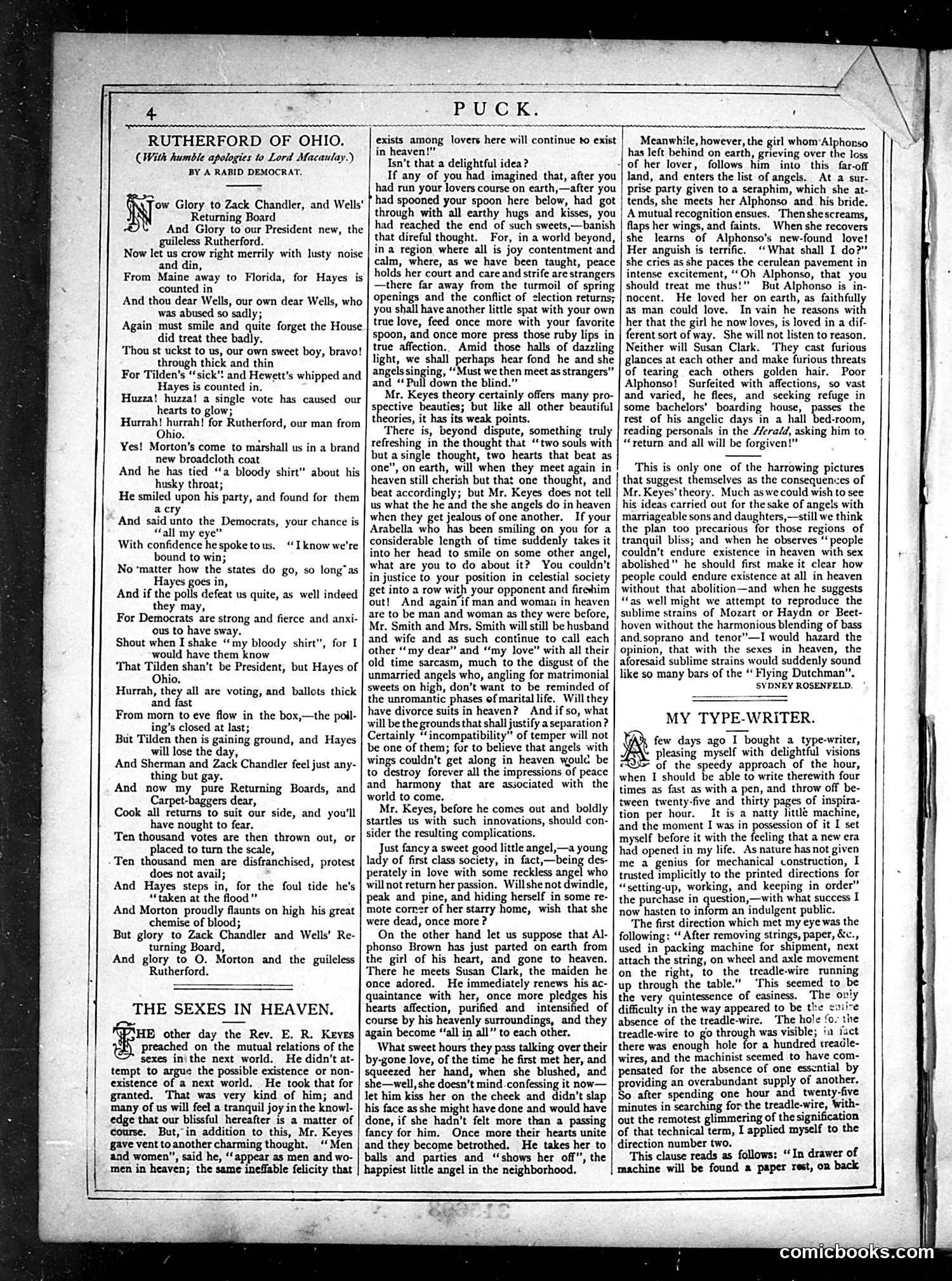
This Puck page satirizes **Rutherford B. Hayes**, Ohio's presidential candidate, through mock-celebratory verses. The satire celebrates Hayes's expected election while ironically naming Democrats he defeated—Tilden, Sherman, and Zack Chandler—in a tongue-in-cheek "glory" poem. The verses mock Democratic losses and Hayes's narrow path to victory. References to "the polls" and ballot-counting suggest the contested 1876 election. The satire attacks Hayes and Republicans while pretending to praise them, typical of Puck's partisan humor. The second article, "The Sexes in Heaven," shifts to social commentary, satirizing Mr. Keyes's theological argument about whether married couples remain "husband and wife" in the afterlife—mocking both religious debate and gender relations of the era.
📄 Transcribed text from this page (OCR, searchable)
Machine-transcribed from the original scan — historical spelling and the odd misread are preserved.
4 RUTHERFORD OF OHIO. (With humble apologies to Lord Macaulay.) BY A RABID DEMOCRAT. ow Glory to Zack Chandler, and Wells’ Returning Board And Glory to our President new, the guileless Rutherford. Now let us crow right merrily with lusty noise and din, From Maine away to Florida, for Hayes is counted in And thou dear Wells, our own dear Wells, who was abused so sadly; Again must smile and quite forget the House did treat thee badly. Thou st uckst to us, our own sweet boy, bravo! through thick and thin For Tilden’s ‘sick’? and Hewett's whipped and Hayes is counted in. Huzza! huzza! a single vote has caused our hearts to glow; Hurrah! hurrah! for Rutherford, our man from Ohio. . Yes! Morton’s come to marshall us in a brand new broadcloth coat And he has tied ‘‘a bloody shirt” about his husky throat; He smiled upon his party, and found for them acry And said unto the Democrats, your chance is “all my eye” With confidence he spoke to us. bound to win; No ‘matter how the states do go, so long”as Hayes goes in, And if the polls defeat us quite, as well indeed they may, For Democrats are strong and fierce and anxi- ‘ous to have sway. Shout when I shake “my bloody shirt”, for I would have them know That Tilden shan’t be President, but Hayes of “Tknow we're Ohio. Hurrah, they all are voting, and ballots thick and fast From morn to eve flow in the box,—the poll- ing’s closed at last; But Tilden then is gaining ground, and Hayes will lose the day, And Sherman and Zack Chandler feel just any- thing but gay. And now my pure Returning Boards, and rpet- ers dear, Cook all returns to suit our side, and you'll have nought to fear. Ten thousand votes are then thrown out, or placed to turn the scale, Ten thousand men are disfranchised, protest does not avail; And Hayes steps in, for the foul tide he’s “taken at the flood” And Morton proudly flaunts on high his great chemise of blood; But glory to Zack Chandler and Wells’ Re- turning Board, And glory to O. Morton and the guileless Rutherford. THE SEXES IN HEAVEN. HE other day the Rev. E. R. Keyes preached on the mutual relations of the sexes injthe next world. He didn’t at- tempt to argue the possible existence or non- existence of a next world. He took that for granted. That was very kind of him; and many of us will feel a tranquil joy in the knowl- edge that our blissful hereafter is a matter of course. But, in addition to this, Mr. Keyes gave vent to another charming thought. “Men and women”, said he, ‘‘appear as men and wo- men in heaven; the same ineffable felicity that CK. exists among lovers here will continue to exist in heaven!” Isn't that a delightful idea? If any of you had imagined that, after you had run your lovers course on earth,—after you had spooned your spoon here below, had got through with all earthy hugs and kisses, you had reached the end of such sweets,—banish that direful thought. For, in a world beyond, in a region where all is joy contentment and calm, where, as we have been taught, peace holds her court and care and strife are strangers —there far away from the turmoil of spring openings and the conflict of election returns; you shall have another little spat with your own true love, feed once more with your favorite spoon, and once more press those ruby lips in true affection. Amid those halls of dazzling light, we shall perhaps hear fond he and she angels singing, “Must we then meet as strangers” and “Pull down the blind.” Mr. Keyes theory certainly offers many pro- spective beauties; but like all other beautiful theories, it has its weak points. There is, beyond dispute, something truly refreshing in the thought that “two souls with but a single thought, two hearts that beat as one”, on earth, will when they meet again in heaven still cherish but that one thought, and beat accordingly; but Mr. Keyes does not tell us what the he and the she angels do in heaven when they get jealous of one another. If your Arabella who has been smiling on you for a considerable length of time suddenly takes it into her head to smile on some other angel, what are you to do about it? You couldn't in justice to your position in celestial society get into a row with your opponent and fireshim out! And again‘if man and woman in heaven are to be man and woman as they were before, Mr. Smith and Mrs. Smith will still be husband and wife and as such continue to call each other “my dear” and “my love” with all their old time sarcasm, much to the disgust of the unmarried angels who, angling for matrimonial sweets on high, don’t want to be reminded of the unromantic phases of marital life. Willthey have divorce suits in heaven? And if so, what will be the grounds that shall justify a separation? Certainly incompatibility” of temper will not be one of them; for to believe that angels with wings couldn't get along in heaven woulc be to destroy forever all the impressions of peace and harmony that are associated with the world to come. Mr. Keyes, before he comes out and boldly startles us with such innovations, should con- sider the resulting complications. Just fancy a sweet good little angel,—a young lady of first class society, in fact,—being des- perately in love with some reckless angel who willnot return her passion. Willshe not dwindle, peak and pine, and hiding herself in some re- mote corner of her starry home, wish that she were dead, once more? On the other hand let us suppose that Al- phonso Brown has just parted on earth from the girl of his heart, and gone to heaven. There he meets Susan Clark, the maiden he once adored. He immediately renews his ac- quaintance with her, once more pledges his hearts affection, purified and_ intensified of course by his heavenly surroundings, and they again become “all in all’’ to each other. What sweet hours they pass talking over their by-gone love, of the time he first met her, and squeezed her hand, when she blushed, and she—well, she doesn’t mind. confessing it now— let him kiss her on the cheek and didn’t slap his face as she might have done and would have done, if she hadn’t felt more than a passing fancy for him. Once more their hearts unite and they become betrothed. He takes her to balls and parties and ‘shows her off”, the happiest little angel in the neighborhood. -| of her lover, Meanwhile, however, the girl whom:Alphonso has left behind on earth, grieving over the loss follows him into this far-off land, and enters the list of angels. At a sur- | prise party given to a seraphim, which she at- | tends, she meets her Alphonso and his bride. A mutual recognition ensues. Then shescreams, flaps her wings, and faints, When she recovers she learns of Alphonso’s new-found love! Her anguish is terrific. ‘What shall I do?” she cries as she paces the cerulean pavement in intense excitement, ‘Oh Alphonso, that you should treat me thus!" But Alphonso is in- nocent. He loved her on earth, as faithfully as man could love. In vain he reasons with her that the girl he now loves, is loved in a dif- ferent sort of way. She will not listen to reason. Neither will Susan Clark. They cast furious glances at each other and make furious threats of tearing each others golden hair. Poor Alphonso! Surfeited with affections, so vast and varied, he flees, and secking refuge in some bachelors’ boarding house, passes the rest. of his angelic days in a hall bed-room, reading personals in the Herald, asking him to “return and all will be forgiven!” . ‘This is only one of the harrowing pictures that suggest themselves as the consequences of Mr. Keyes’ theory. Much as we could wish to see his ideas carried out for the sake of angels with marriageable sons and daughters,—still we think the plan too precarious for those regions of tranquil bliss; and when he observes “people couldn’t endure existence in heaven with sex abolished” he should first make it clear how people could endure existence at all in heaven without that abolition—and when he suggests “as well might we attempt to reproduce the sublime strains of Mozart or Haydn or Beet- hoven without the harmonious blending of bass and.soprano and tenor’—I would hazard the opinion, that with the sexes in heaven, the aforesaid sublime strains would suddenly sound like so many bars of the “ Flying Dutchman”. sv -Y ROSENFELD. MY TYPE-WRITER. few days ago I bought a type-writer, pleasing myself with delightful visions of the speedy approach of the hour, when I should be able to write therewith four times as fast as with a pen, and throw off be- tween twenty-five and thirty pages of inspira- tion per hour. It is a natty little machine, and the moment I was in possession of it I set myself before it with the feeling that a new era had opened in my life. As nature hasnot given me a genius for mechanical construction, I trusted implicitly to the printed directions for “setting-up, working, and keeping in order” the purchase in question,—with what success I now hasten to inform an indulgent public. ‘The first direction which met my eye was the following: “After removing strings, paper, &c., used in packing machine for shipment, next attach the string, on wheel and axle movement on the right, to the treadle-wire running up through the table.” ‘This seemed to be the very quintessence of easiness. The only difficulty in the way appeared to be the eiiive absence of the treadle-wire. The hole fo. the treadle-wire to go through was visible; iu fact there was enough hole for a hundred treadle- wires, and the machinist seemed to have com- pensated for the absence of one essential by roviding an overabundant supply of another. BO after spending one hour and twenty-five minutes in searching for the treadle-wire, ‘Wwith- out the remotest glimmering of the signification of that technical term, I applied myself to the direction number two. This clause reads as follows: ‘In drawer of machine will be found a paper rest, on back