
Puck, 1877-03 · page 12 of 16
Puck — March 1877 — page 12: what you’re looking at
What you’re looking at
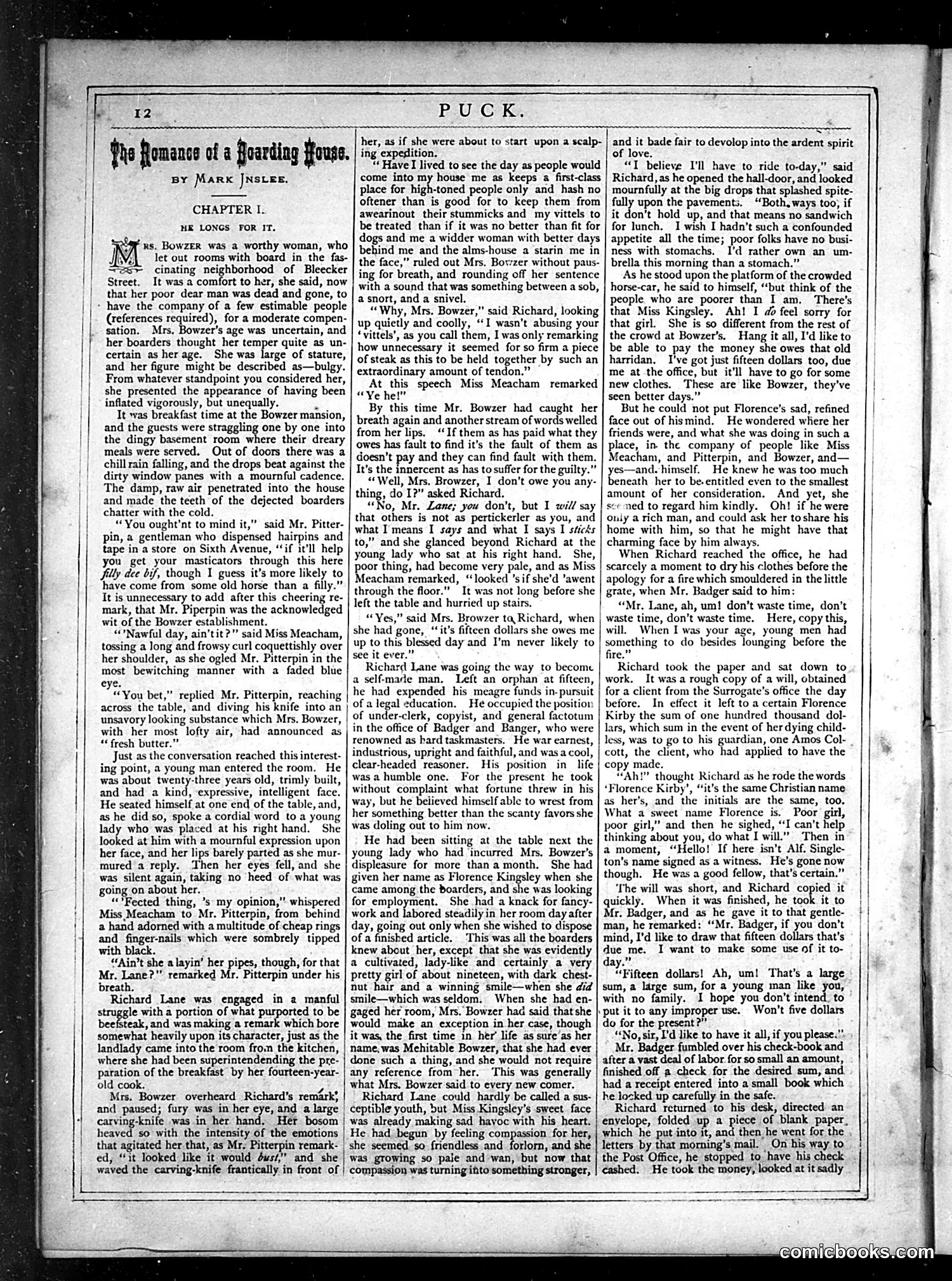
This page contains the beginning of "The Romance of a Boarding House" by Mark Inslee, a serialized fiction story rather than a political cartoon. Chapter I, titled "He Longs for It," introduces Richard Lane, a poor but educated orphan working as a copyist and clerk at a law office. The narrative focuses on his romantic and financial struggles within a boarding house setting, particularly his attraction to Florence Kingsley, a fellow lodger. The page includes social commentary typical of late 19th-century American fiction—contrasting wealth disparity, class consciousness, and the dignity of genteel poverty. There are no political cartoons or satirical illustrations visible on this page; it is primarily literary content with period-appropriate social observations woven into the narrative.
📄 Transcribed text from this page (OCR, searchable)
Machine-transcribed from the original scan — historical spelling and the odd misread are preserved.
pe 12 ' PUCK. Pte Romance of a Hoarding House. By Marx JNSLEE. CHAPTER I. ME LONGS FOR IT. See xs, BowzeR was a worthy woman, who (MV; let out rooms with board in the fas- <zs~ cinating neighborhood of Bleecker Street. It was a comfort to her, she said, now that her poor dear man was dead and gone, to - have the company of a few estimable people (references required), for a moderate compen- sation. Mrs. Bowzer’s age was uncertain, and her boarders thought her temper quite as un- certain as her age. She was large of stature, and her figure might be described as—bulgy. From whatever standpoint you considered her, she presented the appearance of having been inflated vigorously, but unequally. a It was breakfast time at the Bowzer mansion, and the guests were straggling one by one into the dingy basement room where their dreary meals were served. Out of doors there was a chill rain falling, and the drops beat against the dirty window panes with a mournful cadence. The damp, raw air penetrated into the house and made the teeth of the dejected boarders chatter with the cold. “You ought’nt to mind it,” said Mr, Pitter- pin, a gentleman who dispensed hairpins and tape in a store on Sixth Avenue, ‘if it'll help you get your masticators through this here fly dee bif, though I guess it’s more likely to have come from some old horse than a filly.” It is unnecessary to add after this cheering re- mark, that Mr. Piperpin was the acknowledged wit of the Bowzer establishment. “’Nawful day, ain’tit?” said Miss Meacham, tossing a long and frowsy curl coquettishly over her shoulder, as she ogled Mr. Pitterpin in the most bewitching manner with a faded blue eye. “You bet,” replied Mr. Pitterpin, reaching across the table, and diving his knife into an unsavory looking substance which Mrs. Bowzer, with her most lofty air, had announced as “fresh butter.” Just as the conversation reached this interest- ing point, a young man entered the room. He was about twenty-three years old, trimly built, and had a kind, expressive, intelligent face. He seated himself at one end of the table, and, as he did so, spoke a cordial word to a young lady who was placed at his right hand. She looked at him with a mournful expression upon her face, and her lips barely parted as she mur- mured a reply. Then her eyes fell, and she was silent again, taking no heed of what was going on about her. “Fected thing, ’s my opinion,” whispered Miss Meacham to Mr. Pitterpin, from behind a hand adorned with a multitude of cheap rings and finger-nails which were sombrely tipped with black. “Ain't she a layin’ her pipes, though, for that Mr. Lane?” remarked Mr. Pitterpin under his breath. Richard Lane was engaged in a manful struggle with a portion of what purported to be beefsteak, and was making a remark which bore somewhat heavily upon its character, just as the landlady came into the room from the kitchen, where she had been superintendending the pre- paration of the breakfast by her fourteen-year- old cook. ¥; Mrs. Bowzer overheard Richard’s remark, carving-knife was in her hand, Her bosom heaved so with the intensity of the emotions that agitated her that, as Mr, Pitterpin remark- ed, ‘it looked like it would dus/”” and she waved the carving-knife frantically in front of and paused; fury was in her eye, and a large | her, as if she were about to start upon a scalp- ing expedition. “Havel lived to see the day as people would come into my house me as keeps a first-class place for high-toned people only and hash no oftener than is good for to keep them from awearinout their stummicks and my vittels to be treated than if it was no better than fit for dogs and me a widder woman with better days behind me and the alms-house a starin me in the face,” ruled out Mrs. Bowzer without paus- ing for breath, and rounding off her sentence with a sound that was something between a sob, a snort, and a snivel, “Why, Mrs. Bowzer,” said Richard, looking up quietly and coolly, I wasn’t abusing your ‘vittels’, as you call them, I was only remarking how unnecessary it seemed for so firm a piece of steak as this to be held together by such an extraordinary amount of tendon.” At this speech Miss Meacham remarked “Ye hel” By this time Mr. Bowzer had caught her breath again and another stream of words welled from her lips. “If them as has paid what they owes has fault to find it’s the fault of them as doesn’t pay and they can find fault with them. It’s the innercent as has to suffer for the guilty.” “Well, Mrs. Browzer, I don’t owe you any- thing, do 1?” asked Richard. “No, Mr. Lane; you don’t, but I wil/ say that others is not as pertickerler as you, and what I'means I says and what I says I sticks to,” and she glanced beyond Richard at the young lady who sat at his right hand. She, oor thing, had become very pale, and as Miss. feacham remarked, ‘looked 'sif she’d ’awent through the floor.” It was not long before she left the table and hurried up stairs. “Yes,” said Mrs. Browzer ta Richard, when | she had gone, “it’s fifteen dollars she owes me up to this blessed day and I’m never likely to see it ever.” Richard Lane was going the way to become a self-made man. Left an orphan at fifteen, he had expended his meagre funds in-pursuit of a legal education. He occupied the position of under-clerk, copyist, and general factotum in the office of Badger and Banger, who were renowned as bard taskmasters. He war earnest, industrious, upright and faithful, and was cool, clear-headed reasoner. His position in life was a humble one. For the present he took without complaint what fortune threw in his way, but he believed himself able to wrest from her something better than the scanty favors she was doling out to him now. He had been sitting at the table next the young lady who had incurred Mrs. Bowzer’s displeasure for more thana month. She had given her name as Florence Kingsley when she came among the boarders, and she was looking for employment. She had a knack for fancy- work and labored steadily in her room day after day, going out only when she wished to dispose of a finished article. ‘This was all the boarders knew about her, except that she was evidently a cultivated, lady-like and certainly a very pretty girl of about nineteen, with dark chest- nut hair and a winning smile—when she did smile—which was seldom, When she had en- gaged her room, Mrs. Bowzer had said that she would make an exception in her case, though it was, the first time in her’ life as sure’as her name, was Mehitable Bowzer, that she had ever done such a thing, and she would not require any reference from her. ‘This was generally what Mrs. Bowzer said to every new comer. Richard Lane could hardly be called a sus- ceptible youth, but Miss Kingsley’s sweet face was already making sad havoc with his heart. He had. begun by feeling compassion for her, she seemed so friendless and forlorn, and she was growing so pale and wan, but now that compassion was turning ifto something stronger, and it bade fair to devolop into the ardent spirit of love. “TI believe I'll have to ride to-day,” said Richard, as he opened the hall-door, and looked mournfully at the big drops that splashed spite- fally upon the pavements. “Both, ways too} if it don’t hold up, and that means no sandwich for lunch. I wish I hadn’t such a confounded appetite all the time; poor folks have no busi- ness with stomachs. I'd rather own an um- brella this morning than a stomach.” As he stood upon the platform of the crowded horse-car, he said to himself, “but think of the people who are poorer than I am. There’s that Miss Kingsley. Ah! I do feel sorry for that girl. She is so different from the rest of the crowd at Bowzer’s, Hang it all, I'd like to be able to pay the money she owes that old harridan. I've got just fifteen dollars too, due me at the office, but it'll have to go for some new clothes. These are like Bowzer, they've seen better days.” But he could not put Florence's sad, refined face out of hismind. He wondered where her friends were, and what she was doing in such a place, in. the company of people like Miss Meacham, and Pitterpin, and Bowzer, and— es—and. himself. He knew he was too much neath her to be-entitled even to the smallest amount of her consideration. And yet, she sce ned to regard him kindly. Oh! if he were only a rich man, and could ask her to share his home with him, so that he might have that charming face by him always. When Richard reached the office, he had scarcely a moment to dry his clothes before the apology for a fire which smouldered in the little grate, when Mr. Badger said to him: “Mr, Lane, ah, um! don’t waste time, don’t waste time, don’t waste time. Here, copy this, will. When I was your age, young men had something to do besides lounging before the fire.” Richard took the paper and sat down to work. It was a rough copy of a will, obtained for a client from the Surrogate’s office the day before. In effect it left to a certain Florence Kirby the sum of one hundred thousand dol- lars, which sum in the event of her dying child- less, was to go to his guardian, one Amos Col- cott, the client, who had applied to have the copy made. “Ah!” thought ‘Florence Kirby’, 4 ard as he rode the words the same Christian name as her’s, and the jials are the same, too, What a’ sweet name Florence is. girl, poor girl,” and then he sighed, “I can't help thinking about you, do what I will.” Then in a moment, ‘Hello! If here isn’t Alf. Single- ton’s name signed as a witness. He’s gone now though. He was a good fellow, that’s certain.” ‘The will was short, and Richard copied it quickly. When it was finished, he took it to Mr. Badger, and as he gave it to that gentle- man, he remarked: “Mr. Badger, if you don’t mind, I'd like to draw that fifteen dollars that's due me. I want to make some use of it to- day.” {Fifteen dollars! Ah, um! That’s a large sum, a large sum, for a young man like you, with no family. I hope you don’t inten |. put it to any improper use. Won't five dollars do for the present?” “No, sir, I'd like to have it all, if you please.” Mr. Badger fumbled over his check-book and after a vast deal of labor for so small an amount, finished off a check for the desired sum, and had a receipt entered into a small book which he locked up carefully in the safe. Richard returned to his desk, directed an envelope, folded up a piece of blank paper_ which he put into it, and then he went for the letters by that morning’s mail. On his way to the Post Office, he stopped to have his check ¢ashed. ‘He took the money, looked at it sadly