
Puck, 1877-03 · page 10 of 16
Puck — March 1877 — page 10: what you’re looking at
What you’re looking at
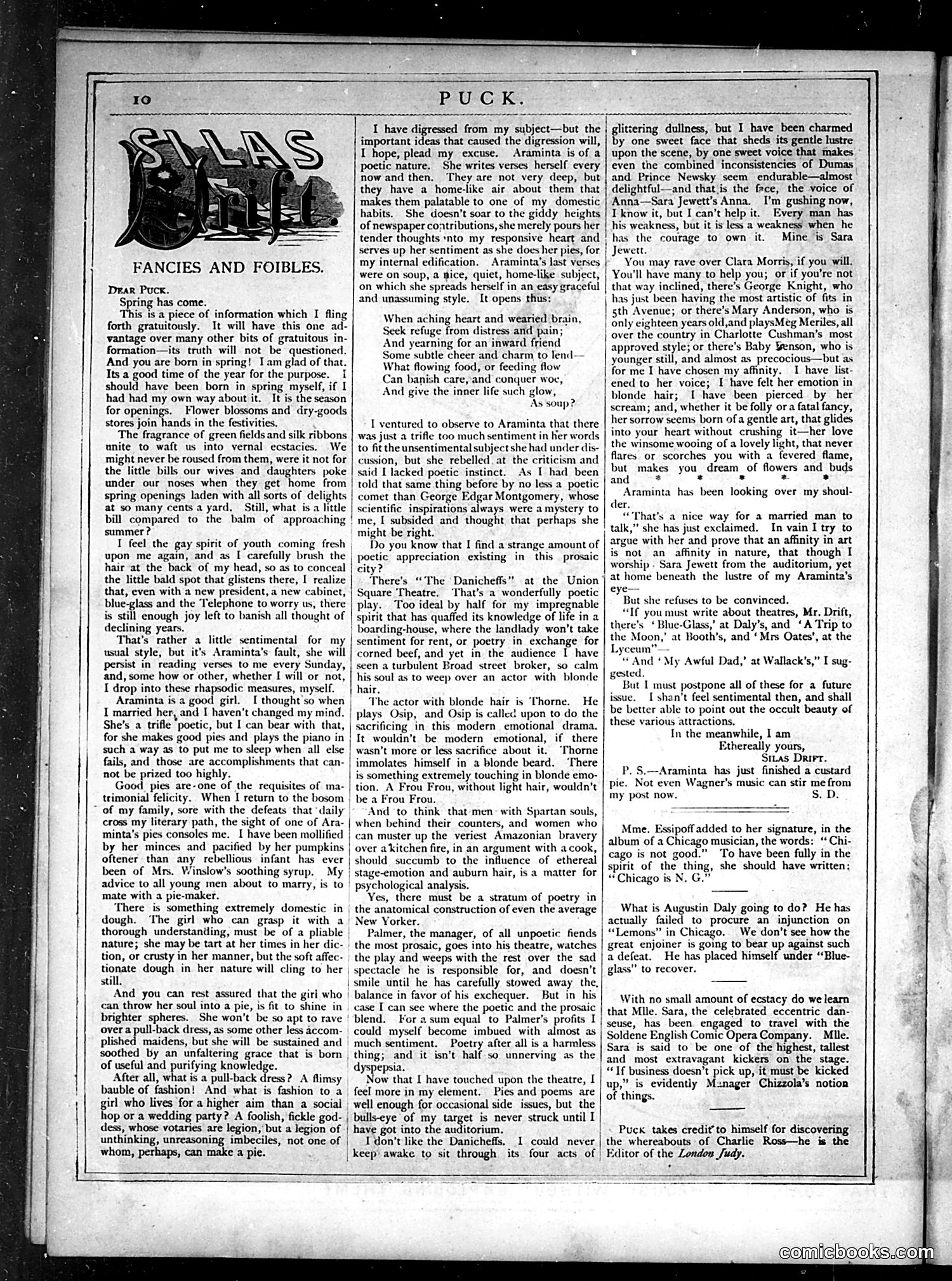
This page is primarily a **written column** rather than a political cartoon. The piece, signed by Silas Dutt, discusses various theatrical and cultural observations. The column references **specific performers and theatrical productions**: mentions "The Danicheff" at the University Square Theatre, discusses an actor with blonde hair named Thorne, and comments on various stage productions and performers like Wagner. The satire appears **social rather than political**—Dutt critiques theatrical sentimentality, excessive emotionalism in acting, and the pretensions of both performers and audiences. He mocks performers who overact or rely on superficial tricks (blonde hair, artificial emotion) rather than genuine artistry. The piece also discusses **Araminta**, apparently a female character or performer, examining how she handles sentimental material. This represents Puck's cultural commentary rather than hard political satire.
📄 Transcribed text from this page (OCR, searchable)
Machine-transcribed from the original scan — historical spelling and the odd misread are preserved.
PUCK. FANCIES AND FOIBLES. Dear Puck. Spring has come. This is a piece of information which I fling forth gratuitously. It will have this one ad- vantage over many other bits of gratuitous in- formation—its truth will not be questioned. And you are born in spring! Iam glad of that. Its a good time of the year for the purpose. should have been born in spring myself, if I had had my own way about it. It is the season for openings. Flower blossoms and dry-goods stores join hands in the festivities. The fragrance of green fields and silk ribbons unite to waft us into vernal ecstacies. We might never be roused from them, were it not for the little bills our wives and daughters poke under our noses when they get home from spring openings laden with all sorts of delights at so many cents a yard. Still, what isa little bill compared to the balm of approaching summer? I feel the gay spirit of youth coming fresh upon me again, and as I carefully brush the hair at the back of my head, so as to conceal the little bald spot that glistens there, I realize that, even with a new president, a new cabinet, blue-glass and the Telephone to worry us, there is still enough joy left to banish all thought of declining years. That’s rather a little sentimental for my usual style, but it’s Araminta’s: fault, she will persist in reading verses to me every Sunday, and, some how or other, whether I will or not, I drop into these rhapsodic measures, myself. Araminta is 2 good girl. [ thought'so when I married her, and I haven't changed my mind. | She’s a trifle ‘poetic, but I can bear with that, for she makes good pies and plays the piano in | such a way as to put me to sleep when all else | fails, and those are accomplishments that can- not be prized too highly. Good pies are-one of the requisites of ma- trimonial felicity. When I return to the bosom ~ of my family, sore with the defeats that “daily cross my literary path, the sight of one of Ara- minta’s pies consoles me. I have been mollified by her minces and pacified by her pumpkins oftener than any rebellious infant has ever been of Mrs. Winslow's soothing syrup. mate with a pie-maker. ‘There is something extremely domestic in dough. ‘he girl who can grasp it with a thorough understanding, must be of a pliable nature; she may be tart at her times in her dic- tion, or crusty in her manner, but the soft affec- tionate dough in her nature will cling to her still. And you can rest assured that the girl who can throw her soul into a pie, is fit to shine in brighter spheres. She won't be so apt to rave over: 3 pull: heck dress, as some other less accom- plished maidens, but she will be sustained and soothed by an unfaltering grace that is born of useful and purifying knowledge. After all, what is a pull-back dress? A flimsy bauble of fashion! And what is fashion to a girl who lives for a higher aim than a social hop or a wedding party? A foolish, fickle god- dess, whose votaries are legion, but a legion of unthinking, unreasoning imbeciles, not one of whom, perhaps, can make a pie. My | advice to all young men about to marry, is to | I have digressed from my subject—but the important ideas that caused the digression will, I hope, plead my excuse. Araminta is of a poetic nature. She writes verses herself every now and then. They are not very deep, but they have a home-like air about them that makes them palatable to one of my domestic habits. She doesn’t soar to the giddy heights of newspaper contributions, she merely pours her tender thoughts ‘nto my responsive heart and serves up her sentiment as she does her pi my internal edification. Araminta’s last verses were on soup, a ice, quiet, home-like subject, on which she spreads herself in an easy graceful and unassuming style. It opens thus: When aching heart and wearied brain, Seek refuge from distress and pain; And yearning for an inward friend Some subtle cheer and charm to lend— i ceding flow As soup? I ventured to observe to Araminta that there was just a trifle too much sentiment in Her words. to fit the unsentimental subject she had under dis- cussion, but she rebelled. at the criticism and said I lacked poetic instinct. As I had been | told that same thing before by no less a poetic comet than George Edgar Montgomery, whose scientific inspirations always were a mystery to me, I subsided and thought that perhaps she might be right. Do you know that I find a strange amount of poetic appreciation existing in this prosaic city? There's ‘The Danicheffs” at the Union Square Theatre. ‘That's a wonderfully poetic play. Too ideal by half for my impregnable spirit that has quaffed its knowledge of life in a boarding-house, where the landlady won’t take sentiment for rent, or poetry in exchange for corned beef, and yet in the audience I have a turbulent Broad street broker, so calm his soul as to weep over an actor with blonde hair. ‘The actor with blonde hair is Thorne. He plays Osip, and Osip is called upon to do the sacrificing in this modern emotional drama. It wouldn't be modern emotional, if there wasn’t more or less sacrifice about it. ‘Thorne immolates himself in a blonde beard. ‘There is something extremely touching in blonde emo- tion. A Frou Frou, without light hair, wouldn't be a Frou Frou. And ‘to think that men: with Spartan souls, when behind their counters, and women who can muster up the veriest Amazonian bravery over akitchen fire, in an argument with acook, should succumb to the influence of ethereal stage-emotion and auburn hair, is a matter for psychological analysis. Yes, there must be a stratum of poetry in the anatomical construction of even the average New Yorker. Palmer, the manager, of all unpoetic fiends the most prosaic, goes into his theatre, watches the play and weeps with the rest over the sad spectacle he is responsible for, and doesn’t | smile until he has carefully stowed away the, | balance in favor of his exchequer. But in his case I can see where the poetic and the prosaic blend. For 2 sum equal to Palmer's profits I could myself become imbued with almost as much sentiment. Poetry after all is a harmless thing; and it isn’t half so unnerving as the dyspepsia. Now that I have touched upon the theatre, I feel more in my element. Pies and poems are well enough for occasional side issues, but the | bullseye of my target is never struck until I | have got into the auditorium. | Idon’t like the Danicheffs. I could never | keep» awake to sit through its four acts of | for | littering dullness, but I have been charmed by one sweet face that sheds its gentle lustre upon the scene, by one sweet voice that makes even the combined inconsistencies of Dumas and. Prince Newsky seem endurable—almost delightful—and that.is the face, the voice of Anna—Sara Jewett’s Anna. I’m gushing now, I know it, but I can’t help it. Every man his weakness, but it is less a weakness when he has the courage to own it. Mine is Sara Jewett. You may rave over Clara Morris, if you will. You'll have many to help you; or if you're not that way inclined, there’s George Knight, who has just been having the most artistic of fits in sth Avenue; or there’s Mary Anderson, who is only eighteen years old,and playsMég Meriles, all over the country in Charlotte Cushman’s most approved style; or there’s Baby Benson, who is younger still, and almost as_precocious—but as for me I have chosen my affinity. I have list- ened to her voice; 1 have felt her emotion in blonde hair; [ have been pierced by her scream; and, whether it be folly ora fatal fancy, her sorrow seems born ofa gentle art, that glides into your heart without crushing it—her love the winsome wooing of a lovely light, that never flares or scorches you with a fevered flame, but makes you dream of flowers and buds ‘and. > * . * . Araminta has been looking over my shoul- der. “That’s a nice way for a married man to talk,” she has just exclaimed. In vain I try to argue with her and prove that an affinity in art is not an affinity in nature, that though I worship. Sara Jewett from the auditorium, yet at home beneath the lustre of my Araminta’s eye- Dut she refuses to be convinced. “If you must write about theatres, Mr. Drift, there’s ‘ Blue-Glass,’ at Daly’s, and ‘A Trip to the Moon,’ at Booth’s, and ‘ Mrs Oates’, at the Lyceum” “And ‘My Awful Dad,’ at Wallack’s,” I sug- gested. But | must postpone all of these for a future issue. I shan’t feel sentimental then, and shall be better able to point out the occult beauty of these various attractions, In the meanwhile, I am Ethereally yours, Sttas Drier. PB: Araminta has just finished a custard pie. Not even Wagner's music can stir me from my post now. S Mme. Essipoff added to her signature, in the album of a Chicago musician, the wor * Chi- cago is not good.” ‘To have been fully in the spirit of the thing, she should have written: “ Chicago is N. G.” What is Augustin Daly going to do? He has | actually failed to procure an injunction on “Lemons” in Chic: We don’t see how the great enjoiner is going to bear up against such a defeat. He has placed himself under ‘“Blue- glass” to recover. With no small amount of ecstacy do we learn that Mlle. Sara, the celebrated eccentric dan- seuse, has been engaged to travel with the Soldene English Comic Opera Company. Mlle. Sara is said to be one of the highest, tallest and most extravagant kickers on the stage. “If business doesn’t pick up, it must be kicked up,” is evidently Menager Chizzola’s notion of things. Puck takes credit’to himself for discovering the whereabouts of Charlic Ross—he is the Editor of the London Judy. COMicdooks.coun