
A complete issue · 44 pages · 1929
Life — May 3, 1929
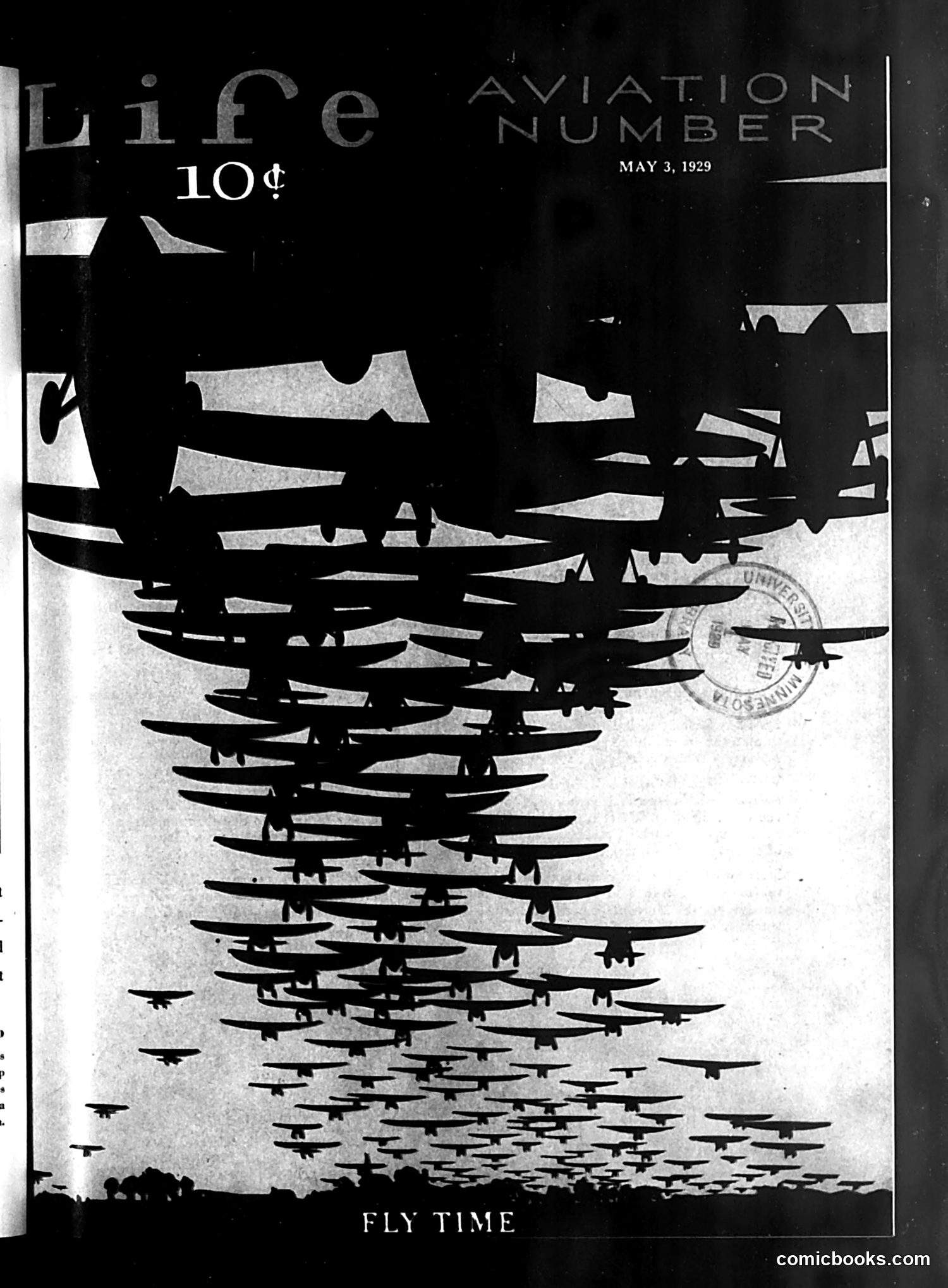
This is Life's special "Aviation Number" cover, priced at 10 cents. The silhouetted illustration titled "FLY TIME" depicts dozens of aircraft stacked vertically in a crowded formation descending toward a landscape. The image satirizes the explosive growth of commercial aviation in the late 1920s. Rather than celebrating aviation as progress, the packed arrangement of planes suggests chaos, overcrowding, and potential danger—a visual joke about the aviation boom becoming dangerously saturated. The descending mass implies either a collision or crash scenario. This reflects genuine contemporary concerns: 1929 saw rapid, largely unregulated aviation expansion before the industry's infrastructure could safely handle increased traffic. The cartoon mocks this reckless growth period preceding the stock market crash that October.
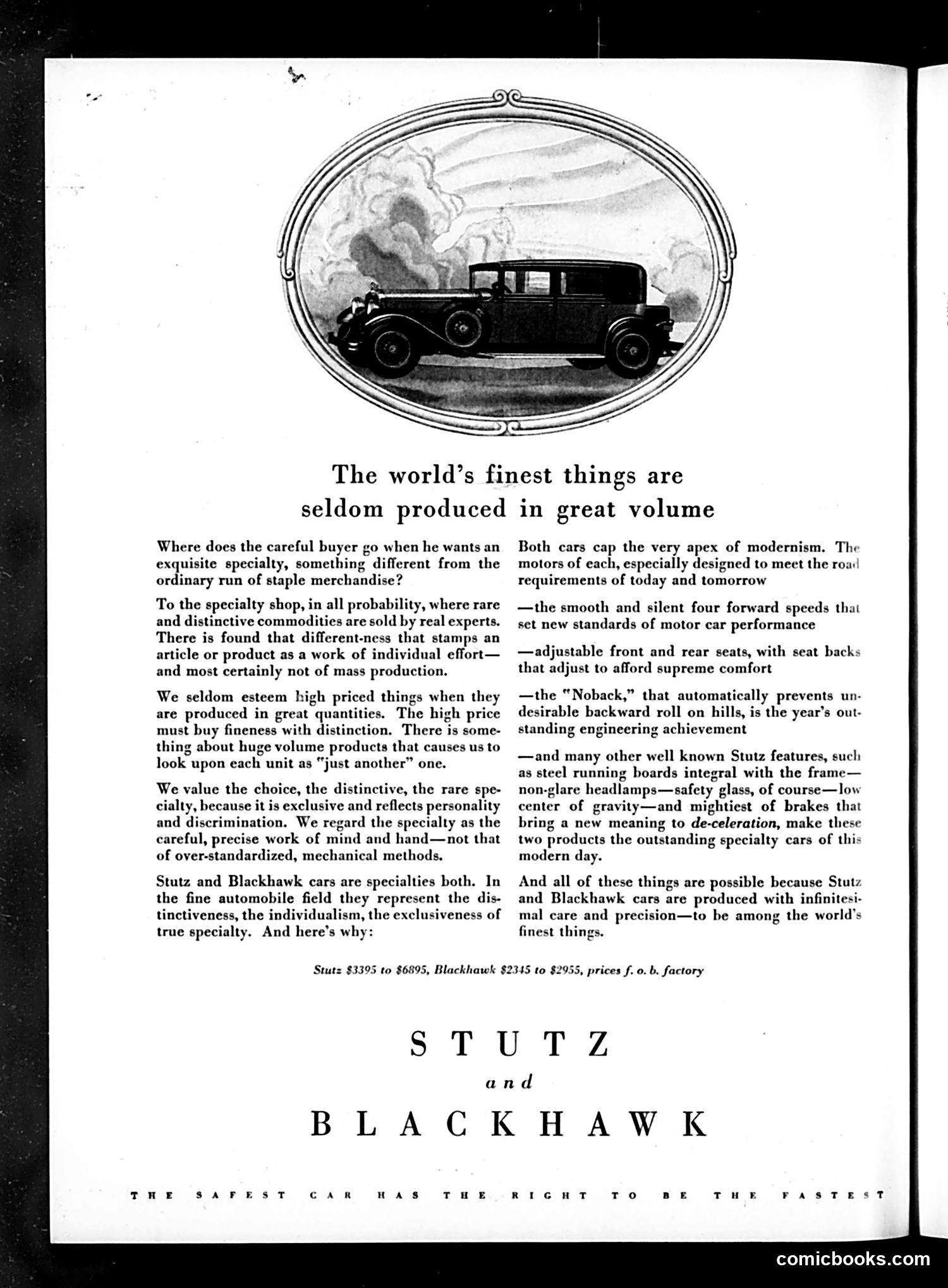
This is **not a cartoon or satire page** — it's a **full-page advertisement** for Stutz and Blackhawk automobiles. The ad uses a rhetorical strategy common to luxury marketing: positioning these cars as rare, exclusive "specialty" products rather than mass-produced vehicles. The opening line — "The world's finest things are seldom produced in great volume" — establishes an elitist pitch targeting wealthy buyers who value distinctiveness. The illustration shows a sleek 1920s sedan. The text emphasizes engineering features (four forward speeds, adjustable seats, safety glass) as markers of modern excellence and careful craftsmanship. The final tagline — "THE SAFEST CAR HAS THE RIGHT TO BE THE FASTEST" — appeals to status-conscious consumers by linking safety with performance and prestige. This reflects 1920s marketing ideology: automobiles as status symbols for discriminating elites.
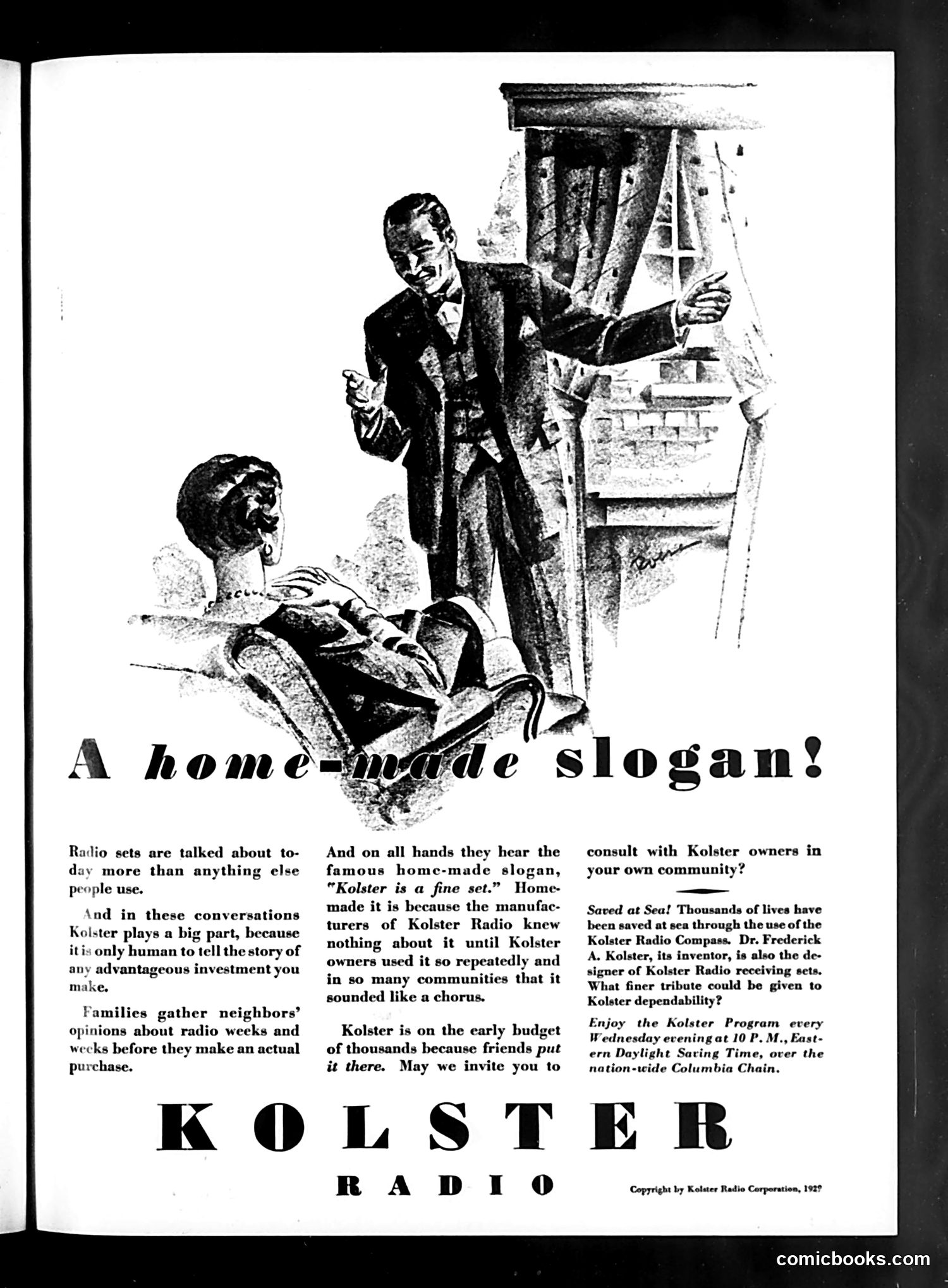
This is primarily a **Kolster Radio advertisement**, not political satire. The page promotes Kolster brand radios through a domestic scene showing a well-dressed man demonstrating a radio set to a woman. The "home-made slogan" reference indicates that word-of-mouth marketing was crucial—families discussed radios before purchasing. The advertisement emphasizes that Kolster radios were popular enough to become conversational topics in communities nationwide. The text mentions Dr. Frederick A. Kolster as the inventor and designer. The ad highlights that "thousands of lives have been saved at sea" through Kolster radio technology, appealing to both practical utility and social responsibility. The program airs Wednesday evenings on Columbia's radio chain. This is essentially 1920s consumer marketing leveraging radio's novelty and perceived prestige.
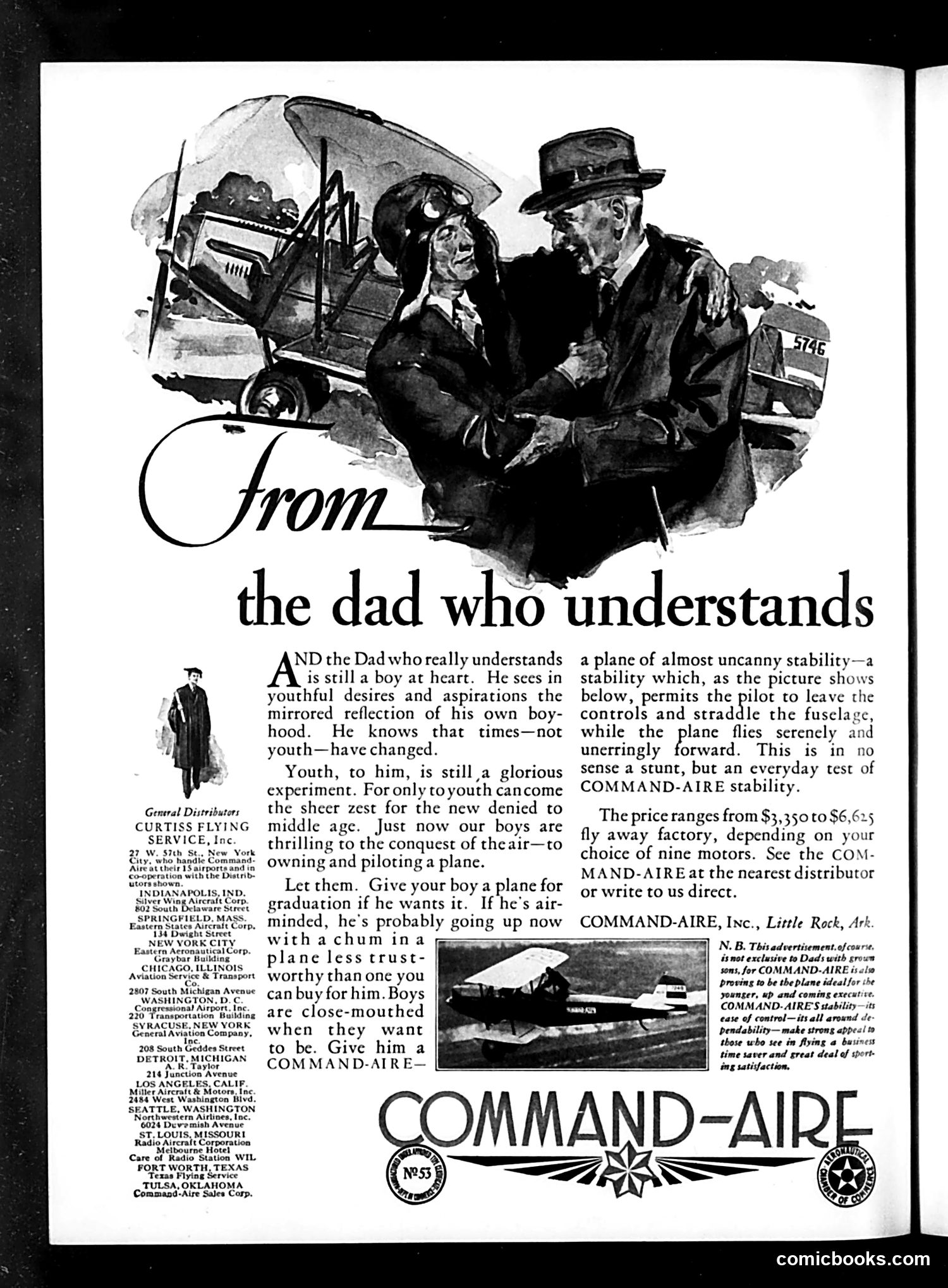
This is primarily a **Command-Aire aircraft advertisement**, not political satire. The page uses a sentimental marketing appeal rather than humor or social commentary. The ad's central message addresses fathers, positioning a small airplane as an ideal graduation gift for air-minded boys. The illustration shows two men and a woman examining an aircraft, suggesting the plane represents fulfilling youthful aviation dreams. The text emphasizes the plane's "stability" and safety features, addressing parental concerns about purchasing aircraft. The ad lists nine available motors and price ranges ($3,350-$6,655), along with distributor locations across America. Rather than satirizing current events, this represents **1920s-era commercial advertising** appealing to middle-class aspirations regarding aviation technology and youth opportunity.
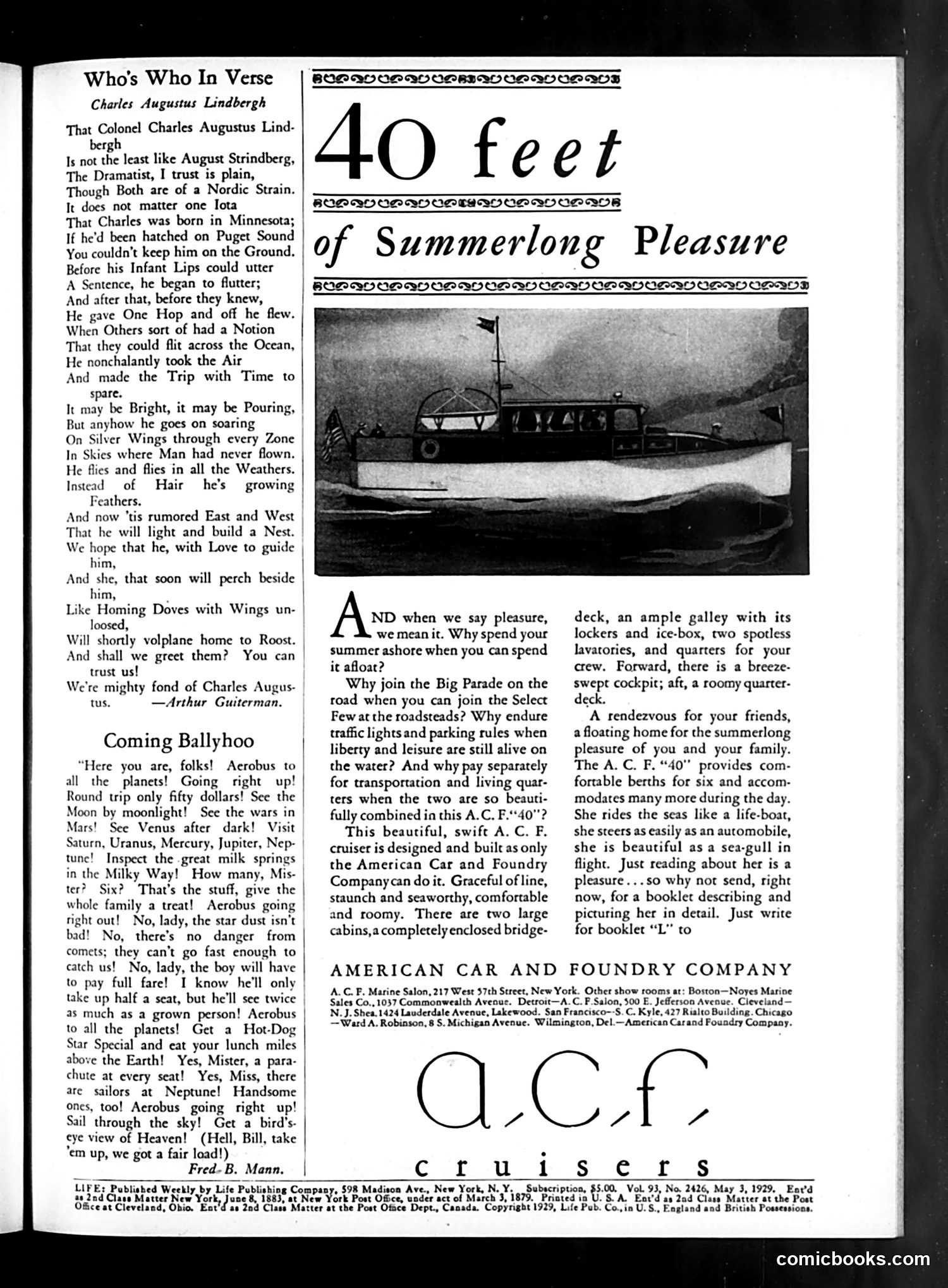
This page is primarily **advertising**, not political satire. The main content promotes the American Car and Foundry Company's "A.C.F. '40'" — a luxury houseboat/cruise vessel designed for summer leisure travel. The top section contains a humorous poem by Arthur Guiterman about Charles Augustus Lindbergh, celebrating his aviation achievements with playful exaggeration (he "gave One Hop and off he flew," will "build a Nest"). This is straightforward celebrity praise of Lindbergh's fame circa 1929. The sidebar "Coming Ballyhoo" is whimsical science fiction comedy about space travel, not satire. The A.C.F. advertisement dominates, targeting wealthy readers with promises of waterborne luxury — comfortable berths, galley service, and escape from traffic and crowds. The photograph shows the vessel itself. No political commentary or satire is evident on this page.
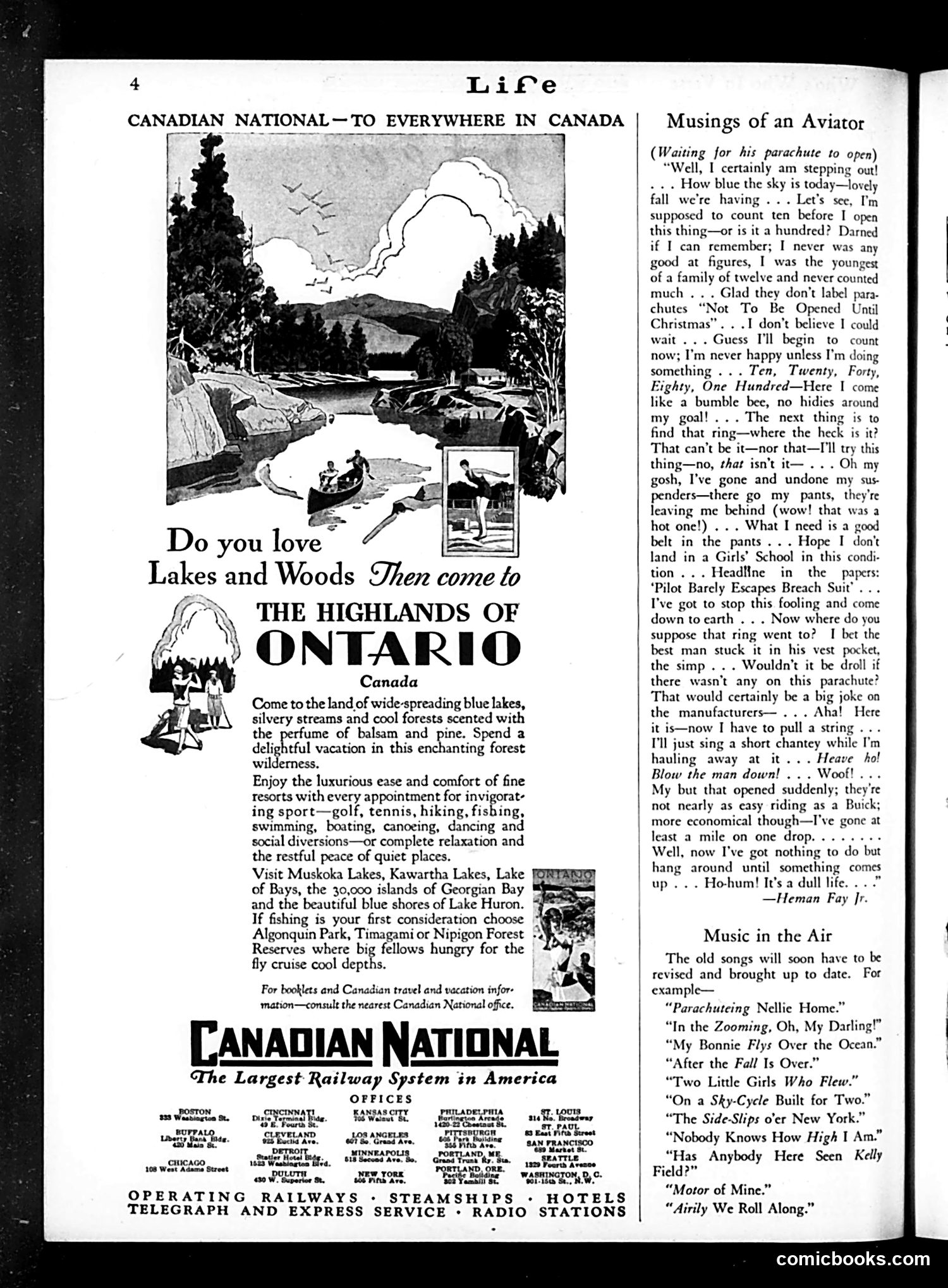
This page contains **advertising and literary content rather than political satire**. The left side features a Canadian National Railway advertisement promoting "The Highlands of Ontario" as a vacation destination for outdoor enthusiasts. The illustration shows a scenic landscape with lakes and forests. The right side presents two separate pieces: "Musings of an Aviator" (a humorous monologue from someone preparing to skydive, dwelling anxiously on lost equipment) and "Music in the Air" (a brief note suggesting popular songs need updating, listing titles like "Parachuting Nellie Home"). There is **no political cartoon or satirical commentary** on this page. It's primarily commercial promotion mixed with light entertainment humor typical of 1920s-era Life magazine.
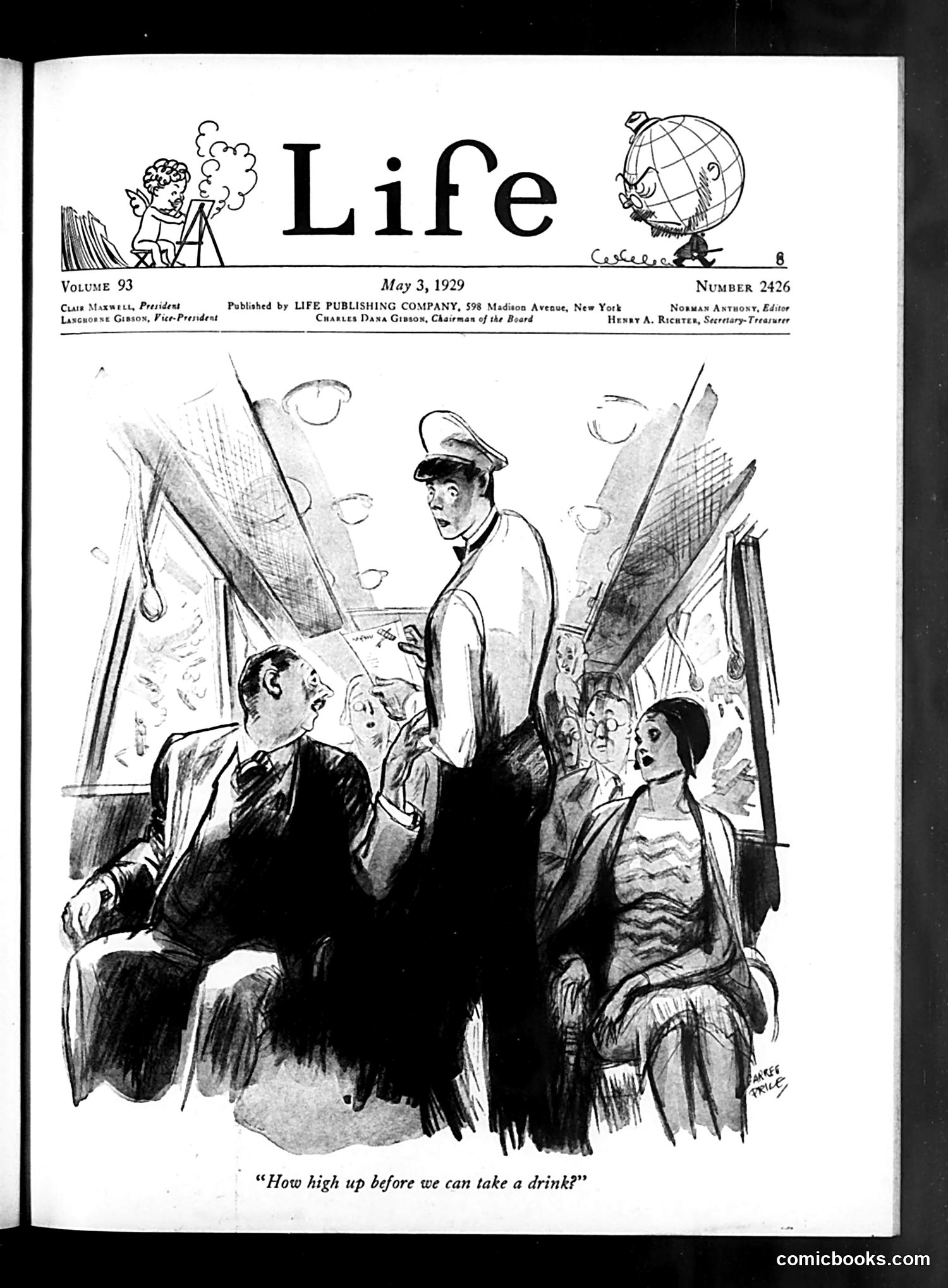
This is the cover of *Life* magazine from May 3, 1929—just months before the stock market crash. The cartoon depicts well-dressed passengers on what appears to be a ship, with sailors adjusting sails above them. A man in a captain's hat stands centrally while passengers below ask, "How high up before we can take a drink?" The satire references **Prohibition** (1920-1933), when alcohol was illegal in the United States. The "how high up" joke likely plays on the idea that maritime law or international waters might permit drinking where U.S. law didn't—a common loophole people exploited. The cartoon mocks the absurdity of Prohibition enforcement and public desperation to circumvent it, while capturing the era's sophisticated leisure culture and the gap between law and widespread public desire.
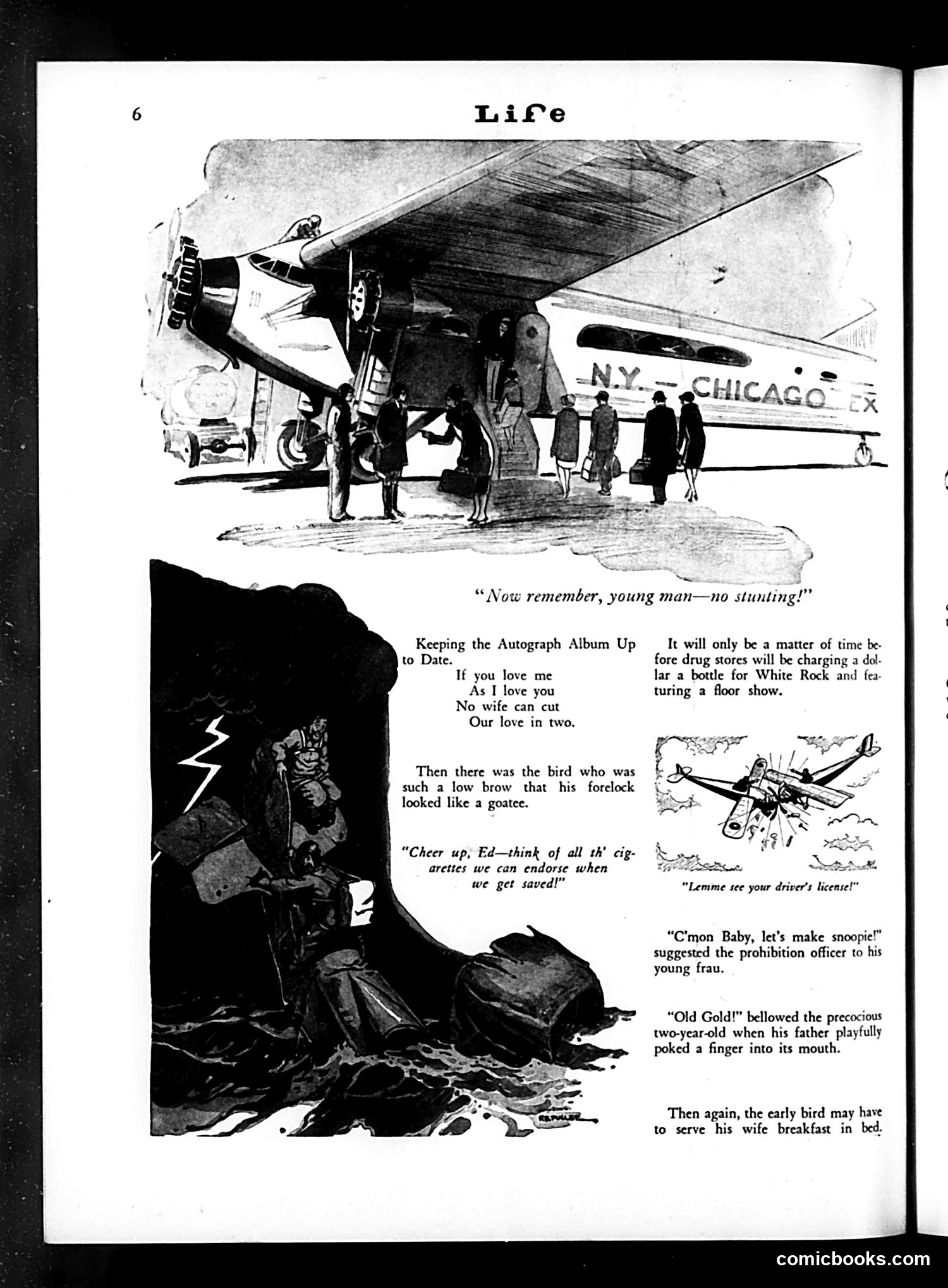
This page contains several humorous vignettes satirizing 1920s social behavior and attitudes: **Top illustration**: Shows passengers boarding a "NY-CHICAGO" commercial airplane, with the caption "Now remember, young man—no stunting!" This jokes about early aviation's dangers and reckless pilots performing dangerous aerial tricks. **Middle section**: Contains brief comedic observations about romance and marriage ("If you love me / As I love you / No wife can cut / Our love in two"), alongside an airplane illustration captioned "Lemme see your driver's license!"—joking that pilots, like drivers, should be licensed. **Bottom illustration**: A dark, somewhat crude scene in a car with text about prohibition officers and "snoopie" (suggesting illicit activity during Prohibition). The overall tone mocks contemporary concerns: aviation safety, automobile culture, marriage fidelity, and Prohibition enforcement.
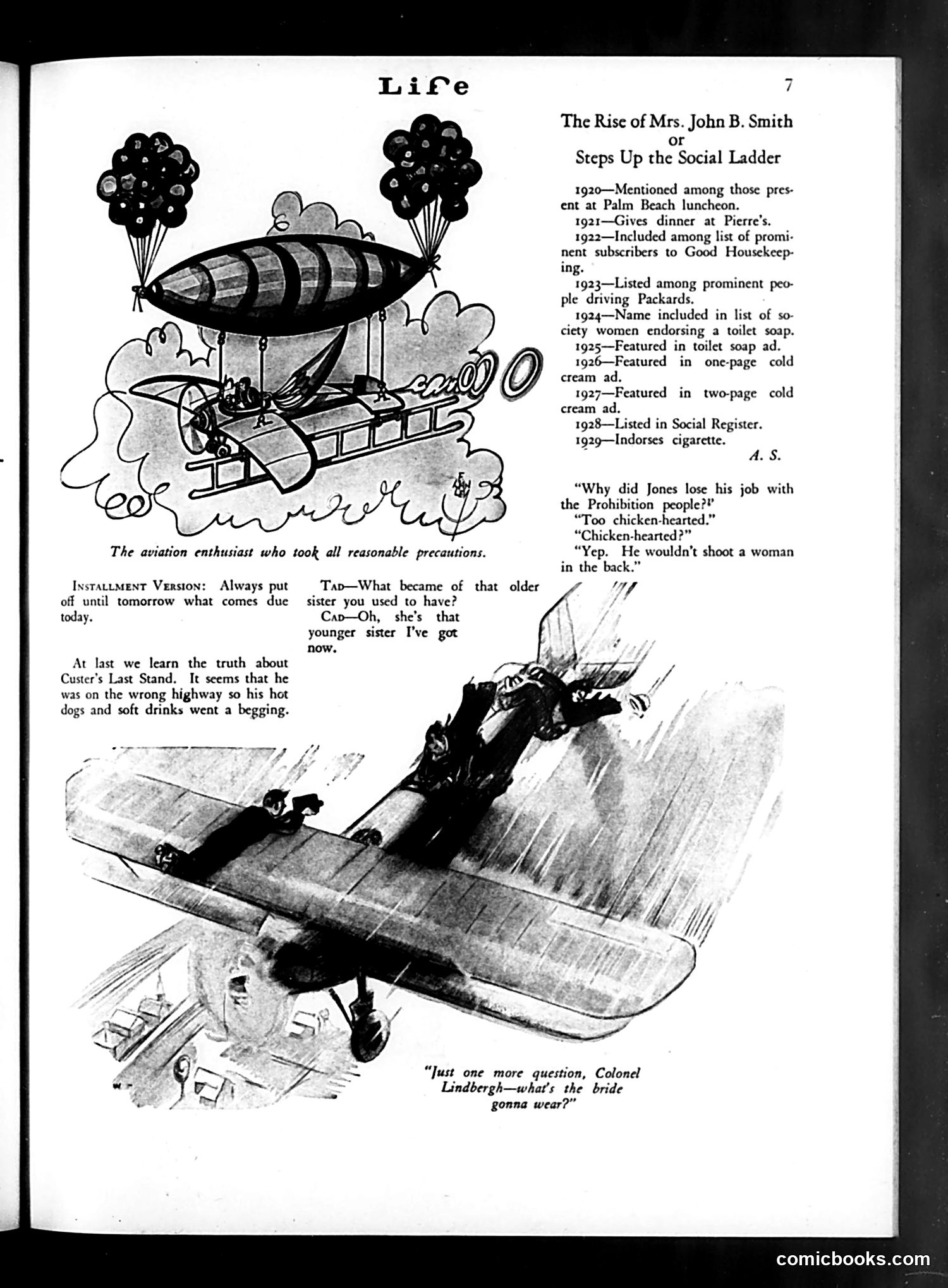
This page contains two satirical pieces from Life magazine (circa 1929): 1. **Top cartoon**: "The aviation enthusiast who took all reasonable precautions" mocks early aviation risks. The absurdist image of an airship with a sleigh suggests the ridiculous contradictions some aviators employed—attempting to be "safe" while engaging in inherently dangerous activity. 2. **Bottom cartoon**: Features Charles Lindbergh, the famous aviator, in what appears to be a plane. The caption "Just one more question, Colonel Lindbergh—what's the bride gonna wear?" references Lindbergh's recent marriage (1929), satirizing press obsession with celebrity gossip over serious matters. The page also includes "The Rise of Mrs. John B. Smith"—a satirical chronicle of social climbing through product endorsements (soap, cold cream, cigarettes), mocking how women achieved status via consumer marketing in the 1920s.
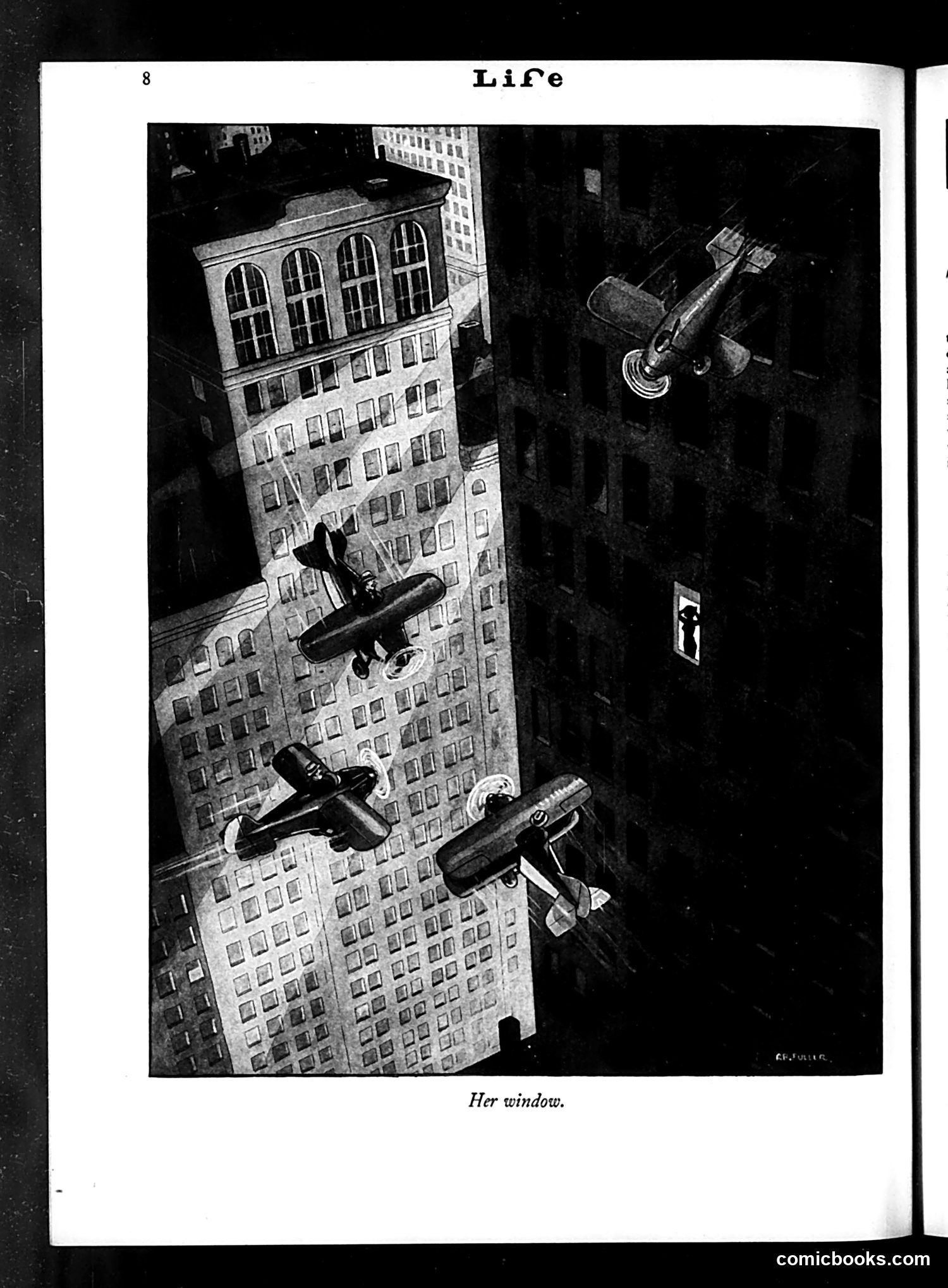
This is a striking aerial photograph from *Life* magazine titled "Her window," showing multiple military aircraft flying in formation past a tall urban skyscraper. The image appears to be commentary on 1940s-era aviation and urban life, likely referencing either World War II military aircraft displays or the emerging peacetime aviation industry. The photograph's perspective—shot from above looking down at the building—creates a dramatic composition emphasizing the aircraft's dominance over the cityscape. The caption "Her window" suggests the romantic or domestic angle: a woman watching these impressive military planes pass her high-rise apartment window. The satire likely comments on public fascination with military aviation, perhaps the spectacle of warplane demonstrations over American cities or the thrill of witnessing such technology from civilian vantage points.
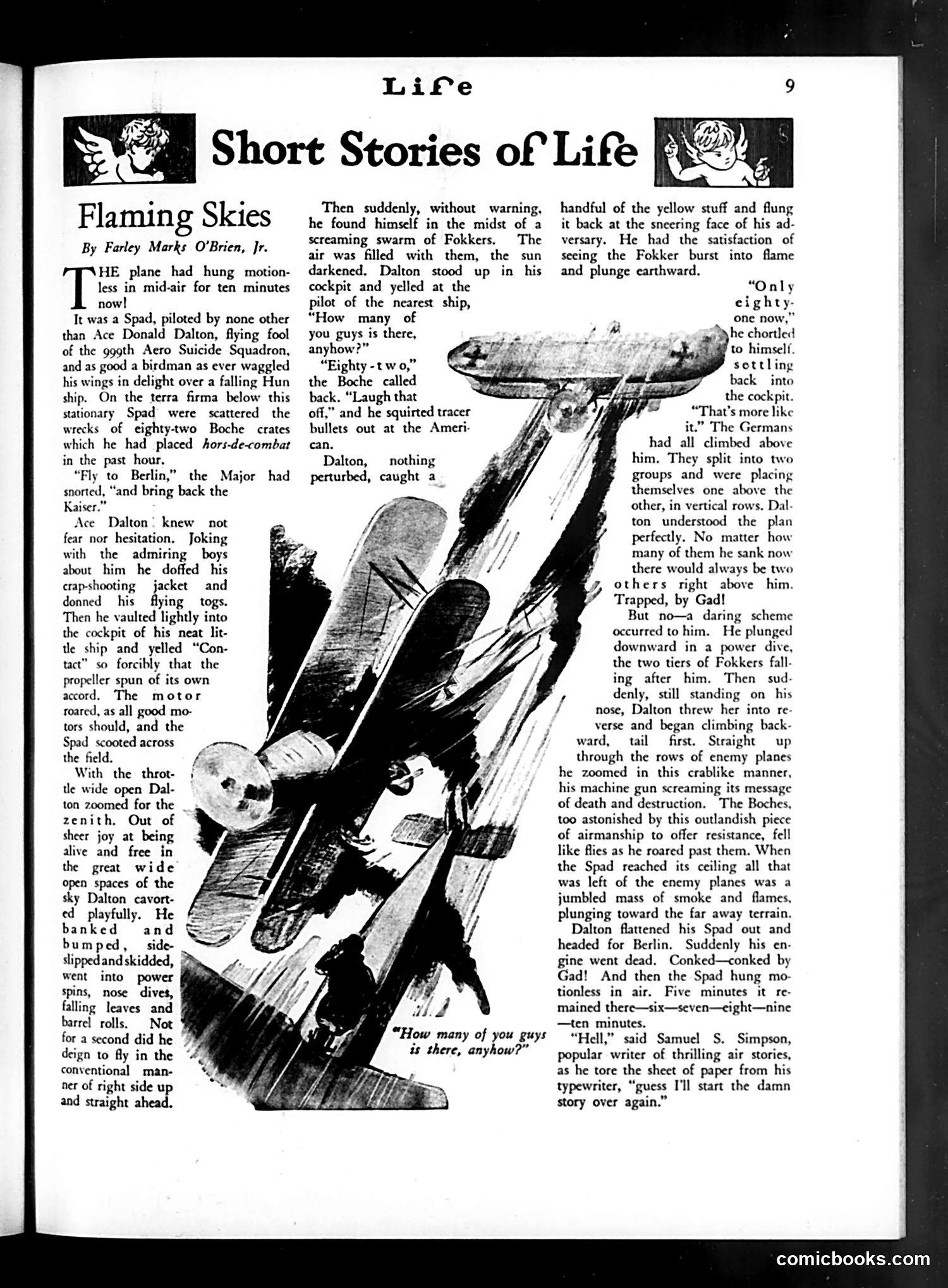
This is a fictional short story, not political satire or social commentary. The narrative follows Ace Donald Dalton, a World War I fighter pilot, who pilots a Spad aircraft in combat against enemy forces (appearing to be German, based on references to "Fokkers" and "the American"). The illustrated action sequence depicts aerial dogfighting: Dalton's plane is shown diving and maneuvering among enemy aircraft. The story describes combat tactics, plane damage, and Dalton's daring escape after being trapped by multiple enemy fighters. This represents popular WWI aviation fiction common in 1920s American magazines—adventure narratives celebrating skilled pilots and aerial combat.
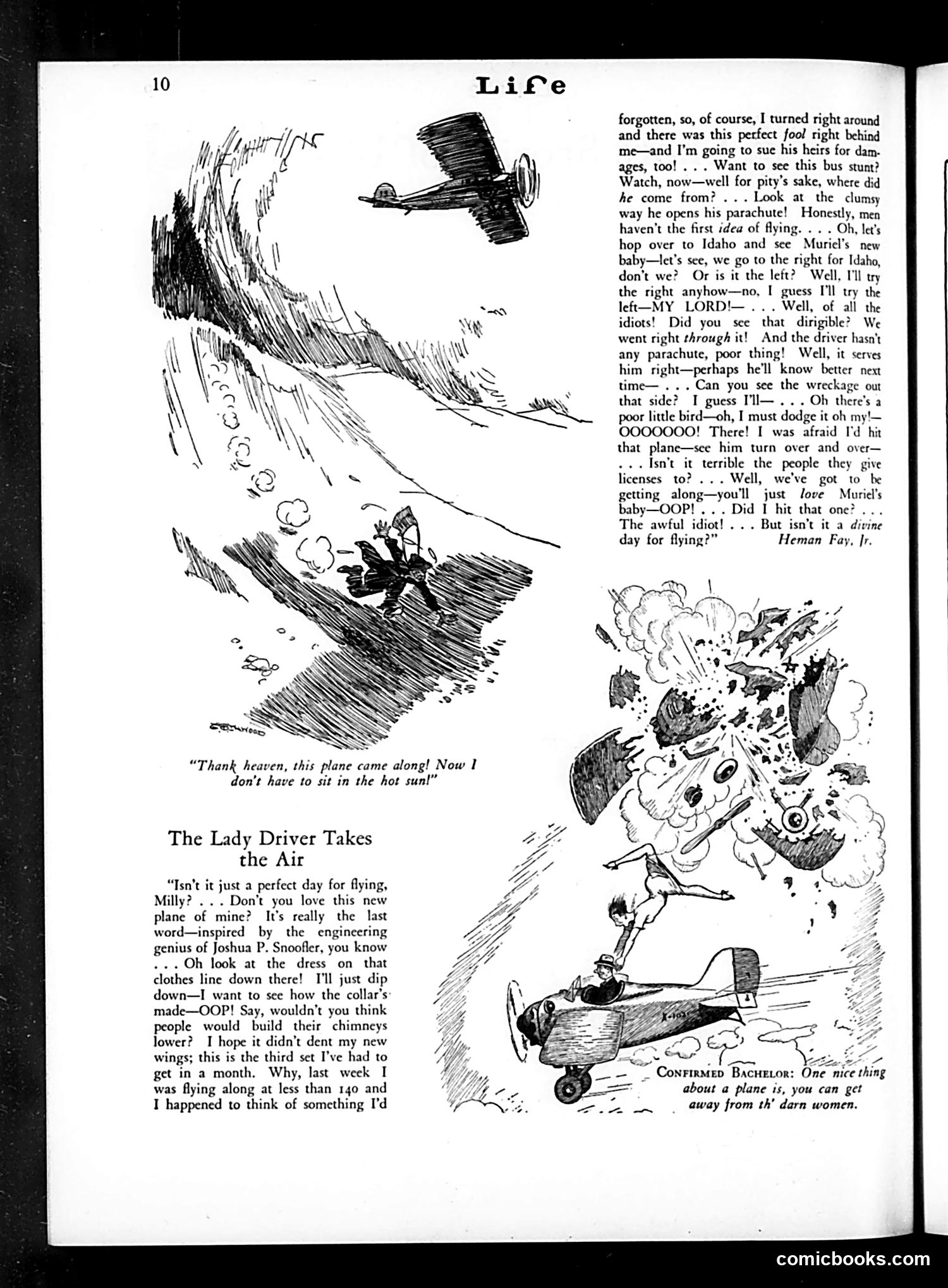
This page satirizes early aviation and gender roles in the 1910s-1920s. A woman pilot ("Milly") discusses her new plane with apparent pride, but the humor targets "lady drivers"—a contemporary stereotype of women as reckless or incompetent motorists, now transferred to aviation. The sketches show aerial mishaps: a plane crashing, another exploding mid-air, and debris falling. The final caption mocks "confirmed bachelors" who prefer planes to women because "you can get away from th' darn women." The satire works on two levels: mocking both women pilots as inherently dangerous AND suggesting aviation itself is absurdly unsafe. The tone combines skepticism about female aviators with general anxiety about this new, unpredictable technology.
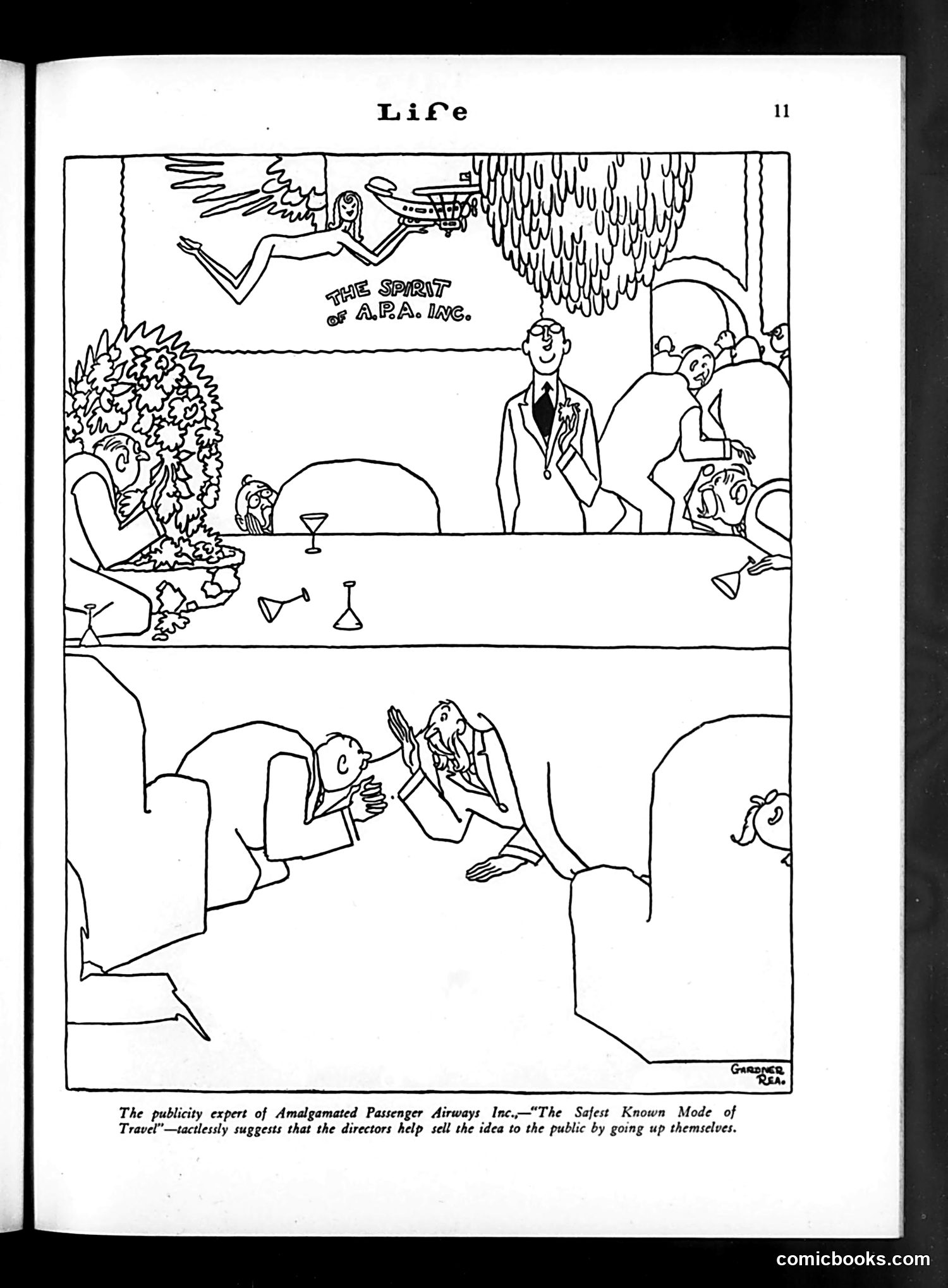
This single-panel cartoon satirizes the publicity methods of Amalgamated Passenger Airways Inc. The top scene shows company directors presenting their airline at what appears to be a formal event or convention, with "The Spirit of A.P.A. Inc." depicted as a winged figure flying overhead. The bottom panel shows the same directors in a living room, literally demonstrating the airline's concept by levitating or flying themselves around the furniture—humorously illustrating the caption's point that the company's publicity experts "tacitly suggest that the directors help sell the idea to the public by going up themselves." The joke mocks the airline industry's marketing approach: rather than conventional advertising, the directors themselves become flying advertisements for their service.
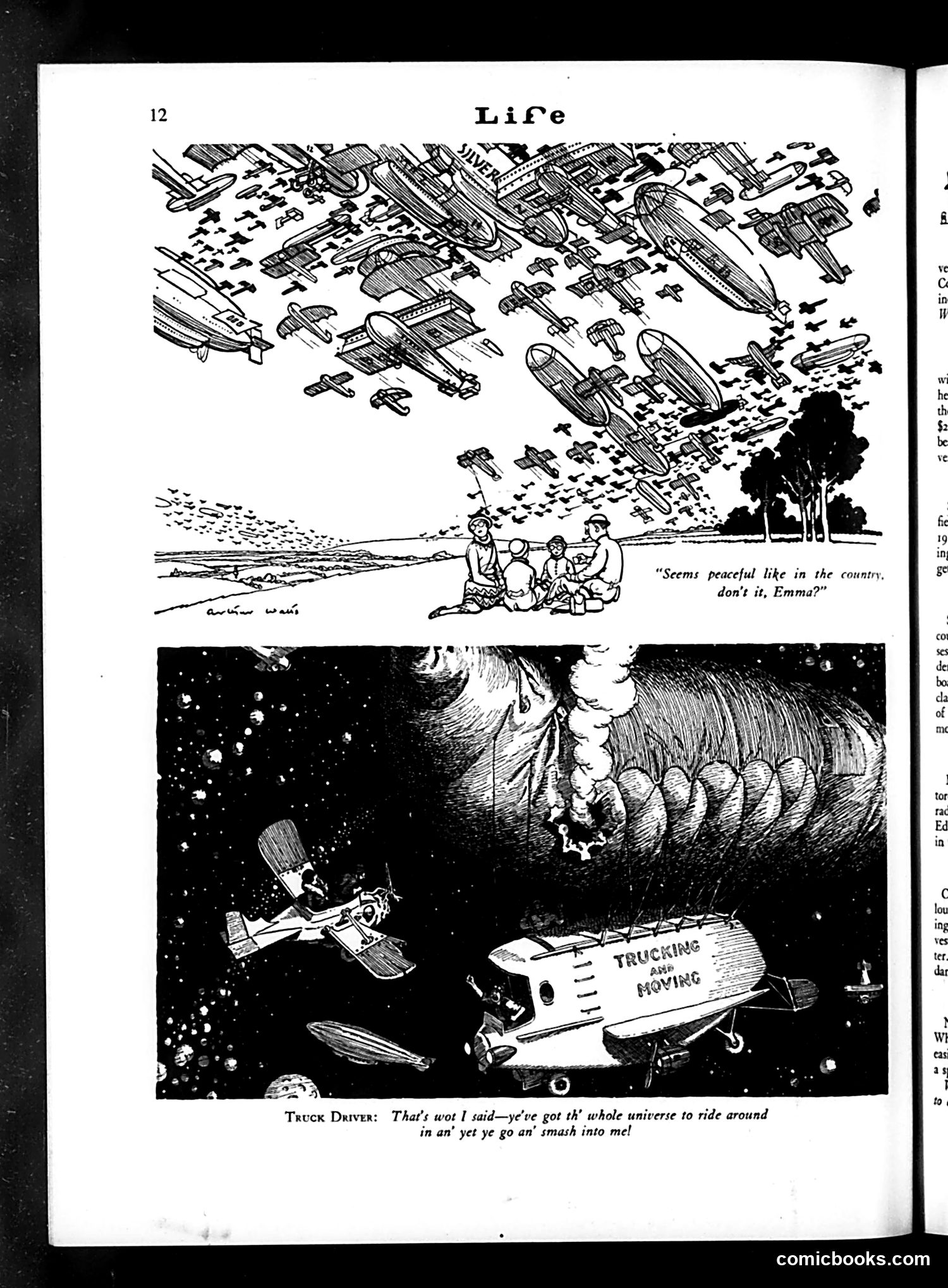
This page contains two cartoons satirizing modern warfare and technology. The **top cartoon** depicts a pastoral scene where a family sits peacefully in the countryside, unaware that massive military aircraft fill the sky above them. The caption—"Seems peaceful like in the country, don't it, Emma?"—presents dark irony: the supposed safety of rural life is illusory given aerial bombardment capabilities. The **bottom cartoon** shows a spacecraft labeled "Trucking and Moving" piloted by someone amid stars. The truck driver complains: "That's not I said—ye're got th' whole universe to ride around in an' yet ye go an' smash into me!" This jokes about congestion and careless driving extending even to space—a humorous commentary on modern transportation problems and crowding, possibly referencing pre-space-age anxieties about technological expansion.
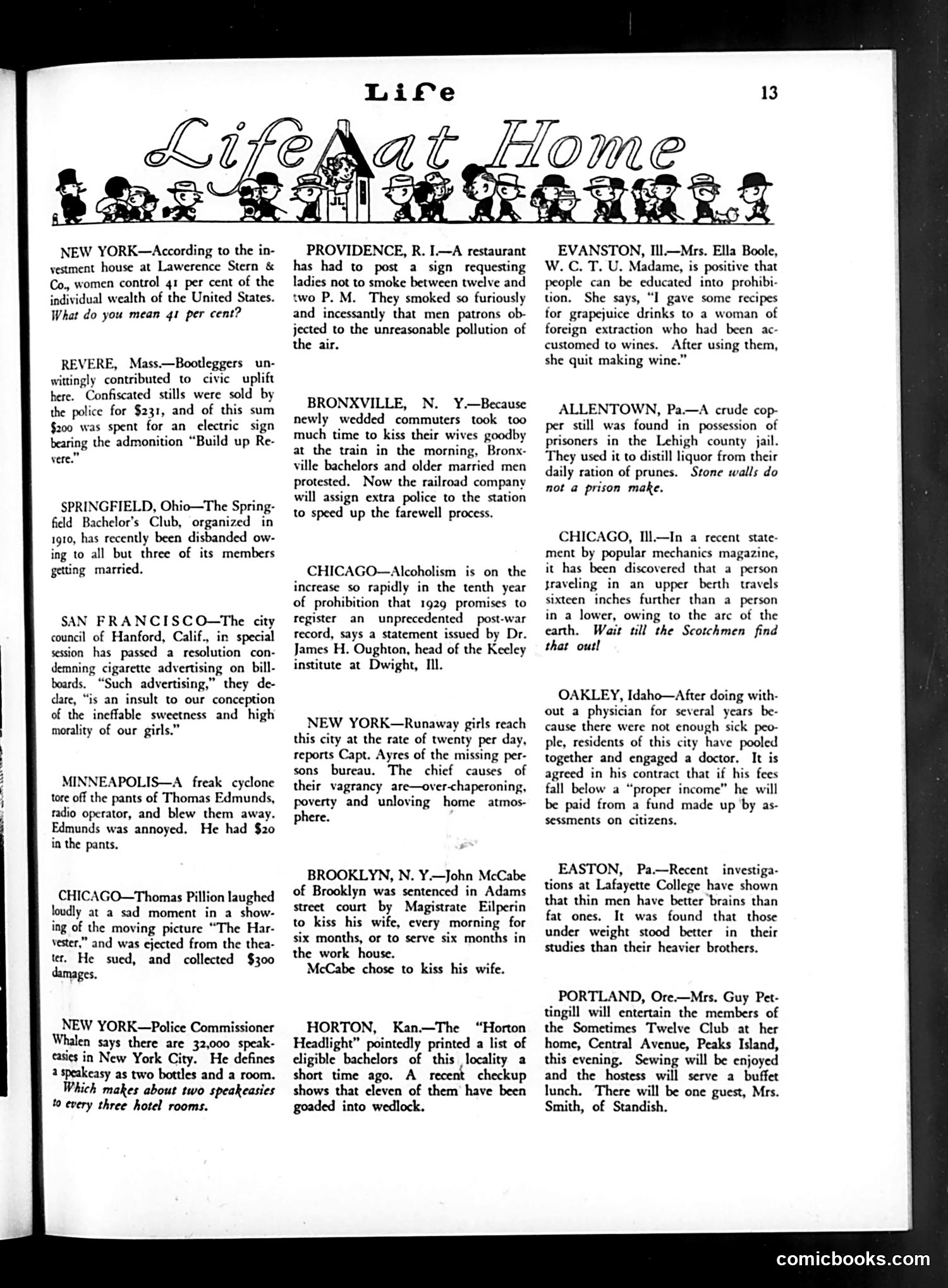
This page contains a column of brief satirical news items from various American cities, not political cartoons. The header illustration shows a row of silhouetted figures in hats—likely representing "everyman" citizens. The items mock contemporary social issues: women controlling household finances (New York), Prohibition-era bootlegging (Massachusetts, Pennsylvania), marital customs (New York), rapid alcoholism increase (Chicago), and gender-based assumptions about intelligence (San Francisco's critique of "cigarette advertising"). One notable item reports that thin men apparently have "better brains" than heavier ones—likely satirizing pseudoscientific claims popular in the 1920s. The column's humor derives from juxtaposing absurd or hypocritical social behaviors: restaurants banning female smoking while men pollute freely; courts mandating spousal kisses; eight bachelors reportedly becoming married.
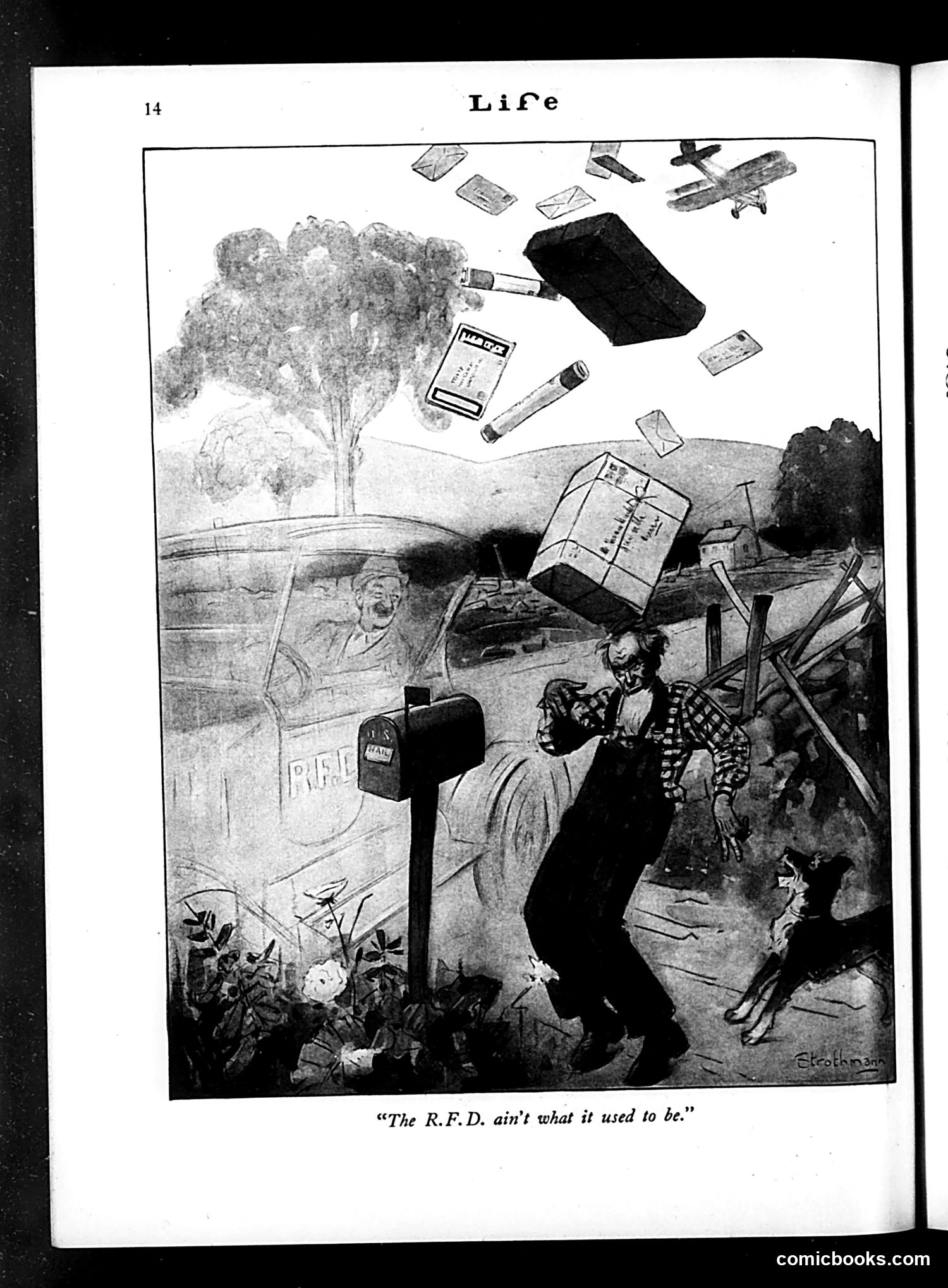
This cartoon satirizes the decline of Rural Free Delivery (R.F.D.), the U.S. postal service that delivered mail to remote farms. The image shows a rural mailbox being bombarded by modern intrusions—airplanes, packages, and various items falling from the sky—while bewildered farm residents watch in dismay. The satire critiques how technological progress and modernization have disrupted traditional rural life. What was once a reliable, orderly service has become chaotic and overwhelming. The cartoon laments the loss of pastoral simplicity as modern conveniences and commercial activity invade the countryside, suggesting rural communities feel besieged rather than benefited by "progress."
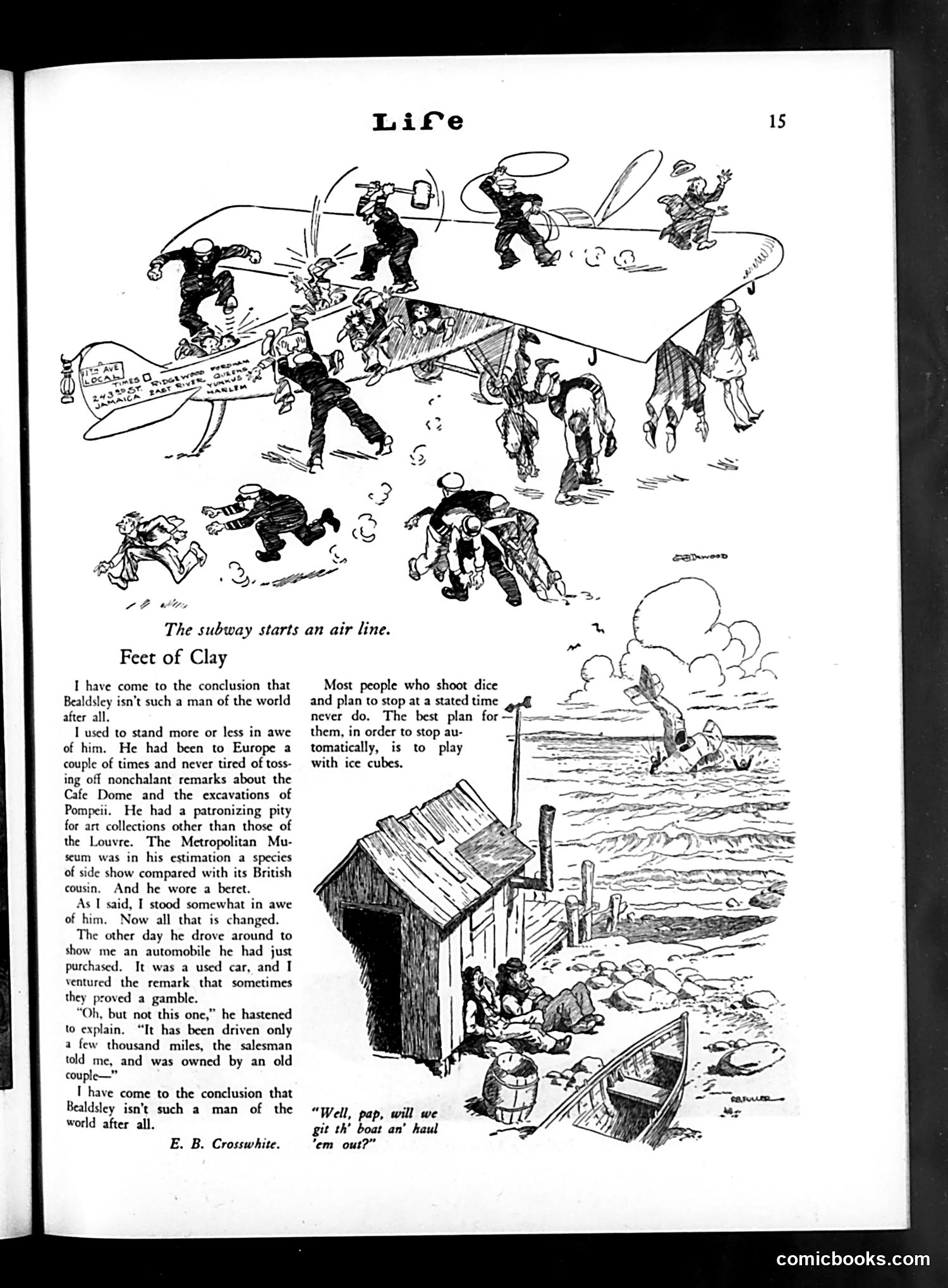
**Top Cartoon ("The subway starts an air line"):** A chaotic cartoon depicting numerous people engaged in slapstick violence—throwing objects, fighting, and tumbling—aboard what appears to be a crowded subway car. The joke satirizes the notorious roughness and disorder of urban subway transit, treating the experience as violent and anarchic enough to rival air travel. **"Feet of Clay" Essay:** E.B. Crosswhite describes disillusionment with a public figure named Bealdsley, whom he previously admired. Crosswhite recounts how Bealdsley's pretensions (claiming European travel, art appreciation) were revealed as hollow when Crosswhite discovered Bealdsley had only driven a recently purchased used car a few thousand miles—exposed as a fraud through this trivial contradiction. **Bottom Illustration:** A beach scene with poor families in a boat, likely depicting economic hardship or working-class leisure.
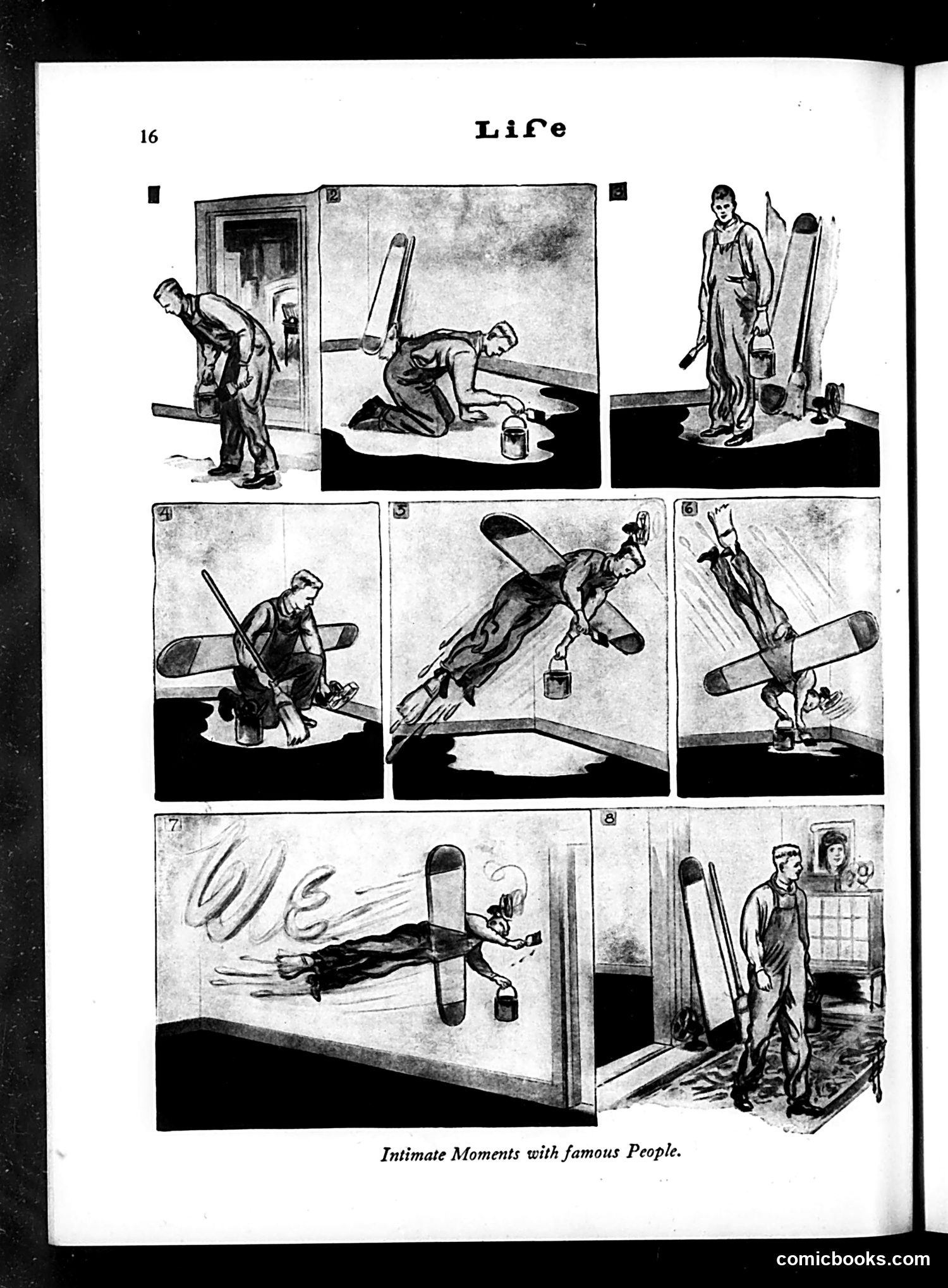
This is a humorous comic strip titled "Intimate Moments with famous People," satirizing the contrast between public personas and private lives of celebrities. The strip depicts an unnamed aviator (likely referencing early aviation pioneers) engaged in mundane, unglamorous activities: struggling with airplane parts, painting or maintaining an aircraft, getting knocked around by equipment, and ultimately arriving home exhausted with tools and materials. The satire's point is that famous people—in this case someone celebrated for aviation achievements—experience ordinary physical labor and domestic hassles behind closed doors, not the heroic glamour the public imagines. It's deflating celebrity mythology through comedic realism, showing that even famous figures deal with dirty work, accidents, and exhaustion like anyone else.
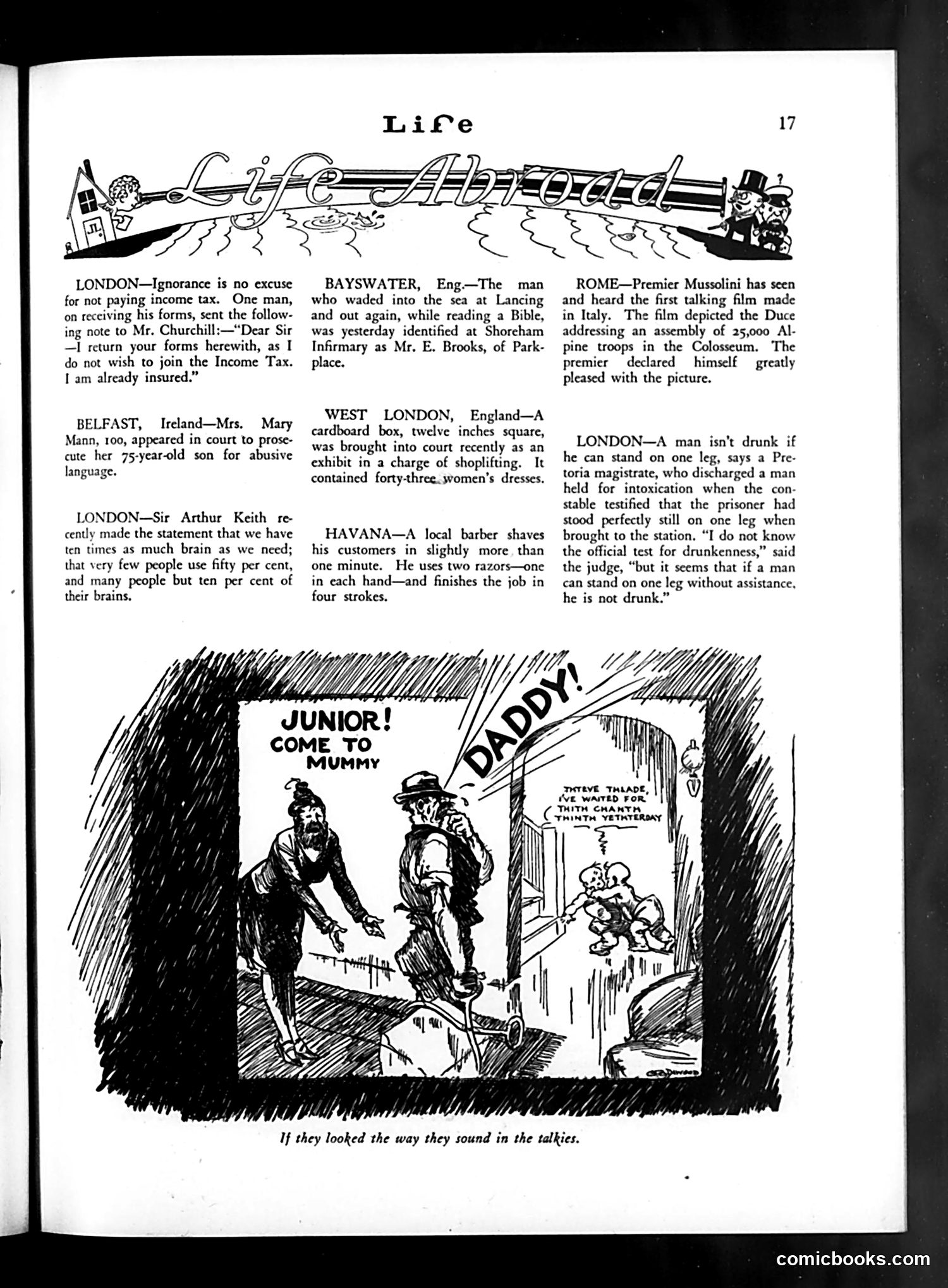
This page contains brief satirical news items from various locations and one cartoon. The cartoon depicts two shabby men calling a child to "come to mummy" and "daddy," with the child responding that they've "traded, we've gotten for nothing, I'm with yesterday." The caption states: "If they looked the way they sound in the talkies." This satirizes early talking pictures (talkies). The joke suggests that if actors in sound films appeared as disheveled and disreputable as their voices sound, audiences would be horrified—implying that early sound technology made actors' voices sound rough, poor quality, or otherwise unattractive compared to their actual appearance. The scattered news items above mock various absurdities: tax avoidance, Bible-reading while wading, film propaganda, dress thievery, and questionable barber efficiency—typical Life magazine humor mocking contemporary society.
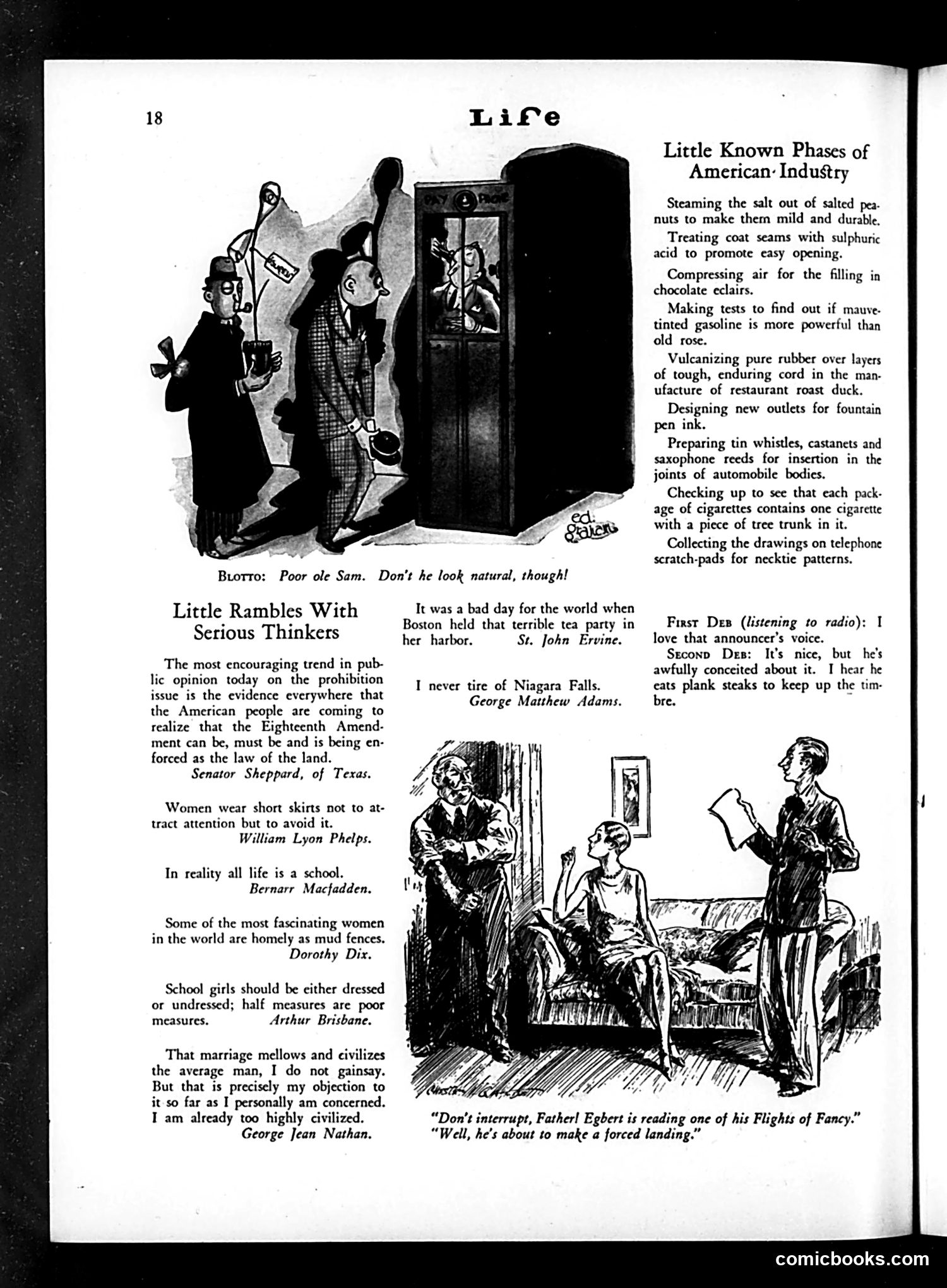
The top cartoon shows two figures entering an elevator labeled "Poor ole Sam. Don't he look natural, though!" - likely satirizing a funeral or viewing, with dark humor about death. The section "Little Rambles With Serious Thinkers" collects brief quotes on contemporary issues: prohibition (the 18th Amendment), women's fashion (short skirts), marriage, education, and gender roles. These appear to be satirical "wisdom" from various public figures and writers. The bottom cartoon depicts a domestic scene where someone is reading "Flights of Fancy" while another warns "Don't interrupt, Father! Egbert is reading one of his Flights of Fancy. Well, he's about to make a forced landing." This jokes about daydreaming and inattention, likely poking fun at escapist reading habits or absent-minded fathers.
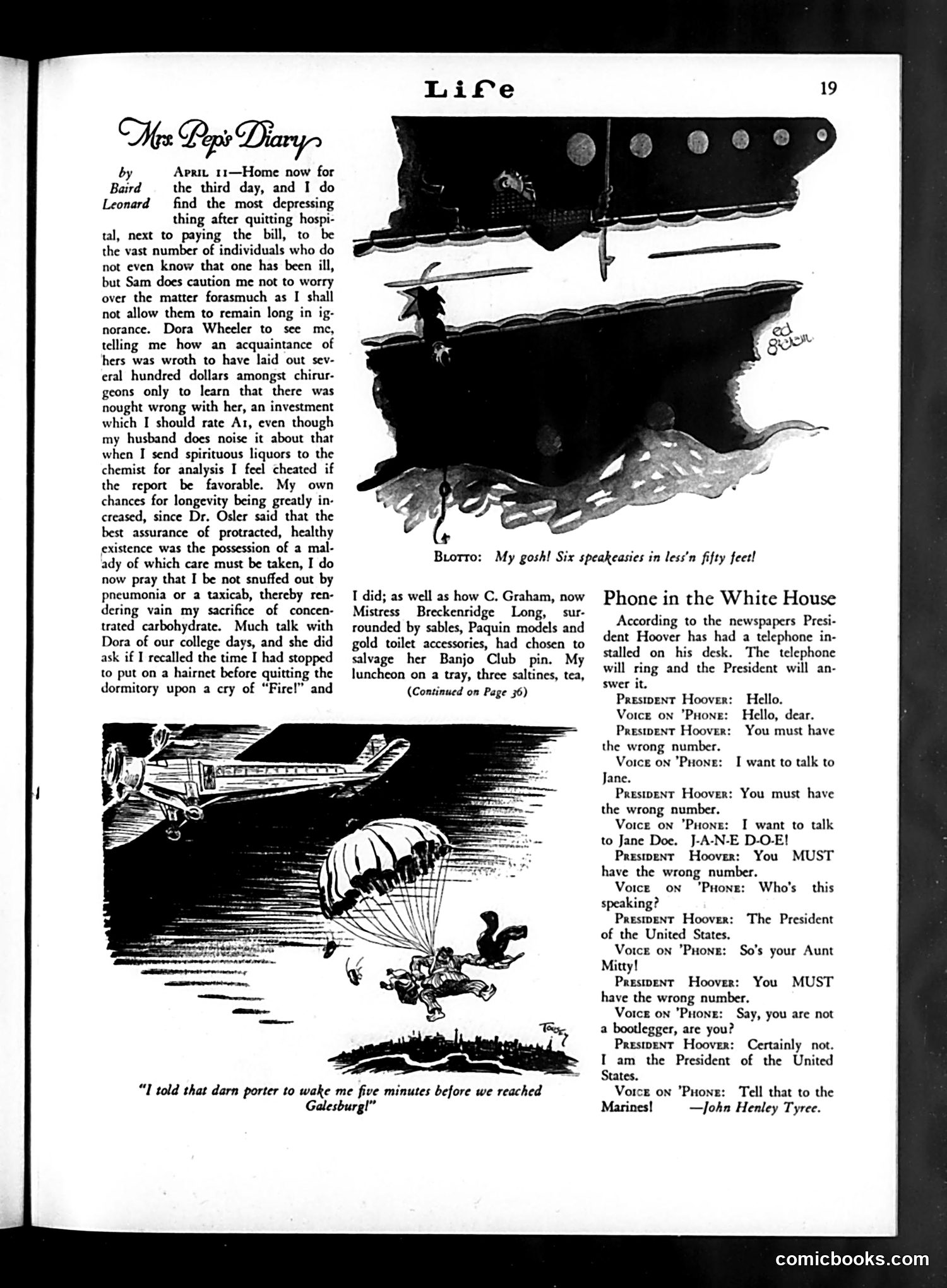
This piece satirizes President Herbert Hoover during Prohibition (implied by the bootlegger reference). The humor centers on wrong numbers—a common nuisance—but weaponizes it to mock Hoover's isolation and the absurdity of his position. The joke: When Hoover identifies himself as "President of the United States," the caller dismisses him, saying "Tell that to the Marines!"—a dismissive phrase meaning "I don't believe you." The escalating absurdity (callers seeking "Jane," an aunt named "Mitty," a bootlegger) suggests Hoover is so out of touch with ordinary Americans that his actual identity sounds implausible. The bootlegger reference mocks enforcement of Prohibition, which Hoover supported but was widely flouted. The satire implies Hoover's presidency was so disconnected from reality that even claiming to be President sounds like a prank call.
This appears to be an engraving or detailed line-art illustration rather than a political cartoon with clear satirical intent. The image shows what looks like a classical or allegorical scene with draped figures and atmospheric effects rendered through fine parallel hatching lines typical of 17th-18th century engraving techniques. The OCR text provides only fragmentary characters that don't form coherent words, making it impossible to determine the specific subject matter, historical reference, or satirical point. **Without legible accompanying text or clearer visual identification of the figures depicted, I cannot reliably explain what political or social commentary this illustration was intended to convey to contemporary Life magazine readers.**
I can see this is a detailed engraving or woodcut-style illustration titled "The Man in Dunot" (visible on the right margin), but the OCR text provided is largely corrupted and illegible, making it impossible to determine the specific political or social commentary intended. The image itself shows figures in what appears to be a dramatic scene with careful cross-hatching characteristic of 19th-century engravings, but without reliable text context, I cannot identify the specific figures, historical references, or satirical point being made. To properly explain this cartoon's meaning to a modern reader, I would need either clearer OCR text or additional publication information (date, issue, artist name) visible on the page.
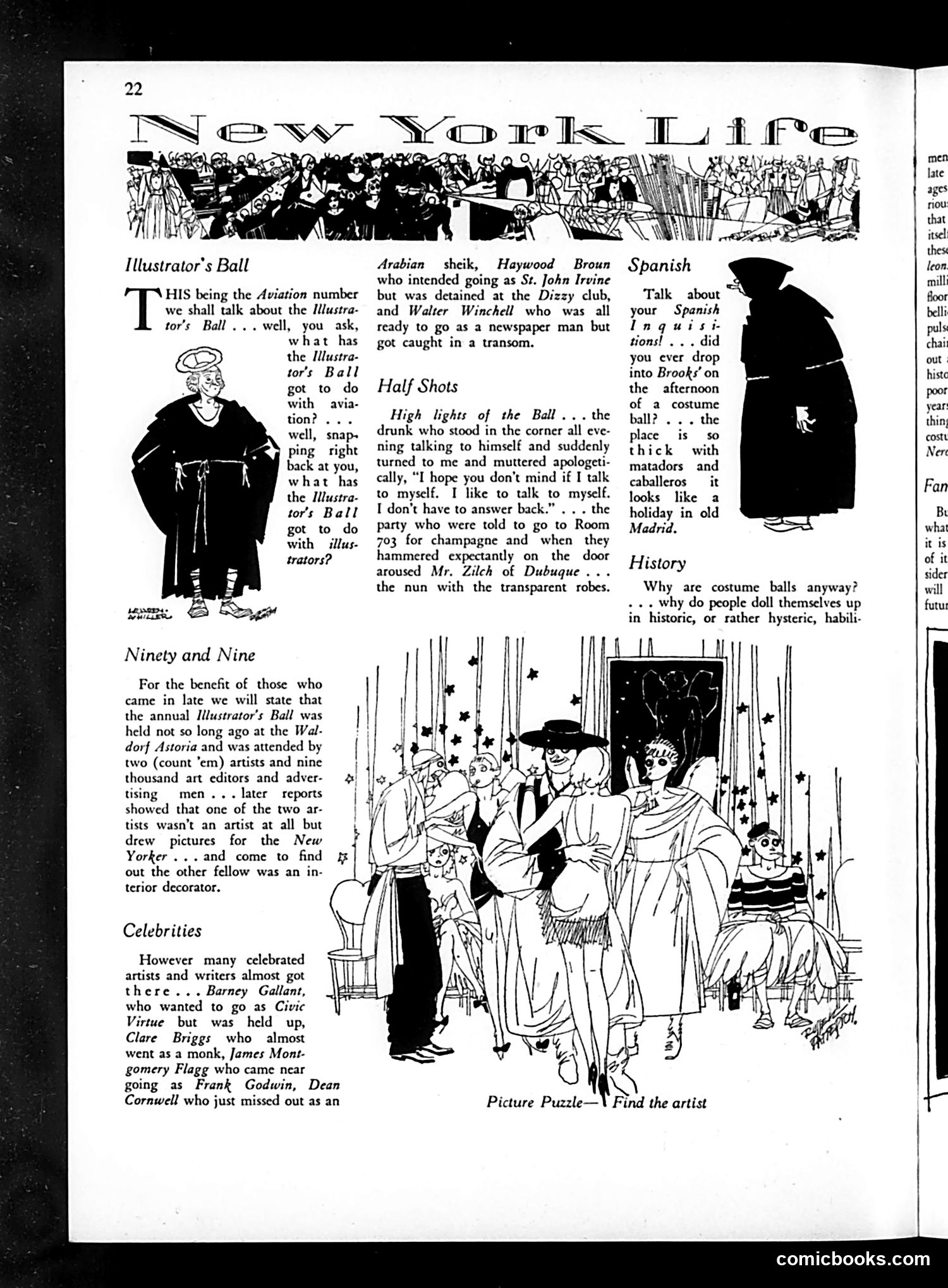
This page satirizes the annual Illustrator's Ball—a prestigious New York event for artists and editors. Life mocks the event's pretensions by revealing that of two actual artists who attended, one merely drew cartoons for the *New Yorker* and the other was just an interior decorator. The humor targets celebrated artists who *almost* attended (Barney Gallant, Clare Briggs, James Montgomery Flagg, Dean Cornwell) but were prevented by mundane circumstances—suggesting their importance was overstated. The anecdotes mock attendees' behavior: a drunk talking to himself, confused guests sent to wrong rooms, a nun's "transparent robes." References to figures like Haywood Broun (newspaper columnist), Walter Winchell (gossip columnist), and costumes evoking Spanish inquisitions and Arabian sheikhs reveal the ball's affected sophistication. The satire essentially argues: the art world's elite gathering was less impressive than advertised, populated by poseurs and mediocrities rather than genuine talent.
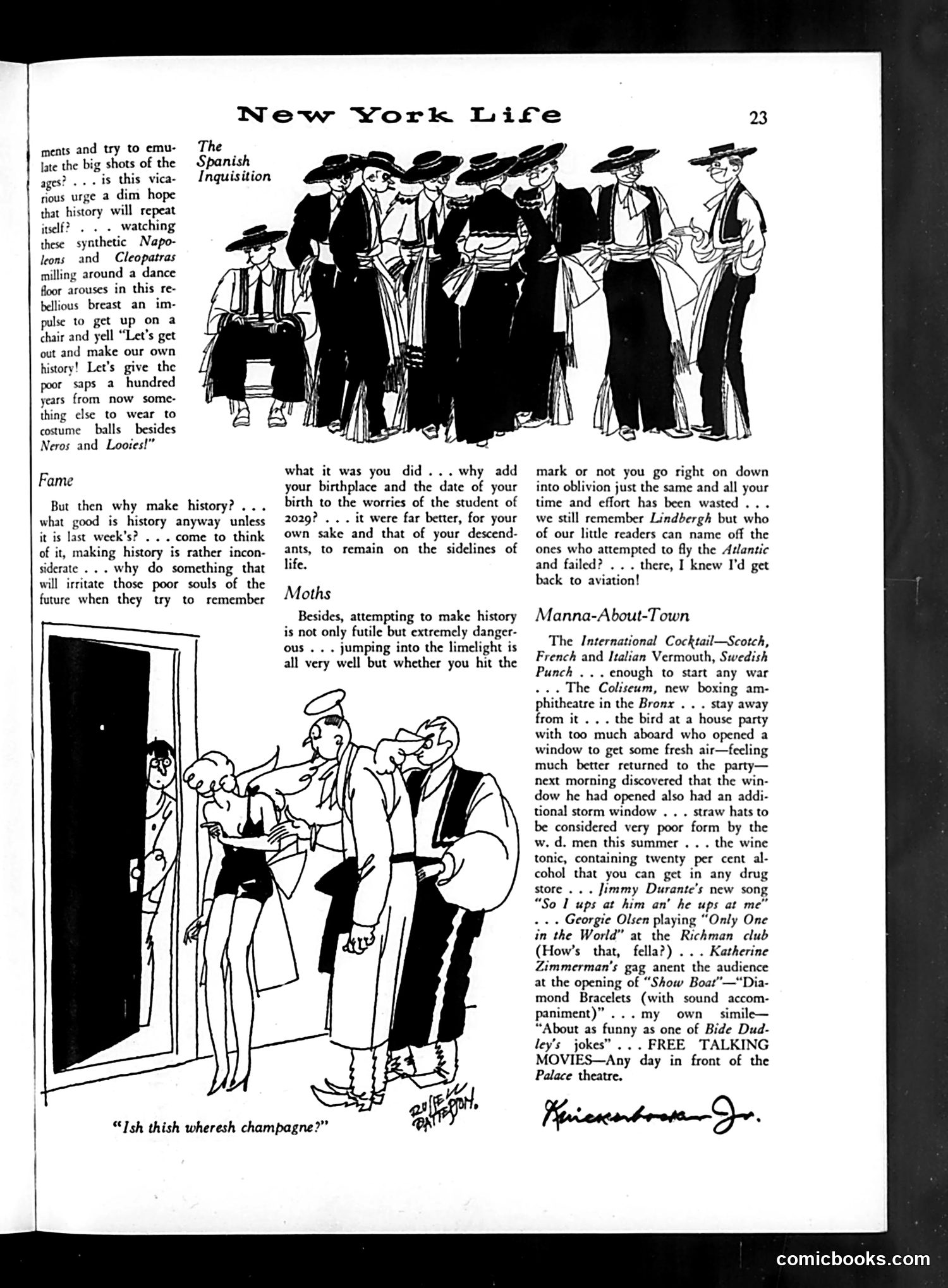
This 1920s Life magazine page satirizes the human impulse to make history and achieve fame. The "Spanish Inquisition" cartoon shows people at a costume ball dressed as historical figures—Napoleon, Cleopatra, etc.—prompting the author's mock outrage: why emulate dead celebrities when you could "make our own history"? The satire then pivots cleverly: the author argues that *actually* making history is pointless. Most historical attempts fail and are forgotten (he notes we remember Lindbergh but not failed Atlantic flyers). It's therefore wiser to "remain on the sidelines of life" than risk oblivion. The lower cartoon depicts partygoers asking for champagne at what appears to be a speakeasy—a Prohibition-era reference. The "Manna-About-Town" section lists New York gossip and entertainment, including cocktail recipes, boxing, and Jimmy Durante references, capturing 1920s social life. The overall message: ambitious people are foolish moths drawn to the flame of fame.
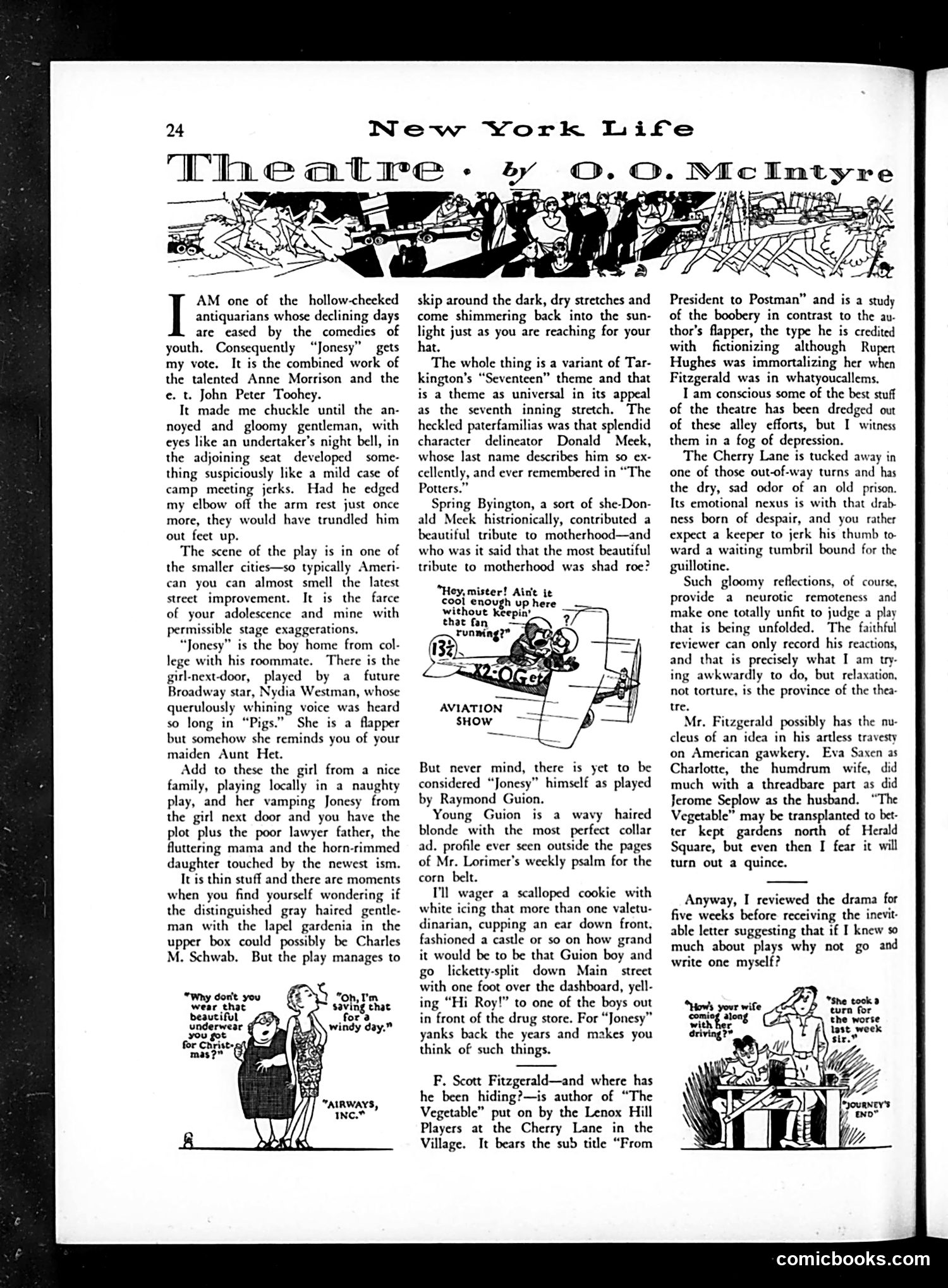
This page reviews two Broadway plays from the 1920s era. The main review covers "Jonesy," a comedy about college-aged romance in small-town America, written by Anne Morrison and John Peter Toohey. The critic praises its universal appeal—comparing it to Booth Tarkington's "Seventeen"—though acknowledges its thin plot. He highlights the performances of actors like Raymond Guion and Nydia Westman. A secondary review mentions F. Scott Fitzgerald's play "The Vegetable," performed at the Cherry Lane Theatre in Greenwich Village. The critic notes Fitzgerald's social commentary contrasting working-class "boobery" with flappers—the modern young women Fitzgerald famously depicted in his novels. The cartoons are theatrical advertisements, including one for an "Aviation Show." The humor assumes readers' familiarity with contemporary Broadway productions and Fitzgerald's literary reputation.
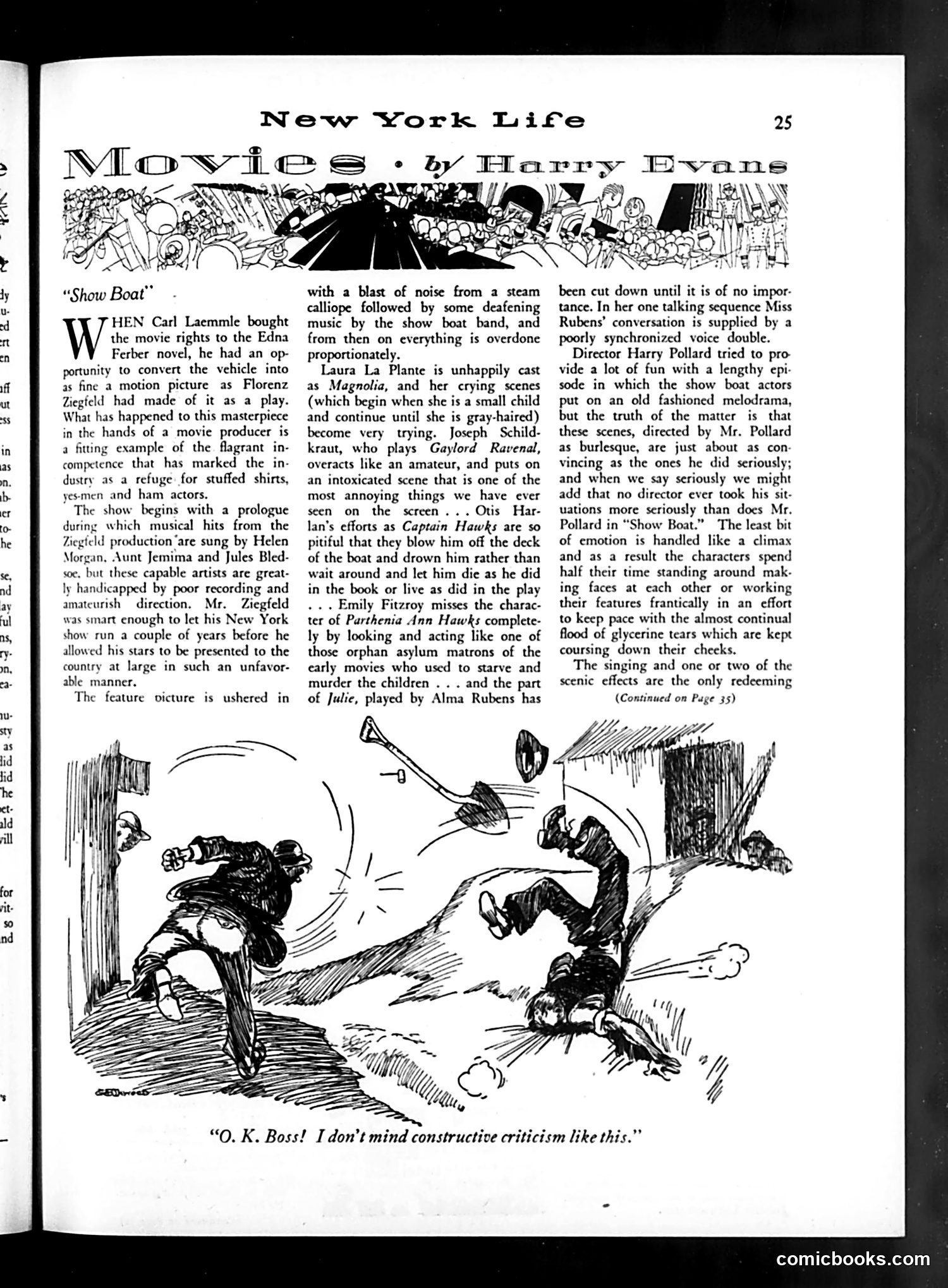
This page reviews the 1929 film adaptation of Edna Ferber's novel "Show Boat." The critic savagely attacks director Harry Pollard and the cast (Laura La Plante, Joseph Schildkraut, Alma Rubens) for overwrought, amateurish performances—excessive crying, overacting, and melodramatic gestures. The review contrasts this unfavorably with the original stage production by Florenz Ziegfeld. The accompanying cartoon illustrates the review's point: two men engage in physical comedy—one knocked backward by the other's punch. The caption reads: "O.K. Boss! I don't mind constructive criticism like this." This is satire: the cartoon suggests the film itself relies on slapstick and broad physical humor rather than genuine artistry, and that such "criticism" (literal violence) is more honest than the movie's pretentious emotional displays. The joke targets both the film's quality and Hollywood's general incompetence during early sound cinema.
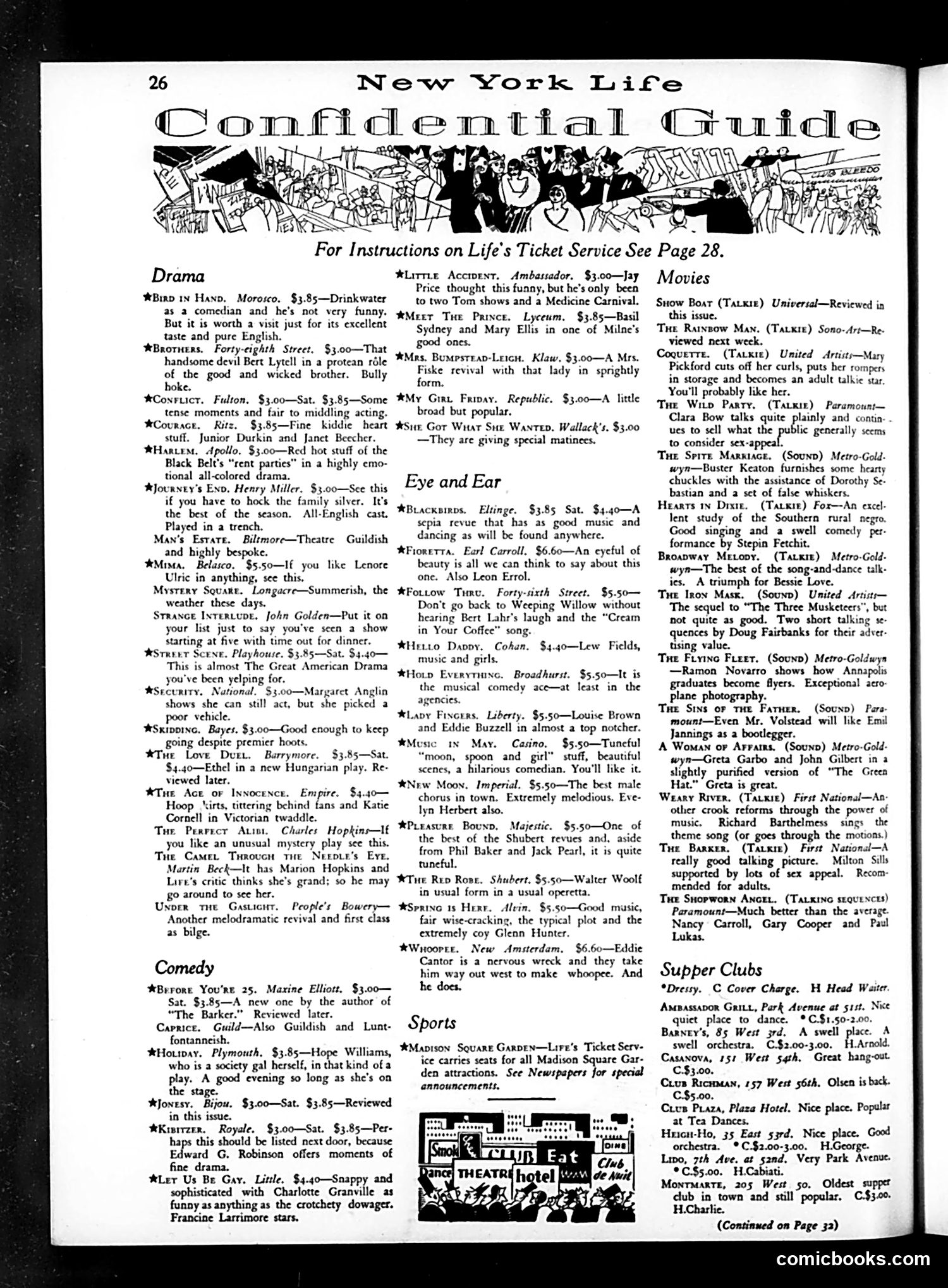
This is a theater guide—essentially a What's-On listing for Broadway shows circa the 1920s. The page reviews current plays, comedies, musicals, and movies with brief critical notes and ticket prices. **The satire is mild**: reviewers use sarcastic shorthand. "Bully hoke" means melodramatic nonsense; calling a show "Guildish" mocks the Theatre Guild's pretentious style. One review notes a critic went to see an actress because "she's grand," admitting bias. The tone is gossipy and irreverent—"bilge," "twaddle"—deflating Broadway's pretensions. **Notable context**: Several shows feature all-Black or all-English casts (unusual enough to specify). Prices range $1–$6.60, substantial sums then. The guide assumes readers know theatrical conventions and gossip. The small illustration at bottom shows a theater marquee, reinforcing the entertainment focus. This reflects 1920s New York's vibrant but commercially-driven theater scene.
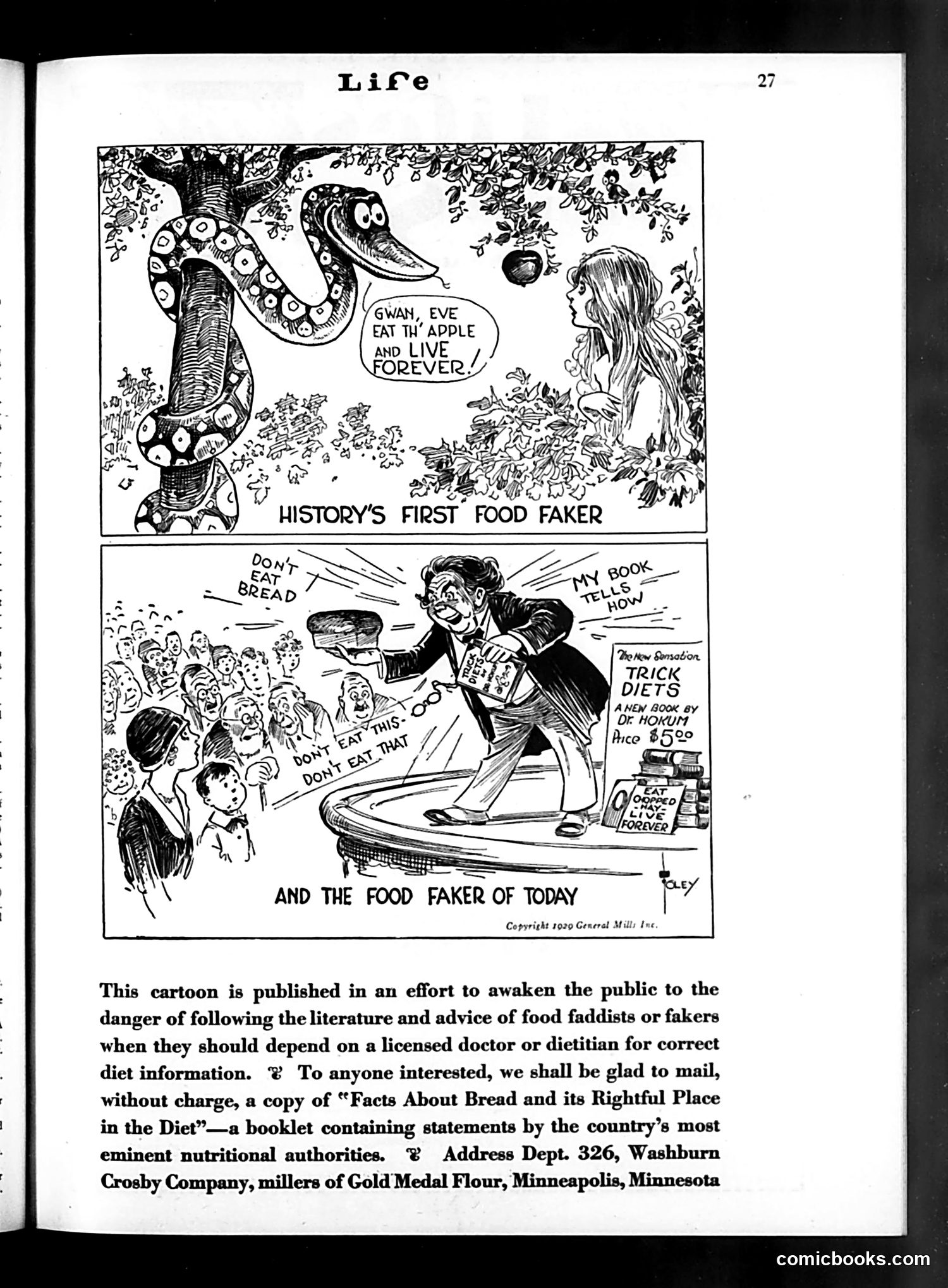
This 1929 General Mills advertisement uses two cartoons to critique "food fakers"—diet quacks and fad diet promoters of the era. **Top panel:** References the Biblical temptation of Eve by the serpent, comparing the snake's "eat th' apple and live forever" to modern false health claims. **Bottom panel:** Contrasts history's "first food faker" (the serpent) with "the food faker of today"—a charlatan selling a book called "Trick Diets" to a gullible crowd, while promoting contradictory advice ("eat this/don't eat that"). The satire targets the proliferation of dubious diet books and self-proclaimed nutrition "experts" flooding the market. General Mills positions itself as the responsible alternative, offering legitimate nutritional guidance from qualified doctors and dietitians, while promoting bread as a healthful dietary staple—naturally benefiting their flour business. The advertisement reflects 1920s-30s anxieties about consumer deception in an unregulated nutrition marketplace.
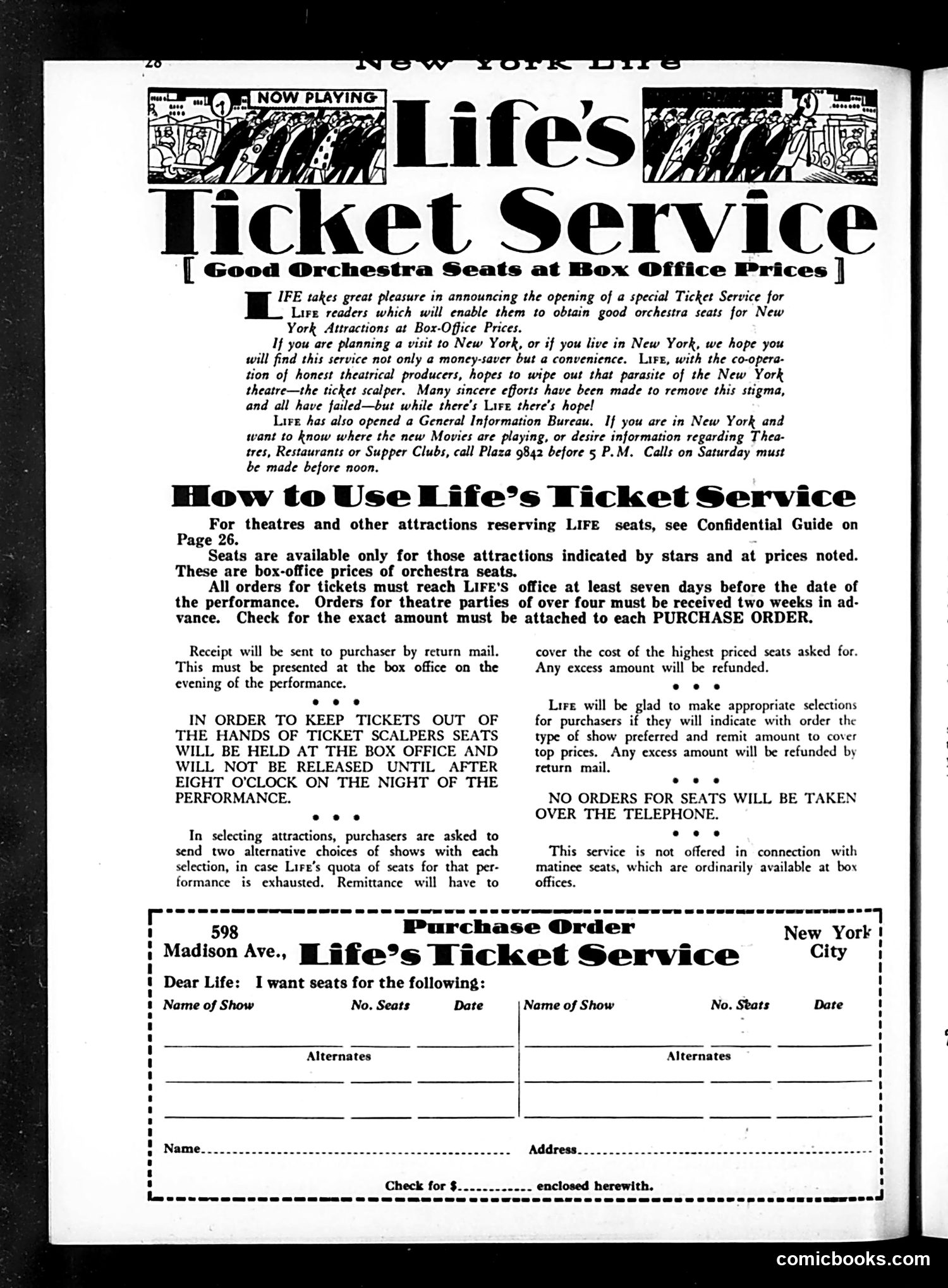
This page advertises Life magazine's anti-scalping ticket service for New York theater—a practical consumer service rather than satire. The social context: ticket scalping was a widespread problem in 1920s Broadway, with middlemen buying orchestra seats and reselling them at inflated prices. Life positioned itself as a public-spirited alternative, offering readers box-office prices for good seats through their General Information Bureau (phone: Plaza 9842). The service included safeguards against scalpers: tickets were held at box offices until 8 PM on performance nights, preventing advance resale. Customers submitted purchase orders with payment and alternate show choices, with two-week advance notice required for large parties. This reflects early 20th-century consumer activism—using magazine reach to combat perceived market exploitation. The tone is earnest reform, not satirical.
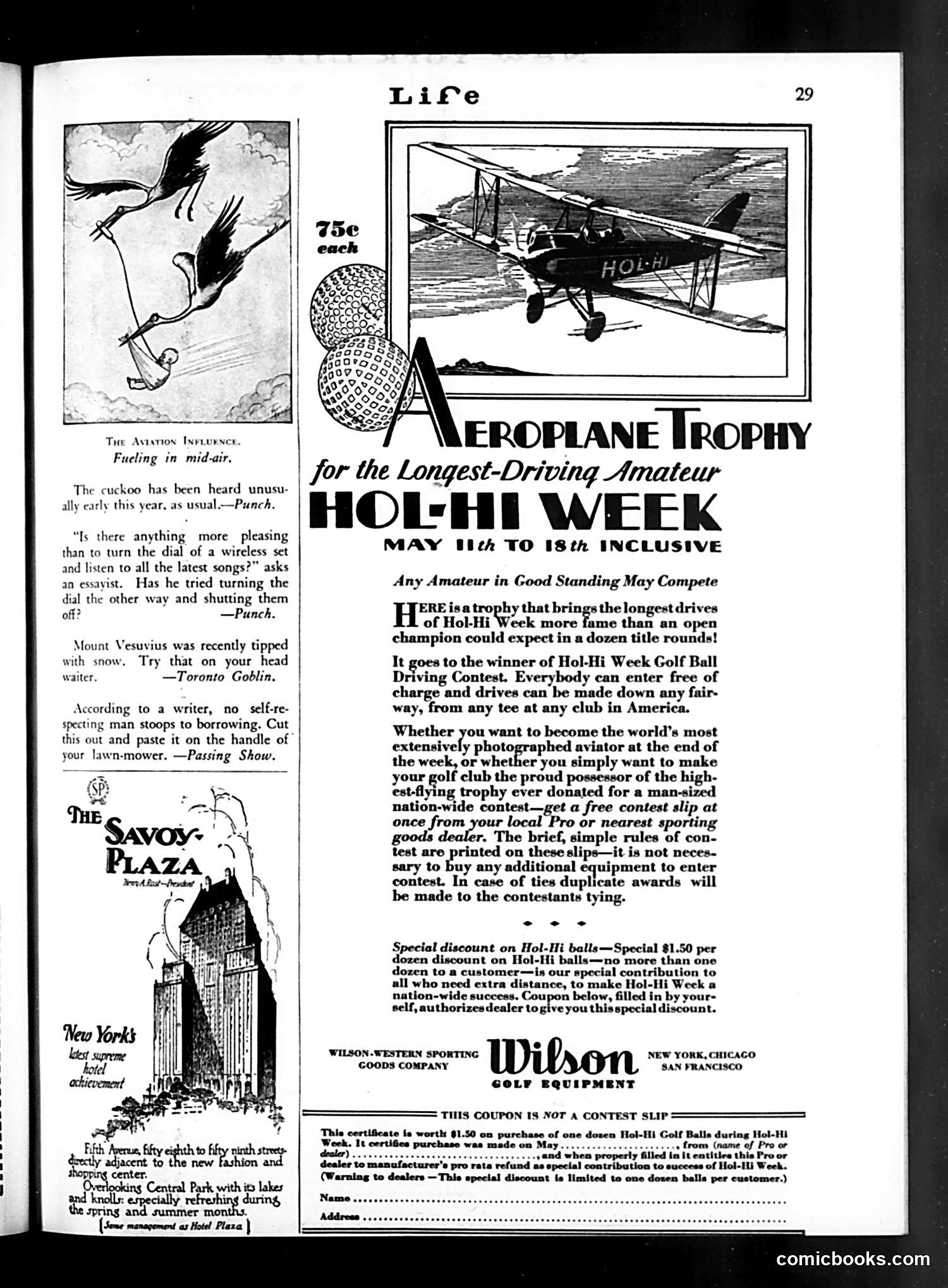
This page is primarily **advertising** rather than political satire. The dominant content is a promotional campaign for "Hol-Hi Week" (May 11-18), a golf ball driving contest sponsored by Wilson sporting goods. The small cartoon at top left, titled "The Aviation Influence," depicts a bird fueling mid-air—a visual pun referencing the newly feasible concept of refueling aircraft in flight, an emerging aviation technology of the era. It's paired with humorous one-liners from various publications about everyday absurdities (early cuckoos, radio dials, Mount Vesuvius). The main advertisement cleverly ties golf to aviation: the "Aeroplane Trophy" promises that the longest-driving amateur golfer will become "the world's most extensively photographed aviator"—playfully suggesting that exceptional golf drives might achieve aviation-like fame. This reflects 1920s enthusiasm for both aviation and sports celebrity. The Savoy Plaza hotel ad below advertises New York luxury accommodations.
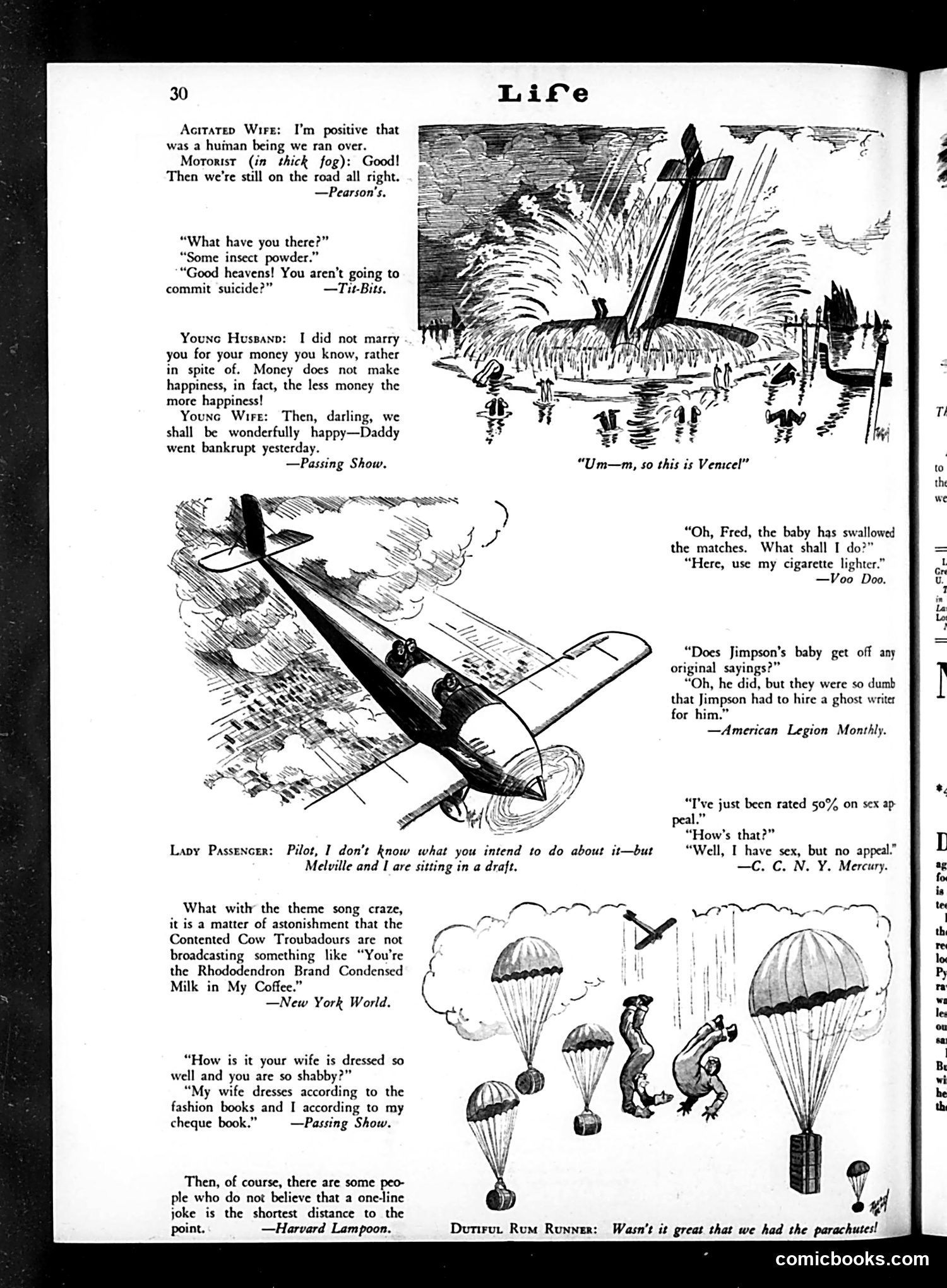
This page from *Life* magazine collects humorous one-liner jokes and cartoons typical of the 1920s-30s era. Key themes: **The jokes satirize:** - **Modern dangers**: A motorist in fog assumes hitting something human means he's still on the road (dark humor about traffic safety) - **Marriage and money**: A young husband's financial philosophy backfires when his father-in-law goes bankrupt, making them poor but "happy" - **Parenting absurdity**: A mother uses a cigarette lighter instead of matches to help her baby—mocking reckless parenting - **Commercialism**: Advertising has become so pervasive that even cows should sing jingles for condensed milk - **Gender economics**: A wife dresses well (from fashion magazines) while the husband dresses poorly (limited by his checkbook) **The cartoons** depict aviation mishaps and parachuting—suggesting contemporary fascination with early aviation's dangers. The overall tone mocks 1920s consumer culture, gender roles, new technologies, and modern absurdities through rapid-fire satire.
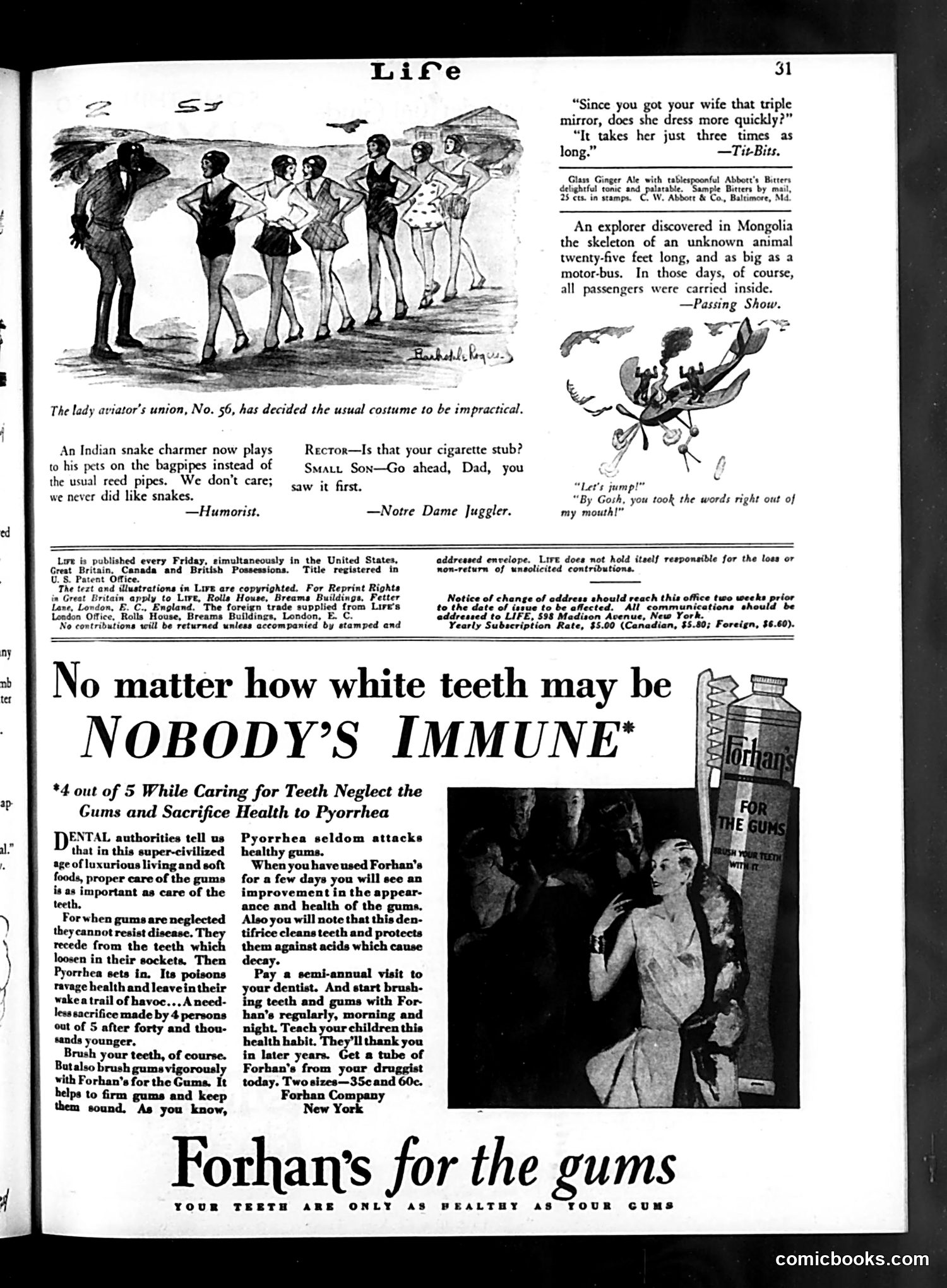
This page contains several brief satirical jokes typical of *Life* magazine's humor section, followed by a full-page advertisement for Forhan's toothpaste. **The cartoons** include a sketch of female aviators in bathing suits (captioned "The lady aviator's union, No. 56, has decided the usual costume to be impractical")—mocking women entering aviation by suggesting they'd abandon proper dress. Other jokes mock vanity (a man's wife taking three times longer to dress with a triple mirror) and domestic life. One joke references an Indian snake charmer using bagpipes instead of traditional pipes—absurdist humor typical of the era. **The Forhan's advertisement** warns that 4 of 5 people over forty neglect gum care, risking pyorrhea (gum disease). It emphasizes that healthy teeth require healthy gums, promoting regular brushing and dental visits. This reflects early 20th-century marketing of oral hygiene as a modern health concern, positioning the product as scientifically endorsed preventative care.
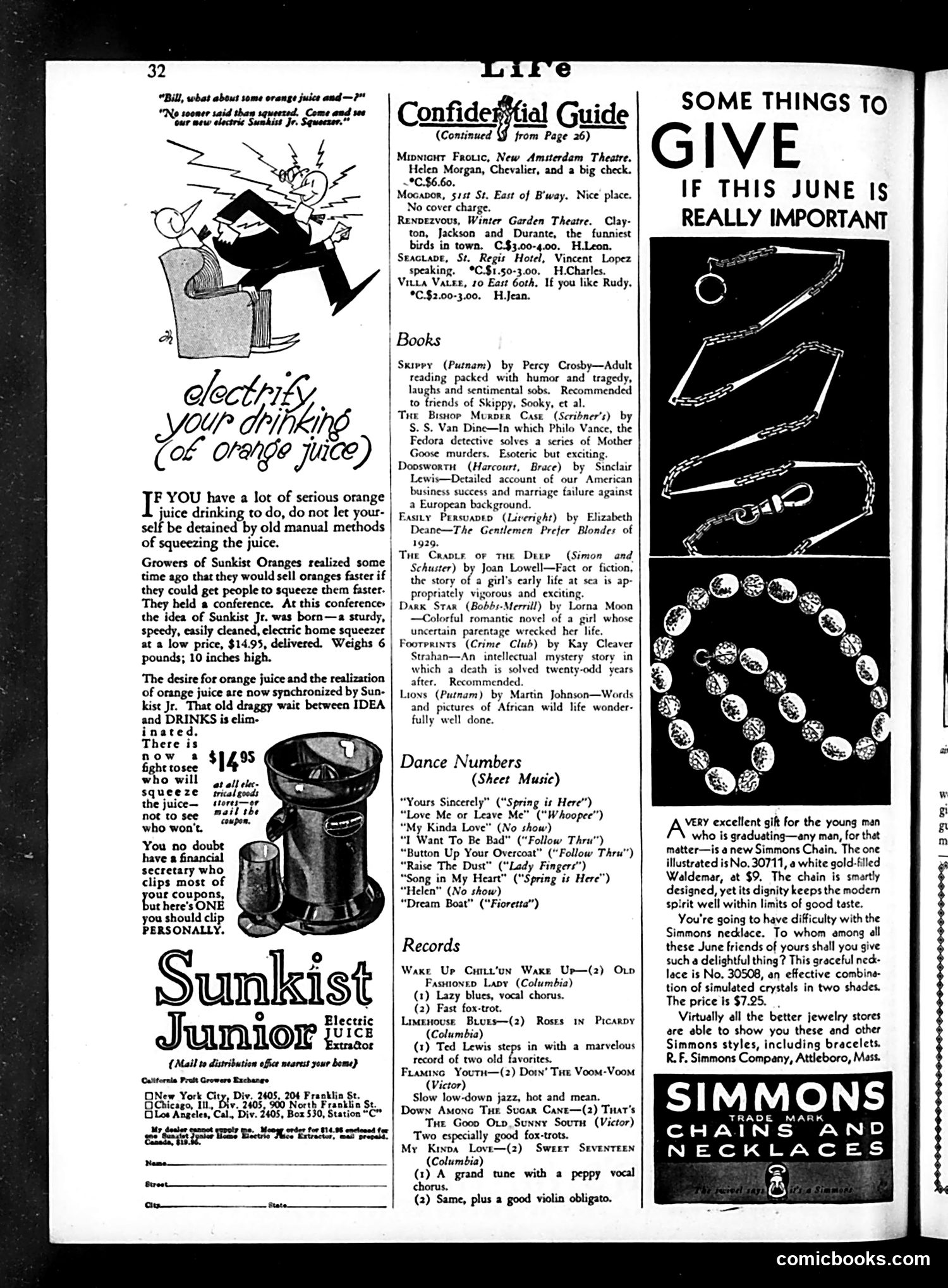
This page contains **primarily advertising and entertainment listings**, not political satire. The main content is: **The Cartoon (Left):** A humorous illustration showing a man being violently ejected from a chair while drinking orange juice, with the caption about orange juice. This is **not political**—it's a visual joke supporting the Sunkist Jr. electric juicer advertisement below. The premise: people drink so much orange juice they need an electric squeezer to keep up with demand. **The Listings (Center/Right):** The "Confidential Guide" section simply recommends current Broadway shows, books, dance numbers, and records—typical entertainment coverage for a 1929 Life magazine. Performers mentioned include Helen Morgan and Bing Crosby. **The Advertising (Right):** A Simmons jewelry chains and necklaces ad featuring gift suggestions. There is **no discernible political content, caricature, or satire** on this page. It's standard magazine filler: consumer advertising mixed with entertainment recommendations for a wealthy, urban readership.
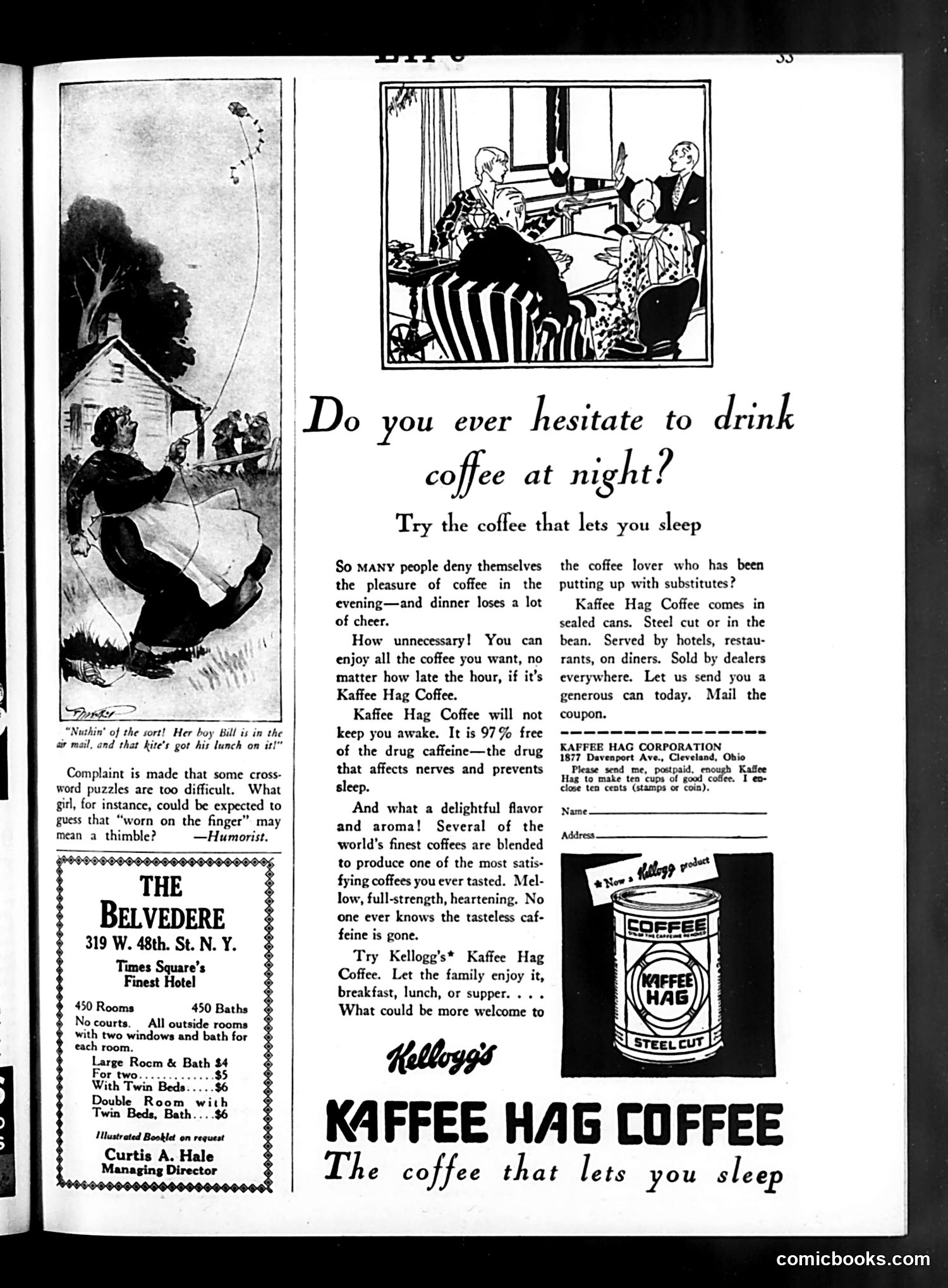
This page contains two distinct elements: **The Cartoon (upper left):** A humorous domestic scene where a woman on a swing observes a kite flying above a schoolhouse. The caption reveals she's correcting someone's assumption—her son Bill's lunch is attached to that kite, not something more sinister. The joke plays on the reader's expectation of danger or mischief. **The Advertisements:** The bulk of the page features ads for the Belvedere Hotel (Times Square) and prominently, **Kaffee Hag Coffee**—a decaffeinated brand. The coffee ad addresses a genuine consumer concern: enjoying coffee's taste and social ritual without caffeine's sleep-disrupting effects. The marketing emphasizes that Kaffee Hag is "97% free" of caffeine, allowing evening coffee consumption without insomnia. For modern readers: this reflects early-20th-century consumer culture where decaffeination was a novel solution to a real problem, and advertising directly addressed household anxieties about lifestyle choices.
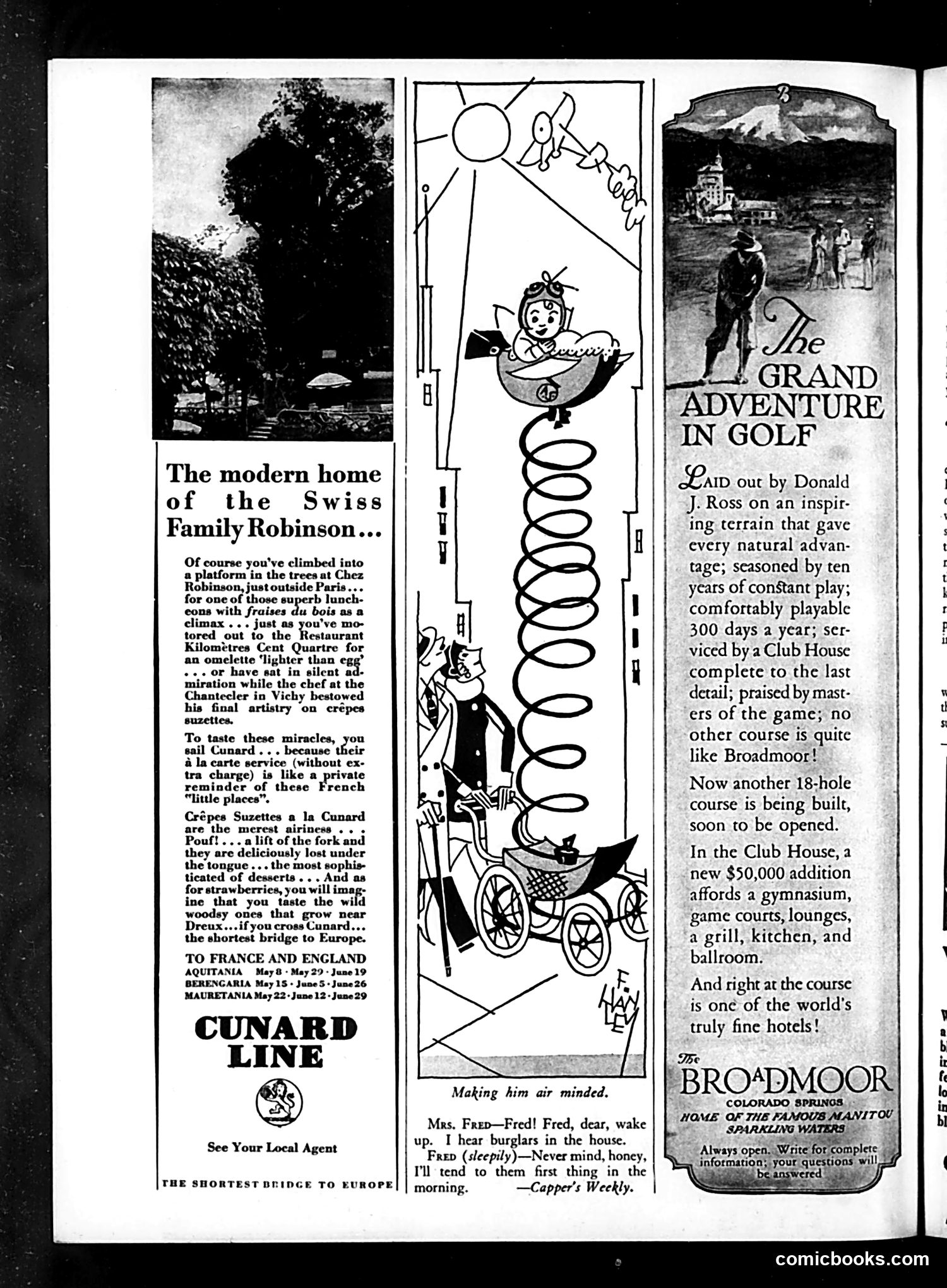
This page contains three separate advertisements with no political cartoons or satire. **Left:** A Cunard Line cruise ship advertisement that humorously references the "Swiss Family Robinson" to appeal to wealthy travelers. It promises luxury French dining experiences (strawberries, crêpes suzettes) as incentive to book transatlantic passage to Europe—positioning ocean travel as a gateway to continental sophistication. **Center:** A brief comic joke (credited to Capper's Weekly) depicting a husband dismissing burglary concerns because he'll "tend to them first thing in the morning"—playing on masculine bravado and casual nonchalance in domestic situations. **Right:** An advertisement for The Broadmoor golf resort in Colorado Springs, emphasizing its championship course design, facilities, and nearby luxury hotel. The page is primarily commercial content aimed at affluent readers, typical of Life magazine's advertising strategy during this period.
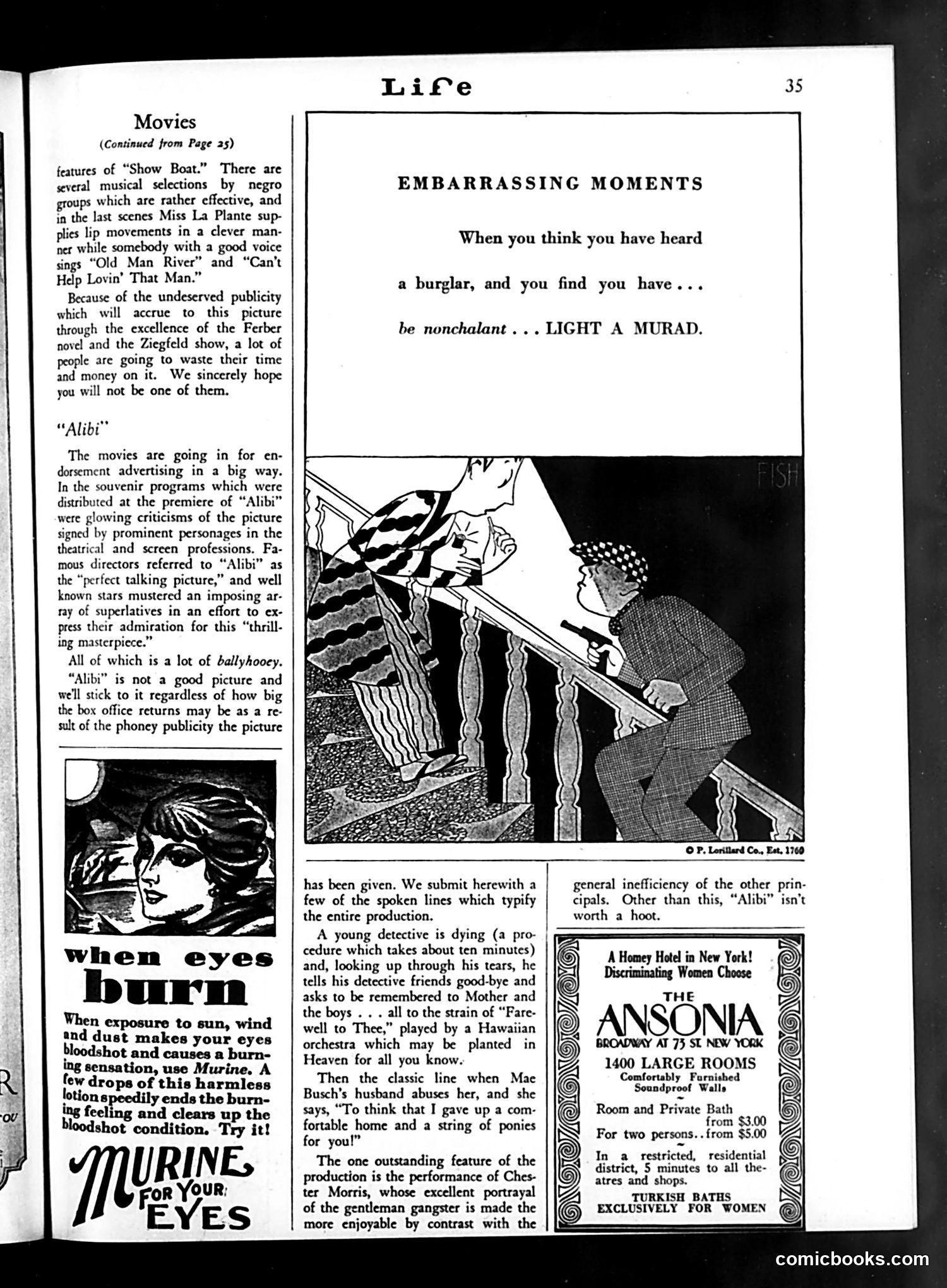
This page contains film criticism and period advertising from approximately the late 1920s. The main content critiques two movies: "Show Boat" (dismissed as overrated despite its source material) and "Alibi" (attacked as fundamentally poor despite heavy promotional endorsements from famous directors and stars). The satire targets **studio publicity tactics**—specifically, Life mocks the practice of securing celebrity testimonials for premiere programs, calling it "ballyhooey" and "phoney publicity." The reviewer argues that artificial endorsements mislead audiences into wasting money on mediocre films. The page's cartoon shows a humorous "embarrassing moment": mistaking a burglar for something else, then casually lighting a Murad cigarette to appear nonchalant. This advertises cigarettes while poking gentle fun at awkward social situations. The other ads (Murine eye drops, the Ansonia Hotel) reflect period consumer products and New York tourism, typical of Life's advertising mix.
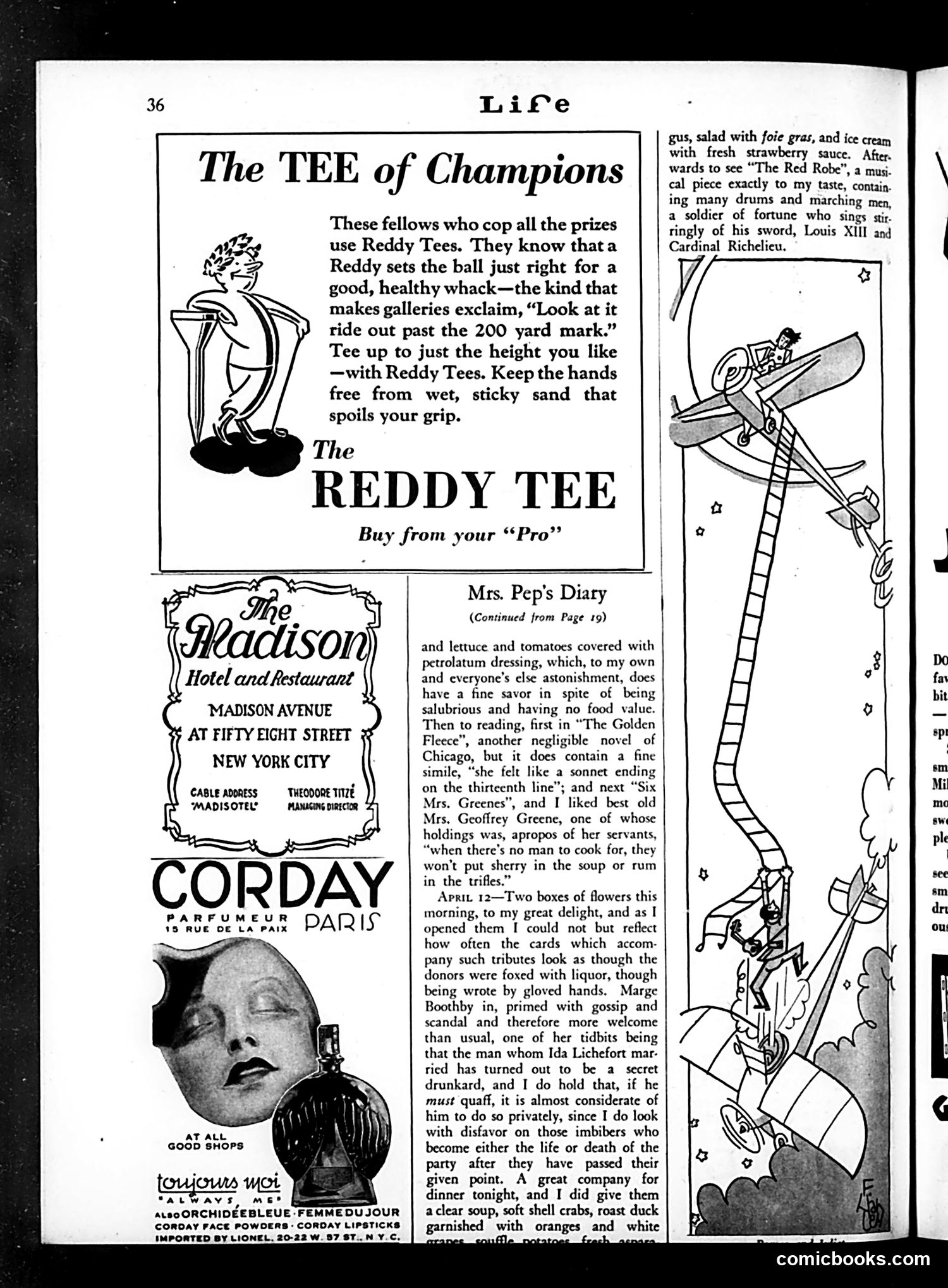
This page is primarily **advertising**, not political satire. The main content is a golf equipment ad for "Reddy Tees," a golf tee product. The ad uses the phrase "These fellows who cop all the prizes use Reddy Tees" to suggest that champions choose this brand—a common advertising strategy of attributing success to a product. The cartoon shows a stylized golfer figure promoting proper tee height and grip technique. The "point" is simply commercial: buy Reddy Tees for better golf performance. The page also contains "Mrs. Pep's Diary," a society column describing dinner parties and social gossip, plus advertisements for the Madison Hotel and Coty perfume products—all typical Life magazine content of the era. There is **no political satire or social commentary** on this page; it's standard 1920s-era advertising and lifestyle content.
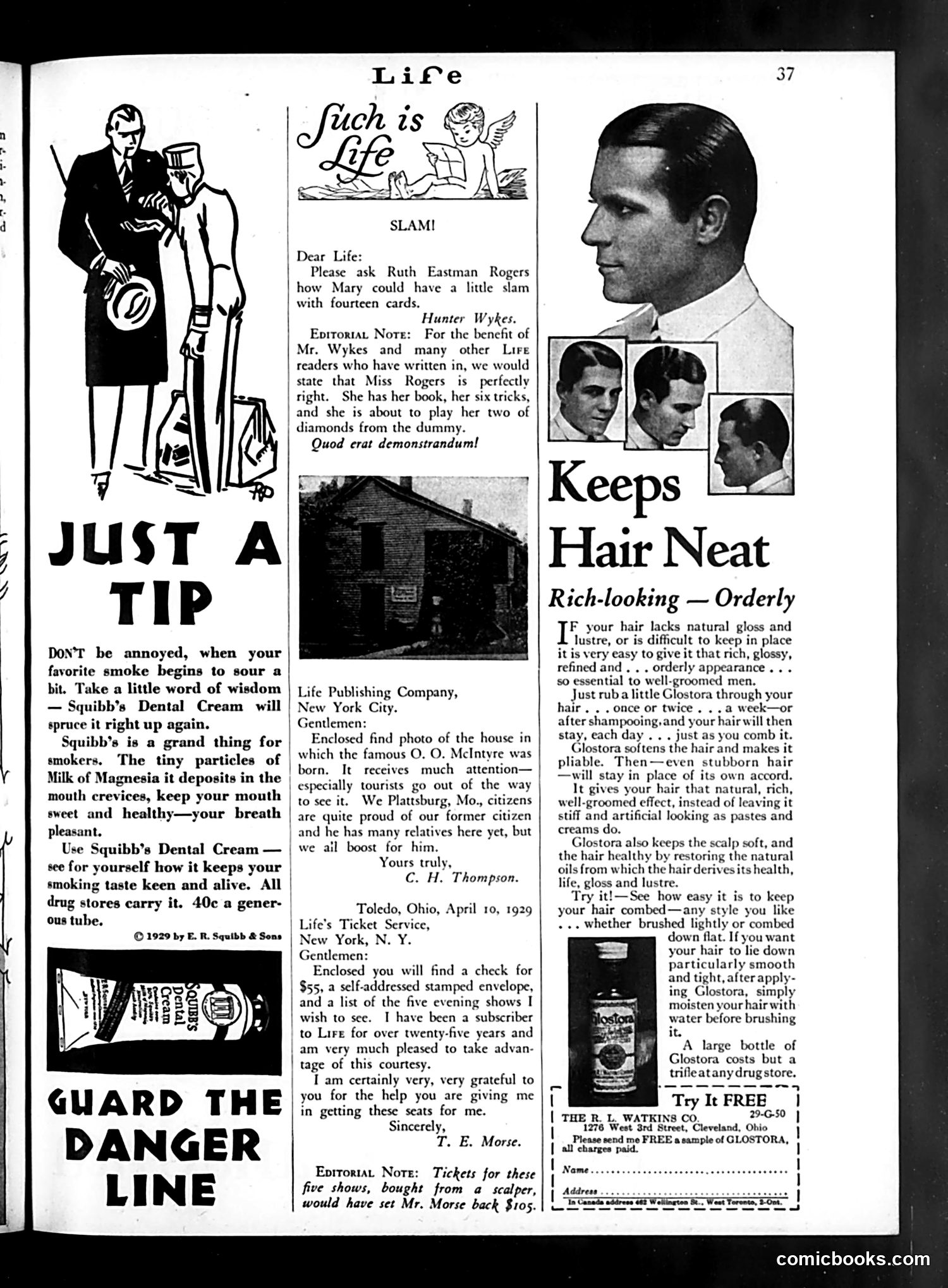
This page contains **advertisements and reader correspondence**, not political cartoons. The content reflects 1920s American consumer culture and Life magazine's reader-interaction features. The "SLAM!" section shows Life's bridge column addressing reader questions about card strategy—here, debating whether a player could legitimately play a low diamond from the dummy with fourteen cards in hand. The editorial note defends the columnist's correctness using Latin ("Quod erat demonstrandum"—"which was to be demonstrated"). Other letters praise Life's ticket service and mention O.O. McIntyre, a notable newspaper columnist of the era. The advertisements promote **Squibb's Dental Cream** (toothpaste marketed to smokers) and **Glostora** (hair pomade). These reflect period concerns: dental hygiene for smokers, and maintaining neat, oiled hair as a marker of respectability and masculinity for "well-groomed men."
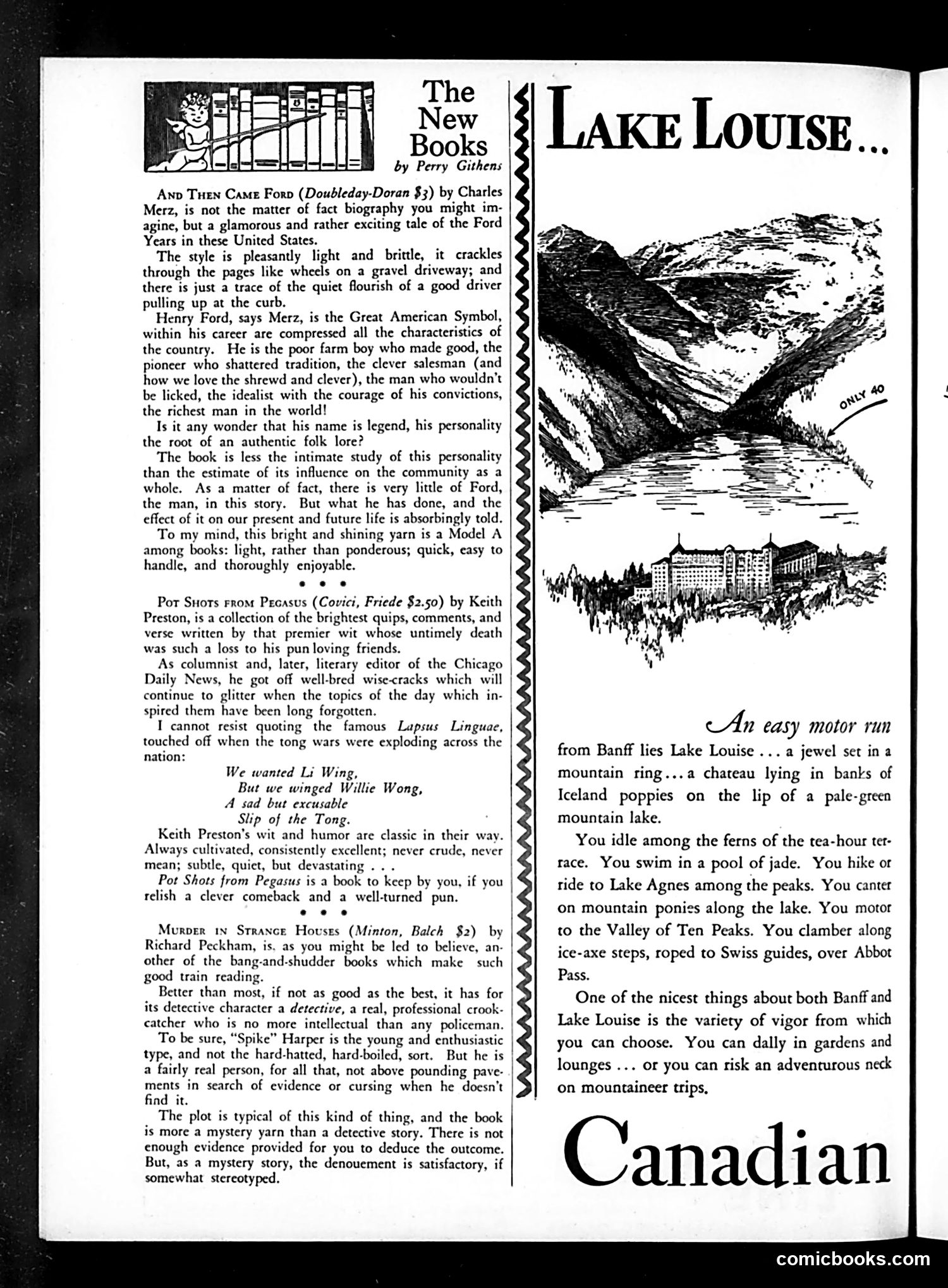
This page contains **book reviews** rather than political cartoons. The reviews by Perry Githens discuss three new books: 1. **"And Then Came Ford"** by Charles Merz—a glamorous historical account of Henry Ford's impact on American culture, positioning Ford as the quintessential "Great American Symbol" embodying American ideals (the poor farm boy who made good, the pioneer, the shrewd businessman). 2. **"Pot Shots from Pegasus"** by Keith Preston—a collection of witty quips and verses, including a poem mocking the Chicago tong wars ("We wanted Li Wing, / But we winged Willie Wong"). 3. **"Murder in Strange Houses"** by Richard Peckham—a detective mystery novel. The page also includes a **travel advertisement** for Lake Louise in the Canadian Rockies, emphasizing leisurely activities and scenic beauty. There are no political cartoons visible on this page. It appears to be a literary review section with adjacent tourism advertising.
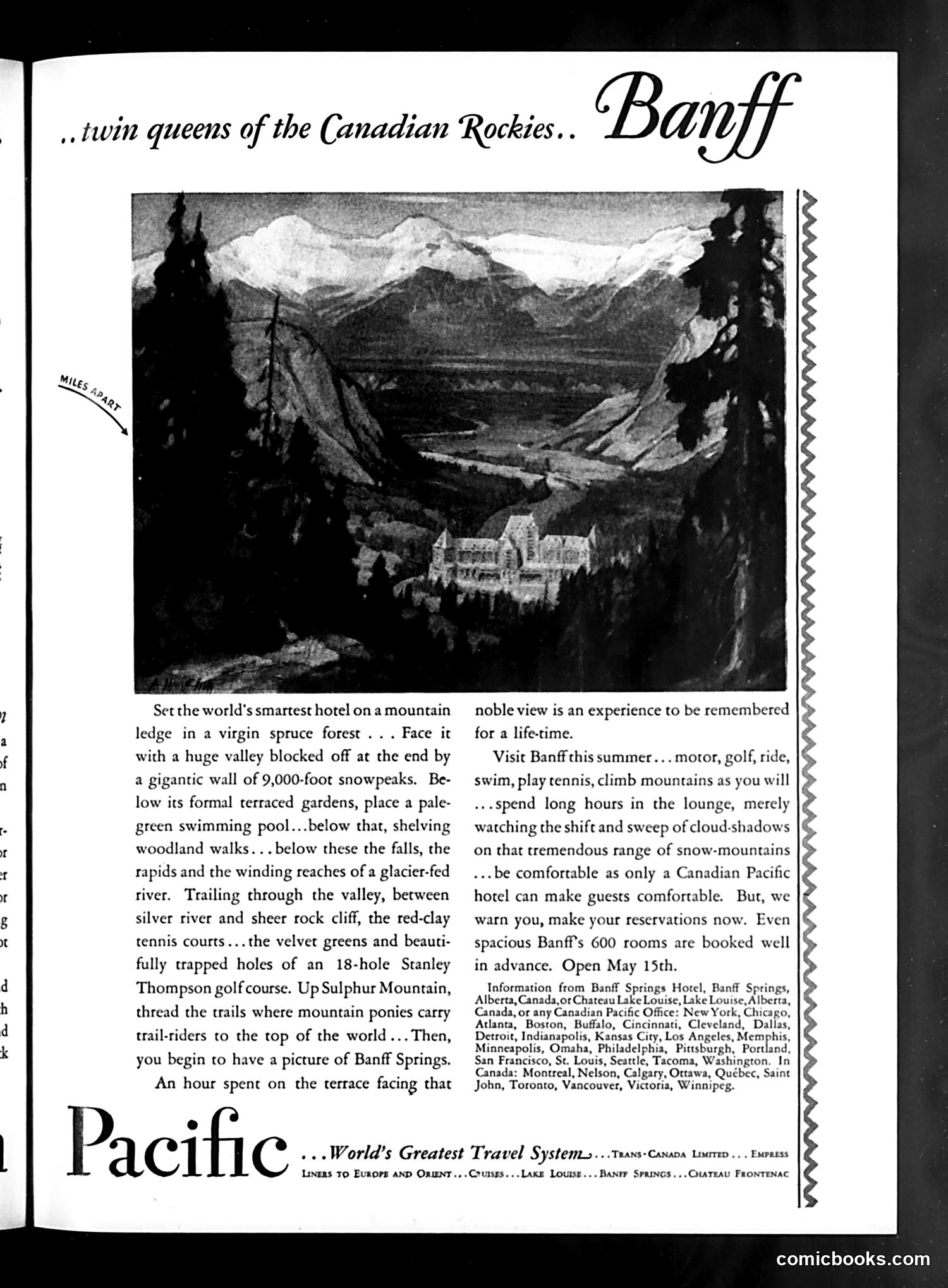
This is **not a cartoon or satire**—it's a straightforward **travel advertisement** for Banff Springs Hotel in Alberta, Canada, run by Canadian Pacific Railways. The page promotes the hotel as a luxury mountain resort featuring snow-capped peaks, formal gardens, a swimming pool, golf course, tennis courts, and horseback riding trails. The "twin queens of the Canadian Rockies" refers poetically to two prominent peaks framing the valley view. The text emphasizes exclusivity and natural grandeur, appealing to affluent travelers seeking leisure activities. A notable detail: the ad warns that "even spacious Banff's 600 rooms are booked well in advance," suggesting post-Depression prosperity and renewed tourist travel (the hotel opened May 15th). This represents early-to-mid 20th century promotional advertising using evocative language and landscape photography—common in *Life* magazine, which mixed journalism, satire, and commercial content.
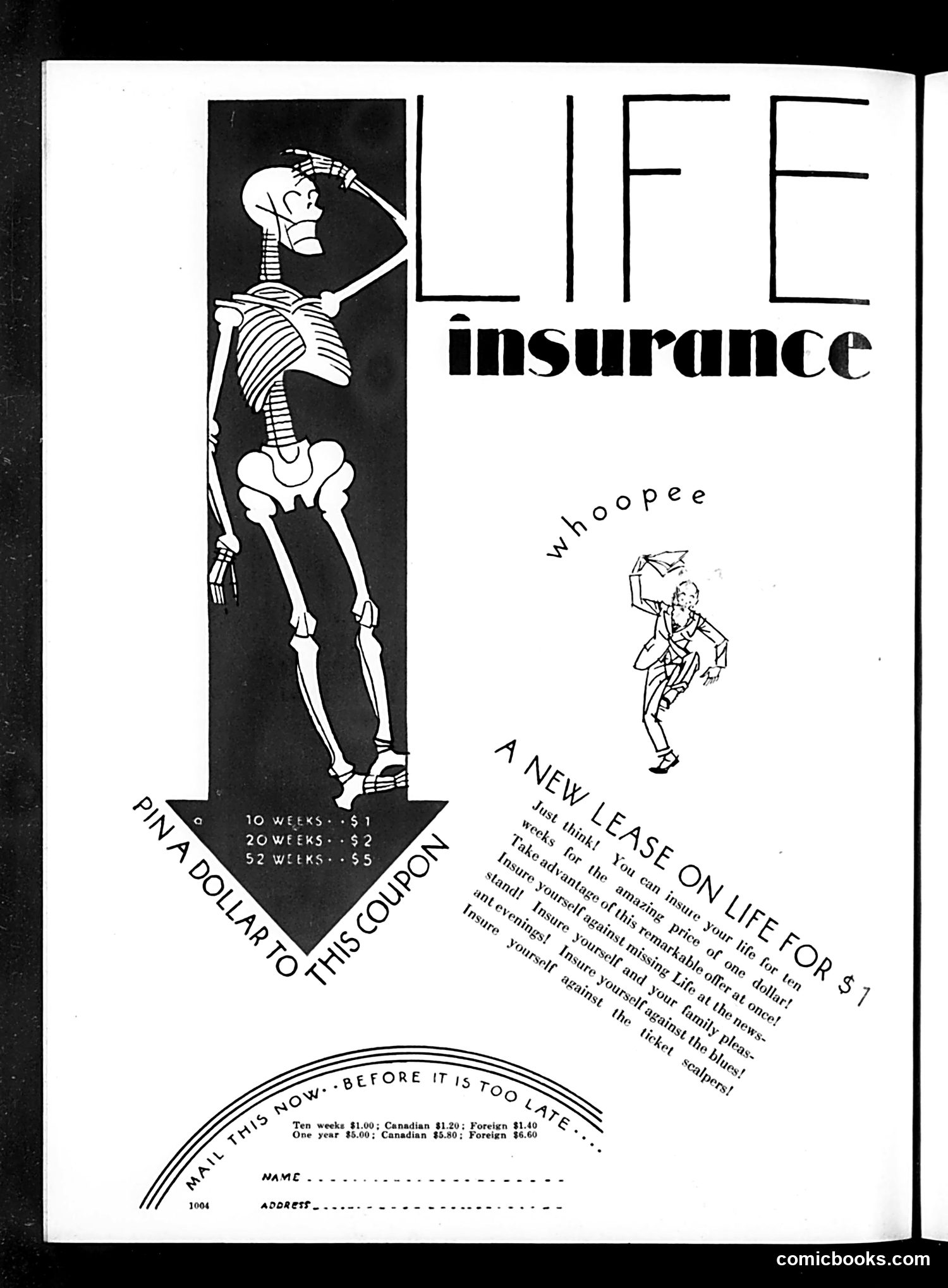
This is a **Life insurance advertisement**, not political satire. The page features a skeleton in formal attire as the main visual, alongside text promoting "A NEW LEASE ON LIFE FOR 3¢." The skeleton represents mortality and death—the traditional memento mori imagery. The ad's dark humor plays on this: by purchasing Life insurance, one can financially protect oneself against death's inevitability. The small figure labeled "whoopee" (suggesting carefree living) contrasts with the skeleton, implying that life insurance allows people to enjoy themselves without fear of leaving dependents destitute. The coupon structure and pricing (10 weeks for $1.00, etc.) indicate this is a mail-in subscription offer for Life magazine itself, which apparently sold life insurance policies to readers. The macabre skeleton-as-salesman was contemporary advertising humor.
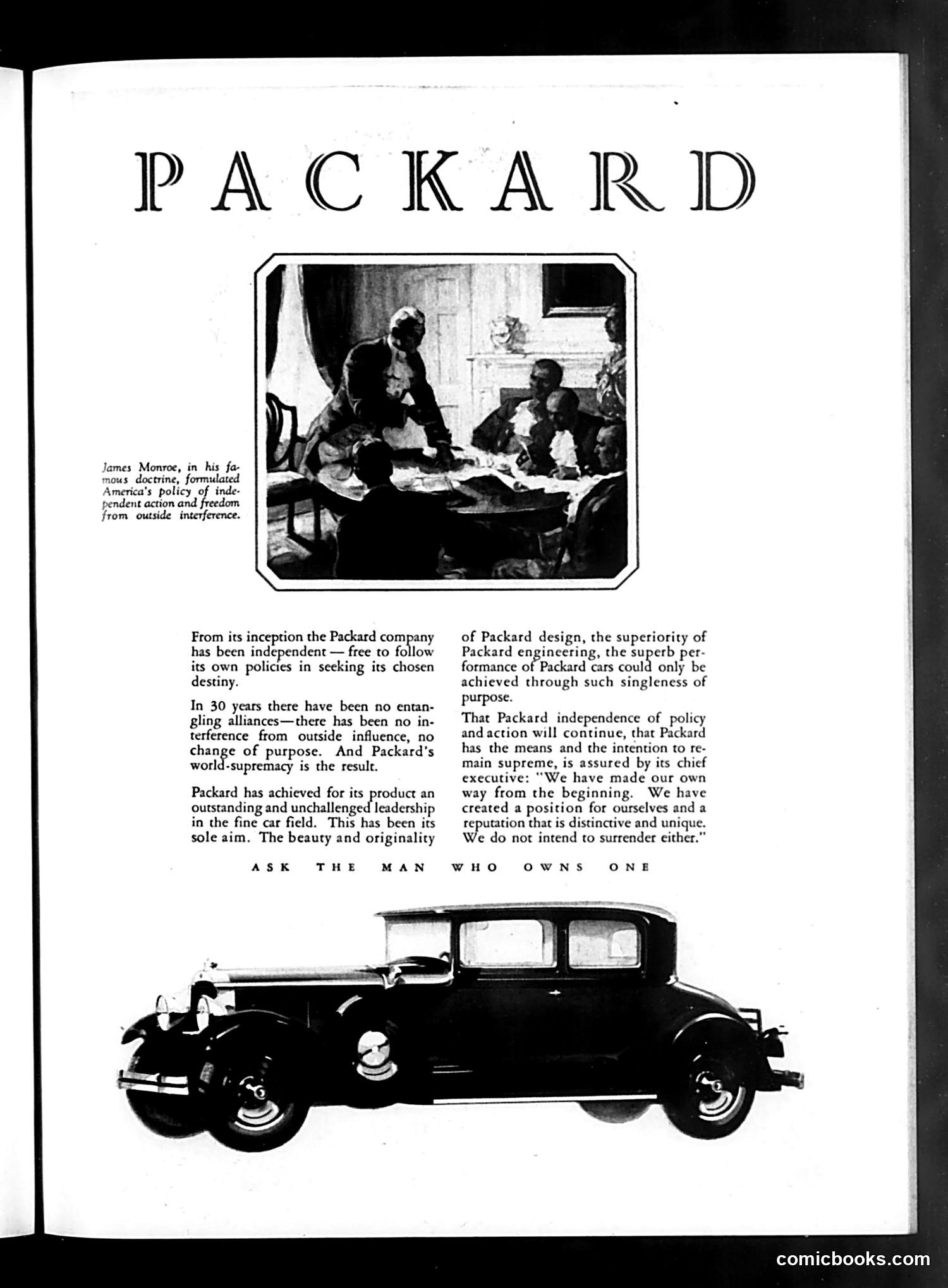
This is a **Packard automobile advertisement**, not political satire. It uses the Monroe Doctrine—America's 1823 policy of independent action free from foreign interference—as a rhetorical parallel to justify Packard's corporate independence and market dominance. The ad's historical photograph shows James Monroe and his cabinet formulating the doctrine. The comparison argues that Packard's 30-year refusal of "entangling alliances" (partnerships, interference) has resulted in automotive supremacy, mirroring how Monroe Doctrine independence supposedly benefited America. The tagline "Ask the man who owns one" was Packard's actual advertising slogan. The car image below showcases their luxury sedan. **The point**: Packard equates corporate independence with patriotic American values, suggesting that buying their car supports American self-determination—a nationalist marketing strategy typical of early 20th-century luxury brands.
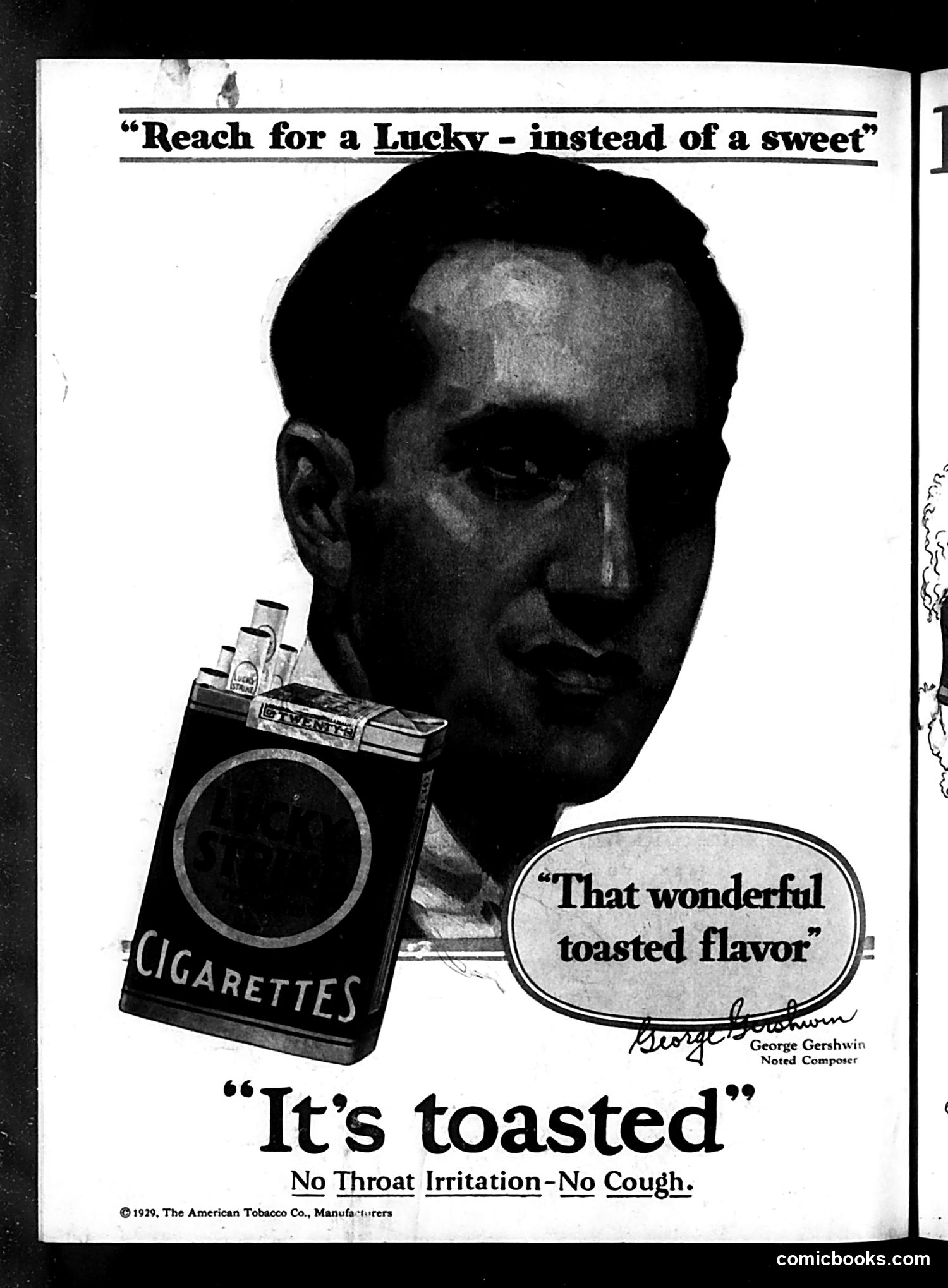
This is a **cigarette advertisement**, not political satire. It's a Lucky Strike ad from 1929 featuring a testimonial from George Gershwin, the noted composer. The ad uses his celebrity endorsement to promote cigarettes as a weight-management alternative to candy ("reach for a Lucky instead of a sweet"). The tagline "It's toasted" and claims of "No Throat Irritation—No Cough" reflect early cigarette marketing that positioned smoking as harmless or even beneficial. Modern readers should note this represents pre-warning-label advertising that could make health claims without scientific evidence—practices now illegal in the U.S. The ad exploits both health anxiety and celebrity influence in ways we'd recognize as predatory marketing today.