
Life, 1929-05-03 · page 26 of 44
Life — May 3, 1929 — page 26: what you’re looking at
What you’re looking at
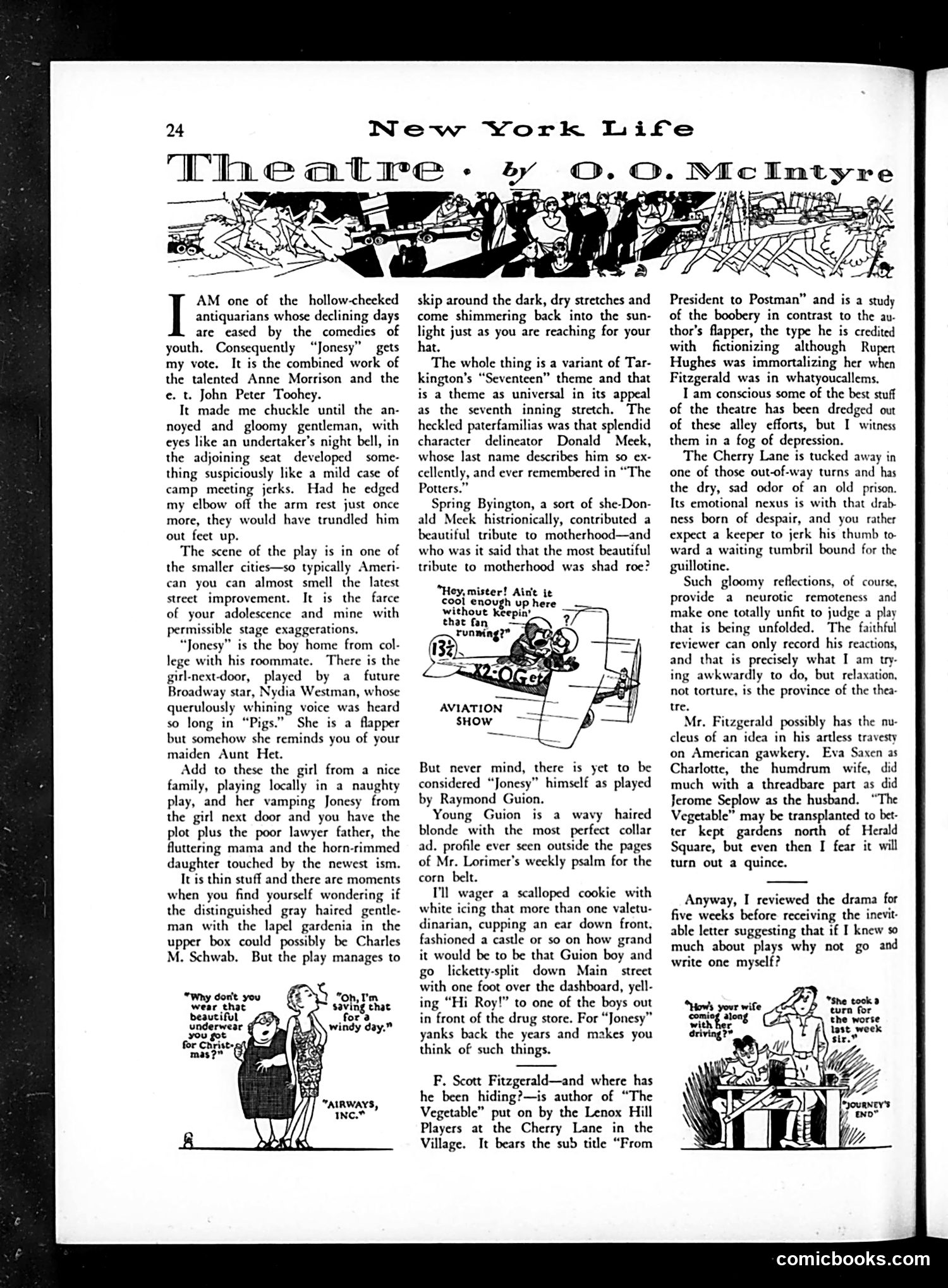
This page reviews two Broadway plays from the 1920s era. The main review covers "Jonesy," a comedy about college-aged romance in small-town America, written by Anne Morrison and John Peter Toohey. The critic praises its universal appeal—comparing it to Booth Tarkington's "Seventeen"—though acknowledges its thin plot. He highlights the performances of actors like Raymond Guion and Nydia Westman. A secondary review mentions F. Scott Fitzgerald's play "The Vegetable," performed at the Cherry Lane Theatre in Greenwich Village. The critic notes Fitzgerald's social commentary contrasting working-class "boobery" with flappers—the modern young women Fitzgerald famously depicted in his novels. The cartoons are theatrical advertisements, including one for an "Aviation Show." The humor assumes readers' familiarity with contemporary Broadway productions and Fitzgerald's literary reputation.
📄 Transcribed text from this page (OCR, searchable)
Machine-transcribed from the original scan — historical spelling and the odd misread are preserved.
24 AM one of the hollow-checked I antiquarians whose declining days are eased by the comedies of youth. Consequently “Jonesy” gets my vote. It is the combined work of the talented Anne Morrison and the ¢. t. John Peter Toohey. It made me chuckle until the an- noyed and gloomy gentleman, with eyes like an undertaker’s night bell, in the adjoining seat developed some- thing suspiciously like a mild case of camp meeting jerks. Had he edged my elbow off the arm rest just once more, they would have trundled him out feet up. The scene of the play is in one of the smaller cities—so typically Ameri- can you can almost smell the latest street. improvement. It is the farce of your adolescence and mine with permissible stage exaggerations. “Jonesy” is the boy home from col- lege with his roommate. There is the girl-next-door, played by a future Broadway star, Nydia Westman, whose querulously whining voice was heard so long in “Pigs.” She is a flapper but somehow she reminds you of your maiden Aunt Het. Add to these the girl from a nice family, playing locally in a naughty play, and her vamping Jonesy from the girl next door and you have the plot plus the poor lawyer father, the fluttering mama and the horn-rimmed daughter touched by the newest ism. It is thin stuff and there are moments when you find yourself wondering if the distinguished gray haired gentle- man with the lapel gardenia in the upper box could possibly be Charles M. Schwab. But the play manages to “Why don't you wear that “AIRWAYS, INC.* skip around the dark, dry stretches and come shimmering back into the sun- light just as you are reaching for your at. The whole thing is a variant of Tar- kington’s “Seventeen” theme and that is a theme as universal in its appeal as the seventh inning stretch. The heckled paterfamilias was that splendid character delineator Donald Meek, whose last name describes him so ex- cellently, and ever remembered in “The Potters.” Spring Byington, a sort of she-Don- ald Meck histrionically, contributed a beautiful tribute to motherhood—and who was it said that the most beautiful tribute to motherhood was shad roe? “Hey, mister! Aint it cool enough up here _ without keepin’ that fan Lies AVIATION SHOW But never mind, there is yet to be considered “Jonesy” himself as played by Raymond Guion. Young Guion is a wavy haired blonde with the most perfect collar ad. profile ever seen outside the pages of Mr. Lorimer’s weekly psalm for the corn belt. T'll wager a scalloped cookie with white icing that more than one valetu- dinarian, cupping an ear down front, fashioned a castle or so on how grand it would be to be that Guion boy and go licketty-split down Main street with one foot over the dashboard, yell- ing “Hi Roy!” to one of the boys out in front of the drug store. For “Jonesy” yanks back the years and makes you think of such things. F. Scott Fitzgerald—and where has he been hiding?—is author of “The Vegetable” put on by the Lenox Hill Players at the Cherry Lane in the Village. It bears the sud title “From New York Life President to Postman” and is a study of the boobery in contrast to the au- thor’s flapper, the type he is credited with fictionizing although Rupert Hughes was immortalizing her when Fitzgerald was in whatyoucallems. I am conscious some of the best stuff of the theatre has been dredged out of these alley efforts, but I witness them in a fog of depression. The Cherry Lane is tucked away in one of those out-of-way turns and has the dry, sad odor of an old prison. Its emotional nexus is with that drab- ness born of despair, and you rather expect a keeper to jerk his thumb to- ward a waiting tumbril bound for the guillotine. Such gloomy reflections, of course, provide a neurotic remoteness and make one totally unfit to judge a play that is being unfolded. The faithful reviewer can only record his reactions, and that is precisely what I am wy- ing awkwardly to do, but relaxation, not torture, is the province of the thea- ure. Mr. Fitzgerald possibly has the nu- cleus of an idea in his artless travesty on American gawkery. Eva Saxen as Charlotte, the humdrum wife, did much with a threadbare part as did Jerome Seplow as the husband. “The Vegetable” may be transplanted to bet- ter kept gardens north of Herald Square, but even then I fear it will turn out a quince. Anyway, I reviewed the drama for five weeks before receiving the inevit- able letter suggesting that if I knew so much about plays why not go and write one myself? comicbooks.com