
Life, 1929-05-03 · page 40 of 44
Life — May 3, 1929 — page 40: what you’re looking at
What you’re looking at
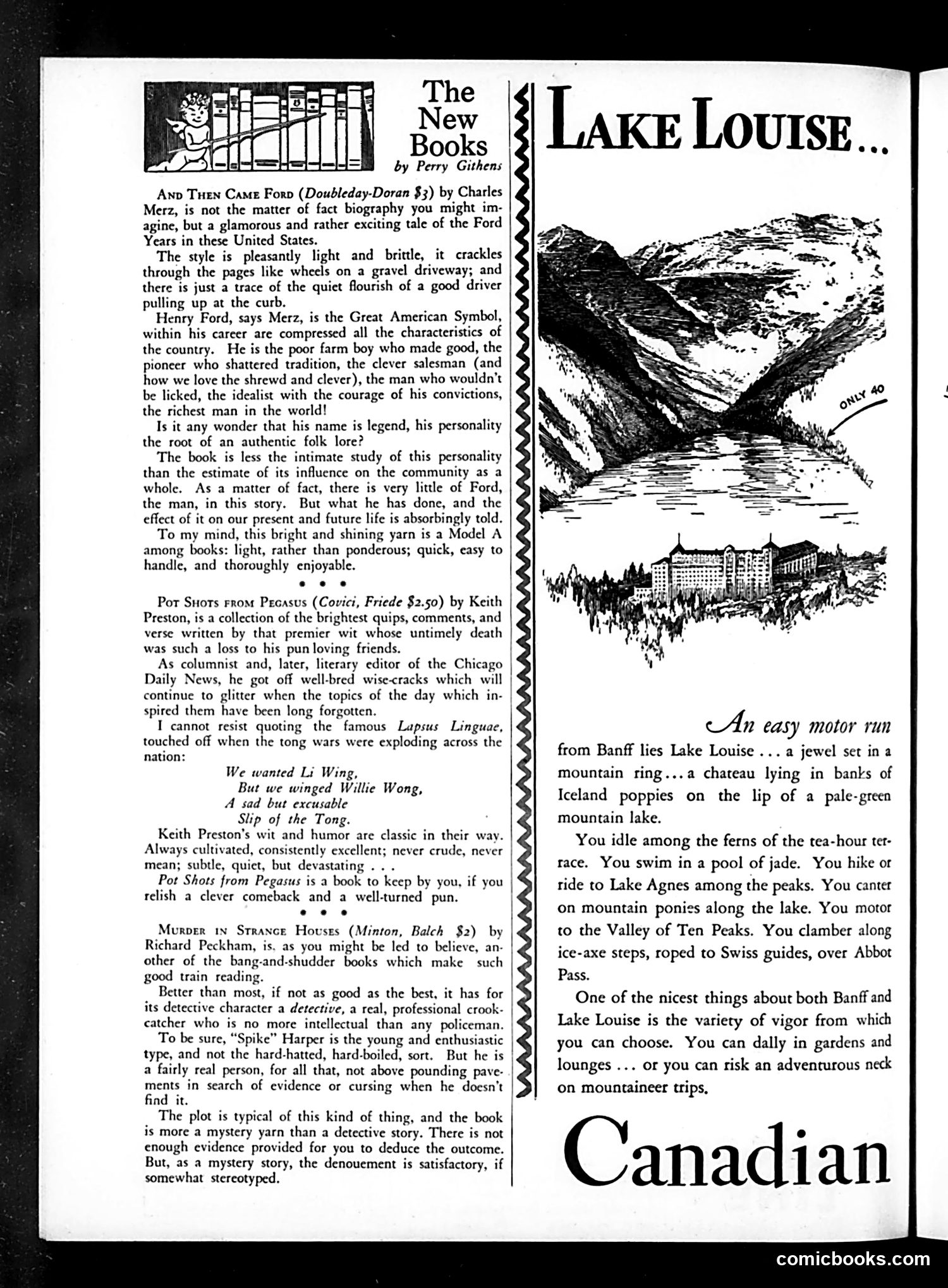
This page contains **book reviews** rather than political cartoons. The reviews by Perry Githens discuss three new books: 1. **"And Then Came Ford"** by Charles Merz—a glamorous historical account of Henry Ford's impact on American culture, positioning Ford as the quintessential "Great American Symbol" embodying American ideals (the poor farm boy who made good, the pioneer, the shrewd businessman). 2. **"Pot Shots from Pegasus"** by Keith Preston—a collection of witty quips and verses, including a poem mocking the Chicago tong wars ("We wanted Li Wing, / But we winged Willie Wong"). 3. **"Murder in Strange Houses"** by Richard Peckham—a detective mystery novel. The page also includes a **travel advertisement** for Lake Louise in the Canadian Rockies, emphasizing leisurely activities and scenic beauty. There are no political cartoons visible on this page. It appears to be a literary review section with adjacent tourism advertising.
📄 Transcribed text from this page (OCR, searchable)
Machine-transcribed from the original scan — historical spelling and the odd misread are preserved.
The New Books mee B aistiil (all by Perry Githens Anp THen Came Forp (Doubleday-Doran $3) by Charles Merz, is not the matter of fact biography you might im- agine, but a glamorous and rather exciting tale of the Ford Years in these United States. The style is pleasantly light and brittle, it crackles through the pages like wheels on a gravel driveway; and there is just a trace of the quiet flourish of a good driver pulling up at the curb. Henry Ford, says Merz, is the Great American Symbol, within his career are compressed all the characteristics of the country. He is the poor farm boy who made good, the pioneer who shattered tradition, the clever salesman (and how we love the shrewd and clever), the man who wouldn't be licked, the idealist with the courage of his convictions, the richest man in the world! Is it any wonder that his name is legend, his personality the root of an authentic folk lore? The book is less the intimate study of this personality than the estimate of its influence on the community as a whole. As a matter of fact, there is very little of Ford, the man, in this story. But what he has done, and the effect of it on our present and future life is absorbingly told. To my mind, this bright and shining yarn is a Model A among books: light, rather than ponderous; quick, easy to handle, and thoroughly enjoyable. Por Suots From Pecasus (Covici, Friede $2.50) by Keith Preston, is a collection of the brightest quips, comments, and | verse written by that premier wit whose untimely death was such a loss to his pun loving friends. As columnist and, later, literary editor of the Chicago Daily News, he got off well-bred wise-cracks which will | continue to glitter when the topics of the day which in- spired them have been long forgotten. I cannot resist quoting the famous Lapsus Linguae, touched off when the tong wars were exploding across the nation: We wanted Li Wing, But we winged Willie Wong, A sad but excusable Slip of the Tong. Keith Preston's wit and humor are classic in their way. Always cultivated, consistently excellent; never crude, never | mean; subtle, quiet, but devastating . . . Pot Shots from Pegasus is a book to keep by you, if you | relish a clever comeback and a well-turned pun. eee Murpver in Strance Hovses (Minton, Balch $2) by Richard Peckham, is, as you might be led to believe, an- other of the bang-and-shudder books which make such good train reading. Better than most, if not as good as the best, it has for its detective character a detective, a real, professional crook- catcher who is no more intellectual than any policeman. To be sure, “Spike” Harper is the young and enthusiastic | type, and not the hard-hatted, hard-boiled, sort. But he is a fairly real person, for all that, not above pounding pave- | ments in search of evidence or cursing when he doesn’t find it. The plot is typical of this kind of thing, and the book is more a mystery yarn than a detective story. There is not enough evidence provided for you to deduce the outcome. But, as a mystery story, the denouement is satisfactory, if somewhat stereotyped. An easy motor run from Banff lies Lake Louise ... a jewel set in a mountain ring...a chateau lying in banks of Iceland poppies on the lip of a pale-green mountain lake. You idle among the ferns of the tea-hour tet- race. You swim in a pool of jade. You hike or tide to Lake Agnes among the peaks. You canter on mountain ponies along the lake. You motor to the Valley of Ten Peaks. You clamber along ice-axe steps, roped to Swiss guides, over Abbot Pass. One of the nicest things about both Banff and Lake Louise is the variety of vigor from which you can choose. You can dally in gardens and lounges ... or you can risk an adventurous neck on mountaineer trips, Canadian comicbooks.com