
A complete issue · 34 pages · 1928
Life — March 22, 1928
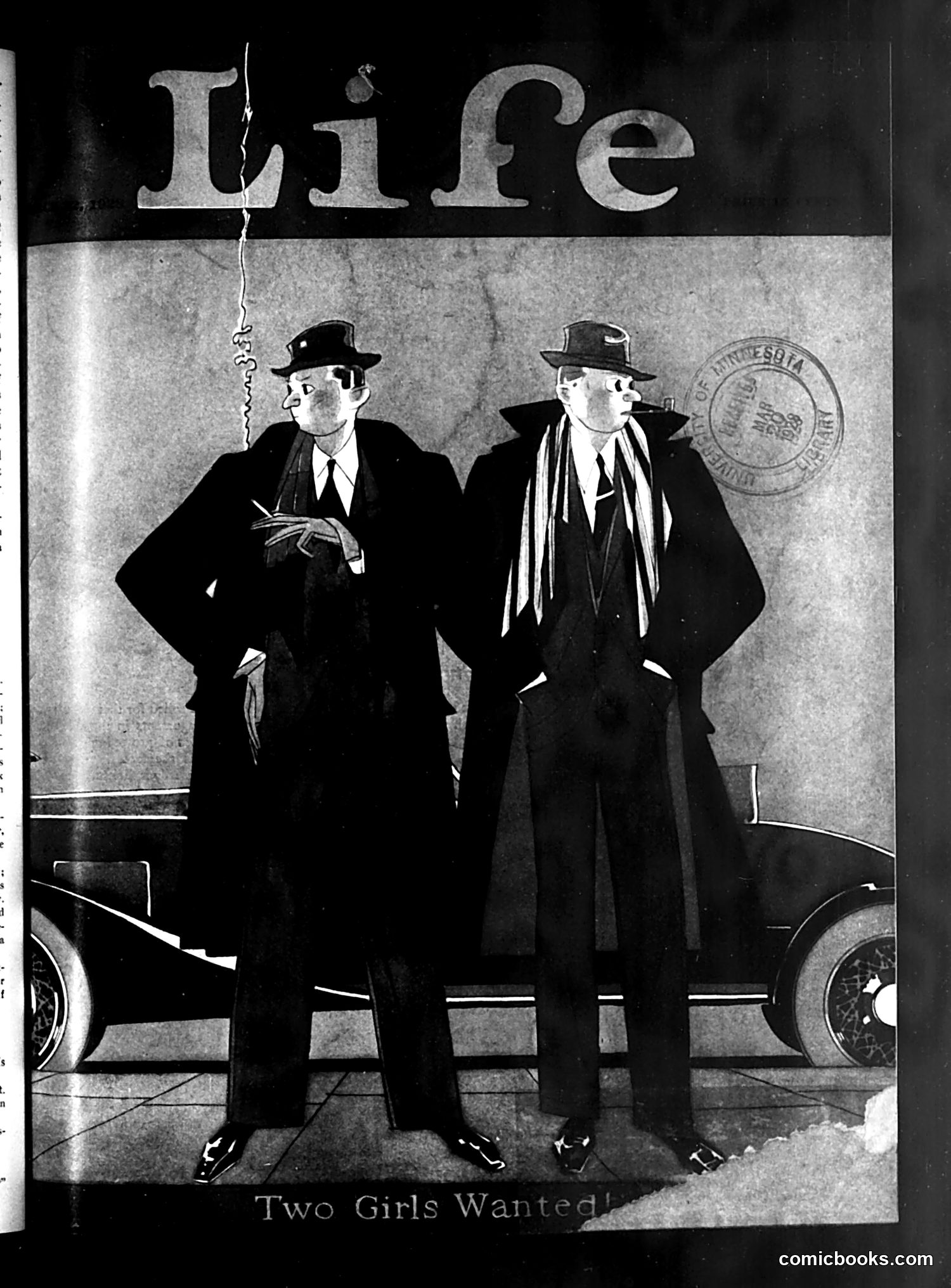
This is a cover from *Life* magazine titled "Two Girls Wanted," showing two men in formal attire standing beside a car. The image appears to be promoting a silent film or theatrical production—the caption indicates a narrative about women being sought. The satire likely comments on early 20th-century romantic comedies or melodramas, where "wanted" women were stock plot devices. The men's exaggerated formal dress and serious expressions contrast with what's probably intended as comedic subject matter. The automobile suggests contemporary (1920s-era) setting, emphasizing modernity. Without clearer identification of the specific production or figures depicted, the exact satirical target remains unclear, though the overall tone suggests mockery of popular entertainment conventions of the period.
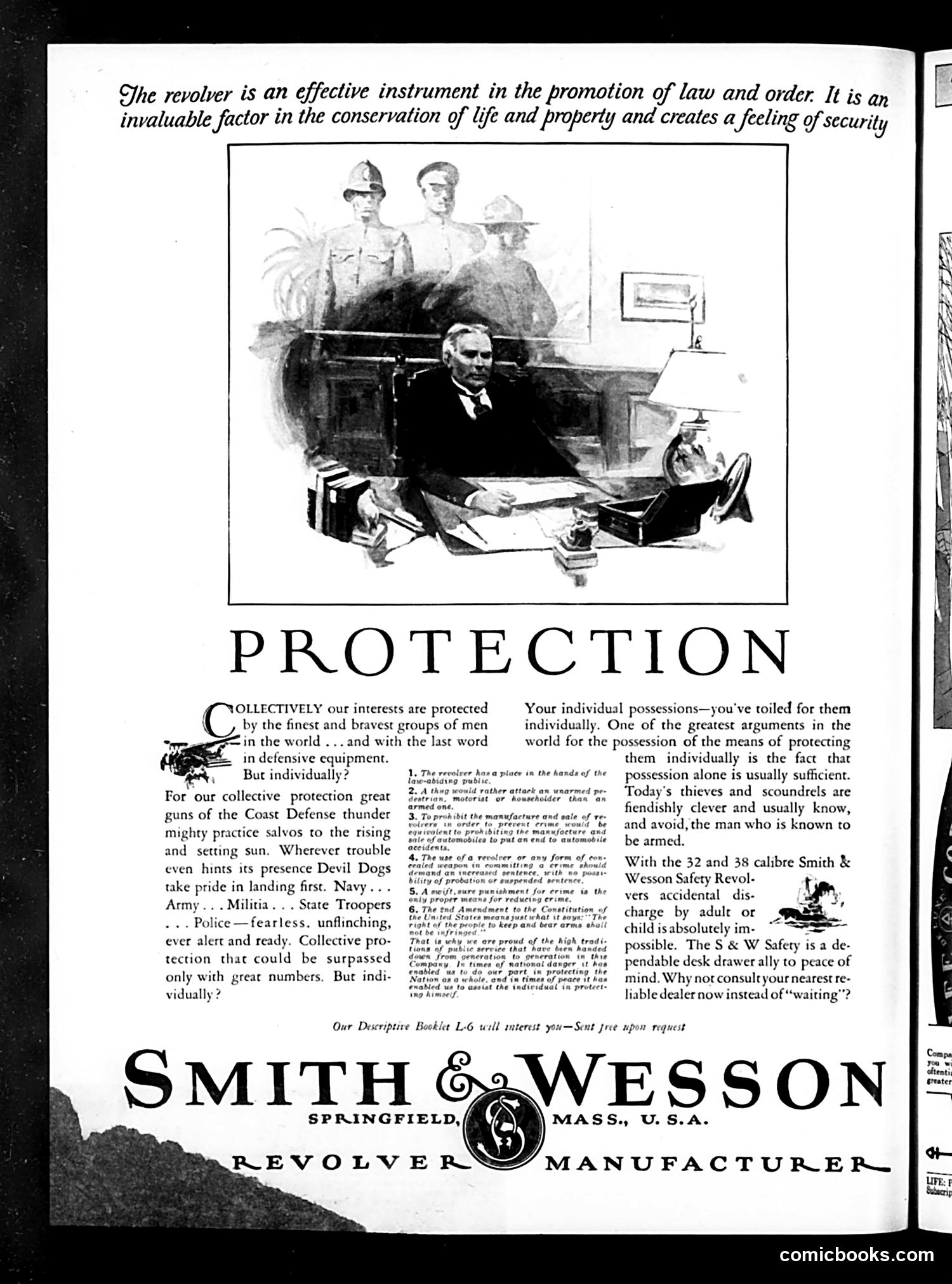
This is a Smith & Wesson revolver advertisement, not satire. The page uses the headline "PROTECTION" to market firearms for both collective (police, military) and individual self-defense. The illustration shows a man at a desk with armed figures looming behind him—a visual argument that personal firearm ownership deters crime. The accompanying text argues that while organized groups (Army, Police) provide collective security, individuals need personal weapons because "possession alone is usually sufficient" to prevent theft. The advertisement targets middle-class anxiety about crime and personal safety, promoting the revolver as essential to peace of mind. It's early-20th-century marketing that equates gun ownership with security and responsibility, positioning the firearm as a practical, necessary tool for law-abiding citizens.
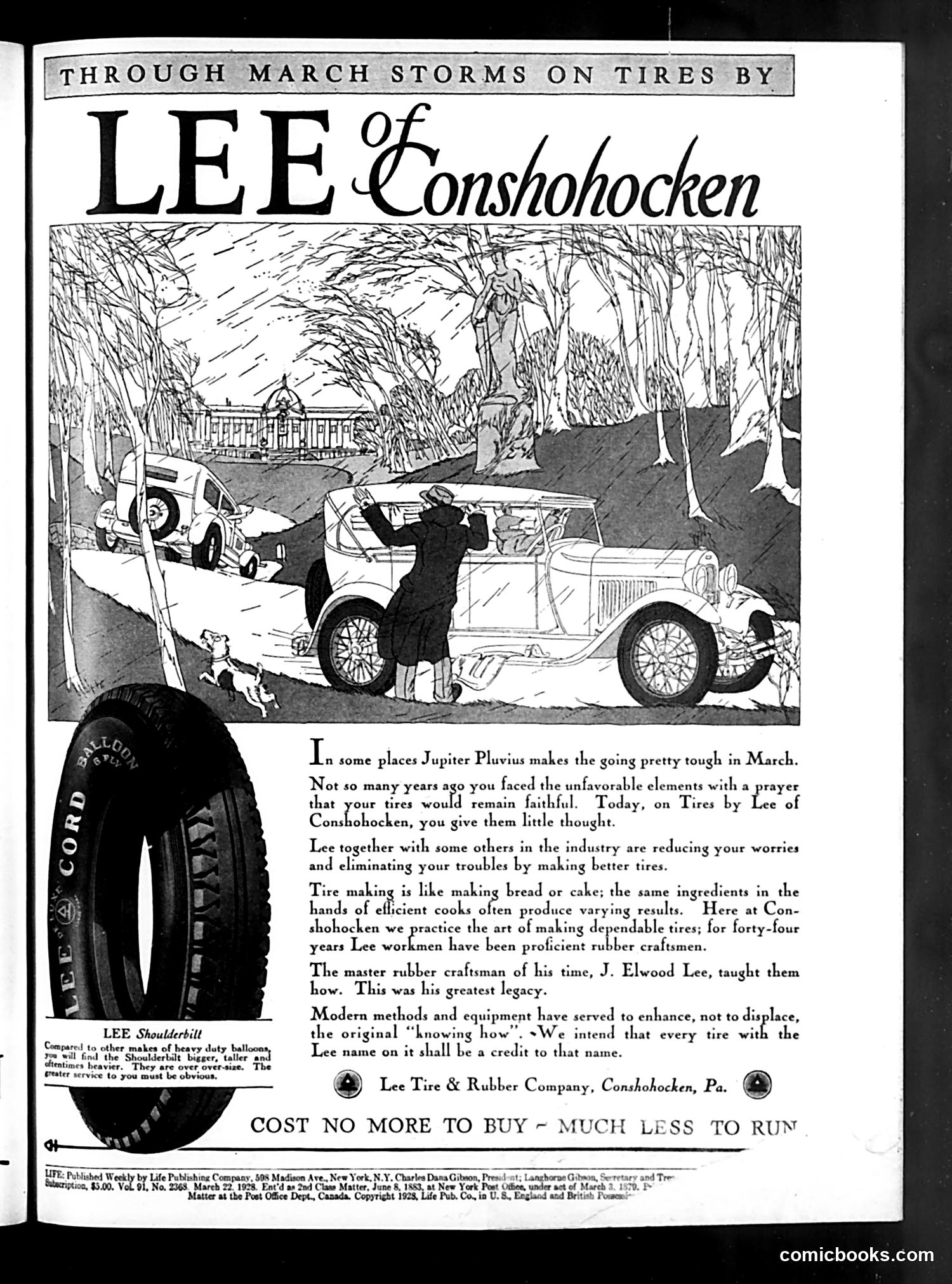
This is primarily a **commercial advertisement**, not political satire. It promotes Lee Tire & Rubber Company's tires made in Conshohocken, Pennsylvania. The advertisement uses a humorous scenario: cars stranded in a snowy March storm seek shelter under trees. The copy claims Lee tires are reliably made ("dependable tires") through traditional craftsmanship inherited from J. Elwood Lee, the company's founder and "master rubber craftsman." The messaging emphasizes that despite modern manufacturing methods, Lee maintains the original quality standards ("knowing how") that make their tires trustworthy in harsh conditions. The tagline promises: "Cost No More to Buy—Much Less to Run." The era appears early-to-mid twentieth century based on the automobile styles and typography. This is product marketing, not editorial commentary.
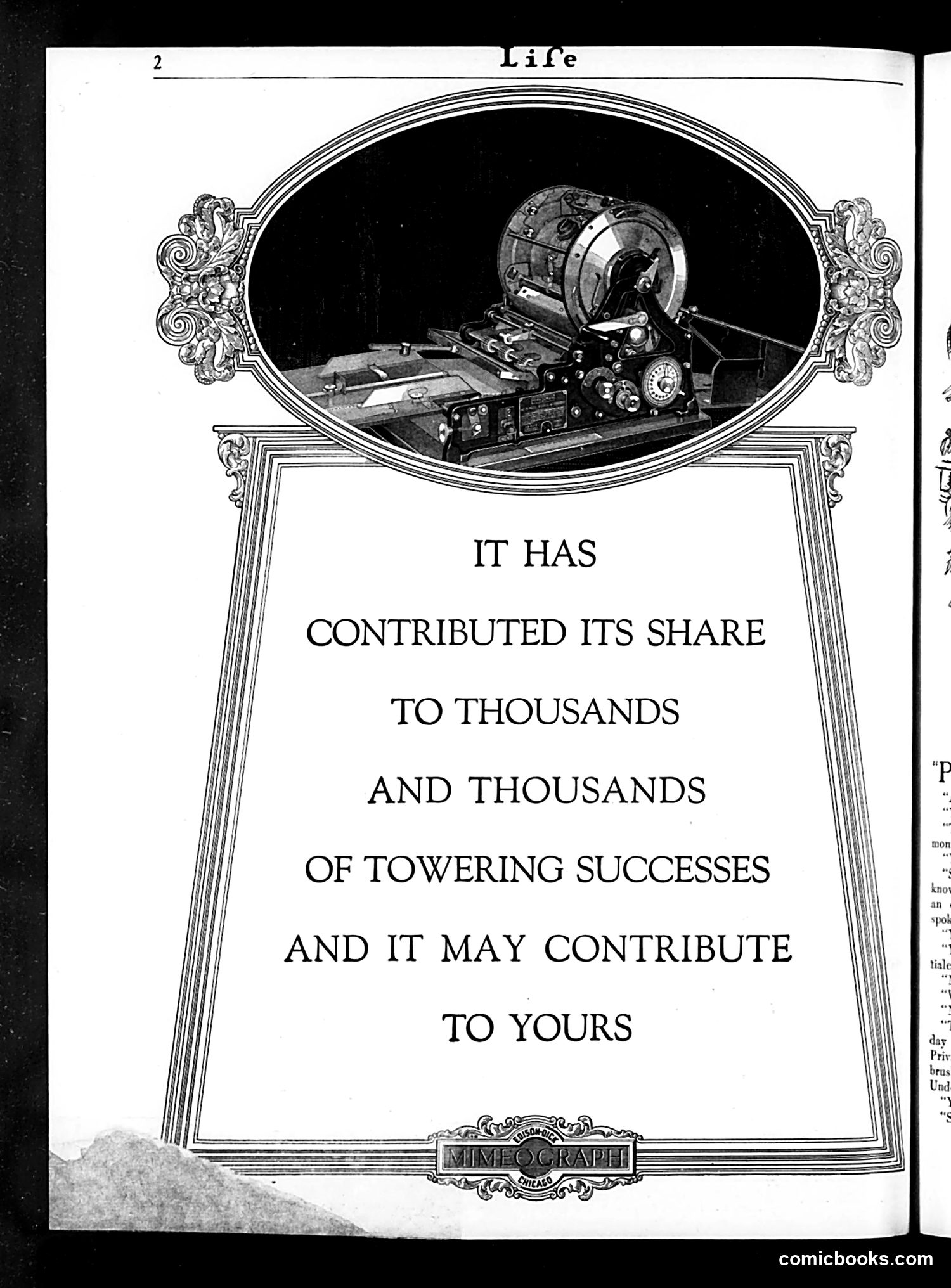
This appears to be a **Mimeograph brand advertisement** rather than political satire. The page shows industrial/office equipment (a mimeograph machine—a early photocopier) displayed in an ornate decorative frame typical of early 20th-century advertising. The text uses aspirational language common to business advertising of that era: the machine has "contributed its share to thousands and thousands of towering successes" and "may contribute to yours." This is a pitch promising that purchasing this equipment will help businesses achieve success. The elaborate Art Nouveau-style borders and formal typography reflect the magazine's upscale aesthetic. This is commercial messaging, not political commentary—marketing office technology to ambitious businesspeople and companies.
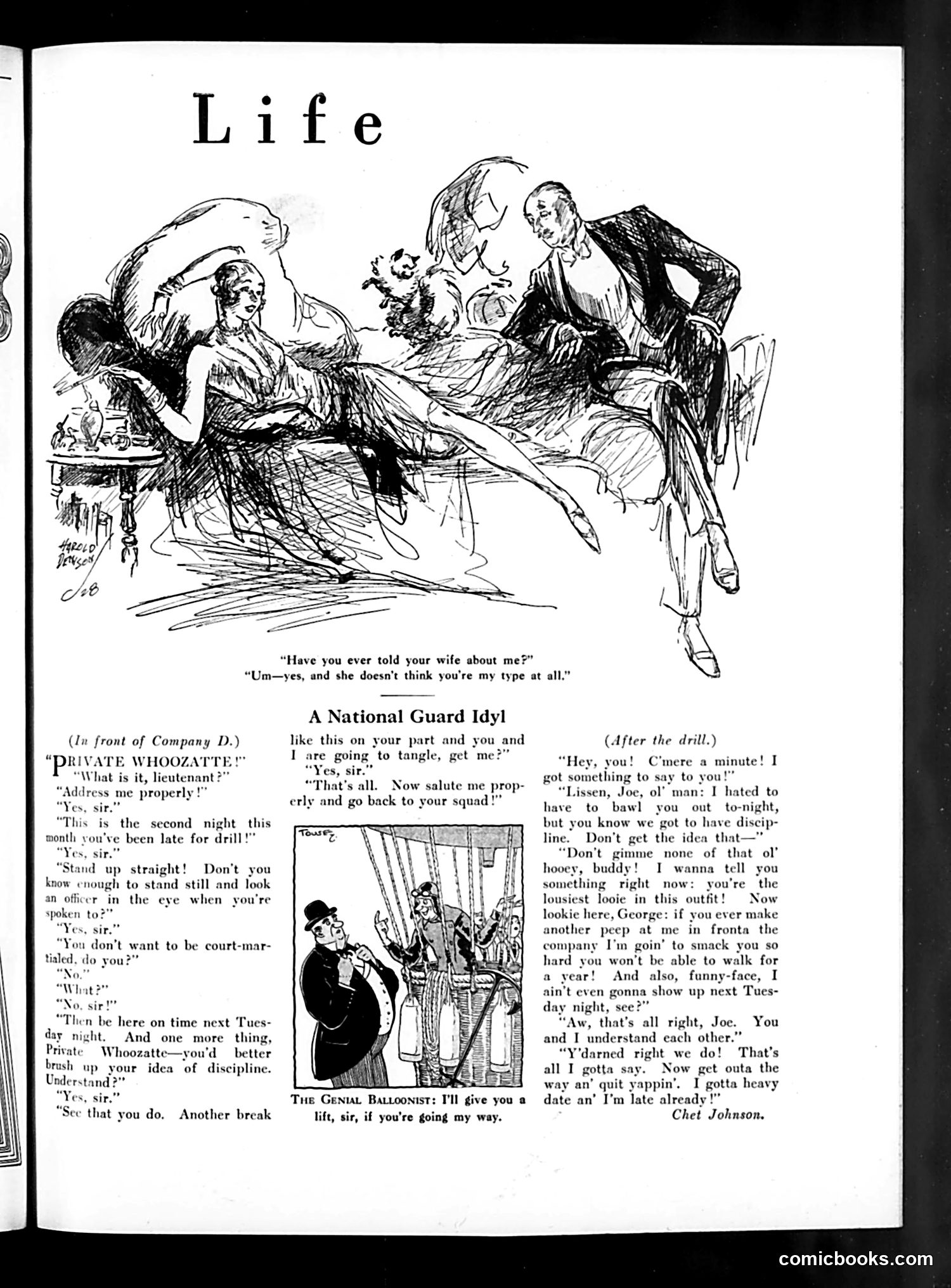
This page from Life magazine contains two separate pieces satirizing military life during what appears to be the early 20th century. The top cartoon depicts a domestic scene where a man is flirting with a woman while her husband watches—captioned "Have you ever told your wife about me?" with her dismissive response. Below are two sketches labeled "A National Guard Idyl" showing military discipline scenarios. The first ("Private Whoozatte") depicts a sergeant harshly correcting a soldier's posture and deportment, emphasizing rigid military protocol. The second illustration ("The Genial Balloonist") shows what appears to be a more humorous interaction, possibly depicting a balloon operator offering assistance to a soldier. The text captures period military slang and the exaggerated formality of military rank and discipline, satirizing the contrast between strict military hierarchy and the casual relationships soldiers might form.
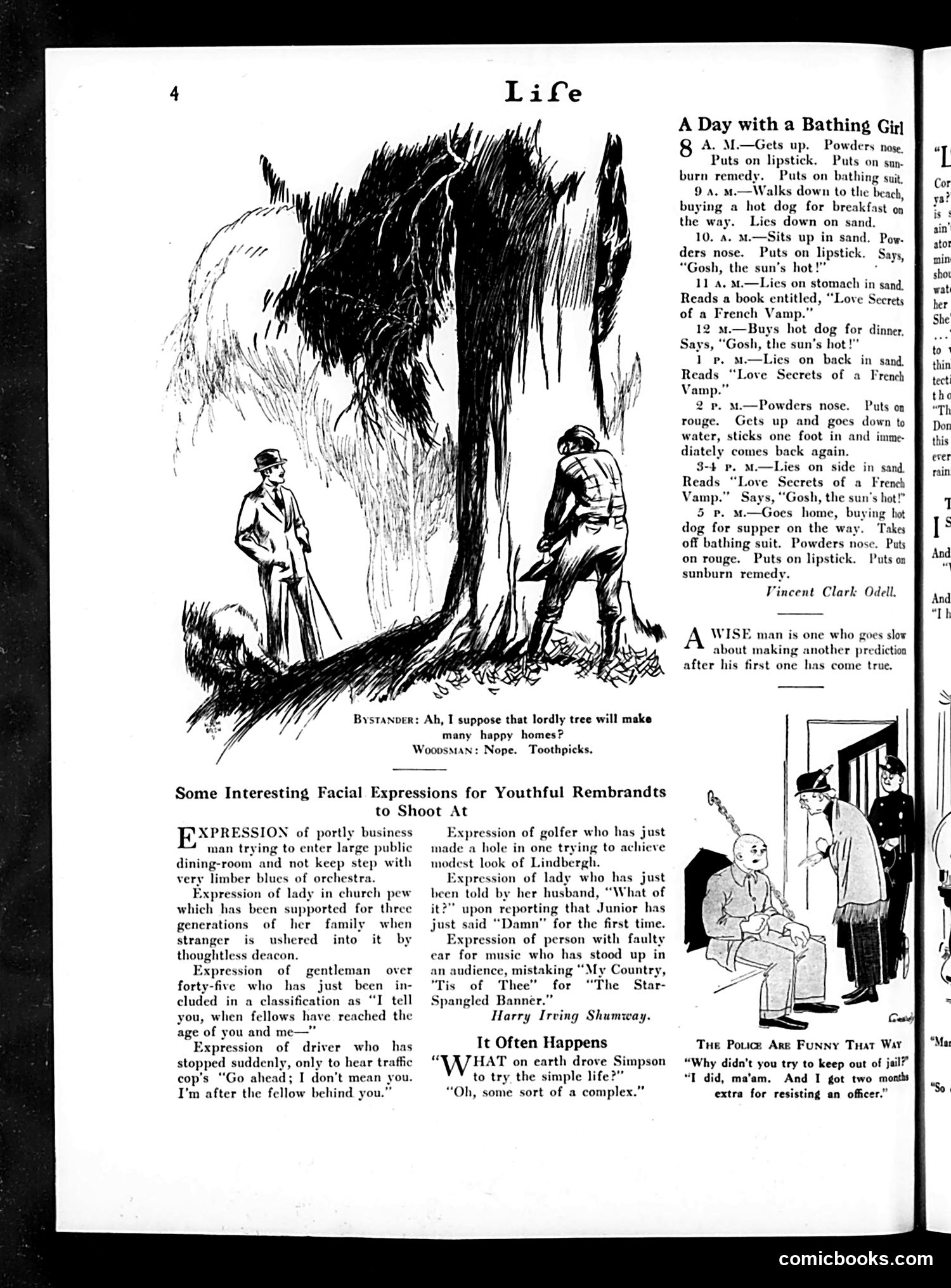
This page from *Life* magazine contains several humorous pieces satirizing early 20th-century social behavior and attitudes. The main cartoon depicts two men encountering a massive tree, with the caption joking that it will produce "toothpicks" rather than "happy homes"—satirizing optimistic but impractical social planning. "A Day with a Bathing Girl" mocks the vanity and routine of fashionable young women at beaches, chronicling her constant primping, sunburn remedies, and leisure reading of romantic fiction. "Some Interesting Facial Expressions" catalogs various social embarrassments—church etiquette failures, musicians' mishaps, and class anxieties—aimed at genteel readers. The bottom cartoon gently satirizes police interactions and the excuses offered for minor infractions. Overall, the page satirizes early 20th-century middle and upper-class social pretension, vanity, and the gap between aspiration and reality.
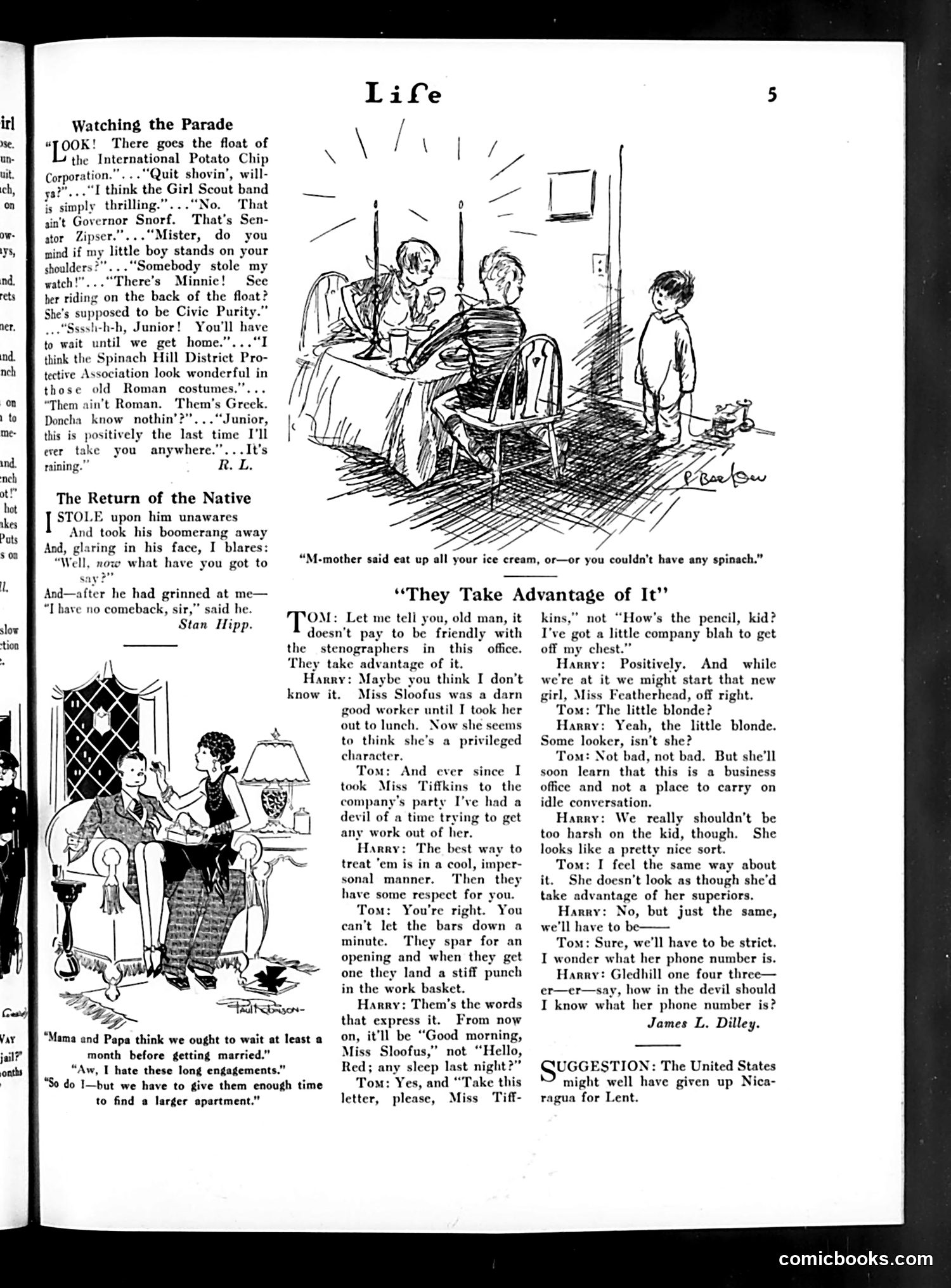
This page contains three distinct pieces of humor content: 1. **"Watching the Parade"** - A dialogue-driven comic about parade spectators making increasingly mundane observations, satirizing how people talk at public events. 2. **"The Return of the Native"** - A brief poem by Stan Hipp about stealing someone's boomerang, playing on the double meaning (returning/not returning). 3. **"They Take Advantage of It"** - A dialogue between Tom and Harry about office stenographers, suggesting young female workers are sometimes treated as privileged or shirk responsibilities. The humor relies on early-20th-century workplace gender dynamics and assumptions about secretaries' behavior and ambitions (marriage prospects, phone flirting). The illustrations accompany each piece humorously depicting the scenarios described.
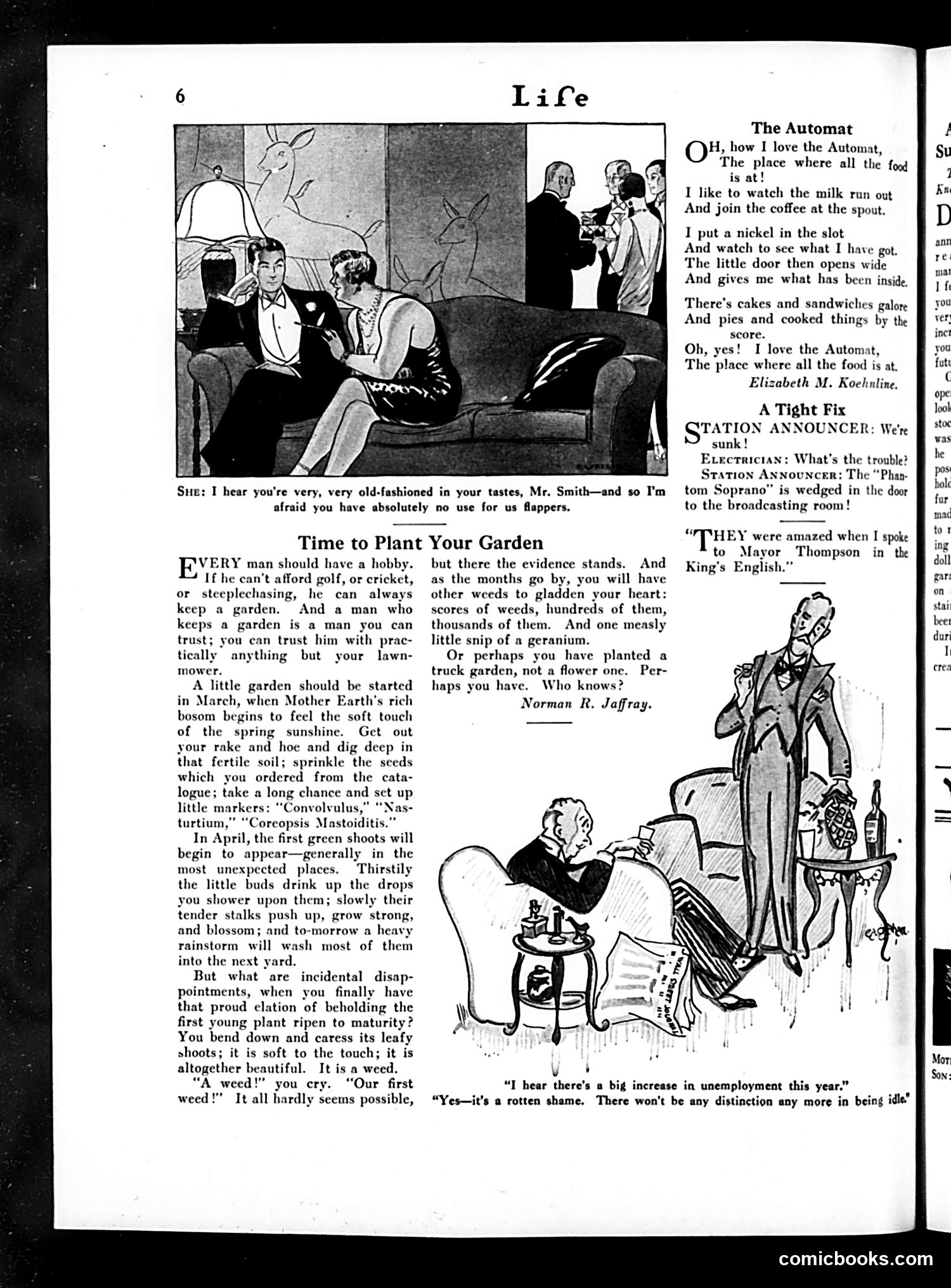
This page contains three separate pieces of satire from *Life* magazine: 1. **"The Automat"** (poem): Celebrates vending machines dispensing food—a novelty technology that delighted early 20th-century urban diners by automating food service. 2. **"Time to Plant Your Garden"** (essay by Norman R. Jaffray): Earnest advice encouraging gardening as a hobby, emphasizing spring planting and the satisfaction of growing things. 3. **"A Tight Fix"** (bottom cartoon): Shows a man complaining about unemployment while discussing Mayor Thompson and "King's English"—satirizing someone who speaks pretentiously despite economic hardship. The joke mocks the gap between affected language and actual poverty. The main cartoon (top) depicts a formal dinner scene with the caption mocking Mr. Smith as "old-fashioned" and useless to "flappers"—referencing 1920s youth culture and generational tensions.
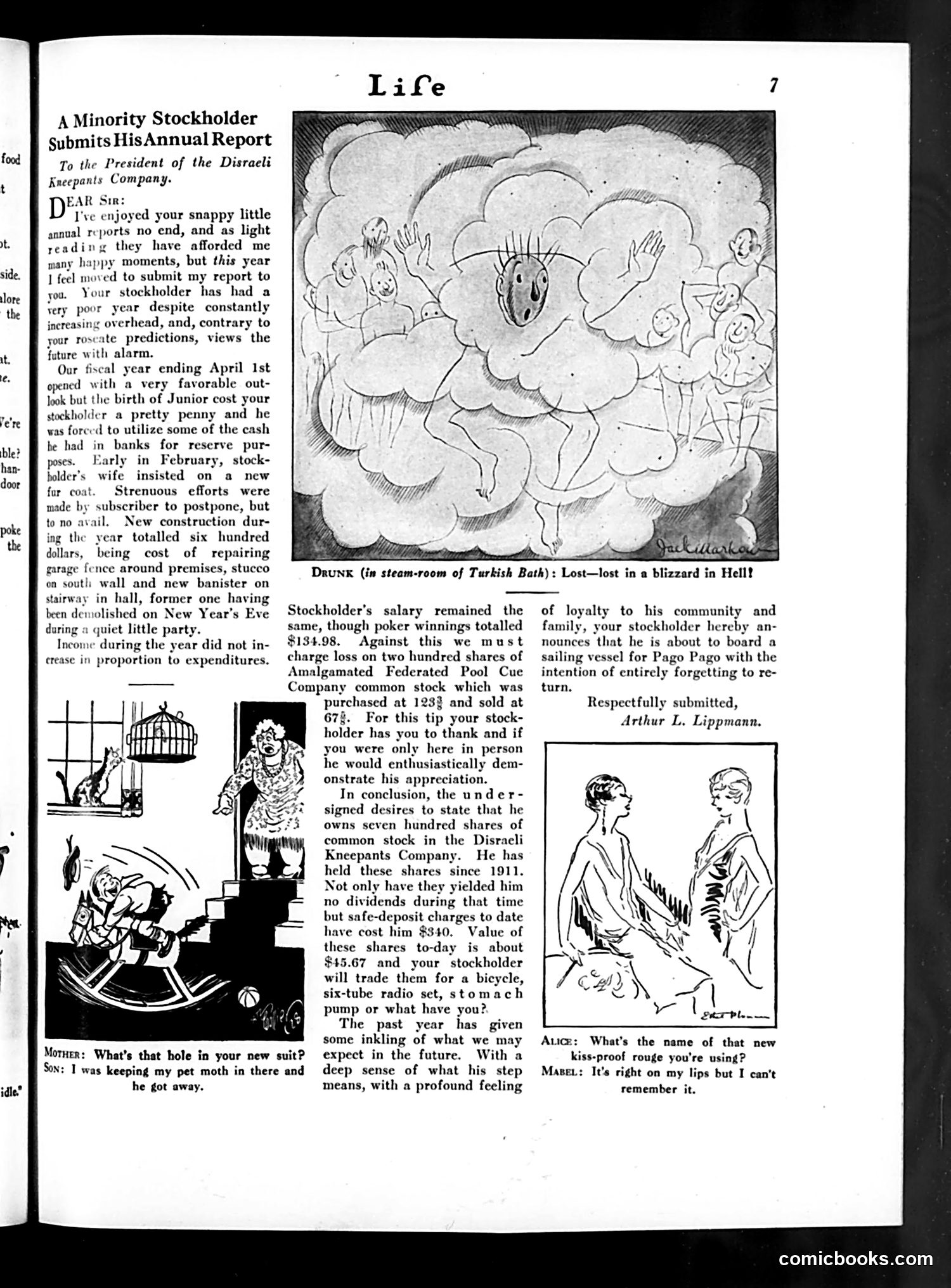
This page contains satirical humor typical of early 20th-century Life magazine. The main content is a mock "Annual Report" from a minority stockholder in the Disraeli Kneepants Company, written by Arthur L. Lippmann. The stockholder complains about poor corporate performance: the company made negligible dividends, charged him $340 in safe-deposit fees, and his shares are now worth only $15.67—less than a bicycle or radio set. The accompanying cartoons mock everyday frustrations: a mother discovers her son kept a pet moth in his new suit's pocket; two women discuss a new cosmetic product with an unflattering name. The humor targets corporate incompetence and domestic absurdities rather than specific political figures or events.
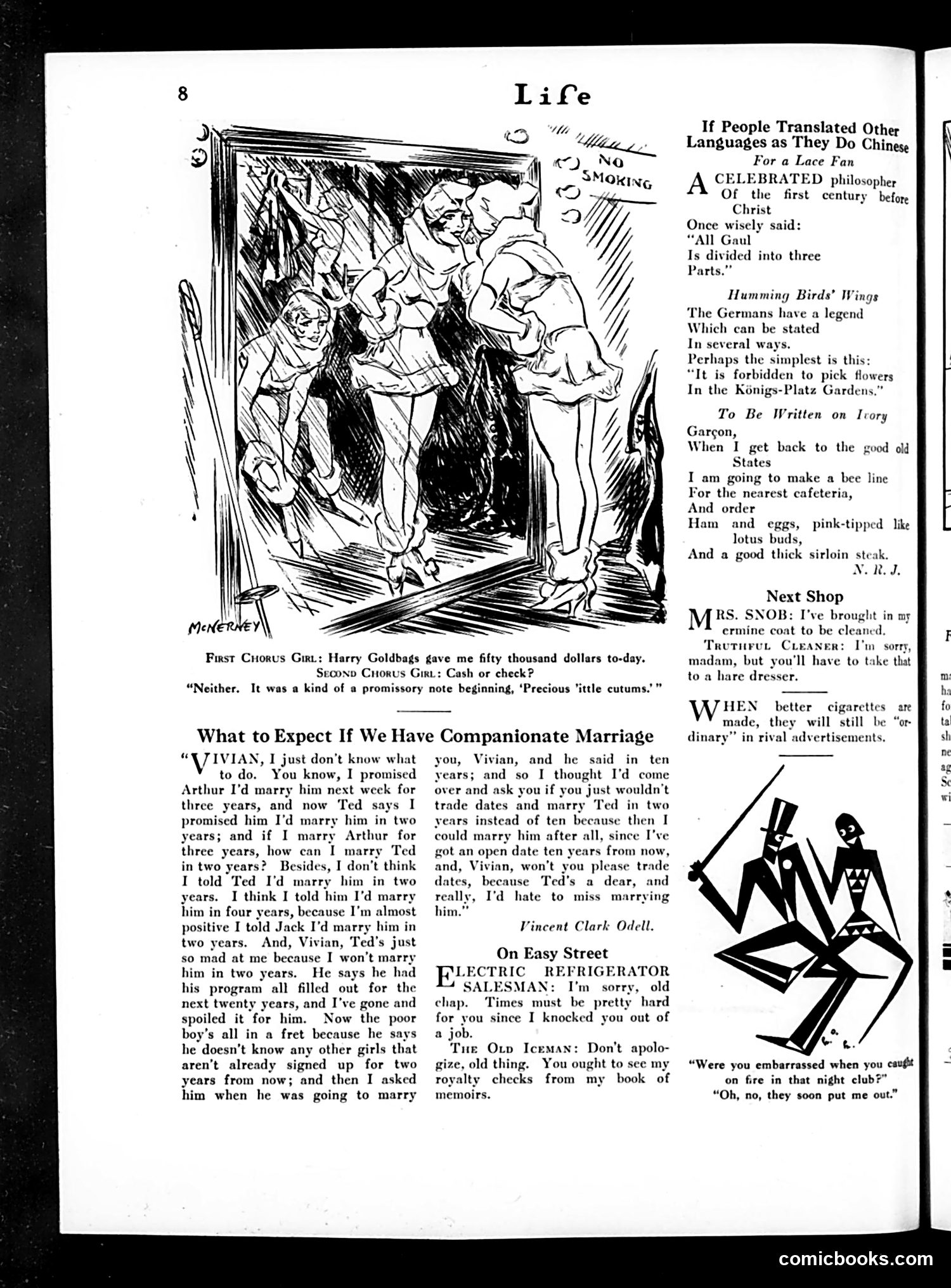
This page contains several humorous pieces satirizing early 20th-century social customs and gender relations. The main cartoon by McKerney depicts two chorus girls discussing a wealthy suitor ("Harry Goldbaggs") who promised one of them $50,000—but only as a promissory note rather than cash. The joke mocks both the girls' mercenary attitudes and wealthy men's deceptive practices. The longer text piece "What to Expect If We Have Companionate Marriage" satirizes a woman named Vivian who juggles promises to marry three different men (Arthur, Ted, and Jack) at different future dates, exposing the absurdity of casual marriage commitments. Other brief comedic exchanges mock everyday situations: a dry cleaner's excuse, cigarette advertising claims, and a refrigerator salesman's awkward encounter with a former victim. The humor targets period anxieties about marriage, wealth, and changing social mores.
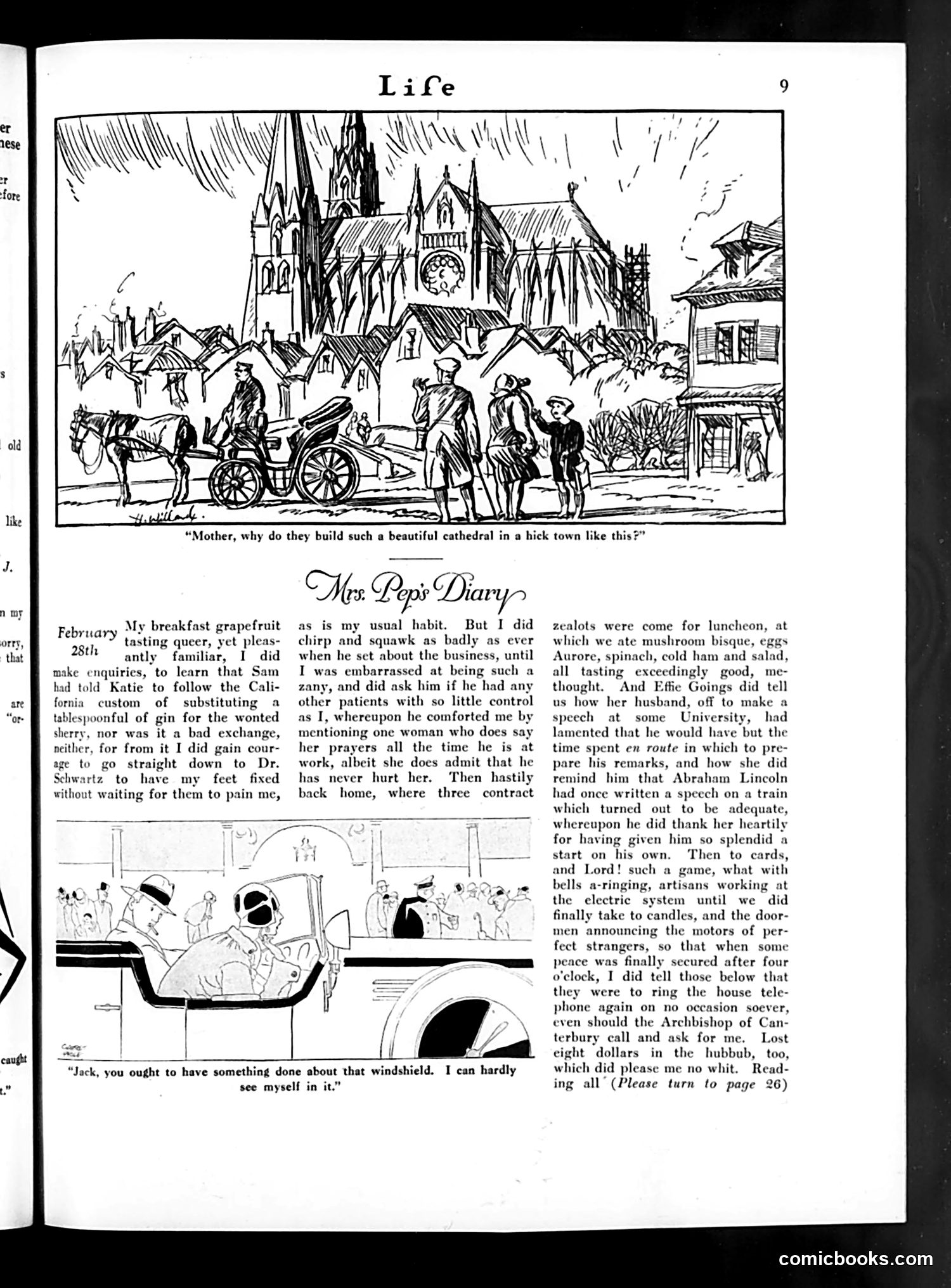
This page contains two unrelated cartoons from an early 20th-century issue. The **top cartoon** shows a child asking their mother why such a beautiful cathedral exists in a "hick town"—satirizing the contrast between architectural grandeur and provincial settings. The **bottom cartoon** depicts a car interior where a passenger tells the driver "Jack, you ought to have something done about that windshield. I can hardly see myself in it." This is a joke about vanity and self-absorption: the passenger is criticizing the windshield's reflective quality not for safety reasons, but because he cannot admire his own reflection in it. The accompanying text is "Mrs. Peps Diary," a domestic humor column dated February 28th, describing mundane household matters and social interactions.
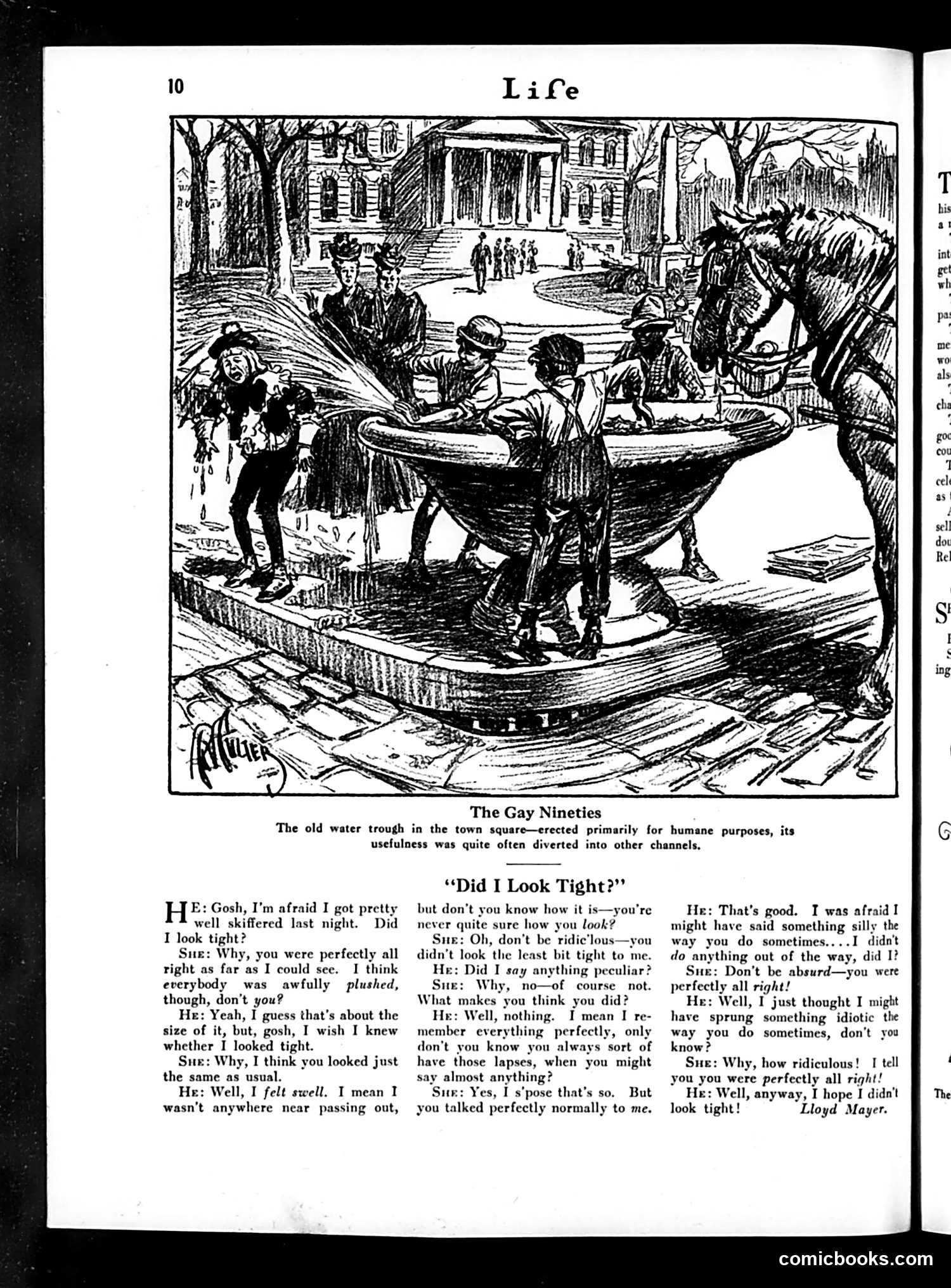
This page contains two elements: 1. **Top illustration**: A sketch titled "The Gay Nineties" depicting a town square water trough (labeled as originally built "for humane purposes"). The scene shows well-dressed figures from that era using it, with a horse and classical architecture. The caption suggests the trough's intended charitable purpose was often diverted elsewhere—likely satirizing how public infrastructure gets repurposed or neglected. 2. **Bottom dialogue**: A comic titled "Did I Look Tight?" featuring a husband and wife discussing his appearance the previous evening. "Tight" here means intoxicated. The wife reassures him he appeared perfectly normal, though he worries he may have seemed drunk. The satire gently mocks marital diplomacy and social pretense about alcohol consumption—common comedy fodder in this era. Both pieces use humor to critique social behavior and Victorian-era propriety.
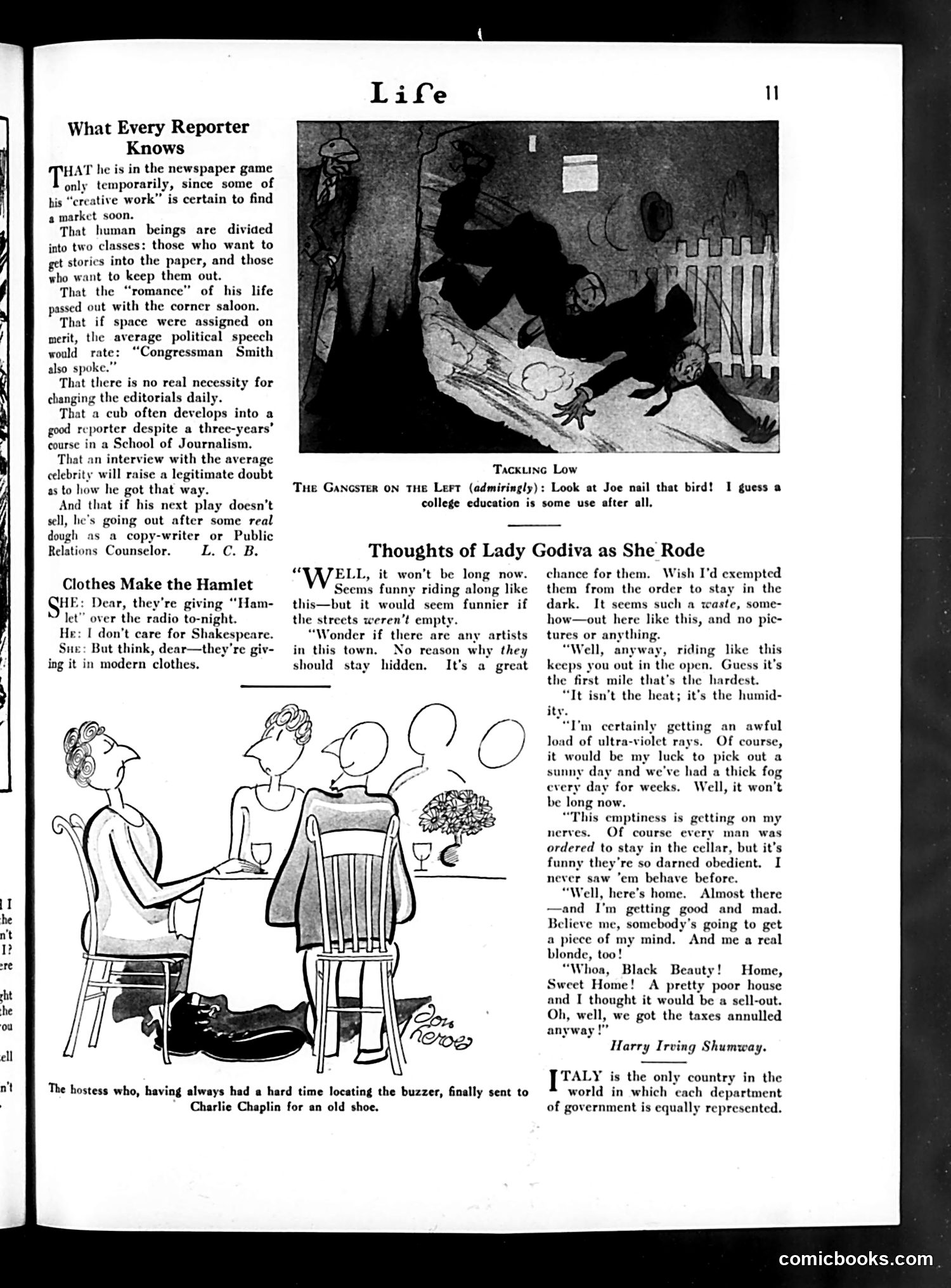
This page contains three separate satirical pieces: 1. **"What Every Reporter Knows"** - A cynical column about newspaper journalism, suggesting reporters are temporary workers focused on sensationalism rather than substance. 2. **"Clothes Make the Hamlet"** - A cartoon dialogue mocking theatrical modernization. A woman suggests performing "Hamlet" in contemporary dress rather than traditional Shakespearean costumes. The joke critiques trendy but misguided attempts to update classics, implying the play's essence gets lost without proper costuming. 3. **"Thoughts of Lady Godiva as She Rode"** - A humorous monologue imagining the legendary nude rider's mundane complaints (weather, taxes, obedience) rather than noble motivations, deflating a romanticized historical figure through domestic realism. The page satirizes journalism, theater, and history through irreverent humor typical of Life's satirical approach.
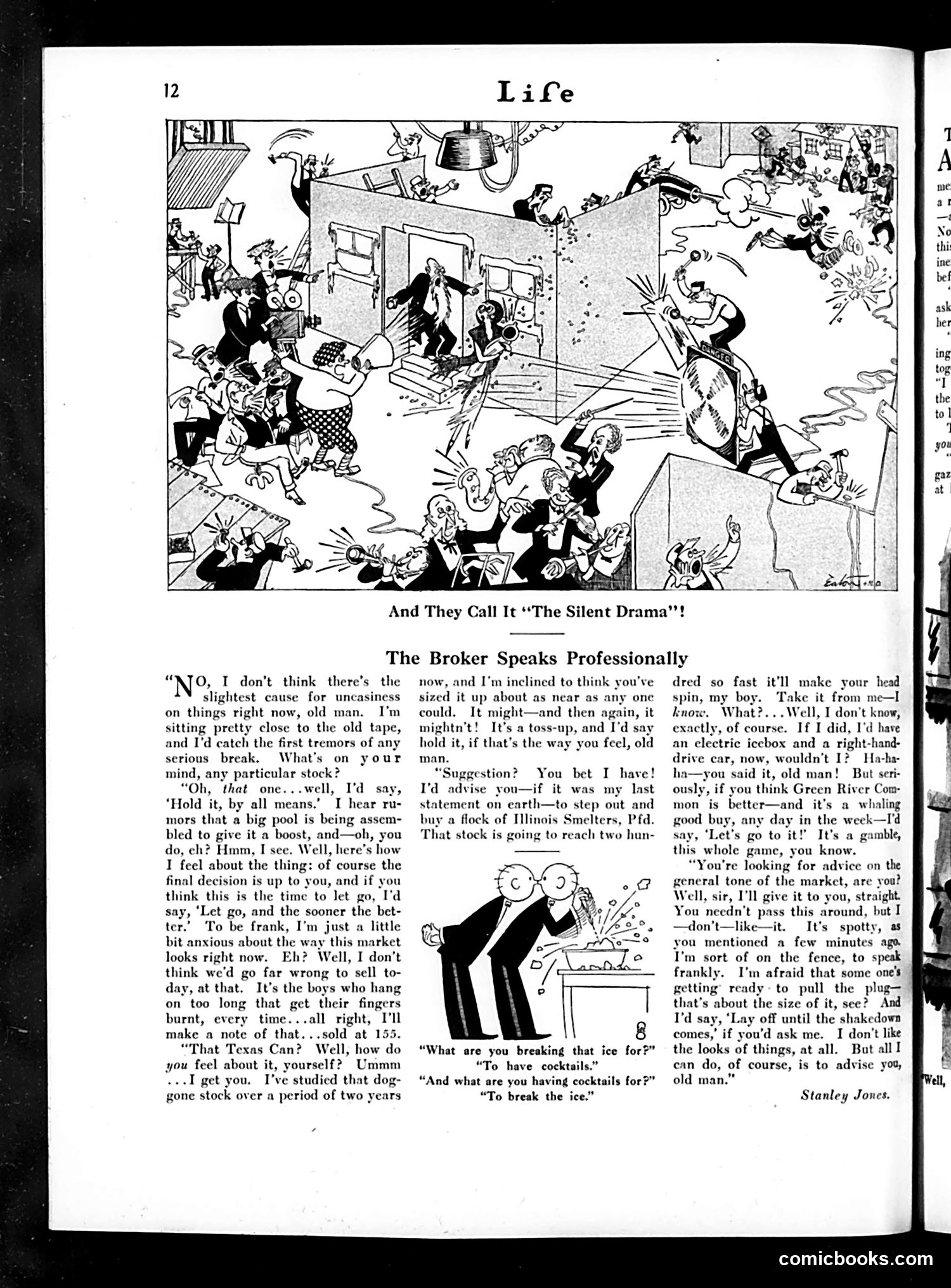
The large cartoon depicts chaos in what appears to be a **stock brokerage office**, with men in suits frantically gesturing, papers flying, and general pandemonium—titled "And They Call It 'The Silent Drama'!" Below, "The Broker Speaks Professionally" presents a dialogue between a broker and client. The broker dismisses the client's market anxiety, claiming to have studied the market carefully over two years. He offers reassurance about holding stocks and advises against panic-selling, suggesting instead to "step out and buy a flock of Illinois Smelters." The humor satirizes **brokers' overconfidence and contradictory advice** during volatile market conditions—likely referencing 1920s stock market speculation and the disconnect between brokers' professional assurances and actual market instability.
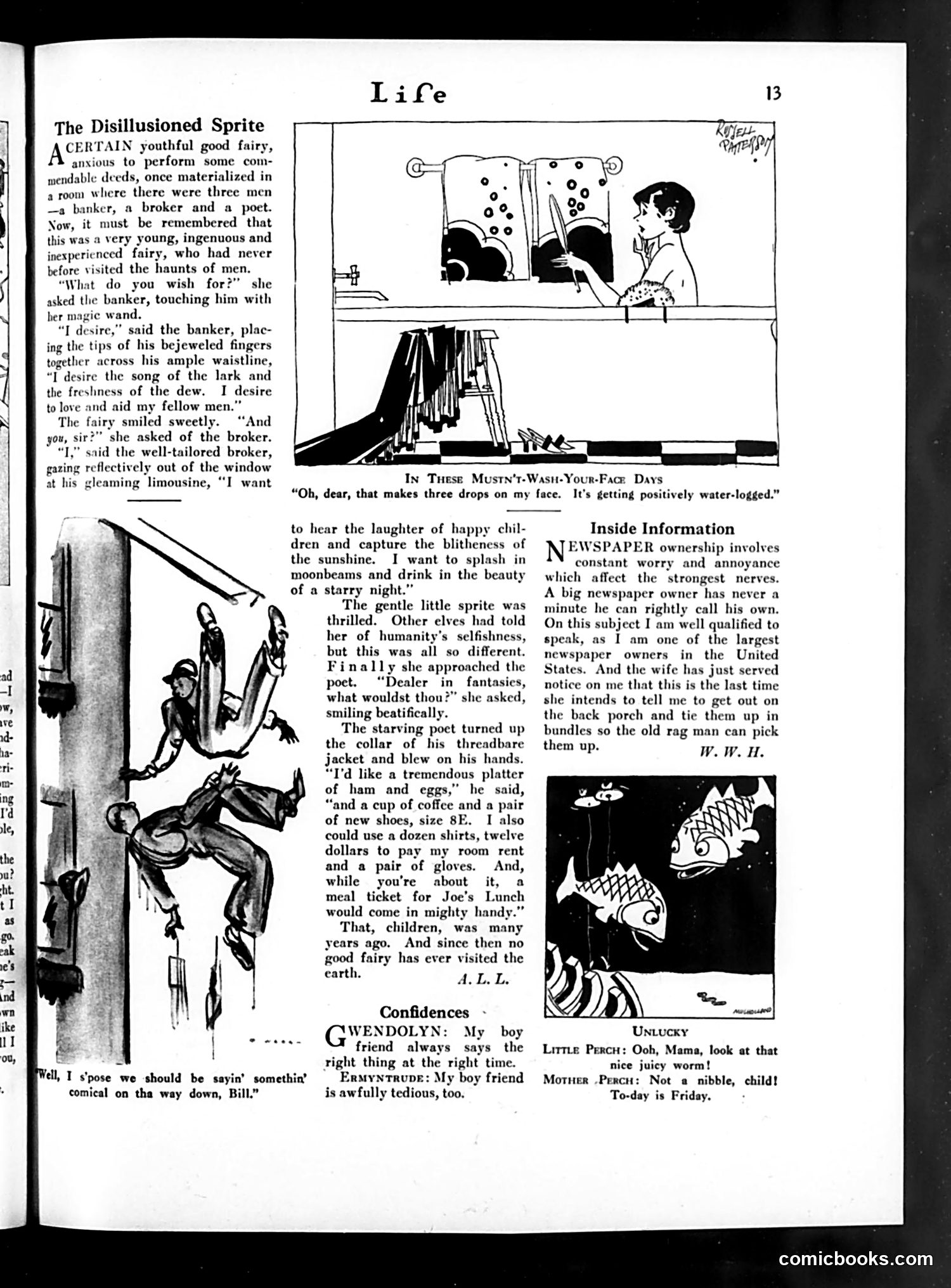
This fairy tale parody satirizes economic hardship and working-class desperation. A young, naive fairy asks a banker and broker what they wish for. Instead of romantic or noble desires, both respond with brutally practical demands: the banker wants song and natural beauty, while the broker—staring from a limousine—wants basic survival needs: ham, eggs, coffee, shoes, shirts, and money for rent and gloves. The joke critiques how capitalism has stripped away idealism. Rather than magical wishes, even fantastical creatures now crave mundane material necessities. This likely reflects post-WWI economic anxieties when *Life* magazine frequently lampooned wealth inequality and the grim realities facing ordinary workers.
This page discusses **Mary Baker Eddy and Christian Science Church leadership disputes**. The main article addresses controversy over whether Mrs. Eddy intended the Church to be run by a board of trustees or a single head. The cartoons (small illustrations with text) appear to satirize organizational infighting within Christian Science—depicting the tensions between different factions competing for control after Eddy's death. One cartoon references **Benjamin Franklin**, likely contrasting historical American pragmatism with contemporary religious institutional quarrels. The commentary criticizes various Christian Science organizations for obsessing over internal governance details rather than spiritual matters, suggesting they've lost sight of the movement's original purpose. The satire targets institutional ego and doctrinal rigidity masquerading as religious principle.
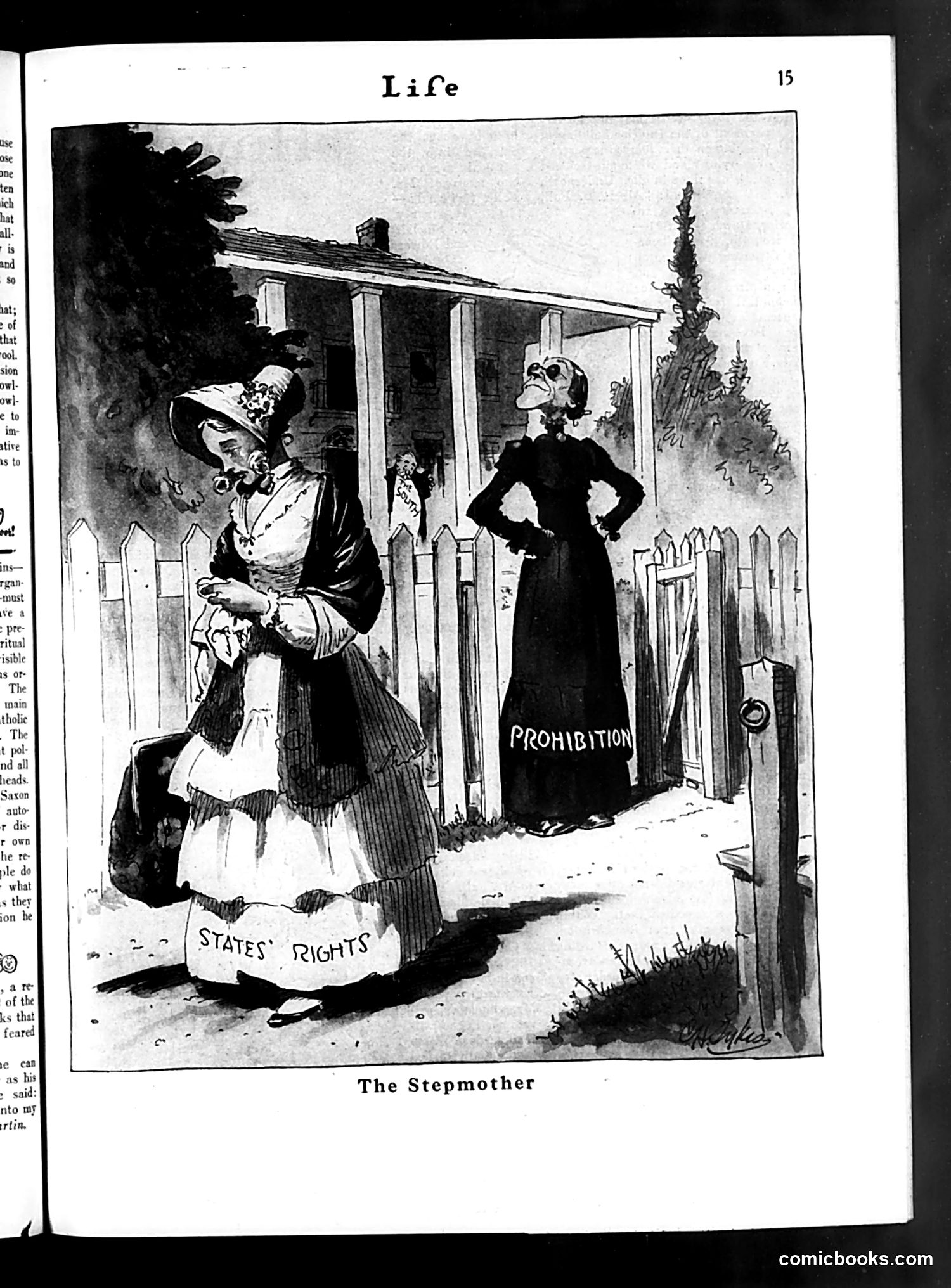
This cartoon critiques the conflict between **federal Prohibition** (represented by the stern, skeletal figure labeled "PROHIBITION" at the gate) and **"States' Rights"** (the older woman on the left in traditional dress). The imagery suggests Prohibition is a harsh "stepmother" figure imposing unwanted rules, while individual states' traditional autonomy is being displaced. The gate and fence emphasize separation and exclusion—Prohibition is literally blocking access. This appeared during the Prohibition era (1920-1933), when the federal government's alcohol ban created tension with states preferring local control. The "stepmother" metaphor implies Prohibition feels foreign and oppressive to established American state governance traditions.
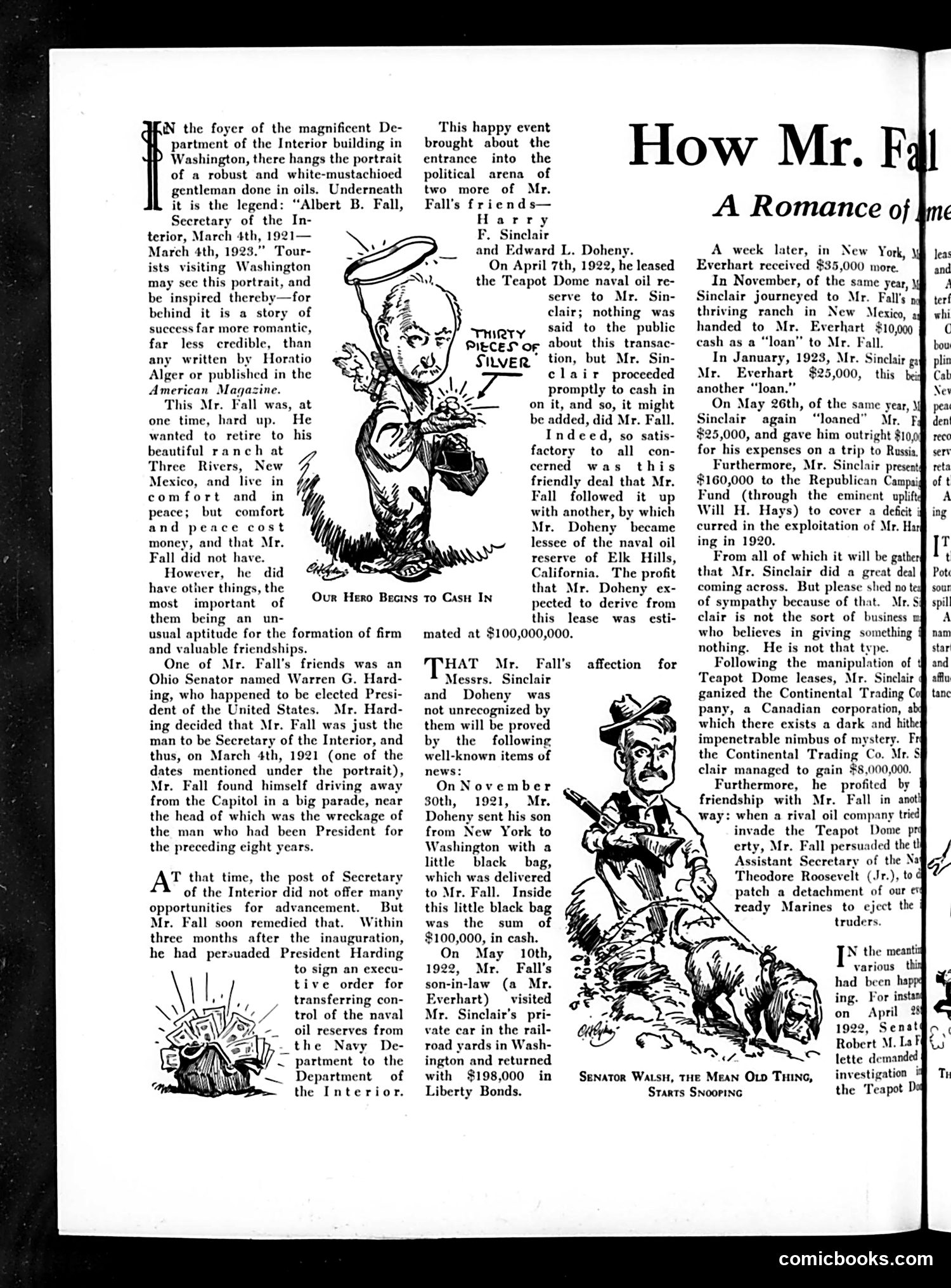
This page satirizes the Teapot Dome scandal, a major 1920s corruption case. The article describes Albert B. Fall, Secretary of the Interior, receiving bribes from oil executives Harry Sinclair and Edward L. Doheny in exchange for control of naval oil reserves. The cartoon depicts Senator Thomas Walsh as a detective investigating Fall's illegal dealings. The caption "Senator Walsh, the Mean Old Thing, Starts Snooping" mocks Walsh's investigation with mock-sympathetic language, suggesting his scrutiny is unwelcome harassment of Fall. The text details cash loans, stock transfers, and ranch improvements Fall received—all bribes disguised as legitimate business transactions. Life magazine exposes this corruption through satirical narrative, portraying the investigators as nuisances rather than watchdogs, reflecting contemporary divided public opinion about the scandal.
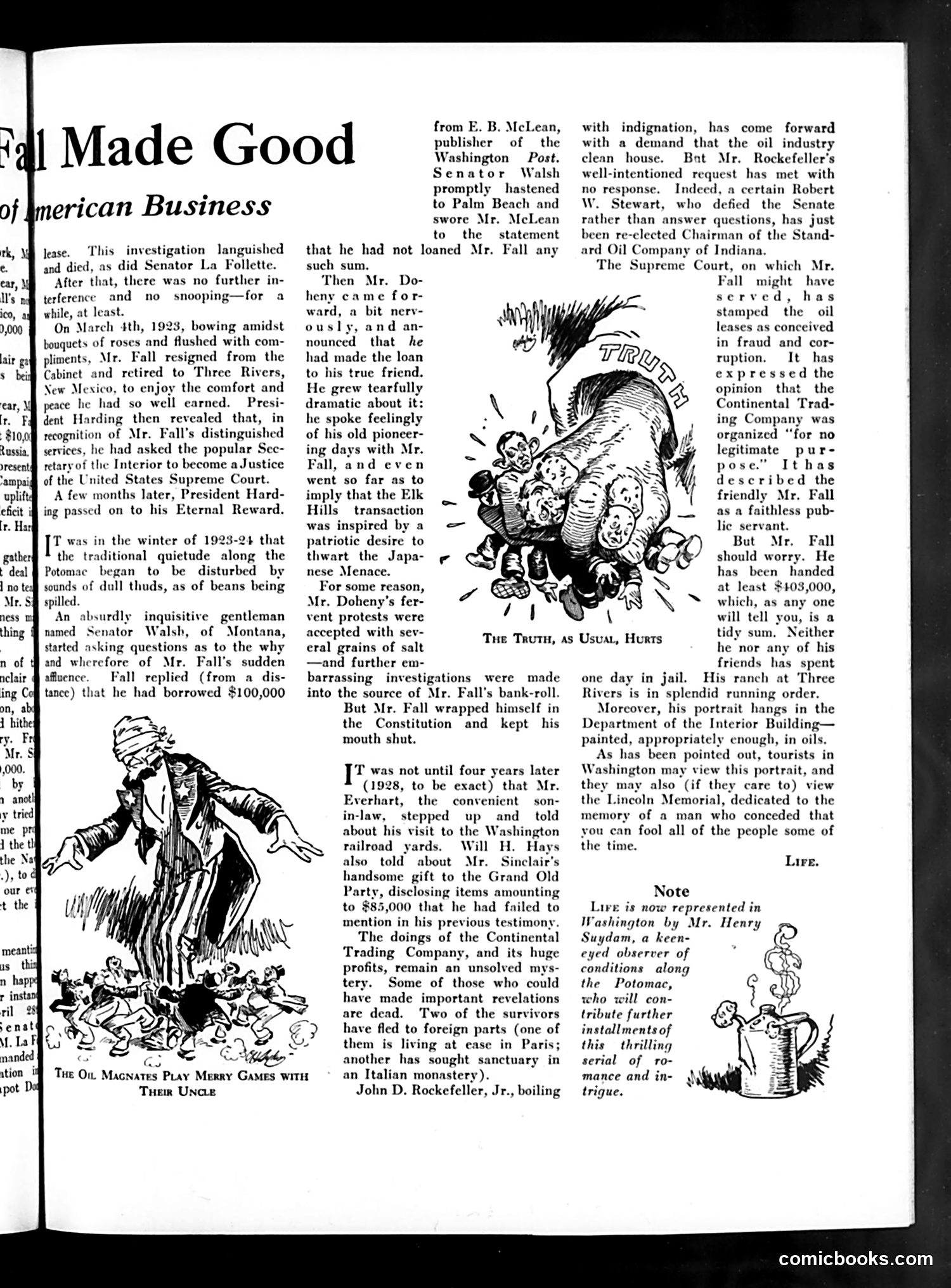
This Life magazine article satirizes **Harry Sinclair** (oil magnate involved in the Teapot Dome scandal) through the fictional character **Mr. Fall**, based on **Albert Fall**, the Interior Secretary who went to prison for bribery. The cartoons mock how Fall and associates grew wealthy through corrupt oil leases. One illustration shows fat oil magnates playing games "with their Uncle"—likely referencing how they exploited governmental connections for profit. The article's tone is bitterly ironic: Fall received substantial money ($103,000+) and a ranch, while claiming to be an honest public servant. The piece suggests wealthy defendants escape real consequences while ordinary citizens face jail time—a critique of how wealth buys leniency in American justice.
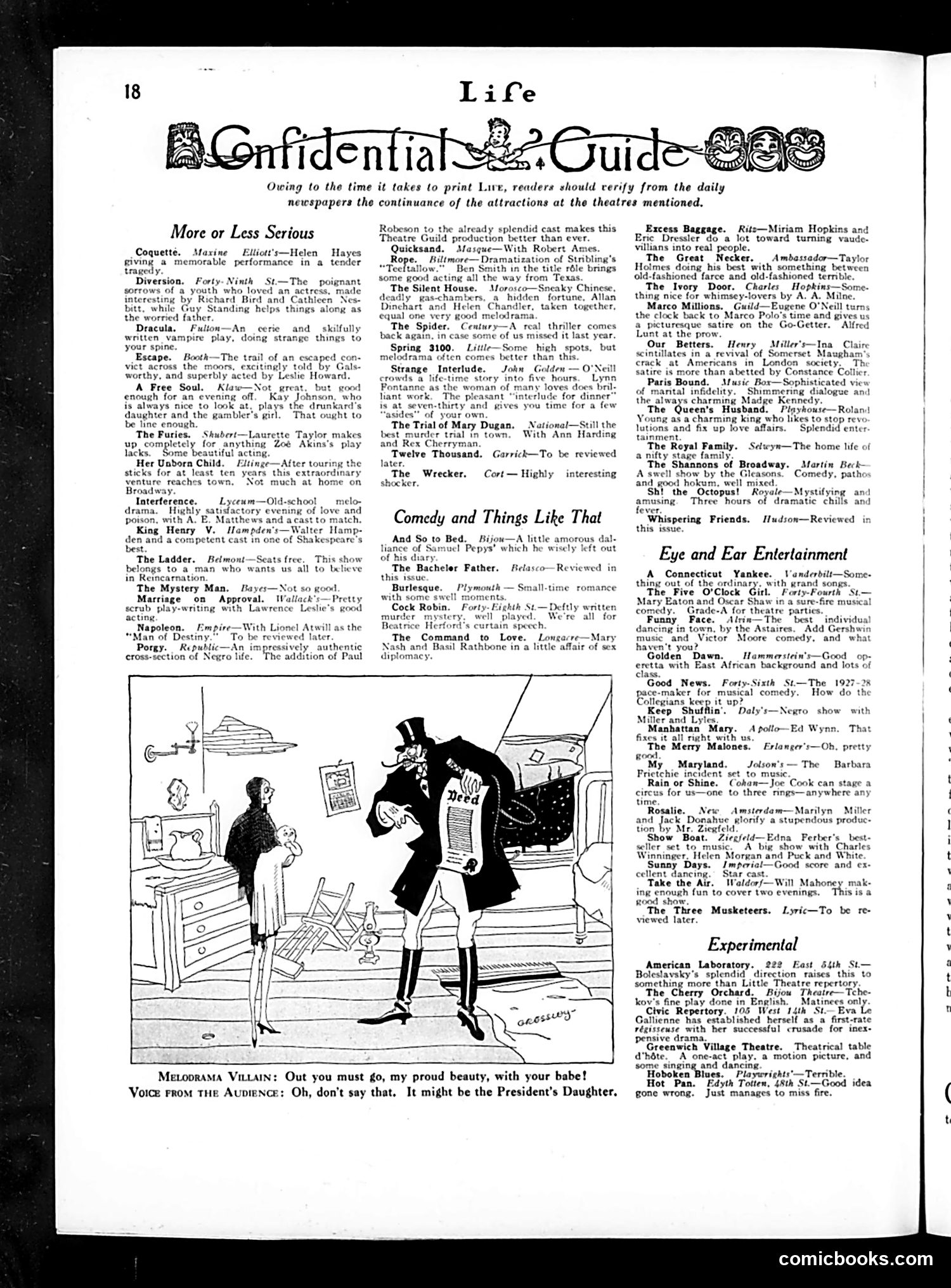
The cartoon depicts a melodramatic scene with two figures in a bedroom. A man in formal attire (top hat and tails) appears to be a theatrical villain confronting a woman. The dialogue below references a "Melodrama Villain" ordering a woman to leave with her baby, and an audience member's interjection: "Oh, don't say that. It might be the President's Daughter." **The Satire:** This mocks the theatrical conventions of melodrama—specifically the villain abandoning an unwed mother and child, a stock plot device. The audience member's comment is a topical joke suggesting that even villains should hesitate before casting out a child if she's connected to the President, implying either political favoritism or the absurdity of clinging to melodramatic tropes when real-world consequences (presidential connection) intervene. It's satire of both overwrought theater and the arbitrary power of political connections. The page is primarily theatrical reviews from *Life* magazine's arts section.
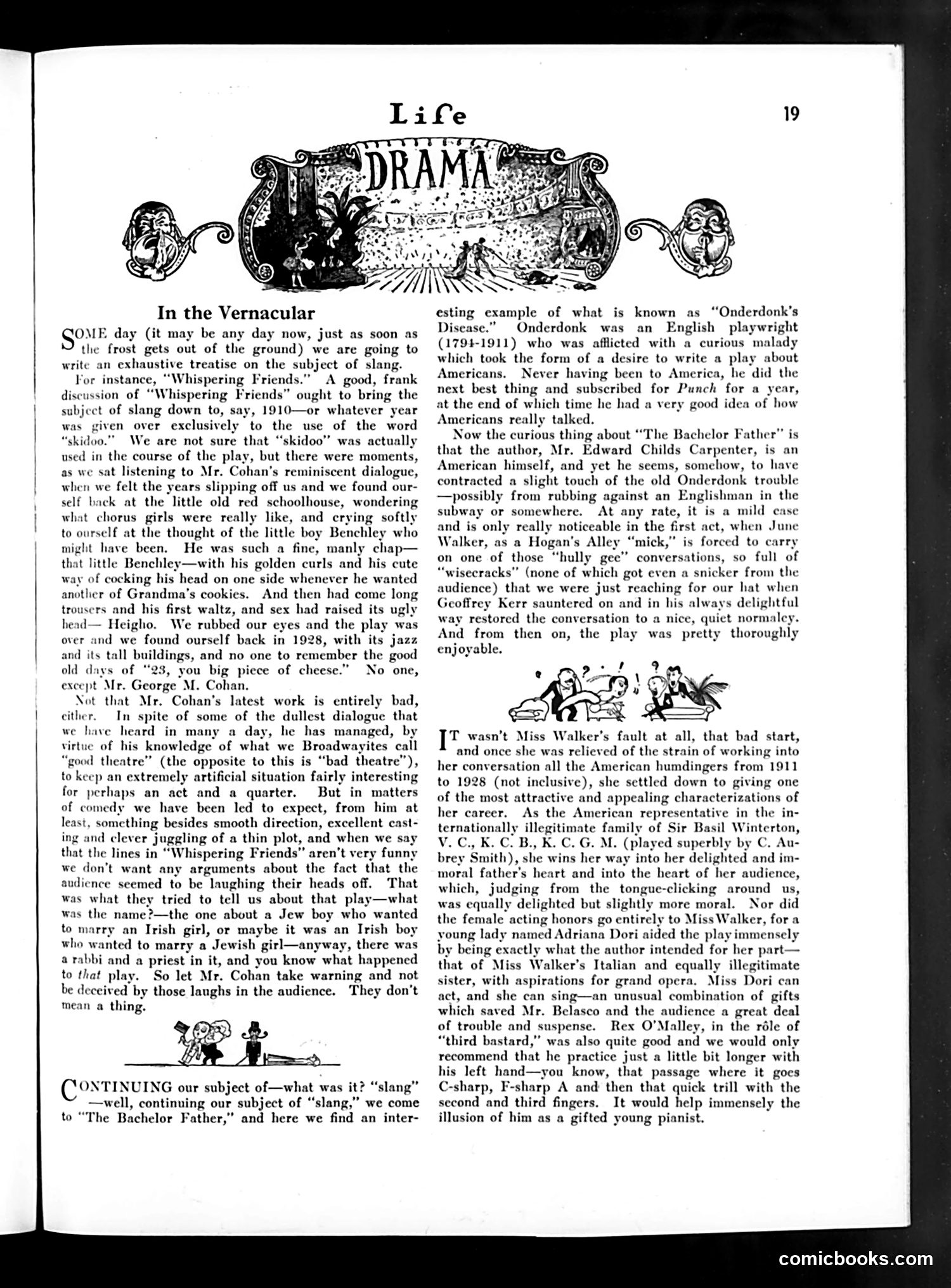
This is a theater review column critiquing two Broadway plays: "Whispering Friends" (by George M. Cohan) and "The Bachelor Father" (by Edward Childs Carpenter). The reviewer mockingly dismisses both works. For "Whispering Friends," he admits the audience laughed but insists the jokes weren't actually funny—the laughter "doesn't mean a thing." Regarding "The Bachelor Father," the reviewer invents a fictional condition called "Onderdonk's Disease" to satirize Carpenter's stereotypical portrayal of working-class Irish-American characters (a "Hogan's Alley 'mick'"). The joke: an American playwright writes unconvincing Irish-American dialogue, as if he'd only learned about Americans from reading the British satirical magazine *Punch*. The broader point targets inauthentic theatrical writing and audience gullibility—mocking both playwrights for relying on clichéd slang and stereotypes rather than genuine wit.
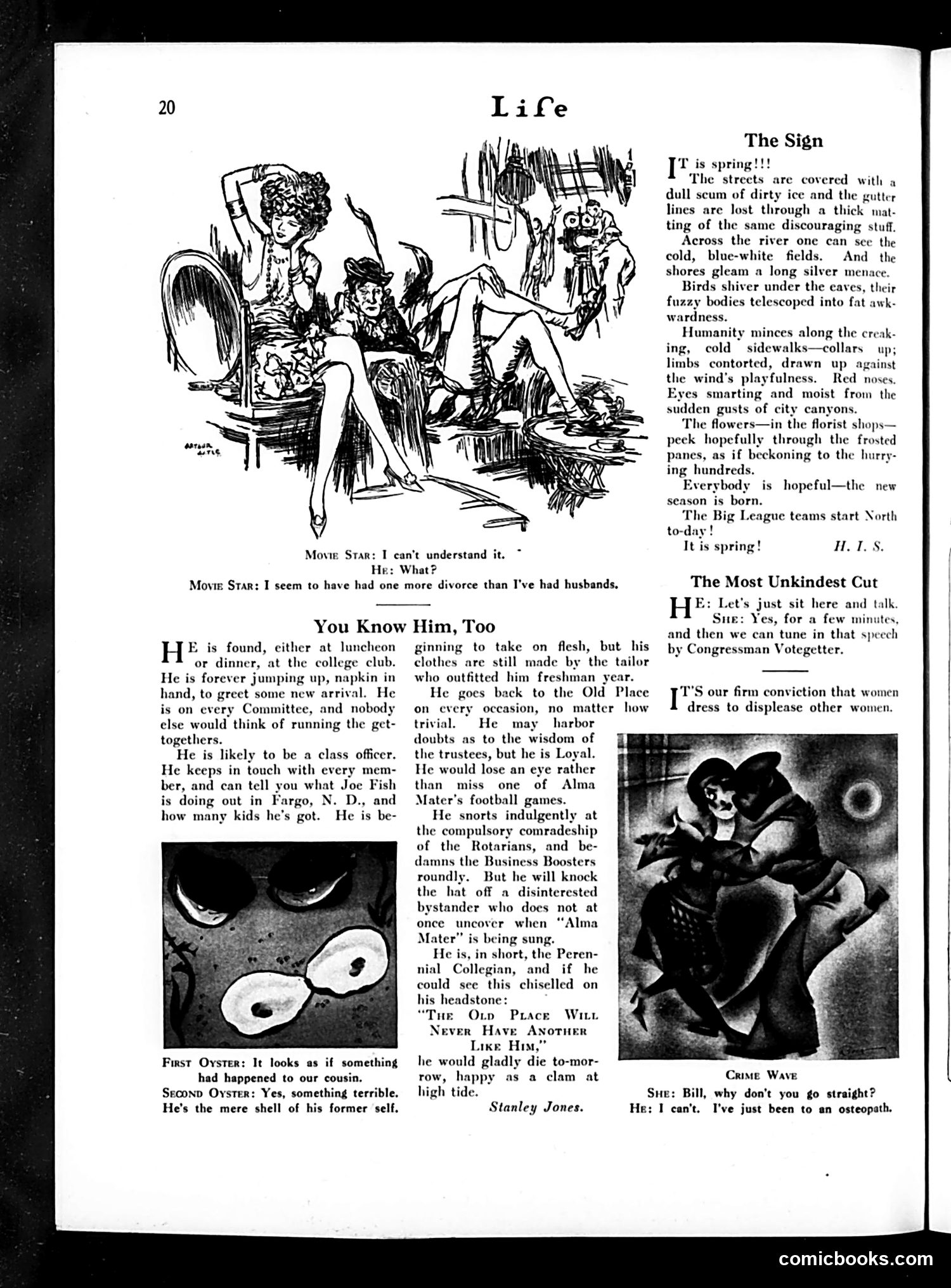
This page contains several satirical pieces typical of 1920s-era *Life* magazine humor: **"Movie Star" joke**: Mocks Hollywood divorce culture—a starlet has divorced more times than she's been married, suggesting she remarried an ex-husband. **"You Know Him, Too"**: By Stanley Jones, satirizes the "Perennial Collegian"—an alumnus obsessed with his college identity. He's perpetually broke (still wearing freshman-era clothes), slavishly loyal to his alma mater, attends every football game, jumps up to greet old classmates, runs committees, yet harbors private doubts. The satire targets masculine sentimentality and arrested development. **"First/Second Oyster" cartoon**: Visual pun on a man who's "the mere shell of his former self"—literally depicted as an oyster shell. **"The Sign"** and **"Crime Wave"**: Brief joke pieces about spring weather and an osteopath straightening someone's spine. **"The Most Unkindest Cut"**: A woman prefers listening to a congressman's speech over conversation—commentary on radio's cultural impact and/or women's political engagement. The overall tone is gentle mockery of American social conventions, collegiate nostalgia, and modern life.
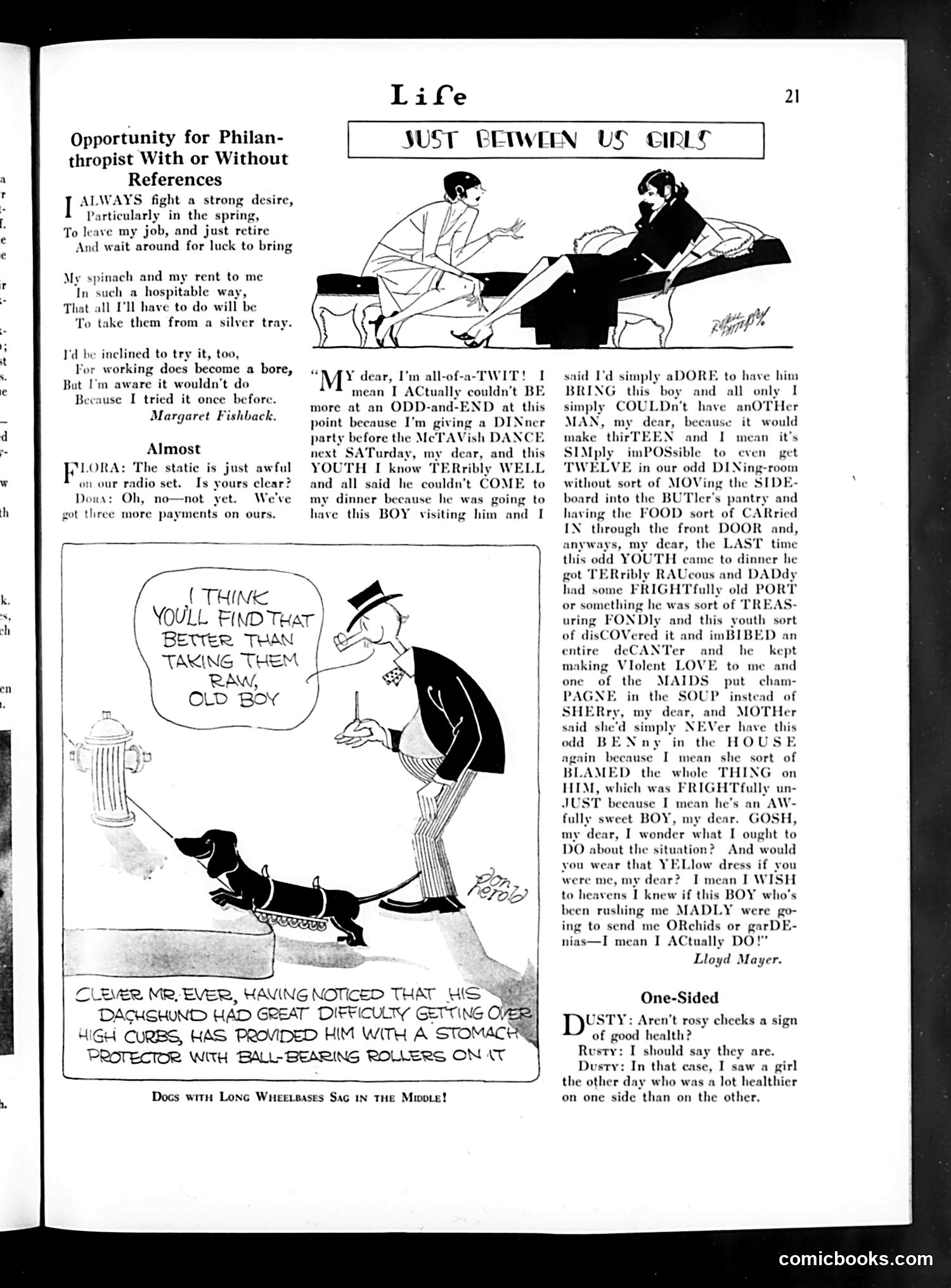
This page from *Life* magazine contains several pieces of social satire typical of the 1920s-30s era: **"Just Between Us Girls"** (top): A woman complains at length about dinner party logistics—a visiting boy makes the guest count odd (13, considered unlucky), requires moving furniture, and causes household chaos. The satire mocks upper-class women's superficial concerns and their tendency toward dramatic, rambling complaints. The exaggerated capitalization of random words parodies affected speech patterns. **"Almost"** (left): A brief joke about radio static—the humor lies in the absurdity that someone would make three more payments on a radio just to receive slightly clearer reception. **Dog cartoon** (center): A clever visual gag showing a dachshund with a stomach protector and ball-bearing rollers, solving the problem of long-bodied dogs scraping their bellies on high curbs. **"One-Sided"** (bottom): A brief exchange joking that a girl's rosy cheeks indicate good health—implying she's healthier on one side of her face than the other, a subtle medical joke.
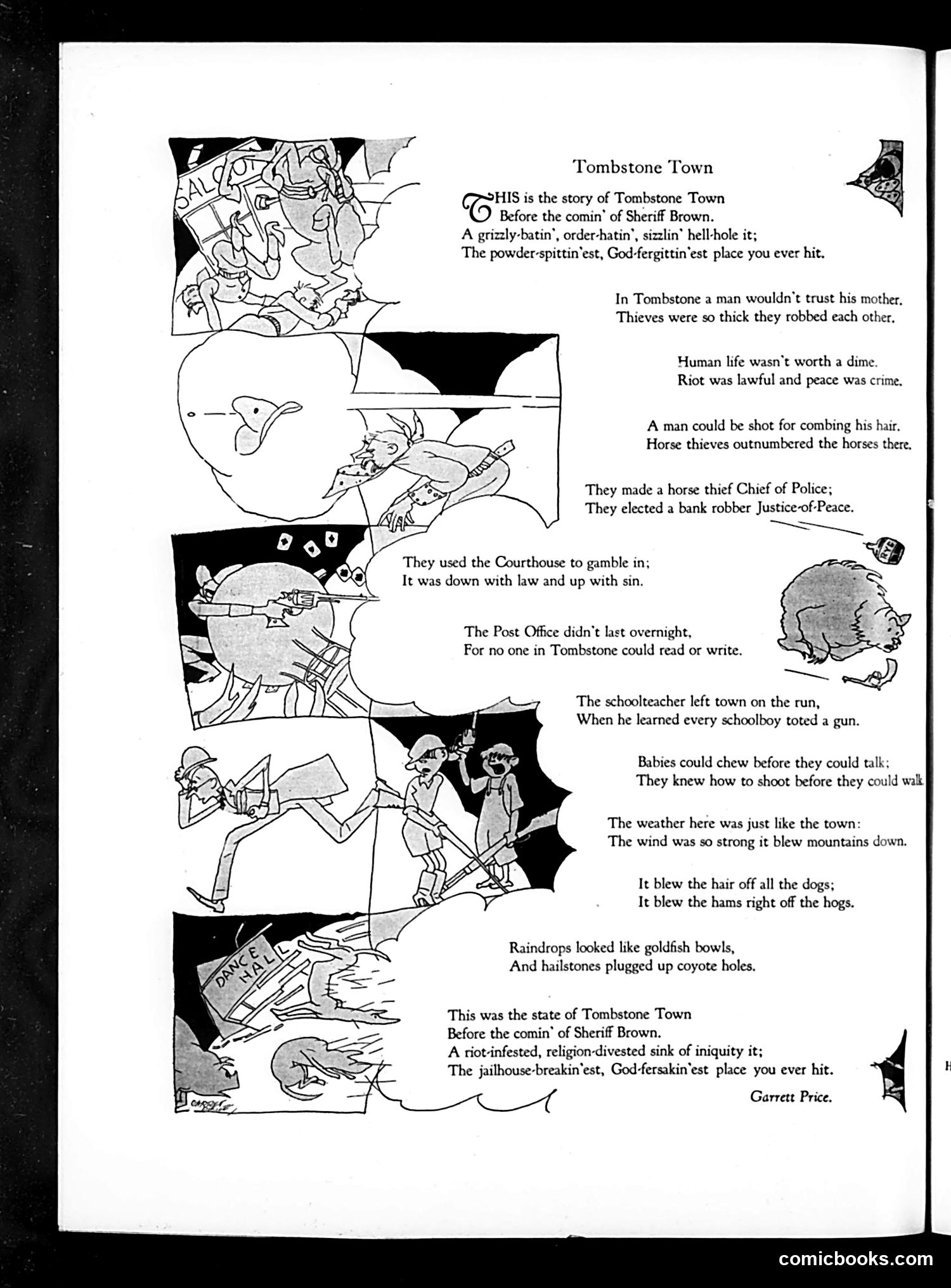
This is a humorous tall tale by Garrett Price satirizing the American Old West's lawless reputation. The poem describes Tombstone, Arizona before "Sheriff Brown" arrived—presenting an exaggerated, anarchic frontier town where criminality is institutionalized: horse thieves serve as police, bank robbers as judges, the courthouse functions as a gambling den. The satire works through absurdist escalation: children learn to shoot before walking, the wind is so violent it strips animals of their hides, even rain becomes cartoonishly oversized. The accompanying illustrations show chaotic scenes matching these descriptions—gunfights, gambling, mayhem. The joke targets both romanticized Wild West mythology and actual historical disorder in frontier towns. By making lawlessness comically extreme and complete, Price mocks both the real violence and popular fictional glamorization of that era. The poem implies that only external authority ("Sheriff Brown") could impose civilization on such chaos.
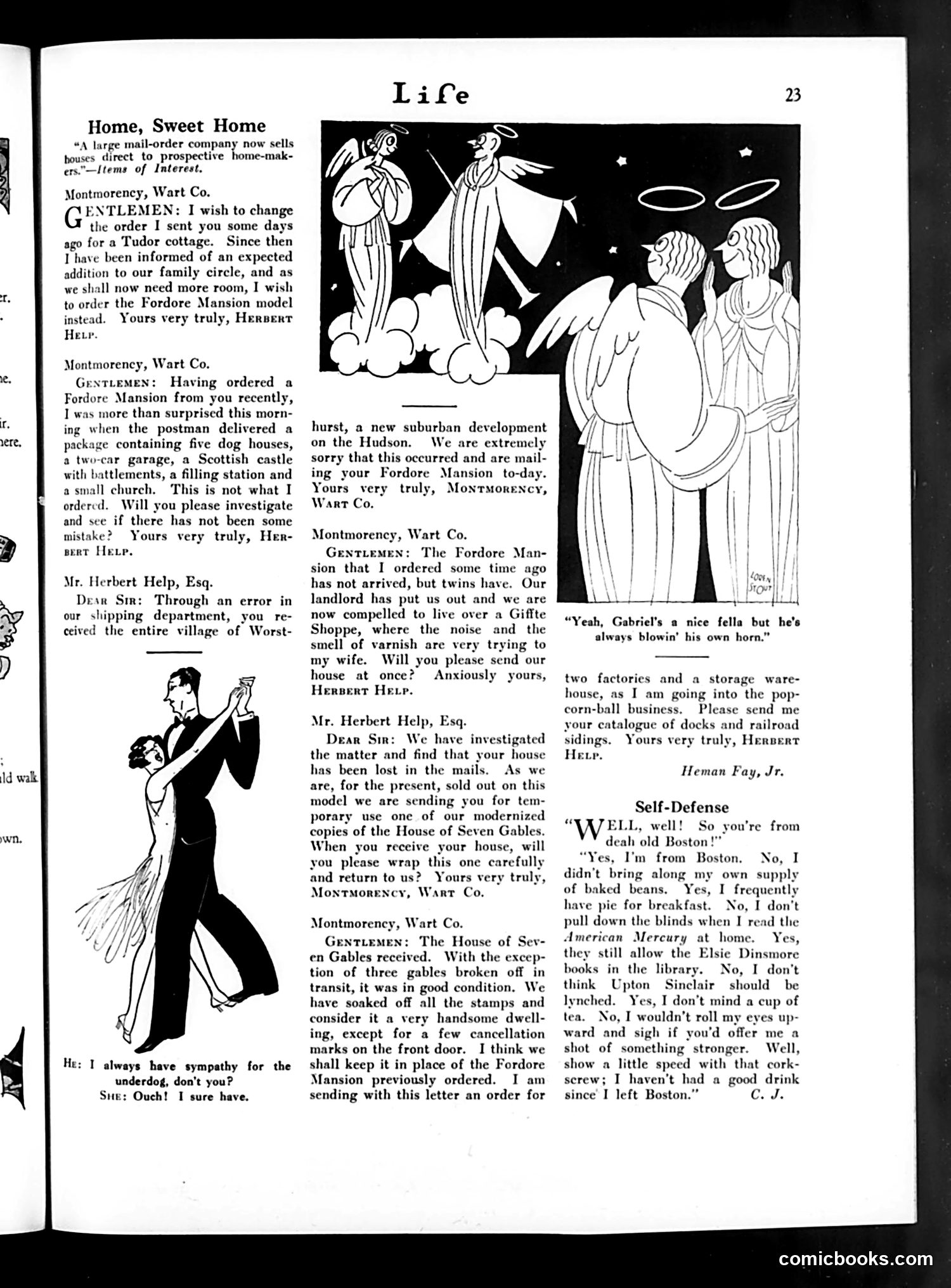
This page satirizes mail-order house companies that sell prefabricated homes directly to consumers—a relatively new business practice at the time. The main cartoon sequence (left side) depicts the absurd incompetence of one such company through letters between a customer (Herbert Help) and "Montmorency, Wart Co." The jokes escalate: the customer orders a Tudor cottage, upgrades to a Fordore Mansion, but receives an entire village instead; his mansion gets lost in the mail while he's forced to live above a shop; when a temporary replacement arrives (the House of Seven Gables), it's damaged but he keeps it anyway and orders industrial buildings. The humor mocks both the reliability of mail-order businesses and the era's growing consumer culture. The cartoon illustration (right) shows angels, playing on the heavenly irony of "Home, Sweet Home." A separate brief comic strip at bottom ("Self-Defense") jokes about Boston stereotypes—baked beans, pie for breakfast, American Mercury readership—suggesting regional clichés people tire of hearing.
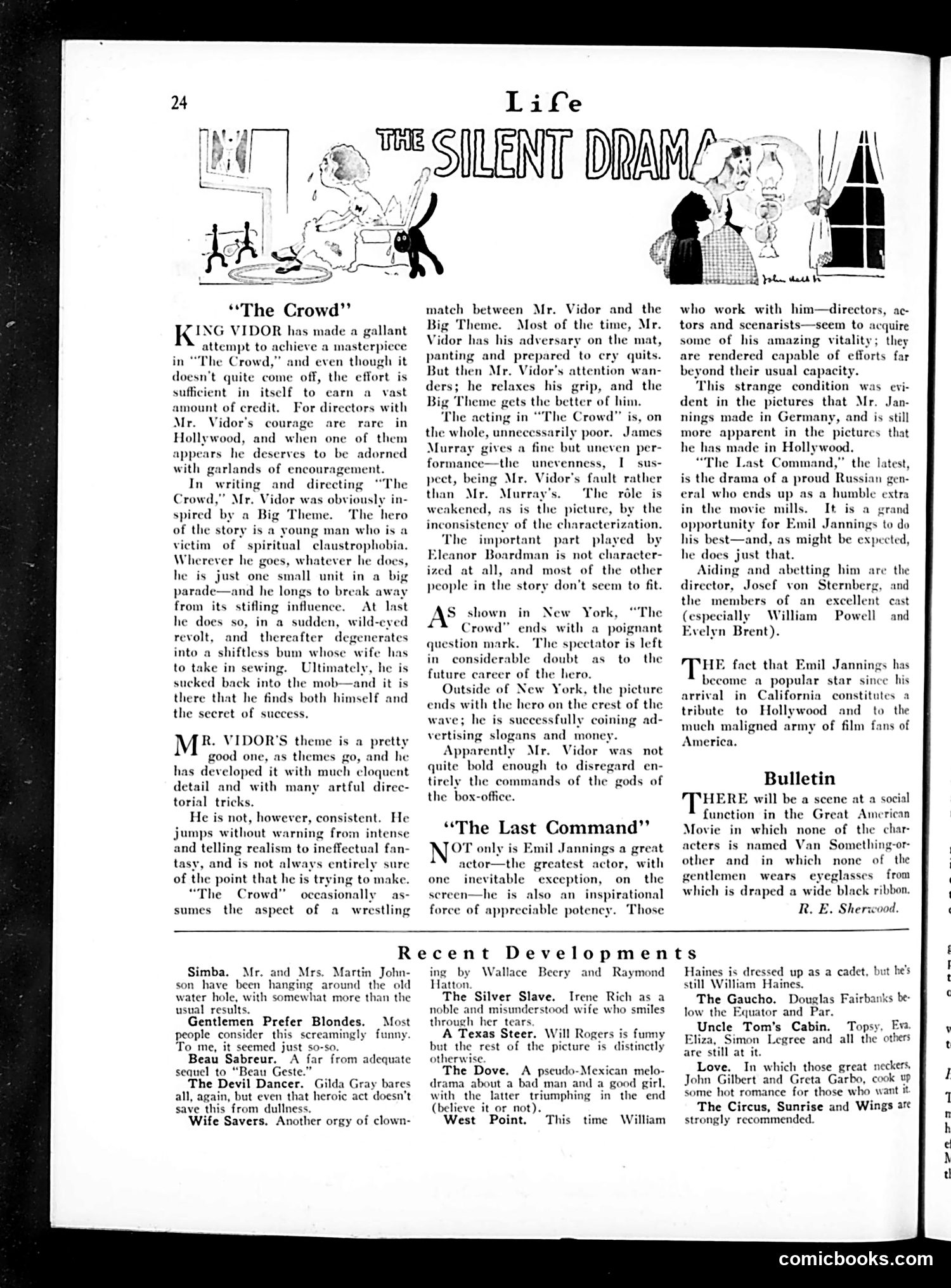
This page contains film reviews from Life magazine's "Silent Drama" section, critiquing two 1920s movies. **"The Crowd"** reviews director King Vidor's ambitious film about an everyman struggling against conformity in modern society. The critic praises Vidor's courage and the film's theme but faults its inconsistency—it vacillates between realism and fantasy without clear purpose. The review notes that actor James Murray delivers an uneven performance, likely due to directorial inconsistency, while Eleanor Boardman's role is underwritten. **"The Last Command"** celebrates Emil Jannings, a German actor whose talent elevates everyone around him. The film depicts a Russian general reduced to working as an extra in Hollywood—a role perfectly suited to showcase Jannings' abilities. The reviewer credits Jannings' presence for inspiring superior work from director Josef von Sternberg and the supporting cast (including William Powell and Evelyn Brent). Both reviews exemplify how 1920s film criticism evaluated artistic ambition, acting talent, and directorial consistency in silent cinema.
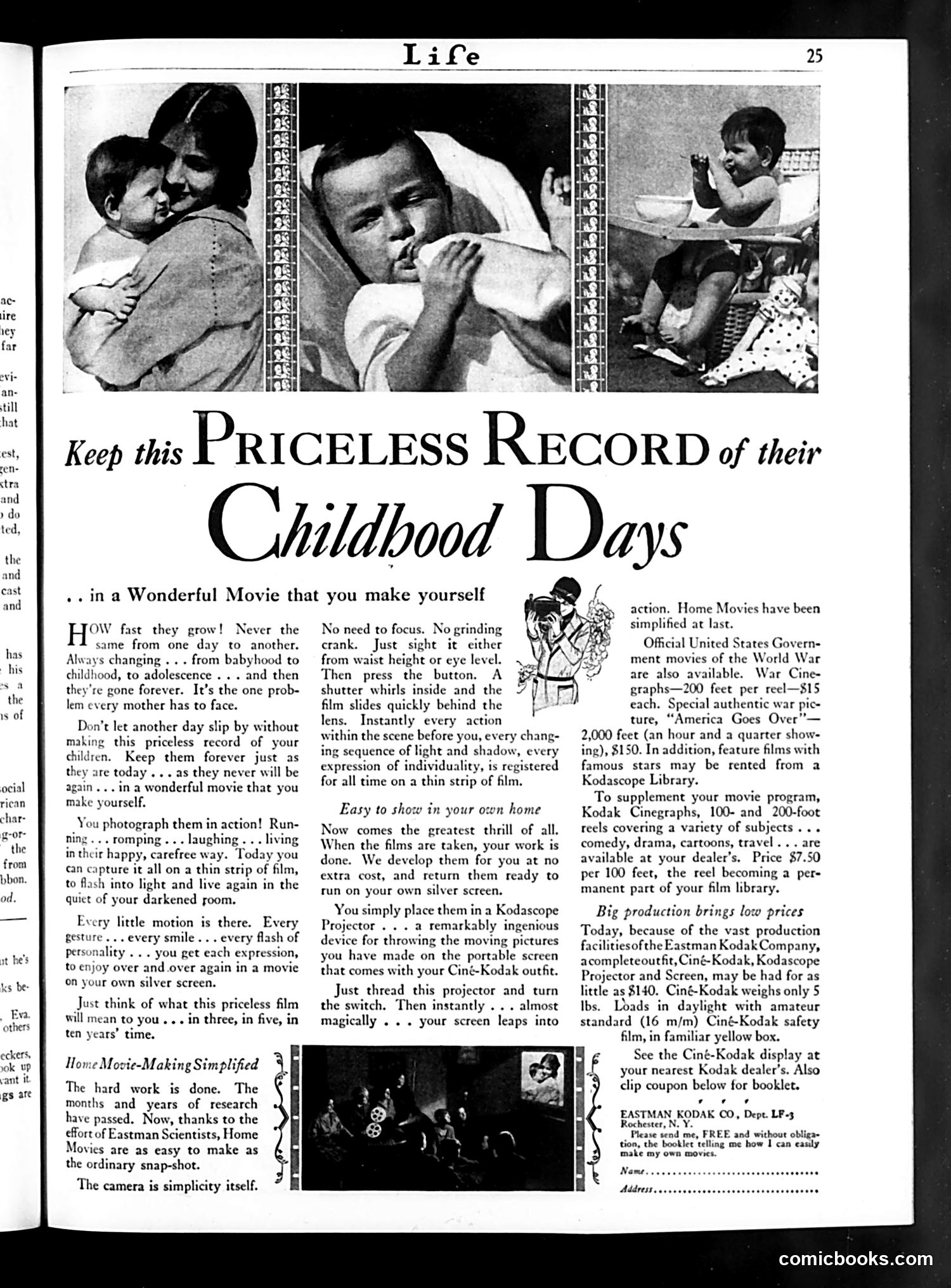
This page is **not a cartoon or satire**, but rather a **straightforward advertisement** for Eastman Kodak's home movie camera system (Ciné-Kodak), appearing in Life magazine. The three photographs at the top show families with children—depicting everyday moments of childhood. The ad's pitch targets parents, emphasizing that children grow quickly and unpredictably ("Never the same from one day to another"). It urges readers to preserve fleeting childhood moments on film. The advertisement highlights the technical simplification Kodak achieved: no focusing needed, simple button operation, and Kodak-handled development. It promises that families can easily project films at home using the Kodascope projector. The lower section mentions WWI-era government war films available for rental—a contemporary reference suggesting this ad dates to the 1920s post-war period when such material was commercially distributed. Pricing ($140 for a complete outfit) positions the technology as increasingly accessible to middle-class families. This represents early consumer home-movie marketing, appealing to nostalgia and family sentiment.
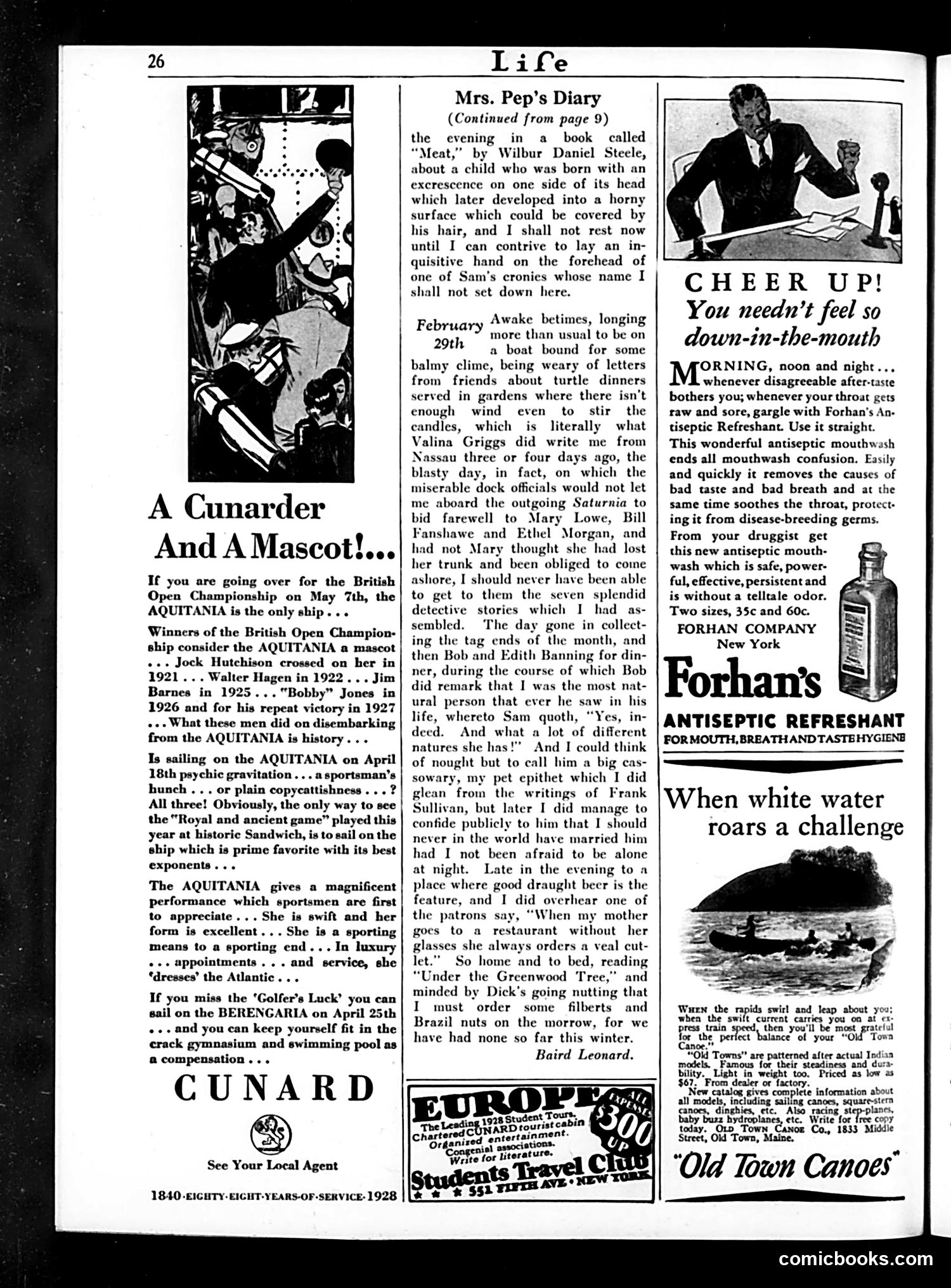
This page contains two distinct elements: **The Cunard Advertisement** (left/center): Promotes the ocean liner *Aquitania* as a "mascot" for golfers competing in the British Open Championship. The ad references real golfers—Jock Hutchison (1921), Walter Hagen (1922), Jim Barnes (1925), and Bobby Jones (1926-27)—who all sailed on the *Aquitania* before winning. The humor suggests that sailing on this particular ship brings good luck, playing on superstition among wealthy sportsmen. It's essentially tongue-in-cheek advertising disguised as sports reportage. **Mrs. Pep's Diary** (right): A humorous domestic column describing the writer's mundane social life—attending dinners, reading books, complaining about travel delays. The tone is satirical upper-class chitchat, poking fun at affected leisure-class concerns. **The remaining advertisements** (Forhan's mouthwash, Old Town Canoes, Students Travel Club) are standard commercial content. The page is primarily **advertising-driven**, typical of Life magazine's business model of that era.
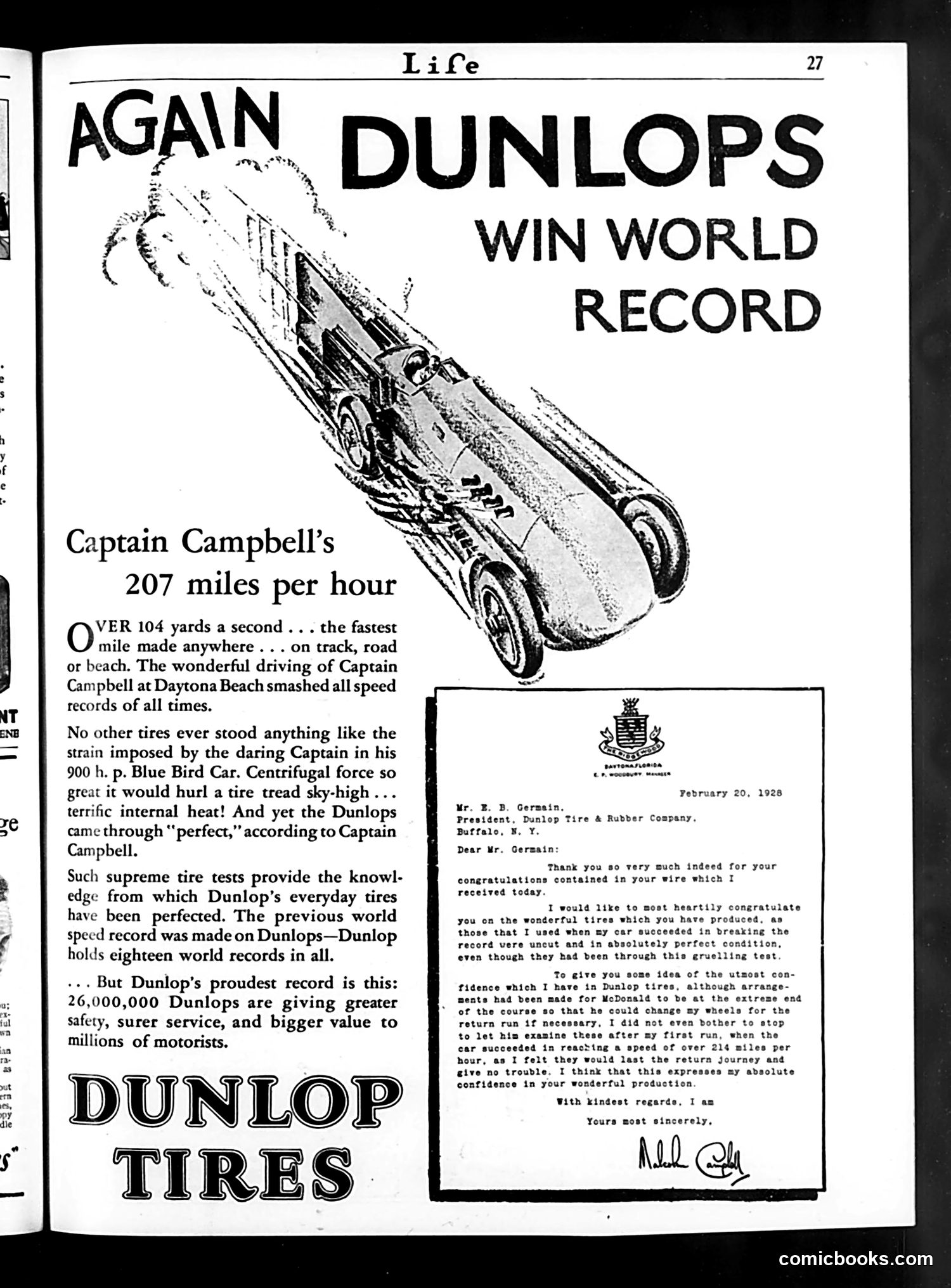
This is primarily a **Dunlop Tire advertisement** from 1928, not satire or political cartooning. The page capitalizes on a real speed record: Captain Campbell drove his "Blue Bird" car at Daytona Beach, achieving 207 mph—over 104 yards per second. The ad argues that Dunlops performed flawlessly under extreme conditions, emphasizing the tires' durability and safety. The included letter (dated February 20, 1928) from Dunlop's president congratulates Campbell on breaking the record using their tires. Campbell's response letter praises the tires' reliability, noting he didn't even stop between runs to change wheels. The ad's argument: if Dunlops survive a 900-horsepower racing car at record-breaking speeds, they'll safely serve ordinary motorists. It concludes that 26 million Dunlops prove the brand's reliability and value. This reflects 1920s marketing strategy—leveraging exotic motorsport achievements to advertise consumer products.
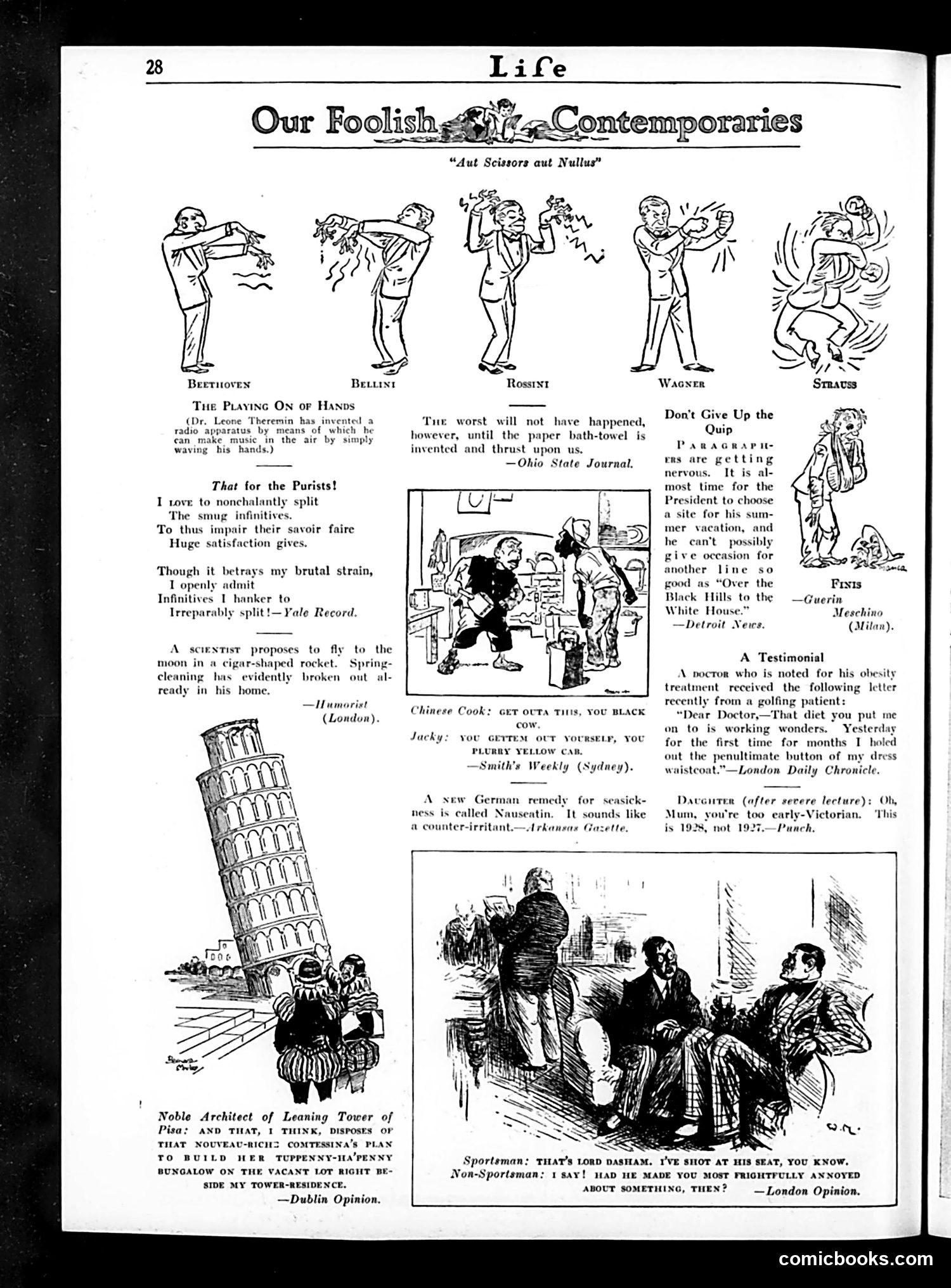
This 1928 *Life* page satirizes contemporary foolishness through caricatures and jokes. The top section mocks famous composers by depicting them engaged in absurd physical gestures—Beethoven conducting wildly, Rossini appearing frantic—labeled "Aut Scissor out Nullus" (roughly "all scissors, nothing else"), likely ridiculing modern musical composition as excessive gesture over substance. The page includes social humor: a doctor's obesity patient excited about diet results; a Chinese cook/servant exchange using racist dialect; jokes about split infinitives (grammatical pedantry); and architectural satire mocking nouveau-riche pretension. The final cartoon depicts two aristocrats discussing "Lord Dasham"—one claims to have shot at his estate (his "seat"), prompting confusion about whether offense was taken. This plays on class distinctions and the absurdity of upper-class social protocols. Overall, the page targets linguistic pedantry, class pretension, modern excess, and social affectation—typical *Life* magazine targets of the Jazz Age era.
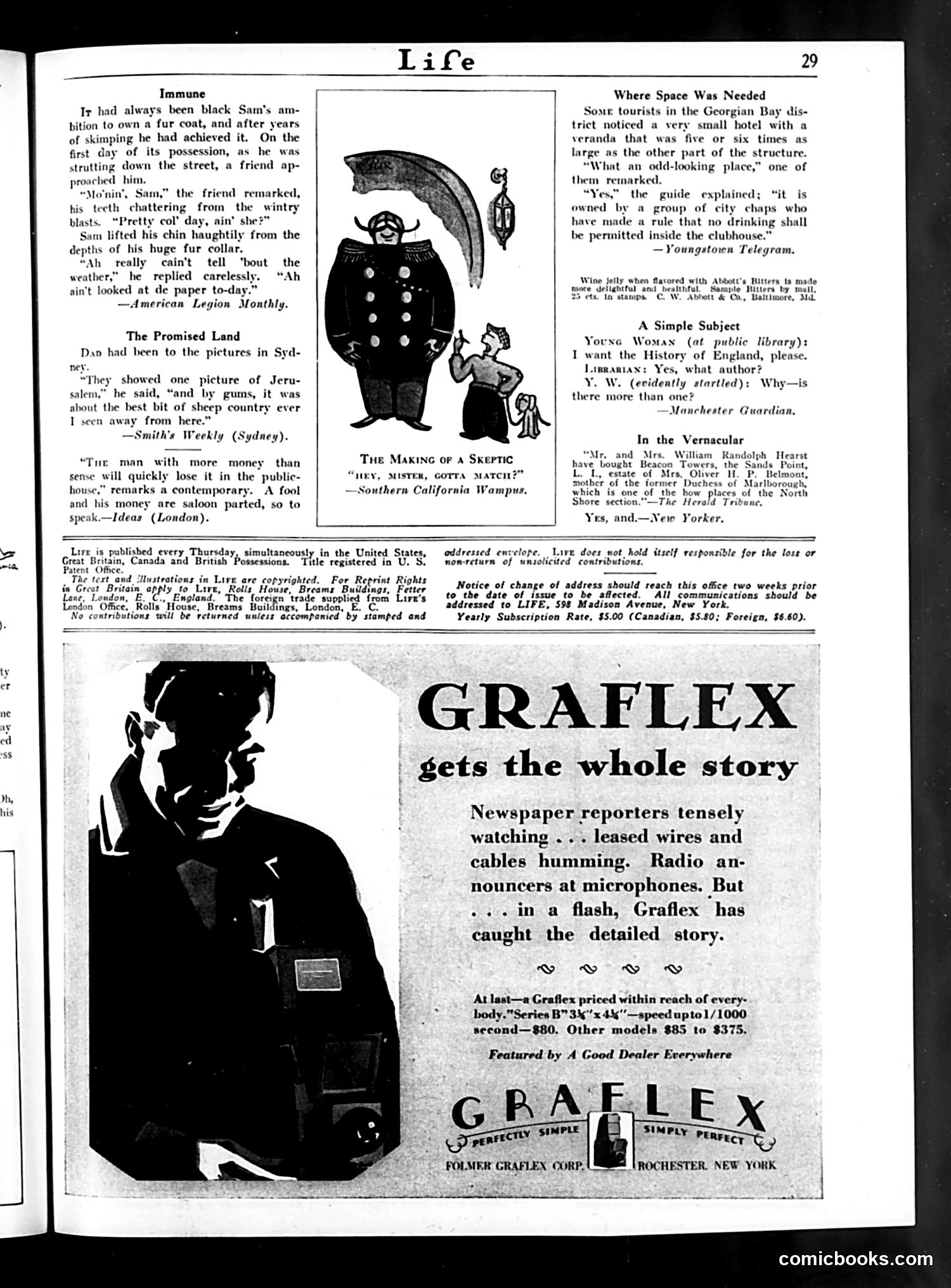
This page contains several short humorous anecdotes typical of Life's satirical format, plus an advertisement. **The cartoons/jokes:** - "Immune": A Black man named Sam, newly owning a fur coat, refuses to acknowledge the cold weather to a shivering friend—asserting dignity through indifference rather than admit discomfort. - "The Promised Land": An Australian man, shown a picture of Jerusalem, praises it only as good "sheep country." - "A Simple Subject": A librarian's bemused response when a young woman asks for "the History of England" as if only one exists. **Social context:** These reflect early-20th-century racial humor (Sam's dialect and stereotyping), colonial attitudes (dismissive Australian perspective), and gentle mockery of public ignorance. **The large advertisement** promotes Graflex cameras to newspaper photographers, emphasizing speed and affordability—reflecting journalism's technological advancement during this era. The page exemplifies Life's mix of satirical commentary on everyday life and contemporary commercial culture.
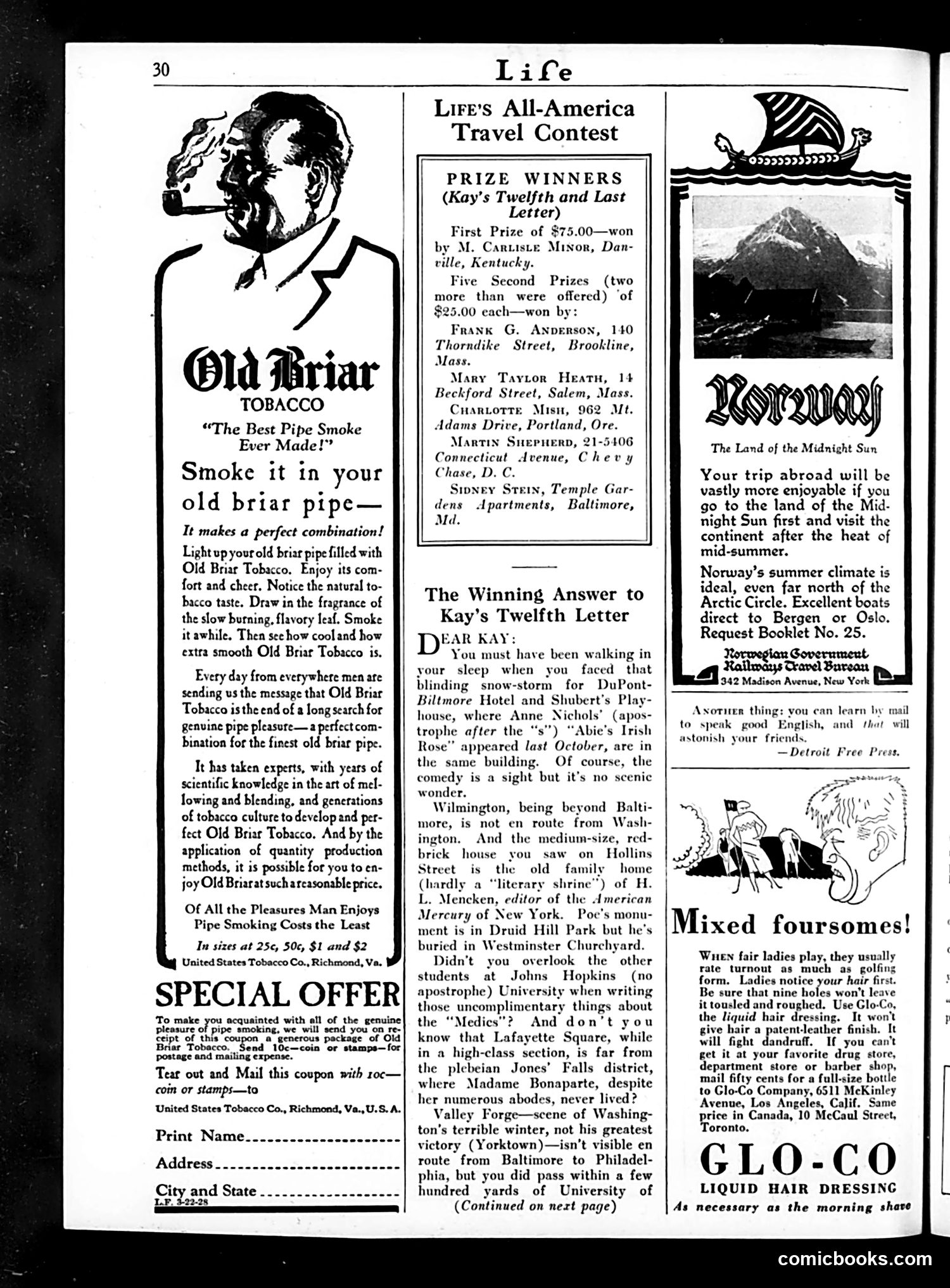
This page is primarily **advertising and contest results**, not political satire. The left side features an **Old Briar Tobacco advertisement**—a straightforward commercial pitch emphasizing pipe-smoking pleasure and affordability. The illustration shows a man's profile smoking a pipe; there's no satirical intent here, just product promotion. The center section announces **winners of Life magazine's "All-America Travel Contest,"** listing prize recipients and their hometowns. Below that, "Kay's Twelfth Letter" reveals the winning answer to a geography/trivia question about American landmarks—apparently contestants had to identify locations mentioned in previous letters. The winning answer corrects geographical errors about Baltimore, Wilmington, Johns Hopkins University, and other East Coast sites. The right side advertises **Norway tourism** and **Glo-Co liquid hair dressing**. **Bottom right**: A small cartoon captioned "Mixed foursomes!" shows women golfing, with a joke about how women golfers should use hair dressing to keep their hair neat during play. This is mild, period-appropriate humor about women's appearance. This page contains **no political satire**—it's a typical 1920s magazine mix of ads, contests, and light humor.
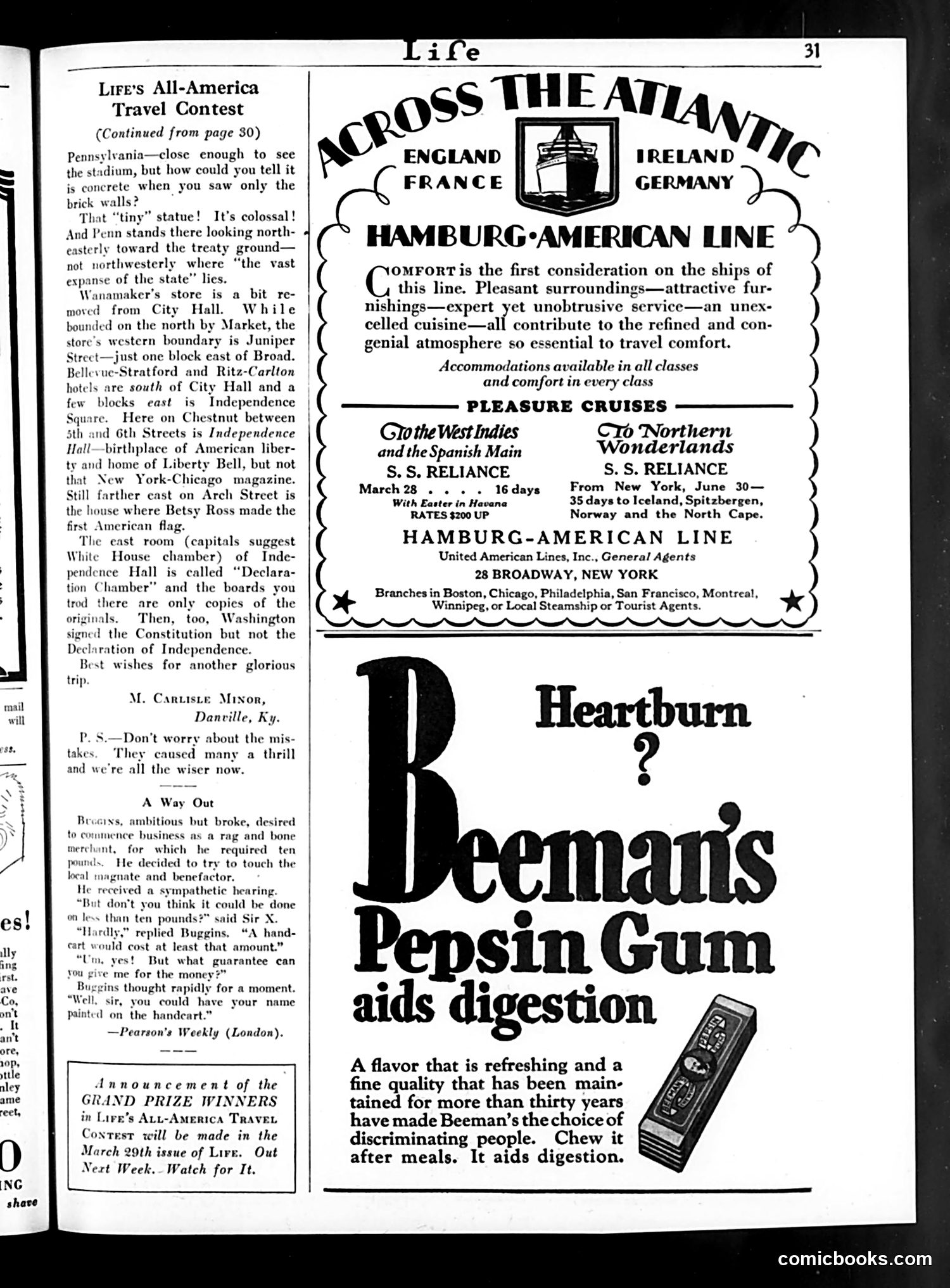
This page is primarily **advertising and contest material**, not political satire. The top half features a travel contest continuation with humorous reader submissions about Philadelphia landmarks (Independence Hall, Liberty Bell, Wanamaker's store). These are light jokes about visitors' confusion regarding the city's geography and architecture—nothing political. The dominant content is **commercial advertising**: 1. **Hamburg-American Line** (large display): A shipping company advertising transatlantic passenger service and pleasure cruises to the West Indies and Northern regions. The text emphasizes comfort and refined service. 2. **Beeman's Pepsin Gum** (lower right): An advertisement claiming the gum aids digestion, highlighting its 30-year track record. 3. **Announcement box**: Notices an upcoming contest winner announcement. The page represents typical 1920s-era *Life* magazine content—mixing reader humor with paid advertisements. There are no political cartoons or social satire visible.
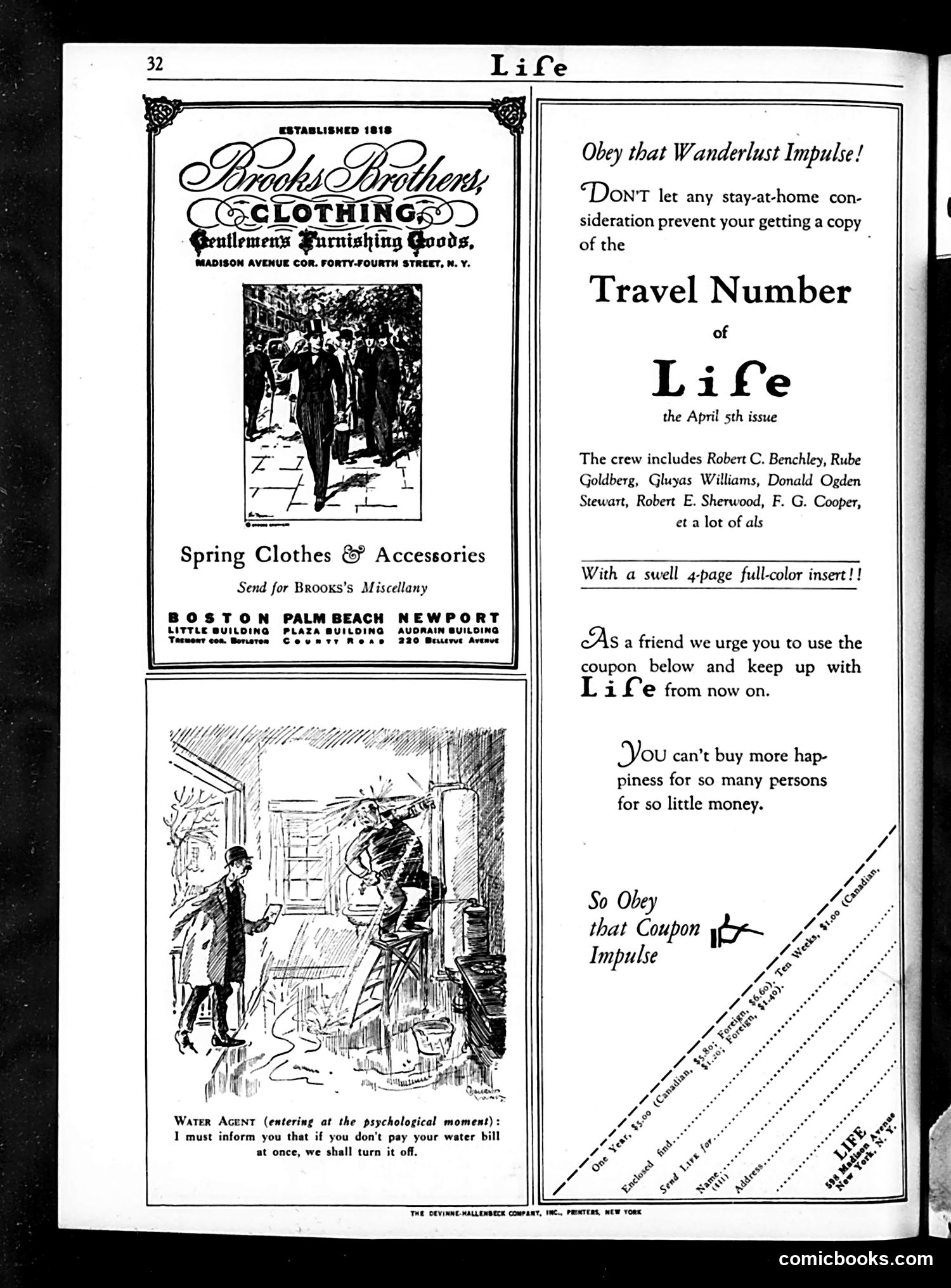
This page is primarily **advertising and promotional content** for Life magazine's April 5th travel issue, not political satire. The humor is gentle and domestic. The small cartoon at bottom depicts a **water bill collector arriving at an awkward moment**—a man on a bicycle has apparently just entered through a door where a woman stands. The joke plays on the phrase "psychological moment": the agent's timing is poor because he's interrupting something private, yet he must deliver his unpleasant message about unpaid bills regardless. The page's main content promotes Life's travel issue, featuring well-known humorists of the era (Benchley, Goldberg, Williams). The surrounding Brooks Brothers clothing ad and subscription coupon reflect Life's target audience: affluent readers who could afford both the magazine and spring fashions. The repeated phrase "Obey that Impulse" humorously urges readers to indulge wanderlust and subscribe—a lighthearted commercial appeal rather than political commentary.