
Life, 1928-03-22 · page 16 of 34
Life — March 22, 1928 — page 16: what you’re looking at
What you’re looking at
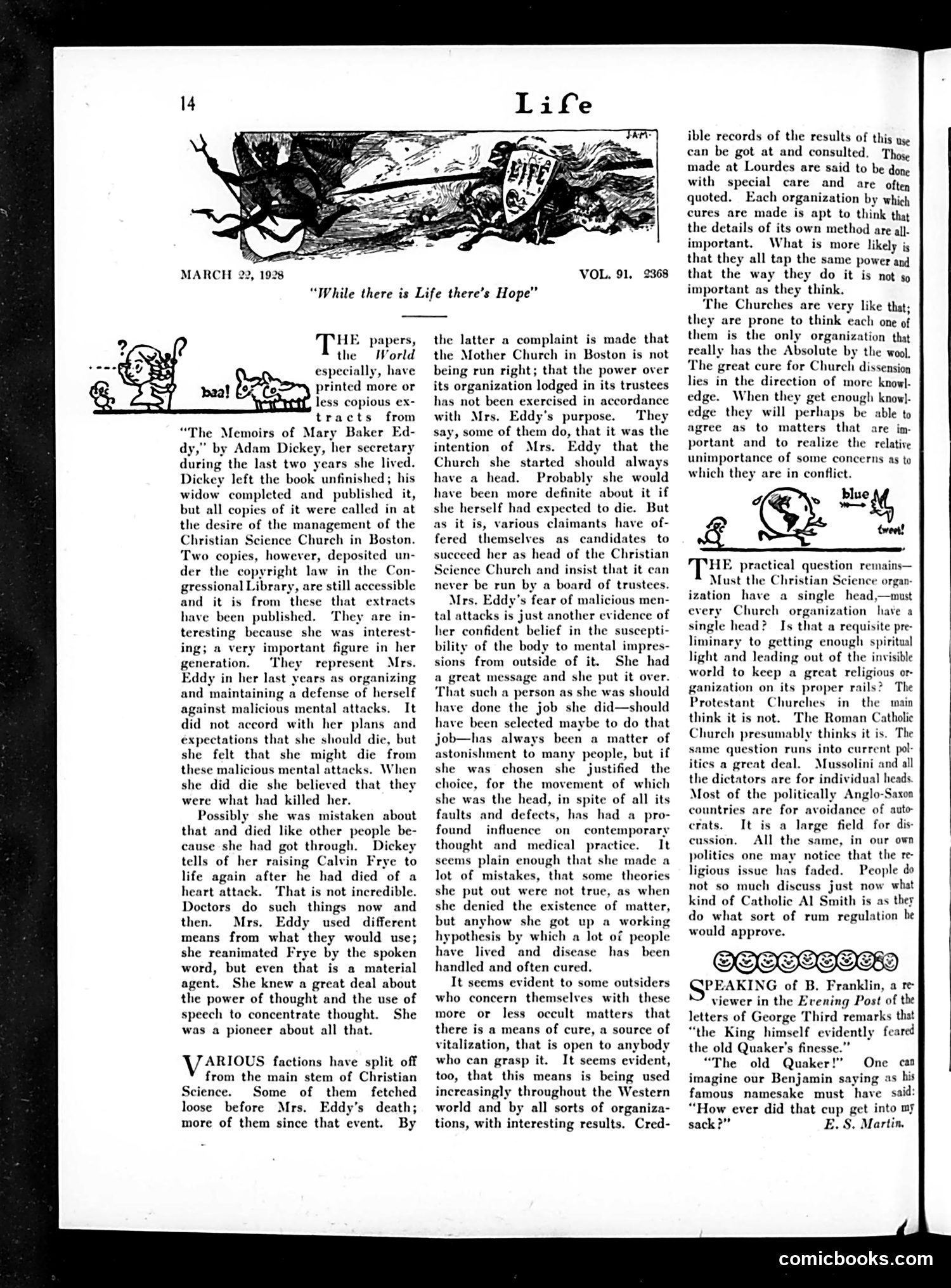
This page discusses **Mary Baker Eddy and Christian Science Church leadership disputes**. The main article addresses controversy over whether Mrs. Eddy intended the Church to be run by a board of trustees or a single head. The cartoons (small illustrations with text) appear to satirize organizational infighting within Christian Science—depicting the tensions between different factions competing for control after Eddy's death. One cartoon references **Benjamin Franklin**, likely contrasting historical American pragmatism with contemporary religious institutional quarrels. The commentary criticizes various Christian Science organizations for obsessing over internal governance details rather than spiritual matters, suggesting they've lost sight of the movement's original purpose. The satire targets institutional ego and doctrinal rigidity masquerading as religious principle.
📄 Transcribed text from this page (OCR, searchable)
Machine-transcribed from the original scan — historical spelling and the odd misread are preserved.
MARCH 22, 1928 VOL. 91. 2368 “While there is Life there’s Hope” HE. papers the World especially, have printed more or less copious ex- tracts from “The Memoirs of Mary Baker Ed- dy,” by Adam Dickey, her secretary during the last two years she lived. Dickey left the book unfinished; his widow completed and published it, but all copies of it were called in at the desire of the management of the Christian Science Church in Boston. Two copies, however, deposited un- der the copyright law in the Con- nal Library, are still accessible from these that extracts have been published. They are in- teresting because she was interest- ing; a very important figure in her generation. They represent Mrs. Eddy in her last years as organizing and maintaining a defense of herself against malicious mental attacks. It did not accord with her plans and expectations that she should die, but she felt that she might die from these malicious mental attacks. When she did die she believed that they were what had killed her. Possibly she was mistaken about that and died like other people be- cause she had got through. Dickey tells of her raising Calvin Frye to life again after he had died of a heart attack. That is not incredible. Doctors do such things now and then. Mrs. Eddy used different means from what they would use; she reanimated Frye by the spoken word, but even that is a material agent. She knew a great deal about the power of thought and the use of speech to concentrate thought. She was a pioneer about all that. Various factions have split off from the main stem of Christian Science. Some of them fetched loose before Mrs. Eddy’s death; more of them since that event. By the latter a complaint is made that the Mother Church in Boston is not being run right; that the power over its organization lodged in its trustees has not been exercised in accordance with Mrs. Eddy's purpose. They say, some of them do, that it was the intention of Mrs. Eddy that the Church she started should always have a head. Probably she would have been more definite about it if she herself had expected to die. But as it is, various claimants have of- fered themselves as candidates to succeed her as head of the Christian Science Church and insist that it can never be run by a board of trustee’ Mrs. Eddy’s fear of malicious men- tal attacks is just another evidence of her confident belief in the suscepti- bility of the body to mental impres- sions from outside of it. She had a great message and she put it over. That such a person as she was should have done the job she did—should have been selected maybe to do that job—has always been a matter of astonishment to many people, but if she was chosen she justified the choice, for the movement of which she was the head, in spite of all its faults and defects, has had a pro- found influence on contemporary thought and medical practice. It seems plain enough that she made a lot of mista that some theories she put out were not true, as when she denied the existence of matter, but anyhow she got up a working hypothesis by which a lot of people have lived and disease has handled and often cured. It seems evident to some outsiders who concern themselves with these more or less occult matters that there is a means of cure, a source of vitalization, that is open to anybody who can grasp it. It seems evident, too, that this means is being used increasingly throughout the Western world and by all sorts of organiza- tions, with interesting results. Cred- been ible records of the results of this use can be got at and consulted. Those made at Lourdes are said to be done with special care and are often quoted. Each organization by which cures are made is apt to think that the details of its own method are al]- important. What is more likely is that they all tap the same power and that the way they do it is not so important as they think. The Churches are very like that; they are prone to think each one of them is the only organization that really has the Absolute by the wool, The great cure for Church dissension lies in the direction of more knowl- edge. When they get enough know]- edge they will perhaps be able to agree as to matters that are im- portant and to realize the relative unimportance of some concerns as to which they are in conflict. blue ~— & tent! THE practical question remains— Must the Christian Science organ- ization have a single every Church organization have a single head? Is that a requisite pre- liminary to getting enough spiritual light and leading out of the invisible world to keep a great religious or ganization on its proper rails? The Protestant Churches in’ the main think it is not. The Roman Catholic Church presumably thinks it is. The same question runs into current pol- ities a great deal. Mussolini and all the dictators are for individual heads. Most of the politically Anglo-Saxon countries are for avoidance of auto crats. It is a large field for dis- All the same, in our own cs one may notice that the re ligious issue has faded. People do not so much discuss just now what kind of Catholic Al Smith is as ther do what sort of rum regulation be would approve. OSCCSCOS SPEAKING of B. Franklin, a re viewer in the Evening Post of the letters of George Third remarks that “the King himself evidently feared the old Quaker’s finesse. “The old Quaker! One can imagine our Benjamin saying as his famous namesake must have said: “How ever did that cup get into my sack?” E. S. Martin. head,—must comicbooks.com