
Life, 1928-03-22 · page 26 of 34
Life — March 22, 1928 — page 26: what you’re looking at
What you’re looking at
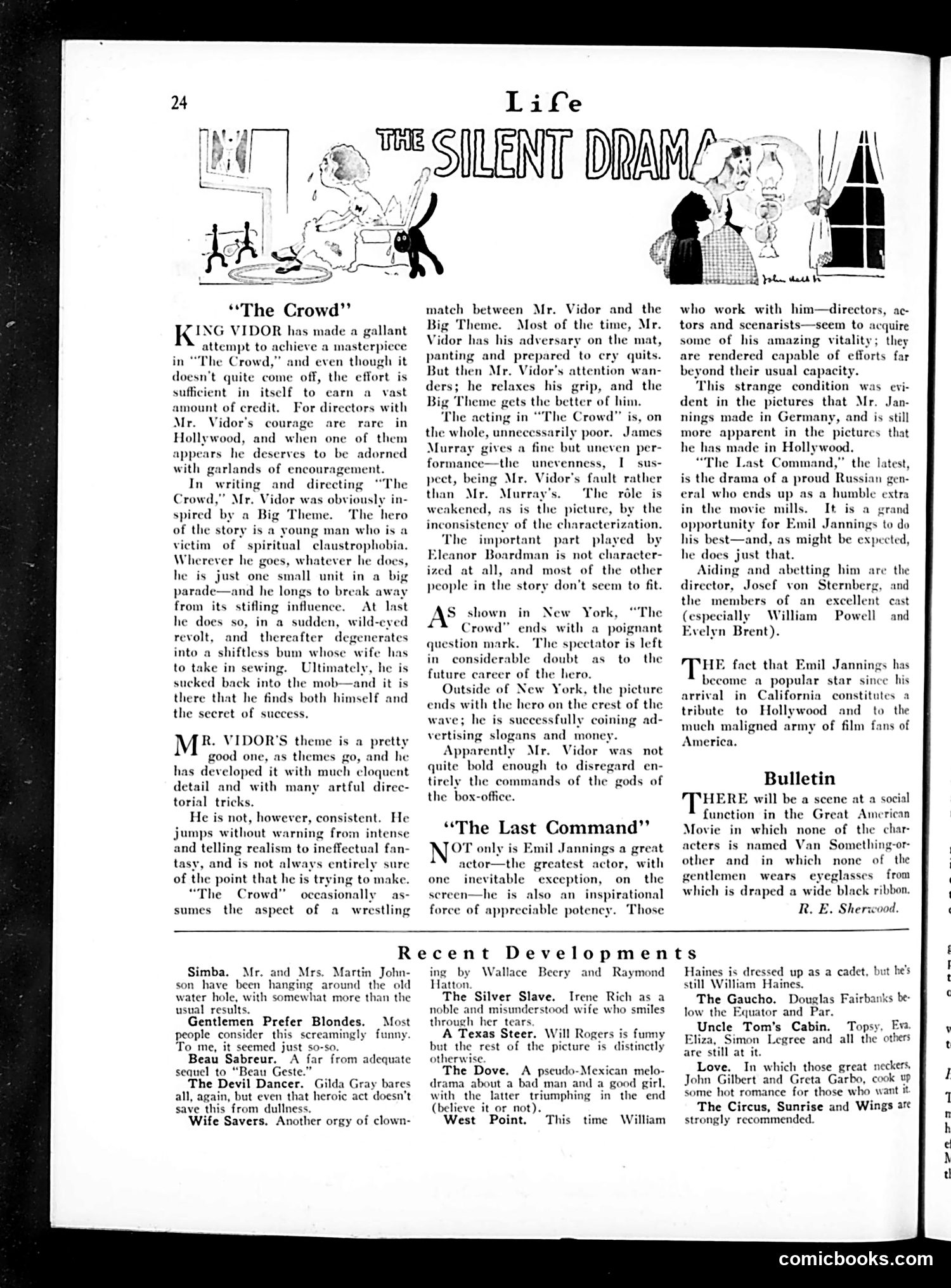
This page contains film reviews from Life magazine's "Silent Drama" section, critiquing two 1920s movies. **"The Crowd"** reviews director King Vidor's ambitious film about an everyman struggling against conformity in modern society. The critic praises Vidor's courage and the film's theme but faults its inconsistency—it vacillates between realism and fantasy without clear purpose. The review notes that actor James Murray delivers an uneven performance, likely due to directorial inconsistency, while Eleanor Boardman's role is underwritten. **"The Last Command"** celebrates Emil Jannings, a German actor whose talent elevates everyone around him. The film depicts a Russian general reduced to working as an extra in Hollywood—a role perfectly suited to showcase Jannings' abilities. The reviewer credits Jannings' presence for inspiring superior work from director Josef von Sternberg and the supporting cast (including William Powell and Evelyn Brent). Both reviews exemplify how 1920s film criticism evaluated artistic ambition, acting talent, and directorial consistency in silent cinema.
📄 Transcribed text from this page (OCR, searchable)
Machine-transcribed from the original scan — historical spelling and the odd misread are preserved.
“The Crowd” Kixe VIDOR has made a gallant ve a masterpiece in “The Crowd,” and even though it doesn't quite come off, the effort is sufficient in itself to earn a vast amount of credit. For directors with Mr. Vidor’s courage are rare in Hollywood, and when one of them appears he deserves to be adorned with garlands of encouragement. In writing and directing “The Crowd,” Mr. Vidor was obviously in- spired by a Big Theme. The hero of the story is a young man who is a victim of spiritual claustrophobia. Wherever he goes, whatever he does, he is just one small unit in a big parade—and he longs to break from its stifling influence. At last he does so, in a sudden, wild-cyed revolt, and thereafter degenerates into a shiftless bum whose wife has to take in sewing. Ultimately, he is sucked back into the mob—and it is there that he finds both himself and the secret of success, ] R. VIDOR'’S theme is a pretty good one, as themes go, and he has developed it with much eloquent detail and with many artful direc- torial tricks. He is not, however, consistent. jumps without He ning from intense and telling realism to ineffectual fan- tasy, and is not always entirely sure of the point that he is trying to make. “The Crowd” occasionally sumes the aspect of a as- wrestling Life match between Mr. Vidor and the Big Theme. Most of the time, Mr. Vidor has his adversary on the mat, panting and prepared to cry quits. But then Mr. Vidor’s attention wan- ders; he relaxes his grip, and the Big Theme gets the better of him. The acting in “The Crowd” is, on the whole, unnecessarily poor. James Murray gives a fine but uneven per- formance—the unevenness, I sus- pect, being Mr. Vidor’s fault rather than Mr. Murray's. The role is weakened, as is the picture, by inconsistency of the characte The important part pls Eleanor Boardman is not cl ized at all, and most of the other people in the story don’t seem to fit. shown in) New AS York, he Crowd” ends with a poignant question mark. ‘The spectator is left in considerable doubt as to the future career of the hero. Outside of New York, the picture ends with the hero on the crest of the wave; he is successfully coining ad- vertising slogans and money. Apparently Mr. Vidor was not quite bold enough to disregard en- tirely the commands of the gods of the box-office. “The Last Command” NOT only is Emil Jannings a great ctor—the greatest actor, with inevitable exception, on the screen—he is also an_ inspirational force of appreciable potency. Those one who work with him—directors, ac- tors and scenarists—seem to acquire some of his amazing vitality; they are rendered capable of efforts far beyond their usual capacity. This strange condition was evi- dent in the pictures that Mr. Jan- nings made in Germany, and is still more apparent in the pictures that he made in Hollywood, the Last Command,” the latest, is the drama of a proud Russian gen- eral who ends up as a humble extra in the movie mills. It is a grand opportunity for Emil Jannings to do his best—and, as might be expected, he does just that. Aiding and abetting him are director, Josef von Sternbe the members of an excellent cast (especially William Powell and Evelyn Brent). HE fact that Emil Jannings has become a popular star since his arrival in California constitutes a tribute to Hollywood and to the much maligned army of film fans of America, Bulletin HERE will be a scene at a social function in the Great American Movie in which none of the char- acters is named Van Something-or- other and in wh none of the gentlemen wears eyeglasses from which is draped a wide black ribbon. R. E. Sherwood. R Simba. Mr. and Mrs. Martin John- son have been hanging around the old water hole, with somewhat more than the usual results. Gentlemen Prefer Blondes. people consider this screamingly To_me, it seemed just so-so. Beau Sabreur. A far from adequate sequel to “Beau Geste.” The Devil Dancer. Gilda Gray bares all, again, but even that heroic act doesn’t save this from dullness. Wife Savers. Another orgy of clown- Most funny. ecent Developments ing by Wallace and Hatton. The Silver Slave. Irene Rich as a noble and misunderstood wife who smiles through her tears A Texas Steer. Will Rogers is funny but the rest of the picture is distinctly otherwise. The Dove. A pscudo-Mexican melo- drama about a bad man and a good girl, with the latter triumphing in the end (believe it_or not). West Point. Beery Raymond This time William Haines is dressed up as a cadet, but he's still William Haines. The Gaucho. Douglas Fairbanks be low the Equator and Par. Uncle Tom's Cabin. Topsy, Eva, Eliza, Simon Legree and all the others are still at it. Love. In which those great neckers. John Gilbert and Greta Garbo, cook up some hot romance for those who want it The Circus, Sunrise and Wings are strongly recommended. comicbooks.com