
Life, 1928-03-22 · page 19 of 34
Life — March 22, 1928 — page 19: what you’re looking at
What you’re looking at
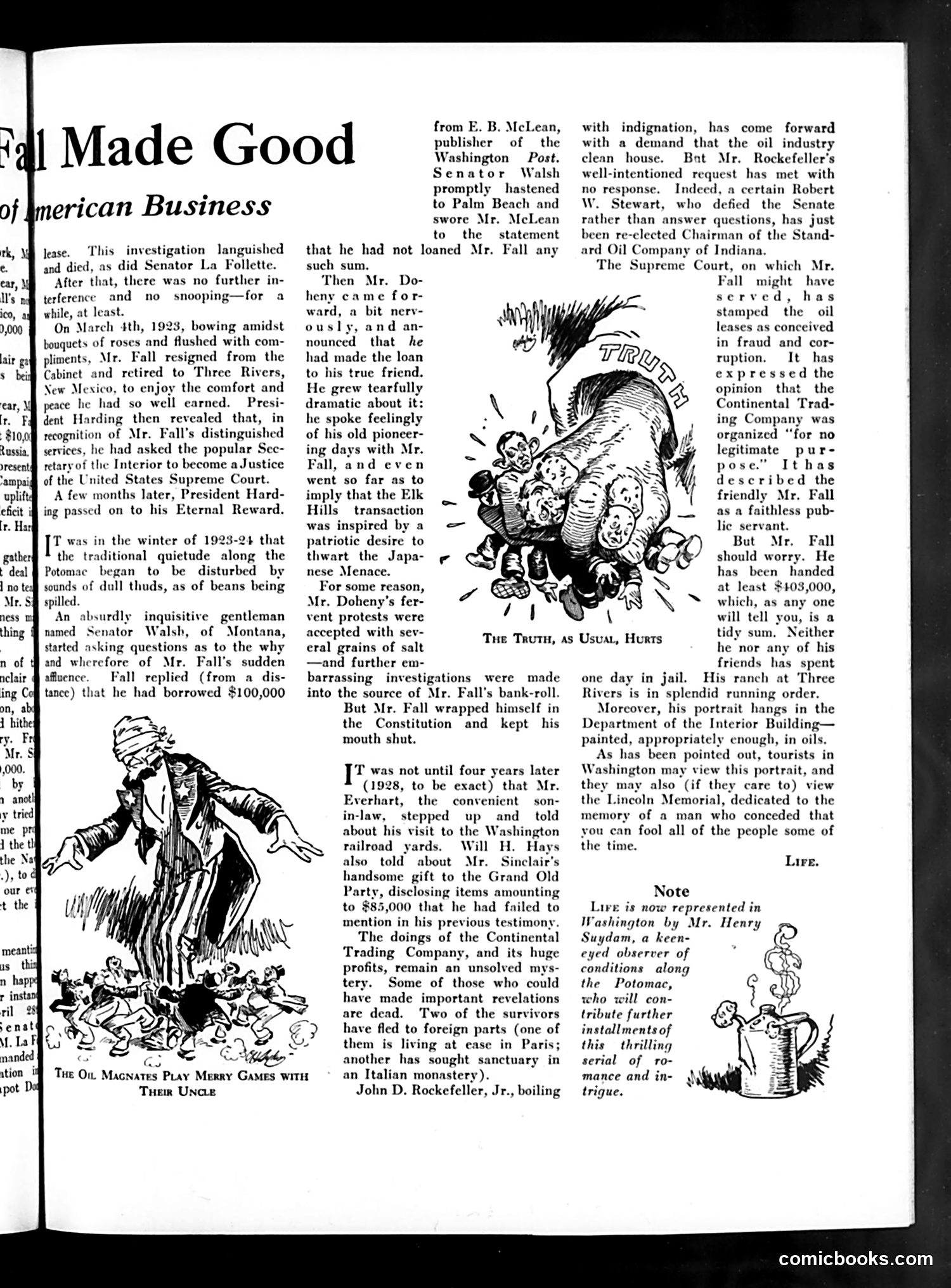
This Life magazine article satirizes **Harry Sinclair** (oil magnate involved in the Teapot Dome scandal) through the fictional character **Mr. Fall**, based on **Albert Fall**, the Interior Secretary who went to prison for bribery. The cartoons mock how Fall and associates grew wealthy through corrupt oil leases. One illustration shows fat oil magnates playing games "with their Uncle"—likely referencing how they exploited governmental connections for profit. The article's tone is bitterly ironic: Fall received substantial money ($103,000+) and a ranch, while claiming to be an honest public servant. The piece suggests wealthy defendants escape real consequences while ordinary citizens face jail time—a critique of how wealth buys leniency in American justice.
📄 Transcribed text from this page (OCR, searchable)
Machine-transcribed from the original scan — historical spelling and the odd misread are preserved.
Made Good erican Business lease. ‘This investigation languished and died, as did Senator La Follette. After that, there was no further in- terference and no snooping—for a while, at least. On March 4th, 1923, bowing amidst bouquets of roses and flushed with com- pliments, Mr. Fall resigned from the Cabinet and retired to Three Rivers, New Mexico, to enjoy the comfort and peace he had so well earned. Presi- dent Harding then revealed that, in recognition of Mr. Fall's distinguished services, he had asked the popular Sec- retary of the Interior to become a Justice of the United States Supreme Court. A few months later, President Hard- ing passed on to his Eternal Reward. T was in the winter of 1923-24 that the traditional quietude along the Potomac began to be disturbed by sounds of dull thuds, as of beans being spilled. absurdly inquisitive gentleman tor Walsh, of Montana, started asking questions as to the why and wherefore of Mr. Fall's sudden affluence. Fall replied (from a dis- tance) that he had borrowed $100,000 Tue Ou. Macnates Pray Merry GaMes witit Tuer Unce from E. B. McLean, publisher of the Washington Post. Senator Walsh promptly hastened to Palm Beach and swore Mr. McLean to the statement that he had not loaned Mr. Fall any such sum. Then Mr. Do- heny came for- ward, a bit nerv- ously, and an- nounced that he had made the loan to his true friend. He grew tearful dramatic about i he spoke feelingly of his old pioncer- ing days with Mr. Fall, and even went so far as to imply that the Elk Hills transaction was inspired by a patriotic desire to thwart the Japa- nese Menace. For some reason, Mr. Doheny’s fer- vent protests were accepted with sev- eral grains of salt —and further em- barrassing investigations were made into the source of Mr. Fall's bank-roll. But Mr. Fall wrapped himself in the Constitution and kept his mouth shut. J" was not until four years later (1928, to be exact) that Mr. Everhart, the convenient son- in-law, stepped up and _ told about his visit to the Washington railroad yards. Will H. Hays also told about Mr. Sinclair's handsome gift to the Grand Old y, disclosing items amounting mention in his previous testimony. The doings of the Continental Trading Company, and its huge profits, remain an unsolved mys- tery. Some of those who could have made important revelations are dead. Two of the survivors have fled to foreign parts (one of them is living at ease in Paris; another has sought sanctuary in an Italian monastery). John D, Rockefeller, Jr., boiling Tue Trutu, as Usuat, Hurts with indignation, has come forward with a demand that the oil industry clean house. Bnt Mr. Rockefeller’s well-intentioned request has met with no response. Indeed, a certain Robert W. Stewart, who defied the Senate rather than answer questions, has just been re-elected Chairman of the Stand- ard Oil Company of Indiana. The Supreme Court, on which Mr. Fall might have served, has stamped the oil leases as conceived in fraud and cor- ruption, It has expressed the opinion that the Continental Trad- ing Company was organized “for no legitimate pur- pose.” Ithas described the friendly Mr. Fall as a faithless pub- lic servant. But Mr. Fall should worry. He has been handed at least $403,000, which, as any one will tell you, is a tidy sum, Neither he nor any of his friends has spent one day in jail. His ranch at Three Rivers is in splendid running order. Moreover, his portrait hangs in the Department of the Interior Building— painted, appropriately enough, in oils. As has been pointed out, tourists in Washington may view this portrait, and they may also (if they care to) view the Lincoln Memorial, dedicated to the memory of a man who conceded that you can fool all of the people some of the time. Lire. Note Lire is now represented in Washington by Mr. Henry Suydam, a keen- eyed observer of conditions along the Potomac, who will con- tribute further installments of this thrilling serial of ro- mance and in- trigue. comicbooks.com