
Life, 1928-03-22 · page 18 of 34
Life — March 22, 1928 — page 18: what you’re looking at
What you’re looking at
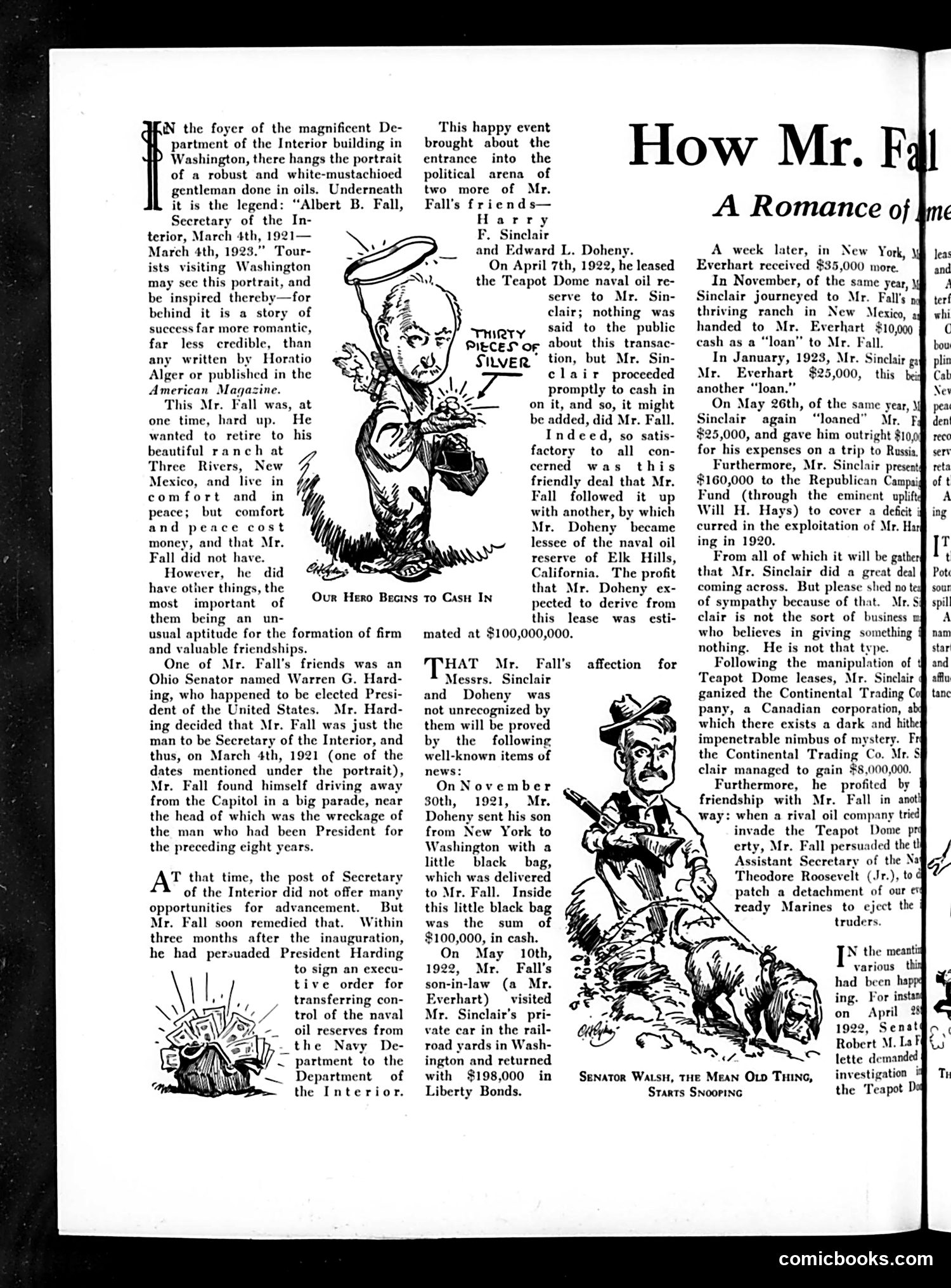
This page satirizes the Teapot Dome scandal, a major 1920s corruption case. The article describes Albert B. Fall, Secretary of the Interior, receiving bribes from oil executives Harry Sinclair and Edward L. Doheny in exchange for control of naval oil reserves. The cartoon depicts Senator Thomas Walsh as a detective investigating Fall's illegal dealings. The caption "Senator Walsh, the Mean Old Thing, Starts Snooping" mocks Walsh's investigation with mock-sympathetic language, suggesting his scrutiny is unwelcome harassment of Fall. The text details cash loans, stock transfers, and ranch improvements Fall received—all bribes disguised as legitimate business transactions. Life magazine exposes this corruption through satirical narrative, portraying the investigators as nuisances rather than watchdogs, reflecting contemporary divided public opinion about the scandal.
📄 Transcribed text from this page (OCR, searchable)
Machine-transcribed from the original scan — historical spelling and the odd misread are preserved.
WN the foyer of the magnificent De- partment of the Interior building in Washington, there hangs the portrait of a robust and white-mustachioed gentleman done in oils. Underneath it is the legend: “Albert B. Fall, Secretary of the In- This happy event brought about the entrance into the political arena of two more of Mr. Fall’s friend s— Harry terior, March 4th, 1921— March 4th, 1923." Tour- ists visiting Washington y see this portrait, and spired thereby—for behind it is a story of success far more romantic, far less credible, than any written by Horatio Alger or published in the American Magazine. This Mr. Fall was, at one time, hard up. wanted to retire to beautiful ranch at Three Rivers, New Mexico, and live in comfort and in peace; but comfort and peace cost money, and that Mr. Fall did not have. However, he did have other things, the most important of them being an un- usual aptitude for the He his Our Hero Becins to Caso IN formation of firm and valuable friendships. One of Mr. Fall's friends was an Ohio Senator named Warren G. Hard- ing, who happened to be elected Presi- dent of the United States. Mr. Hard- ing decided that Mr. Fall was just the man to be Secretary of the Interior, and thus, on March 4th, 1921 (one of the dates mentioned under the portrait), Mr. Fall found himself driving away from the Capitol in a big parade, near the head of which was the wreckage of F. Sinclair and Edward L. Doheny. On April 7th, 1922, he leased the Teapot Dome naval oil re- serve to Mr. Sin- clair; nothing was said to the public about this transac- tion, but Mr. Sin- clair proceeded promptly to cash in on it, and so, it might be added, did Mr. Fall. Indeed, so satis- factory to all con- cerned was this friendly deal that Mr. Fall followed it up with another, by which Mr. Doheny became lessee of the naval oil reserve of Elk Hills, California. The profit that Mr. Doheny ex- pected to derive from this lease was esti- os mated at $100,000,000. HAT Mr. Fall's Messrs. Sinclair affection for and Doheny was not unrecognized by them will be proved by the following well-known items of news: OnNovember soth, 1921, Mr. Doheny sent his son How Mr. F A Romance of A week later, in New York, \j Everhart received $35,000 more. In November, of the same year, \f Sinclair journeyed to Mr. Fall's nq thriving ranch in New Mexi handed to Mr. Everhart cash as a “loan” to Mr. In January, 1923, Mr. Sinclair ge Mr. Everhart $25,000, this bei another “loan,” On May 26th, of the same year, ) Sinclair again “loaned” Mr. F, $25,000, and gave him outright $100) for his expenses on a trip to Russia, Furthermore, Mr. Sinclair present $160,000 to the Republican Campai Fund (through the eminent upliftd Will H. Hays) to cover a deficit curred in the exploitation of Mr. Har ing in 1920. From all of which it will be gather that Mr. Sinclair did a great deal coming across. But please shed no ted of sympathy because of that. Mr. $: clair is not the sort of business a who believes in giving something nothing. He is not that type. Following the manipulation of { Teapot Dome leases, Mr. Sinclair ganized the Continental Trading Co pany, a Canadian corporation, ab which there exists a dark and hithe! impenetrable nimbus of mystery. F the Continental Trading Co. Mr. § clair managed to gain $8,000,000. Furthermore, he profited by friendship with Mr. Fall in anot} way: when a rival oil company tried from New York to Washington with a little black bag, which was delivered to Mr. Fall. Inside this little black bag the man who had been President for invade the Teapot Dome prq the preceding eight years. erty, Mr. Fall persuaded the th Assistant Secretary of the Nat T that time, the post of Secretary of the Interior did not offer many opportunities for advancement. But Mr. Fall soon remedied that. Within was the sum _ of three months after the inauguration, $100,000, in cash. he had persuaded President Harding On May 10th, to sign an execu- 1922, Mr. Fall's tive order for son-in-law (a Mr. transferring con- Everhart) __ visited trol of the naval Mr. Sinclair's _pri- . a on m oil reserves from vate car in the rail- 1922, § _ the Navy De- road yards in Wash- Robert M. LaF ~ partment to the ington and returned lette demanded ~ Department of with $198,000 in investigation . the Interior. Liberty Bonds. the Teapot Ds patch a detachment of our ¢ ready Marines to eject the truders. various thin had been hap | Senator Wats, THe Mean Oxo Tino, Starts SNoorinc comicbooks.com