
Life, 1928-03-22 · page 21 of 34
Life — March 22, 1928 — page 21: what you’re looking at
What you’re looking at
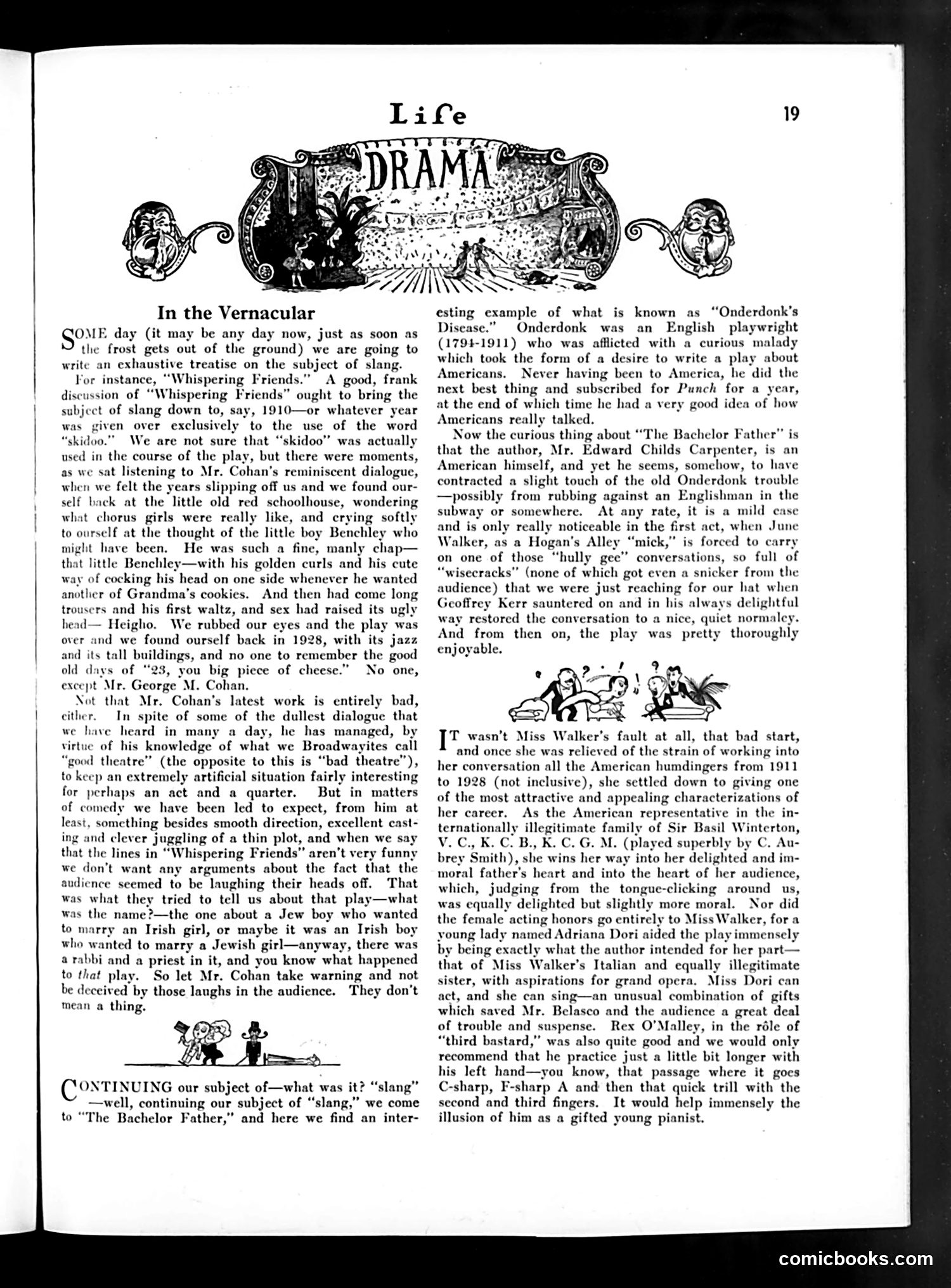
This is a theater review column critiquing two Broadway plays: "Whispering Friends" (by George M. Cohan) and "The Bachelor Father" (by Edward Childs Carpenter). The reviewer mockingly dismisses both works. For "Whispering Friends," he admits the audience laughed but insists the jokes weren't actually funny—the laughter "doesn't mean a thing." Regarding "The Bachelor Father," the reviewer invents a fictional condition called "Onderdonk's Disease" to satirize Carpenter's stereotypical portrayal of working-class Irish-American characters (a "Hogan's Alley 'mick'"). The joke: an American playwright writes unconvincing Irish-American dialogue, as if he'd only learned about Americans from reading the British satirical magazine *Punch*. The broader point targets inauthentic theatrical writing and audience gullibility—mocking both playwrights for relying on clichéd slang and stereotypes rather than genuine wit.
📄 Transcribed text from this page (OCR, searchable)
Machine-transcribed from the original scan — historical spelling and the odd misread are preserved.
In the Vernacular SOME day (it may be any day now, just as soon as the frost gets out of the ground) we are going to write an exhaustive treatise on the subject of slang. For instance, “Whispering Friends.” A good, frank discussion of “Whispering Friends” ought to bring the subject of slang down to, say, 1910—or whatever year was en over exclusively to the use of the word “skidoo.”” We are not sure that “skidoo” was actually used in the course of the play, but there were moments, as we sat listening to Mr. Cohan’s reminiscent dialogue, when we felt the years slipping off us and we found our- self back at the little old red schoolhouse, wondering what chorus girls were really like, and crying softly at the thought of the little boy Benchley who might have been. He was such a fine, manly chap— that little Benchley—with his golden curls and his cute way of cocking his head on one side whenever he wanted another of Grandma's cookies. And then had come long trousers and his first waltz, and sex had raised its ugly head— Heigho. We rubbed our eyes and the play was over and we found ourself back in 1928, with its jazz and its tall buildings, and no one to remember the good old days of “23, you big piece of cheese.” No one, except Mr. George M. Cohan. Not that Mr. Cohan’s latest work is entirely bad, cither. In spite of some of the dullest dialogue that we have heard in many a day, he has managed, by virtue of his knowledge of what we Broadwayites call “good theatre” (the opposite to this is “bad theatre’), to keep an extremely artificial situation fairly interesting for perhaps an act and a quarter. But in matters of comedy we have been led to expect, from him at least, something besides smooth direction, excellent cast- ing and clever juggling of a thin plot, and when we say that the lines in “Whispering Friends” aren’t very funny we don't want any arguments about the fact that the audience seemed to be laughing their heads off. That was what they tried to tell us about that play—what was the name?—the one about a Jew boy who wanted to marry an Irish girl, or maybe it was an Irish boy who wanted to marry a Jewish girl—anyway, there was a rabbi and a priest in it, and you know what happened to that play. So let Mr. Cohan take warning and not be deceived by those laughs in the audience. They don't mean a thing. to oursel ONTINUING our subject of—what was it? “slang” —well, continuing our subject of “slang,” we come to “The Bachelor Father,” and here we find an inter- esting example of what is known as ‘Onderdonk’s Disease.” Onderdonk was an English playwright (1794-1911) who was afflicted with a curious malady which took the form of a desire to write a play about Americans. Never having been to America, he did the next best thing and subscribed for Punch for a year, at the end of which time he had a very good idea of how Americans really talked. Now the curious thing about “The Bachelor Father” is that the author, Mr. Edward Childs Carpenter, is an American himself, and yet he seems, somehow, to have contracted a slight touch of the old Onderdonk trouble —possibly from rubbing against an Englishman in the subway or somewhere. At any rate, it is a mild case and is only really noticeable in the first act, when June Walker, as a Hogan's Alley “mick,” is forced to carry on one of those “hully gee” conversations, so full of “wisecracks” (none of which got even a snicker from the audience) that we were just reaching for our hat when Geoffrey Kerr sauntered on and in his always delightful way restored the conversation to a nice, quiet normalcy. And from then on, the play was pretty thoroughly enjoyable. T wasn’t Miss Walker's fault at all, that bad start, and once she was relieved of the strain of working into her conversation all the American humdingers from 1911 to 1928 (not inclusive), she settled down to giving one of the most attractive and appealing characterizations of her career. As the American representative in the in- ternationally illegitimate family of Sir Basil Winterton, V. C., K. C. B., K. C. G. M. (played superbly by C, Au- brey Smith), she wins her way into her delighted and im- moral father's heart and into the heart of her audience, which, judging from the tongue-clicking around us, was equally delighted but slightly more moral. Nor did the female acting honors go entirely to Miss Walker, for a young lady named Adriana Dori aided the play immensely by being exactly what the author intended for her part— that of Miss Walker’s Italian and equally illegitimate sister, with aspirations for grand opera. Miss Dori can act, and she can sing—an unusual combination of gifts which saved Mr. Belasco and the audience a great deal of trouble and suspense. Rex O'Malley, in the réle of “third bastard,” was also quite good and we would only recommend that he practice just a little bit longer with his left hand—you know, that passage where it goes C-sharp, F-sharp A and then that quick trill with the second and third fingers. It would help immensely the illusion of him as a gifted young pianist. comicbooks.com