
A complete issue · 40 pages · 1927
Life — September 22, 1927
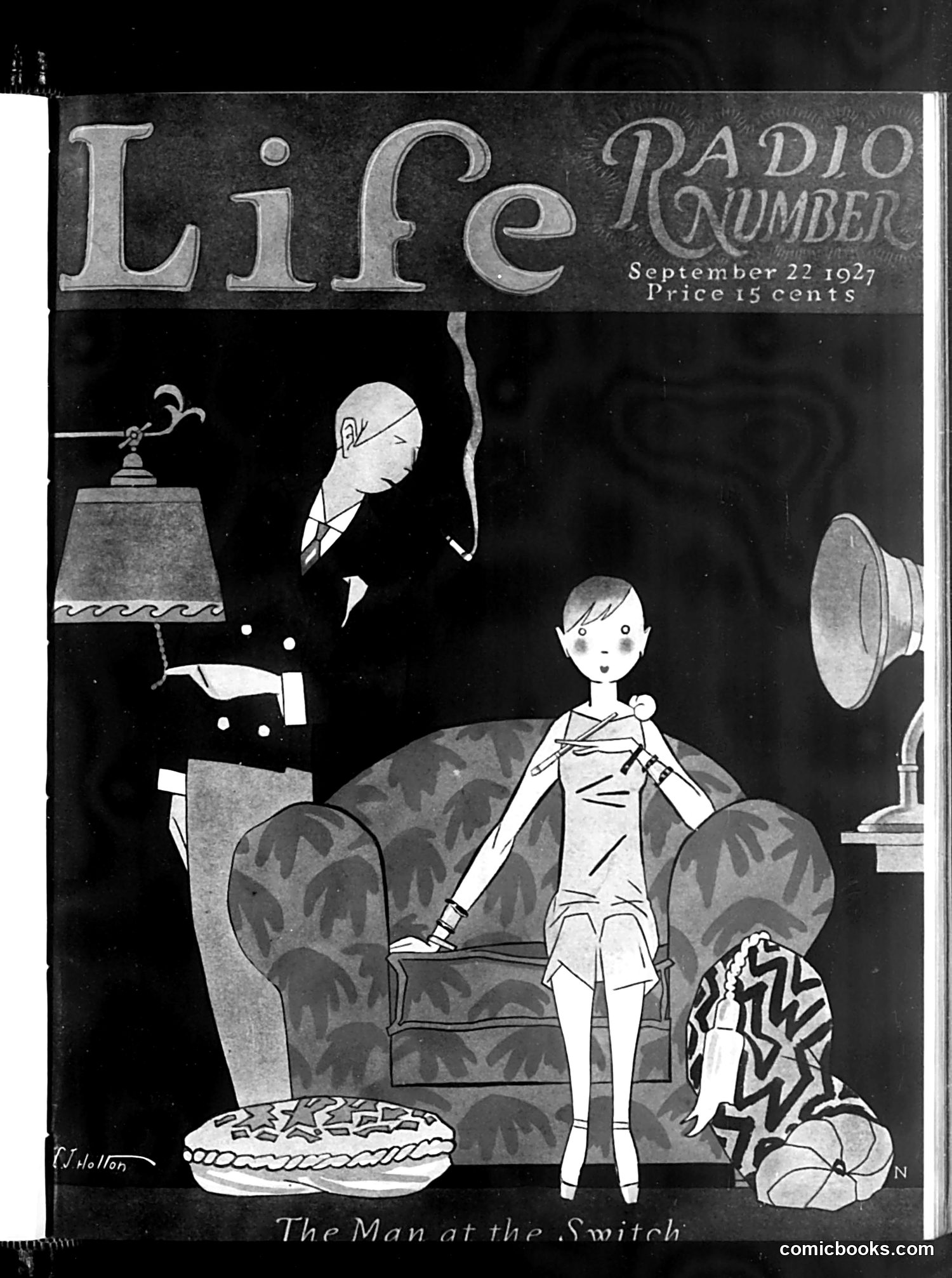
**September 22, 1927** This cover illustration, titled "The Man at the Switch," depicts a domestic radio scene. A fashionably dressed woman sits listening to a radio set, while a man stands behind/above her adjusting controls. The Art Deco styling and the woman's short, bobbed hairstyle reflect 1920s modernity. The satire likely concerns radio's emerging role in American homes and domestic life. "The man at the switch" suggests control—possibly commentary on who controls broadcast content, or perhaps the husband's authority over family entertainment choices. The elaborate radio equipment and the woman's attentive posture emphasize radio's novelty as a mass medium reshaping home life. The specific political or social reference remains unclear from the image alone.
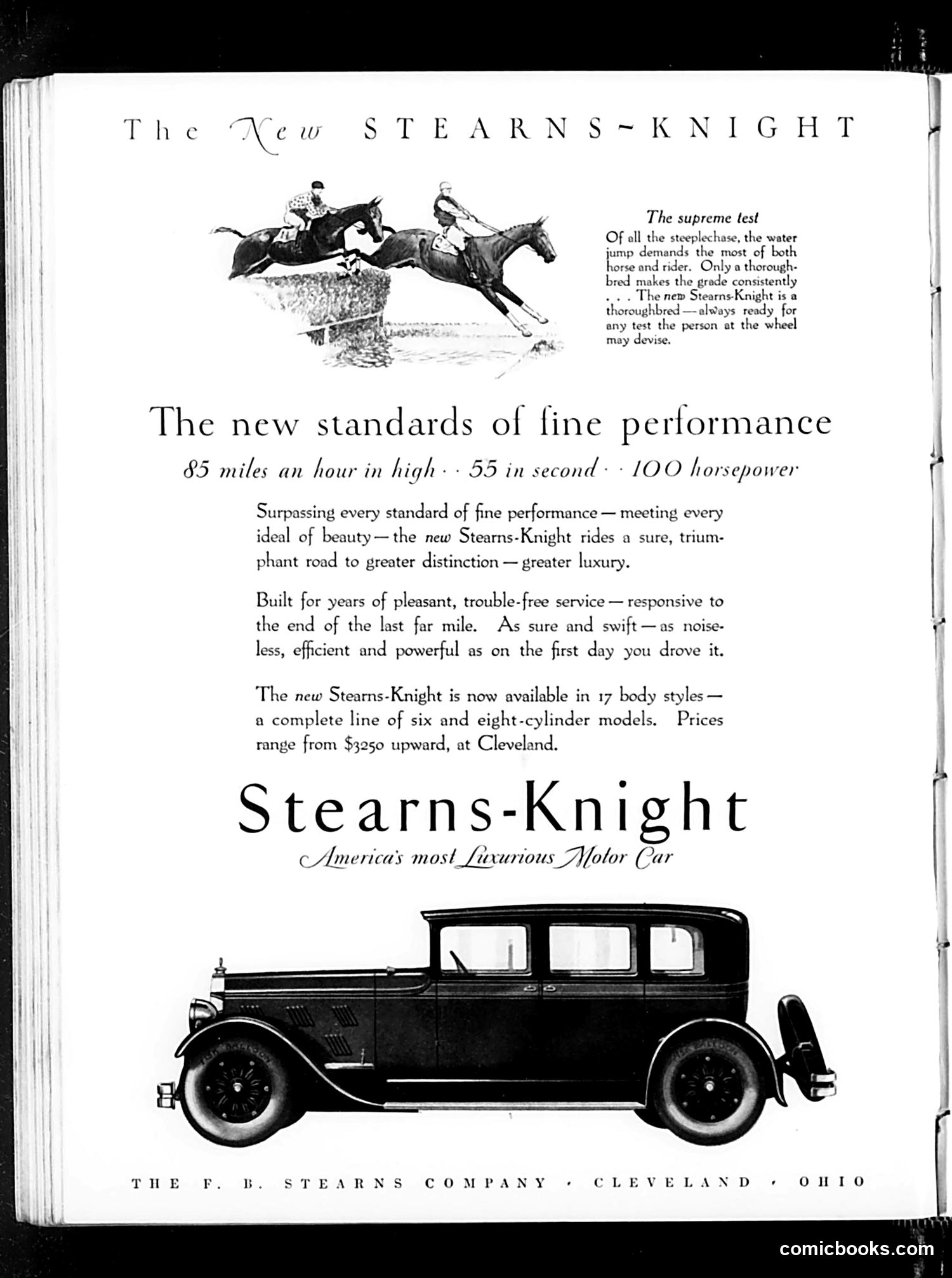
This page is primarily **advertising, not satire**. It's a full-page ad for the Stearns-Knight automobile from the F.B. Stearns Company in Cleveland, Ohio. The only cartoon element is the illustration at top showing two horses and riders jumping a fence—a visual metaphor comparing the car's performance to equestrian excellence. The text claims the Stearns-Knight meets "the supreme test" of steeplechase jumping, positioning it as the most demanding automotive challenge. The ad emphasizes luxury and performance: 85 mph speed, 55-second acceleration, 100 horsepower. It's pitched as "America's most Luxurious Motor Car" available in 17 body styles, priced from $3,250 upward—targeting wealthy buyers in the 1920s-30s era. This reflects period advertising strategy: associating automobiles with aristocratic sports and prestige.
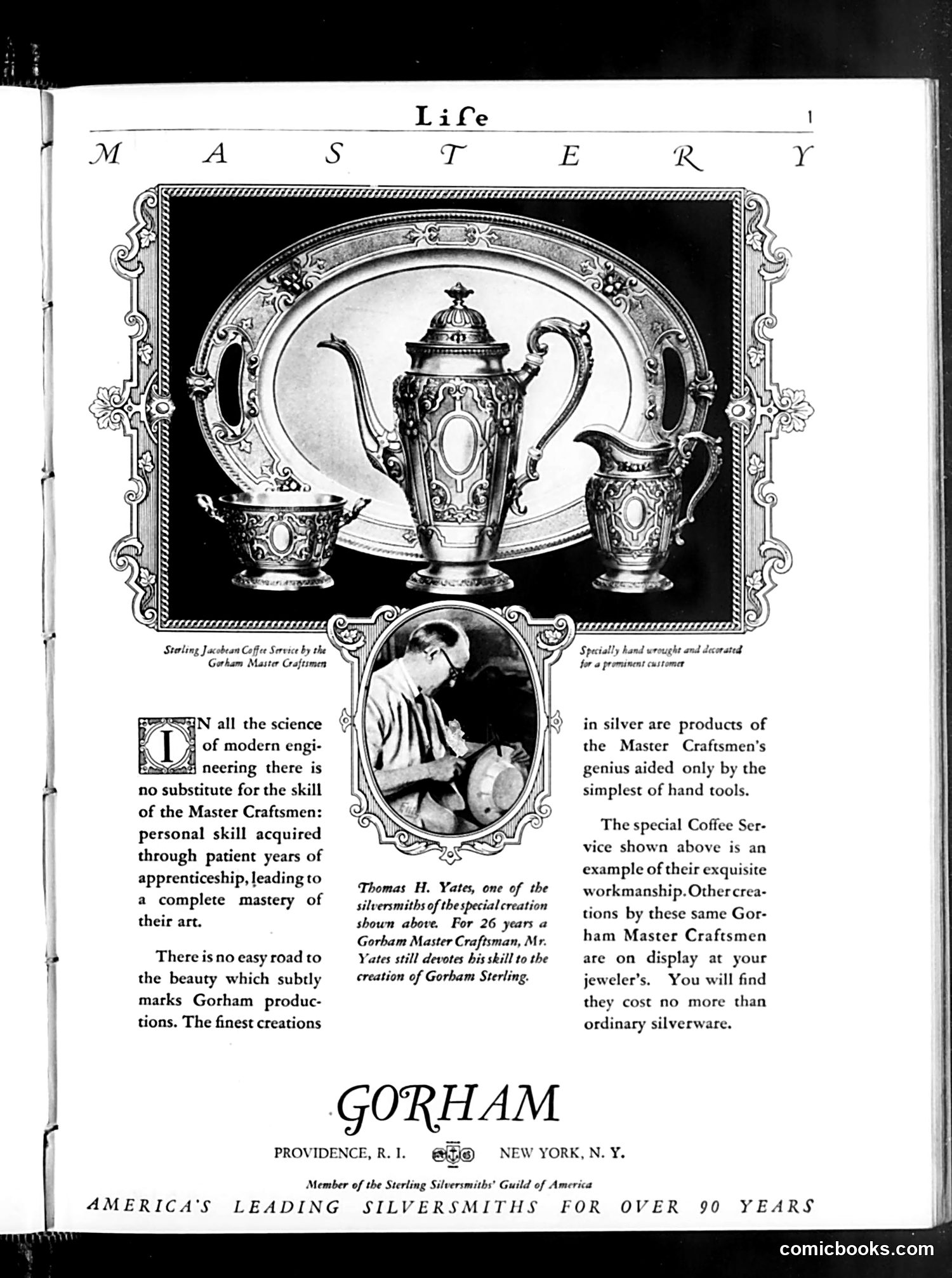
This is **not a political cartoon or satire**—it's a **straightforward advertisement** for Gorham sterling silver, a prominent American silverware manufacturer. The page showcases a Sterling Jacobean Coffee Service (teapot, creamer, sugar bowl, and serving plate) and features a photograph of Thomas H. Yates, identified as one of Gorham's master craftsmen with 26 years of experience. The ad emphasizes that these products represent exceptional handcrafted quality, not mass production. The text argues that despite modern science, skilled artisanship remains irreplaceable—that Gorham's products cost no more than ordinary silverware despite their superior craftsmanship. This is a period advertisement highlighting American manufacturing excellence and the value of specialized labor.
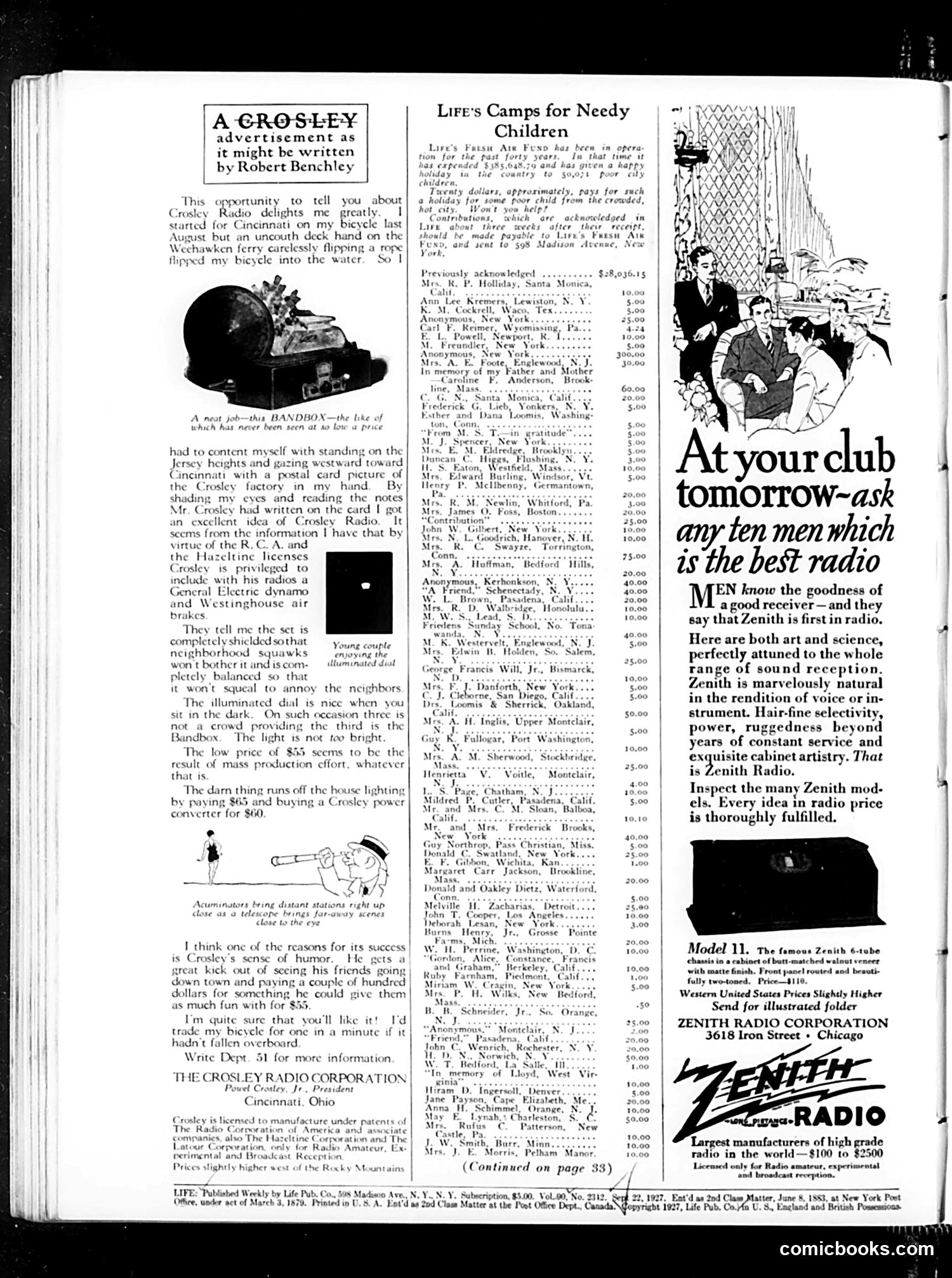
This page is primarily **advertising and fundraising content** rather than political satire. The left column features "A Crosley Advertisement as it might be written by Robert Benchley"—a humorous ad parody by the famous satirist. Benchley mockingly describes a Crosley radio's capabilities and domestic mishaps in his characteristic witty style, poking fun at both the product and earnest advertising language of the era. The center contains **"Life's Camps for Needy Children,"** a charitable fundraising list acknowledging donations for sending poor children to summer camps—typical Depression-era philanthropy. The right side advertises **Zenith Radio**, claiming superiority in sound quality and cabinet design. The page reflects 1920s consumer culture and early radio industry competition, with satire limited to Benchley's ad parody rather than political commentary.
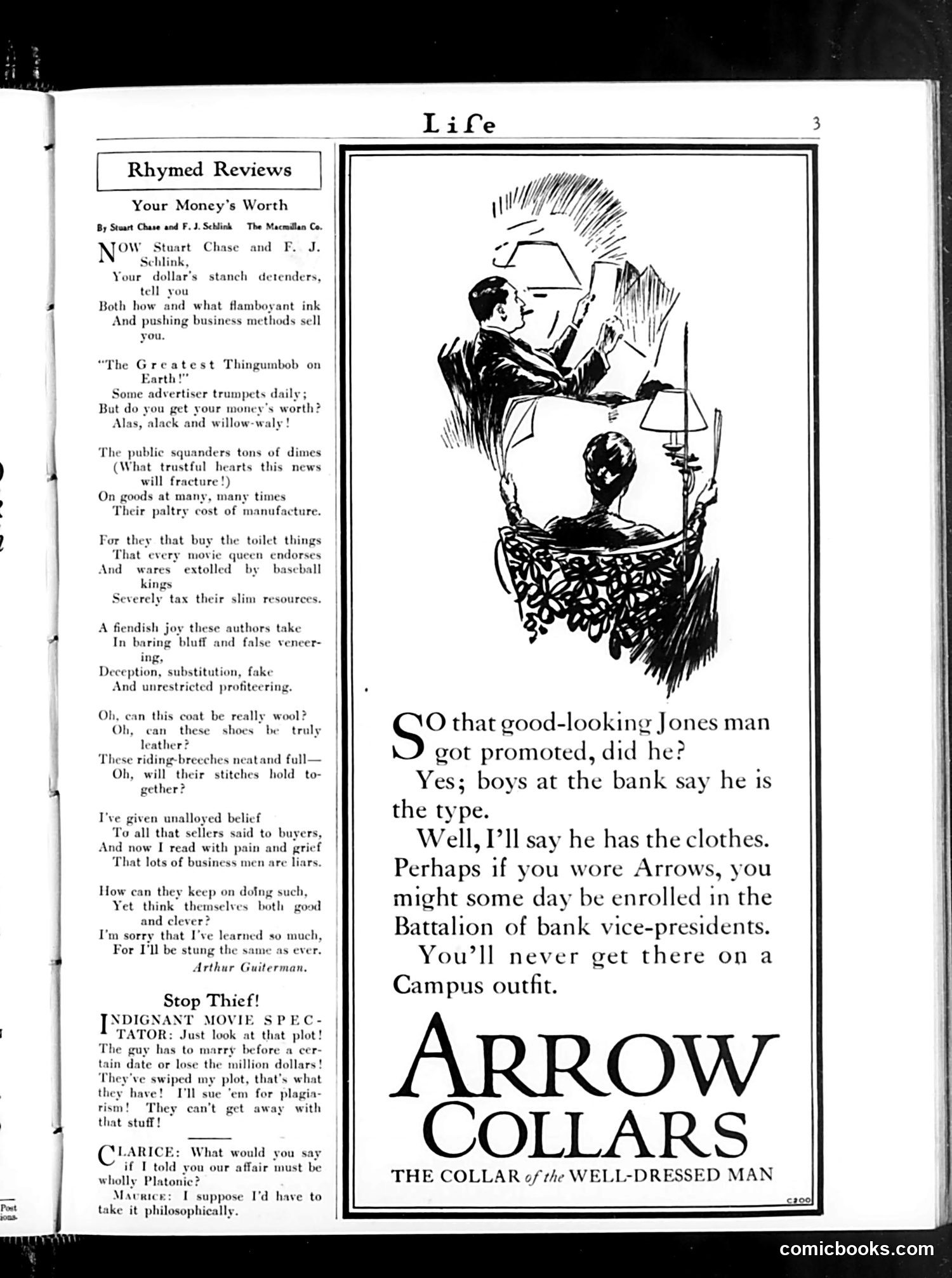
This page is primarily an **Arrow Collars advertisement** (right side), not political commentary. The ad uses social satire to sell men's clothing: it mocks the idea that wearing Arrow brand collars could elevate one's status to "bank vice-president," humorously suggesting that proper dress alone won't guarantee professional success—you need actual qualifications. The left side contains **"Rhymed Reviews,"** satirical poetry critiquing consumer culture and business practices. Arthur Guiterman's verse attacks false advertising, deceptive marketing tactics, and profiteering by sellers of cheap goods marketed as quality items. The "Stop Thief!" section mocks a movie plot twist. Both sections reflect early 20th-century consumer skepticism about advertising claims and commercial dishonesty.
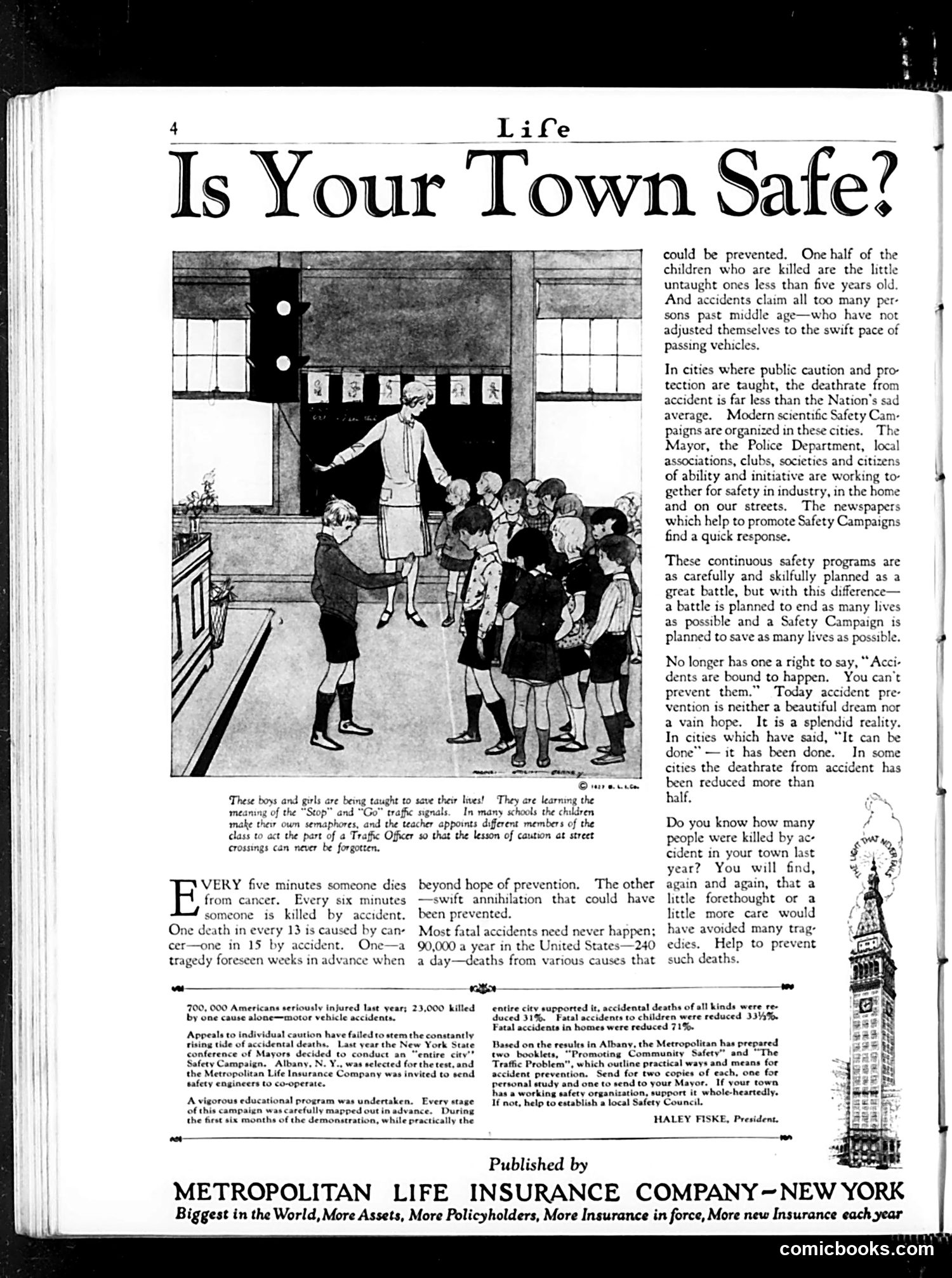
This is **not satire or cartoon commentary** — it's an earnest **public safety advertisement** published by Metropolitan Life Insurance Company. The illustration shows a female safety instructor teaching a diverse group of children about street crossing safety, with traffic signals visible. The article advocates for organized "Safety Campaigns" to reduce accidental deaths, which claim one life every 13 seconds in America. It notes that cities with active safety education programs (like Albany) have reduced accident deaths by over half. The key message: accidents aren't inevitable; systematic public education by mayors, police, and civic organizations can prevent tragedies. This reflects early-20th-century Progressive Era thinking about using organized campaigns and public education to solve social problems.
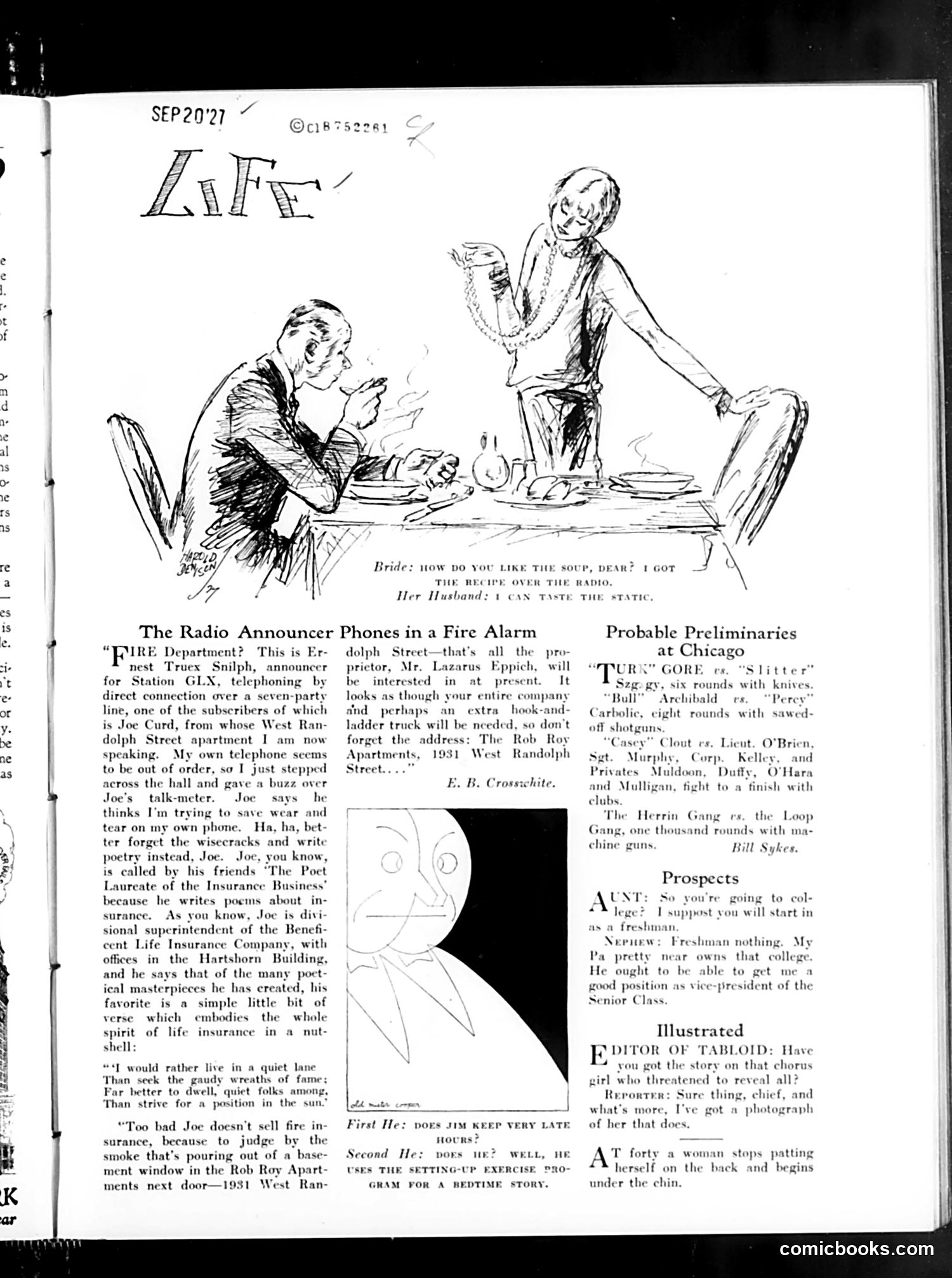
The main cartoon depicts a dinner scene where a wife serves soup to her husband, who complains he can taste static. She responds that she got the recipe "over the radio." This satirizes the novelty and ubiquity of radio in the 1920s—apparently families were now obtaining recipes via radio broadcasts, a cutting-edge technology. The joke is the husband's humorous complaint that the interference ("static") has literally affected the food's taste, suggesting radio's pervasive presence in domestic life had become somewhat absurd or intrusive. The cartoon reflects early radio's cultural penetration and audiences' mixed reactions to this new medium that was reshaping American homes and daily routines.
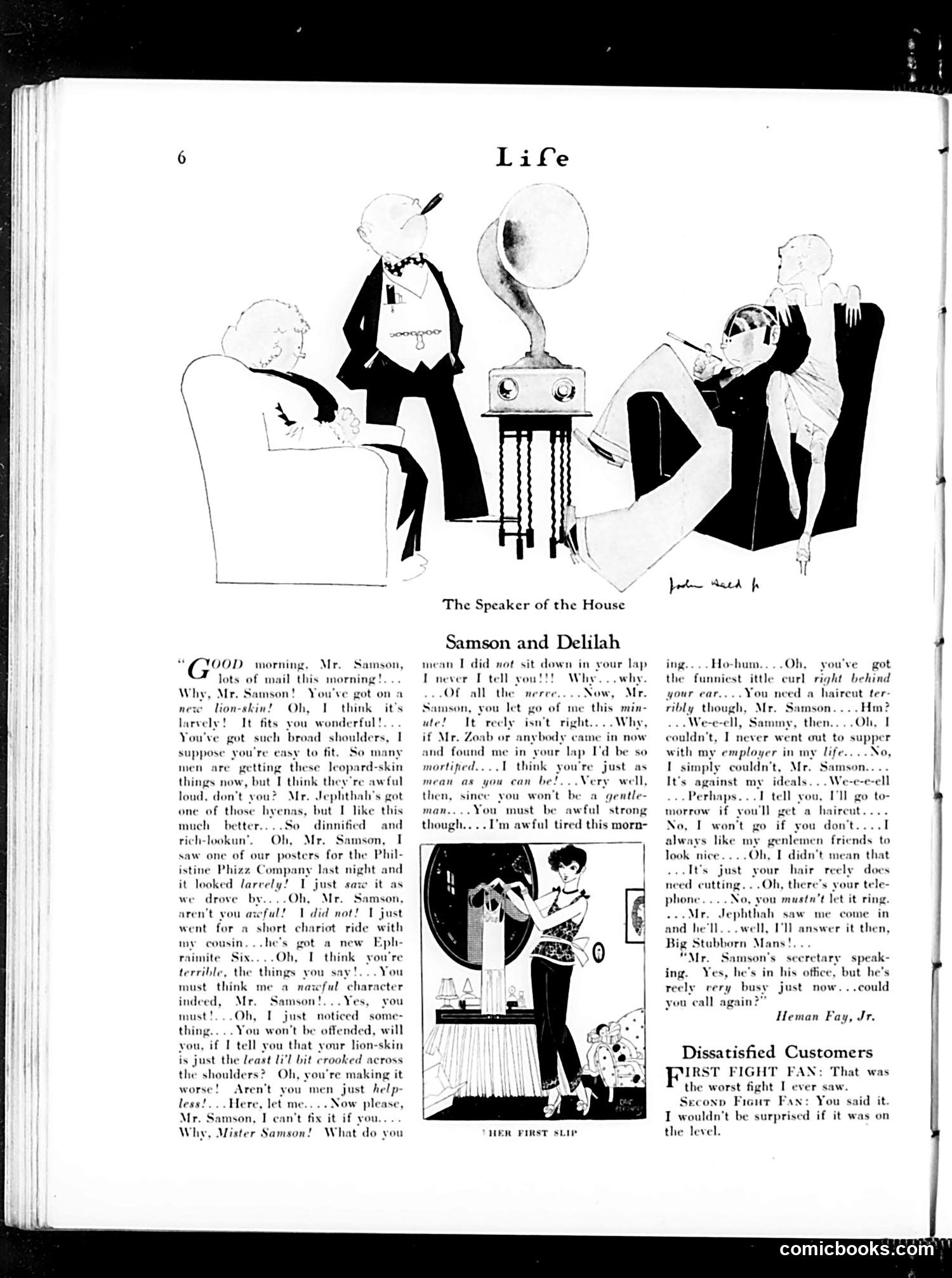
This page satirizes workplace dynamics through a sketch titled "Her First Slip." The illustration shows a young woman at a desk with a telephone, apparently a secretary or office worker, while an older man (labeled "The Speaker of the House") observes nearby. The accompanying dialogue presents the woman's rambling, gossipy phone conversation—mentioning mail, fashion, and personal matters—while the man waits impatiently. The humor targets both the stereotype of chatty female office workers and the frustration of supervisors dealing with their personal calls during work hours. The "Dissatisfied Customers" section below offers brief joke exchanges about a disappointing boxing match, unrelated to the main cartoon. The overall satire reflects 1920s-era workplace and gender stereotypes.
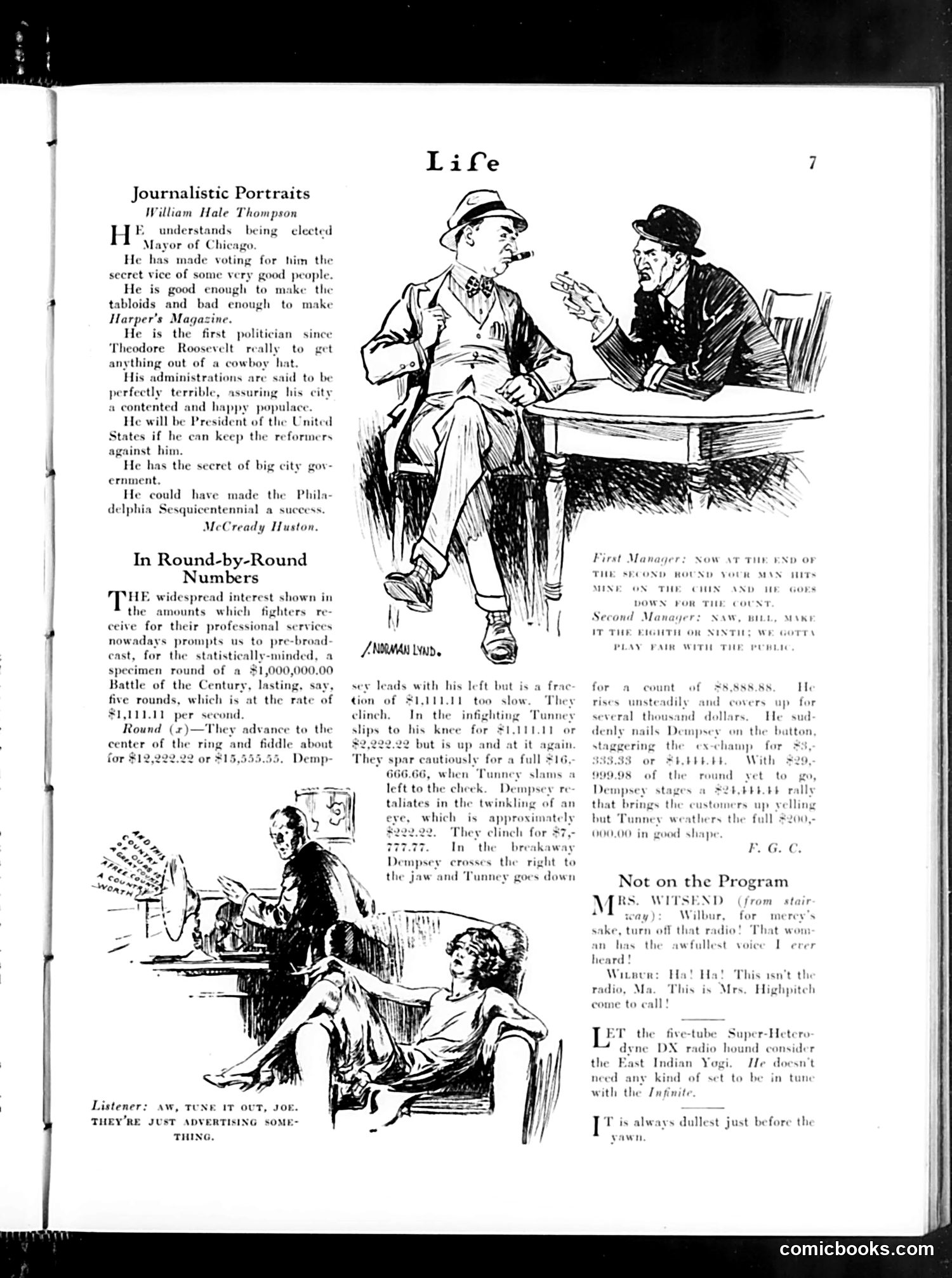
This page satirizes William Hale Thompson, Chicago's Mayor. The text mocks his political posturing—noting he's made voting "the secret vice of some very good people" and claims he could have made Philadelphia's Sesquicentennial successful, yet his "administrations are said to be perfectly terrible." The top cartoon shows Thompson (identifiable by his hat and cigar) meeting with another figure, likely a journalist or political operative, in what appears to be a back-room deal or interview—satirizing corrupt political dealings. The lower cartoon depicts radio listening, with a caption about tuning out advertisements, suggesting commentary on Thompson's use of media for self-promotion or political messaging—a relatively modern concern for the 1920s era when radio was emerging as a political tool.
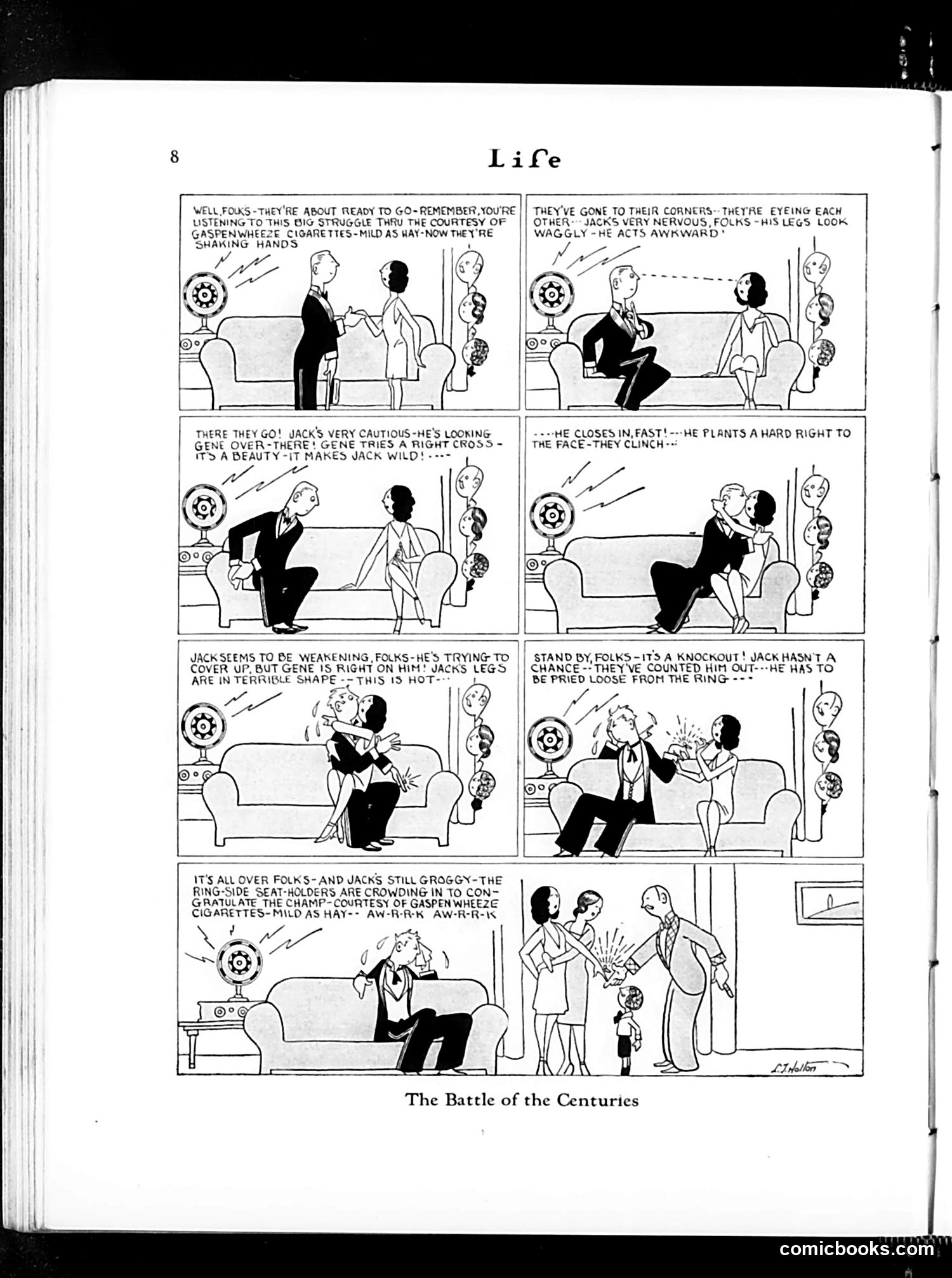
This single-panel comic satirizes a boxing match between Jack and a female opponent ("a beauty"). The narrative captions follow the action: Jack and his opponent arrive at their corners; they circle each other warily; Jack attempts an aggressive move but the woman responds effectively; Jack weakens as the fight progresses; ultimately, the woman defeats him decisively, and ringside spectators congratulate her with Gaspen Wheeze cigarettes as consolation prizes. The satire appears to target gender role expectations of the era—the comic's humor derives from a man being physically bested by a woman, presented as an unexpected and amusing reversal. The title "Battle of the Centuries" suggests this represents a clash between traditional masculine dominance and emerging female independence or equality, framed through popular entertainment boxing culture.
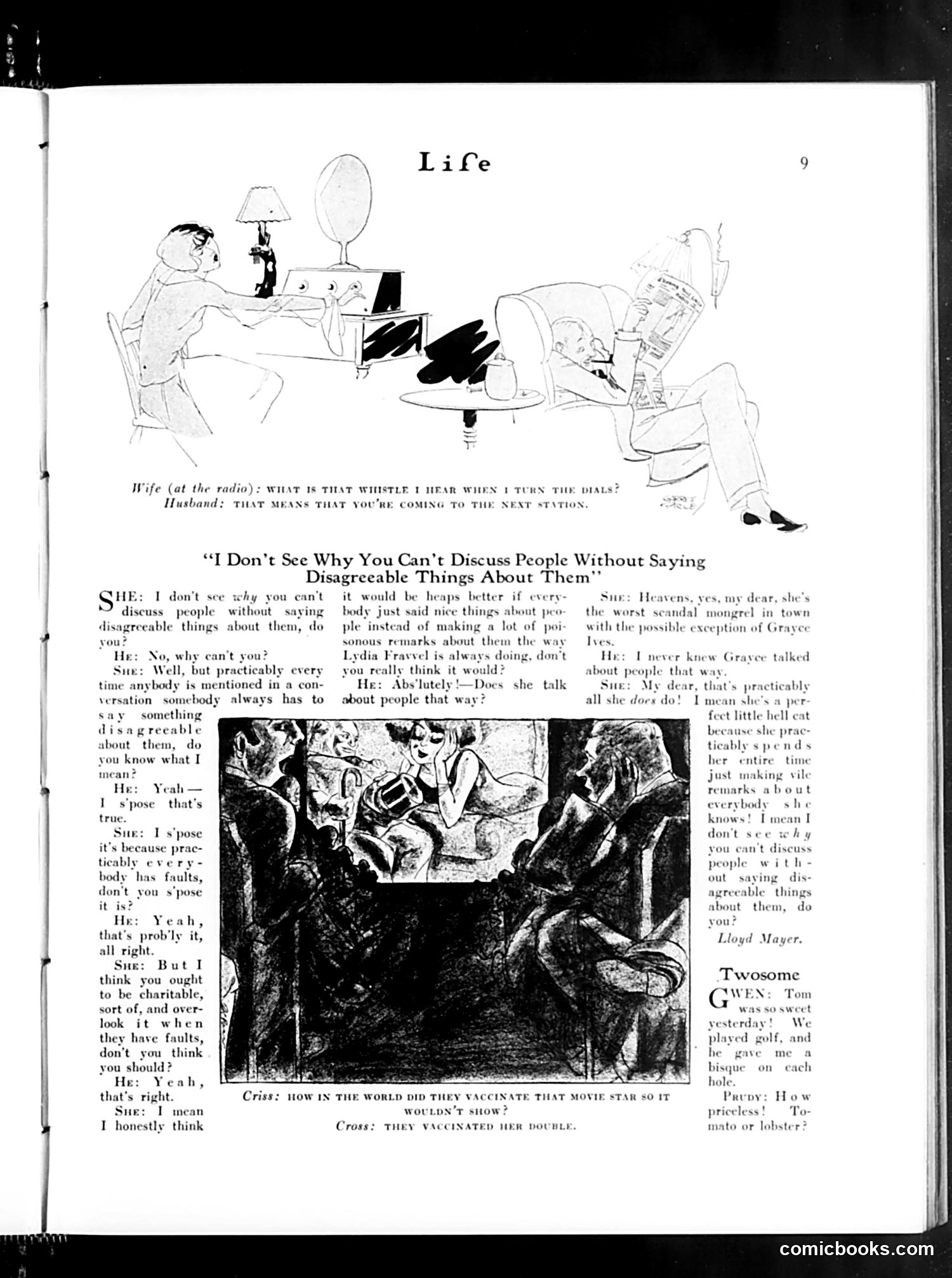
This page contains two satirical pieces about social conversation. **Top cartoon:** Depicts a couple at home with a radio. The wife asks about a whistling sound when turning the dial; the husband explains it means "you're coming to the next station." This is a simple domestic humor joke about radio technology. **Main article:** "'I Don't See Why You Can't Discuss People Without Saying Disagreeable Things About Them'" presents a dialogue between a husband and wife debating whether it's possible to discuss others without making negative remarks. The husband argues it's impossible; the wife contends people should be discussed charitably. **Bottom cartoon:** References vaccinating "that movie star" (identity unclear from image) to prevent her from appearing in films—a joke about unpopular celebrities. The overall theme mocks 1920s-era social conventions and gossip culture.
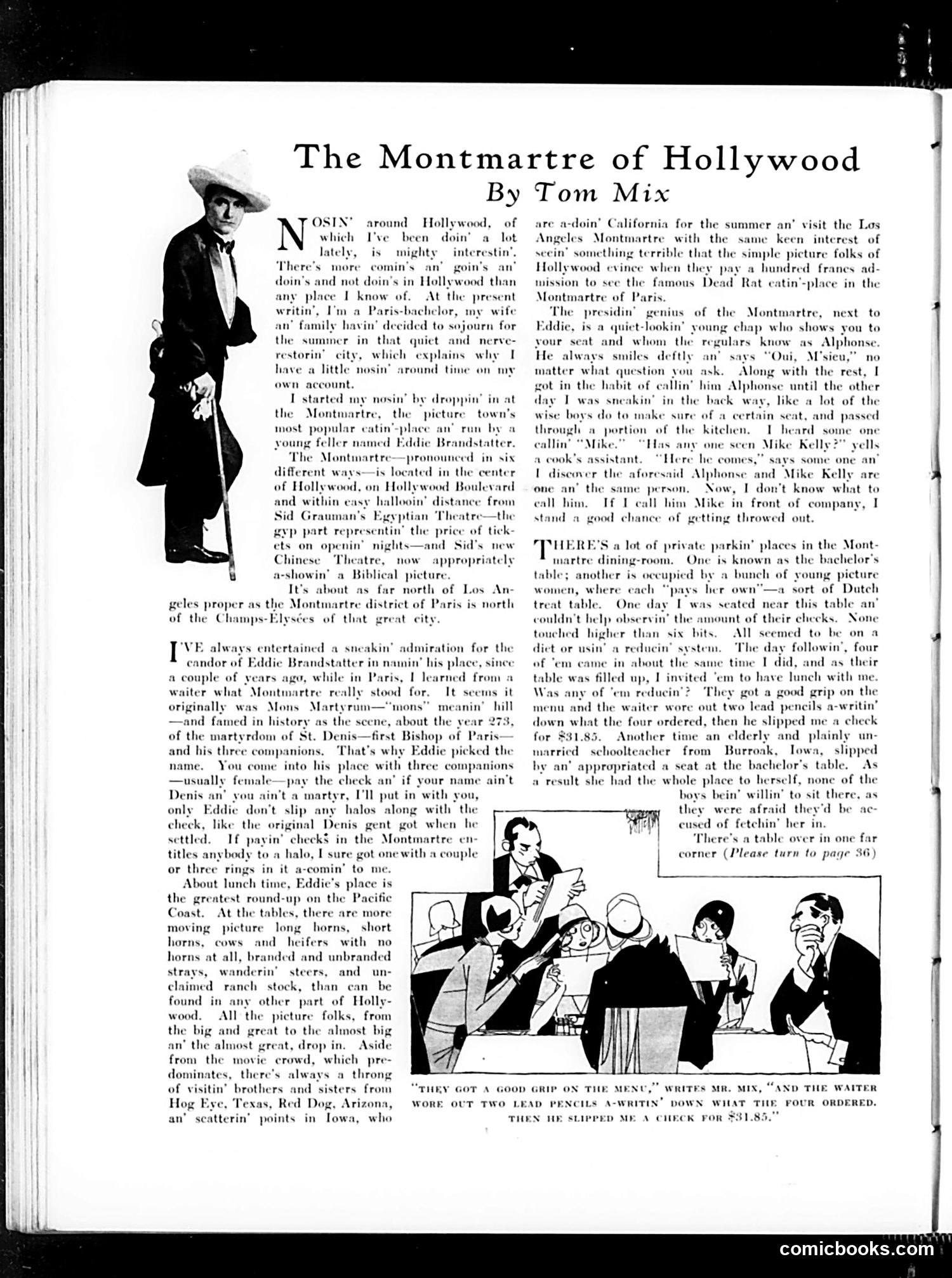
This is a humorous article by Tom Mix about the Montmartre nightclub/restaurant in Hollywood, illustrated with a single cartoon. The cartoon depicts diners at an upscale restaurant table where the waiter presents an exorbitant bill. The caption reads: "They got a good grip on the menu," while "Mr. Mix" and the waiter "wore out two lead pencils a-writin' down what the four ordered. Then he slipped me a check for $31.85." The satire targets Hollywood's expensive dining culture and inflated restaurant prices, using folksy language ("a-writin'") to humorously contrast working-class sensibilities with fine-dining pretension. Mix, a famous cowboy actor, adopts an outsider's perspective to mock the ostentatious spending habits of Hollywood's social scene.
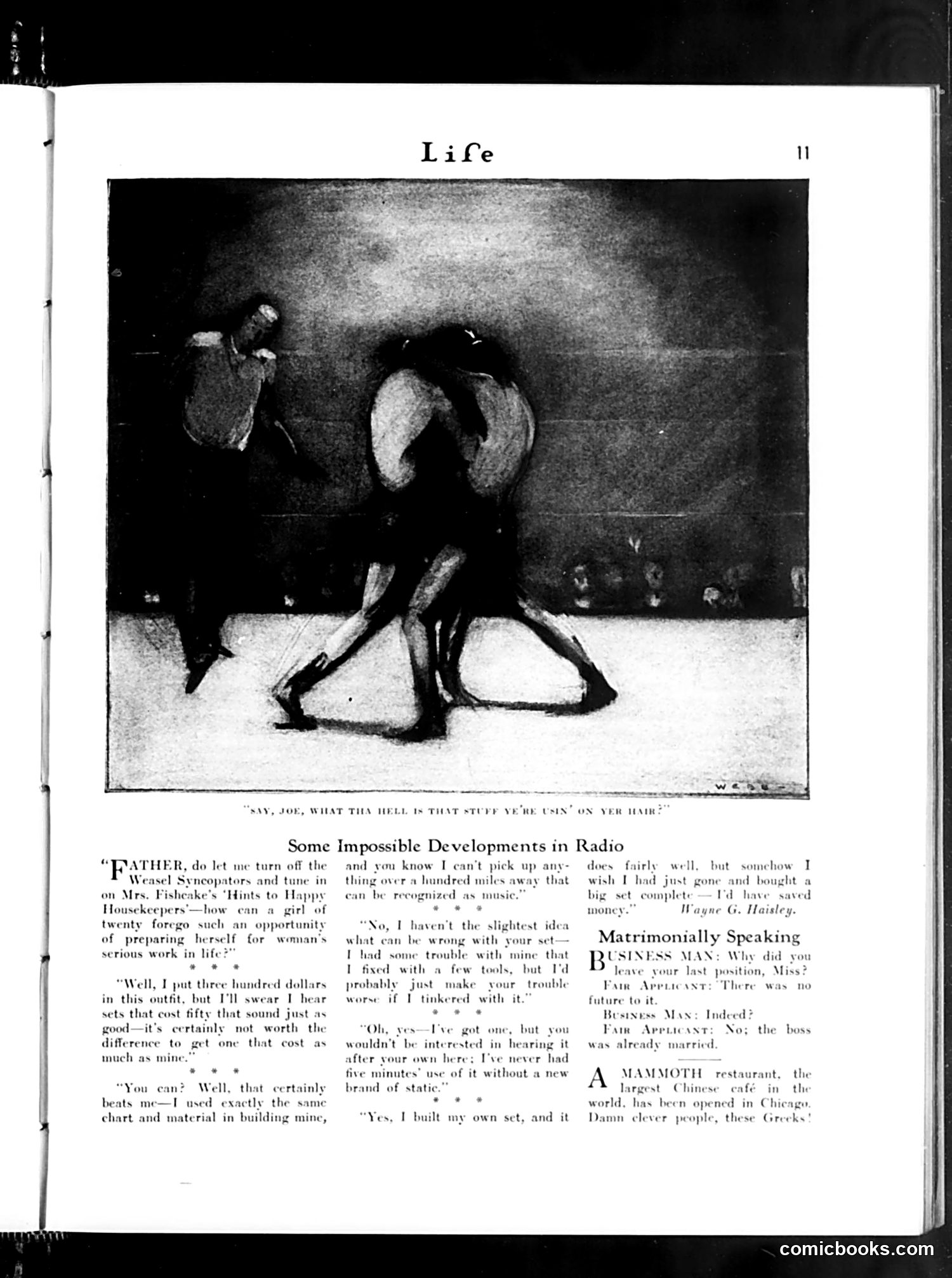
The main illustration depicts two boxers in a ring, captioned "Say, Joe, what the hell is that stuff you're usin' on yer hair?" This appears to be a humorous boxing cartoon, likely satirizing either a specific boxer or the absurdity of using hair products during athletic competition. Below are three satirical sections about impossible radio developments, including complaints about radio broadcasts and a joke about "matrimonially speaking"—commenting on radio's then-novel role in domestic life. The final item mocks a newly opened "mammoth" Chinese restaurant in Chicago, with the punchline "Damn clever people, these Greeks!"—a period joke about ethnic business ownership and the irony of non-Chinese entrepreneurs running Chinese establishments. The page overall reflects 1920s-30s American humor about emerging technologies and consumer culture.
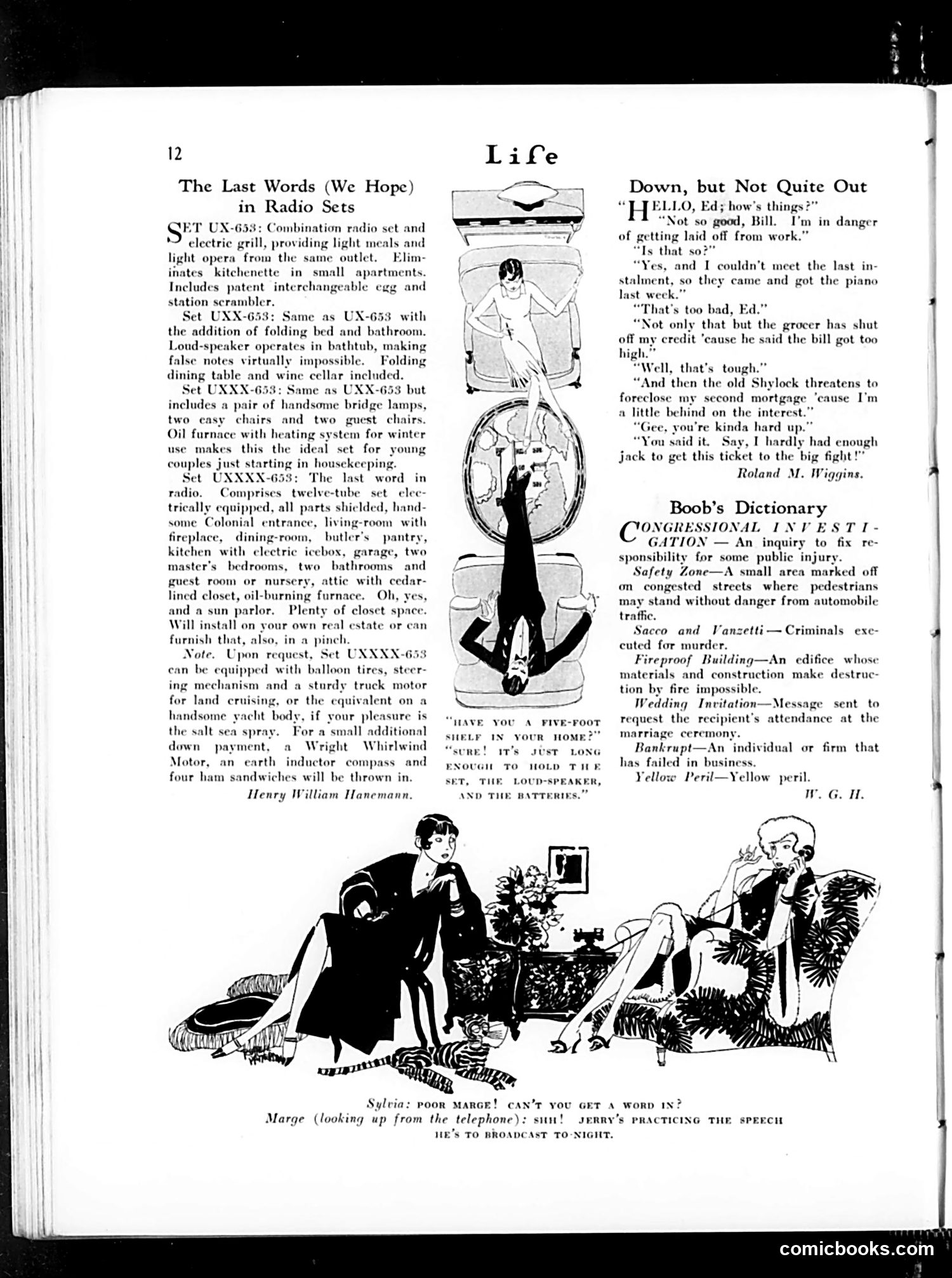
This page from *Life* magazine contains three distinct sections: **Top Left:** Product advertisements for radio sets (UX-653, UXX-653, UXXX-653) with increasingly elaborate features—from basic combination radio/light sets to luxury models with folding beds and dining tables. This reflects 1920s enthusiasm for new radio technology as a status symbol. **Center:** A cartoon illustration showing a woman in domestic distress, humorously depicting the challenges of housewifery and financial stress ("getting laid off from work," mortgage threats, grocer's bills). **Bottom:** A domestic humor cartoon where "Sylvia" interrupts "Marge's" telephone conversation while "Jerry" practices a radio speech in the background—satirizing the intrusion of new technology (radio broadcasting) into domestic life and the chaos of modern household management. The overall theme mocks emerging consumer culture and domestic pressures of the era.
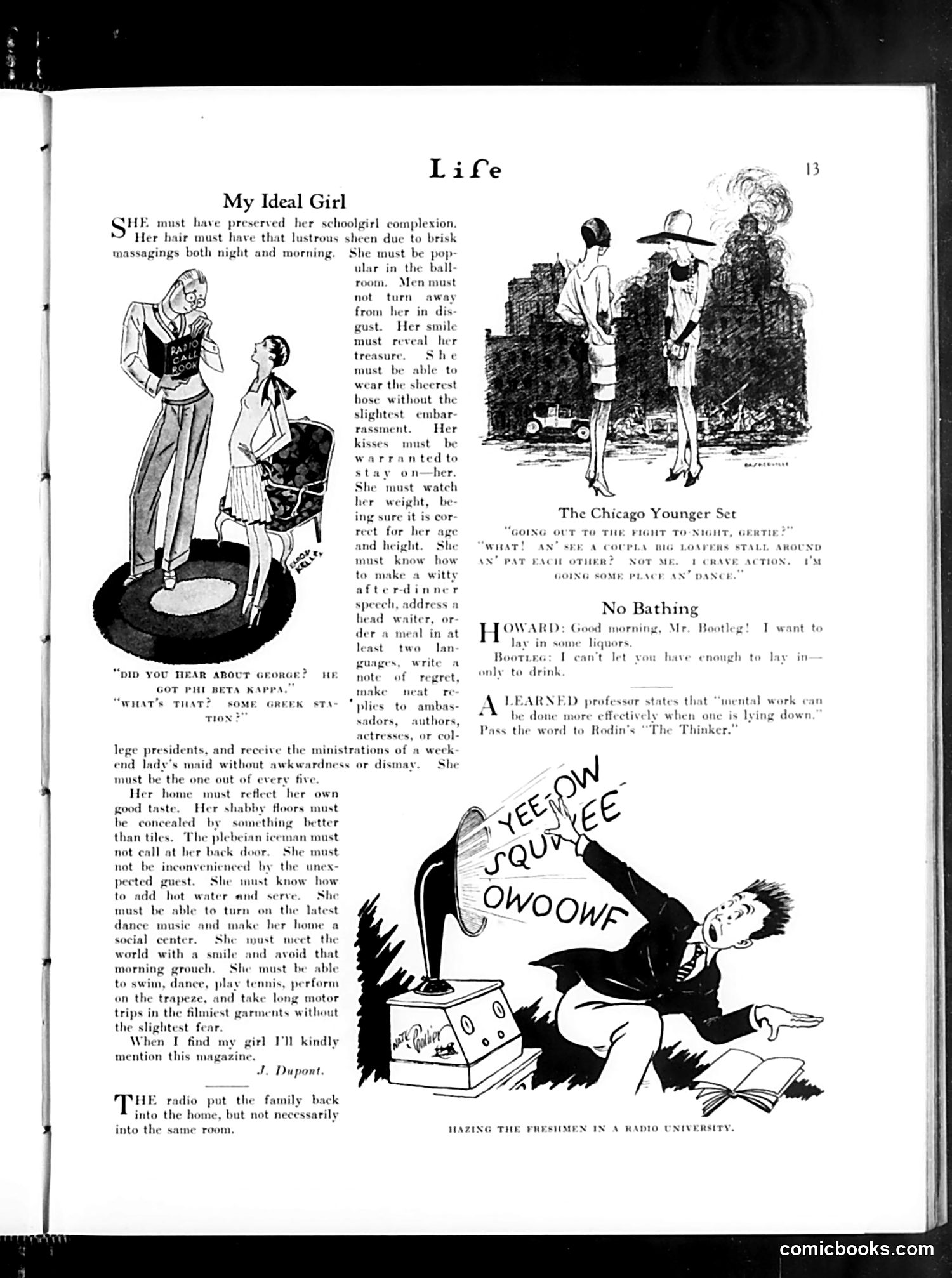
This page contains three satirical pieces about 1920s social attitudes: **"My Ideal Girl"** (left column) mocks prescriptive gender standards by listing absurdly contradictory expectations—a woman must maintain "schoolgirl complexion" through constant massage, be popular yet modest, wear revealing clothes without embarrassment, and perform endless domestic and social duties without fatigue. The satire exposes how impossible these beauty and behavioral standards were for women. **"The Chicago Younger Set"** cartoon mocks wealthy young people's shallow behavior and obsession with nightlife and drinking. **"No Bathing"** and **"Hazing the Freshmen"** are brief jokes about college life and radio use. The overall theme critiques 1920s consumer culture, gender expectations, and youth behavior during the Jazz Age.
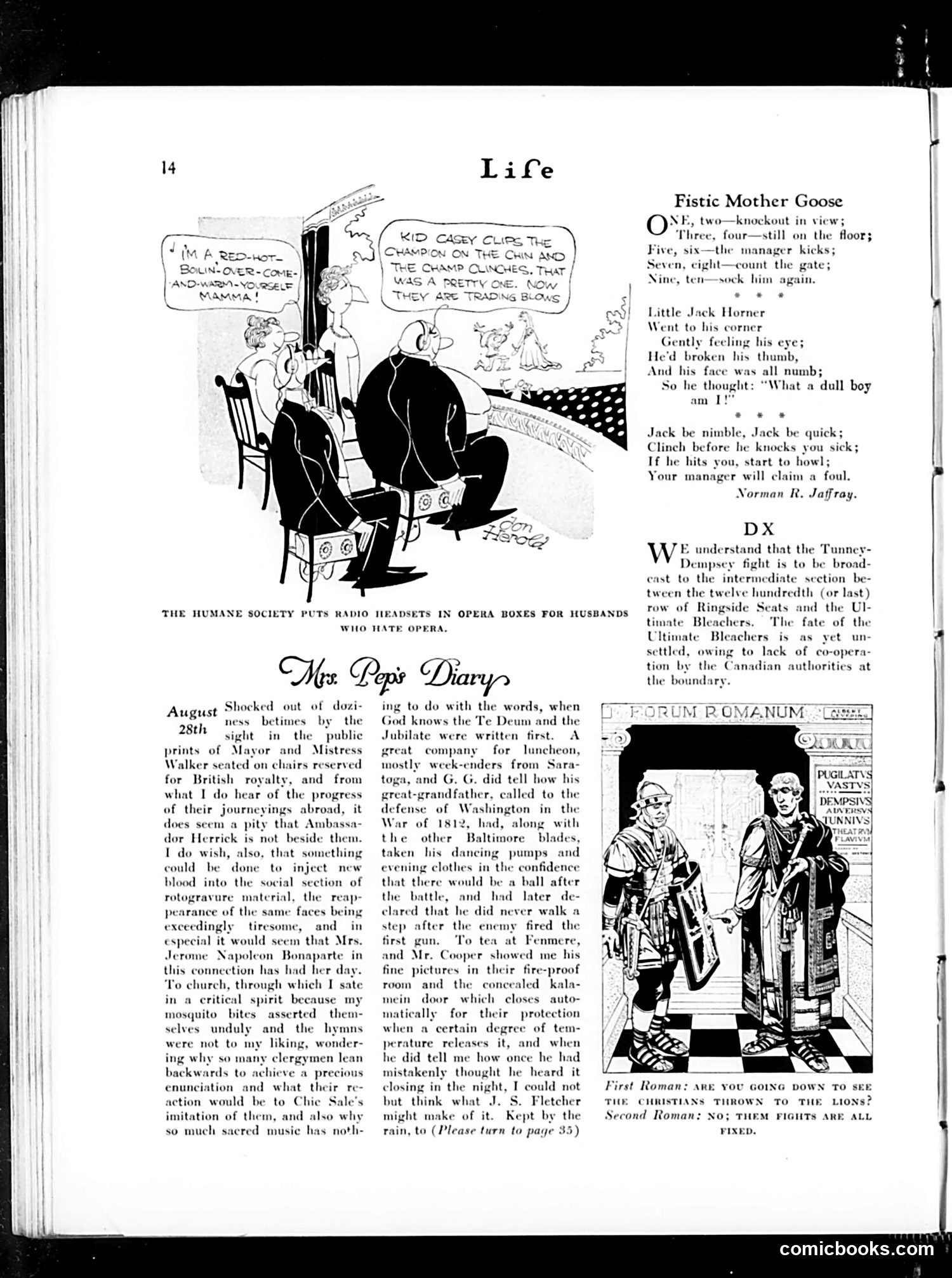
This cartoon satirizes the marital discord over opera attendance. Two well-dressed men sit in an opera box wearing radio headsets while their wives (visible in silhouette) watch the performance. The joke targets husbands forced to accompany their wives to opera—an entertainment many men found tedious—by allowing them to listen to something else (likely a sports broadcast or other programming) instead. The caption credits this solution to "the Humane Society," treating male opera-aversion as a condition requiring charitable intervention. This reflects early 20th-century gender assumptions about entertainment preferences and marital compromise, where opera was stereotyped as feminine entertainment and radio as a male escape.
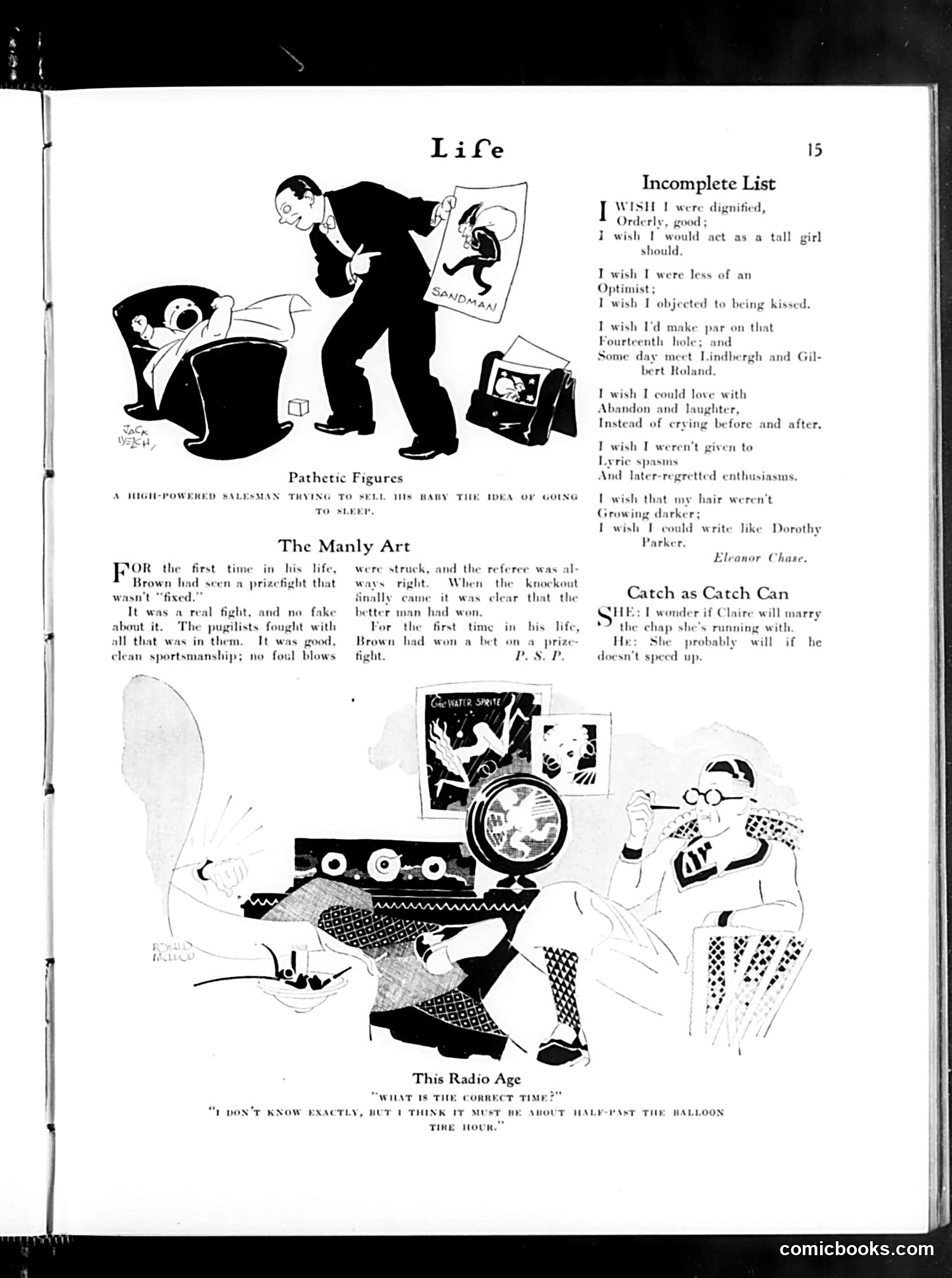
This page contains three humorous pieces satirizing early 20th-century American life: **"Pathetic Figures"** shows a salesman attempting to sell products to a sleeping baby—mocking overeager salesmanship. **"The Manly Art"** celebrates a boxer named Brown winning his first prizefight, with the referee's decision being questioned. The humor lies in depicting boxing as both brutal and celebrated as "good, clean sportsmanship." **"Incomplete List"** is a personal essay by Eleanor Chase listing wishes (dignity, optimism, romance, golf skills, better hair)—gentle self-deprecating humor about modern women's desires and frustrations. **"This Radio Age"** depicts confusion over time-telling, with someone humorously suggesting a clock reads "about half-past the balloon time hour"—satirizing how radio broadcasting was becoming central to daily life and timekeeping during this period.
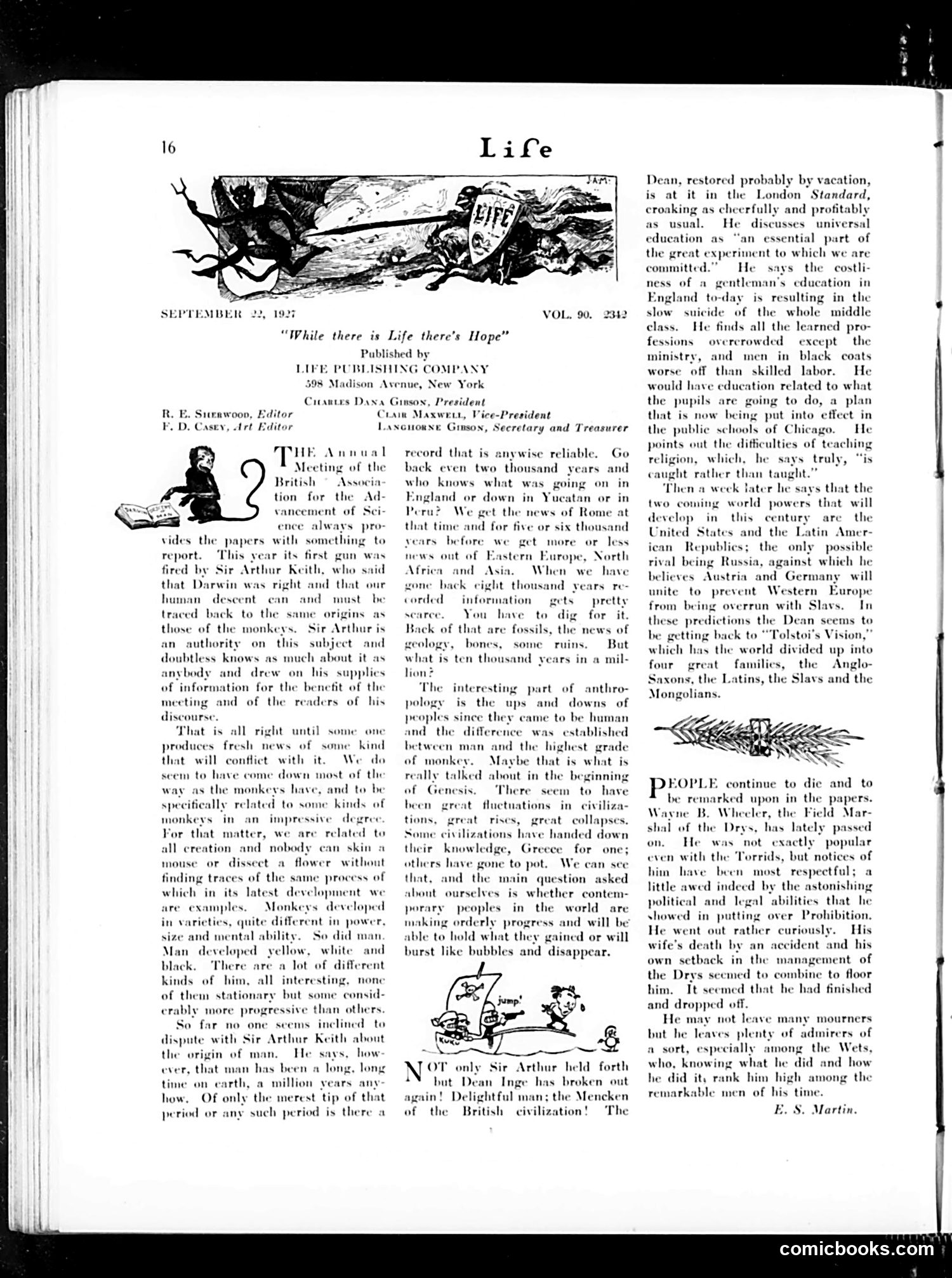
This page contains editorial commentary rather than political cartoons. The main article discusses the British Association for the Advancement of Science's annual meeting, where Sir Arthur Keith presented theories on human evolution and mankind's descent from primates. The satire targets Keith's evolutionary claims, with the text humorously suggesting that if humans descended from monkeys, perhaps this explains contemporary human behavior and social problems. The author uses this framework to critique modern civilization's failings. A small illustration showing primitive figures appears to accompany the evolutionary theme, reinforcing the satirical comparison between "civilized" society and animal behavior. The piece appears designed to mock both the scientific lecture and contemporary social conditions through evolutionary humor.
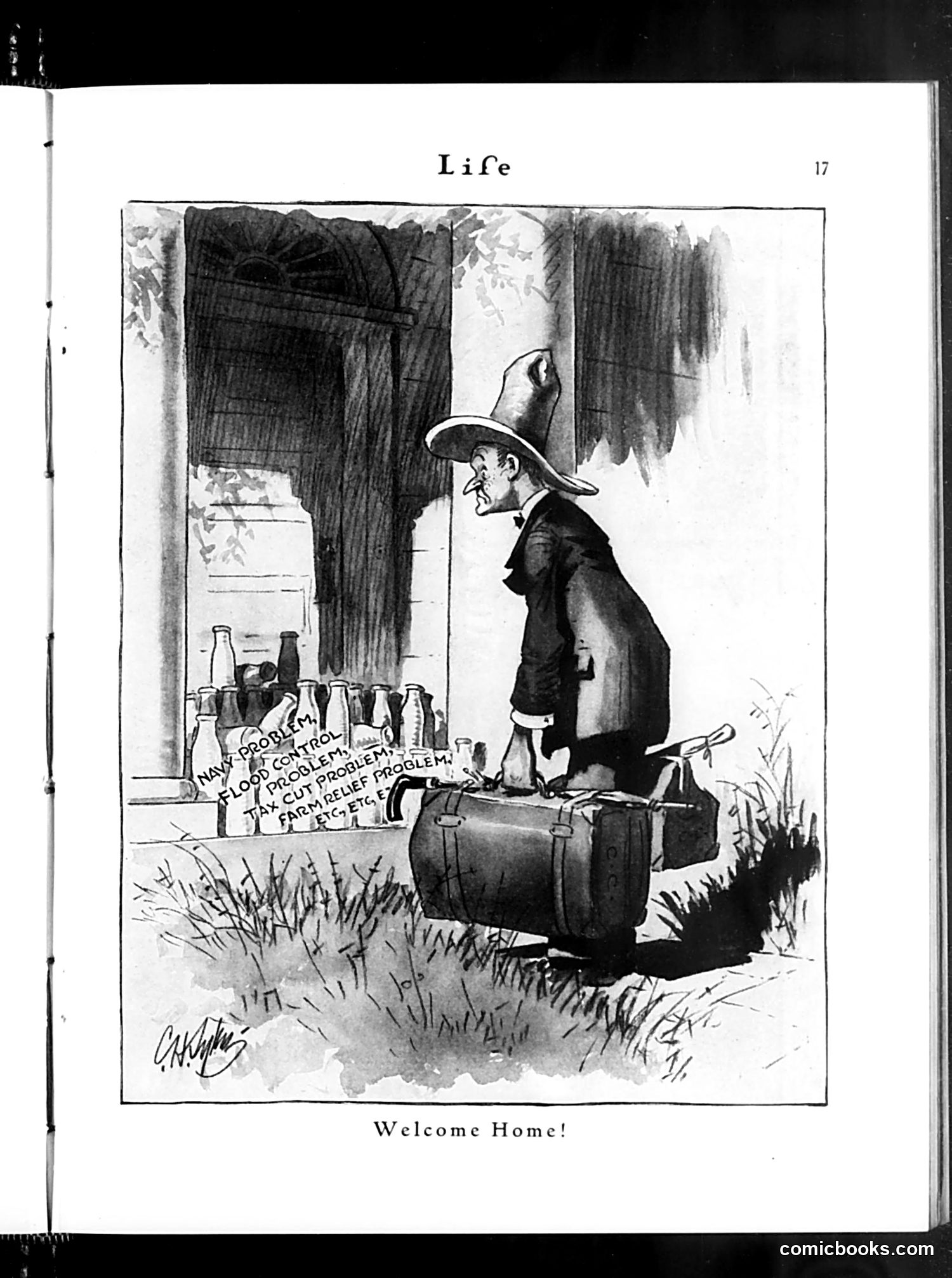
This cartoon depicts a traveling salesman or returning soldier arriving home with a suitcase, confronted by bottles of patent medicines and remedies displayed on a shelf. The bottle labels read "Navy Goodley," "Floor Control," "Toilet Problem," "Cut Problem," "Flatulence Relief," and others—humorous fake product names suggesting dubious cure-alls. The satire mocks the era's proliferation of questionable patent medicines and nostrums marketed to the public. The "welcome home" caption is ironic: rather than a warm homecoming, the returning figure faces walls of dubious health products, satirizing both consumer gullibility and the fraudulent patent medicine industry that exploited Americans' health anxieties during this period.
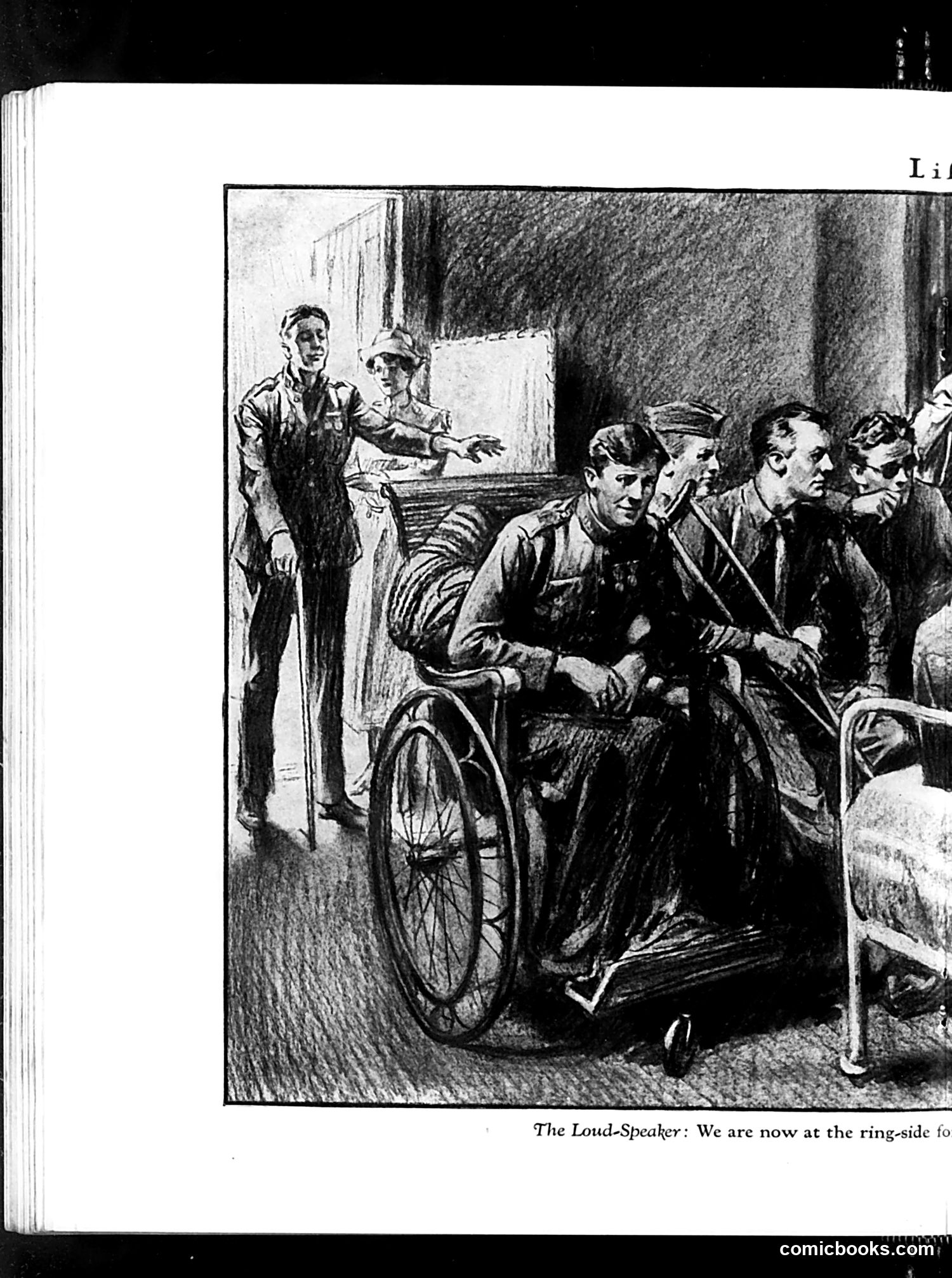
This sketch depicts a scene at what appears to be a boxing or sporting event ("ring-side"). A uniformed official or announcer stands addressing a seated audience of working-class men. The cartoon's title, "The Loud-Speaker," suggests satire about public address systems or amplified announcements—a relatively new technology in the early 20th century. The humor likely stems from the contrast between the formal, authoritative speaker and the casual, skeptical audience members who appear indifferent or unimpressed. The scene mocks either the grandiosity of public announcements or the disconnect between institutional authority figures and ordinary people. Without the complete caption, the specific political reference remains unclear, though the working-class setting suggests social commentary typical of *Life* magazine's satirical approach.
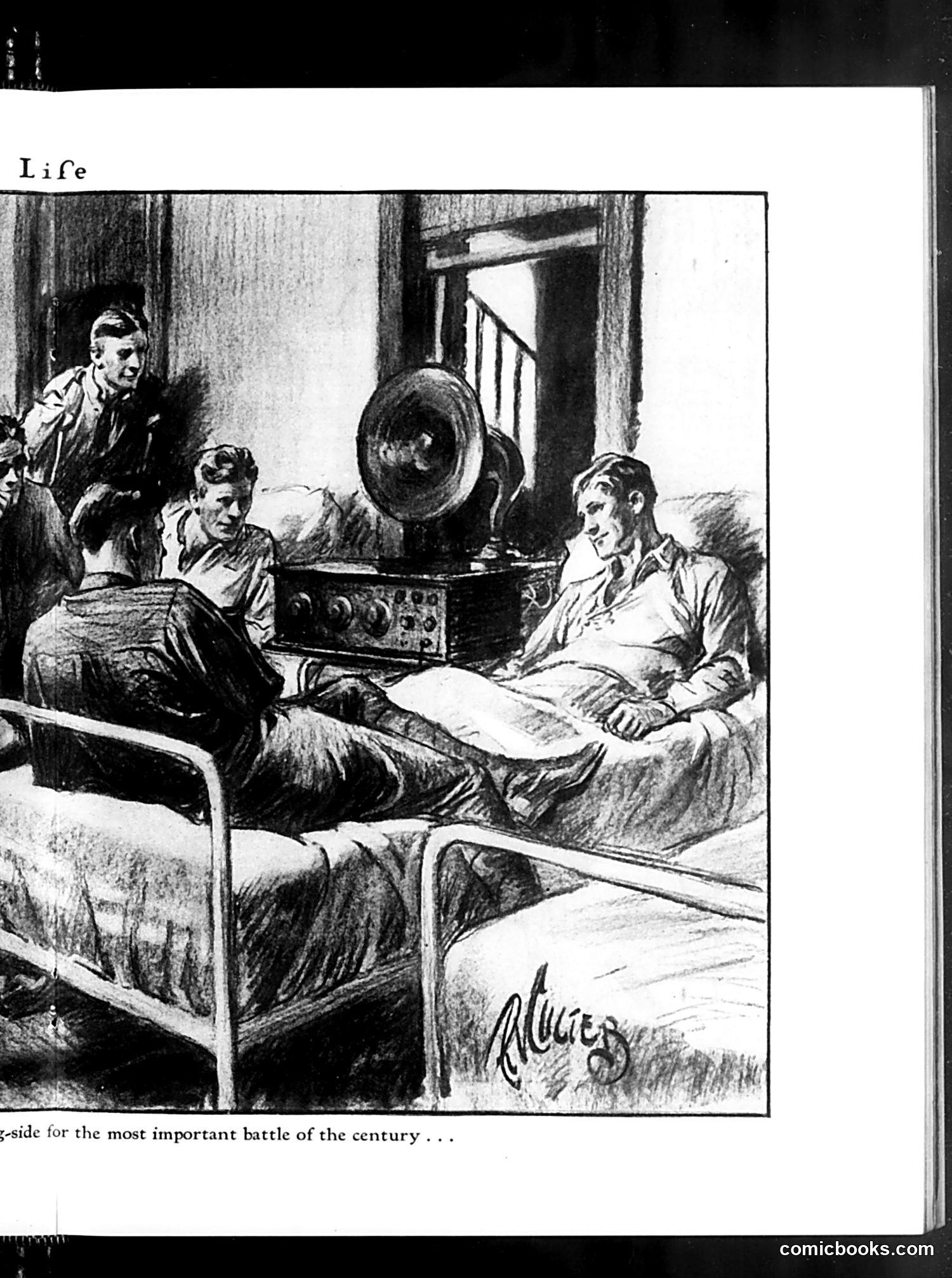
This cartoon depicts soldiers in what appears to be a military barracks or hospital, gathered around a radio. The caption references "the most important battle of the century," suggesting this is satirizing wartime media consumption—likely American soldiers listening to radio broadcasts during a major conflict (the image style suggests early-to-mid 20th century). The satire appears to mock the gap between martial rhetoric and soldiers' actual reality: rather than engaging in actual combat, these men are lounging in bunks, casually tuning into broadcasts about the "important battle." The cartoon likely critiques either war propaganda's grandiosity or the disconnect between home-front narratives and soldiers' mundane experience. The artist signature appears to read "Phelps" or similar, though this isn't entirely clear.
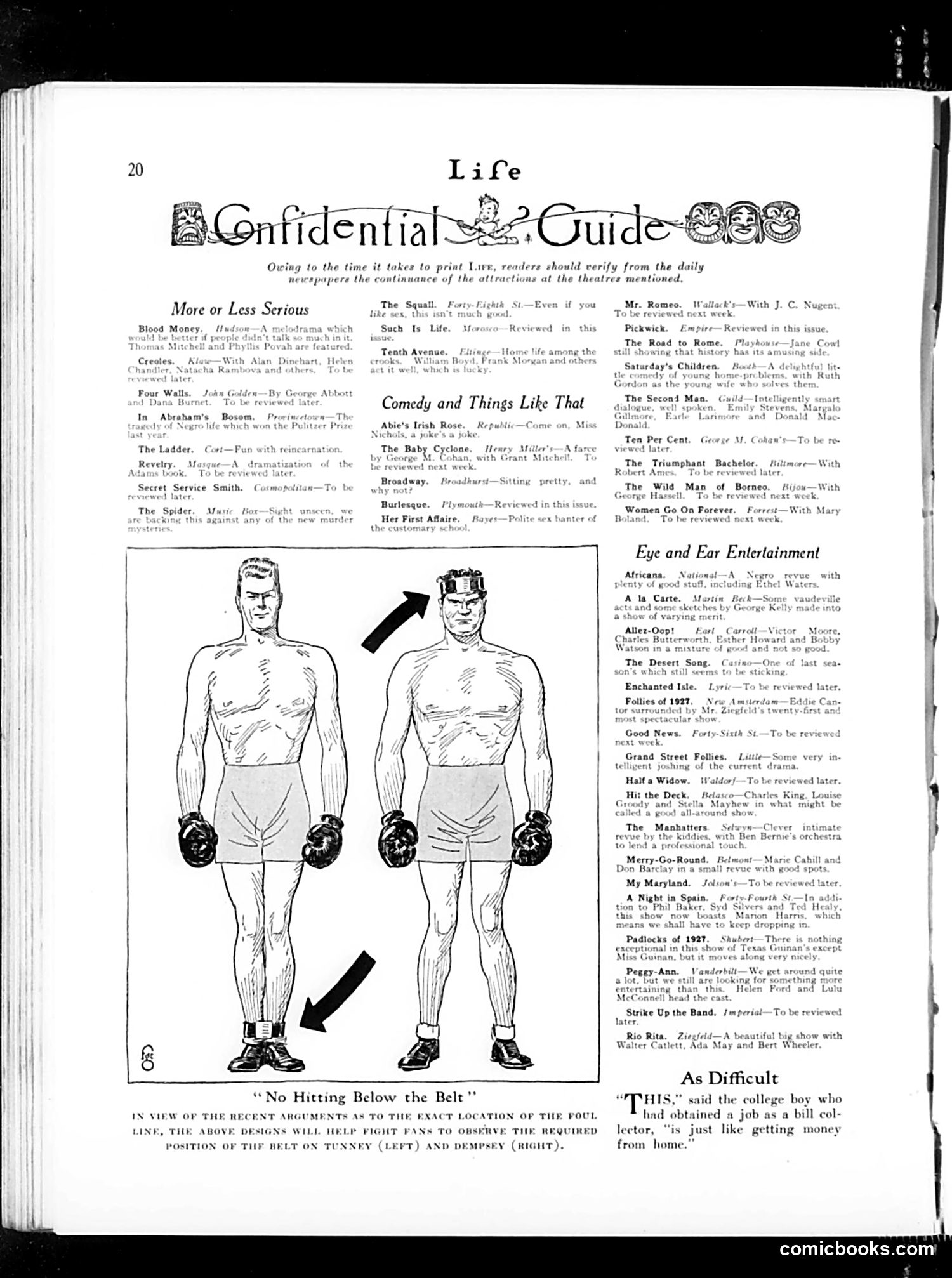
This page from Life magazine contains theater reviews and a notable boxing cartoon titled **"No Hitting Below the Belt."** The cartoon depicts two male boxers in fighting stance, labeled **Tunney (left) and Dempsey (right)**, with arrows indicating the belt line and "foul line" location. This references the famous **Tunney-Dempsey heavyweight championship fights** of the 1920s, which generated intense public debate about boxing rules and what constituted illegal punches. The satire addresses recent arguments about the exact location of the foul line in professional boxing—a hotly debated topic in sports at the time. By showing proper fighting position with marked guidelines, Life is humorously commenting on the technical disputes surrounding these high-profile matches. The page also includes theater reviews of current Broadway shows and a small joke about college fundraising at the bottom, typical of Life's mixed satirical content format.
This page contains theater reviews from Life magazine's "Drama" section. The main content critiques a stage adaptation of Dickens's *Pickwick Papers* at the Empire Theatre. **The Satire:** The reviewer criticizes the production's excessive theatricality—actors hopping about, tittering, and performing elaborate physical comedy that the critic argues is historically inaccurate to Dickens's actual writing. The reviewer notes the irony that their own review suffers from the same artificiality they're condemning in the production itself. **Key Points:** John Cumberland as Mr. Pickwick is praised as the only performer who seems like a real person. Bruce Winston is commended for making an improbable monologue believable through sheer force of personality. The production is dismissed as a "Punch and Judy show" for audiences unwilling to engage with genuine realism. The piece also briefly reviews *Burlesque* and *Such Is Life*, praising performances by Hal Skelly and Barbara Stanwyck. The overall tone is witty and self-aware.
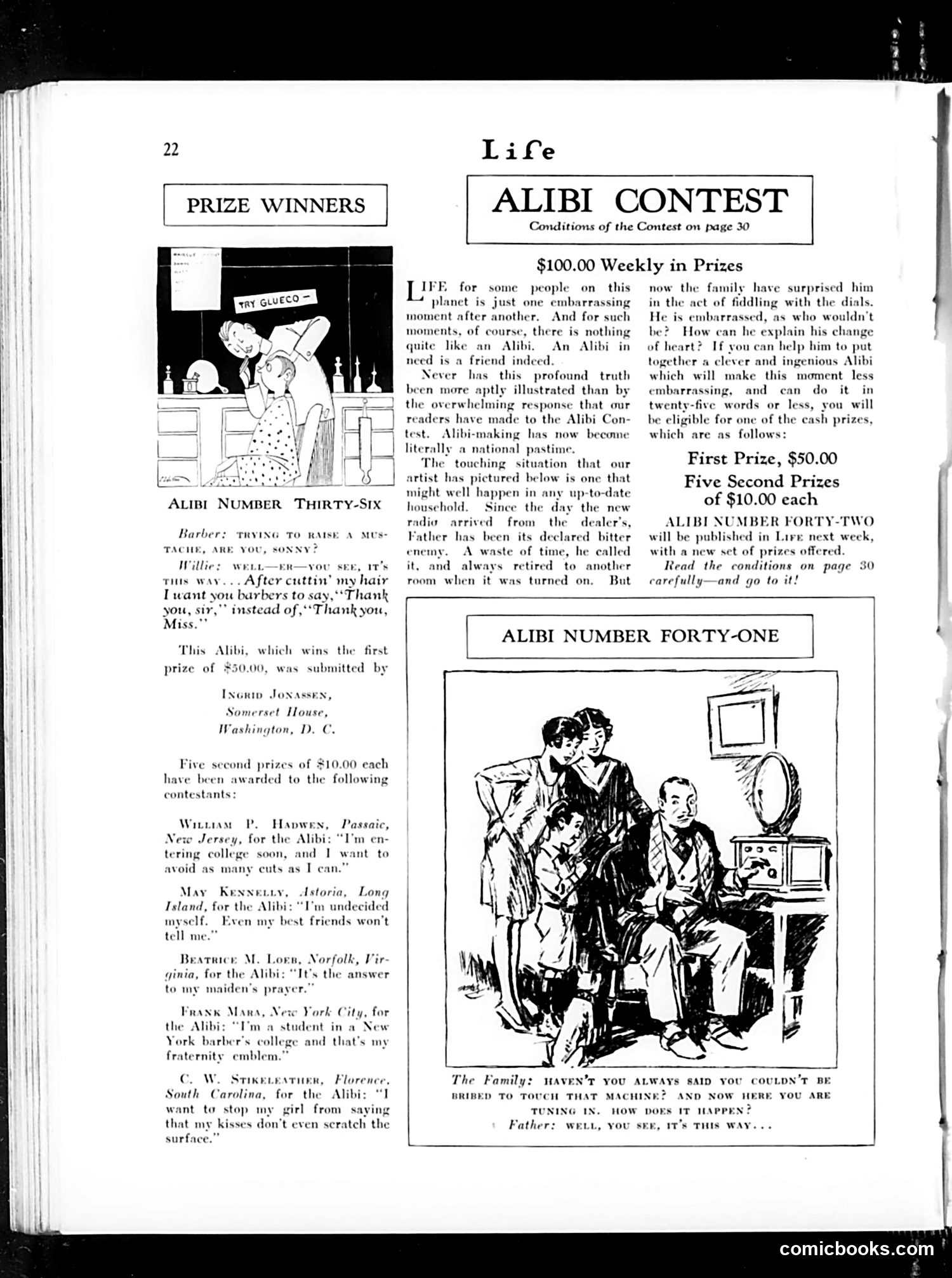
This page showcases Life magazine's "Alibi Contest"—a humor competition where readers submit clever excuses for embarrassing situations. The contest reflects 1920s-30s American culture fascinated by quick wit and social awkwardness. **The main cartoon (Alibi #41)** depicts a domestic scene where a father—who has publicly denounced radio as a wasteful nuisance—is caught secretly tuning the family radio set. His embarrassed family confronts him, and he must produce an alibi to save face. **The humor** relies on several period details: the novelty and controversy of home radios (still relatively new), traditional patriarchal authority being undermined, and the gap between public posturing and private behavior. The father's predicament—needing to explain his hypocrisy—was relatable to contemporary readers. The surrounding text and prize-winning alibis (like the barber wanting to be called "sir" instead of "miss") show how the contest tapped into everyday social embarrassments and gender-related anxieties of the era.
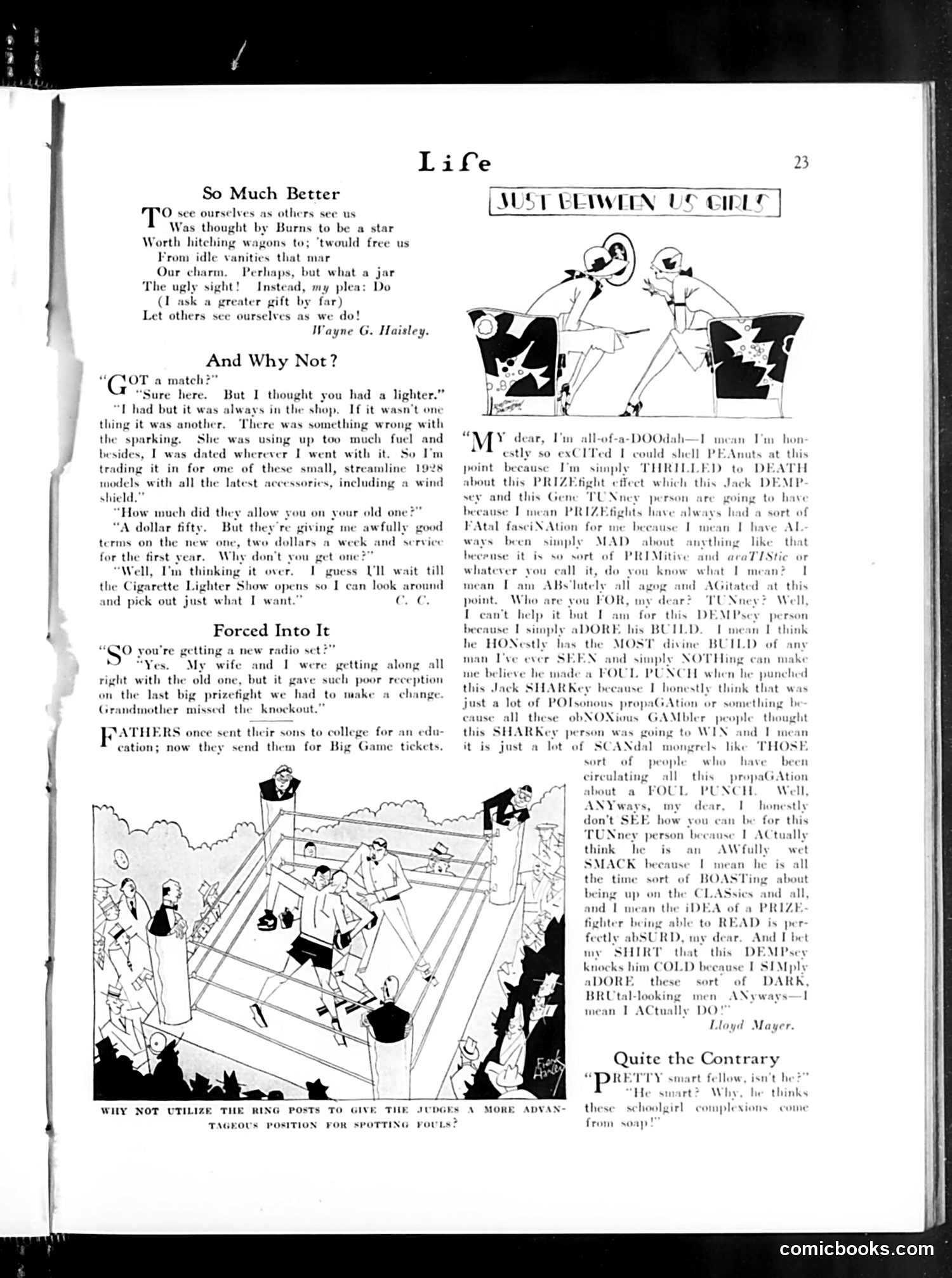
This 1928 *Life* magazine page satirizes American consumer culture and celebrity obsession. The main cartoon, "Forced Into It," depicts a boxing stadium where families attend prizefights—a hugely popular spectator sport of the era. The satire critiques how *fathers* now send sons to college not for education but to obtain tickets to the "Big Game" (major sporting events), inverting traditional parental priorities. The right column features an extended monologue by an excited female fan about the famous Jack Dempsey-Gene Tunney heavyweight championship fight. The satire mocks her breathless, superficial enthusiasm—her excessive capitalization and fragmented speech patterns suggest shallow celebrity worship. She admires Dempsey solely for his physique while dismissing Tunney as intellectual and "wet" for reading, ridiculing anti-intellectual attitudes. The surrounding vignettes mock modern consumer behavior: people constantly upgrading lighters and radios, trading old items for new accessories—reflecting 1920s materialism and planned obsolescence. The humor targets both consumerism and the era's obsessive sports fandom.
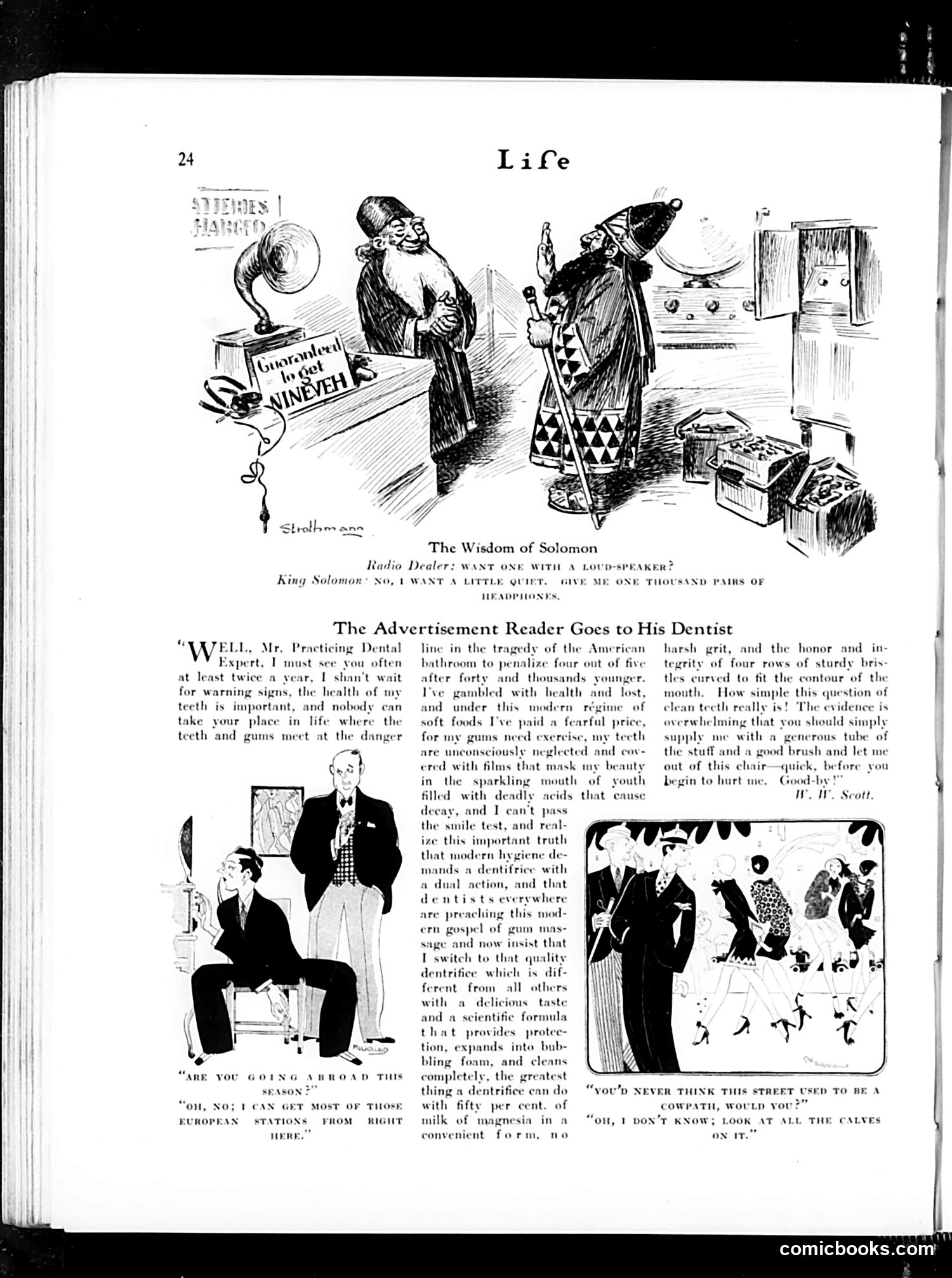
This page contains three satirical pieces mocking modern consumer culture and advertising. **"The Wisdom of Solomon"** depicts a radio dealer pitching a loud-speaker to a customer labeled "King Solomon." The joke inverts Solomon's legendary wisdom: while the dealer wants to sell expensive technology, Solomon—the wise king—requests the opposite: a thousand pairs of headphones for quiet. This satirizes the aggressive marketing of new radio technology and the irony that modern conveniences often create noise rather than peace. **"The Advertisement Reader Goes to His Dentist"** mocks advertising's influence on consumers. A patient parrots elaborate dental marketing language about "dual action" dentifrices, scientific formulas, and gum massage—despite his dentist's visible skepticism. The satire targets how advertising copy infiltrates everyday speech, making people sound absurd by repeating corporate sales pitches verbatim. The bottom panels continue this theme with mundane exchanges where characters seem oblivious to obvious truths, reinforcing the magazine's criticism of modern gullibility and consumerism.
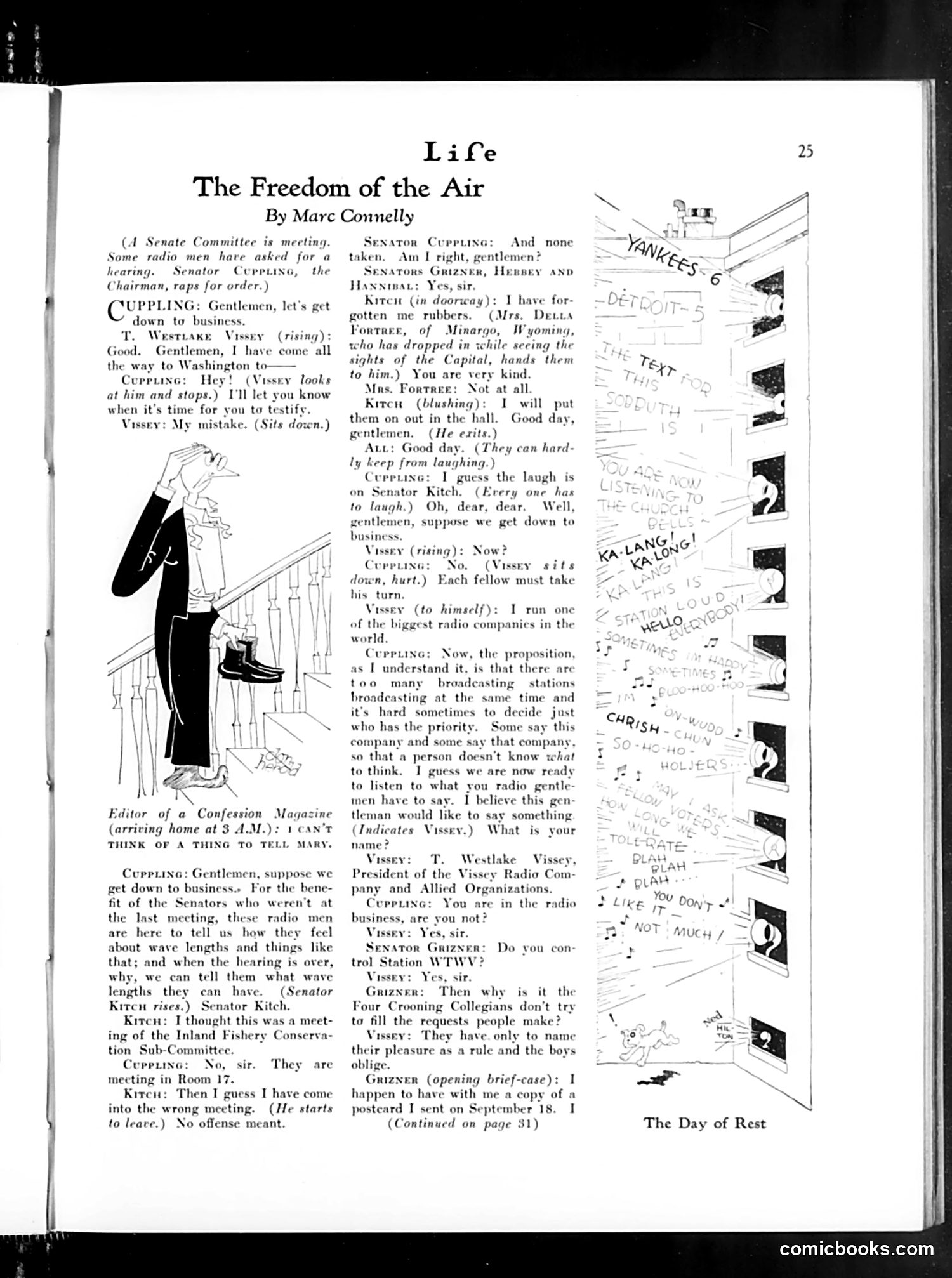
This is a satirical sketch about radio regulation, set during a Senate committee hearing. The humor centers on bureaucratic incompetence and the chaos of early radio broadcasting. **Key figures:** Senator Cuppling chairs a hearing about radio wavelength allocation. T. Westlake Vissey, president of a major radio company, attempts to testify. Senator Kitch accidentally enters the wrong meeting room. **The satire:** Multiple broadcasting stations operate simultaneously on overlapping frequencies, creating chaos. The Senate committee is disorganized—they can barely keep proceedings focused. Vissey wants priority for his company, while Senator Grizner questions why radio stations won't fulfill listener requests (likely referencing the "Four Crooning Collegians," a popular singing group). **The joke:** The sketch mocks both corporate self-interest in controlling airwaves and governmental inability to effectively regulate emerging technology. The bureaucratic confusion—wrong meetings, forgotten rubbers—undercuts any authority they might claim.
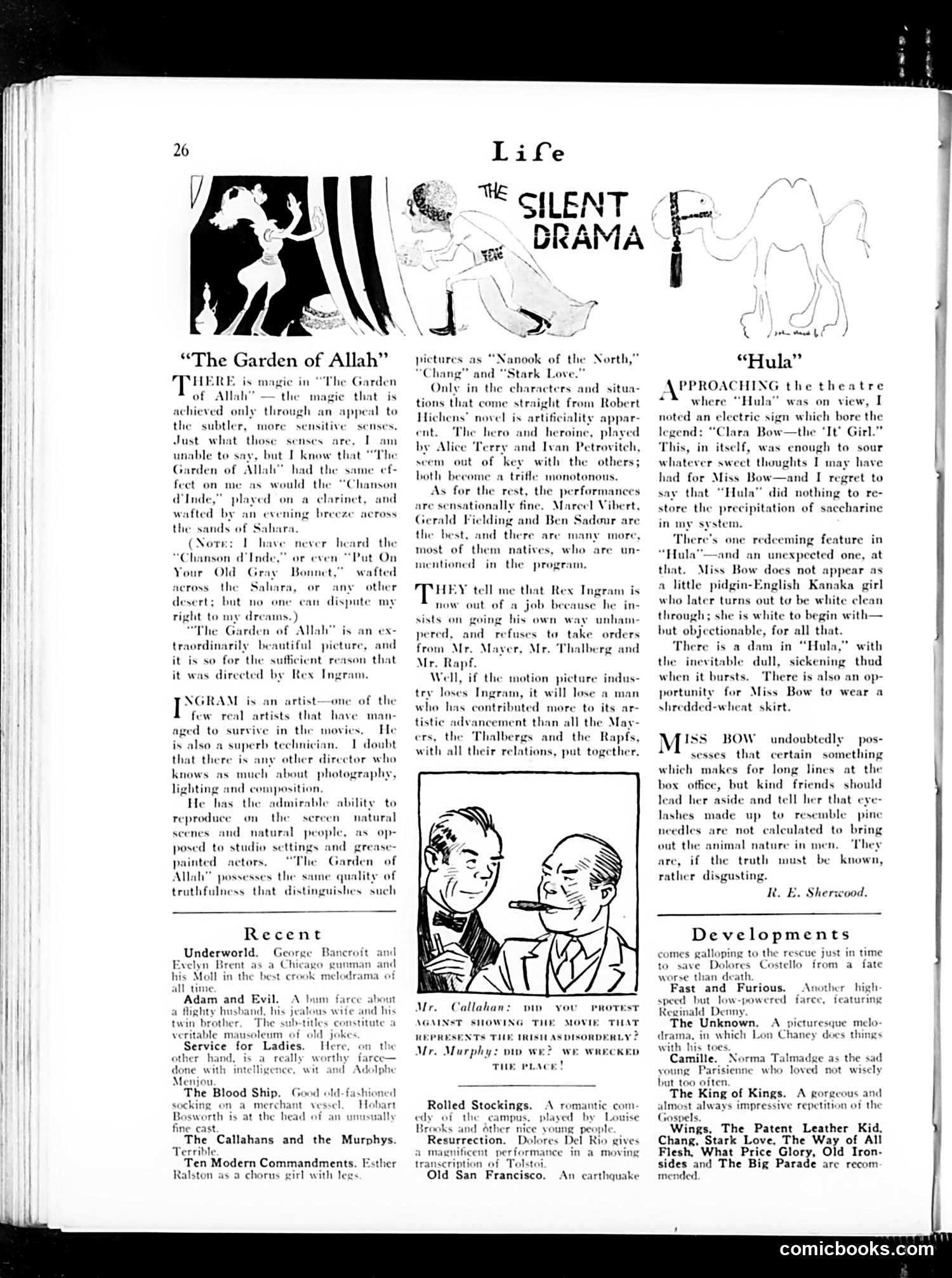
This page reviews recent films. The main cartoon (center-left) depicts two men in conversation—labeled as Mr. Callahan and Mr. Murphy—debating whether to protest a movie ("The Callahans and the Murphys") for its portrayal of Irish characters as disorderly. Murphy responds that they *would* wreck the place, which is the joke: he unwittingly confirms the stereotype they're objecting to. The reviews themselves are critical assessments of contemporary silent films. The reviewer praises director Rex Ingram's artistic vision in "The Garden of Allah" but expresses frustration that Ingram is being forced out of the film industry by studio executives (Mayer, Thalberg, Rapf) who won't tolerate his independence. The reviewer also criticizes Clara Bow's performance in "Hula," finding her character objectionable regardless of her ethnicity. The satire targets both Hollywood's treatment of ethnic groups and studio control over creative talent.
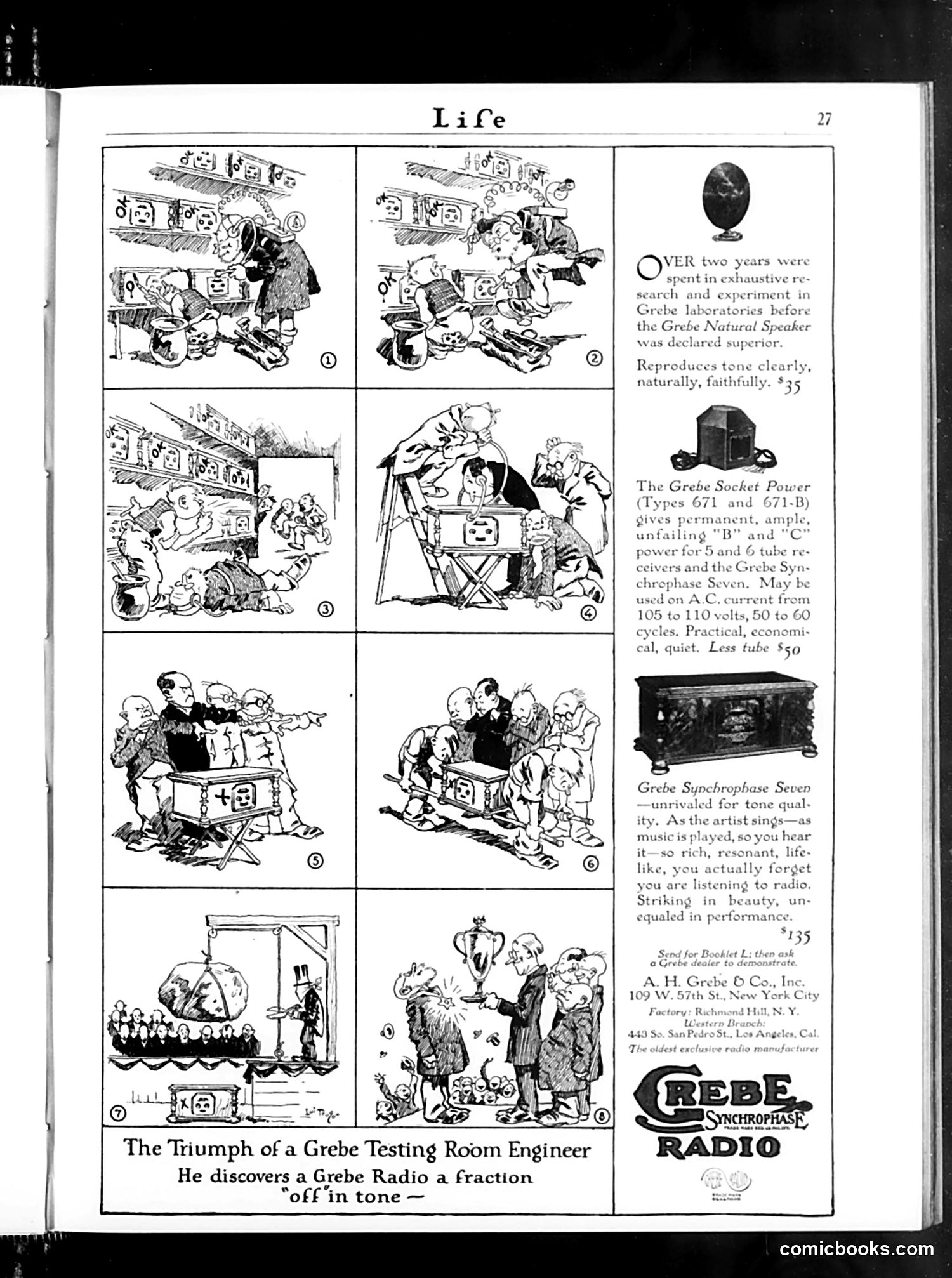
This page is primarily **advertising for Grebe brand radios**, not political satire. The left side features a humorous comic strip titled "The Triumph of a Grebe Testing Room Engineer," showing an engineer discovering a Grebe radio plays slightly "off in tone"—a self-deprecating joke about product quality. The right side advertises three Grebe products: the Natural Speaker ($35), Socket Power unit ($50), and Synchrohpase Seven ($135), emphasizing their superior sound reproduction and reliability. The comic strip's eight panels depict exaggerated physical comedy—characters reacting dramatically to the radio discovery—typical of 1920s-30s humor conventions. This appears to be a **product placement advertisement disguised as entertainment**, a common Life magazine strategy. The "triumph" is ironic: the engineer's careful testing reveals the product's minor flaw, yet Grebe uses this to demonstrate quality control and attention to detail.
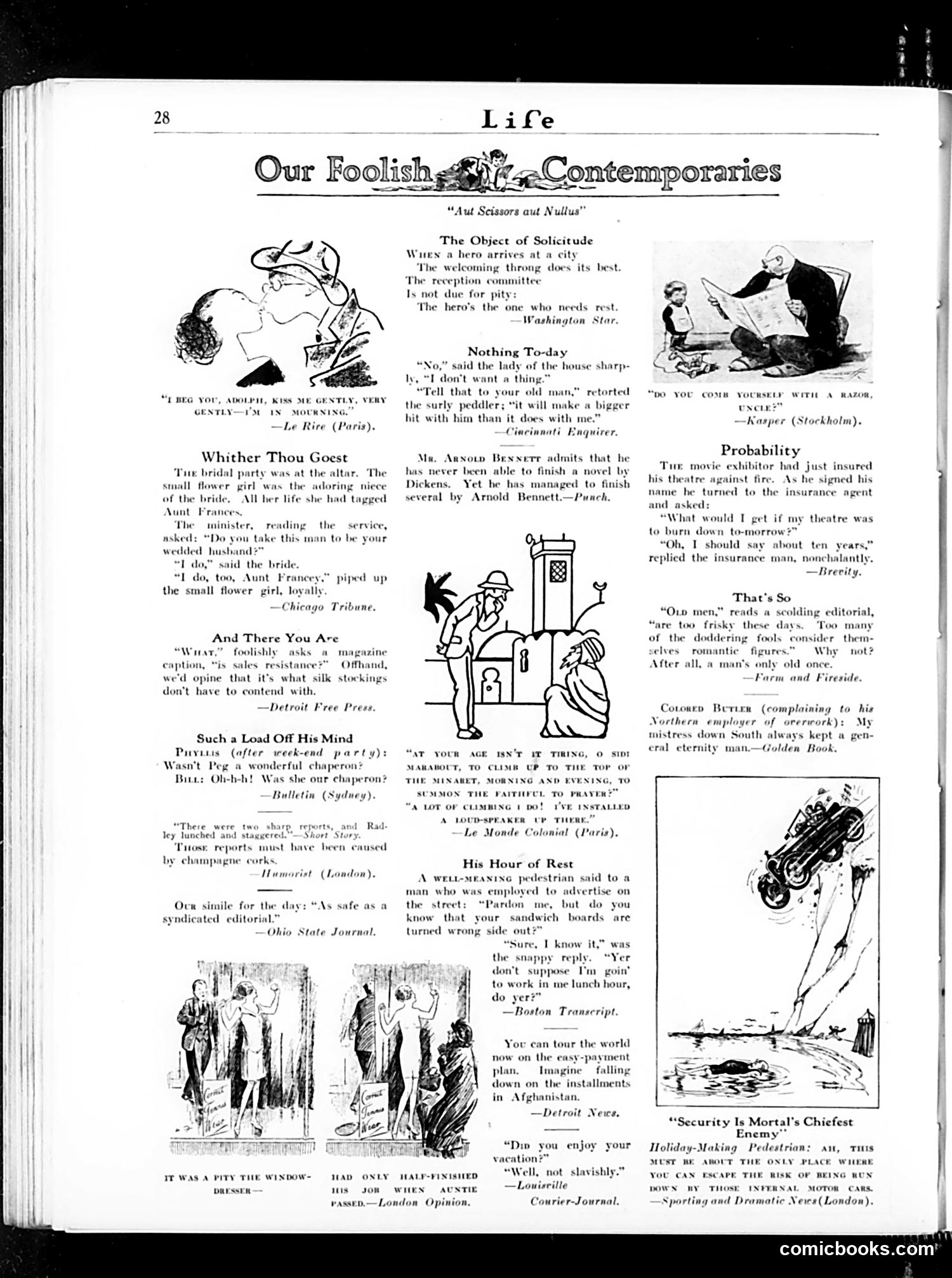
This is a collection of brief satirical observations and jokes mocking contemporary social behaviors and attitudes. Key targets include: **Social pretense**: A small flower girl at a wedding loyally mimics the bride's vows, satirizing mindless conformity. **Consumer culture**: "Sales resistance" is joked as something silk stockings don't need—mocking women's supposed inability to resist luxury purchases. **Marriage dynamics**: A wife's claim she "doesn't want a thing" is ridiculed as obviously false to her husband, satirizing domestic dishonesty. **Modernization absurdity**: A Muslim cleric installs a loudspeaker to call the faithful to prayer rather than climbing the minaret—poking fun at technology replacing tradition. **Insurance irony**: A theater owner asking about fire insurance payout receives a dark joke about prison time—suggesting arson is his real concern. The humor reflects early 20th-century attitudes about gender, consumption, religion, and modernity, presented through brief anecdotes and cartoon illustrations typical of *Life* magazine's satirical style.
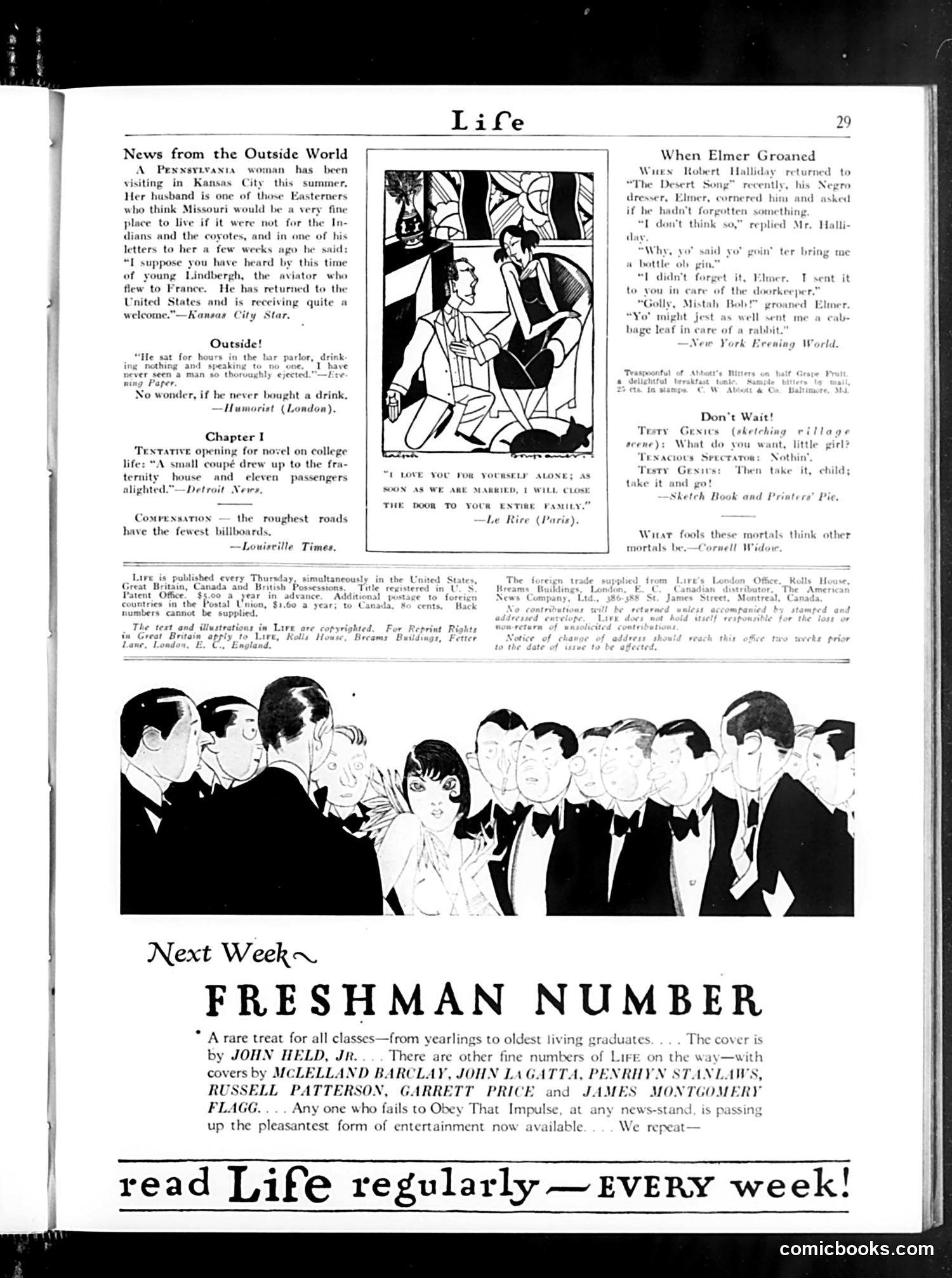
This page from Life magazine (circa 1920s, based on style) is primarily **advertising and filler content** rather than political satire. The small anecdotes ("News from the Outside World") are light humor pieces mocking regional American stereotypes—an Eastern husband dismissing Missouri due to "Indians and coyotes," and an actor's dresser complaining about being sent a cabbage leaf instead of a bottle of gin. These are mild jokes about urban vs. rural attitudes and theatrical life. The central illustration appears to depict a domestic or social scene with multiple figures, captioned with a quote about love and marriage from *Le Rire* (a French publication), suggesting it's illustrating a humorous observation about relationships. **The bulk of the page is promotional**: announcing next week's "Freshman Number" with cover art by prominent illustrators (John Held Jr., McClelland Barclay, Penrhyn Stanlaws, etc.), and pushing readers to "read Life regularly—EVERY week!" There is no significant political commentary or complex satire visible here—it's mostly light entertainment and magazine promotion aimed at college-aged readers.
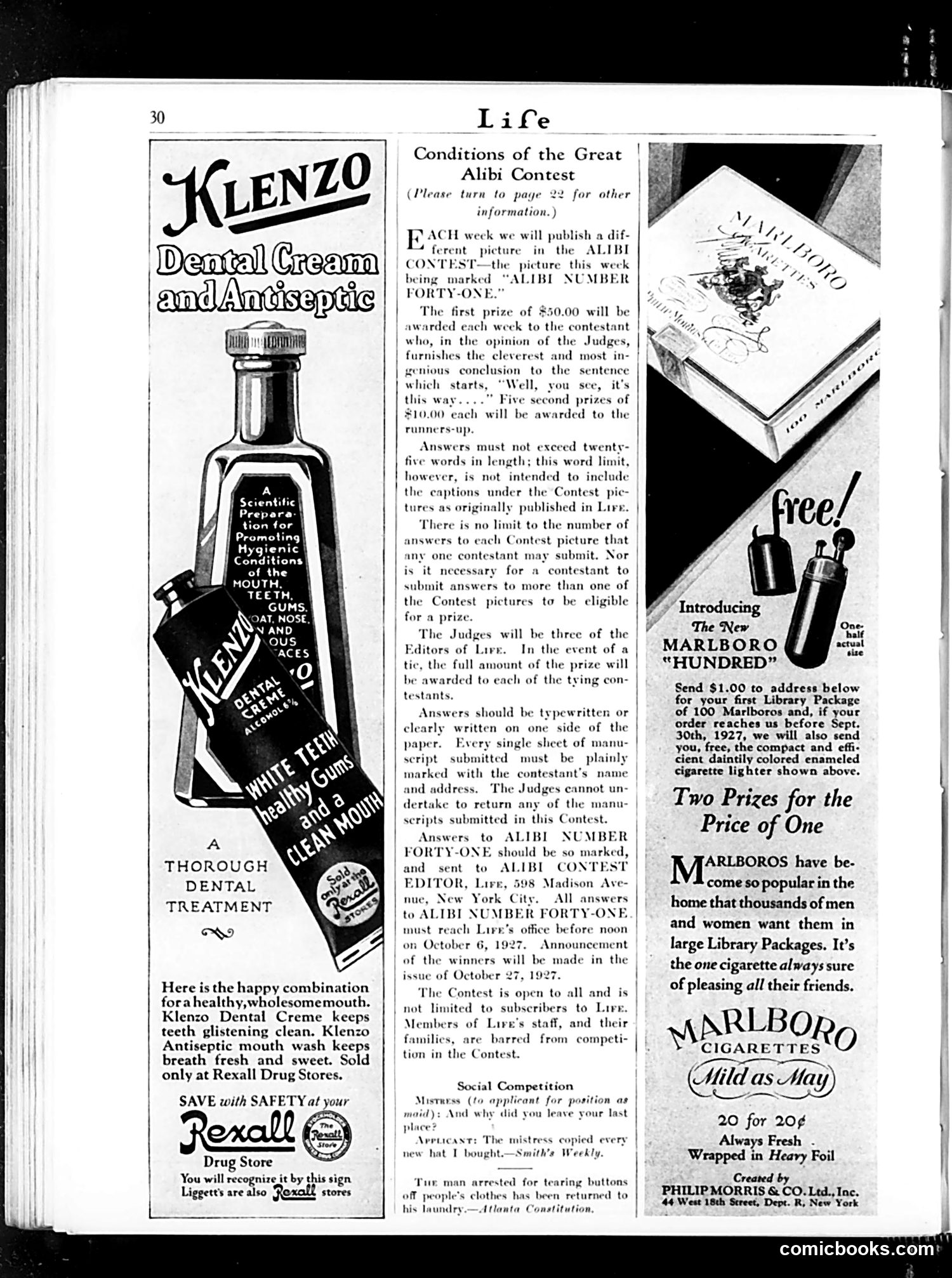
This page is primarily **advertising and contest information**, not satirical content. The main feature is the **"Alibi Contest"** — a weekly competition where Life magazine publishes pictures and readers submit humorous explanations beginning "Well, you see, it's this way..." The winner receives $50, with five $10 second prizes. Answers must be under 25 words, typewritten or clearly handwritten, submitted by October 6, 1927. The judges are Life editors. The page also contains advertisements: **Klenzo Dental Cream** (a Rexall drug store product) and **Marlboro Cigarettes** (20 for 20¢), which promoted a "Library Package" of 100 cigarettes with a free enameled cigarette lighter. There is one small joke under "Social Competition": a maid applicant explains she left her previous job because the mistress copied her new hats—a light commentary on class envy between mistress and servant.
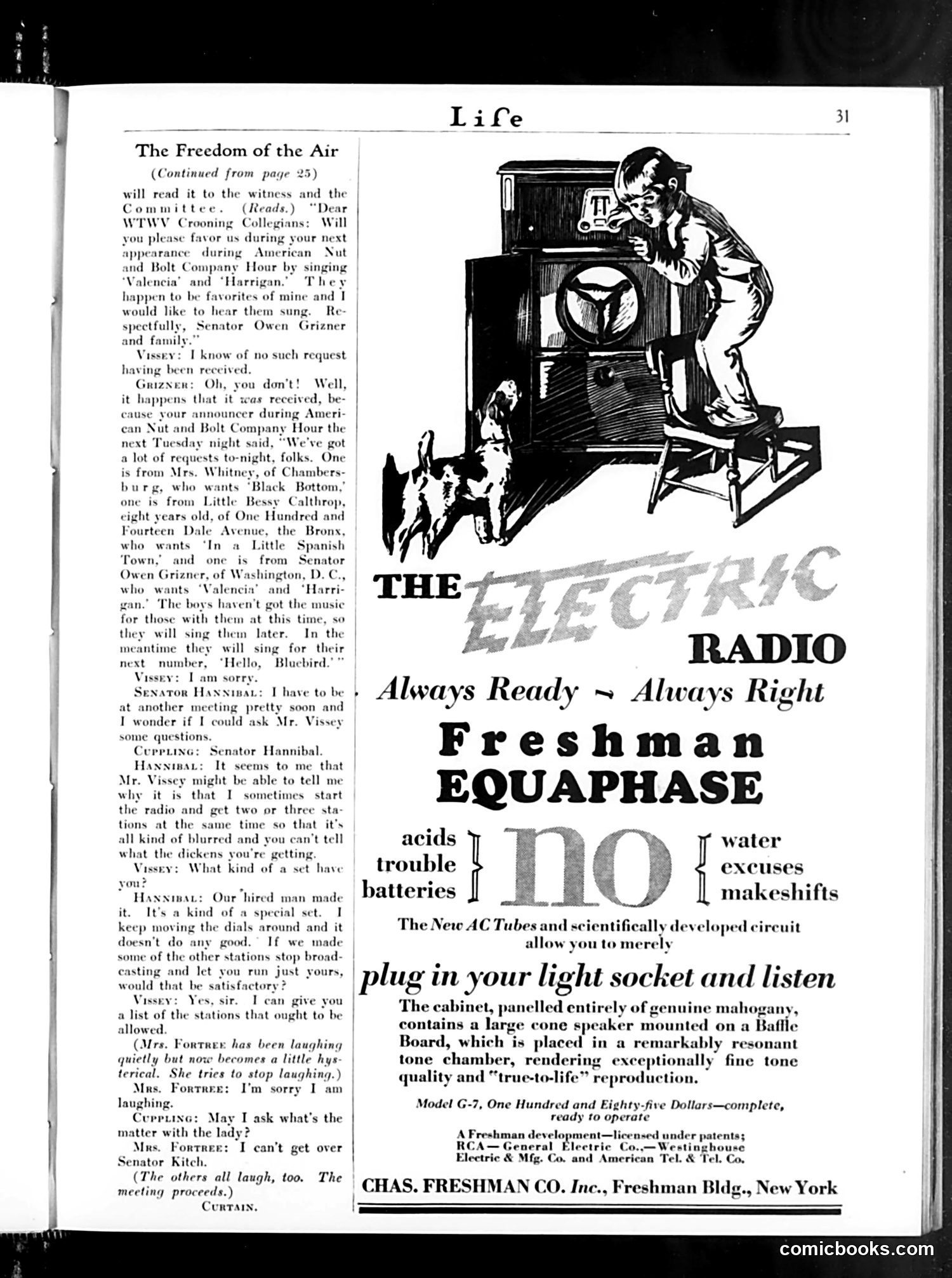
This satirical sketch mocks early radio regulation and corporate power struggles. A committee investigates station WTWV's operations, exposing how broadcasters manipulate "listener requests" for promotional purposes. Senator Grizner catches the announcer reading a request he supposedly never received—revealing the show plants fake requests to seem responsive to the public. The humor escalates when another senator asks why his homemade radio picks up multiple stations simultaneously. The broadcaster suggests simply **shutting down competing stations**—a darkly comic solution highlighting the industry's monopolistic impulses and contempt for genuine public service. The final joke about "Senator Kitch" (unclear reference) triggers uncontrollable laughter, suggesting another absurdity in the proceedings. The page also contains a radio advertisement claiming the "Freshman EQUAPHASE" model eliminates technical troubles through simple plug-in convenience—ironically juxtaposed against the sketch's critique of industry dishonesty and self-interest.
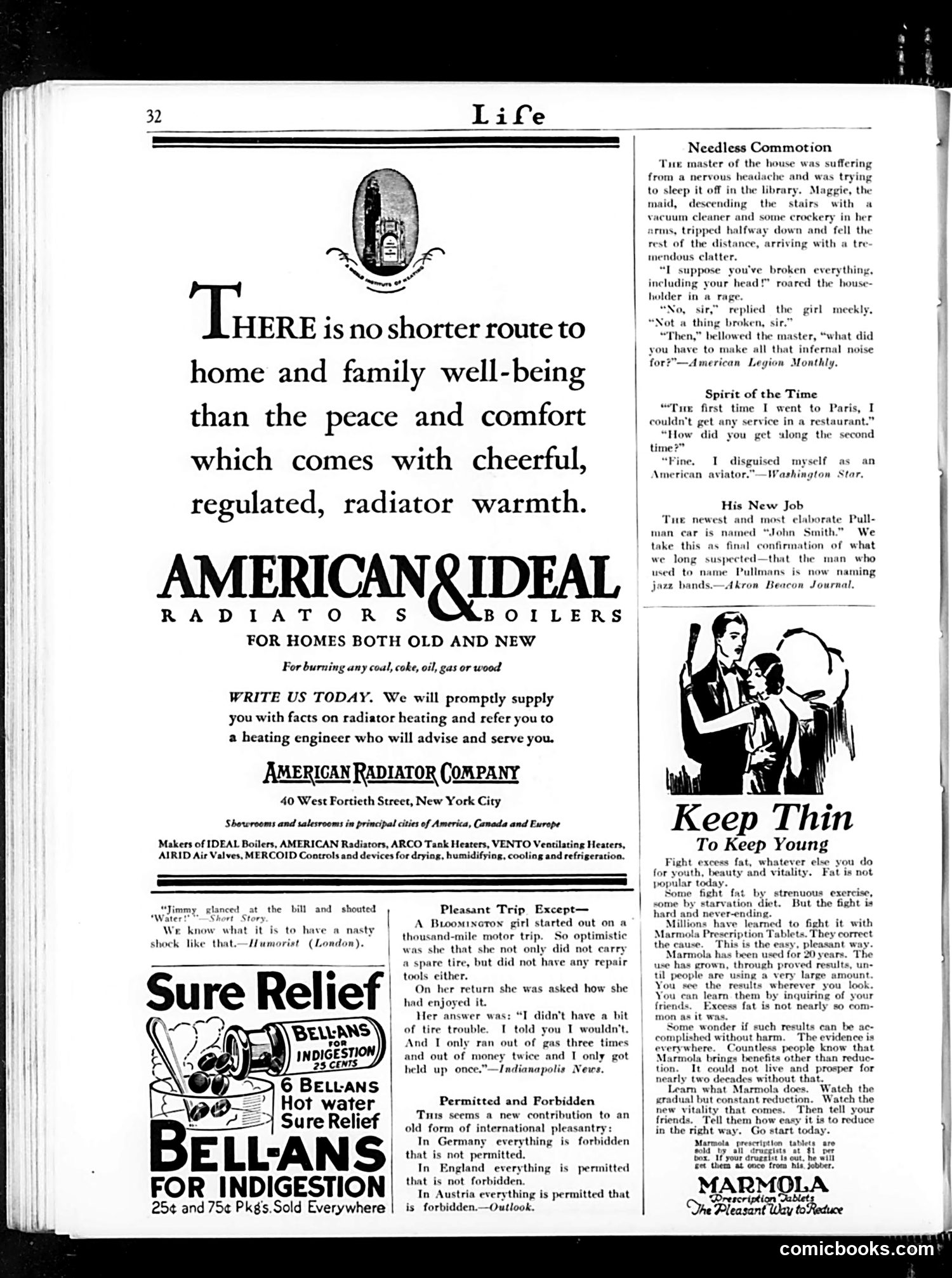
This page is primarily **advertising with interspersed humor**—typical of early 20th-century Life magazine format. The main advertisement promotes American Radiator Company's heating systems, emphasizing domestic comfort and warmth as central to family well-being. The surrounding content consists of brief **humorous anecdotes** poking fun at contemporary situations: a water bill shock, a woman's disastrous motor trip (lacking spare tire or tools), German-Austrian-English cultural differences regarding rules, a servant's accident during a headache, a Paris restaurant experience, and a Pullman car named "John Smith." There are also **product advertisements**: Bell-Ans for indigestion relief and Marmola weight-loss tablets. The "Keep Thin" ad reflects 1920s-era beauty standards promoting thinness as youthful and desirable. The cartoons are simple, single-panel illustrations accompanying short jokes—typical Life magazine humor. None reference specific political figures or events; instead, they mock everyday middle-class experiences and contemporary social anxieties (travel troubles, digestive problems, weight concerns).
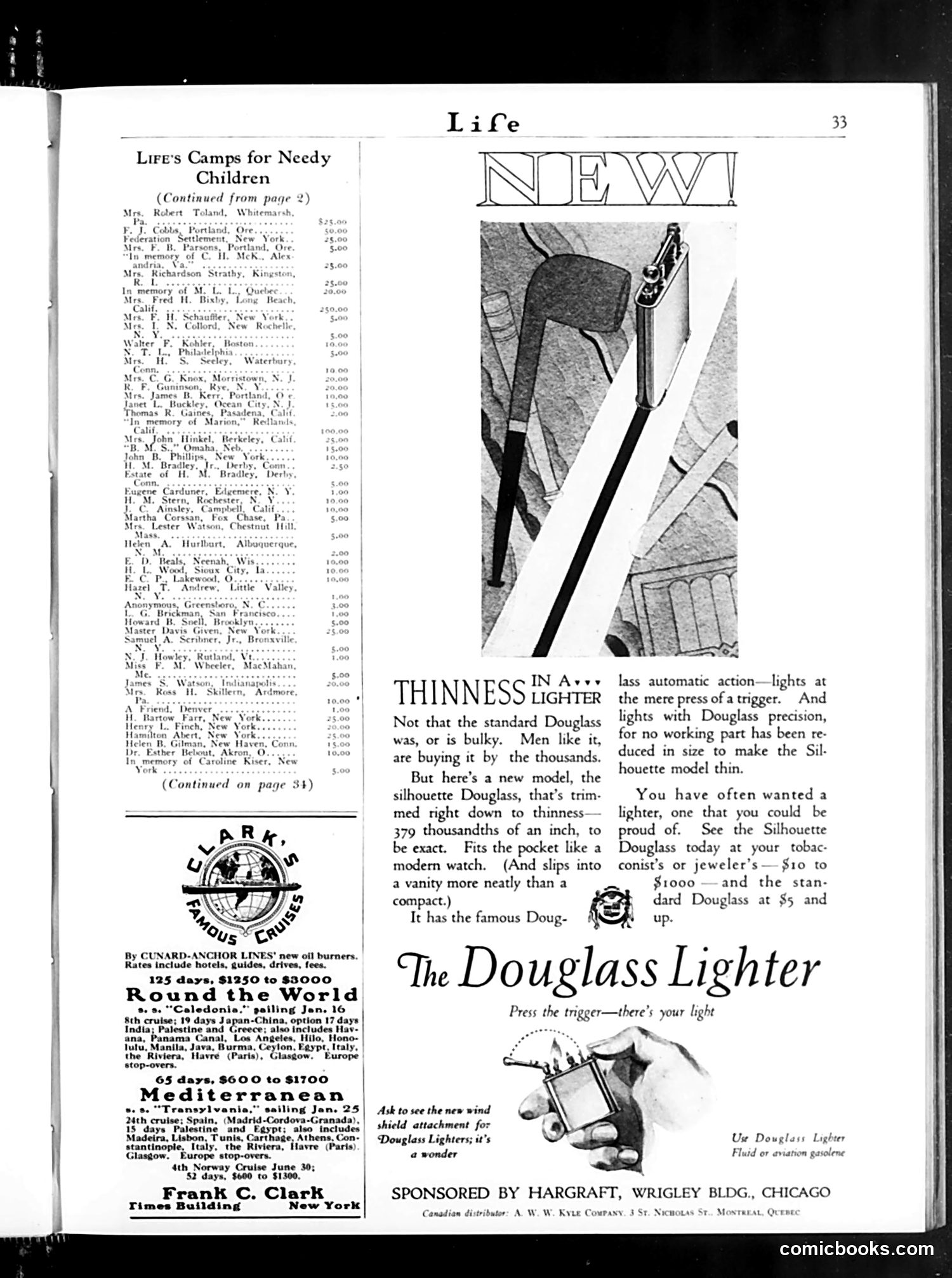
This page is primarily **advertising** rather than editorial content or political satire. The dominant feature is a full-page advertisement for the **Douglass Lighter**, a new cigarette lighter model being marketed as exceptionally thin (379 thousandths of an inch). The ad emphasizes its compact pocket design, automatic trigger action, and precision—positioning it as a luxury item available at various price points ($5 to $1,000). The advertisement uses aspirational language ("You have often wanted a lighter, one that you could be proud of") to appeal to consumers seeking status through stylish accessories. The left column contains a continuation of "Life's Camps for Needy Children," listing donors to the charitable cause—typical of Life's practice of acknowledging philanthropic contributions. The page also includes cruise line advertisements (Cunard-Anchor Lines, Mediterranean cruises), standard travel marketing of the era. **No political satire or caricature appears on this page.** It represents mid-20th century consumer magazine advertising and charitable donor recognition.
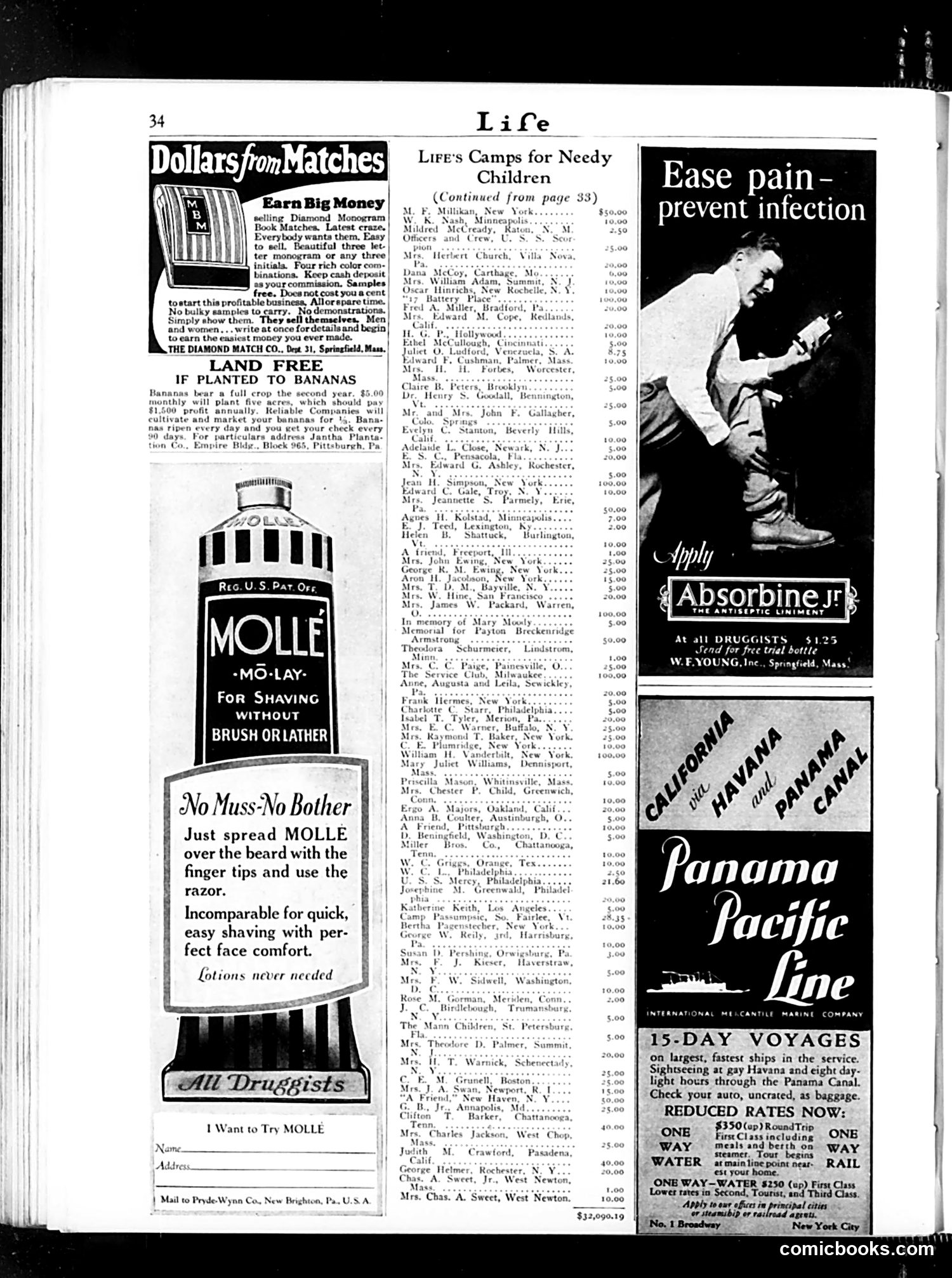
This page is primarily **advertising**, not satirical content. It contains four major advertisements typical of 1920s-era magazines: 1. **"Dollars from Matches"** — a mail-order scheme promising quick money selling personalized monogram matchbooks 2. **"Land Free if Planted to Bananas"** — a land investment pitch 3. **Mollé Shaving Cream** — emphasizing convenience ("no brush or lather needed") 4. **Panama Pacific Line** — cruise ship voyages to Cuba and Panama Canal The page also includes a continuation of "Life's Camps for Needy Children," a charitable donation list with contributor names and amounts. There is no cartoon or political satire visible on this page. The **Absorbine Jr. medical advertisement** (right side) and Panama Pacific cruise ad are straightforward commercial appeals. This represents typical early-20th-century magazine monetization through advertisements rather than editorial content.
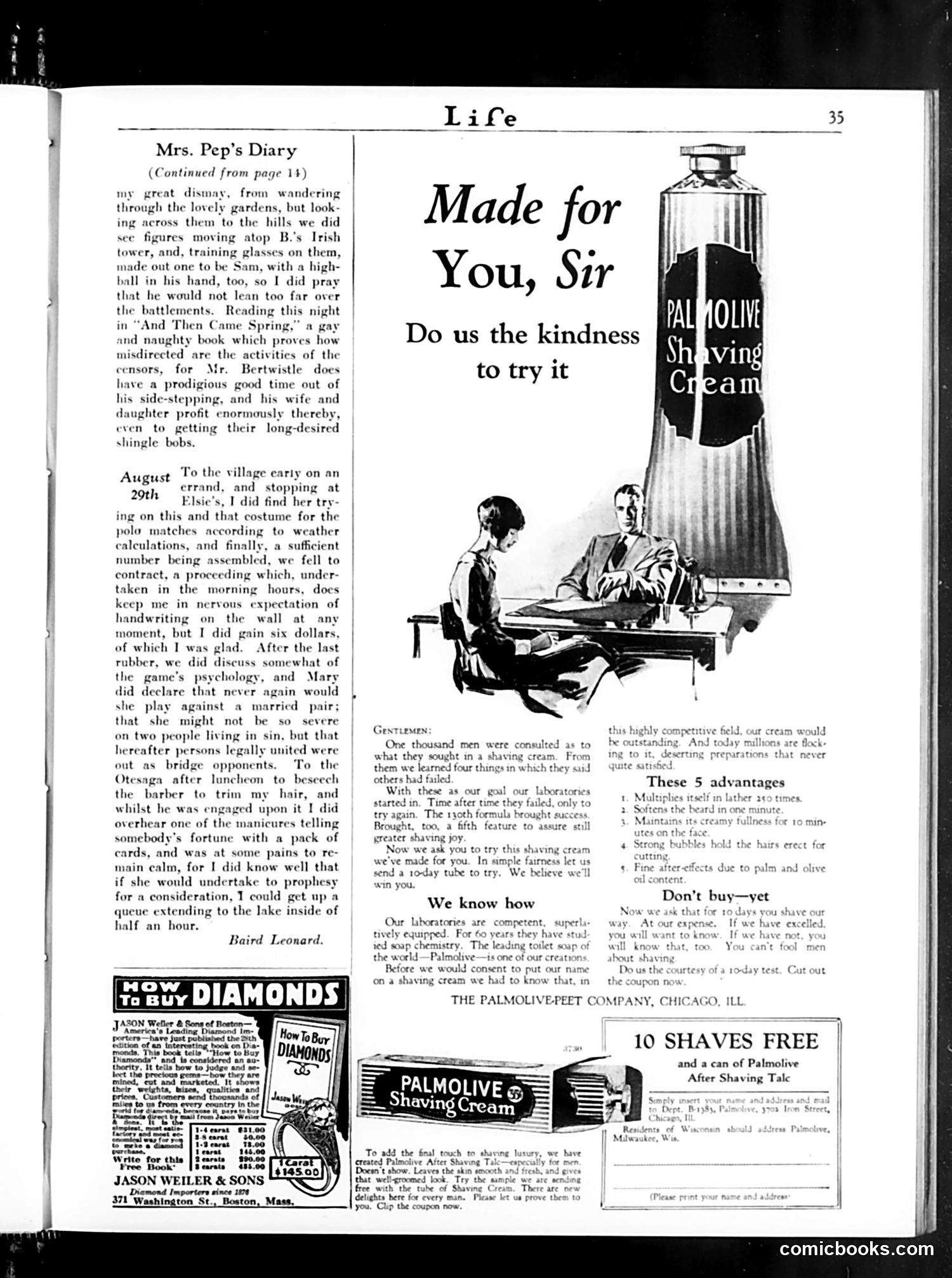
This page mixes satirical diary content with period advertising. **The Diary Section** ("Mrs. Pep's Diary") is a humorous social commentary on 1920s upper-class leisure activities. It mocks the wealthy through gossipy anecdotes: characters drinking on Irish towers, women trying on polo outfits, card games involving moral hand-wringing about unmarried couples, and fortune-telling manicurists. The tone satirizes both the frivolity of this set and their selective morality—they condemn "sin" in others while engaging in questionable behavior themselves. References to "shingle bobs" (fashionable short haircuts) and contract bridge date this to the Jazz Age. **The Advertisements** for Palmolive Shaving Cream and Jason Weiler diamonds are straightforward period promotions, not satirical content. They represent typical luxury marketing to Life's affluent readership. The page's satire targets the hypocrisy and idle pursuits of wealthy interwar Americans, a consistent theme in Life magazine's editorial voice.
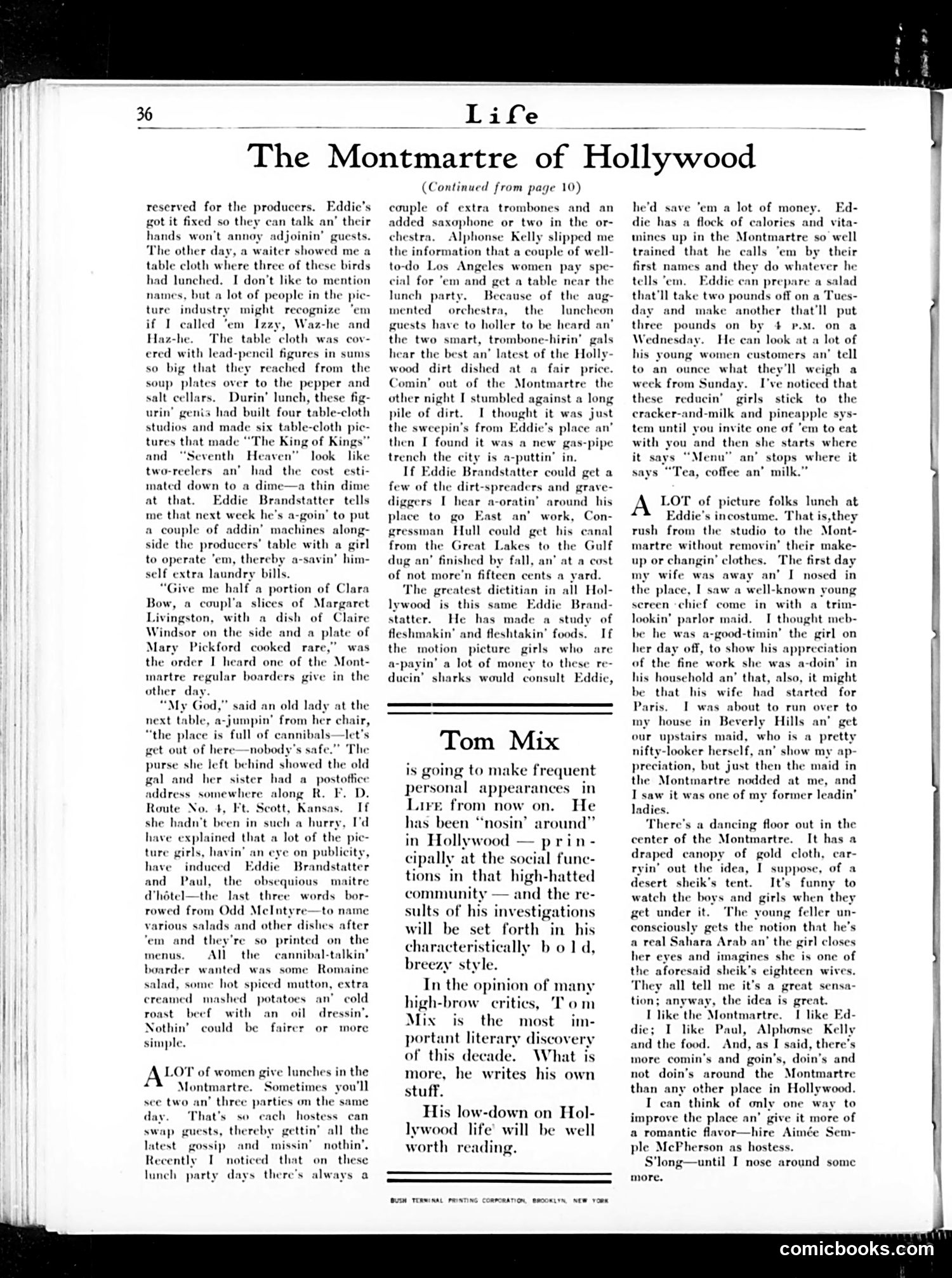
This satirical piece from *Life* magazine mocks the vanity and excess of 1920s Hollywood culture. The author describes the Montmartre restaurant in Hollywood, where movie industry figures gather and behave absurdly. Key targets of satire: - **Movie producers and executives** ("Izzy, Waz-he and Haz-he") who obsessively calculate film budgets and production costs even during lunch, covering tablecloths with financial figures - **Starlets and actresses** who pay orchestras to play louder so gossip about other actresses remains private during lunch parties—essentially paying for discretion while engaging in petty scandal-mongering - **General Hollywood pretension**: dishes named after famous actresses (Clara Bow, Mary Pickford) to attract publicity-hungry diners The humor relies on depicting Hollywood figures as simultaneously calculating, vain, and ridiculous—treating restaurants as extensions of their professional obsessions rather than places for simple dining.
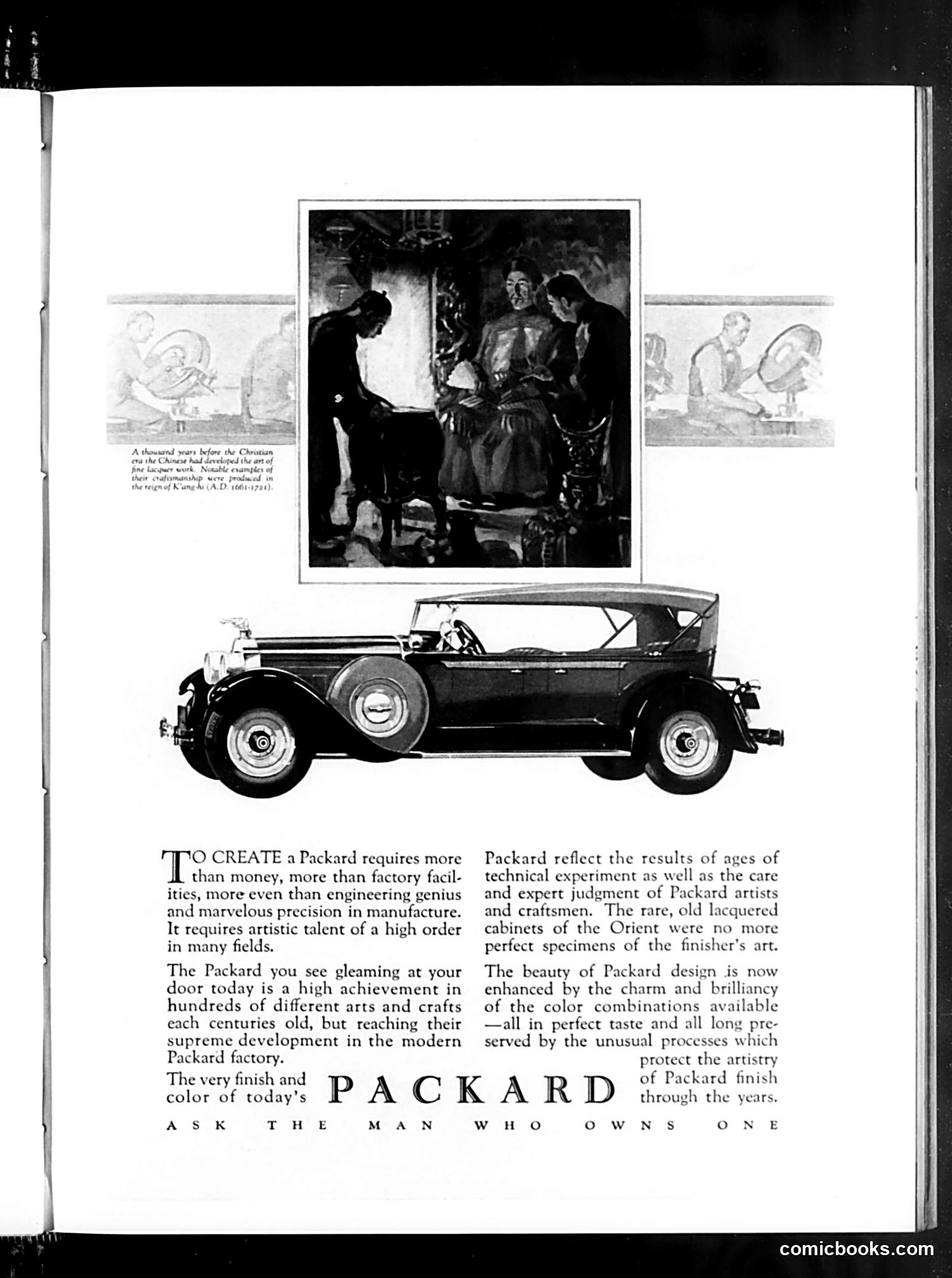
This is primarily a **luxury automobile advertisement**, not political satire. The page promotes Packard cars through an aspirational marketing campaign. The central image shows a **1920s-era convertible automobile**, displayed prominently alongside period artwork depicting what appears to be **historical craftsmen or artisans** (the smaller images above). The advertisement's strategy compares Packard automobile manufacturing to **fine art and traditional craftsmanship**—suggesting that building a Packard requires the same skill, patience, and artistic mastery as creating valuable antiques (specifically mentioning "lacquered cabinets of the Orient"). The tagline **"Ask the Man Who Owns One"** was Packard's actual advertising slogan, positioning car ownership as a status symbol and marker of refined taste. For modern readers: this reflects early 20th-century luxury marketing that equated expensive consumer goods with fine art and cultural sophistication—a common approach targeting wealthy, educated consumers during the automobile industry's expansion.
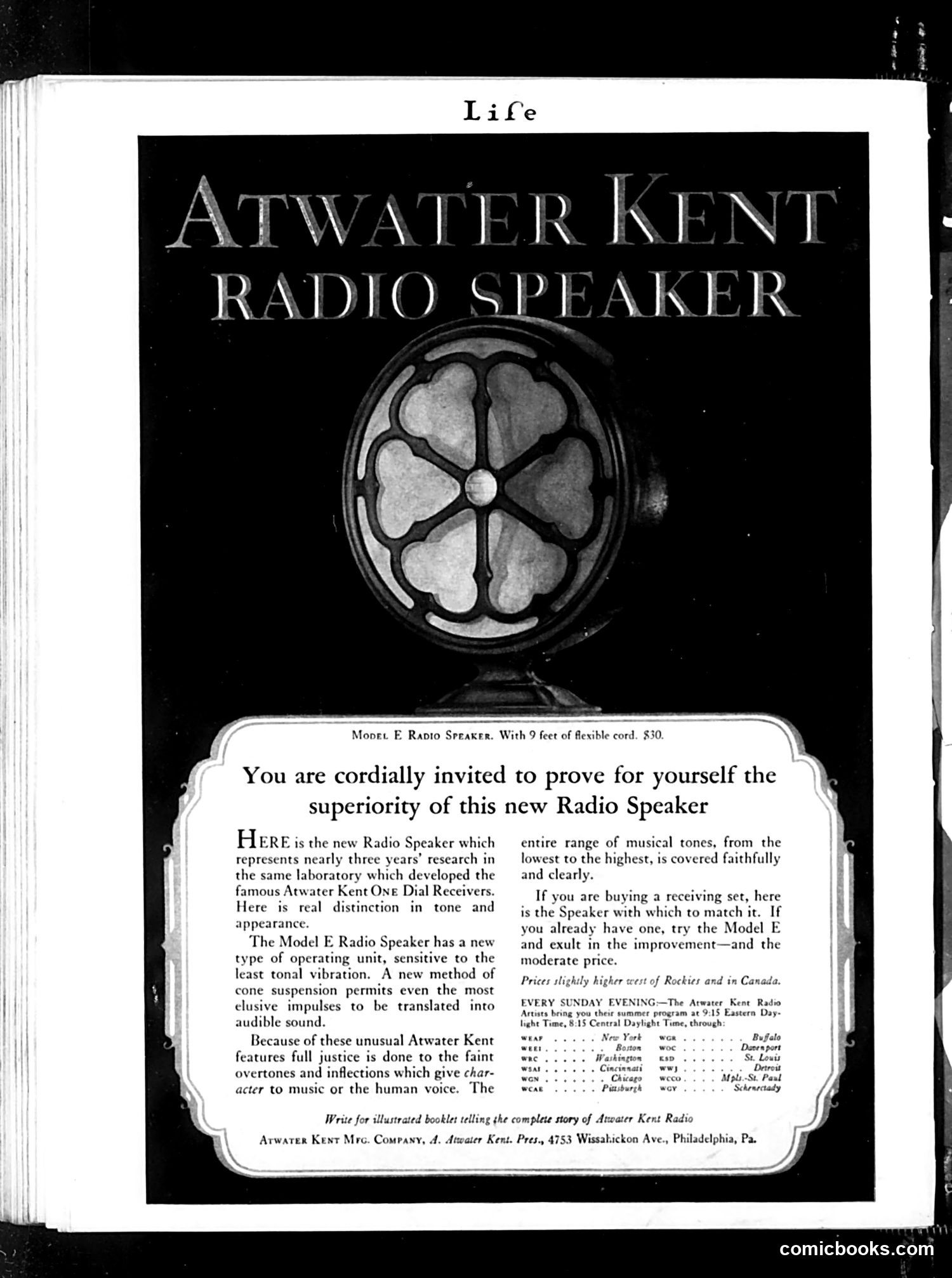
This is **not a cartoon or satire page** — it's a straightforward **product advertisement** for the Atwater Kent Model E Radio Speaker, circa 1920s. The page features a large photograph of the speaker (a decorative horn-shaped device with a floral or leaf-like metal grille) and promotional copy highlighting its technical superiority: improved cone suspension, sensitivity to subtle tonal vibrations, and ability to reproduce the full range of musical frequencies. The advertisement appeals to consumers already owning Atwater Kent radio receivers and encourages them to upgrade to this speaker model. It also mentions the company's weekly Sunday radio program broadcast across multiple U.S. cities. There is no political satire, caricature, or social commentary here — this is simply a period advertisement demonstrating early 1920s radio technology marketing.