
Life, 1927-09-22 · page 18 of 40
Life — September 22, 1927 — page 18: what you’re looking at
What you’re looking at
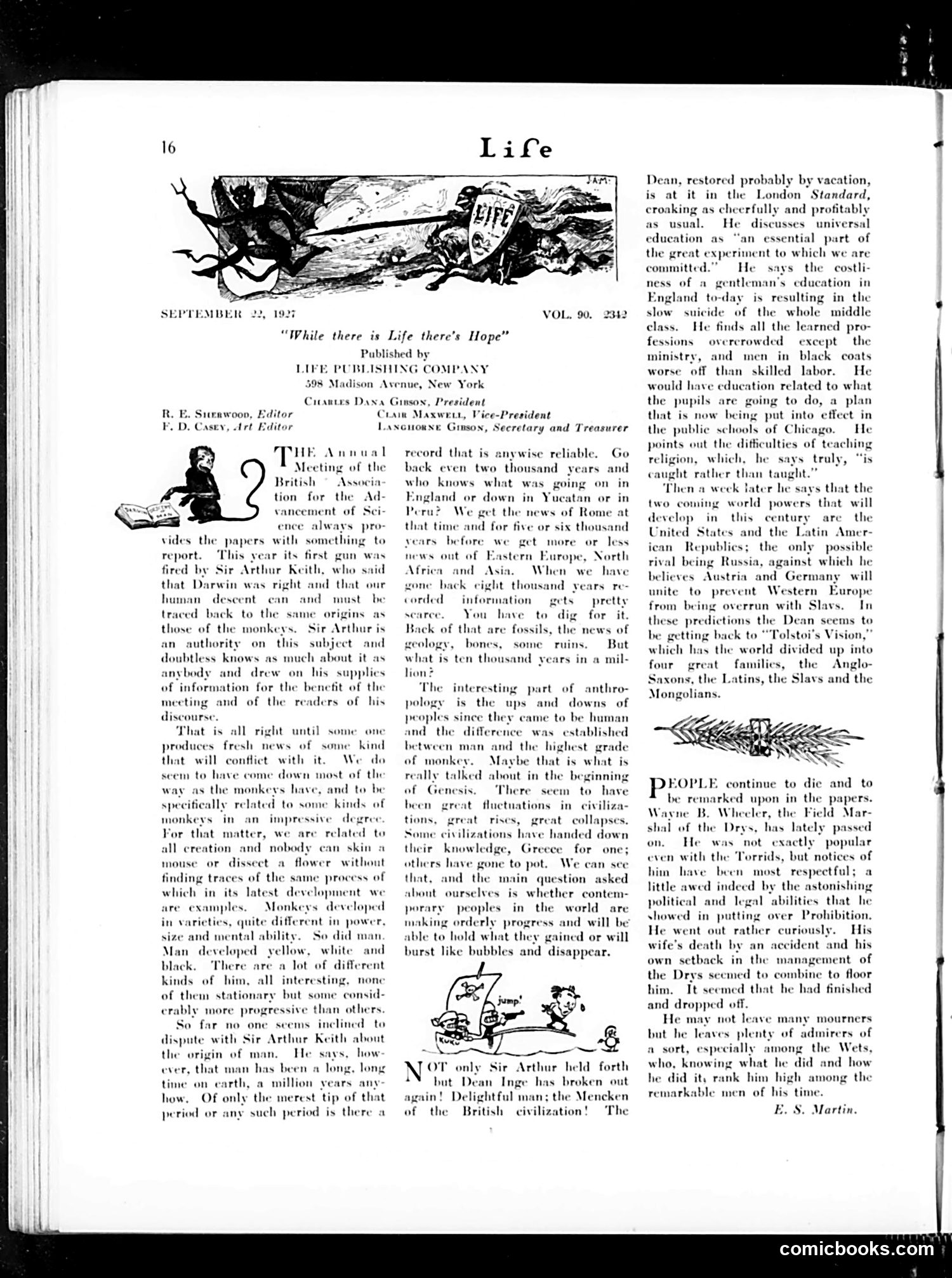
This page contains editorial commentary rather than political cartoons. The main article discusses the British Association for the Advancement of Science's annual meeting, where Sir Arthur Keith presented theories on human evolution and mankind's descent from primates. The satire targets Keith's evolutionary claims, with the text humorously suggesting that if humans descended from monkeys, perhaps this explains contemporary human behavior and social problems. The author uses this framework to critique modern civilization's failings. A small illustration showing primitive figures appears to accompany the evolutionary theme, reinforcing the satirical comparison between "civilized" society and animal behavior. The piece appears designed to mock both the scientific lecture and contemporary social conditions through evolutionary humor.
📄 Transcribed text from this page (OCR, searchable)
Machine-transcribed from the original scan — historical spelling and the odd misread are preserved.
SEPTEMBER 22, 1927 VOL, 90. 2342 “While there is Life there's Hope” Published by LIFE PUBLISHIN 598 Madison Aven Crantes Dawa € R. E. Surawoon, Editor Cis FP. D. Casey, Art Editor Tule Annual Meeting of the British — Associa tion for the Ad vancement of > ence always pro- vides the papers with something to report. This year its first gun was fired by Sir Arthur Keith, who said that Darwin was right and that our human descent) can and must be traced back to the same origins as those of the monkeys, Sir Arthur is an authority on this sul doubtless knows as much anybody and drew on his supplies of information for the benefit of the meeting and of the readers of his discourse That is all right until some one produces fresh news of some kind that will conflict with it. We do seem to have come down most of the way as the monkeys have, and to be specitically related to some kinds of monkeys ‘in an impressive degree For that matter, we are related te all creation and nobody can skin a mouse or dissect a flower without finding traces of the same process of which in its latest development we are examples. Monkeys developed in varieties, quite different in power, size and mental ability. Hid man Man developed yellow, white and black. ‘There are a lot of different kinds of him, all interesting, none of them stationary but some consid- crably more progressive than others So far no one seems inclined to dispute with Sir Arthur Keith about the origin of man. He says, how ever, that man has been a lo time on earth, a million years any how. Of only the merest tip of that period or any such period is there a long “OMPANY e, New York nson, President Maxwett, Vice-President Laxcuouxe Ginson, Secretary and Treasurer back even two thousand who k ows what was going on in ad or down in Yucatan or in W t the news of Rome at that time and for five or six thousand Peru years before we get more or less news out of Eastern Europe, North fries and Asia, When we have gone back eight thousand years. re- corded — information Ss pretty scarce You have to dig for it. Back of that geology, bon are fossils, the news of » Some ruins, But what is ten thousand years in a mil- lion , The interesting part of anthro- pology is the ups and downs of peoples since they came to be human ind the difference was established between man and the highest grade monkey. Maybe that is what is really talked about in the beginning of Genesis. There seem to have been great fluctuations in’ civiliza- tions, great rises, great collapses. nded down for one; We can see Some civilizations have their knowledge, Gree others have gone to pot. that. and the main question asked ibout ourselves is whether contem- porary peoples in the world are making orderly progress and will be ible to hold what they gained or will burst like bubbles and disappear. Not only Sir Arthur held forth 4° but Dean Inge has broken out again! Delightful man; the Mencken of the British civilization! The Dean, restored probably by vacation, is at it in the London Standard, croaking as cheerfully and profitably as usual. He discusses universal education as “an essential part of the gr committed.” He says the costli- ness of a gentleman's education in England to. is resulting in the slow suicide of the whole middle class. He finds all the learned pro- fessions overcrowded except — the ministry, and men in’ black coats worse off than skilled labor. He would have education related to what the pupils are going to do, a plan that is now being put into effect in the public schools of Ch He points out the dithculties of teaching religion, which, he says truly, “is caught rather than taught.” Then a week later he says that the two coming world powers that will develop in’ this century are the United States and the Latin Amer- ican Republics; the only possible rival being Russia, against whieh he believes Austria and Germany will unite to prevent Western Europe from being overrun with Slavs. In these predictions the Dean seems to be getting back to “Tolstoi’s Vision,” which has the world divided up into eat families, the Anglo- ns, the Latins, the Slavs and the veriment to which we are DEOPLE continue to die and to be remarked upon in the papers. Wayne B. Wheeler, the Field Mar- shai of the Drys, has lately passed on. He was not exactly” popular even with the rrids, but notices of him have been most respectful; a little awed indeed by the astonishing politi and abilities that he showed in putting over Prohibition. He went out rather curiously. His wife’s death by an accident and his own setback in the the Drys secmed to to floor him. It seemed that he had finished and dropped off. He may not leave many mourners but he leaves plenty of admirers of ially among the Wets, who, knowing what he did and how he did it, rank him high among the remarkable men of his time. E, S. Martin. a sort, espe comicbooks.com