
Life, 1927-09-22 · page 23 of 40
Life — September 22, 1927 — page 23: what you’re looking at
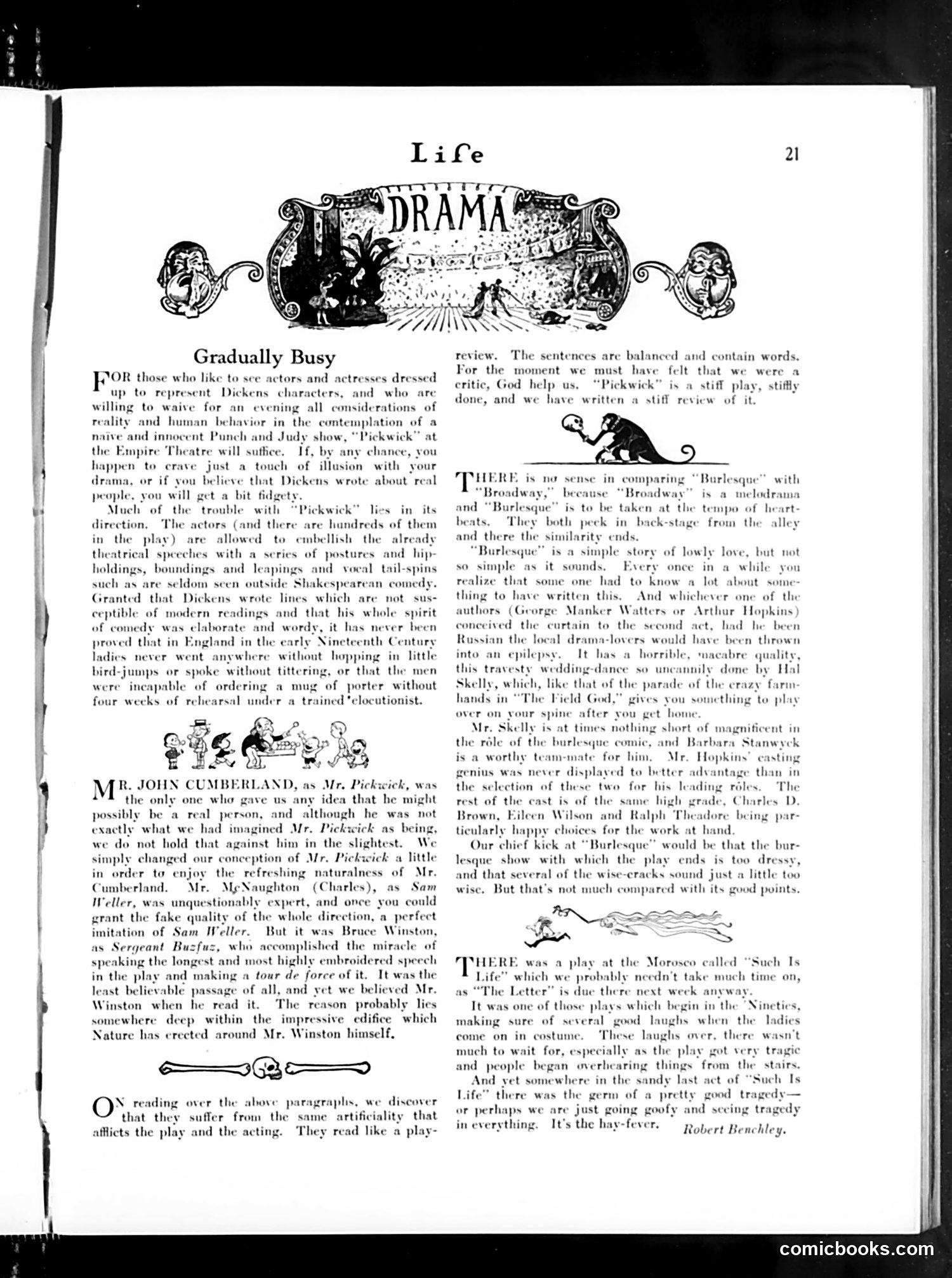
What you’re looking at
This page contains theater reviews from Life magazine's "Drama" section. The main content critiques a stage adaptation of Dickens's *Pickwick Papers* at the Empire Theatre. **The Satire:** The reviewer criticizes the production's excessive theatricality—actors hopping about, tittering, and performing elaborate physical comedy that the critic argues is historically inaccurate to Dickens's actual writing. The reviewer notes the irony that their own review suffers from the same artificiality they're condemning in the production itself. **Key Points:** John Cumberland as Mr. Pickwick is praised as the only performer who seems like a real person. Bruce Winston is commended for making an improbable monologue believable through sheer force of personality. The production is dismissed as a "Punch and Judy show" for audiences unwilling to engage with genuine realism. The piece also briefly reviews *Burlesque* and *Such Is Life*, praising performances by Hal Skelly and Barbara Stanwyck. The overall tone is witty and self-aware.
📄 Transcribed text from this page (OCR, searchable)
Machine-transcribed from the original scan — historical spelling and the odd misread are preserved.
— —o Gradually Busy VOR those who like to sce actors and actresses dressed up to represent Dickens characters, and who are willing to waive for an evening all considerations of reality and human behavior in the contemplation of a and innocent Punch and Judy show, “Pickwick” at Empire Theatre will sutice. If, by any chance, you happen to erave just a touch of illusion with your drama, or if you believe that Dickens wrote about real people, you will get a bit fidget Much of the trouble with ickwick” lies in its direction. The actors (and there are hundreds of them in the play) are allowed to embellish the already theatrical speeches with a series of postures and hip holdings, boundings and leapings and vocal tail-spins such as are seldom seen outside Shakespearean comedy. Granted that Dickens wrote lines which are not. sus- ceptible of modern readings and that his whole spirit of comedy was elaborate and wordy, it has never been proved that in England in the early Nineteenth Century ladies never went anywhere without hopping in little bird-jumps or spoke without tittering, or that the men were incapable of ordering a mug of porter without four weeks of rehearsal under a trained ‘elocutionist. . E> ry > we > a EPSP NO) TyA Uw R. JOHN CUMBERLAND, as Mr. Pickwick, was the only one who gave us any idea that he might possibly be a real person, and although he was not exactly what we had imagined Mr. Pickwick as being, we do not hold that inst him in the slightest. We simply changed our conception of Mr. Pickwick a litth in order ta enjoy the refreshing naturalness of Mr. Cumberland. Mr. MgNaughton (Charles) Weller, was unquestionably expert, and once you ¢ grant the fake quality of the whole direction, a perf imitation of Sam Weller. But it was Bruce Winston, as Sergeant Buzft who accomplished the miracle of speaking the longest and most highly embroidered speech in the play and making a tour de force of it. It was the least believ : of all, and yet we believed Mr. Winston when he r it. The reason probably lies somewhere deep within the impressive edifice which Nature has erected around Mr. Winston himself, —33-> O* reading over the above paragraphs, we discover that they suffer from the same artificiality that afflicts the play and the acting. They read like a play- review. The sentences are balanced and contain word For the moment we must have felt that we were critic, God help us. a “Pickwick” iy a stiff play, stiffly done, and we have written a stiff review of it. ¢ “Burlesque” with TTP HERE. is nu sense in compari “Broadway, y" is a melodrama and “Burlesque” is to be taken at the tempo of heart beats. They both peek in back-stage from the alley and there the similarity ends. “Burlesque” is a simple story of lowly love, so simple as it. sounds. because “Broadw but not Every once in a while you realize that some one had to know a lot about some thing to have written this. And whichever one of the authors (George Manker Watters or Arthur Hopkins conceived the curtain to the second act, had he been Russian the loeal drama-lovers would have been thrown into an epilepsy. It hh 1 horrible, macabre quality, this travesty wedding-dance so uncannily done by Hal Skelly, which, like that of the parade of the crazy farm hands in “The Field God,” gives you something to play over on your spine after you get home Mr. Skelly is at times nothing short of magnificent in the ré and Barbara Stanwyck is a worthy team-mate for him. Mr. Hopkins’ casting le of the burlesque comic, genius was never displayed to better advantage than in the selection of these two for his leading réles. The grade, Charles D Brown, Eileen Wilson and Ralph Theadore being par- ticularly happy choices for the work at hand Our chief kick at “Burlesque” would be that the bur- lesque show with which the play ends is too dressy, rest of the cast is of the same hig and that several of the wise-eracks sound just a little too wise, But that’s 1 t much compared with its good points. TPRHER Pit as “The Letter” is due there next week any of those plays which begin in the “Nineties, was a play at the Morosco called “Such Is which we probably needn't take much time o} way It was making sure of several good laughs when the ladies come on in costume. These laughs over, there wasn't much to wait for, especially as the play got very tragic and people began overhearing things from the stairs. And yet somewhere in the sandy last act of “Such Is Life” there was the germ of a pretty or perhaps we are just going goofy and secing tragedy in everything. It's the hay-fever. overt Benchley. wood tragedy— comicbooks.com