
A complete issue · 34 pages · 1927
Life — June 16, 1927
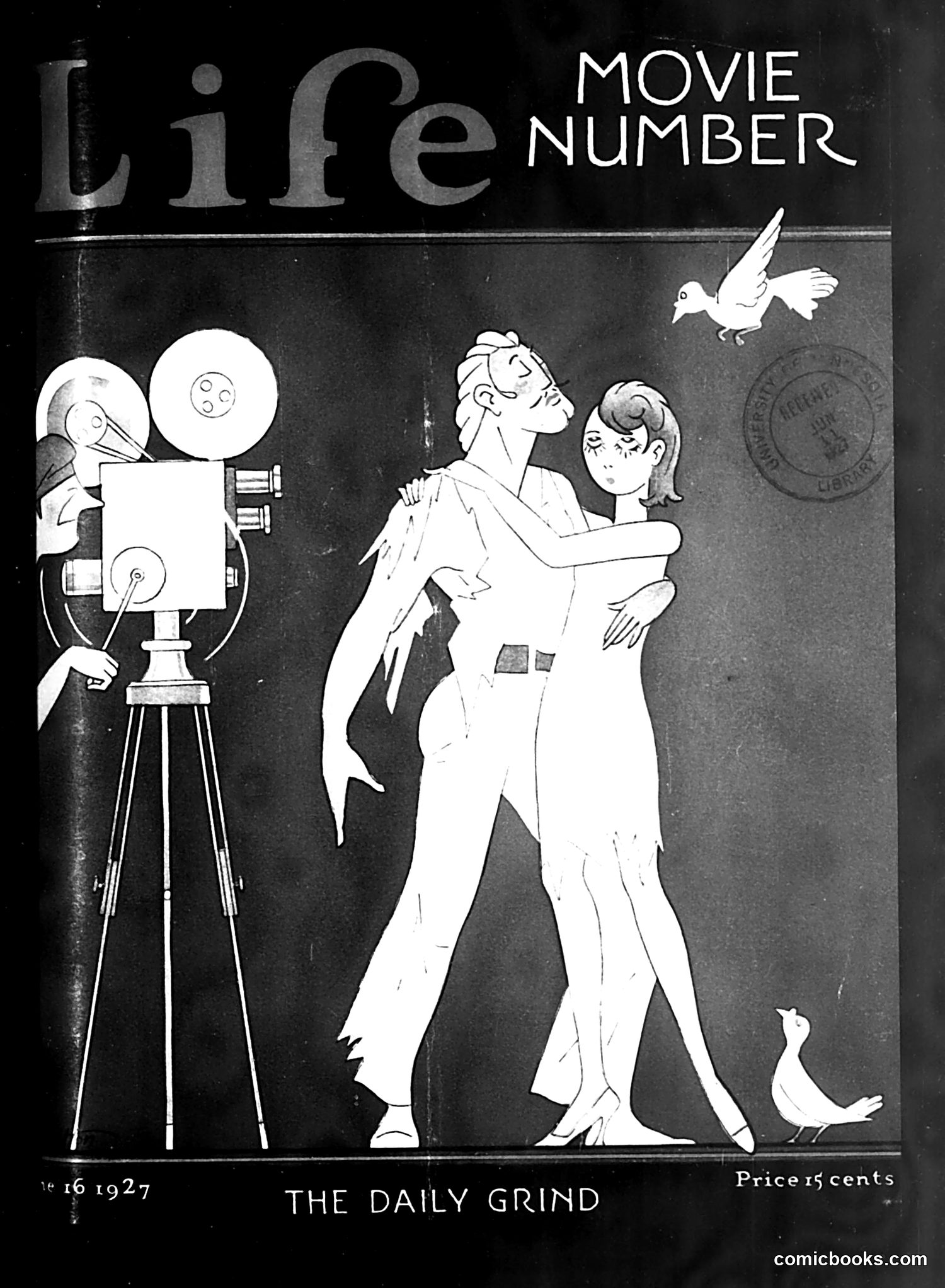
This is a cover for "Life Movie Number"—a special issue devoted to cinema. The illustration satirizes Hollywood's extravagance and moral concerns of the 1920s. The central figures appear to be glamorous film actors in revealing costumes, styled as "fallen angels" with wings—a visual pun on both heavenly and morally questionable imagery. A film camera on a tripod captures the scene, reinforcing the movie industry context. The small bird at bottom left and dove above likely reference purity or innocence, contrasting ironically with the scantily-clad figures. This reflects 1920s anxieties about Hollywood's perceived decadence and its influence on American morality during the Jazz Age. The satire mocks both the industry's glamorous excess and contemporary moral panic about cinema's corrupting effects.
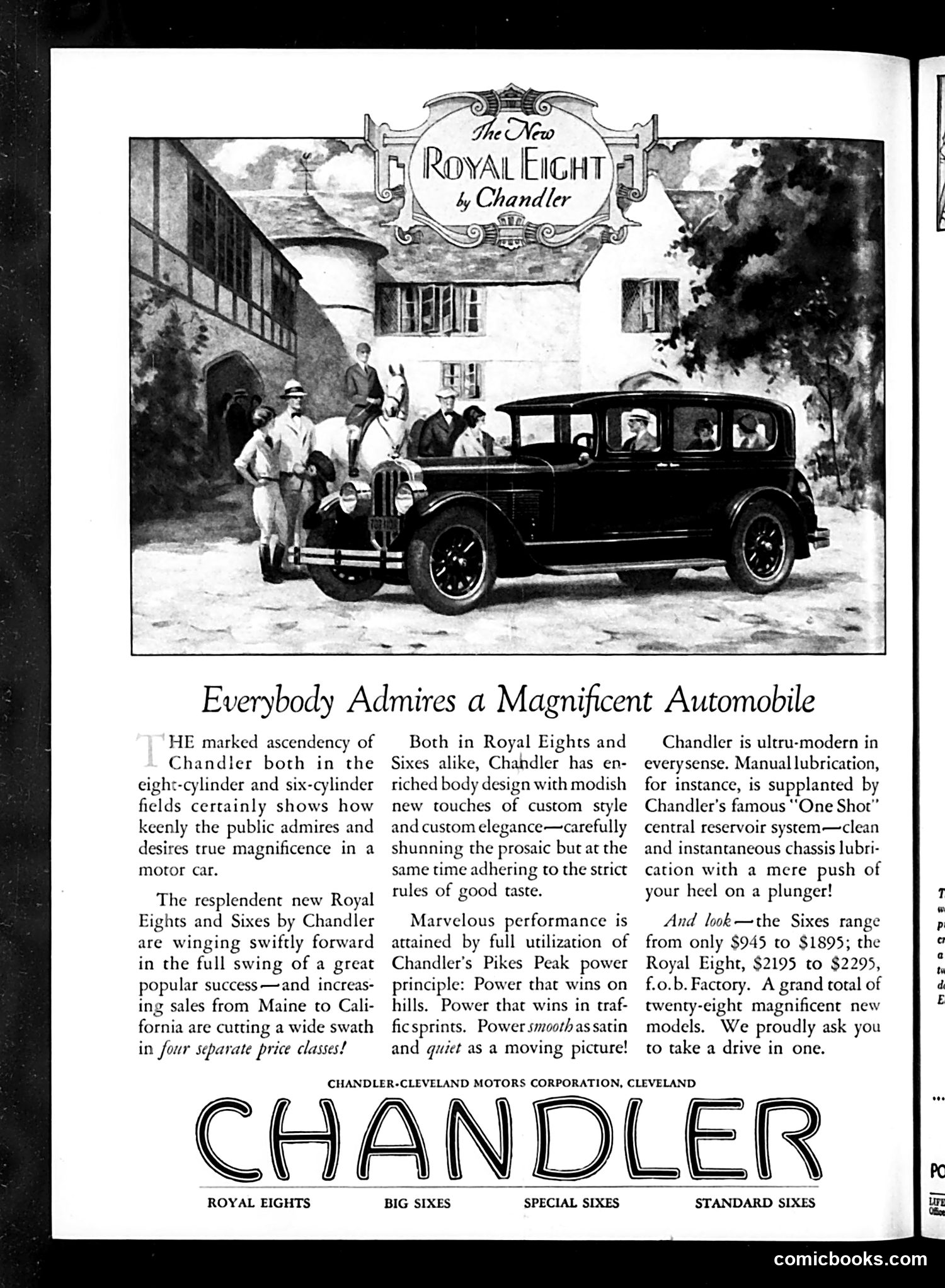
This is **not** a political cartoon or satirical content—it's a **full-page automobile advertisement** for Chandler cars, published in Life magazine. The image shows a 1920s luxury automobile (the Royal Eight model) displayed in front of a mansion, surrounded by well-dressed figures admiring it. The ad emphasizes the car's modern engineering features, performance capabilities, and social prestige. The only "satire" here is implicit in Life magazine's advertising model: the juxtaposition of the car's magnificence with aspirational wealth and class status. The headline "Everybody Admires a Magnificent Automobile" reflects 1920s consumer culture, where owning such vehicles signaled social success. This represents straightforward period advertising rather than editorial satire or political commentary.
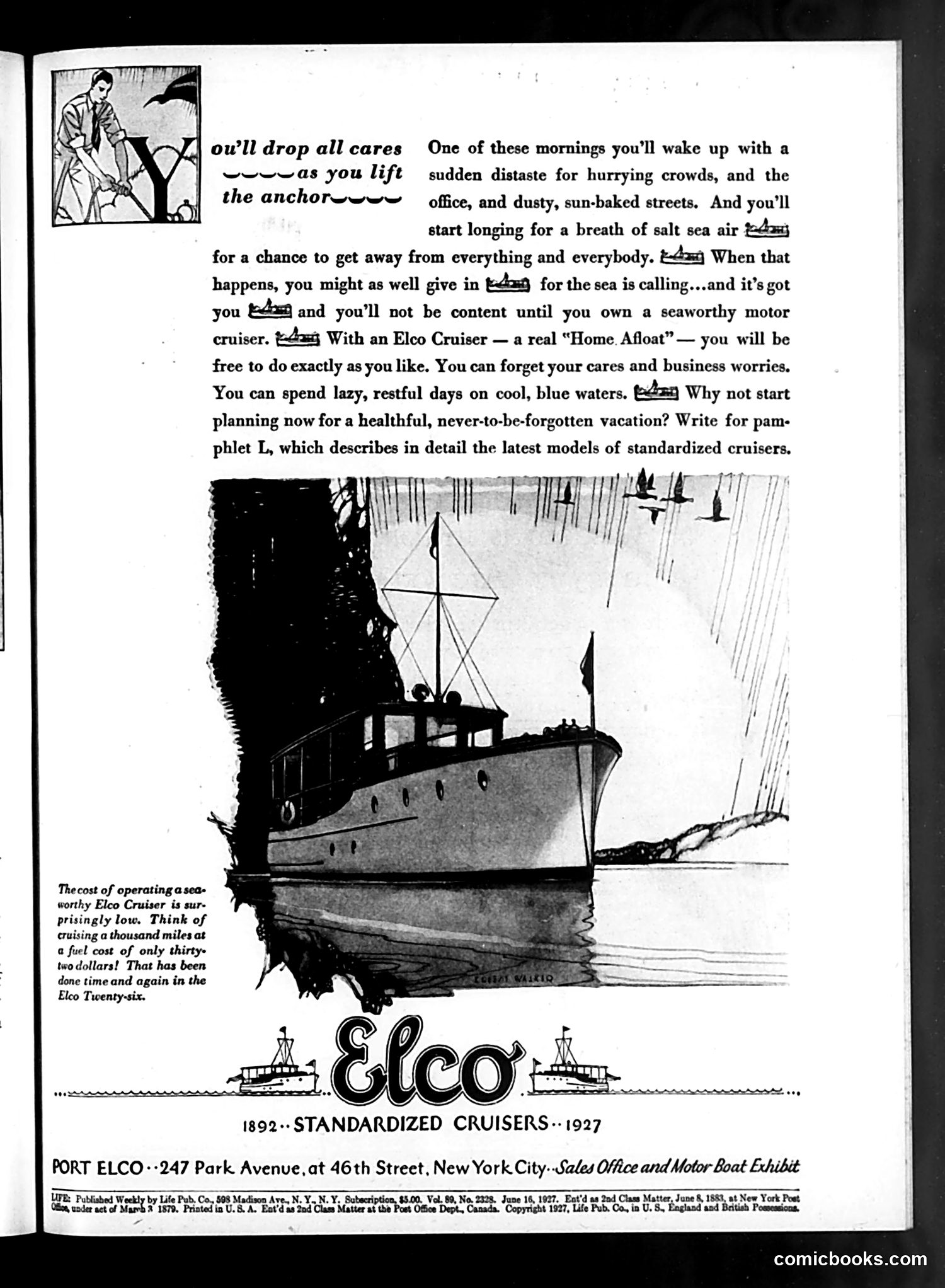
This page is **primarily an advertisement** for Elco motor cruisers, not a political cartoon. The ad uses aspirational marketing targeted at urban professionals. It depicts a man dropping anchor as he "lifts the anchor" of city life—a visual pun. The text promises escape from "hurrying crowds," dusty streets, and office worries through boat ownership. The small illustration at top left shows a businessman releasing his mooring line, symbolizing freedom from work obligations. The large central image showcases an Elco cruiser at anchor, emphasizing its seaworthiness and comfort as a "Home Afloat." The appeal is escapist leisure fantasy marketed to 1920s affluent readers during an era of economic prosperity, promoting recreational boating as the ultimate vacation solution.
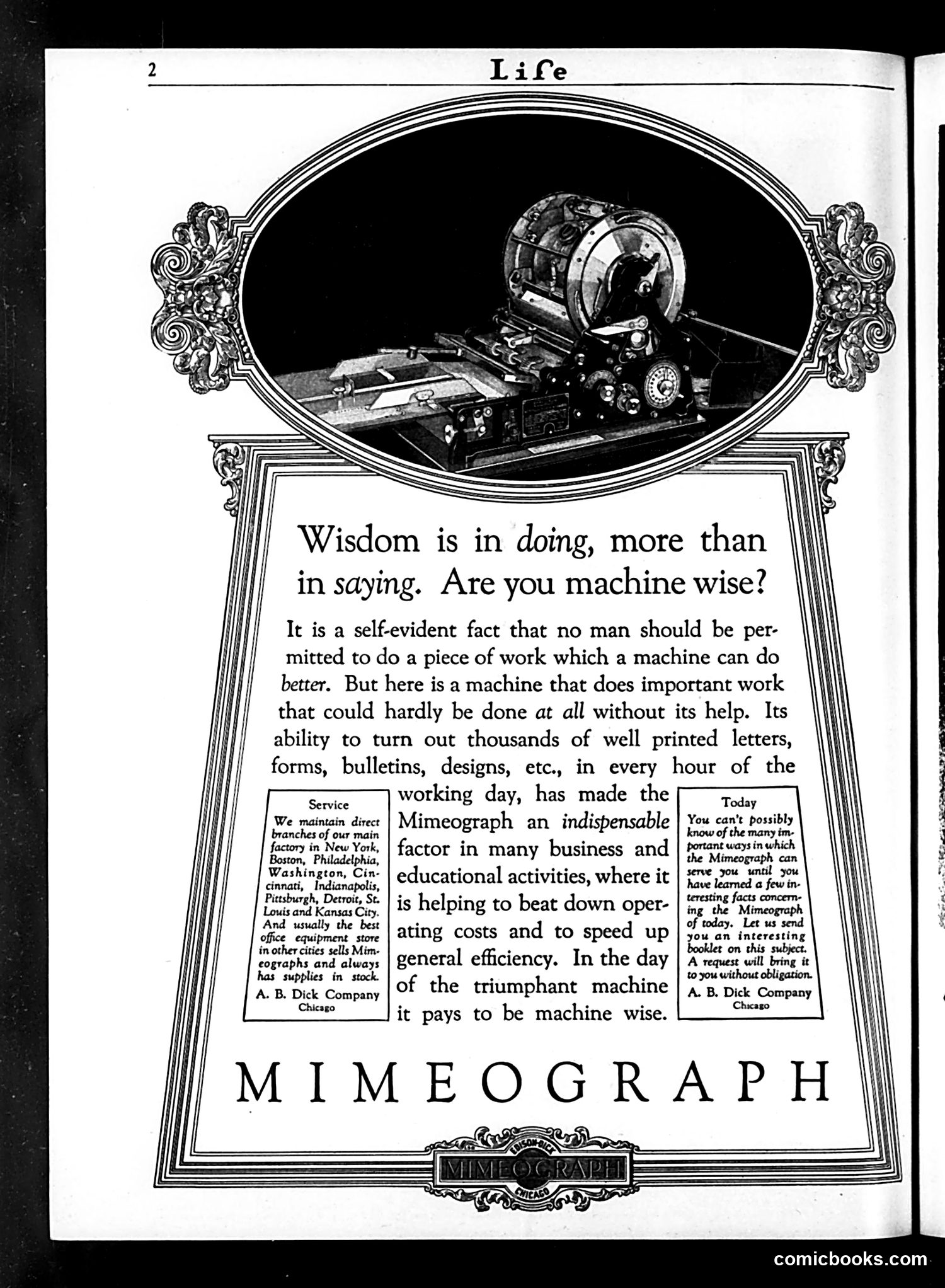
This is a **full-page advertisement**, not satirical content. It promotes the Mimeograph machine, manufactured by A.B. Dick Company of Chicago. The ad argues that "wisdom is in doing, more than in saying" and positions the mimeograph as "machine wise"—essential business equipment. It emphasizes the machine's ability to produce thousands of printed letters, forms, and bulletins daily, thereby reducing operating costs and improving efficiency. The image shows the mimeograph device itself. Two small text boxes provide service information and invite readers to request demonstrations. This represents early-20th-century office technology marketing, targeting businesses and educational institutions. The mimeograph was genuinely revolutionary for reproducing documents before photocopiers existed—making bulk document production affordable for organizations beyond large printing houses.
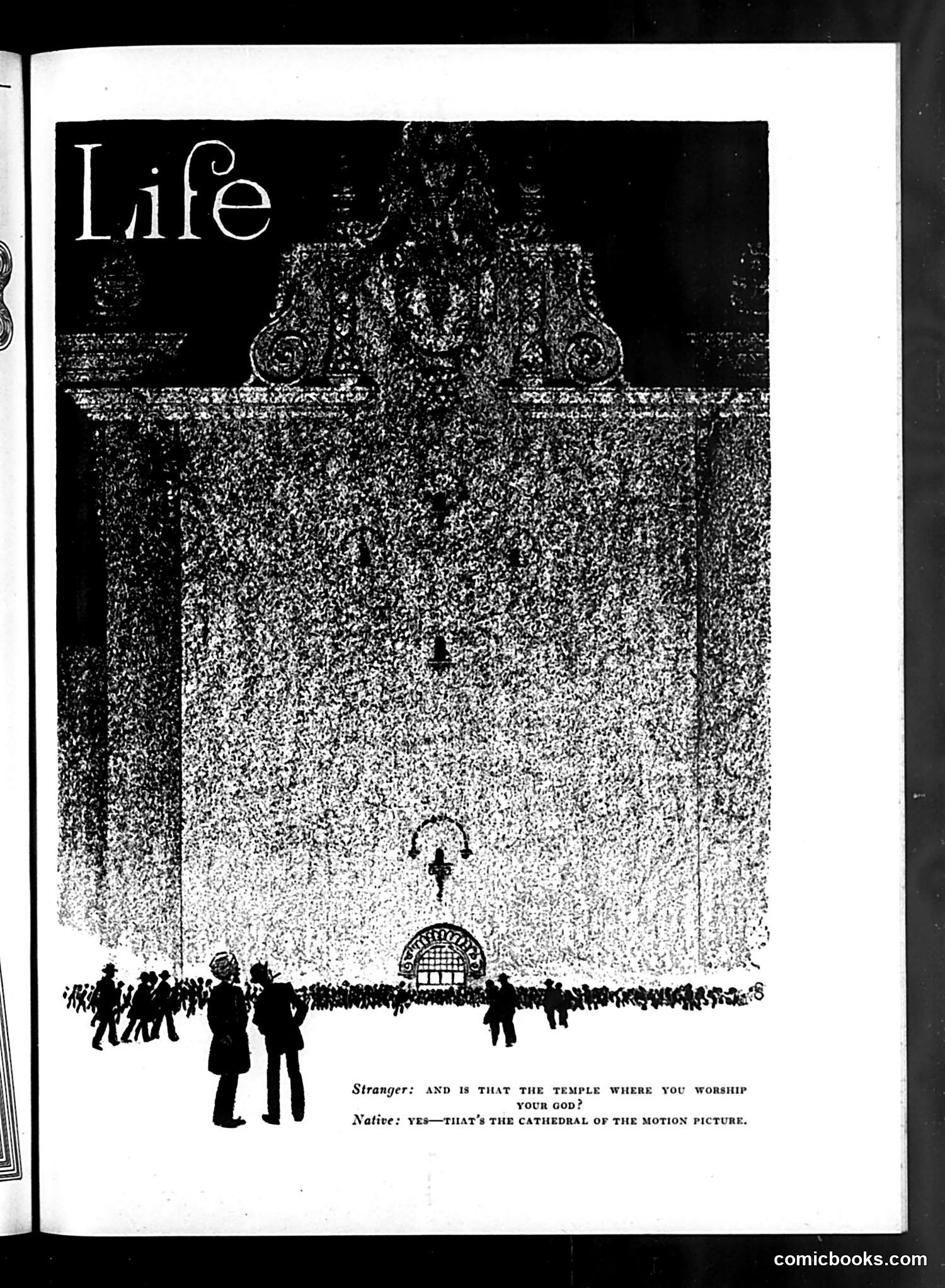
This is a satirical commentary on cinema as a cultural institution. The image shows a massive cathedral-like structure labeled "Life," depicting a movie theater as a religious edifice complete with ornate architecture and crowds of worshippers below. The dialogue exchange is the key: a stranger asks if this is "the temple where you worship your god," and the native replies "yes—that's the cathedral of the motion picture." The satire critiques how American society has elevated cinema to quasi-religious status, treating movies with reverence typically reserved for actual places of worship. The 1920s context suggests concern about film's growing cultural dominance and its potential to replace traditional religious values in society. The towering scale emphasizes how completely motion pictures have captured public devotion.
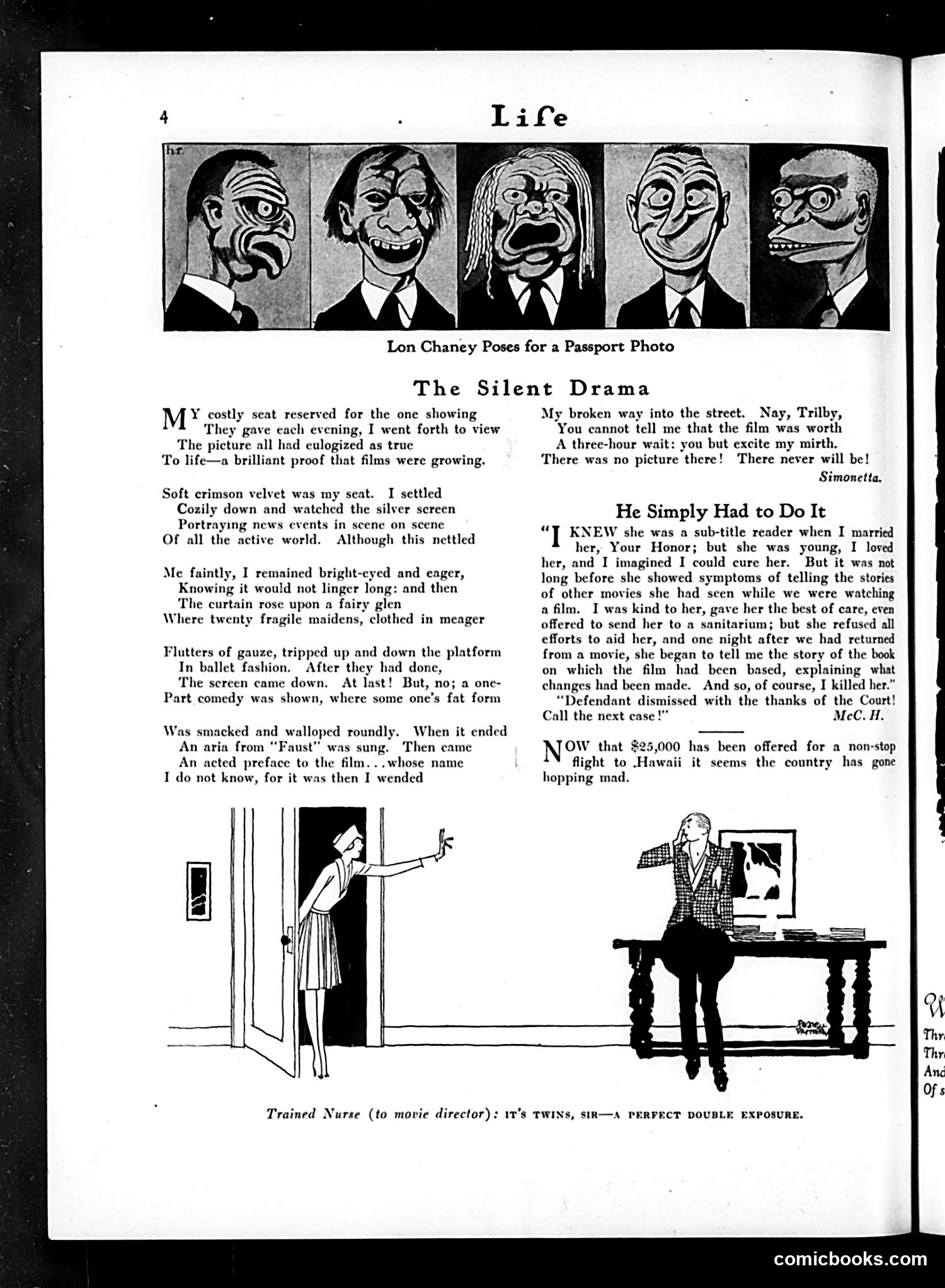
**Top Section:** Five caricatured faces labeled "Lon Chaney Poses for a Passport Photo." Lon Chaney was a famous silent-film actor known for grotesque makeup and character transformations. The joke satirizes his extreme range—these exaggerated expressions suggest that his face-morphing abilities make him suitable material for a passport photo identification, humorously implying his features are so malleable he could impersonate anyone. **Main Content:** Two pieces critique silent cinema: "The Silent Drama" is a poem about attending an overhyped film, and "He Simply Had to Do It" recounts a husband whose film-obsessed wife narrated an entire movie's plot, spoiling it completely. **Bottom Cartoon:** Depicts a nurse-turned-film-director showing twins to a movie director as a "perfect double exposure"—satirizing both Hollywood's technical jargon and the era's casual conflation of real life with cinema.
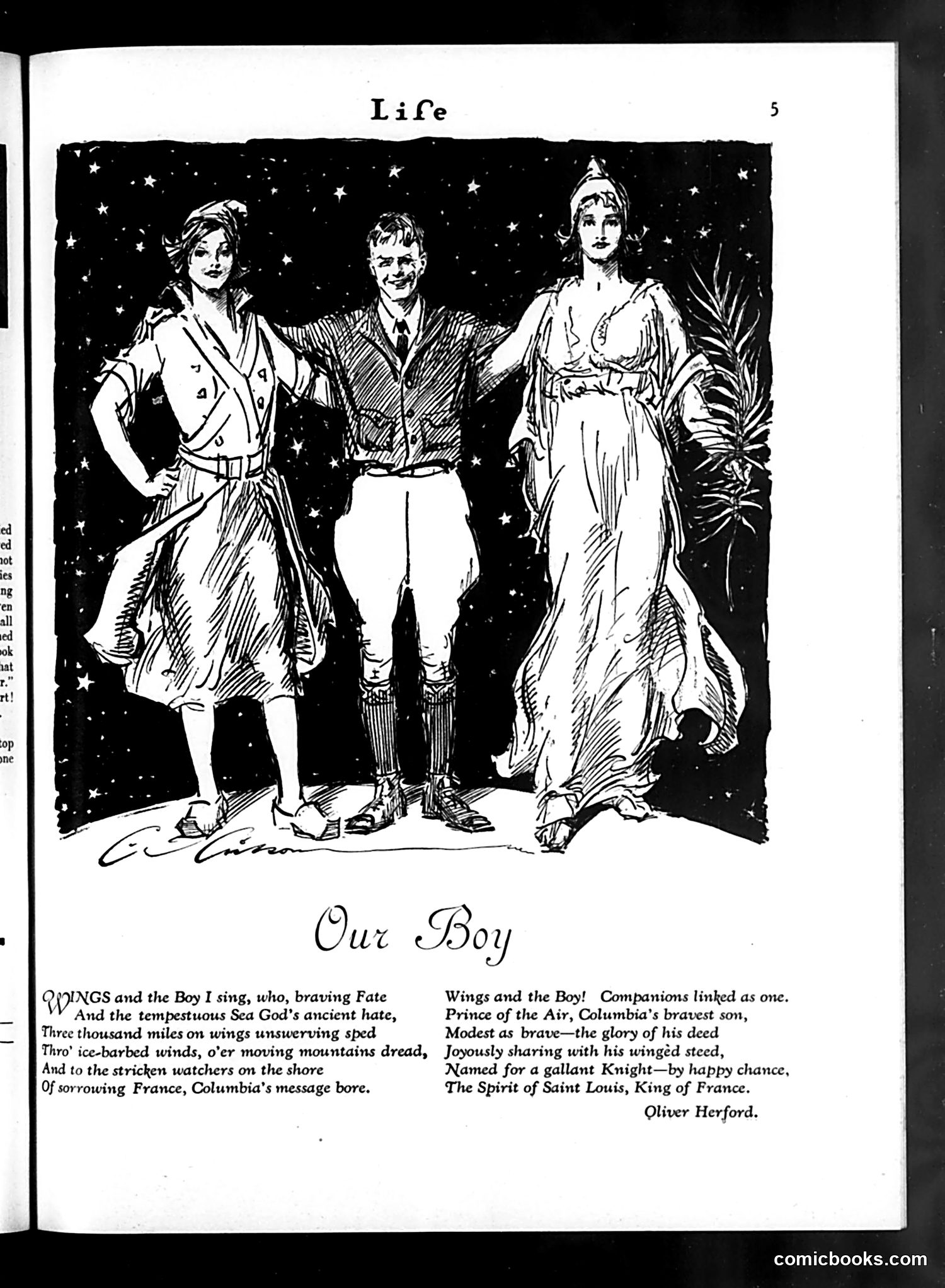
This page celebrates Charles Lindbergh's 1927 transatlantic flight. The illustration shows three figures: two women flanking a man in aviation gear in the center, set against a starry background. The poem by Oliver Herford praises "the Boy"—Columbia's brave son—as "Prince of the Air" and the "Spirit of Saint Louis, King of France." The satire likely mocks the intense public adulation surrounding Lindbergh's achievement. By framing him as royalty and dressing the female figures allegorically (possibly representing different nations or virtues), the cartoonist gently ridicules the hero-worship and romantic idealization that made Lindbergh a celebrity sensation. The tone is affectionate rather than harsh—typical of Life's sophisticated satirical approach to contemporary events.
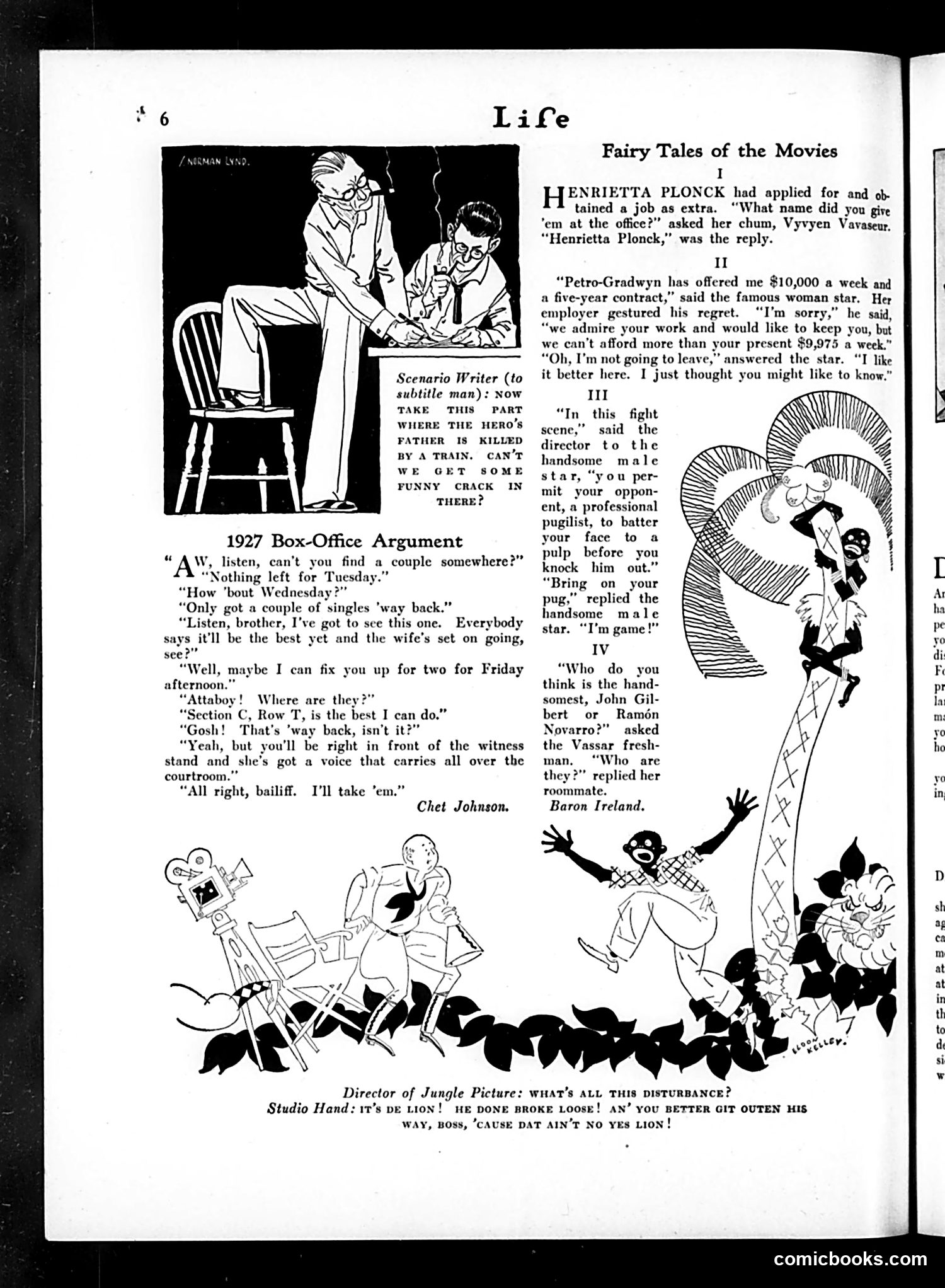
This page satirizes Hollywood's contradictions circa 1927. The top cartoon shows a "1927 Box-Office Argument" where studio executives negotiate casting and scheduling with typical studio logic—moving performers around like chess pieces to maximize profit. The subsequent numbered sections mock film industry absurdities: Henrietta Plonck's mundane name contrasts with Hollywood's invented personas; Petro-Gradwyn's salary disputes reveal studio cost-cutting despite star status; directors' demands for physical violence in fight scenes; and casting debates about unknown actors. The bottom cartoon depicts chaos on a jungle picture set, with the director demanding mayhem while the studio hand (assistant) warns that a loose lion has escaped—illustrating the gap between cinematic fantasy and on-set reality. The satire mocks both studio pretension and chaotic filmmaking practices of the silent era.
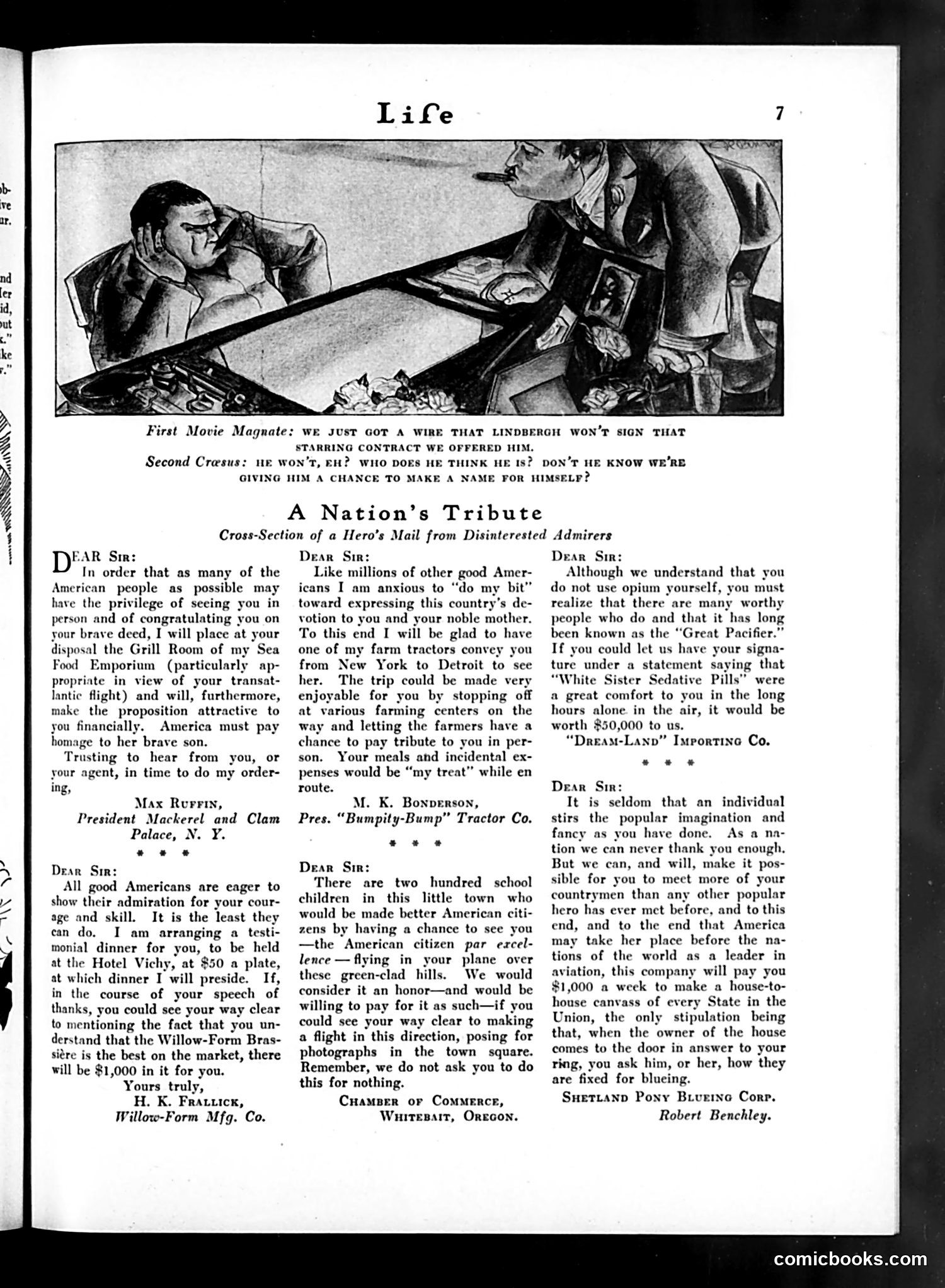
The cartoon at the top depicts a "First Movie Magnate" and "Second Crewus" (likely "Circus") discussing Charles Lindbergh. The magnate has secured a wire stating Lindbergh won't sign a starring contract they offered. The second figure questions why they're not giving Lindbergh "a chance to make a name for himself"—satirizing how both the film industry and circus were desperately competing to capitalize on Lindbergh's fame following his 1927 transatlantic flight. Below, "A Nation's Tribute" presents humorous letters from Americans offering Lindbergh various tributes: farm tractors, dinners, school visits, and even a house-to-house canvass. The satire mocks the nation's obsessive hero-worship and commercial exploitation of Lindbergh's celebrity.
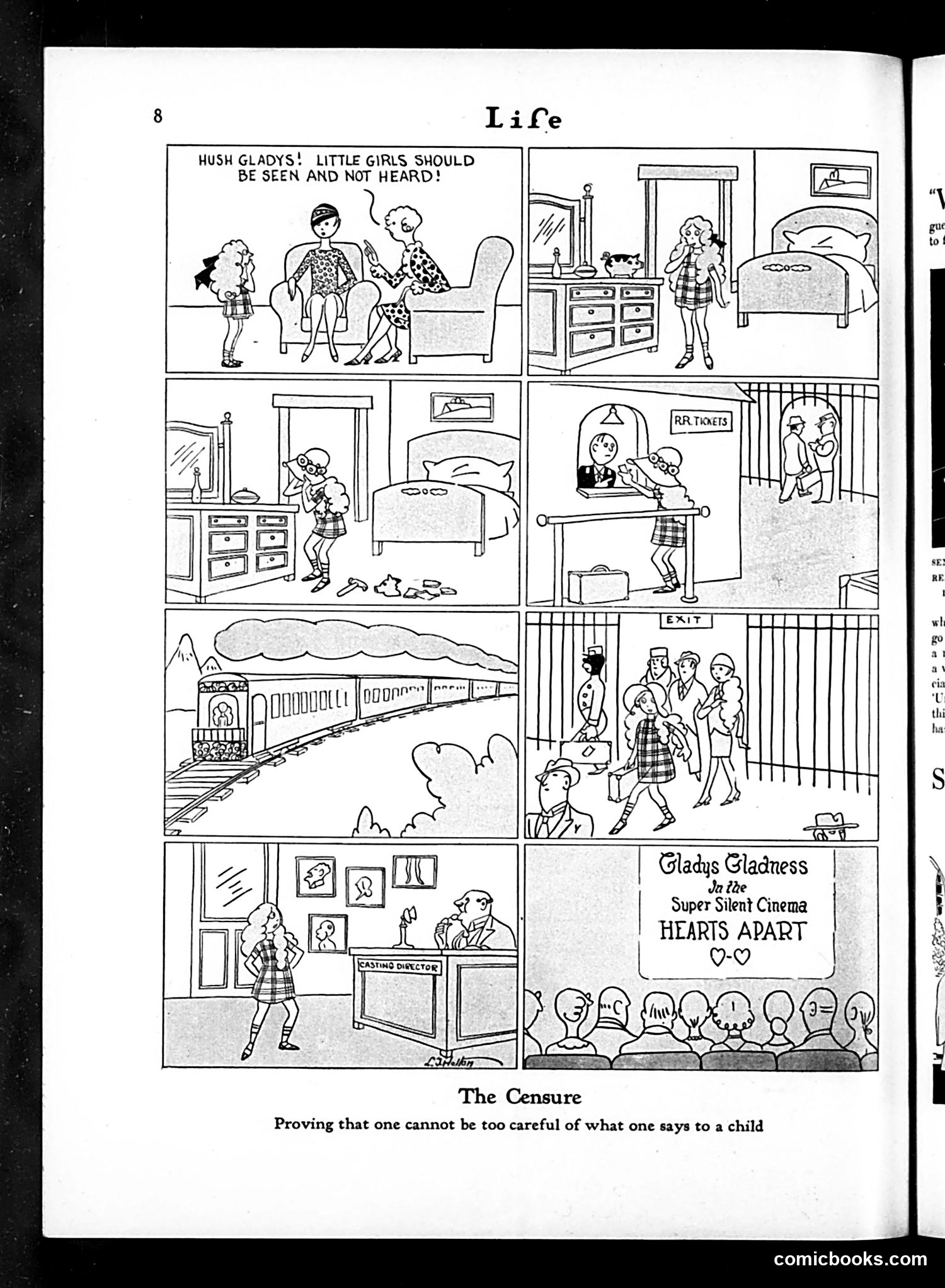
This multi-panel comic satirizes the common parental warning "children should be seen and not heard." The opening caption shows an adult scolding a girl for being loud, establishing the premise. The subsequent panels follow the girl through increasingly elaborate fantasies: imagining herself in fancy bedrooms, traveling by train, attending a movie premiere, and finally being cast in a film. The final panel shows her daydreaming in a casting director's office while a silent film titled "Hearts Apart" plays behind her. The subtitle, "Proving that one cannot be too careful of what one says to a child," suggests the irony: silencing children backfires—instead of obedience, it breeds wild imaginative escapism and unrealistic ambitions. The satire critiques overly restrictive parenting as counterproductive.
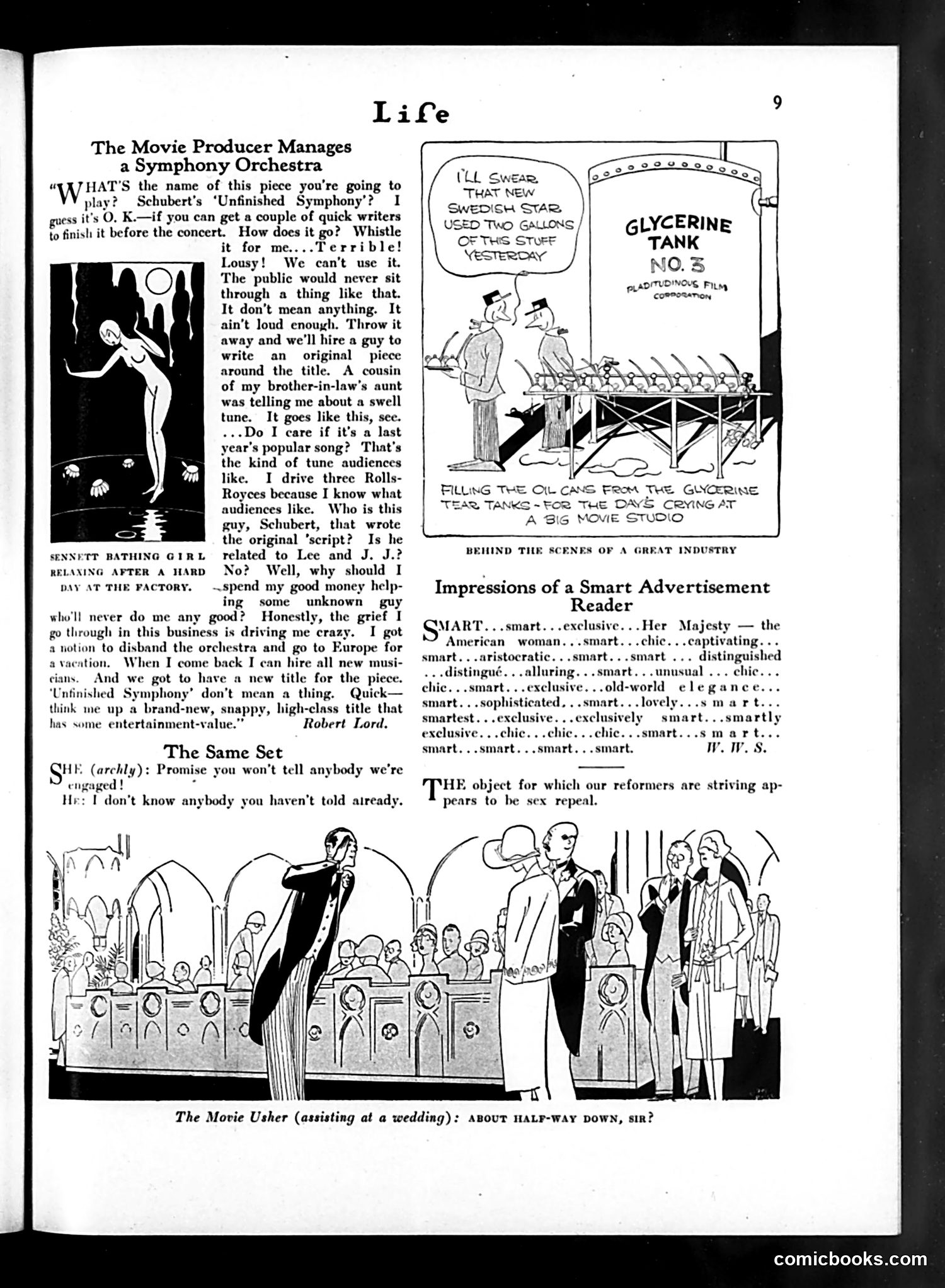
This page contains three unrelated humorous pieces: 1. **"The Movie Producer Manages a Symphony Orchestra"**: A producer complains that Schubert's "Unfinished Symphony" is too obscure and uncommercial. He proposes discarding the original composition and hiring someone to write a catchy, recognizable title instead—mocking Hollywood's tendency to prioritize entertainment value and marketing over artistic merit. 2. **"Behind the Scenes of a Great Industry"**: A cartoon showing film crew members filling oil cans from glycerine tanks for a crying scene—satirizing the artificial, manufactured nature of movie emotions and special effects. 3. **"The Same Set"** and **"Impressions of a Smart Advertisement"**: Brief satirical pieces about wedding scenes and consumer marketing language respectively. The overall theme critiques Hollywood's commercialism and superficiality.
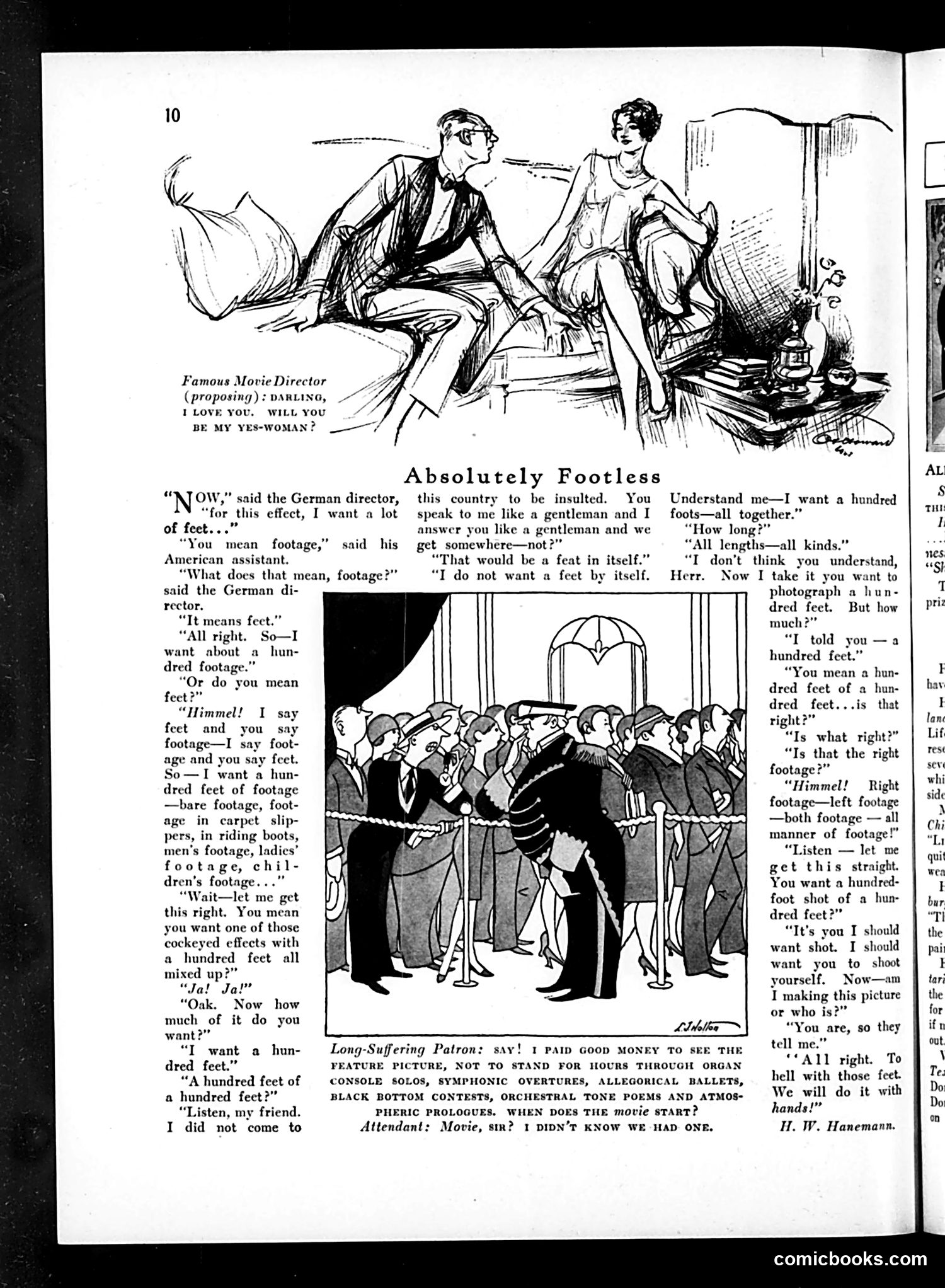
This satirical piece mocks the absurd demands of a famous German film director working in America. The joke pivots on a language/cultural misunderstanding: the director wants "a hundred feet" of film footage, but his American assistant interprets "feet" literally—as human feet to photograph. What follows is escalating confusion as the director tries to clarify he means film length (measured in feet), while the assistant keeps proposing ridiculous literal interpretations: mixed footage of men, women, and children's actual feet; feet in carpet slippers and riding boots. The satire targets both the imperious European director stereotype and American literalism. The cartoon's humor relies on early cinema terminology being unfamiliar enough to permit this wordplay joke about transatlantic miscommunication.
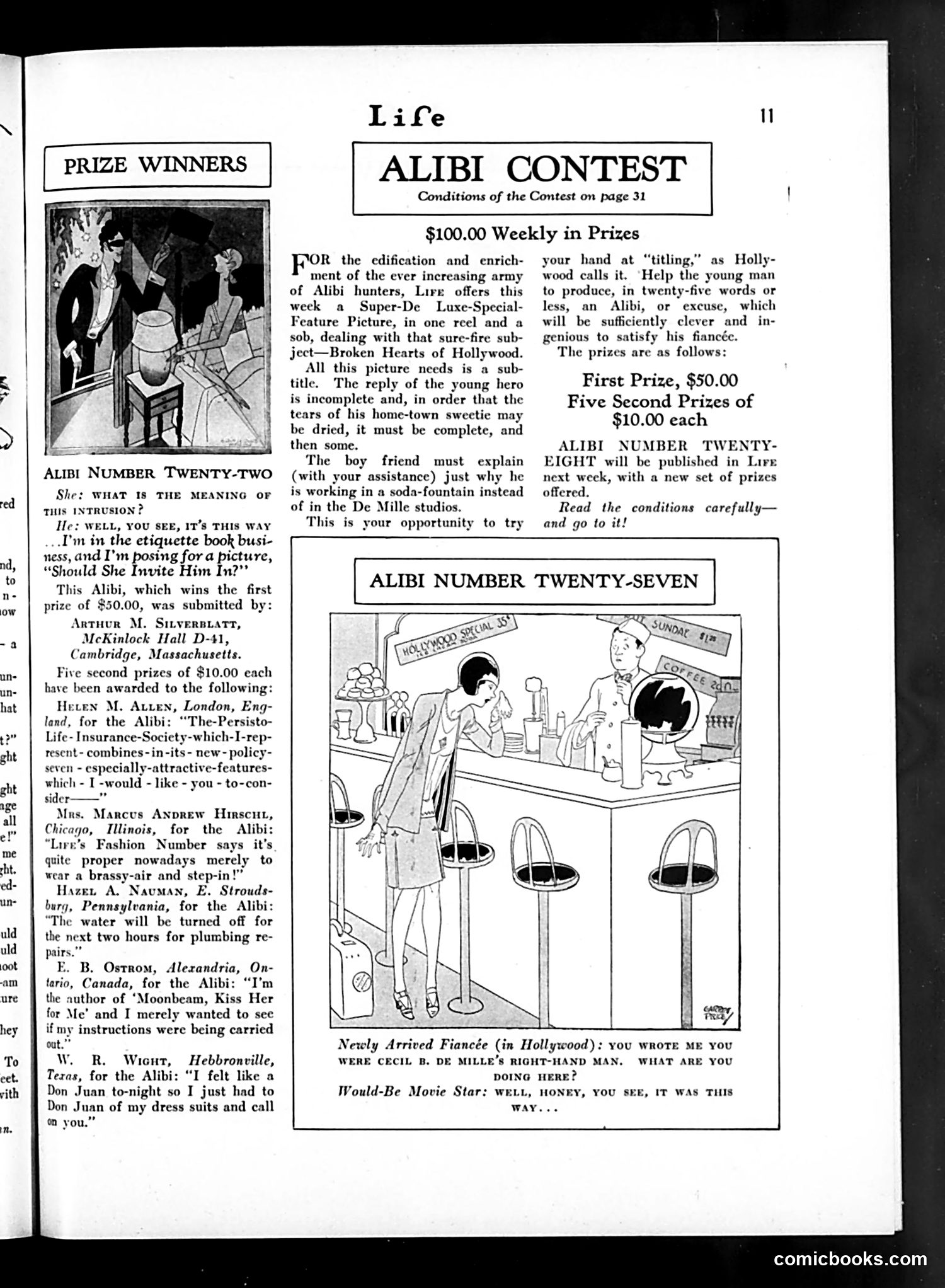
This page features Life magazine's weekly "Alibi Contest"—a humor competition where readers submit creative excuses. The featured cartoon (Alibi #27) depicts a scene at what appears to be a soda fountain or diner counter. A woman's fiancé has arrived unexpectedly, and she must explain her presence there to Cecil B. DeMille's "right-hand man." The humor lies in the absurd explanation she's concocting on the spot. The contest invites readers to complete the narrative: explain why the "newly arrived fiancée" is working at this establishment instead of where she claimed to be. Readers could win $50 for the best answer. This reflects 1920s-era humor conventions where elaborate, implausible excuses were treated as entertainment.
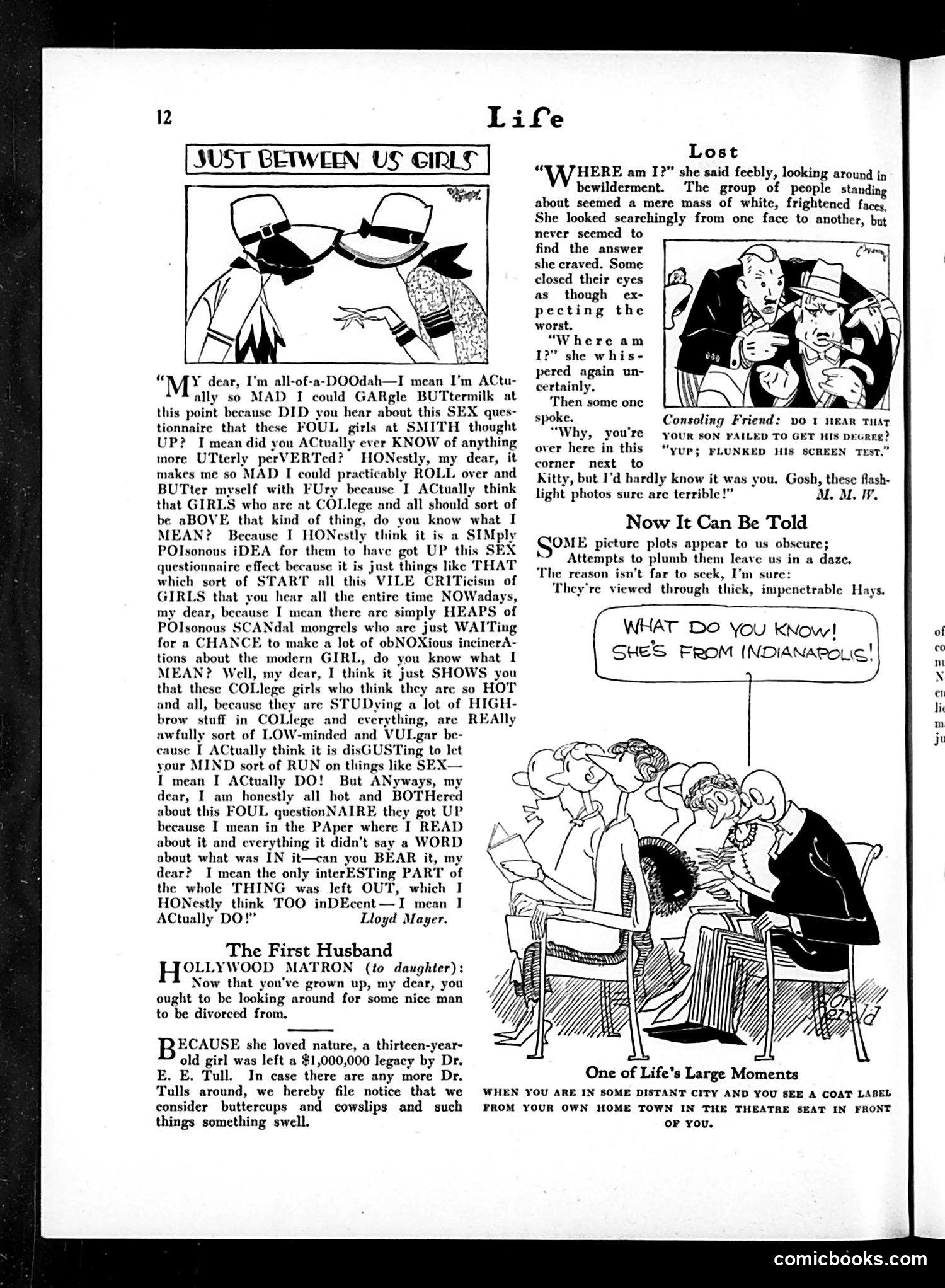
This page contains three distinct pieces of satirical content: 1. **"Just Between Us Girls"** — A lengthy letter (attributed to Lloyd Meyer) mocking college women who completed a sex questionnaire. The writer sarcastically criticizes their behavior as crude and hypocritical, suggesting educated women shouldn't discuss such "vulgar" topics. 2. **"Lost"** — A cartoon showing a bewildered woman surrounded by people at what appears to be a social gathering. A companion reassures her about a man from Indianapolis, with the caption playing on the awkwardness of forgotten social connections. 3. **"The First Husband"** and **"One of Life's Large Moments"** — Brief humorous observations about marriage and social recognition, reflecting early 20th-century anxieties about courtship and status. The overall tone targets women's changing social behavior and education during this period.
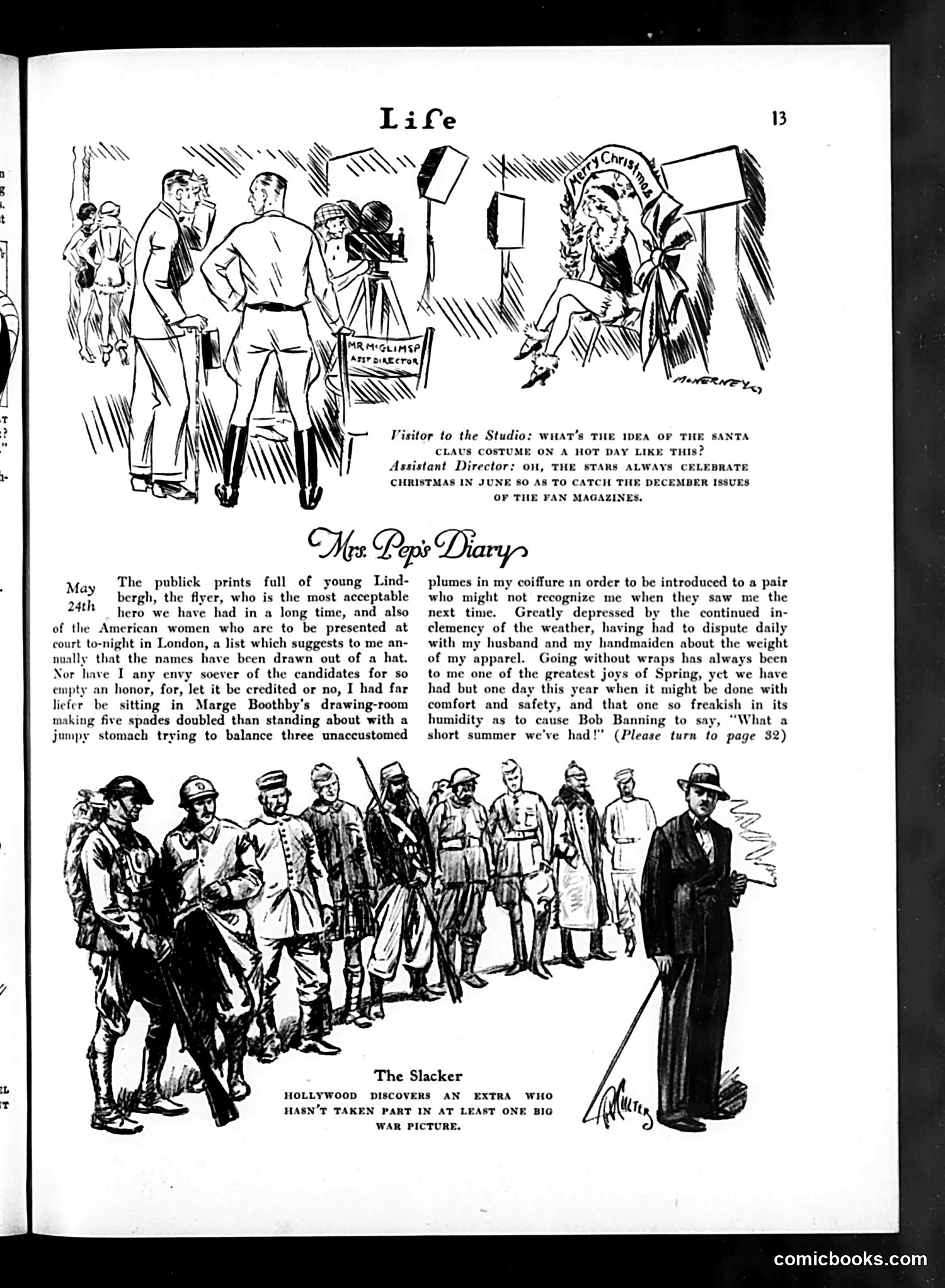
This page contains two satirical cartoons about Hollywood filmmaking during what appears to be WWI era. The **top cartoon** mocks a film studio's decision to film a Christmas scene in June wearing Santa costumes on a hot day—purely to catch the December magazine issues' attention. It satirizes Hollywood's desperation for publicity and the absurdity of seasonal content timing. The **bottom cartoon**, titled "The Slacker," depicts a man in civilian dress standing apart from a group of soldiers. The caption indicates Hollywood discovered an "extra" who hasn't participated in "at least one big war picture." This mocks both actors' eagerness to appear in military films and Hollywood's obsession with war-themed productions during the WWI period. Both cartoons critique Hollywood's commercialism and opportunism.
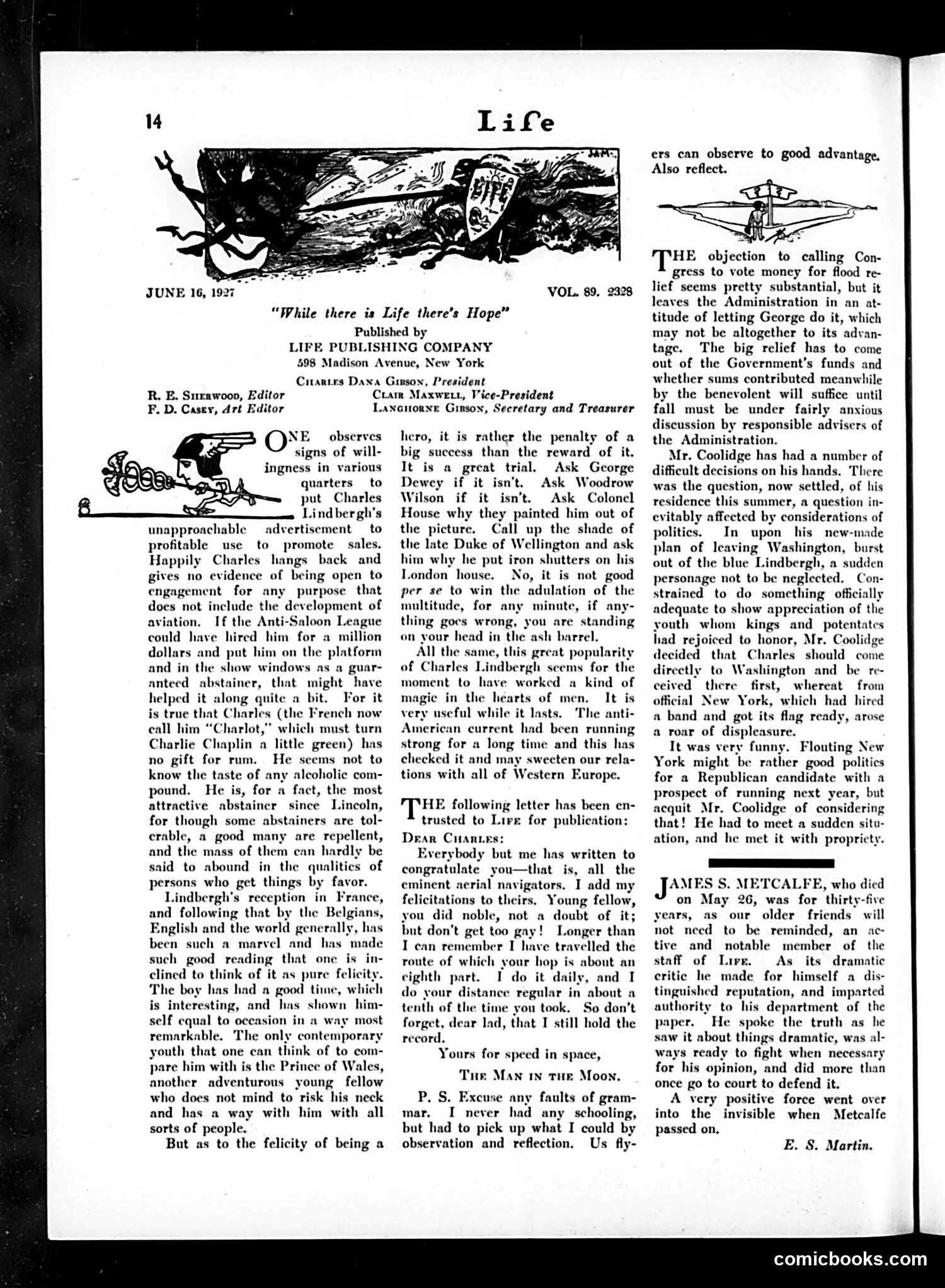
The masthead cartoon depicts a figure labeled "LIFE" emerging from what appears to be a barrel or container, with the caption "While there is Life there's Hope." The accompanying article critiques Charles Lindbergh's popularity and the commercialization following his transatlantic flight success. The text satirizes how various interests—from the Anti-Saloon League to advertisers—attempted to exploit Lindbergh's fame for their own agendas. The satire targets the American tendency to capitalize on celebrity and the pressure placed on famous figures to endorse causes. It also humorously notes Lindbergh's appeal transcends political divisions, comparing him favorably to historical figures like Lincoln and the Prince of Wales. The piece gently mocks both Lindbergh's handlers and the public's eagerness to claim him as representative of their various interests.
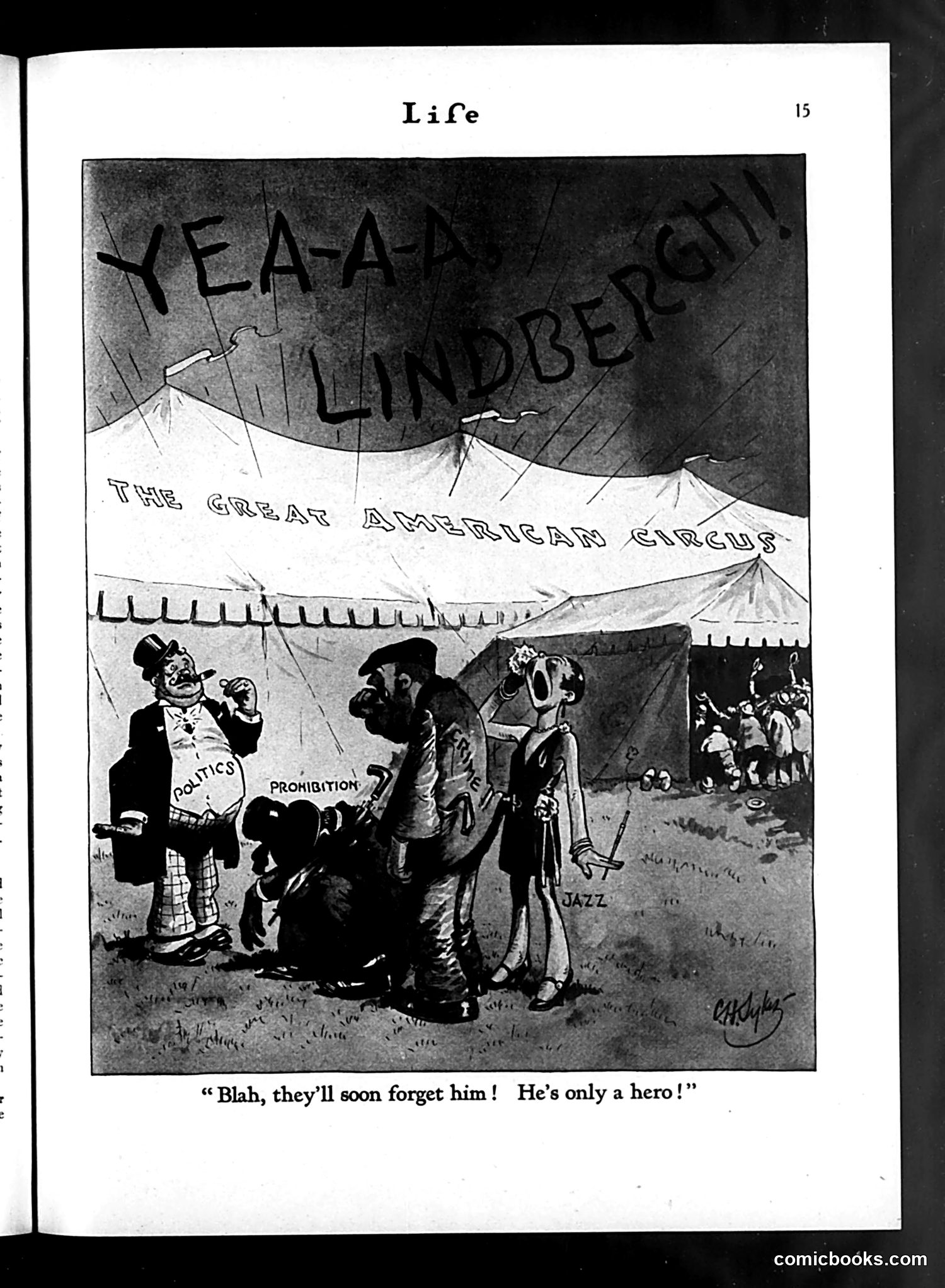
This Life magazine cartoon satirizes American attitudes toward war heroes and social issues in the 1920s. Under a circus tent labeled "The Great American Circus," three figures representing contemporary social concerns—**Politics**, **Prohibition**, and **Jazz**—discuss a war hero (likely from WWI, given the Lindbergh reference visible at top). The caption reads: "Blah, they'll soon forget him! He's only a hero!" The satire suggests that despite celebrating military heroes, American society quickly moves past them, distracted by trivial entertainments and social debates. The circus setting emphasizes how these political/social preoccupations are treated as spectacle rather than serious matters. It's a cynical commentary on public memory and misplaced priorities in post-war America.
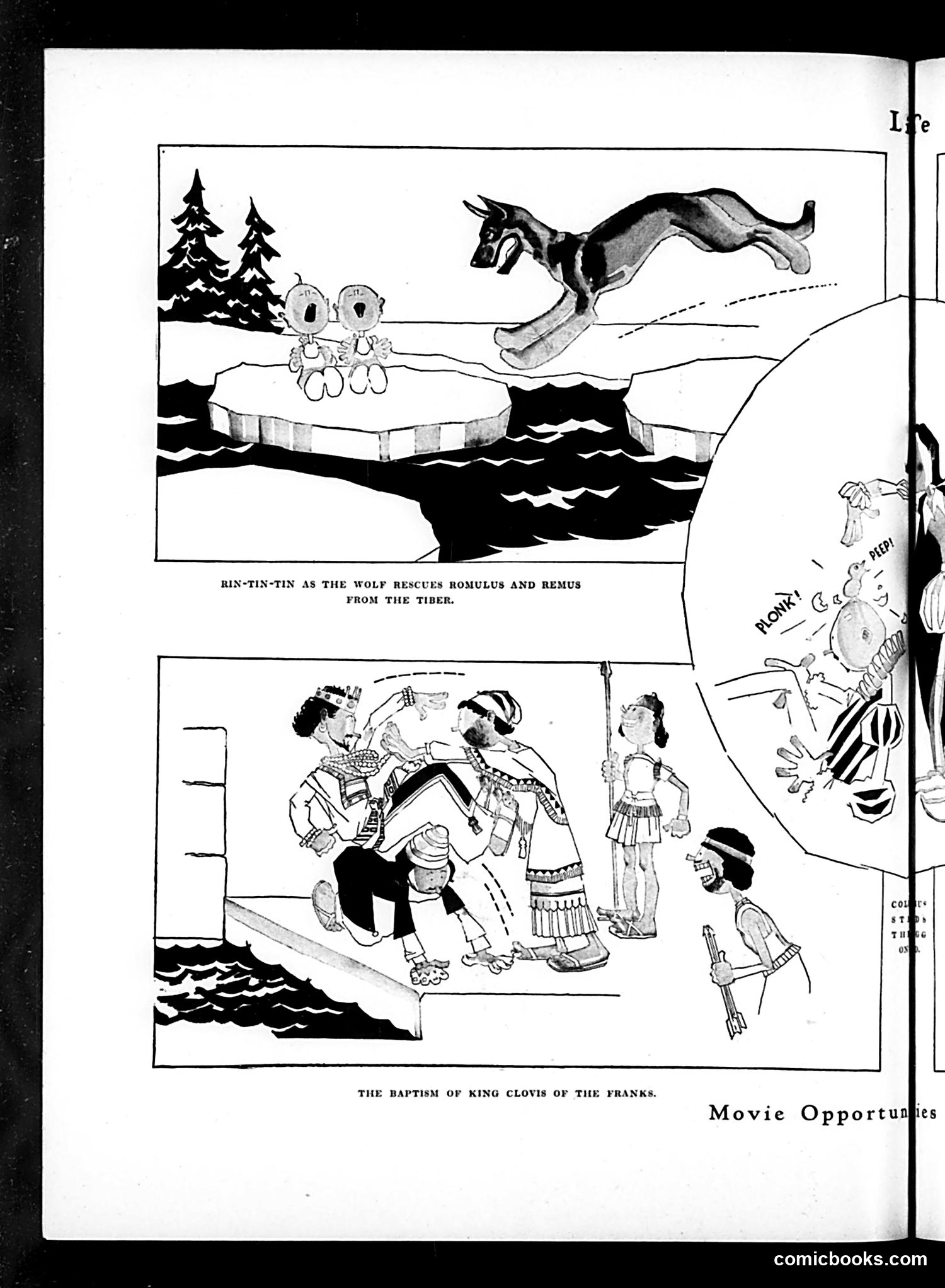
This page shows two historical cartoon panels under the heading "Movie Opportunities." **Top panel:** Shows Rin-Tin-Tin (a famous dog star of silent films) rescuing two infant figures labeled Romulus and Remus from a tiger. This references the Roman foundation myth where a she-wolf (not a tiger) rescued the twins who founded Rome. **Bottom panel:** Depicts "The Baptism of King Clovis of the Franks," a medieval historical event, rendered as a chaotic scene with multiple figures in period costume. Both panels appear to propose historical or mythological scenarios as potential film subjects, satirizing Hollywood's appetite for dramatizing classical history and legend. The joke suggests these famous historical moments could be reimagined as movie plots, likely mocking contemporary filmmaking trends or Rin-Tin-Tin's popularity in cinema.
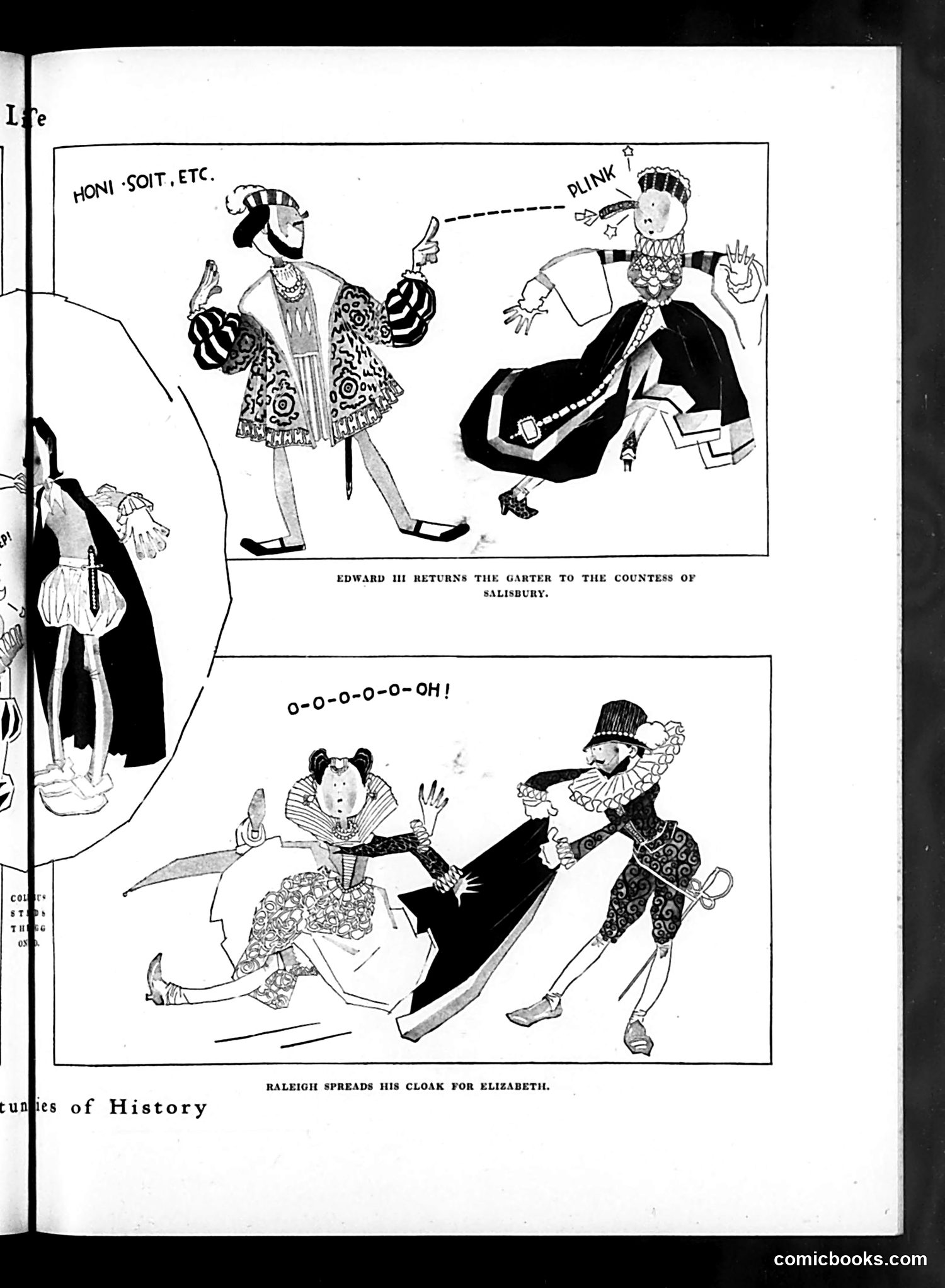
This page contains two historical cartoon panels depicting figures from Tudor England: **Top panel:** "Edward III Returns the Garter to the Countess of Salisbury." Shows a man in elaborate period dress saying "HONI SOIT, ETC." (the Order of the Garter's motto) to a woman, with "PLINK" and "BLINK" sound effects suggesting magical or fantastical elements. **Bottom panel:** "Raleigh Spreads His Cloak for Elizabeth." Depicts the famous legend of Sir Walter Raleigh laying his cloak before Queen Elizabeth I, with the woman exclaiming "O-O-O-O-OH!" Both panels humorously exaggerate the gallant, courtly behavior of these historical figures through caricature and comedic sound effects, treating well-known historical anecdotes with satirical humor typical of *Life* magazine's style.
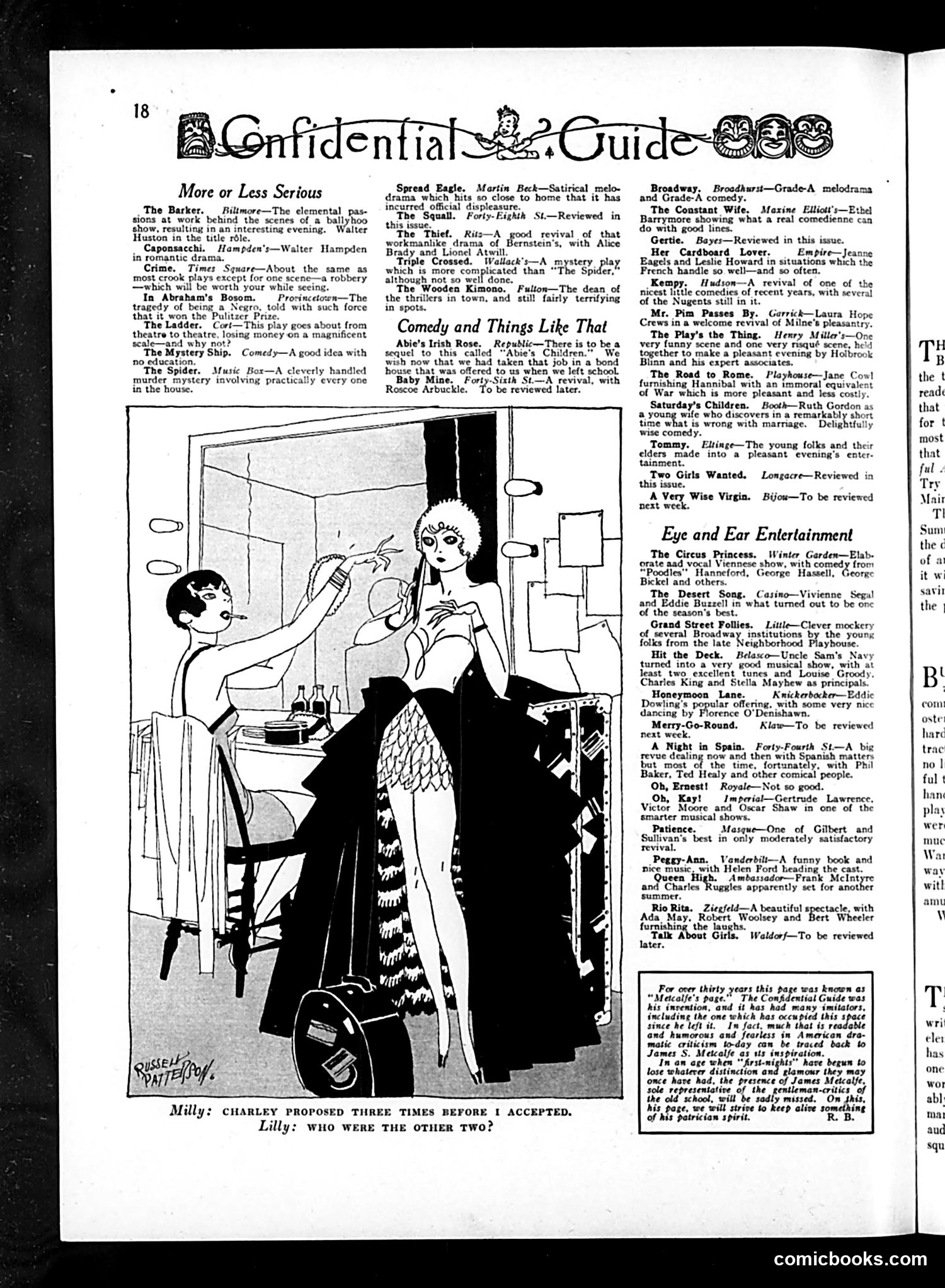
This is a theater review section from Life magazine, listing Broadway shows and entertainments. The cartoon depicts a flirtation or romantic moment between two people in what appears to be a dressing room or backstage setting. The caption joke reads: "Milly: Charley proposed three times before I accepted. Lilly: Who were the other two?" This is a play on the assumption that a woman would have multiple male suitors proposing to her—a dated social scenario where men initiated proposals and women had their pick of eager admirers. The reviews themselves catalog 1920s Broadway offerings: dramatic productions (like *In Abraham's Bosom*, which won the Pulitzer Prize), comedies, musicals, and vaudeville shows. Notably, *Spread Eagle* is called out for being so satirically pointed about American politics that it "incurred official displeasure"—suggesting wariness of government response to theatrical criticism. The tone reflects Entertainment-page coverage of a thriving theater district before film dominated popular culture.
This is a theater criticism piece analyzing three modestly successful Broadway plays from the 1926-27 season: "Two Girls Wanted," "The Squall," and "Gertie." The author argues these plays succeeded despite receiving no critical acclaim, simply through word-of-mouth and cut-rate ticket agencies. The piece identifies actress Nydia Westman's distinctive physical comedy (her "squeak and pigeon-toed walk") as key to "Two Girls Wanted"'s success, contrasting it with Mary Phillips' more sophisticated acting that audiences undervalued. Notably, the author observes that the season's most commercially successful comedy was also its cleanest—a pointed commentary on 1920s theater's reputation for moral permissiveness. The review notes these plays made little money but "kept going," suggesting persistent popular appeal despite critical indifference. The tone is analytical yet slightly dismissive of mass audiences' tastes versus critical standards.
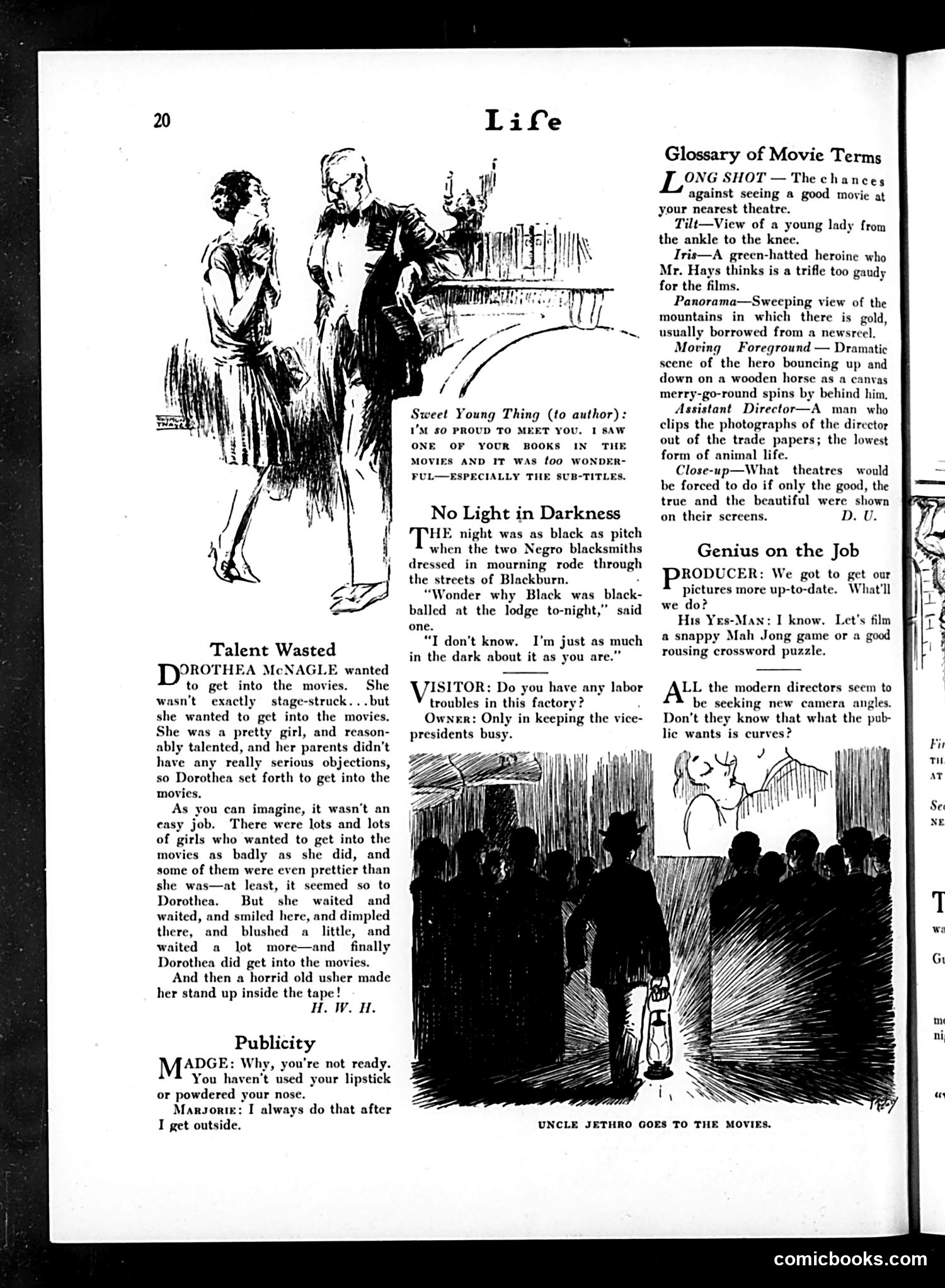
This page mocks early 1920s Hollywood through several interconnected jokes about the film industry's absurdities. **"Talent Wasted"** satirizes the difficulty of breaking into movies—Dorothea finally achieves her dream only to be made an usher, suggesting the industry's waste of aspiring talent. **"No Light in Darkness"** is a pun-based joke about two Black characters named "Black" discussing being "blackballed" from a lodge while riding through "Blackburn"—wordplay that trivializes exclusion. **The "Glossary of Movie Terms"** mocks Hollywood's pretentious terminology and censorship (referencing Will Hays' film morality standards). It ridicules both the industry's artistic pretensions and its focus on female bodies ("Tilt"). **"Genius on the Job"** satirizes producers' obsession with topical trends (Mah Jong, crossword puzzles) over genuine cinematic innovation—the "yes-man" sycophant exemplifies studio hierarchy. **"Publicity"** jokes about actresses' performative preparation for public appearance. Overall: satire of Hollywood's superficiality, censorship, commercialism, and hierarchical exploitation of performers.
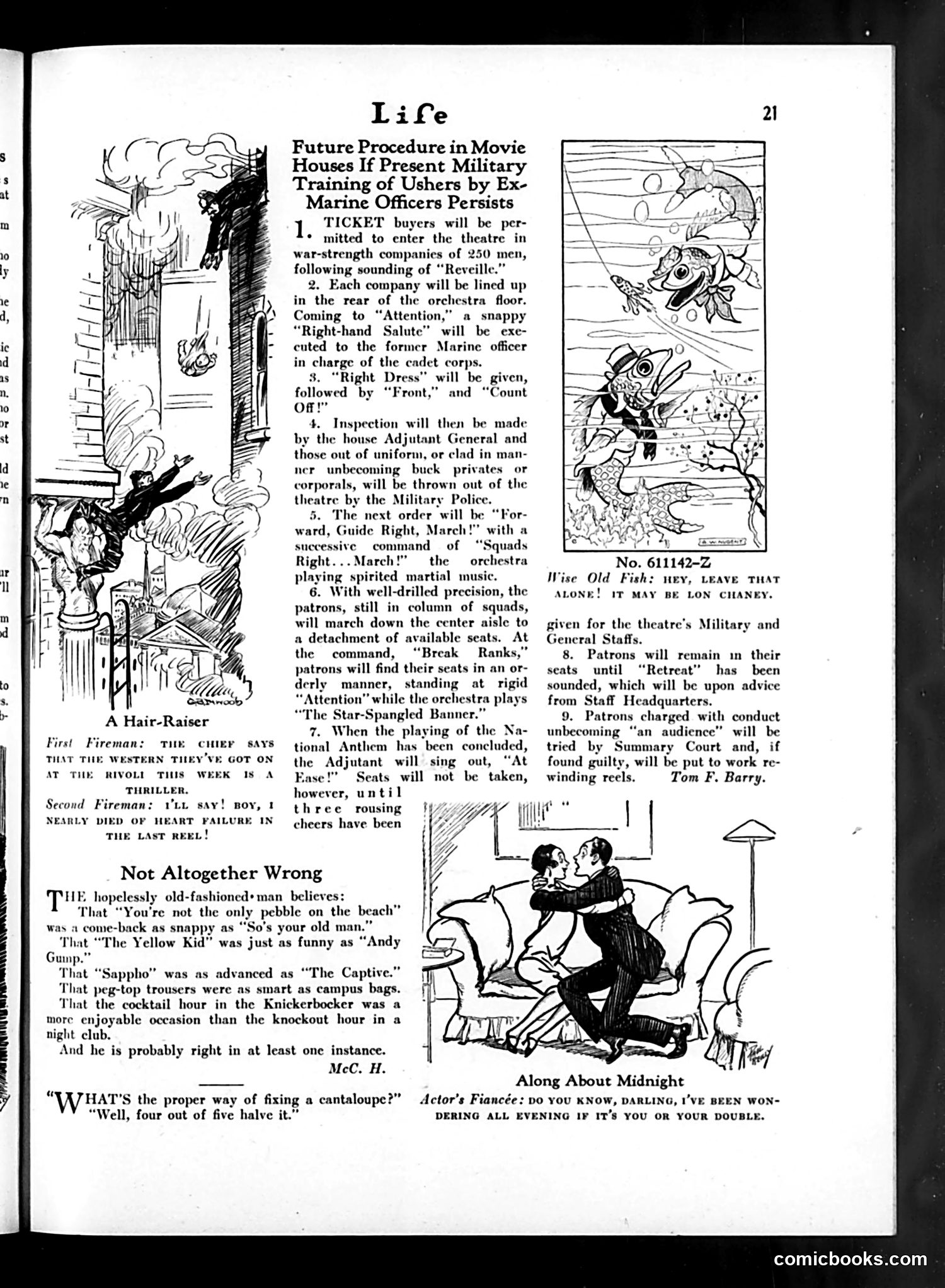
This satirical page mocks the militarization of American movie theaters, apparently a real trend where ex-Marine officers were training theater ushers. **Main cartoon**: The elaborate "Future Procedure" is a deadpan nine-point military protocol for moviegoers—entering in "war-strength companies," standing at attention, saluting former Marine officers, marching to seats in formation, standing through the National Anthem. The joke is absurdist escalation: ordinary theater attendance treated with full military rigor. This satirizes the visible military influence on civilian life, likely referencing post-WWI military culture seeping into everyday institutions. **Secondary content**: - "Hair-Raiser" jokes about a Western film's thrilling climax - "Not Altogether Wrong" nostalgically compares old entertainment (Yellow Kid, Sappho) to modern equivalents, suggesting nothing improves - "Along About Midnight" features a romantic couple joke about duality The cartoons are unsigned except Tom F. Barry credited for the main piece. The satire targets how thoroughly militarism had infiltrated civilian spaces.
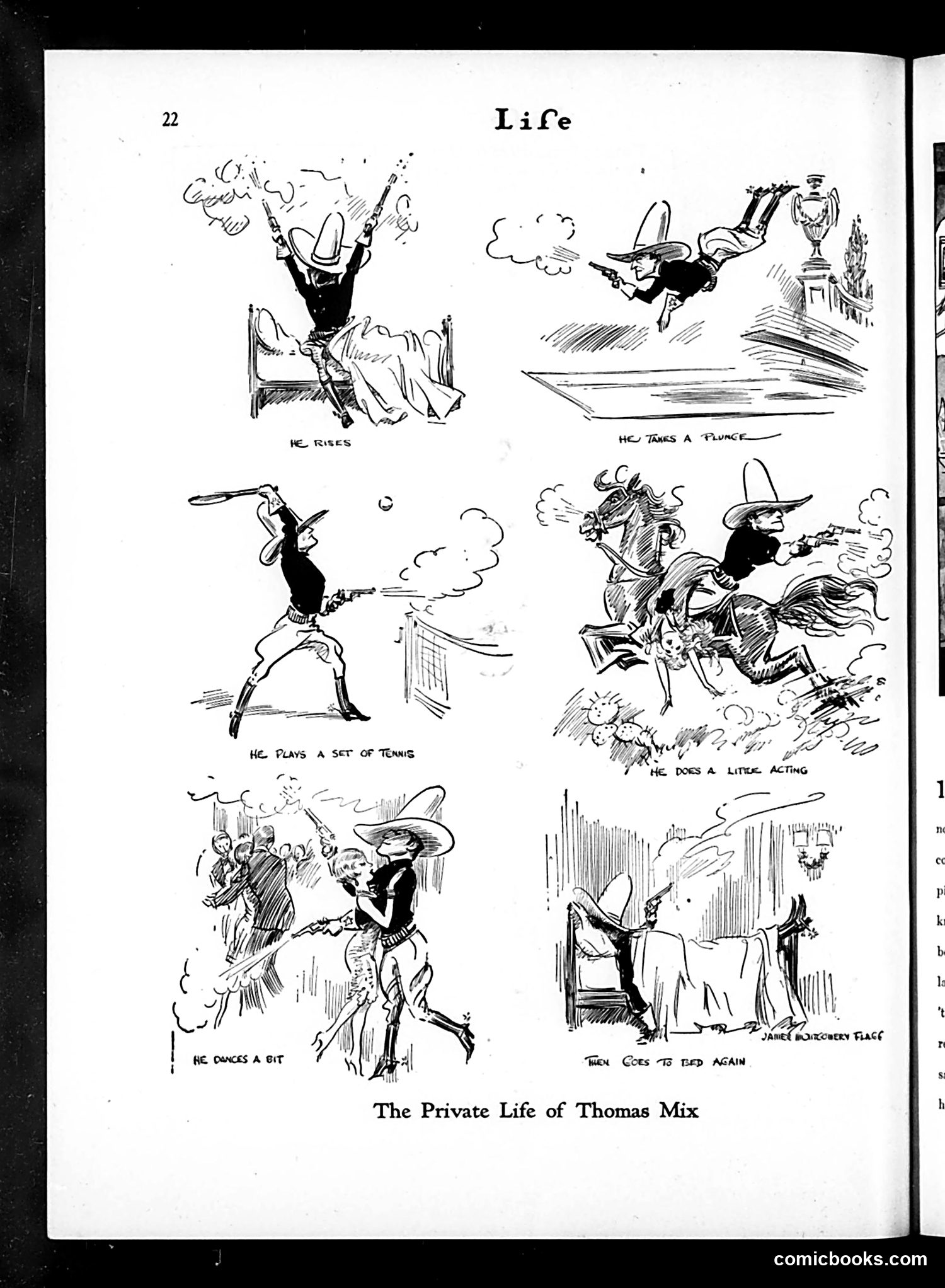
This satirical comic strip mocks Tom Mix, a famous silent-film cowboy star known for action-packed westerns. The six panels humorously contrast his on-screen heroic persona with exaggerated "private" activities: he rises energetically in bed, takes a theatrical plunge, plays tennis, performs horse stunts, dances socially, and finally returns to bed. The joke targets the gap between celebrity image and reality—suggesting Mix's real life consists of mundane, vain, or undignified pursuits despite his rugged screen reputation. The title "Private Life" emphasizes this exposure of behind-the-scenes behavior. This type of celebrity mockery was common in Life magazine's satirical humor, deflating Hollywood figures' carefully cultivated public personas through exaggeration and visual comedy.
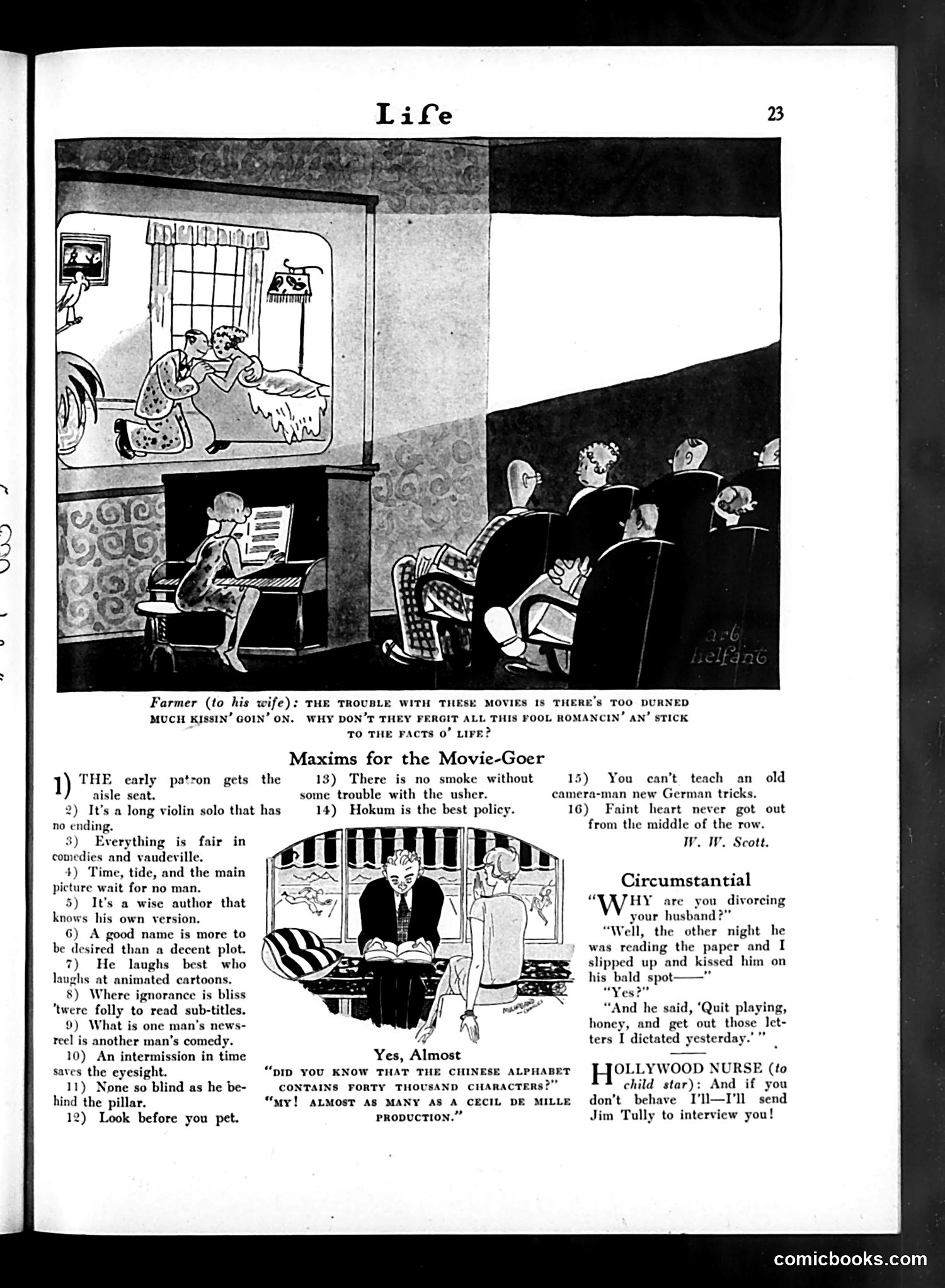
This page mocks early cinema culture and movie-theater etiquette circa the 1920s. The top cartoon shows a farmer complaining to his wife that movies have too much kissing and romance—he wants them to "stick to the facts o' life," a joke on the disconnect between rural values and Hollywood's sentimental output. The "Maxims for the Movie-Goer" list satirizes theater annoyances: long violin solos, poor sight lines, excessive subtitles, and annoying intermissions. A joke about Cecil B. DeMille's lavish productions suggests his films contain as many "characters" (extras/spectacle) as the Chinese alphabet has written characters. Brief jokes mock divorce proceedings and Hollywood's star system, including a reference to Jim Tully, apparently a feared interviewer. The overall tone ridicules both pretentious filmmaking and unsophisticated movie patrons' complaints about cinema conventions.
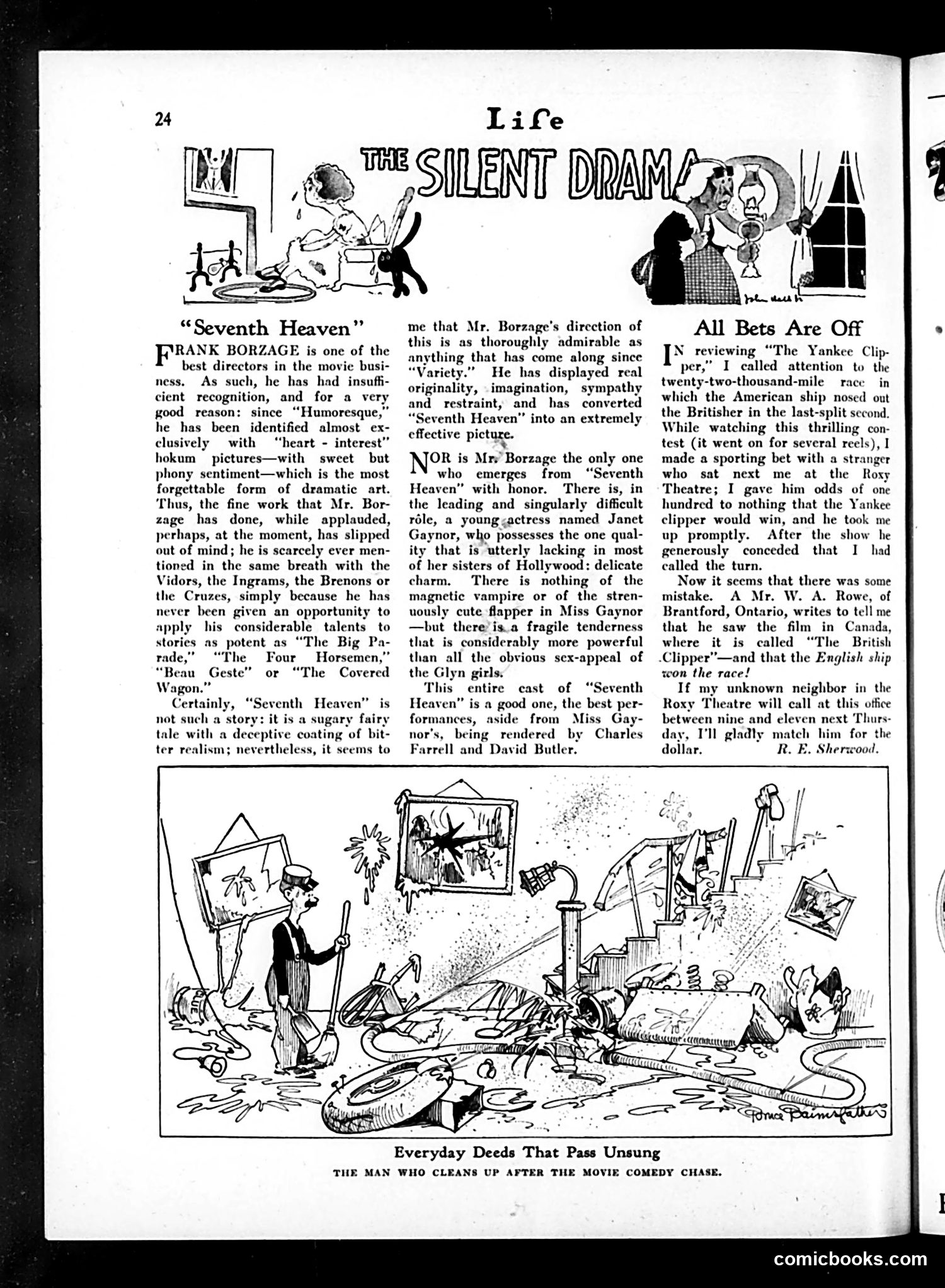
This page reviews Frank Borzage's film "Seventh Heaven" and includes a humorous cartoon about movie production. **The "Seventh Heaven" Review:** The critic praises Borzage's direction of this sentimental romantic film, noting he's been unfairly overlooked because he specializes in "heart-interest" stories rather than prestigious epics like "The Big Parade" or "Beau Geste." The review particularly praises actress Janet Gaynor for her "delicate charm"—a quality the critic suggests is rare among Hollywood actresses, who typically rely on sex appeal or flapper affectations. **The Cartoon:** Titled "Everyday Deeds That Pass Unsung," it depicts a janitor cleaning up the chaotic wreckage after a movie comedy chase scene—overturned furniture, broken props, scattered debris. The satire celebrates unrecognized workers whose labor makes Hollywood productions possible, much like the review's theme of overlooked talent. **"All Bets Are Off":** A brief humorous note about film distribution: the same movie shown in Canada was retitled with a British ship winning instead of an American one, invalidating the critic's wager with a theater patron.
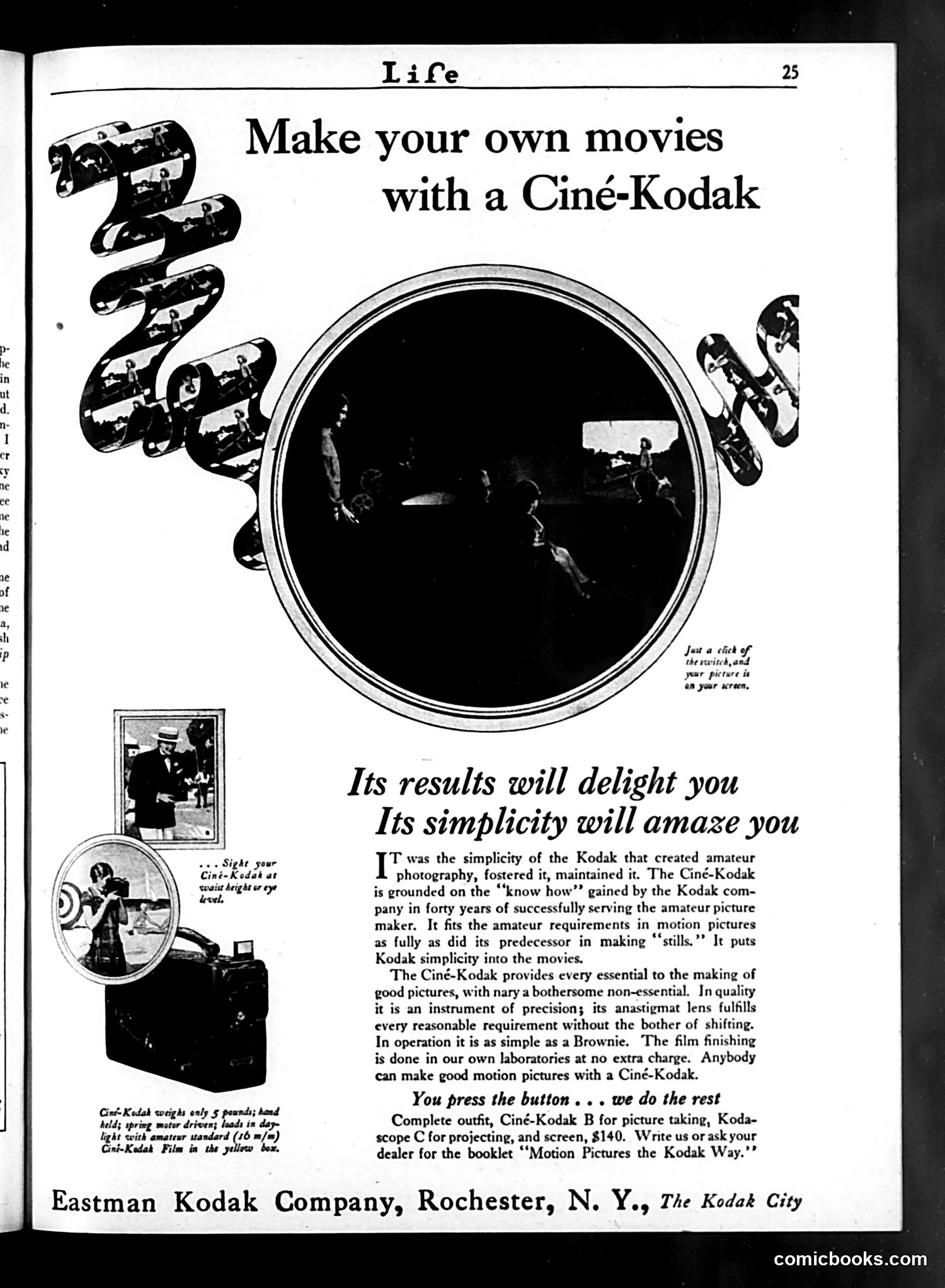
This is primarily an **advertisement**, not a political cartoon. It promotes Kodak's Ciné-Kodak movie camera to amateur filmmakers. The page emphasizes the camera's accessibility to ordinary people—"Anybody can make good motion pictures"—reflecting early 20th-century democratization of technology. The tagline "You press the button... we do the rest" echoes Kodak's famous slogan, positioning the company as removing technical barriers for consumers. The circular viewfinder image shows silhouettes of people filming, suggesting recreational home moviemaking. The smaller photos demonstrate the camera's portability and ease of use. This reflects a cultural moment when motion pictures were transitioning from professional/theatrical domain to consumer hobby. The price ($140) and emphasis on "simplicity" target middle-class Americans seeking entertainment and creative outlets—likely appealing to the Life magazine readership of the era. No political satire is present; this is straightforward consumer advertising.
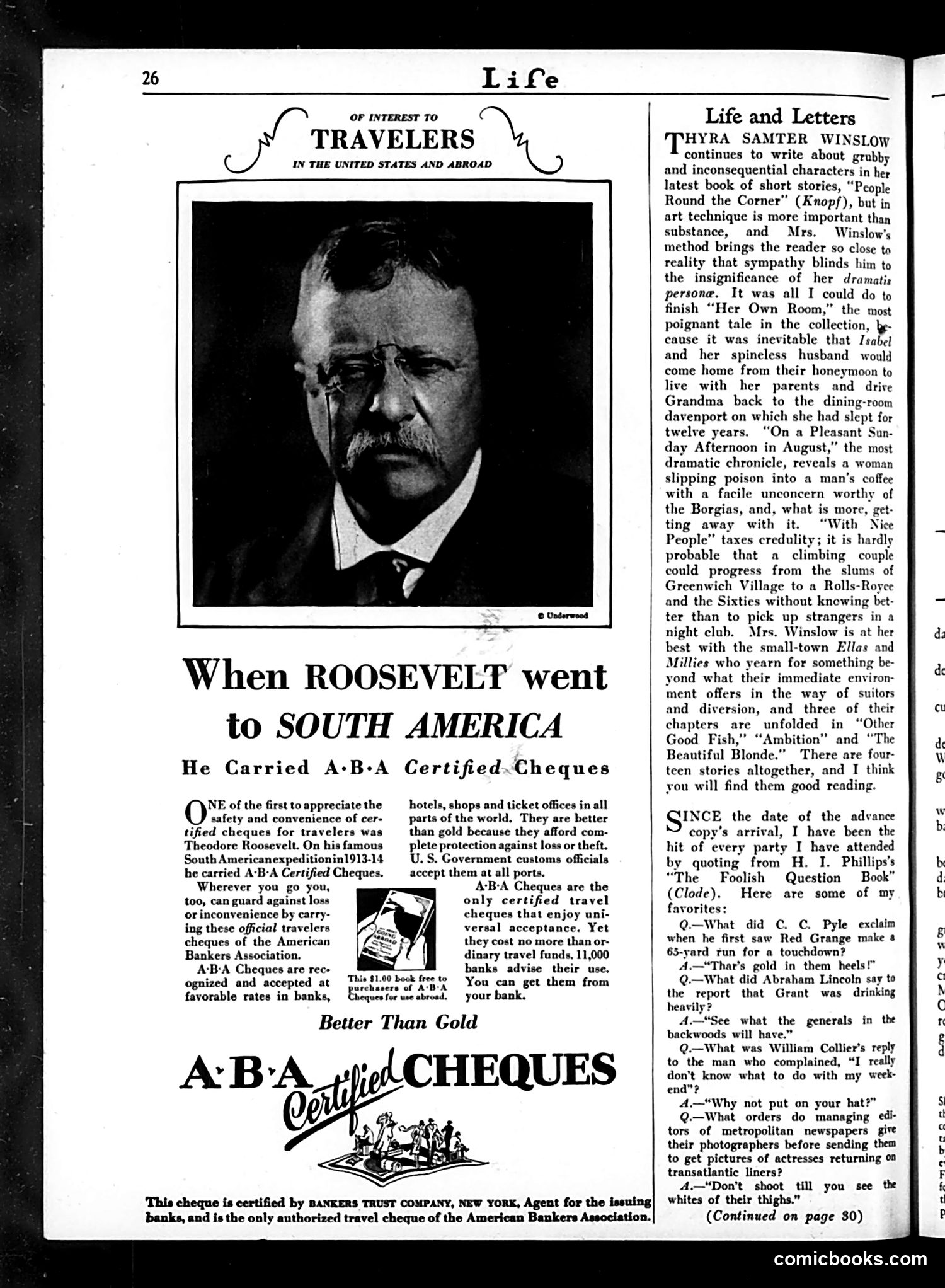
This page contains **advertising disguised as editorial content**—a common practice in early 20th-century magazines. The main feature advertises **A-B-A Certified Cheques** (traveler's checks) by claiming Theodore Roosevelt carried them on his 1913-14 South American expedition. This is a marketing appeal to safety and prestige: if Roosevelt trusted them, so should you. The ad emphasizes they're accepted worldwide and safer than cash. The right column reviews author **Thyra Samter Winslow's** short story collection and excerpts from **H.I. Phillips's joke book**. The jokes reference contemporary figures: Red Grange (football star), C.C. Pyle (his promoter), and Grant (likely Ulysses S. Grant, referenced humorously). The final joke about actresses and "transatlantic liners" satirizes newspaper photographers' invasive behavior toward returning celebrities. The page illustrates how early *Life* mixed commercial promotion with literary content, while the jokes show period humor focused on sports celebrities and media culture.
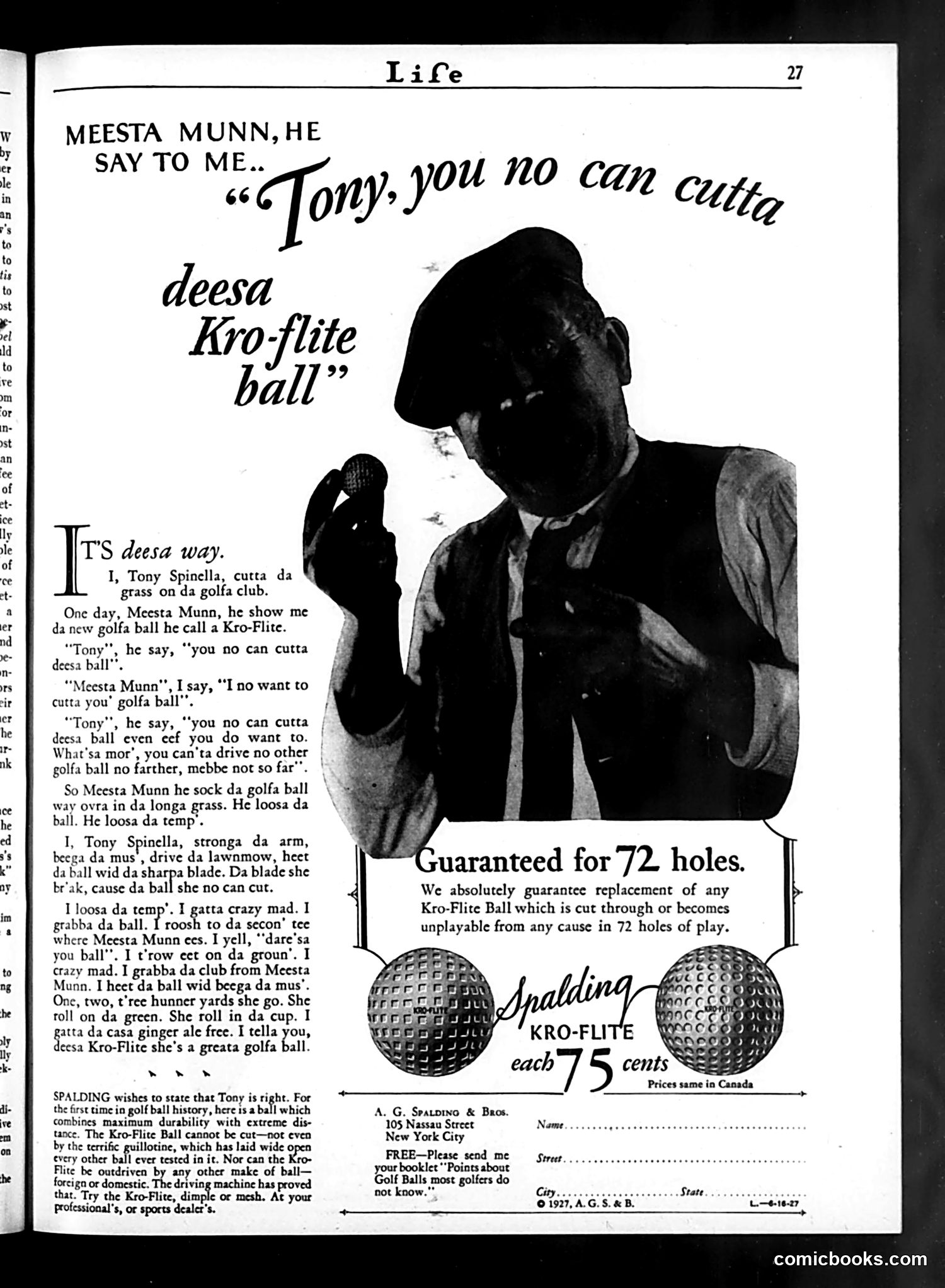
This is primarily a **product advertisement** for Spalding's Kro-Flite golf ball, disguised as humorous narrative. The "story" features Tony Spinella, depicted through **Italian-immigrant dialect humor** (common in 1920s American media). Tony recounts how groundskeeper Meesta Munn challenged him to cut a Kro-Flite ball—claims it's impossible. Tony attempts various destructive methods (blade, mower) and fails. He then accidentally hits the ball 300 yards onto the green and into the cup, "proving" its superiority. The satire targets **competitor golf balls**: the narrative demonstrates the Kro-Flite's durability (can't be cut) and distance (outdrives others). The exaggerated ethnic caricature and comedic setup make the sales pitch entertaining rather than direct. The guarantee promises replacement if the ball becomes unplayable within 72 holes—standard marketing reassurance. **Context**: This reflects 1920s advertising's comfort with broad ethnic stereotyping for comedic effect, now considered offensive.
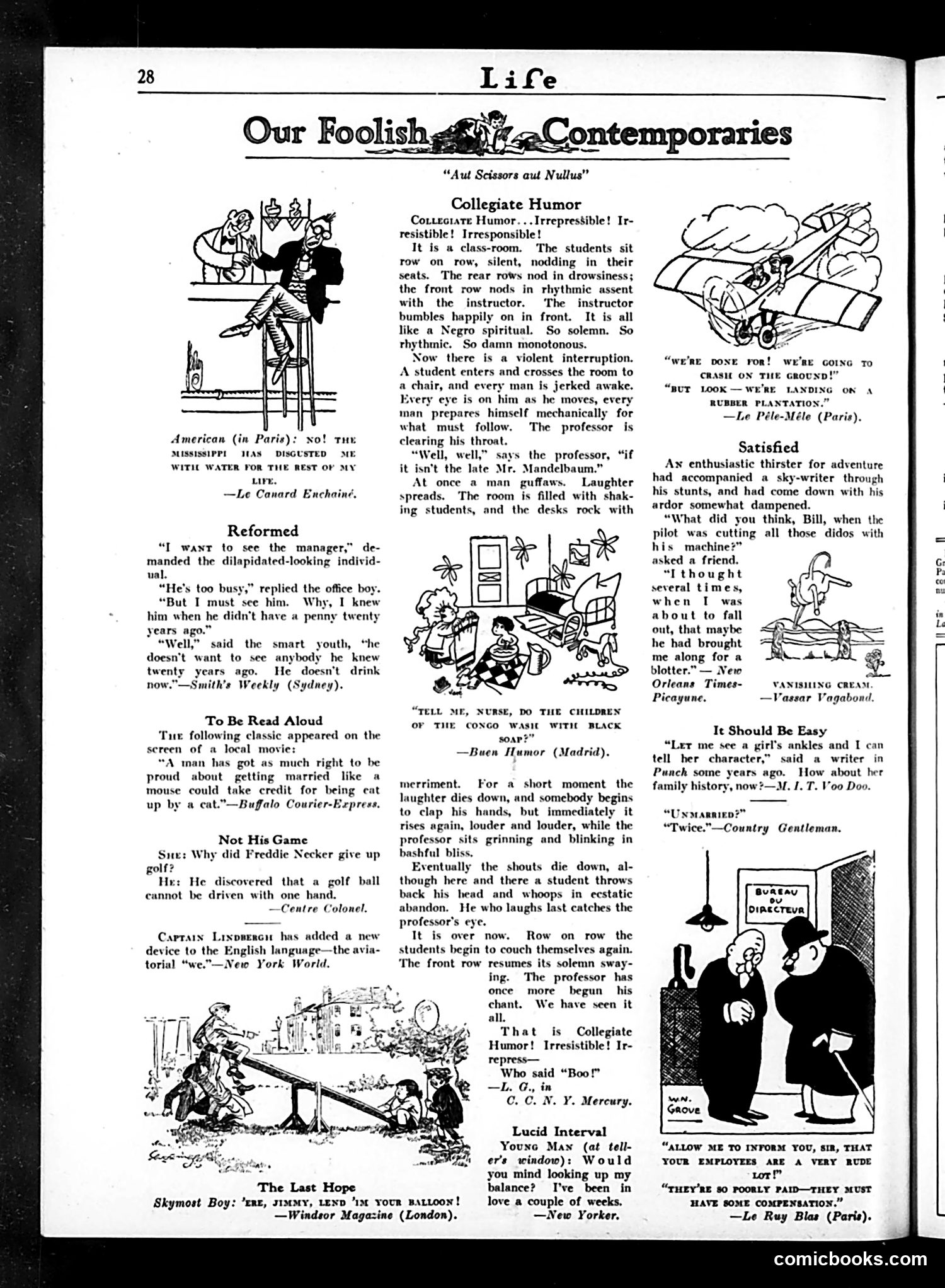
This page collects brief humorous anecdotes and cartoons from various international sources, primarily satirizing early 20th-century social conventions and collegiate life. **Main Features:** The "Collegiate Humor" section depicts a drowsy classroom where students snap to attention only when a tardy classmate enters, then again when the professor makes a sarcastic remark. The satire targets the performative nature of classroom engagement—students feign interest through synchronized nodding and laughter while actually disengaged. **Other notable items:** - An American in Paris rejecting the Mississippi River (social commentary on expatriate attitudes) - A reformed social climber avoiding old acquaintances - Various one-liners mocking marriage, golf, and aviation terminology - A cartoon about a sky-writing adventure gone wrong The page's subtitle "Aut Scissors aut Nullus" (scissors or nothing) suggests Life's editorial approach: sharp, cutting wit. The international sourcing reflects this era's cosmopolitan humor exchange among English-language publications.
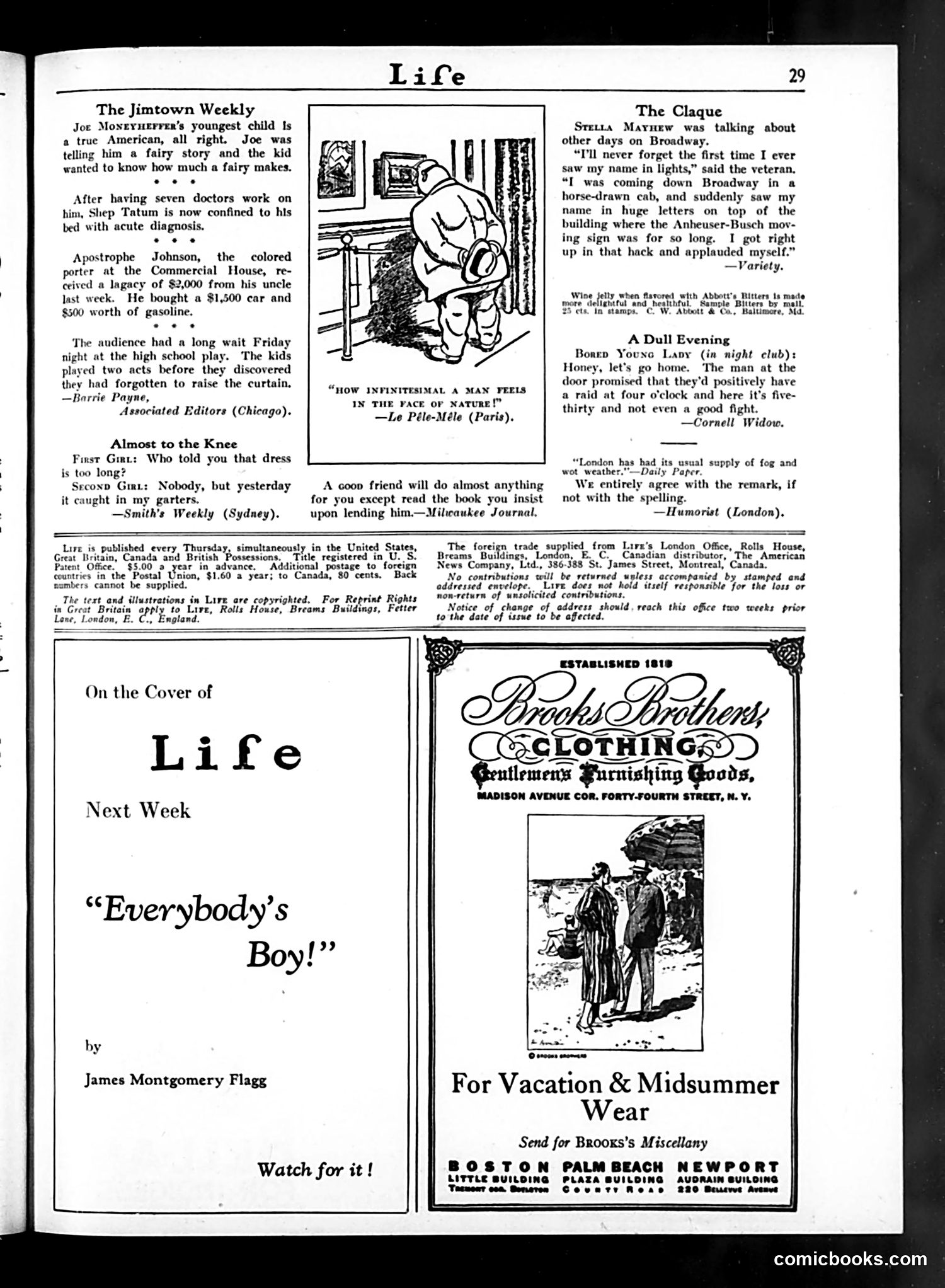
This page contains miscellaneous humor items and advertisements typical of *Life* magazine's satirical format. The main cartoon depicts a man hunched over in awe at nature's vastness, captioned with a French quote about human insignificance. The text pieces are brief comedic anecdotes from various sources (labeled "Jimtown Weekly," "Smith's Weekly," etc.). They mock small-town life and human foibles: a child's materialistic question about fairy earnings, malapropisms ("acute diagnosis" for acute condition), and poor theater management. "The Claque" recalls an actress seeing her name in lights—on a beer advertisement—and applauding herself anyway, satirizing vanity and the Broadway entertainment world's relationship with commercial endorsements. The page also includes advertisements for Brooks Brothers clothing and Abbott's Bitters (a patent medicine), typical of the era. The upcoming cover story advertises James Montgomery Flagg's illustration for "Everybody's Boy!"—likely patriotic content, given Flagg's famous WWI recruitment posters.
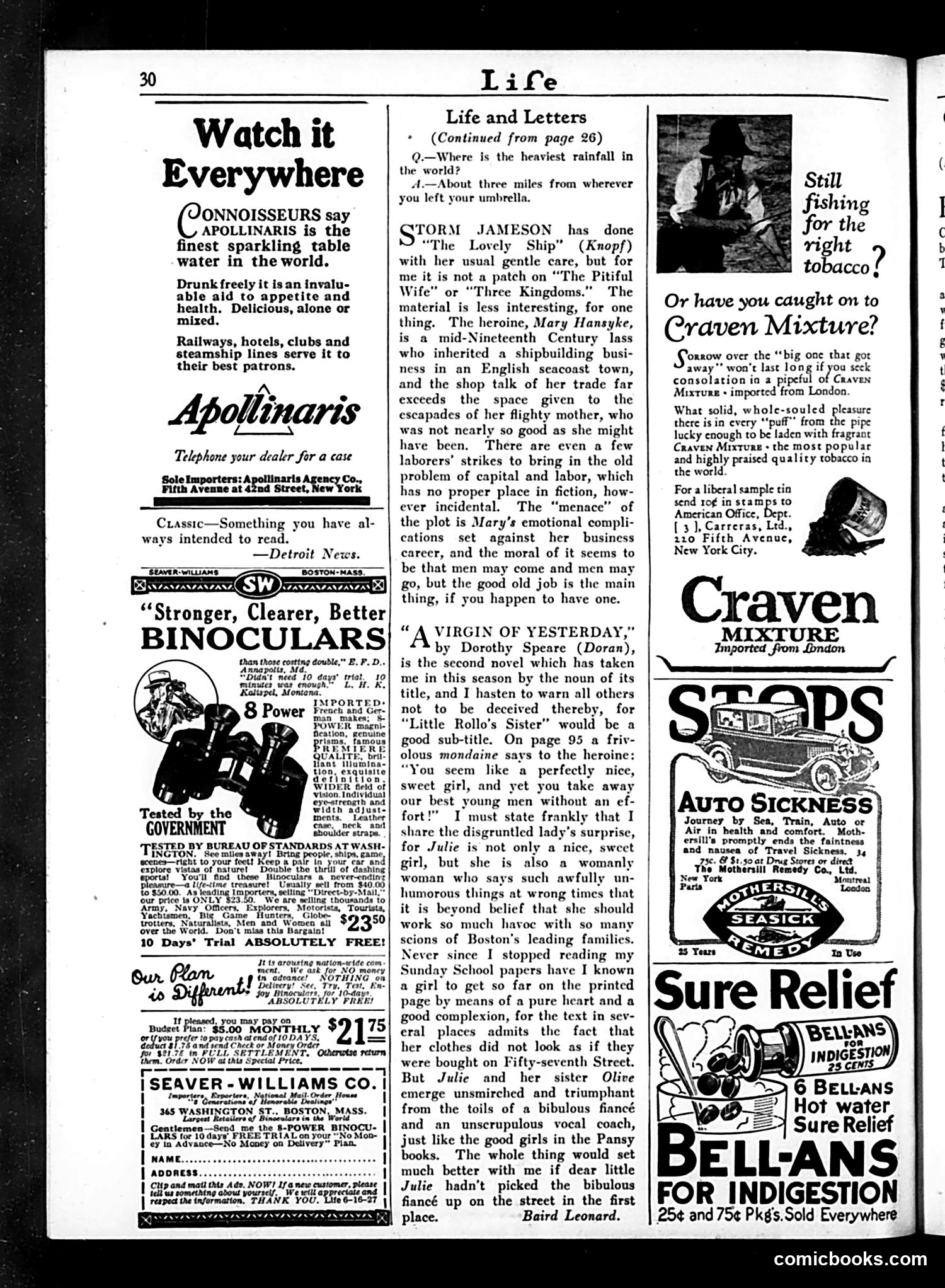
This page is primarily **advertising and book reviews**, not political satire. The dominant content includes: **Advertisements:** Apollinaris sparkling water, binoculars (Seaver-Williams Co.), Craven tobacco mixture, and Bell-ans indigestion remedy occupy most space. **"Life and Letters" column:** Reviews two novels—Storm Jameson's "The Lovely Ship" and Dorothy Speare's "A Virgin of Yesterday." The reviewer criticizes both works, finding Jameson's shipbuilding plot tedious and Speare's heroine implausibly virtuous despite her supposed charm over men. **Humor section:** A brief joke about umbrellas and rainfall appears at the top. The page reflects 1920s-30s magazine format: advertising revenue funds editorial content. No political cartoons or satire are present—this is standard Life magazine material mixing consumer goods promotion with literary criticism for educated readers.
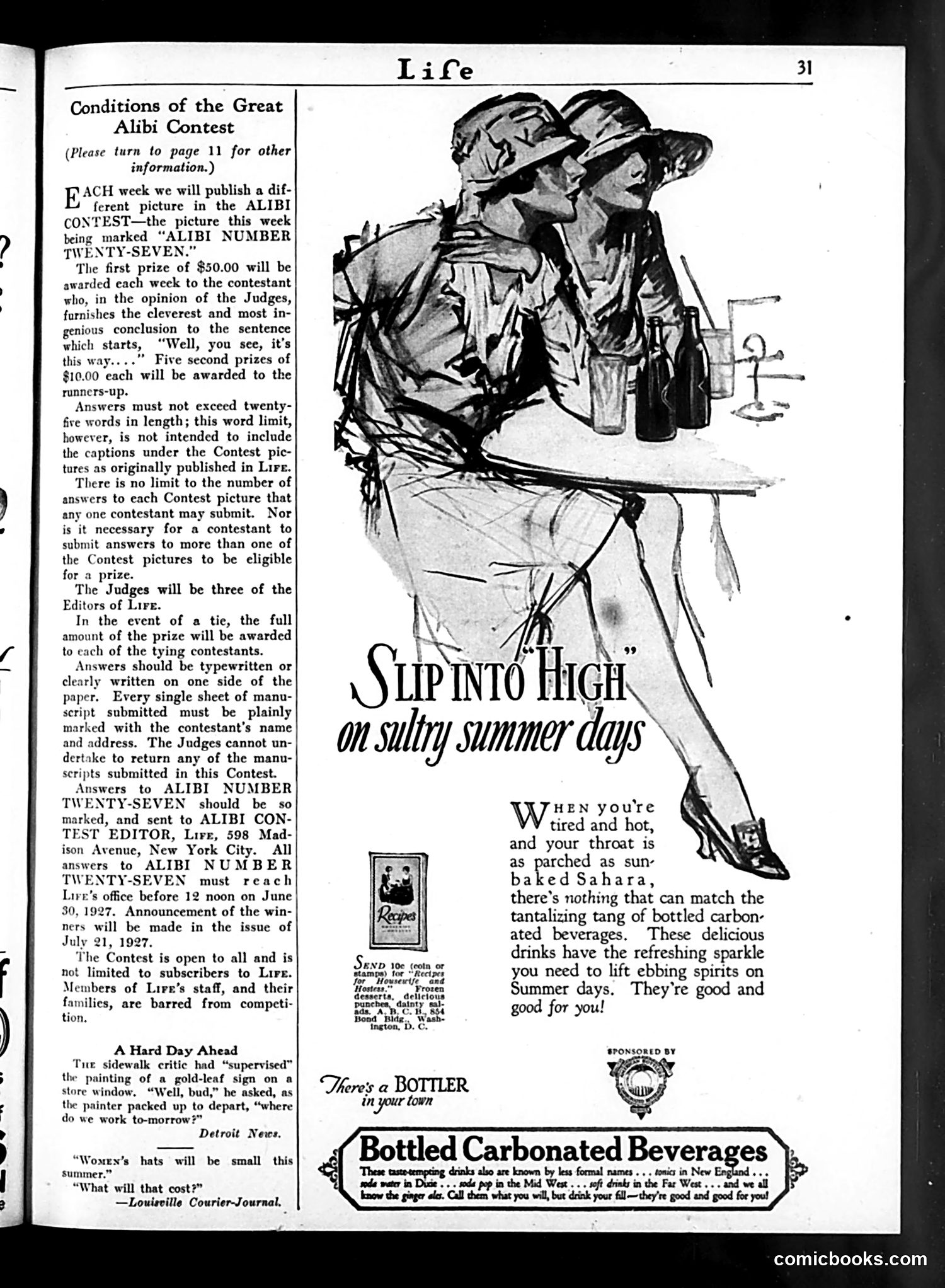
This page contains **Life's "Alibi Contest,"** a popular reader-participation feature where contestants submit humorous explanations to captioned images. "Alibi Number Twenty-Seven" shows two men in hats sitting with bottles, apparently caught in an awkward situation—the joke being readers must complete the sentence "Well, you see, it's this way..." with a clever excuse. The contest offered $50 for the best answer and $10 prizes for runners-up, limited to 25 words. Submissions went to Life's Manhattan offices, with winners announced in the July 21, 1927 issue. The page also features a **Bottled Carbonated Beverages advertisement** depicting a woman in summer dress ("Slip into High on sultry summer days"), promoting fizzy drinks as refreshment for hot weather. The ad notes these drinks were regionally called "tonics," "soda pop," or "soft drinks" depending on location. Both elements reflect 1920s consumer culture and reader engagement through contests and advertising.
This page contains primarily **advertisements and serialized editorial content** rather than political cartoons. The main text is "Mrs. Pep's Diary," a humorous domestic column describing a wealthy woman's trivial concerns—retrieving an old coat from a shopkeeper, dealing with insurance claims for fire damage, searching for a book, and her husband obsessively organizing handkerchiefs. The satire targets upper-class affectation and the narrator's self-absorbed preoccupations. The advertisements promote 1920s leisure and consumer goods: European car rentals (appealing to wealthy travelers), bunion remedies, and home movie cameras. A cigarette ad offers Johnnie Walker cigarettes at twenty for 20 cents. An ad for "The Gay Nineties" by R.V. Culter references Charles Dana Gibson's famous illustrative style, promoting nostalgia for an earlier era. The overall page reflects Jazz Age consumer culture and the leisure pursuits of the affluent classes that Life magazine's audience would have inhabited.