
Life, 1927-06-16 · page 22 of 34
Life — June 16, 1927 — page 22: what you’re looking at
What you’re looking at
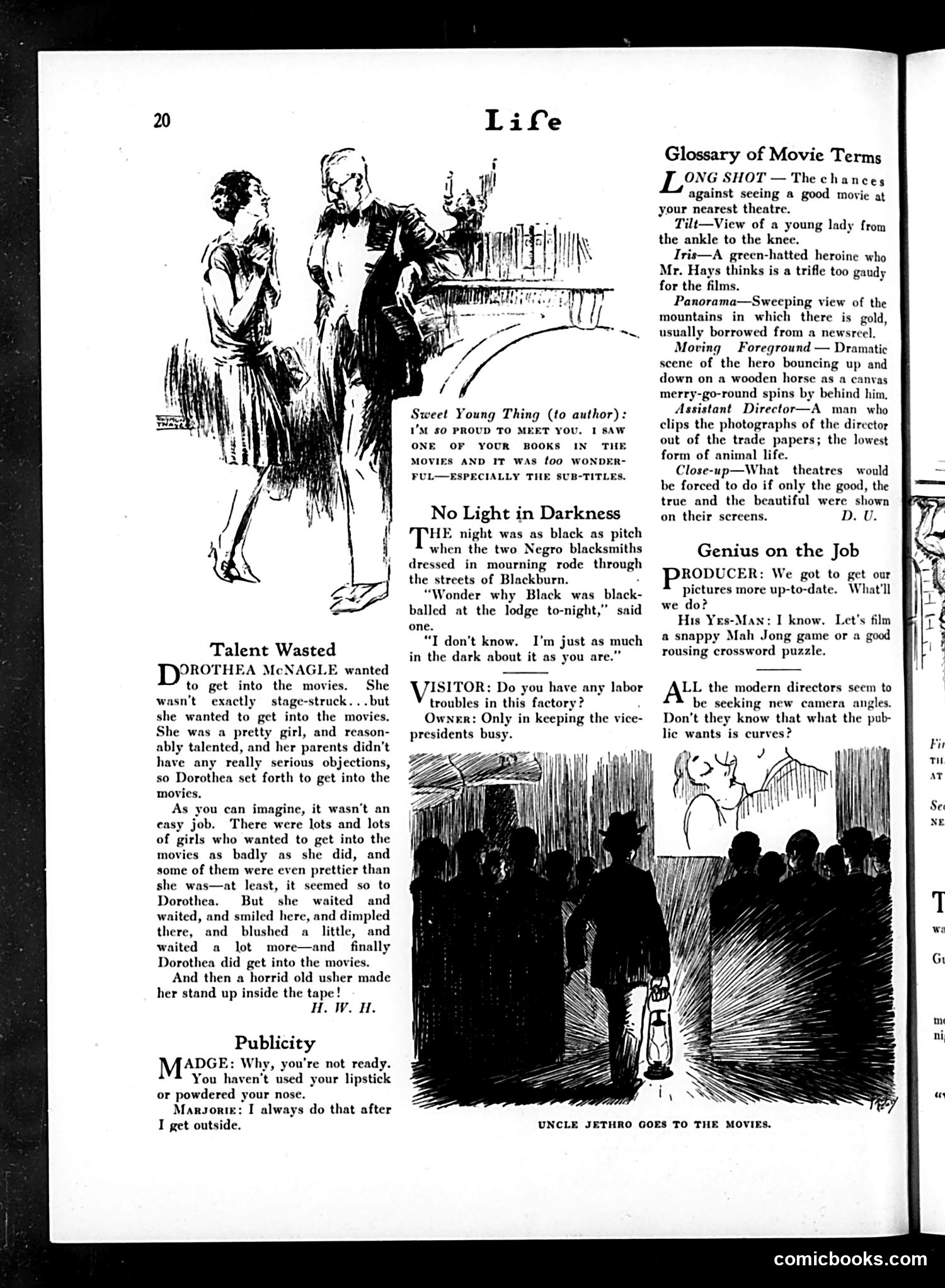
This page mocks early 1920s Hollywood through several interconnected jokes about the film industry's absurdities. **"Talent Wasted"** satirizes the difficulty of breaking into movies—Dorothea finally achieves her dream only to be made an usher, suggesting the industry's waste of aspiring talent. **"No Light in Darkness"** is a pun-based joke about two Black characters named "Black" discussing being "blackballed" from a lodge while riding through "Blackburn"—wordplay that trivializes exclusion. **The "Glossary of Movie Terms"** mocks Hollywood's pretentious terminology and censorship (referencing Will Hays' film morality standards). It ridicules both the industry's artistic pretensions and its focus on female bodies ("Tilt"). **"Genius on the Job"** satirizes producers' obsession with topical trends (Mah Jong, crossword puzzles) over genuine cinematic innovation—the "yes-man" sycophant exemplifies studio hierarchy. **"Publicity"** jokes about actresses' performative preparation for public appearance. Overall: satire of Hollywood's superficiality, censorship, commercialism, and hierarchical exploitation of performers.
📄 Transcribed text from this page (OCR, searchable)
Machine-transcribed from the original scan — historical spelling and the odd misread are preserved.
Talent Wasted OROTHEA McNAGLE wanted to get into the movies. She wasn't exactly stage-struck. . .but she wanted to get into the movies. She was a pretty girl, and reason- ably talented, and her parents didn’t have any really serious objections, so Dorothea set forth to get into the movies. As you can imagine, it wasn’t an easy job. There were lots and lots of girls who wanted to get into the movies as badly as she did, and some of them were even prettier than she was—at least, it seemed so to Dorothea. But she waited and waited, and smiled here, and dimpled there, and blushed a little, and waited a lot more—and finally Dorothea did get into the movies. And then a horrid old usher made her stand up inside the tape! H.W. H. Publicity ADGE: Why, you're not ready. You haven't used your lipstick or powdered your nose. Margsorte: I always do that after I get outside. Sweet Young Thing (to author): VM $0 PROUD TO MEET YOU. 1 SAW ONE OF YOUR BOOKS IN THE MOVIES AND IT WAS t00 WONDER- FUL—ESPECIALLY THE SUB-TITLES. No Light in Darkness ‘THE night was as black as pitch when the two Negro blacksmiths dressed in mourning rode through the streets of Blackburn. “Wonder why Black was black- balled at the lodge to-night,” said one. “T don't know. I'm just as much in the dark about it as you are.” ISITOR: Do you have any labor troubles in this factory? Owner: Only in keeping the vice- presidents busy. Glossary of Movie Terms ONG SHOT — The chances against seeing a good movie at your nearest theatre. Tilt—View of a young lady from the ankle to the knee. Iris—A green-hatted heroine who Mr. Hays thinks is a trifle too gaudy for the films. Panorama—Sweeping view of the mountains in which there is gold, usually borrowed from a newsreel, Moving Foreground — Dramatic scene of the hero bouncing up and down on a wooden horse as a canvas merry-go-round spins by behind him, Assistant Director—A man who clips the photographs of the director out of the trade papers; the lowest form of animal life. Close-up—What theatres would be forced to do if only the good, the true and the beautiful were shown on their screens. D. Uz. Genius on the Job RODUCER: We got to get our pictures more up-to-date. What'll we do? His Yes-Man: I know. Let's film a snappy Mah Jong game or a good rousing crossword puzzle. LL the modern directors seem to be seeking new camera angles. Don’t they know that what the pub- lic wants is curves? UNCLE JETHRO GOES TO THE MOVIES. comicbooks.com