
Life, 1927-06-16 · page 16 of 34
Life — June 16, 1927 — page 16: what you’re looking at
What you’re looking at
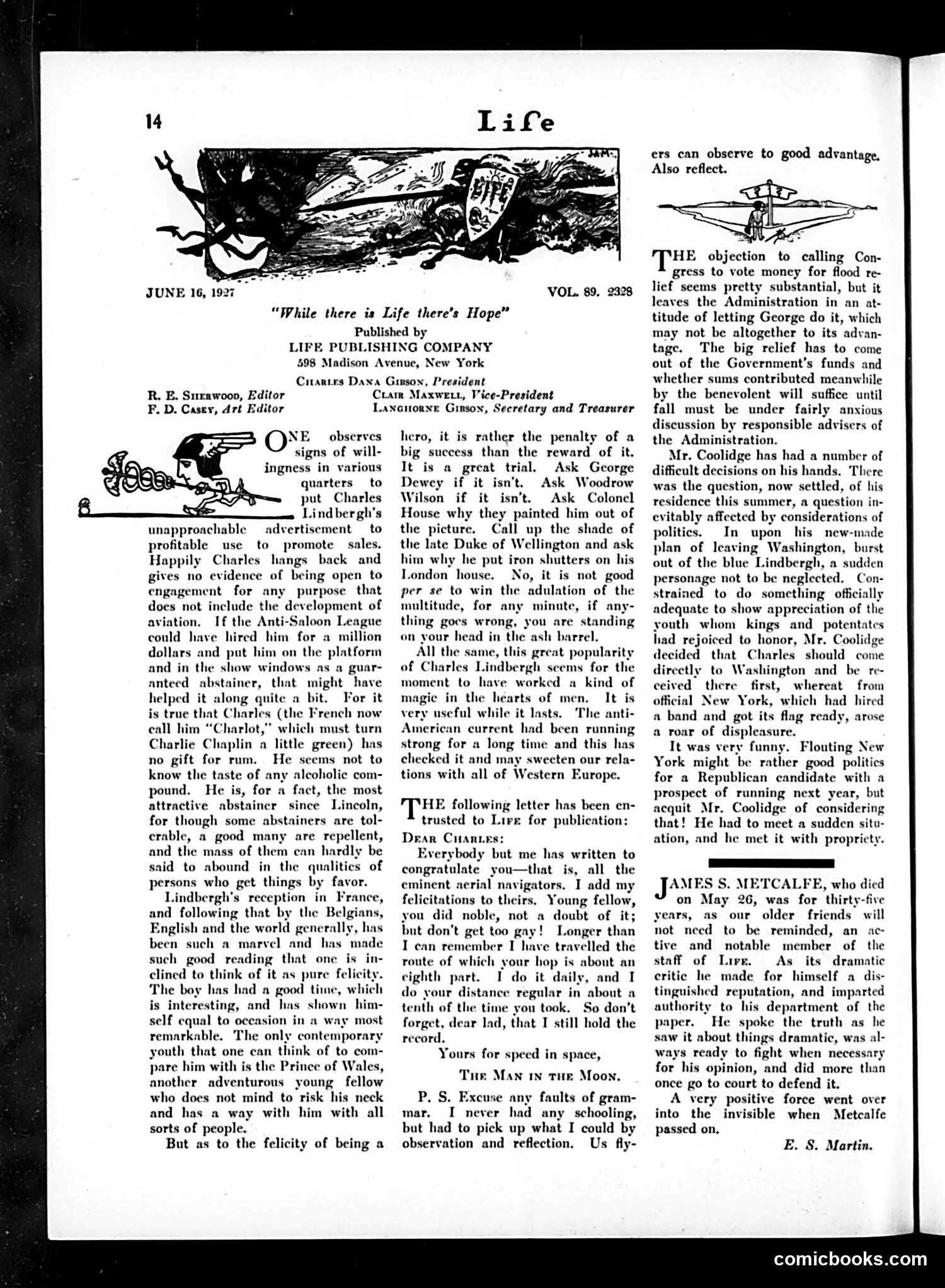
The masthead cartoon depicts a figure labeled "LIFE" emerging from what appears to be a barrel or container, with the caption "While there is Life there's Hope." The accompanying article critiques Charles Lindbergh's popularity and the commercialization following his transatlantic flight success. The text satirizes how various interests—from the Anti-Saloon League to advertisers—attempted to exploit Lindbergh's fame for their own agendas. The satire targets the American tendency to capitalize on celebrity and the pressure placed on famous figures to endorse causes. It also humorously notes Lindbergh's appeal transcends political divisions, comparing him favorably to historical figures like Lincoln and the Prince of Wales. The piece gently mocks both Lindbergh's handlers and the public's eagerness to claim him as representative of their various interests.
📄 Transcribed text from this page (OCR, searchable)
Machine-transcribed from the original scan — historical spelling and the odd misread are preserved.
JUNE 16, 192 VOL. 89. 2328 “While there is Life there’s Hope” Published by LIFE PUBLISHING COMPANY 598 Madison Avenue, New York Citartes Dana Ginson, President R. E. Sieawoon, Editor F. D. Casey, drt Editor NE — observes signs of will- ingness in various quarters to put Charles * Lindbergh's unapproachable advertisement _ to profitable use to promote _ sales. Happily Charles hangs back and gives no evidence of being open to engagement for any purpose that does not include the development of aviation. If the Anti-Saloon League could have hired him for a million dollars and put him on the platform and in the show windows as a guar- anteed abstainer, that might have helped it along quite a bit. For it is true that Charles (the French now call him “Charlot,” which must turn Charlie Chaplin a little green) has no gift for rum. He seems not to know the taste of any alcoholic com- pound. He is, for a fact, the most attractive abstainer since Lincoln, for though some abstainers are tol- erable, a good many are repellent, and the mass of them can hardly be said to abound in the qualities of persons who get things by favor. Lindbergh's reception in France, and following that by the Belgians, English and the world generally, I been such a marvel and has made such good reading that one is in- clined to think of it as pure felicity. The boy has had a good time, which is interesting, and has shown him- self equal to occasion in a way most remarkable. The only contemporary youth that one can think of to com- pare him with is the Prince of Wales, another adventurous young fellow who does not mind to risk his neck and has a way with him with all sorts of people. But as to the felicity of being a Cram Maxwett, Vice-President Lanonorne Ginson, Secretary and Treasurer hero, it is rather the penalty of a big success than the reward of it. It is a great trial. Ask George Dewey if it isn’t. Ask Woodrow Wilson if it isn’t. Ask Colonel House why they painted him out of the picture. Call up the shade of the late Duke of Wellington and ask him why he put iron shutters on his I.ondon house. No, it is not good per se to win the adulation of the multitude, for any minute, if any- thing goes wrong, you are standing on your head in the ash barrel. All the same, this great popularity of Charles Lindbergh seems for the moment to have worked a kind of magic in the hearts of men. It is very useful while it lasts. The anti- American current had been running strong for a long time and this has checked it and may sweeten our rela- tions with all of Western Europe. HE following letter has been en- trusted to Lire for publication: Dear Cuantes: Everybody but me has written to congratulate you—that is, all the eminent aerial navigators. I add my felicitations to theirs, Young fellow, you did noble, not a doubt of it; but don’t get too gay! Longer than I can remember I have travelled the route of which your hop is about an eighth part. I do it daily, and I do your distance regular in about a tenth of the time you took. So don’t forget, dear lad, that I still hold the record, Yours for speed in space, Tur Man in tue Moon, P. S. Excuse any faults of gram- mar. I never had any schooling, but had to pick up what I could by observation and reflection, Us fly- ers can observe to good advantage, Also reflect. HE objection to calling Con- gress to vote money for flood re- lief seems pretty substantial, but it leaves the Administration in an at- titude of letting George do it, which may not be altogether to its advan- tage. The big relief has to come out of the Government’s funds and whether sums contributed meanwhile by the benevolent will suffice until fall must be under fairly anxious discussion by responsible advisers of the Administration. Mr. Coolidge has had a number of difficult decisions on his hands. There was the question, now settled, of his residence this summer, a question in- evitably affected by considerations of politics. In upon his new-made plan of leaving Washington, burst out of the blue Lindbergh, a sudden personage not to be neglected. Con- strained to do something officially adequate to show appreciation of the youth whom kings and_potentates had rejoiced to honor, Mr. Coolidge decided that Charles should come directly to Washington and be re- ceived there first, whereat from official New York, which had hired a band and got its flag ready, arose a roar of displeasure. It was very funny. Flouting New York might be rather good politics for a Republican candidate with a prospect of running next year, but acquit Mr. Coolidge of considering that! He had to meet a sudden situ- ation, and he met it with propriety. Es JAMES S. METCALFE, who died on May 26, was for thirty-five years, as our older friends will not need to be reminded, an ac- tive and notable member of the staff of Lire. As its dramatic critic he made for himself a dis- tinguished reputation, and imparted authority to his department of the paper. He spoke the truth as he saw it about things dramatic, was ways ready to fight when necessary for his opinion, and did more than once go to court to defend it. A very positive force went over into the invisible when Metcalfe passed on, E. S. Martin. comicbooks.com