
Life, 1927-06-16 · page 20 of 34
Life — June 16, 1927 — page 20: what you’re looking at
What you’re looking at
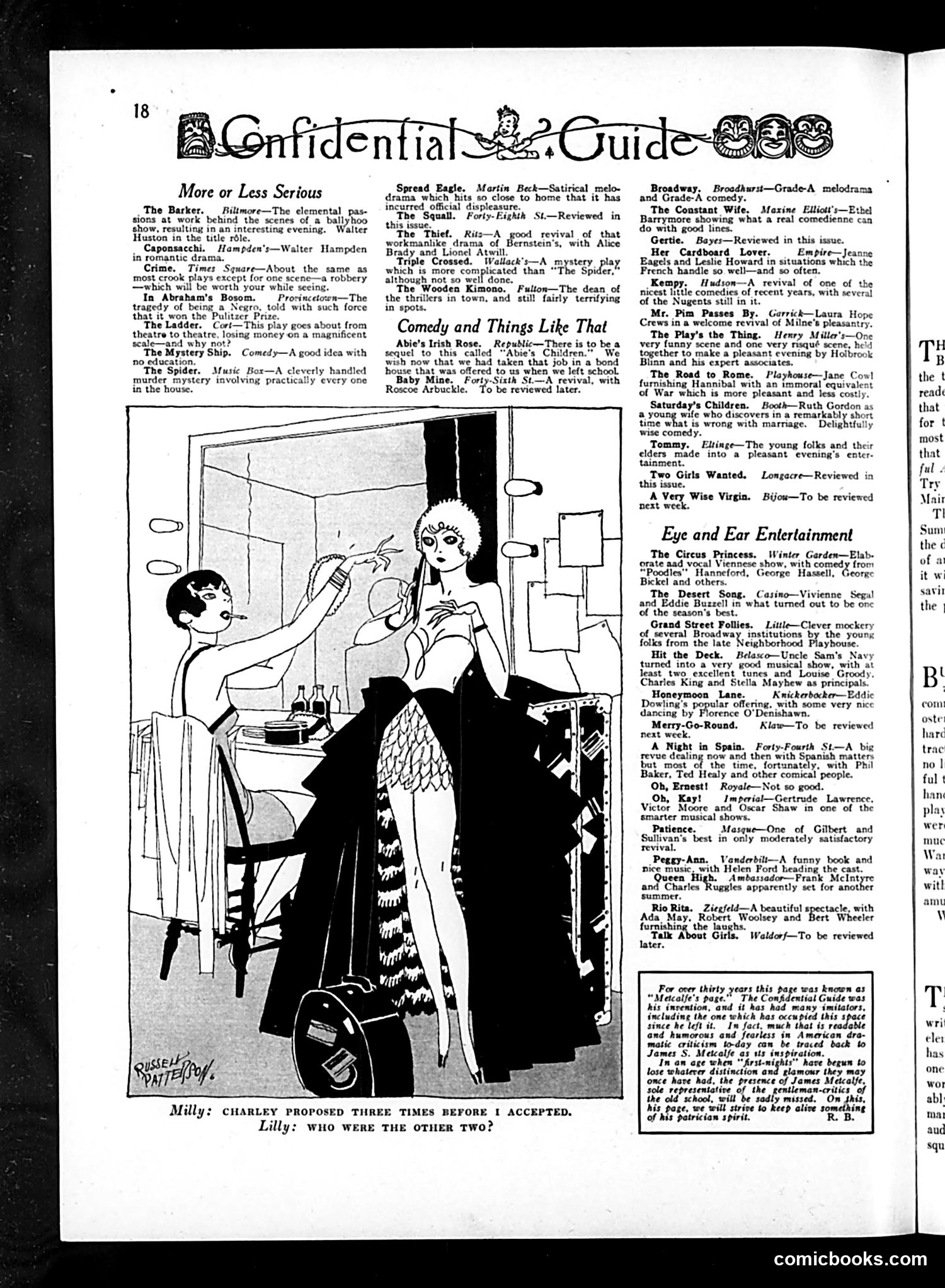
This is a theater review section from Life magazine, listing Broadway shows and entertainments. The cartoon depicts a flirtation or romantic moment between two people in what appears to be a dressing room or backstage setting. The caption joke reads: "Milly: Charley proposed three times before I accepted. Lilly: Who were the other two?" This is a play on the assumption that a woman would have multiple male suitors proposing to her—a dated social scenario where men initiated proposals and women had their pick of eager admirers. The reviews themselves catalog 1920s Broadway offerings: dramatic productions (like *In Abraham's Bosom*, which won the Pulitzer Prize), comedies, musicals, and vaudeville shows. Notably, *Spread Eagle* is called out for being so satirically pointed about American politics that it "incurred official displeasure"—suggesting wariness of government response to theatrical criticism. The tone reflects Entertainment-page coverage of a thriving theater district before film dominated popular culture.
📄 Transcribed text from this page (OCR, searchable)
Machine-transcribed from the original scan — historical spelling and the odd misread are preserved.
More or Less Serious The Barker. _Biltmore—The elemental pas- sions at work behind the scenes of a ballyhoo show, resulting in an interesting evening. Walter Huston in the title rdle. _ Caponsacchi. Hampden's—Walter Hampden in romantic drama. Crime. Times Square—About the same as most crook plays except for one scene—a robbery —which will be worth your while seeing. In Abraham's Bosom. — Provincetown—The tragedy of being a Negro. told with such force that it won the Pulitzer Prize. The Ladder. Cor!—This play goes about from theatre to theatre, losing money on a magnificent scale—and why not? The Mystery Ship. Comedy—A good idea with no education. The Spider. Music Box—A cleverly handled murder mystery involving practically every one in the house. Spread Eagle. Martin Beck—Satirical melo- drama which hits so close to home that it has incurred official displeasure. ; ; The Squall. Forty-Eighih St—Reviewed in this issue. ; The Thief. Rits—A good revival of that workmanlike drama of Bernstein's, with Alice Brady and Lionel Atwill. Triple Crossed. | Wallack’s—A mystery. play which is more complicated than “The Spider.” although not so well done. The Wooden Kimono. Fulton—The dean of the thrillers in town, and still fairly terrifying in spots. Comedy and Things Like That Abie’s Irish Rose. Republic—There is to be a sequel to this called “Abie's Children.” We wish now that we had taken that job in a bond house that was offered to us when we left school. Baby Mine. Forty.Sixth St—A revival, with Roscoe Arbuckle. To be reviewed later. Milly: cuarLey PRoposeD THREE TIMES BEFORE 1 ACCEPTED. Lilly: wuo were THE OTHER TWO? Broadway. Broadhurst—Grade-A melodrama and Grade-A comedy. The Constant Wife. Maxine Eltiott’s—Ethel Barrymore showing what a real comedienne can do with good lines. Gertie. Bayes—Reviewed in this issue. Her Cardboard Lover. _ Empire—Jeanne Eagels and Leslie Howard in situations which the French handle so well—and so often. Kempy. Hudson—A revival of one of the nicest little comedies of recent years, with several of the Nugents still in it. Mr. Pim Passes By. Garrick—Laura Hope Crews in a welcome revival of Milne’s pleasantry. The Play's the Thing. Henry Miller's—One very funny scene and one very risqué scene, he'd together to make a pleasant evening by Holbrook Blinn and his expert associates. The Road to Rome. Playhouse—Jane Cowl furnishing Hannibal with an immoral equivalent of War which is more pleasant and less costly. Saturday’s Children. Booth—Ruth Gordon as a young wife who discovers in a remarkably short time what is wrong with marriage. Delightfully wise comedy. Tommy. Elsinge—The young folks and their elders made into a pleasant evening's enter- tainment. Two Girls Wanted. Longecre—Reviewed in this issue. A Very Wise Virgin. Bijow—To be reviewed next week. Eye and Ear Entertainment The Circus Princess. Winter Garden—Elab- orate aad vocal Viennese show, with comedy from “Poodles Hanneford, George Hassell, George Bickel and others. The Desert Song. Casino—Vivienne Segal and Eddie Buzzell in what turned out to be onc of the season's Grand Street Follies. Little—Clever mockery of, several Broadway institutions by the youns folks from the late Neighborhood Playhouse. Hit the Deck. Belasco—Uncle Sam's Navy turned into a very good musical show, with at least two excellent tunes and Louise Groody. Charles King and Stella Mayhew as principals. Honeymoon Lane. — Knickerbocker—Eddic Dowling’s popular offering, with some very nice dancing by Florence O' Denishawn. Merry-Go-Round. Klaw—To be reviewed next week. A Night in Spain. Forty-Fourth St—A biz revue dealing now and then with Spanish matters Bat most of the time, fortunately, with Phil Baker, Ted Healy and other comical people. Ob, Ernest! Royale—Not so good. Ob, Kay! — Impericl—Gertrude Lawrence, Victor Moore and Oscar Shaw in one of the smarter musical shows. Patience. Masque—One of Gilbert and Sullivan's best in only moderately satisfactory revival. Peggy-Ann. Vanderdili—A funny book and nice music. with Helen Ford heading the cast. Queen High. Ambassador—Prank McIntyre and Charles Ruggles apparently set for another summer. Rio Rita. Ziesfeld—A beautiful 5 Ada. May, Robert Woolsey and furnishi the laughs. 4 ails ‘About Girls. Waldorf—To be reviewed ter. tacle, with ert: Wheeler For over thirty years this page was known as “Metcalfe's page.” The Confidential Guide was his invention, and it has had many imitators, including the ome which has occupied this space since he left it. Im fact. much that is readable and humorous and fearless in American dra- matic criticism to-day can be traced back to James S. Metcalfe a3 us tio. In an age when “first-nights” have begun to lose whaterer distinction and glamour they may once have had, the presence of James Metcalfe, sole representative of the gentleman-critics of the old school, will be sadly missed. On this, his page, we will strive to keep alive something of his patrician spirit. R. B. Sum the ¢ of a it com! muc Wat way witl amu AY comicbooks.com