
A complete issue · 39 pages · 1927
Life — May 26, 1927
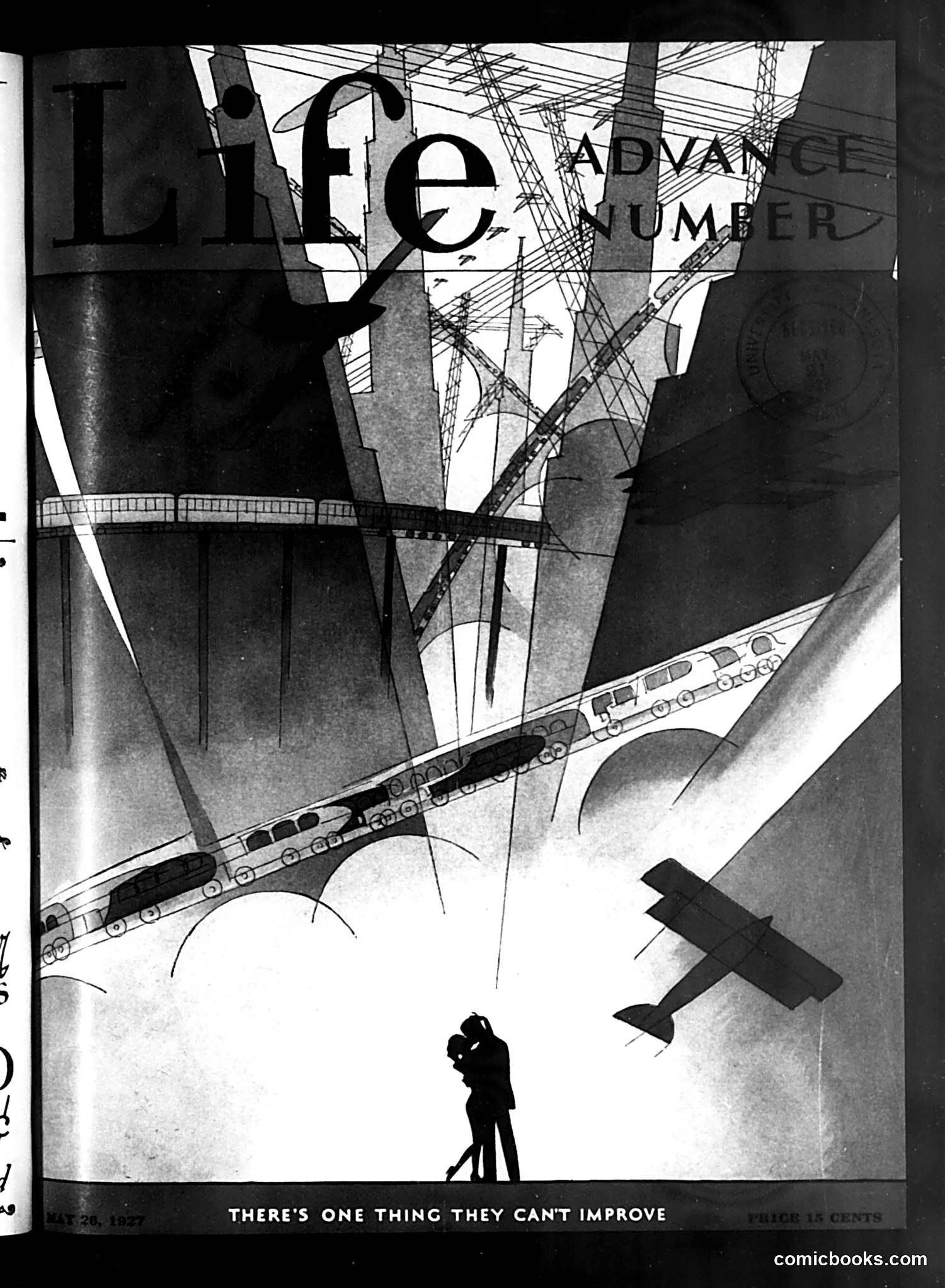
This cover satirizes modern technological advancement and industrial progress. The composition shows a silhouetted couple in the foreground, dwarfed by massive industrial and transportation infrastructure above them—factory smokestacks, electrical transmission lines, a streamlined passenger train, and an airplane. The caption "THERE'S ONE THING THEY CAN'T IMPROVE" suggests ironic commentary: while engineers continuously modernize machines and infrastructure, human romance or human connection remains unchanged and irreplaceable. The intimate couple contrasts sharply with the impersonal industrial machinery surrounding them, implying that technological progress cannot improve upon fundamental human emotions or relationships. This reflects 1920s anxieties about whether rapid modernization was dehumanizing society.
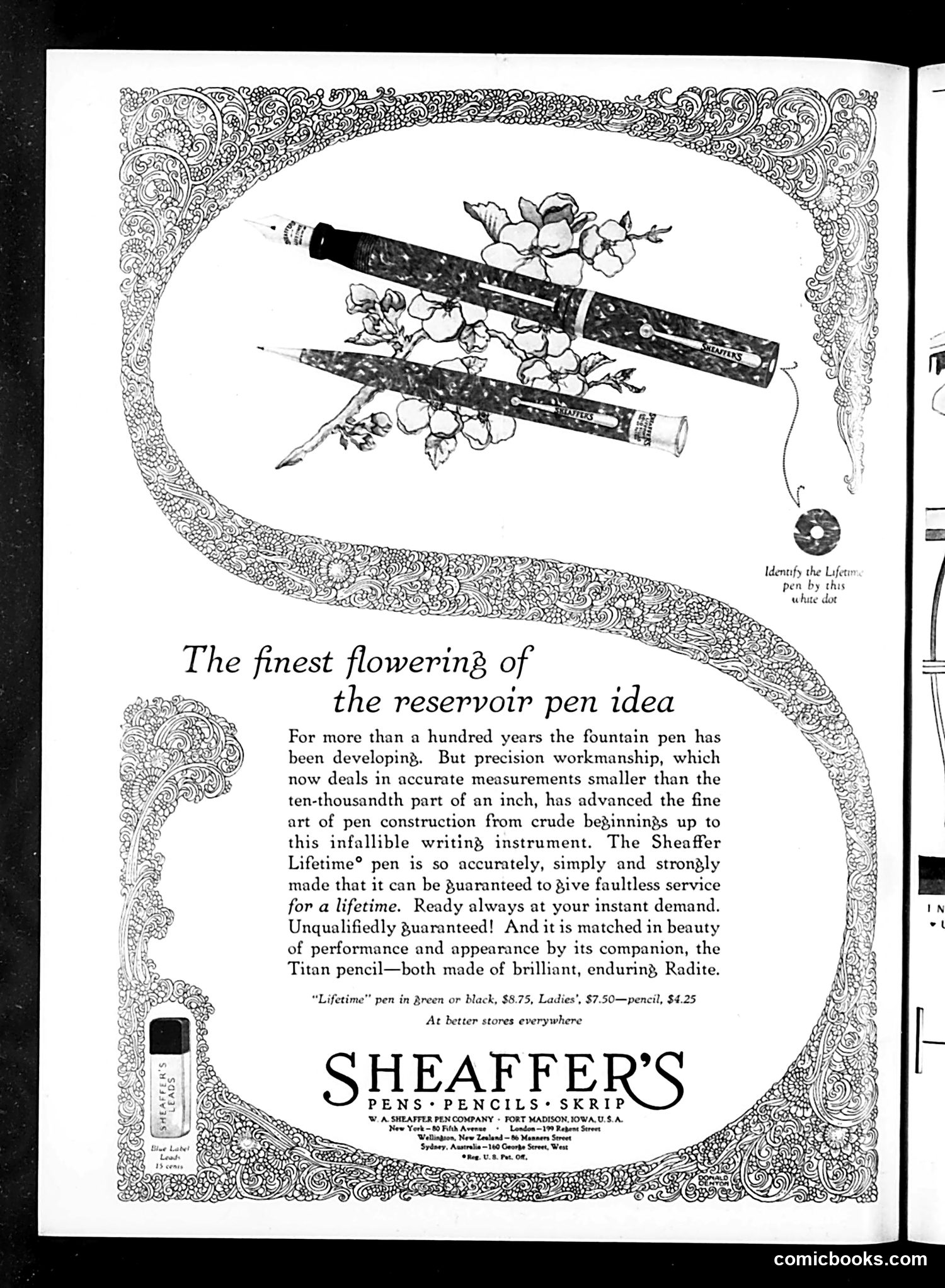
This is primarily an **advertisement, not political satire or editorial content**. It's a Sheaffer pen advertisement from Life magazine promoting their "Lifetime" fountain pen and "Titan" pencil. The decorative ornamental border frames three writing instruments arranged with flowering plant imagery. The ad emphasizes precision engineering and durability—claiming the pen is "guaranteed to give faultless service for a lifetime" and highlighting how fountain pen technology has advanced over a century through "precision workmanship." Pricing information ($8.75 for pens, $7.50-$4.25 for pencils) and distribution details are provided at the bottom. There is no political cartoon or satire present on this page—it's a straightforward product advertisement using ornate design typical of early 20th-century marketing.
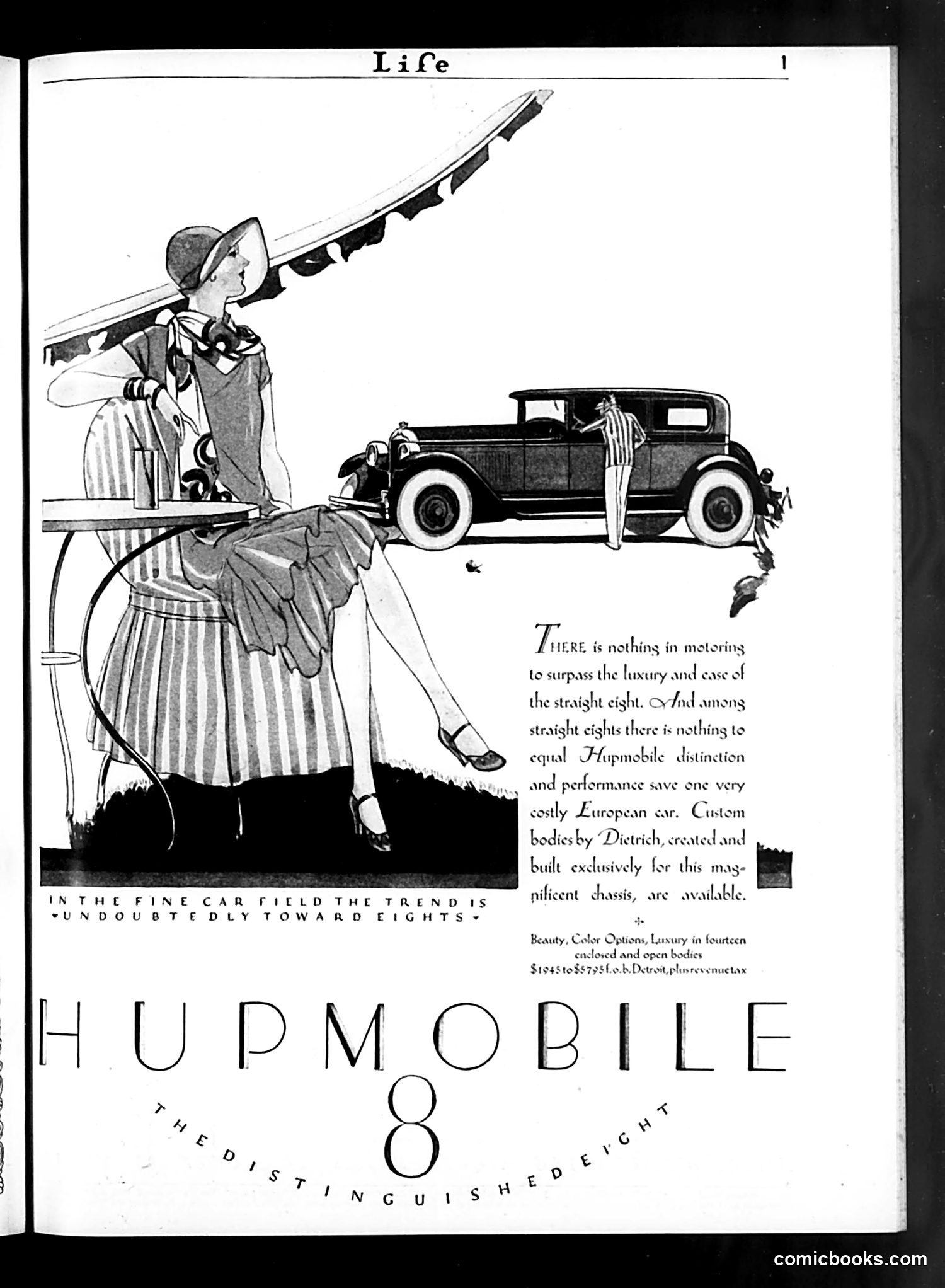
This page is primarily a **Hupmobile automobile advertisement**, not a political cartoon. The illustration shows a fashionable 1920s woman in a cloche hat and pleated skirt perched on a large surveying instrument, gazing at a Hupmobile sedan below. The accompanying text claims that among "straight eights" (eight-cylinder engines), only an expensive European custom car can match the Hupmobile's "distinction and performance." The satirical element is subtle: the woman represents aspirational luxury and leisure, positioned literally above the car in a pose suggesting elegance and superiority. The joke advertises the vehicle's prestige by associating it with fashionable, refined consumers. The "distinguished eight" tagline plays on contemporary automotive competition during the 1920s boom era. This reflects period advertising targeting wealthy, style-conscious buyers.
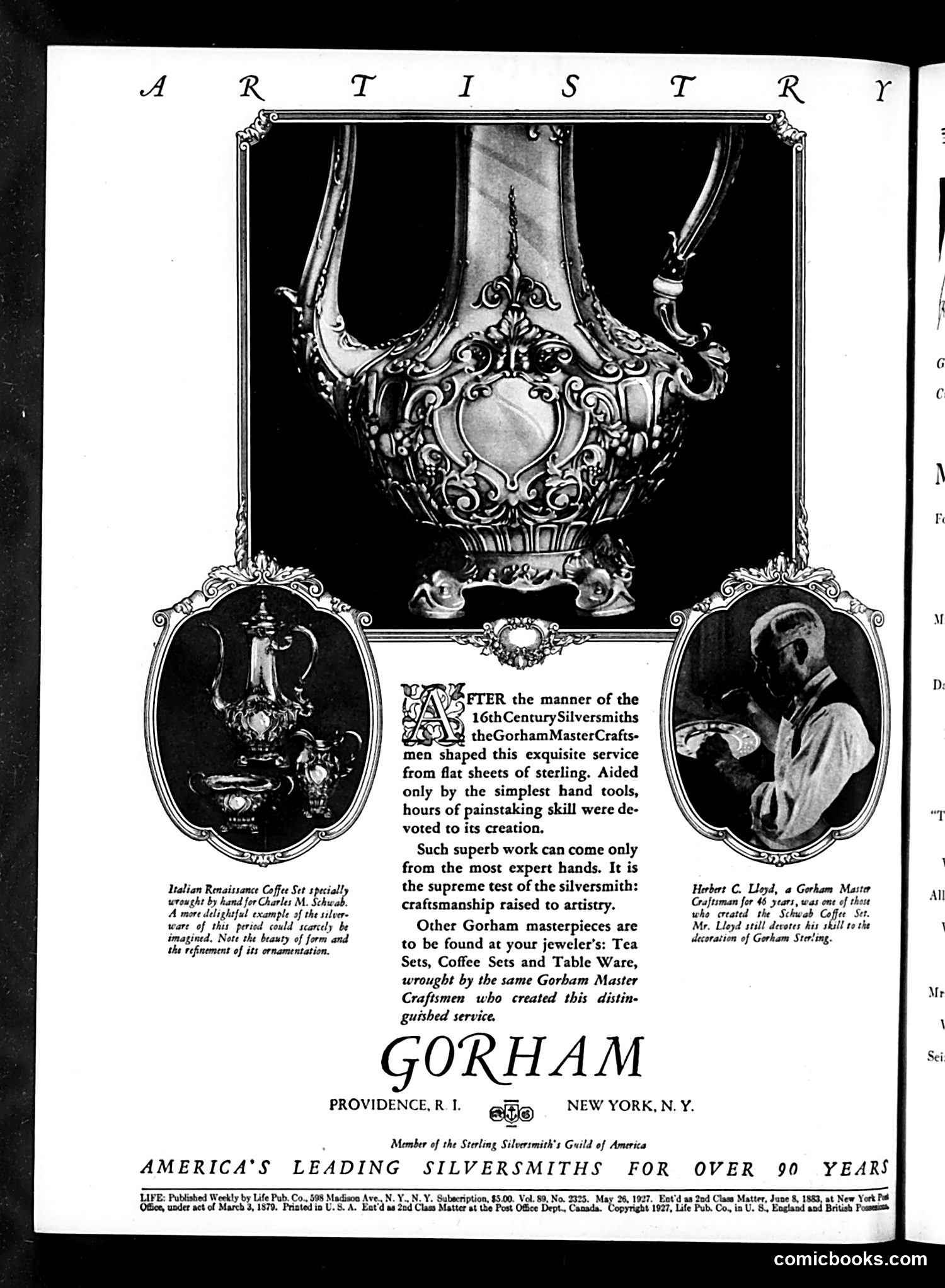
This is **not a political cartoon or satire**—it's a straightforward **advertisement for Gorham Sterling Silver**. The page features a luxury silverware service piece (a decorative urn or coffee set) shown in the central image, with two smaller photographs below: one of a historical Italian Renaissance coffee service and one of Herbert C. Lloyd, a Gorham Master Craftsman, at work. The ad emphasizes traditional craftsmanship, claiming Gorham's silversmiths work "after the manner of 16th-Century Silversmiths" using only simple hand tools. It positions their sterling silverware products—Tea Sets, Coffee Sets, and Table Ware—as artisanal masterpieces for wealthy consumers. This represents 1927 **luxury marketing** targeting affluent readers of *Life* magazine.
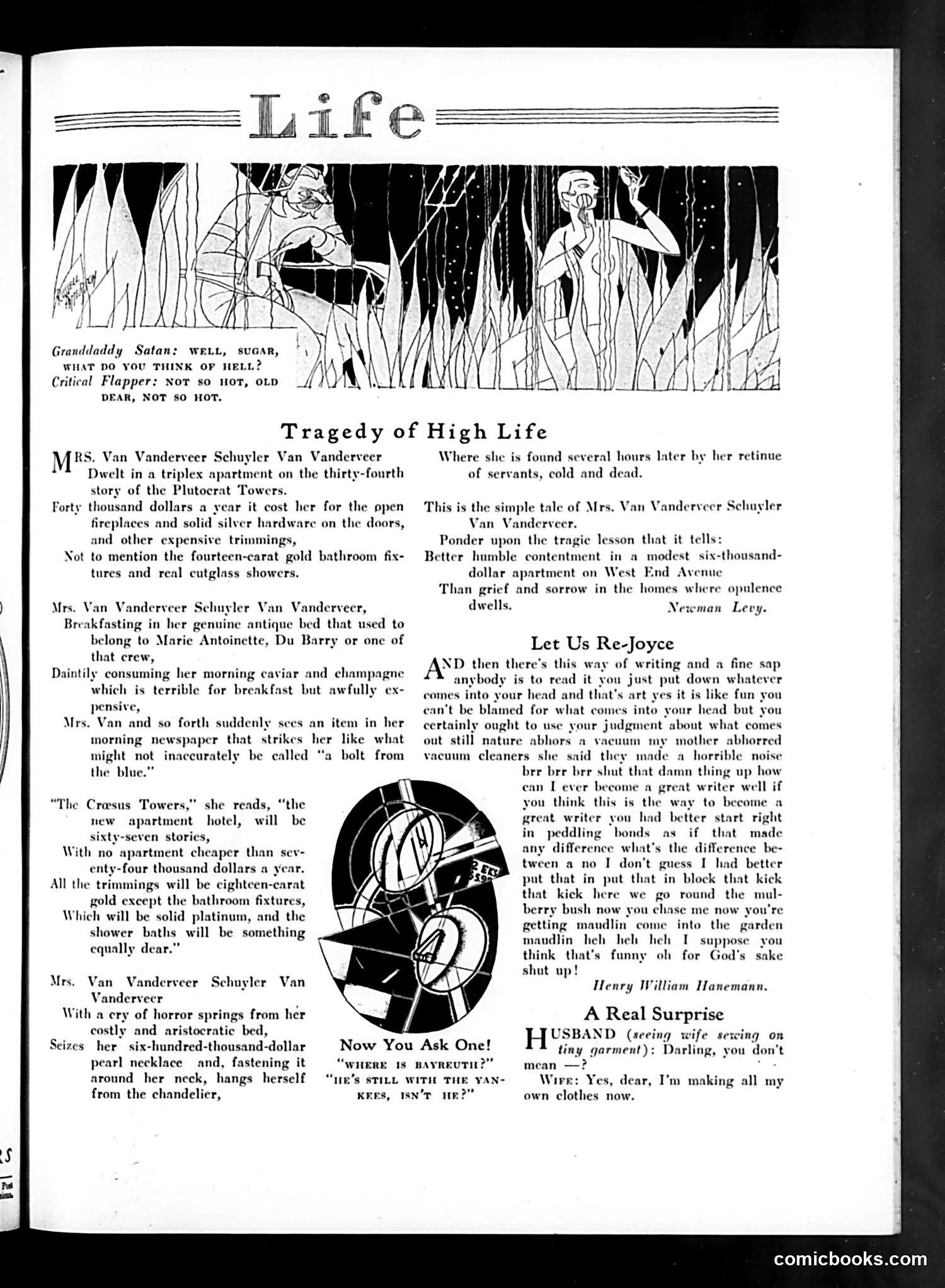
**Top Cartoon ("Granddaddy Satan"):** A satirical dialogue between Satan and Critical Flapper. Satan asks about Hell's temperature; the Flapper dismisses it as "not so hot"—a flippant, modern response typical of 1920s youth culture. The satire mocks young women's irreverent attitudes toward traditional morality and authority. **Main Content:** "Tragedy of High Life" mocks wealthy New York society, specifically Mrs. Van Vanderveer Schuyler Van Vanderveer. The satire ridicules her excessive spending on luxury apartments ($40,000/year for fireplaces alone) and eventual suicide over financial concerns—highlighting the moral emptiness and fragility of the wealthy elite. The accompanying pieces ("Let Us Re-Joyce," "A Real Surprise") continue satirizing modern life through humor about writing, vacuum cleaners, and domestic roles.
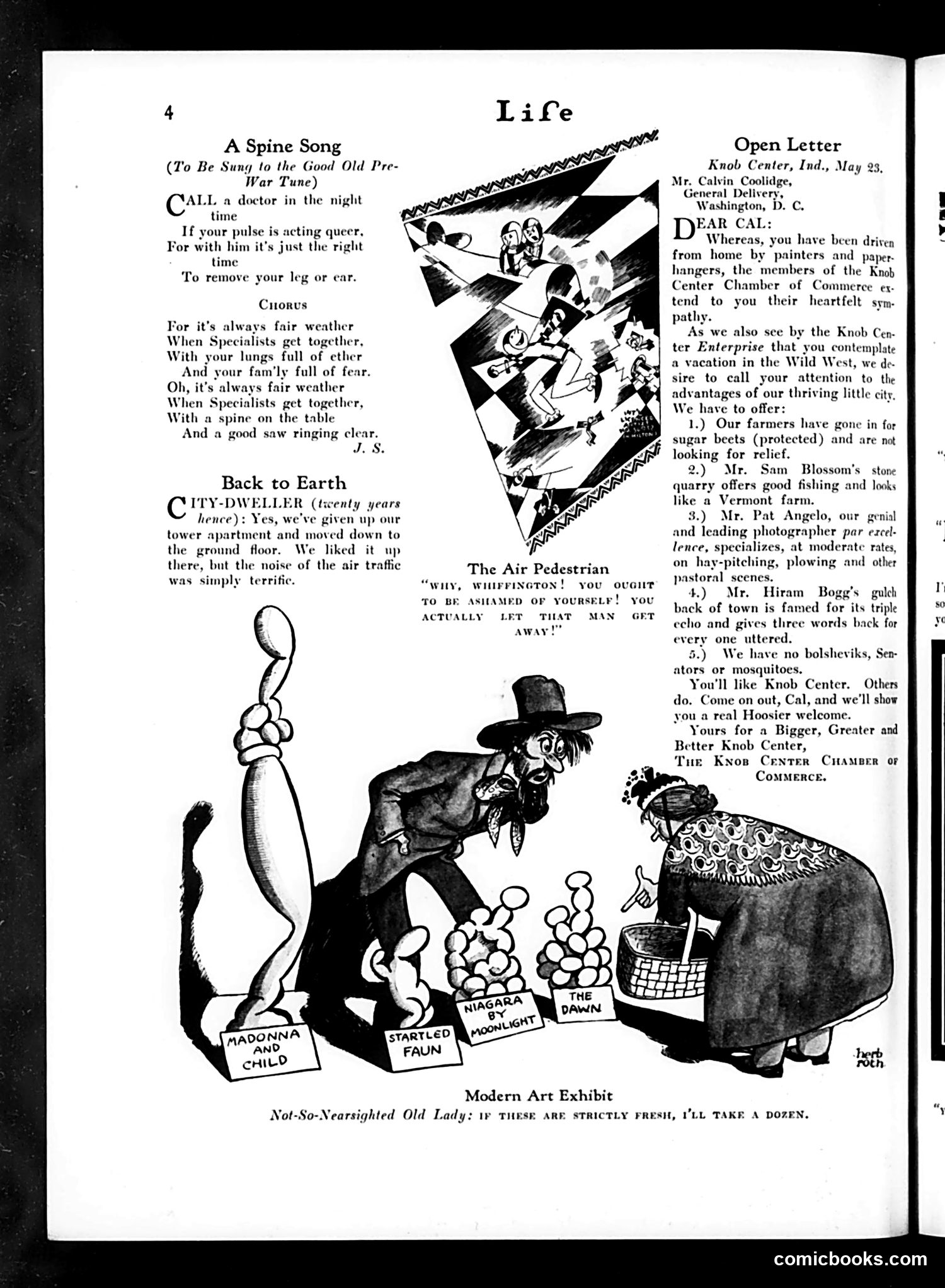
The "Modern Art Exhibit" cartoon at bottom satirizes modernist art movements through exaggerated sculptures. An elderly woman examines abstract pieces labeled "Madonna and Child," "Startled Faun," "Niagara by Moonlight," and "The Dawn." Her comment—"If these are strictly fresh, I'll take a dozen"—suggests she mistakes avant-garde art for produce, mocking both modernism's obscurity and wealthy collectors' pretension in acquiring it. The page also contains "A Spine Song" (medical humor), "Back to Earth" (urban-to-rural migration commentary), and "The Air Pedestrian" (early aviation satire). An "Open Letter" from Knob Center Chamber of Commerce promotes rural Indiana as vacation destination, humorously contrasting city life's noise and congestion with pastoral simplicity.
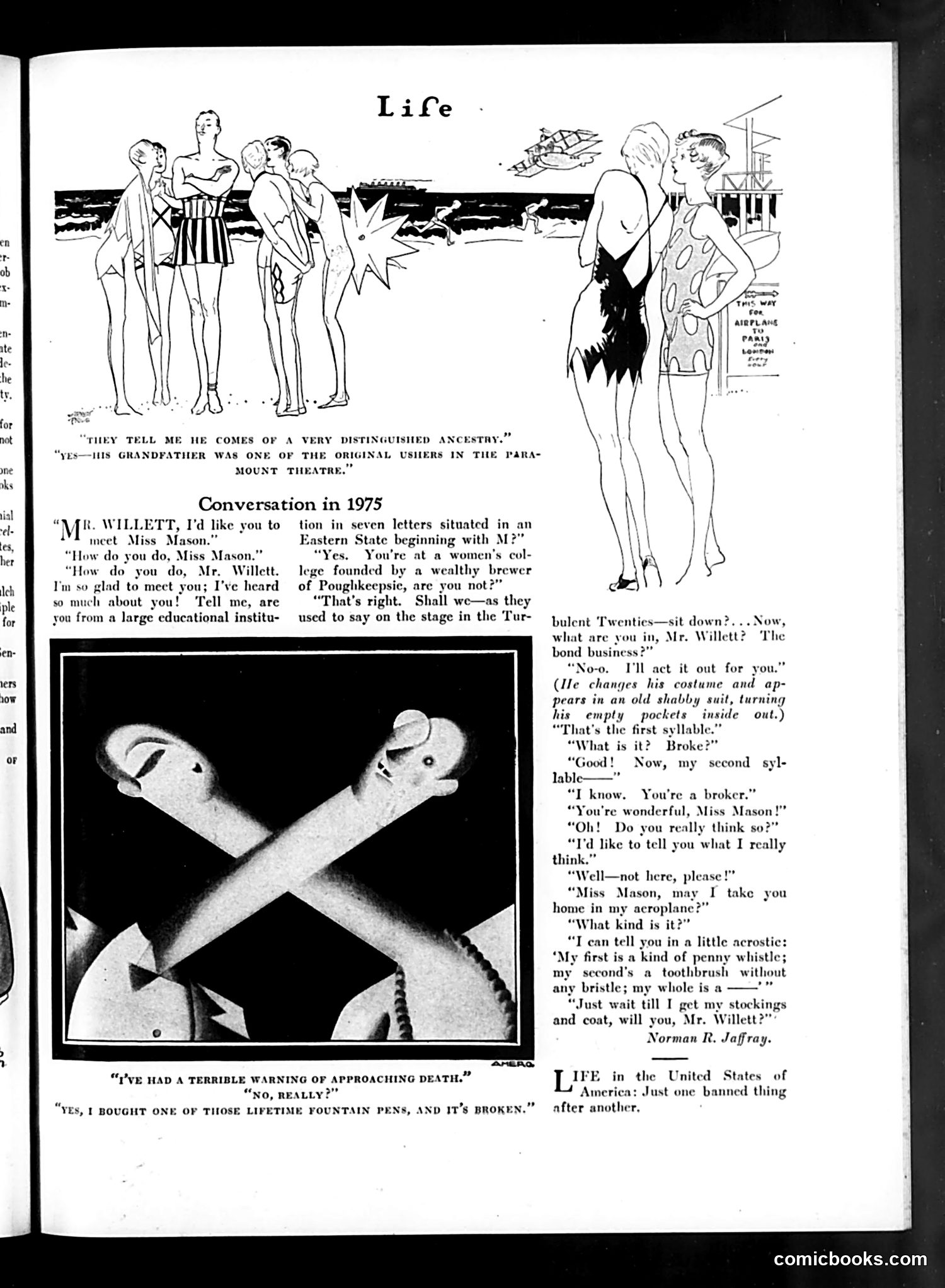
This page satirizes 1920s social pretension and dating culture. The top cartoon mocks a young man's boasting about his distinguished ancestry—specifically claiming his grandfather was "one of the original ushers in the Paramount theatre," a joke equating minor theater employment with genuine aristocracy. The main section, "Conversation in 1975," depicts a flirtation between Mr. Willett and Miss Mason at what appears to be a beach resort. The humor centers on Willett's transparent business pitch disguised as romance—he offers to take Miss Mason on an airplane ride while actually promoting an acrostie (a word puzzle). The satire targets male duplicity in courtship and commercial hustle masked as leisure-class sociability.
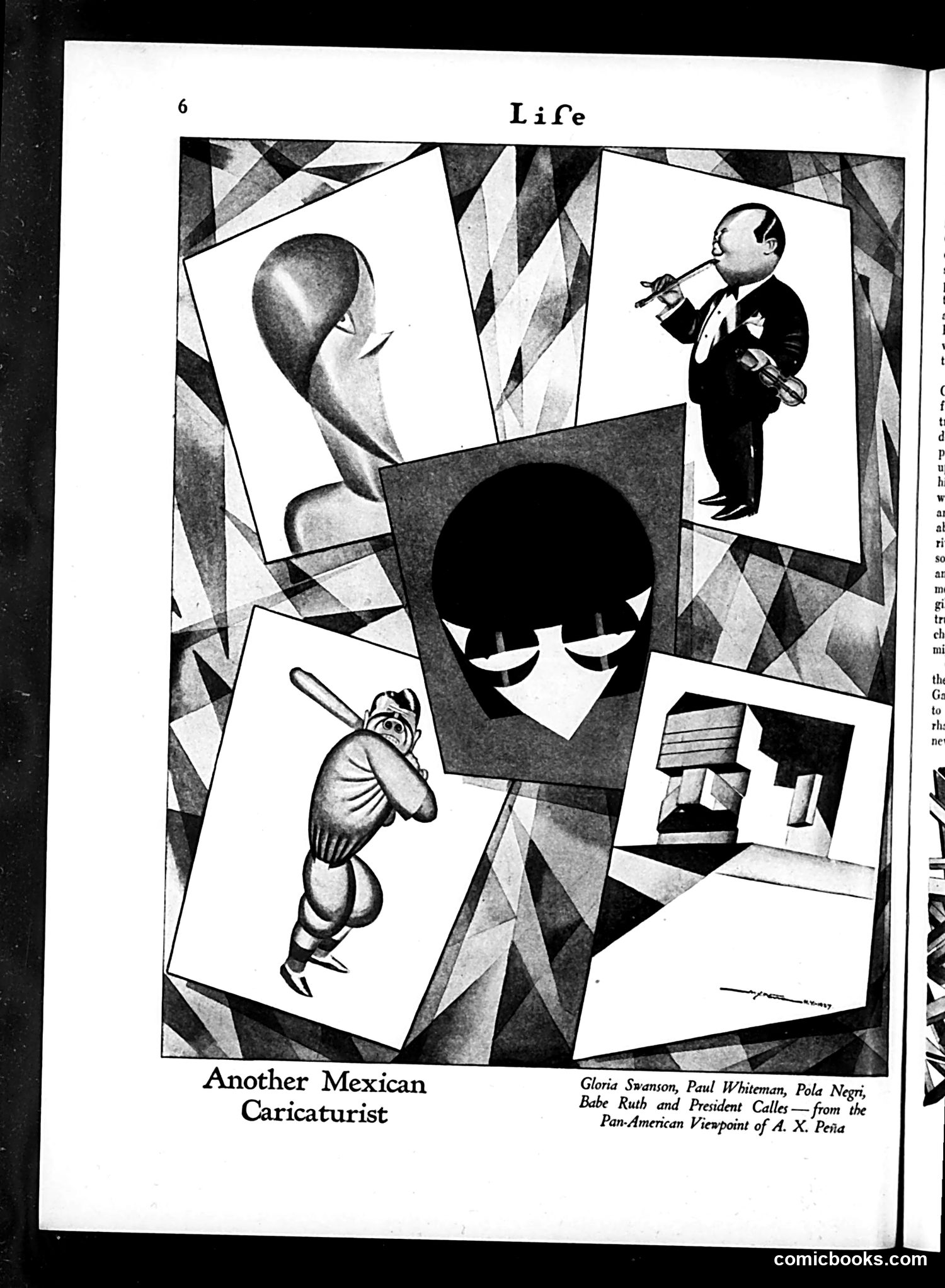
This satirical piece presents caricatures of American celebrities viewed through a Mexican perspective, credited to artist A. X. Peña. The page shows exaggerated portrait studies featuring Gloria Swanson, Paul Whiteman, Pola Negri, Babe Ruth, and President Coolidge. The satire works on two levels: it mocks both the subjects being caricatured and the style of Mexican caricature itself. The geometric, cubist-influenced background and distorted facial features represent how Mexican artists might view these American cultural icons. The humor derives from seeing familiar American figures rendered as grotesque through an unfamiliar artistic lens, playing on 1920s anxieties about foreign perspectives and artistic modernism while simultaneously exoticizing Mexican art traditions.
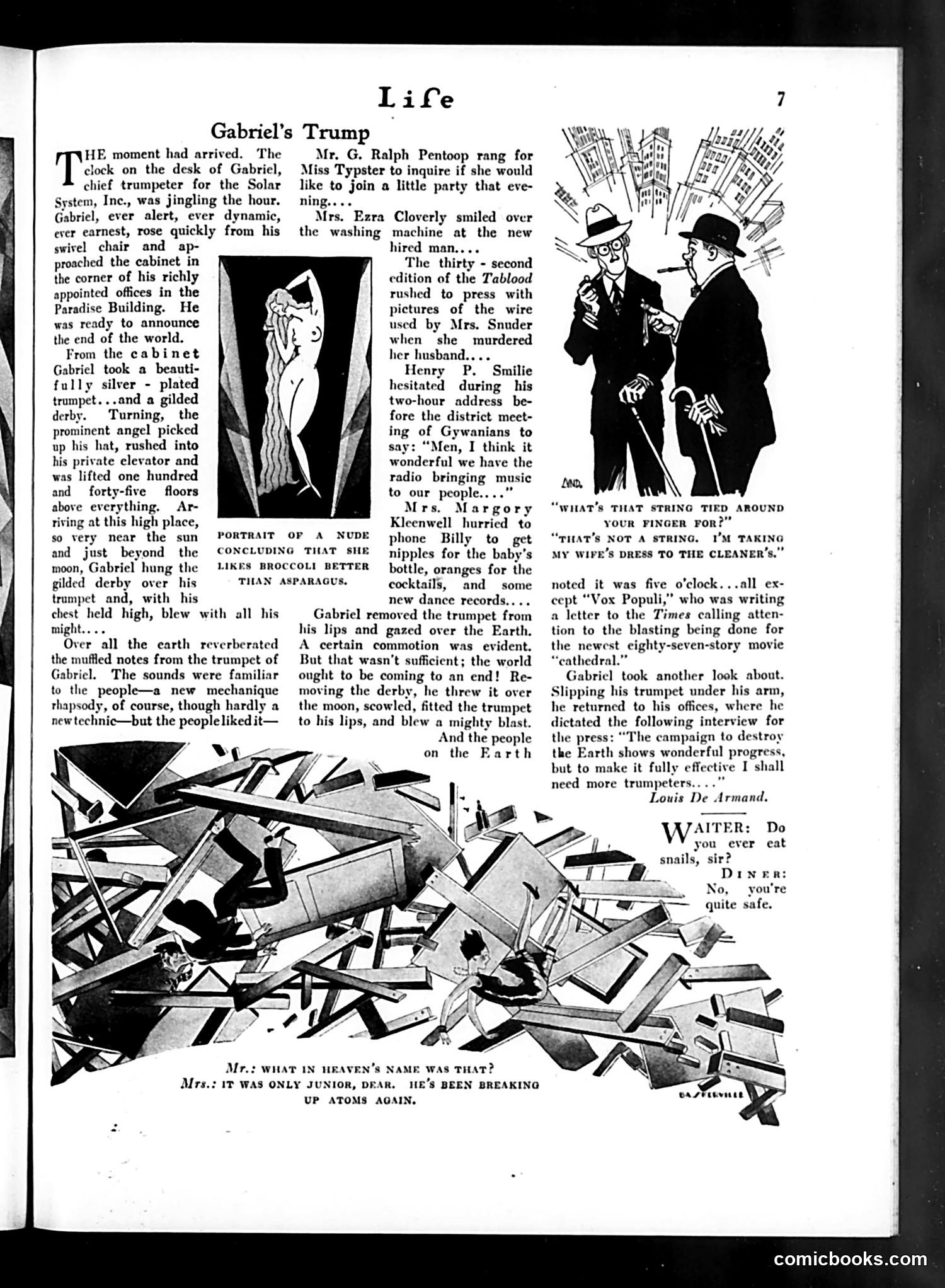
This satirical story mocks contemporary 1920s-30s sensationalism and tabloid journalism. Gabriel, the archangel, uses his trumpet to end Earth—but finds the world already morally collapsed through human folly. The narrative ridicules: **Current events referenced:** - Tabloid newspapers (the *Tabloid* edition featuring a murder case) - Radio bringing "music to the people" - Movie industry (the "eighty-seven-story movie 'Cathedral'") - Trivial celebrity gossip and social parties **The satire's point:** Rather than divine judgment destroying civilization, human society has already degraded itself through superficial media, entertainment, and materialism. Gabriel's trumpet becomes redundant—the world needs no supernatural intervention to collapse. The accompanying cartoons mock marital discord and domestic absurdity, reinforcing the theme of human moral failure.
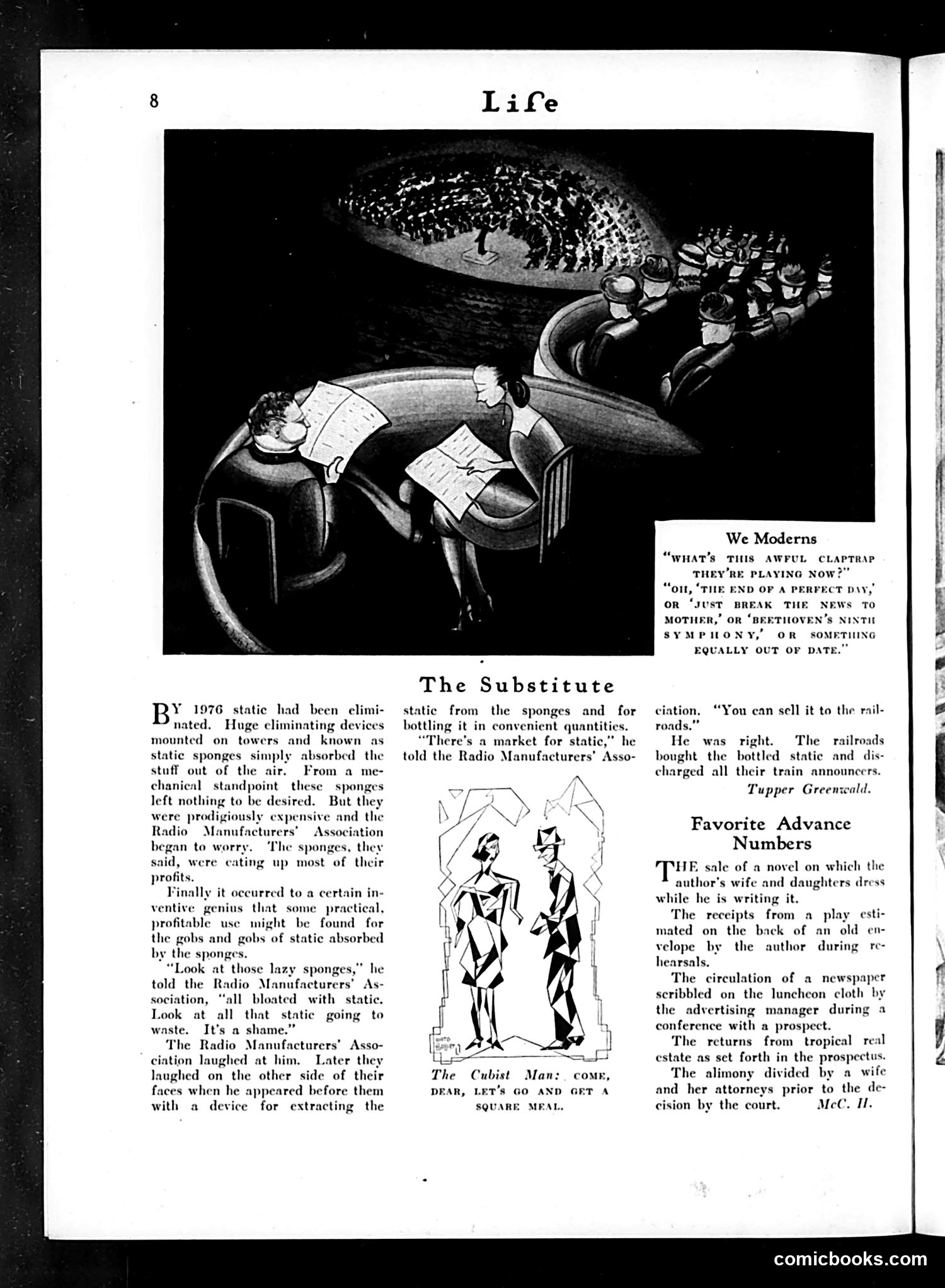
The main cartoon "The Substitute" satirizes radio static elimination technology circa 1926. Radio manufacturers developed sponges to absorb static interference, but these were expensive and consumed profits. A clever engineer proposed using "lazy sponges"—essentially rebranding the same technology as waste absorption—to the Radio Manufacturers' Association. The joke: they could sell the identical product to railroads as static eliminators, extracting the static from train announcers' broadcasts. The secondary cartoon "The Cubist Man" shows two fashionably-dressed figures in a geometric art style, with the caption suggesting they should leave for "a square meal"—a pun on cubist angular aesthetics versus hunger. Both target early 20th-century commercial absurdity and artistic pretension.
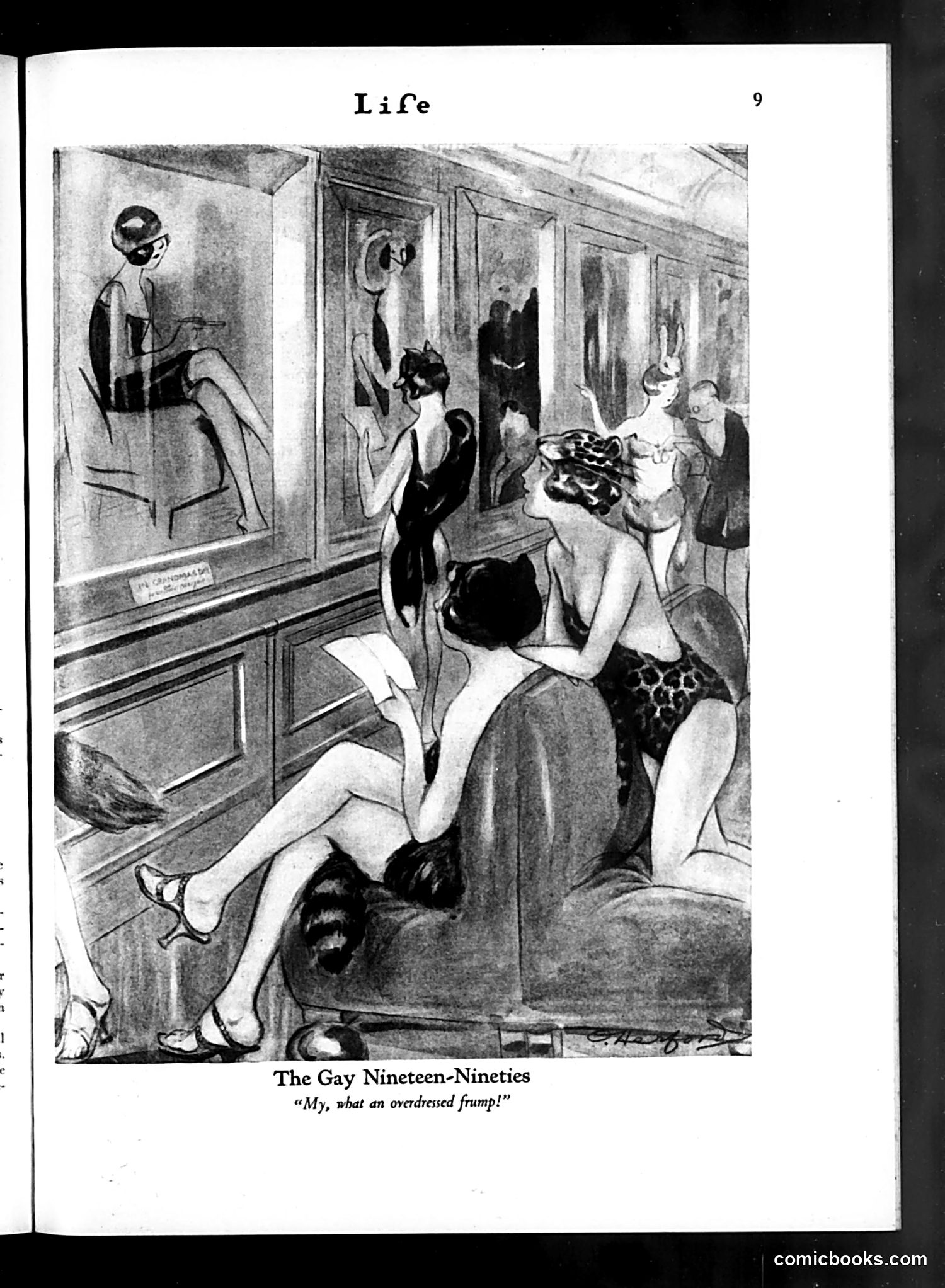
This satirical cartoon from *Life* magazine depicts fashionable women in what appears to be a shop window display, viewing mannequins or other women modeling clothing. The caption "My, what an overdressed frump!" suggests the joke concerns fashion standards and social commentary on women's appearance. The title "The Gay Nineteen-Nineties" references the 1890s era, likely contrasting past fashion sensibilities with contemporary (to the magazine's publication) standards. The satire appears to mock either the excesses of 1890s fashion or the cattiness of women critiquing each other's dress choices. The window-display framing emphasizes how women were publicly evaluated as objects of aesthetic judgment, a recurring theme in period satire about gender and vanity.
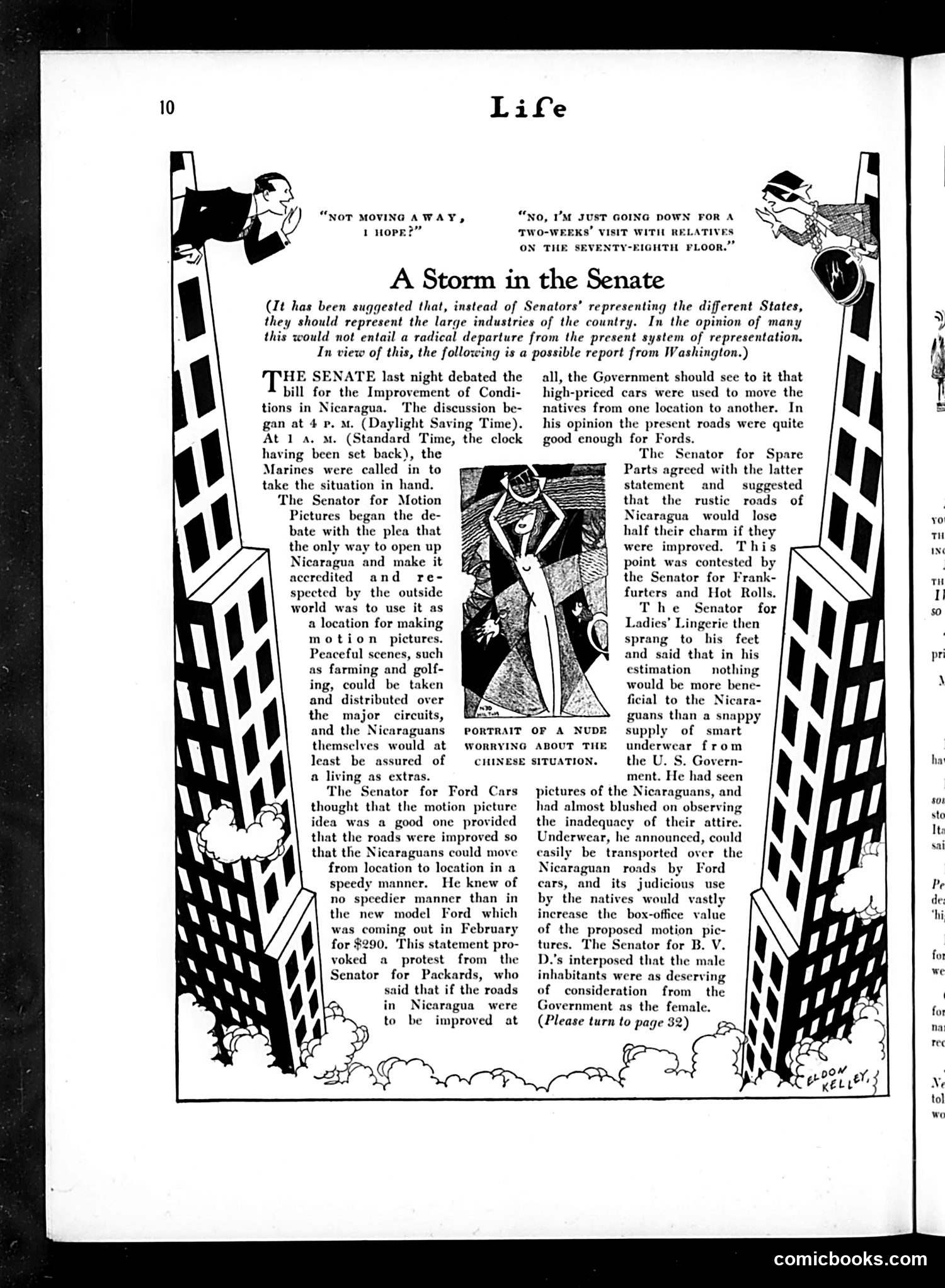
This satirical piece mocks a Senate debate about improving roads in Nicaragua. The cartoon depicts senators arguing over whether the government should fund better infrastructure there. The satire targets several absurd positions: one senator argues Nicaragua should remain underdeveloped to preserve its "charm" for motion pictures; another suggests the real benefit would be improved American car sales (Ford specifically); a third argues that better roads would only increase underwear imports from the U.S. The central illustration shows a nude woman labeled "Portrait of a Nude Worrying About the Chinese Situation," satirizing how disconnected these debates were from actual geopolitical concerns. The piece ridicules senators for prioritizing trivial commercial and aesthetic interests over genuine foreign policy considerations.
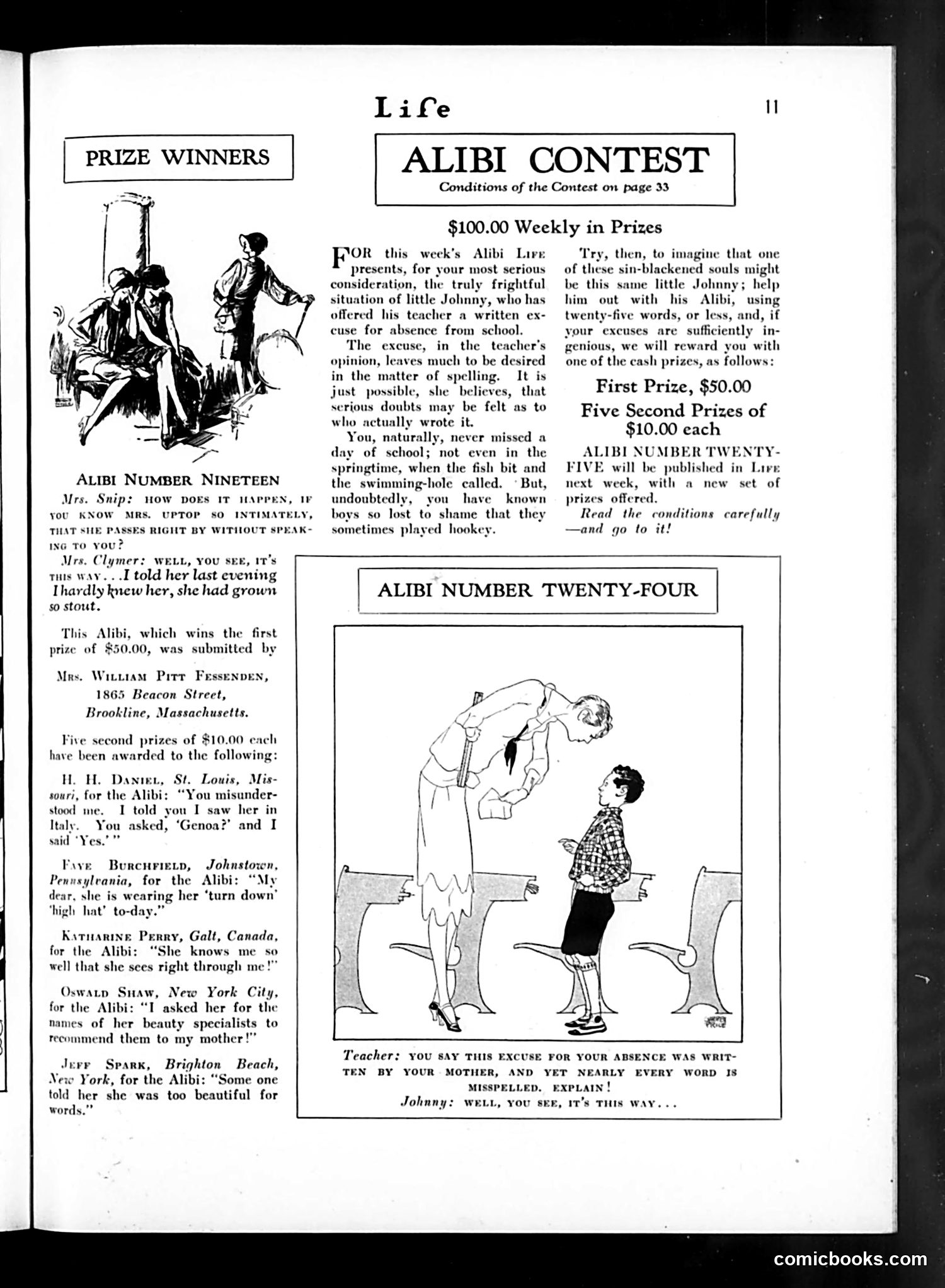
This page features an "Alibi Contest" — a humor competition where readers submit excuses for misbehavior. The winning entry, submitted by Mrs. William Pitt Fessenden of Brookline, Massachusetts, won $50.00. The featured cartoon (Alibi Number Twenty-Four) shows a schoolboy caught by his teacher with a fabricated written excuse for absence. The boy claims his mother wrote it, but the teacher notes that nearly every word is misspelled—suggesting the boy actually wrote it himself, poorly, attempting deception. The joke mocks a common childhood trick: forging a parent's note to skip school. The satire targets both the boy's transparent dishonesty and the universal gap between children's literacy and their parents'. The contest invited readers to submit similar humorous excuses and explanations for everyday transgressions.
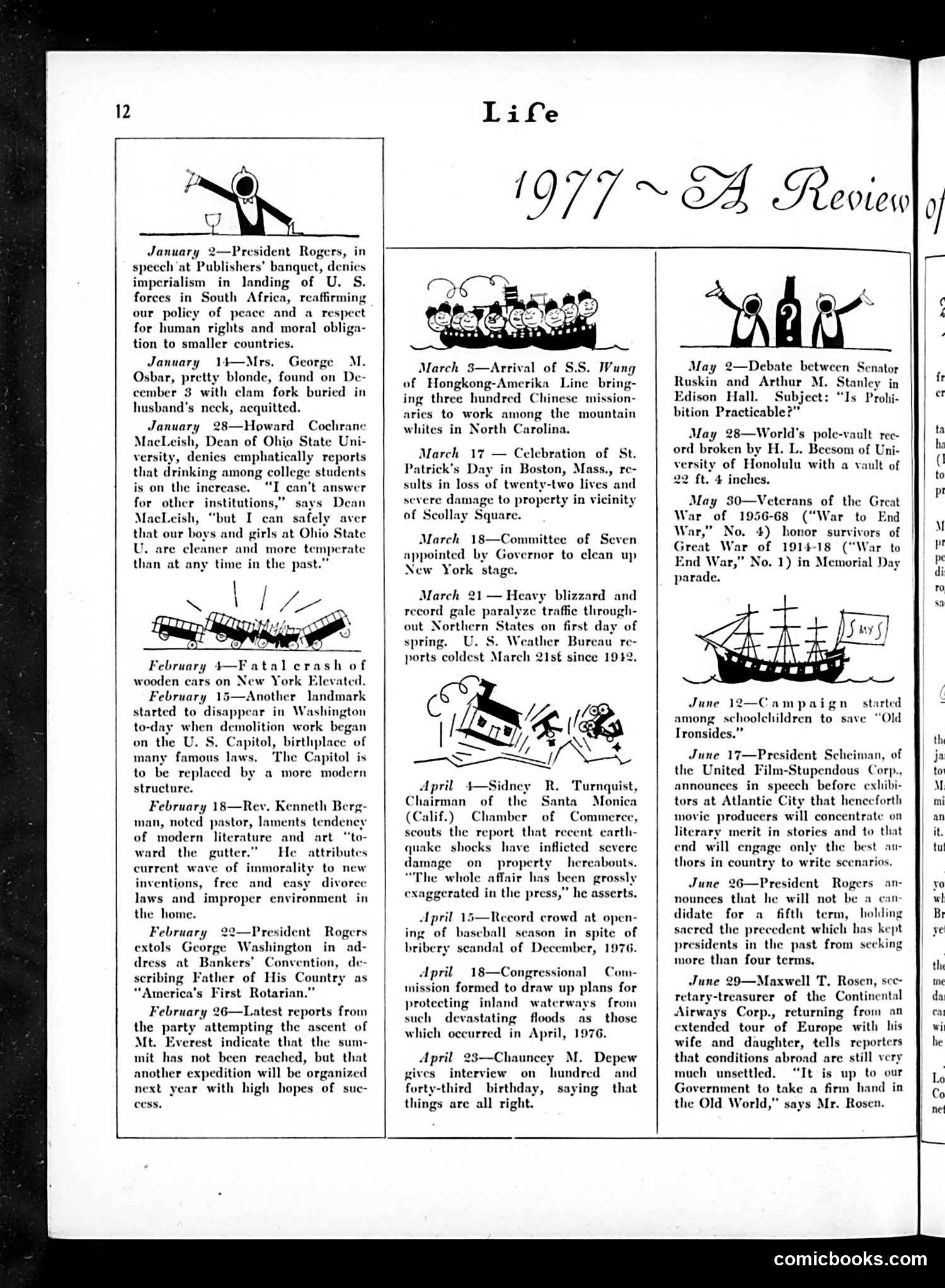
This page presents a chronological summary of 1977's major events through brief text entries and accompanying illustrations. Key items include: - **January 2**: President Rogers denouncing imperialism in U.S. foreign policy - **February 4**: A fatal elevated train crash in New York (illustrated with a derailed car) - **February 22**: President Rogers at George Washington's birthday celebration - **March-April**: Various events including the S.S. Wang arrival, St. Patrick's Day celebration in Boston, congressional flood-protection plans, and an earthquake in California - **May-June**: A pole-vault record, a debate in Edison Hall, a campaign to save "Old Ironsides" (illustrated with a ship), and President Rogers announcing he won't seek reelection The page functions as a satirical year-in-review, using simple illustrations to highlight notable news stories and political developments from 1977.
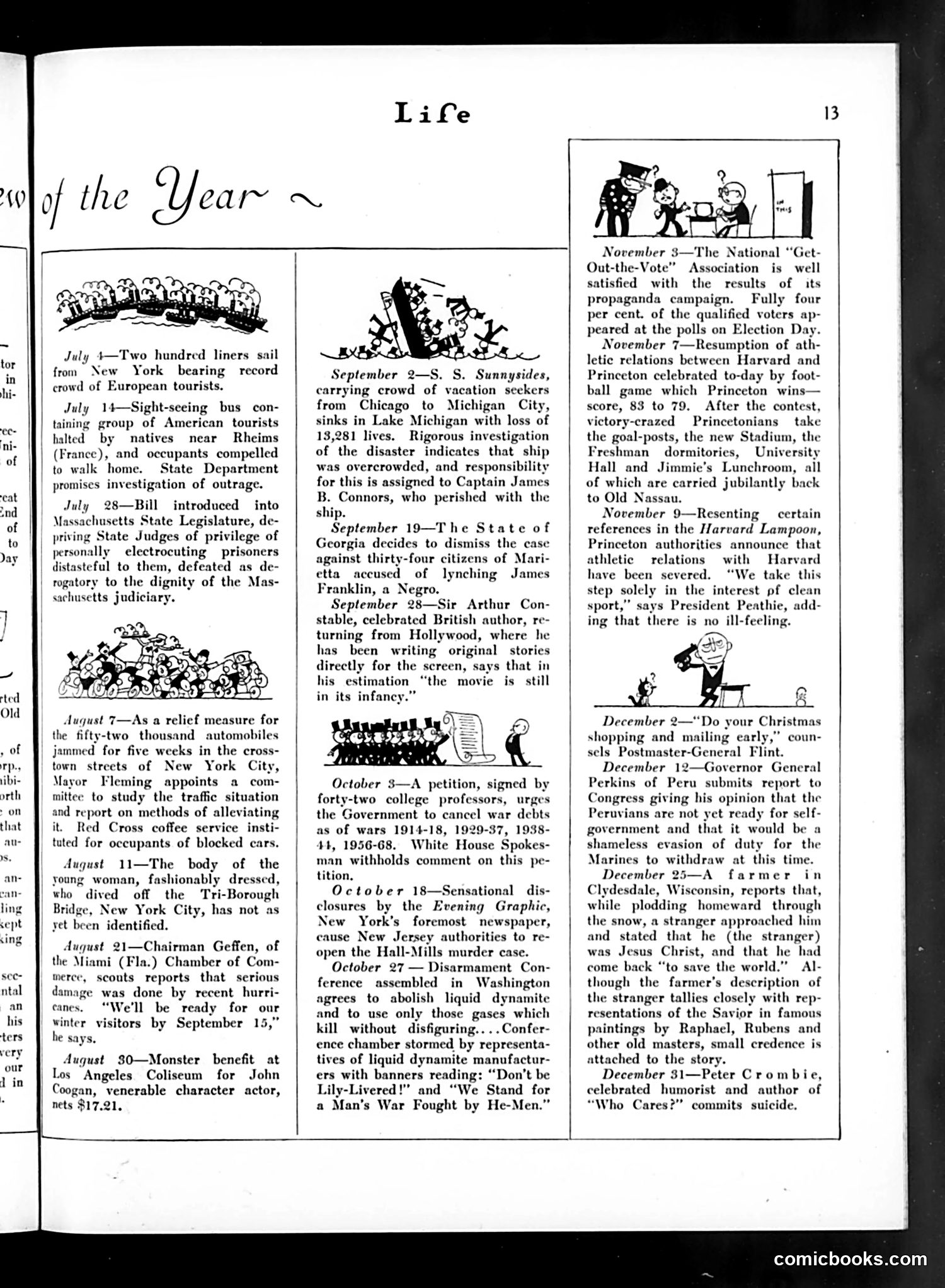
This page presents a chronological digest of 1924 events with accompanying cartoons. The entries mix political, social, and entertainment news: **Key References:** - **July 4**: 200 ocean liners and a sightseeing bus incident involving American tourists near Rheims, France - **September 2**: S.S. *Sunnyside* ship disaster in Lake Michigan - **September 19**: State of Georgia dismisses a lynching case against 34 citizens - **October 27**: A disarmament conference in Washington debates abolishing liquid dynamite The cartoons use exaggeration and visual humor to satirize these events—overcrowded vessels, bureaucratic bungling, and political hypocrisy. The style reflects 1920s satirical conventions: simple line drawings with captions explaining contemporary disasters, reforms, and social absurdities for the educated readership of *Life* magazine.
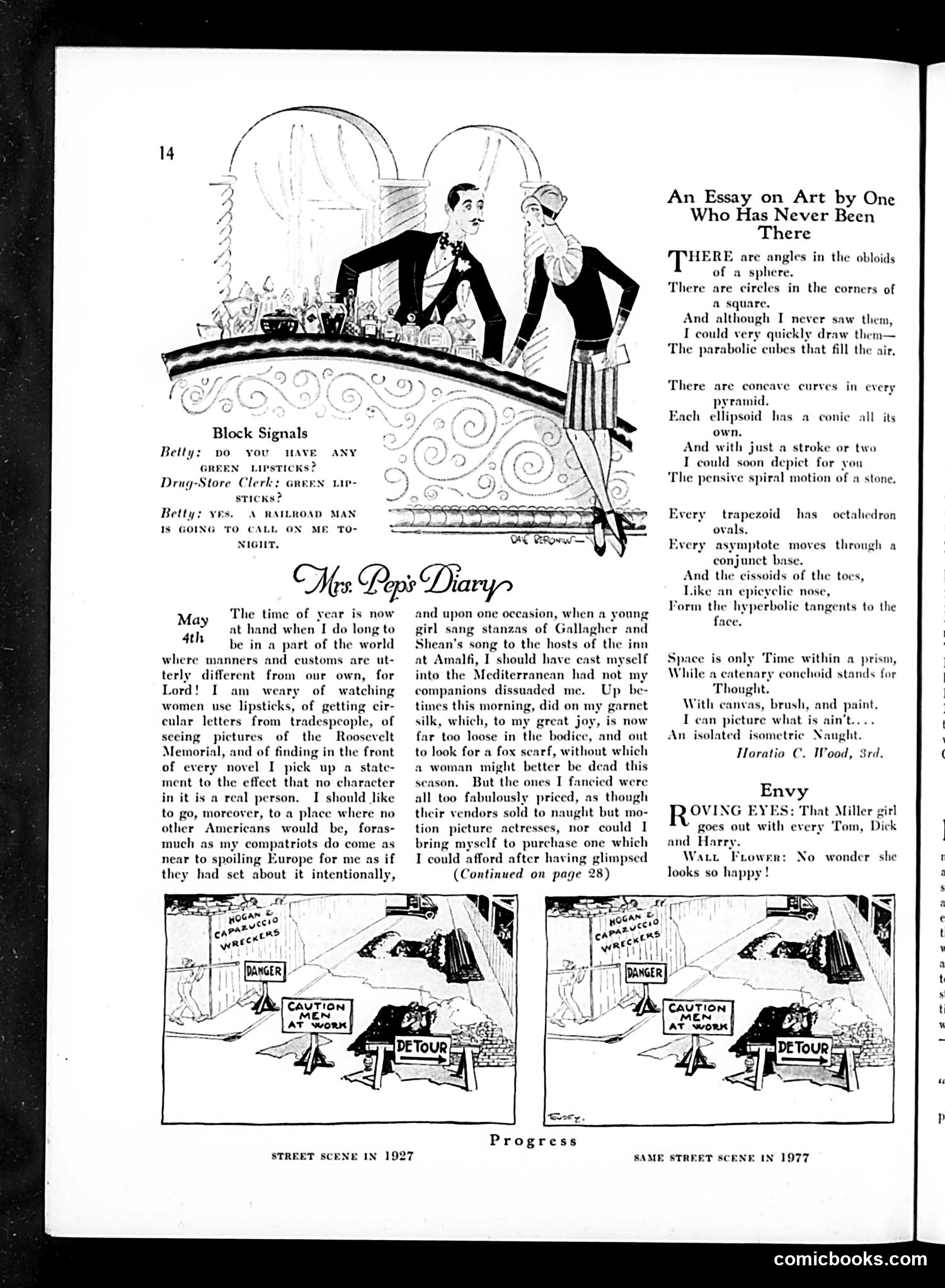
This page contains three main elements: **"Block Signals"** (top): A cartoon joke about a woman named Betty who claims to have "green lipsticks" from a drug store, which a railroad man will supposedly call on her about tonight—the humor relies on the double meaning of "green" (inexperienced/naive). **"Mrs. Pep's Diary"** (center): A dated social column where the author describes European travel and fashionable women's customs, including lipstick use—reflecting 1920s concerns about modern women's cosmetics and behavior. **"Progress"** (bottom): A before-and-after cartoon comparing a street construction site in 1927 versus 1977, satirizing slow urban development and bureaucratic red tape (the same warning signs remain unchanged fifty years later). The overall page reflects 1920s anxieties about modernity, women's changing roles, and American progress.
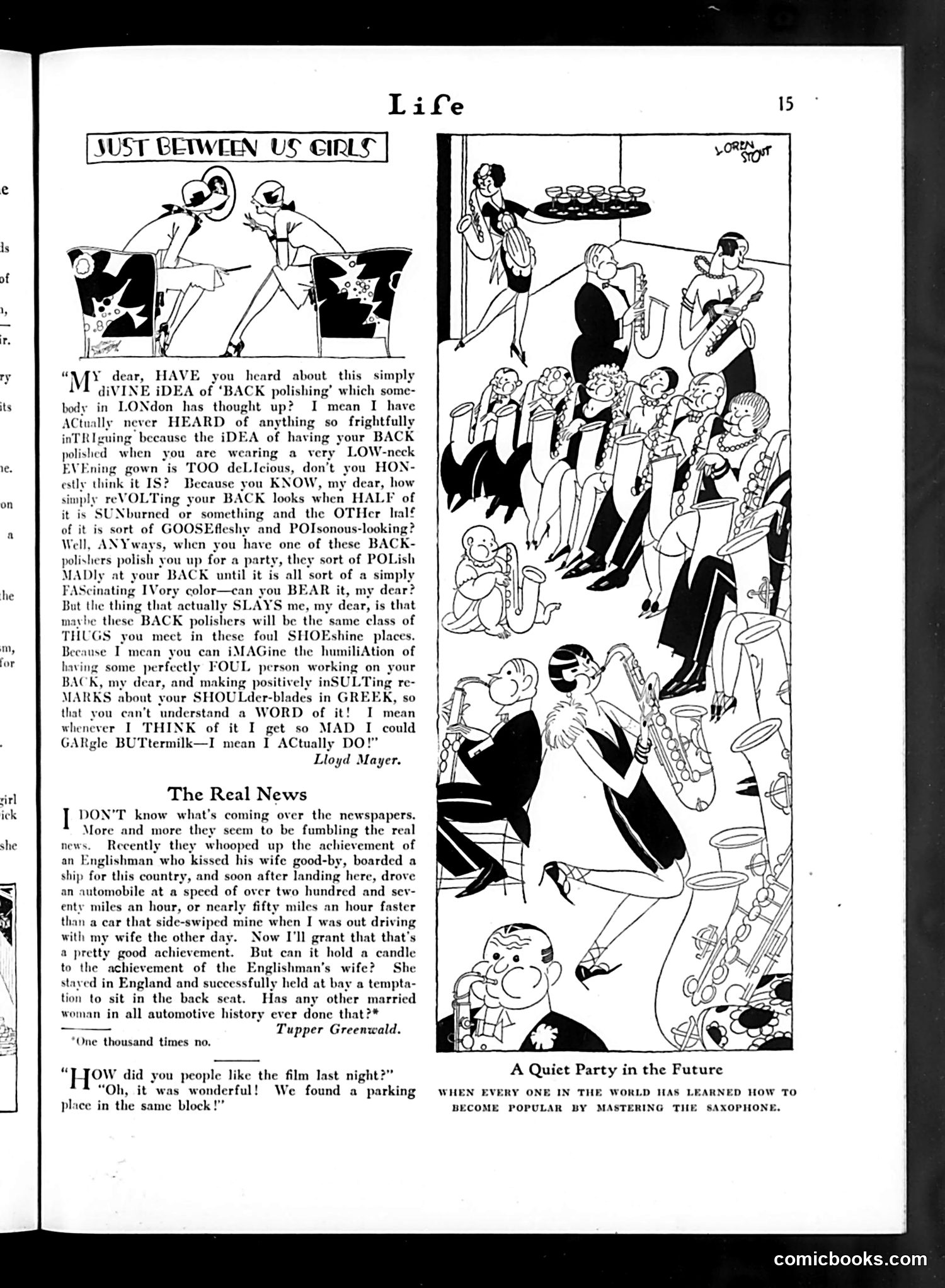
The top cartoon satirizes women's fashion obsession with "back polishing"—applying polish to expose low-neckline evening gowns. Lloyd Mayer's column mocks how women discuss this beauty trend in hushed, dramatic tones, treating it as scandalous. The humor lies in elevating a trivial grooming practice to pseudo-forbidden status. The right-side cartoon, "A Quiet Party in the Future," depicts a wild saxophone jazz party. Its caption predicts that when everyone masters the saxophone, parties will become unbearably loud. This satirizes both the era's jazz craze and the common fear that popularizing something ruins it—a commentary on 1920s cultural anxieties about mass entertainment and social homogenization.
This page contains editorial commentary rather than a cartoon. The main illustration is a decorative header showing a skeleton or death figure labeled "LIFE," establishing the satirical tone. The text discusses concerns about world crisis, religious fundamentalism, and scientific predictions about civilization's future. It references Macaulay's comments on bishops and mentions specific concerns about British-Israel groups, cults, and prohibition-era problems. The editorial appears skeptical of both religious prophets making apocalyptic predictions and scientists offering dire forecasts. It expresses worry about social instability—mentioning rum distribution and prohibition enforcement—while suggesting that reasonable solutions exist if people would pursue them rather than embrace extreme ideologies or panic predictions. The piece advocates rational, moderate approaches to contemporary anxieties.
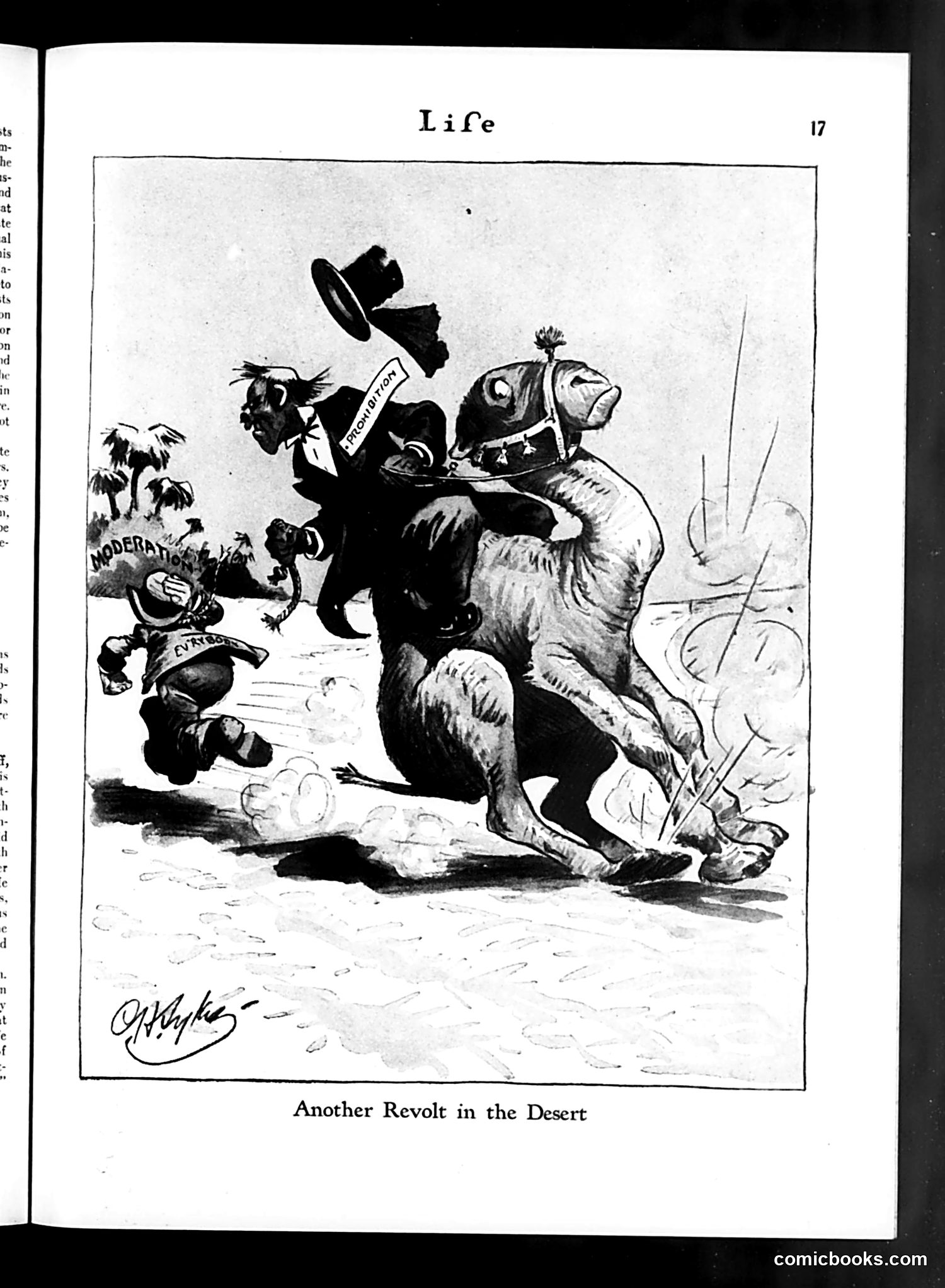
This political cartoon depicts a camel rider in military dress and decorative headgear experiencing a revolt—the camel is bucking and throwing the rider's possessions (including a hat) into the air. On the left, a small figure labeled "MODERATION" appears to be fleeing or falling. The cartoon satirizes instability in a desert region, likely referencing Middle Eastern or North African colonial conflicts. The "revolt" is both literal (the camel bucking) and metaphorical (political upheaval). The loss of "moderation" suggests the cartoonist views the uprising as chaotic or extreme. Without a date or more context, the specific historical event is unclear, but this appears to critique either colonial military ventures or regional power struggles common to early-20th-century geopolitics.
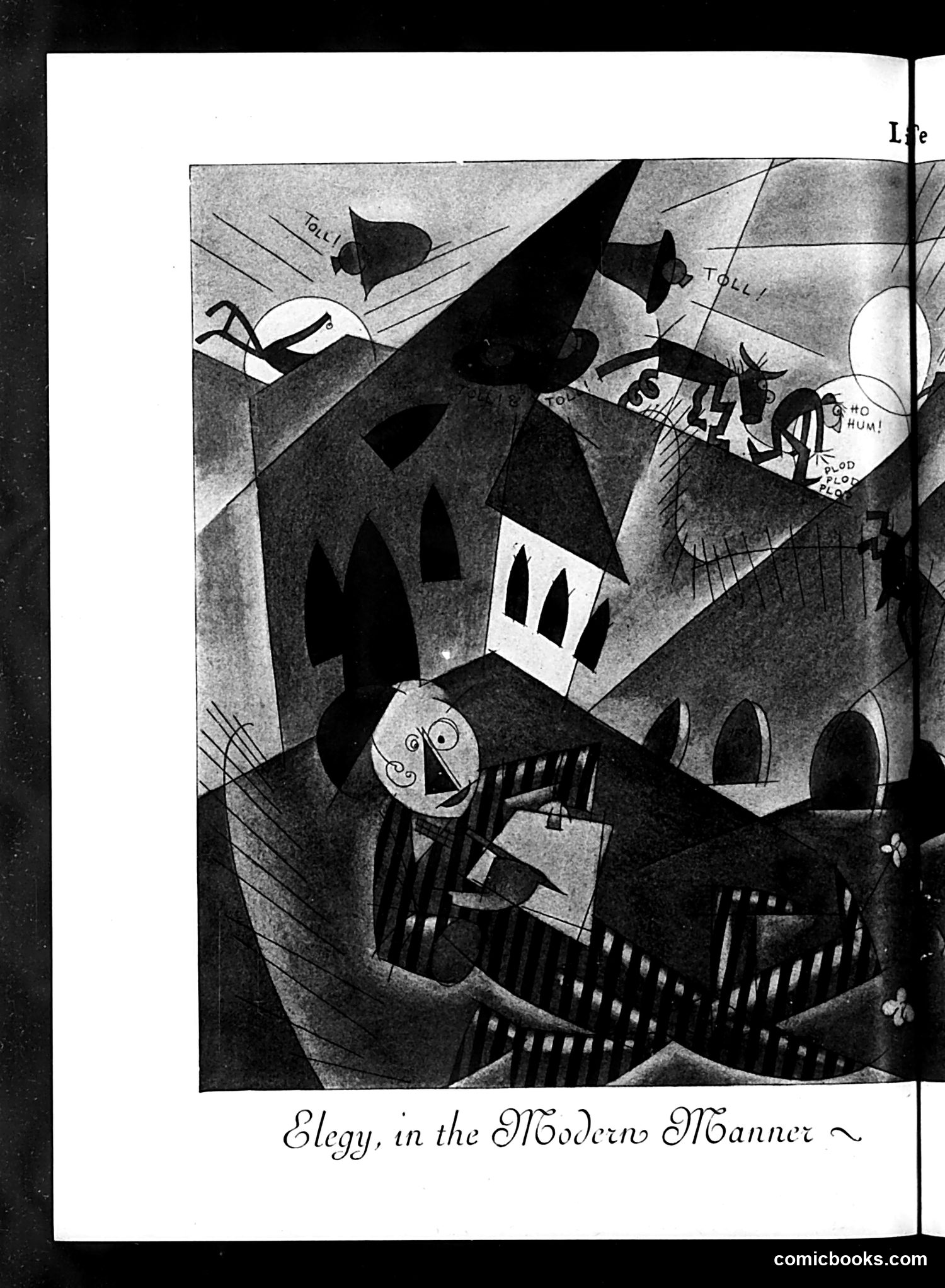
This satirical cartoon depicts a grotesque figure in a witch's hat standing in a Gothic castle, using a megaphone or amplifier device. The figure appears to be a caricature of modernist or avant-garde artistic/literary practices. The "modern manner" referenced in the title likely mocks contemporary experimental art movements popular in the 1920s-30s. The exaggerated, distorted style of the illustration itself mimics modernist aesthetics while critiquing them—a meta-joke where the cartoon's own visual approach parodies what it's attacking. The castle setting and theatrical presentation suggest satire of pretentious, overly dramatic modern artistic expression. The specific figure and cultural reference remain unclear without additional context.
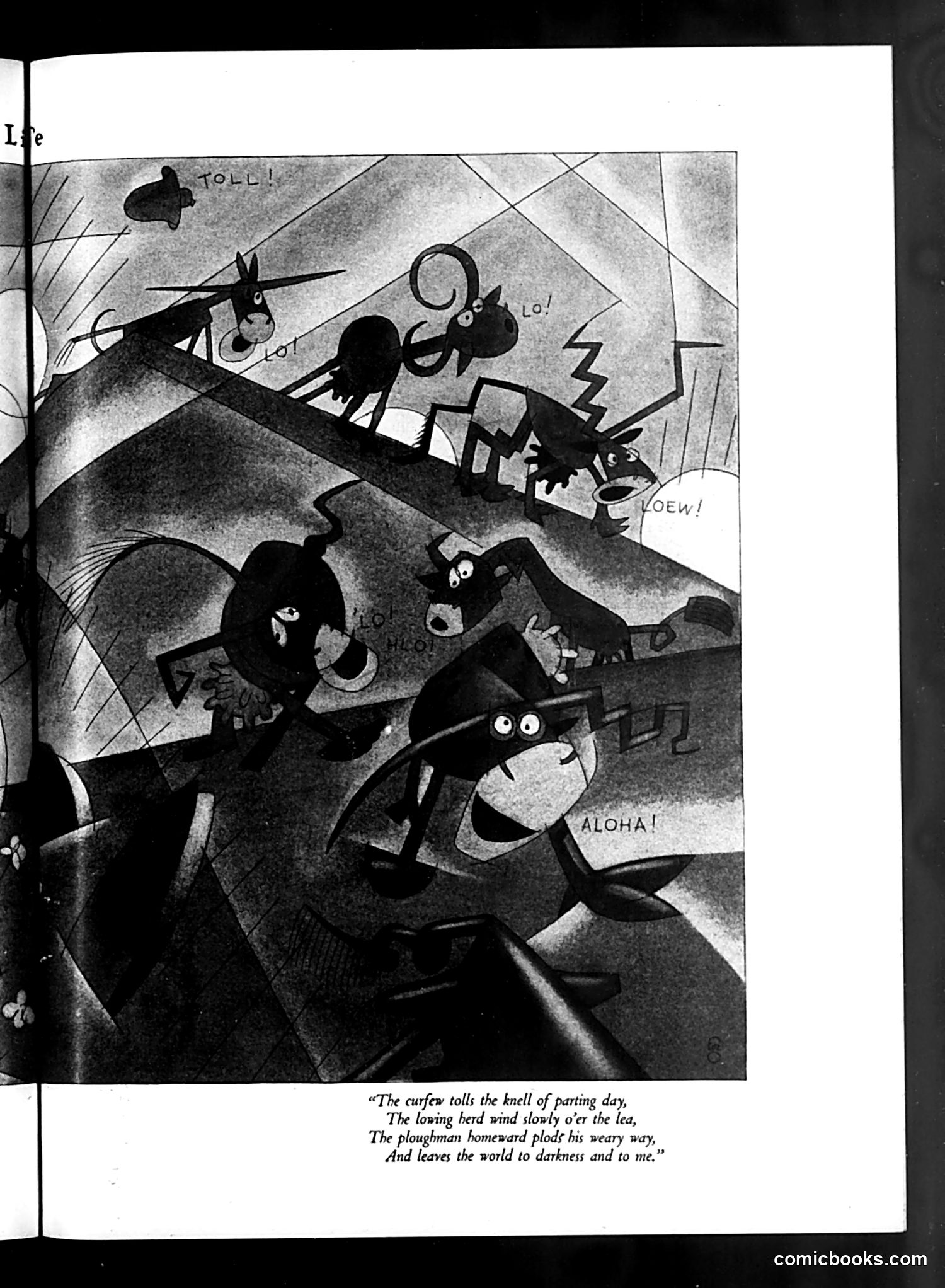
This appears to be a humorous illustration accompanying a poetic passage (from Gray's "Elegy Written in a Country Churchyard"). The cartoon depicts anthropomorphic animals—likely cows or cattle—in an exaggerated, chaotic scene within what appears to be a barn or farm structure. The animals are making various vocalizations ("TOLL!", "LO!", "OEW!", "ALOHA!"), creating comedic cacophony that directly mocks the poem's serene, melancholic tone about pastoral quietude and twilight. The joke satirizes the romanticized literary vision of farm life by showing its actual, noisy reality. Rather than peaceful solitude and contemplative darkness, the farm is loud and disruptive—the opposite of what the classical poem promises. This is characteristic of *Life* magazine's gentle, literary-minded humor.
This page critiques several Broadway plays opening that season, written with satirical wit typical of Life magazine's theater reviews. The author skewers four shows—"Julie," "Katy Did," "He Loved the Ladies," and "Oh, Ernest!"—as poorly conceived dramas that audiences endure only briefly before leaving. "Julie" mocked French-Canadian dialect; "Katy Did" had a nonsensical plot about a waitress marrying a king; "Oh, Ernest" attempted to parody Oscar Wilde's work but failed. The main target is "Triple Crossed," a murder mystery that becomes absurdly meta: an actor is killed onstage, but this killing is revealed as part of the play itself—creating confusion between reality and performance. The author notes the play's copyright predates "The Spider" (suggesting accusations of plagiarism), but suggests the derivative work's convoluted plot actually parodies its inspiration. The satire extends to practical absurdity: these plays cast so many audience members as actors that they sell out despite minimal actual attendance—a financial fiction.
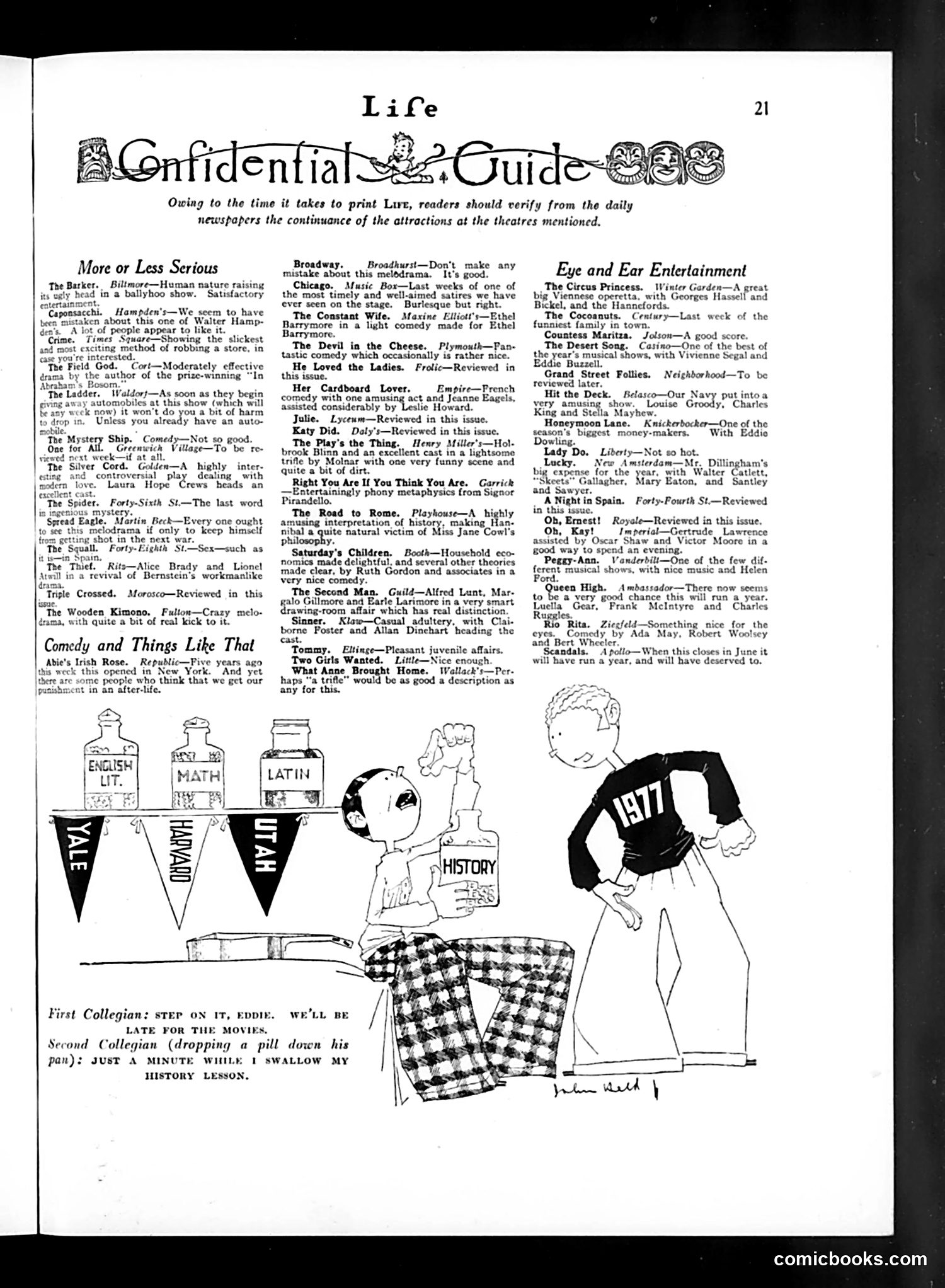
This is a theater review and entertainment guide from Life magazine, circa mid-1920s. The main content catalogs Broadway shows and movies with brief, witty assessments—typical of Life's satirical theater criticism of the era. The cartoon below illustrates college life through two collegians. The first excitedly plans to attend movies, claiming he'll "step on it." The second, casually dropping a pill down his pants, says he'll "just swallow" his history lesson instead—a joke about academic cheating or shortcuts. The visual gag shows bottles labeled "English Lit," "Math," and "Latin" on a shelf, with "History" as a book, all referencing typical college subjects. The satire targets student laziness and the era's growing skepticism toward education's value. The 1927 date on the figure's sweater anchors this to the Jazz Age, when movies were revolutionizing entertainment and college culture was shifting away from traditional academics.
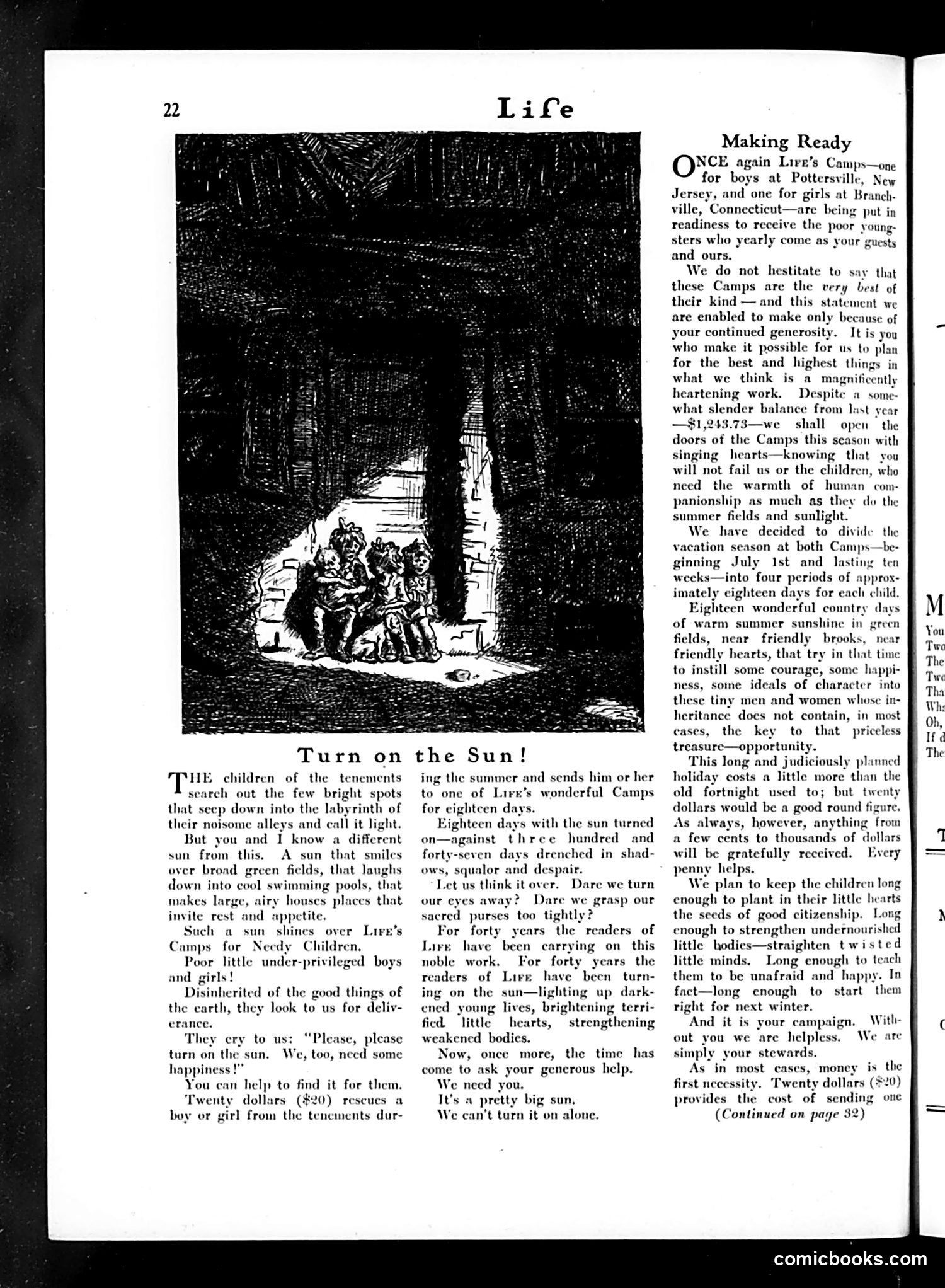
This page presents a fundraising appeal for Life magazine's summer camps for poor urban children. The central image depicts tenement children huddled in dark shadows, contrasting with the text's metaphor of "turning on the sun"—providing privileged summer experiences. The appeal argues that impoverished children deserve access to green fields, swimming pools, and fresh air that wealthier children enjoy. Life has run this charitable program for forty years and now seeks donations (particularly $20 per child) to send underprivileged boys and girls from New Jersey and Connecticut to separate camps for eighteen-day stays. The rhetoric emphasizes moral obligation: "Dare we turn our eyes away? Dare we grasp our sacred purses too tightly?" The satire isn't harsh here—rather, it's a sentimental appeal to readers' conscience, using vivid class contrast to shame the affluent into charitable giving. The "sun" represents opportunity and childhood happiness denied to tenement dwellers.
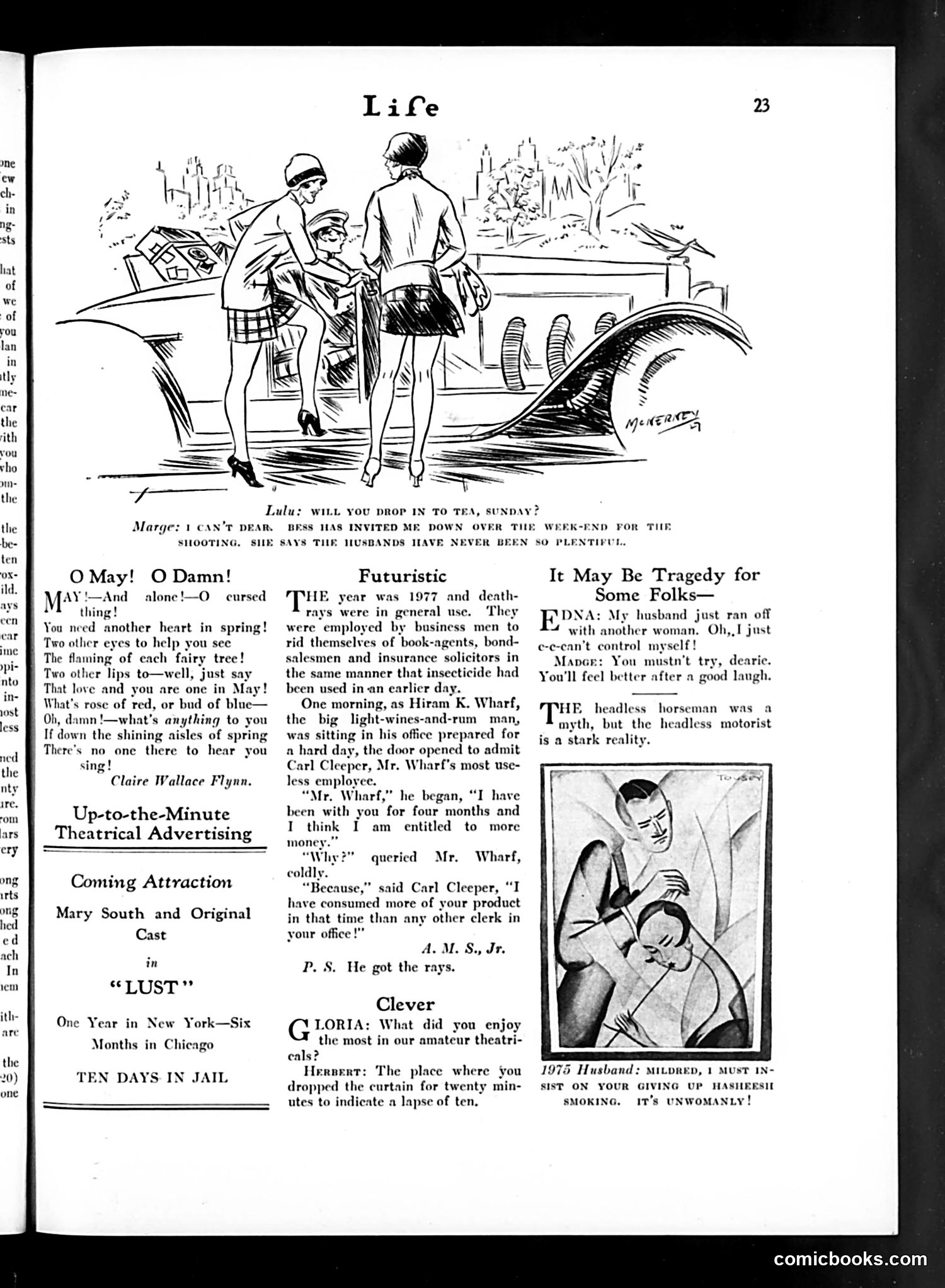
This page contains several satirical pieces typical of 1920s Life magazine: **Top cartoon**: Shows fashionable women at leisure, with dialogue about a weekend shooting party. The satire targets the era's wealthy idle class and their casual social arrangements. **"Futuristic" story**: A darkly comic piece set in 1977 imagining "death-rays" as common business tools for eliminating annoying solicitors. The joke relies on exaggerating contemporary frustrations with persistent salesmen into absurd sci-fi violence. **"Clever" section**: Brief humorous exchanges mocking amateur theater and headless motorists (likely referencing reckless driving). **"It May Be Tragedy for Some Folks"**: Social commentary on marital infidelity and changing gender roles, with 1975 depicting husbands policing women's behavior (smoking deemed "unwomanly"). The overall tone reflects Jazz Age anxieties about modernity, wealth inequality, and shifting social conventions, presented through light satirical humor aimed at educated urban readers.
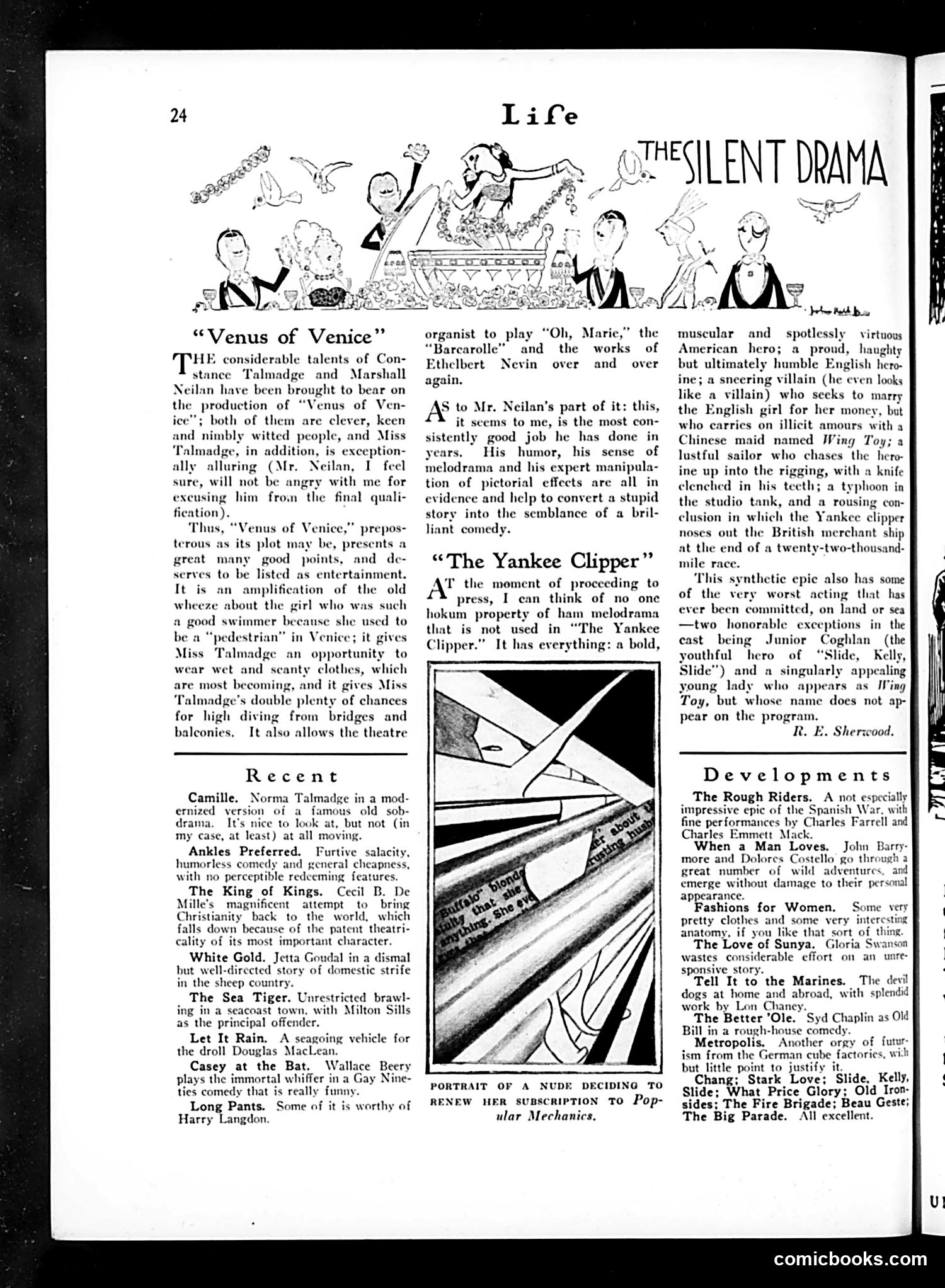
This page reviews contemporary silent films, reflecting the era's entertainment culture. The main cartoon depicts a nude woman deciding to renew her subscription to *Popular Mechanics*—a absurdist joke playing on the incongruity of a figure typically associated with leisure or display reading a technical/industrial magazine. It's satirizing both the magazine's unexpected female readership and perhaps mocking pretensions to intellectualism. The film reviews themselves reveal 1920s cinema conventions: swimming scenes in "Venus of Venice" exist mainly to showcase actress Constance Talmadge in scanty costumes; "The Yankee Clipper" is criticized as melodramatic hokum stuffed with clichéd plot elements (virtuous heroes, sneering villains, typhoons in studio tanks). Reviewer R.E. Sherwood's sardonic tone reflects sophisticated dismissal of formulaic entertainment, while acknowledging occasional bright spots in otherwise mediocre productions. The reviews showcase how silents relied on physical spectacle and visual effects over substantive storytelling.
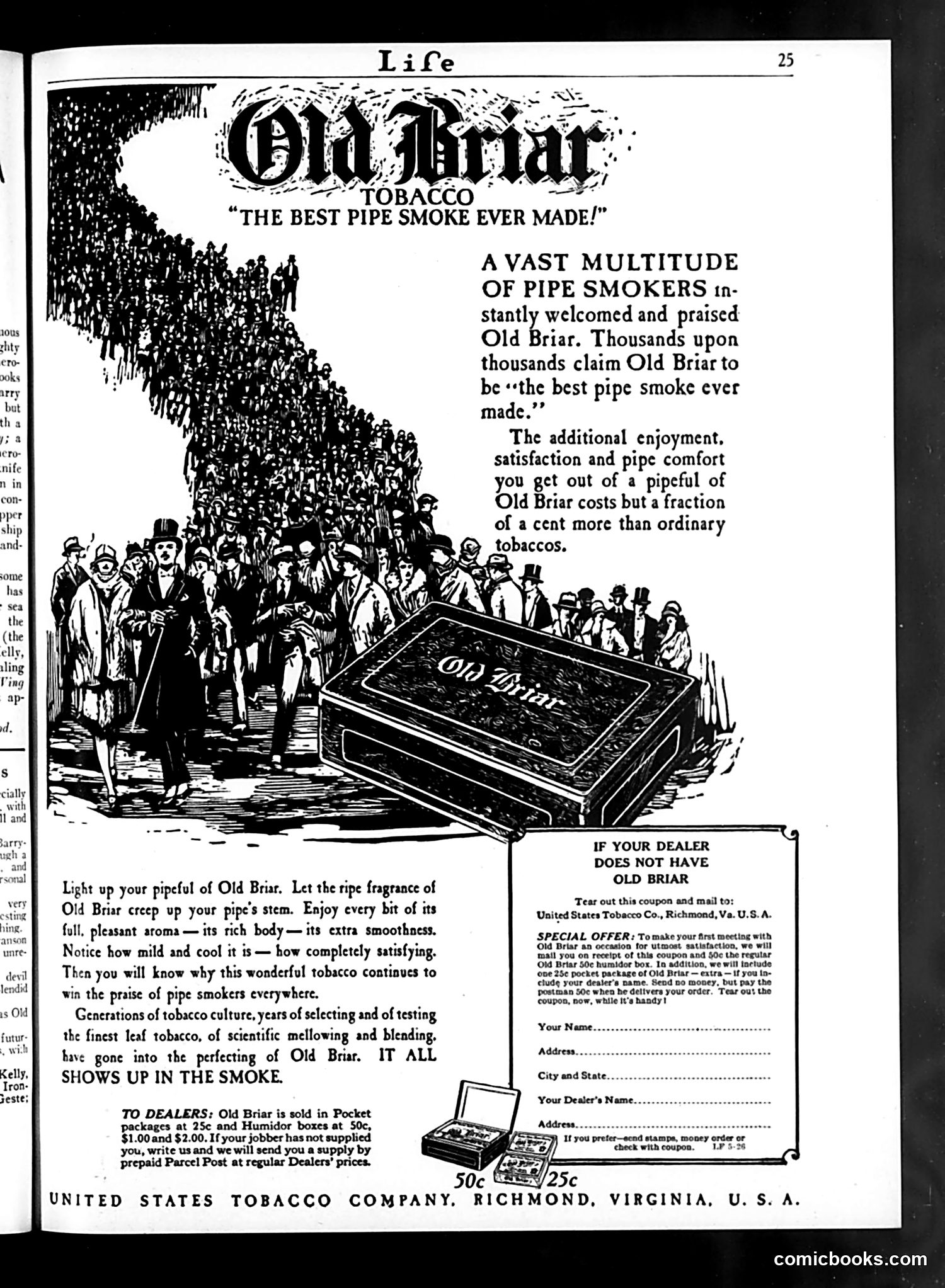
This is primarily a **tobacco advertisement**, not political satire. It appears in Life magazine (likely early 20th century) promoting Old Briar pipe tobacco. The image depicts a massive crowd of men—representing satisfied customers—gathering around an enormous box of Old Briar tobacco, visually emphasizing the product's popularity and universal appeal. The advertisement claims thousands of pipe smokers praise it as "the best pipe smoke ever made." The sales pitch emphasizes value: Old Briar costs only marginally more than cheaper tobaccos while offering superior smoothness, mildness, and aroma. A coupon offers a promotional deal—a 50-cent humidor box plus a free 25-cent package for interested customers. **Historical context**: This reflects an era when tobacco advertising was unregulated and celebrated in mainstream magazines. The "multitude" imagery was common marketing rhetoric of the period, using crowd appeal as a persuasion technique.
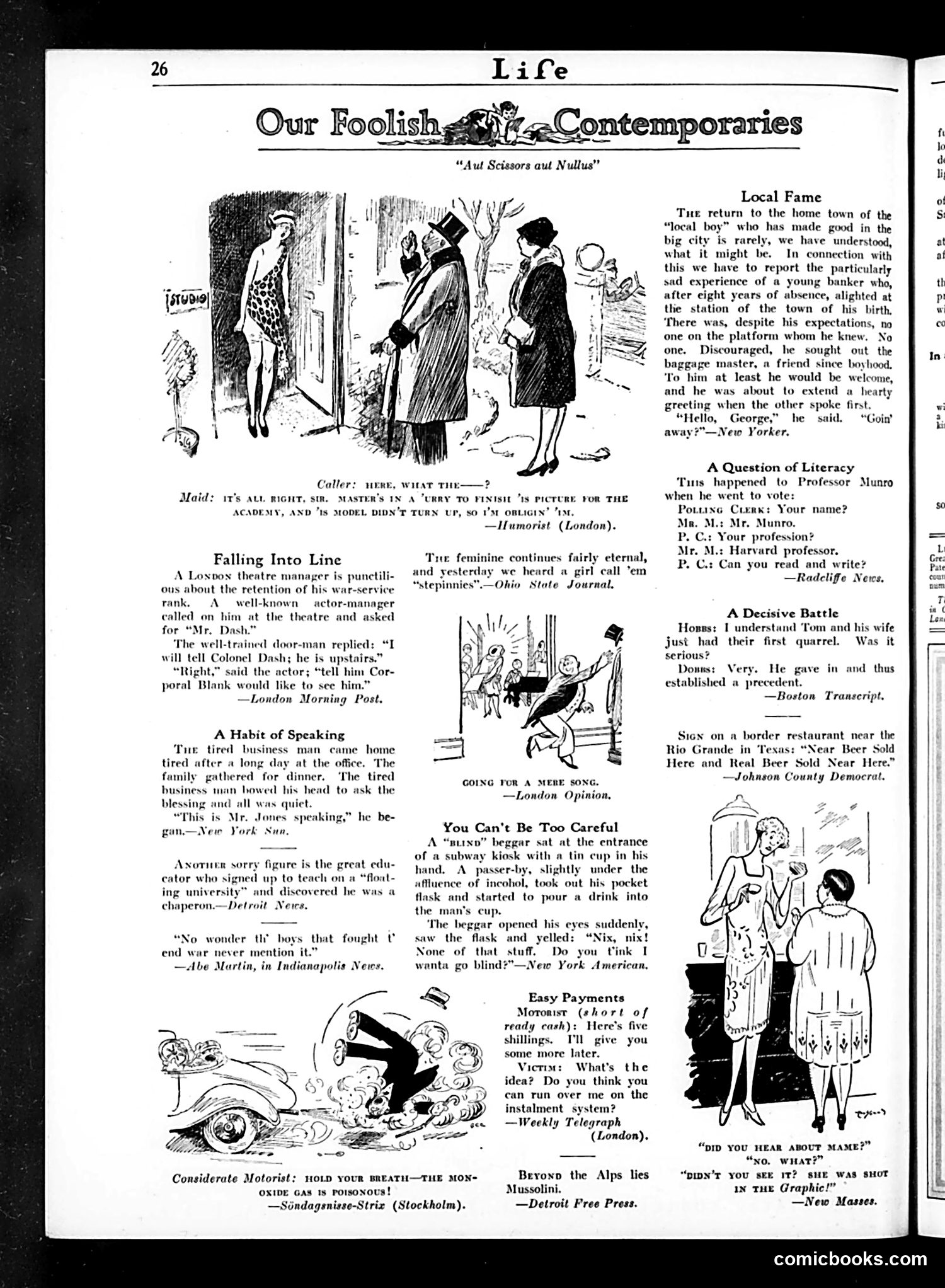
This page collects brief humorous anecdotes mocking everyday social absurdities of the era (appears to be 1920s-30s based on references). **Key satirical targets:** - **Class pretension**: A theater manager insists on military titles; an actor responds mockingly with a lower rank - **Modern anxieties**: A motorist warns about carbon monoxide poisoning (early automobile concern) - **Prohibition era**: A drunk man tries pouring liquor into a beggar's cup; the beggar refuses, joking he'll "go blind" (a common joke about alcohol) - **Male dominance**: A husband establishes marital "precedent" by winning their first quarrel - **Education/literacy**: A Harvard professor cannot read or write well enough to vote - **Advertising absurdity**: A border restaurant sign paradoxically advertises both "Near Beer" (legal substitute) and "Real Beer" The cartoons use exaggerated situations to mock contemporary social pretensions, the persistence of drinking despite Prohibition, gender dynamics, and general human foolishness. The tone is gently mocking rather than sharply political.
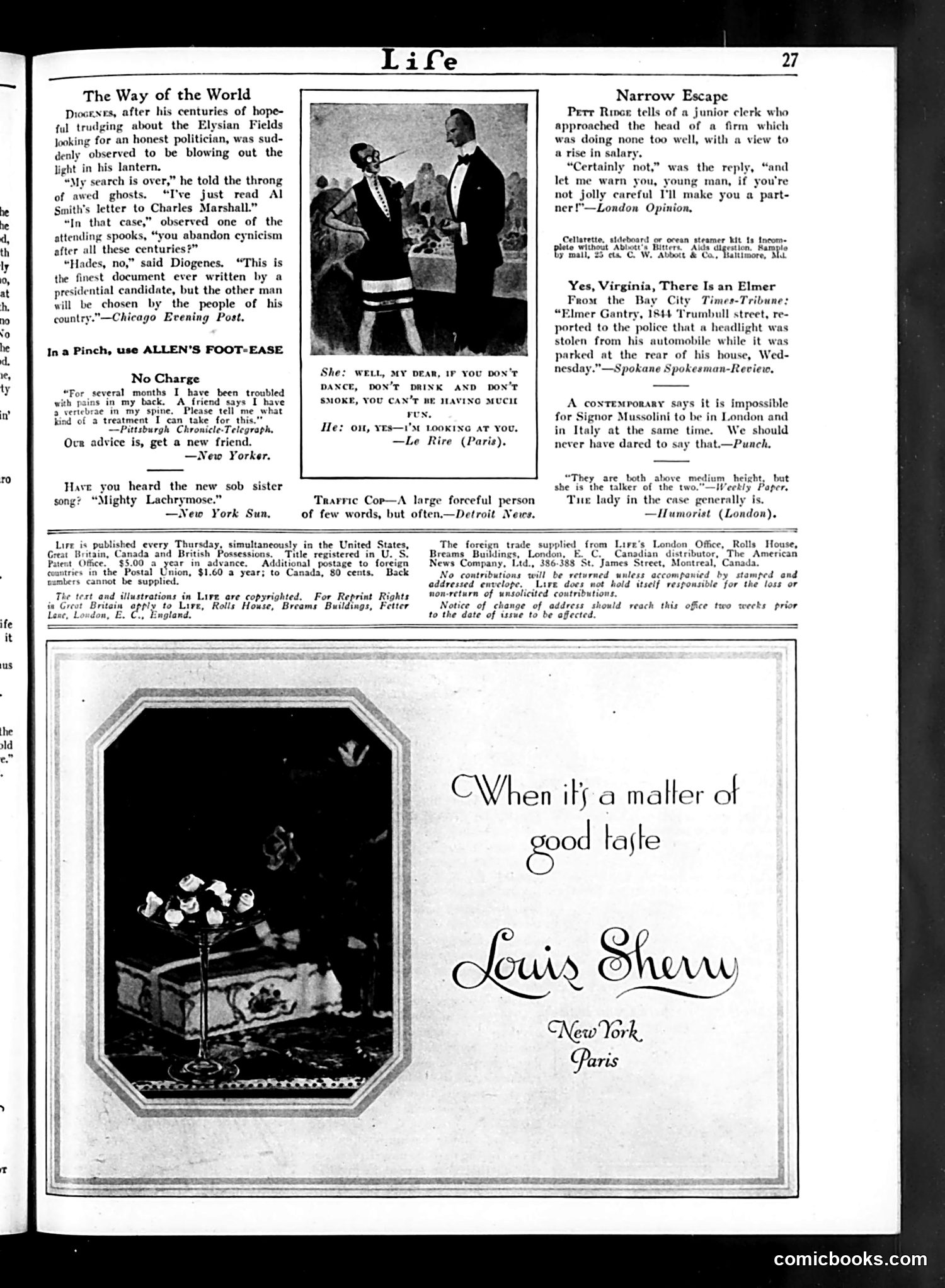
This page from *Life* magazine contains several brief humorous anecdotes typical of the publication's satirical format. The main political reference appears in "The Way of the World," which alludes to Al Smith's 1928 presidential campaign. The joke references Smith's letter to Charles Marshall, suggesting that despite Smith writing an exemplary document, the opposing candidate (likely Herbert Hoover) would win anyway—a cynical commentary on American electoral politics where quality arguments don't guarantee victory. The other items are light social humor: complaints about back pain and friend-seeking advice; a "sob sister" song joke; observations about smoking and women's talkativeness; and a darkly humorous anecdote about an employee being threatened with a partnership instead of a raise. The page also contains advertisements and publication information. Without clearer image resolution of the cartoon illustration, specific visual satire details remain unclear, though the overall tone reflects *Life*'s characteristic blend of political cynicism and genteel social observation.
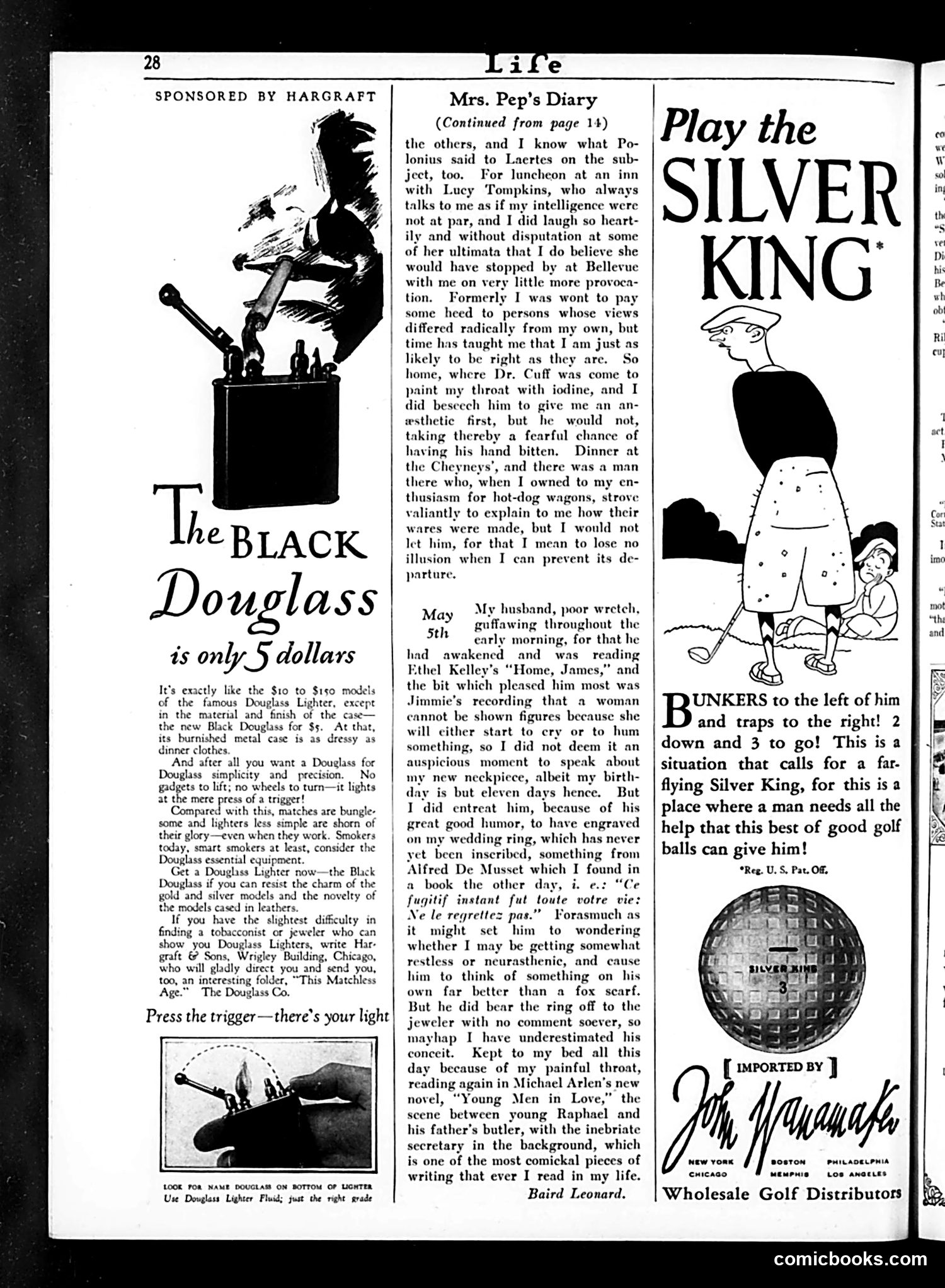
This page combines two distinct content types: **Left side:** A Douglas Lighter advertisement emphasizing simplicity and affordability ($5 model). The imagery shows a silhouetted figure operating the lighter with the tagline "Press the trigger—there's your light," highlighting the device's ease of use as a selling point for Depression-era consumers seeking reliable, affordable products. **Center/Right:** "Mrs. Pep's Diary" (continued from page 14) is a humorous satirical column written in affected, overwrought language. The narrator mocks herself—and by extension, pretentious society figures—through exaggerated references to literature (Hamlet, De Musset), affected sophistication, and self-aware commentary on snobbery. Her dismissal of Lucy Tompkins's intelligence while affecting intellectual superiority satirizes the affectations of upper-class women. **Right side:** A "Silver King" golf ball advertisement with vintage illustration. The diary column exemplifies Life magazine's satirical commentary on American social pretension during this era.
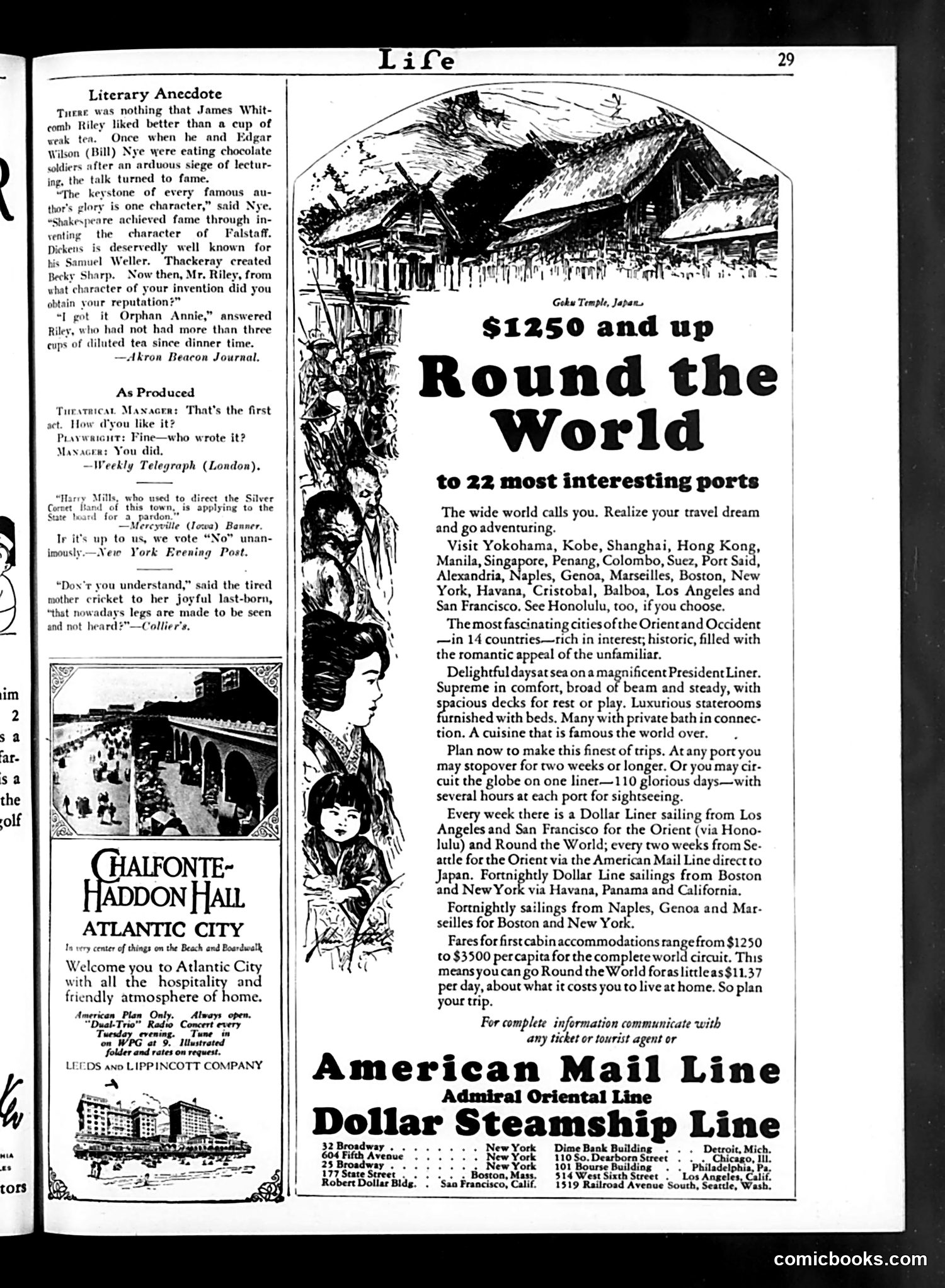
This page is primarily **advertising**, not political satire. The dominant content is a cruise line advertisement for "Round the World" voyages starting at $1250, featuring exotic ports across Asia and beyond. The upper left contains brief **literary anecdotes** about American writers James Whitcomb Riley and Bill Nye, presenting humorous exchanges about their work and personalities. These are lighthearted pieces typical of Life's "filler" content. There's also a small hotel advertisement for Atlantic City's Chalfonte-Haddon Hall. The page reflects **1920s-30s consumer culture**: luxury ocean travel was marketed as accessible to middle-class Americans ("$11.37 per day"), and Orient cruises represented fashionable exoticism. The Japanese temple illustration and emphasis on "romantic appeal of the unfamiliar" reveal period attitudes toward Asian destinations as exotic spectacles rather than genuine cultural engagement. The literary snippets serve as cultural touchstones—Riley and Nye were well-known figures of their era whose names would resonate with readers.
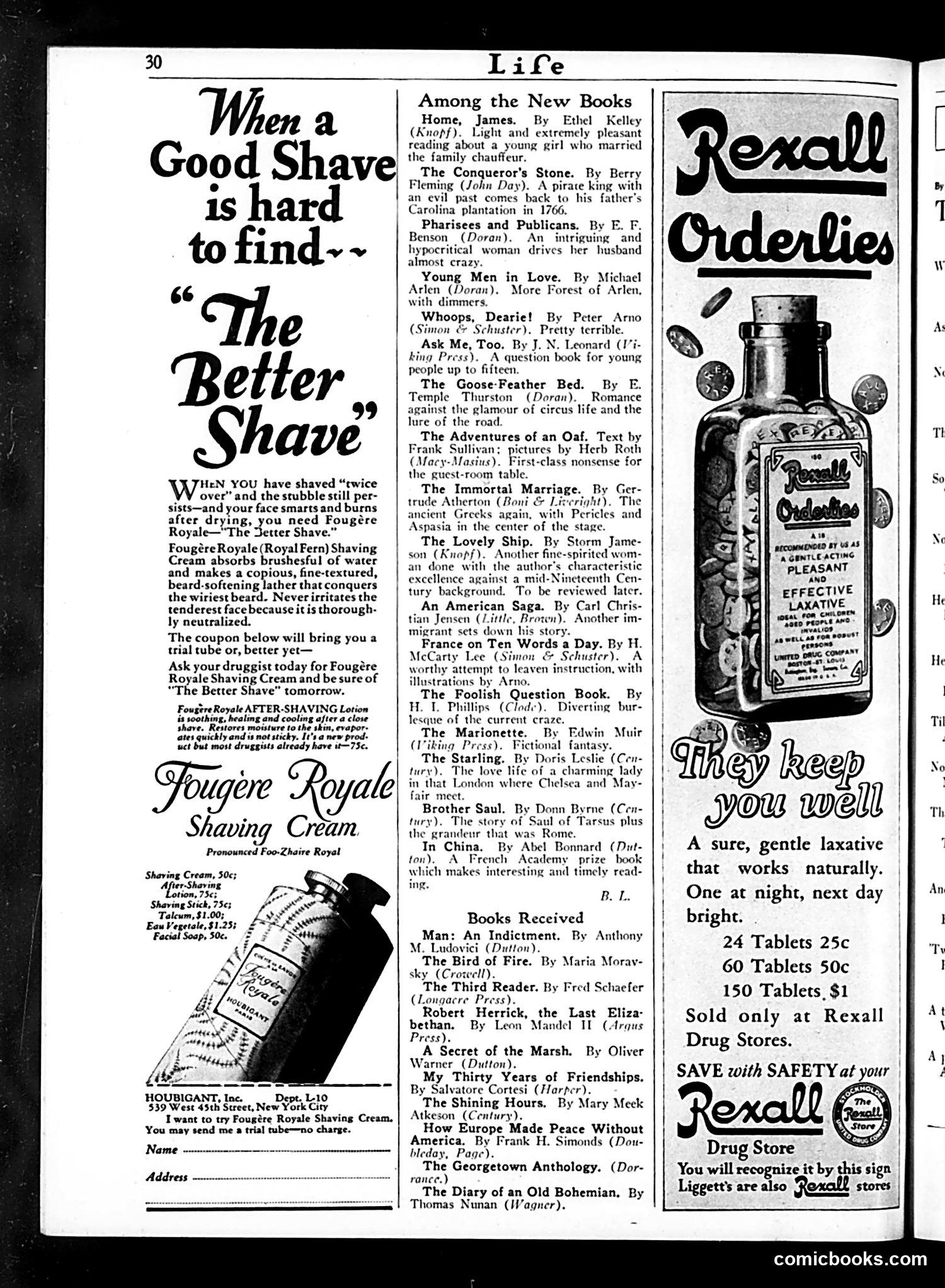
This page is primarily **advertising and book reviews**, not political satire. The left side features a large advertisement for Fougère Royale shaving cream, emphasizing that it provides a superior shave by creating rich lather that softens even stubborn beards without irritating skin. The copy appeals to men frustrated with inadequate shaves. The right side contains "Among the New Books"—brief descriptions of recently published novels and non-fiction, typical of *Life* magazine's literary coverage. Titles range from romance (*Home, James*) to historical fiction (*The Conqueror's Stone*) to humor (*The Adventures of an Oaf*). Below is an advertisement for **Rexall Orderlies**, a laxative marketed as "a sure, gentle laxative that works naturally." There is **no political cartoon or satire** on this page. It represents standard early-20th-century magazine content: consumer goods advertising and entertainment/literature reviews.
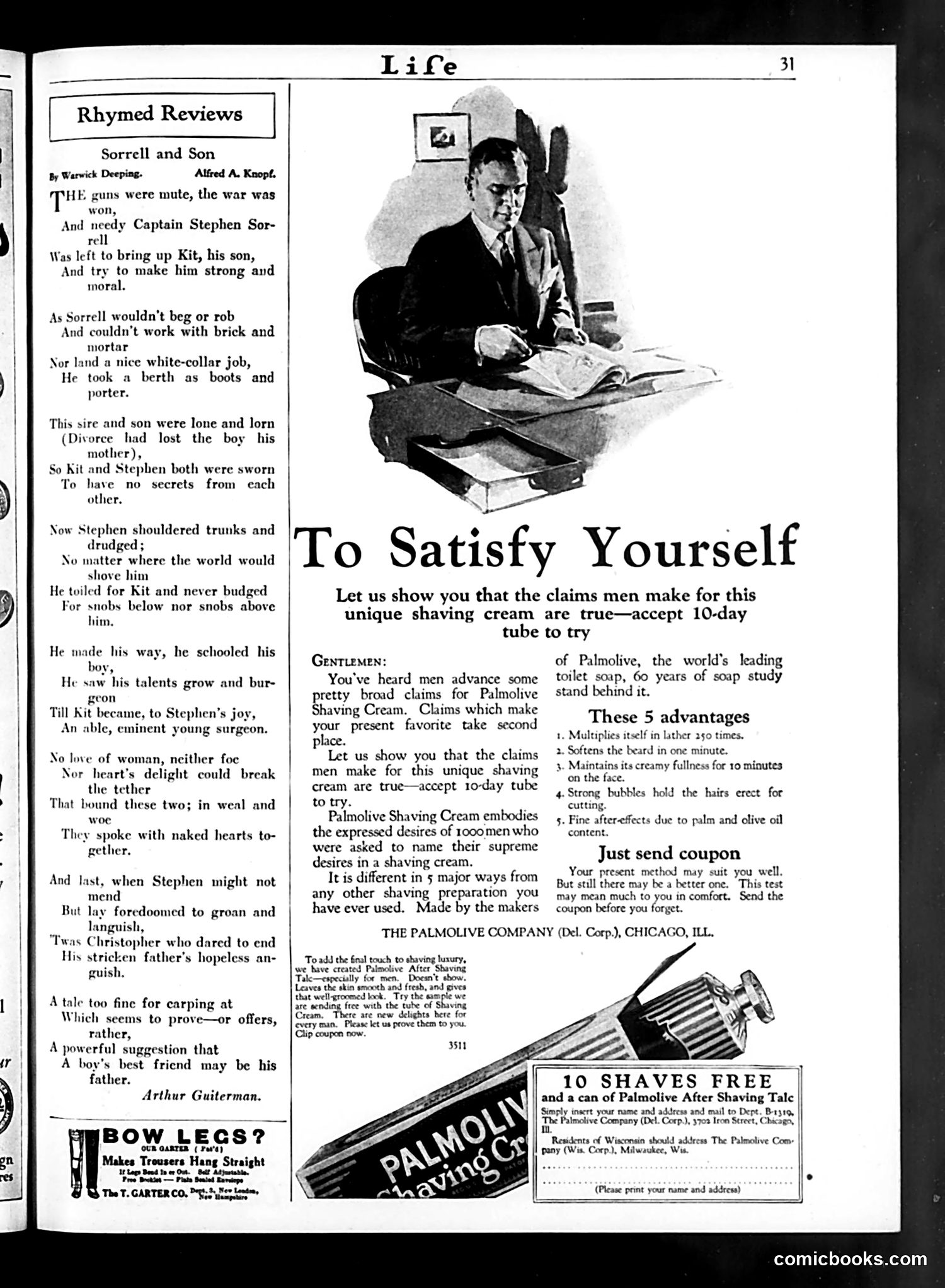
This page contains two distinct elements: **Rhymed Review (Left):** A positive book review by Arthur Guiterman of "Sorrell and Son" by Warwick Deeping. The narrative poem summarizes the novel's plot about a post-WWI father and son whose deep bond—unbroken by romantic entanglements—culminates in the son mercifully ending his dying father's suffering. Guiterman presents this as a touching affirmation that "a boy's best friend may be his father," endorsing the novel's emotional core. **Advertisement (Right):** A full-page Palmolive Shaving Cream ad emphasizing scientific claims. The ad appeals to men's desire for practical proof, offering a 10-day trial tube and listing five specific advantages (lather multiplication, beard softening, etc.). This reflects 1920s advertising's shift toward pseudo-scientific product justification rather than pure marketing hype. The juxtaposition is typical of *Life*'s era—serious literary commentary alongside consumer advertising, both targeting the magazine's educated male readership.
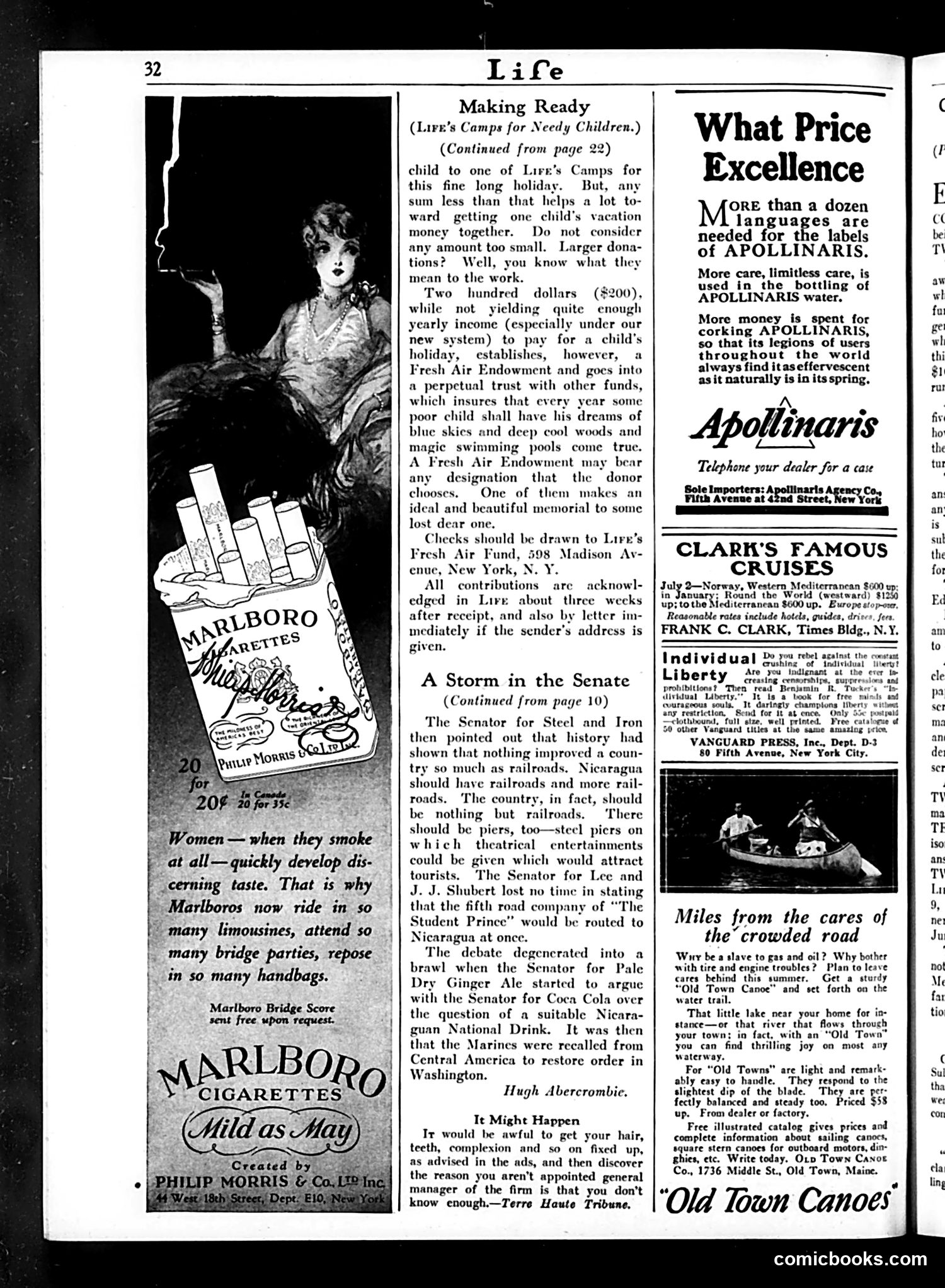
This page is primarily **advertisements and filler content** rather than political satire. The **Marlboro cigarette ad** features a woman smoking, using the sexist appeal that women smokers develop "discerning taste"—the implication being that Marlboros attract wealthy, sophisticated women (those in limousines and bridge parties). The **"Storm in the Senate"** section is light satirical commentary on Congressional absurdity: a senator argues that Nicaragua needs nothing but railroads and steel piers for theaters, while another senator and a beverage industry representative devolve into arguing over which drink should be Nicaragua's national beverage. The joke: Congress treats serious policy as childish squabbling, requiring the Marines to restore order in Washington itself. The remaining content—**"It Might Happen"** and various product advertisements (Apollinaris water, Clark's cruises, Old Town Canoes)—are standard magazine filler without satirical content. The page reflects 1920s advertising conventions and light political humor typical of Life magazine's genteel satire.
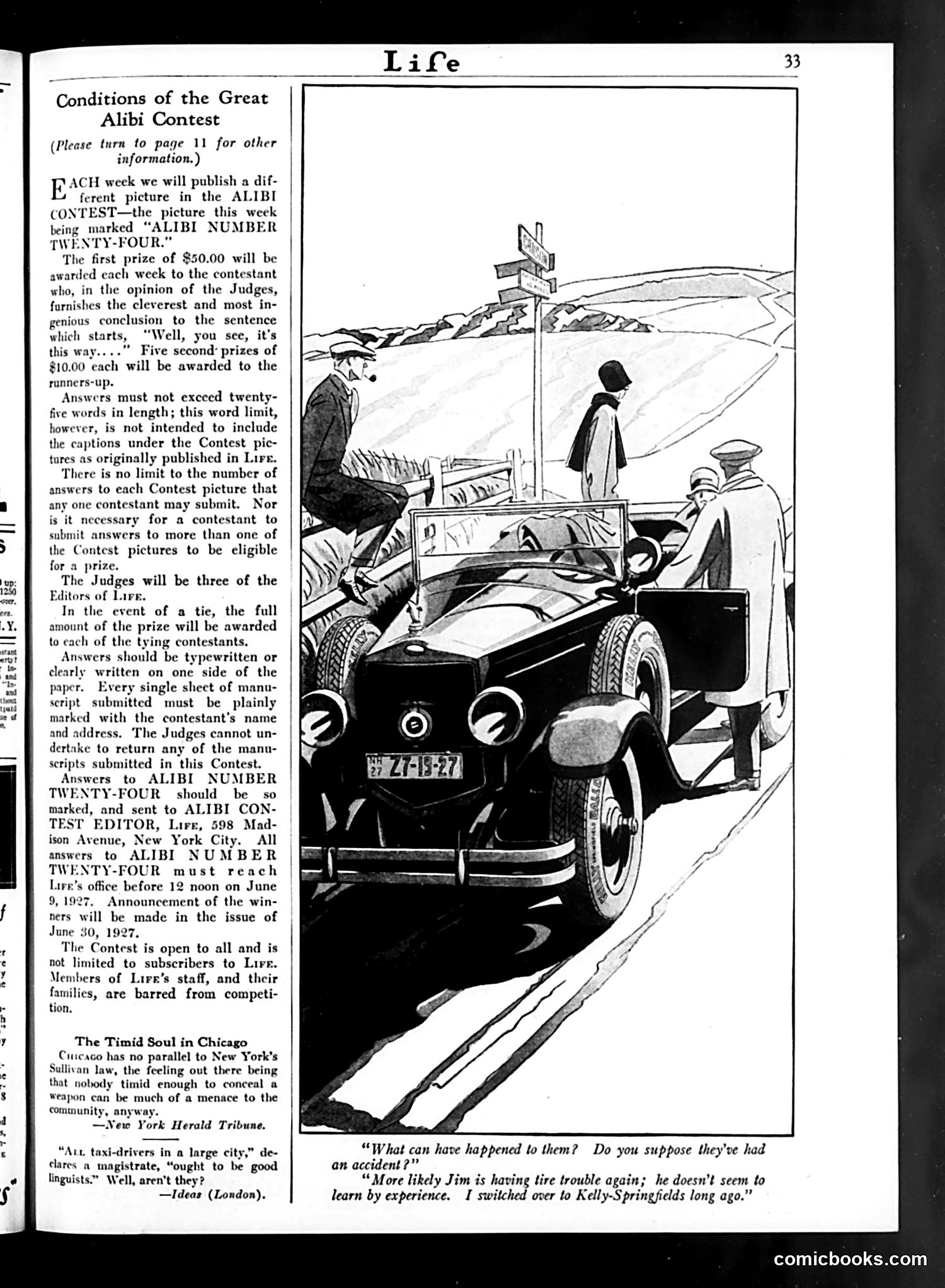
This page announces Life's weekly reader-participation contest. Contestants must complete the caption starting "Well, you see, it's..." for the cartoon depicting a car accident scene with multiple figures examining a damaged vehicle on a rural road. The joke setup is straightforward: someone needs to invent an excuse ("alibi") explaining what happened. The cartoon's dialogue provides context—onlookers speculate whether there's been an accident, with one character blaming tire failure and recommending Kelly-Springfields brand tires. This is essentially a caption-writing contest where readers submit creative explanations in 25 words or fewer. The $50 first prize suggests Life's confidence in reader engagement. The rules clarify submission procedures, judging criteria, and eligibility (staff excluded). The page also includes unrelated brief humor items about Chicago's lack of gun regulations and taxi drivers' linguistic abilities—typical filler content for the era's satirical magazine.
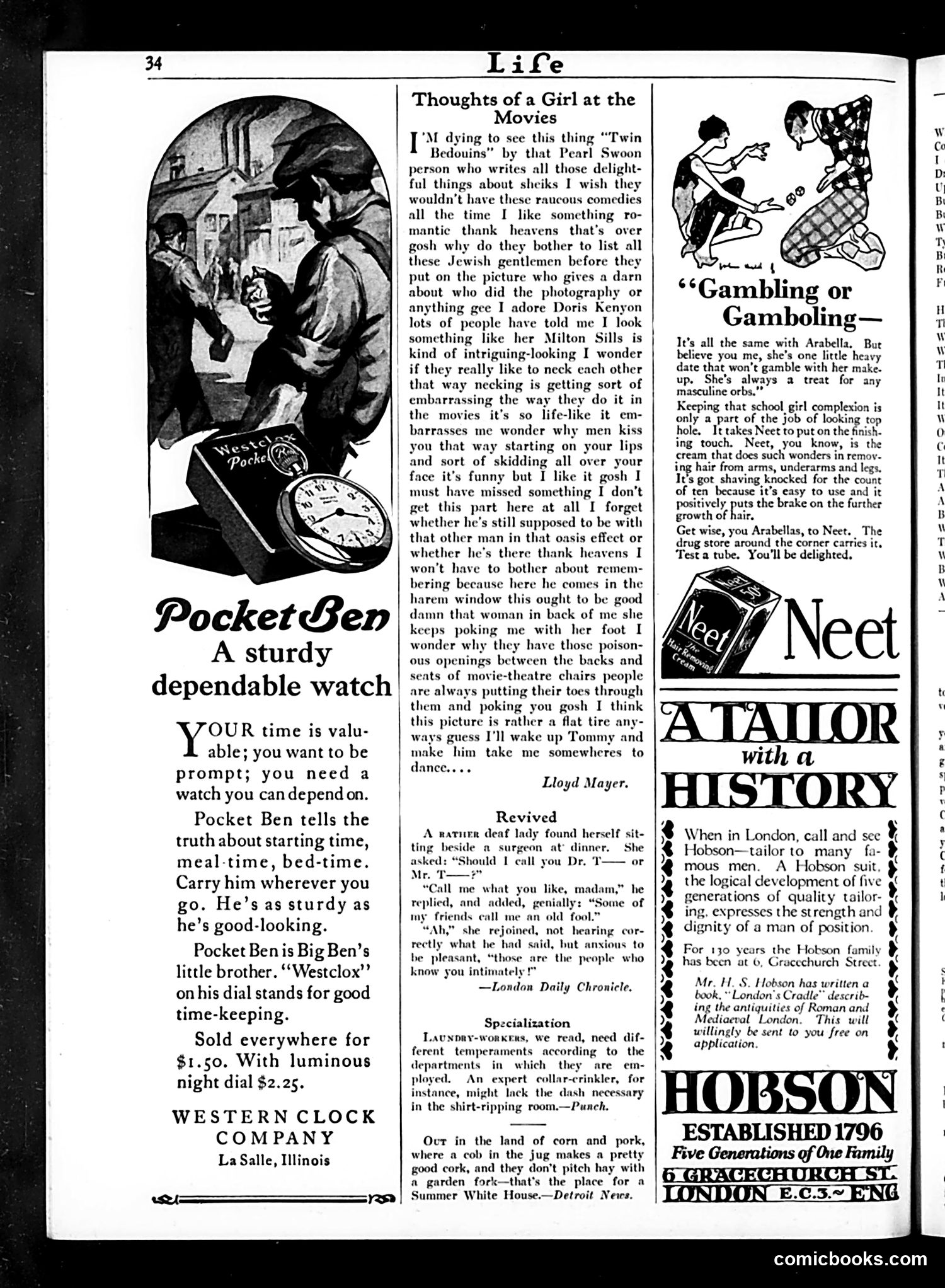
This page mixes advertisements with humor pieces typical of 1920s *Life* magazine. The main satirical content is "Thoughts of a Girl at the Movies"—a stream-of-consciousness monologue capturing a young woman's scattered attention while watching a film. She references contemporary silent-film stars (Pearl Swoon, Doris Kenyon, Milton Sills) and complains about movie conventions: raucous comedies, credits listing crew, other patrons kicking seats. The piece gently mocks both cinema conventions and female moviegoers' romantic escapism. The reference to "Jewish gentlemen" in credits appears to acknowledge—without comment—the visible prominence of Jewish professionals in early Hollywood. The small sidebar ad for "Neet" (a hair-removal cream) humorously links to the piece, advertising feminine grooming as essential to attracting "masculine orbs." Other content includes a mild pun ("Gambling or Gamboling"), a deaf-lady joke, and observations on labor specialization—all light, period-typical humor. The *Pocket Ben* watch ad and *Hobson* tailor advertisement are straightforward commercial pitches.
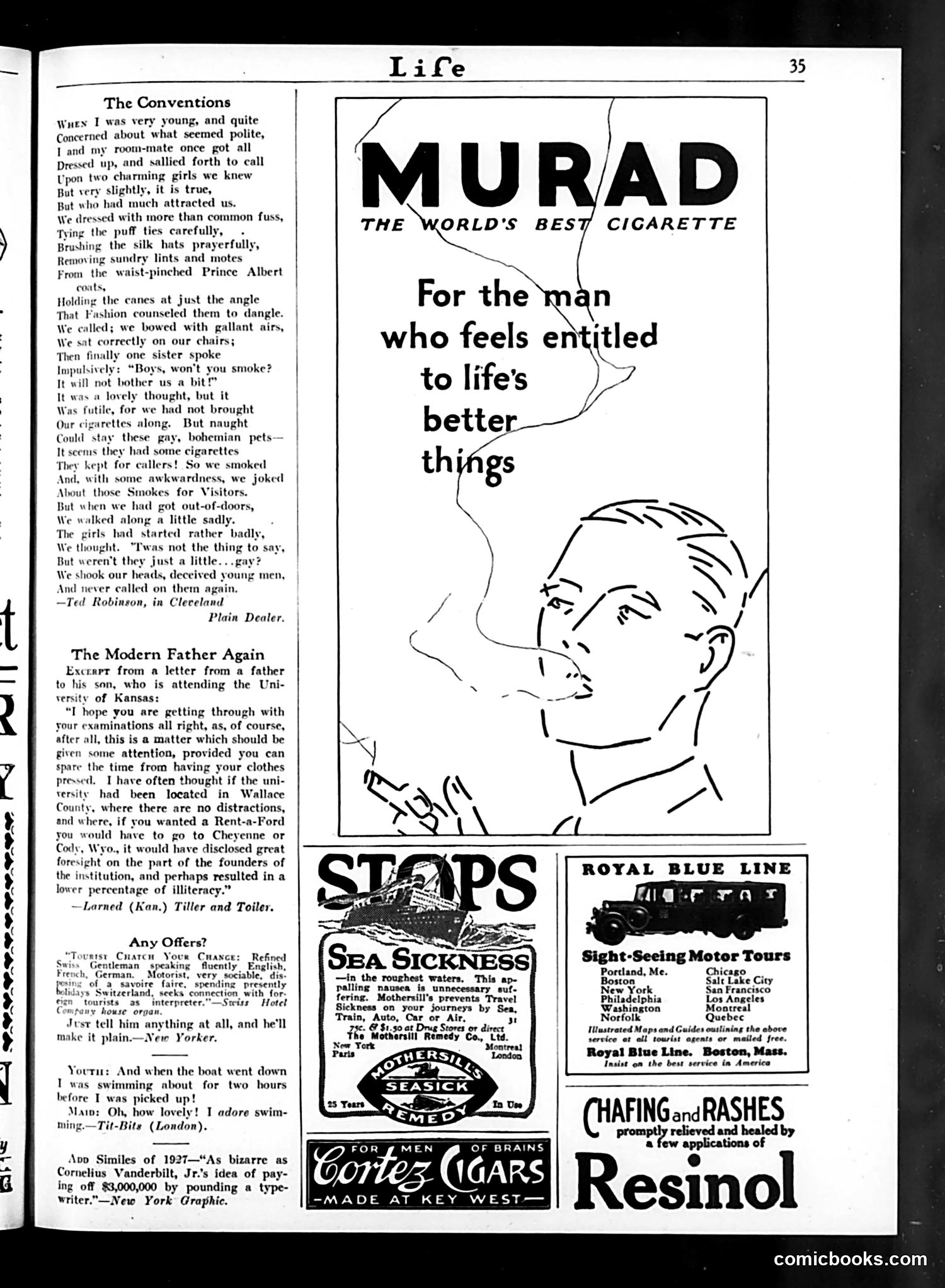
This page from *Life* magazine contains primarily **text-based humor and advertisements** rather than political cartoons. The main content includes: 1. **"The Conventions"** — A humorous poem by Ted Robinson satirizing outdated social etiquette. Young men dress meticulously to visit "charming girls," but when the women offer them cigarettes (which the men hadn't brought), the men interpret this forwardness as improper behavior and never call again. The joke mocks rigid social conventions and the men's prudish overreaction to what was actually generous hospitality. 2. **"The Modern Father Again"** — A satirical excerpt from a father's letter to his university son, gently mocking how the father prioritizes clothing care over academics while pretending to emphasize studies. The right side contains **period advertisements** for Murad cigarettes, seasickness remedies, sightseeing tours, and skin treatments—typical of 1920s magazine advertising. The Murad ad's tagline about men "entitled to life's better things" reflects 1920s aspirational marketing.
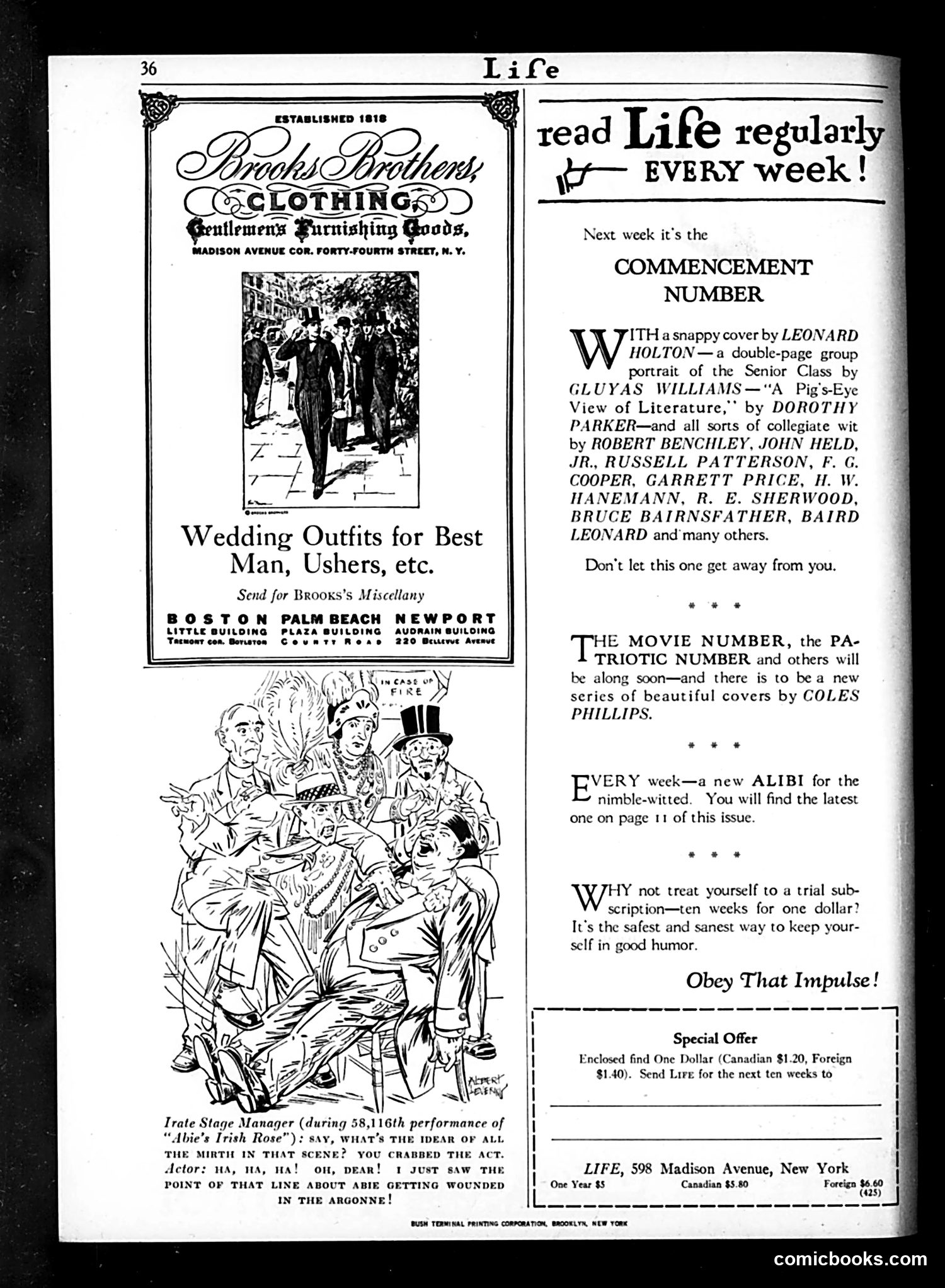
This page is primarily **advertising and promotional content** for *Life* magazine itself, not political satire. The cartoon depicts a theater scene from the play *"Abie's Irish Rose,"* a popular 1920s comedy about an interfaith romance. A stage manager confronts an actor about laughing during a serious moment—specifically a line mentioning a character being wounded in the Argonne (a WWI battlefield). The joke relies on the contrast: the actor initially finds the line darkly funny, then realizes its tragic context (a soldier's death), making the mirth inappropriate. The cartoon satirizes **theatrical performance and audience reaction** rather than politics. The surrounding text promotes *Life's* upcoming "Commencement Number" and advertises subscription offers, along with a Brooks Brothers clothing ad. This is a typical magazine page mixing entertainment content with advertisements.

I appreciate your detailed instructions, but I must be honest: this image is almost entirely black or severely underexposed, making it impossible to discern any cartoon content, text, figures, caricatures, or satirical details. Only a white margin is visible on the left edge, and what appears to be a watermark or logo reading "comicbooks.com" at the bottom right. The rest is essentially obscured darkness. To provide the historical analysis you've requested, I would need a clearer, properly exposed image where the actual cartoon(s) and legible OCR text are visible. I cannot responsibly invent details about content I cannot see, even to be helpful.