
Life, 1927-05-26 · page 18 of 39
Life — May 26, 1927 — page 18: what you’re looking at
What you’re looking at
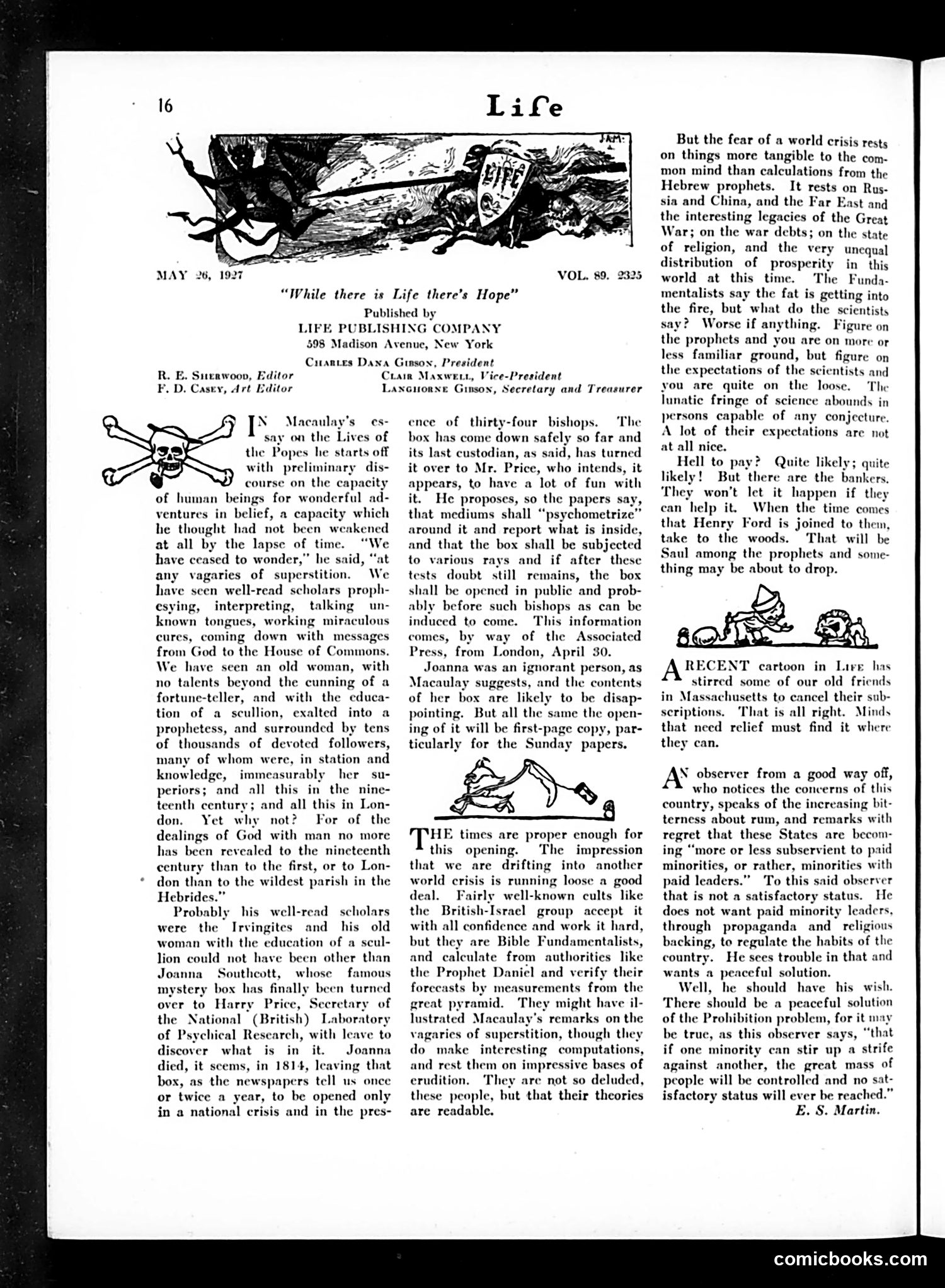
This page contains editorial commentary rather than a cartoon. The main illustration is a decorative header showing a skeleton or death figure labeled "LIFE," establishing the satirical tone. The text discusses concerns about world crisis, religious fundamentalism, and scientific predictions about civilization's future. It references Macaulay's comments on bishops and mentions specific concerns about British-Israel groups, cults, and prohibition-era problems. The editorial appears skeptical of both religious prophets making apocalyptic predictions and scientists offering dire forecasts. It expresses worry about social instability—mentioning rum distribution and prohibition enforcement—while suggesting that reasonable solutions exist if people would pursue them rather than embrace extreme ideologies or panic predictions. The piece advocates rational, moderate approaches to contemporary anxieties.
📄 Transcribed text from this page (OCR, searchable)
Machine-transcribed from the original scan — historical spelling and the odd misread are preserved.
MAY 26, VOL, 89. 2325 “While there is Life there’s Hope” Published by LIFE PUBLISHING COMPANY 598 Madison Avenue, New York Cuantes Dana Ginson, President Surawoov, Editor Art Editor N Macaulay's — es- say on the Lives of the Popes he starts off with preliminary dis- course on the capacity of human beings for wonderful ad- ventures in belief, a capacity which he thought had not been weak at all by the lapse of time. have ceased to wonder,” he said, “at any vagaries of superstition. We have scen well-read scholars proph- esying, interpreting, talking un- known tongues, working miraculous cures, coming down with messages from God to the House of Commons. We have seen an old woman, with no talents beyond the cunning of a fortune-teller, and with the cduca- tion of a scullion, exalted into a prophetess, and surrounded by tens of thousands of devoted followers, many of whom were, in station and knowledge, immeasurably her su- periors; and all this in the nine- teenth century; and all this in Lon- don. Yet why not? For of the dealings of God with man no more has been revealed to the nineteenth century than to the first, or to Lon- don than to the wildest parish in the Hebrides.” Probably his well-read scholars were the Irvingites and his old woman with the education of a scul- lion could not have been other than Joanna Southcott, whose famous mystery box has finally been turned over to Harry Price, Secretary of the National (British) Laboratory of Psychical Research, with leave to discover what is in it. Joanna died, it scems, in 1814, leaving that box, as the newspapers tell us once or twice a year, to be opened only in a national crisis and in the pres- Crai Maxwett, Vice-President Laxcuonxe Ginson, Secretary and Treasurer ence of thirty-four bishops. The box has come down safely so far and its last custodian, as said, has turned it over to Mr. Price, who intends, it appears, to have a lot of fun with it. He proposes, so the papers say, that mediums shall “psychometrize” around it and report what is inside, and that the box shall be subjected to various rays and if after these tests doubt still remains, the box shall be opened in public and prob- ably before such bishops as can be induced to come. This information comes, by way of the Associated Press, from London, April 30. Joanna was an ignorant person, as Macaulay suggests, and the contents of her box are likely to be disap- pointing. But all the same the open- ing of it will be first-page copy, par- ticularly for the Sunday papers. = HE times are proper enough for this opening. The impression that we are drifting into another world crisis is running loose a good deal. Fairly well-known cults like the British-Israel group accept it with all confidence and work it hard, but they are Bible Fundamentalists, and calculate from authorities like the Prophet Daniel and verify their forecasts by measurements from the great pyramid. They might have il- lustrated Macaulay's remarks on the vagaries of superstition, though they do make interesting computations, and rest them on impressive bases of erudition. They are not so deluded, these people, but that their theories are readable. But the fear of a world crisis rests on things more tangible to the com- mon mind than calculations from the Hebrew prophets. It rests on Rus- sia and China, and the Far East and the interesting legacies of the Great War; on the war debts; on the state of religion, and the very unequal distribution of prosperity in this world at this time. The Funda- mentalists say the fat is getting into the fire, but what do the say? Worse if anything. Figure on the prophets and you are on more or less familiar ground, but figure on the expectations of the scientists and you are quite on the loose. The lunatic fringe of science abounds in persons capable of any conjecture. A lot of their expectations are not at all nice. Hell to pay? Quite likely; quite likely! But there are the bankers. They won't let it happen if they can help it. When the time comes that Henry Ford is joined to them, take to the woods. That will be Saul among the prophets and some- thing may be about to drop. RECENT cartoon in Lire has stirred some of our old friends in Massachusetts to cancel their sub- scriptions. ‘That is all right. Minds that need relief must find it where they can. AY observer from a good way off, who notices the concerns of this country, speaks of the increasing bit- terness about rum, and remarks with regret that these States are becom- ing “more or less subservient to paid minorities, or rather, orities with paid leaders.” To this said observer that is not a satisfactory status. He does not want paid minority leaders, through propaganda and _ religious backing, to regulate the habits of the country. He sees trouble in that and wants a peaceful solution. Well, he should have his wish. There should be a peaceful solution of the Prohibition problem, for it may be true, as this observer says, “that if one minority can stir up a strife against another, the great mass of people will be controlled and no sat- isfactory status will ever be reached.” E. S. Martin. comicbooks.com