
Life, 1927-05-26 · page 22 of 39
Life — May 26, 1927 — page 22: what you’re looking at
What you’re looking at
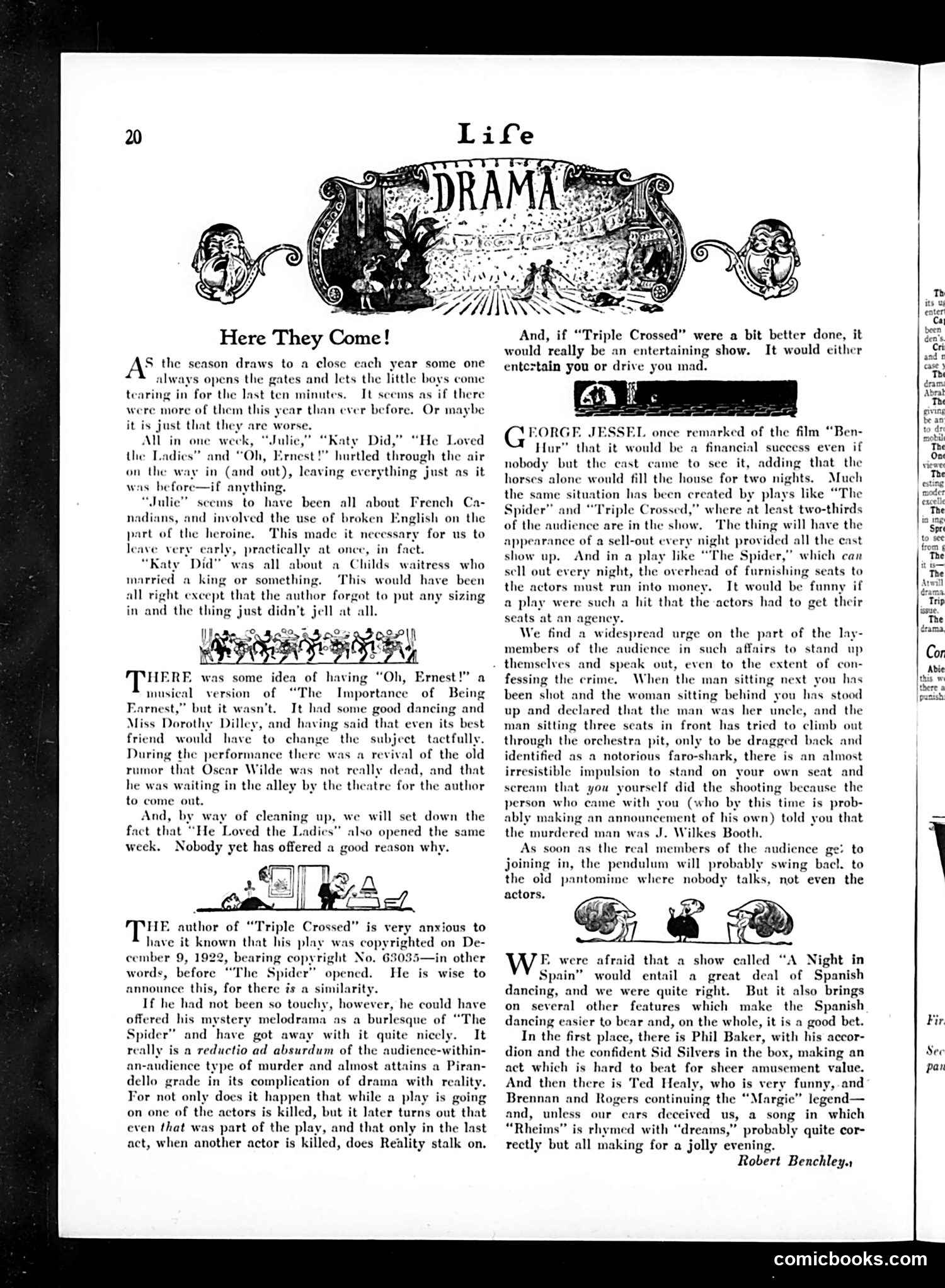
This page critiques several Broadway plays opening that season, written with satirical wit typical of Life magazine's theater reviews. The author skewers four shows—"Julie," "Katy Did," "He Loved the Ladies," and "Oh, Ernest!"—as poorly conceived dramas that audiences endure only briefly before leaving. "Julie" mocked French-Canadian dialect; "Katy Did" had a nonsensical plot about a waitress marrying a king; "Oh, Ernest" attempted to parody Oscar Wilde's work but failed. The main target is "Triple Crossed," a murder mystery that becomes absurdly meta: an actor is killed onstage, but this killing is revealed as part of the play itself—creating confusion between reality and performance. The author notes the play's copyright predates "The Spider" (suggesting accusations of plagiarism), but suggests the derivative work's convoluted plot actually parodies its inspiration. The satire extends to practical absurdity: these plays cast so many audience members as actors that they sell out despite minimal actual attendance—a financial fiction.
📄 Transcribed text from this page (OCR, searchable)
Machine-transcribed from the original scan — historical spelling and the odd misread are preserved.
Here They Come! season draws to a close each year some one s opens the and lets the little boys come tearing in for the last ten minutes. It seems as if there were more of them this year than ever before. Or maybe it is just that they are worse. AML in one week, “Julie,” “Katy Did,” “He Loved the Ladies” and “Oh, Ernest!" hurtled through the air on the way in (and out), leaving everything just as it was before—if anything. “Julie” scems to have been all about French Ca- nadians, and involved the use of bro! English on the part of the heroine. This made it necessary for us to leave very early, practically at once, in fact. Katy Did” was all about a Childs waitress who married a king or something. This would have been all right except that the author forgot to put any sizing in and the thing just didn’t jell at all. HERE was some idea of having “Oh, Ernest!” a al version of “The Importance of Being Farnest,” but it wasn’t. It had some good dancing and Miss Dorothy Dilley, and having said that even its best friend would have to change the subject tactfully. During the performance there was a revival of the old rumor that Oscar Wilde was not really dead, and that he was waiting in the alley by the theatre for the author to come out. And, by way of cleaning up, we will set down the fact that “He Loved the Ladies” also opened the same week. Nobody yet has offered a good reason why. HF. author of “Triple Crossed” is very anxious to have it known that his play was copyrighted on De- cember 9, 1922, bearing copyright No. 68035—in other words, before “The Spider’ opened. He is wise to announce this, for there is a similarity. If he had not been so touchy, however, he could have offered his mystery melodrama as a burlesque of “The Spider” and have got away with it quite nice really is a reductio ad absurdum of the audience- an-audience type of murder and almost attains a Piran- dello grade in its complication of drama with reality, For not only does it happen that while a play is going on one of the actors is killed, but it later turns out that even that was part of the play, and that only in the last act, when another actor is killed, does Reality stalk on. And, if “Triple Crossed” were a bit better done, it would really be an entertaining show. It would either entertain you or drive you mad. FORGE JESSEL once remarked of the film “Ben- Hur” that it would be a financial success even if nobody but the cast came to see it, adding that the horses alone would fill the house for two nights. Much the same situation has been created by plays like “The Spider” and “Triple Crossed,” where at least two-thirds of the audience are in the show, The thing will have the appearance of a sell-out e night provided all the cast show up. And in a play he Spider,” which can sell out every night, the overhead of furnishing seats to the actors must run into money. It would be funny if a play were such a hit that the actors had to get their seats at an agency. We find a widespread urge on the part of the lay- members of the audience in such affairs to stand up themselves and speak out, even to the extent of con- fessing the crime. When the man sitting next you has been shot and the woman sitting behind you has stood up and declared that the man was her uncle, and the man sitting three seats in front has tried to climb out through the orchestra pit, only to be dragged back and identified as a notorious faro-shark, there is an almost irresistible impulsion to stand on your own seat and scream that you yourself did the shooting because the person who came with you (who by this time is prob- announcement of his own) told you that the murdered man was J. Wilkes Booth. As soon as the real members of the audience ge: to joining in, the pendulum will probably swing bacl. to the old pantomime where nobody talks, not even the W were afraid that a show called “A Night in Spain” would entail a great deal of Spanish dancing, and we were quite right. But it also brings on several other features which make the Spanish dancing easier to bear and, on the whole, it is a good bet. In the first place, there is Phil Baker, with his accor- dion and the confident Sid Silvers in the box, making an act which is hard to beat for sheer amusement value. And then there is Ted Healy, who is very funny, and Brennan and Rogers continuing the “Margie” legend— and, unless our cars deceived us, a song in which “Rheims” is rhymed with “dreams,” probably quite cor- rectly but all making for a jolly evening. Robert Benchleys comicbooks.com