
Life, 1927-05-26 · page 26 of 39
Life — May 26, 1927 — page 26: what you’re looking at
What you’re looking at
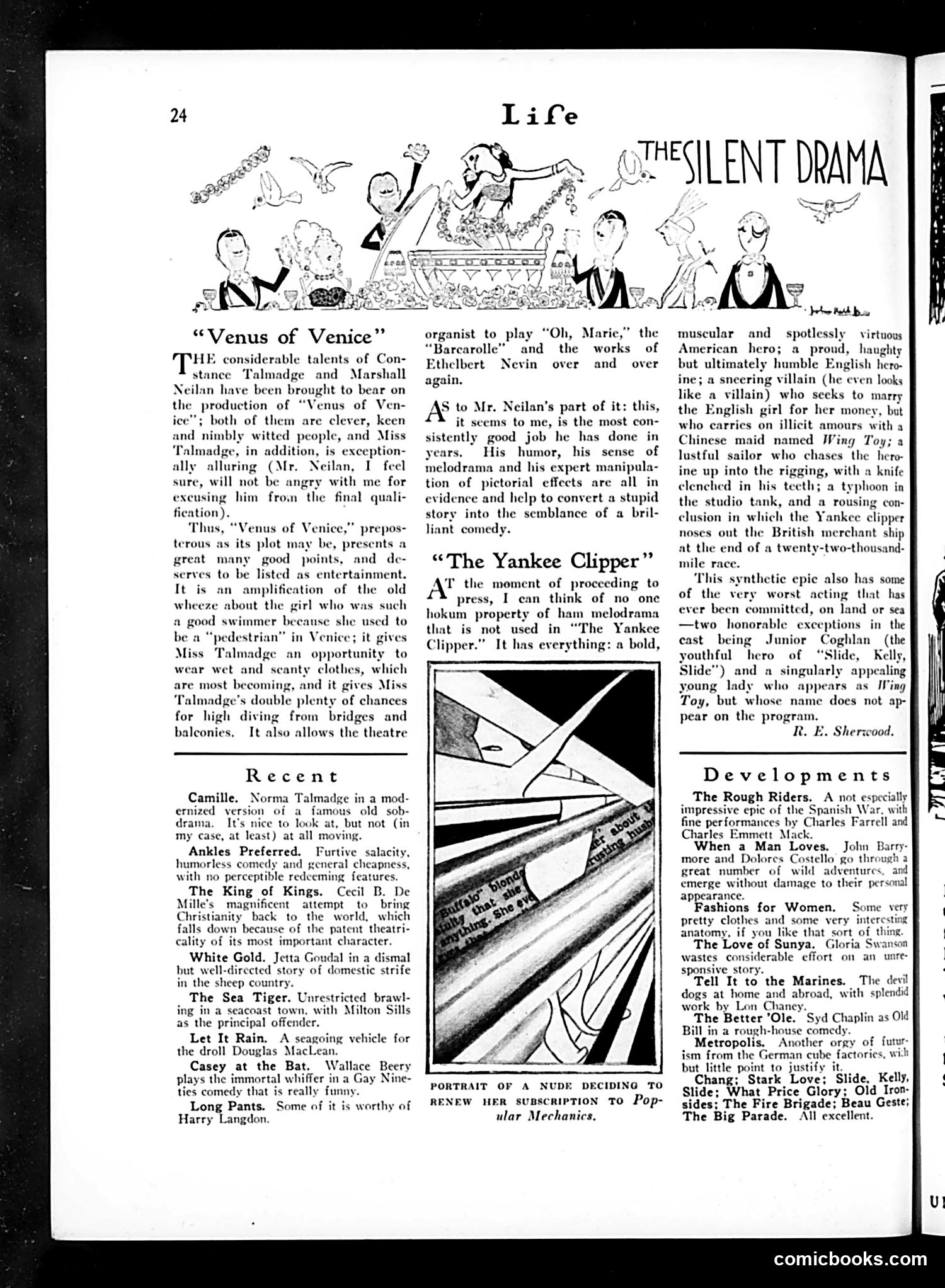
This page reviews contemporary silent films, reflecting the era's entertainment culture. The main cartoon depicts a nude woman deciding to renew her subscription to *Popular Mechanics*—a absurdist joke playing on the incongruity of a figure typically associated with leisure or display reading a technical/industrial magazine. It's satirizing both the magazine's unexpected female readership and perhaps mocking pretensions to intellectualism. The film reviews themselves reveal 1920s cinema conventions: swimming scenes in "Venus of Venice" exist mainly to showcase actress Constance Talmadge in scanty costumes; "The Yankee Clipper" is criticized as melodramatic hokum stuffed with clichéd plot elements (virtuous heroes, sneering villains, typhoons in studio tanks). Reviewer R.E. Sherwood's sardonic tone reflects sophisticated dismissal of formulaic entertainment, while acknowledging occasional bright spots in otherwise mediocre productions. The reviews showcase how silents relied on physical spectacle and visual effects over substantive storytelling.
📄 Transcribed text from this page (OCR, searchable)
Machine-transcribed from the original scan — historical spelling and the odd misread are preserved.
“Venus of Venice” HE considerable talents of Con- stance Talmadge and Marshall Neilan have been brought to bear on the production of “Venus of Ven- ice”; both of them are clever, keen and nimbly witted people, and Miss ‘Talmadge, in ally alluring sure, will not excusing him fication). Thus, “Venus of Venice,” prepos- terous as its plot may be, presents a great many good points, and de- serves to be listed as entertainment, of the old wheeze about the girl who was such a good swimmer because she used to be a “pedestrian” in Venice; it gives Miss Talmadge an opportunity to wear wet and scanty clothes, which are most becoming, and it gives Miss ‘Talmadge’s double plenty of chances for high diving from bridges and balconies, It also allows the theatre addition, is exception- (Mr. Neilan, I feel be angry with me for from the final quali- Recent Camille. Norma Talmadge in a mod- ernized version of a famous old sob- drama. It’s nice to look at, but not (in my case, at least) at all moving. Ankles Preferred. Furtive salacity, humorless comedy and general cheapness, with no perceptible redeeming features. The King of Kings. Cecil B. De Mille’s magnificent attempt to bring Christianity back to the world, which falls down because of the patent theatri- cality of its most important character. White Gold. Jetta Goudal in a dismal but well-directed story of domestic strife in the sheep country. The Sea Tiger. Unrestricted brawl- ing in a seacoast town, with Milton Sills as the principal offender. Let It Rain. A seagoing vehicle for the droll Douglas MacLean. Casey at the Bat. Wallace Beery plays the immortal whiffer in a Gay Nine- ties comedy that is really funny. Long Pants. Some of it is worthy of Harry Langdon. Marie,” the works of and over organist to play “Oh, “Barcarolle” and the Ethelbert Nevin over again, AS to Mr. Neilan’s part of it: this, it scems to me, is the most con- sistently good job he has done in years. His humor, his sense of melodrama and his expert manipula- tion of pictorial effects are all in evidence and help to convert a stupid story into the semblance of a bril- liant comedy. “The Yankee Clipper” the moment of proceeding to T A press, I can think of no one hokum property of ham melodrama that is not used in “The Yankee Clipper.” It has everything: a bold, PORTRAIT OF A NUDE DECIDING TO RENEW HER suBSCRIPTION TO Pop- ular Mechanics, muscular and spotlessly virtuous American hero; a proud, haughty but ultimately humble English hero- ine; a sneering villain (he even looks like a villain) who seeks to marry the English girl for her money, but who carries on illicit amours with a Chinese maid named Wing Toy; a lustful sailor who chases the hero- ine up into the rigging, with a knife clenched in his teeth; a typhoon in the studio tank, and a rousing con- clusion in which the Yankee clipper noses out the British merchant ship at the end of a twenty-two-thousand- mile race. This synthetic epic also has some of the very worst acting that has ever been committed, on land or sea —two honorable exceptions in the east being Junior Coghlan (the youthful hero of “Slide, Kelly, Slide”) and a singularly appealing young lady who appears as Wing Toy, but whose name does not ap- pear on the program. R. E. Sherwood, Developments The Rough Riders. A not especially impressive epic of the Spanish War, with fine performances by Charles Farrell and Charles Emmett Mack. When a Man Loves. John Barry- more and Dolores Costello go through a great number of wild adventures, and emerge without damage to their personal appearance. Fashions for Women. Some very pretty clothes and some very interesting anatomy, if you like that sort of thing. The Love of Sunya. Gloria Swanson wastes considerable effort on an unre sponsive story. Tell It to the Marines. The devil dogs at home and abroad, with splendid work by Lon Chaney. The Better ’Ole. Syd Chaplin as Old Bill in a rough-house comedy. Metropolis, Another orgy of futur- ism from the German cube factories, wih but little point to justify it. Chang; Stark Love; Slide, Kelly, Slide; What Price Glory; Old Iron- sides; The Fire Brigade; Beau Geste; The Big Parade. All excellent. comicbooks.com i) Ul