
A complete issue · 35 pages · 1927
Life — March 3, 1927
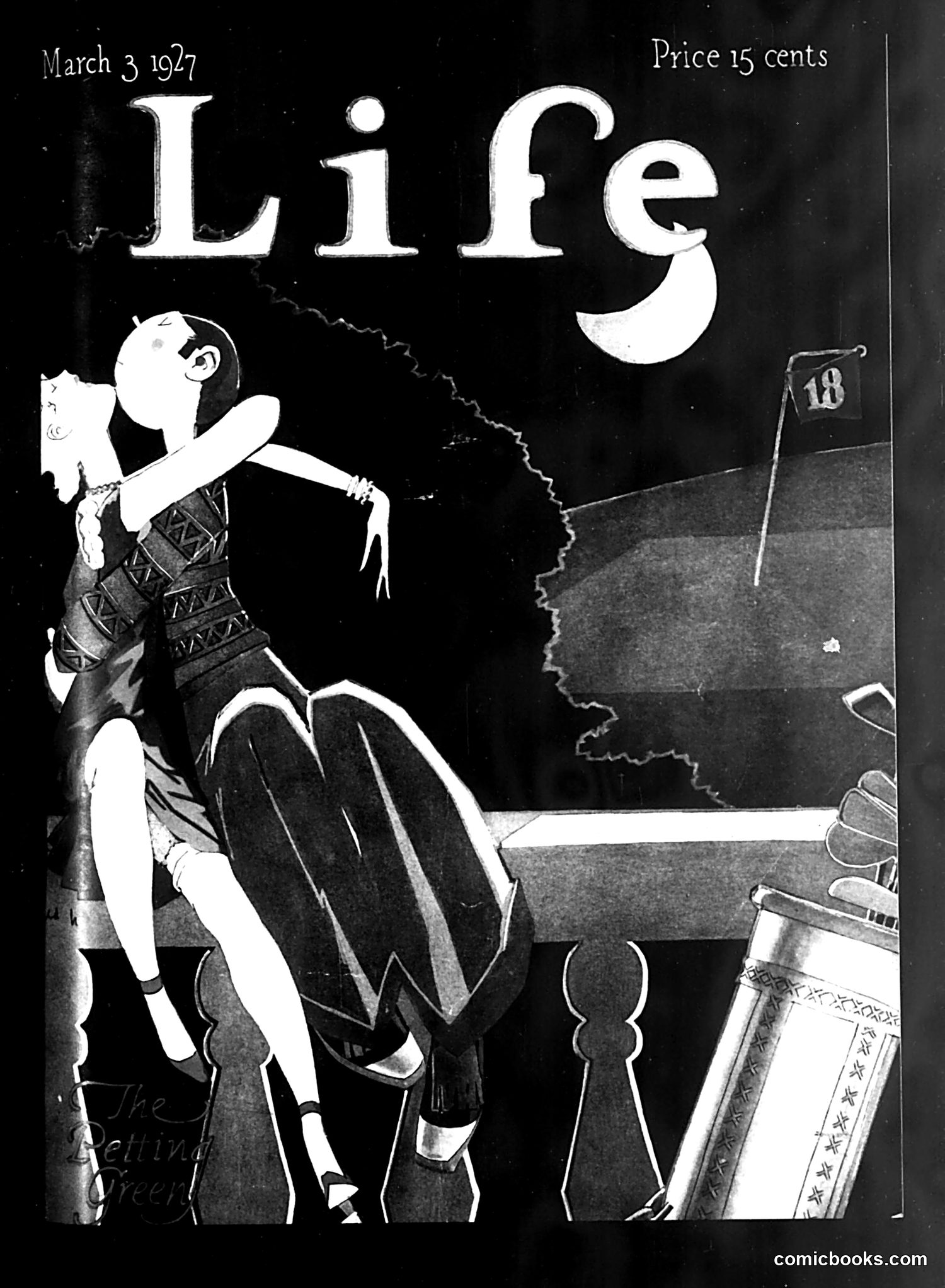
This cover depicts a flapper woman in fashionable 1920s attire playing golf. The illustration satirizes the "New Woman" of the Jazz Age—a figure who challenged traditional gender roles by participating in sports, smoking, drinking, and adopting modern, independent lifestyles. The golf setting specifically references how wealthy women were increasingly claiming access to previously male-dominated leisure activities. The woman's bare legs, short skirt, and confident pose embody the era's moral anxieties about female liberation. The flag marked "18" suggests a country club or exclusive course, emphasizing that this modern independence was largely a phenomenon among affluent women. The satire likely mocks both the women's newfound freedoms and society's discomfort with these changes.
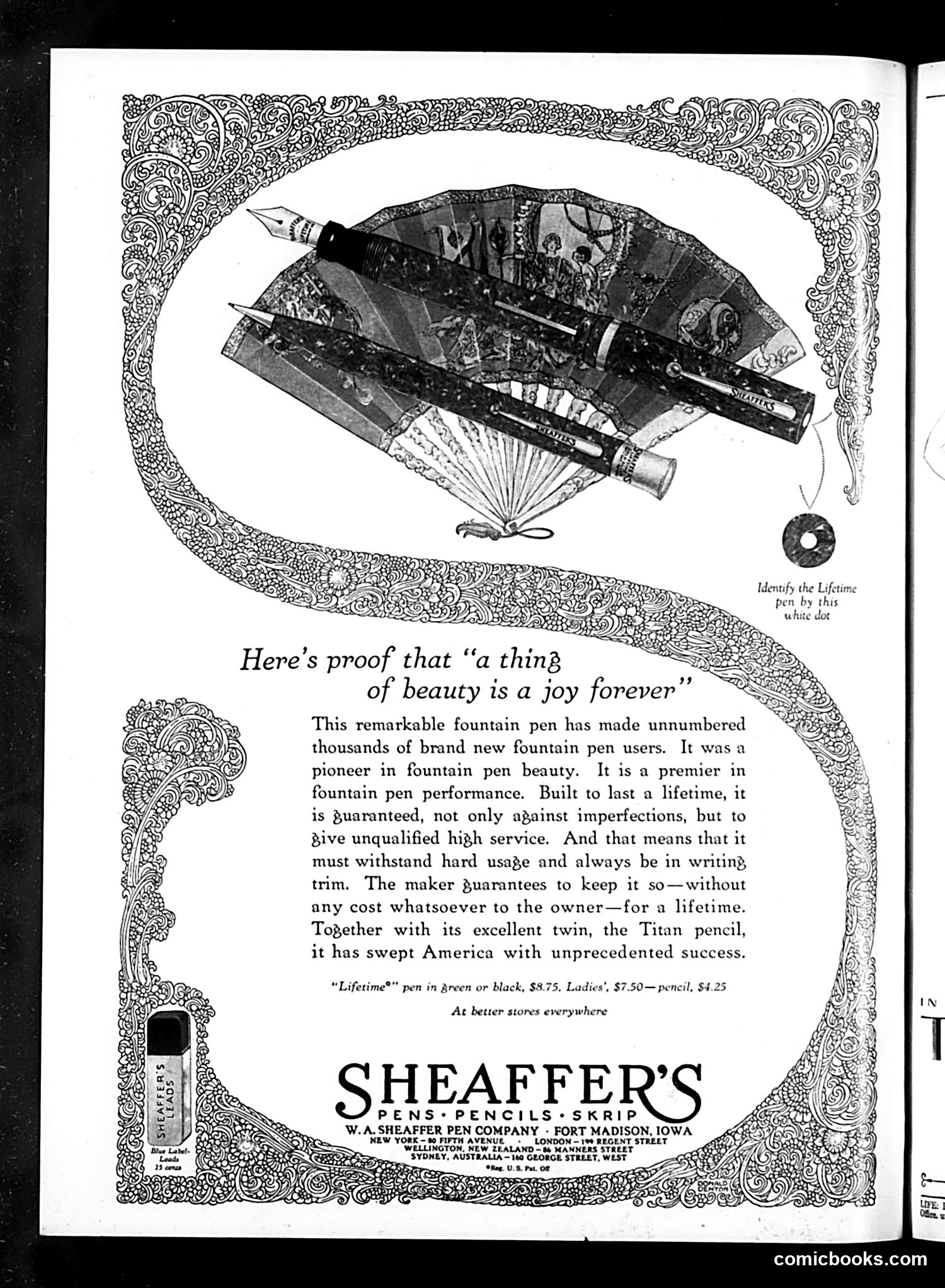
This page is **primarily an advertisement**, not satire or political commentary. It promotes Sheaffer's "Lifetime" fountain pen and Titan pencil. The ad uses the phrase "a thing of beauty is a joy forever" (from Keats) to market the pen's durability and lifetime guarantee. The ornate decorative border and elegant presentation of writing instruments reflect early 20th-century advertising aesthetics. The small circular white dot in the upper right identifies the pen's lifetime guarantee. Text emphasizes the pen "built to last a lifetime" with unconditional service, positioning it as a premium product. **No political figures or satire are present.** This is straightforward product advertising from the W.A. Sheaffer Pen Company (Fort Madison, Iowa), typical of Life magazine's commercial content during this era.
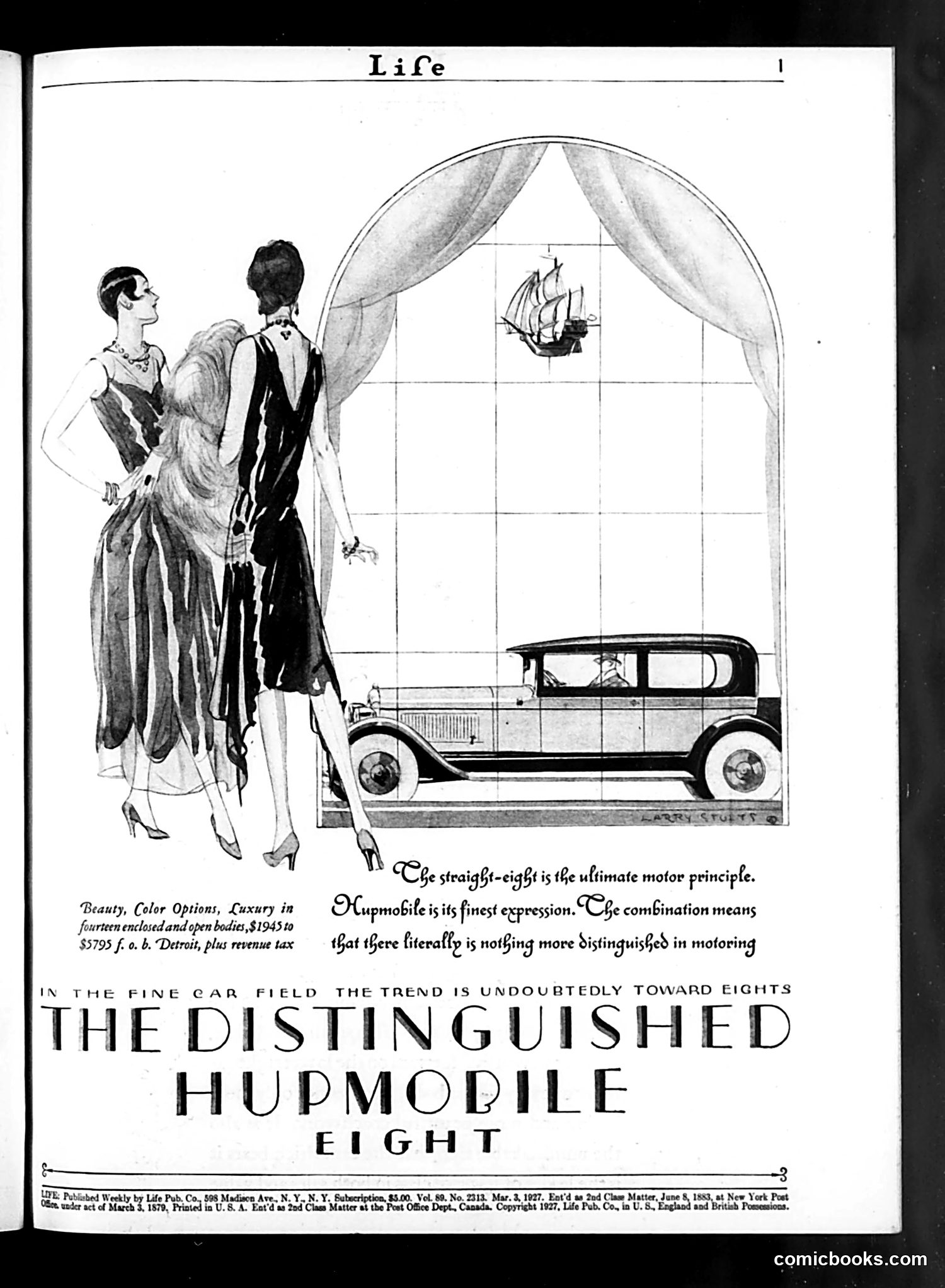
This is primarily a **Hupmobile automobile advertisement**, not political satire. The page shows two elegantly dressed women viewing a framed window display containing a Hupmobile Eight car and a sailing ship. The ad's text claims the straight-eight engine is "the ultimate motor principle" and that the Hupmobile represents its "finest expression," suggesting this car design is superior to competitors. The satirical element is subtle: the *Life* magazine framing presents this as lifestyle commentary rather than pure advertising. The wealthy women's fashionable appearance, the theatrical window-display presentation, and the grandiose language about the car's significance gently mock the consumerism and status-seeking of 1920s automobile culture—positioning luxury cars as objects of aspiration for the affluent. The price ($1,945-$5,795) and production details appear in smaller text below.
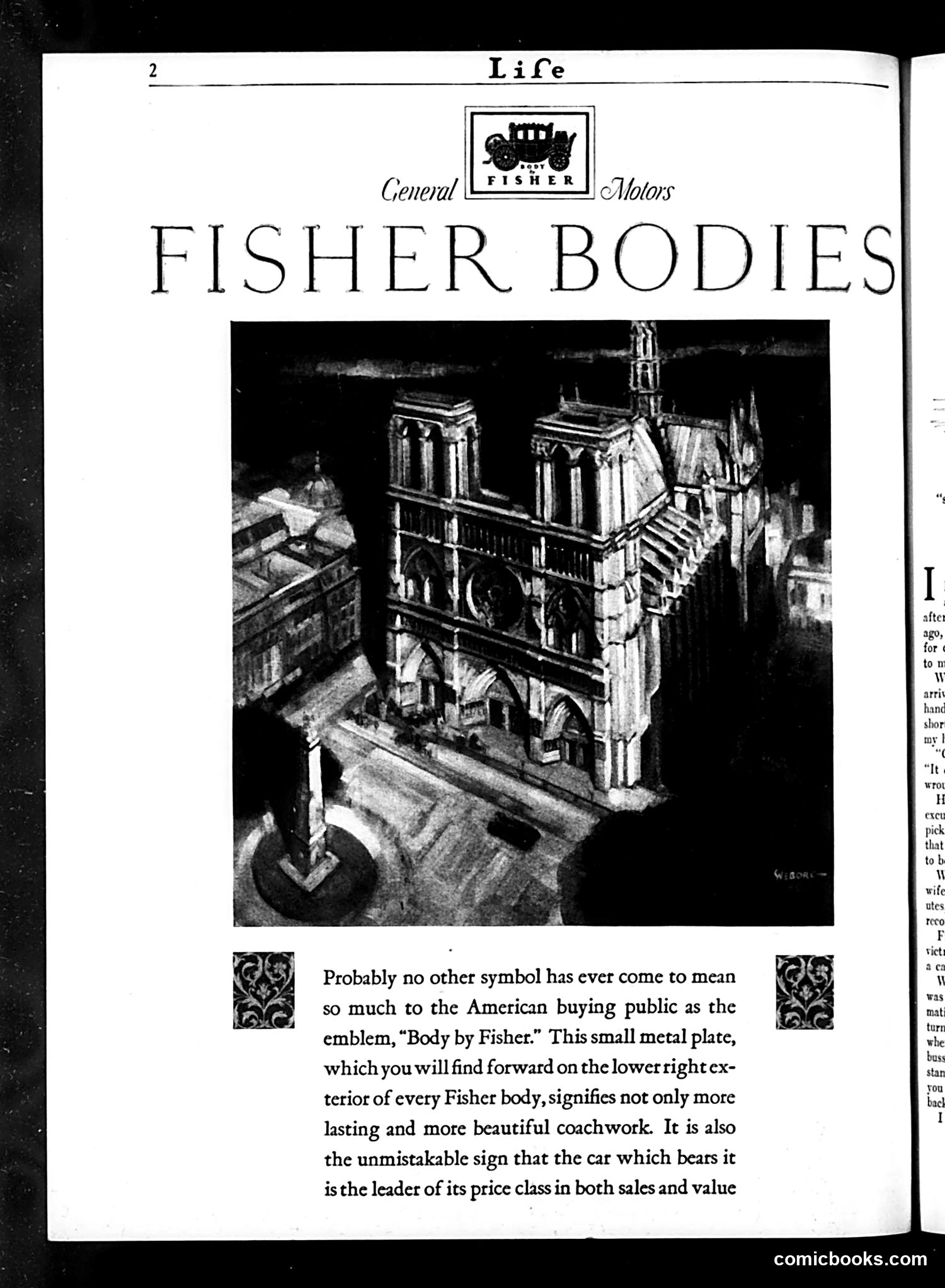
This is not satire or a political cartoon—it's a straightforward advertisement for Fisher Bodies, a major automobile coachwork manufacturer of the early 20th century. The page features a black-and-white photograph of an ornate architectural model (appears to be Notre-Dame Cathedral) to establish Fisher's craftsmanship and attention to detail. The text emphasizes that the "Body by Fisher" emblem signifies superior quality, durability, and beautiful construction. The ad argues that cars bearing this metal plate are "leaders" in their price class for both sales and value. This represents early automotive advertising strategy: associating a component manufacturer's brand with prestige and reliability to influence consumer purchasing decisions about which car to buy.
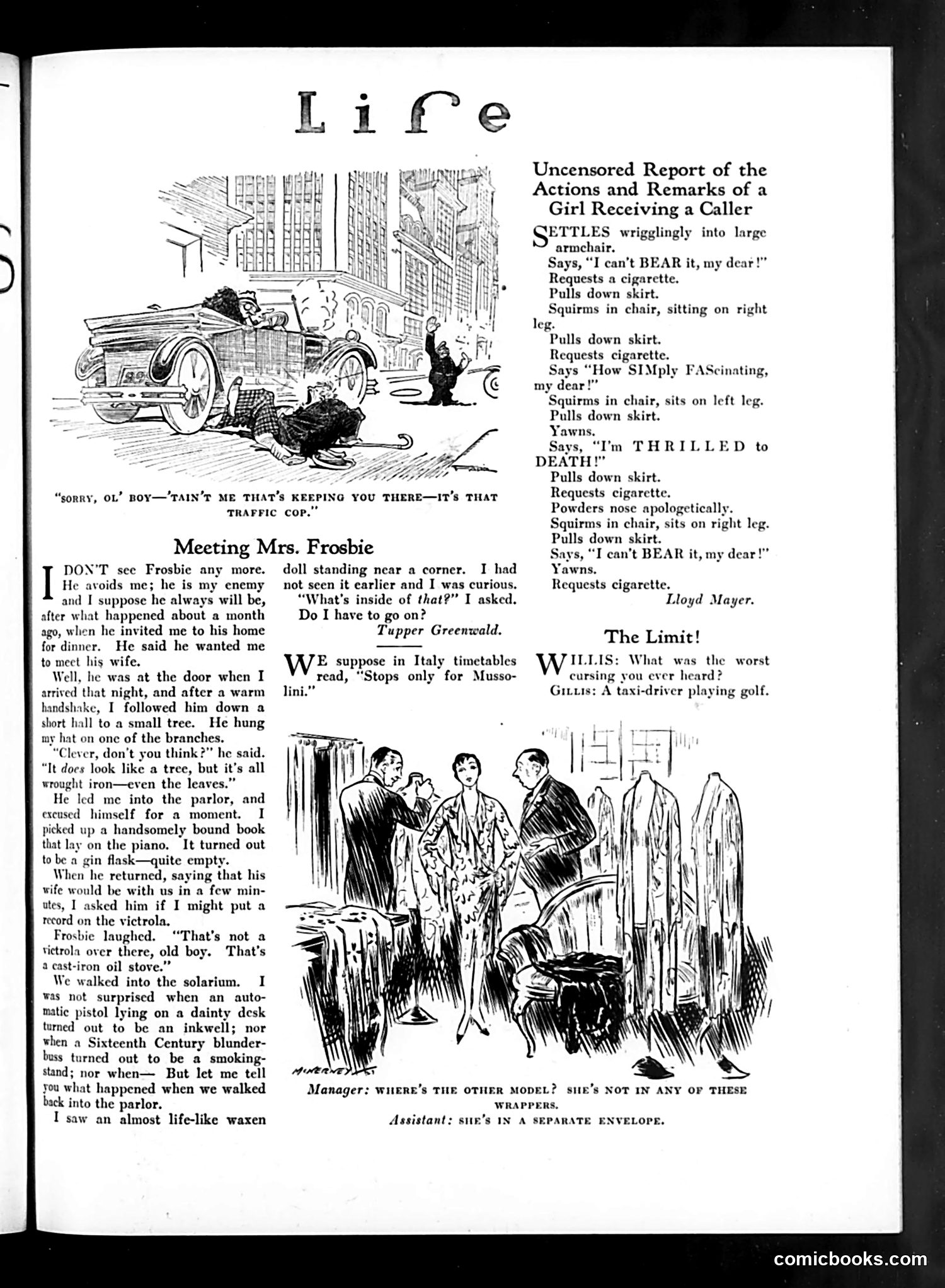
This page contains three satirical pieces from an early 20th-century Life magazine: 1. **Top cartoon**: A woman lies in the street after being hit by a car. The joke plays on the phrase "traffic cop"—the driver blames a "traffic cop" for the accident rather than himself, a humorous deflection of responsibility. 2. **"Meeting Mrs. Frosbie"**: A social commentary story mocking pretentious wealthy people. The narrator describes visiting Frosbie's home and encountering absurd affectations—a bound book used as a gin flask, a waxen figure in the parlor. The satire targets nouveau riche pretension and ostentatious displays of culture. 3. **"The Limit!"**: A brief joke about a taxi driver cursing while playing golf—the humor derives from incongruous professions colliding. The page reflects early 20th-century American satire targeting class pretension and modern urban life.
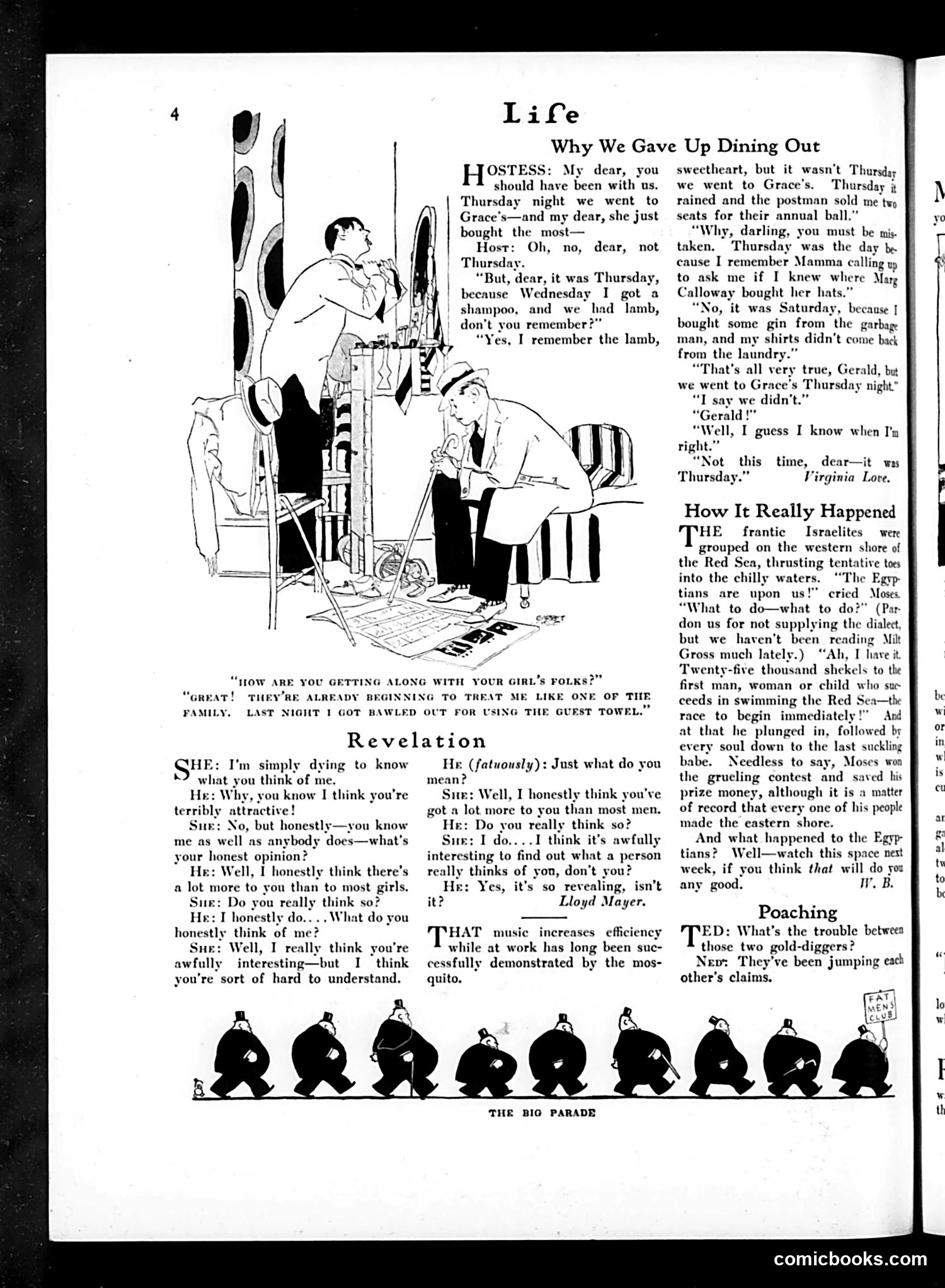
This page contains several short humor pieces typical of 1920s Life magazine: **"Why We Gave Up Dining Out"** presents a domestic dispute where a husband and wife argue about which night they dined at Grace's restaurant—he claims Thursday, she insists Saturday. The joke mocks couples' tendency to contradict each other over trivial details. **"Revelation"** is a flirtation dialogue where a man compliments a woman's attractiveness. She asks what he finds appealing, and he admits she's "hard to understand"—a backhanded compliment suggesting women are inherently puzzling to men. **"How It Really Happened"** satirizes biblical narrative, depicting Moses and Israelites at the Red Sea in modern comic style, suggesting religious stories have mundane explanations. The bottom shows **"The Big Parade,"** likely referencing the popular 1925 war film.
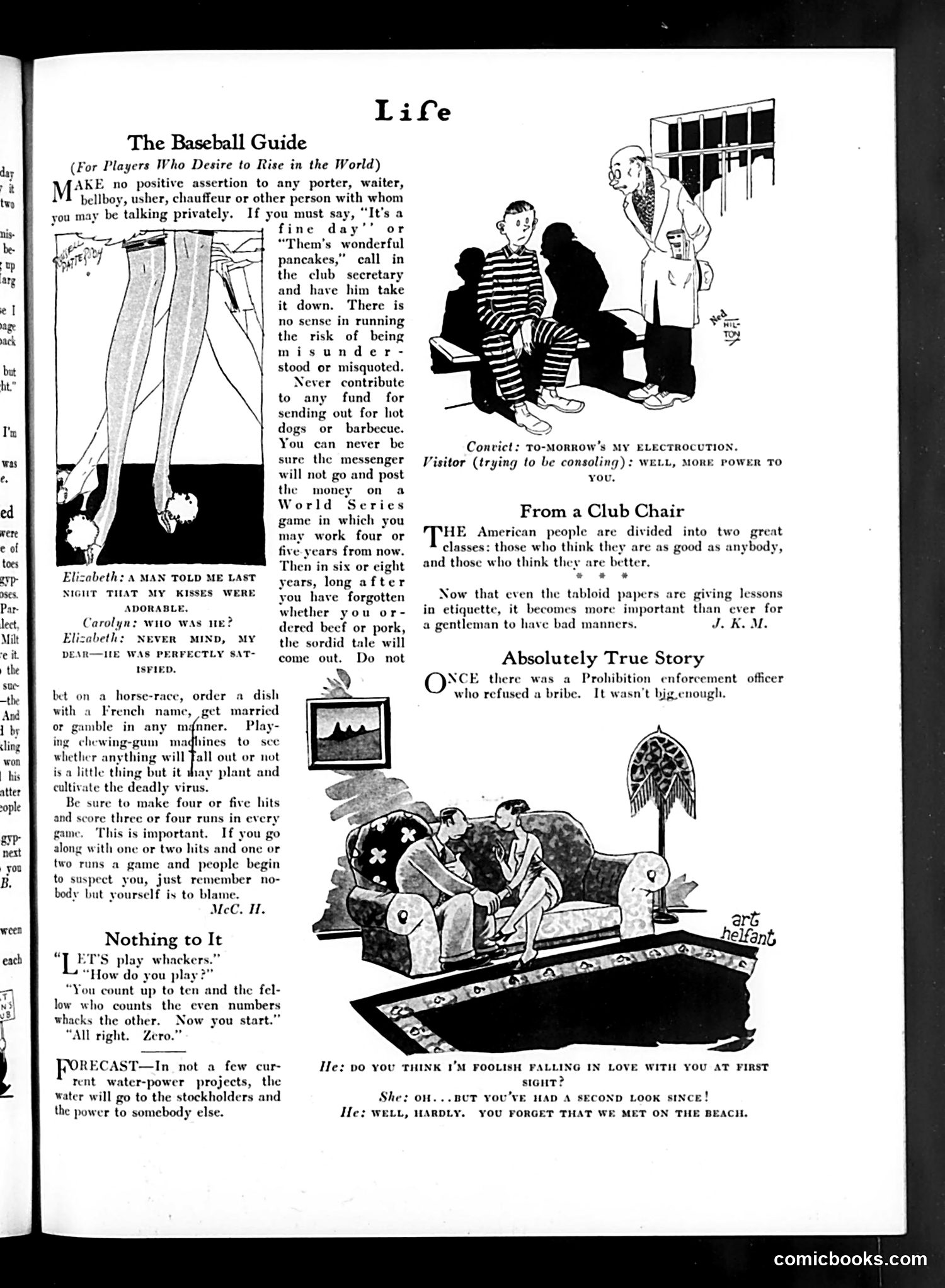
This page contains three humorous sections: **"The Baseball Guide"** offers satirical etiquette advice for baseball players, cautioning against complaining to staff or making frivolous fund-raising appeals—likely mocking players' actual behavior of the era. **"From a Club Chair"** makes a brief social commentary about American manners and etiquette, suggesting even tabloid papers now teach gentlemen proper behavior. **"Absolutely True Story"** presents a cartoon about Prohibition enforcement. It depicts a corrupt officer who refused a bribe—presented as absurdly unusual. The punchline involves a romantic couple on a couch; the officer apparently encountered them before, suggesting his "integrity" is merely coincidental rather than principled. This satirizes widespread corruption among Prohibition agents during the 1920s-30s.
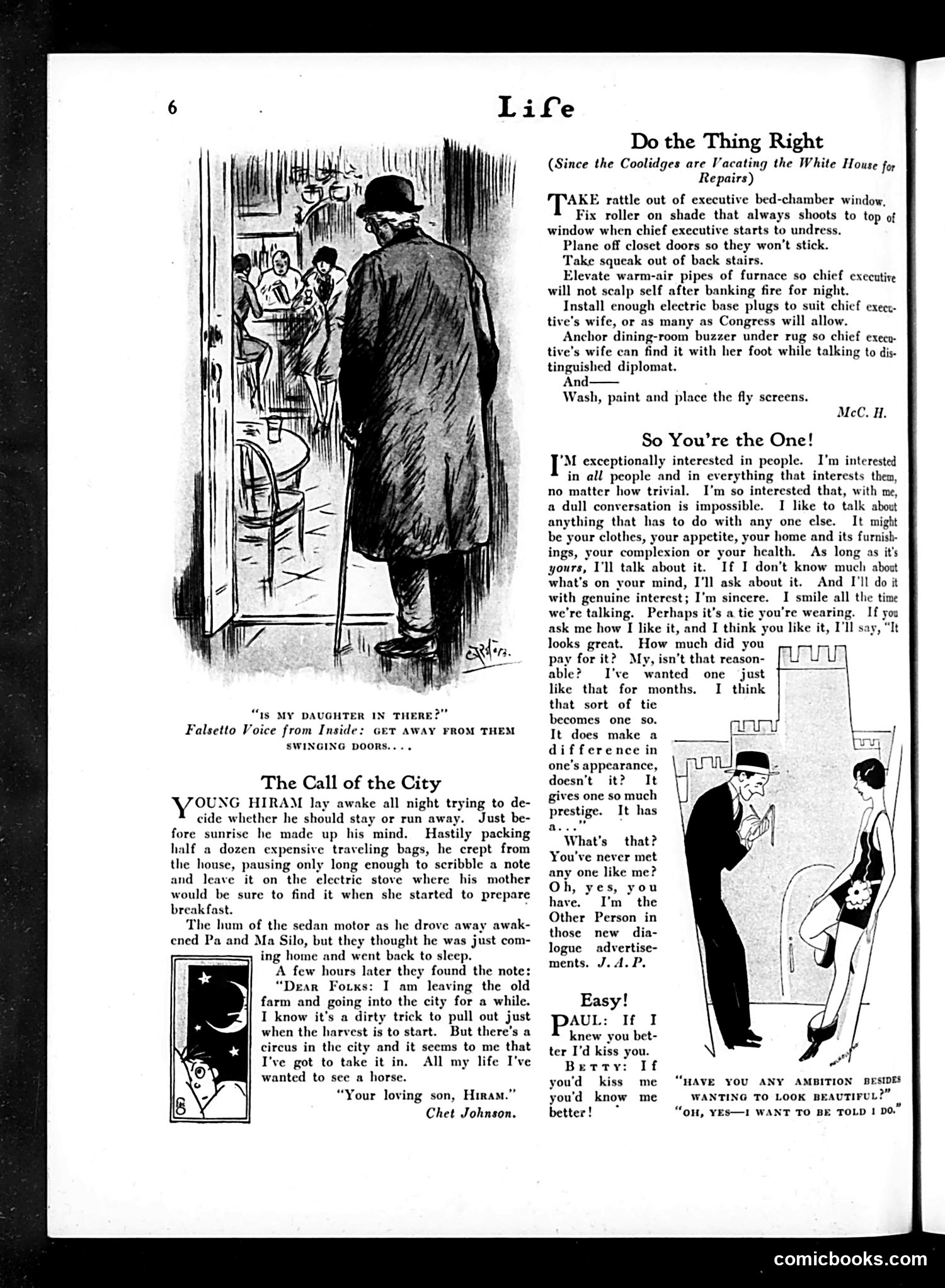
This page contains satirical advice and humor columns typical of Life's social commentary. **"Do the Thing Right"** offers tongue-in-cheek maintenance tips for White House upkeep during the Coolidge administration's renovation, mocking both the building's condition and executive life. **"The Call of the City"** depicts a young man debating whether to leave farm life for urban opportunity—a common theme of the era's rural-to-urban migration anxiety. **"So You're the One!"** presents a character claiming exceptional interest in people and willingness to discuss anything, satirizing a particular social personality type. The cartoons and brief dialogues mock contemporary social conventions, romantic posturing, and the tension between rural tradition and urban modernity. The humor relies on recognizing familiar social types rather than specific political figures.
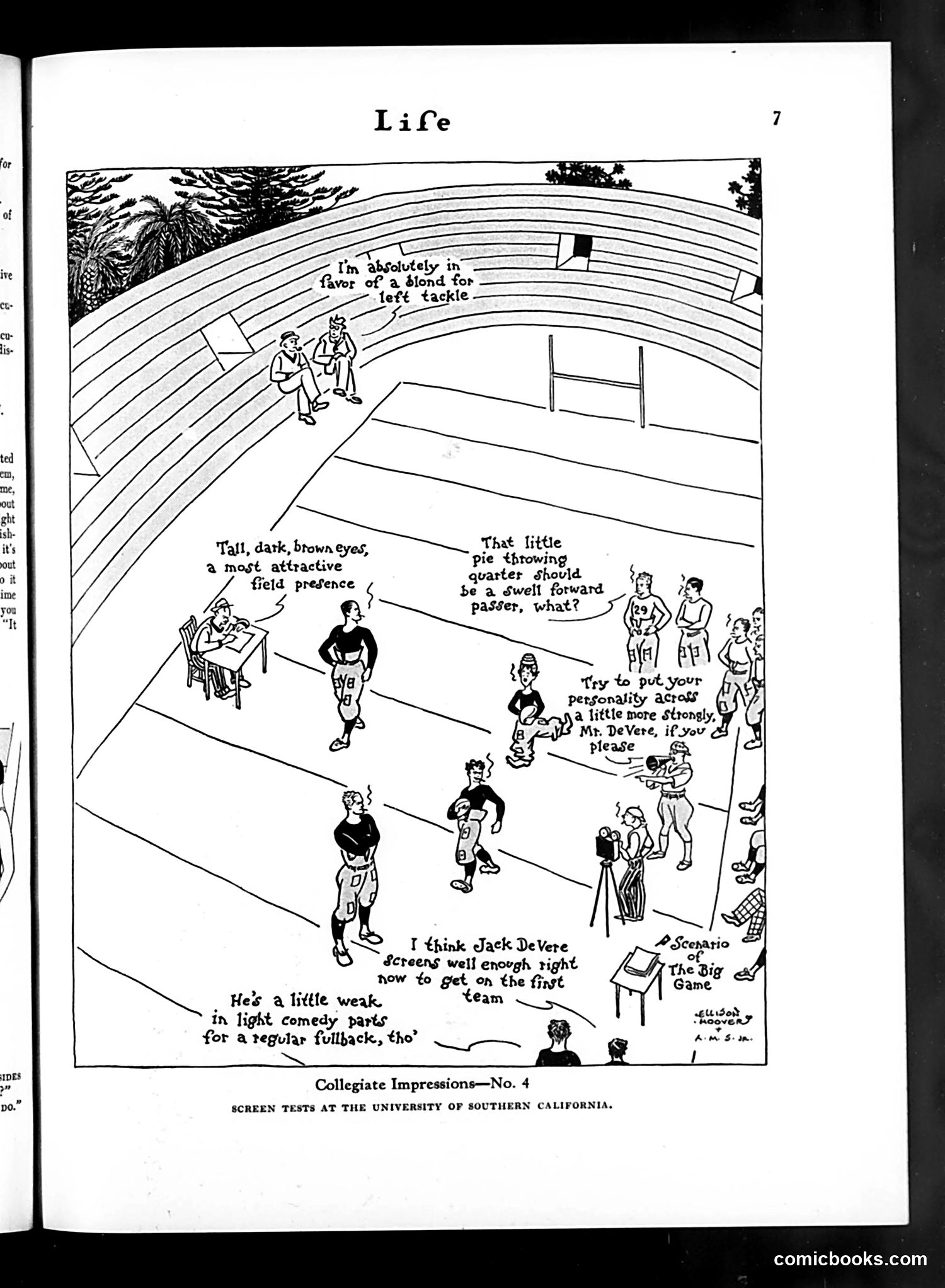
This cartoon satirizes college football recruitment and player evaluation at the University of Southern California. The scene depicts coaches and scouts assessing potential players in a stadium setting, with various comments about their attributes: - One prospect is praised for being "tall, dark, brown eyes" with "attractive field presence" - Another is criticized as "a little pie throwing goofball" who should be a "swell forward passer" - Jack DeVere is assessed as screening "well enough right now to get on the first team" but being "a little weak in light comedy parts for a regular fullback" The humor mocks how college football programs evaluate players like movie studios test actors, reducing athletes to physical and personality traits rather than pure athletic ability. "Screen test" language blurs film and sports industry jargon.
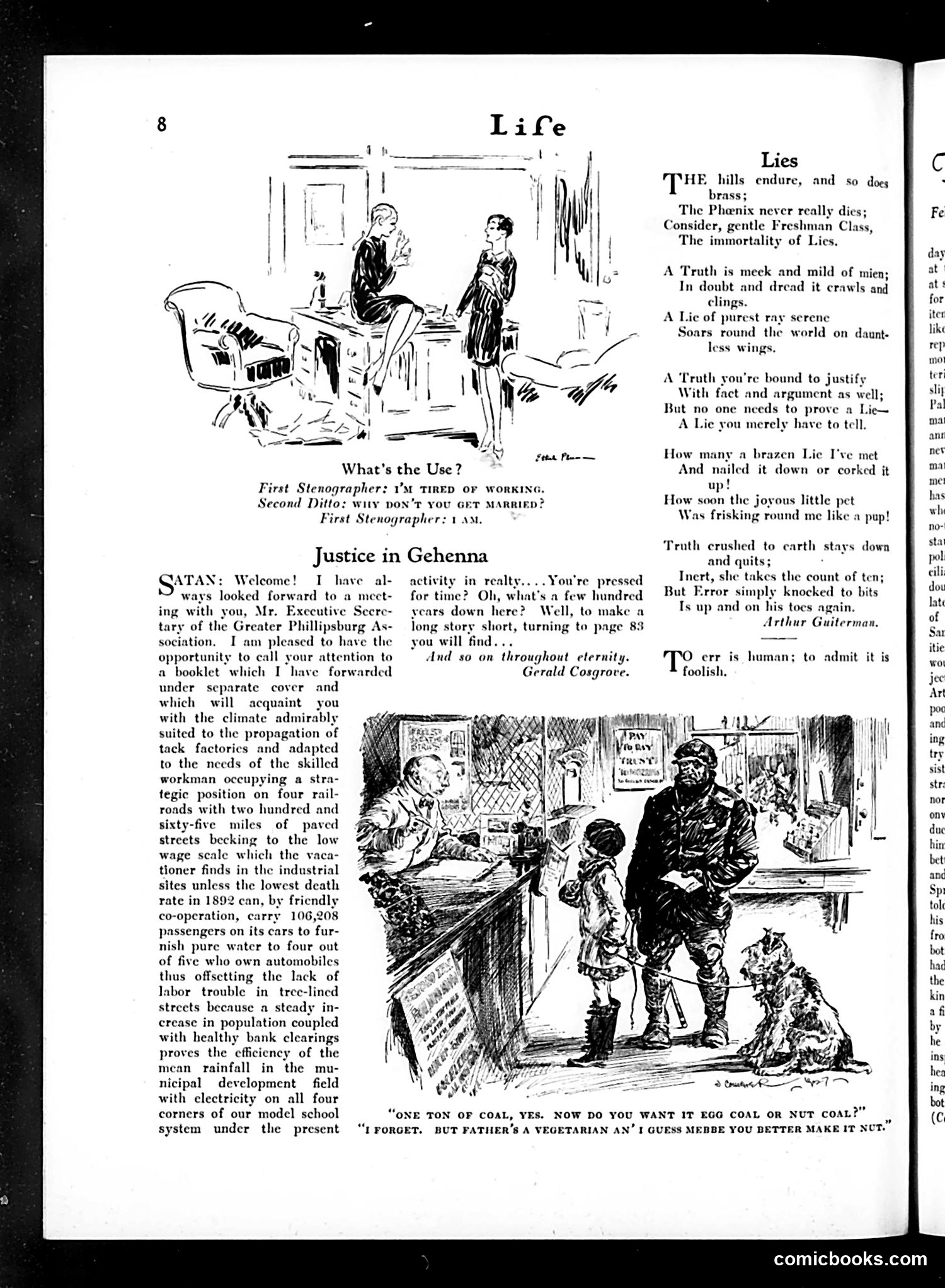
This page contains three distinct pieces: 1. **"What's the Use?"** — A brief joke about a stenographer tired of work; the second character suggests marriage as an escape, but the first replies "I am" — satirizing marriage as equally exhausting labor. 2. **"Justice in Gehenna"** — A lengthy satirical letter from "Satan" welcoming the reader to a meeting, praising the Greater Phillipsburg Association for their anti-labor advocacy. This mocks employers opposing unionization and worker protections, portraying such opposition as literally demonic. 3. **"Lies"** and **bottom cartoon** — A poem celebrating lies' superiority to truth, followed by a street scene where a coal vendor pressures a child whose father is vegetarian. The satire criticizes commercial manipulation of consumers, particularly children.
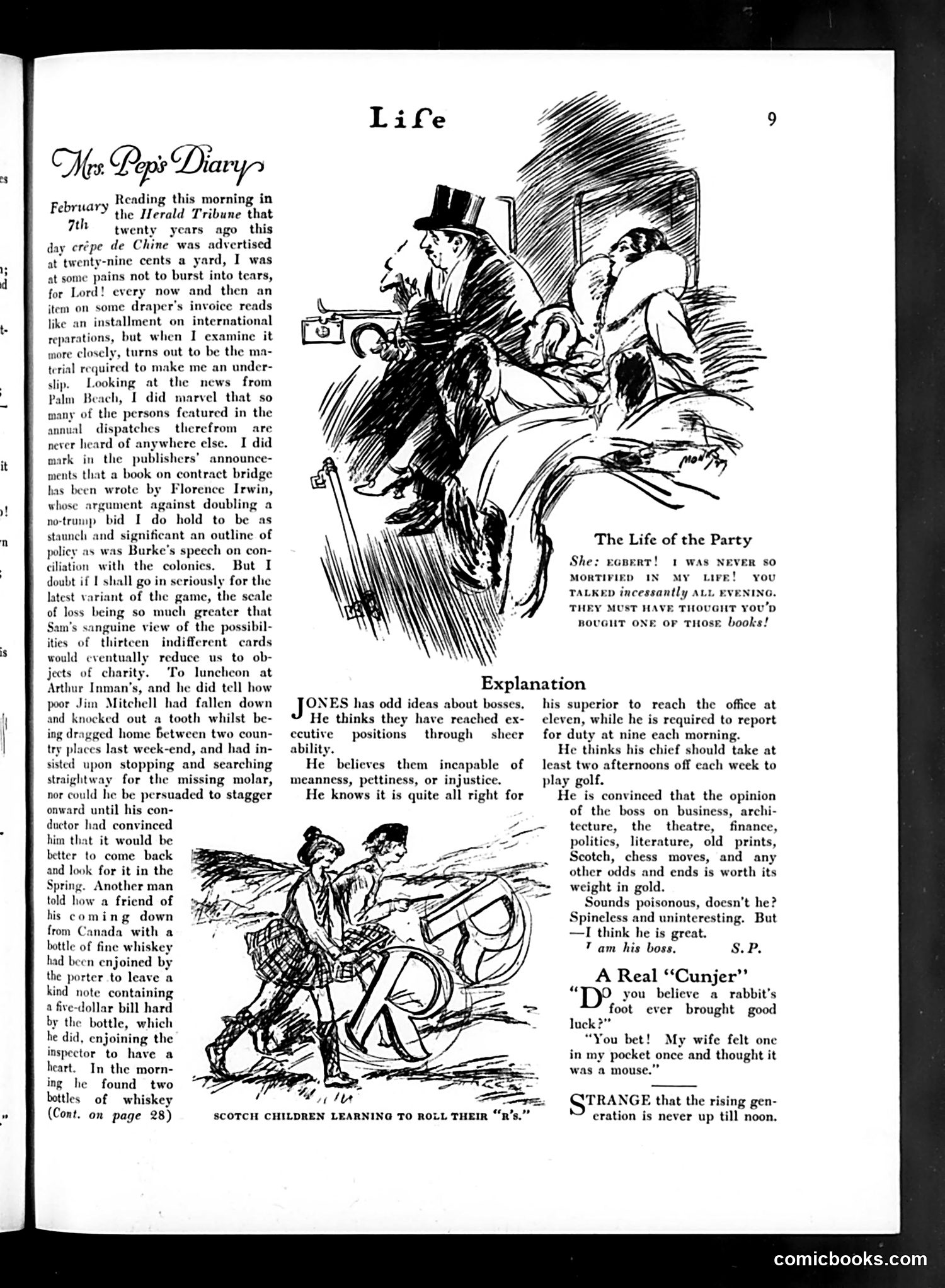
This page contains a satirical advice column and humorous anecdotes rather than political cartoons. "Mrs. Pep's Diary" discusses contract bridge (a card game), publishing debates, and workplace anecdotes about an eccentric boss named Jones. The main cartoon depicts "The Life of the Party"—a man in a top hat lecturing others, with the caption showing a woman mortified by his constant, incessant talking at social gatherings. The joke satirizes a recognizable social type: the tedious bore who dominates conversations. Secondary humor includes brief jokes about "cunjer" (a superstition about rabbit's feet bringing luck) and observations about rising generations never sleeping past noon. The humor is gentle social satire aimed at recognizable personality types and period customs.
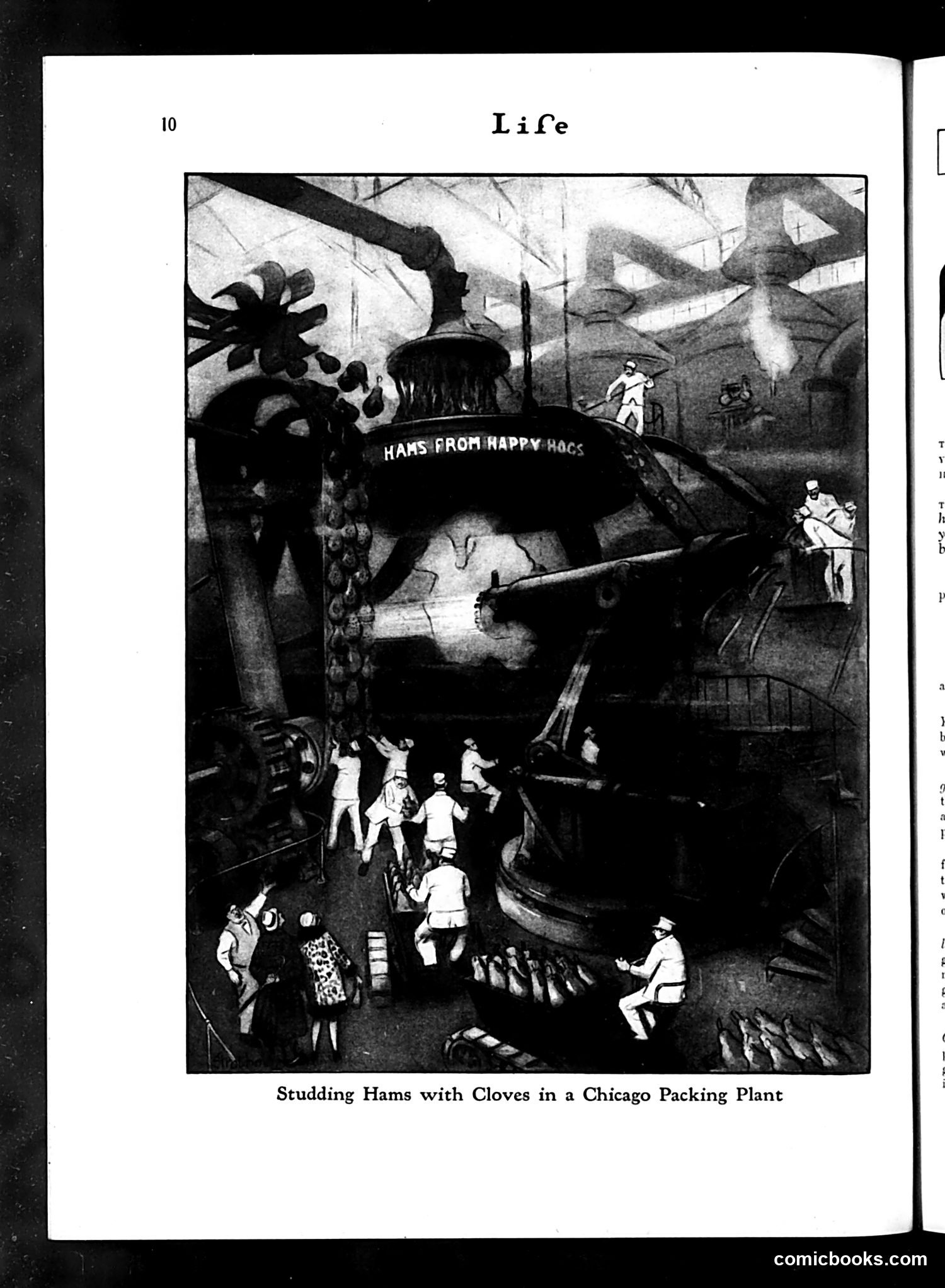
This page from *Life* magazine shows an industrial scene depicting meat processing in a Chicago packing plant. The caption reads "Studding Hams with Cloves in a Chicago Packing Plant," and the image displays workers in what appears to be a factory facility with large meat products and industrial machinery. The satirical intent likely comments on **food production and labor practices** in American meatpacking—an industry notorious for poor working conditions and questionable sanitation standards, particularly after Upton Sinclair's 1906 exposé *The Jungle*. The juxtaposition of workers dwarfed by massive industrial equipment and meat products satirizes the scale and mechanization of food production, possibly critiquing worker exploitation or food safety practices of the era.
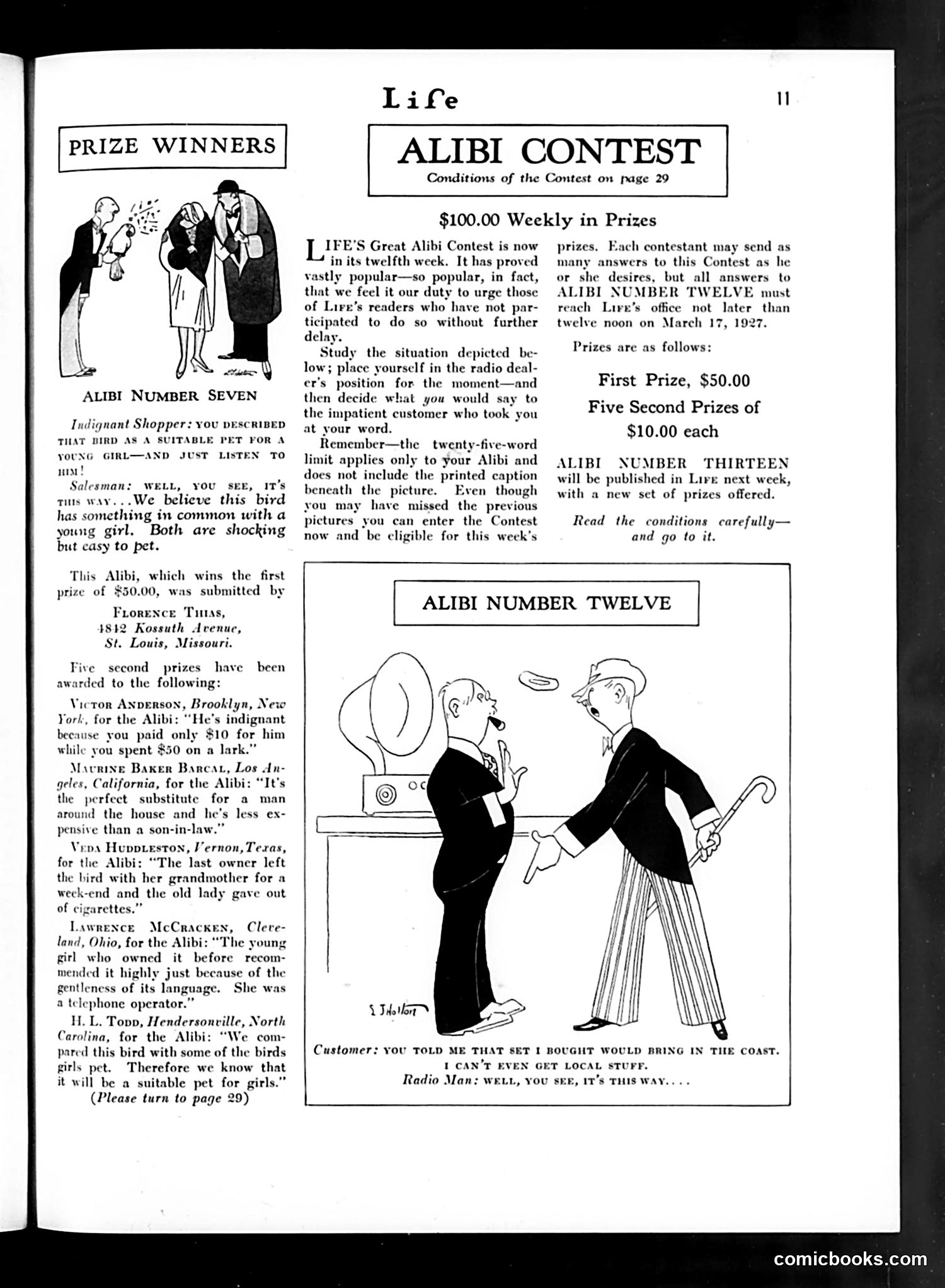
This page features Life's "Alibi Contest," a recurring humor feature where readers submit clever excuses for everyday situations. **Alibi Number Twelve** depicts a radio salesman and customer at a large radio set. The customer complains he was told the radio would "bring in the coast" but can't even get local stations. The salesman's response—"Well, you see, it's this way..."—suggests he's about to deliver a dubious excuse. The satire targets 1920s radio technology's unreliable performance and salesmen's exaggerated marketing claims. Customers expected radios to receive distant broadcasts, but reception was inconsistent. The joke mocks both the product's limitations and the seller's predictable evasiveness when confronted with disappointed buyers—a timeless consumer complaint about overpromised technology.
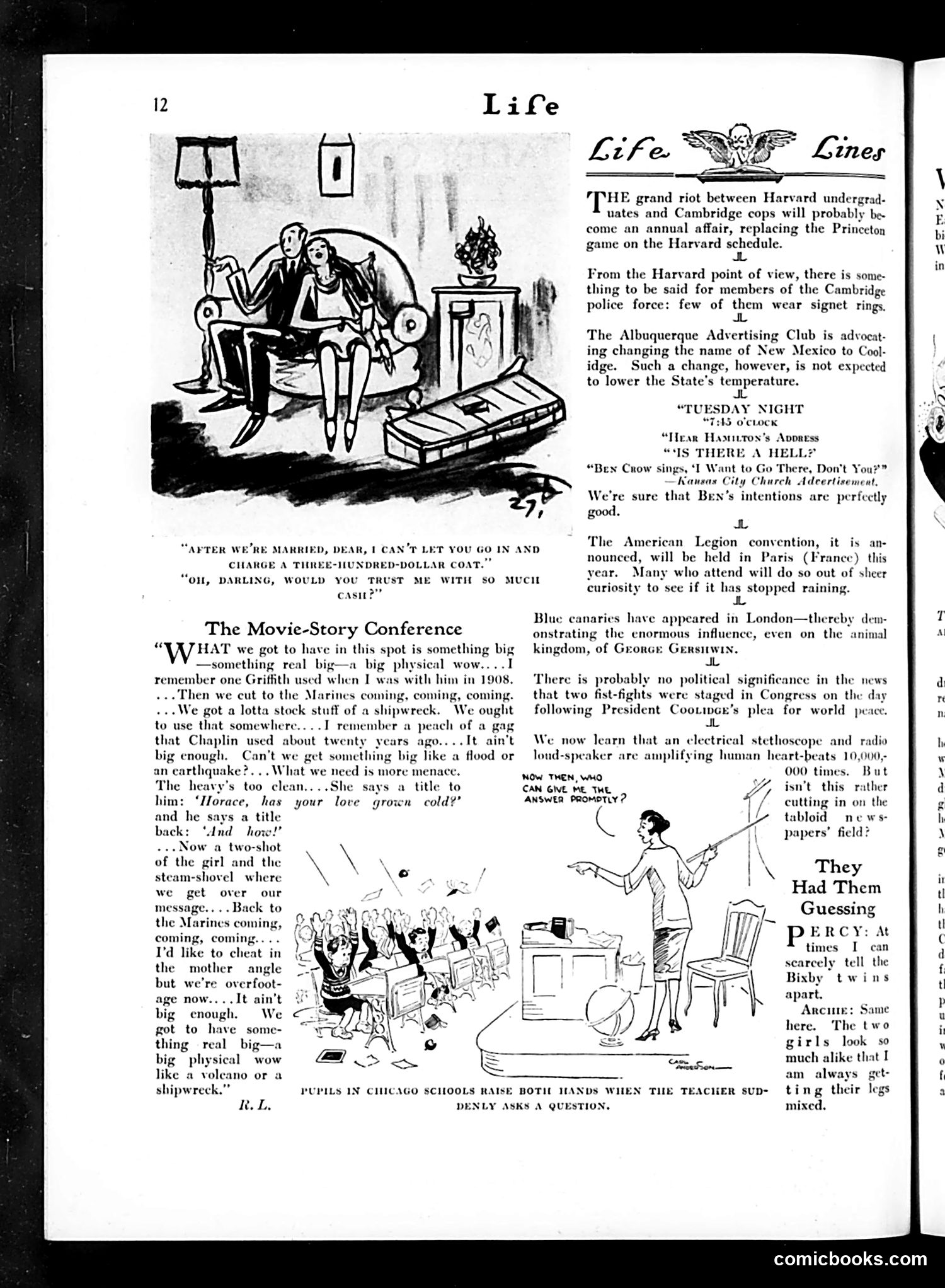
This page contains satirical commentary and cartoons about early 1920s American life. The top cartoon shows a couple on a couch, with the man saying he cannot afford an expensive coat, satirizing post-WWI economic concerns about marriage expenses. "The Movie-Story Conference" section parodies Hollywood's creative process, with a fictional writer (R.L.) describing absurdly melodramatic film plots involving Marines, shipwrecks, and volcanos—mocking the era's sensationalist cinema. The bottom cartoon depicts Chicago schoolchildren enthusiastically raising their hands when a teacher asks a question, captioned to suggest they're responding to an absurd query. The joke targets educational earnestness. The "Life Lines" column offers brief satirical observations, including commentary on Harvard-Cambridge sports rivalries, political events under President Coolidge, and social trivia about the wealthy and famous.
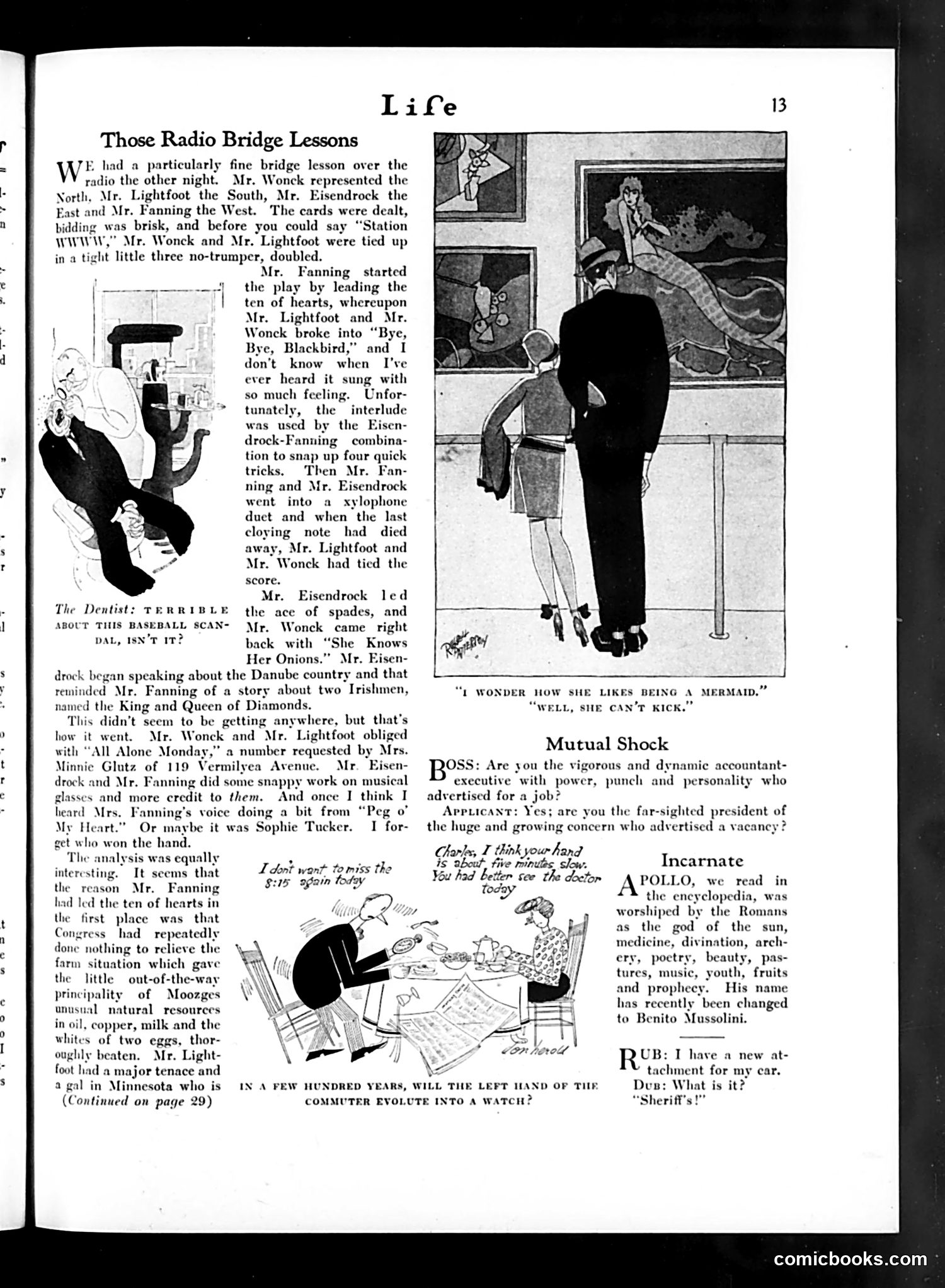
This page contains three distinct humor pieces: 1. **"Those Radio Bridge Lessons"**: A narrative about a bridge card game interrupted by radio performers (Wonek, Lightfoot, Eisendrock, Fanning). The joke involves their musical performance disrupting the game, with a xylophone duet providing comedic chaos. This satirizes early radio entertainment's intrusion into domestic life. 2. **"The Dentist"**: A cartoon showing someone terrified about a baseball scandal, satirizing public anxiety over sports controversies of the era. 3. **"Mutual Shock" and other brief jokes**: Quick comedic exchanges about job interviews and car attachments, typical of the magazine's humor-column format. The page reflects 1920s-30s concerns: radio's cultural impact, sports integrity, and employment dynamics—all delivered through light satire characteristic of *Life* magazine's satirical approach.
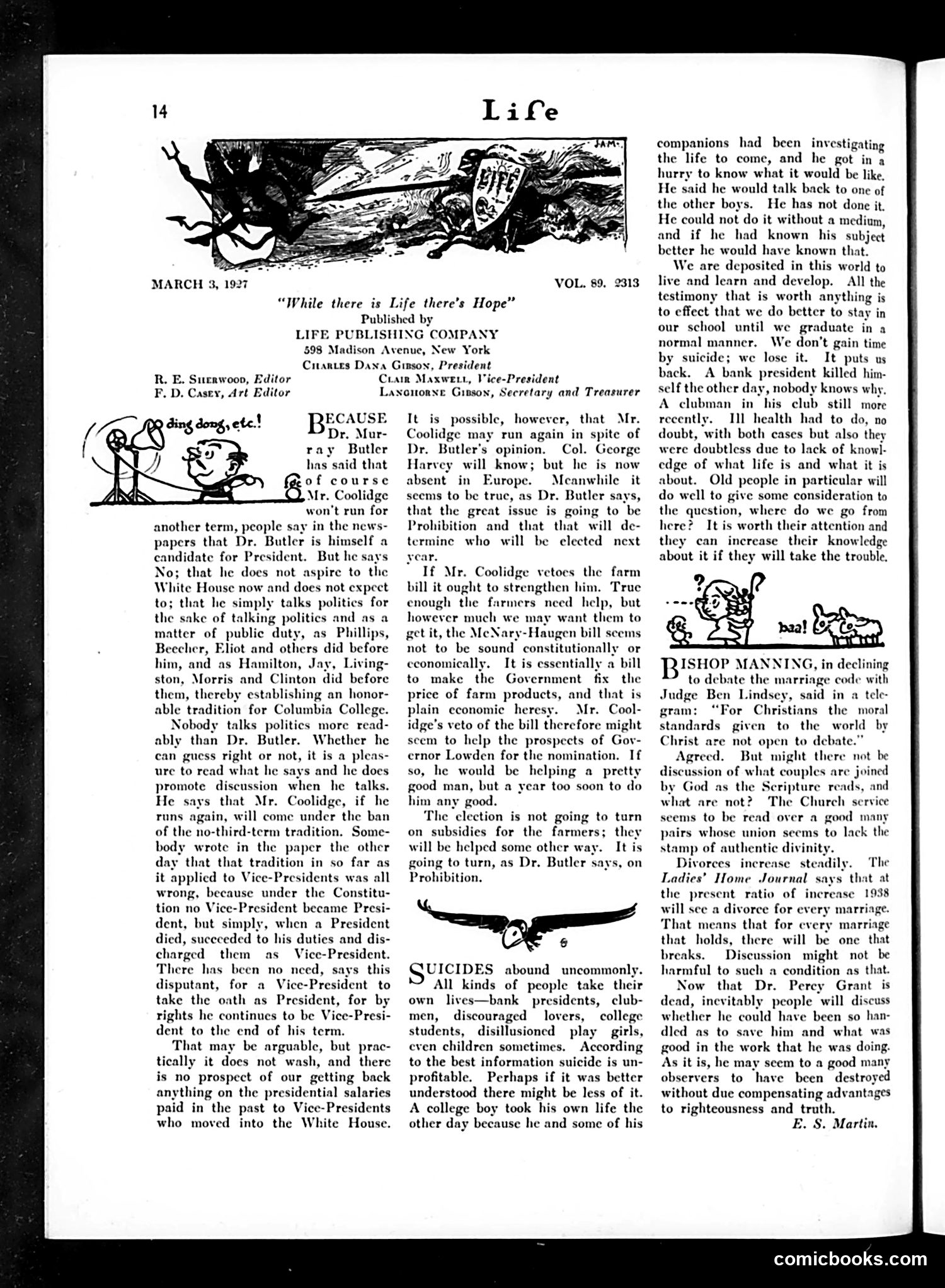
This editorial page contains political commentary rather than traditional cartoons. The main illustration shows a figure labeled "Coolidge" ringing a bell marked "PROHIBITION," satirizing President Calvin Coolidge's political position. The text discusses whether Coolidge will run for re-election and debates his potential veto of the McNary-Haugen farm bill. The article suggests Coolidge may be a candidate for president despite claims otherwise, and questions the constitutionality of farm price-fixing legislation. Additional sections address suicides among various demographics and Bishop Manning's criticism of the marriage code, suggesting the Church's moral authority is questioned. The overall tone mocks Coolidge's political ambitions while discussing serious policy disagreements of the era.
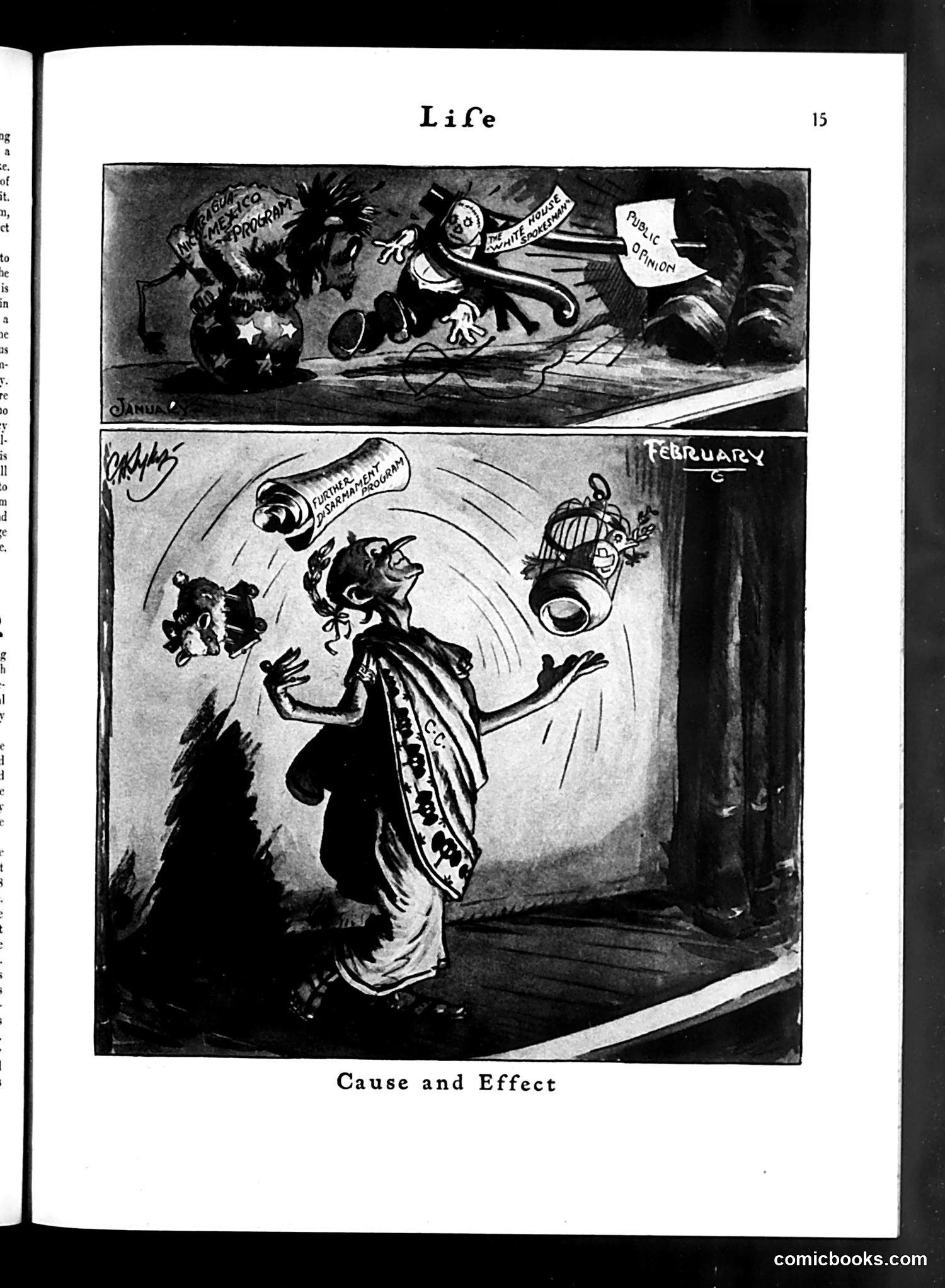
This page contains two satirical cartoons showing cause-and-effect relationships. The **top cartoon (January)** appears to show political or social forces in conflict—figures labeled with terms like "Public Opinion" clash with what looks like established power structures or institutions. The **bottom cartoon (February)**, titled "Cause and Effect," depicts a central figure juggling or managing various spheres labeled with different issues or concerns. The figure appears to be a political leader or public official attempting to balance competing demands or problems simultaneously—a common satirical commentary on the challenges of governance or political leadership. Both cartoons use exaggerated, expressionistic style typical of early-to-mid 20th century political satire to critique the complexity and contradictions of managing public affairs. Without additional context, specific figures and issues remain unclear.
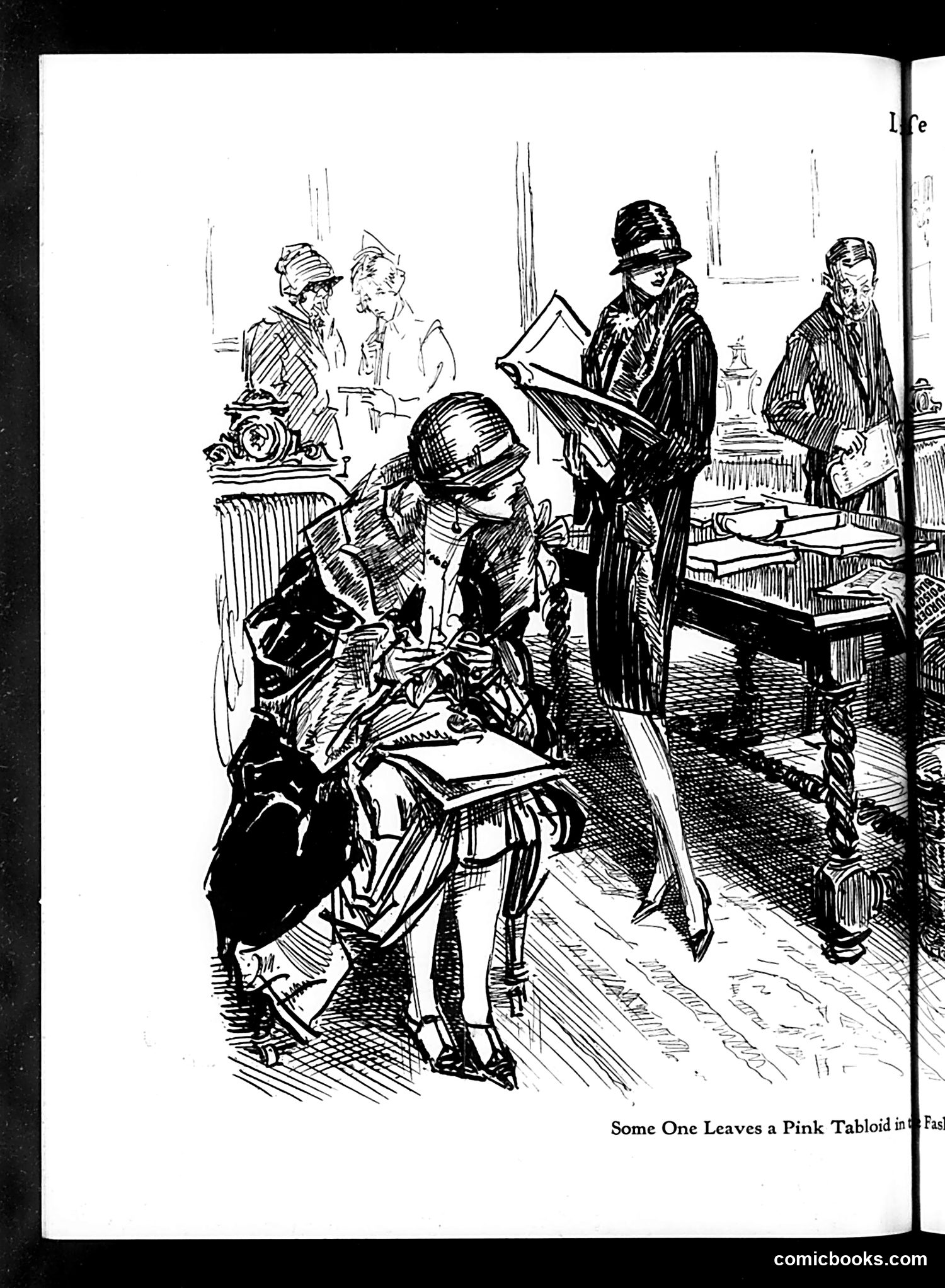
This cartoon satirizes the social anxiety created by tabloid newspapers in early 20th-century high society. The scene depicts a well-dressed woman at a fashionable restaurant discovering or reacting to an abandoned pink tabloid (likely a scandal sheet). The other diners and staff display various reactions ranging from interest to concern. The satire targets two things: the sensationalism and scandal-mongering of tabloid journalism, and the vulnerability of wealthy, fashionable people to public exposure through such publications. The "pink tabloid" appearing in an exclusive restaurant suggests these gossip papers penetrated even exclusive social spaces, making everyone—regardless of class—susceptible to embarrassing public revelation. The cartoon mocks both tabloid culture and the vanity of high society.
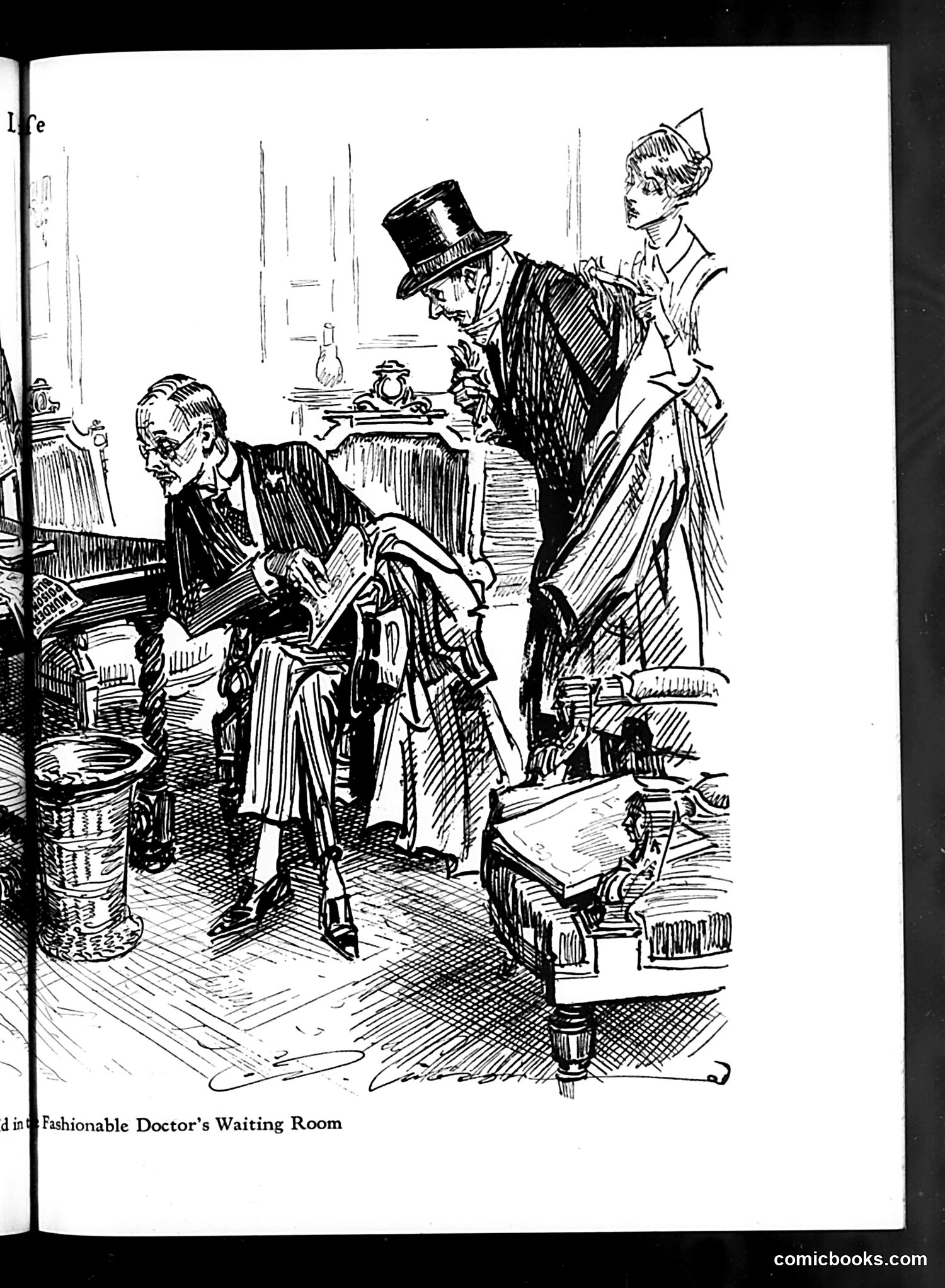
This satirical cartoon depicts a doctor's waiting room where social class anxiety is on display. A well-dressed gentleman in a top hat and formal wear sits prominently in the center, while other patients wait. A woman in fashionable dress stands nearby, and a man sits on the left. The satire targets the pretensions of "fashionable" medical practice—suggesting that wealthy patients were treated as status symbols rather than medical cases. The elaborate formal dress and furnishings emphasize that this is an upscale establishment where appearance and social standing matter as much as actual healthcare. The joke appears to be mocking both the vanity of wealthy patients seeking trendy doctors and the doctors themselves who cultivated exclusive, fashionable practices as a marker of success.
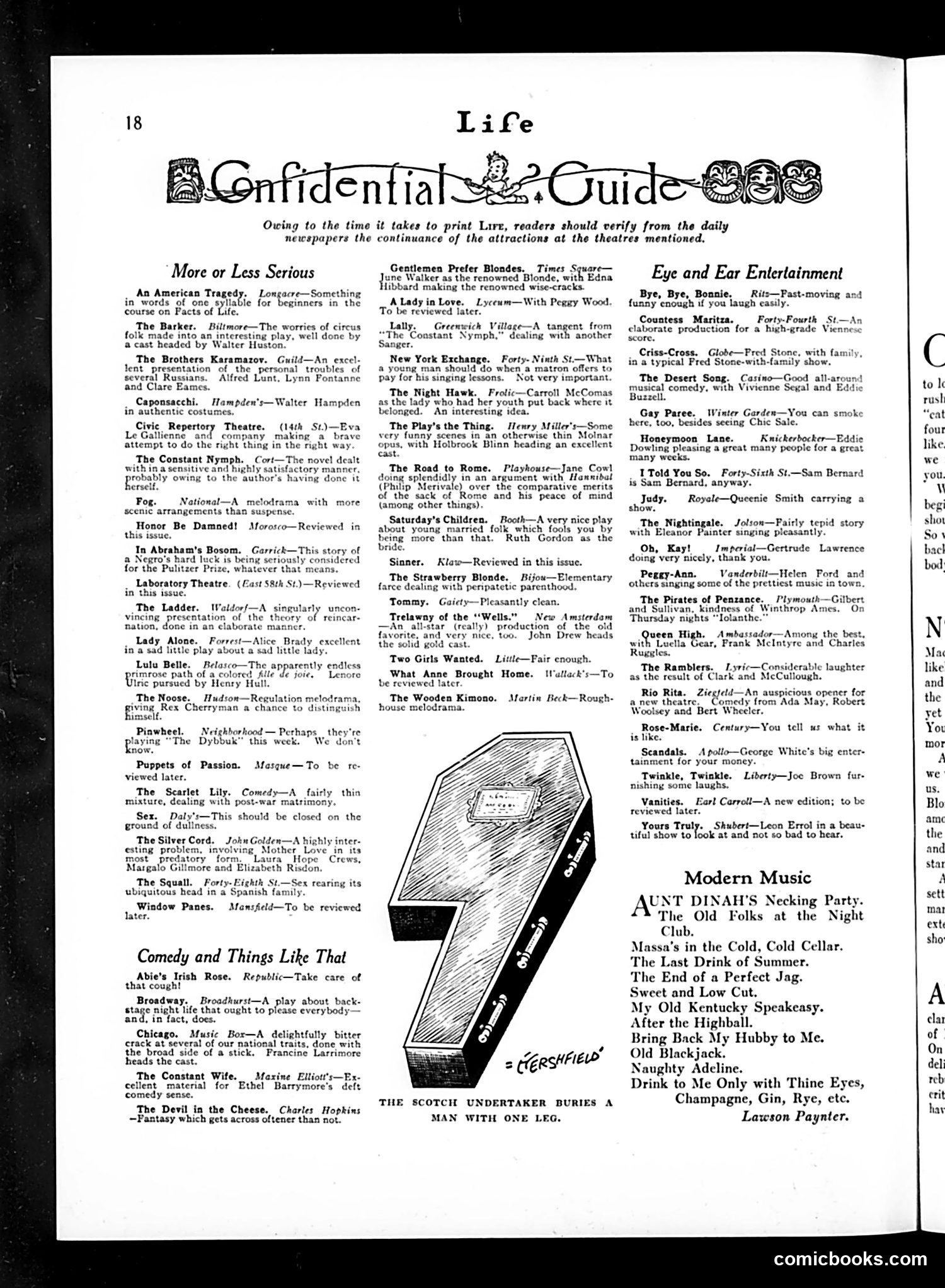
This is a theater review page from Life magazine's "Confidential Guide" section, cataloging Broadway and Off-Broadway productions. The content is entirely theatrical criticism—not political satire. The cartoon shows a coffin labeled "Hersfield's" with a single protruding leg, captioned "The Scotch Undertaker Buries a Man with One Leg." This is a simple visual gag playing on Scottish stereotypes about frugality: the undertaker apparently charges per limb, so he buries the man incompletely to save costs. The reviews themselves are brief, sardonic capsules of contemporary plays (many now forgotten). Notable productions reviewed include *Abie's Irish Rose*, *The Constant Nymph*, and *In Abraham's Bosom*—the latter noted as potential Pulitzer material. The tone is witty dismissal: *Sex* at Daly's "should be closed on the ground of dullness"; *Chicago* is "a delightfully bitter crack." The page reflects 1920s theater culture and Life's role as entertainment arbiter for educated readers.
This is a theater review column discussing several Broadway productions. The critic describes attending multiple shows in one evening, including Willard Mack's "Honor Be Damned!" **Key figures discussed:** - **Willard Mack**: An actor-playwright characterized as somewhat "hammy" but entertaining despite his theatricality - **Charles Mack**: Part of the vaudeville duo Moran and Mack, performing in "Vanities" **The satire:** A joke by Charles Mack deflates pretentious dramatic criticism. When a character protests that a dog wouldn't realistically refuse meat, Mack replies the dog simply "heard of this one!"—a witty riposte to critics who complain that theatrical characters don't behave realistically. **Other theaters mentioned:** The American Laboratory Theatre and Cherry Lane Playhouse, experimental venues representing the "Little Theatre Movement." The column advocates for entertainment value while noting that experimental theaters should improve their craft rather than excuse poor quality as avant-garde.
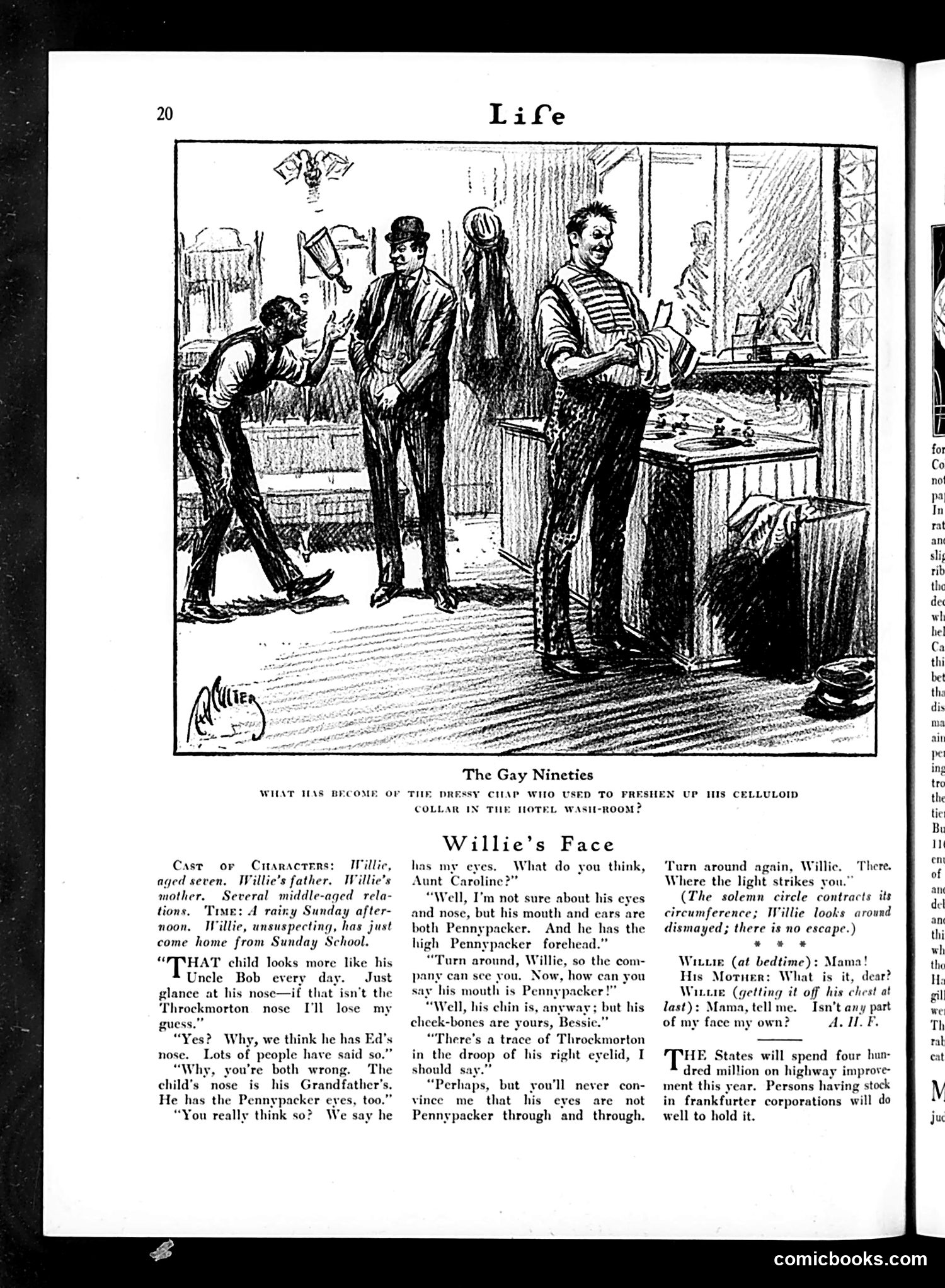
This sketch satirizes a common Victorian social ritual: relatives obsessively analyzing a child's physical features to identify which family members he "takes after." The humor lies in the absurdity of the adults' competing claims—each relative insists Willie's nose, eyes, forehead, and chin belong to *their* side of the family, creating an exhausting parade of observations that reduces the boy to a collection of inherited parts. By the sketch's end, Willie—exhausted from being turned around repeatedly under scrutiny—plaintively asks his mother: "Isn't any part of my face my own?" This captures the joke's point: in their eagerness to claim genetic credit, the relatives have entirely erased Willie's individual identity. The title references "The Gay Nineties," suggesting this mocks outdated upper-middle-class social conventions of that era.
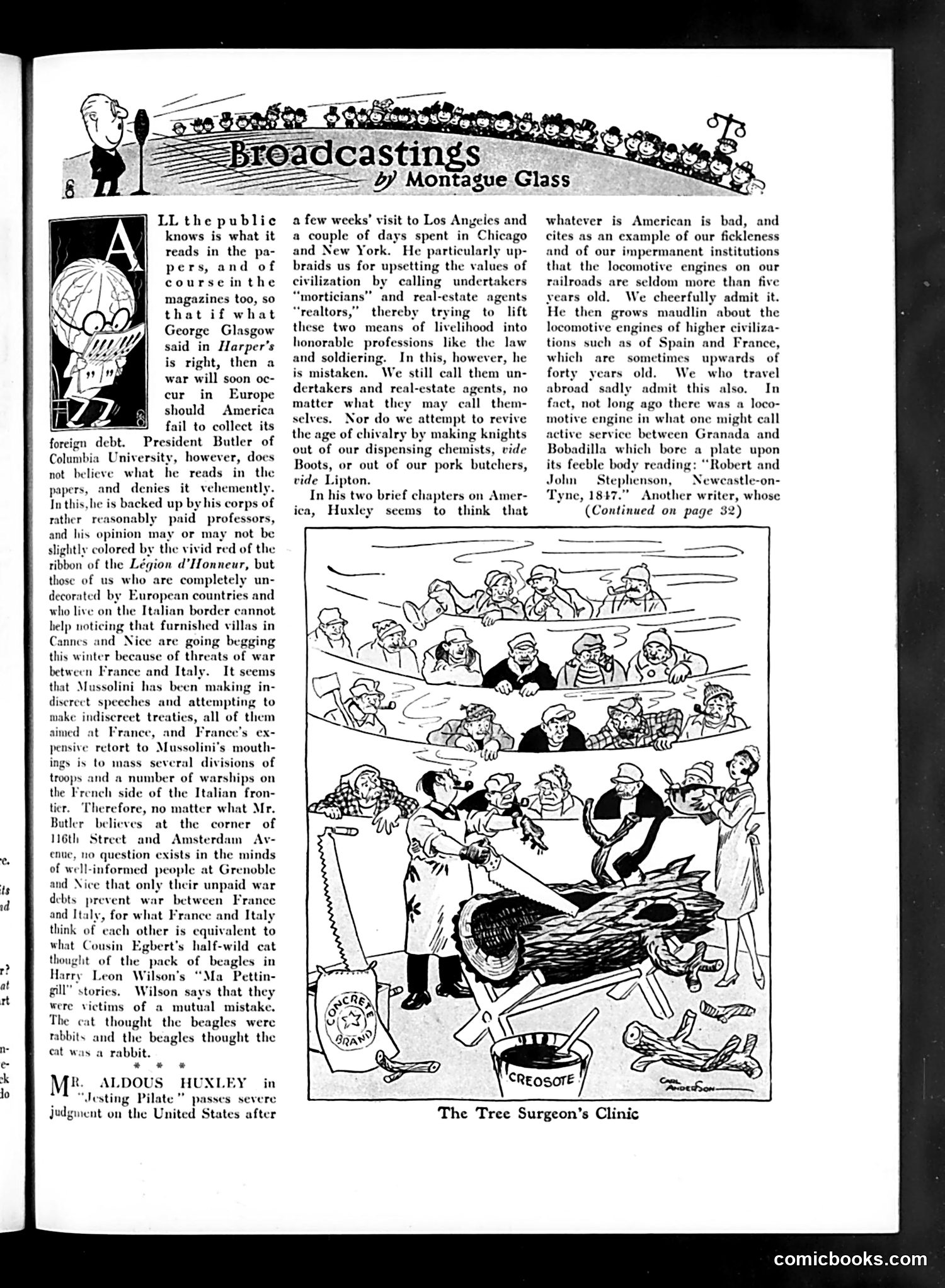
This satirical column critiques public intellectuals and foreign observers of American society. **Main targets:** 1. **President Butler of Columbia University**: Criticized for dismissing newspaper reports of potential France-Italy war tensions, despite credible evidence (furnished villas in the French Riviera sitting empty due to war fears). Butler's credibility is questioned—his Legion of Honor decoration may bias his pro-European views. 2. **Aldous Huxley**: The English author is mocked for condemning American culture during his U.S. visit, particularly for criticizing Americans' use of euphemisms ("morticians" for undertakers, "realtors" for real-estate agents). The author defends America, noting these terms don't actually elevate these professions' status. Huxley is also ridiculed for romanticizing European locomotives' longevity while dismissing American engines' shorter lifespans—the author suggests this reflects practical American values, not cultural inferiority. **The satire's point**: Elite intellectuals either willfully ignore reality (Butler) or harbor prejudiced condescension toward America (Huxley). The cartoon "The Tree Surgeon's Clinic" (bottom) likely reinforces these themes through visual metaphor, though its specific meaning is unclear without additional context.
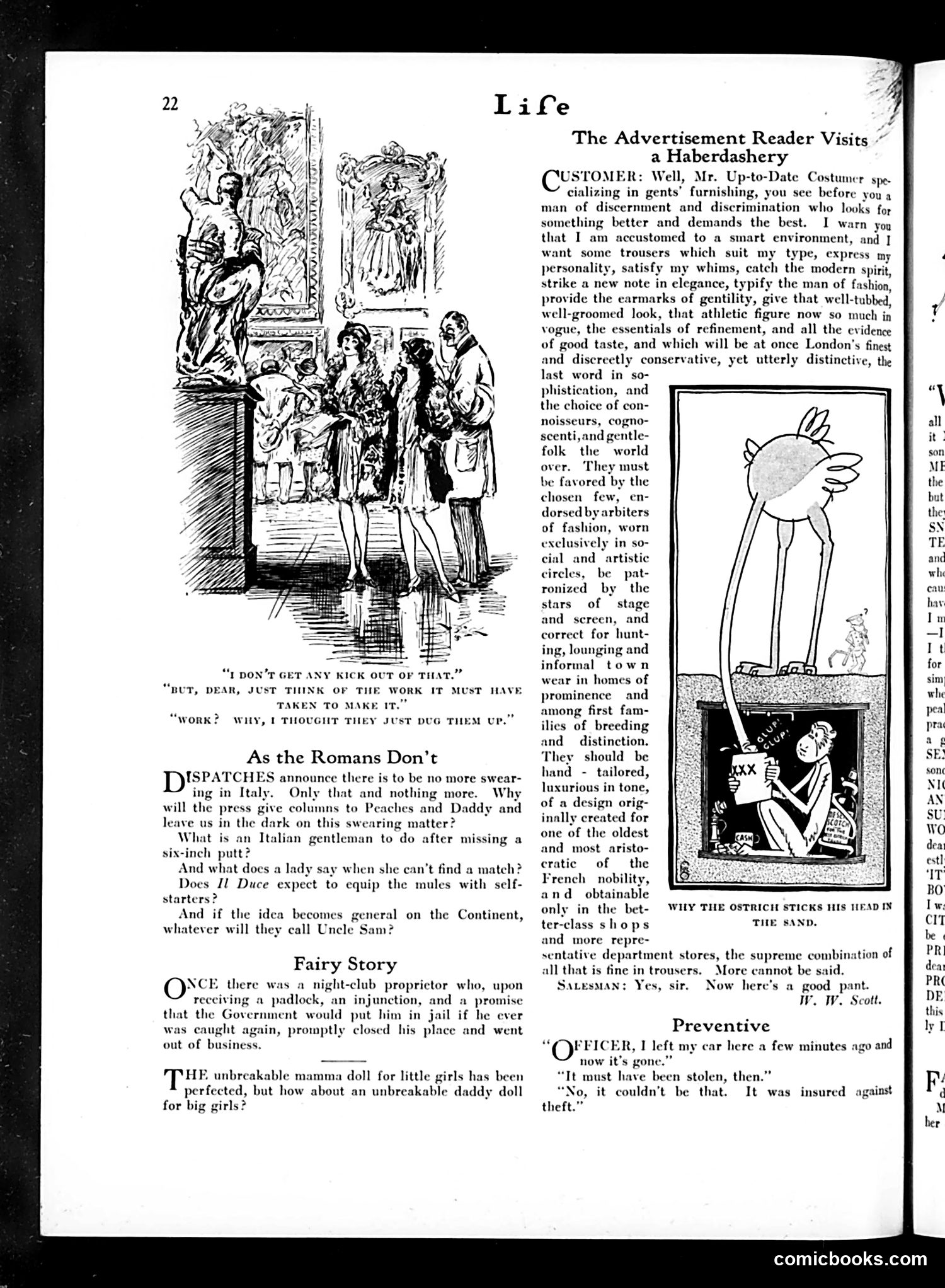
This page from *Life* magazine contains several satirical pieces lampooning 1920s consumer culture and social pretension. The main cartoon mocks advertisement-driven fashion obsession. A pompous customer visits a haberdasher, delivering an absurdly verbose monologue about trousers that must simultaneously be exclusive, conservative, athletic, refined, and endorsed by fashion arbiters—an impossible contradiction Life ridicules as the height of advertising-driven vanity. The "Romans Don't" section satirizes Mussolini's Italy, referencing Il Duce's announced ban on swearing. The writer mockingly questions what Italian gentlemen will do without profanity—a jab at fascist authoritarianism. The "Fairy Story" briefly mocks Prohibition enforcement: a nightclub owner, threatened with jail, simply closes shop, suggesting the policy's ineffectiveness. "Preventive" contains a brief joke about insured cars, playing on the irony of insurance against theft rather than prevention. The overall tone ridicules consumer excess, authoritarian governance, and modern anxieties about property and status.
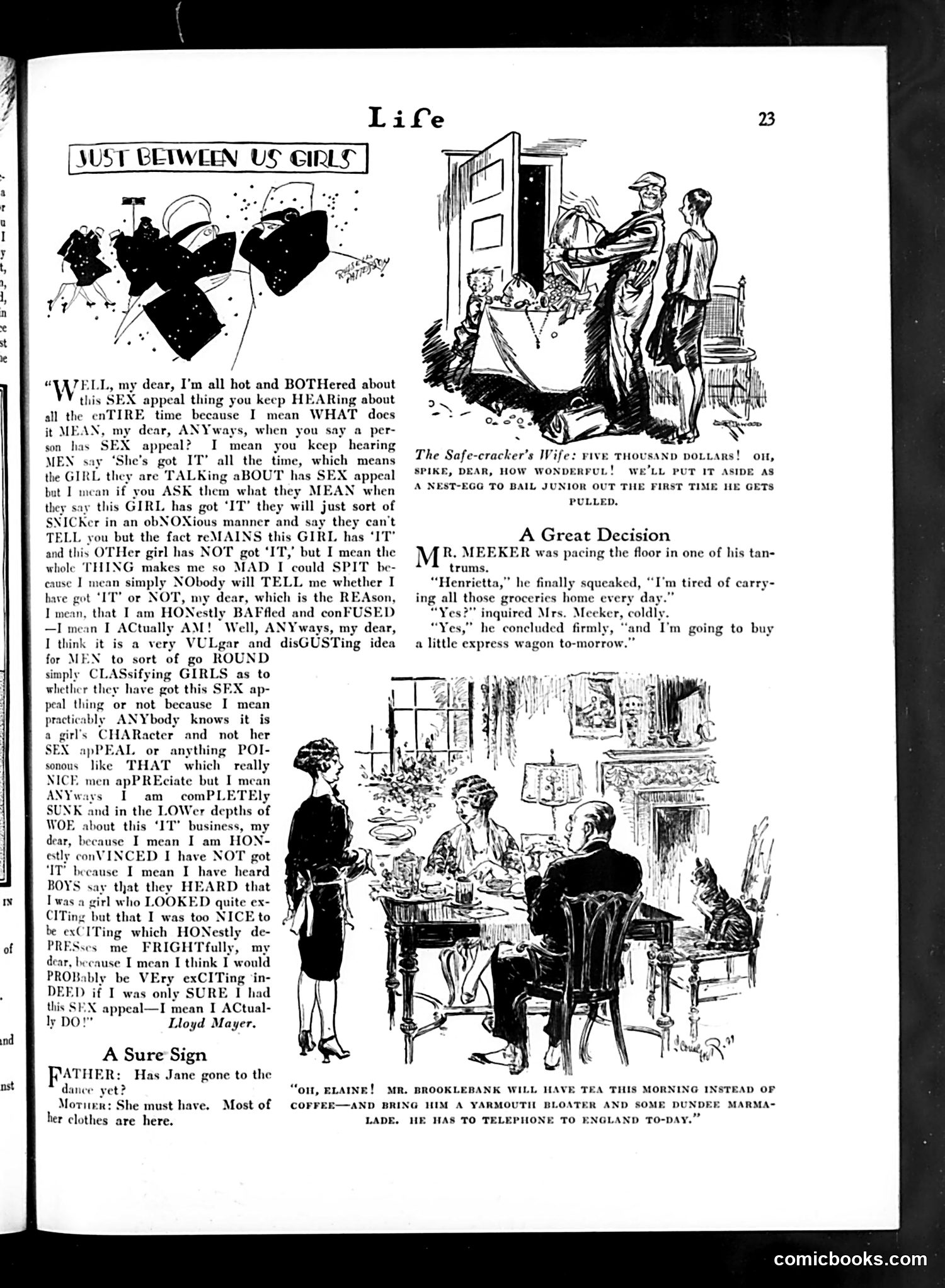
This page contains three separate humorous pieces satirizing early 20th-century social attitudes: **"Just Between Us Girls"** mocks women's obsession with the term "IT"—slang for sex appeal. The piece, written by Lloyd Mayer, ridicules the vague concept through a breathless female monologue using exaggerated capitalization for emphasis. The satire targets both the undefined nature of "IT" and women's anxiety about whether they possess this mysterious quality. **"A Sure Sign"** is a brief joke about a father and mother discussing their daughter Jane's absence, implying she's at a dance. **"A Great Decision"** humorously depicts marital dynamics: Mr. Meeker, exhausted from carrying groceries, decides to buy an express wagon—a seemingly momentous decision his wife receives with cold indifference. The joke satirizes both male self-importance over minor decisions and marital tension. **"The Safe-cracker's Wife"** darkly jokes about criminal life: a wife plans to save stolen money to bail out their son when he inevitably gets arrested, normalizing crime as family business.
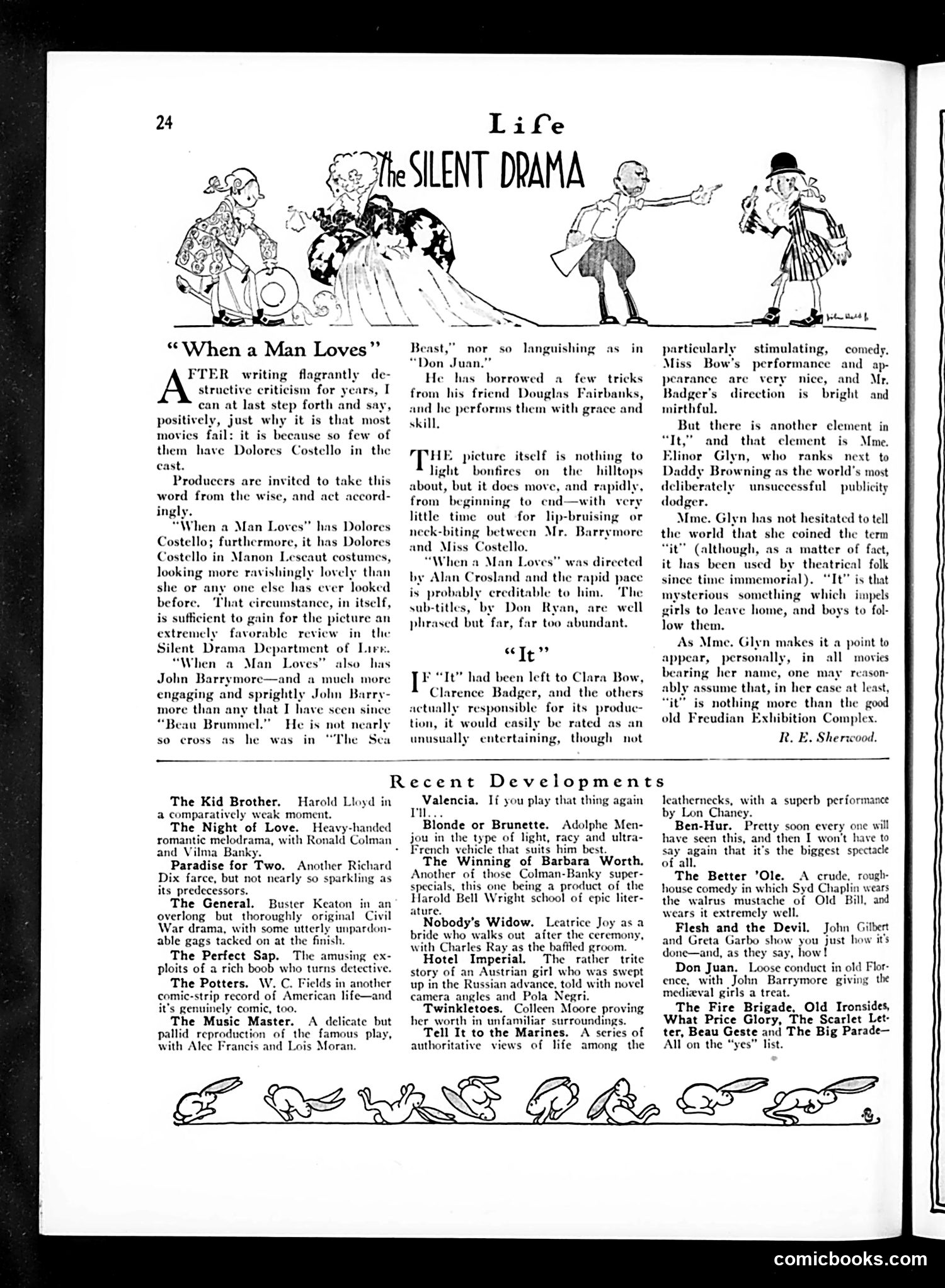
This page reviews recent silent films. The top cartoon illustrates the review of "When a Man Loves"—a John Barrymore and Dolores Costello picture. The critic humorously argues that Costello's presence alone justifies a positive review, regardless of plot quality. The second review discusses "It," starring Clara Bow and directed by Clarence Badger. The satire targets Elinor Glyn, the British screenwriter who popularized the term "It" (sexual magnetism/appeal) and made a point of appearing in her own films for publicity. The critic mockingly suggests Glyn's personal appearances prove "It" is merely exhibitionism rather than the mysterious quality she claims to have invented. The "Recent Developments" section briefly reviews other current releases, mentioning stars like Harold Lloyd, Buster Keaton, W.C. Fields, and Ronald Colman. This reflects Life magazine's role as arbiter of American popular entertainment during the silent film era.
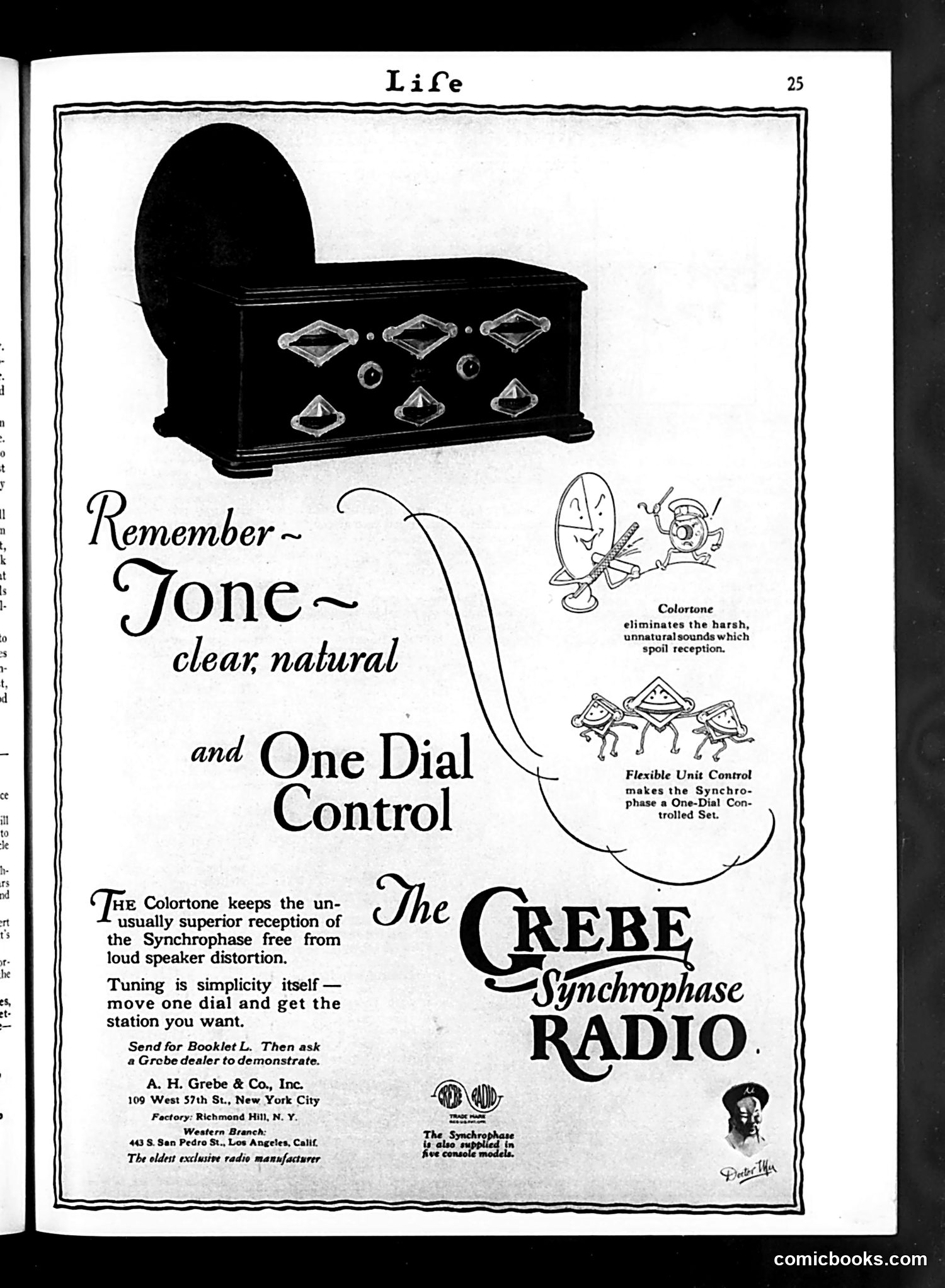
This is **not a cartoon or satire** — it's a **radio advertisement** from Life magazine's advertising section (page 25). The page promotes the **Grebe Synchrophase Radio**, a consumer product from the early radio era. The ad emphasizes technical features: "Colortone" technology eliminates distortion, and "Flexible Unit Control" provides "One Dial Control" for simplified tuning — a significant selling point when radios typically required multiple adjustment dials. The small illustrated figures (appearing to be anthropomorphized radio components) are purely decorative, meant to make technical specifications whimsical and appealing to readers. **Historical context**: This represents the 1920s consumer radio boom, when improved reception and easier operation were major competitive advantages. A.H. Grebe & Co. claims to be "the oldest exclusive radio manufacturer," emphasizing their established credibility in this rapidly evolving market.
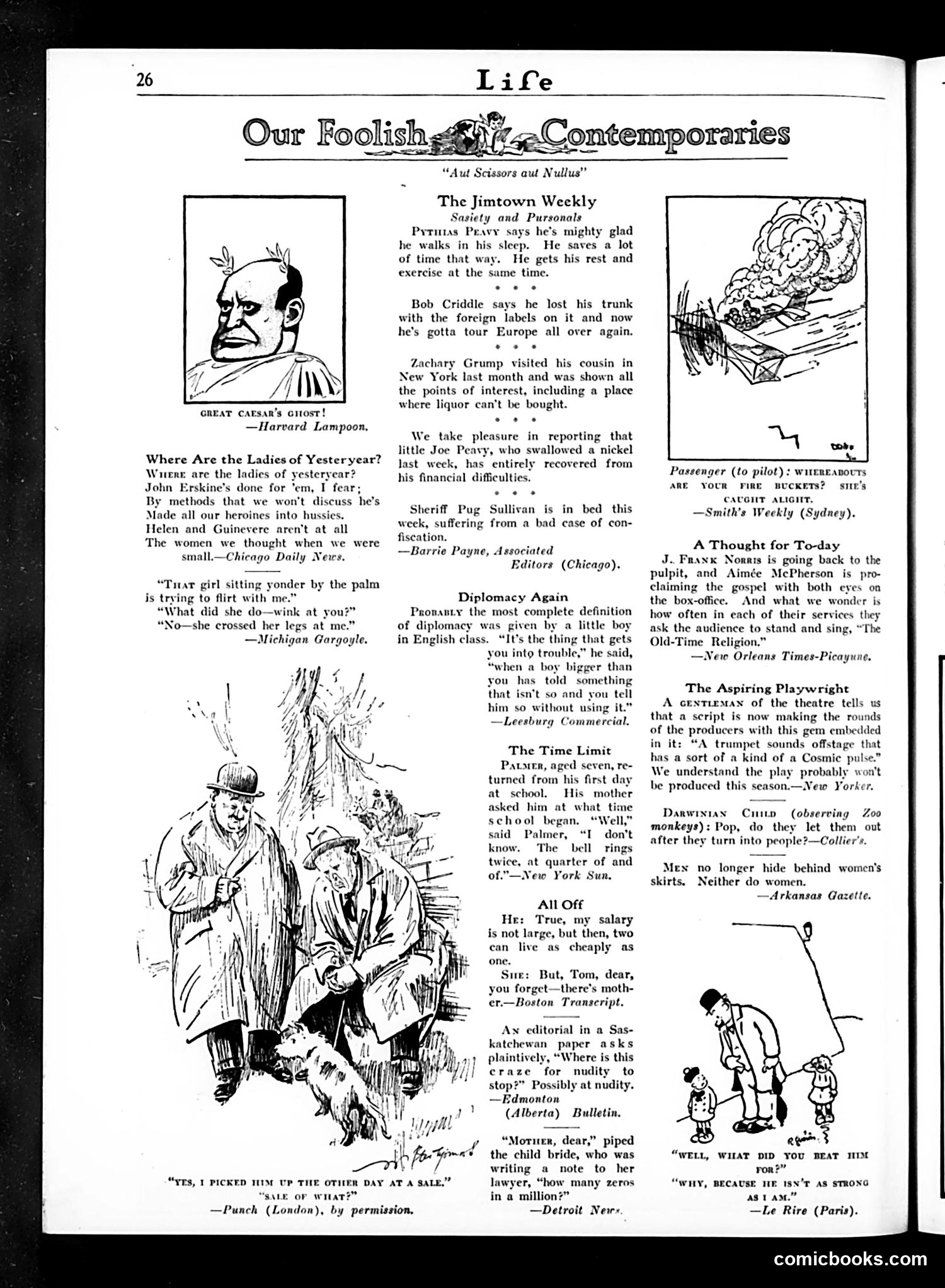
This page collects brief humorous items and cartoons from various publications. Key satirical points: **"Where Are the Ladies of Yesteryear?"** critiques scholar John Erskine's reinterpretations of classical heroines (Helen, Guinevere), suggesting his modern scholarly approach has "made all our heroines into hussies"—mocking both intellectual revisionism and changing sexual attitudes. **The leg-crossing joke** plays on flirtation as sexually suggestive behavior rather than innocent. **"Jimtown Weekly" items** are small-town gossip parodies, including wordplay ("confiseation" instead of "confiscation"). **The child's diplomatic definition** satirizes adult hypocrisy—diplomacy as polite lying. **The nudity editorial** makes a deadpan joke: asking when society's nudity craze will end, the response is "possibly at nudity" (when everyone is naked, the craze ends). The overall tone reflects 1920s-30s middle-class anxieties about modernity: changing sexual mores, intellectual trends, and social conventions—presented through light satire rather than serious critique.
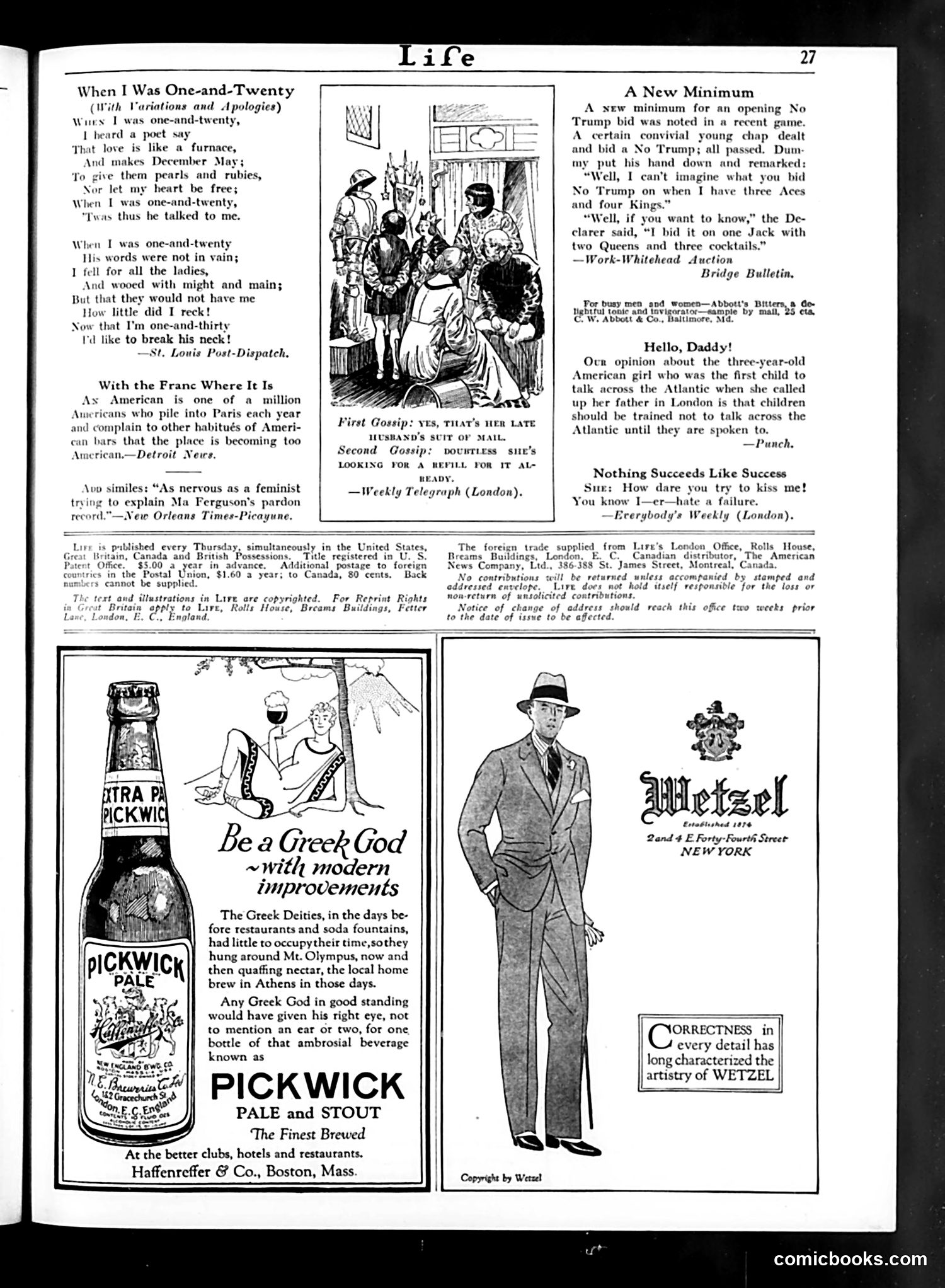
This page contains several brief satirical pieces typical of Life's humor circa the 1920s: **"When I Was One-and-Twenty"** parodies a famous poem, humorously reversing its wisdom: the speaker ignored romantic advice when young, pursued women unsuccessfully, and now regrets dismissing the original counsel. **"With the Franc Where It Is"** mocks American tourists in Paris who complain the city has become "too American"—satirizing their hypocrisy in seeking authentic European experience while recreating American environments. **The gossip cartoon** jokes about a woman wearing her late husband's armor suit, looking for a refill—suggesting she's drinking heavily, perhaps to cope with widowhood or simply enjoying newfound freedom. **"Nothing Succeeds Like Success"** makes a sharp joke about rejecting failure: a woman refuses a kiss from someone who "hates a failure," implying she fears being kissed by an unsuccessful person. The remaining items are brief bridge-game and parenting quips, plus period advertisements for beer and men's clothing—standard magazine filler reflecting 1920s consumer culture and leisure activities among affluent readers.
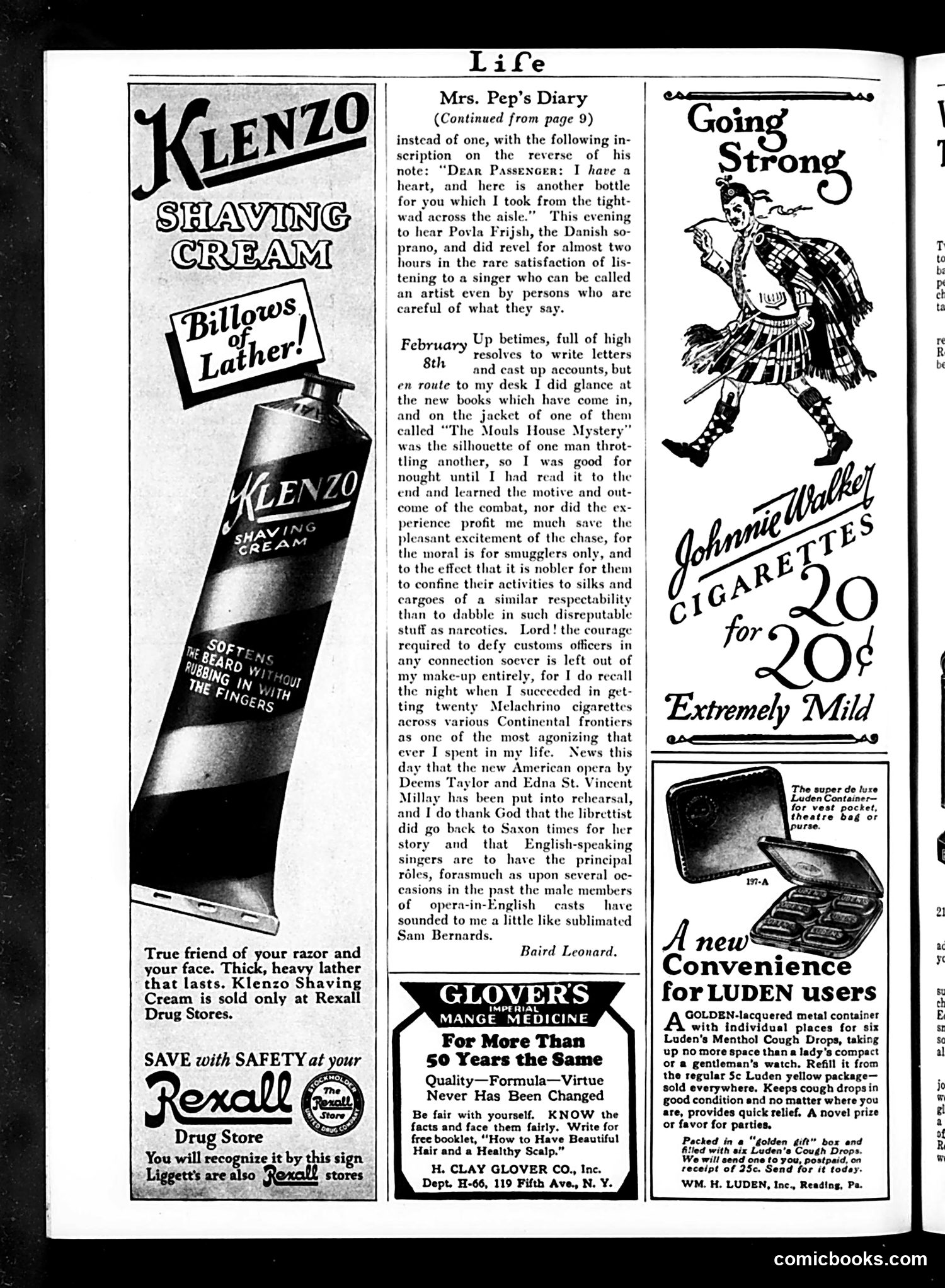
This page is primarily **advertising** with one substantial literary feature. The main content is "Mrs. Pep's Diary" (continued), a humorous personal essay by Baird Leonard describing the diarist's February activities—reading a murder mystery novel, attending a Danish opera singer's performance, and nervously recalling smuggling cigarettes across European borders as the most thrilling adventure of her life. The satire is gentle: the piece gently mocks the writer's easily distracted nature, her admission that a morality tale about smuggling only appeals to criminals, and her breathless recollection of petty contraband smuggling as a "most agonizing" experience—inflating mundane life drama. The page also contains period advertisements for Klenzo Shaving Cream, Glover's mange medicine, Luden's cough drops, Johnny Walker cigarettes, and a Rexall drug store endorsement—typical 1920s commercial content with no satirical intent.
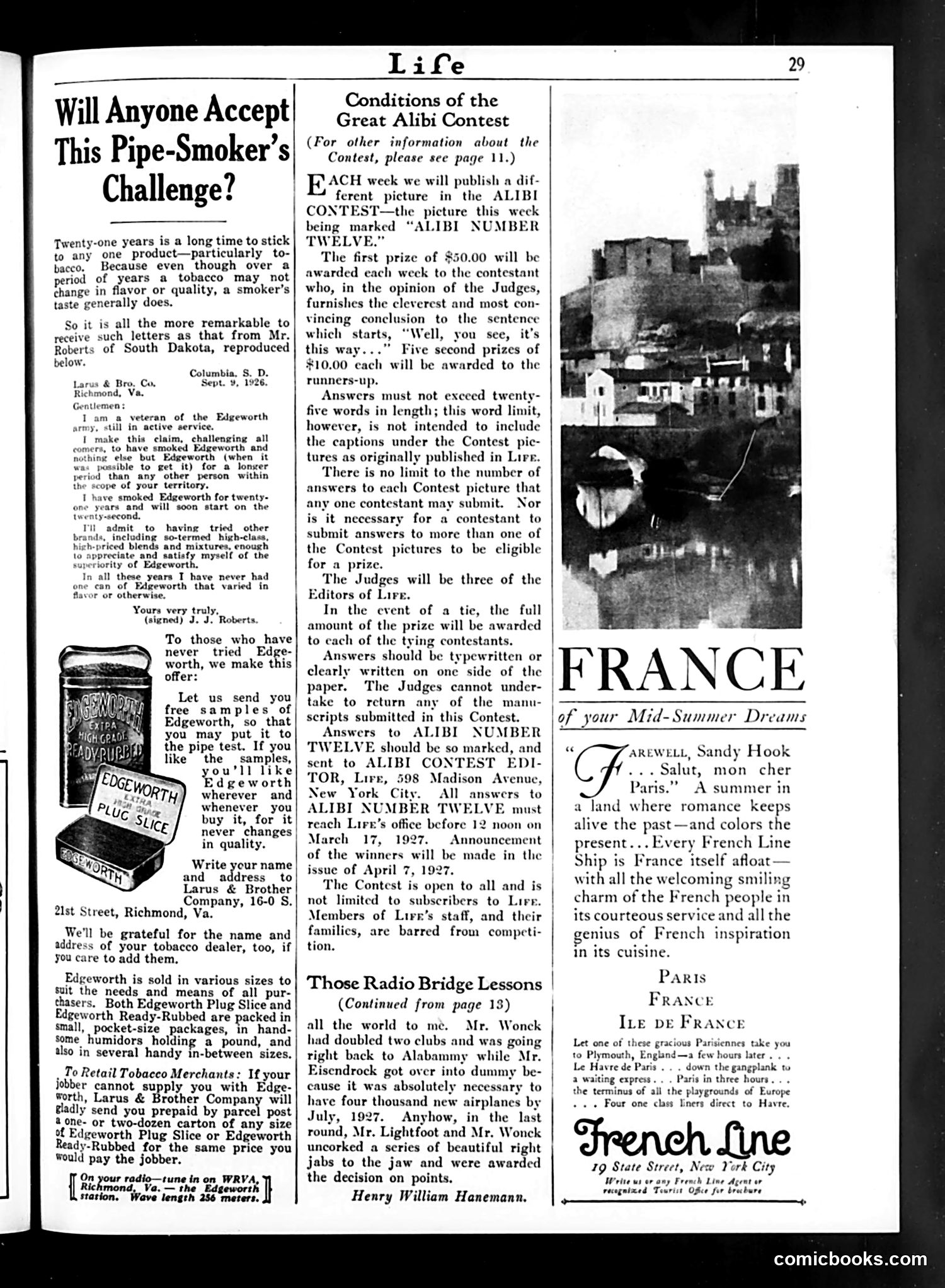
This page contains **advertising and contest information**, not political satire. The left side features a **testimonial advertisement for Edgeworth pipe tobacco**. A customer from South Dakota, J.J. Roberts, claims he's smoked only Edgeworth for twenty-one years, challenging competitors' products. The ad leverages this loyalty claim to market the tobacco's consistency and quality, offering free samples to skeptical readers. The right side announces Life's **"Great Alibi Contest,"** where readers submit humorous explanations (under 25 words) to incomplete sentences paired with pictures, competing for $50 weekly prizes. This was a popular participatory feature in magazines of the 1920s, encouraging reader engagement. There is no political commentary or caricature. The page reflects 1920s consumer culture: long-term brand loyalty was considered noteworthy enough to advertise, and interactive contests were a standard magazine engagement strategy.
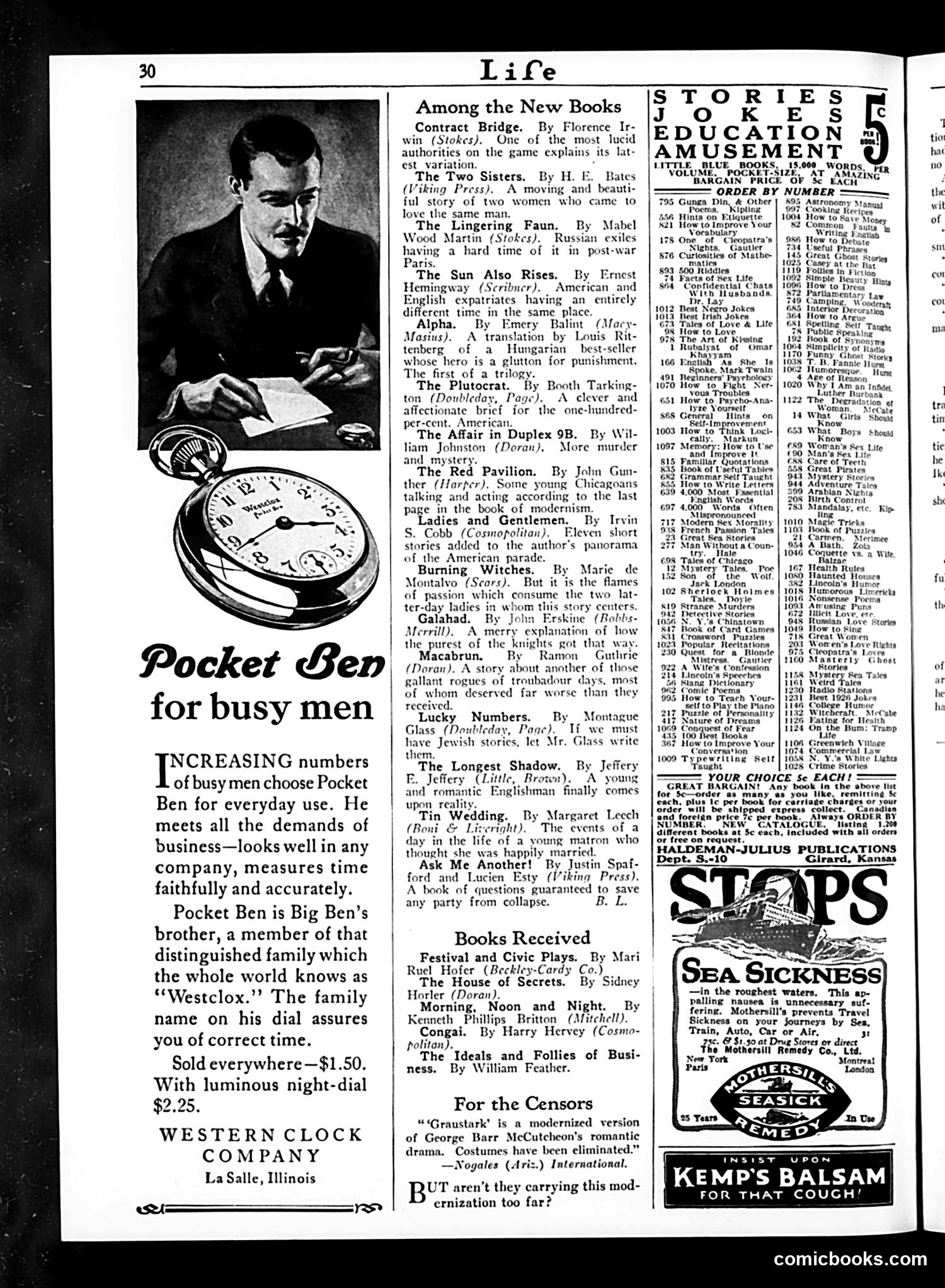
This page is primarily a **product advertisement** for Pocket Ben watches, a budget timepiece marketed to businessmen. The ad features an illustration of a man in formal dress consulting a pocket watch, emphasizing reliability and professional appearance. The wordplay centers on "Big Ben" (London's famous clock tower), with Pocket Ben positioned as its "brother"—a clever marketing device suggesting trustworthiness through family association. The Westclox company emphasizes that the watch "measures time faithfully and accurately" and "looks well in any company," appealing to early 20th-century professional masculinity. The rest of the page contains book reviews, a common Life magazine feature, and classified advertisements for mail-order items like books and seasickness remedies. There is **no political satire or cartoon commentary** on this particular page—it's a straightforward commercial and literary publication.
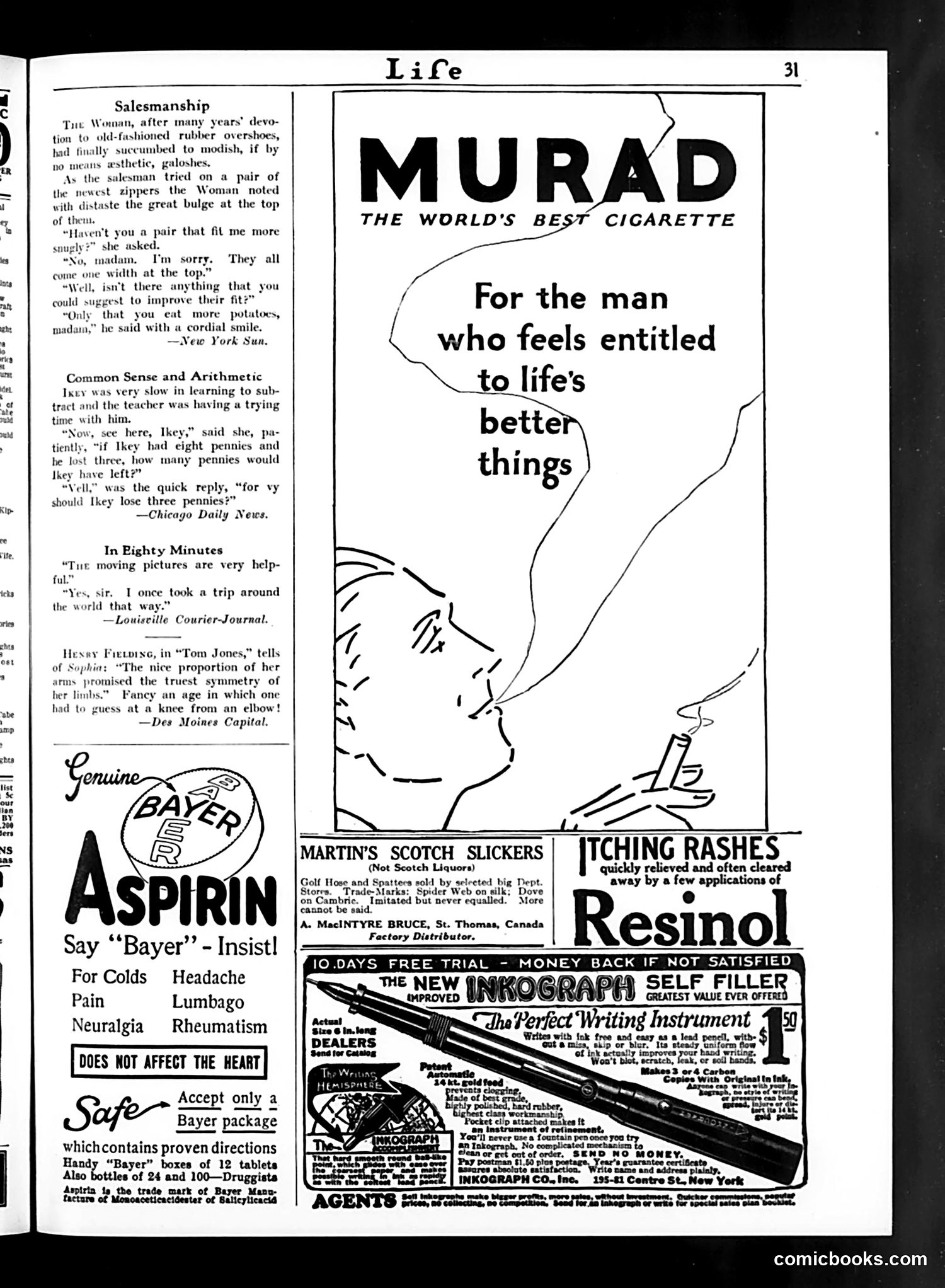
This page contains several short humor pieces and period advertisements reflecting early 20th-century American social attitudes. The cartoon at top shows a woman trying on galoshes with a zippered design. The humor relies on fashion anxiety: the new style creates an unflattering bulge, and the frustrated salesman's suggestion that she "eat more potatoes" to fill out the fit is meant as absurdist comedy—insulting disguised as practical advice. The other text pieces are brief anecdotes about arithmetic confusion, cinema tourism, and literary fashion history—typical "light humor" filler for the era. The advertisements are period-authentic: Bayer Aspirin (which claims not to affect the heart), Murad cigarettes (marketed as premium), Martin's Scotch Slickers rainwear, Resinol rash cream, and Inkograph fountain pens. The Murad ad's tagline—"for the man who feels entitled to life's better things"—reflects aspirational marketing of luxury consumer goods to middle-class readers.
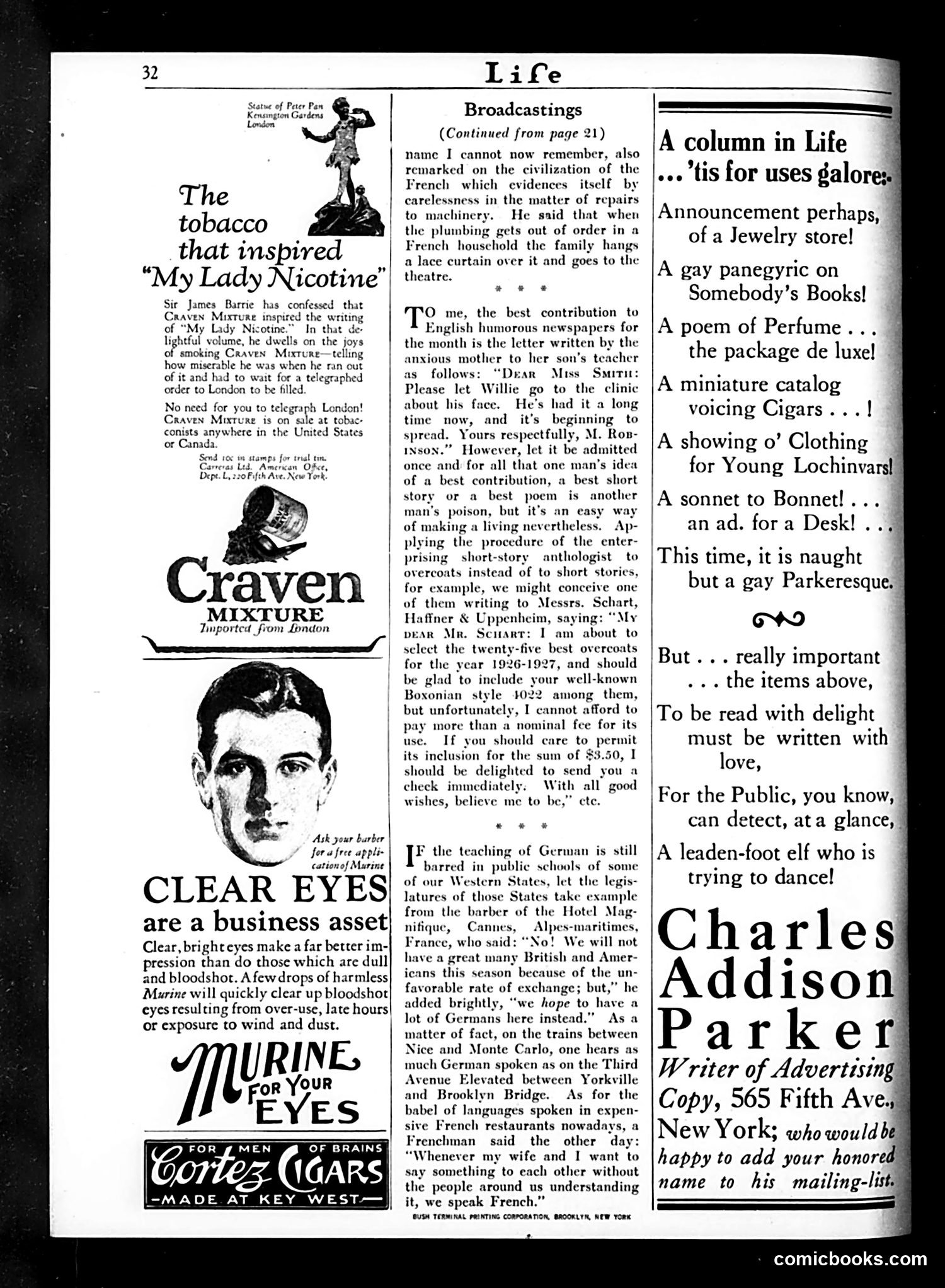
This page combines advertisements and satirical editorial commentary typical of 1920s *Life* magazine. **The Advertisements** showcase consumer products (Craven Mixture tobacco, Murine eyedrops, Cortes cigars) with claims about their benefits—tobacco inspiring literary genius, eye drops as a "business asset." **The Editorial Column** mocks the pretentiousness of advertisements themselves. The right-side "Column in Life" sarcastically catalogs absurd ad types—jewelry store announcements disguised as content, poems about perfume, miniature catalogs. The final jab identifies this as a "gay Parkeresque" column (referencing Dorothy Parker's witty style), then names Charles Addison Parker as the writer soliciting honorable mentions for his mailing list. **The Satire**: The page itself demonstrates what it mocks—commercial content masquerading as editorial material. By listing ridiculous ad formats while surrounded by actual ads, *Life* critiques how advertising increasingly blurred boundaries with genuine journalism and literature, turning everything—even poetry and storytelling—into marketing vehicles.

I can see this is a very dark, low-contrast image from what appears to be a historical publication. The left margin shows partial text fragments ("sl," "c.," "h," "w,", "e,", "s", "n", "r"), and the bottom right corner displays "comicbooks.com." However, the image is too dark and degraded for me to discern any cartoon illustrations, caricatures, or satirical content with confidence. The central area appears to show some shadowy forms or possibly a figure, but I cannot make out sufficient detail to identify specific political or social references, historical figures, or the intended satirical message. To provide accurate analysis as requested, I would need a clearer, higher-contrast version of this page.