
Life, 1927-03-03 · page 23 of 35
Life — March 3, 1927 — page 23: what you’re looking at
What you’re looking at
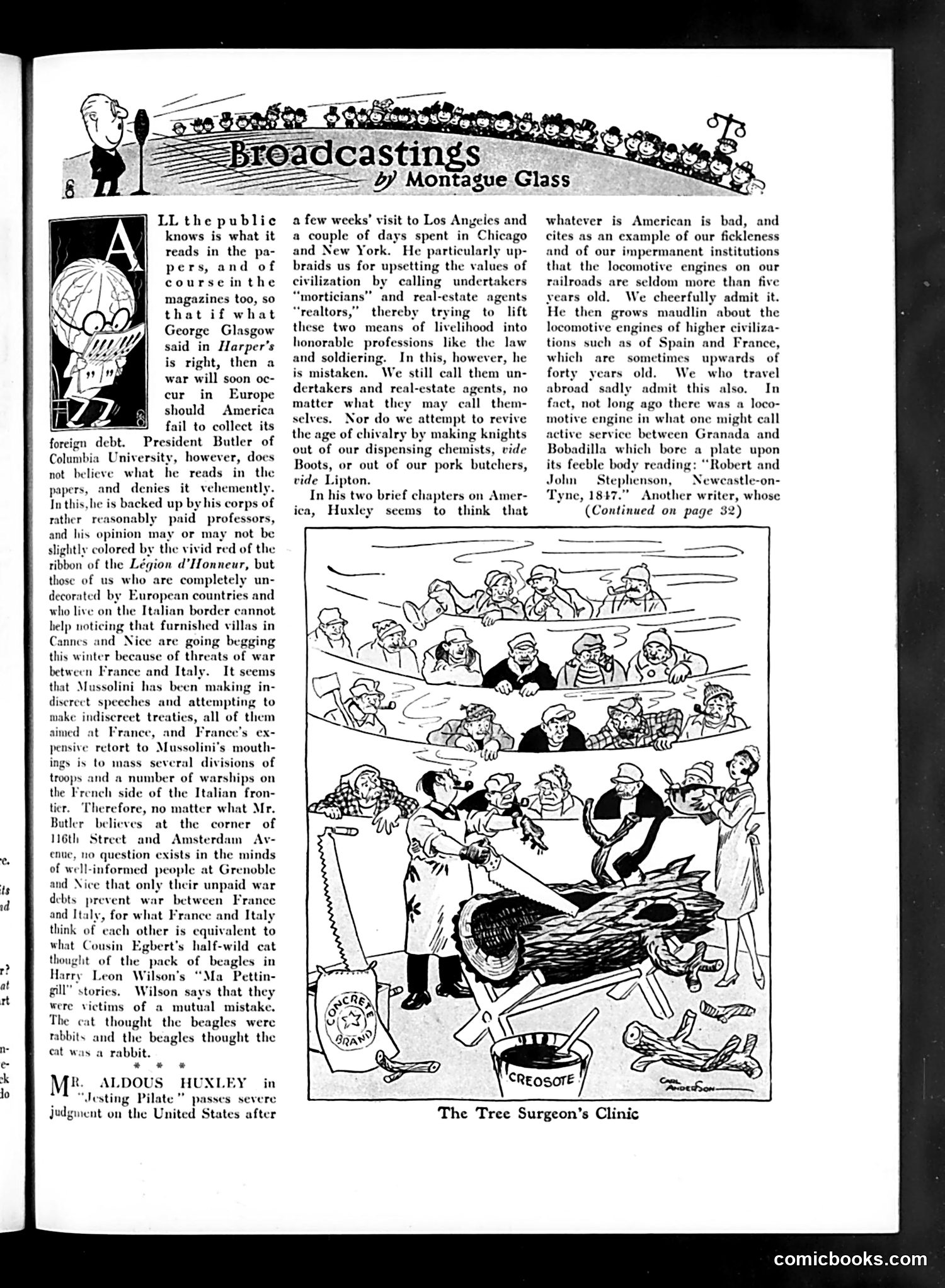
This satirical column critiques public intellectuals and foreign observers of American society. **Main targets:** 1. **President Butler of Columbia University**: Criticized for dismissing newspaper reports of potential France-Italy war tensions, despite credible evidence (furnished villas in the French Riviera sitting empty due to war fears). Butler's credibility is questioned—his Legion of Honor decoration may bias his pro-European views. 2. **Aldous Huxley**: The English author is mocked for condemning American culture during his U.S. visit, particularly for criticizing Americans' use of euphemisms ("morticians" for undertakers, "realtors" for real-estate agents). The author defends America, noting these terms don't actually elevate these professions' status. Huxley is also ridiculed for romanticizing European locomotives' longevity while dismissing American engines' shorter lifespans—the author suggests this reflects practical American values, not cultural inferiority. **The satire's point**: Elite intellectuals either willfully ignore reality (Butler) or harbor prejudiced condescension toward America (Huxley). The cartoon "The Tree Surgeon's Clinic" (bottom) likely reinforces these themes through visual metaphor, though its specific meaning is unclear without additional context.
📄 Transcribed text from this page (OCR, searchable)
Machine-transcribed from the original scan — historical spelling and the odd misread are preserved.
LL the public knows is what it reads in the pa- pers, and of courseinthe magazines too, so that if what George Glasgow said in Harper's is right, then a war will soon oc- cur in Europe should America - fail to collect its foreign debt. ident Butler of Columbia Unive » however, does not believe what he reads in the papers, and nies it vehemently. In this,he is backed up by his corps of rather reasonably paid professors, and his opinion may or may not be slightly colored by the vivid red of the ribbon of the Légion d’Honneur, but those of us who are completely un- decorated by European countries and who live on the Italian border cannot help noticing that furnished as in Cannes and Nice are going begging this winter because of threats of war between France and Italy. It seems that Mussolini has been making in- diserect speeches and attempting to make indisereet treaties, all of them aimed at France, 2 i pensive retort to Mussolini’ ings is to troops and a number of we the French side of the It tier. Therefore, no matter what Mr. Butler believes at’ the corner of N6th Street and Amsterdam Av- enue, no question exists in the minds of well-informed people at Grenoble and Nice that only their unpaid war debts prevent war between France and Italy, for what France and Italy think of each other is equivalent to what Cousin Egbert’s half-wild cat thought of the k of beagles in Harry Leon Wilson’s “Ma Pettin- gill” stories. Wilson says that they were victims of a mutual mistake. The cat thought the beagles were tabbits and the beagles thought the cat was a rabbit. Me e* * ALDOUS HUXLEY in judgment on the United States after mouth- desting Pilate” passes severe a few weeks’ visit to Los Angeles and a couple of days spent in Chicago and New York. He particularly up- braids us for upsetting the values of civilization by calling undertakers “morticians” and real-estate agents “realtors,” thereby trying to lift these two means of livelihood into honorable professions like the law and soldiering. In this, however, he is mistaken. We still call them un- dertakers and real-estate agents, no matter what they may call the selves. Nor do we attempt to revive the age of chivalry by making knights out of our dispensing chemists, vide Boots, or out of our pork butchers, vide Lipton. In his two brief chapters on Amer- ica, Huxley seems to think that whatever is American is bad, and cites as an example of our fickleness and of our impermanent institutions that the locomotive engines on our railroads are seldom more than five years old. We cheerfully admit it. He then grows maudlin about the locomotive engines of higher civiliza- tions such as of Spain and France, which are sometimes upwards of forty old. We who travel abroad y admit this also. In fact, not long ago there was a loco- engine in what one might call da and plate upon Robert and illa which bore a its feeble body reading John Stephenson, Tyne, 1847.” Another writer, whose (Continued on page 32) The Tree Surgeon’s Clinic comicbooks.com