
Life, 1927-03-03 · page 21 of 35
Life — March 3, 1927 — page 21: what you’re looking at
What you’re looking at
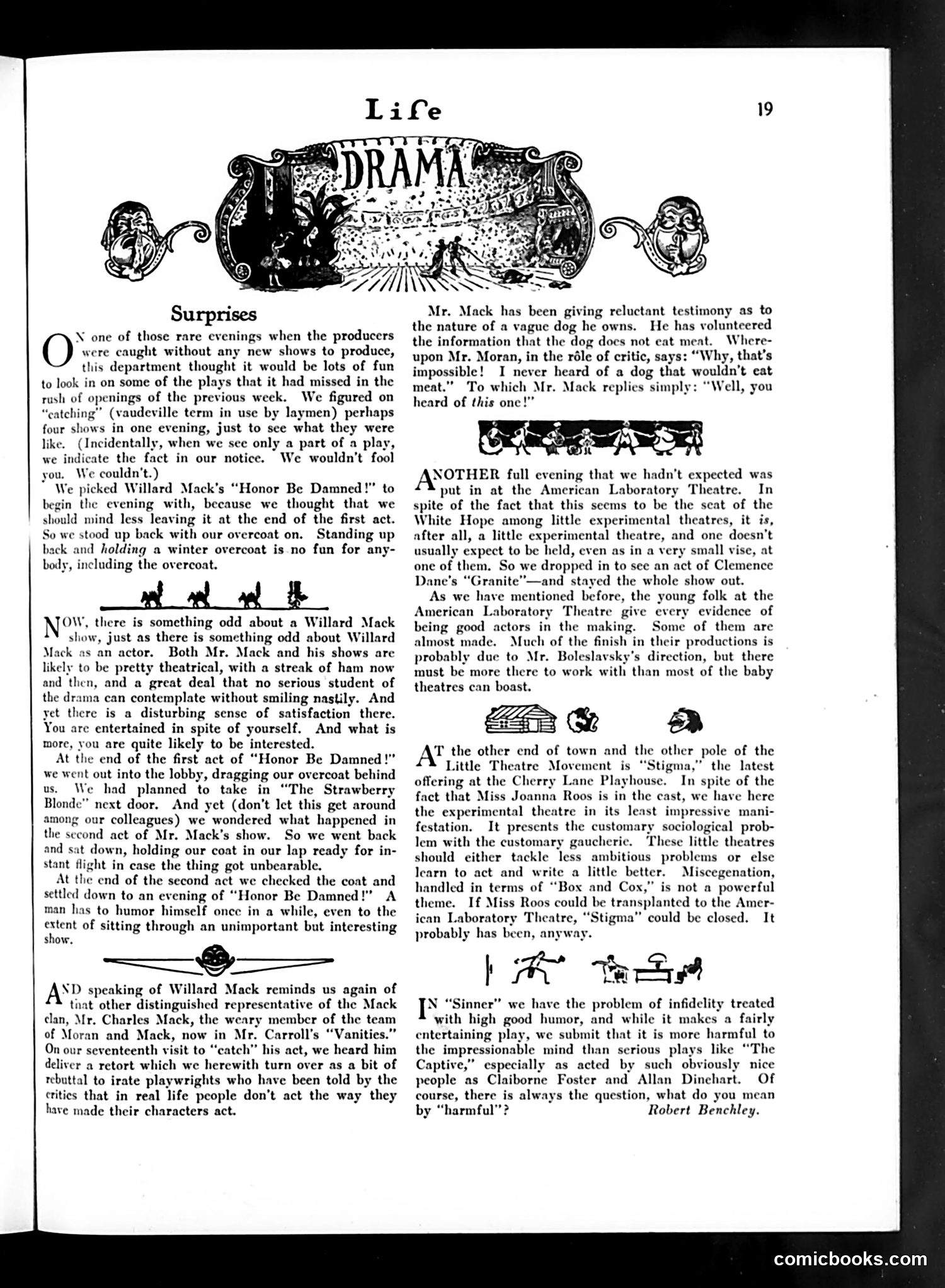
This is a theater review column discussing several Broadway productions. The critic describes attending multiple shows in one evening, including Willard Mack's "Honor Be Damned!" **Key figures discussed:** - **Willard Mack**: An actor-playwright characterized as somewhat "hammy" but entertaining despite his theatricality - **Charles Mack**: Part of the vaudeville duo Moran and Mack, performing in "Vanities" **The satire:** A joke by Charles Mack deflates pretentious dramatic criticism. When a character protests that a dog wouldn't realistically refuse meat, Mack replies the dog simply "heard of this one!"—a witty riposte to critics who complain that theatrical characters don't behave realistically. **Other theaters mentioned:** The American Laboratory Theatre and Cherry Lane Playhouse, experimental venues representing the "Little Theatre Movement." The column advocates for entertainment value while noting that experimental theaters should improve their craft rather than excuse poor quality as avant-garde.
📄 Transcribed text from this page (OCR, searchable)
Machine-transcribed from the original scan — historical spelling and the odd misread are preserved.
were caught without any new shows to produce, this department thought it would be lots of fun to look in on some of the plays that it had missed in the rush of openings of the previous week. We figured on “catching” (vaudeville term in use by laymen) perhaps four shows in one evening, just to see what they were like. (Incidentally, when we see only a part of a play, we indicate the fact in our notice. We wouldn't fool you. We couldn't.) We picked Willard Mack's “Honor Be Damned!” to begin the evening with, because we thought that we should mind less leaving it at the end of the first act. So we stood up back with our overcoat on. Standing up O one of those rare evenings when the producers back and holding a winter overcoat is no fun for any- body, including the overcoat. _ wd iw 2 h OW, there is something odd about a Willard Mack show, just as there is something odd about Willard Mack as an actor. Both Mr. Mack and his shows are likely to be pretty theatrical, with a streak of ham now and then, and a great deal that no serious student of the drama can contemplate without smiling nastily. And yet there is a disturbing sense of satisfaction there. You arc entertained in spite of yourself. And what is more, you are quite likely to be interested. At the end of the first act of “Honor Be Damned!” we went out into the lobby, dragging our overcoat behind us. We had planned to take in “The Strawberry Blonde” next door. And yet (don’t Ict this get around among our colleagues) we wondered what happened in the second act of Mr. Mack’s show. So we went back and sat down, holding our coat in our lap ready for in- stant flight in case the thing got unbearable. At the end of the second act we checked the coat and settled down to an evening of “Honor Be Damned!” A man has to humor himself once in a while, even to the extent of sitting through an unimportant but interesting show. AS? speaking of Willard Mack reminds us again of that other distinguished representative of the Mack clan, Mr, Charles Mack, the weary member of the team of Moran and Mack, now in Mr. Carroll's “Vanities.” On our seventeenth visit to “catch” his act, we heard him deliver a retort which we herewith turn over as a bit of rebuttal to irate playwrights who have been told by the critics that in real life people don’t act the way they have made their characters act. Mr. Mack has been giving reluctant testimony as to the nature of a vague dog he owns. He has volunteered the information that the dog does not cat meat. Where- upon Mr. Moran, in the réle of critic, says: “Why, that’s impossible! I never heard of a dog that wouldn’t eat meat.” To which Mr. Mack replies simply: “Well, you heard of this one!” oo ANOTHER full evening that we hadn't expected was put in at the American Laboratory Theatre. In spite of the fact that this seems to be the scat of the White Hope among little experimental theatres, it is, after all, a little experimental theatre, and one doesn’t usually expect to be held, even as in a very small vise, at one of them. So we dropped in to see an act of Clemence Dane's “Granite”—and stayed the whole show out. As we have mentioned before, the young folk at the American Laboratory Theatre give every evidence of being good actors in the making. Some of them are almost made. Much of the finish in their productions is probably due to Mr. Boleslavsky’s direction, but there must be more there to work with than most of the baby theatres can boast. “4A T the other end of town and the other pole of the Little Theatre Movement is “Stigma,” the latest offering at the Cherry Lane Playhouse. In spite of the fact that Miss Joanna Roos is in the cast, we have here the experimental theatre in its least impressive mani- festation. It presents the customary sociological prob- lem with the customary gaucherie. These little theatres should either tackle less ambitious problems or else learn to act and write a little better. Miscegenation, handled in terms of “Box and Cox,” is not a powerful theme. If Miss Roos could be transplanted to the Amer- ican Laboratory Theatre, “Stigma” could be closed. It probably has been, anyway. | A wee N “Sinner” we have the problem of infidelity treated with high good humor, and while it makes a fairly entertaining play, we submit that it is more harmful to the impressionable mind than serious plays like “The Captive,” especially as acted by such obviously nice people as Claiborne Foster and Allan Dinehart. Of course, there is always the question, what do you mean by “harmful”? Robert Benchley. comicbooks.com