
Life, 1927-03-03 · page 26 of 35
Life — March 3, 1927 — page 26: what you’re looking at
What you’re looking at
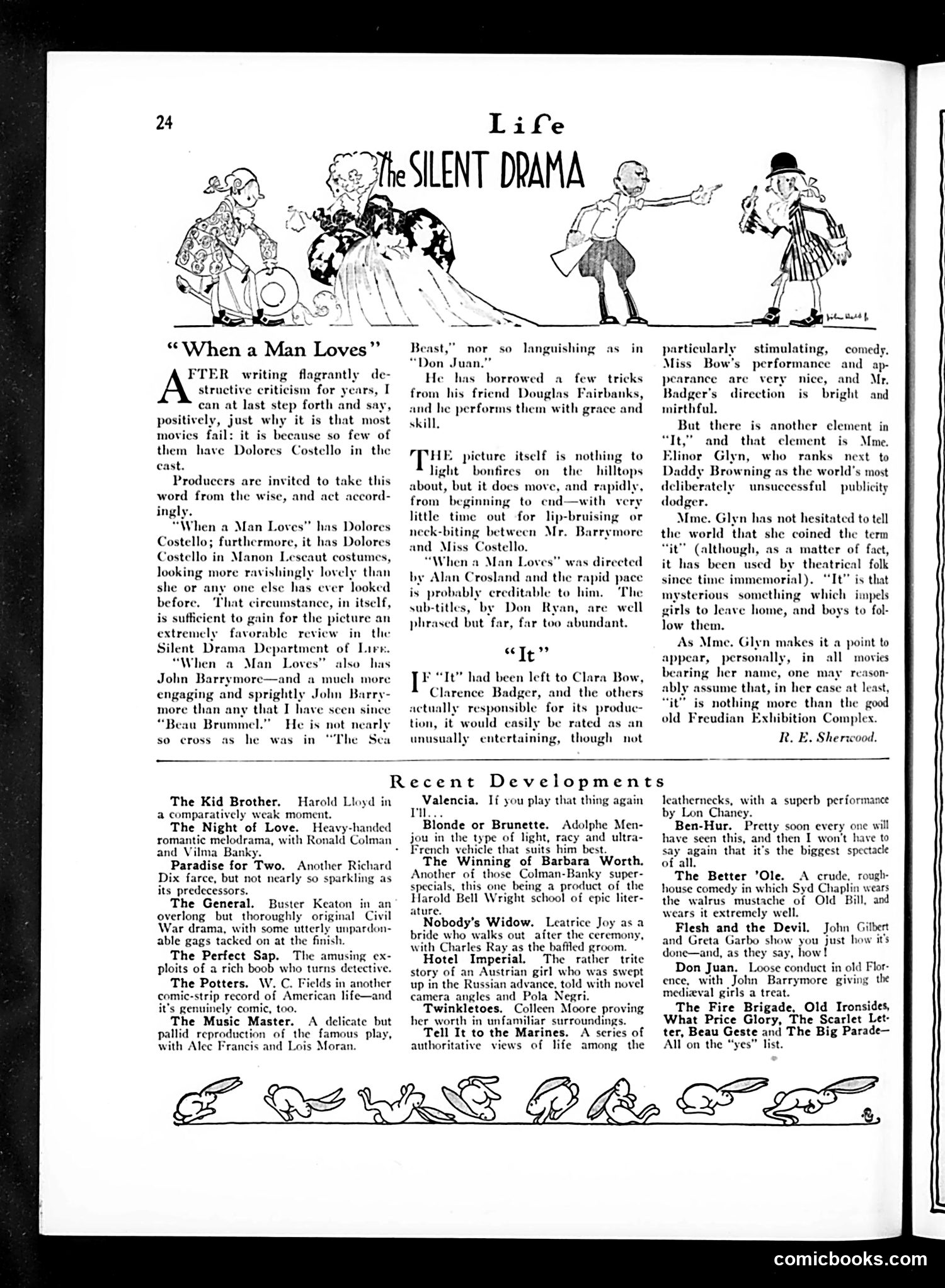
This page reviews recent silent films. The top cartoon illustrates the review of "When a Man Loves"—a John Barrymore and Dolores Costello picture. The critic humorously argues that Costello's presence alone justifies a positive review, regardless of plot quality. The second review discusses "It," starring Clara Bow and directed by Clarence Badger. The satire targets Elinor Glyn, the British screenwriter who popularized the term "It" (sexual magnetism/appeal) and made a point of appearing in her own films for publicity. The critic mockingly suggests Glyn's personal appearances prove "It" is merely exhibitionism rather than the mysterious quality she claims to have invented. The "Recent Developments" section briefly reviews other current releases, mentioning stars like Harold Lloyd, Buster Keaton, W.C. Fields, and Ronald Colman. This reflects Life magazine's role as arbiter of American popular entertainment during the silent film era.
📄 Transcribed text from this page (OCR, searchable)
Machine-transcribed from the original scan — historical spelling and the odd misread are preserved.
“When a Man haven FTER writing flagrantly de- structive criticism for years, I can at last step forth and say, positively, just why it is that most movies fail: it is because so few of them have Dolores Costello in the cast. Producers are invited to word from the wise, and act a e this ord- hen a Man Loves” has Dolores Costello; furthermore, it has Dolores Costello in Manon Lescaut costumes, more ravishingly lovely than ny one else has ever looked before. That circumstance, in itself, is sufficient to gain for the picture an extremely favorable review in’ the Silent Drama Department of Lire. “When a Man Loves” also has John Barrymore—and a much more engaging and sprightly John Barry- more than any that I have scen since “Beau Brummel.” He is not near, so cross as he was in “The Life Beast,” nor so languishing “Don Juan.” He borrowed from his friend Dou, and he performs them with grace and skill. HE picture itself is nothing to light bonfires on the hilltops about, but it docs move, and rapidly, from beginning to cnd—with very little time out for lip-bruising or neck-biting between Mr. Barrymore and Miss Costello. “When a Man Loves” was directed by Alan Crosland and the rapid pace is probably creditable to him. The sub-titles, by Don Ryan, are well phrased but far, far too abundant, “Te” I “It” had been left to Clara Bow, Clarence Badger, and the others actually responsible for its produc- tion, it would easily be rated as an unusually entertaining, though not particularly stimulating, comedy. s Bow’s performance and ap- nee are very nice, and Mr, Badger’s direction is bright and mirthful. But there is another clement in “It,” and that clement is Mme. Elinor Glyn, who ranks next to Daddy Browning as the world’s most deliberately unsuccessful publicity dodger. Mme. Glyn has not hesitated to tell the world that she coined the term t” (although, as a matter of fact, it has been used by theatrical folk since time immemorial). ‘It’ is that mysterious something which impels girls to leave home, and boys to fol- low them. As Mme. Glyn makes it a point to appear, personally, in all movies bearing her name, one may reason- sume that, in her case at least, nothing more than the good old Freudian Exhibition Complex. R. E. Sherwood. Recent Developments The Kid Brother. Harold Lloyd in a comparatively weak moment. The Night of Love. Heavy-handed romantic melodrama, with Ronald Colma an and Vilma Banky. Paradise for Two. Another Richard Dix farce, but not nearly so sparkling as its predecessors. The General. Buster Keaton in an overlong but thoroughly original Civil War drama, with some utterly unpardon- able gags tacked on at the finish. The Perfect Sap. The amusing ex- ploits of a rich boob who turns detective. The Potters. W. C. Fields in another comic-strip record of American life—and it’s genuinely comic, too. The Music Master. A delicate but pallid reproduction of the famous play, with Alee Francis and Lois Moran. Valencia. If you play that thing again Blonde or Brunette. Adolphe Men- jou in the type of light, racy and ultra- French vehicle that suits him best. The Winning of Barbara Worth. Another of those Colman-Banky super- specials, this one being a product of the Harold Bell Wright school of epic liter- ature. Nobody’s Widow. Leatrice Joy asa bride who walks out after the ceremony, with Charles Ray as the baffled groom. Hotel Imperial. The rather trite story of an Austrian girl who was swept up in the Russian advance, told with novel camera angles and Pola Negri. Twinkletoes. Colleen Moore proving her worth in unfamiliar surroundings. Tell It to the Marines. A scries of authoritative views of life among the leathernecks, with a superb performance by Lon Chaney. Ben-Hur. Pretty soon every one will have seen this, and then I won't have to say again that it’s the biggest spectacle of all. The Better ’Ole. A crude, rough- house comedy in which Syd Chaplin wears the walrus mustache of Old Bill, and wears it extremely well. Flesh and the Devil. John Gilbert and Greta Garbo show you just how it's done—and, as they say, how! Don Juan. Loose conduct in old Flor- ence, with John Barrymore giving the mediaval girls a treat. The Fire Brigade, Old Ironsides, What Price Glory, The Scarlet Let- ter, Beau Geste and The Big Parade— All on the “yes” list. comicbooks.com