
A complete issue · 40 pages · 1926
Life — November 4, 1926
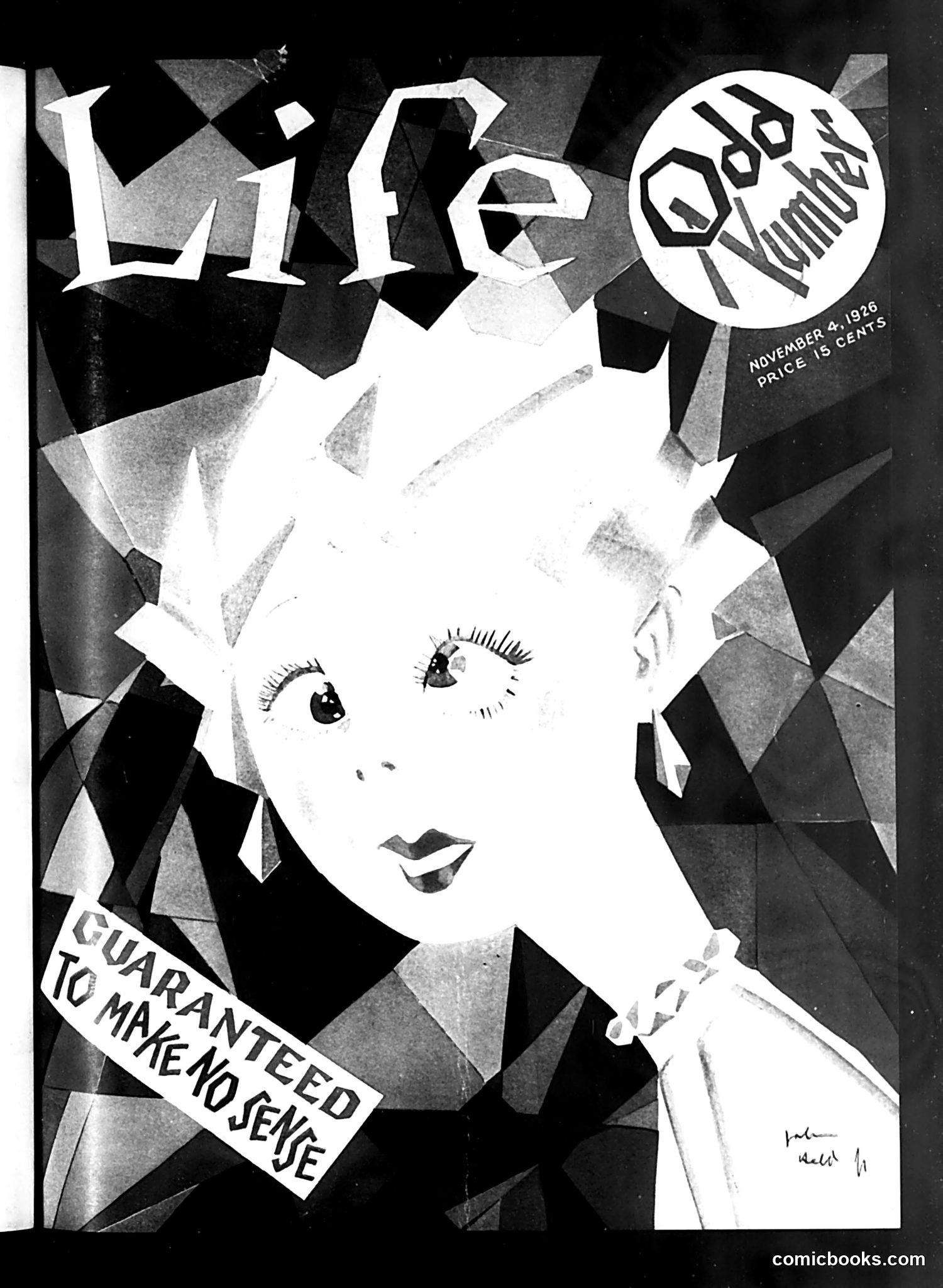
This cover features an Art Deco-style illustration of a woman's face with striking geometric styling—characteristic of 1920s modernism. The banner reading "GUARANTEED TO MAKE NO SENSE" appears to be satirizing contemporary fashion or beauty trends, suggesting the absurdity of whatever trend is being promoted. The circular logo in the upper right indicates this is Life magazine's satirical humor issue. The price of 15 cents and November 4, 1926 date confirm this is from the Jazz Age period. The geometric, somewhat avant-garde aesthetic of the illustration itself appears to be part of the satire—mocking perhaps the pretentiousness or confusion surrounding modern art and design trends of the era. The exaggerated eyes and expression emphasize the ridicule.
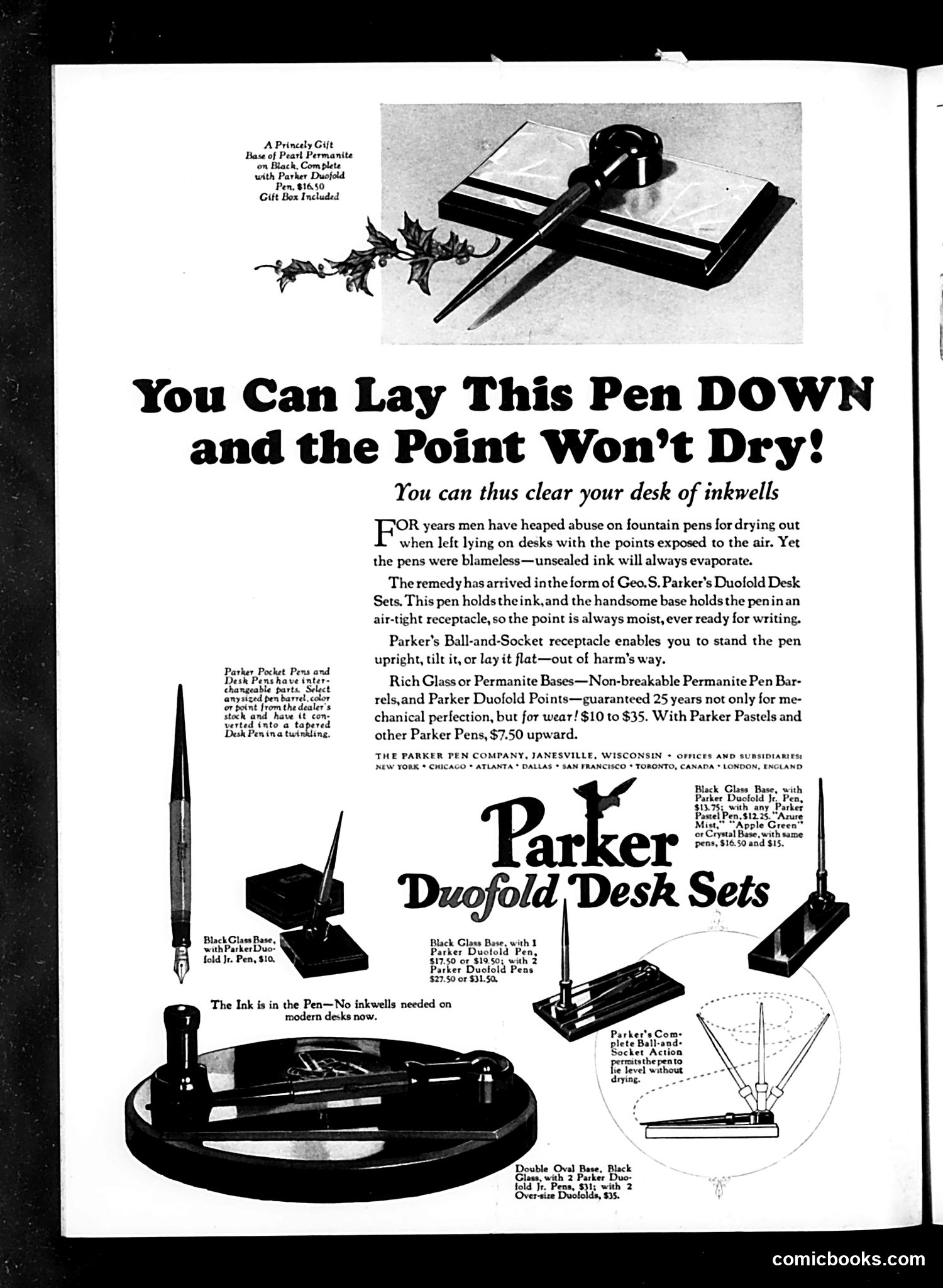
This is **not a cartoon or satire page** — it's a straightforward **advertisement for Parker Duofold fountain pens**, specifically their desk sets. The ad addresses a genuine practical problem of the era: fountain pens dried out when left uncapped on desks. Parker's solution was the "Duofold Desk Sets," which featured special bases that kept pen points moist in an "air-tight receptacle." The headline "You Can Lay This Pen DOWN and the Point Won't DRY!" emphasizes the innovation. Various desk set models are shown with different base styles (glass, Permanite, oval bases), priced from $10-$35. This reflects early-20th-century business culture where fountain pens were essential desk tools, and ink-drying was a genuine workplace frustration worthy of advertising attention.
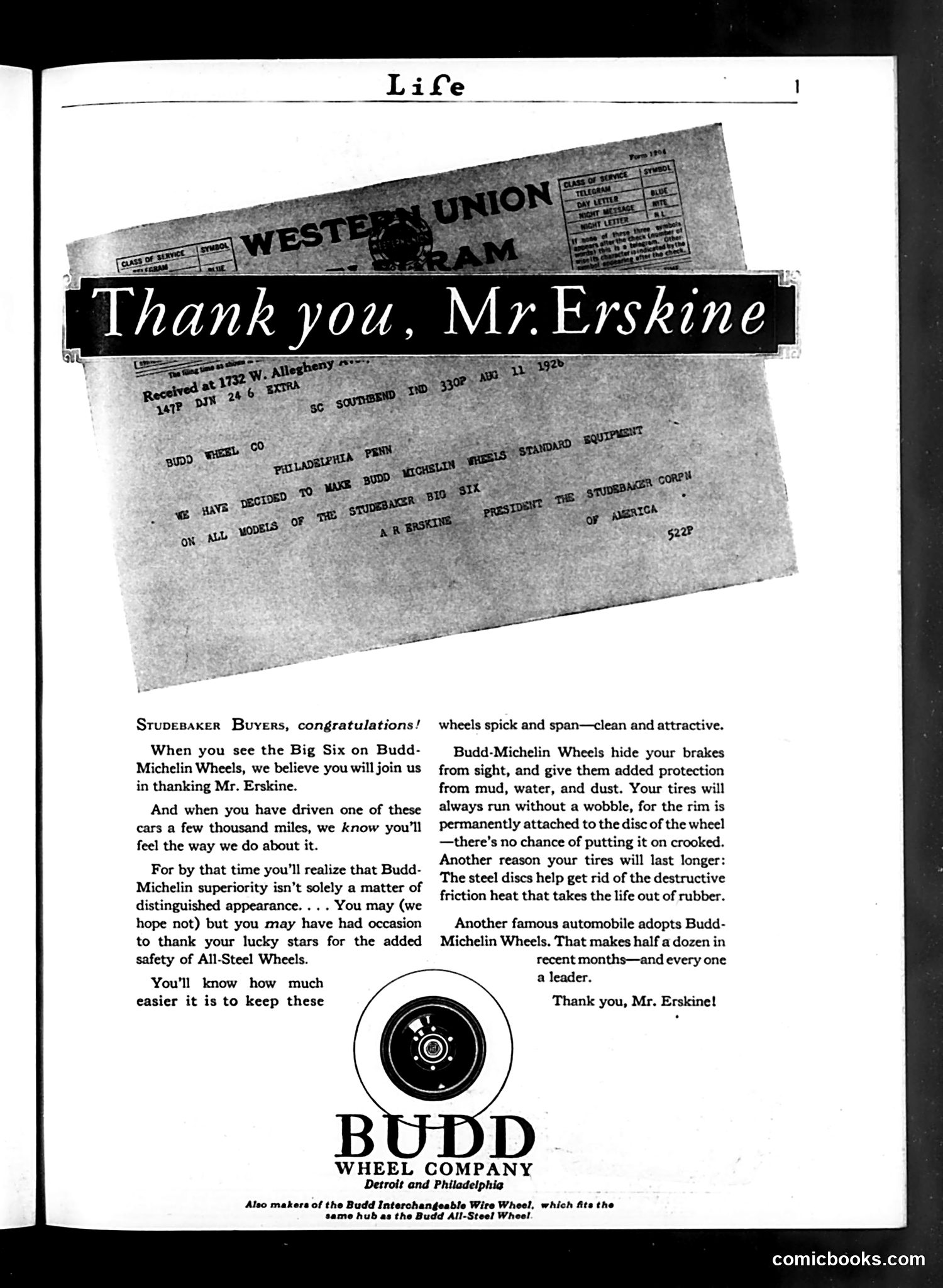
This page is **primarily an advertisement**, not satire or editorial content. It's a Budd Wheel Company ad from Life magazine, likely 1920s era (based on the Western Union telegram visible at top, dated August 11, 1924). The "joke" is commercial flattery: the ad thanks "Mr. Erskine" (appears to be an automotive industry figure) for deciding to equip Studebaker's "Bid Six" car with Budd-Michelin All-Steel Wheels. The telegram format creates a mock-congratulatory tone, as if this business decision warrants public celebration. The ad then lists technical advantages: wheels are cleaner, more durable, protect brakes, reduce friction heat damage to tires. The satire is gentle—essentially thanking someone in business for making a good product choice, presented as though it were newsworthy.
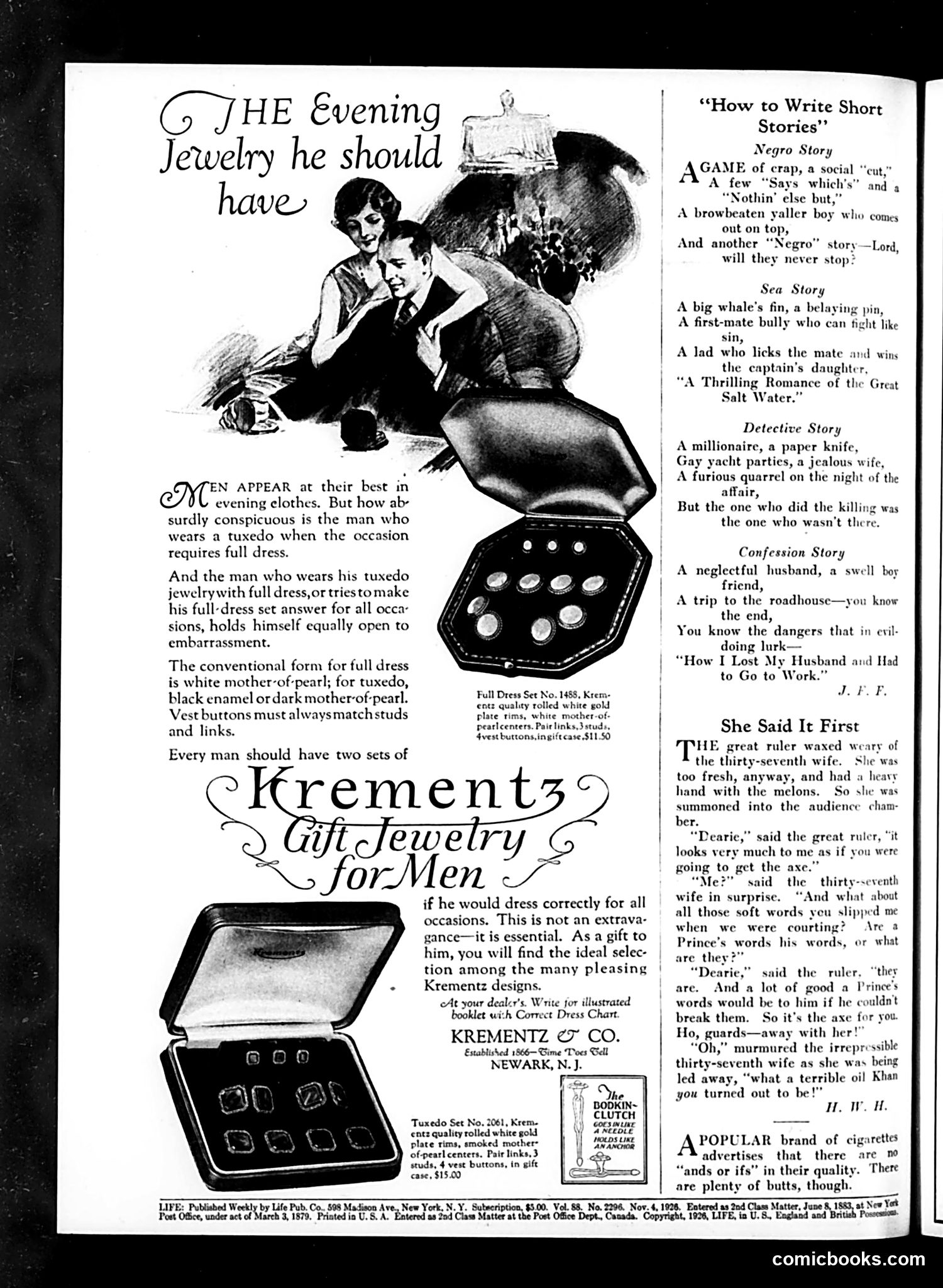
This page is **primarily advertising** for Krementz Gift Jewelry for Men, occupying the left half. The ad emphasizes that men need proper evening wear accessories—specifically cufflinks and studs in mother-of-pearl or black enamel—to avoid embarrassment at formal occasions. The illustration shows two men admiring jewelry, establishing it as aspirational. The right side contains short fiction pieces and a brief humorous story titled "She Said It First," featuring a domestic dispute where a wife preemptively threatens her husband with an axe before he can criticize her appearance. The jokes appear to reference general marriage humor rather than specific political events or figures. This is a typical 1928 Life magazine layout mixing advertising with light entertainment content.
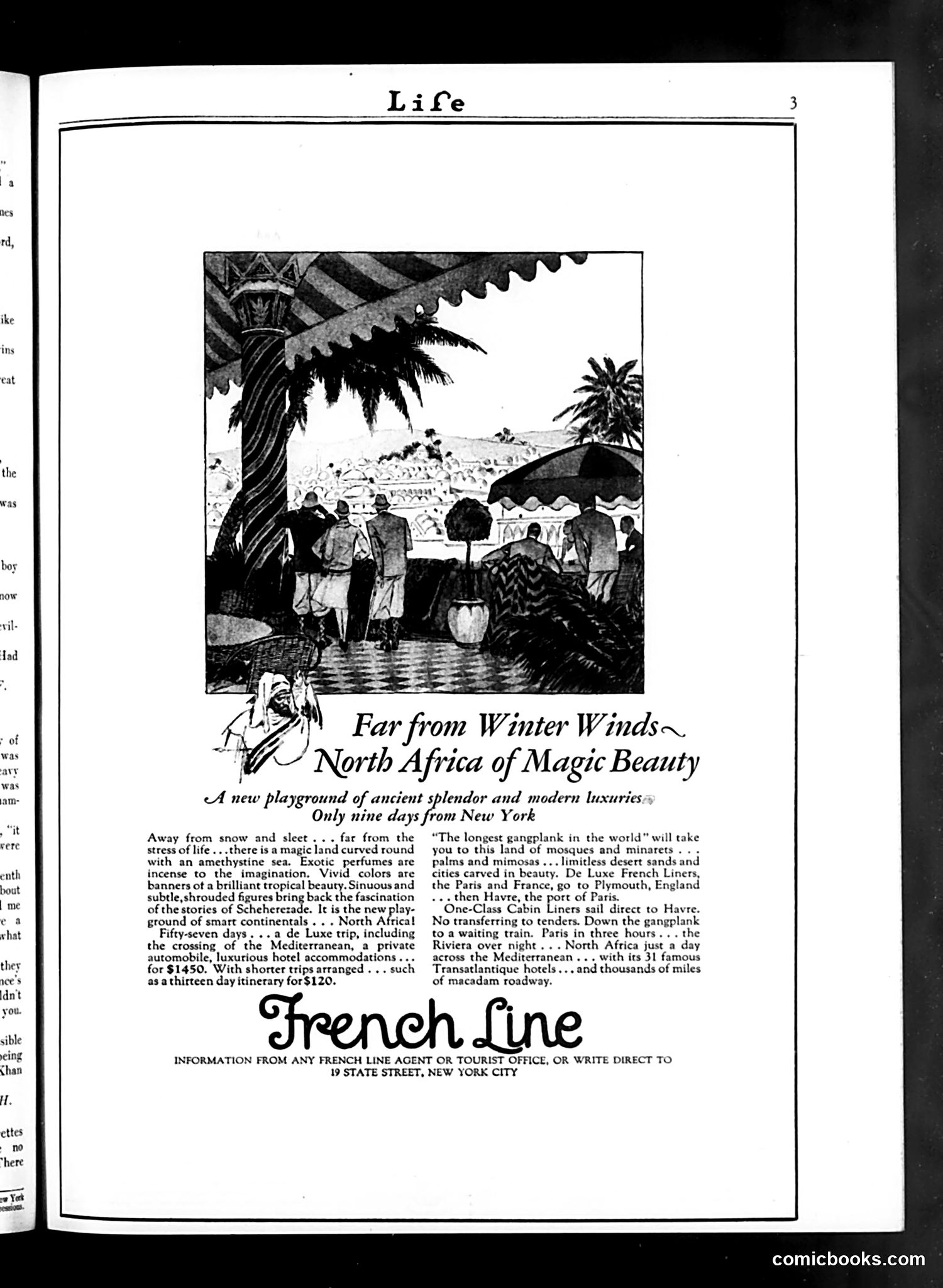
This page is primarily **advertising, not satire or political commentary**. It's a French Line cruise advertisement from *Life* magazine promoting luxury travel to North Africa. The illustrated scene shows well-dressed tourists beneath a palm tree in what appears to be a Mediterranean or North African setting, with umbrellas and colonial-era architecture visible. The ad emphasizes exotic appeal: "magic land," "ancient splendor and modern luxuries," mosques, minarets, and desert landscapes. Key selling points include the novelty of quick travel ("only nine days from New York"), luxurious accommodations ($1,450 for a 50-day trip), and the prestige of French cruise liners serving Paris and Havre. The address for information is 19 State Street, New York City. The image reflects early-20th-century travel marketing's romanticization of colonized regions as exotic leisure destinations.
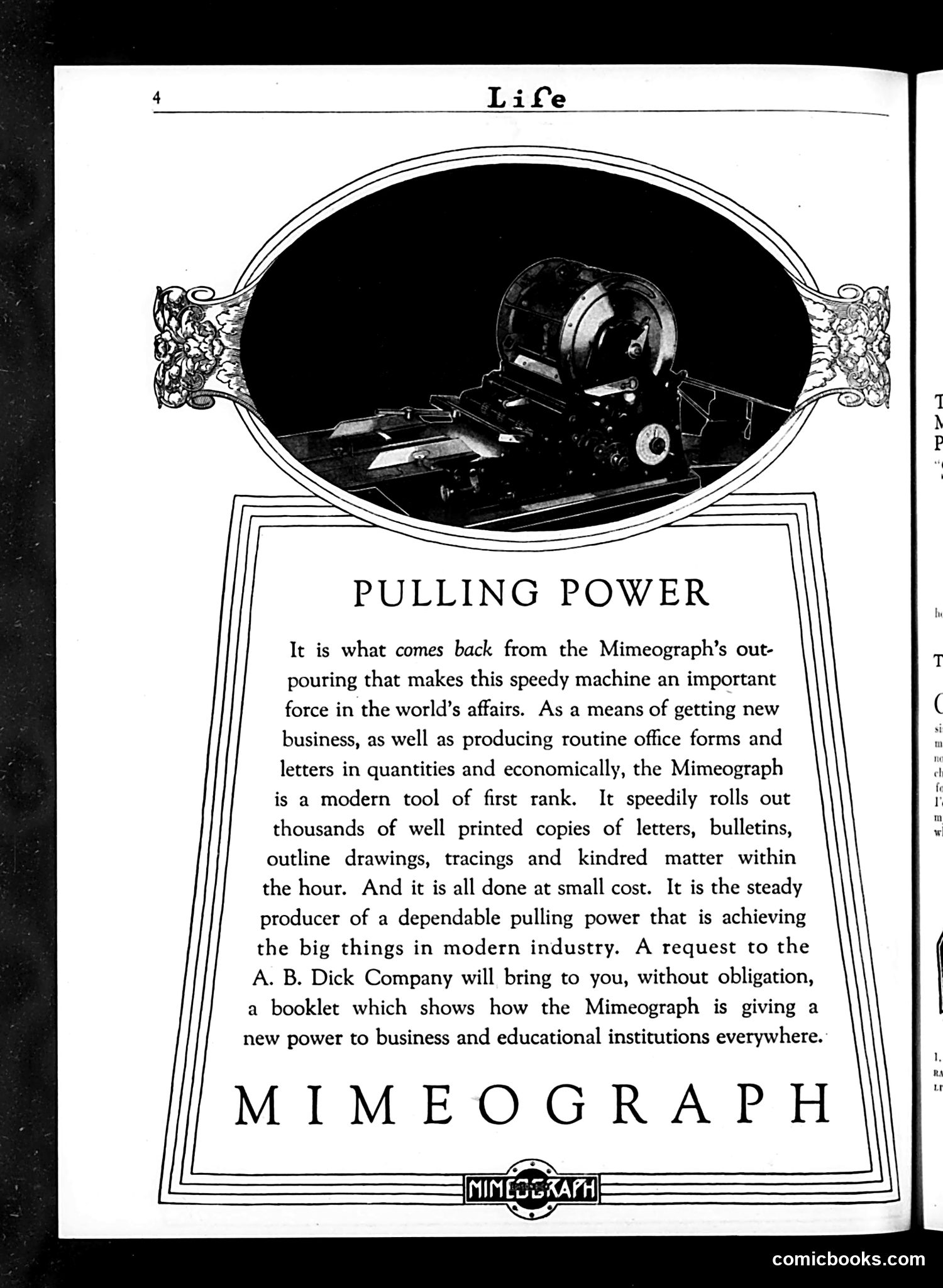
This is **not a political cartoon or satire**—it's a **straightforward advertisement** for the Mimeograph machine, published in *Life* magazine (page 4). The image shows the mechanical device itself. The ad's "PULLING POWER" headline uses business jargon metaphorically, claiming the mimeograph's output (reproduced documents) provides the "pulling power" that drives modern business success. The copy emphasizes the machine's practical value: it quickly produces multiple copies of letters, bulletins, and drawings cheaply, making it essential office equipment for "business and educational institutions everywhere." This represents early 20th-century office technology marketing—selling efficiency and cost-savings to businesses. There is no satire or political commentary present.
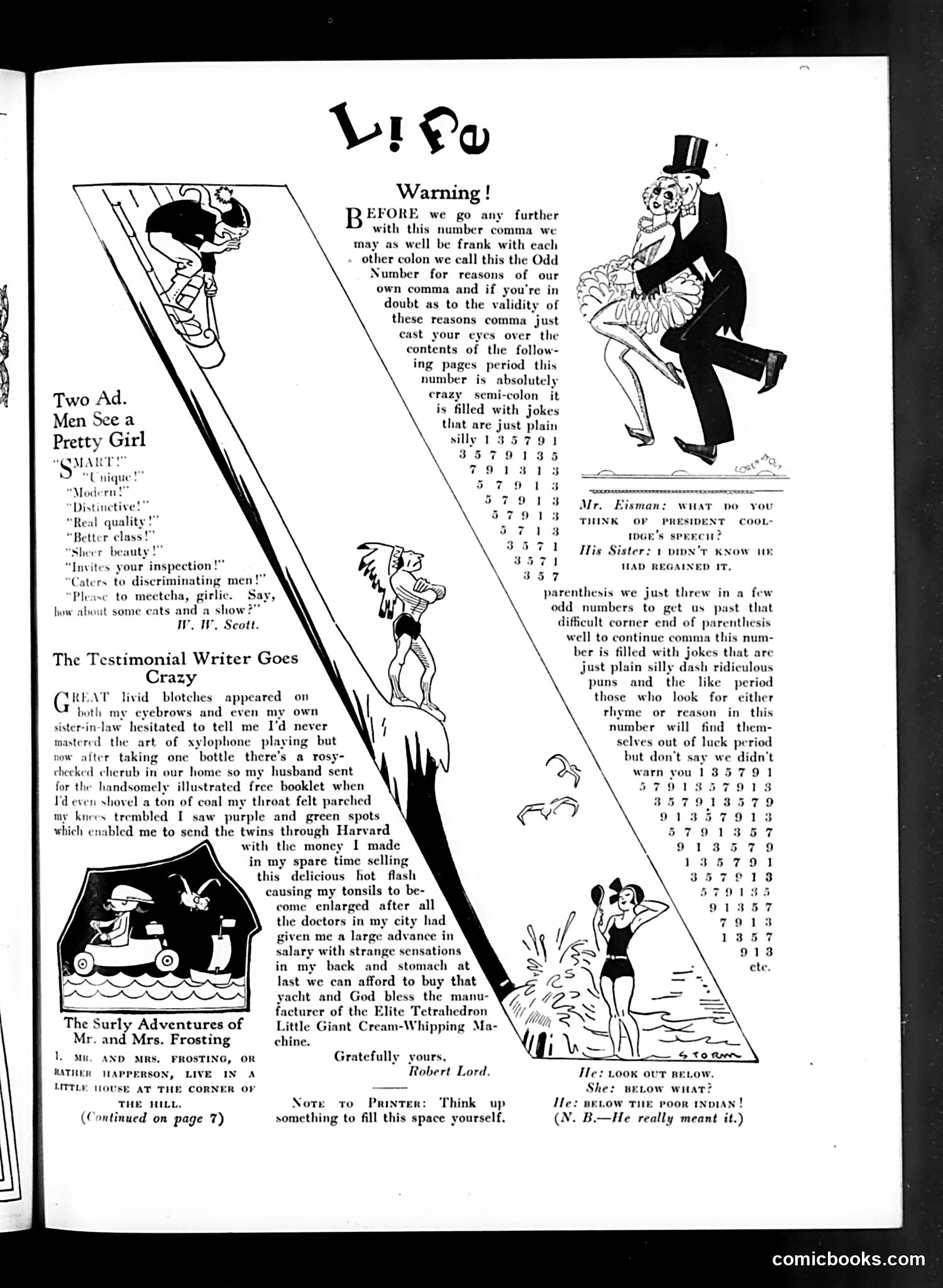
This page from *Life* magazine contains several humorous pieces typical of the publication's satirical style: 1. **"Two Ad Men See a Pretty Girl"** - A visual gag showing advertisers using marketing language ("SMART!" "Unique!" "Modern!") to describe a woman, satirizing how advertising copy objectifies and commodifies everything, including people. 2. **"The Testimonial Writer Goes Crazy"** - Robert Lord's piece mocks fake testimonials and product endorsements, describing how he wrote dishonest promotional copy (for "Elite Tetrahedral Little Giant Cream-Whipping Machine") and suffered physical consequences, satirizing fraudulent advertising practices. 3. **"The Surly Adventures of Mr. and Mrs. Frosting"** - A serialized comic strip about domestic life. The "Warning!" section contains intentional nonsense numbers—a joke about the magazine itself being deliberately absurd and silly.
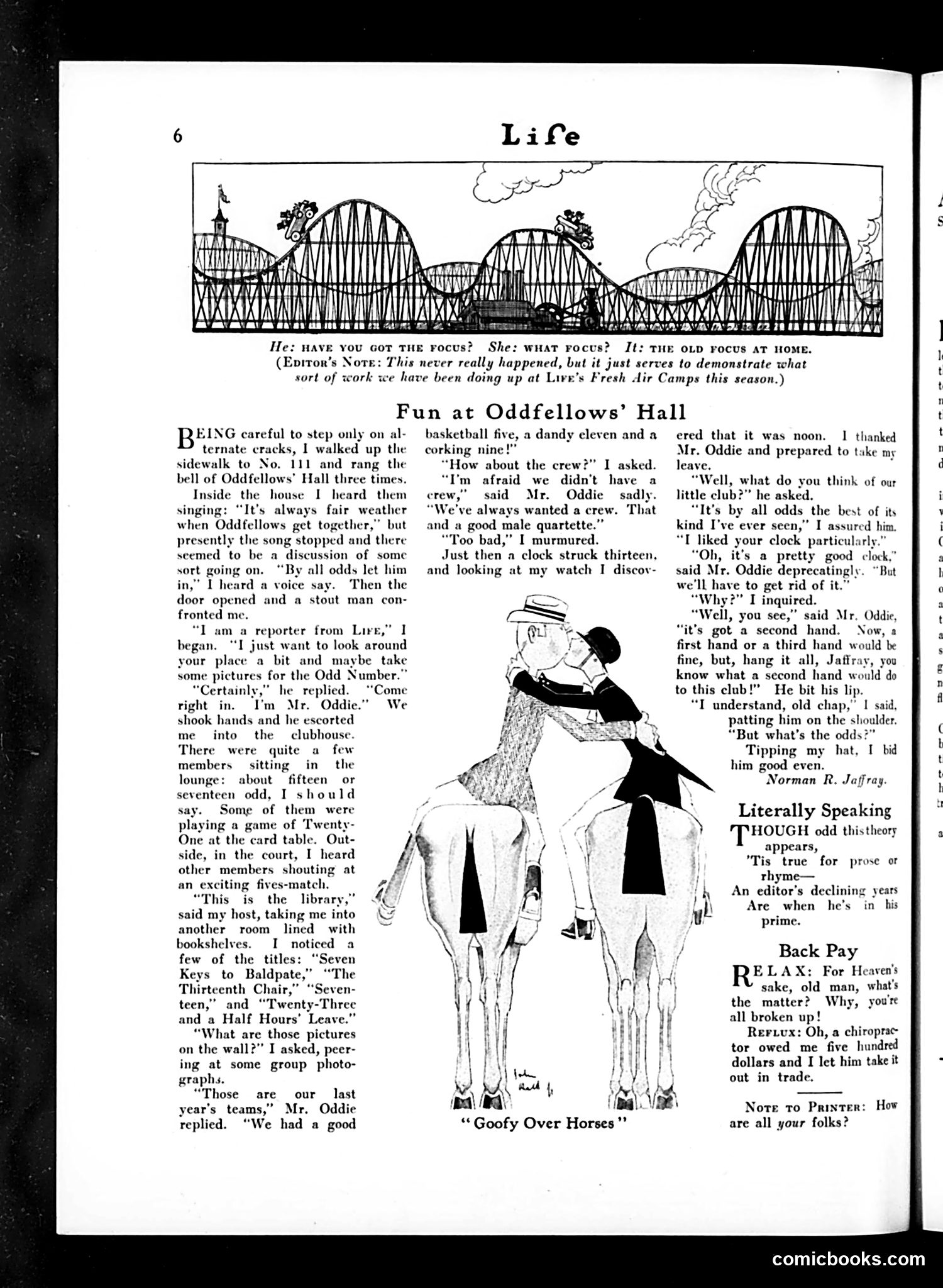
This page from *Life* magazine contains a humorous story titled "Fun at Oddfellows' Hall" about a reporter visiting a fraternal organization's headquarters to gather material. The narrative describes encountering various club members and their activities. The main cartoon, titled "Goofy Over Horses," depicts a man attempting to ride or mount a horse in an awkward, exaggerated manner—likely satirizing incompetent horsemanship or bumbling behavior. The humor appears aimed at slapstick physical comedy rather than political commentary. The other brief items—"Literally Speaking" and "Back Pay"—are short joke or observation pieces typical of *Life's* satirical format, poking gentle fun at human nature and social situations rather than targeting specific figures or events.
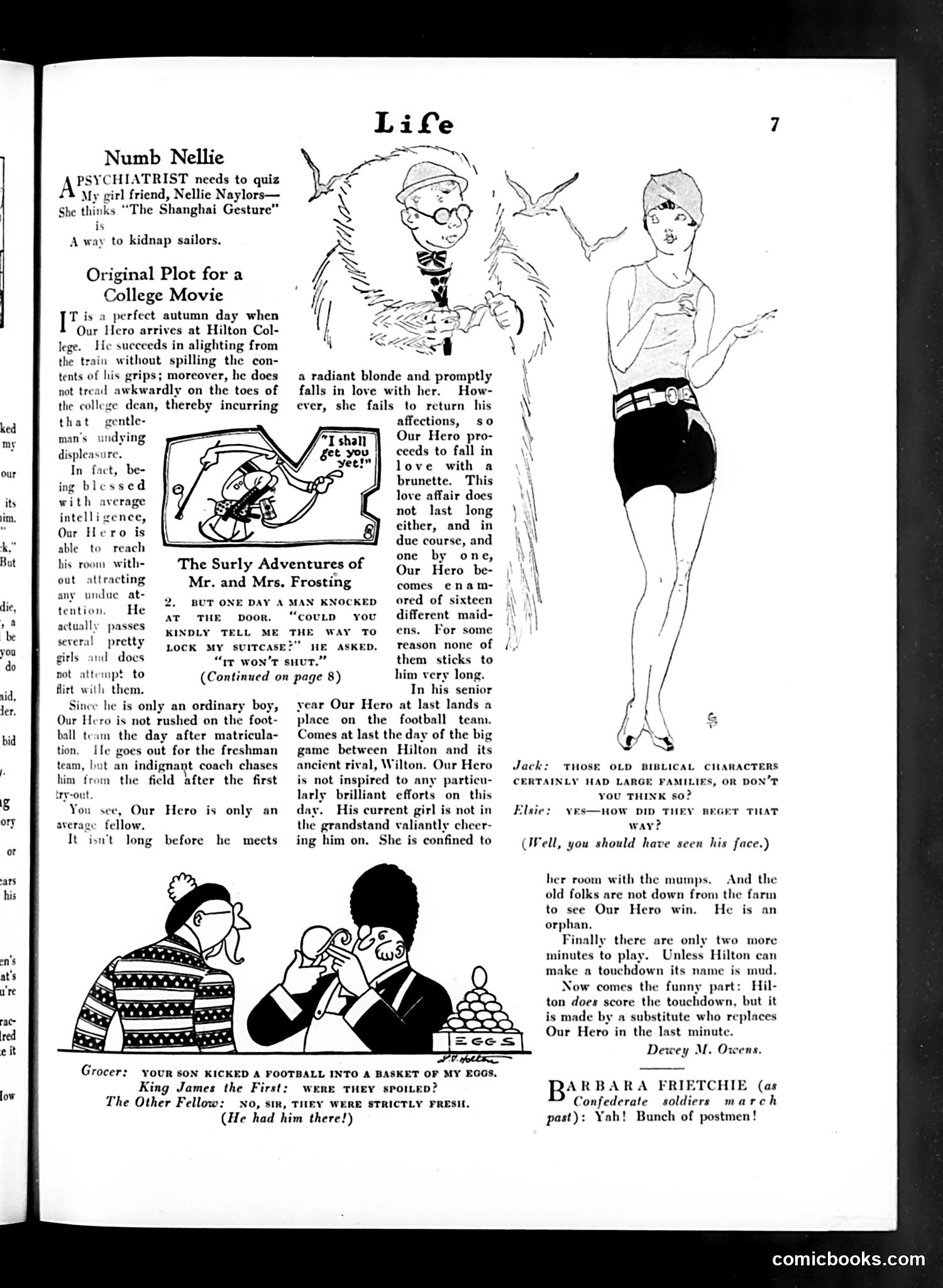
This page contains humorous fictional vignettes rather than political satire: **"Numb Nellie"** mocks a psychiatrist who must quiz his girlfriend about her thoughts, with a joke about kidnapping sailors. **"Original Plot for a College Movie"** satirizes formulaic college films: an attractive hero arrives, succeeds athletically, romances a blonde, falls for a brunette instead, and performs heroically at a football game. The satire targets Hollywood's predictable, repetitive college movie plots. **"The Surly Adventures of Mr. and Mrs. Frosting"** presents a domestic comedy where a man refuses to help his wife with her suitcase. The bottom cartoon depicts a grocer and another man discussing eggs kicked into a basket—a simple slapstick joke about freshness. These are light humor pieces typical of 1920s-era Life magazine, not political commentary.
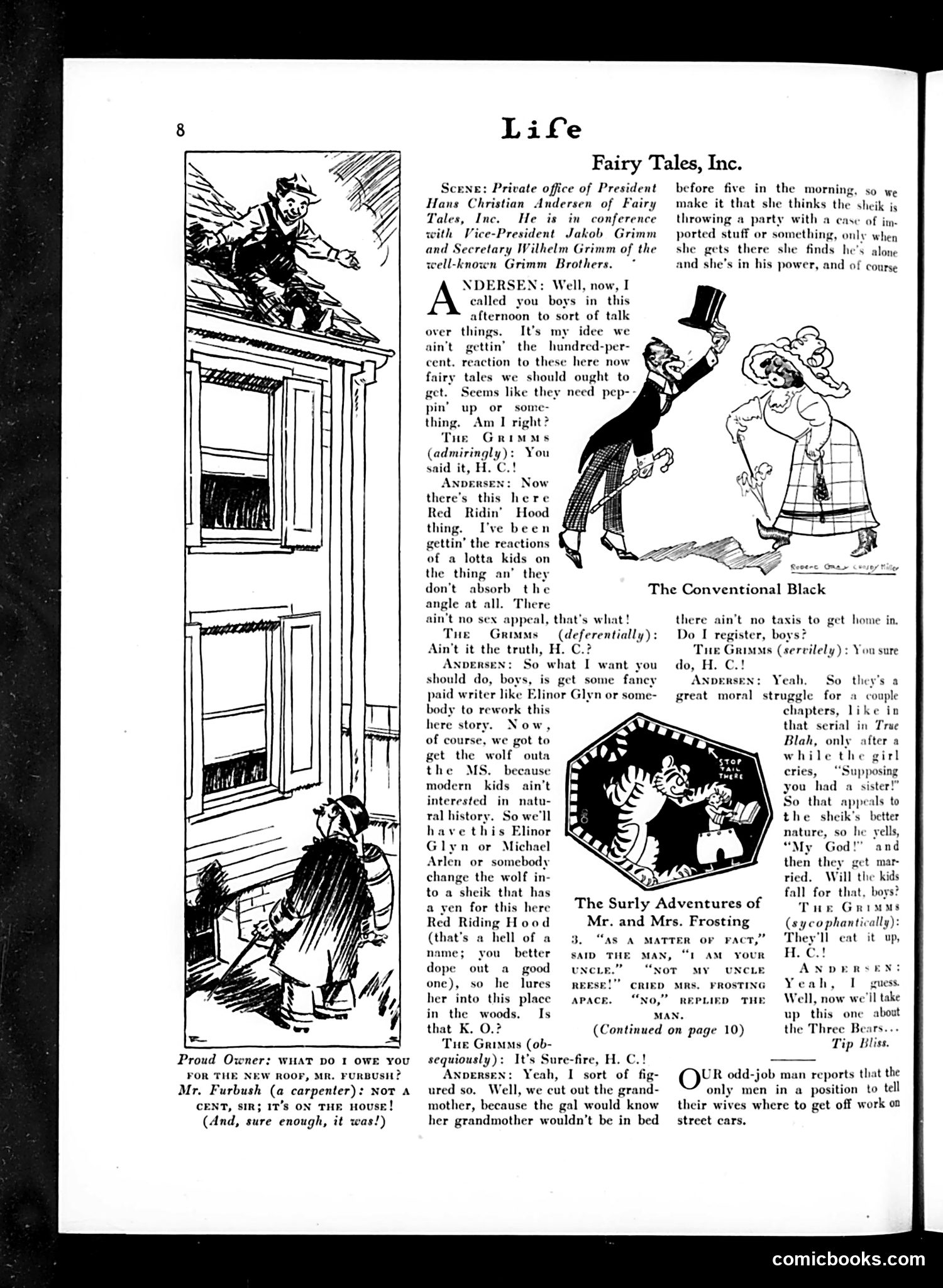
This page from *Life* magazine satirizes the Grimm Brothers' fairy tale adaptations. The main dialogue shows President Hans Christian Andersen of "Fairy Tales, Inc." and Vice-President Jakob Grimm discussing how to modernize classic stories to appeal to contemporary children. The satire targets two issues: 1. **Bowdlerization of classics**: The executives plan to replace traditional content (like Red Riding Hood) with sanitized versions featuring modern figures like Elinor Glyn, removing moral lessons that made original tales valuable. 2. **Commercial exploitation**: The cartoons mock how publishers were repackaging classic literature for profit without understanding their educational worth. The joke assumes readers value traditional fairy tales' darker elements and moral lessons, viewing their corporate "improvement" as corrupt modernization.
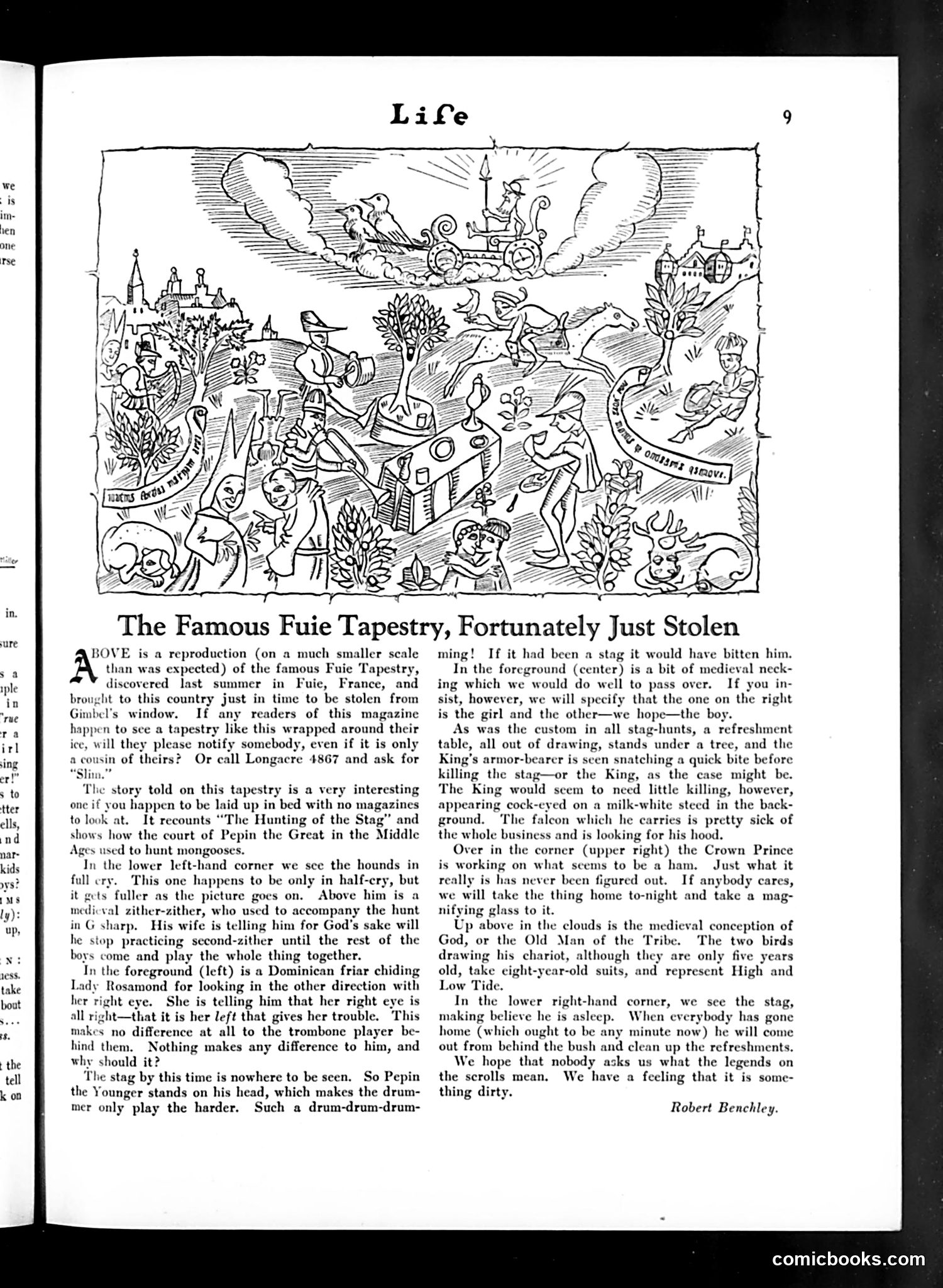
This page reproduces a medieval-style tapestry illustration depicting "The Hunting of the Stag"—a popular courtly subject from the Middle Ages. The satirical article, attributed to Robert Benchley, humorously describes the chaotic scene as if analyzing an actual historical artifact. The joke appears to be Benchley's deadpan, overly-detailed interpretation of the tapestry's busy composition. He identifies various figures (a Dominican friar chiding Lady Rosamond, the King's armor-bearer, the Crown Prince on a "ham"), treating obvious visual absurdities—like Pepin with a drum on his head—as serious historical facts requiring explanation. The satire mocks both medieval tapestry scholarship's tendencies toward overwrought interpretation and the magazine's readers' appreciation of highbrow cultural analysis.
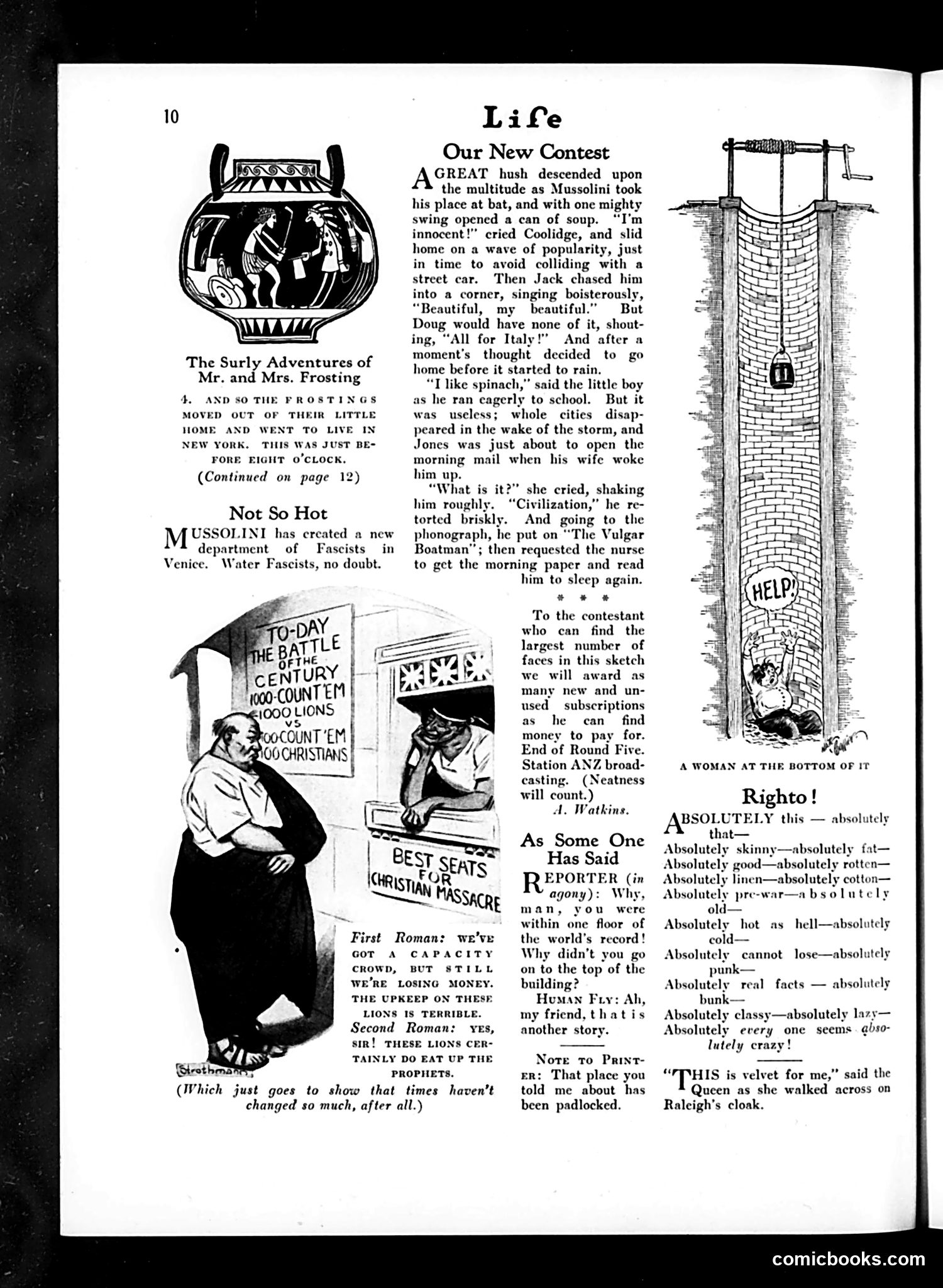
This page contains several satirical pieces mocking contemporary politics and society. **"Not So Hot"** depicts a cartoon where a man reads propaganda posters about Mussolini's fascist regime in Venice, including slogans about "battle of the century" and "Christian massacre." The satire ridicules fascist rhetoric as contradictory and absurd—the caption notes "times haven't changed so much, after all," suggesting cyclical human folly. **"Our New Contest"** is a humorous short story about Coolidge (likely President Calvin Coolidge) taking a bat at soup during a public event, creating chaos. It's political satire mocking the president's awkwardness or incompetence in public settings. The "Righto!" section appears to be absurdist word-play humor. Overall, the page satirizes both foreign fascism and American political leadership circa the 1920s-1930s.
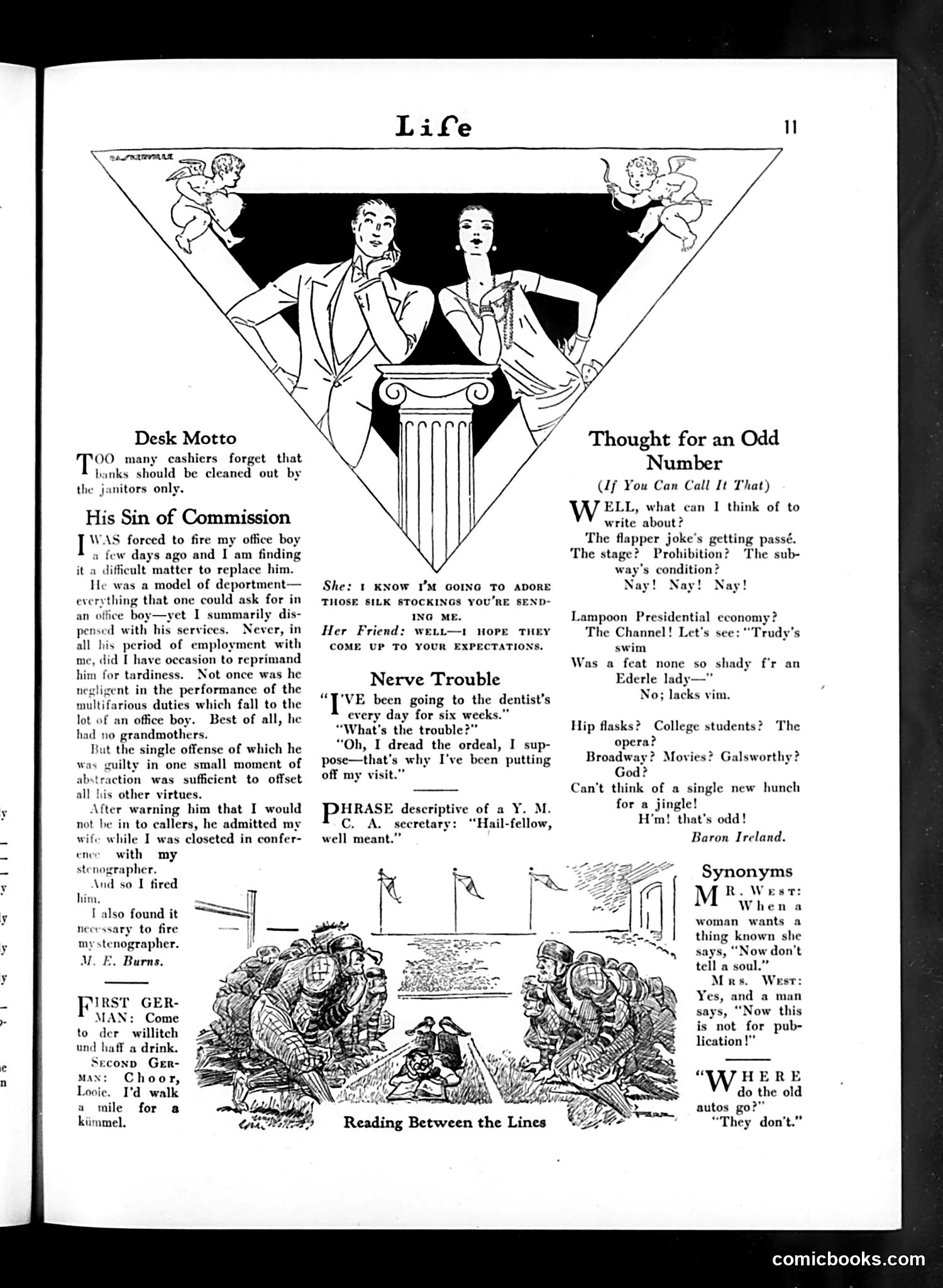
This page contains several humor pieces typical of 1920s-era Life magazine: **"Desk Motto"** satirizes a bank manager who fired an office boy over a minor mistake, then had to hire a stenographer to replace him—revealing the boy's actual value. **"Nerve Trouble"** mocks a patient's dental anxiety, playing on common phobias. **"Reading Between the Lines"** (cartoon) appears to show working-class or immigrant figures in a humorous domestic scene, though the specific satire is unclear from the image alone. **"Synonyms"** presents wordplay jokes about euphemistic language—how refined speakers say uncomfortable truths delicately. The overall tone reflects 1920s humor: workplace mishaps, class-based comedy, and linguistic wit. The decorative header features classical figures, typical of Life's aesthetic approach to presenting satirical content.
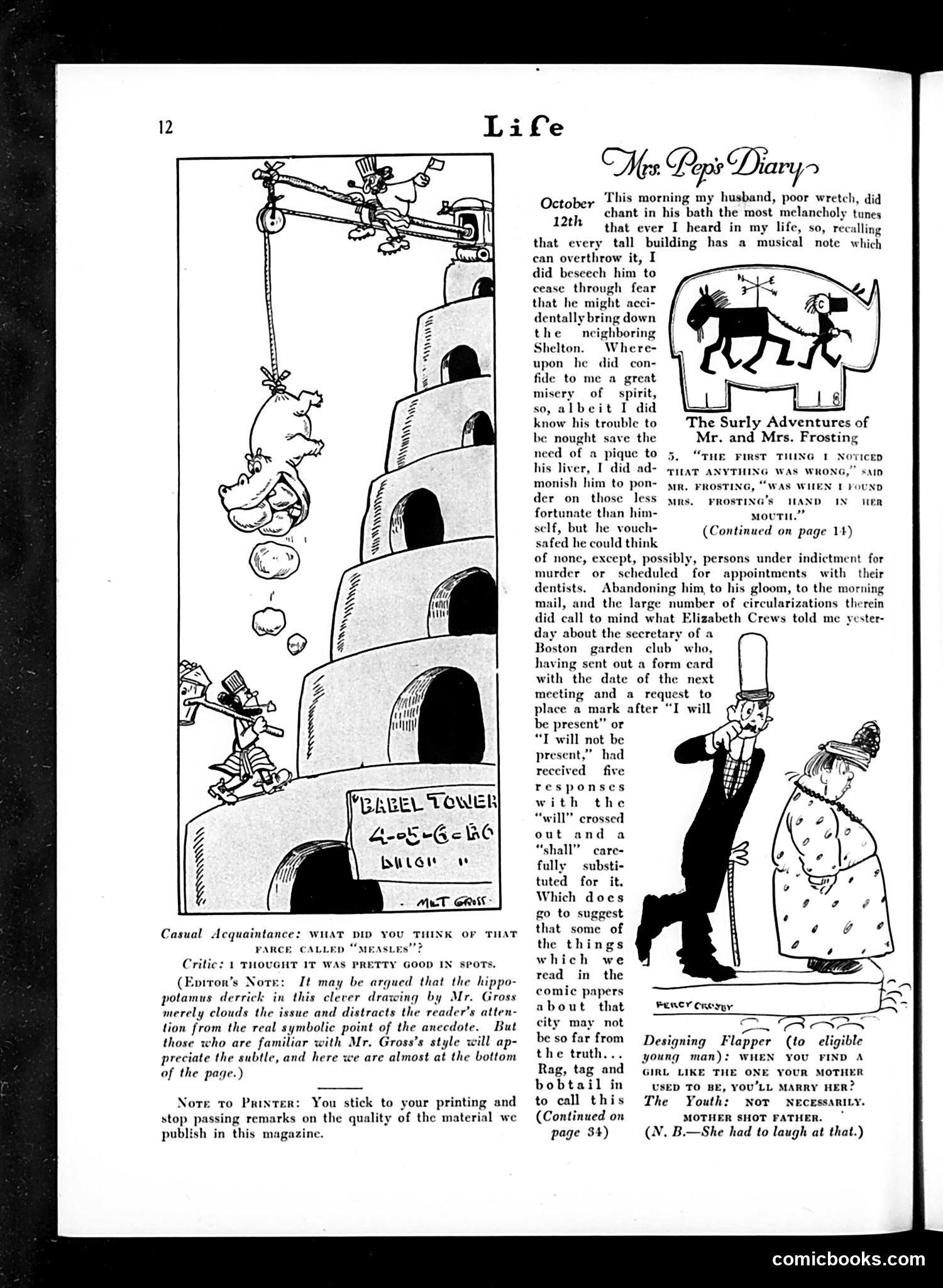
This page features "Mrs. Pop's Diary" (October 12th), a domestic humor column where the narrator recounts her husband's loud bathing and singing, which she fears might damage nearby buildings. She notes his subsequent melancholy and worries about his mental state. The main cartoon, "Babel Tower" by Met Gross (credited at bottom), depicts a tall tower with multiple levels where tiny figures attempt various activities. Below are reader responses: one "Casual Acquaintance" thought it "pretty good in spots," while a "Critic" offered mixed praise. At right, "The Surly Adventures of Mr. and Mrs. Frostling" begins a serialized comic strip about this couple's misadventures, featuring illustrations of a man, woman, and horse. The page represents typical early 20th-century magazine humor mixing domestic comedy, visual gags, and serialized strips.
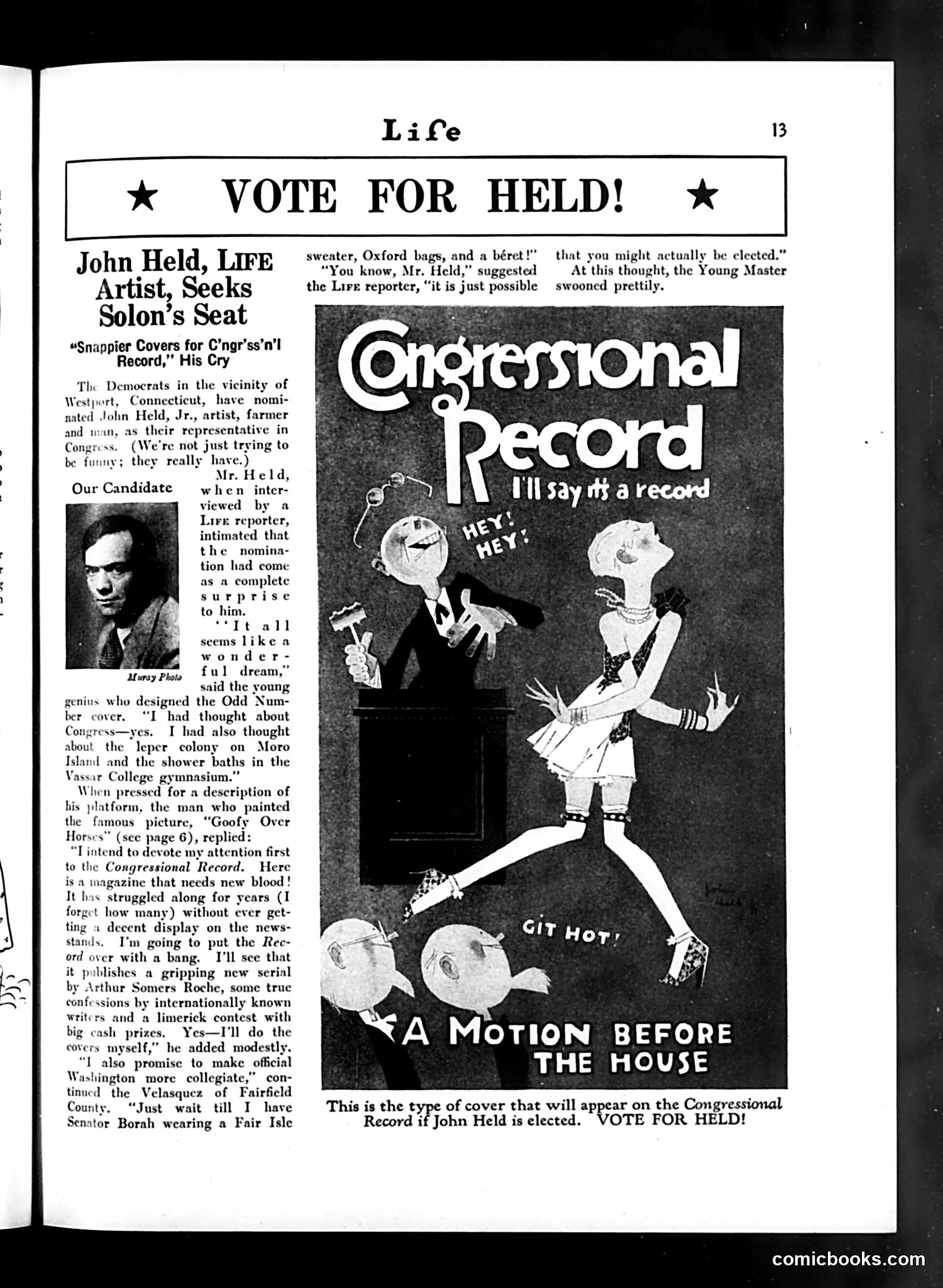
This Life magazine page promotes artist and cartoonist **John Held Jr.** as a Democratic candidate for Congress from Connecticut. The satire operates on multiple levels: **The Joke**: Held is known for designing the "Odd Number" and painting "Goofy Over Hoses"—frivolous artistic pursuits. The article ironically suggests that someone so disconnected from serious matters might actually win election, mocking both Held's unsuitability and voters' judgment. **The Mock Campaign Promise**: The "Congressional Record" cartoon shows absurd changes Held would make—turning Congress into entertainment, with characters exclaiming "Hey hey!" and "Git hot!" This ridicules both Held's artistic sensibilities and the emptiness of political campaigns. The overall message: even an artist famous for silly work could get elected, a cynical commentary on democratic processes and voter discernment.
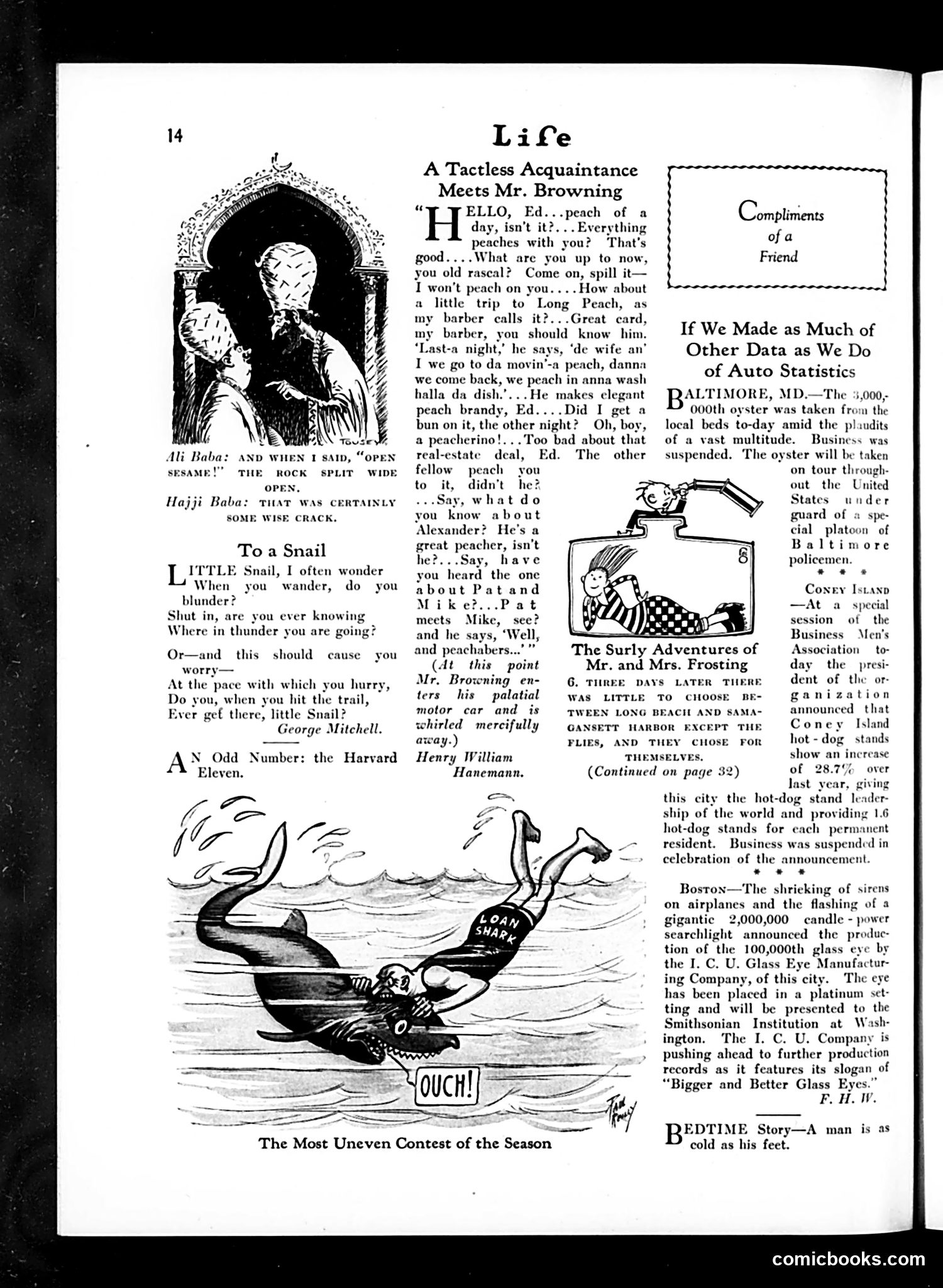
This page contains three humorous pieces. "A Tactless Acquaintance Meets Mr. Browning" is a dialogue where someone pesters "Ed" with gossip and small talk about peaches and real estate—poking fun at intrusive, boundary-crossing social behavior. "To a Snail" is a poem by George Mitchell about snails' leisurely pace. The main cartoon, "The Most Uneven Contest of the Season," depicts a person being attacked by a shark labeled "LOAN SHARK" while shouting "OUCH!" The joke satirizes predatory lending practices—the wordplay between actual sharks and financial "sharks" who aggressively pursue debtors. This reflects early 20th-century concerns about exploitative lending and debt collection.
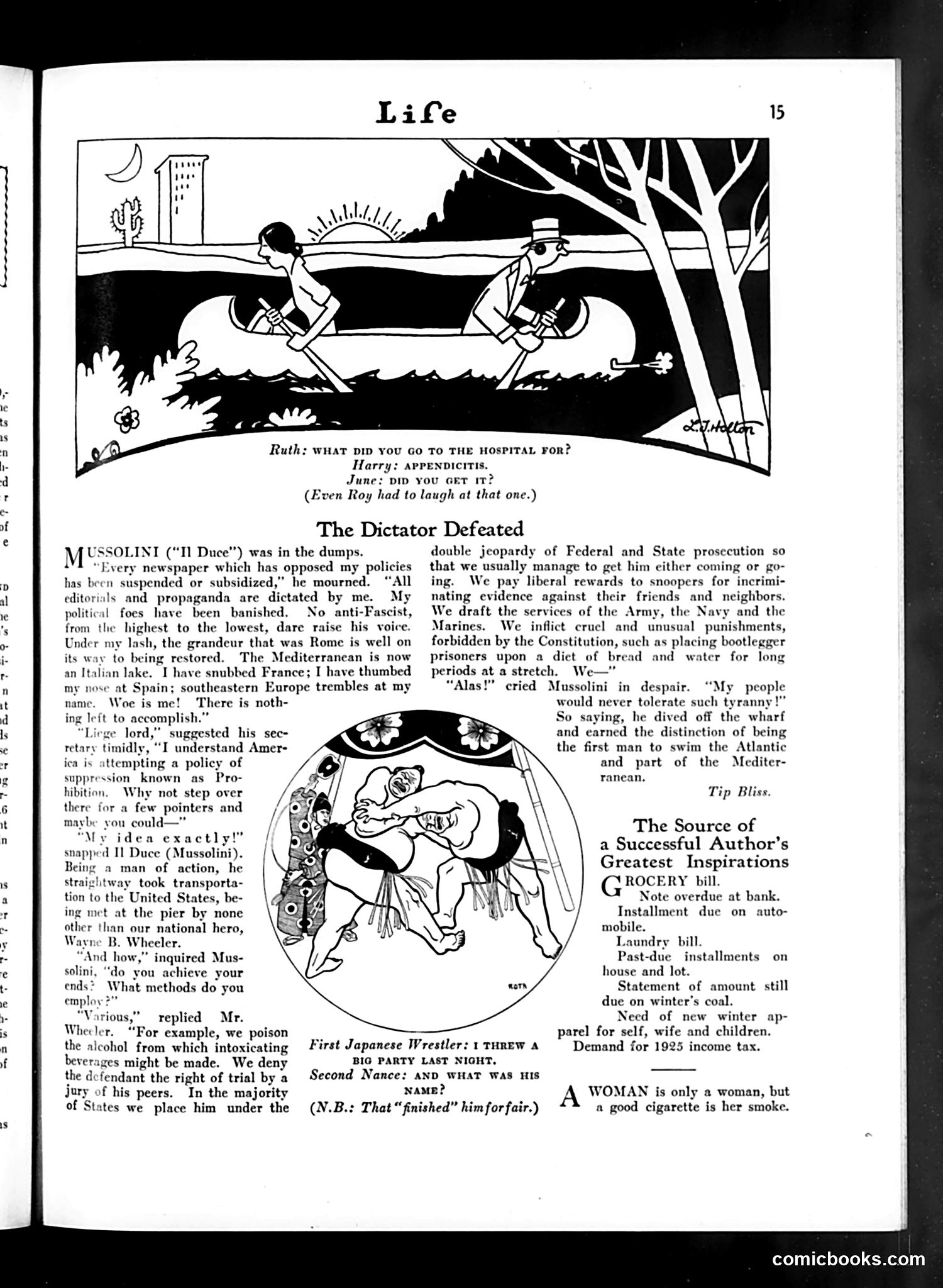
**Top Cartoon:** Shows two people in a canoe during sunrise/sunset. The dialogue references appendicitis and hospital visits, making light of a common 1920s medical condition that required surgery. **Main Article: "The Dictator Defeated"** Satirizes Mussolini ("Il Duce"), attacking his authoritarian control of Italian newspapers, suppression of free speech, and use of brutal punishments. The piece celebrates his apparent downfall, noting he "died of the shaft" and "earned the distinction of being the first man to swim the Atlantic." This appears to be celebratory satire mocking Mussolini's grandiose propaganda. **Central Cartoon:** Depicts a Japanese wrestler in an exaggerated fighting pose, with captions making crude ethnic humor about wrestling terminology. **Right Column:** Contains miscellaneous brief satirical items about everyday frustrations (bills, debts, taxes) and a quip about women smokers.
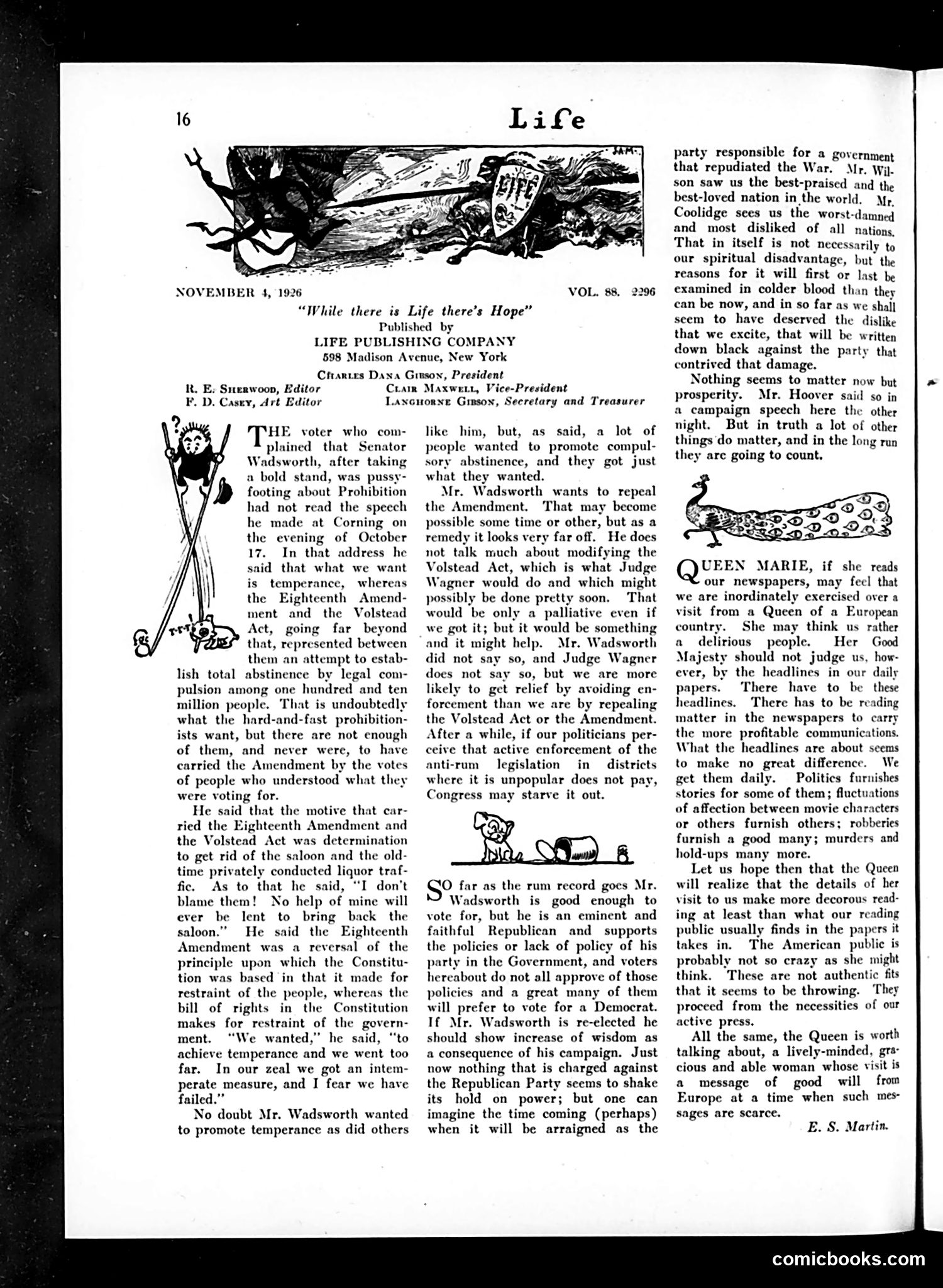
This *Life* magazine page from November 4, 1926, contains political commentary (not a cartoon) critiquing Senator Wadsworth's stance on Prohibition. The article discusses Wadsworth's opposition to the Eighteenth Amendment and the Volstead Act, describing him as wanting to "promote temperance" while avoiding enforcement of Prohibition laws. The piece satirizes the tension within Republican politics: Wadsworth represents those wanting repeal or non-enforcement, yet the GOP must appear to support Prohibition publicly. The author questions whether Wadsworth's approach—avoiding enforcement rather than openly repealing the law—represents genuine principle or political compromise. The secondary item discusses Queen Marie of Romania's visit to America, treated as celebrity gossip rather than serious news coverage.
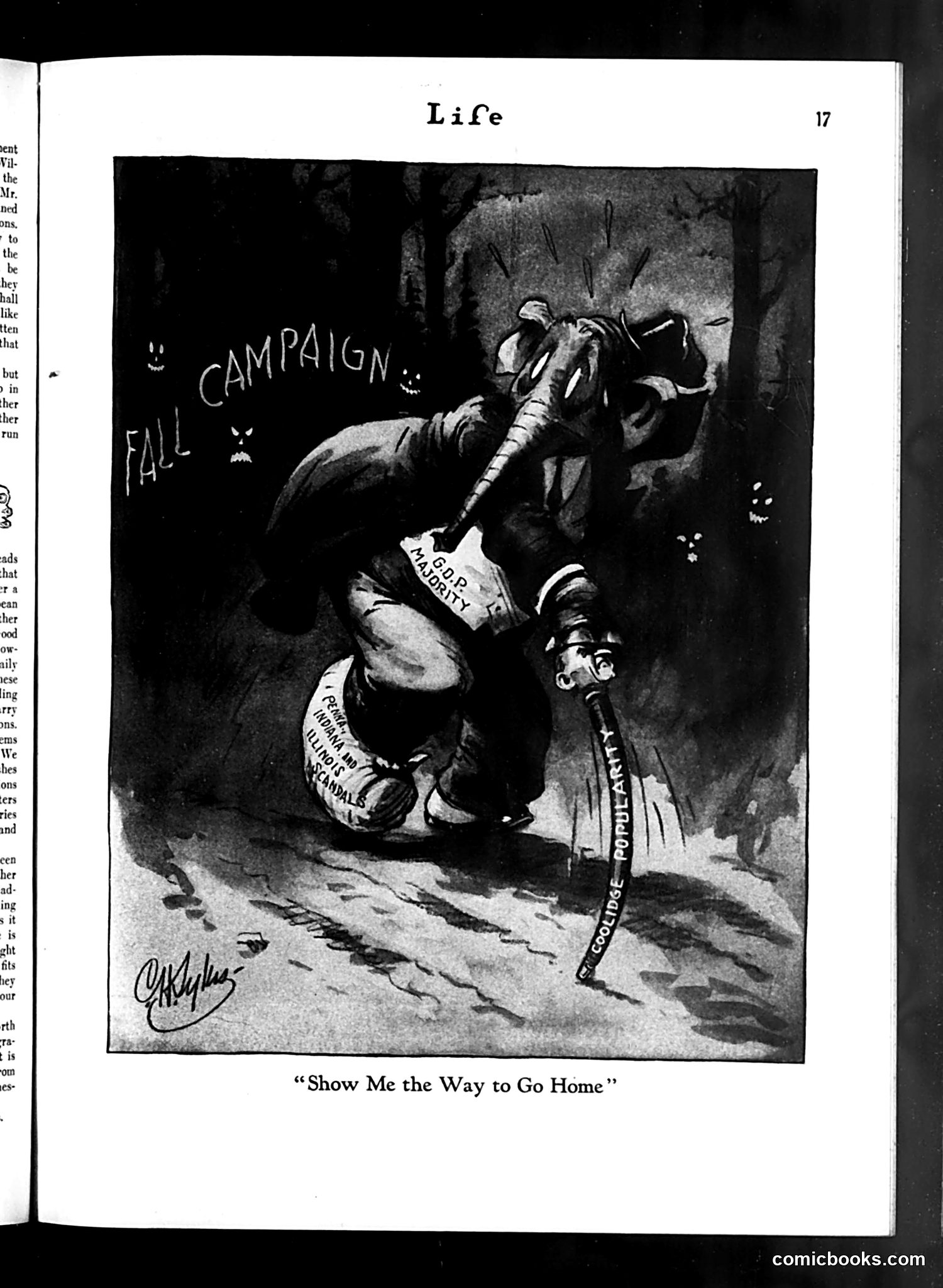
This political cartoon depicts a large figure labeled "Liberty" being struck down or defeated by a smaller figure wielding a club labeled "Fall Campaign." The figure with the club also wears a sash reading "Prosperity" and stands on a platform labeled "Procedure Populism." The satire appears to criticize how political campaigns (specifically a fall campaign, likely from the 1920s based on Life magazine's era) use appeals to prosperity and populism to undermine democratic liberty. The ironic caption—"Show Me the Way to Go Home"—suggests that Liberty is lost or defeated by these political machinations, unable to find its way amid campaign rhetoric and procedural manipulation. The cartoon warns against prioritizing election-year populism over fundamental democratic principles.
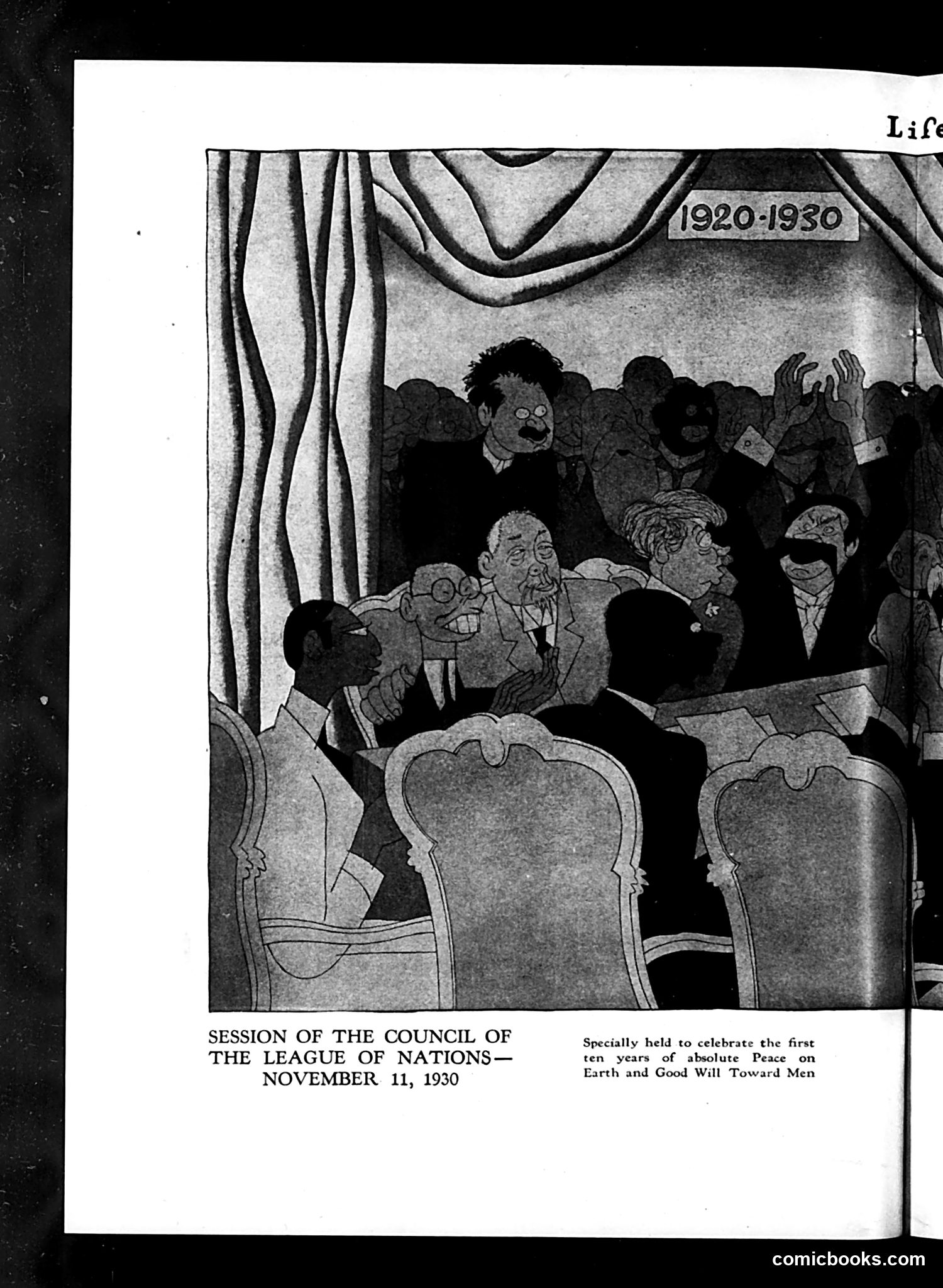
This is a satirical cartoon depicting a League of Nations Council meeting held on November 11, 1930 (Armistice Day), ostensibly to celebrate ten years of peace. The cartoon shows caricatured politicians and diplomats seated in an auditorium—their exaggerated features typical of 1930s political satire. The date box "1920-1930" marks the decade supposedly of peace. The satire's point appears cynical: despite the League's formal gathering to celebrate peace and goodwill, the crowded, somewhat chaotic scene and grotesque caricatures suggest the meeting is performative or ineffective. The interwar period saw growing tensions and the League's inability to prevent future conflicts, making the idealistic rhetoric about "absolute Peace" and "Good Will" seem hollow or naive to contemporary readers.
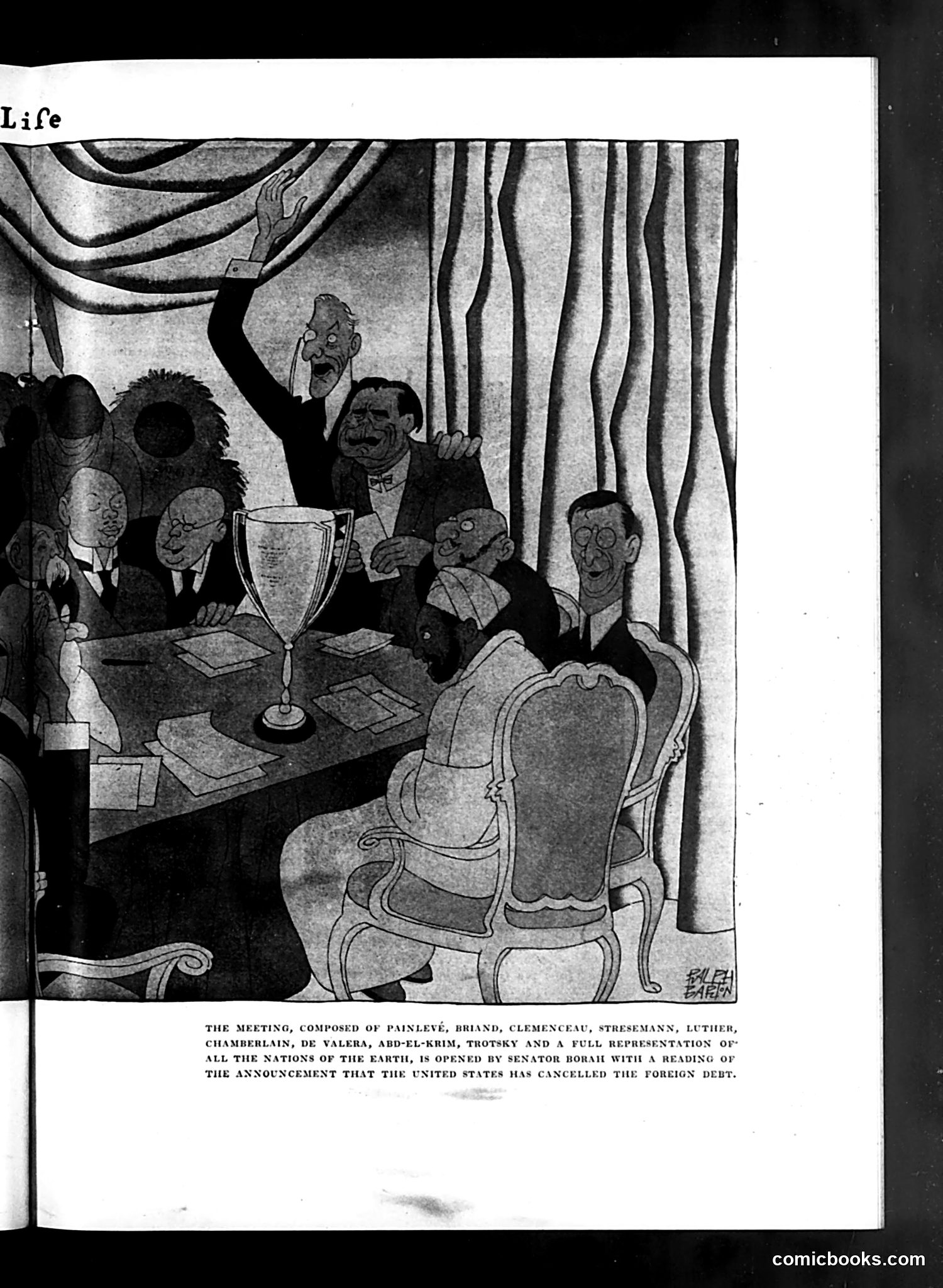
This satirical cartoon depicts an international conference of world leaders celebrating the U.S. cancellation of foreign debt. The caricatured figures represent major political personalities of the 1920s era, including French (Poinlevé, Briand, Clemenceau), German (Stresemann, Luther), British (Chamberlain), Irish (de Valera), and Soviet (Trotsky) representatives, plus Moroccan leader Abd-el-Krim. The satire mocks the unrealistic optimism of international debt forgiveness. The exaggerated facial expressions and celebratory trophy suggest the cartoon critiques the naïveté of expecting such generosity would solve world tensions or create genuine harmony among ideologically opposed nations—many of whom had recently been wartime enemies.
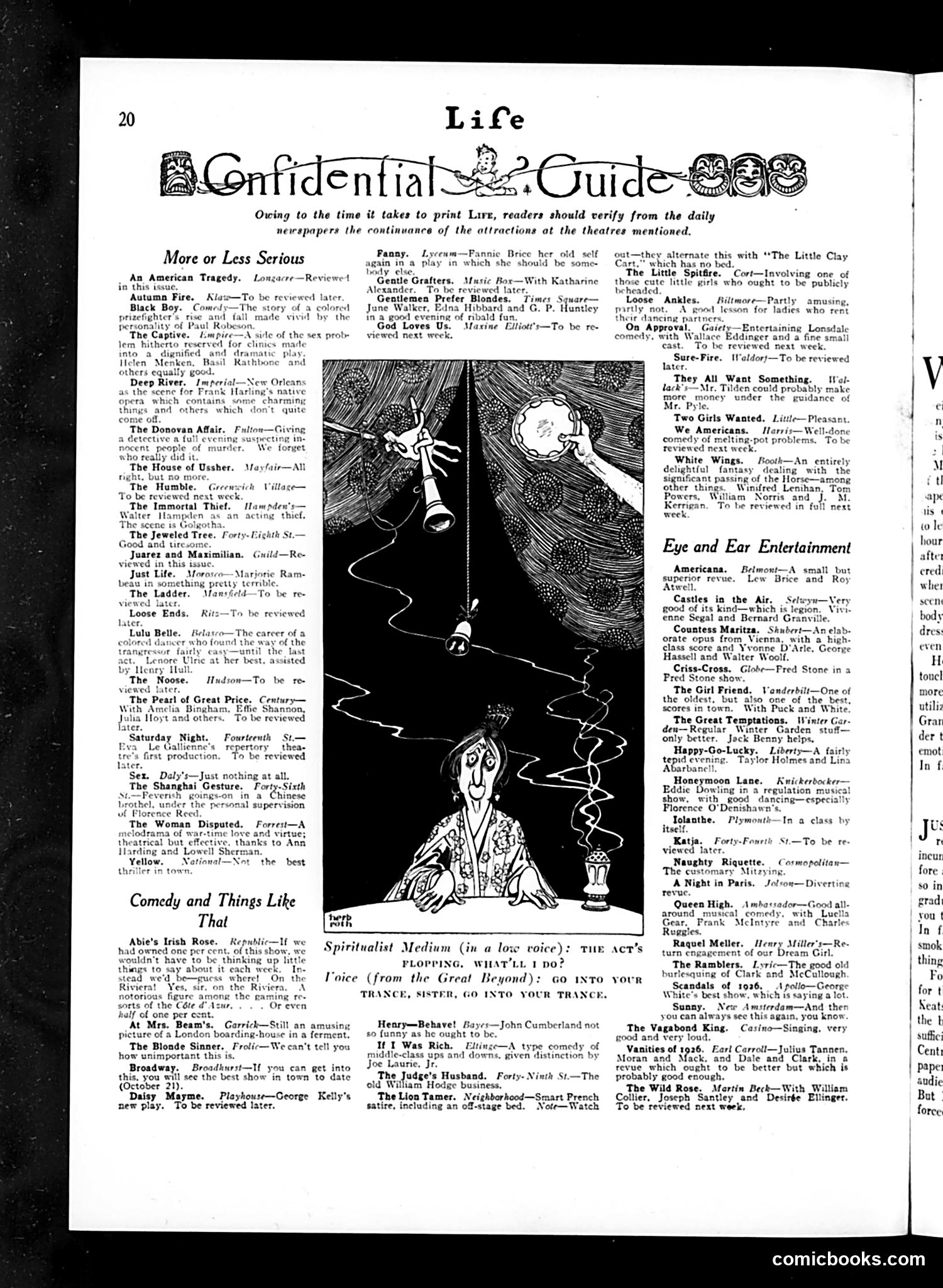
This page is primarily a theater review guide for Broadway shows circa the 1920s, with one central cartoon. **The Main Cartoon:** A spiritualist medium (depicted with exaggerated features typical of period caricature) consults a client seeking guidance from "the Great Beyond." The spirit's response—"GO INTO YOUR TRANCE"—is a joke about fraudulent spiritualism: the medium has no actual supernatural connection, so they must manufacture a fake trance to maintain the illusion. **Context:** This satirizes the 1920s spiritualism craze, when séances and mediums were fashionable among the wealthy and gullible. The joke exposes spiritualism as performance theater rather than genuine contact with the dead. **The Reviews:** The surrounding text catalogs current Broadway productions, with brief, often caustic commentary on plays ranging from serious dramas to comedies. Notable is the enthusiastic endorsement of "Abie's Irish Rose" (a Jewish-Irish romance play that became a phenomenon). The page reflects 1920s entertainment culture and contemporary skepticism toward spiritual hucksterism.
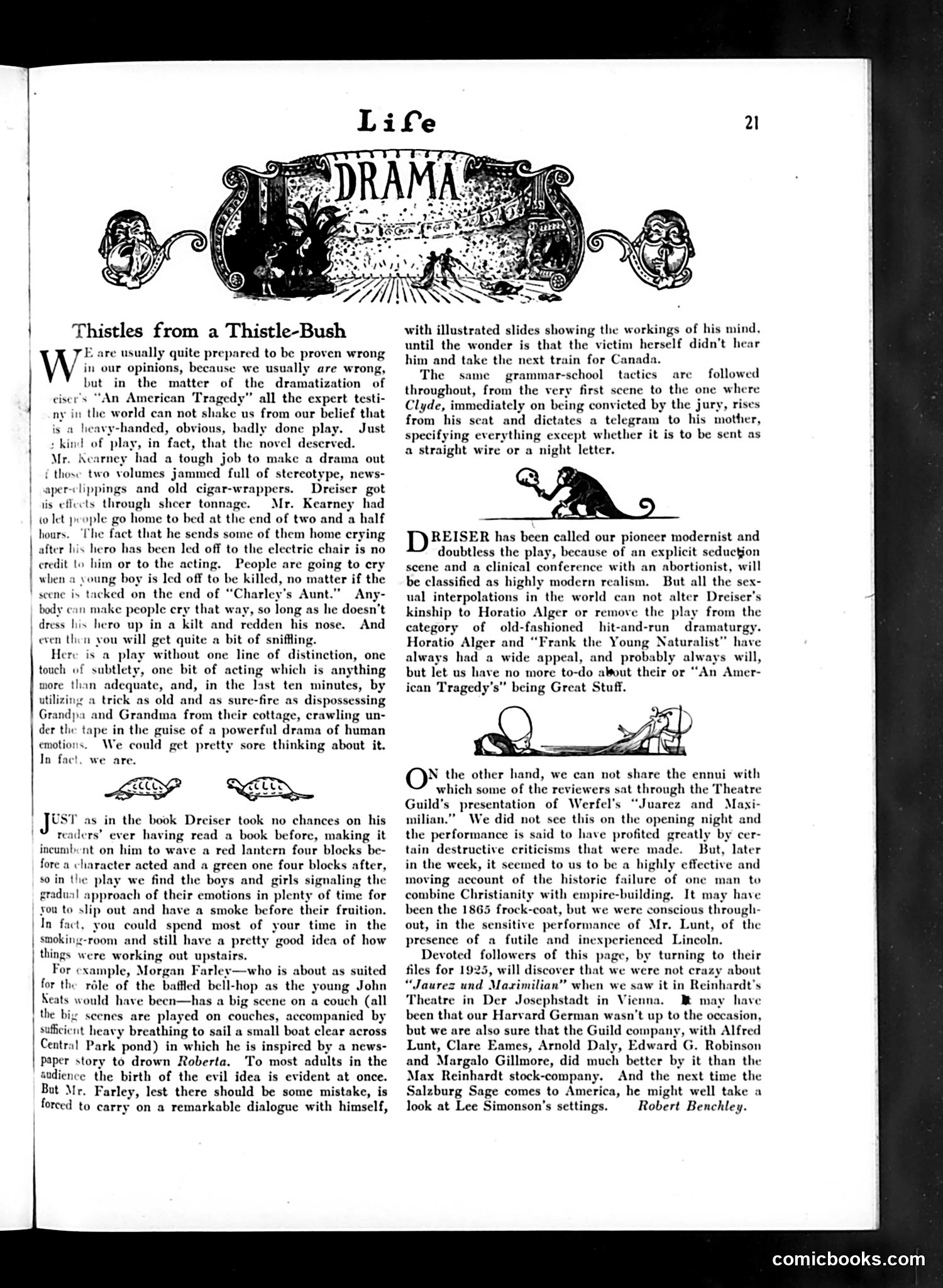
This page critiques the stage adaptation of Theodore Dreiser's novel *An American Tragedy*, panned as heavy-handed and obvious. The reviewer argues the play relies on crude theatrical mechanics—literally showing a character's murderous thoughts via "illustrated slides showing the workings of his mind"—rather than subtle acting or dialogue. The satire targets the adaptation's over-explanation of emotion and motivation. Actor Morgan Farley is mocked for performing an awkward internal monologue to convey his character's evil impulse to drown a woman, when adults in the audience would already understand. The reviewer suggests Dreiser himself made no artistic chances in the source material, and the playwright (Kearney) followed suit, reducing complex human psychology to obvious, melodramatic signposting—comparable to old-fashioned "hit-and-run dramaturgy" rather than modern realism.
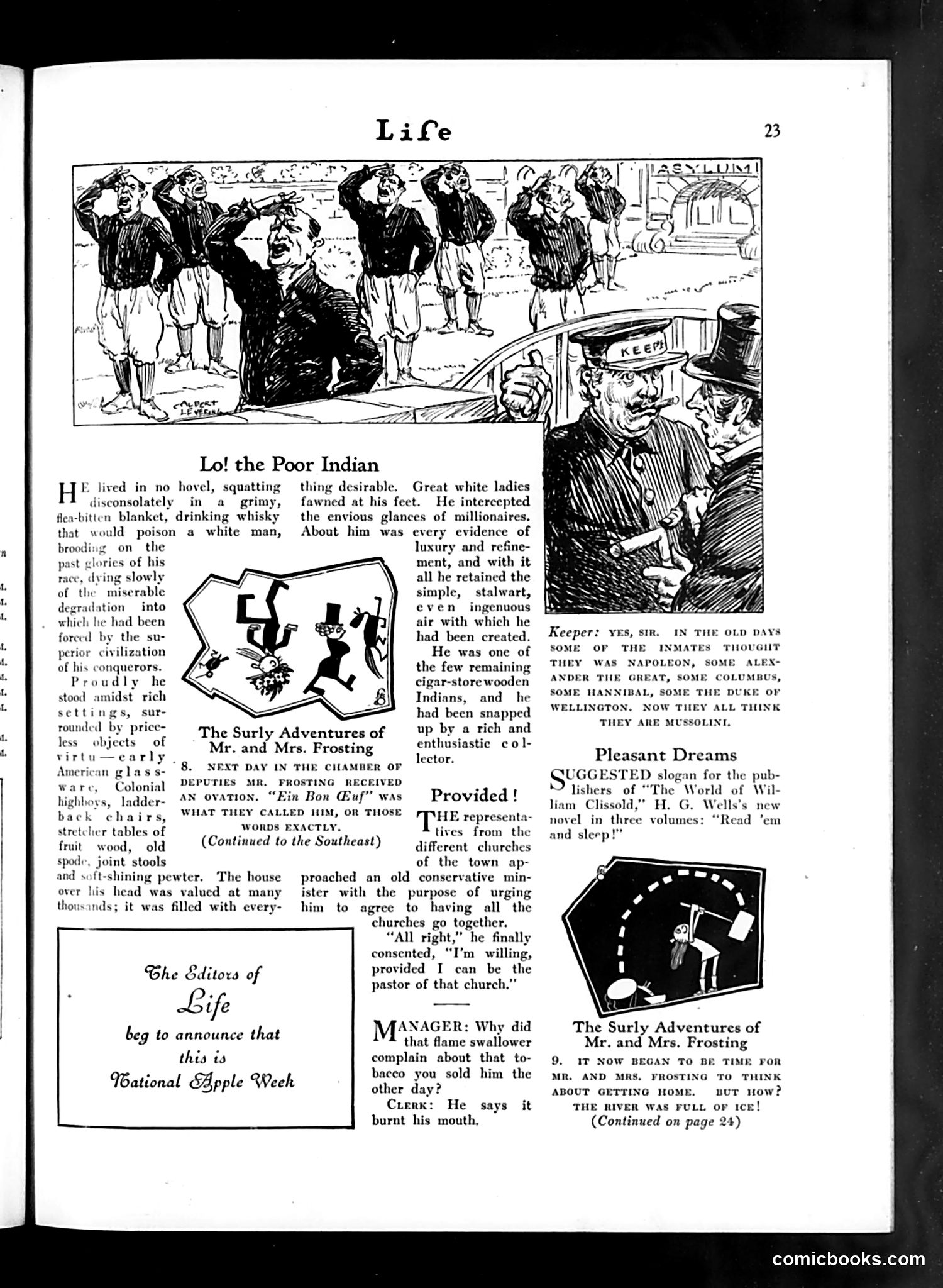
**"Lo! the Poor Indian"** satirizes the romanticization and appropriation of Native Americans by wealthy white collectors. The text describes a cigar-store wooden Indian (a common decorative object of the era) that has been purchased by a rich collector. The satire mocks the irony: while actual Native Americans were degraded and impoverished by "superior civilization," this wooden caricature is now treated as a prized artifact surrounded by luxury and fawned over by "great white ladies." The joke exposes the contradiction between how America treated Native peoples and how it fetishized their stereotypical image as decorative objects. It's social criticism dressed as humor—highlighting the hypocrisy of a society that dispossessed Indigenous peoples while simultaneously collecting representations of them as status symbols.
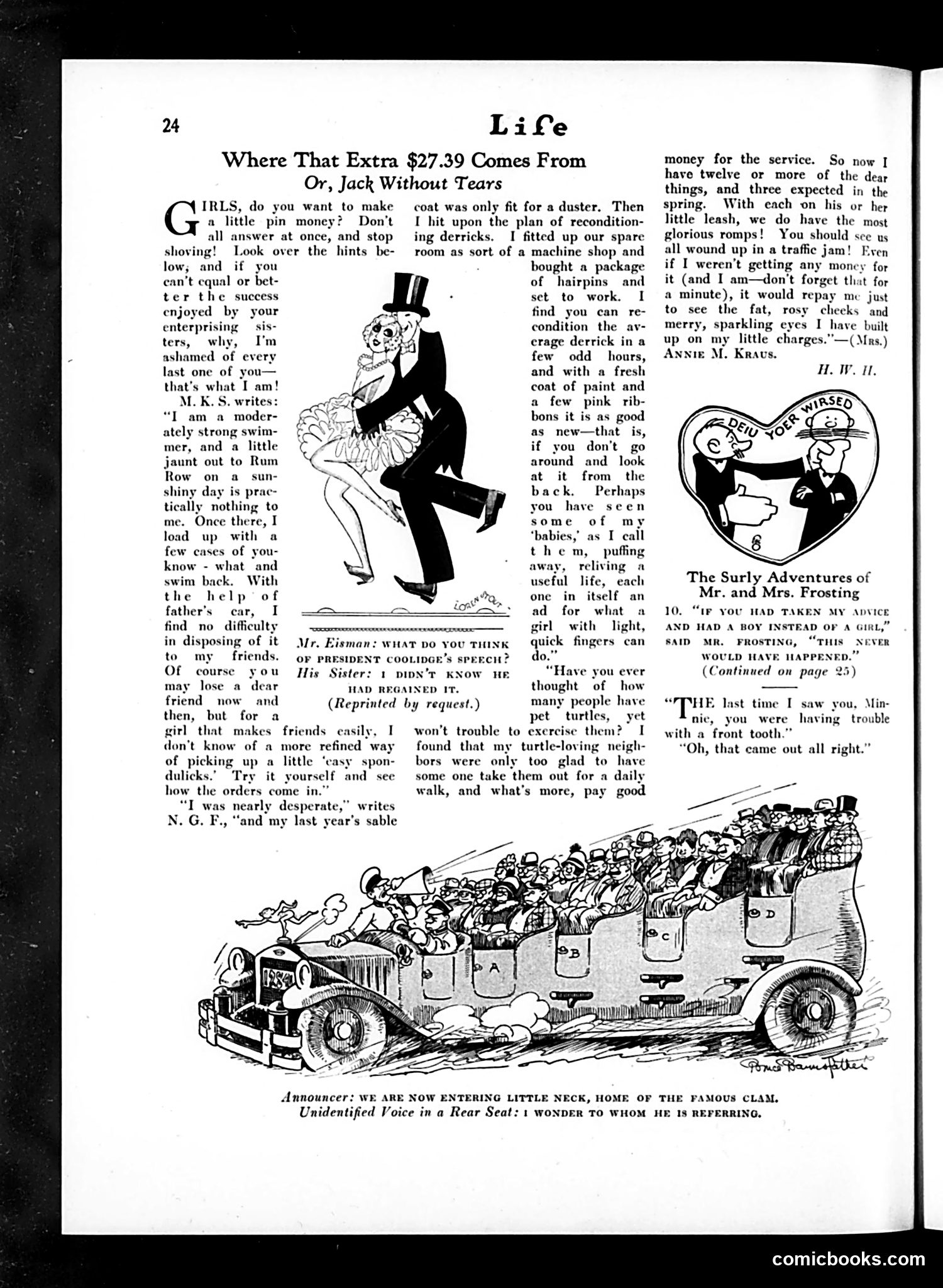
This 1920s *Life* magazine page satirizes Prohibition-era moneymaking schemes. The main article describes creative (often illegal) ways women earned extra income during alcohol prohibition: - One writer admits to bootlegging alcohol from "Rum Row" (offshore smuggling operations) via swimming and her father's car - Another reconditions used oil derricks and resells them - A third walks neighbors' pet turtles for pay The large cartoon depicts a crowded vehicle labeled with letters (A-D), likely representing bootleggers smuggling contraband into "Little Neck" (a real location, humorously called "home of the famous clam"—a winking reference to hidden illegal goods). The smaller comic strip "Mr. and Mrs. Frosting" jokes about gender stereotypes unrelated to the main theme. The page mocks how ordinary people, especially women, ingeniously exploited Prohibition's economic opportunities and legal loopholes. The tone is conspiratorial humor—acknowledging criminality while treating it as clever entrepreneurship.
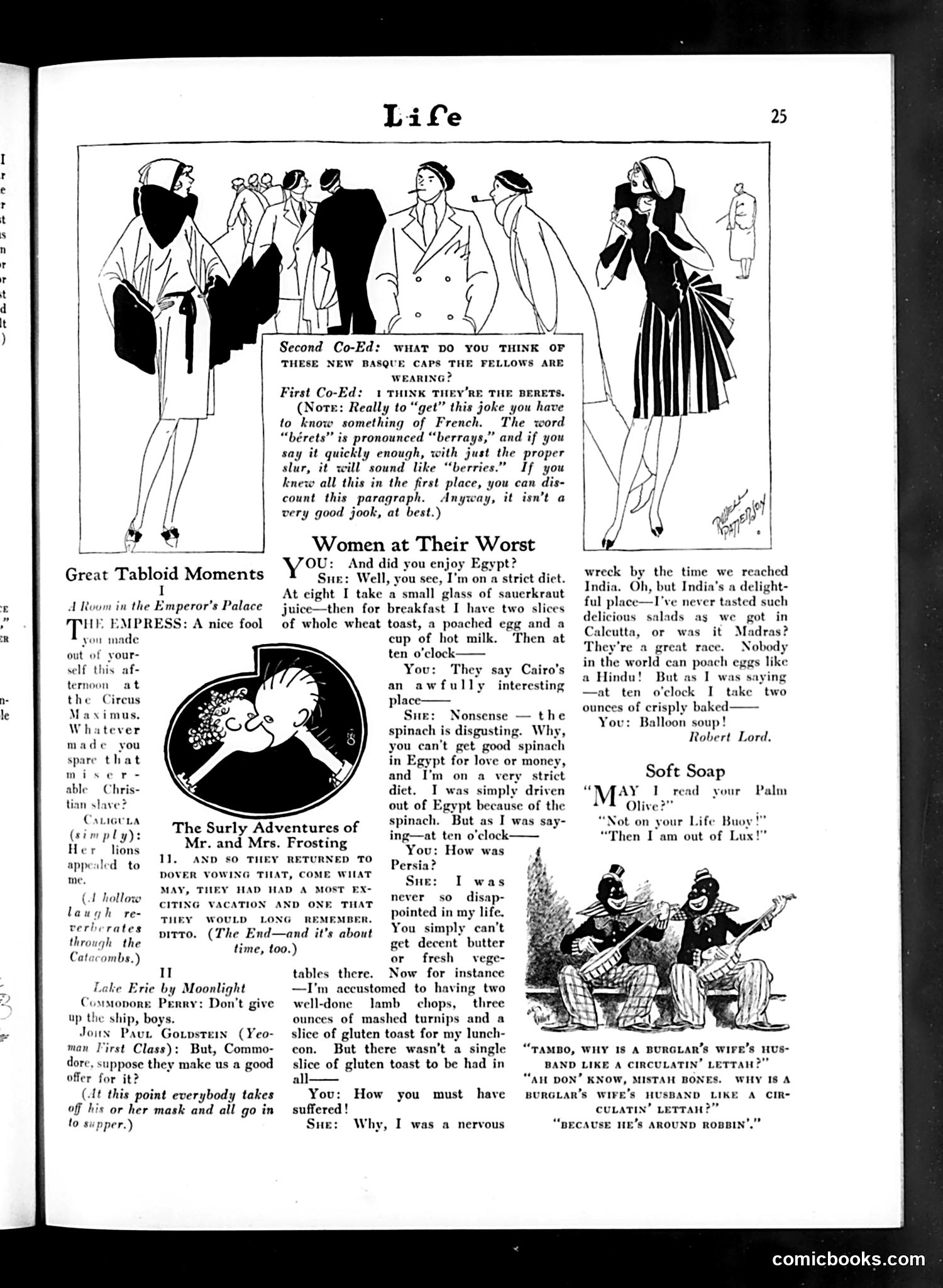
This page contains several humorous sketches mocking 1920s social pretensions and romantic narratives. **"Women at Their Worst"** ridicules wealthy women travelers obsessed with their strict diets. A woman describes trips to Egypt, Persia, and India but fixates entirely on food availability—sauerkraut juice, gluten toast, spinach—completely missing each destination's cultural significance. The satire targets self-absorbed tourists indifferent to the world beyond their own dietary routines. **"The Surly Adventures of Mr. and Mrs. Frosting"** parodies melodramatic vacation narratives, ending anticlimactically when the couple simply removes their masks and goes to dinner. **The co-ed joke** plays on pronunciation: "bérets" (French caps) sounds like "berries" when pronounced quickly—a weak pun the author himself admits "isn't a very good joke, at best." **"Soft Soap"** presents minstrel-style humor (Tambo and Bones characters) with a burglar pun: a burglar's wife's husband is like "a circulatin' letter" because "he's around robbin'"—typical of early 20th-century variety comedy. The overall tone mocks pretension, superficiality, and sentimental storytelling conventions.
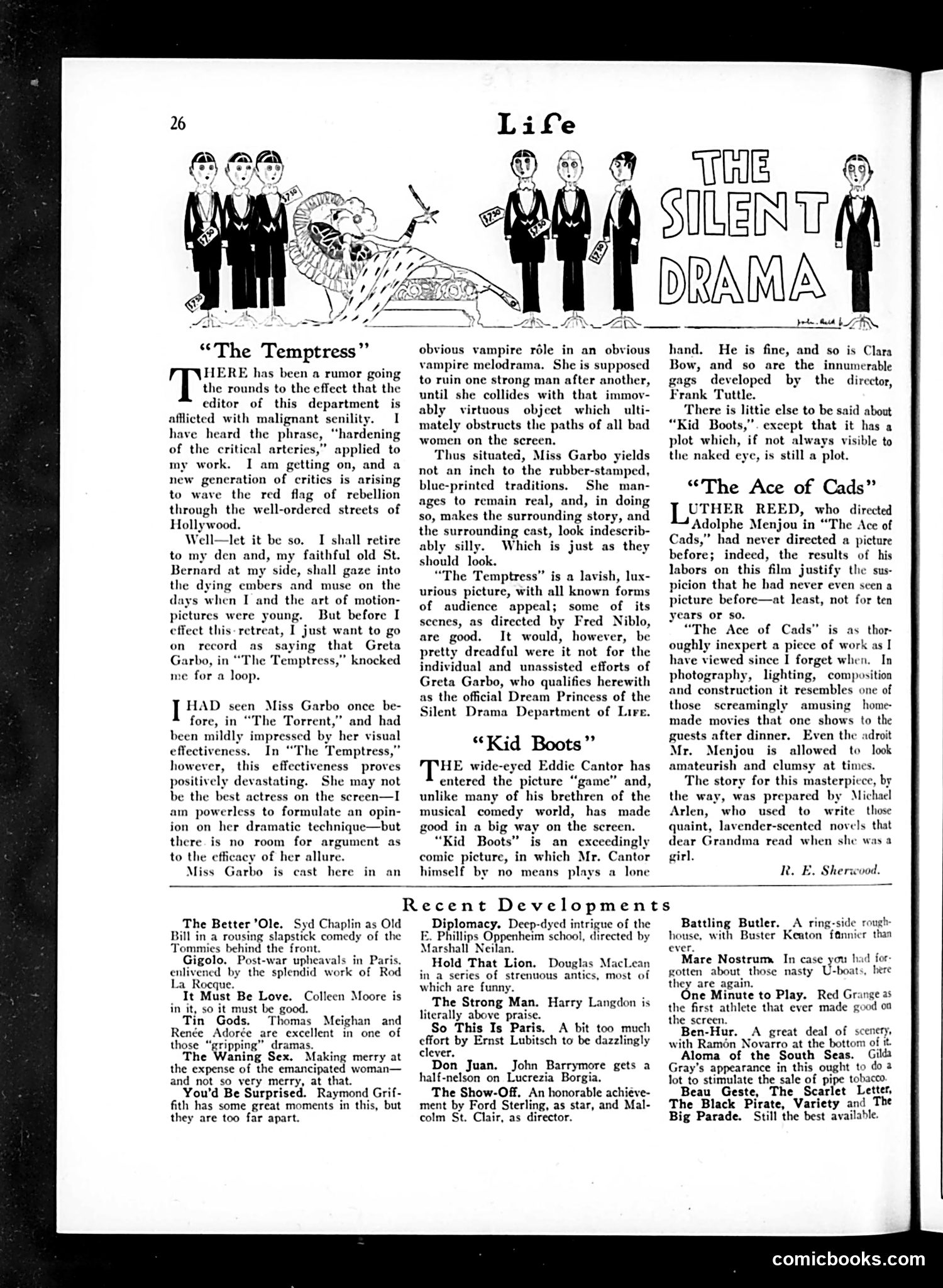
This page contains three film reviews from the silent era (likely mid-1920s). The header cartoon depicts three identical men in suits confronting a reclining lion—likely satirizing formulaic Hollywood narratives where virtuous heroes triumph over dangerous "villains." **"The Temptress"** reviews Greta Garbo's vampire role. The critic praises her magnetic presence, claiming she elevates an otherwise dull melodrama through sheer charisma alone, despite being cast in a stock "seductress" character. **"Kid Boots"** celebrates Eddie Cantor's successful transition from stage to screen, with supporting praise for Clara Bow and director Frank Tuttle. **"The Ace of Cads"** harshly critiques director Luther Reed's directorial debut as incompetent—comparing it to amateur home movies. Even lead actor Adolphe Menjou cannot salvage the poorly composed, lit, and constructed picture, though the source story came from novelist Michael Arlen. The reviews mock Hollywood's rigid formulas while acknowledging star power's ability to transcend material.
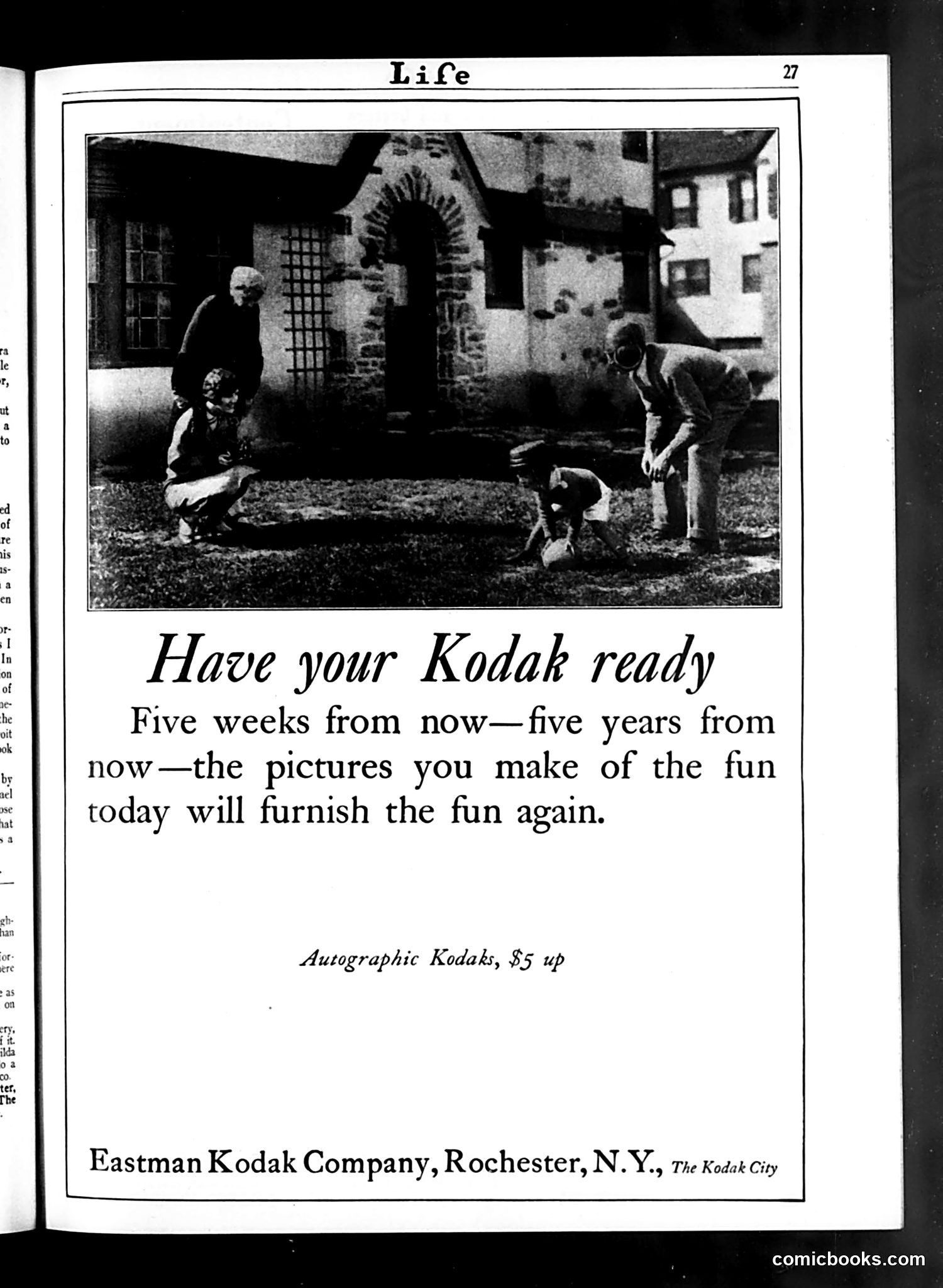
This is an advertisement, not political satire. The page shows a family photograph scene with adults and children playing outdoors near a stone building. The ad's message appeals to nostalgia and the permanence of photography: pictures taken today will provide entertainment and memories for years to come. The advertisement promotes "Autographic Kodaks" (cameras allowing users to write notes directly on film negatives) starting at $5. The pitch targets family leisure and memory-making—core themes of early 20th-century consumer culture. There's no satirical content here; rather, it's a straightforward marketing appeal to encourage camera purchases by emphasizing photography's emotional and social value as a means of preserving and reliving happy moments.
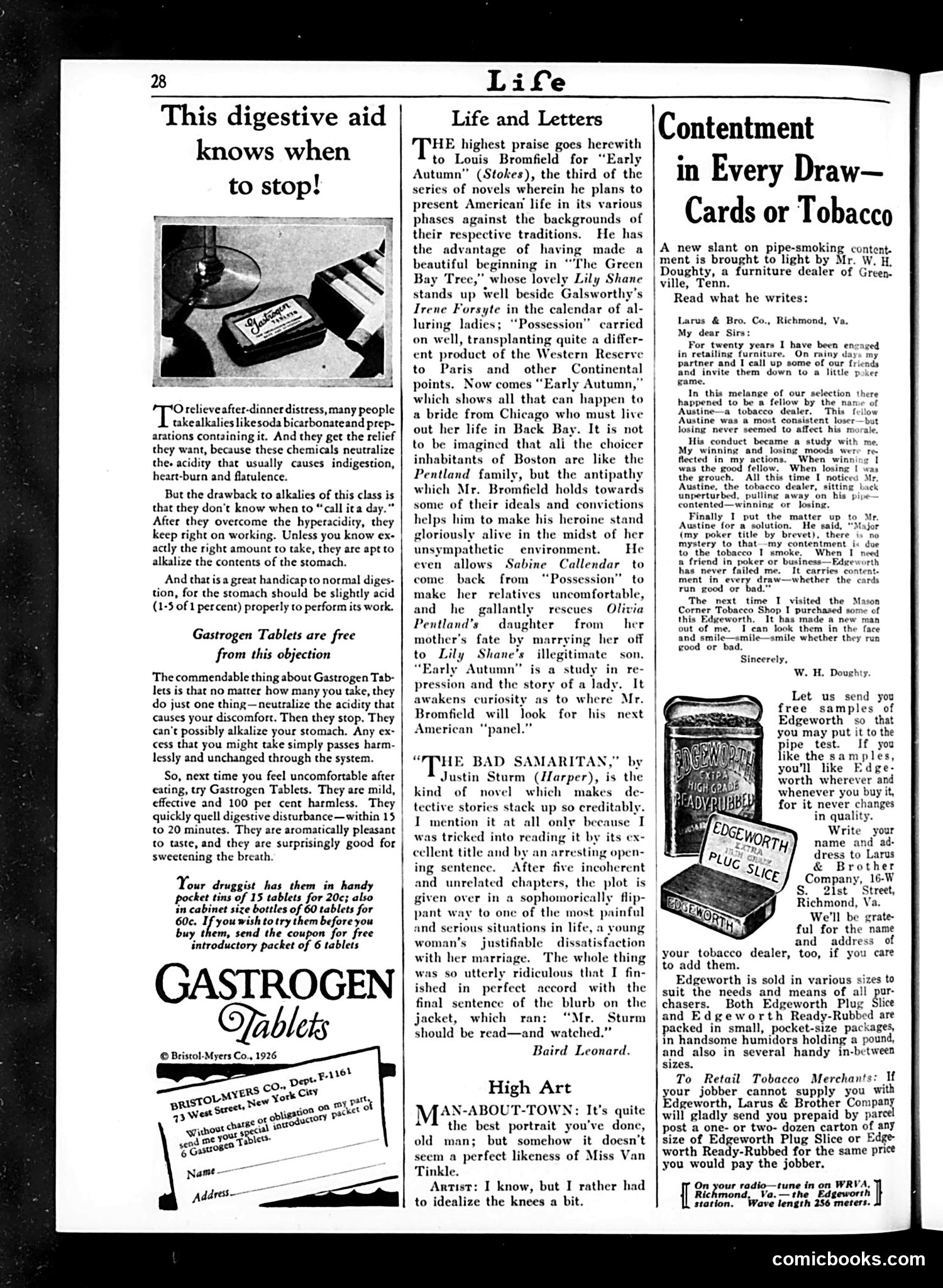
This page combines pharmaceutical advertising with literary criticism, typical of 1920s Life magazine content. **The Gastrogen Tablets Advertisement** (left side) uses pseudo-scientific reasoning to promote antacid tablets. It argues that while competing alkaline products (like baking soda) neutralize stomach acid, they can't "stop" working and risk over-alkalizing the stomach. Gastrogen supposedly solves this problem. The ad emphasizes safety through precise dosing—a marketing strategy appealing to consumers worried about medication risks. The coupon offer was standard direct-response advertising. **The Literary Section** (right side) reviews recent novels by Louis Bromfield and Justin Sturm. The critic praises Bromfield's "Early Autumn" as part of a series examining American life, comparing his character "Lily Shane" favorably to Galsworthy's literary creations. However, he dismisses Sturm's "The Bad Samaritan" as poorly constructed, criticizing its plot developments as ridiculous and trivial. The page reflects 1920s concerns: digestive health anxieties and modernist American literature exploring social conventions and repression.
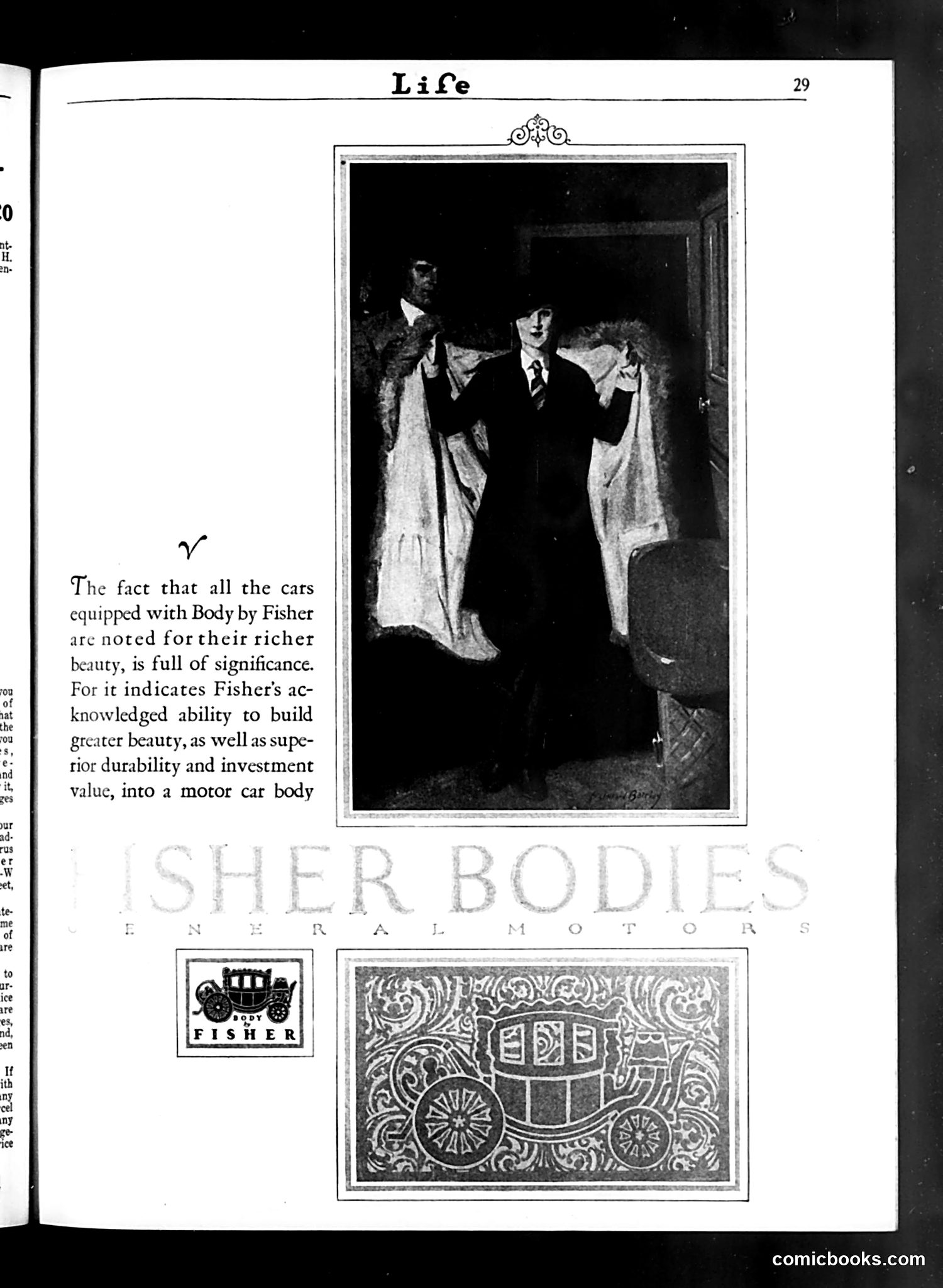
This page is primarily **advertising** for Fisher Body Company, not political satire. The image shows two men in formal attire examining what appear to be fur coats or fabric samples in a car interior, emphasizing luxury and quality craftsmanship. The text argues that Fisher Body's reputation for beauty in automobile bodies demonstrates their superior engineering and durability. The advertisement uses the analogy of fine materials (the furs/fabrics shown) to suggest that Fisher applies similar attention to quality and aesthetic refinement to motorcar construction. The Fisher Body logo and ornate carriage illustration below reinforce the brand's association with luxury vehicle manufacturing. This is a straightforward early 20th-century luxury goods advertisement, not satirical commentary.
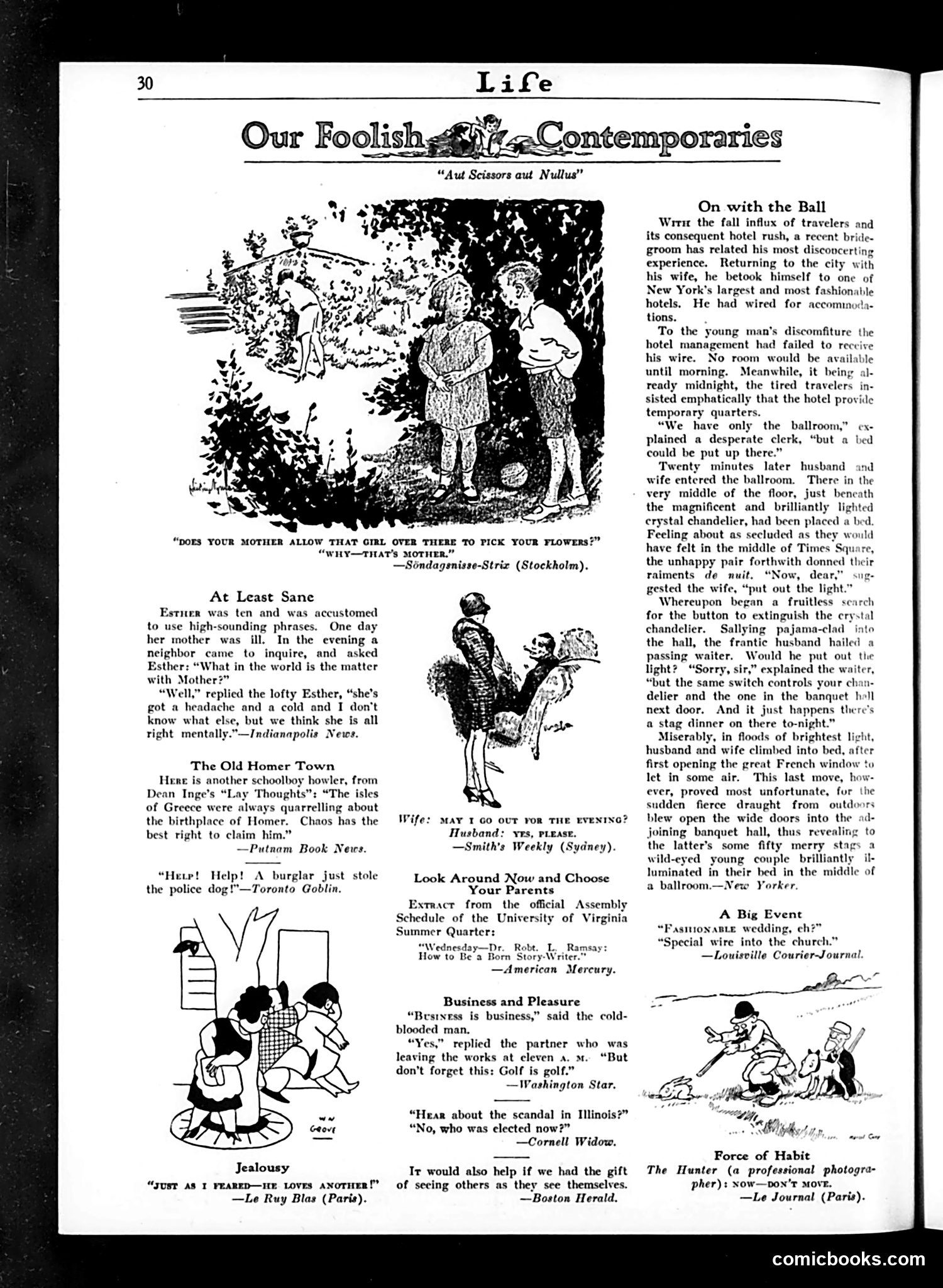
This page from *Life* magazine collects brief humorous anecdotes and jokes from newspapers and publications worldwide, satirizing human folly and social absurdities. **Key sections:** - **"At Least Sane"**: A child's malapropism—calling her ill mother "all right mentally" despite physical ailments—mocks pretentious vocabulary misuse. - **"On with the Ball"**: The longest piece ridicules hotel incompetence and newlywed embarrassment. A couple forced to sleep in a ballroom during a banquet cannot extinguish the chandelier (controlled by the adjacent banquet hall's switch), then accidentally expose themselves to fifty dinner guests when opening windows for air. This satirizes modern hotel service failures and the couple's predicament. - **Shorter jokes** mock linguistic confusion ("Homer Town"), jealousy, and contemporary absurdities like Illinois political scandals and golf culture. The cartoons feature simple line drawings illustrating domestic or social mishaps. Overall, the page represents *Life*'s satirical format: exposing modern life's everyday foolishness through compilation of real newspaper anecdotes.
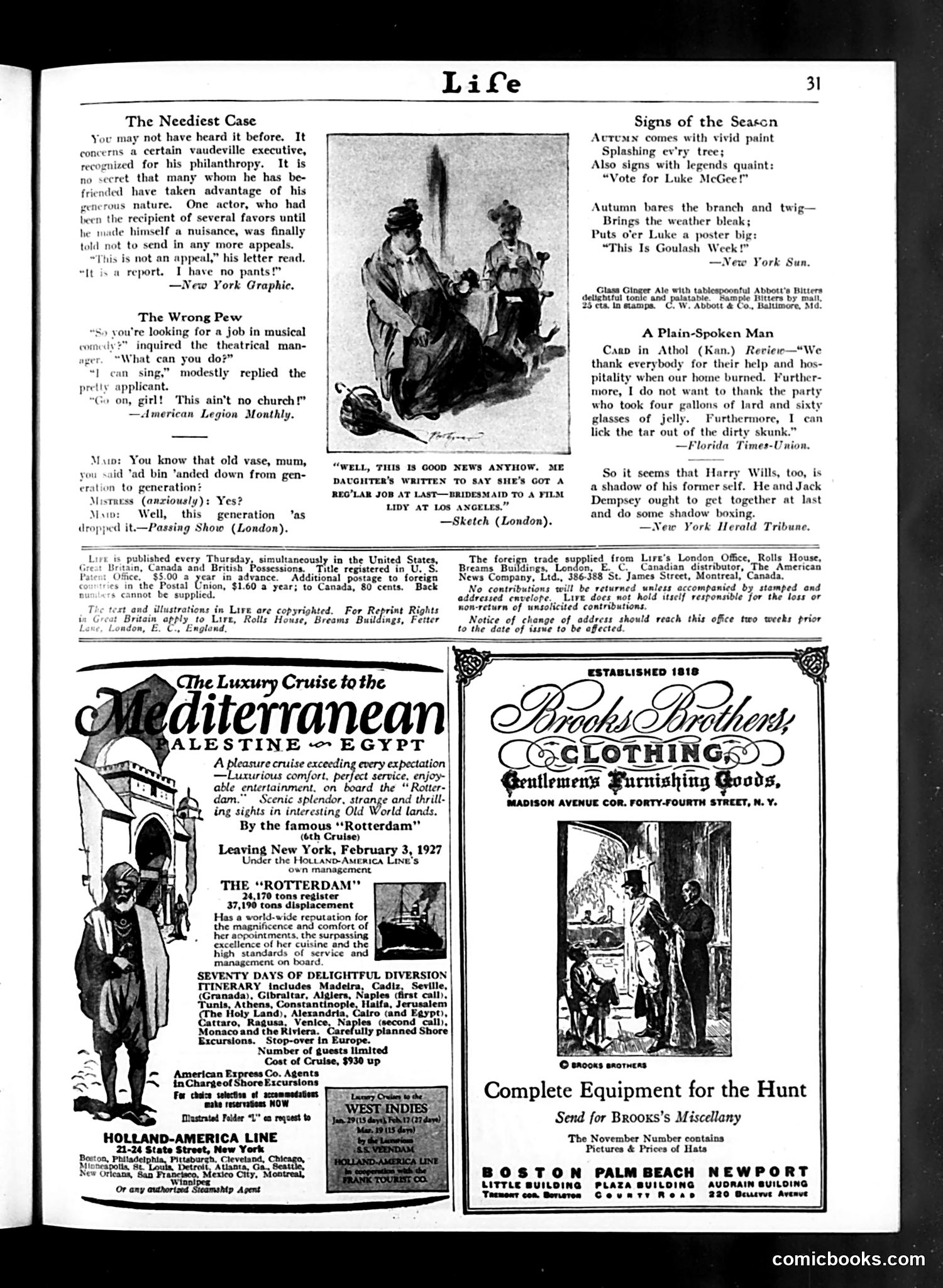
This page contains primarily **short humor pieces and advertisements** rather than political cartoons. The jokes satirize everyday social situations: **"The Neediest Case"** mocks a philanthropist exploited by those he helps—an actor claiming poverty to manipulate further charity. **"The Wrong Pew"** is a workplace gag: a job applicant says she can sing; the theatrical manager dismissively replies "This ain't no church!"—implying singing ability alone won't get you hired in theater. **Other brief jokes** target class pretension (a servant claiming a family heirloom vase was "handed down"), unemployment during economic uncertainty, and political campaign signs. **Boxing reference**: The Harry Wills/Jack Dempsey mention refers to heavyweight boxers whose delayed fight disappointed fans—the "shadow boxing" pun suggests both fighters are past their prime. The page is mostly **advertisements** (cruise lines, Brooks Brothers clothing), which dominated Life's revenue model. The humor reflects 1920s preoccupations: economic anxiety, employment struggles, and entertainment industry gossip.
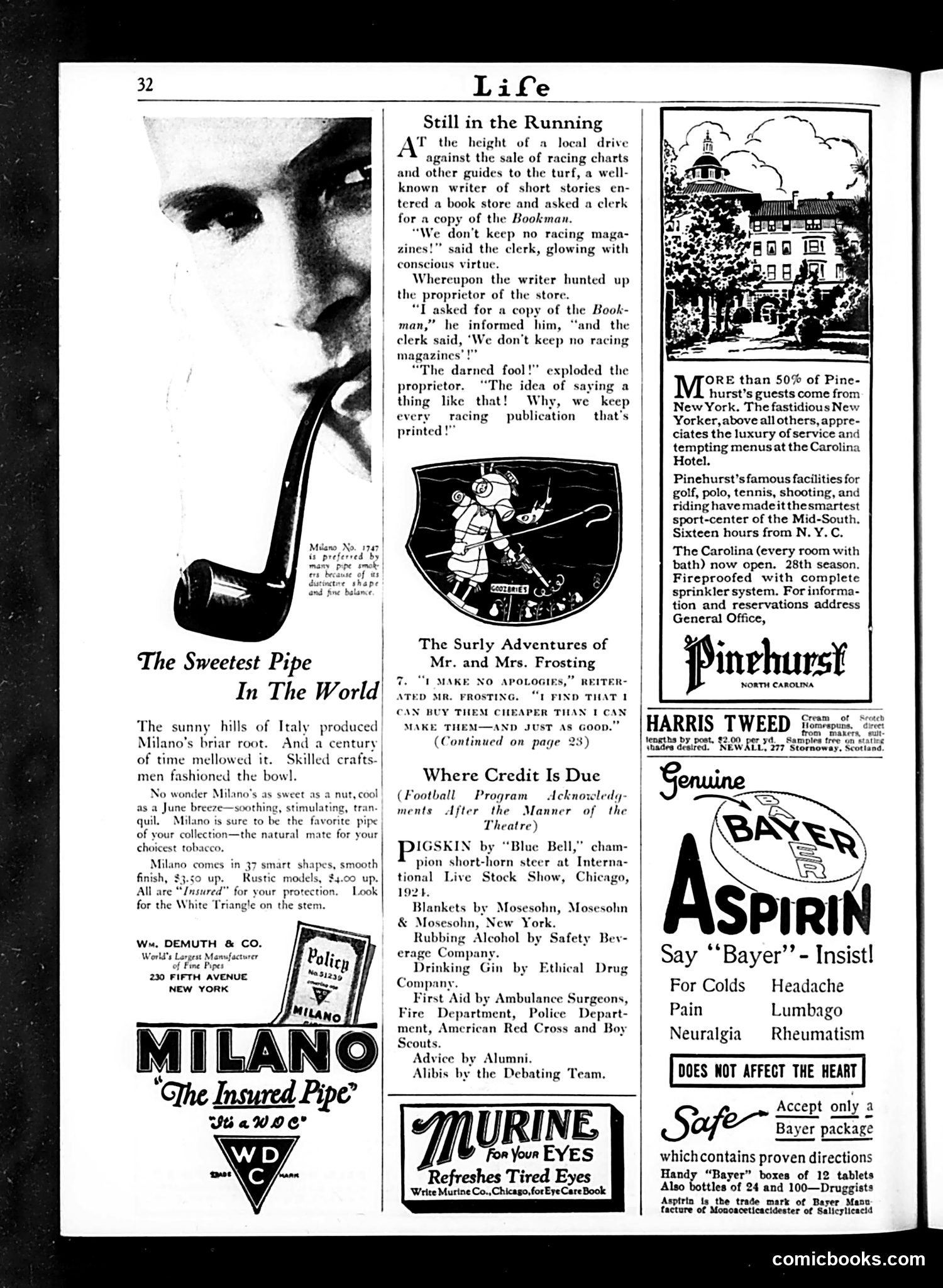
This short comic piece satirizes moral inconsistency during Prohibition-era anti-gambling efforts. A bookstore clerk self-righteously refuses to sell racing charts and betting guides, claiming virtue by saying "We don't keep no racing magazines." When confronted, the proprietor explodes in outrage—not because the clerk was wrong, but because he *lied*. The owner actually stocks "every racing publication that's printed." The joke mocks the gap between public morality and private practice: the clerk virtue-signals about refusing gambling materials while his employer openly profits from selling them. It's a commentary on how businesses and individuals publicly supported progressive reforms like anti-gambling campaigns while privately ignoring them. The humor depends on exposing the hypocrisy beneath a thin moral facade.
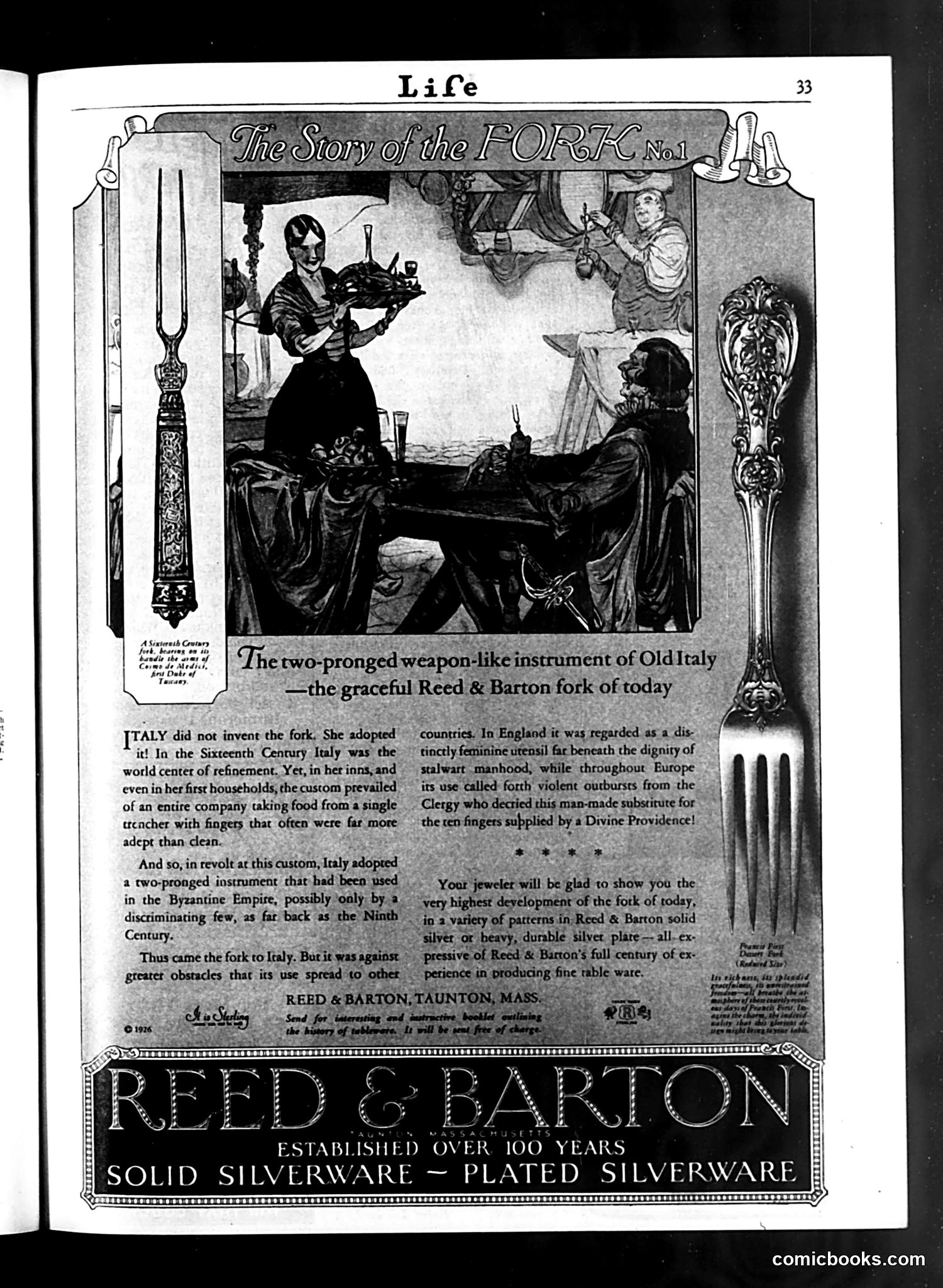
This is primarily a **silverware advertisement** disguised as educational content, not political satire. The piece humorously traces fork history: Italy allegedly "adopted" the fork (rather than inventing it) from Byzantine tradition. The joke centers on social pretension—the fork was initially considered *unmanly* and "distinctly feminine" in Europe, with clergy denouncing it as blasphemous (God provided fingers). Italy embraced it to escape the "uncivilized" practice of communal eating with unwashed hands from shared trenchers. The central illustration shows diners using forks while servants work above—contrasting refined dining with manual labor. **The satire's point**: by adopting the fork, Italy (and later Europe) achieved "refinement." The ad implies that using Reed & Barton's forks similarly elevates one's social standing and cleanliness—a common early 20th-century advertising strategy linking consumer goods to civilization and respectability. This is commercial messaging dressed in mock-historical narrative.
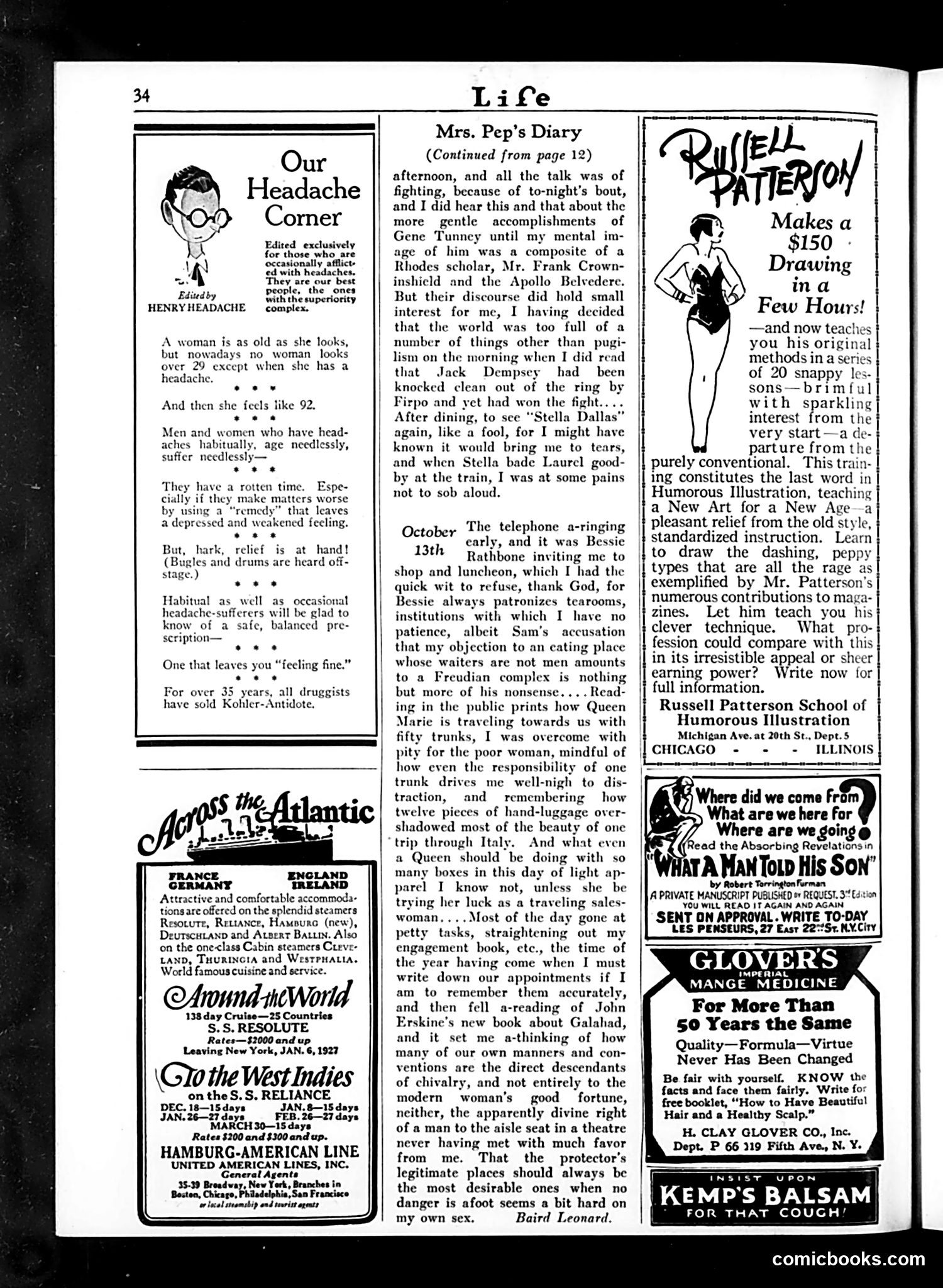
This page contains a satirical advice column and serialized diary entry typical of *Life* magazine's humor. **"Our Headache Corner"** is a mock medical advice section edited by "Henry Headache." It satirizes both habitual complainers (those with "superiority complexes") and patent medicine advertising. The jokes suggest headache sufferers are needlessly aging themselves, then pivot to promote "Kohler-Antidote"—a real over-the-counter remedy—with mock-heroic language ("relief is at hand!"). The satire targets two targets: the self-pitying headache prone and the snake-oil advertising industry itself. **Mrs. Pep's Diary** continues a serialized domestic narrative. The diarist discusses Gene Tunney (a famous boxer of the 1920s), attends "Stella Dallas" (a popular weepy film), and reflects on Queen Marie's fifty trunks while organizing her own appointment book. The humor lies in the diarist's pretentious literary references (Rhodes scholars, Apollo Belvedere, John Erskine) applied to mundane domestic complaints—satire of educated women's aspirations meeting ordinary bourgeois reality.
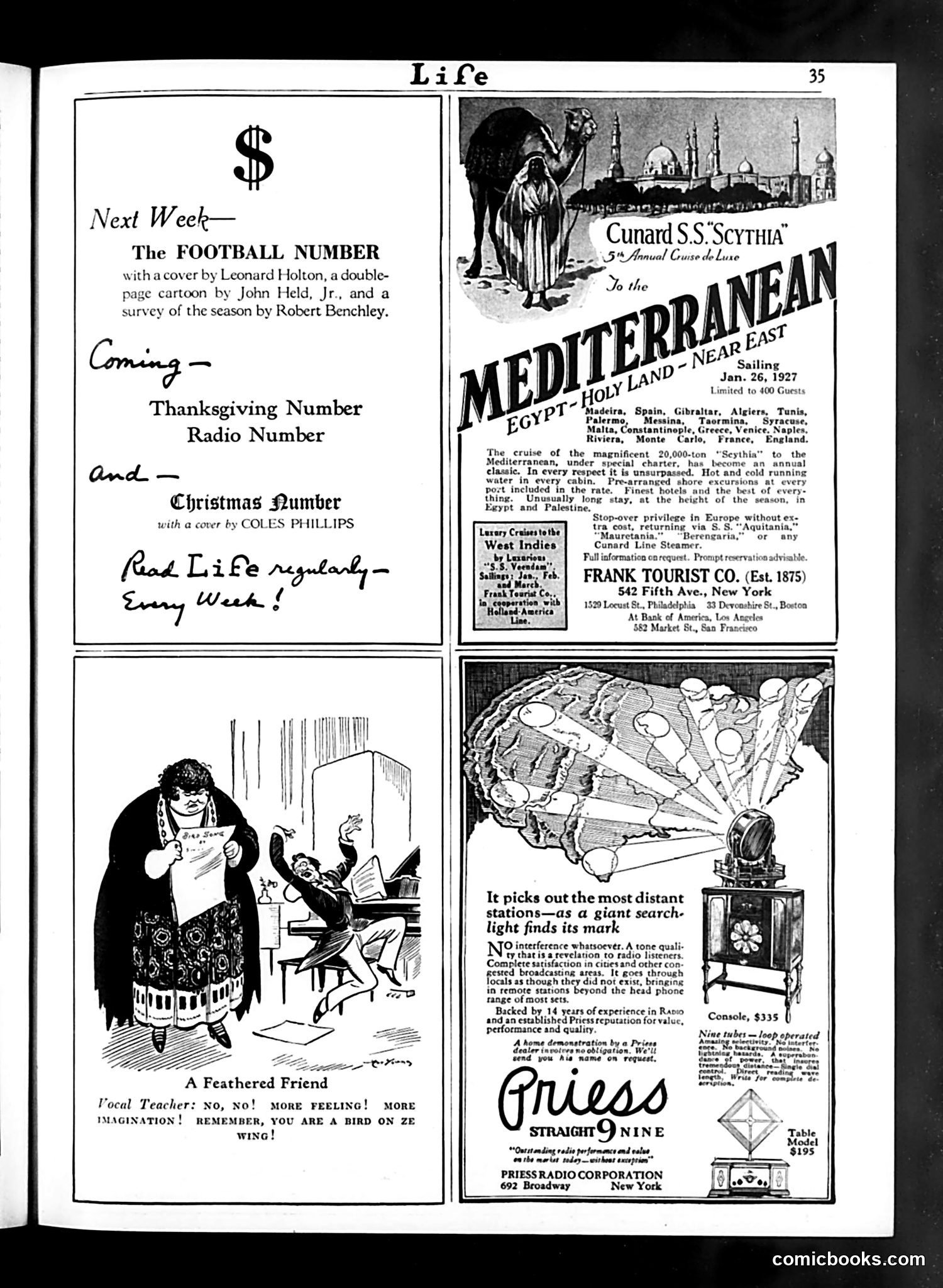
This cartoon satirizes overly earnest vocal instruction. A dramatic singing teacher (depicted with exaggerated continental mannerisms—"ZE wing") lectures a female student about emotional performance, insisting she imagine herself as a bird to achieve proper feeling and imagination. The joke targets pretentious music pedagogy of the 1920s: the absurdity of literal metaphorical instruction ("you ARE a bird") for developing artistic expression. The teacher's theatrical intensity and affected accent amplify the satire—suggesting such instructors prioritize dramatic posturing over practical technique. The cartoon reflects period attitudes about both artistic training and the slightly ridiculous European affectations associated with classical music instruction in America. The page also contains advertisements for a Mediterranean cruise and radio equipment—typical Life magazine content from 1927—and previews upcoming issues (Football, Thanksgiving, Radio, and Christmas numbers).
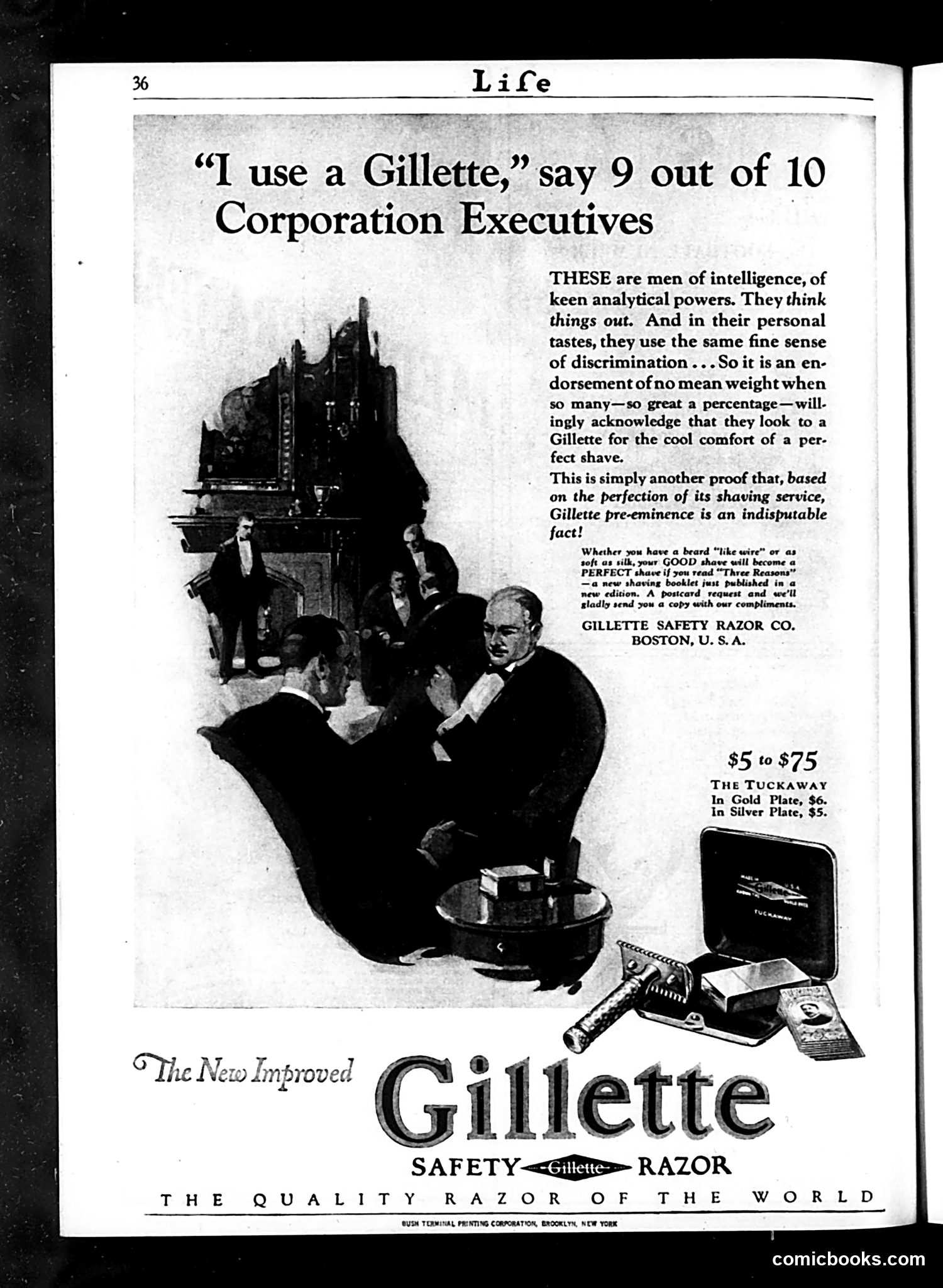
This is a **Gillette Safety Razor advertisement**, not satirical content. It appears in *Life* magazine's advertising section (page 36). The ad uses **appeals to authority and status**: it claims "9 out of 10 corporation executives" use Gillette razors, positioning the product as endorsed by intelligent, discriminating men of power. The illustration shows well-dressed businessmen in an office setting, reinforcing association with success and respectability. The advertising strategy exploits early 20th-century class consciousness—suggesting that wealthy executives' "fine sense of discrimination" extends to their grooming choices, and that ordinary men should emulate their preferences. The copy emphasizes the razor's technical superiority ("perfection of its shaving service") while the price range ($5-$75) targets affluent consumers. This represents typical **vintage advertising rhetoric**: testimonial-based persuasion combined with aspirational messaging.
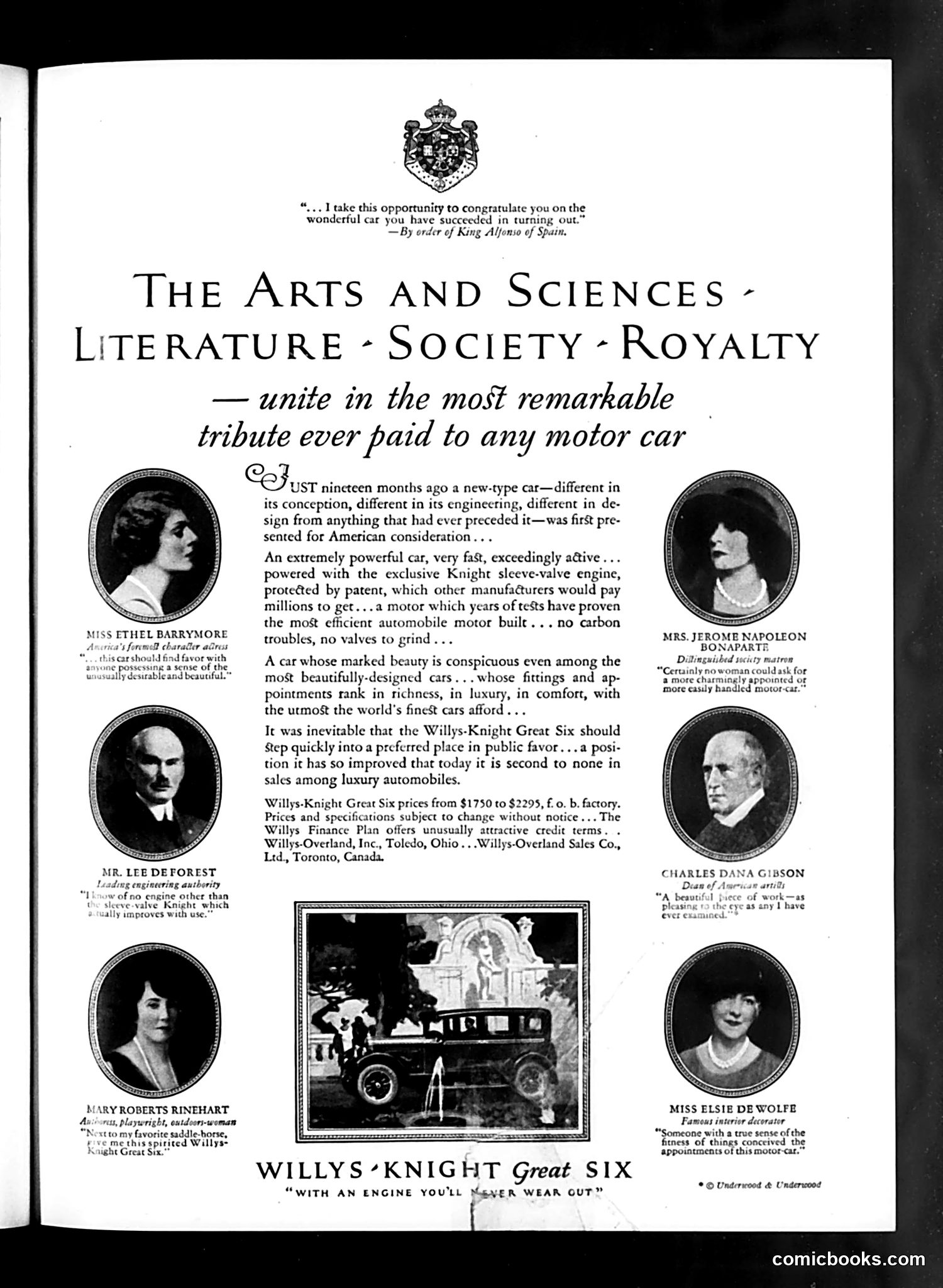
This is a **full-page advertisement**, not a satirical cartoon. It promotes the Willys-Knight Great Six automobile by featuring endorsements from prominent American cultural figures of the era: actress Ethel Barrymore, engineer Lee DeForest, author Mary Roberts Rinehart, and others. The advertisement's appeal rests on **celebrity endorsement and social prestige**. It opens with a quote attributed to King Alfonso of Spain, lending royal approval. Each featured figure represents arts, sciences, and high society—suggesting the car appeals to refined, accomplished people, not merely wealthy ones. The technical claims (Knight sleeve-valve engine, no carbon troubles, superior efficiency) are secondary to the **social positioning**: owning this car signals cultivation and taste. For modern readers, this exemplifies early 20th-century advertising strategy: associate products with aspirational figures to sell luxury goods to an upwardly mobile audience.
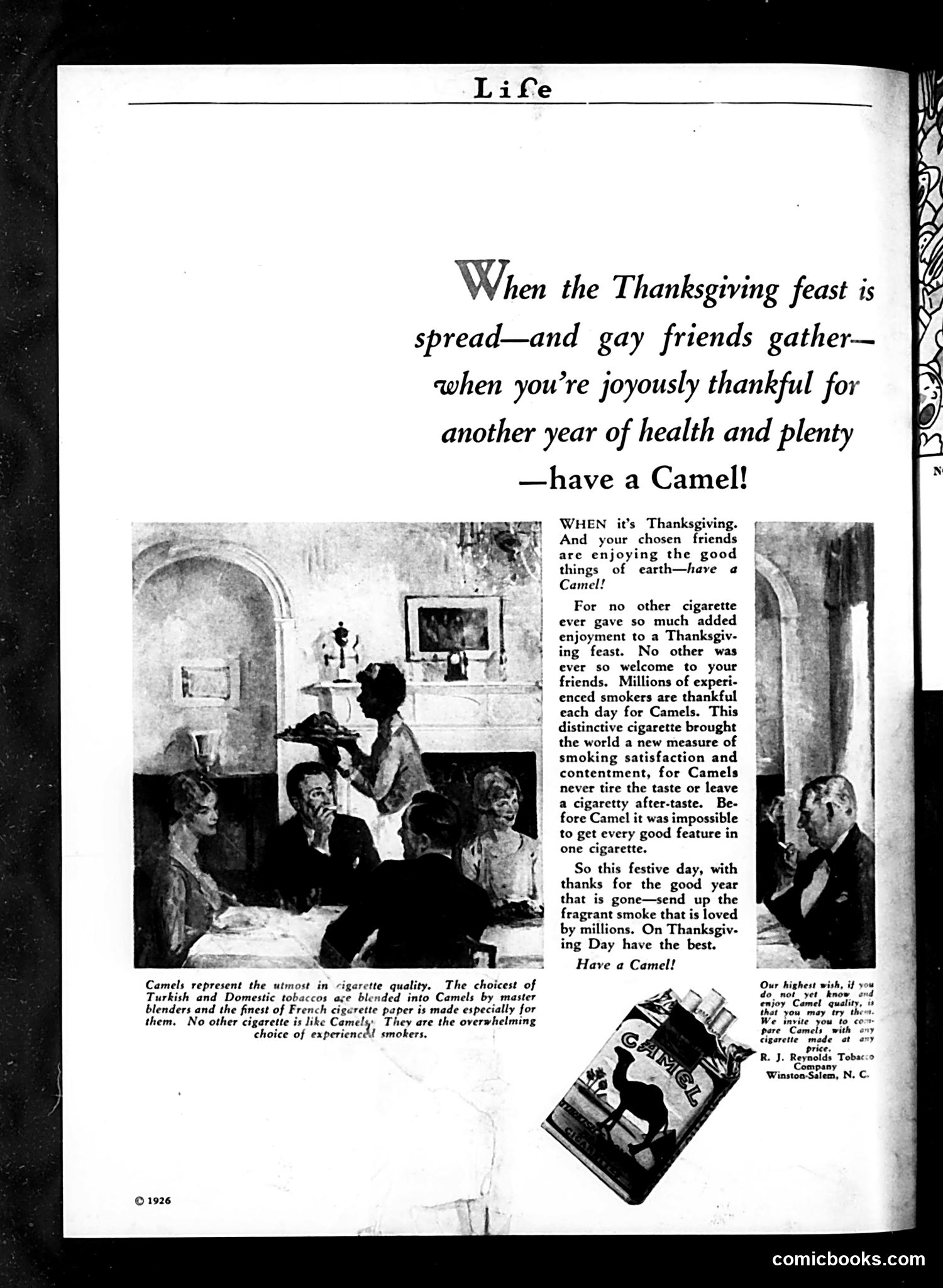
This is a **Camel cigarette advertisement**, not satire—it's a straightforward 1926 product endorsement disguised as lifestyle advice. The image shows a middle-class Thanksgiving dinner scene with people gathered around a table. The ad's pitch: smoking Camels enhances holiday enjoyment and is the sophisticated choice for gatherings with "chosen friends." **For modern readers, the jarring element is the casual promotion of cigarettes as an integral part of festive socializing.** The text claims Camels never leave an "after-taste" and represent "utmost in cigarette quality"—marketing language that now seems absurd given known health dangers. The ad reflects 1920s advertising norms: cigarettes were marketed as markers of refinement and social belonging, with testimonials about "millions of experienced smokers" (a manipulation technique still used today). There's no health disclaimer whatsoever—regulations didn't require them until decades later. This represents pre-regulation consumer advertising at its most brazen.