
Life, 1926-11-04 · page 35 of 40
Life — November 4, 1926 — page 35: what you’re looking at
What you’re looking at
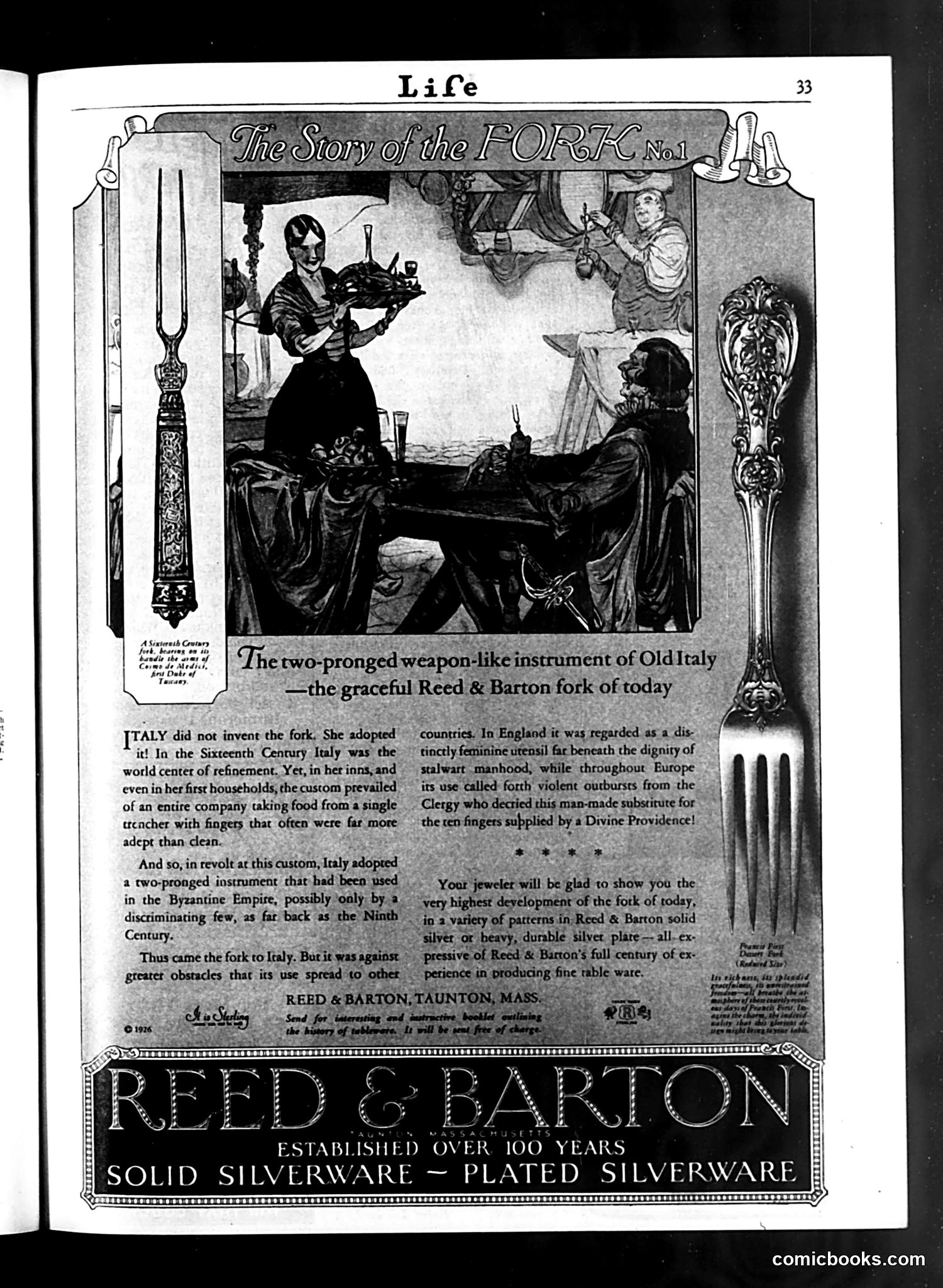
This is primarily a **silverware advertisement** disguised as educational content, not political satire. The piece humorously traces fork history: Italy allegedly "adopted" the fork (rather than inventing it) from Byzantine tradition. The joke centers on social pretension—the fork was initially considered *unmanly* and "distinctly feminine" in Europe, with clergy denouncing it as blasphemous (God provided fingers). Italy embraced it to escape the "uncivilized" practice of communal eating with unwashed hands from shared trenchers. The central illustration shows diners using forks while servants work above—contrasting refined dining with manual labor. **The satire's point**: by adopting the fork, Italy (and later Europe) achieved "refinement." The ad implies that using Reed & Barton's forks similarly elevates one's social standing and cleanliness—a common early 20th-century advertising strategy linking consumer goods to civilization and respectability. This is commercial messaging dressed in mock-historical narrative.
📄 Transcribed text from this page (OCR, searchable)
Machine-transcribed from the original scan — historical spelling and the odd misread are preserved.
ALY did not invent the fork. She adopted : it! In the Sixteenth Century Italy was) the world center of refinement. Yet, in her inns,and_ + even in her first households, the custom prevailed, of an entire company taking food from a single ¢ trenacher with fingers that often were be “more adept than clean. And so, in revolt ar ‘this custom, a two-pronged instrument that had in the Byzantine Empire, po: was regarded asa dis- beneath the dignity of JO YEARS ATE D SI LVERWARE Tusescoesessesrens comicbooks.com