
Life, 1926-11-04 · page 18 of 40
Life — November 4, 1926 — page 18: what you’re looking at
What you’re looking at
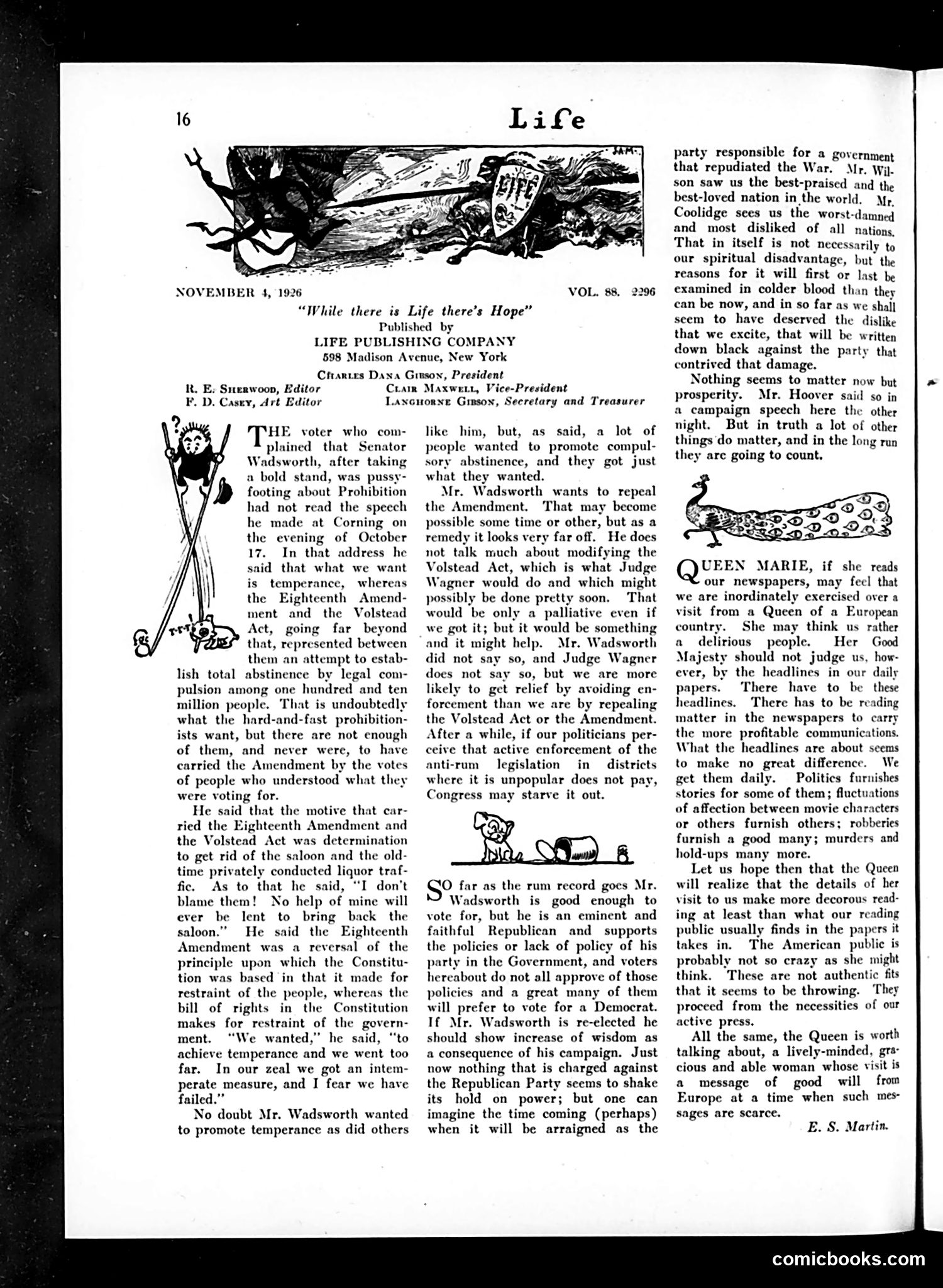
This *Life* magazine page from November 4, 1926, contains political commentary (not a cartoon) critiquing Senator Wadsworth's stance on Prohibition. The article discusses Wadsworth's opposition to the Eighteenth Amendment and the Volstead Act, describing him as wanting to "promote temperance" while avoiding enforcement of Prohibition laws. The piece satirizes the tension within Republican politics: Wadsworth represents those wanting repeal or non-enforcement, yet the GOP must appear to support Prohibition publicly. The author questions whether Wadsworth's approach—avoiding enforcement rather than openly repealing the law—represents genuine principle or political compromise. The secondary item discusses Queen Marie of Romania's visit to America, treated as celebrity gossip rather than serious news coverage.
📄 Transcribed text from this page (OCR, searchable)
Machine-transcribed from the original scan — historical spelling and the odd misread are preserved.
NOVEMBER 4, 1926 “While there is Life there’s Hope” Published by LIFE PUBLISHING COMPANY 698 Madison Avenue, New York Ctrantes Dana Ginson, President R. E, Sueawoon, Editor F. D. Casey, Art Editor HE voter who com- plained that Senator Wadsworth, after taking a bold stand, was pussy footing about Prohibi had not read the speech he made at Corning on the evening of October 17. In that address he said that what we want is temperance, whe the Eighteenth Amend- ment and the Volstead Act, going far beyond that, represented between them an attempt to estab- lish total abstinence by legal com- pulsion among one hundred and ten million people. That is undoubtedly what the hard-and-fast prohibition- ists want, but there are not enough of them, and never were, to have carried the Amendment by the votes of people who understood what they were voting for. He said that the motive that car- ried the Eighteenth Amendment and the Volstead Act was determination to get rid of the saloon and the old- time privately conducted liquor traf- fic. As to that he said, “I don’t blame them! No help of mine will ever be lent to bring back the saloon.” He said the Eighteenth Amendment was a reversal of the principle upon which the Constitu- tion was based in that it made for restraint of the people, whereas the bill of rights in the Constitution makes for restraint of the govern- ment. “We wanted,” he said, “to achieve temperance and we went too far. In our zeal we got an intem- perate measure, and I fear we have failed.” No doubt Mr. Wadsworth wanted to promote temperance as did others Cram Maxwent, Laxcuorxe Grnso: -President Secretary and Treasurer like him, but, as said, a lot of people wanted to promote compul- sory abstinence, and they got just what they wanted. Mr. Wadsworth wants to repeal the Amendment. That may become possible some time or other, but as a remedy it looks very far off. He does not talk much about modifying the Volstead Act, which is what Judge Wagner would do and which might possibly be done pretty soon. That would be only a palliative even if we got it; but it would be something and it might help. Mr. Wadsworth did not say so, and Judge Wagner does not say so, but we are more likely to get relief by avoiding en- forcement than we are by repealing the Volstead Act or the Amendment. After a while, if our politicians per- ceive that active enforcement of the anti-rum legislation in districts where it is unpopular does not pay, Congress may starve it out. ~O far as the rum record gocs Mr. Wadsworth is good enough to vote for, but he is an eminent and faithful Republican and supports the policies or lack of policy of his party in the Government, and voters hereabout do not all approve of those policies and a great many of them will prefer to vote for a Democrat. If Mr. Wadsworth is re-elected he should show increase of wisdom as a consequence of his campaign. Just now nothing that is charged against the Republican Party seems to shake its hold on power; but one can imagine the time coming (perhaps) when it will be arraigned as the party responsible for a government that repudiated the War. Mr. Wij son saw us the best-praised and the best-loved nation in the world. Mr. Coolidge sees us the worst-damned and most disliked of all nations, That in itself is not necessarily to our spiritual disadvantage, but the reasons for it will first or last be examined in colder blood than they can be now, and in so far as we shall seem to have deserved the dislike that we excite, that will be written down black against the party that contrived that damage. , Nothing seems to matter now but prosperity. Mr. Hoover said so in a campaign speech here the other night. But in truth a lot of other things do matter, and in the long run they are going to count. - UEEN MARIE, if she reads our newspapers, may fecl that we are inordinately exercised over a visit from a Queen of a European country. She may think us rather a delirious people. Her Good Majesty should not judge us, how- ever, by the headlines in our daily papers. There have to be these headlines. There has to be reading matter in the newspapers to carry the more profitable communications. What the headlines are about seems to make no great difference. We get them daily. Politics furnishes stories for some of them; fluctuations of affection between movie characters or others furnish others; robberies furnish a good many; murders and hold-ups many more. Let us hope then that the Queen will realize that the details of her visit to us make more decorous read- ing at least than what our reading public usually finds in the papers it takes in. The American public is probably not so crazy as she might think. These are not authentic fits that it seems to be throwing. They proceed from the necessities of our active press. All the same, the Queen is worth talking about, a lively-minded, gra- cious and able woman whose visit is a message of good will from Europe at a time when such mes- sages are scarce. E. S. Martin. comicbooks.com