
Life, 1926-11-04 · page 23 of 40
Life — November 4, 1926 — page 23: what you’re looking at
What you’re looking at
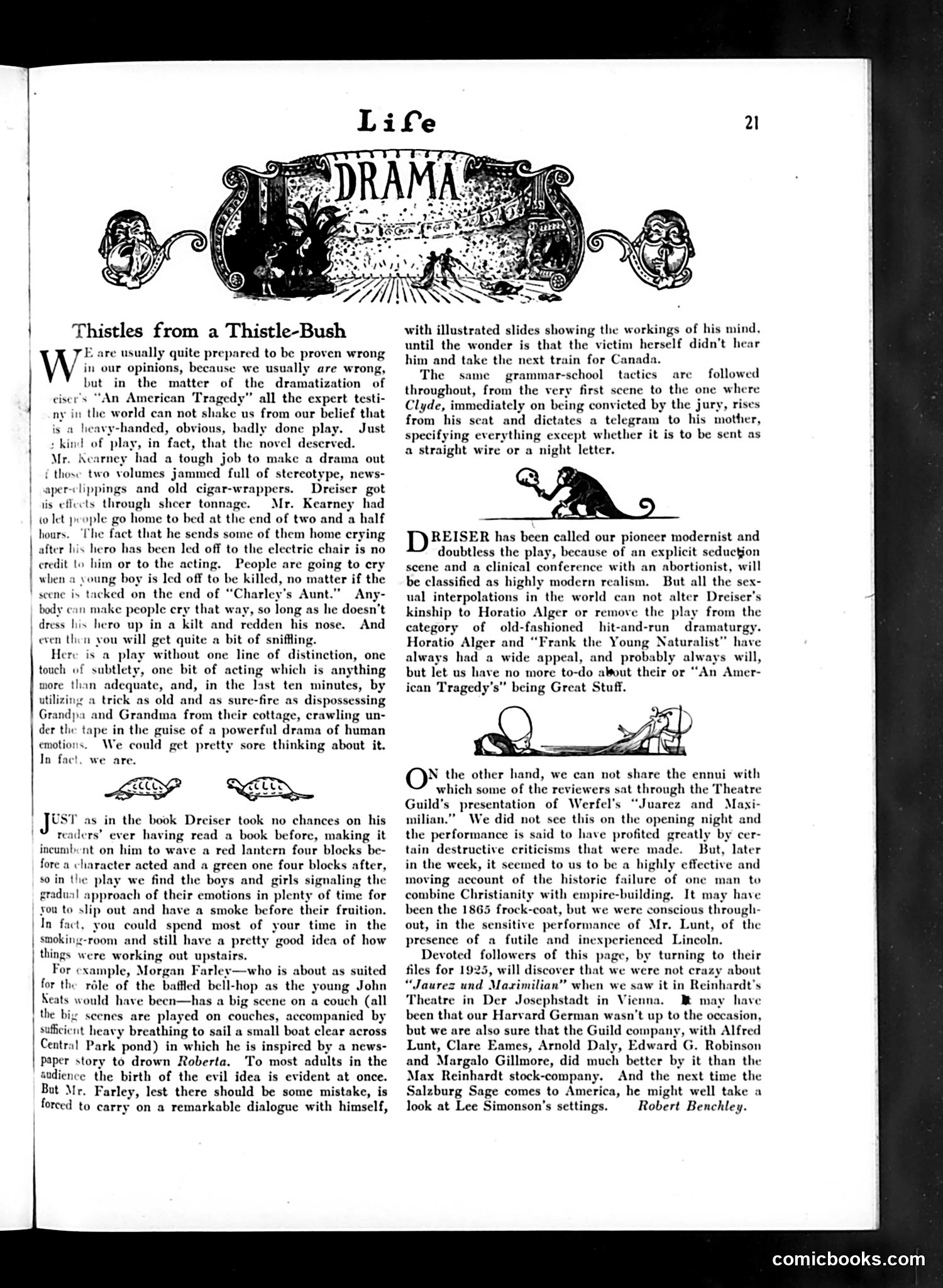
This page critiques the stage adaptation of Theodore Dreiser's novel *An American Tragedy*, panned as heavy-handed and obvious. The reviewer argues the play relies on crude theatrical mechanics—literally showing a character's murderous thoughts via "illustrated slides showing the workings of his mind"—rather than subtle acting or dialogue. The satire targets the adaptation's over-explanation of emotion and motivation. Actor Morgan Farley is mocked for performing an awkward internal monologue to convey his character's evil impulse to drown a woman, when adults in the audience would already understand. The reviewer suggests Dreiser himself made no artistic chances in the source material, and the playwright (Kearney) followed suit, reducing complex human psychology to obvious, melodramatic signposting—comparable to old-fashioned "hit-and-run dramaturgy" rather than modern realism.
📄 Transcribed text from this page (OCR, searchable)
Machine-transcribed from the original scan — historical spelling and the odd misread are preserved.
E are usually quite prepared to be proven wrong { Thistles from a Thistle-Bush J. nn in our opinions, because we usually are wrong, but in the matter of the dramatization of ciscr’s “An American Tragedy” all the expert testi- ny in the world can not shake us from our belief that is a heavy-handed, obvious, badly done play. Just | = kind of play, in fact, that the novel deserved. Mr. Kearney had a tough job to make a drama out | f those two volumes jammed full of stereotype, news- | aper-clippings and old cigar-wrappers. Dreiser got lis effects through shcer tonna Mr. Kearney had | let people go home to bed at the end of two and a half hours. ‘The fact that he sends some of them home erying after his hero has been led off to the electric chair is no credit to him or to the acting. People are going to cry when a young boy is led off to be killed, no matter if the scene iy tacked on the end of “Charley’s Aunt.” Any- body can make people ery that way, so long as he doesn't dress his hero up in a kilt and redden his nose. And even then you will get quite a bit of sniffing. Here is a play without one line of distinction, one touch of subtlety, one bit of acting which is anything more than adequate, and, in the last ten minutes, by i a trick as old and as sure-fire as dispossessing 1 and Grandma from their cottage, crawling un- der the tape in the guise of a powerful drama of human emotic We could get pretty sore thinking about it. In fact, we are. jest as in the book Dreiser took no chances on his readers’ ever having read a book before, making it incumbent on him to wave a red lantern four blocks be- fore a character acted and a green one four blocks after, so in the play we find the boys and girls signaling the gradual approach of their emotions in plenty of time for you to slip out and have a smoke before their fruition. In fact, you could spend most of your time in the smoking-room and still have a pretty good idea of how things were working out upstairs. For example, Morgan Farley—who is about as suited for the role of the baffled bell-hop as the young John Neats would have been—has a big scene on a couch (all the big scenes are played on couches, accompanied by sufficient heavy breathing to sail a small boat clear across Central Park pond) in which he is inspired by a news- Paper story to drown Roberta. To most adults in the audience the birth of the evil idea is evident at once. But Mr. Farley, lest there should be some mistake, is forced to carry on a remarkable dialogue with himself, 21 with illustrated slides showing the workings of his mind, until the wonder is that the victim herself didn’t hear him and take the t train for Canada. The same grammar-school tactics are followed throughout, from the very first scene to the one where Clyde, immediately on being convicted by the jury, rises from his seat and dictates a telegram to his mother, specifying everything except whether it is to be sent as a straight wire or a night letter. REISER has been called our pioneer modernist and doubtless the play, because of an explicit seduction scene and a clinical conference with an abortionist, will be classified as highly modern realism. But all the ual interpolations in the world can not alter Dreiser's kinship to Horatio Alger or remove the play from the category of old-fashioned hit-and-run dramaturgy. Horatio Alger and “Frank the Young Naturalist” have always had a wide appeal, and probably always will, but let us have no more to-do about their or “An Amer- ican Tragedy’s” being Great Stuff. N the other hand, we can not share the ennui with which some of the reviewers sat through the Theatre Guild's presentation of Werfel’s “Juarez and Maxi- milian.”” We did not see this on the opening night and the performance is said to have profited greatly by cer- tain destructive criticisms that were made. But, later in the week, it seemed to us to be a highly effective and moving account of the historic failure of one man to combine Christianity with empire-building. It may have been the 1865 frock-coat, but we were conscious through- out, in the sensitive performance of Mr. Lunt, of the presence of a futile and inexperienced Lincoln. Devoted followers of this page, by turning to their files for 1925, will discover that we were not crazy about “Jaurez und Mazimilian” when we saw it in Reinhardt's Theatre in Der Josephstadt in Vienna. RM may have been that our Harvard German wasn't up to the occasion, but we are also sure that the Guild company, with Alfred Lunt, Clare Eames, Arnold Daly, Edward G. Robinson and Margalo Gillmore, did much better by it than the Max Reinhardt stock-company. And the next time the Salzburg Sage comes to America, he might well take a look at Lee Simonson’s settings. Robert Benchley. comicbooks.com