
A complete issue · 41 pages · 1926
Life — August 5, 1926
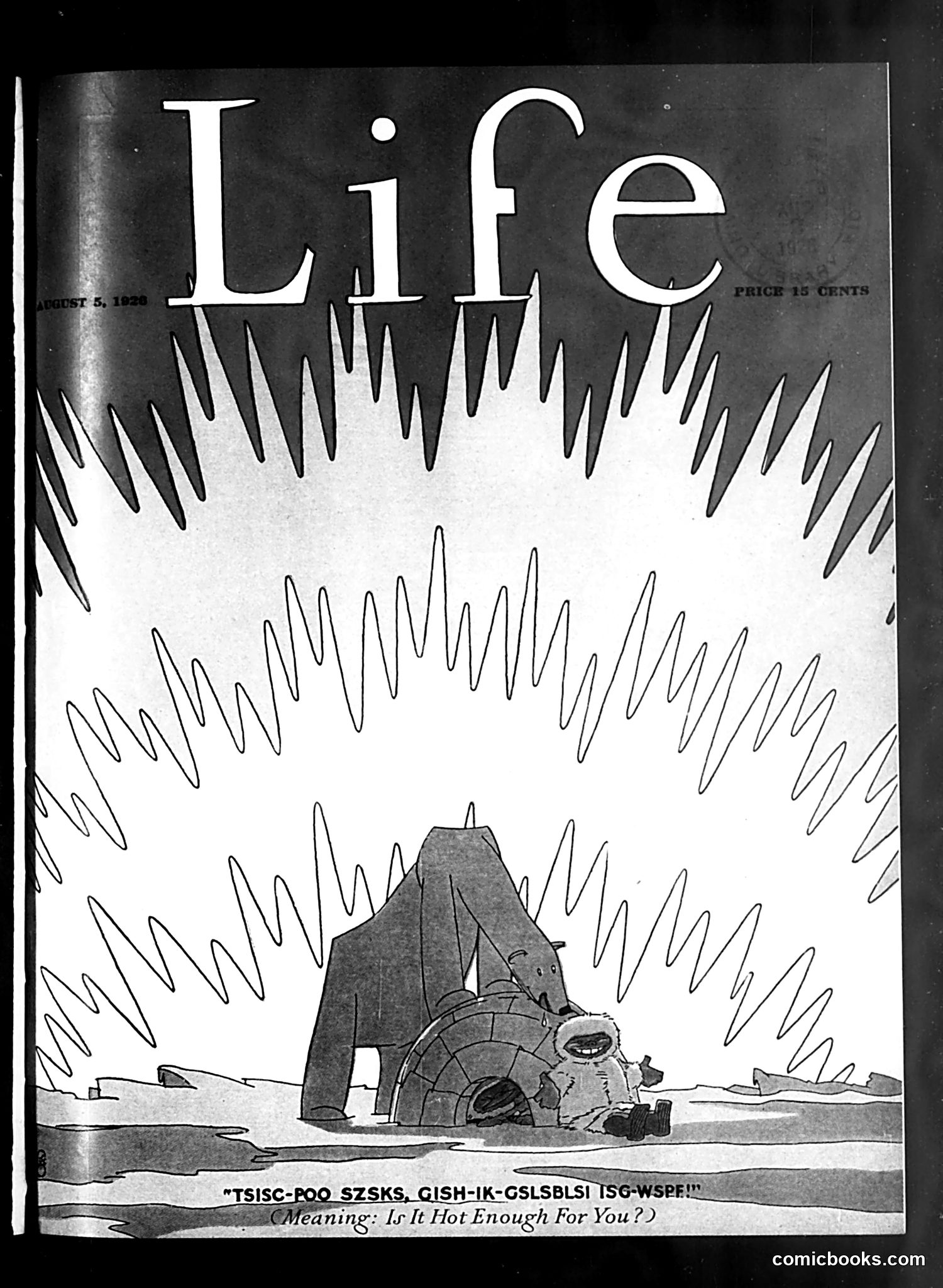
This cover depicts a figure huddled under an umbrella amid intense heat waves during what appears to be extreme summer weather. The Native American phrase at the bottom—"TSISC-POO SZSKS, GISH-IK-GSLSBLSI ISG-WSPF!" with translation "(Meaning: Is It Hot Enough For You??)"—uses mock-Indigenous language as comedic device (reflecting the casual ethnic humor common in 1928). The cartoon satirizes the sweltering summer heat of 1928, a period of notable heat waves in America. The figure's minimal shelter against the oppressive waves suggests the inadequacy of protection against extreme temperatures. The joke plays on the common conversational phrase "Is it hot enough for you?"—a period-typical way Americans discussed insufferable summer weather.
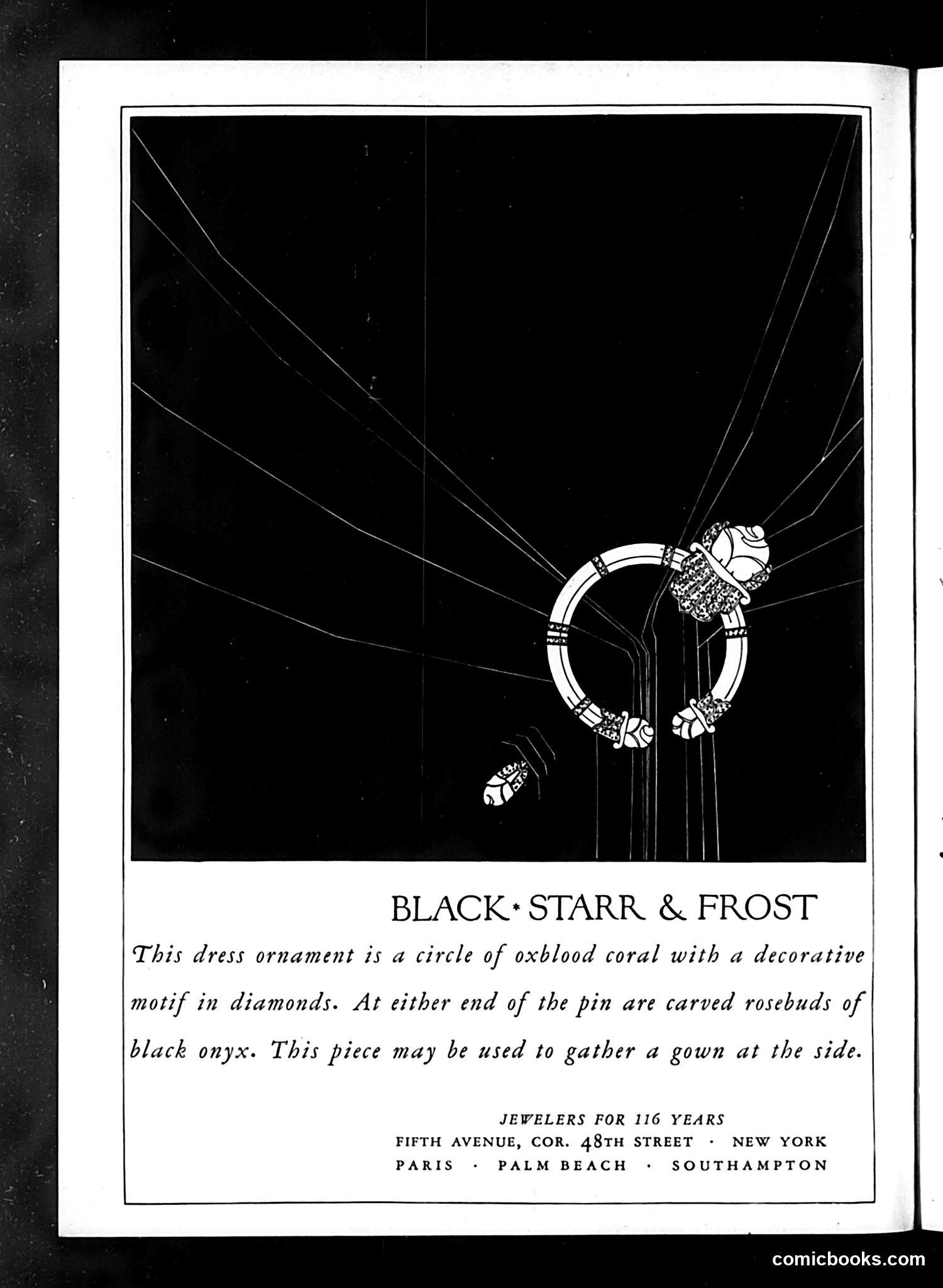
This page is **not a cartoon or satirical content** — it's a jewelry advertisement from Black, Starr & Frost, a luxury jeweler operating for 116 years with locations in New York, Paris, Palm Beach, and Southampton. The image shows a detailed technical illustration of a dress ornament: a circular brooch made of oxblood coral with diamond decorative motifs. The pin features carved black onyx rosebuds at each end and can be used to gather fabric at a garment's side. The Art Deco-style illustration emphasizes the piece's elegance and craftsmanship for wealthy consumers. This represents typical high-end fashion jewelry advertising from the early-to-mid 20th century, targeting affluent clientele rather than offering social commentary or satire.
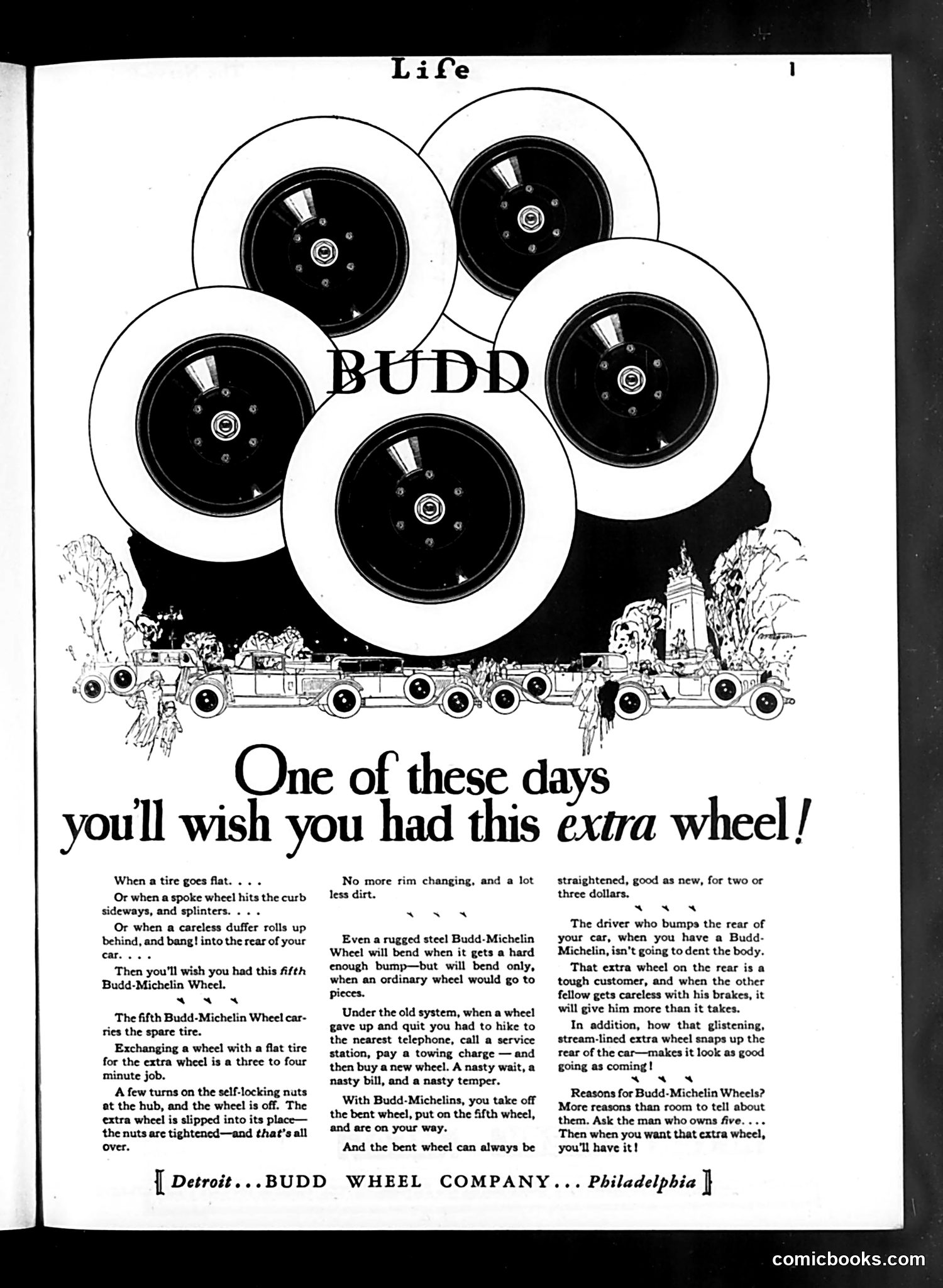
This is a **Budd-Michelin Wheel advertisement**, not a satirical cartoon. The page promotes a fifth spare wheel for automobiles. The advertisement uses humor to sell the product: it depicts scenarios where drivers wish they had this extra wheel—flat tires, rim damage, spoke breakage, and careless accidents. The illustrated car at bottom shows the spare wheel mounted prominently. The copy emphasizes practical benefits: durability of steel construction, convenience of quick changes, and cost savings versus traditional repairs and towing charges. The tagline "One of these days you'll wish you had this extra wheel!" plays on relatable automotive frustrations. This reflects early 1900s car culture when tire failures and wheel damage were common hazards. The ad targets middle-class automobile owners worried about roadside breakdowns and repair expenses.
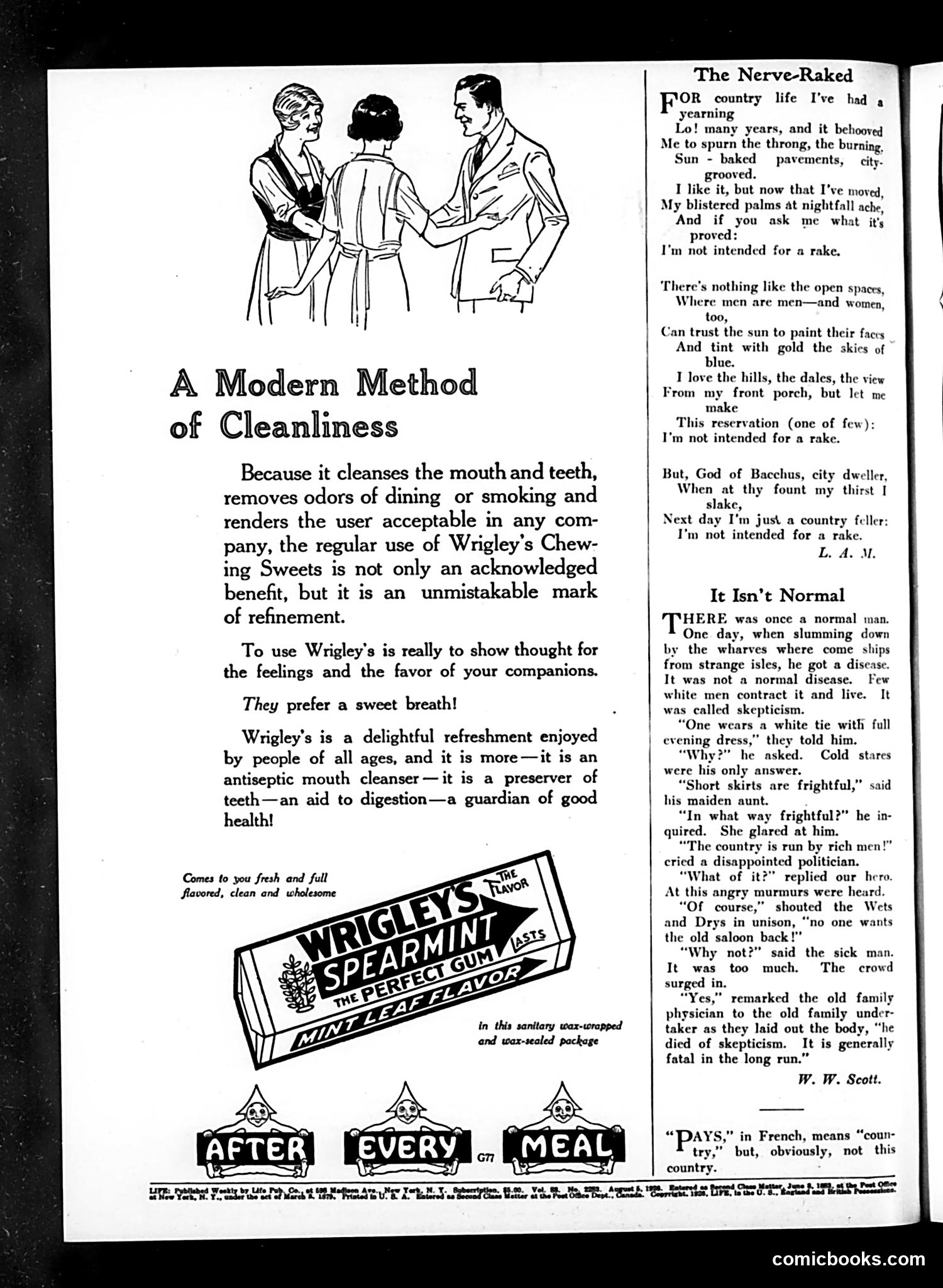
This page contains a **Wrigley's Spearmint Gum advertisement** disguised as editorial content—a common early 20th-century marketing practice. The left side features "A Modern Method of Cleanliness," promoting gum as a social refinement that freshens breath after meals and demonstrates consideration for companions. The illustration shows three well-dressed figures in conversation, implying that chewing gum signals good manners and hygiene. The right side contains two separate pieces: a poem titled "The Nerve-Raked" about urban versus country living, and a short story "It Isn't Normal" by W.W. Scott satirizing social conformity and skepticism. The advertisement's core message—that gum use marks refinement and social awareness—reflects early 1900s anxieties about urbanization, manners, and what constitutes acceptable public behavior.
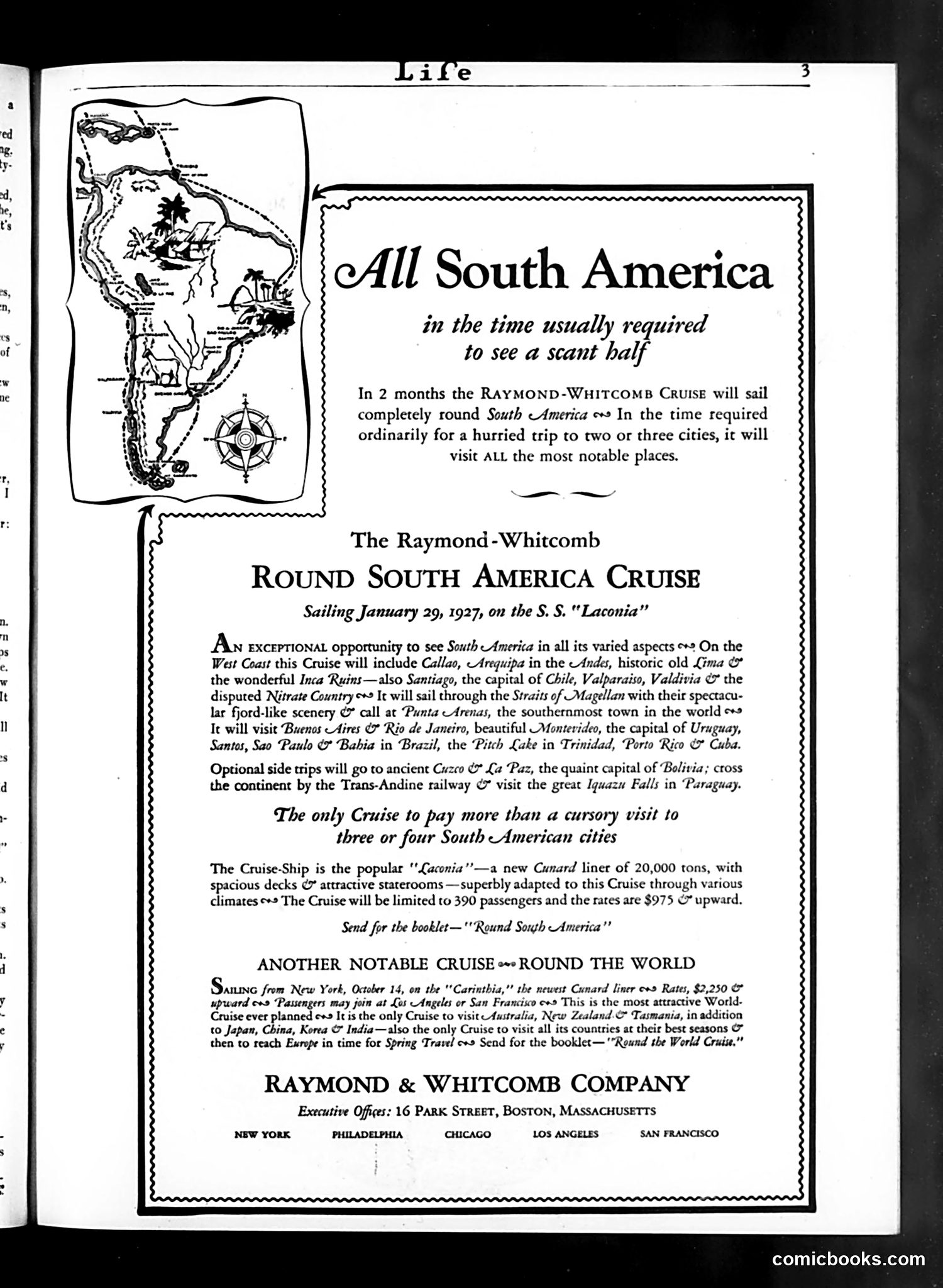
This page is **primarily advertising**, not satire or political commentary. It promotes the Raymond-Whitcomb Company's cruise services. The map on the left shows South America with marked cruise destinations. The main advertisement highlights a two-month "Round South America Cruise" departing January 29, 1927, on the S.S. *Laconia*. It emphasizes comprehensive coverage of notable sites—the Andes, Inca ruins, Santiago, Chilean ports, Buenos Aires, Rio de Janeiro, and other cities—positioning this as superior to "hurried" competitors visiting only two or three locations. Below is a secondary advertisement for a "Round the World" cruise on the *Carinthia*, departing October 14 from New York, visiting Australia, New Zealand, and Tasmania. The Raymond & Whitcomb Company's Boston headquarters is listed with five branch offices. No political satire is evident here.
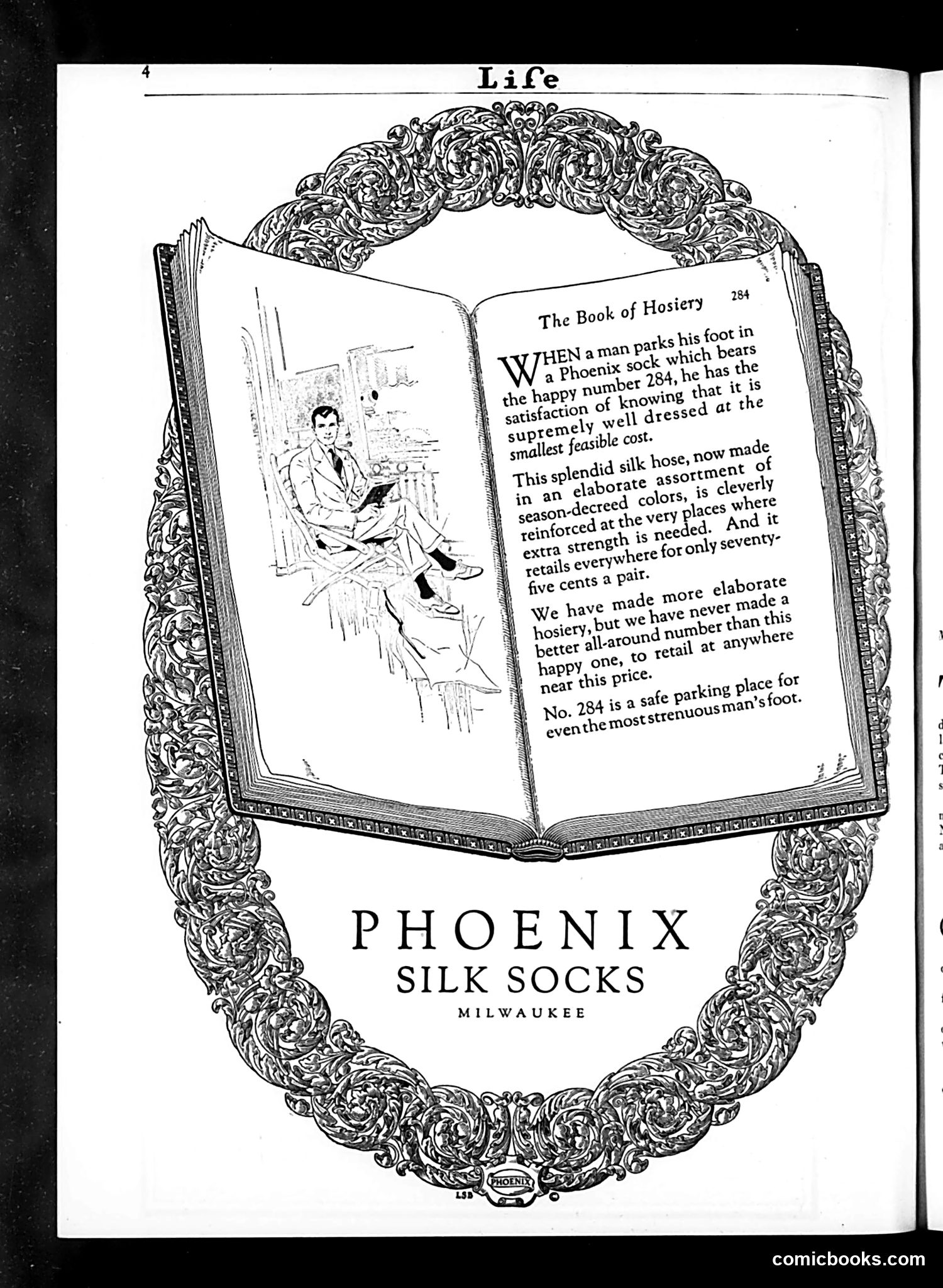
This page is primarily **advertising**, not satire or political commentary. It's a Phoenix Silk Socks advertisement from Milwaukee. The ad uses a framing device—an ornate book titled "The Book of Hosiery"—to present marketing copy. The illustration shows a man in a Phoenix sock, depicted as well-dressed and comfortable in a chair. The text is a sales pitch emphasizing quality: Phoenix silk hose costs only 75 cents per pair and offers durability through reinforced areas and "elaborate assortment of season-decreed colors." The ad claims this represents exceptional value—"we have never made a better all-around number to retail at anywhere near this price." No political figures or satirical content appears. This is straightforward commercial messaging typical of early 20th-century magazine advertising, using ornate design to suggest luxury and refinement.
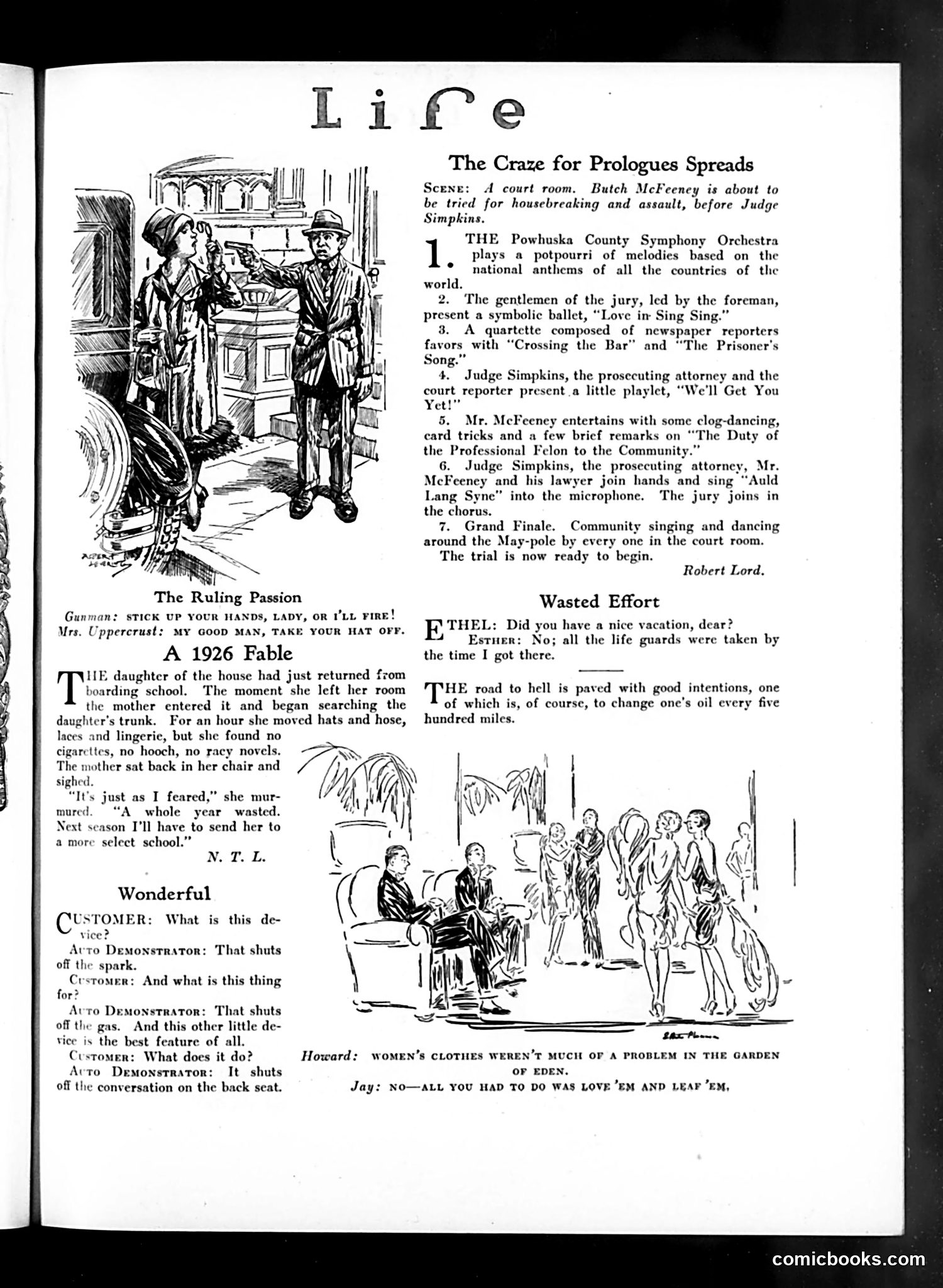
This page contains three satirical pieces from 1926: 1. **"The Craze for Prologues Spreads"** depicts a courtroom trial that devolves into musical entertainment—a satire on theatrical prologues (musical introductions to films) becoming ubiquitous and absurd. Judge Simpkins presides over increasingly ridiculous musical performances rather than conducting actual legal proceedings. 2. **"The Ruling Passion"** is a brief fable about a mother's disappointment that her daughter's expensive education has failed to produce domestic virtue—satirizing wealthy parents' expectations of private schooling. 3. **"Wasted Effort"** mocks tourist vacation planning, suggesting life guards' attentiveness makes the effort pointless, with a caption about how good intentions pave the road to hell. The illustrations use period-typical sketchy line work to convey social commentary.
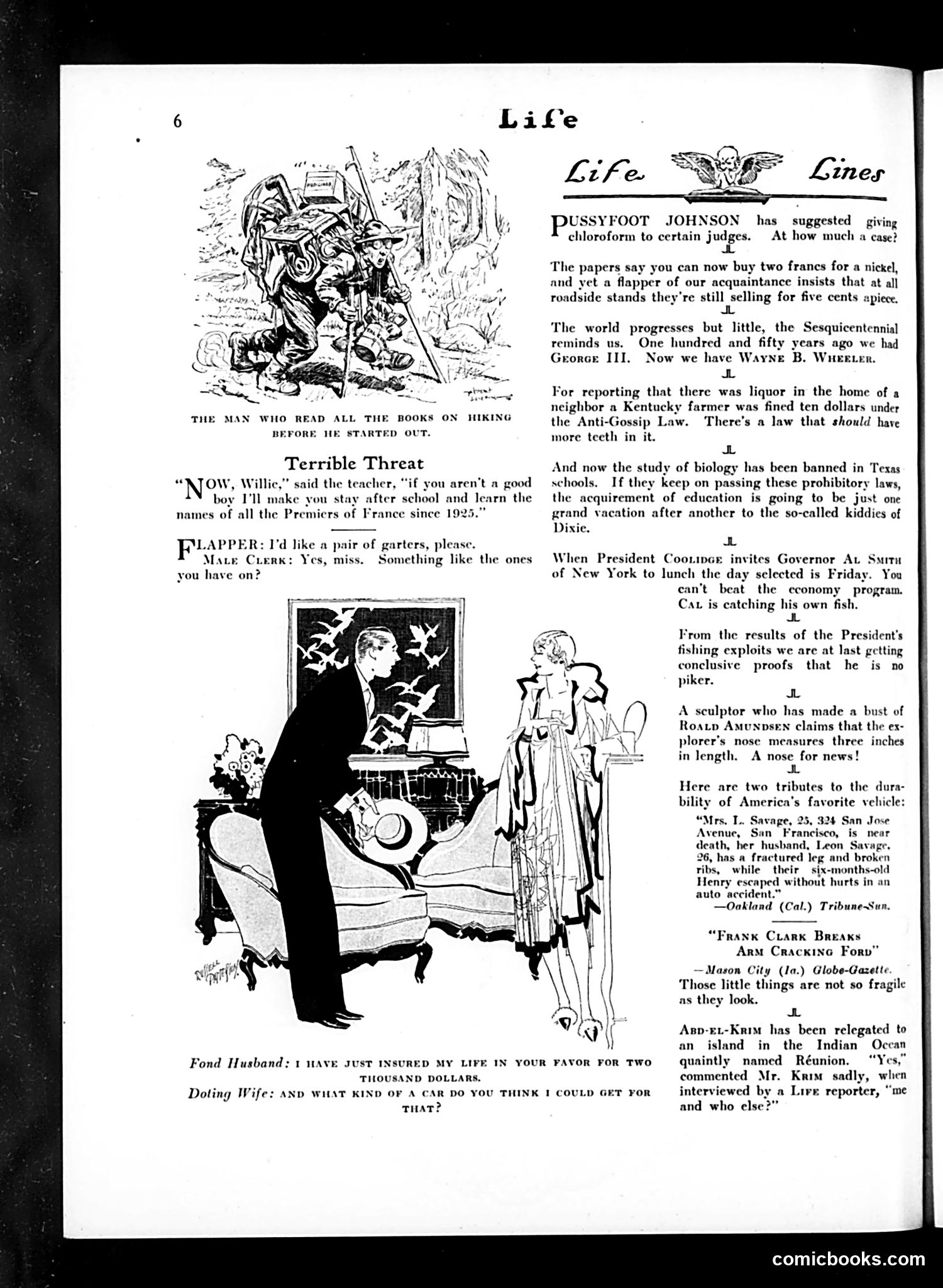
This cartoon satirizes marital economics during the 1920s. A husband has just insured his life for two thousand dollars in his wife's favor. The wife responds that for such an amount, she could obtain garters—implying his life insurance payout is inadequate compensation for her. The joke reflects contemporary anxieties about women's consumer desires and marital value. The cartoon mocks both husbands' financial insecurity and wives' materialism. The woman's casual dismissal of her husband's life insurance as insufficient for even a modest purchase (garters were inexpensive accessories) suggests either her extravagant expectations or the inadequacy of working-class male earnings. This represents typical Jazz Age satirical commentary on gender relations and economic pressures within American marriages.
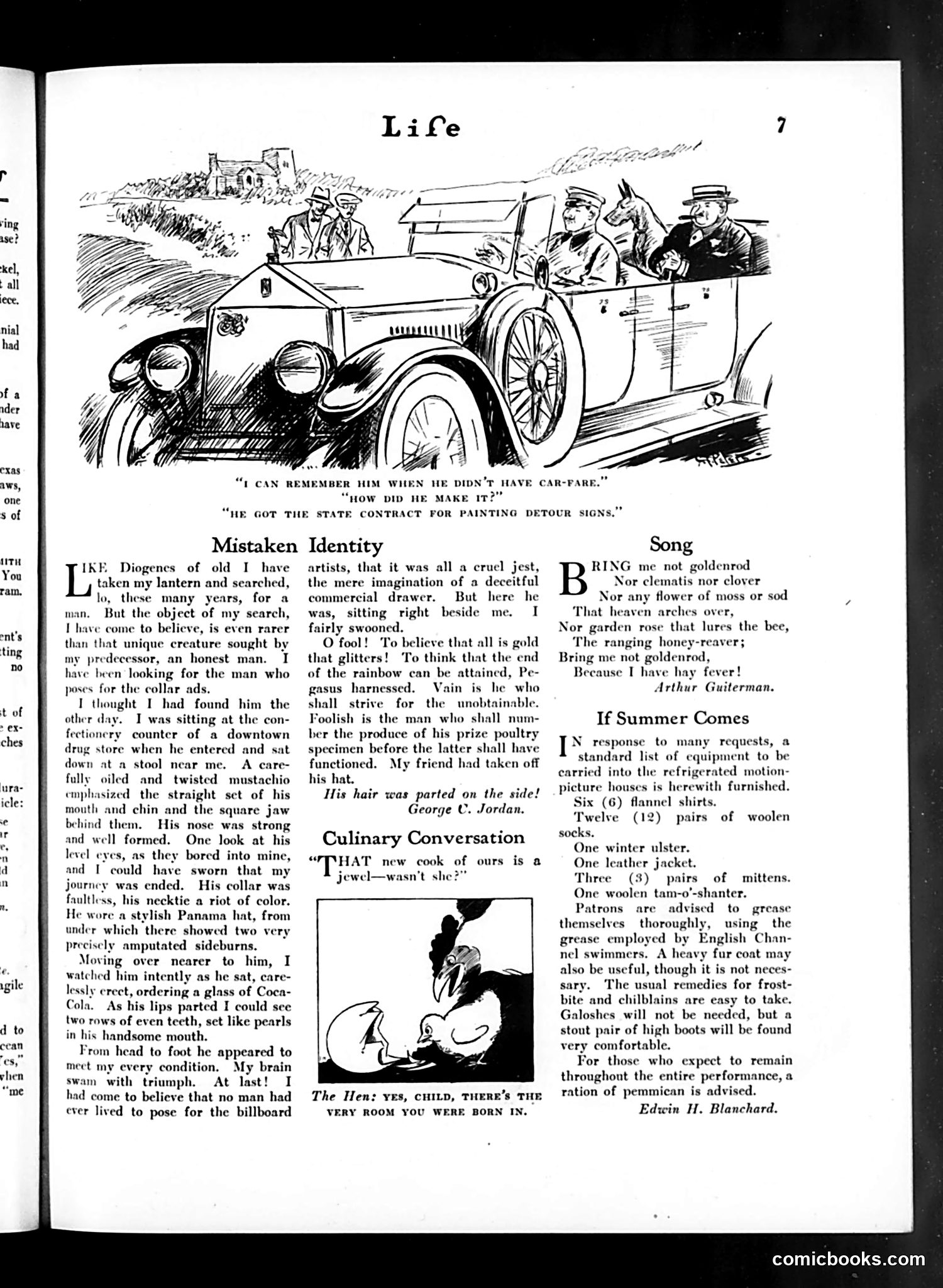
The top cartoon depicts an early automobile with passengers, captioned with dialogue about car-fare and painting detour signs. This appears to be satirizing a specific person—likely a politician or public figure—who worked on state contracts for road signage while claiming not to have funds for cab fare. The joke targets hypocrisy: someone involved in lucrative government contracts yet claiming poverty. The remaining page contains three unrelated pieces: a short story titled "Mistaken Identity" about searching for an artist, a poem called "Song," and a section "If Summer Comes" listing equipment for refrigerated picture houses. Without additional context about the specific historical moment, the exact identity of the satirized figure remains unclear, though the cartoon clearly mocks someone exploiting government contracts.
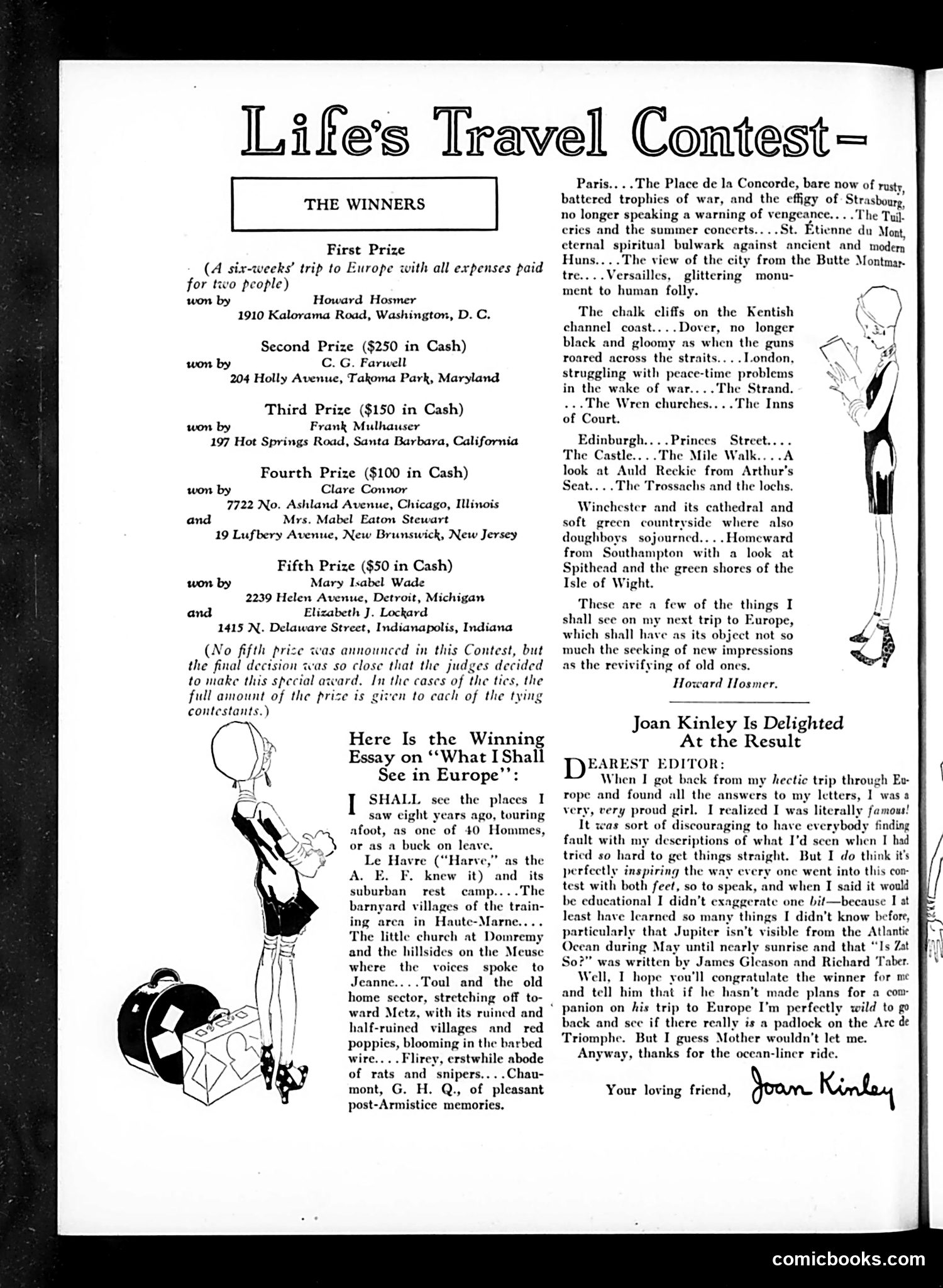
This page announces winners of Life magazine's essay contest on "What I Shall See in Europe." The first prize—a six-week European trip for two—went to Howarld Hoemer of Washington, D.C. The winning essay describes post-WWI European destinations: Paris with its war-damaged monuments, English chalk cliffs, Scottish castles, Winchester Cathedral, and the Isle of Wight. The essay emphasizes tourism's appeal as both sightseeing and "reviving of old ones." The cartoon illustrations show a stylized traveler with luggage, typical of 1920s travel imagery. A letter from Joan Kinley congratulates the winner, noting she'd hoped her own essay about Jupiter's visibility would win—a humorous detail suggesting the contest's competitive nature. This reflects 1920s American fascination with European cultural tourism following World War I.
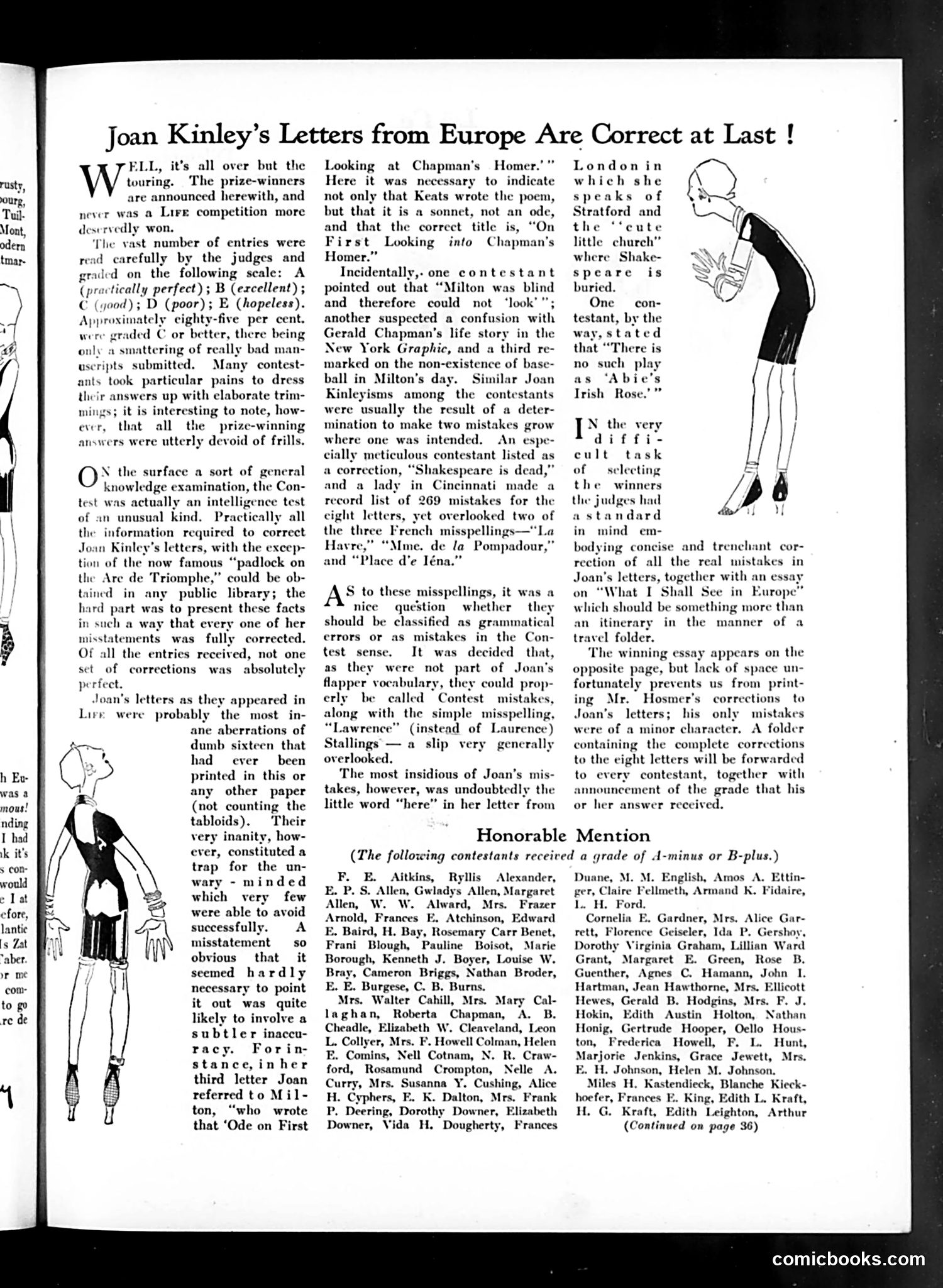
This page announces results of a literary contest where readers corrected errors in Joan Kinley's "Letters from Europe." The article explains that judges found approximately 85% of entries graded C or better, with many contestants making elaborate corrections. The two cartoon illustrations appear to satirize overly pedantic or earnest contest participants—figures shown in exaggerated poses suggesting obsessive attention to detail. The text notes that some contestants were "meticulous" in identifying errors, including misspellings of French words and confusion about literary references. The article credits the winning essay "What I Shall See in Europe" and notes it resembles a travel itinerary. It concludes by listing "Honorable Mention" recipients—contestants who received B-plus or A-minus grades.
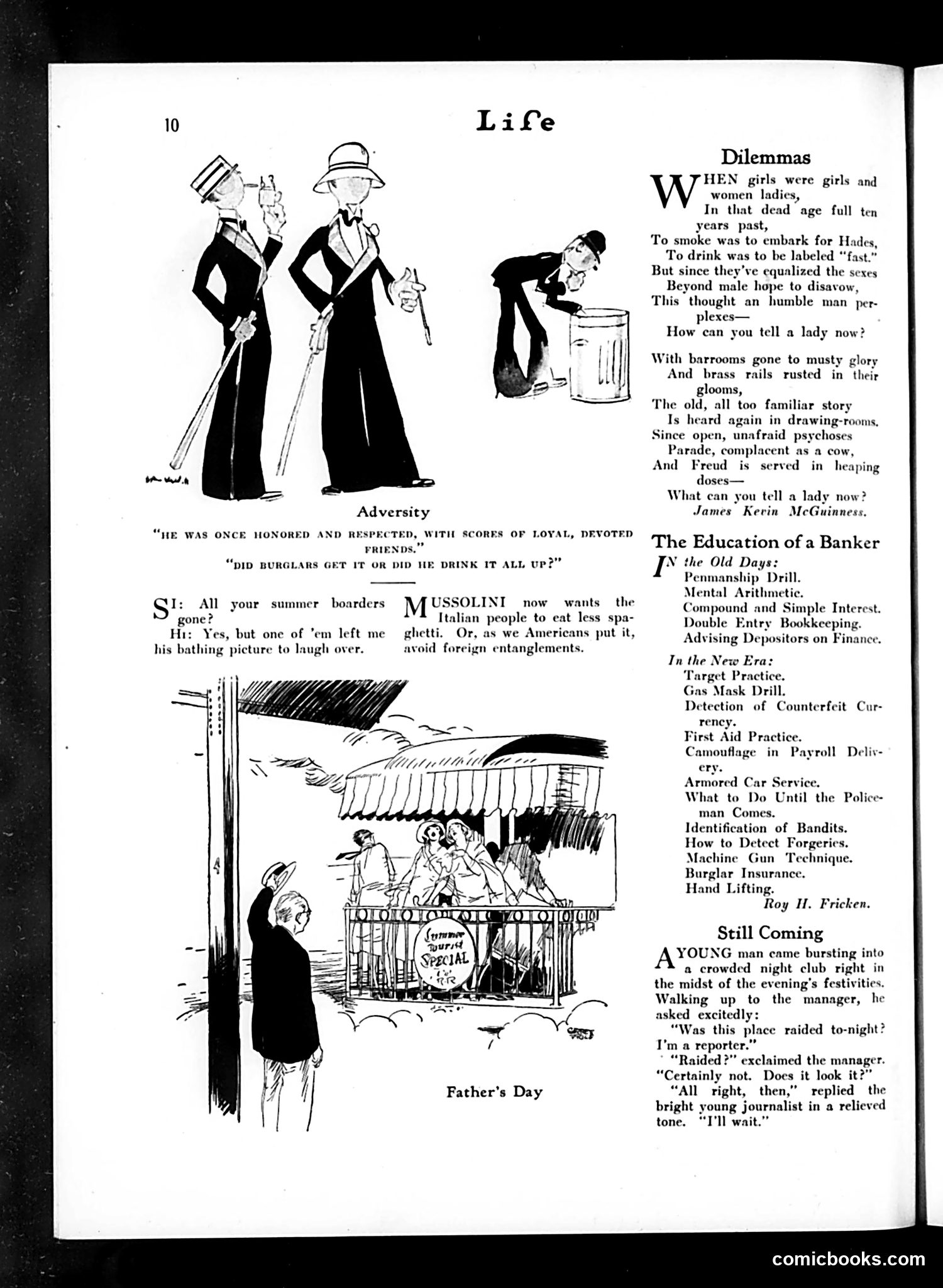
**"Adversity" cartoon**: Two elegantly dressed women hold cocktails while a man empties a bucket, illustrated with the caption: "He was once honored and respected, with scores of loyal, devoted friends — did burglars get it or did he drink it all up?" This satirizes the social consequences of Prohibition-era drinking. Once-respectable men lose their standing through either theft or alcoholism, reducing them to menial labor. **"Father's Day" cartoon**: Shows a man watching a seaside amusement stand labeled "Summer Special," depicting the nostalgic (or ironic) observation that fathers must work while families vacation. The page reflects 1920s concerns: Prohibition's social impact, gender roles, class anxiety, and economic inequality during this period.
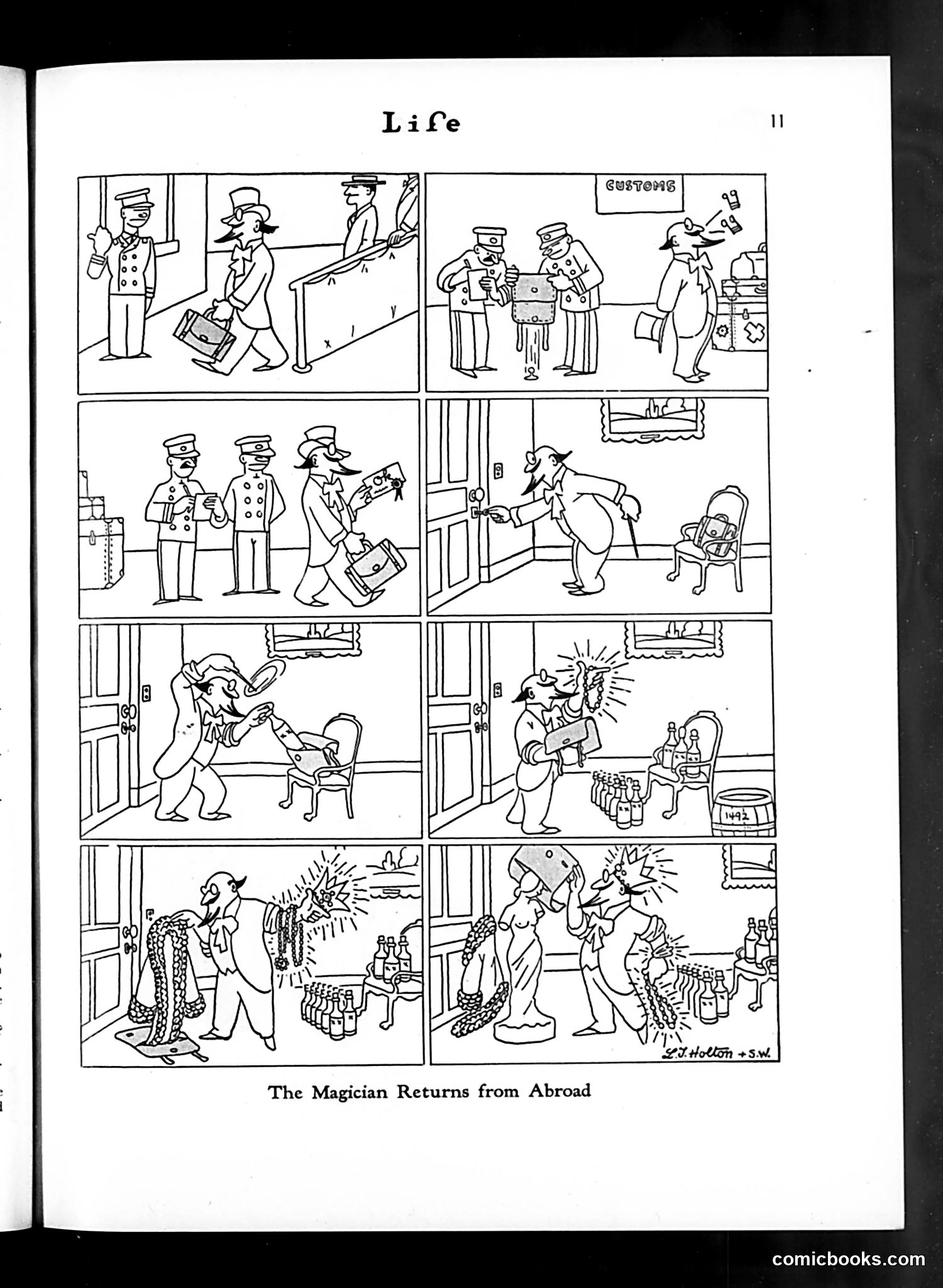
This comic strip satirizes a traveling magician's homecoming and domestic chaos. The narrative follows a magician arriving at customs with luggage, then returning home where his family—a woman and child—react with escalating pandemonium to his magic tricks. The joke centers on the contrast between the magician's professional success abroad (suggested by customs inspection and travel) and his domestic life, where his magic acts create increasingly wild disorder at home: the child's reactions intensify, bottles scatter, and by the final panels, complete mayhem erupts with the woman appearing distressed amid debris. The satire appears to mock both the performer's inability to control his "act" in a domestic setting and the family's exasperation with his antics—suggesting magic tricks lose their charm when performed repeatedly for captive household audiences.
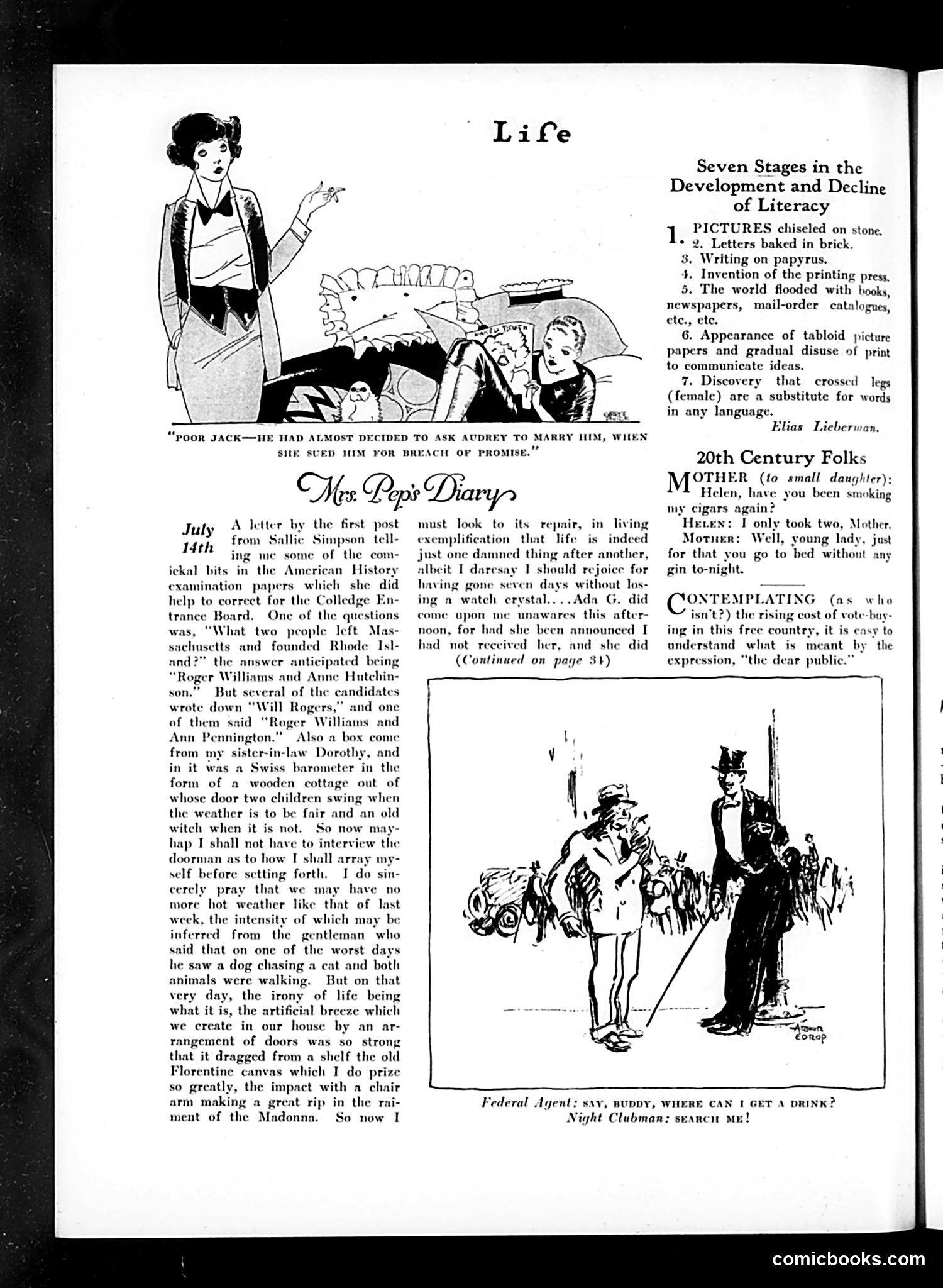
This page contains **Mrs. Pep's Diary**, a column about American history exam questions. The author discusses Rhode Island's founding, mentioning "Roger Williams and Ann Hutchinson" were candidates for answers, but "Roger Williams" and "Will Rogers" appear in the sources instead—likely a confusion of historical figures with the contemporary comedian Will Rogers. The bottom cartoon satirizes **Prohibition enforcement**. A well-dressed Federal Agent and Night Clubman are depicted, with the agent asking "where can I get a drink?" while the night clubman responds "search me!"—a joke about Prohibition's ironic effect: even law enforcement officers couldn't legally obtain alcohol, undermining the policy's credibility. This reflects 1920s public skepticism about Prohibition's enforcibility.
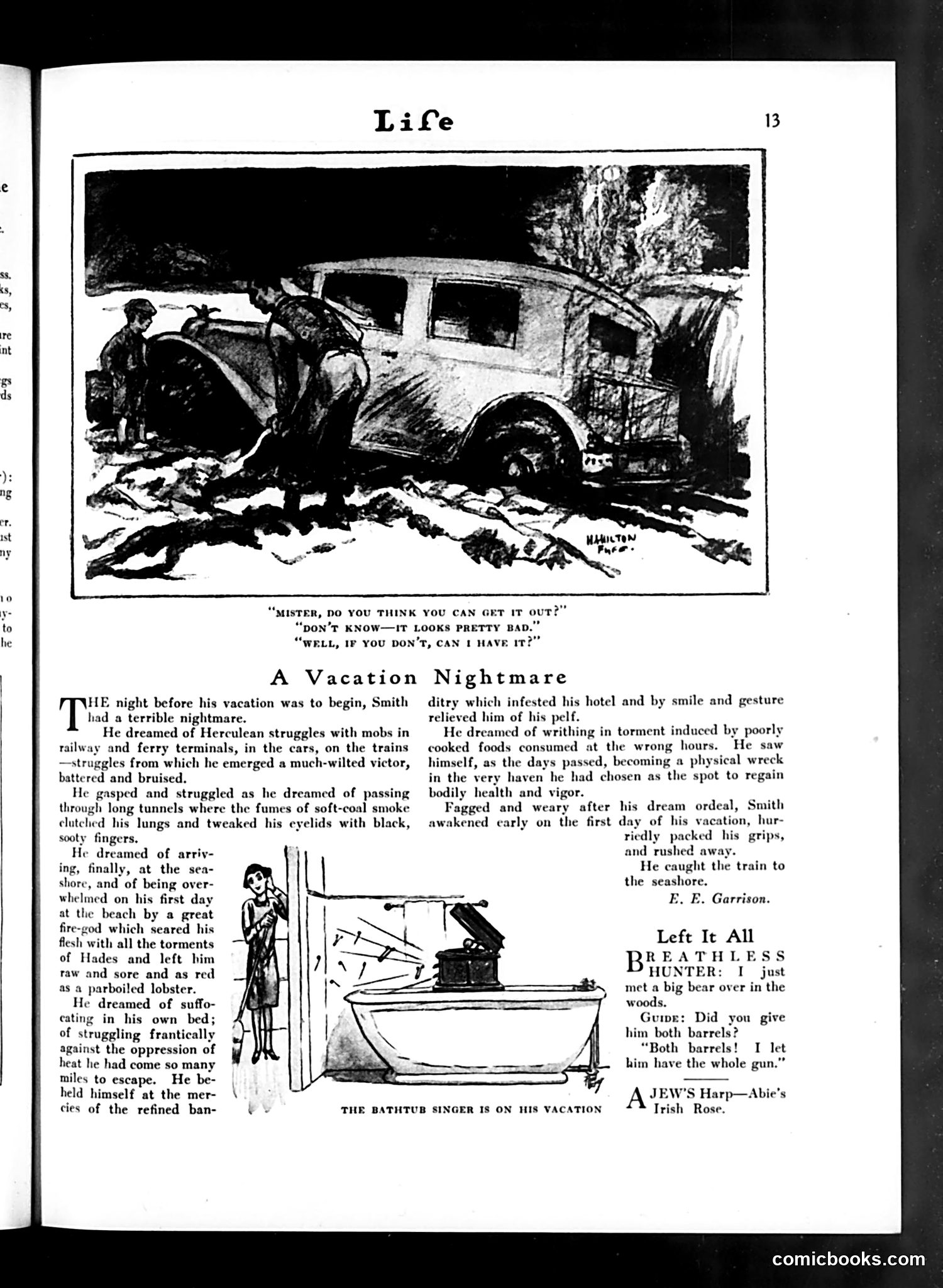
**Top Cartoon: "A Vacation Nightmare"** This depicts a man named Smith whose anticipated vacation becomes a series of nightmares. The accompanying text describes his anxious dreams: struggling with mobs at ferry terminals, passing through tunnels of smoke, dreaming of poorly cooked food, and imagining himself as a "parboiled lobster" at the beach. The humor satirizes the common experience of vacation anxiety—the gap between expectations and reality. The broken-down car illustration reinforces the theme of travel disasters. **Lower Section: Comedy Bits** Brief joke entries titled "Left It All" and "A Jew's Harp" follow typical magazine humor conventions of the era, offering quick punchlines rather than narrative comedy. The page satirizes the American vacation experience and its frequent disappointments through relatable anxieties.
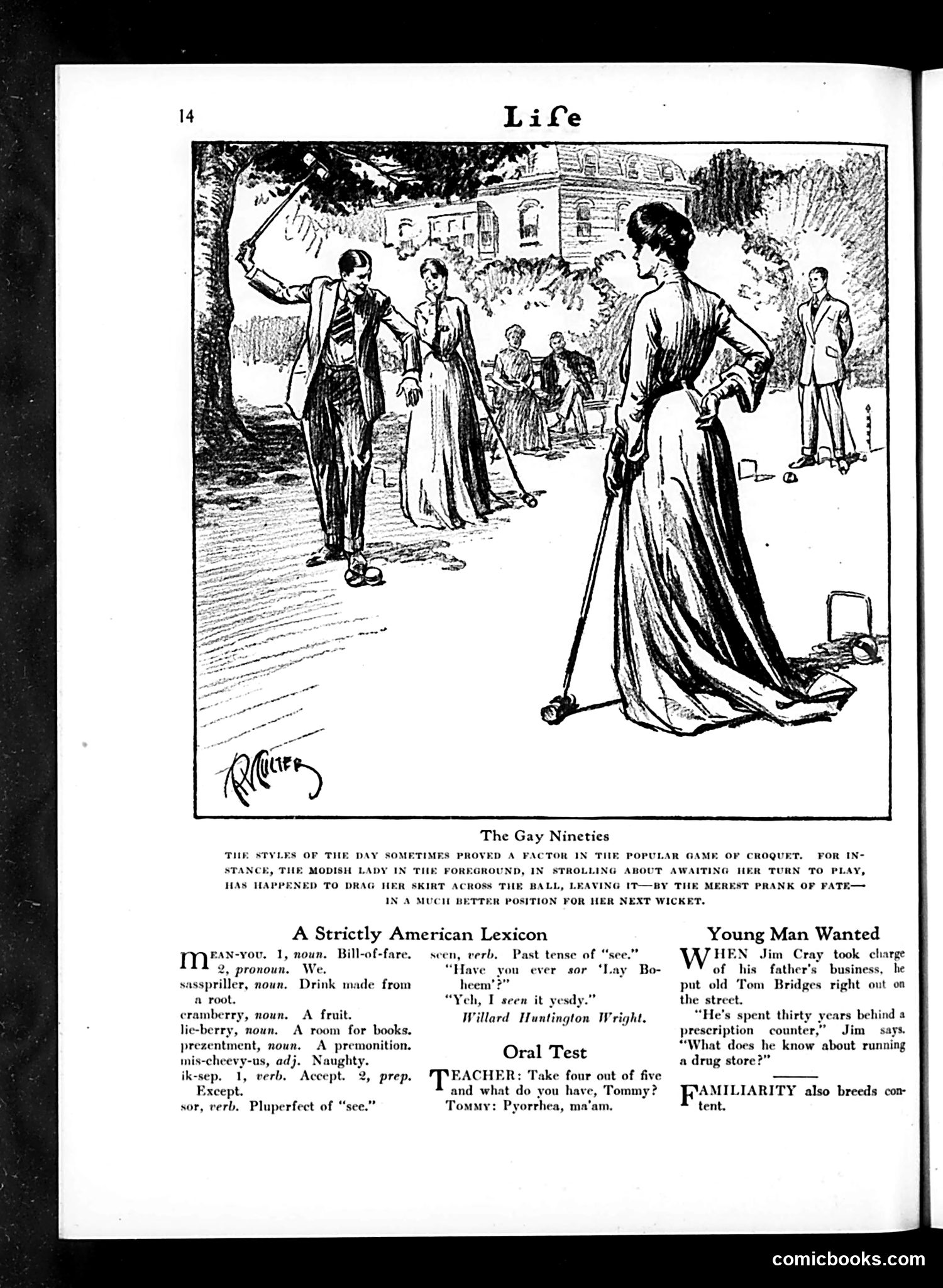
This page features a cartoon titled "The Gay Nineties" depicting people playing croquet—a fashionable lawn game of that era. The caption explains that women's clothing styles sometimes interfered with gameplay; the modishly-dressed woman in the foreground must drag her skirt across the court, which humorously puts her at a disadvantage for her next wicket. Below are three unrelated humor sections: a "Strictly American Lexicon" defining slang terms, an "Oral Test" joke about arithmetic, and "Young Man Wanted" anecdote about a naive pharmacy employee. The cartoon satirizes late-19th-century women's fashion—specifically the impractical trailing skirts that constrained movement—while gently mocking both the fashion-conscious women who wore them and the leisure pursuits of the wealthy.
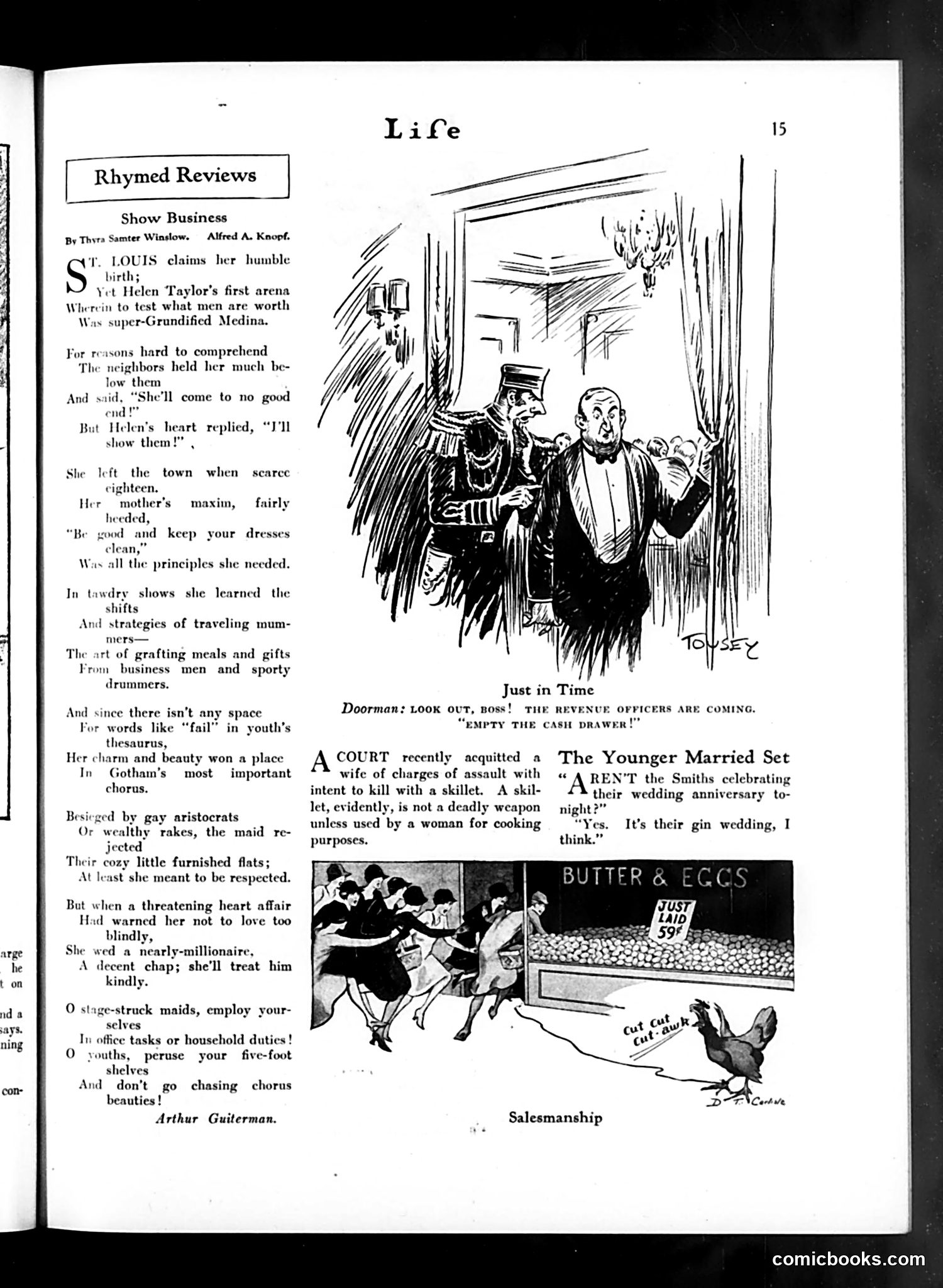
**"Show Business" (Rhymed Review):** A poem by Thayer Swinton Winslow and Alfred A. Knopf about Helen Taylor's theatrical debut. The narrative follows her rise from humble origins to stage success, emphasizing her beauty, charm, and survival of social obstacles—a rags-to-riches theater story typical of early 20th-century entertainment journalism. **"Just in Time" Cartoon:** Depicts doormen/hotel staff urgently telling a boss to "empty the cash drawer" as revenue officers approach—satirizing tax evasion or financial misconduct by businesses attempting to hide assets from authorities. **"The Younger Married Set" and "Salesmanship":** Brief humorous pieces about wealthy couples celebrating anniversaries with "gin weddings" and a cartoon showing a cat promoting butter and eggs—typical light satirical advertisements of the period.
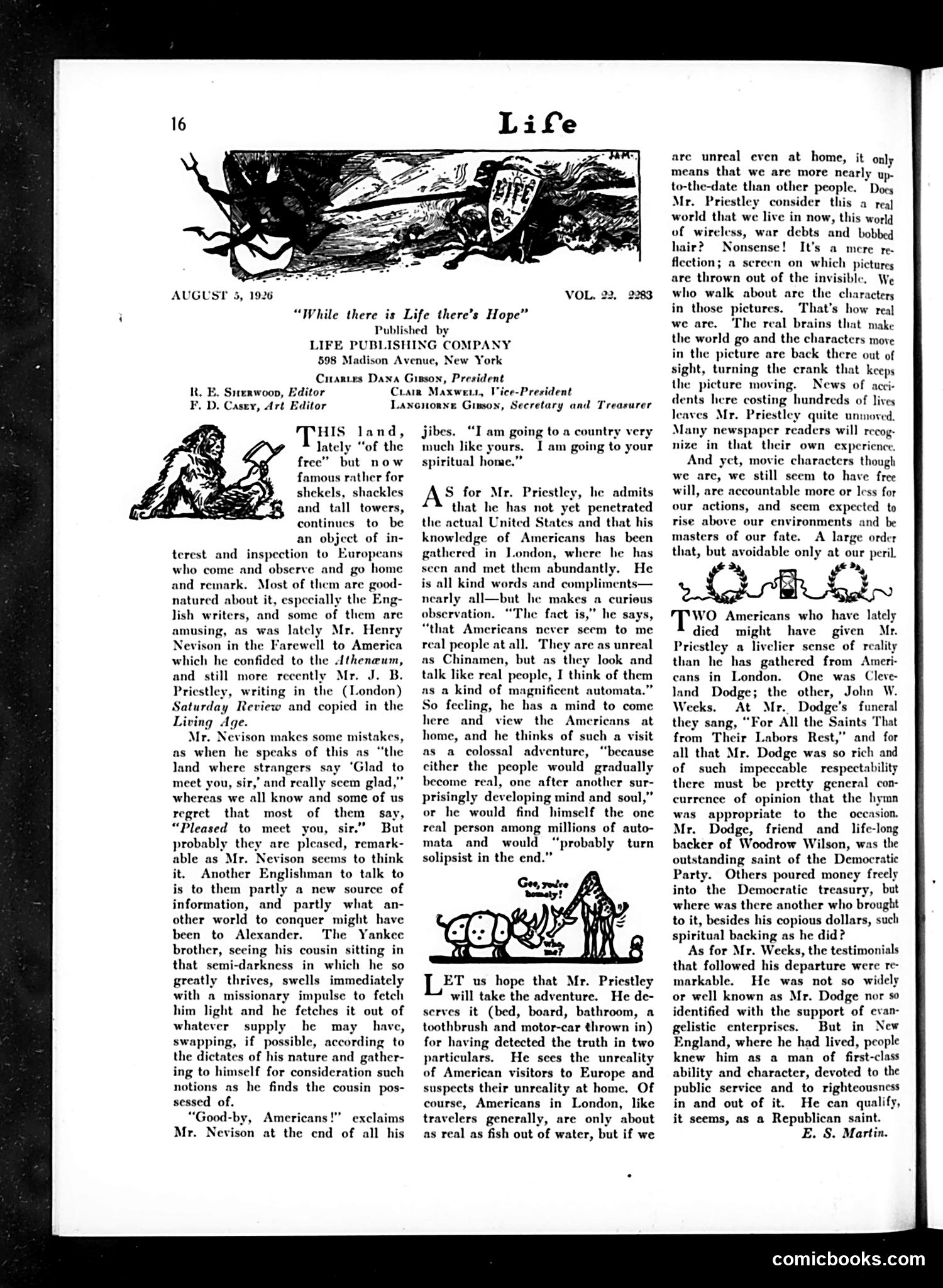
This page contains a satirical article about Mr. J.B. Priestley, a British writer, who the text indicates is visiting America and observing American life. The article critiques Priestley's observations about Americans, suggesting he finds them "unreal" and mechanical—like "magnificent automata." The cartoons mock both Priestley's perspective and American culture. One illustration shows figures in an exaggerated, puppet-like manner, reinforcing the automata comparison. The text humorously defends Americans against Priestley's criticism while simultaneously poking fun at American materialism and superficiality. The piece also briefly discusses the funeral of Cleveland Dodge, a prominent American businessman, noting the respectability afforded him despite his wealth—a likely critique of American reverence for the wealthy.
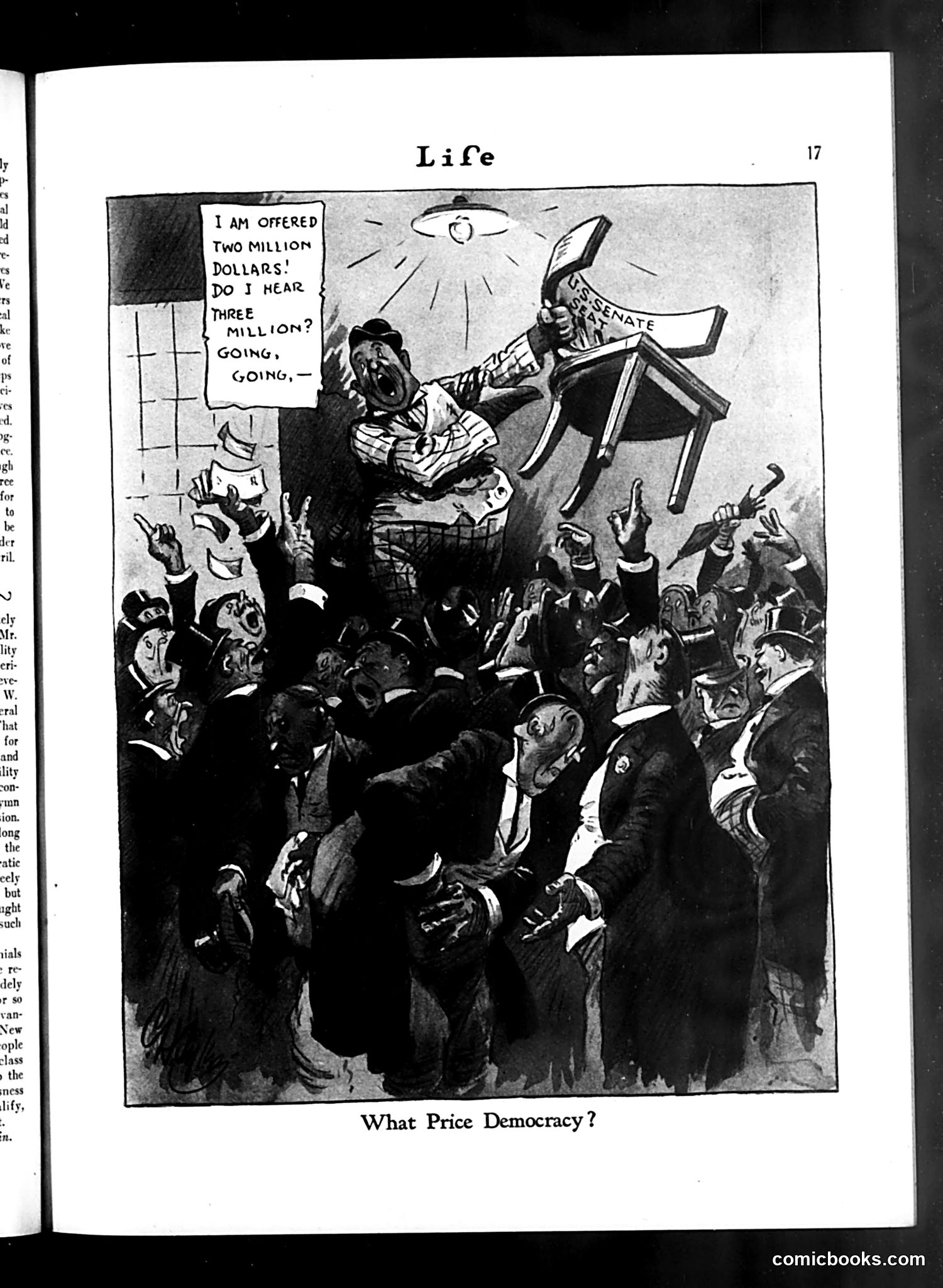
This political cartoon satirizes the corruption of democratic processes through bribery and auction. A figure (likely representing a politician or democratic institution) is being auctioned off to the highest bidder, with someone offering "two million dollars" and bidding up to "three million." The crowd of suited men eagerly participating represents wealthy interests competing to purchase political influence. The caption "What Price Democracy?" directly questions whether democratic values can be bought and sold. The cartoon critiques how money corrupts politics—suggesting that democratic principles are merely commodities available to the highest bidder rather than serving the public good. This reflects early-to-mid twentieth century concerns about corporate influence and political corruption in American democracy.
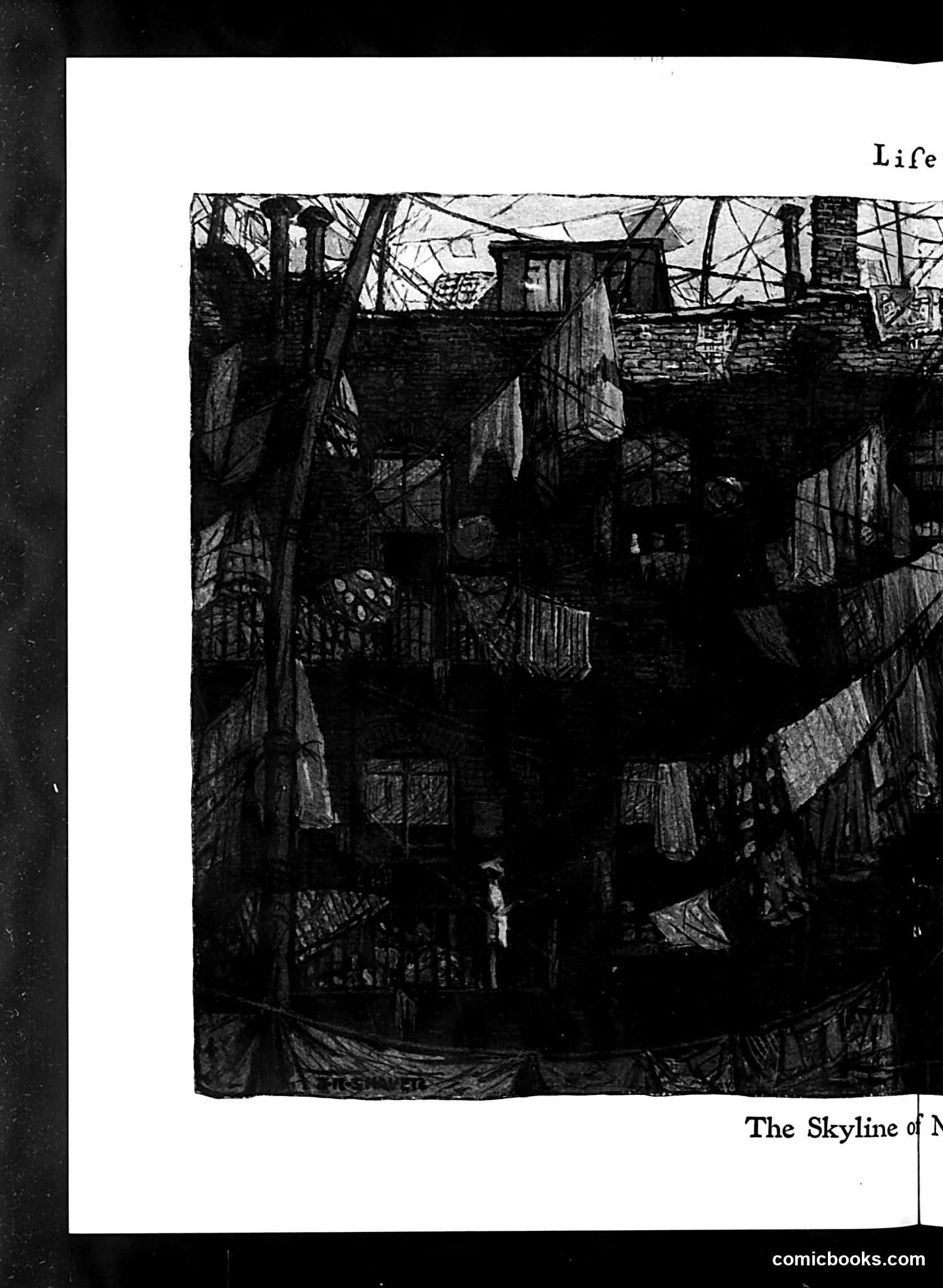
This page from *Life* magazine features a black and white illustration titled "The Skyline of M[...]" (the full title appears cut off). The image depicts a densely packed urban courtyard or alleyway viewed from above, showing multiple deteriorating tenement buildings with laundry hanging between them on clotheslines. The illustration appears to be social commentary on crowded, impoverished urban housing conditions—likely depicting a major American city's immigrant or working-class neighborhood. The tangled web of clotheslines, cramped architecture, and dark tones emphasize the overcrowding and poor living conditions. This satirical approach was typical of *Life* magazine's criticism of urban poverty and tenement housing in early-to-mid 20th century America.
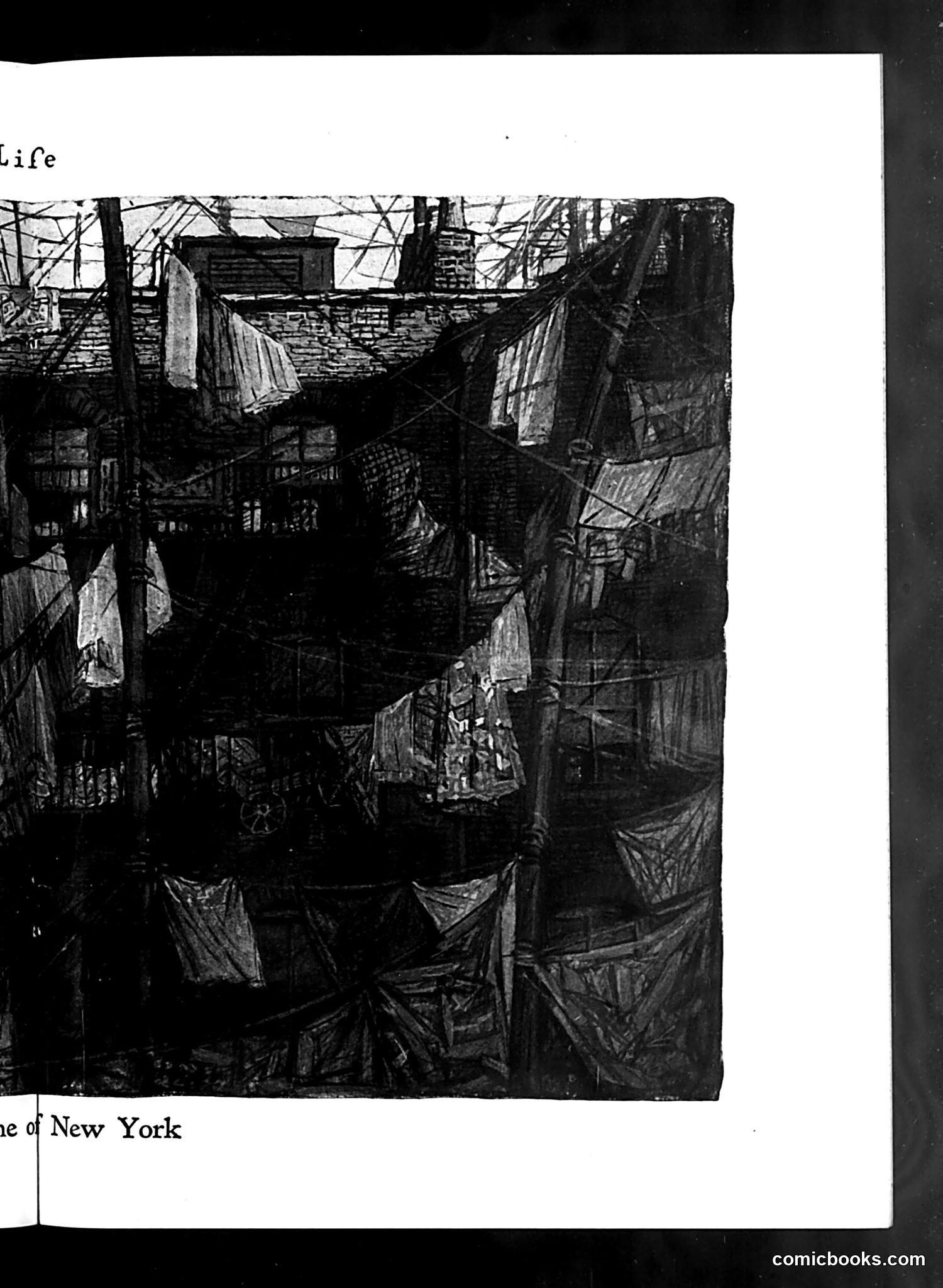
This page shows a stark black-and-white photograph documenting tenement housing conditions in New York City. The image depicts cramped urban housing with laundry hanging between buildings, multiple levels of fire escapes, and densely packed structures characteristic of overcrowded immigrant neighborhoods. The caption "New York" suggests this is documentary photography rather than political satire. The image serves as social commentary on urban poverty and housing density—likely from the late 19th or early 20th century when *Life* magazine often published investigative photojournalism exposing slum conditions. The satire is implicit: by simply showing these conditions without editorializing, the photograph makes a pointed argument about inequality and living standards in America's major cities.
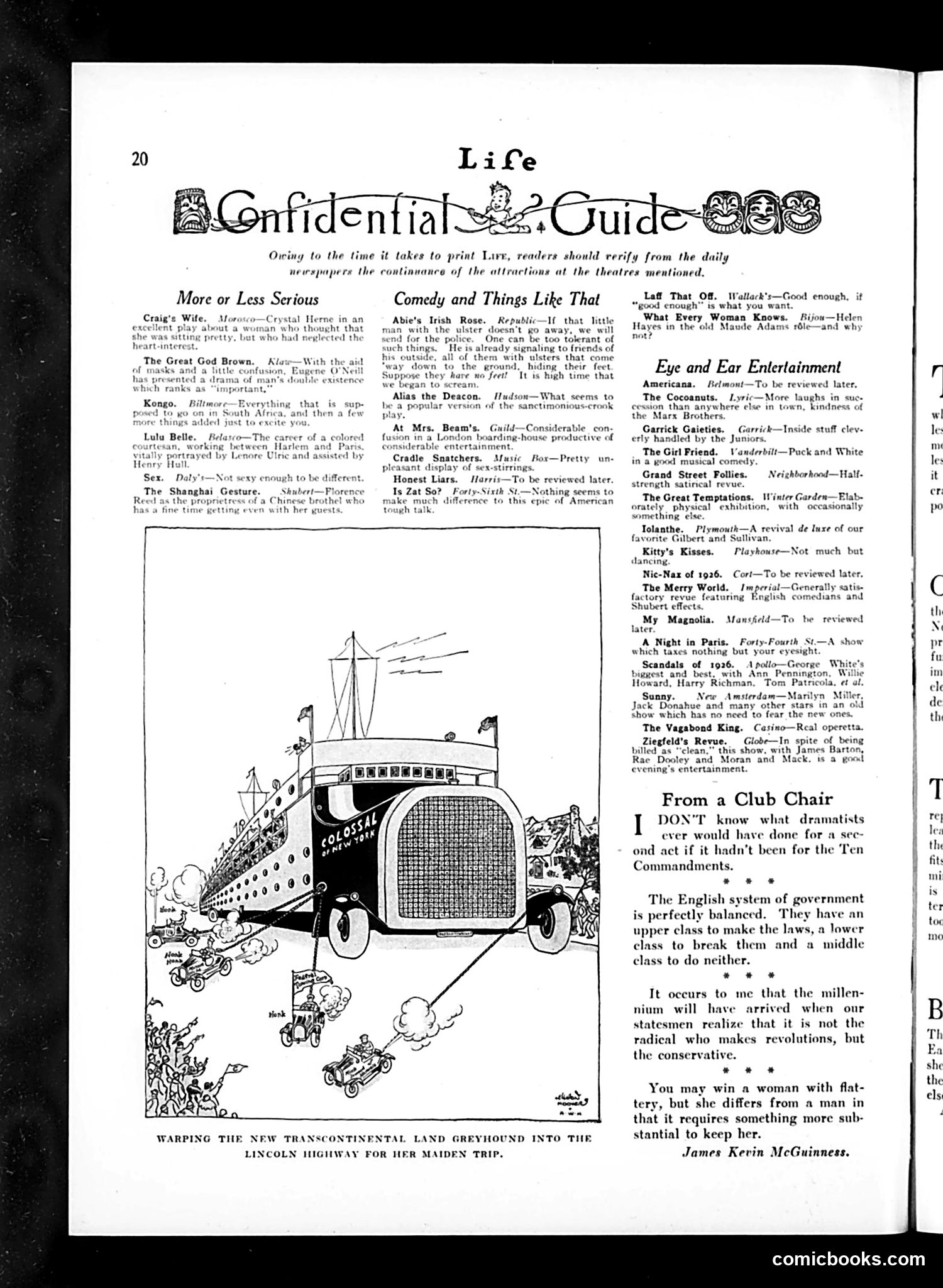
The main cartoon depicts a whimsical scene of a massive ocean liner being converted into a land vehicle—a "Transcontinental Land Greyhound"—for highway travel. The caption sarcastically references "her maiden trip," playing on the ship terminology while mocking the era's obsession with converting everything into automobiles. **The satire:** This reflects 1920s American car-culture mania, where the automobile was reshaping transportation and society. The joke exaggerates this trend absurdly—if everything must become a car, why not repurpose an entire ocean liner? **The page context:** This is from Life's entertainment/gossip section, listing Broadway shows and concluding with James Kevin McGuinness's humorous column "From a Club Chair." His observations mock social conventions (the Ten Commandments' dramaturgical convenience, British class systems, conservatism causing revolution, and female materialism). The overall tone is lighthearted social commentary typical of 1920s sophisticate humor—gently satirizing American consumer culture, transportation trends, and human nature.
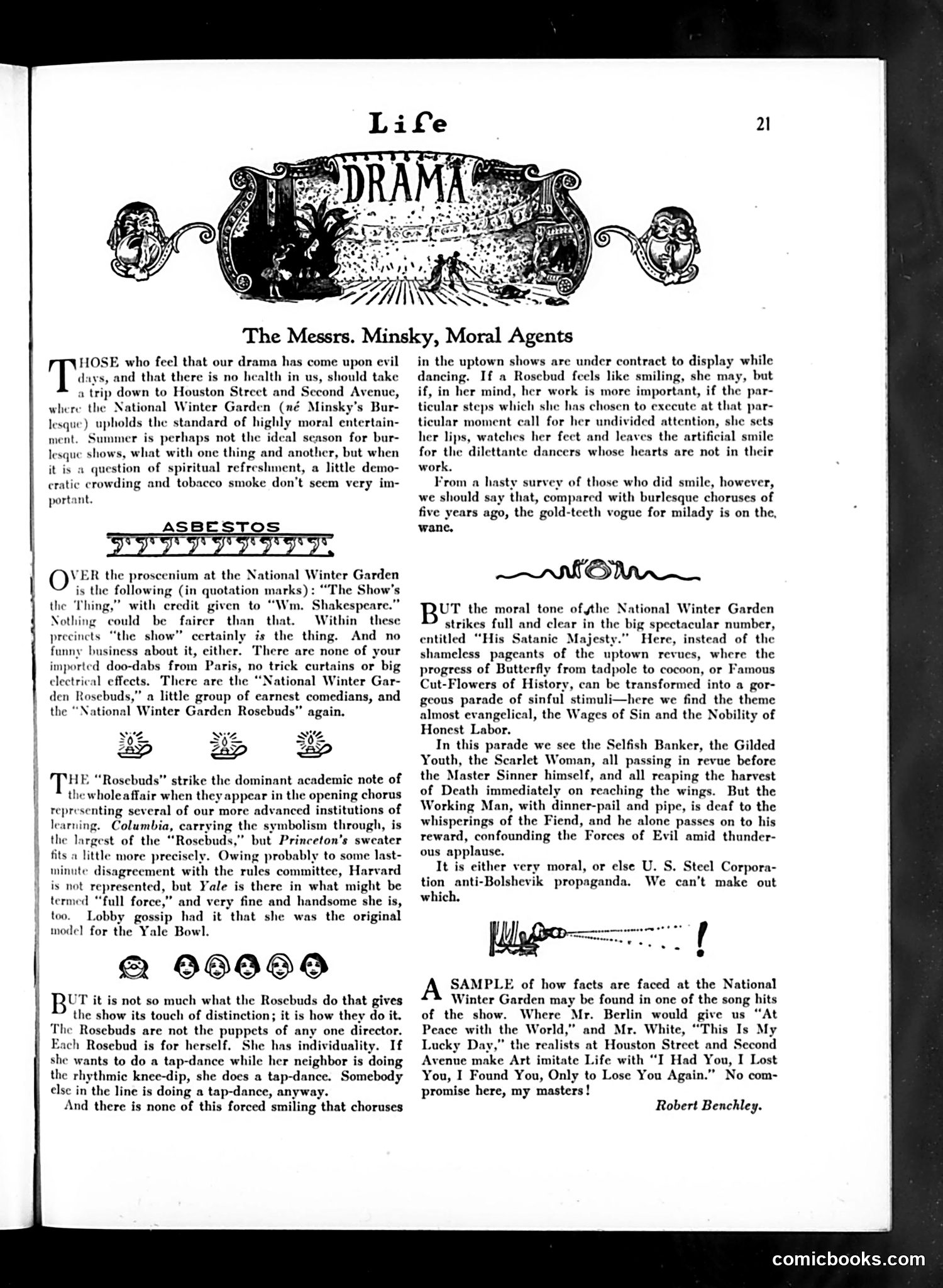
This is satirical theater criticism of a burlesque show at the National Winter Garden (formerly Minsky's Burlesque) on Houston Street in New York. The author mocks the venue's pretense of "moral entertainment" while actually describing typical burlesque performances. The satire operates on multiple levels: the theater quotes Shakespeare ("The Show's the Thing") to justify itself; the chorus line, called the "Rosebuds," includes girls representing Ivy League colleges (Columbia, Princeton, Yale); and the spectacular number "His Satanic Majesty" supposedly carries moral lessons—depicting sinful characters (Selfish Banker, Scarlet Woman) punished by Death, while the Working Man virtously escapes temptation. The author's irony is clear: burlesque—traditionally associated with sexual spectacle—is being rebranded as wholesome moral instruction. The reference to "gold-teeth vogue" and individual dancers doing tap-dances instead of synchronized routines satirizes both the performers' lack of coordination and the show's amateurish "distinction."
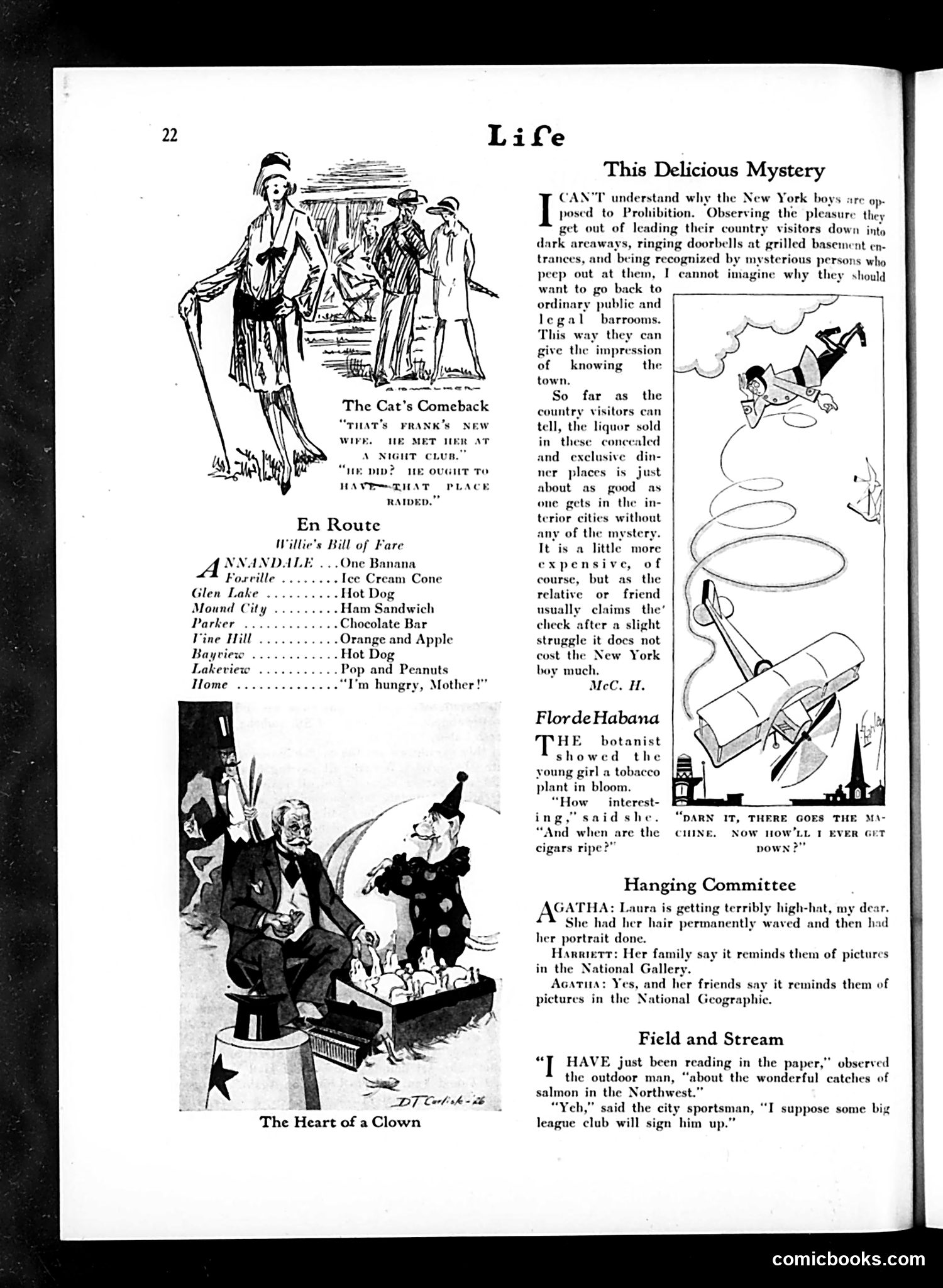
This page satirizes **Prohibition and its unintended consequences** in 1920s New York. The main article mocks New Yorkers' enthusiasm for illegal speakeasies—hidden basement bars accessed through mysterious rituals (ringing doorbells, secret entrances). The author humorously notes that country visitors find the illicit thrill more appealing than the actual liquor, which is no better than legal alternatives but costs more. The cartoon vignettes mock social pretension and human folly: "The Cat's Comeback" jokes about meeting women at raided nightclubs; "En Route" lists food stops; "The Heart of a Clown" depicts party-goers; "Flor de Habana" jokes about tobacco ripening; "Hanging Committee" mocks social climbers; and "Field and Stream" confuses a famous baseball player with a salmon catch. The satire targets both Prohibition's failure and the era's obsession with fashionable vice and status-seeking.
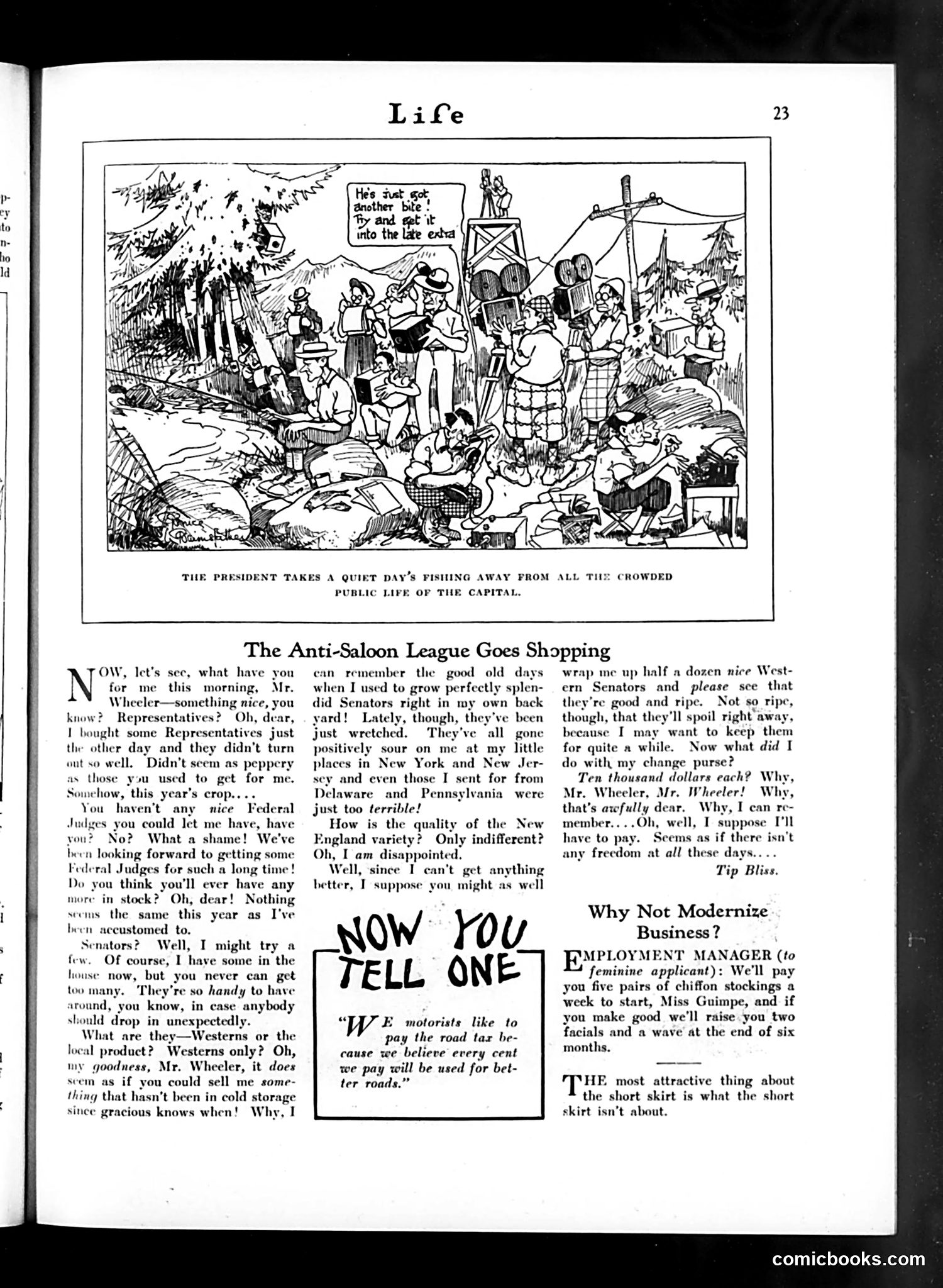
This cartoon satirizes the Anti-Saloon League's perceived corruption of the political process. The figure labeled "Mr. Wheeler" (likely Wayne Wheeler, the League's prominent leader) is depicted as a merchant literally *selling* politicians—Senators, Representatives, and Federal Judges—like commodities. The joke targets the League's reputation for wielding excessive political influence through lobbying and backroom dealing, particularly regarding Prohibition legislation. By presenting politicians as purchasable goods "in stock," the cartoonist suggests politicians have become mere products controlled by special-interest groups rather than independent representatives. The customer's complaint about quality—Senators "going sour," stored goods spoiling—mocks both the perceived corruption of the legislative process and the League's outsized power over elected officials. The satire implies that American democracy has been commercialized and compromised by organizations like the Anti-Saloon League, reducing governance to a transaction rather than representation.
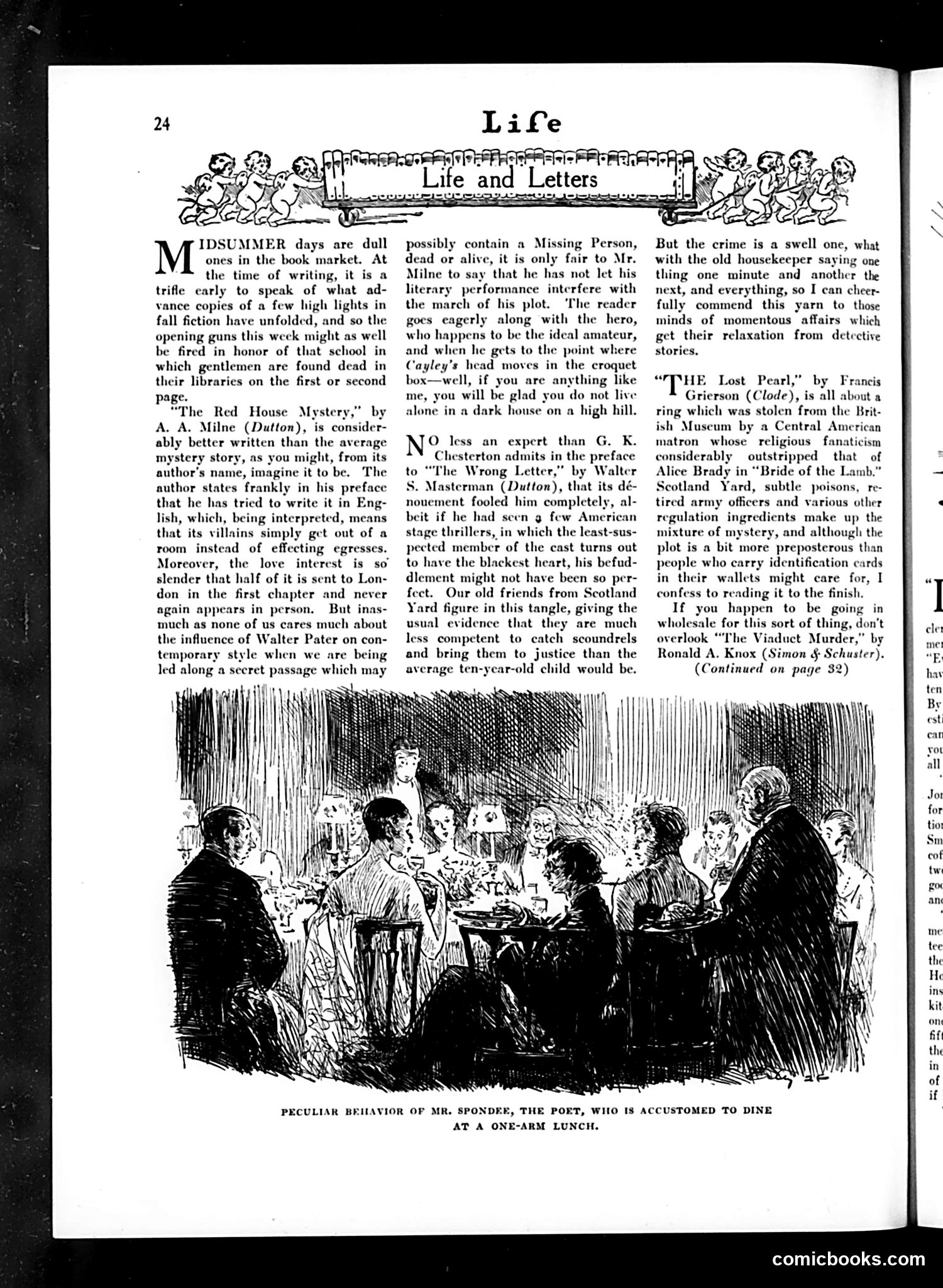
This page reviews three mystery novels for a general literary audience. The main cartoon illustrates a humorous social observation unrelated to the reviews: it depicts Mr. Spondee, a poet, dining at a "one-arm lunch" (a casual cafeteria-style restaurant) while eating with one hand—a joke about his name and his profession. The satire mocks the eccentric behavior or pretensions of artists/poets in everyday situations. The book reviews discuss A.A. Milne's *The Red House Mystery*, Francis Grierson's *The Lost Pearl*, and Ronald A. Knox's *The Viaduct Murder*. The critic praises Milne for prioritizing plot over literary style, admits that G.K. Chesterton was fooled by the mystery's solution, and generally recommends all three as entertaining detective fiction. The tone is informal and witty, typical of Life's satirical approach to culture.
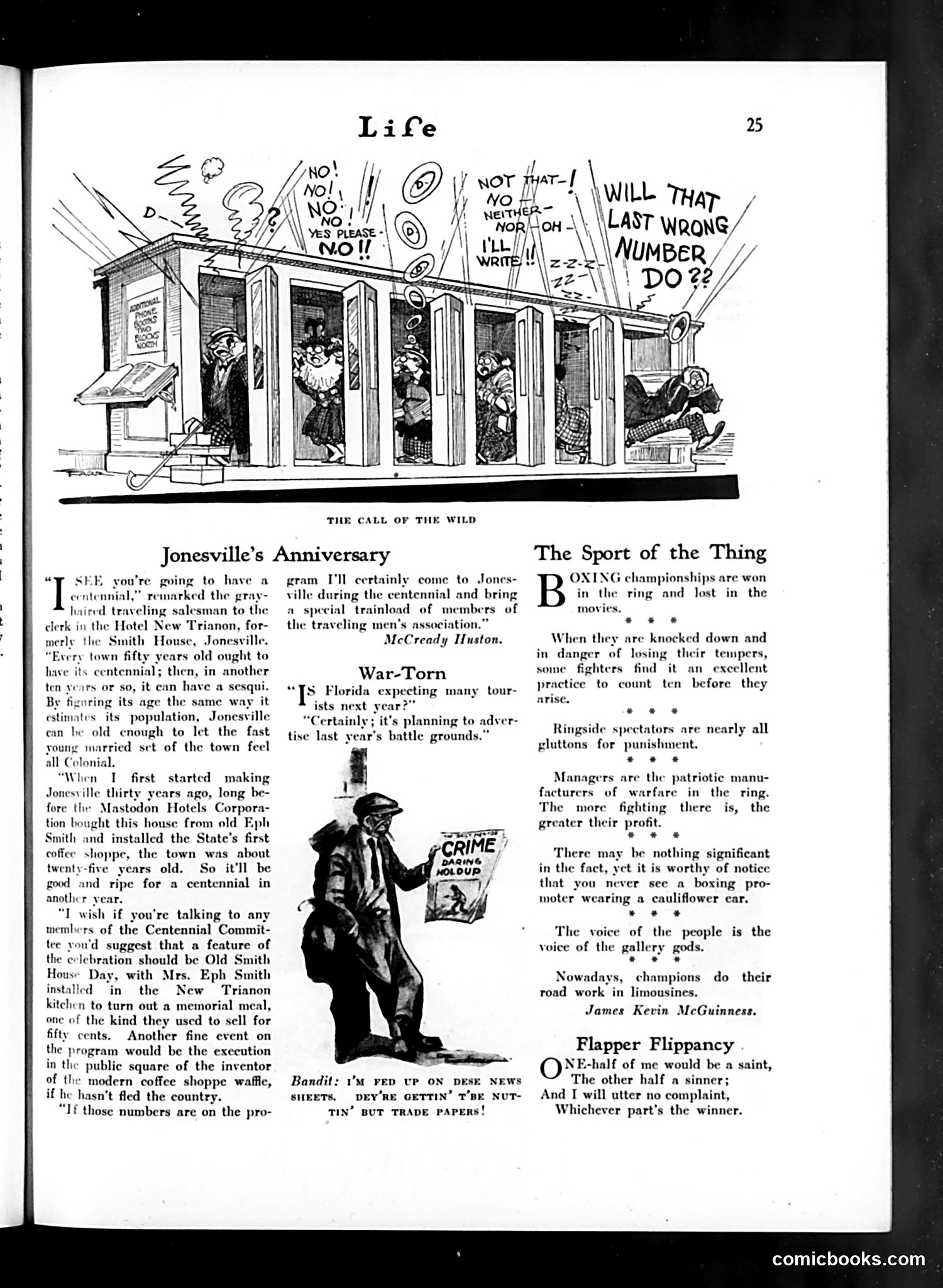
The top cartoon satirizes small-town boosterism and historical revisionism. A traveling salesman discusses "Jonesville's" upcoming centennial celebration with a hotel clerk. The joke: the town manipulates its age (claiming it's older than it actually is) the same way it inflates its population figures—through creative accounting. The salesman suggests the celebration include nostalgic events like recreating old-fashioned meals, and jokingly proposes executing the inventor of the modern "coffee shoppe waffle" (a contemporary chain restaurant innovation he despises). The satire targets early 20th-century American small towns' tendency to manufacture heritage and celebrate "progress" while simultaneously romanticizing a disappearing past. It mocks both commercialization of tradition and the traveling salesman culture itself—a common subject in Life's humor during this era.
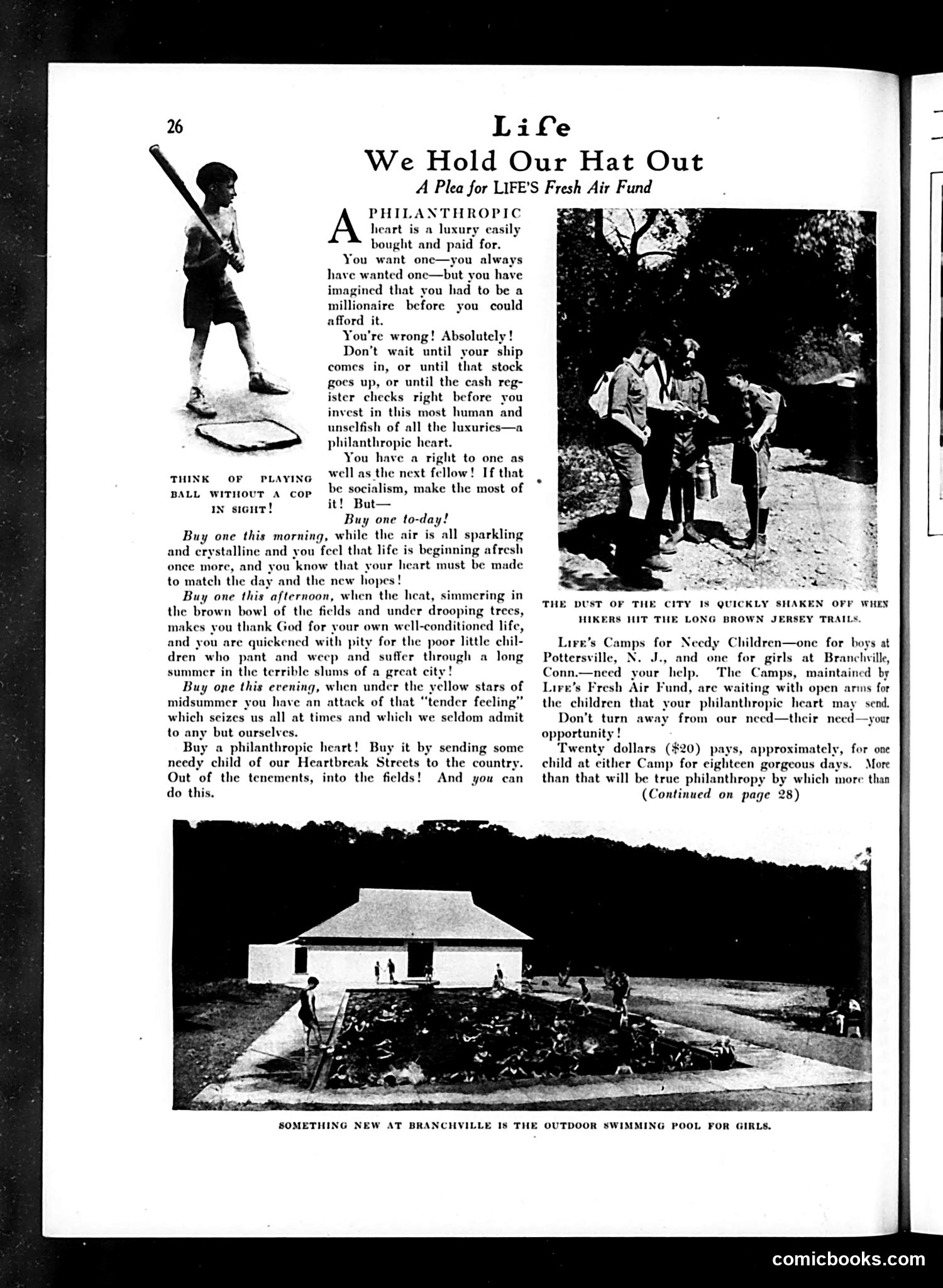
This is a fundraising appeal, not a satirical cartoon. Life magazine is soliciting donations for its "Fresh Air Fund," which sent poor urban children from tenement slums to country camps for summer relief. The rhetoric uses gentle irony: it claims a "philanthropic heart" is a luxury anyone can afford (contradicting the assumption that charity requires wealth). The appeal emphasizes emotional appeal—describing children suffering in city heat—while positioning giving as accessible to ordinary readers. The images show the camps' facilities: children hiking in nature and an outdoor swimming pool at Branchville. The cost was $20 per child for eighteen days. The text frames this as addressing "Heartbreak Streets" and urban poverty, reflecting Progressive Era concerns about industrial city conditions and child welfare. The phrase "if that be socialism, make the most of it" suggests contemporary debates about charity versus systemic reform, though it's presented lightheartedly rather than critically.
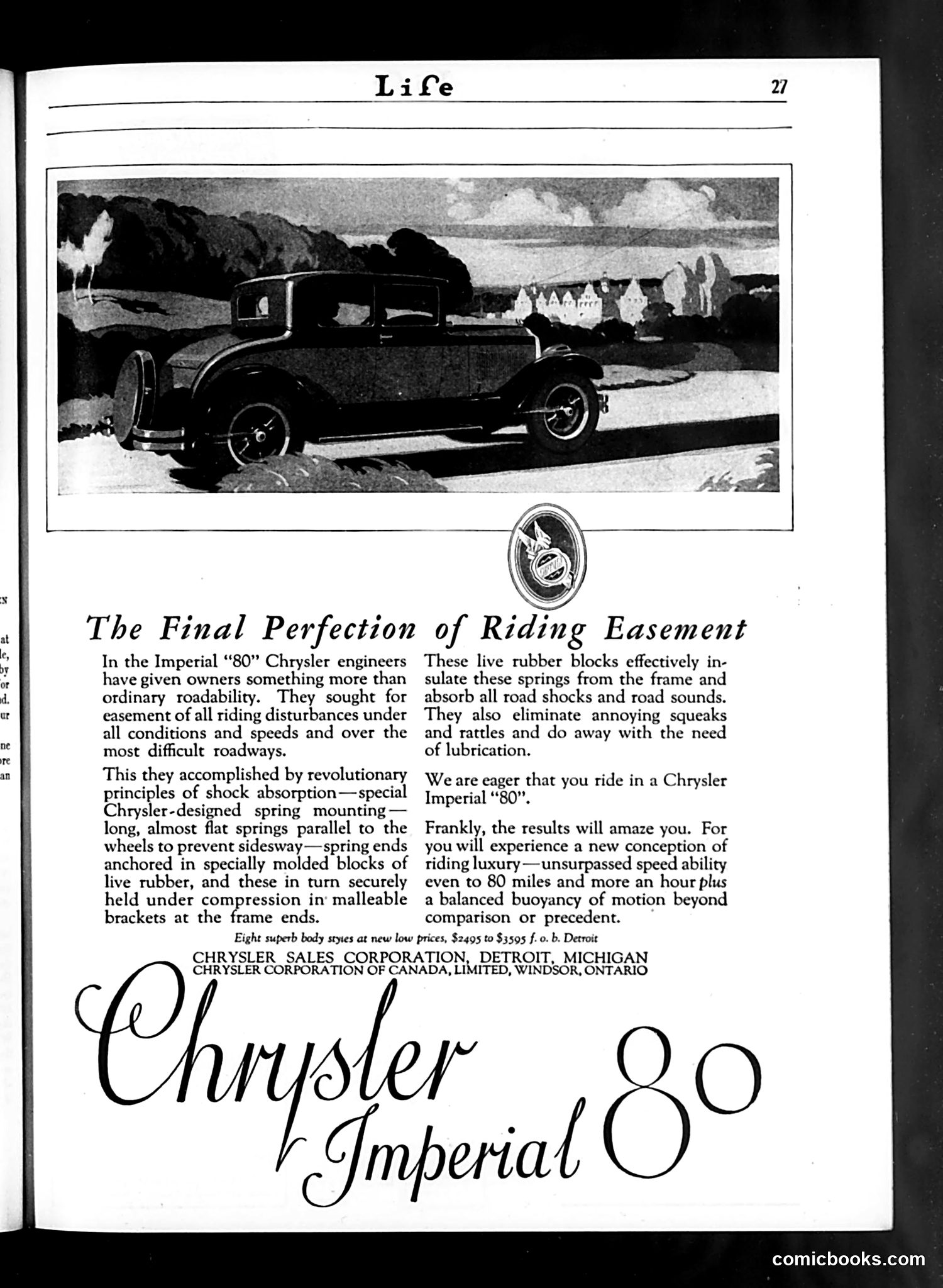
This is **not a cartoon or satire**—it's a straightforward automobile advertisement from Life magazine, page 21. The page promotes the **Chrysler Imperial "80"** sedan, showcasing a sleek 1920s-era car in an idyllic countryside setting. The ad emphasizes engineering innovations in **suspension and shock absorption**: specially designed springs, rubber mounting blocks, and frame brackets intended to eliminate road vibrations and noise. The sales pitch targets affluent buyers seeking luxury and smoothness, promising a "new conception of riding luxury" with speeds up to 80 mph. Pricing ranges from $2,495–$3,595 (substantial sums at the time). There is no satirical content here—this represents typical 1920s automotive advertising, highlighting technical specifications as status markers. The idealized landscape and well-appointed vehicle reflect period consumer aspirations for comfort, speed, and modern engineering.
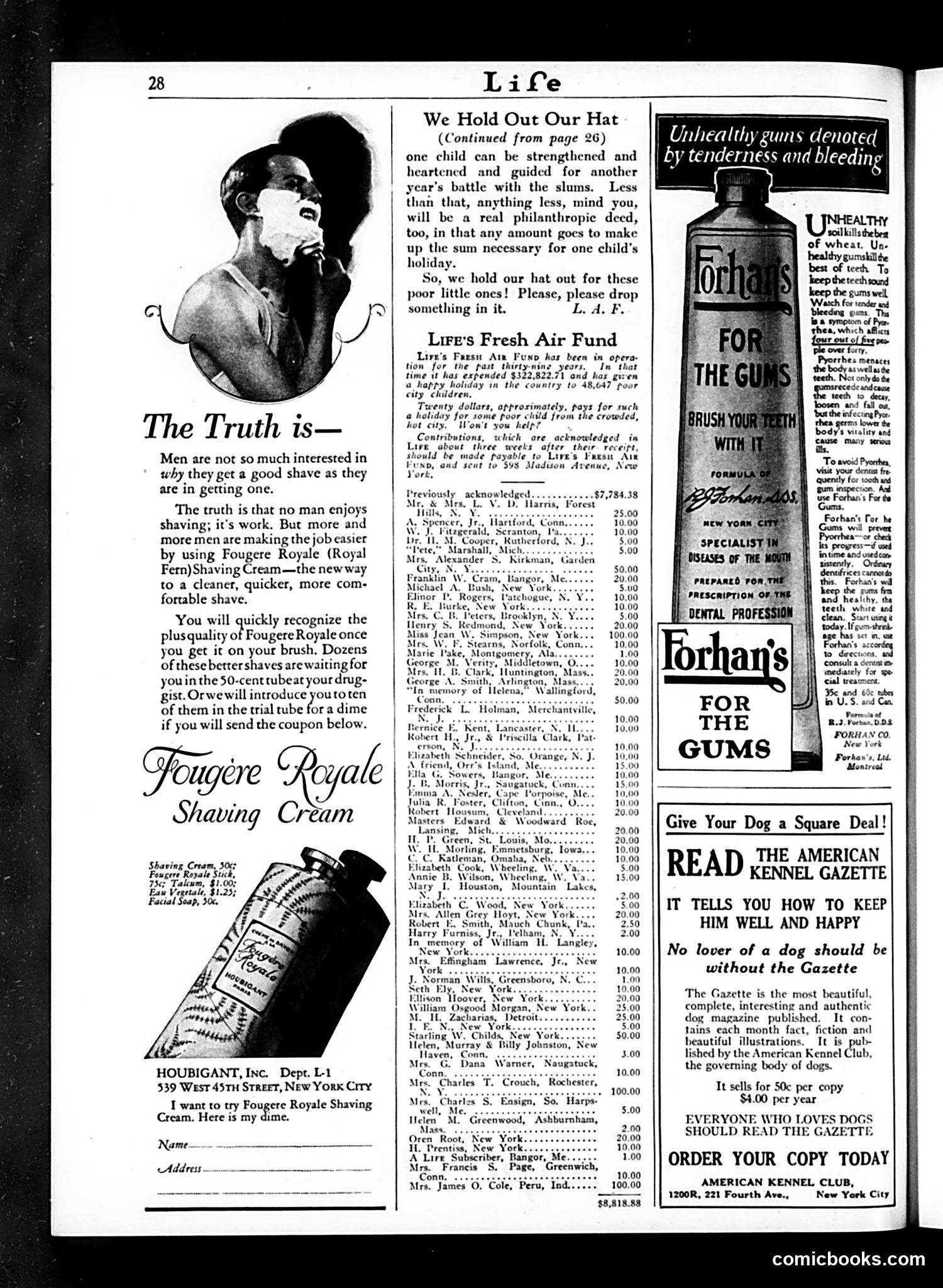
This page combines editorial content with period advertising, centered on early 20th-century concerns about public health and charity. **Main Content:** The left side features "We Hold Out Our Hat," a fundraising appeal for **Life's Fresh Air Fund**—a real charitable program that sent poor urban children to the countryside for holidays. The article appeals to readers' philanthropic instincts, noting the fund has aided nearly 49,000 children over 39 years. Accompanying this is a list of donations ranging from $1 to $100, documenting contributors' names and hometowns. **The Satirical Element:** The framing article "The Truth Is—" mocks men's vanity about shaving, arguing men care less about getting a good shave than *appearing* to. It then pivots to promote **Fougere Royale Shaving Cream** as the solution—a classic advertising strategy: identify a problem (men's discomfort), frame it as shameful, then sell the remedy. **Advertisements:** The right side showcases **Forhan's For The Gums**—a dental product addressing "unhealthy gums denoted by tenderness and bleeding"—and the **American Kennel Gazette** subscription offer. For modern readers: this reflects 1920s-era direct advertising mixed with genuine charitable appeals, where personal grooming anxiety and pet care were emerging consumer concerns.
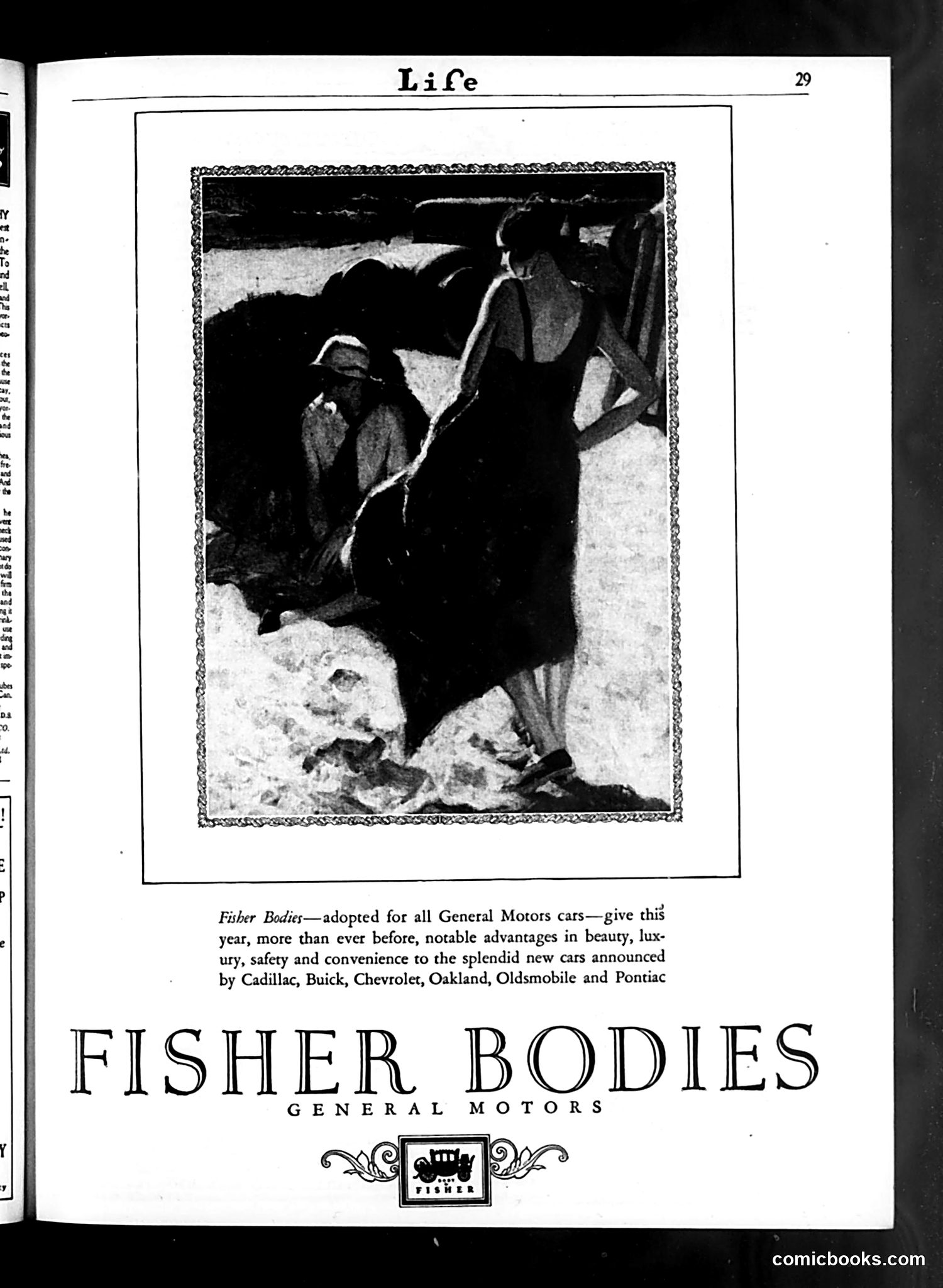
This is primarily a **General Motors advertisement**, not satirical content. It promotes Fisher Bodies, a coachbuilding company that General Motors had acquired to manufacture car bodies for its various brands (Cadillac, Buick, Chevrolet, Oakland, Oldsmobile, and Pontiac). The black-and-white photograph shows what appears to be **factory workers or craftspeople assembling or inspecting a car body**—likely meant to convey quality manufacturing and skilled craftsmanship. The image emphasizes the human expertise behind Fisher Bodies' production. The ad's messaging highlights that Fisher Bodies' adoption across all GM vehicles provides customers with improvements in "beauty, luxury, safety and convenience." This represents a marketing strategy positioning quality car bodies as a premium feature during the 1920s-30s automotive market. The Fisher logo with its carriage imagery reinforces the company's heritage in fine vehicle construction.
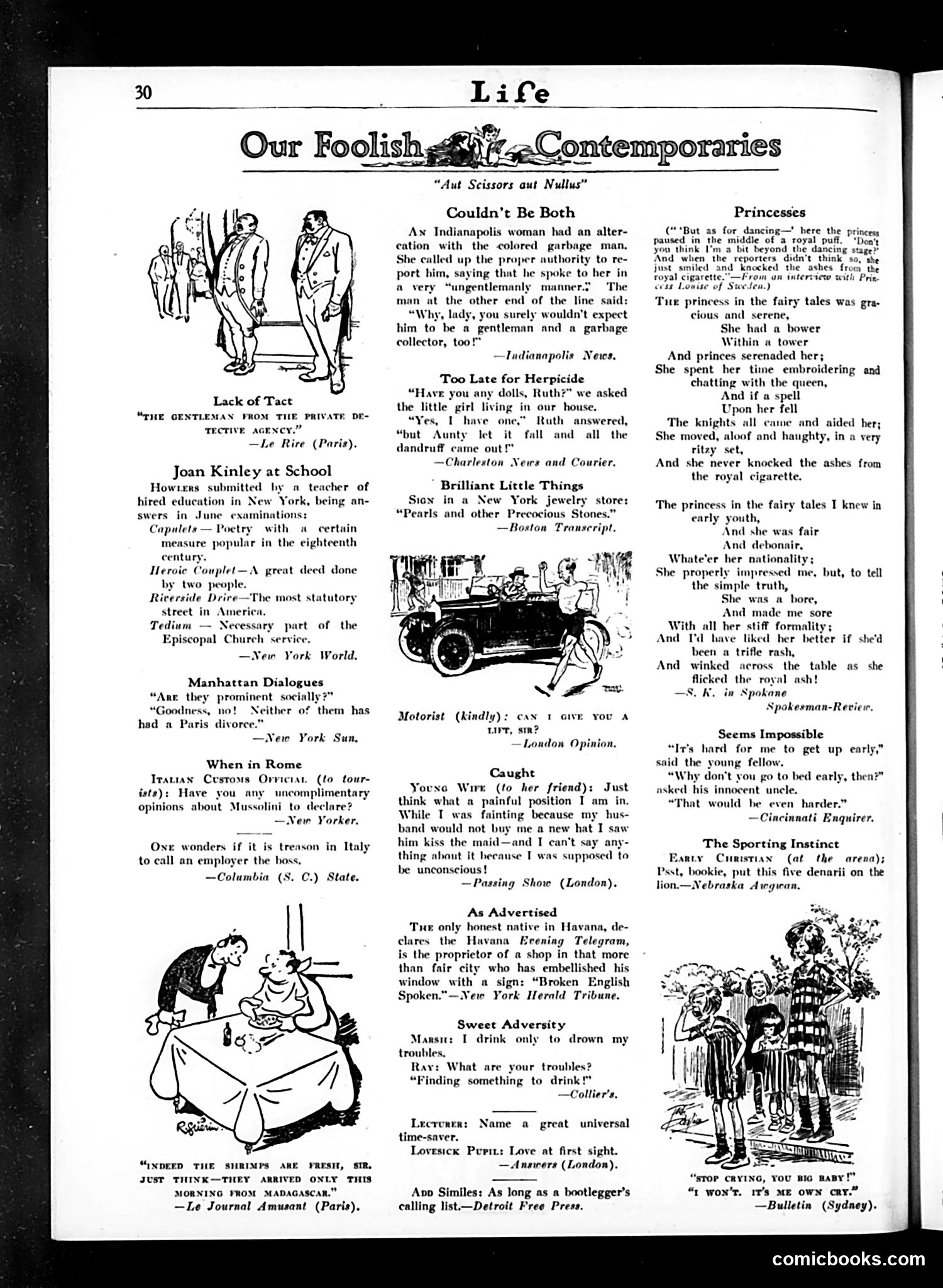
This page from *Life* magazine collects humorous anecdotes and short jokes from various publications, organized under the header "Our Foolish Contemporaries." The content satirizes early 20th-century social pretensions and absurdities. Key examples include: - **"Lack of Tact"**: A cartoon mocking private detectives' bluntness (French source). - **"Couldn't Be Both"**: Jokes about class contradictions—a woman expects a garbage collector to behave like a gentleman, revealing snobbish assumptions. - **"Princesses"**: A longer poem contrasting idealized fairy-tale princesses (gracious, formal) with modern royal women (smoking, flicking ash casually, behaving like ordinary people). The satire suggests modern royalty disappoints romantic expectations. - **"Manhattan Dialogues"**: Mockery of wealthy New Yorkers who gain social standing through divorce. The cartoons and brief quips target pretentiousness, class consciousness, and the gap between traditional expectations and modern behavior. The magazine's satirical approach assumes educated readers who recognize these social ironies.
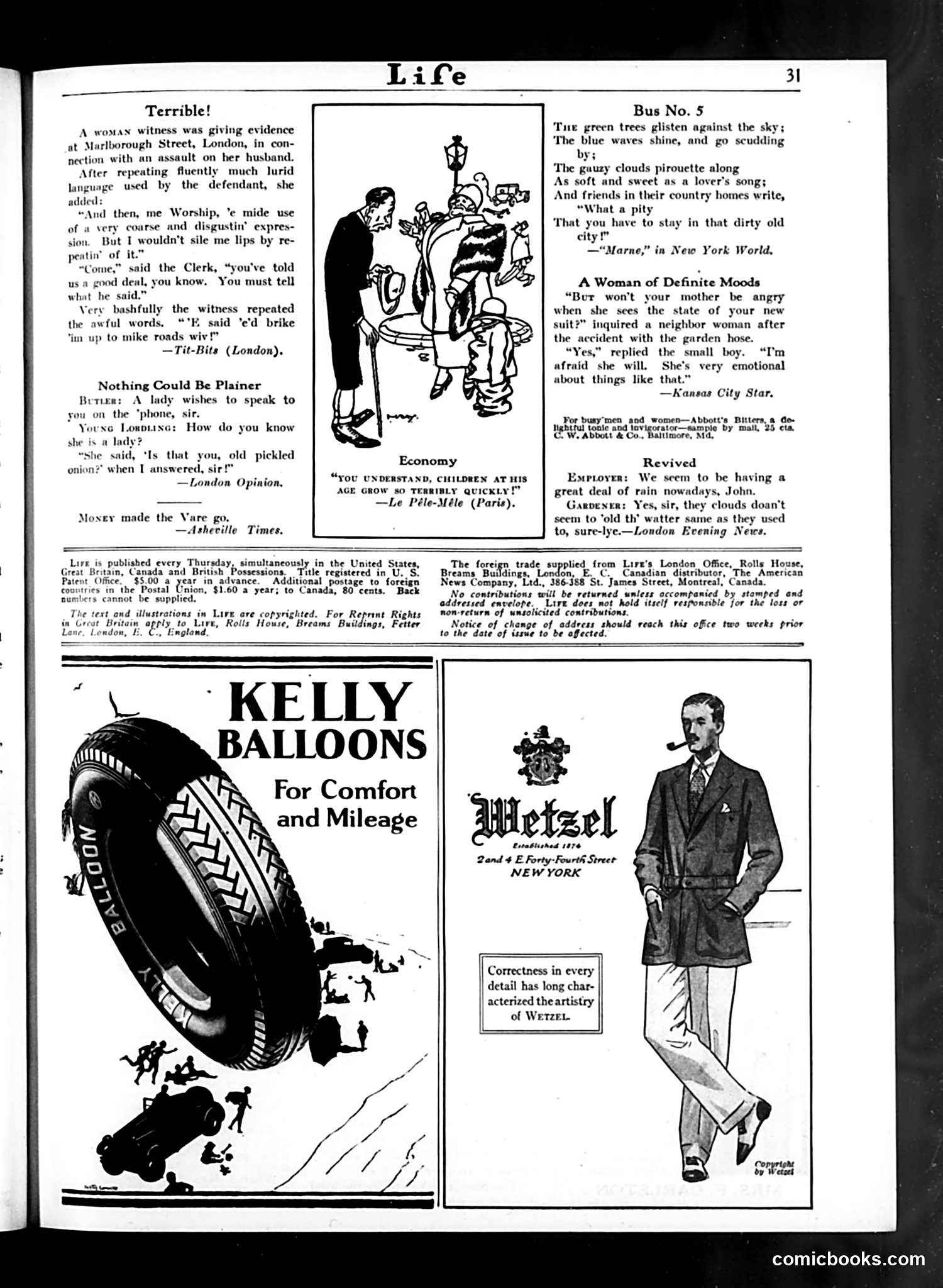
This page from *Life* magazine presents British and American humor anecdotes alongside period advertisements. The jokes rely on wordplay and class-based comedy typical of early 20th-century satire: **"Terrible!"** satirizes a Victorian court witness who freely repeats crude language, then bashfully refuses to say the truly vulgar phrase—highlighting the arbitrary nature of propriety. **"Nothing Could Be Plainer"** plays on how a woman's rude greeting ("old pickled onion") reveals her true character despite her claimed ladyhood—mocking pretension. The other brief jokes mock working-class speech patterns and weather complaints. **Advertisements** include Kelly Balloons (tires) and Wetzel menswear, positioning luxury goods for affluent readers. The boxed cartoon in the center shows a woman scolding children at a lampost, with French caption—the specific reference is unclear without context. The page reflects *Life*'s focus on genteel humor aimed at educated, middle-to-upper-class readers.
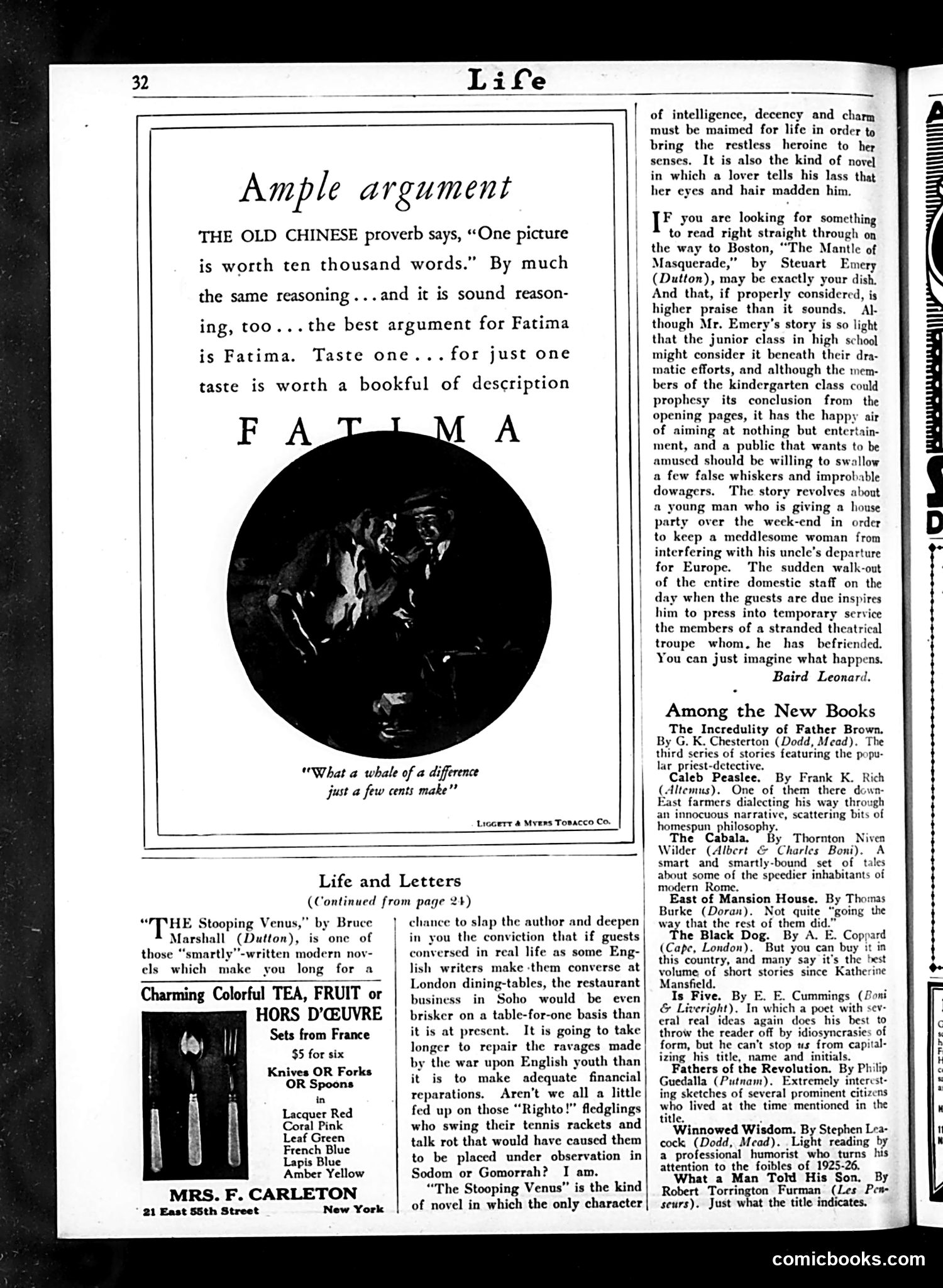
This page is primarily **advertising and book reviews**, not political satire. The main visual element is a **Fatima cigarette advertisement** featuring a circular image of a woman's face. The ad uses the Chinese proverb "one picture is worth ten thousand words" to argue that experiencing the product itself is better than any description. The tagline "What a whale of a difference just a few cents make" emphasizes affordable luxury. Below is a "Life and Letters" column reviewing contemporary novels, including "The Stooping Venus" (criticized for predictable melodrama with disabled heroines) and "The Mantle of Masquerade" (praised as light entertainment). The reviewer dismisses post-WWI British fiction featuring overly cheerful young characters saying "Righto!" The page also advertises **Mrs. F. Carleton's French tableware sets** (tea, hors d'oeuvres, cutlery) and lists "Among the New Books," including works by Chesterton, Wilder, and Cummings. **No political commentary is evident here**—this is consumer-focused editorial content typical of 1920s Life magazine.
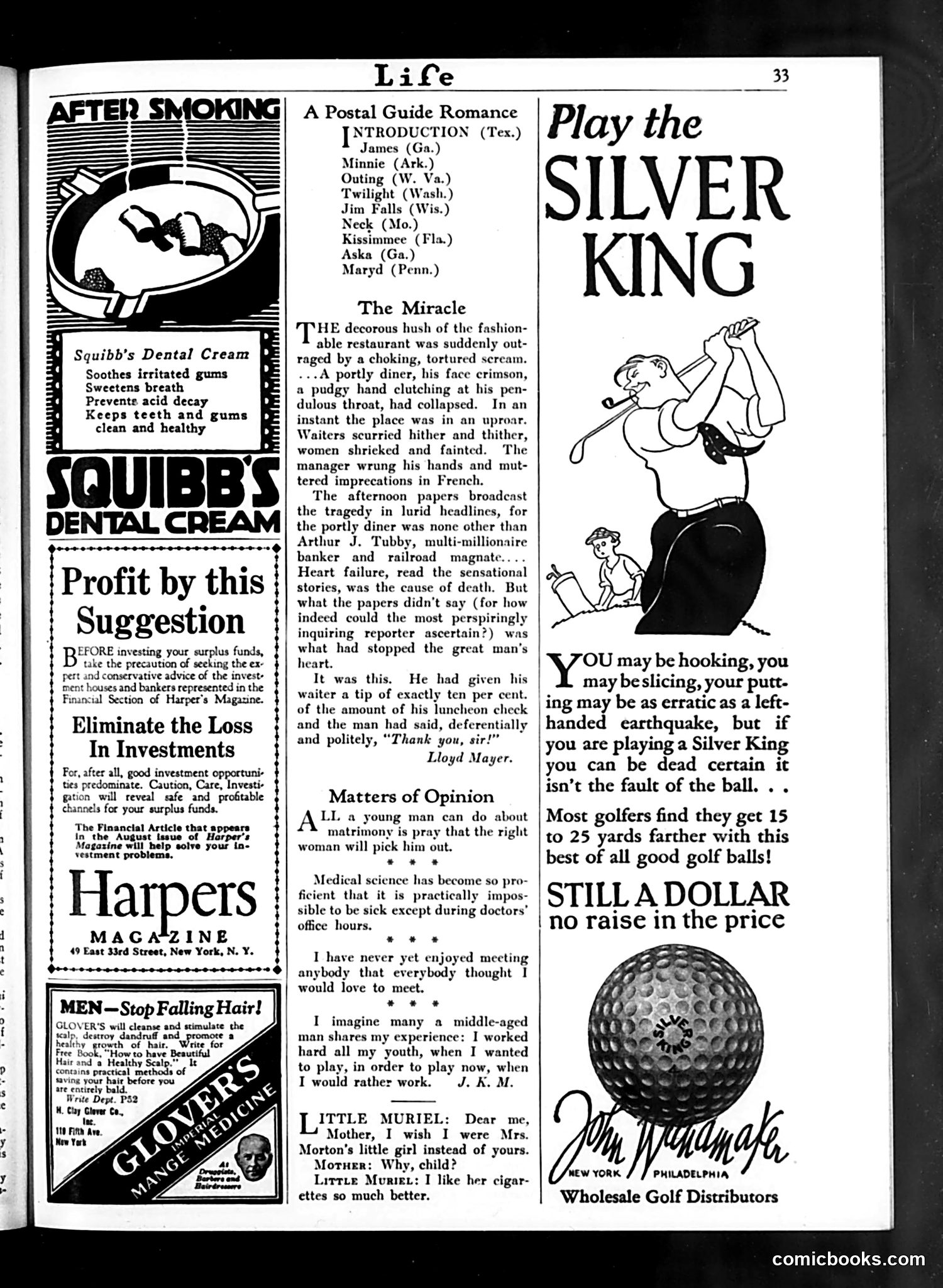
This page mixes advertisements with satirical humor typical of Life magazine's format. **"The Miracle" Story:** A humorous short story about Arthur J. Tubby, a wealthy banker who dies in a fancy restaurant. The twist: his heart stops not from the choking incident, but because he gave his waiter a ten percent tip—and the waiter thanked him politely anyway. The satire targets both miserliness among the wealthy and the absurdity of tipping culture: the implication that a rich man would be so shocked by his own generosity that it literally stops his heart. **"Matters of Opinion" Column:** Brief satirical observations on modern life—matrimony, medicine's office hours, social obligations—typical of period humor offering cynical social commentary. **"Little Muriel" Joke:** A child prefers her neighbor's mother because of better cigarettes, satirizing both children's innocence and advertising's pervasiveness. **Advertisements** for Squibb's Dental Cream, Harper's Magazine investments, Glover's hair medicine, and Silver King golf balls dominate the left and bottom margins.
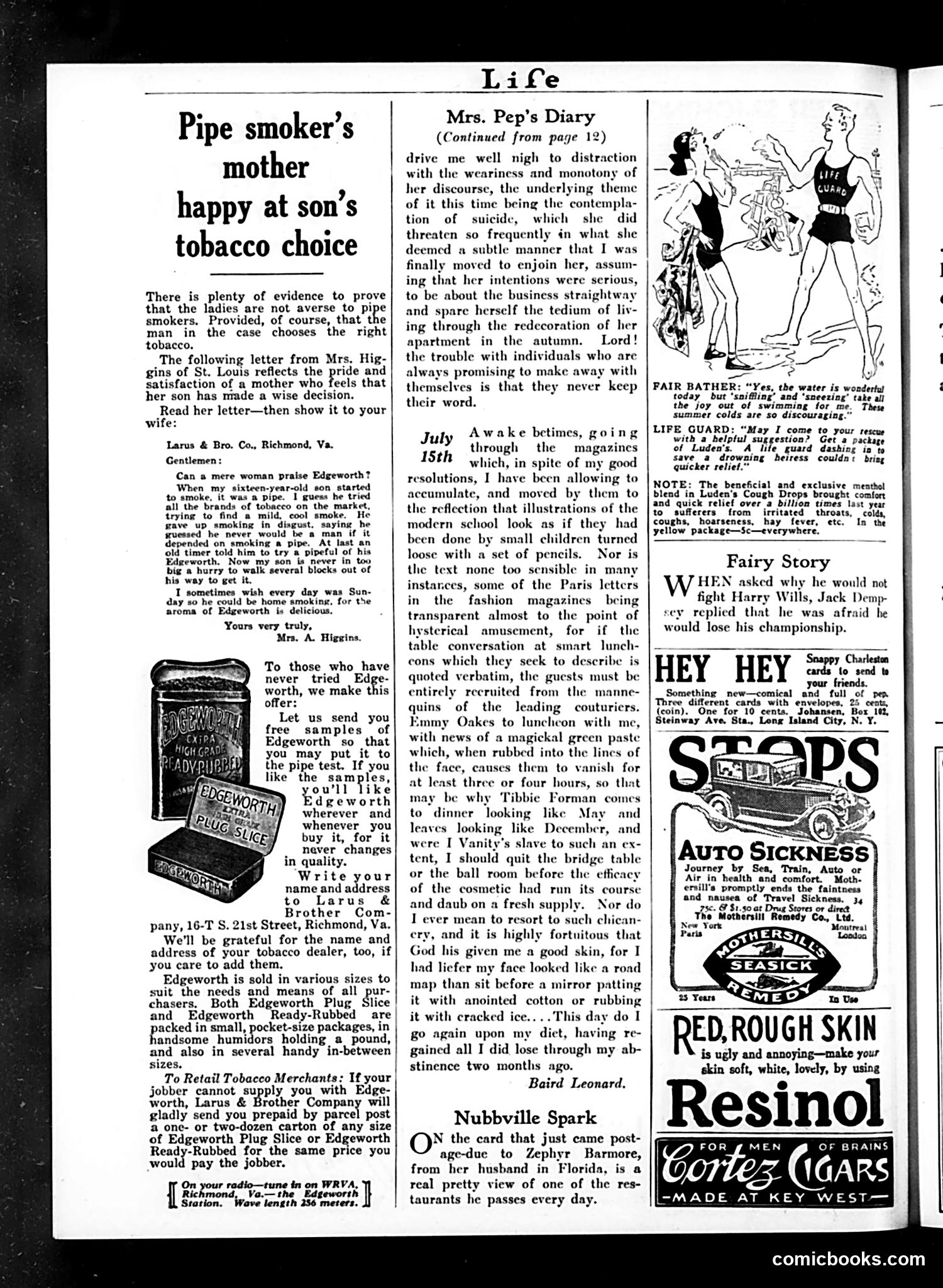
This page is primarily **advertising** disguised as editorial content. The main feature is a fake "letter to the editor" praising Edgeworth pipe tobacco, supposedly from "Mrs. A. Higgins" of St. Louis. The testimonial claims her previously reluctant teenage son became devoted to smoking after trying Edgeworth. The satire targets **consumer advertising tactics** of the 1920s-30s: using fabricated "real customer" endorsements to manipulate purchasing decisions. The implausibly perfect narrative—a mother happily endorsing her son's smoking habit based on one brand—is absurd enough to read as parody. The secondary content includes "Mrs. Pep's Diary" (a gossip column) and various beauty/health product ads (Resinol, seasickness remedies), typical magazine filler. The broader joke: Life magazine (a satirical publication) is gently mocking how tobacco companies used fake testimonials and maternal approval to market addictive products to young people.
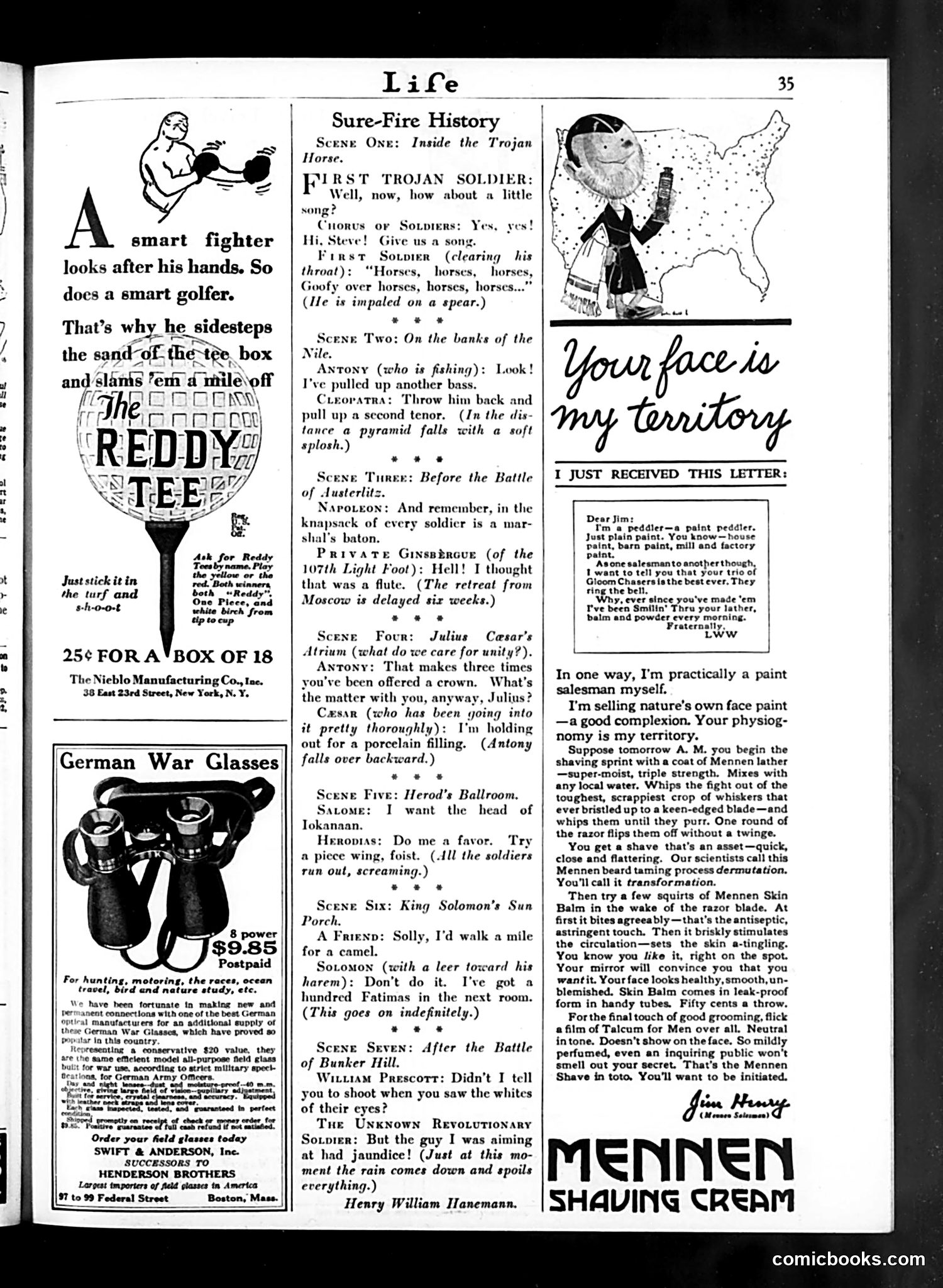
This page contains **"Sure-Fire History,"** a satirical sketch by Henry William Hanemann that mocks historical narratives by inserting absurd modern anachronisms and non-sequiturs into famous historical moments. The humor derives from historical figures making ridiculous statements or trivial complaints that contradict the gravity of events: a Trojan soldier gets impaled while singing about horses; Napoleon worries about porcelain dental work instead of conquest; King Solomon admits to owning "a hundred Fatimas"; a Revolutionary War soldier claims his target had jaundice. The satire appears to mock both pretentious historical drama and perhaps contemporary politicians/military figures who make seemingly important pronouncements about serious matters while remaining fundamentally petty or self-absorbed. The page also contains period advertisements (German War Glasses, Reddy Tee golf product) and a Mennen Shaving Cream ad with testimonial letter—typical of 1910s-era Life magazine content.
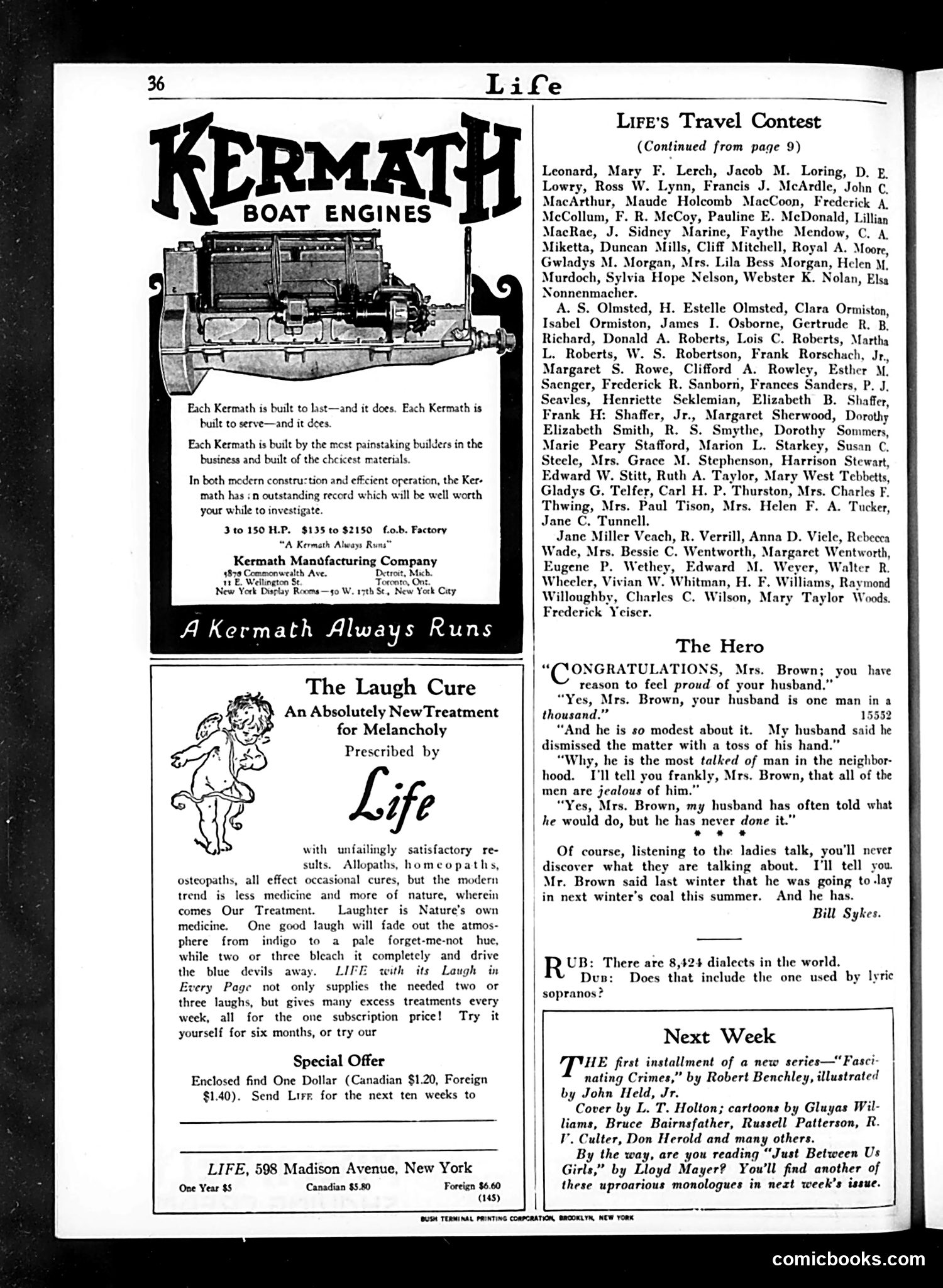
This is primarily a **satirical piece about male boasting and inaction**, not a political cartoon. The humor targets a common social dynamic of the era. The setup: Ladies congratulate Mrs. Brown on her husband being "one man in a thousand"—modest, talked-about, admired by other men (who are "jealous"). The punchline reveals the truth: Mr. Brown has often *claimed* he would do impressive things but has "never done it." The satire mocks **masculine posturing**—men who gain reputations through talk rather than accomplishment. The ladies' obliviousness to what they're actually praising (nothing) is the joke's target. The final line promises readers will learn what Mr. Brown supposedly did, suggesting the reveal is deliberately anticlimactic. This reflects early 20th-century *Life* magazine's satirical approach to domestic life and gender dynamics, gently poking fun at both male braggadocio and female gullibility in social situations.
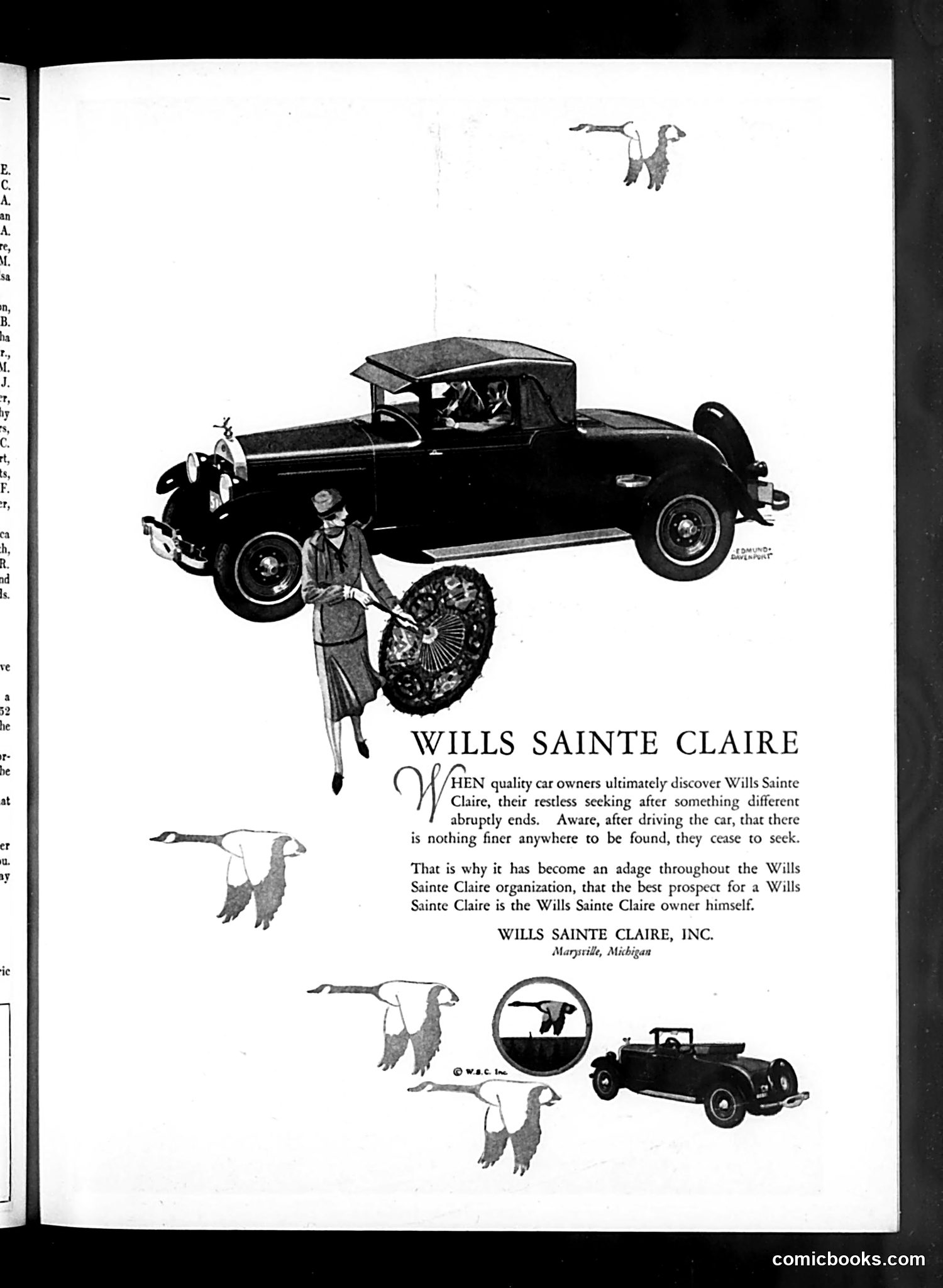
This is **a vintage automobile advertisement**, not satire or political commentary. It advertises the Wills Sainte Claire car, manufactured in Marysville, Michigan. The decorative illustrations—stylized women in 1920s dress holding large fans, and small dogs—are typical Art Deco ornaments common in period advertising. They serve no satirical purpose. The ad's message is straightforward marketing: Wills Sainte Claire owners become so satisfied they become the best customers for future sales ("the best prospect for a Wills Sainte Claire is the Wills Sainte Claire owner himself"). This reflects luxury car positioning emphasizing exclusivity and quality. The Wills Sainte Claire was an actual high-end automobile brand (1921-1927), and this appears to be a genuine period advertisement rather than Life magazine's typical satirical content.
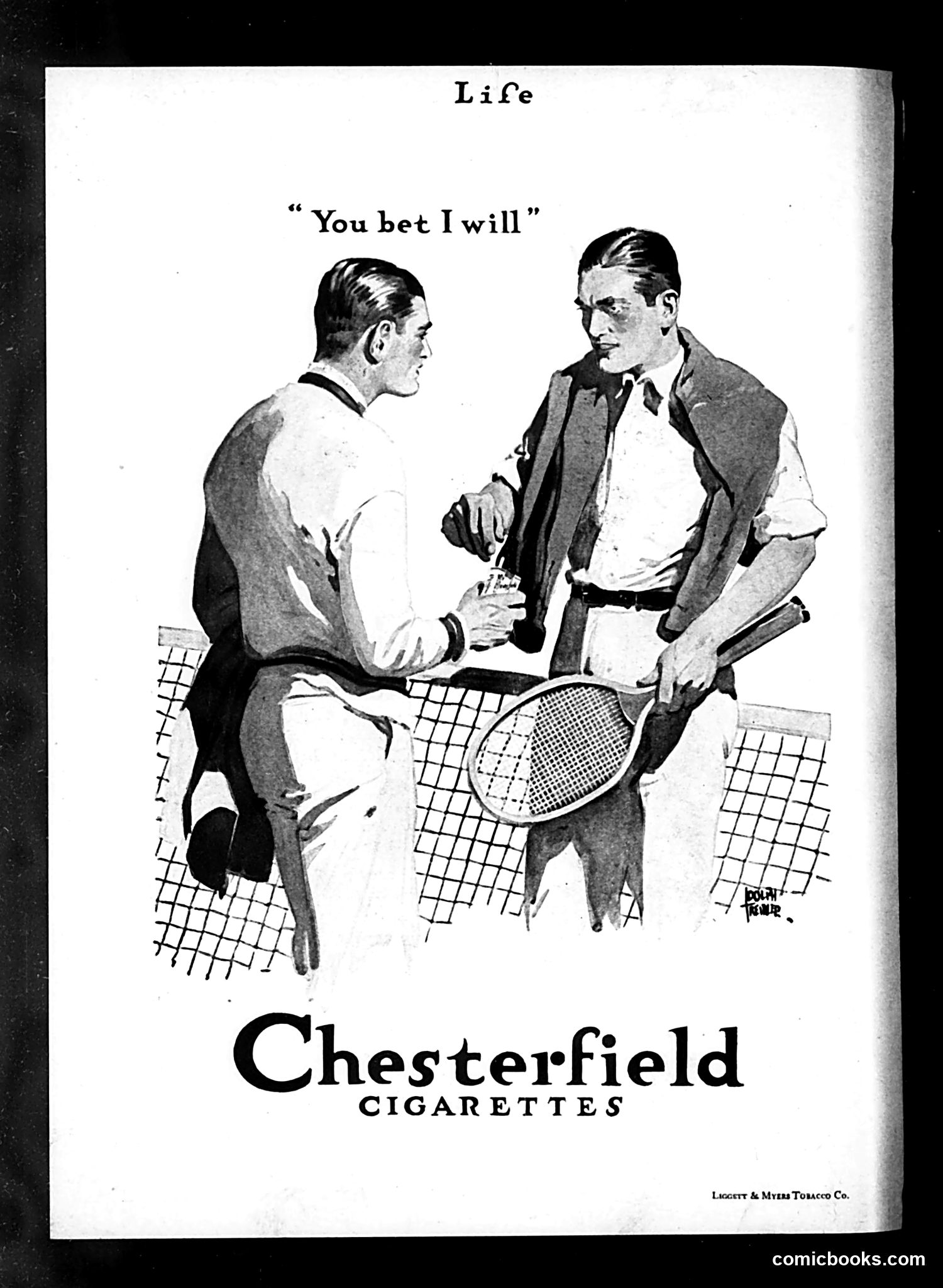
This is a vintage advertisement for Chesterfield cigarettes from *Life* magazine. It depicts two well-dressed men on a tennis court engaged in conversation, with one saying "You bet I will"—apparently accepting a wager or challenge about a tennis match. The ad uses aspirational imagery common to mid-20th-century cigarette marketing: athletic, sophisticated men in leisure settings. The implication is that Chesterfield smokers are successful, confident, and socially prominent. The tennis court setting reinforces associations with wealth, health, and active lifestyles—ironic given cigarettes' actual health effects. This represents pre-warning-label tobacco advertising, when such ads routinely appeared in mainstream publications without disclaimers.

I can see this is a very dark, low-contrast black and white image from what appears to be an old publication. The page is largely illegible due to the poor image quality and darkness. While the OCR text indicates this is from "Life" magazine (visible in the comicbooks.com watermark), I cannot reliably make out specific cartoon illustrations, text content, political figures, or satirical commentary from the actual image provided. To properly explain the historical context and meaning of the cartoon(s) as requested, I would need a clearer, higher-contrast version of this page. I cannot responsibly identify figures or interpret the satire without being able to see the actual content clearly.