
Life, 1926-08-05 · page 26 of 41
Life — August 5, 1926 — page 26: what you’re looking at
What you’re looking at
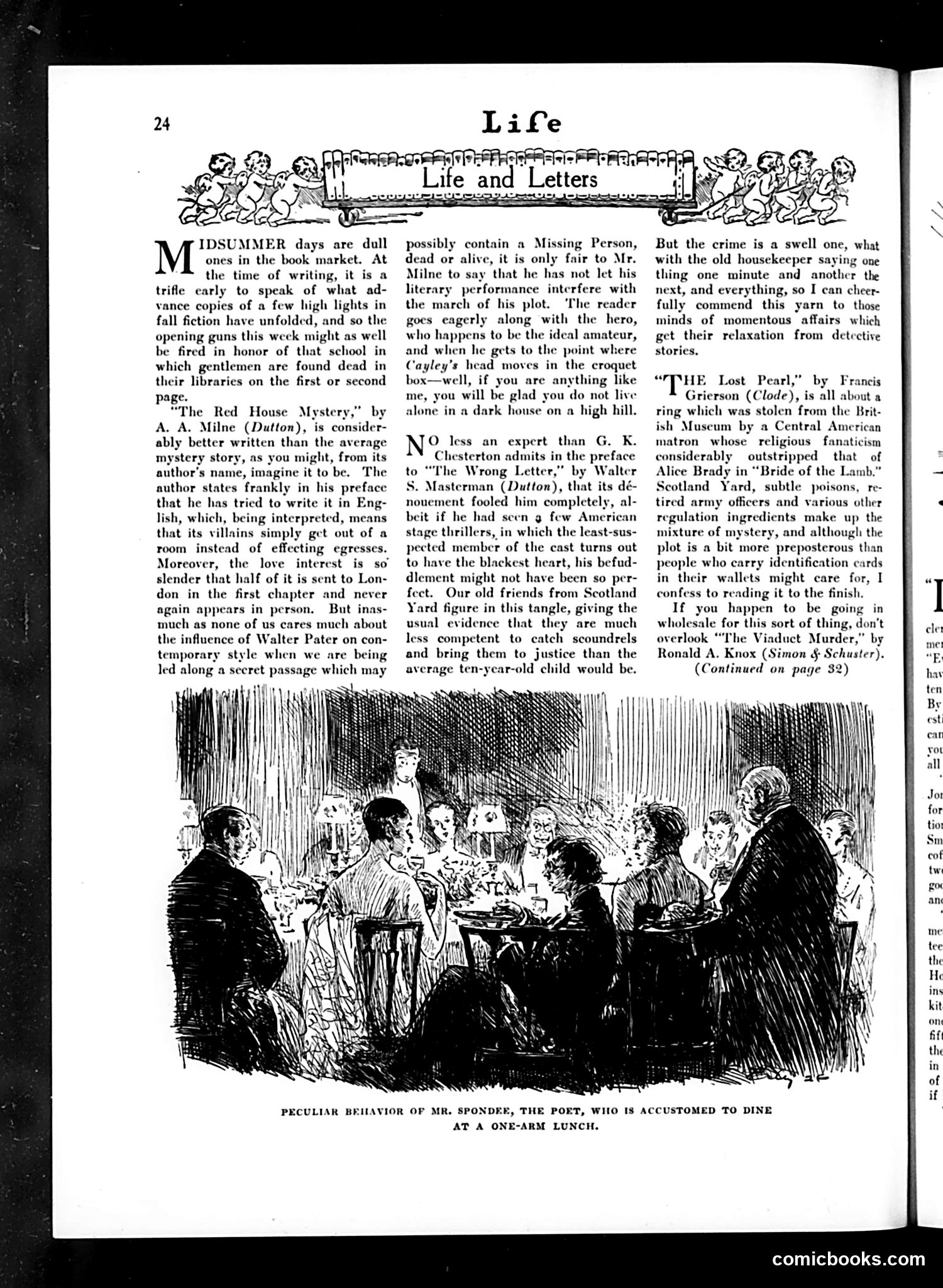
This page reviews three mystery novels for a general literary audience. The main cartoon illustrates a humorous social observation unrelated to the reviews: it depicts Mr. Spondee, a poet, dining at a "one-arm lunch" (a casual cafeteria-style restaurant) while eating with one hand—a joke about his name and his profession. The satire mocks the eccentric behavior or pretensions of artists/poets in everyday situations. The book reviews discuss A.A. Milne's *The Red House Mystery*, Francis Grierson's *The Lost Pearl*, and Ronald A. Knox's *The Viaduct Murder*. The critic praises Milne for prioritizing plot over literary style, admits that G.K. Chesterton was fooled by the mystery's solution, and generally recommends all three as entertaining detective fiction. The tone is informal and witty, typical of Life's satirical approach to culture.
📄 Transcribed text from this page (OCR, searchable)
Machine-transcribed from the original scan — historical spelling and the odd misread are preserved.
M the time of wri trifle carly to speak of what ad- vance copies of a few high lights in fall fiction have unfolded, and so the opening guns this weck might as well be fired in honor of that school in which gentlemen are found dead in their libraries on the first or second page. “The Red House Mystery,” by A. A. Milne (Dutton), is consider- ably better written than the average mystery story, as you might, from its author's name, imagine it to be. The author states frankly in his preface that he has tried to write it in Eng- lish, which, being interpreted, means that its villains simply get out of a room instead of effecting egresses. Moreover, the love interest slender that half of it is sent to Lon- don in the first chapter and never again appears in person. But inas- much as none of us cares much about the influence of Walter Pater on con- temporary style when we are being led along a secret passage which may PECULIAR BEMAVIOR OF MR, SPONDER, THE is so possibly contain a Missing Person, dead or alive, it is only fair to Mr. Milne to say that he has not let his literary performance interfere with the march of his plot. ‘The reader goes eagerly along n the hero, who happens to be the ideal amateur, and when he gets to the point where Cayley’s head moves in the croquet box—well, if you are anything like me, you will be glad you do not li alone in a dark house on a high hill. O less an expert than G. K,. Chesterton admits in the preface nouement fooled him completely, a beit if he had scen g few America stage thrillers, in which the least-sus- pected member of the cast turns out to have the blackest heart, his befud- dicment might not have been so per- fect. Our old friends from Scotland Yard figure in this tangle, giving the usual evidence that they are much less competent to catch scoundrels and bring them to justice than the average ten-year-old child would be. AT A ONE-ARM LUNCH. But the crime is a swell one, what with the old housekeeper saying one thing one minute and another the next, and everything, so I can cheer- fully commend this yarn to those minds of momentous affairs which get their relaxation from detective stories, HE Lost Pearl,” by Francis Grierson (Clode), is all about a ring which was stolen from the Brit- ish Museum by a Central American matron whose religious fanaticism considerably outstripped that of Alice Brady in “Bride of the Lamb.” Scotland Yard, subtle tired army offi and various other regulation ingredients make up the mixture of mystery, and although the plot is a bit more preposterous than people who carry identification cards in their wallets might care for, I confess to reading it to the finish. If you happen to be going in wholesale for this sort of thing, don’t overlook “Ihe Viaduct Murder,” by Ronald A. Knox (Simon § Schuster). (Continued on page 32) poisons, re- POET, WHO IS ACCUSTOMED TO DINE comicbooks.com