
Life, 1926-08-05 · page 18 of 41
Life — August 5, 1926 — page 18: what you’re looking at
What you’re looking at
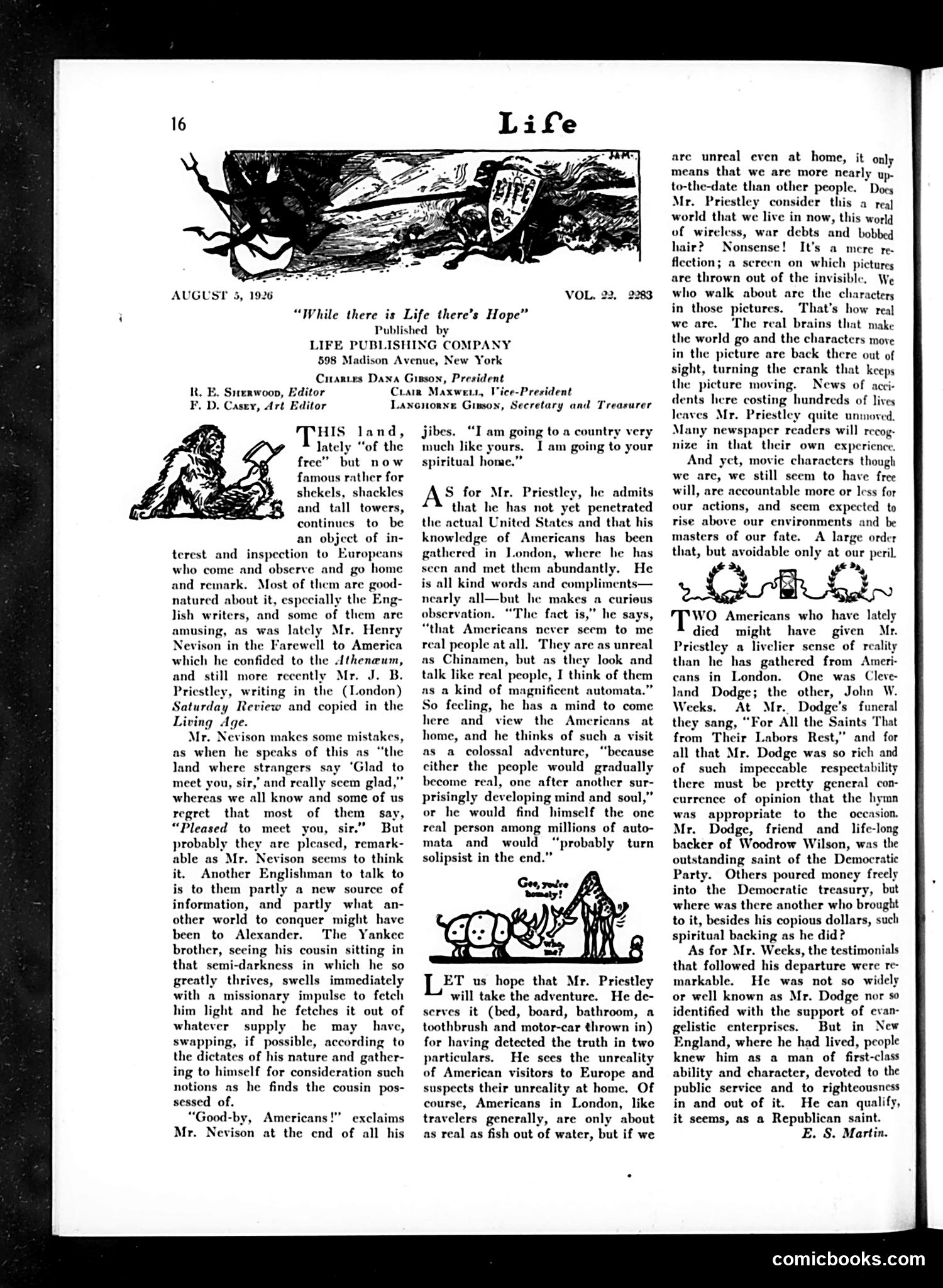
This page contains a satirical article about Mr. J.B. Priestley, a British writer, who the text indicates is visiting America and observing American life. The article critiques Priestley's observations about Americans, suggesting he finds them "unreal" and mechanical—like "magnificent automata." The cartoons mock both Priestley's perspective and American culture. One illustration shows figures in an exaggerated, puppet-like manner, reinforcing the automata comparison. The text humorously defends Americans against Priestley's criticism while simultaneously poking fun at American materialism and superficiality. The piece also briefly discusses the funeral of Cleveland Dodge, a prominent American businessman, noting the respectability afforded him despite his wealth—a likely critique of American reverence for the wealthy.
📄 Transcribed text from this page (OCR, searchable)
Machine-transcribed from the original scan — historical spelling and the odd misread are preserved.
22, “While there is Life there’s Hope” Published by LIFE PUBLISHING COMPANY 598 Madison Avenue, New York Cirantes Dana Ginson, President R. E. Sirerwoon, Editor F, D. Casey, Art Editor HIS land, lately “of the free” but now famous rather for shekels, shackles and tall towers, continues to be an object of in- terest and inspection to Europeans who come and observe and go home and remark. Most of them are good- natured about it, especially the Eng- lish writers, and some of them are amusing, as was latcly Mr. Henry Nevison in the Farewell to America vhich he confided to the Atheneum, and still more recently Mr. J. B. Priestley, writing in the (London) Saturday Review and copied in the Living Age. Mr. son makes some mistakes, as when he speaks of this as “the land where strangers say ‘Glad to meet you, sir,’ and really seem glad,” whereas we all know and some of us regret that most of them say, “Pleased to mect you, sir.” But probably they are pleased, remark- able as Mr. Nevison seems to think it. Another Englishman to talk to is to them partly a new source of information, and partly what an- other world to conquer might have been to Alexander. The Yankee brother, seeing his cousin sitting in that semi-darkness in which he so greatly thrives, swells immediately with a missionary impulse to fetch him light and he fetches it out of whatever supply he may have, swapping, if possible, according to the dictates of his nature and gather- ing to himself for consideration such notions as he finds the cousin pos- sessed of. “Good-by, Americans!” exclaims Mr. Nevison at the end of all his Chaim Maxwens, Vice-President Lanouorxn Guson, Secretary and Treasurer jibes. “I am going to a country very much like yours. I am going to your spiritual home.” S for Mr. Priestley, he admits that he has not yet penetrated the actual United States and that his knowledge of Americans has been gathered in London, where he has seen and met them abundantly. He is all kind words and compliments— nearly all—but he makes a curieus observation. “The fact is,” he says, “that Americans never seem to me real people at all. They are as unreal as Chinamen, but as they look and talk like real people, I think of them as a kind of magnificent automata.” So fecling, he has a mind to come here and view the Americans at home, and he thinks of such a visit as a colossal adventure, “because cither the people would gradually become real, one after another sur- prisingly developing mind and soul,” or he would find himself the one real person among millions of auto- mata and would “probably turn solipsist in the end.” ET us hope that Mr. Priestley will take the adventure. He de- serves it (bed, board, bathroom, a toothbrush and motor-car thrown in) for having detected the truth in two particulars. He sees the unreality of American visitors to Europe and suspects their unreality at home. Of course, Americans in London, like travelers generally, are only about as real as fish out of water, but if we are unreal even at home, it only means that we are more nearly up- to-the-date than other people. Mr. Priestley consider this a real world t we live in now, this world of wireless, war debts and bobbed hair? Nonsense! It’s a mere te- flection; a screen on which pictures are thrown out of the invisible. We who walk about are the characters in those pictures. That's how real we are. The real brains that make the world go and the characters move in the picture are back there out of sight, turning the crank that keeps the picture moving. News of acci- dents here costing hundreds of lives leaves Mr. Priestley quite unmoved. Many newspaper readers will recog- nize in that their own experience. And yet, movie characters though we arc, we still seem to have free will, are accountable more or less for our actions, and scem expected to rise above our environments and be masters of our fate. A large order that, but avoidable only at our peril. Ot CoE WO Americans who have lately died might have given Mr. Priestley a livelier sense of reality than he has gathered from Ameri- cans in London. One was Cleve- land Dodge; the other, John W. Weeks. At Mr. Dodge’s funeral they sang, “For All the Saints That from Their Labors Rest,” and for all that Mr. Dodge was so rich and of such impeccable respectability there must be pretty general con- currence of opinion that the hymn was appropriate to the occasion. Mr. Dodge, friend and _ life-long backer of Woodrow Wilson, was the outstanding saint of the Democratic Party. Others poured money freely into the Democratic treasury, but where was there another who brought to it, besides his copious dollars, such spiritual backing as he did? As for Mr. Weeks, the testimonials that followed his departure were re- markable. He was not so widely or well known as Mr. Dodge nor so identified with the support of evan- gelistic enterprises. But in New England, where he had lived, people knew him as a man of first-class ability and character, devoted to the public service and to righteousness in and out of it. He can qualify, it seems, as a Republican saint. E. S. Martin. Docs comicbooks.com