
Life, 1926-08-05 · page 4 of 41
Life — August 5, 1926 — page 4: what you’re looking at
What you’re looking at
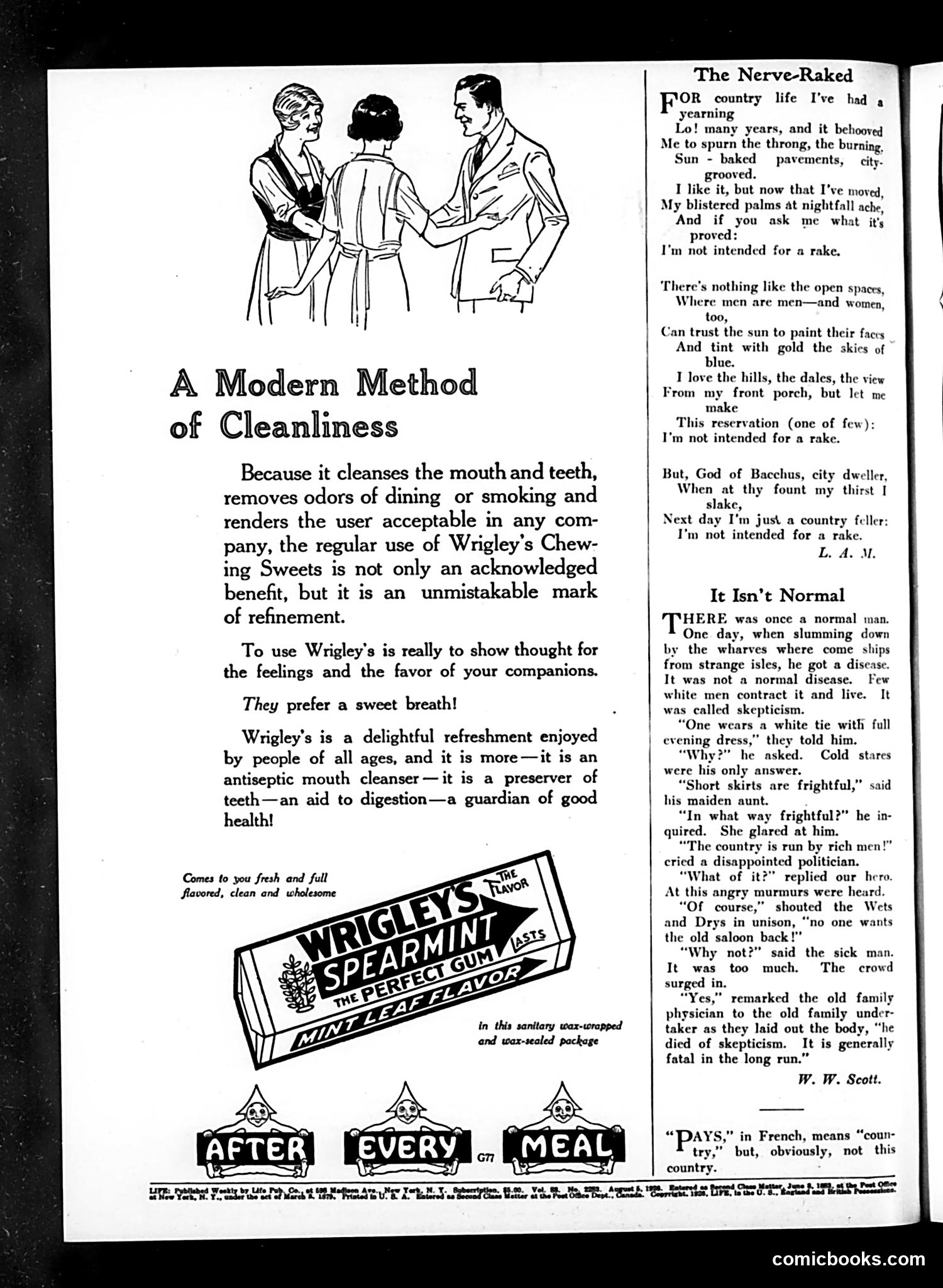
This page contains a **Wrigley's Spearmint Gum advertisement** disguised as editorial content—a common early 20th-century marketing practice. The left side features "A Modern Method of Cleanliness," promoting gum as a social refinement that freshens breath after meals and demonstrates consideration for companions. The illustration shows three well-dressed figures in conversation, implying that chewing gum signals good manners and hygiene. The right side contains two separate pieces: a poem titled "The Nerve-Raked" about urban versus country living, and a short story "It Isn't Normal" by W.W. Scott satirizing social conformity and skepticism. The advertisement's core message—that gum use marks refinement and social awareness—reflects early 1900s anxieties about urbanization, manners, and what constitutes acceptable public behavior.
📄 Transcribed text from this page (OCR, searchable)
Machine-transcribed from the original scan — historical spelling and the odd misread are preserved.
A Modern Method of Cleanliness Because it cleanses the mouth and teeth, removes odors of dining or smoking and renders the user acceptable in any com- pany, the regular use of Wrigley’s Chew- ing Sweets is not only an acknowledged benefit, but it is an unmistakable mark of refinement. To use Wrigley's is really to show thought for the feelings and the favor of your companions, They prefer a sweet breath! Wrigley’s is a delightful refreshment enjoyed by people of all ages, and it is more—it is an antiseptic mouth cleanser—it is a preserver of teeth—an aid to digestion—a guardian of good health! Comes to you fresh and full flavored, clean and in this sanitary wax-wrapped and wax-sealed package The Nerve-Raked For country life I've had yearning Lo! many years, and it behooved Me to spurn the throng, the burning, Sun - baked pavements, city. grooved. 7 I like it, but now that I've moved, My blistered palms at nightfall ache, And if you ask me what it's proved: I'm not intended for a rake, There's nothing like the open spaces, Where men are men—and women, too, Can trust the sun to paint their faces And tint with gold the skies of blue. I love the hills, the dales, the view From my front porch, but let me make This reservation (one of few): I'm not intended for a rake. But, God of Bacchus, city dweller, When at thy fount my thirst I slake, Next day I’m just a country feller: I'm not intended for a rake. L. A. M. It Isn’t Normal HERE was once a normal man. One day, when slumming down by the wharves where come ships from strange isles, he got a disease. It was not a normal disease. Few white men contract it and live. It was called skepticism. “One wears a white tie with full evening dress,” they told him. “Why?” he asked. Cold stares were his only answer. “Short skirts are frightful,” said his maiden aunt. “In what way frightful?” he in- quired. She glared at him. “The country is run by rich men!” cried a disappointed politician. “What of it?” replied our hero. At this angry murmurs were heard. “Of course,” shouted the Wets and Drys in unison, “no one wants the old saloon back!” “Why not?” said the sick man. It was too much. The crowd surged in. “Yes,” remarked the old family physician to the old family under- taker as they laid out the body, “he died of skepticism. It is generally fatal in the long run.” W. W. Scott. “DAYS,” in French, means “‘coun- try,” but, obviously, not this country. EEL PO FoR eet Ea A Lote a te Se Rs Slee Ta PS Oe ea es: comicbooks.com