
Life, 1926-08-05 · page 14 of 41
Life — August 5, 1926 — page 14: what you’re looking at
What you’re looking at
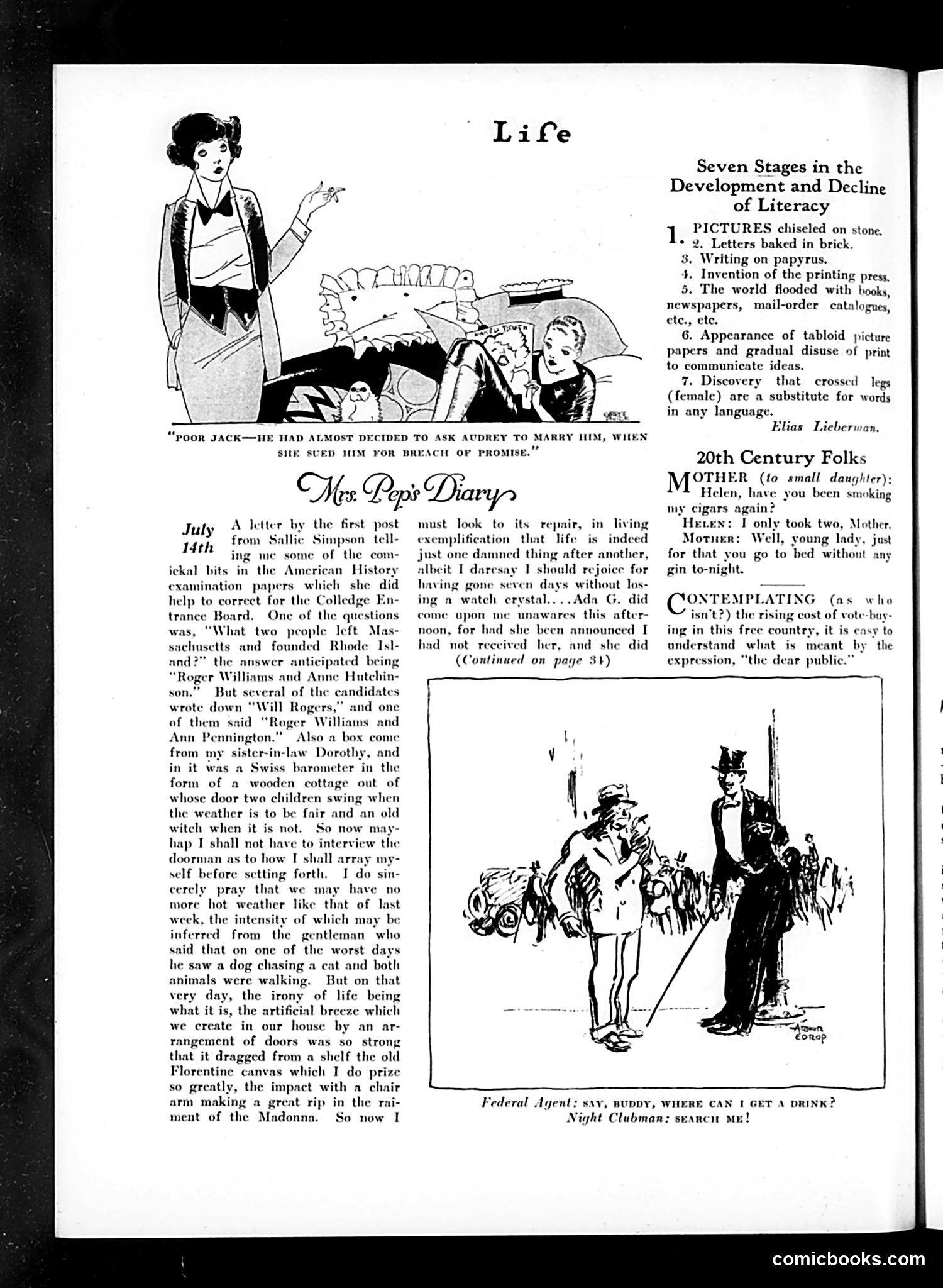
This page contains **Mrs. Pep's Diary**, a column about American history exam questions. The author discusses Rhode Island's founding, mentioning "Roger Williams and Ann Hutchinson" were candidates for answers, but "Roger Williams" and "Will Rogers" appear in the sources instead—likely a confusion of historical figures with the contemporary comedian Will Rogers. The bottom cartoon satirizes **Prohibition enforcement**. A well-dressed Federal Agent and Night Clubman are depicted, with the agent asking "where can I get a drink?" while the night clubman responds "search me!"—a joke about Prohibition's ironic effect: even law enforcement officers couldn't legally obtain alcohol, undermining the policy's credibility. This reflects 1920s public skepticism about Prohibition's enforcibility.
📄 Transcribed text from this page (OCR, searchable)
Machine-transcribed from the original scan — historical spelling and the odd misread are preserved.
fi ep) NOG aeiviti: “PooR JACK—HE HAD ALMOST DECIDED TO ASK AUDREY TO MARRY HIM, WIEN SHE SUED HIM FOR BREACIT OF PROMISE.” July A letter by the first post 14th from Sallie Simpson tell- ing me some of the com- 1 bits in the American History mination papers which she did help to correct for the Colledge En- trance Board. One of the questions was, “What two people left Mas- sachusetts and founded Rhode Isl- and?” the answer anticipated being “Roger Williams and Anne Hutchin- son.” But several of the wrote down Roger: of them said “Roger Williams and Ann Pennington.” Also a box come from my siste aw Dorothy, and in it w Swiss barometer in the form of a wooden cottage out of whose door two children swing when the weather is to be nd an old witch when it is not. So now may- hap I shall not have to interview the doorman as to how [ shall array my self before setting forth. I do sin- cerely pray that we may have no more hot ther like that of last week, the intensity of which may be inferred from the gentleman who said that on one of the worst days he saw a dog chasing a cat and both animals were walking. But on that very day, the irony of life being what it is, the artificial breeze which we create in our house by an ar- rangement of doors was so strong that it dragged from a shelf the old Florentine canvas which I do prize so greatly, the impact with a chair arm making a great rip in the rai- ment of the Madonna. So now I must look to its repair, in living exemplification that life is indeed just one damned thing after another, albe f en days without los- ing a watch crys‘ -Ada G. did come upon me unawares this after- noon, for had she been announced I had not received her, and she did (Continued on page 3+) x gone se Seven Stages in the Development and Decline of Literacy 1 PICTURES chiseled on stone. * 2. Letters baked in brick. 3. Writing on papyrus. +. Invention of the printing press, The world flooded with books, newspapers, mail-order catalogues, ete., ete. 6. Appearance of tabloid picture papers and gradual disuse of print to communicate ideas. 7. Discovery that crossed legs (female) are a substitute for words in any language. Elias Lieberman. 20th Century Folks MOTHER (to small daughter): Helen, have you been smoking my cigars again? Herren: I only took two, Mother. Motner: Well, young lady, just for that you go to bed without any gin to-night. (as who isn’t?) the rising cost of vote-buy- ing in this free country, it is easy to understand what is meant by the expression, “the dear public.” Federal Agent: sav, BUDDY, WHERE CAN I GET A DRINK? Night Clubman: searcu me! comicbooks.com