
Life, 1926-08-05 · page 23 of 41
Life — August 5, 1926 — page 23: what you’re looking at
What you’re looking at
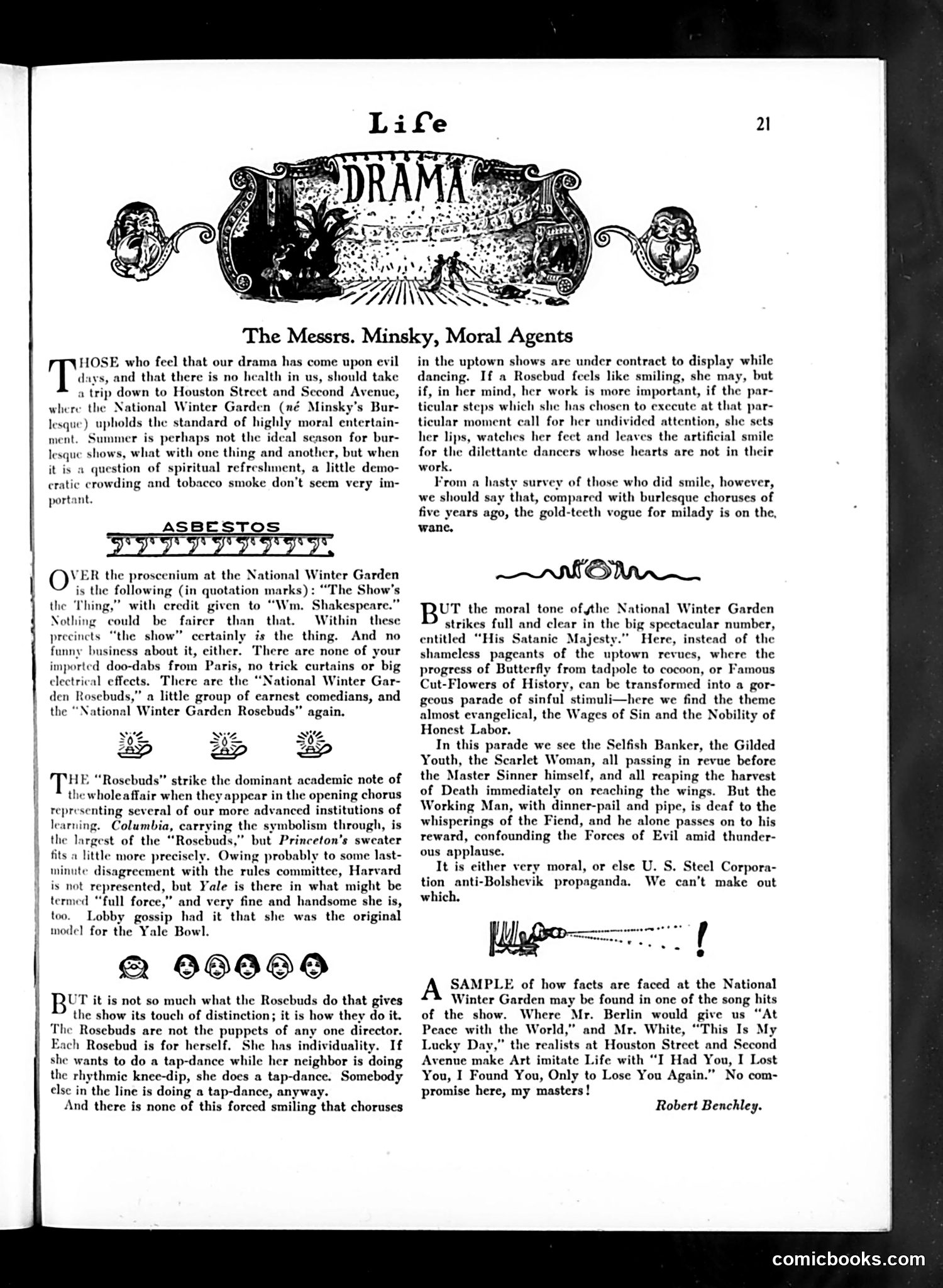
This is satirical theater criticism of a burlesque show at the National Winter Garden (formerly Minsky's Burlesque) on Houston Street in New York. The author mocks the venue's pretense of "moral entertainment" while actually describing typical burlesque performances. The satire operates on multiple levels: the theater quotes Shakespeare ("The Show's the Thing") to justify itself; the chorus line, called the "Rosebuds," includes girls representing Ivy League colleges (Columbia, Princeton, Yale); and the spectacular number "His Satanic Majesty" supposedly carries moral lessons—depicting sinful characters (Selfish Banker, Scarlet Woman) punished by Death, while the Working Man virtously escapes temptation. The author's irony is clear: burlesque—traditionally associated with sexual spectacle—is being rebranded as wholesome moral instruction. The reference to "gold-teeth vogue" and individual dancers doing tap-dances instead of synchronized routines satirizes both the performers' lack of coordination and the show's amateurish "distinction."
📄 Transcribed text from this page (OCR, searchable)
Machine-transcribed from the original scan — historical spelling and the odd misread are preserved.
days, and that there is no health in us, should take a trip down to Houston Strect and Second Avenue, where the National Winter Garden (né Minsky’s Bur- lesque) upholds the standard of highly moral entertain- ment. Summer is perhaps not the idcal season for bur- lesque shows, what with one thing and another, but when it is a qu n of spiritual refreshment, a little demo- cratic crowding and tobacco smoke don’t seem very im- portant. ASBE ik OVER the proscenium at the National Winter Garden s the following (in quotation marks) : “The Show's the Thing,” with credit given to “Wm. Shakespeare.” Nothing wld be fairer than that. Within these precincts “the show” certainly is the thing. And no funny business about it, either. There are none of your imported doo-dabs from Paris, trick curtains or big electrical effects. There are the “National Winter Gar- den Rosebuds,” a little group of earnest comedians, and the “National Winter Garden Rosebuds” again, Tinea who feel that our drama has come upon evil HE “Rosebuds” strike the dominant academic note of the whole affair when they appear in the opening chorus representing several of our more advanced institutions of learning. Columbia, carrying the symbolism through, is the largest of the “Rosebuds,” but Princeton’s sweater fits a little more precisely. Owing probably to some last- minute disagreement with the rules committee, Harvard is not represented, but Yale is there in what might be termed “full force,” and very fine and handsome she is, too. Lobby gossip had it that she was the original model for the Yale Bowl. Q 9HO8H8 UT it is not so much what the Rosebuds do that gives the show its touch of distinction; it is how they do it. The Rosebuds are not the puppets of any one director. Each Rosebud is for herself. She has individuality. If she wants to do a tap-dance while her neighbor is doing the rhythmic knee-dip, she does a tap-dance. Somebody else in the line is doing a tap-dance, anyway. And there is none of this forced smiling that choruses The Messrs. Minsky, Moral Agents in the uptown shows are under contract to display while dancing. If a Rosebud feels like smiling, she may, but if, in her mind, her work is more important, if the par- ticular steps which she has chosen to execute at that par- ticular moment call for her undivided attention, she sets her lips, watches her feet and leaves the artificial smile for the dilettante dancers whose hearts are not in their work. From a hasty survey of those who did smile, however, we should say that, compared with burlesque choruses of five years ago, the gold-teeth vogue for milady is on the, wane, —~ltOMn—. But the moral tone of gthe National Winter Garden strikes full and clear in the big spectacular number, entitled “His Satanic Majesty.” Here, instead of the shameless pageants of the uptown revues, where the progress of Butterfly from tadpole to cocoon, or Famous Cut-Flowers of History, can be transformed into a gor- geous parade of sinful stimuli—here we find the theme almost evangelical, the Wages of Sin and the Nobility of Honest Labor. In this parade we sce the Selfish Banker, the Gilded Youth, the Scarlet Woman, all passing in revue before the Master Sinner himself, and all reaping the harvest of Death immediately on reaching the wings. But the Working Man, with dinner-pail and pipe, is deaf to the whisperings of the Fiend, and he alone passes on to his reward, confounding the Forces of Evil amid thunder- ous applause. It is either very moral, or else U. S. Steel Corpora- tion anti-Bolshevik propaganda, We can’t make out which, SAMPLE of how facts are faced at the National Winter Garden may be found in one of the song hits of the show. Where Mr. Berlin would give us “At Peace with the World,” and Mr. White, “This Is My Lucky Day,” the realists at Houston Strect and Second Avenue make Art imitate Life with “I Had You, I Lost You, I Found You, Only to Lose You Again.” No com- promise here, my masters! Robert Benchley. comicbooks.com