
A complete issue · 40 pages · 1926
Life — March 4, 1926
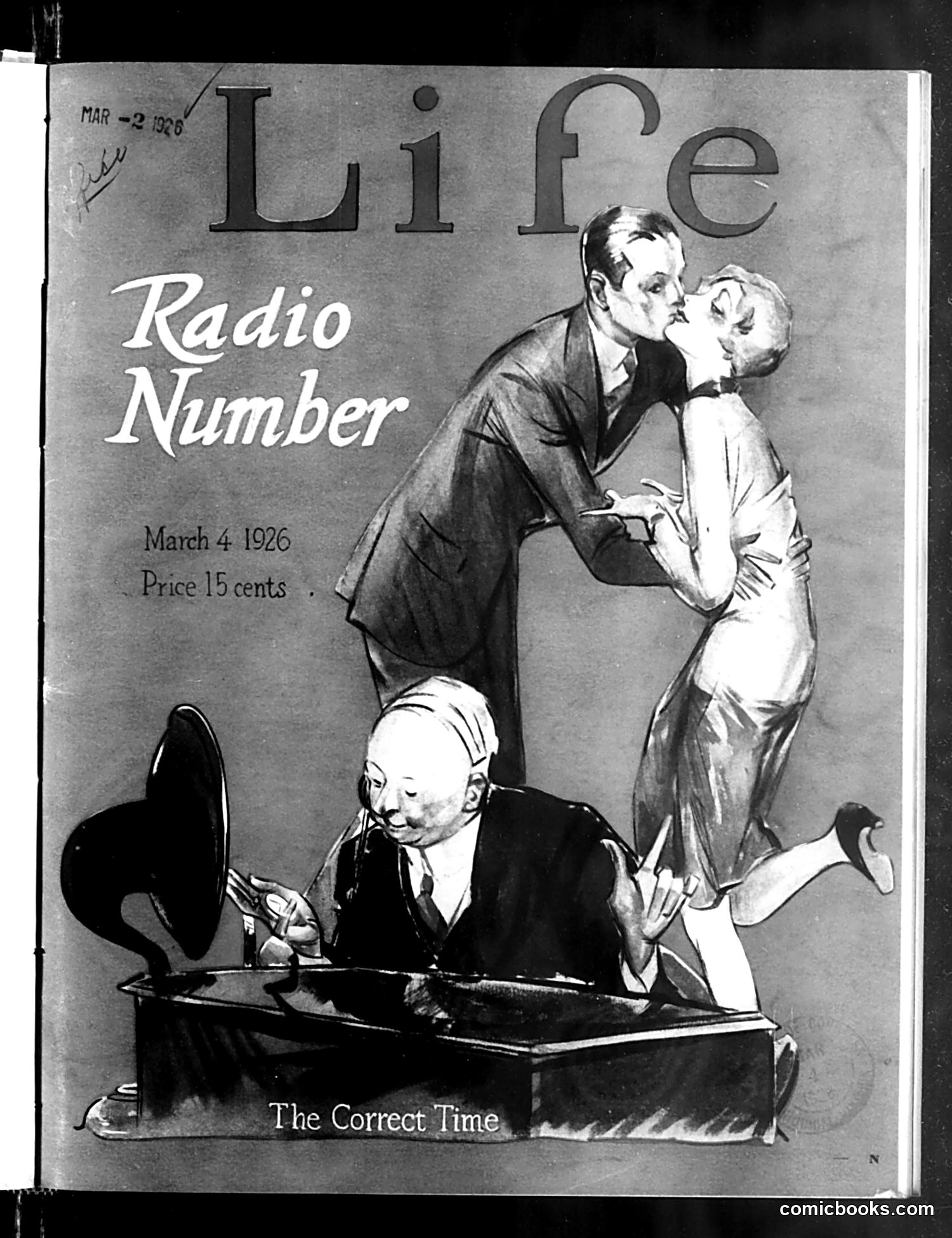
This cover satirizes early radio's cultural impact. The illustration shows three figures: a man at a broadcasting microphone (center), a couple kissing in the background. The caption "The Correct Time" and "Radio Number" suggest the joke concerns radio broadcasts providing official time announcements. The satire appears to target how radio was transforming social life—the implication being that couples were now timing romantic moments by radio broadcasts, or that radio's intrusion into domestic spaces was affecting intimate behavior. The caricatured figures and their exaggerated poses underscore the comic absurdity of technology dictating personal conduct. This reflects 1920s anxieties about radio's rapid penetration into American homes and its influence on traditional social customs.
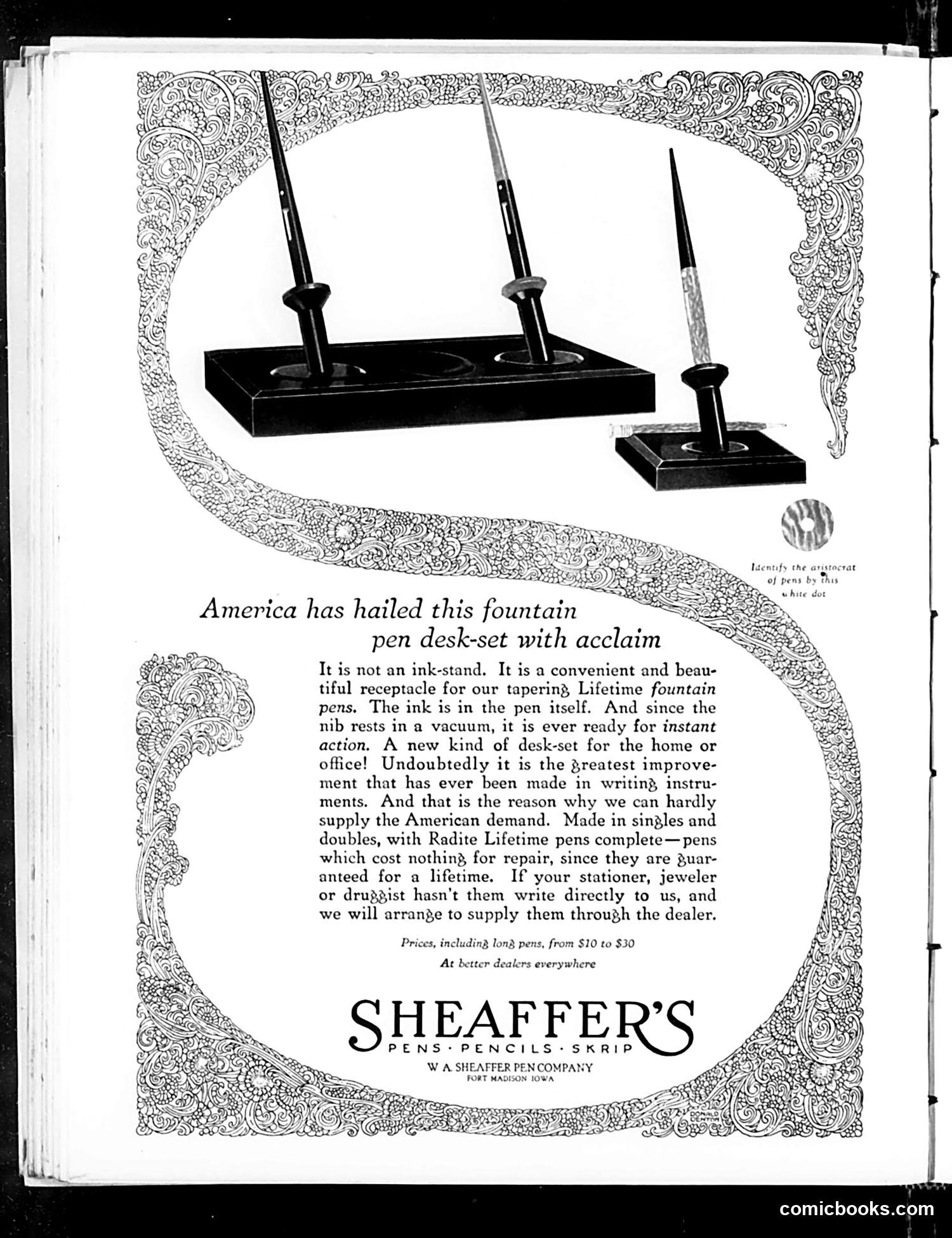
This is **not a political cartoon or satire** — it's a straightforward **advertisement for Sheaffer fountain pens**, specifically their desk-set model. The page shows product images of pen holders with three standing pens (and one smaller set), framed by ornate decorative borders typical of 1920s-30s design. The text emphasizes that this is a convenient desk accessory featuring "Lifetime" fountain pens with vacuum-fill technology, marketed as requiring no repairs and ready for instant use. It claims this represents "the greatest improvement that has ever been made in writing instruments." The ad targets home and office users, available in single and double sets, priced $10-$30, distributed through dealers nationwide. This is purely commercial advertising, not editorial content or satire.
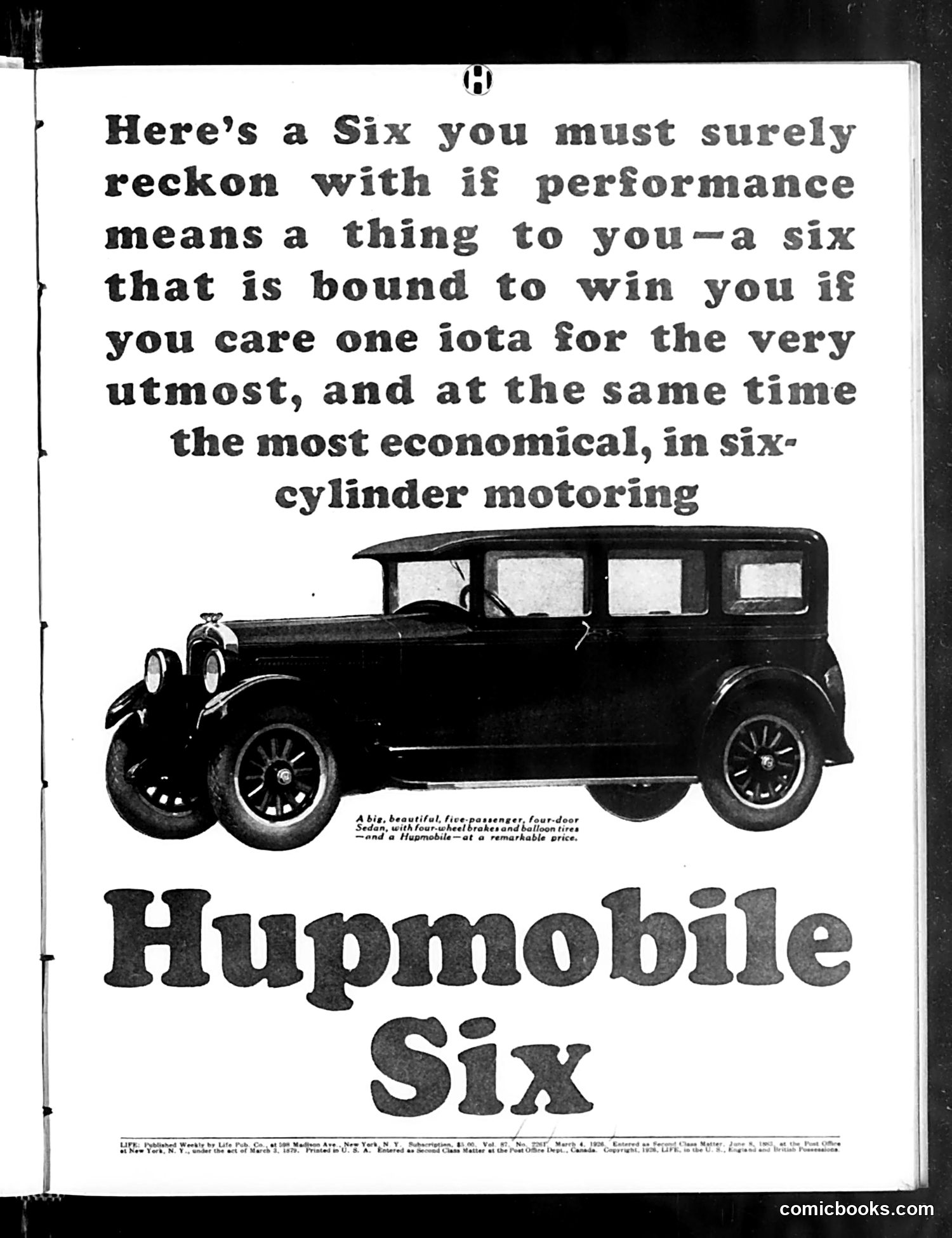
This page is primarily an **advertisement for the Hupmobile Six automobile**, not political satire. The heading promises that this six-cylinder car combines performance ("bound to win you") with economy in "six-cylinder motoring." The vehicle shown is a five-passenger, four-door sedan typical of the 1920s era. The small caption beneath describes it as "A big, beautiful, five-passenger, four-door sedan, with four-wheel brakes and balloon tires—and a Hupmobile—at a remarkable price." There is **no political cartoon or satirical content** on this page. It's straightforward early automotive marketing, appealing to buyers who valued both performance and affordability during the post-WWI automobile boom.
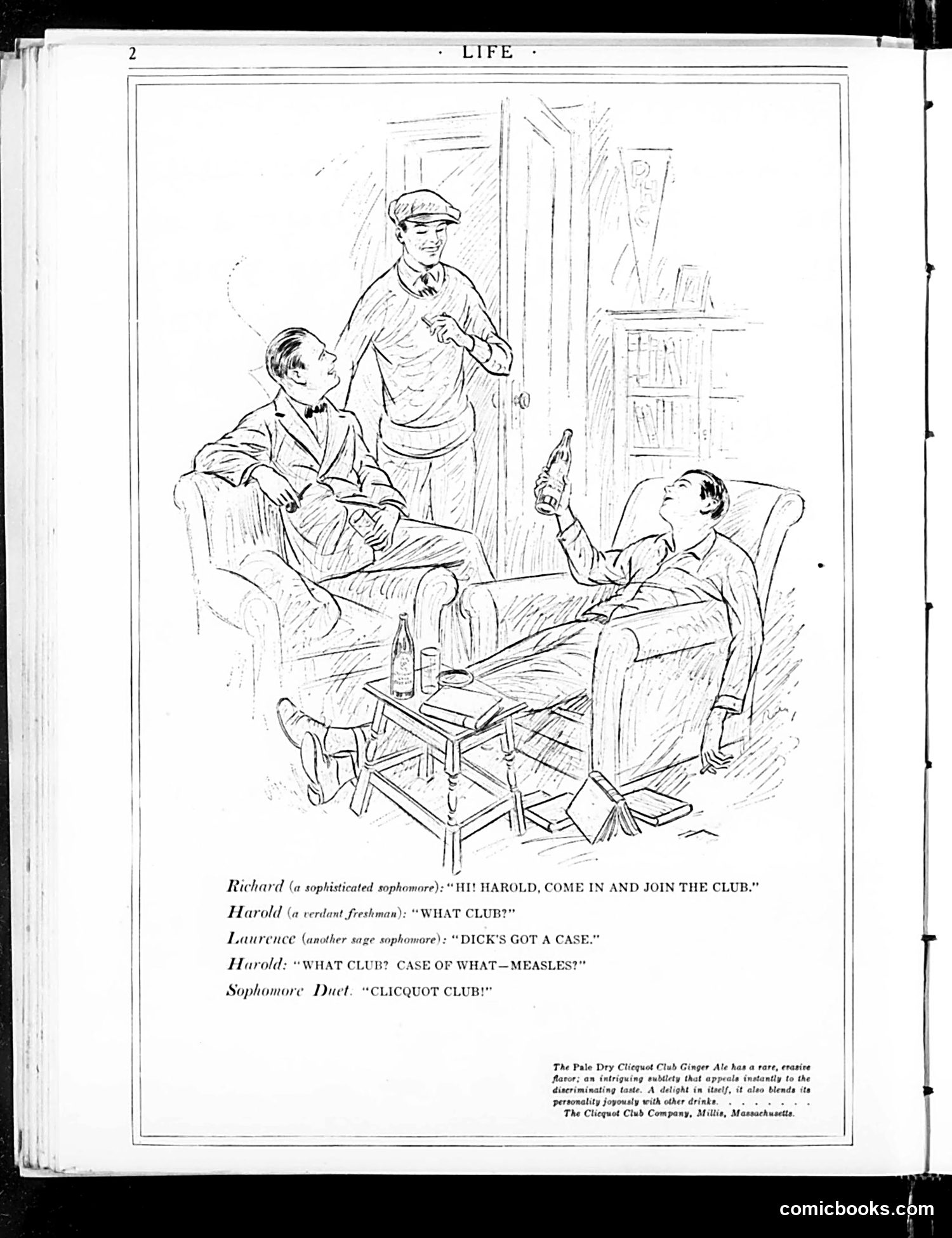
This is a humorous cartoon about college hazing and social clubs at an American university. The scene depicts three sophomores attempting to recruit a freshman named Harold into their "Clicquot Club." The joke hinges on a pun: Harold misunderstands "club" as referring to a drinking establishment (confusing it with "case of measles"), while the sophomores are promoting the Clicquot Club—a real ginger ale brand advertised at the page's bottom. The humor derives from the miscommunication between the sophisticated sophomores and the bewildered freshman, who mistakes their invitation for something concerning his health rather than a beverage club. The cartoon satirizes both college hazing culture and the pretensions of fraternity-like organizations, while functioning as product placement for Clicquot ginger ale.
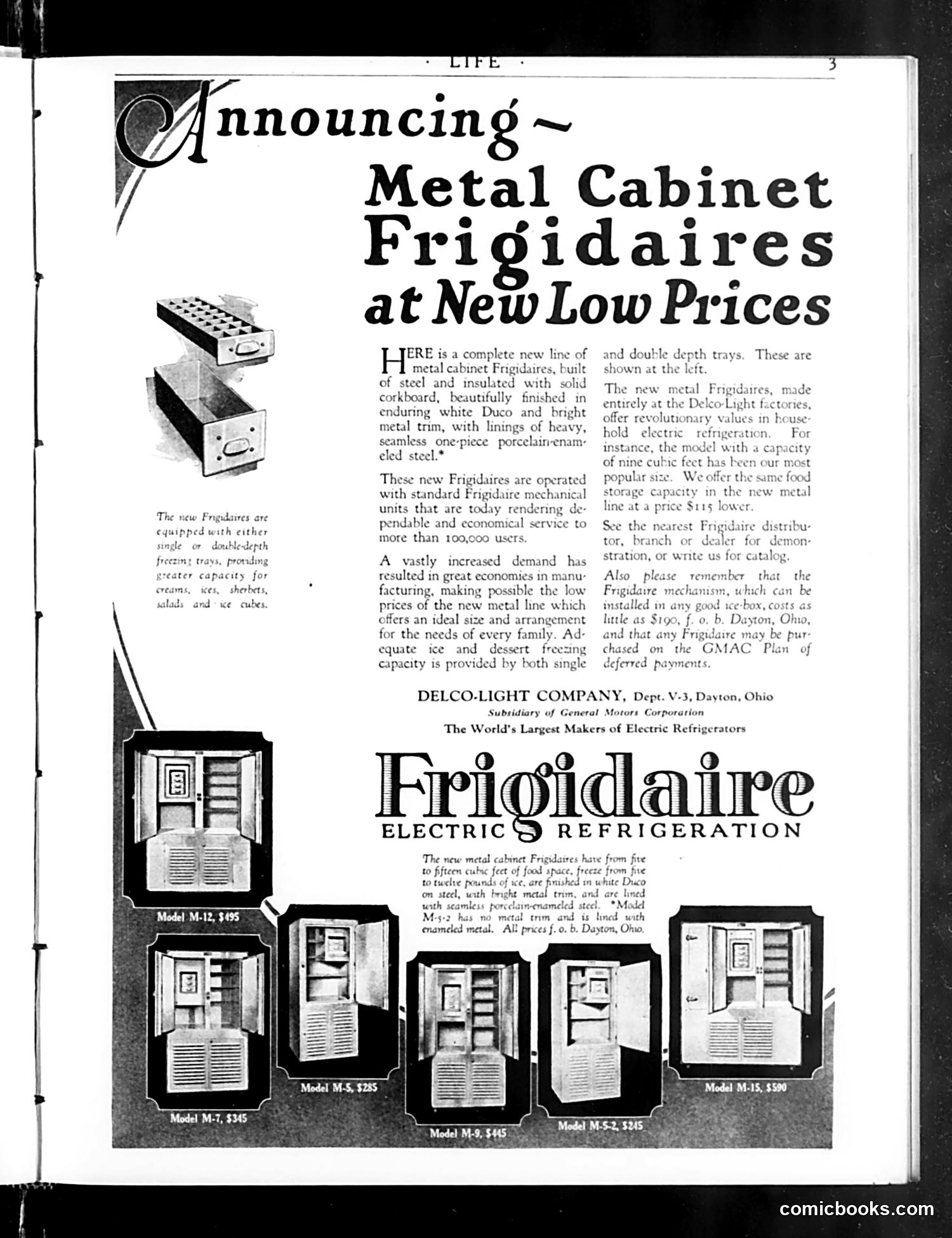
This page is primarily **advertising, not satire or political commentary**. It announces new metal cabinet Frigidaire refrigerators at reduced prices from Delco-Light Company (a General Motors subsidiary). The page shows five refrigerator models with their specifications and prices, ranging from $285 to $500. The text emphasizes manufacturing economies that enabled lower pricing, and highlights features like ice/dessert freezing capacity and available purchase plans. There are no political cartoons, caricatures, or satirical commentary present. This is a straightforward commercial advertisement from Life magazine's advertising section, demonstrating how the publication supported itself through paid product promotion alongside its editorial content.
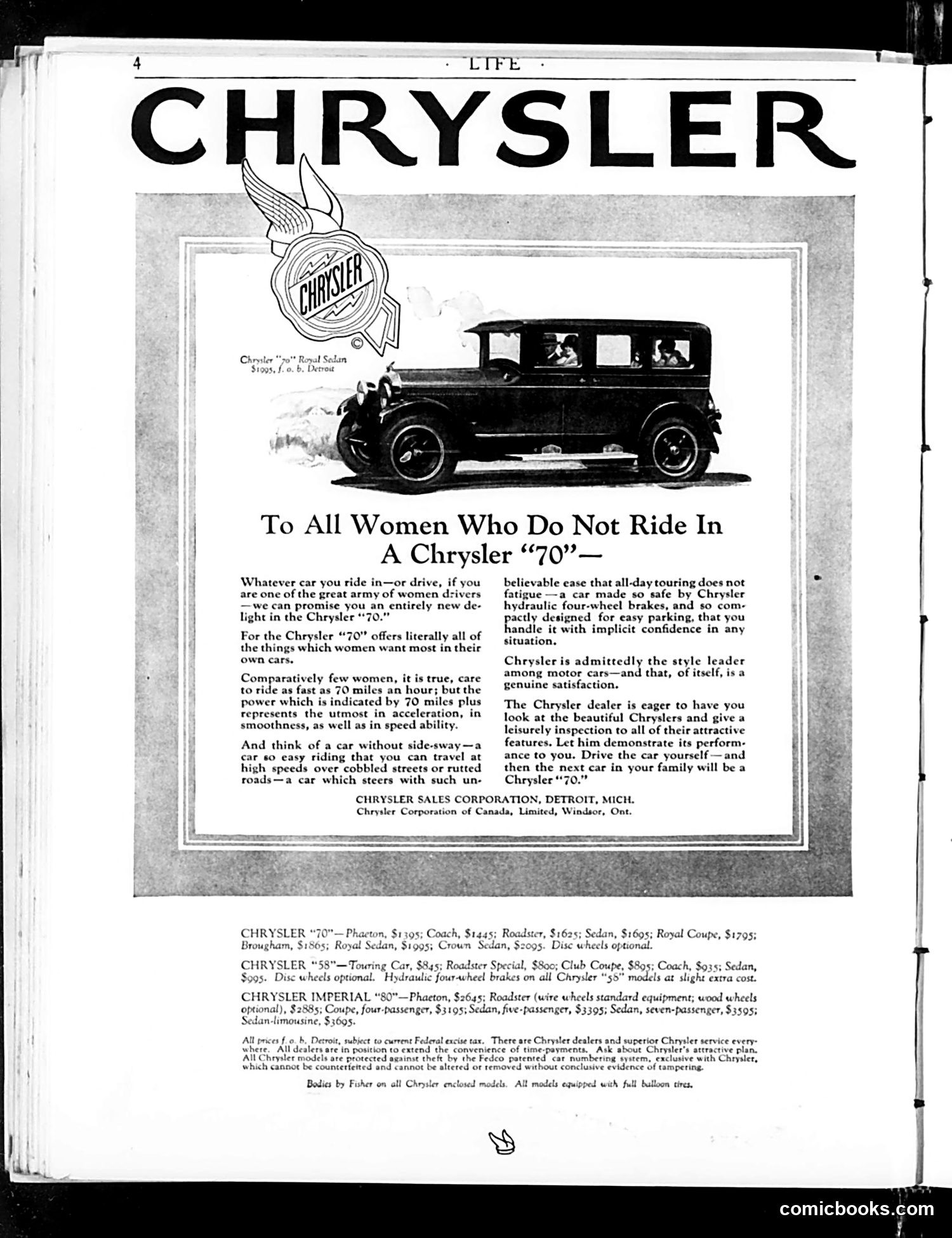
This page is primarily a **Chrysler automobile advertisement**, not satire or political commentary. The ad targets women drivers, promoting the Chrysler "70" model. The headline "To All Women Who Do Not Ride In A Chrysler '70'" uses reverse psychology—suggesting women are missing out. The copy emphasizes features marketed as appealing to women: safety (hydraulic four-wheel brakes), ease of parking, and smooth handling. The ad reflects **1920s gender attitudes**: it assumes women need reassurance about driving capability and appeals to concerns about safety and ease rather than performance. The car illustration shows passengers (appearing to be women), reinforcing the domestic/family-oriented marketing angle. This is straightforward period advertising, not satirical content, though modern readers might find the gender-targeted messaging itself notable as historical artifact.
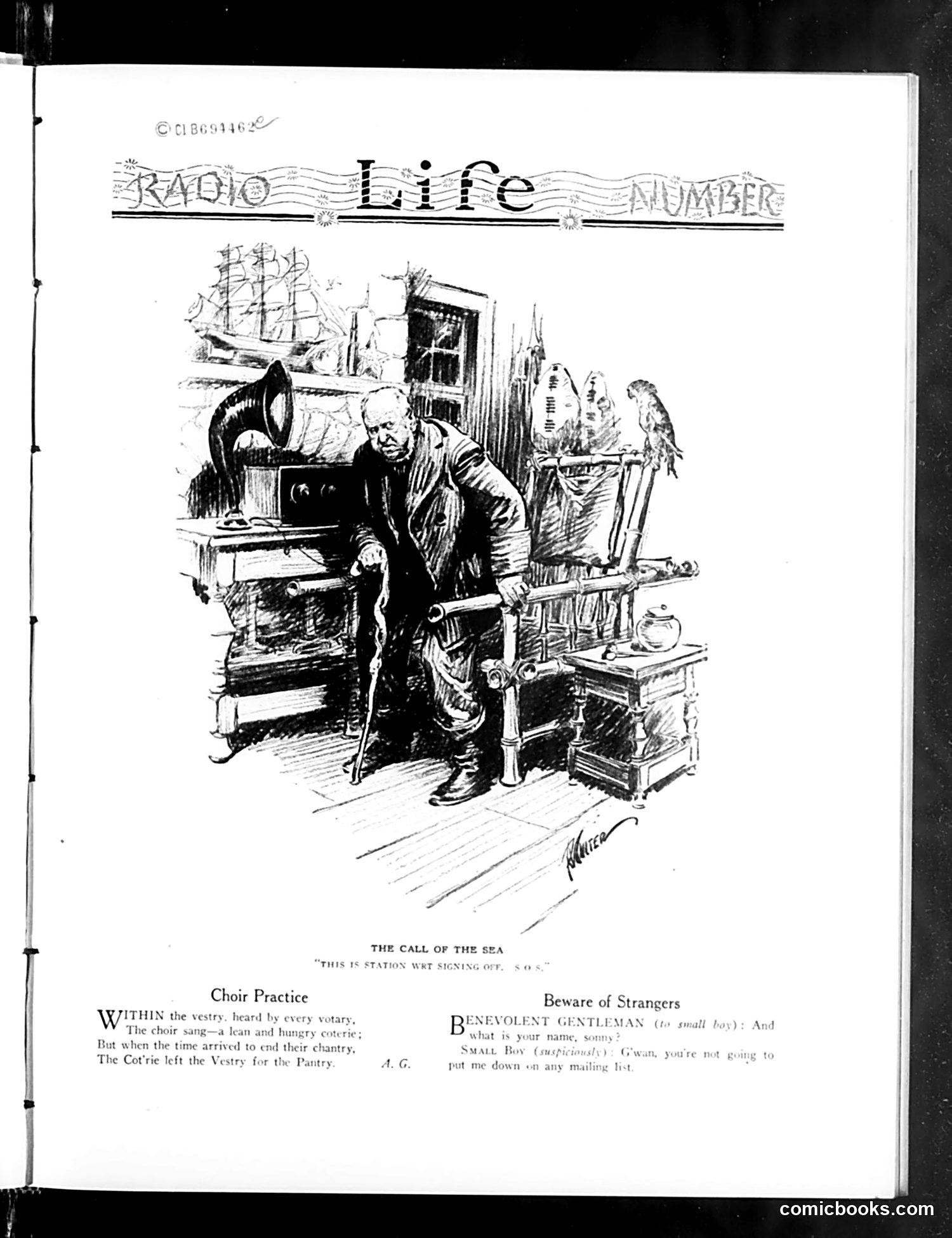
This page from *Life* magazine features a central illustration titled "The Call of the Sea" showing an elderly man in what appears to be a cluttered study or cabin, surrounded by nautical memorabilia (a ship model, naval instruments, a parrot). Below are two brief satirical pieces: **"Choir Practice"** — A humorous verse about a church choir's tendency to abandon their duties when the food runs out. **"Beware of Strangers"** — A comedic dialogue where a benevolent gentleman attempts to get a small boy's name for a mailing list, but the boy refuses, suspecting the stranger's intentions. The central illustration appears to be a sentimental or nostalgic depiction of maritime life, while the accompanying texts offer gentle social satire on everyday situations—church life and stranger-danger awareness—typical of early 20th-century American humor.
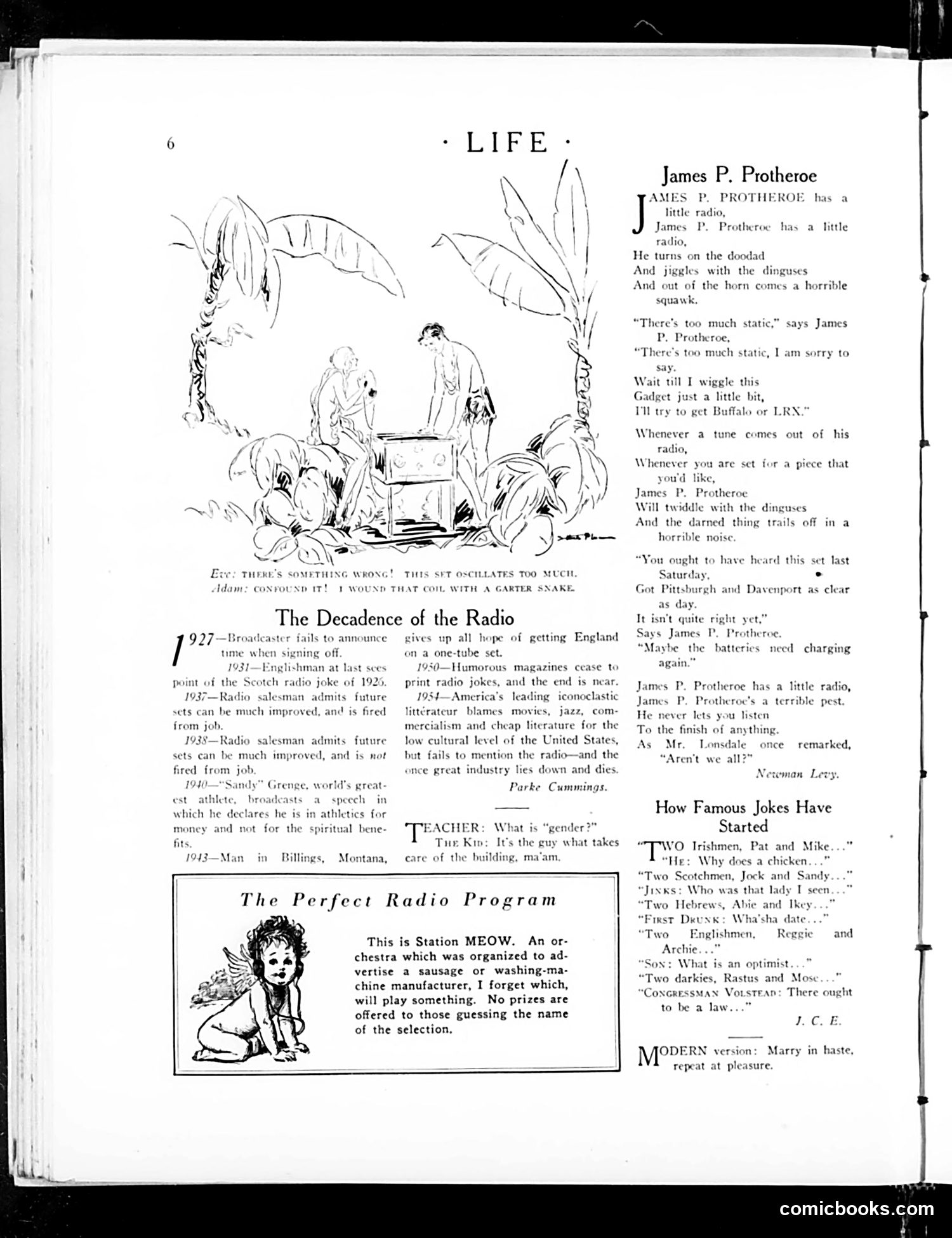
This page satirizes 1920s radio culture through humor about technical problems and social absurdities. "James P. Protheroe" is a fictional character who owns a cheap radio that produces constant static and unwanted squeaks—contemporary complaints about early radio sets' poor quality and unreliability. The main cartoon shows people gathered around a radio emitting noise, with the caption about "oscillates too much" and "compound it with a garter snake," mocking both technical jargon and the radio's uselessness. "The Decadence of the Radio" section catalogs the medium's perceived cultural decline—from initial optimism (1927) to present disgust (1934)—blaming it for lowered cultural standards. The page includes period humor about gender and famous joke origins, typical of Life's satirical style. Overall, it captures early radio's reputation as unreliable technology and cultural embarrassment.
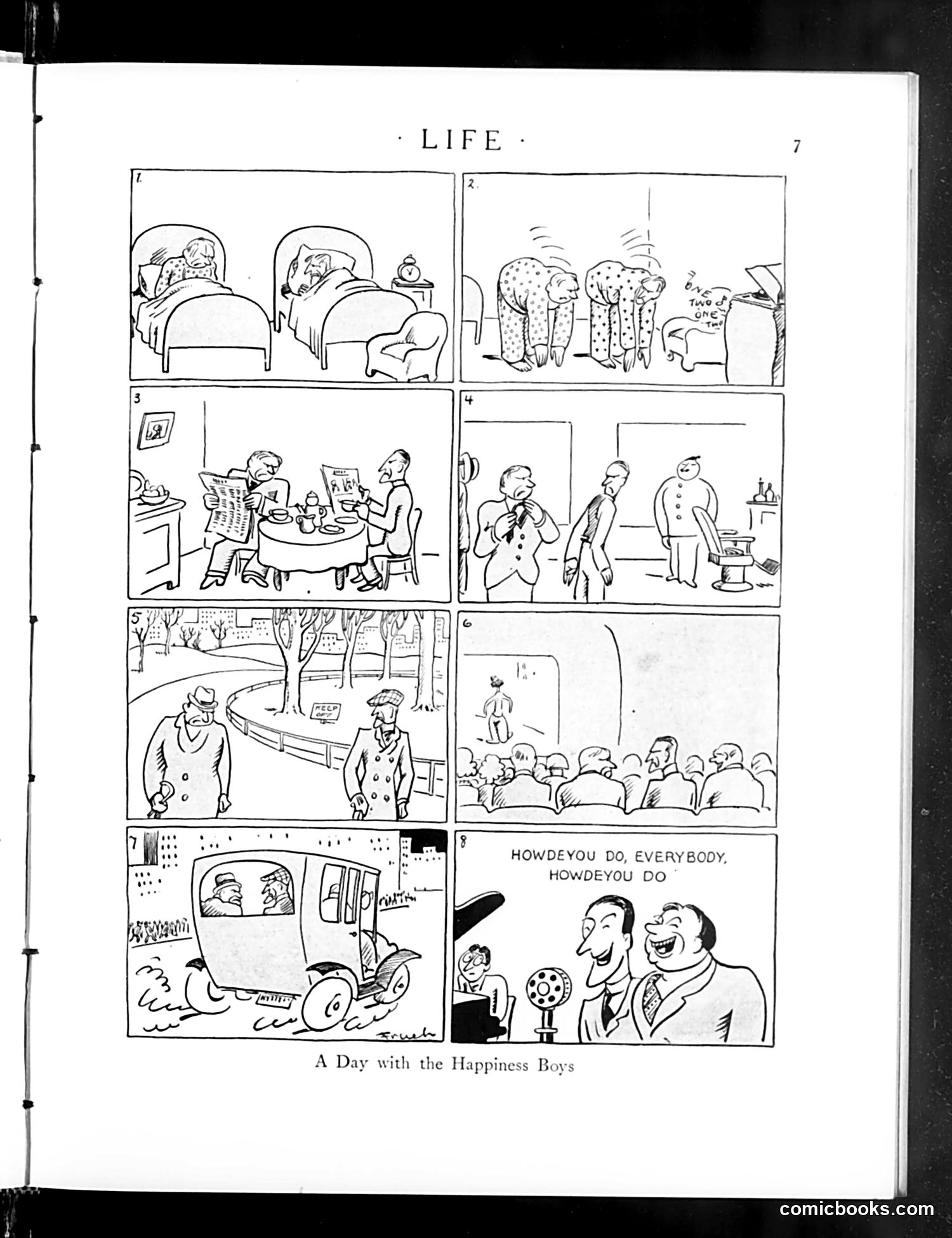
This comic strip satirizes a popular radio duo of the 1920s-30s called "The Happiness Boys" (also known as "Laff and Gaff"). The strip depicts their morning routine and public appearances with exaggerated humor. The comic mocks their cheerful persona and relentless catchphrase "How do you do, everybody, how do you do" (visible in panel 8). Each panel shows mundane daily activities—waking up, breakfast, office work, public speaking—contrasted with their perpetually upbeat demeanor. The satire targets the artificial cheerfulness required of radio personalities and entertainers of the era, suggesting the exhausting performance of constant happiness even in ordinary or awkward situations. This reflects contemporary skepticism about manufactured celebrity personas.
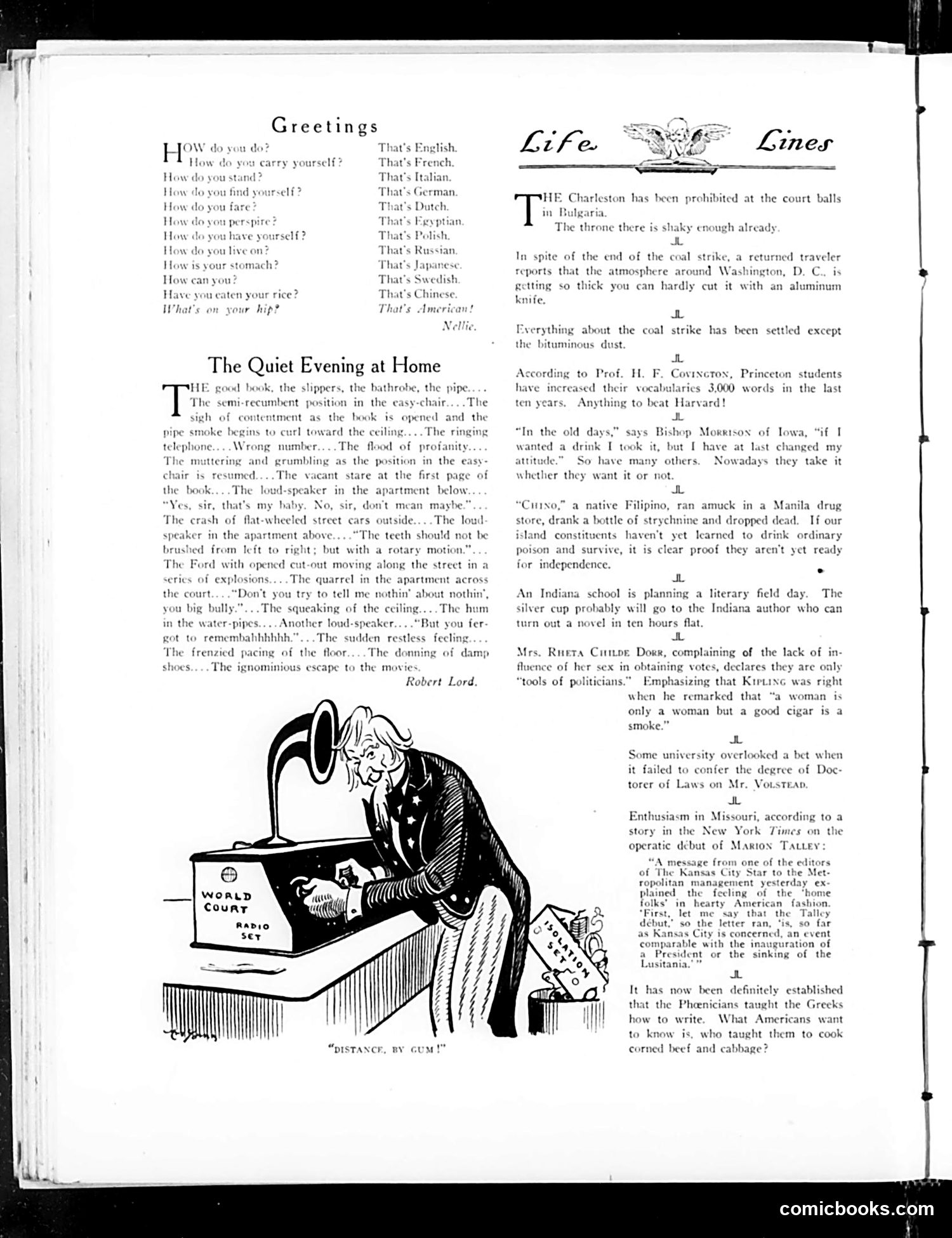
This cartoon depicts a woman operating an early radio set labeled "World Court Radio," seemingly broadcasting to distant places. The caption "DISTANCE, BY GUM!" suggests amazement at radio technology's ability to transmit across vast distances. The accompanying "Life Lines" column references the coal strike's atmospheric effects in Washington, D.C., and Princeton students' expanding vocabulary. One item mocks women's influence in politics, quoting Kipling's remark that "a good cigar is a smoke"—suggesting women shouldn't be taken seriously in governance. The overall page satirizes 1920s concerns: new communication technology, labor unrest, academic pretension, and evolving gender roles. The cartoon celebrates radio as a marvel of modern distance communication, while the commentary reflects contemporary anxieties about social change.
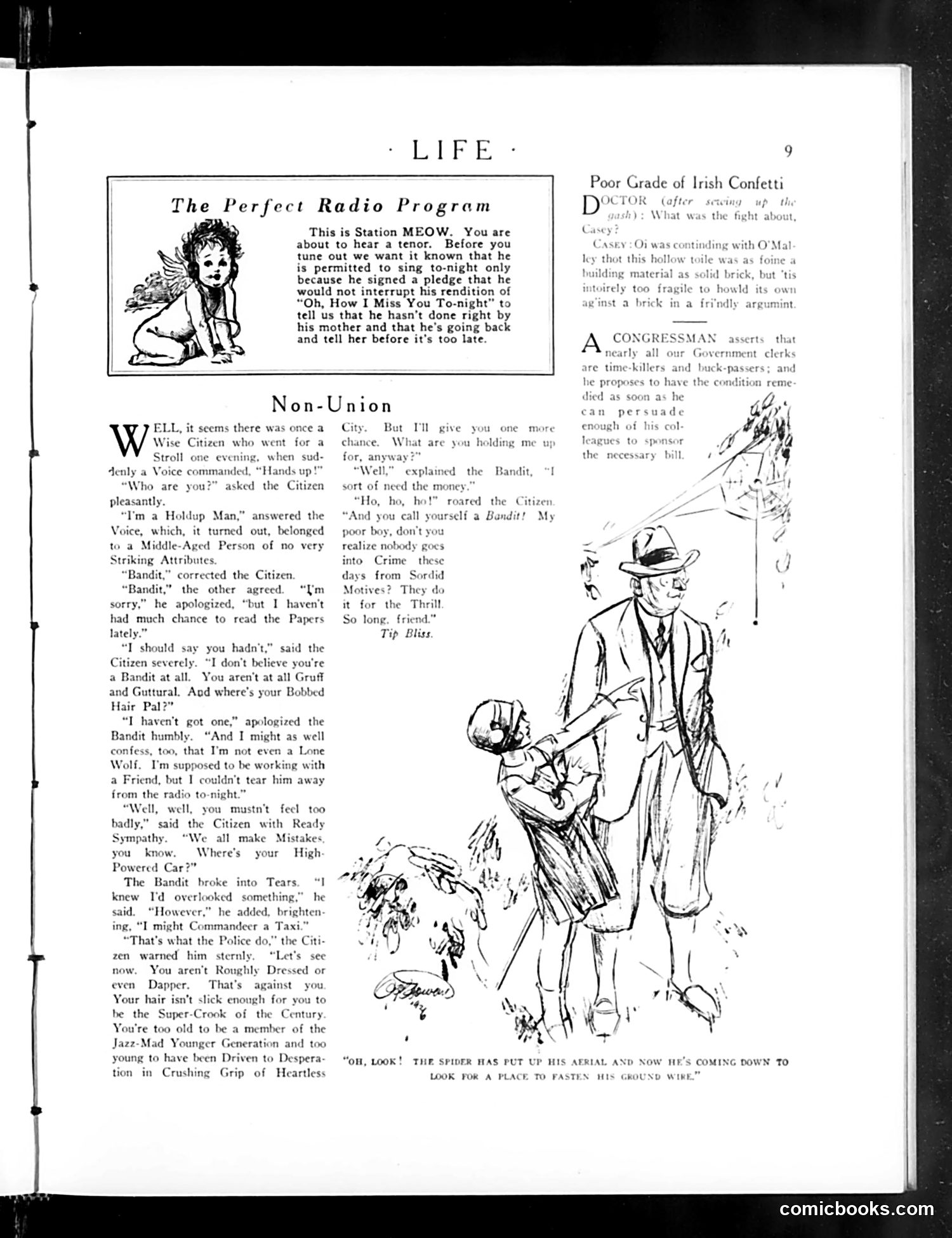
This satirical piece mocks a conversation between a "Citizen" and a "Bandit" criminal character. The joke hinges on labor union politics: when the Citizen accuses the Bandit of being a "Lone Wolf" (working independently), the Bandit defensively explains he's "not even a member of the Jazz-Mad Younger Generation" — suggesting organized crime had unionized or formed collective operations. The satire targets 1920s anxieties about both labor unions and organized crime syndicates. By portraying a criminal defending his "non-union" status as if apologizing for being unorganized, Life ridicules the era's perception that even criminal enterprises were becoming institutionalized and collective, reflecting broader concerns about organized labor's growing power and legitimacy during this period.
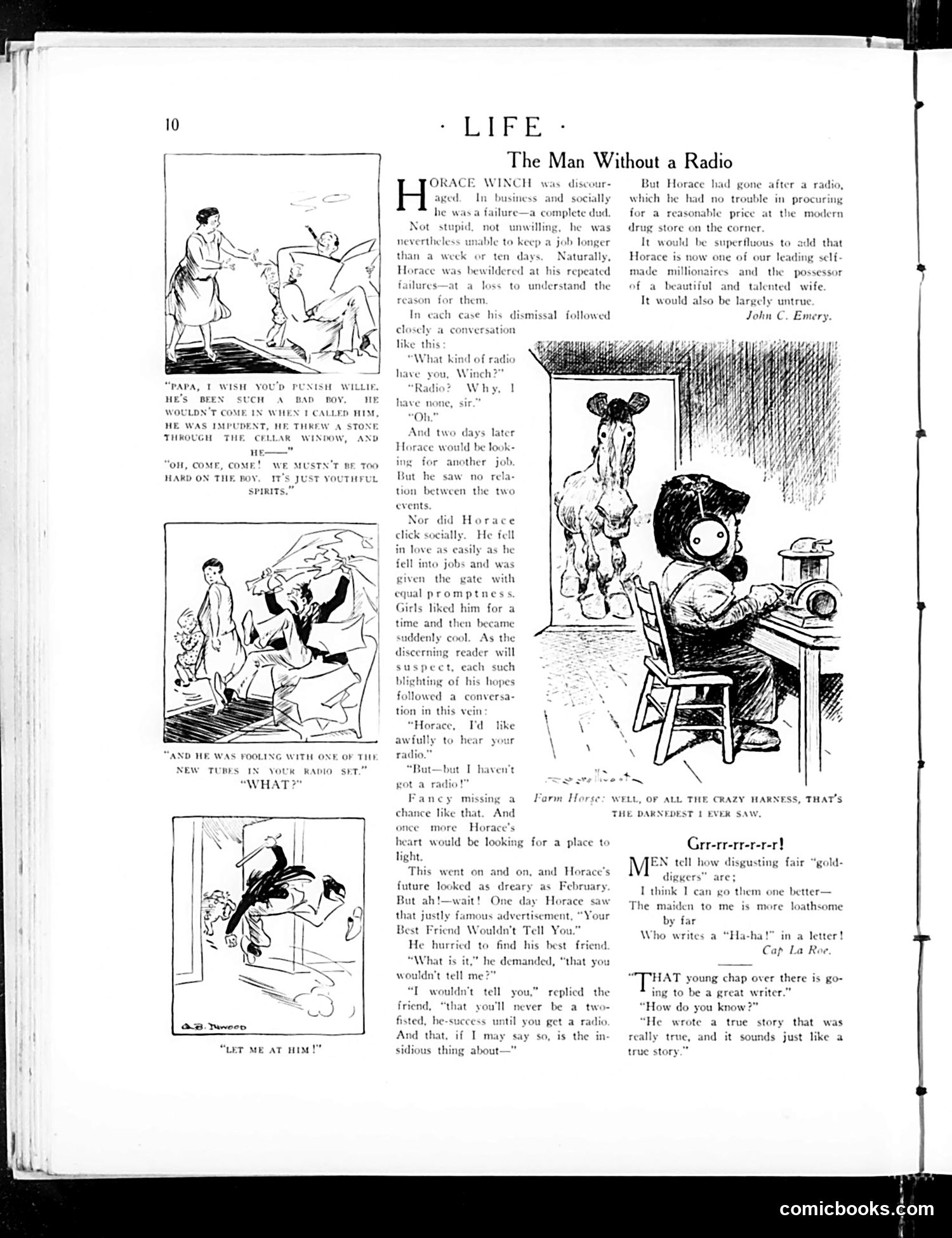
This satirical story mocks Horace Winch, a perpetually unemployed man whose repeated job failures stem from his lack of a radio. The narrative presents radio ownership as a status symbol essential for social and professional success in 1920s America. The cartoons illustrate Horace's downward spiral: his dismissals from jobs, his desperate search for employment, and his romantic difficulties—all apparently caused by his radio-less status. His friend's ultimatum—"success until you get a radio"—underscores the satire: the story ridicules how thoroughly radio had become embedded in American consumer culture and self-identity. The piece mocks both Horace's failure and society's materialistic values, suggesting that owning modern technology had become bizarrely central to respectability itself.
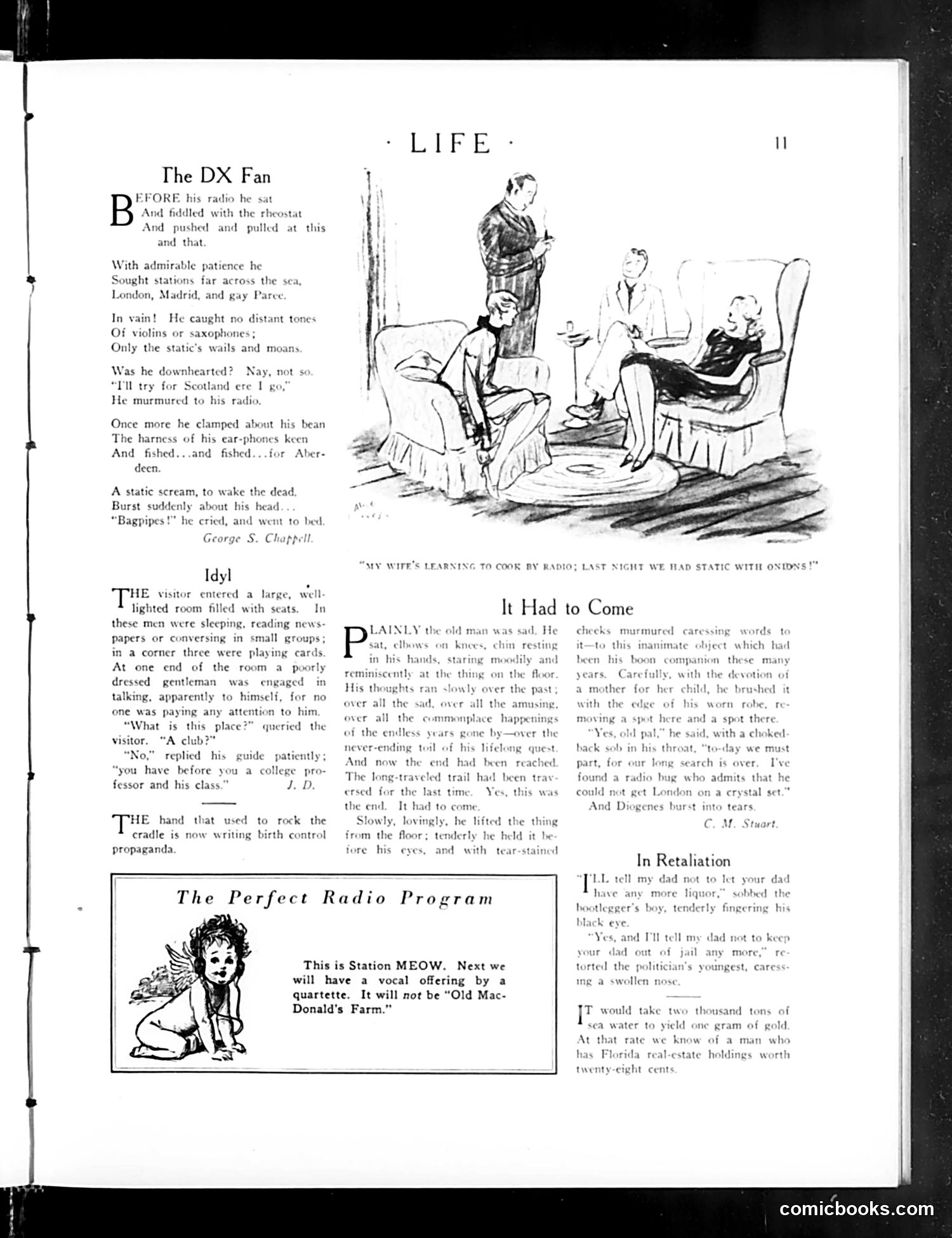
This page from *Life* satirizes radio enthusiasts of the early-to-mid 20th century. "The DX Fan" mocks amateur radio operators obsessed with tuning distant stations—the poem describes a man frantically adjusting his receiver seeking London, Madrid, and Paris, only to catch static and "state's wails and moans." The joke: despite his "admirable patience," he achieves nothing, then retreats to bed muttering about trying Scotland next. The accompanying illustration shows him frustrating his family with this hobby. "The Perfect Radio Program" box sarcastically presents Station MEOW offering "a vocal offering by a quartette...not 'Old MacDonald's Farm'"—mocking both pretentious programming and the cats he'd hear instead. These pieces gently ridicule the obsessive radio-tinkering culture that emerged as broadcasting technology spread.
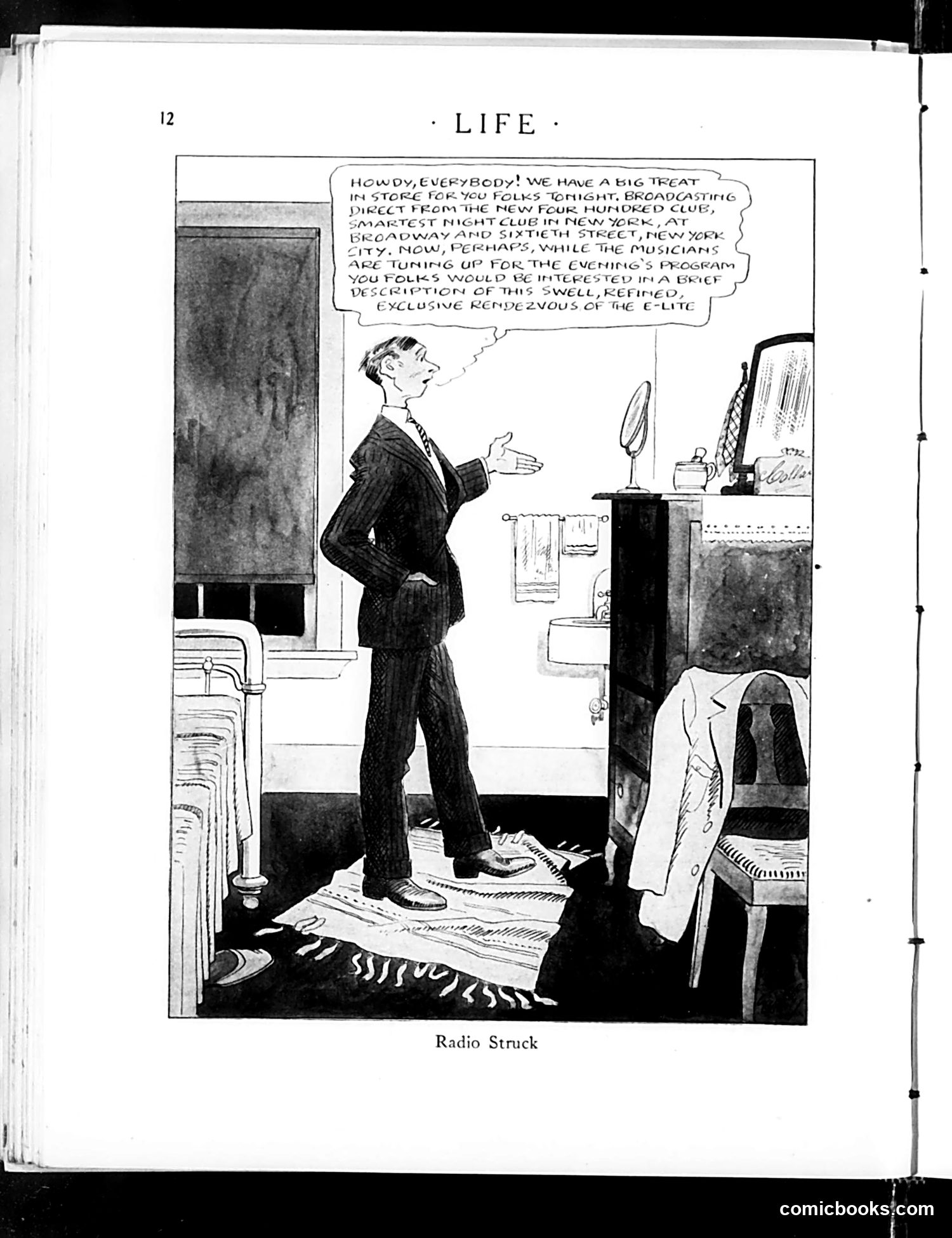
This cartoon satirizes early radio broadcasting's cultural pretension. A well-dressed man in a bathroom enthusiastically announces a "big treat" for listeners: a live performance from an elite New York venue (Broadway and 66th Street), featuring "smartest musicians" playing for "exclusive rendezvous of the elite." The humor lies in the contrast: he's broadcasting this "exclusive" event from a *bathroom*—an absurdly non-elite, private space. The joke targets radio's simultaneous claims to exclusivity and mass accessibility. By bringing "exclusive" entertainment into bathrooms and ordinary homes, radio democratizes culture while broadcasters still market it as prestigious. The satire mocks both the pretentiousness of early radio promotion and the mundane reality of how people actually consumed it.
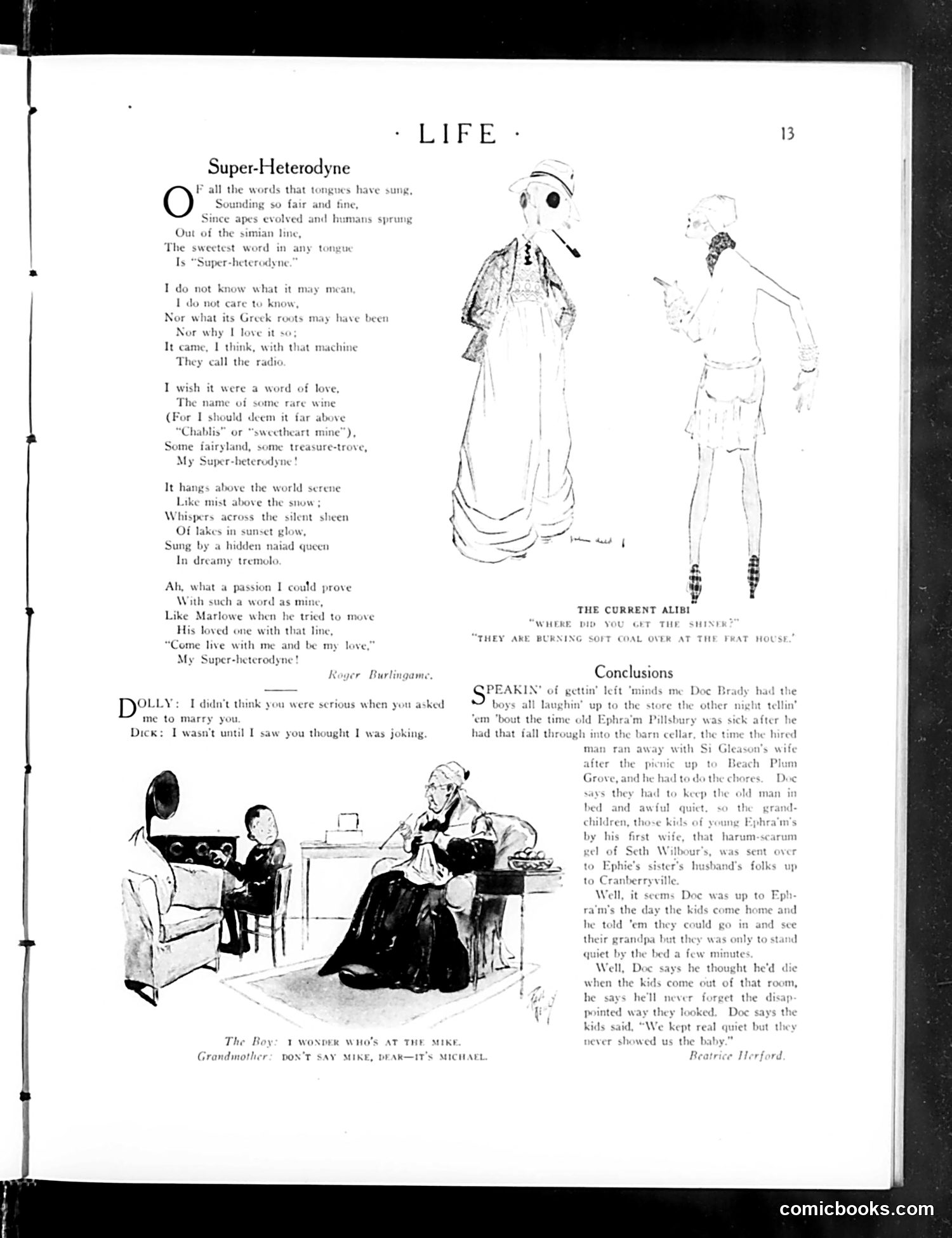
This page contains two satirical pieces: **"Super-Heterodyne"** (poem by Roger Burlingame): Satirizes the newly popular radio technology by treating "super-heterodyne" (a radio circuit type) as if it were a precious word, comparing it to classical or romantic language. The humor mocks how people were excited about technical jargon surrounding the emerging radio industry—treating modern technology with almost reverential language. **"Conclusions"** (by Beatrice Herford): A humorous anecdote about children witnessing adults' disappointment over a stillbirth, illustrating generational differences in understanding and emotional response. The joke centers on children's innocent misinterpretation of adult grief. The illustrations accompanying these pieces show period-appropriate figures in early 20th-century clothing, typical of Life magazine's satirical style.
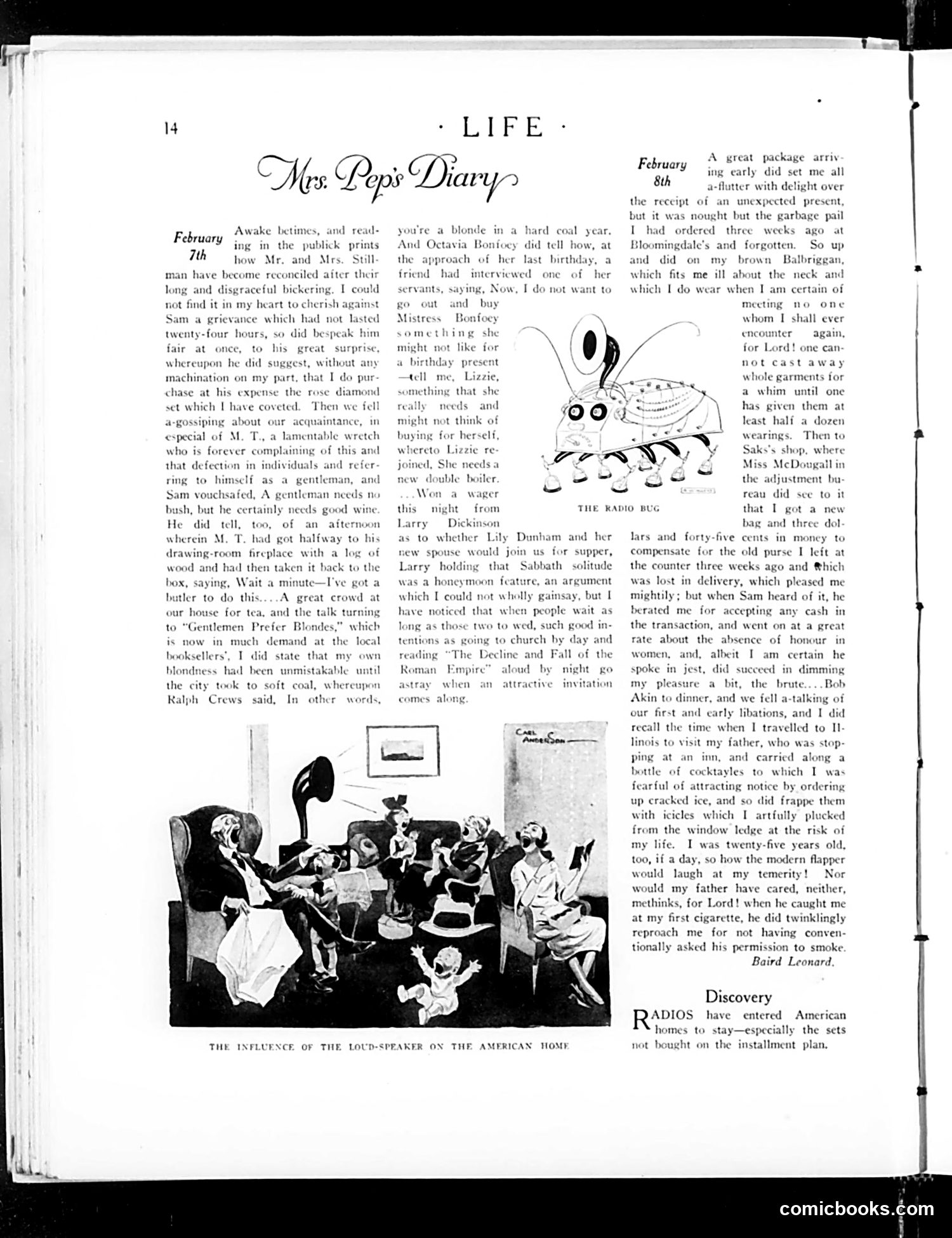
This page features a diary entry satirizing domestic life and modern technology. The main illustration, captioned "The Influence of the Loud-Speaker on the American Home," depicts a chaotic living room where a radio speaker dominates the space, with family members scattered about in disarray—some appearing agitated or distressed. The satire targets how early radios disrupted household dynamics. The diary entry recounts personal grievances (a servant's dismissal, birthday gift troubles) but emphasizes the radio's arrival as a major household event, suggesting Americans were becoming comically obsessed with this new technology. The joke: radios were invading American homes so rapidly and thoroughly that they were reshaping family life and domestic order, often chaotically. This captures 1920s anxiety about technology's transformative social impact.
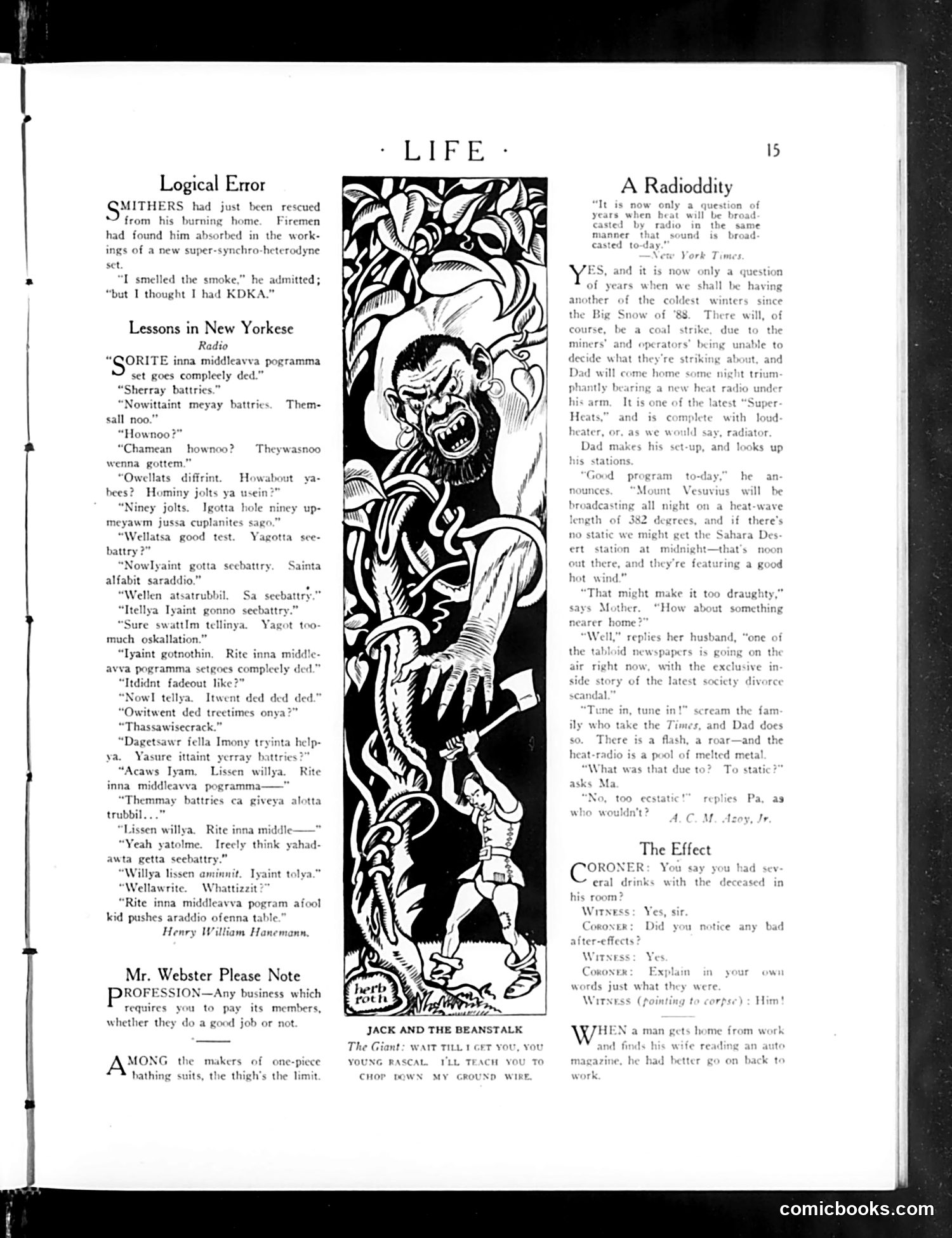
The central illustration is a classic fairy-tale adaptation of "Jack and the Beanstalk," showing the Giant threatening young Jack. The Giant appears as a grotesque, menacing figure with exaggerated features—grinning wickedly while towering over Jack, who cowers below with a sword. The accompanying text presents the Giant's dialogue: "Wait till I get you, you young rascal. I'll teach you to chop down my ground wise." This appears to be a straightforward satirical retelling of the nursery tale rather than political commentary. The other page content includes humor columns and short satirical pieces typical of Life magazine's format—observations on modern life, New York radio programs, and social absurdities—presented without clear connection to the fairy-tale cartoon.
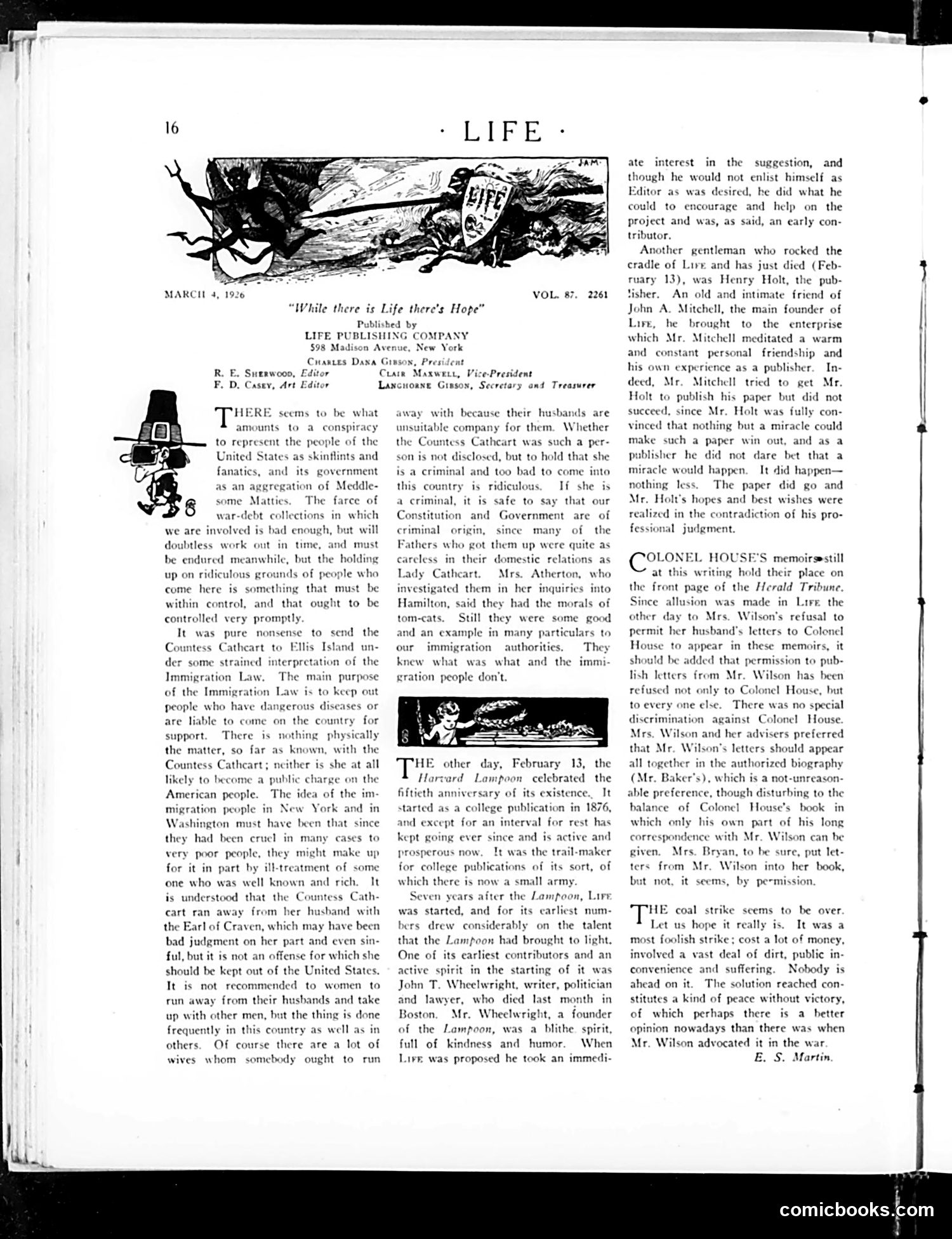
The visible cartoon depicts a figure wearing a Pilgrim hat labeled "LIFE," appearing to represent the magazine itself personified as an American founding figure. The image seems to comment on immigration and government policy. The text discusses the Countess Cathcart's legal troubles regarding immigration law violations and marital scandal. The editorial critiques how the U.S. government inconsistently enforces immigration restrictions while wealthy aristocratic figures face scrutiny. The passage suggests hypocrisy in immigration enforcement—that rule-breaking appears tolerated for some social classes while being strictly applied to others. The Pilgrim imagery likely invokes America's founding mythology ironically, contrasting ideals of liberty with selective enforcement of laws favoring the privileged.
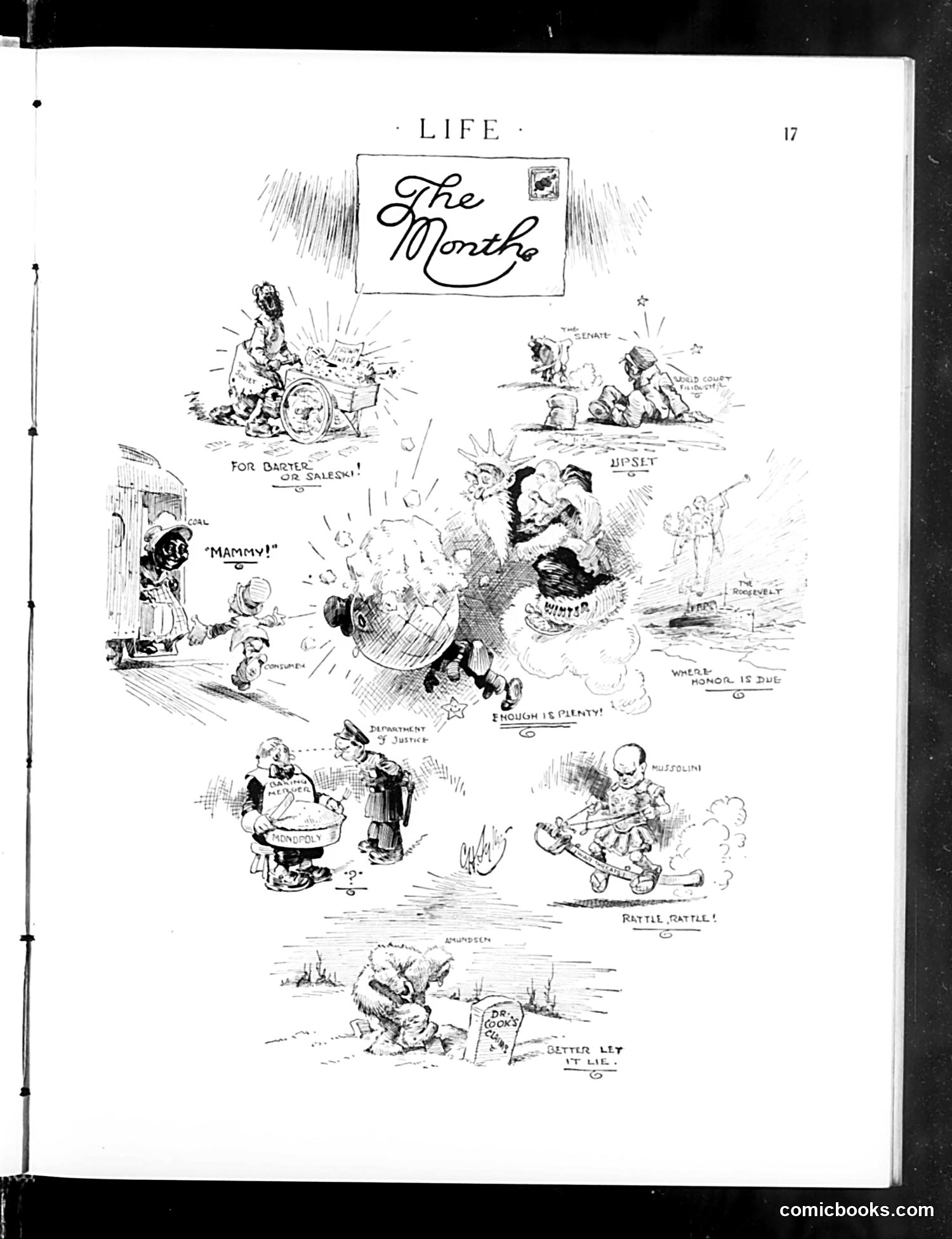
This is a satirical composite from *Life* magazine depicting multiple contemporary political figures and events through caricature. The central large head appears to be a major political figure of the era. Surrounding vignettes reference: - **"For Barter or Sales"** - suggests political trading/corruption - **"Senate"** and **"World Court"** - legislative and international governance - **"Upset"** - political instability - **"Department of Justice"** - law enforcement - **"Enough is Plenty"** and **"Where Honor is Due"** - commentary on political ethics - Figures labeled **Mussolini** and **Roosevelt** appear in separate scenes The cartoon satirizes political chaos, questionable dealings between government branches, and international relations during what appears to be the interwar or early WWII period. Without the publication date visible, precise attribution of specific events remains unclear, though the style and references suggest early-to-mid 20th century American political commentary.
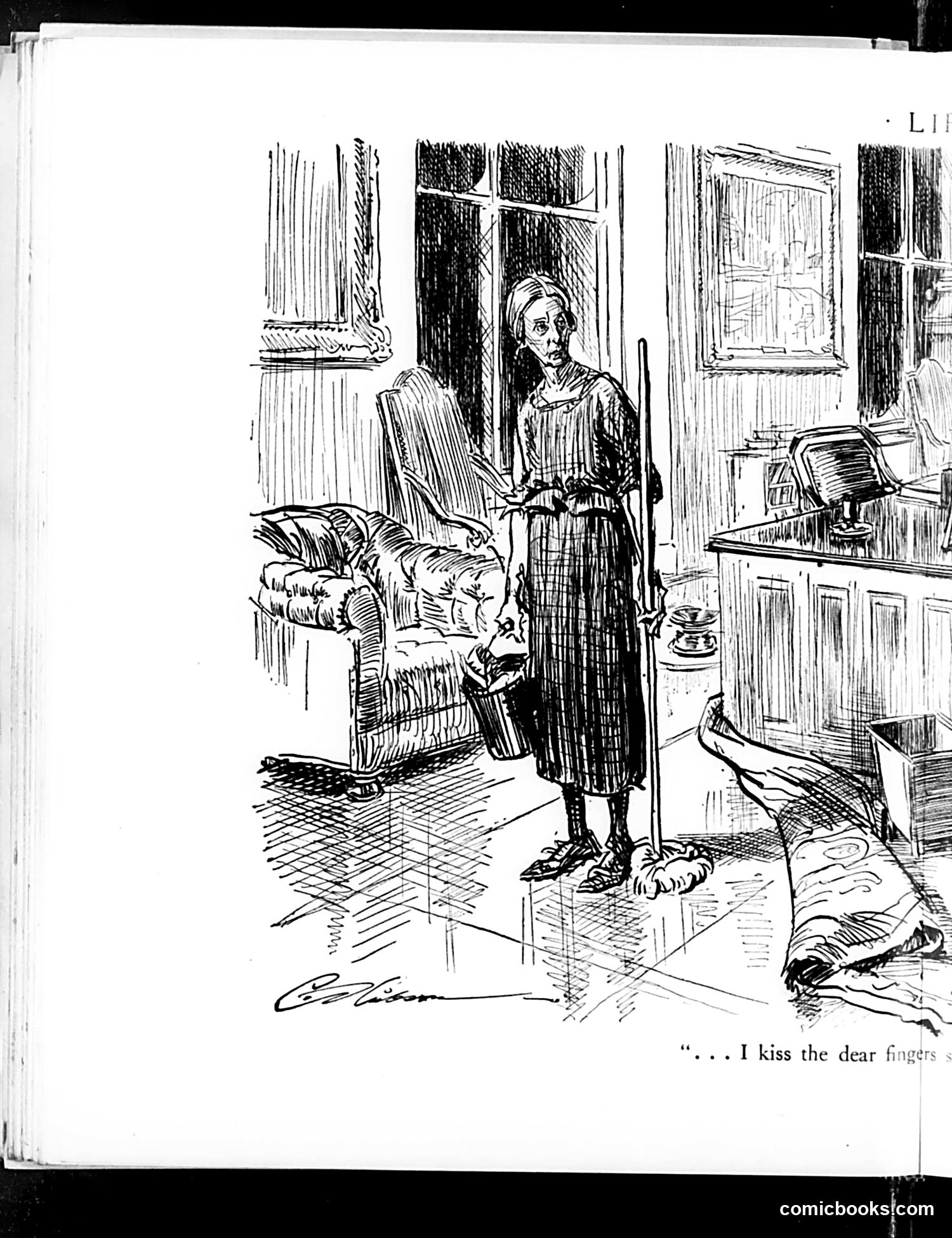
This appears to be an illustration from *Life* magazine showing a domestic interior scene. A standing woman in a long dress holds what appears to be a broom or staff, while a man reclines in an armchair. The visible caption reads "...I kiss the dear fingers." The sketch likely satirizes sentimental Victorian romance or marital dynamics—possibly mocking the contrast between grandiose romantic declarations ("I kiss the dear fingers") and the mundane reality of domestic life shown in the image. The woman's posture and the household setting suggest commentary on gender roles or the gap between romantic idealization and actual marriage. The artist's signature is visible but difficult to read clearly. Without additional context or complete text, the specific satirical target remains somewhat unclear.
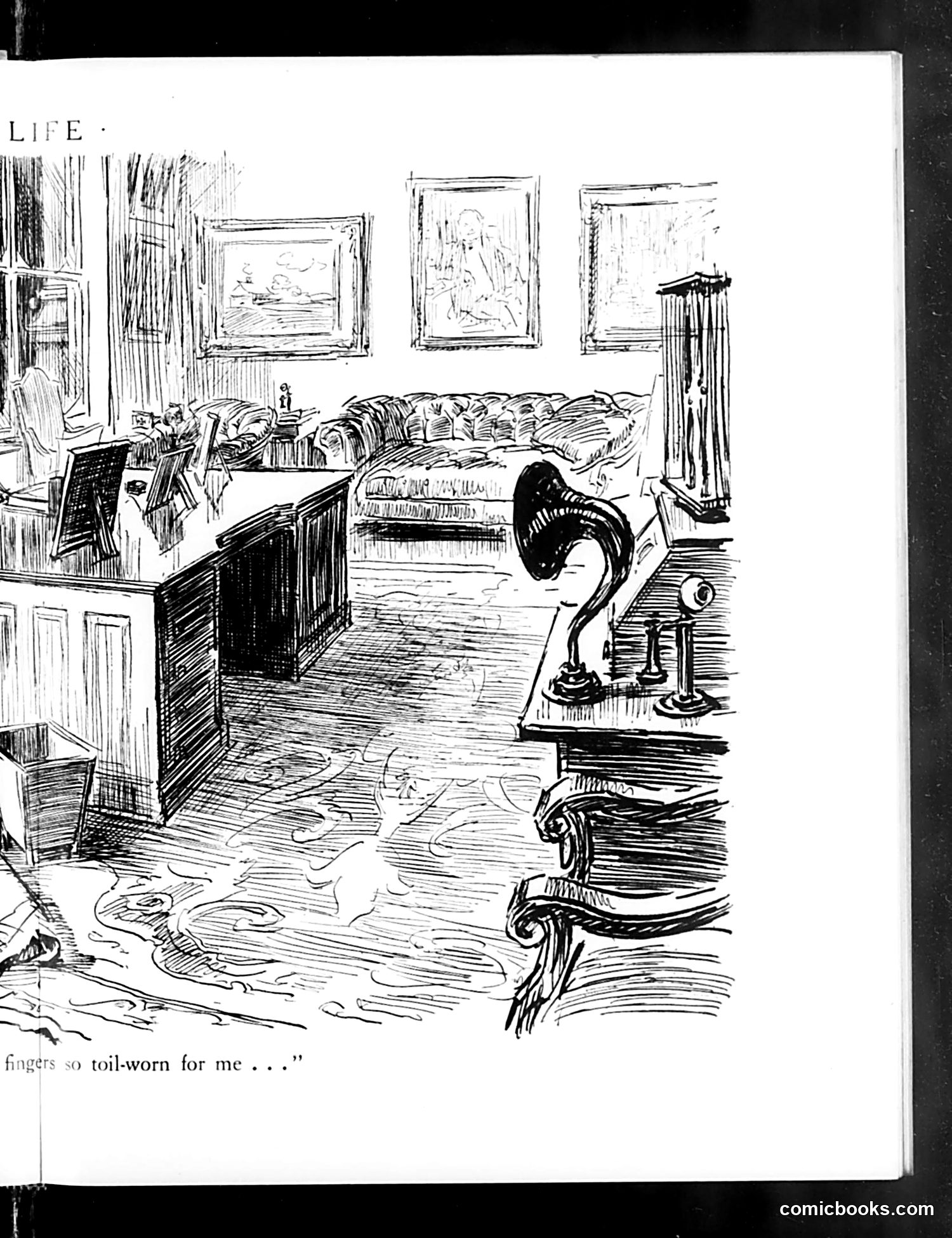
This appears to be a sketch from *Life* magazine's "Life" section showing an interior domestic scene. The visible caption reads: "fingers so toil-worn for me..." The cartoon depicts a bedroom/living space with a bed, desk, fireplace, and various furnishings rendered in quick pen strokes. The caption suggests the image comments on domestic labor—specifically the physical toll of housework on women's hands. This likely satirizes either: 1. A sentimental or romantic notion that ignores women's actual labor 2. The contrast between idealized domesticity and harsh physical reality of household work Without additional context or the full caption, the precise satirical target remains unclear, though the theme aligns with early-to-mid 20th century critiques of women's domestic burden. The sketch style is typical of *Life*'s humorous editorial illustrations.
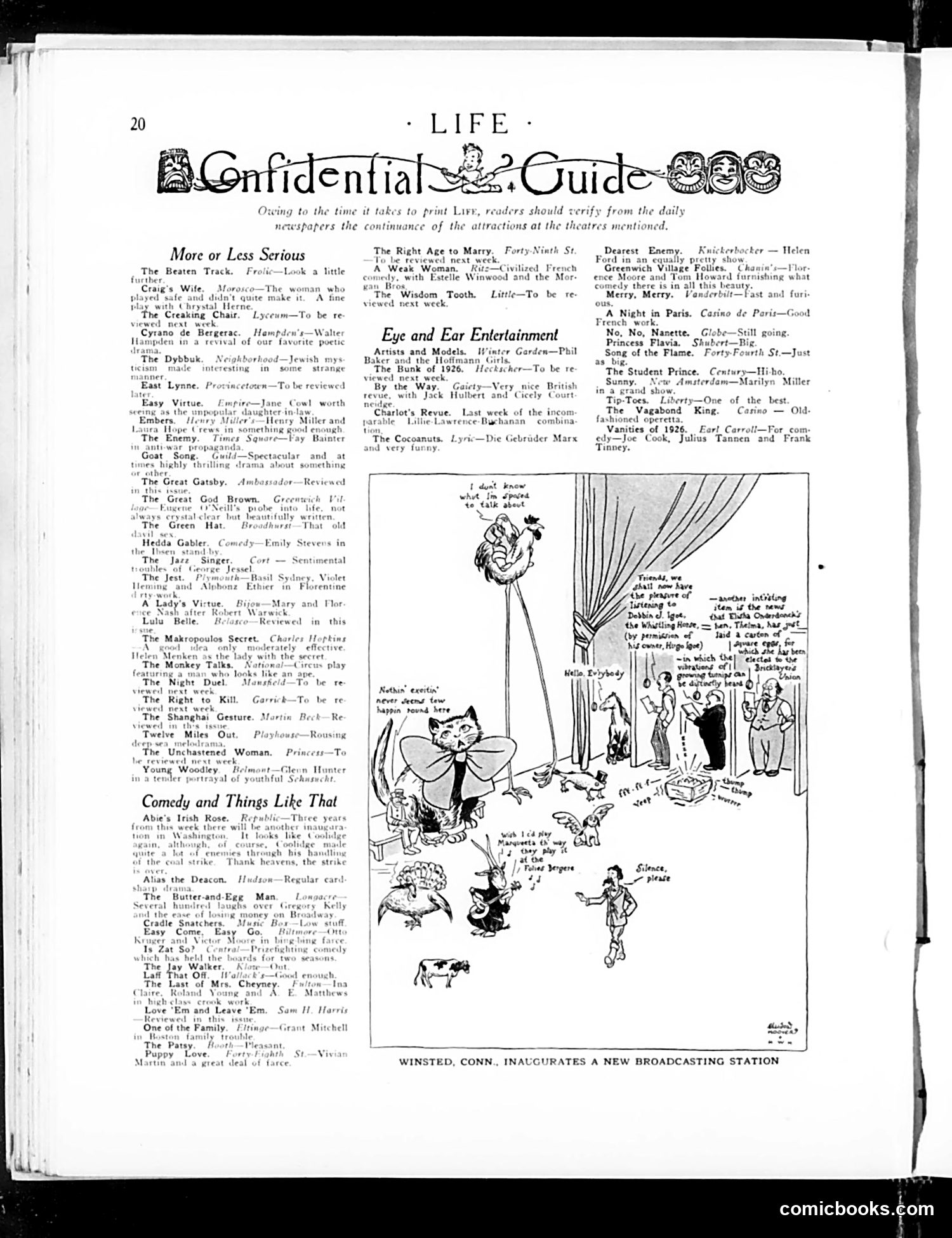
This page is primarily a **theater listings guide** for Broadway shows, with a cartoon illustration occupying the right side depicting the "inauguration of a new broadcasting station" in Winsted, Connecticut. The cartoon shows a whimsical scene of various animals and figures gathered around what appears to be a radio broadcasting setup. The humor seems to center on **rural America's fascination with the emerging radio technology** in the 1920s—the illustration captures incredulous or amazed reactions from farm animals and townspeople encountering this novelty. The satirical point targets the **novelty and strangeness of radio broadcasting to small-town America**, treating it as a curiosity worthy of ceremonial attention. This reflects the genuine cultural moment when radio was transforming American life, and rural areas were experiencing this technology for the first time. The page's main function is promoting theatrical attractions—typical of *Life* magazine's role as an entertainment guide for urban audiences of the Jazz Age era.
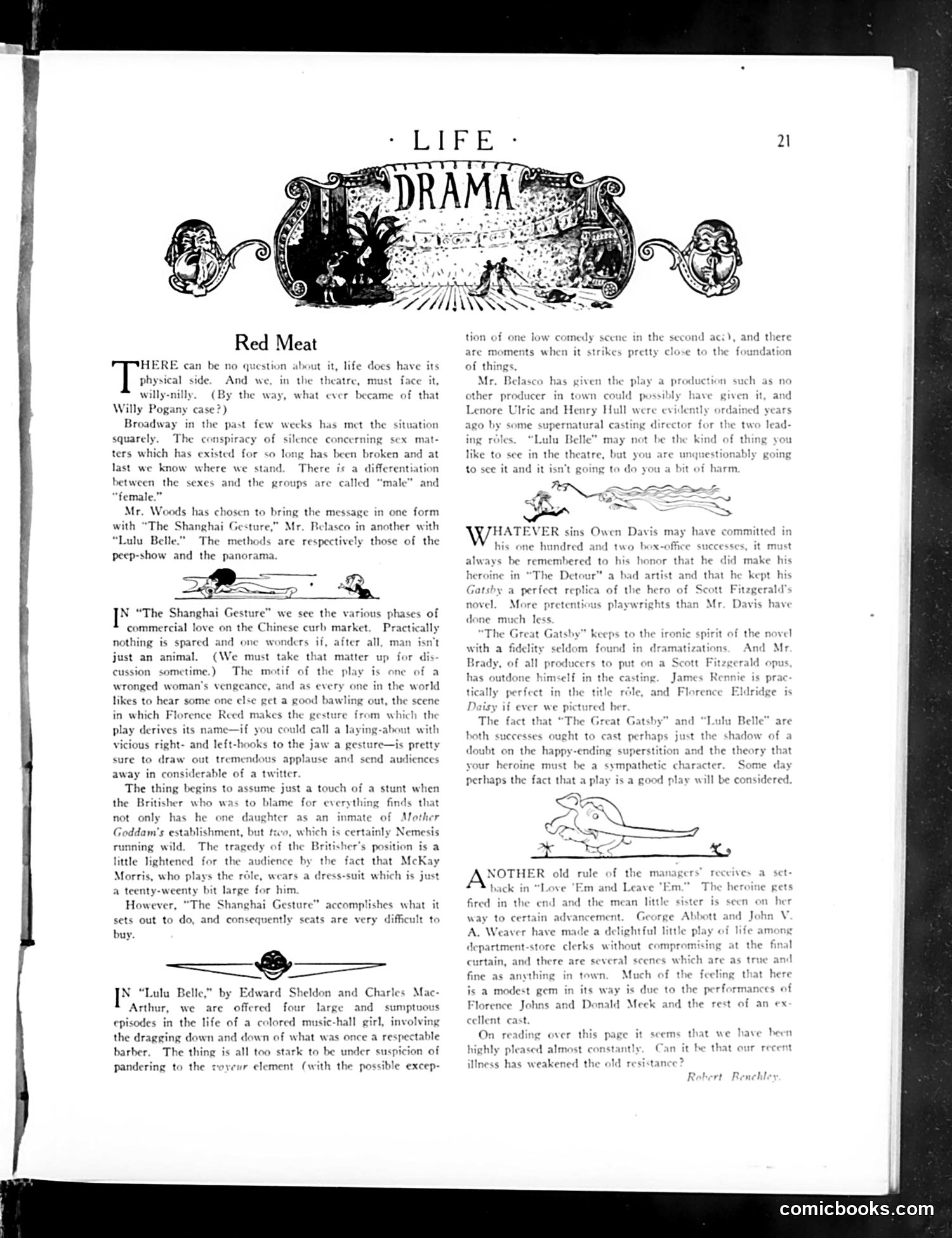
This is a theater review page from *Life* magazine discussing three Broadway productions: *Red Meat*, *The Shanghai Gesture*, and *Lulu Belle*. The critic argues that Broadway has honestly confronted sex differences and gender roles through drama. *The Shanghai Gesture* depicts commercial sex in Chinese markets without sanitizing details. *Lulu Belle* dramatizes the "degradation" of a Black music-hall performer—the reviewer notes it's "stark" but necessary theater. The page celebrates theatrical realism over sentimentality. It praises producer David Belasco's casting choices and argues that successful plays needn't feature only sympathetic heroines. References to *The Great Gatsby* and *The Detour* suggest the critic values fidelity to source material and psychological complexity. The small cartoon illustrations appear decorative rather than satirical—they accompany theatrical discussion without making specific political points. The overall tone celebrates serious drama addressing previously taboo subjects.
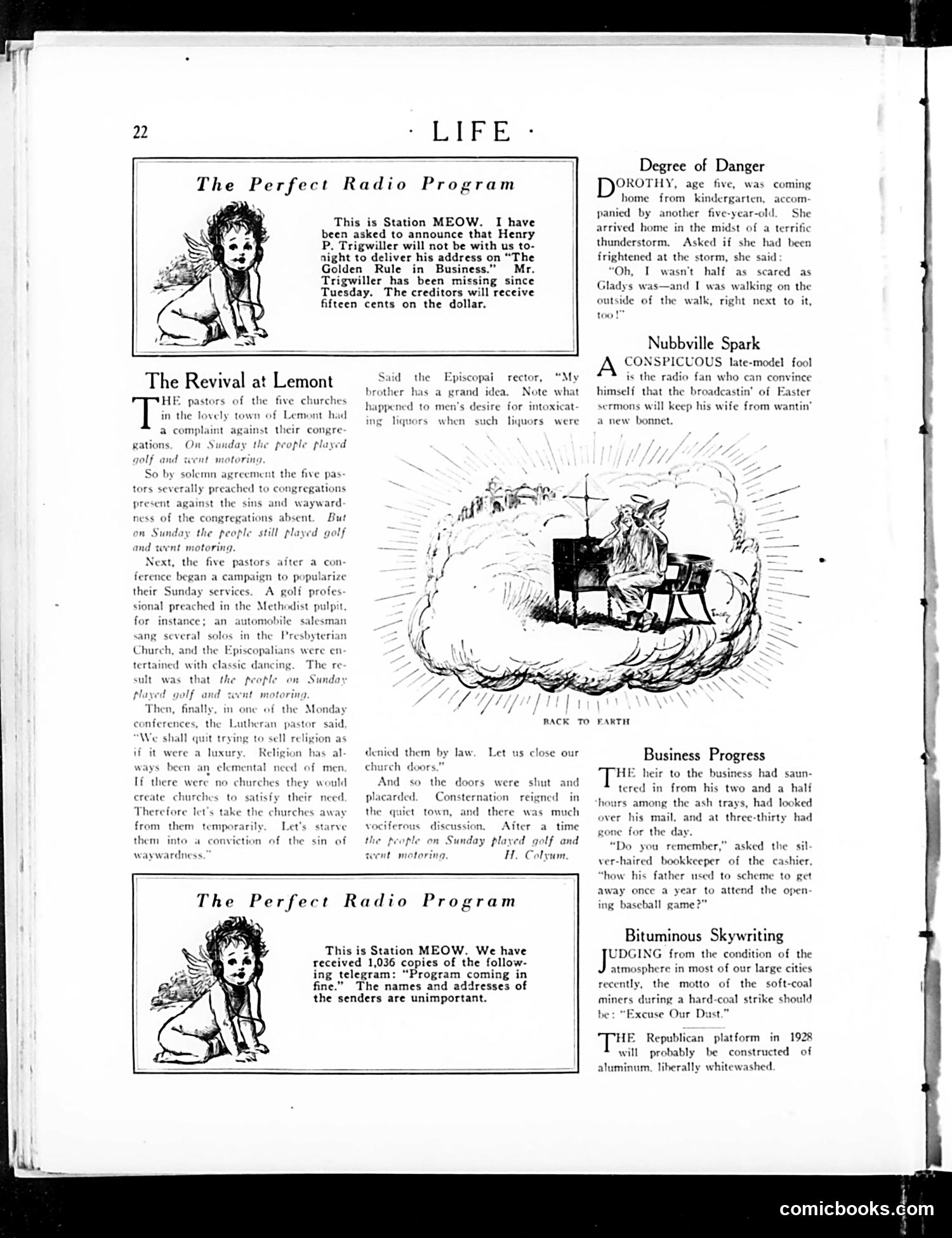
This page from *Life* satirizes American hypocrisy and social contradictions of the 1920s: **"The Revival at Lemont"** mocks religious leaders who preach against worldly pleasures while practicing them. Five pastors sermonize against golf and motoring on Sundays, yet play golf themselves. When they close churches to "starve" parishioners into virtue, the town experiences relief rather than repentance—exposing the gap between clergy rhetoric and behavior. **"The Perfect Radio Program"** (repeated twice) jokes about commercial radio's unreliability: Henry Trigwiller vanishes before delivering a business ethics speech, yet receives only 15 cents on the dollar from creditors. The absurdity satirizes both radio's newness and corporate malfeasance. **Minor items** ("Degree of Danger," "Nubbville Spark," "Business Progress") offer brief social commentary on childhood fearlessness, radio evangelism's materialism, and dynastic business complacency. **"Bituminous Skywriting"** and the Republican platform comment mock pollution and political whitewashing—coal miners' dust pollution and politicians' cosmetic platform construction. The overall tone critiques institutional hypocrisy and the gap between professed and actual values.
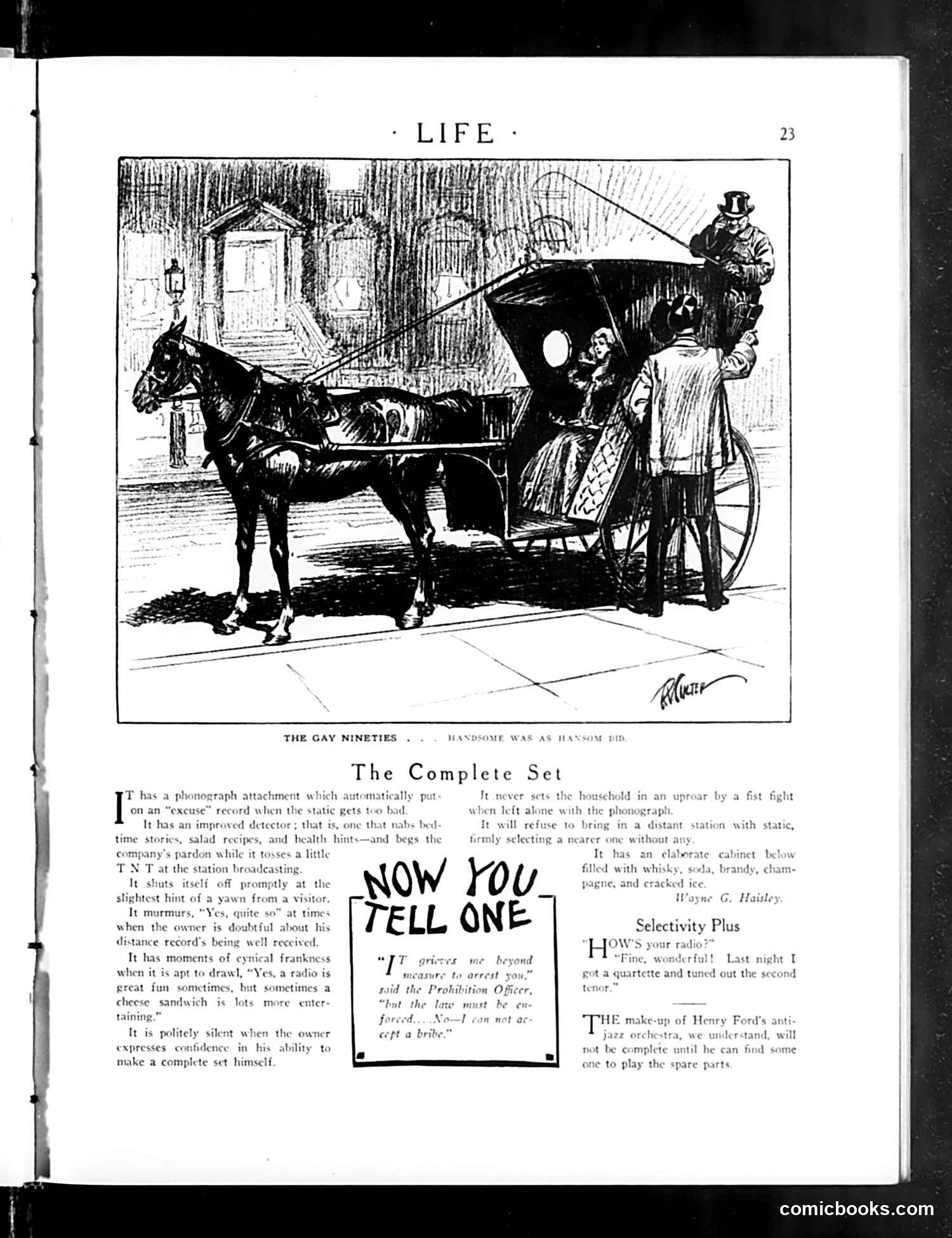
The top cartoon, titled "The Gay Nineties," depicts a nostalgic scene of 1890s street life: a horse-drawn carriage with a coachman and elegantly dressed passengers. The caption "Handsome was as Hansom did" is a play on the phrase "handsome is as handsome does"—suggesting that the era's romantic appeal lay in its stylish transportation and social customs. Below, the page advertises radio technology and accessories as "The Complete Set." The satirical text humorously anthropomorphizes the radio, describing it as temperamental and opinionated—it provides excuses for poor reception, refuses to bring in certain stations, and will "drawl" cynical comments about music quality. The joke contrasts nostalgic 1890s elegance with modern 1920s-30s radio technology, poking fun at consumers' eagerness to own the latest gadgets while these new devices remain unreliable and temperamental. The "Now You Tell One" section appears to be a joke feature mocking Prohibition enforcement.
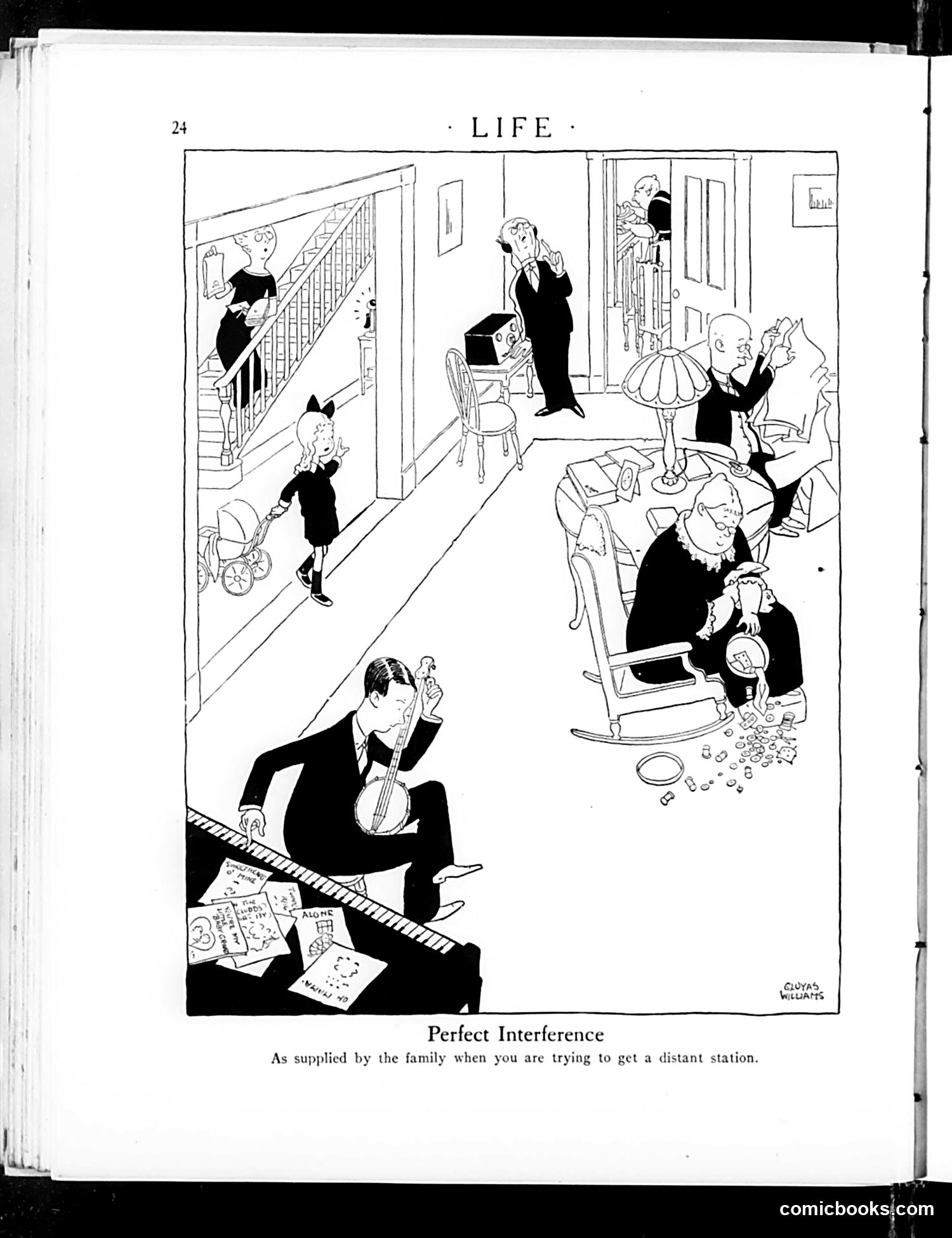
This single-panel cartoon satirizes family disruptions during radio listening. A man in formal attire sits in the foreground attempting to tune a radio, surrounded by scattered papers and sheet music, trying to receive a distant station. Behind him, the domestic scene shows complete chaos: children playing, a woman in a ball gown, adults conversing, someone on stairs, a baby in a carriage, and general household commotion. The joke is that "perfect interference" comes not from technical radio problems, but from the family itself—their noise and activities completely derail his concentration. This reflects early 20th-century radio culture, when receiving distant broadcasts required focus and skill. The cartoon humorously suggests that getting a clean signal is nearly impossible when living with a boisterous household.
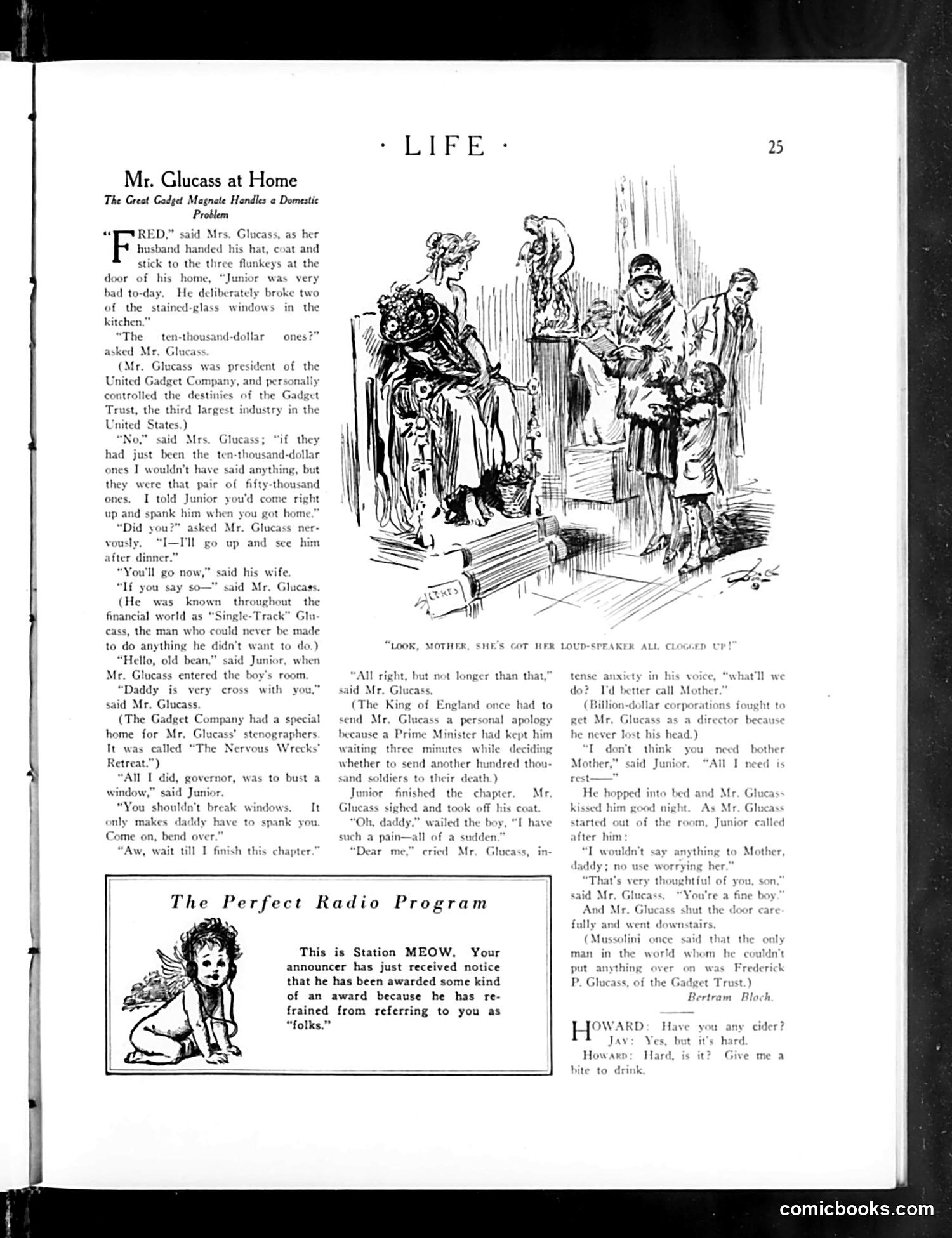
This story satirizes a wealthy businessman's inability to discipline his own child, despite controlling a massive corporation. Mr. Glucass, president of the United Gadget Company (a fictional industrial giant), is described as "Single-Track"—a man who refuses to do anything he doesn't want to do. The humor centers on his weakness: his wife demands he spank their son Junior for breaking expensive stained-glass windows, but Glucass avoids the task, claiming he'll do it "after dinner." When he finally goes upstairs, Junior merely complains of stomach pain and Glucass abandons the punishment entirely. The satire mocks the contradiction between ruthless business authority and domestic powerlessness—a wealthy magnate who controls millions cannot control his own household. The accompanying joke about a radio announcer avoiding calling listeners "folks" is unrelated social commentary on contemporary radio conventions.
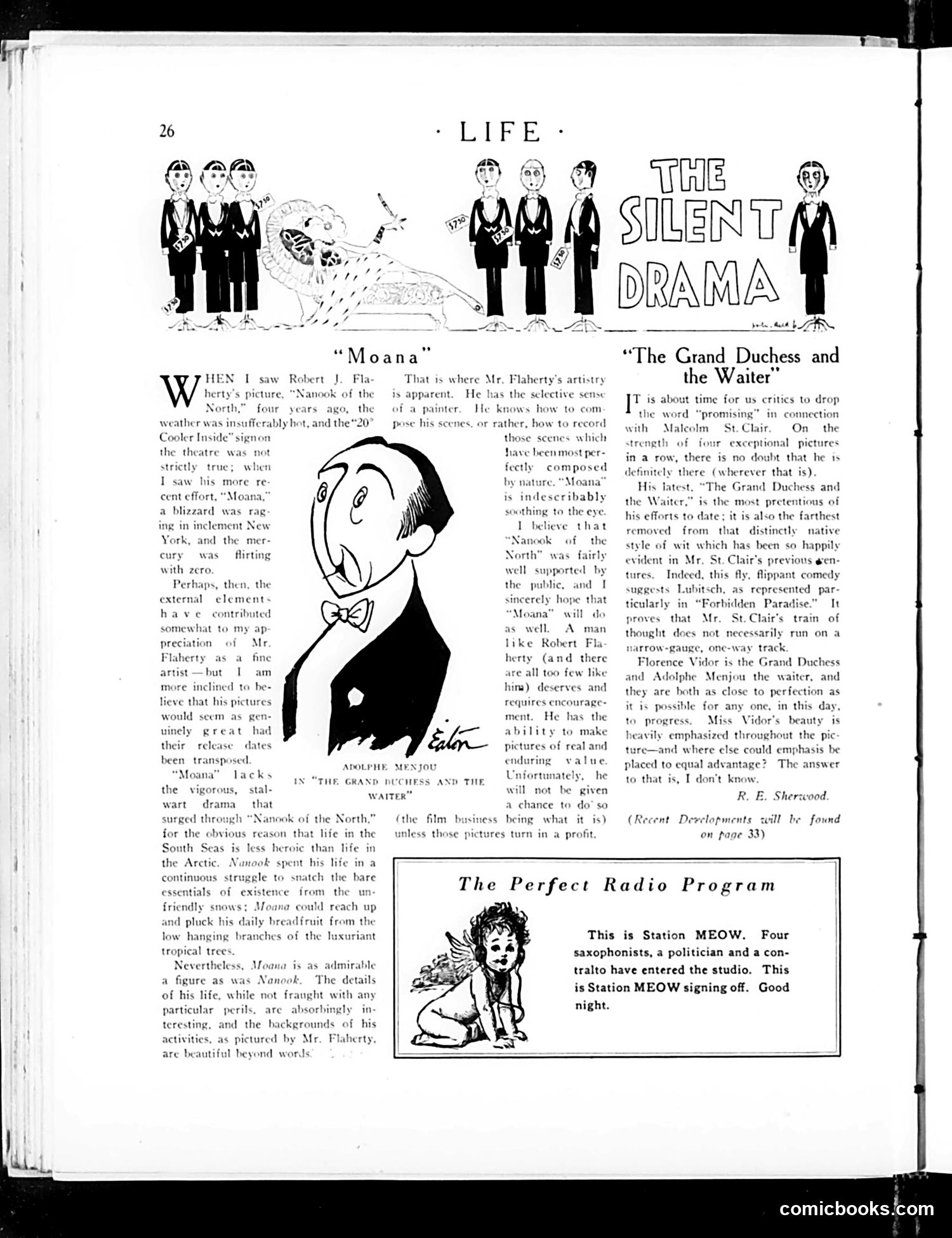
This page contains film reviews by critic R.E. Sherwood. The main critique discusses Robert Flaherty's documentary films "Nanook of the North" and "Moana," praising Flaherty's artistic composition and selective scene-recording. The reviewer argues that while "Moana" lacks the dramatic survival struggle of "Nanook," Flaherty's visual artistry remains exceptional. The second review covers "The Grand Duchess and the Waiter," starring Florence Vidor and Adolphe Menjou (identified in the caricature). Sherwood criticizes this comedy as the most pretentious of St. Clair's recent efforts, arguing it abandons the witty style evident in his previous work like "Forbidden Paradise." He notes that talented filmmakers rarely get opportunities to create profitable art. The small illustration at bottom satirizes radio programming with "Station MEOW" — a humorous absurdist sketch about incongruous studio guests.
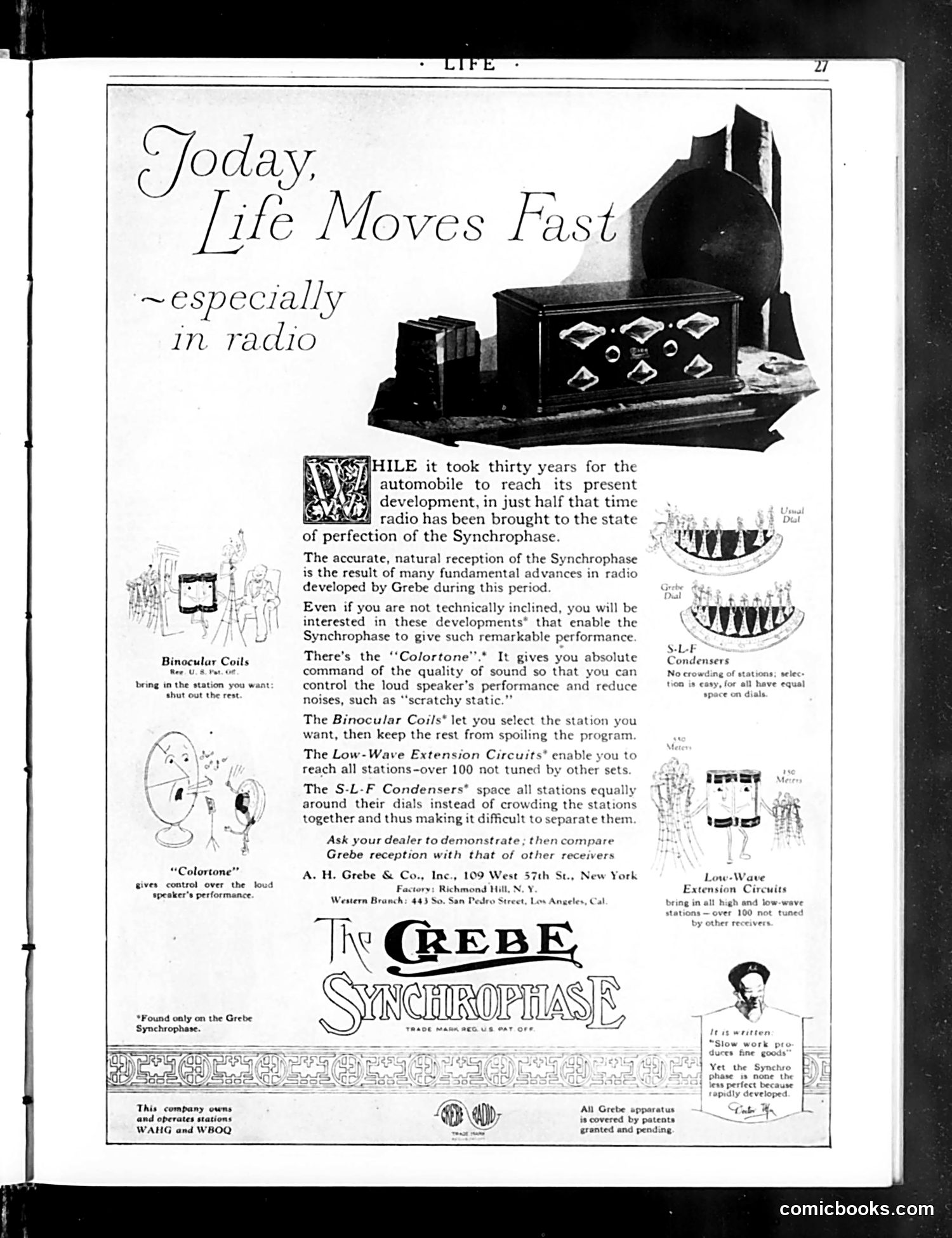
This is a **product advertisement**, not political satire. The page promotes the Grebe Synchrophase radio receiver, a cutting-edge consumer technology of the era. The advertisement compares radio's rapid development (15 years) to the automobile's slower evolution (30 years), positioning radio as the faster-advancing technology. It highlights technical features like "Colortone" (sound quality control), "Binocular Coils" (station selection), and other innovations as reasons for superior reception. The small illustrations (binocular coils diagram, "Colortone" speaker control, antenna circuits) are technical explanations rather than cartoons. The humor is minimal—mostly the gentle mockery of rapid technological progress itself. This reflects 1920s consumer culture enthusiasm for radio as a transformative domestic technology, and Grebe's attempt to differentiate their product through advertised innovations.
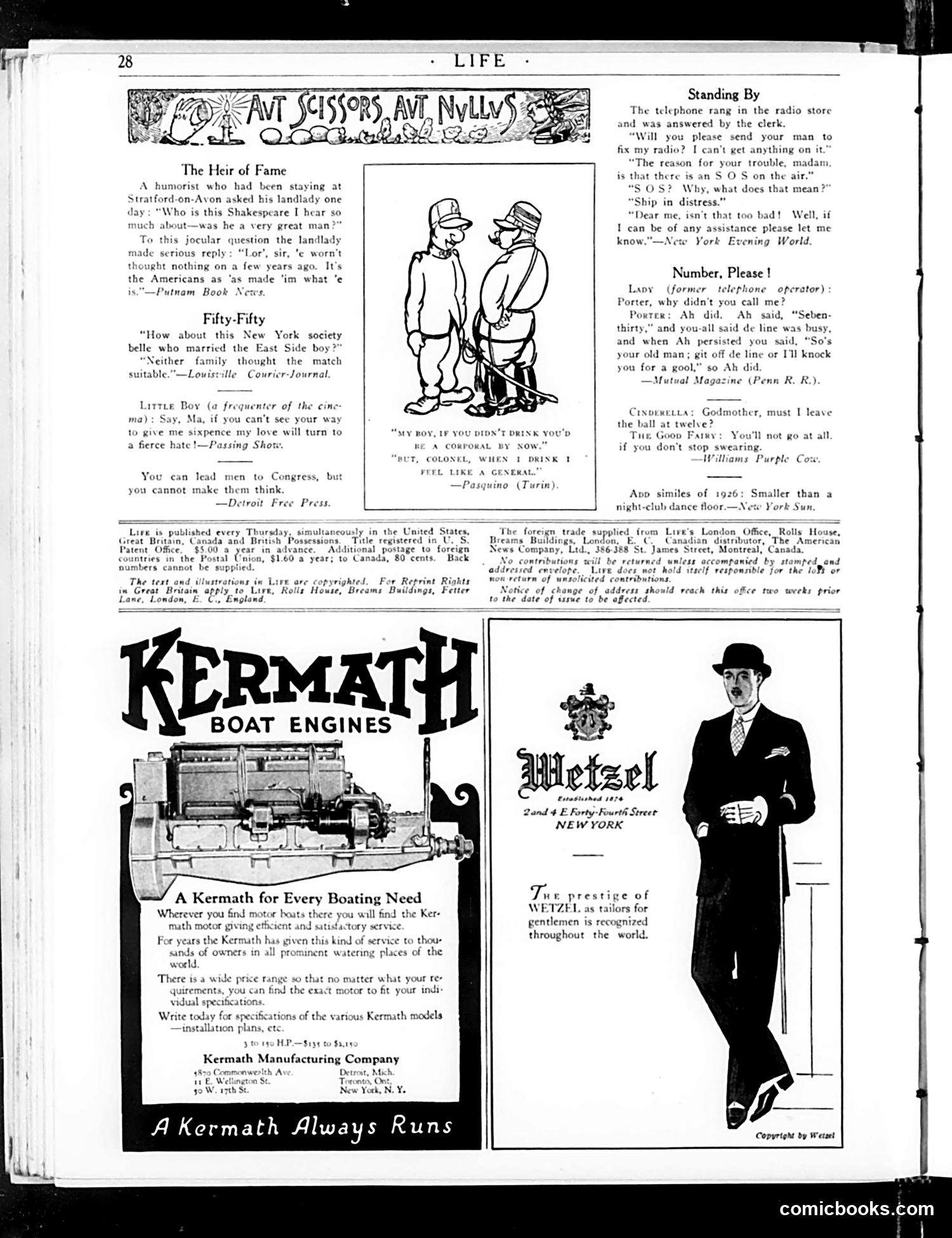
This page contains several brief humorous anecdotes typical of Life's satirical format: **"The Heir of Fame"** mocks British deference to American cultural influence. A landlady dismisses Shakespeare as historically obscure until Americans made him famous—satirizing American cultural arrogance and Britain's anxiety about losing cultural dominance. **"Standing By"** jokes about radio's emerging technology. A listener confused by "S.O.S" (distress signal) thinks a ship needs help, not realizing radio broadcasts carry maritime emergency signals. **"Number, Please!"** features former telephone operators as characters—a dated job reference. The humor involves miscommunication and dialect humor typical of 1920s comedy. **Other brief jokes** reference contemporary concerns: prohibition-era drinking, gender roles in courtship, and social class. The page is primarily **advertising** (Kermath boat engines, Wetzel tailors), which dominated Life's revenue model. The cartoons are simple line drawings illustrating short jokes rather than complex political satire.
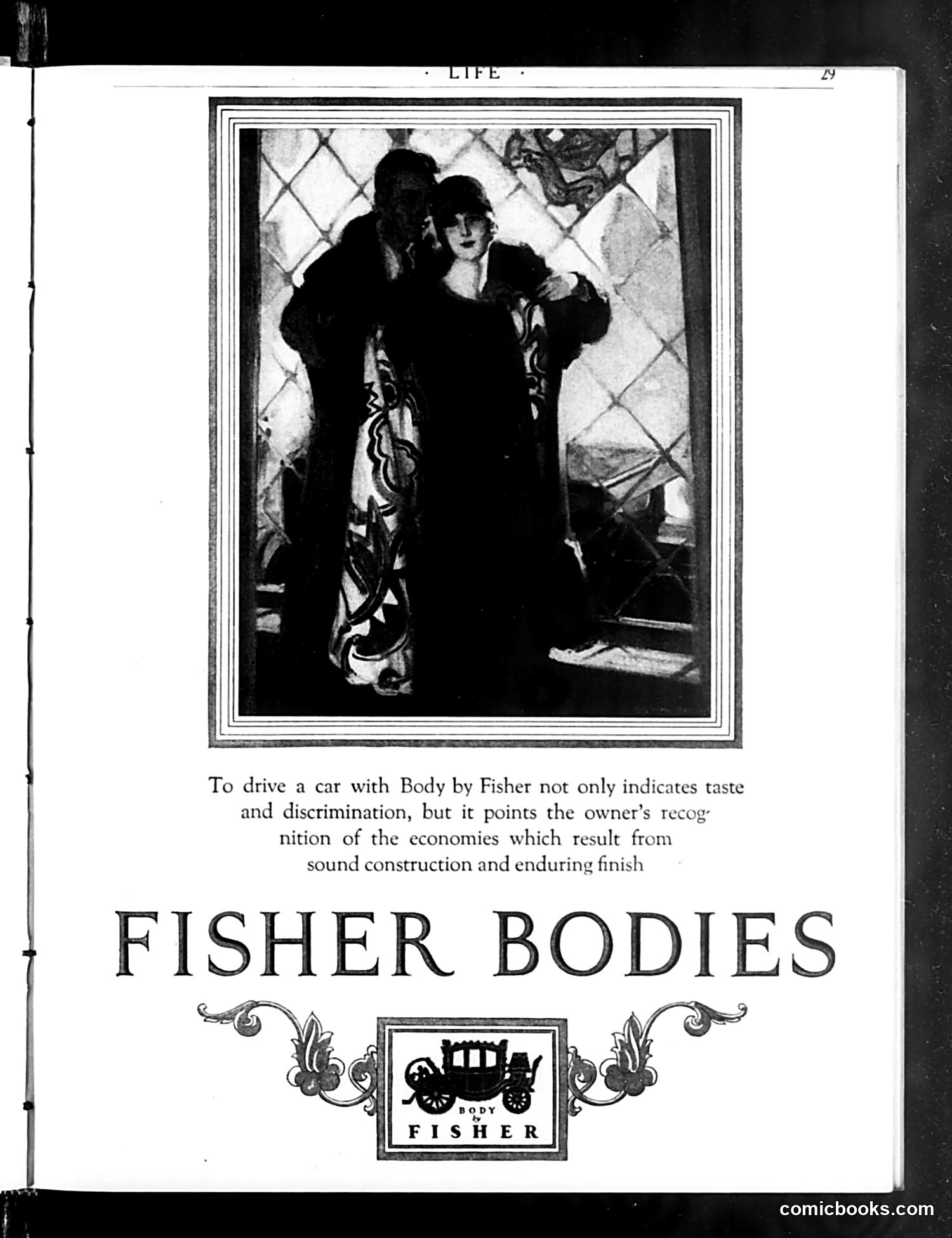
This is a straightforward automobile advertisement, not political satire. The page promotes "Fisher Bodies," a car body manufacturer, using a photograph of elegantly dressed figures (appearing to be a couple) near a luxury automobile in an interior setting with decorative windows. The advertisement's text claims that choosing a Fisher body demonstrates the owner's "taste and discrimination" while recognizing the "economies" of quality construction and durability. This marketing strategy appeals to aspirational consumers by linking car ownership to social status and refinement. The ornate logo at bottom features a horse-drawn carriage, likely referencing Fisher's heritage in vehicle manufacturing. This appears typical of 1920s automobile advertising targeting affluent buyers.
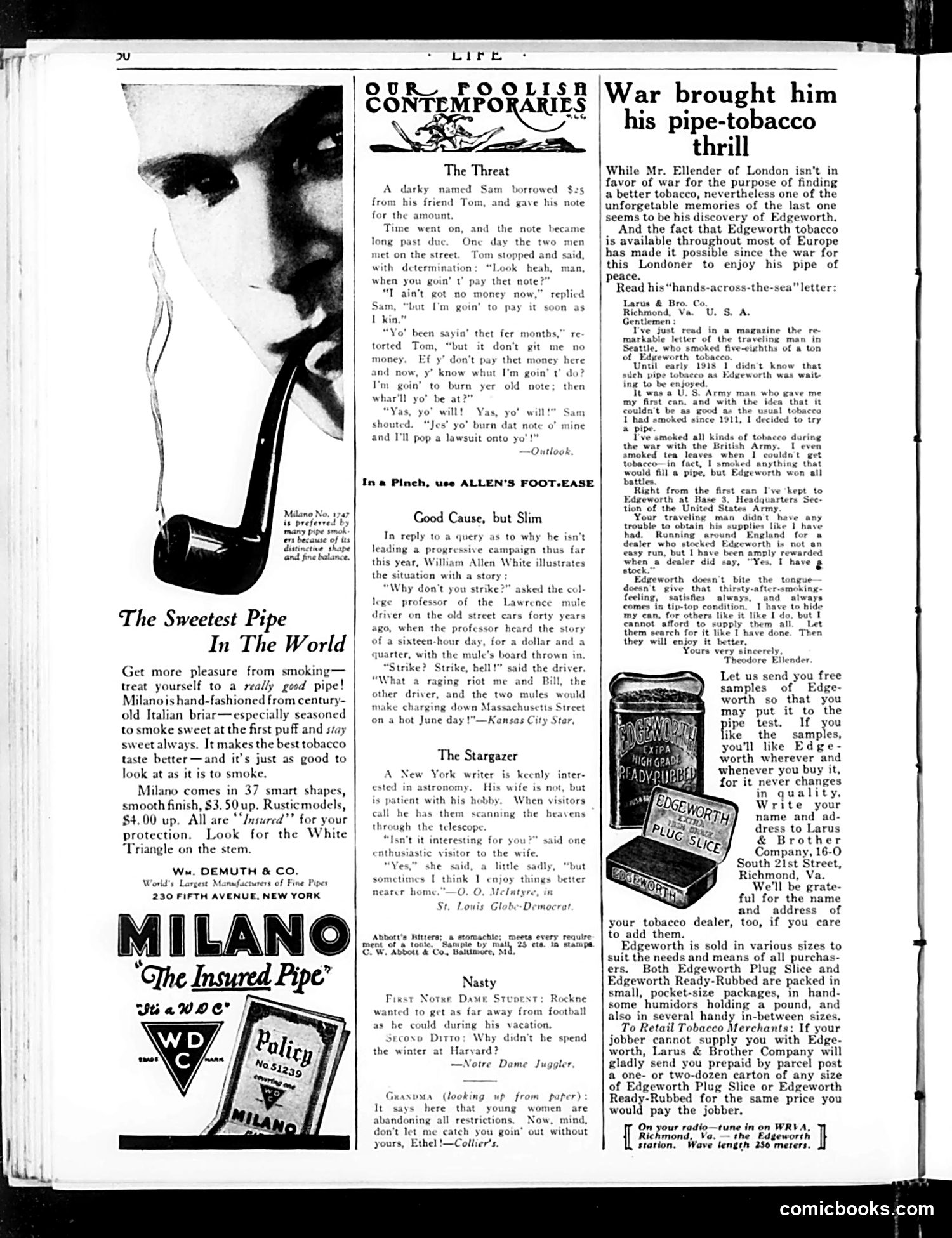
This page contains **advertising and humor content**, not political cartoons. The **Milano pipe advertisement** (left) uses a glamorous portrait to market hand-crafted Italian smoking pipes, emphasizing quality and aesthetic appeal. The **"Our Foolish Contemporaries" section** (center) reprints three humorous anecdotes from other publications: a dialect joke about an African American debtor threatening to burn a promissory note; a story by journalist William Allen White comparing labor strikes to mule drivers; and a joke about an astronomer's wife finding his hobby tedious. The **Edgeworth tobacco advertisement** (right) frames pipe smoking as a wartime discovery—a soldier found the tobacco during WWI and now, postwar, treasures it as a memory. This nostalgia marketing connects the product to patriotic experience. The **Allen's Foot-Ease advertisement** and smaller items fill remaining space. The page reflects early 20th-century advertising conventions and period humor, including casual racial stereotypes typical of that era's Life magazine.
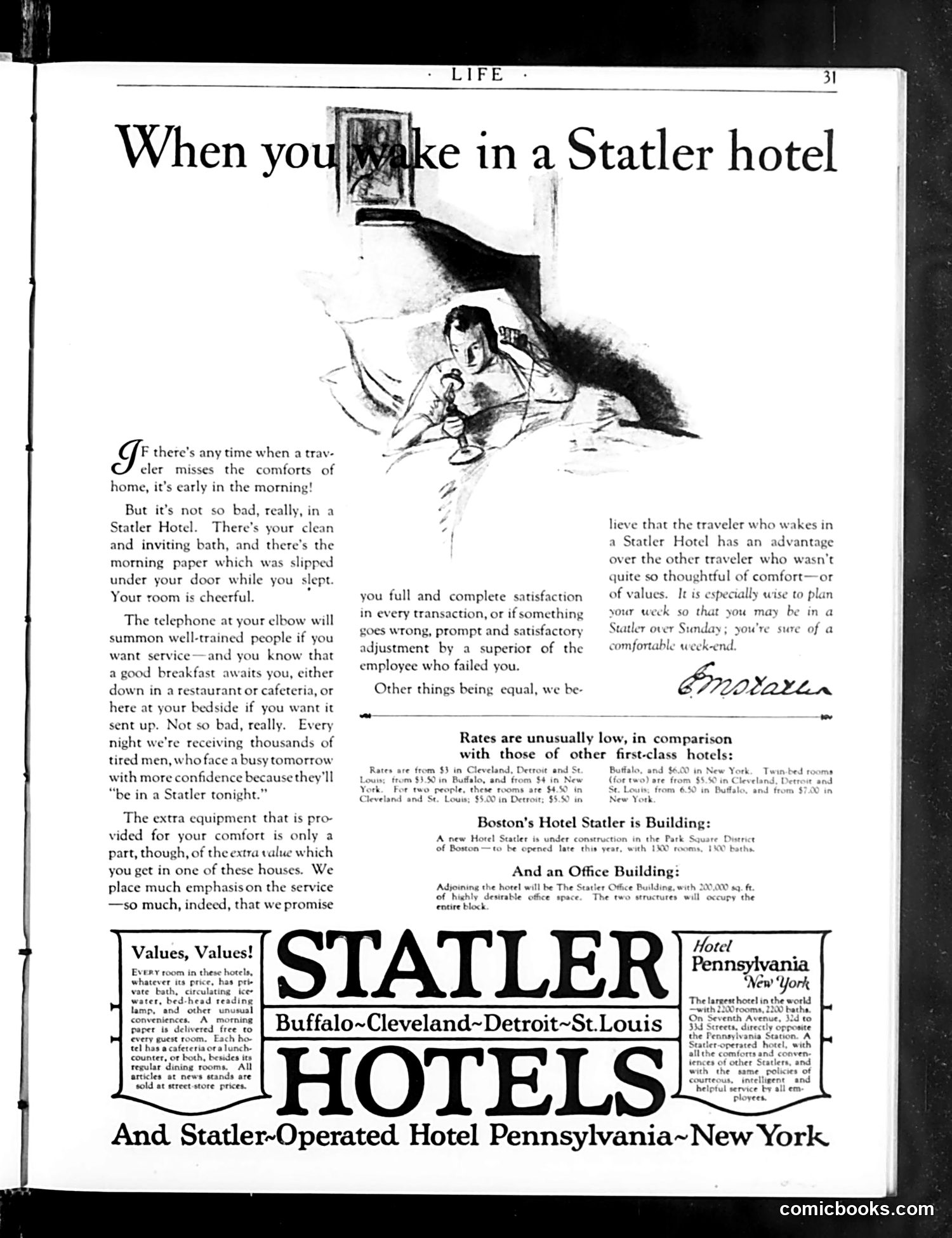
This is primarily a **hotel advertisement**, not political satire. It appeared in Life magazine (likely 1910s-1920s based on style) promoting the Statler Hotel chain across major American cities. The small cartoon illustration shows a traveler waking in a hotel room—depicting the target audience: businessmen on the road who miss home comforts. The ad's humor is gentle and domestic rather than satirical: it plays on the relatable anxiety of early-morning hotel stays, then reassures readers that Statler Hotels offer superior amenities (clean bath, morning newspaper slipped under the door, good breakfast, responsive telephone service). The accompanying text emphasizes "Values, Values!"—highlighting competitive pricing and standardized comfort across locations. The mention of "well-trained people" and prompt service adjustment reflects early 20th-century business values around customer service standardization. This represents advertising-as-content in Life magazine's editorial space, using humor to sell hospitality rather than making any broader social or political commentary.
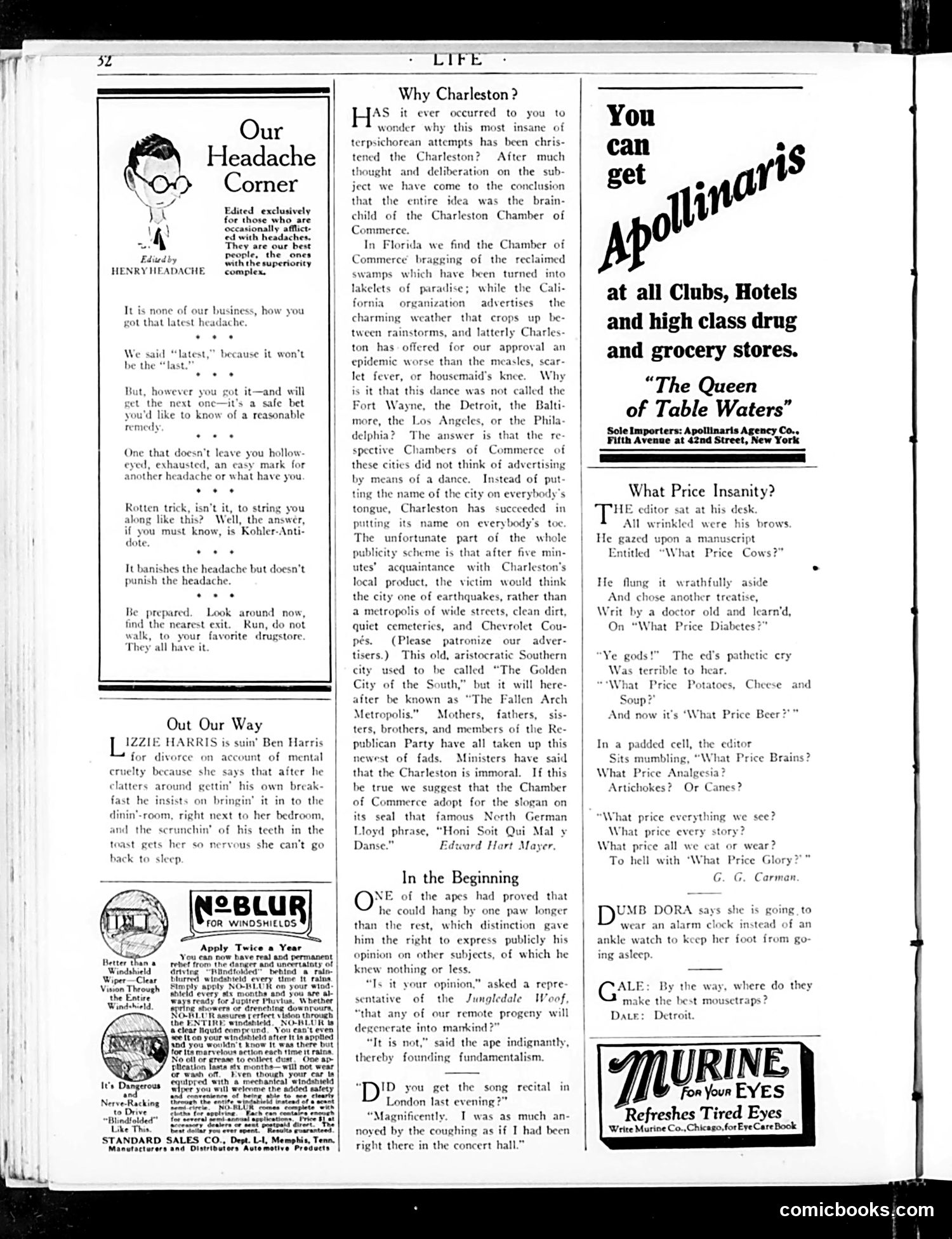
This page satirizes the Charleston dance craze of the 1920s. The main article "Why Charleston?" argues that the dance's popularity results from opportunistic marketing by the Charleston Chamber of Commerce, not the city's actual merits. The author notes that Charleston promoted itself through the dance while other cities (Fort Wayne, Detroit, Philadelphia) didn't think of this advertising strategy. The satire targets civic boosterism and herd mentality: the Charleston became famous simply because one Chamber of Commerce successfully branded it with their city's name. The article mockingly suggests Charleston now has a worse reputation for earthquakes and moral decay than for its historical charm as "The Golden City of the South." The sidebar "Our Headache Corner" is an unrelated advice column about remedies for headaches, while "Out Our Way" shows domestic humor about a husband's breakfast habits annoying his wife.
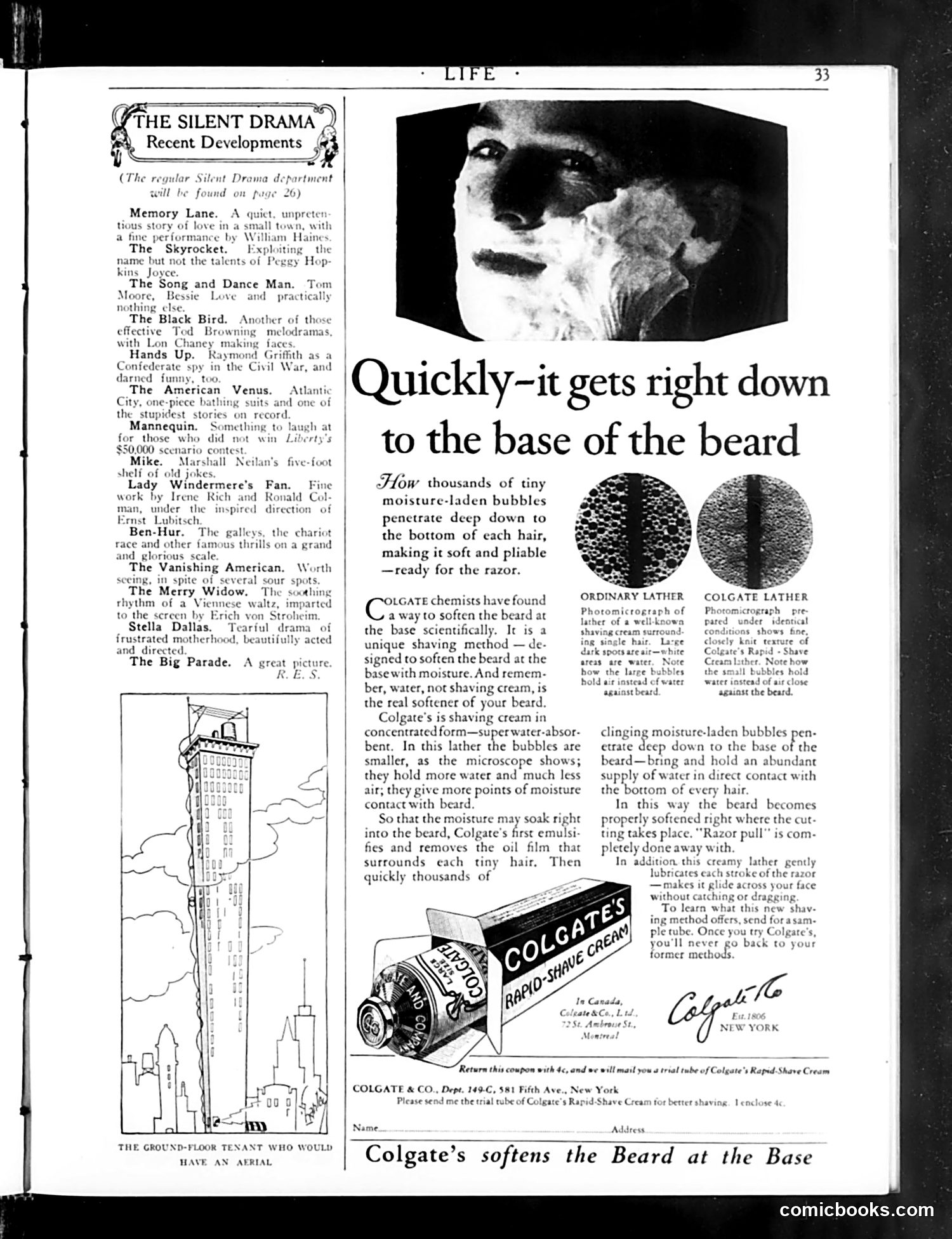
This page contains two distinct elements: **Left Column - "The Silent Drama: Recent Developments"** This is a film review section listing recent movie releases with brief critiques. It covers popular films of the silent era (titles like *Ben-Hur*, *The Big Parade*, *The Merry Widow*), offering sarcastic or complimentary one-line assessments. This reflects Life magazine's role as a cultural arbiter commenting on contemporary entertainment. **Right Column - Colgate Advertisement** A full-page advertisement for Colgate's Rapid-Shave Cream, featuring microscopic photographs comparing ordinary lather to Colgate's formula. The ad uses pseudo-scientific language to claim Colgate's concentrated formula creates smaller bubbles that penetrate beard hair more effectively, softening at the base for a better shave. A coupon invites readers to request a free trial tube. **Context for Modern Readers:** The page reflects 1920s consumer culture: silent films were dominant entertainment, and shaving products were marketed with emerging scientific claims (micrography imagery) to suggest superiority, despite limited actual differentiation between competing brands.
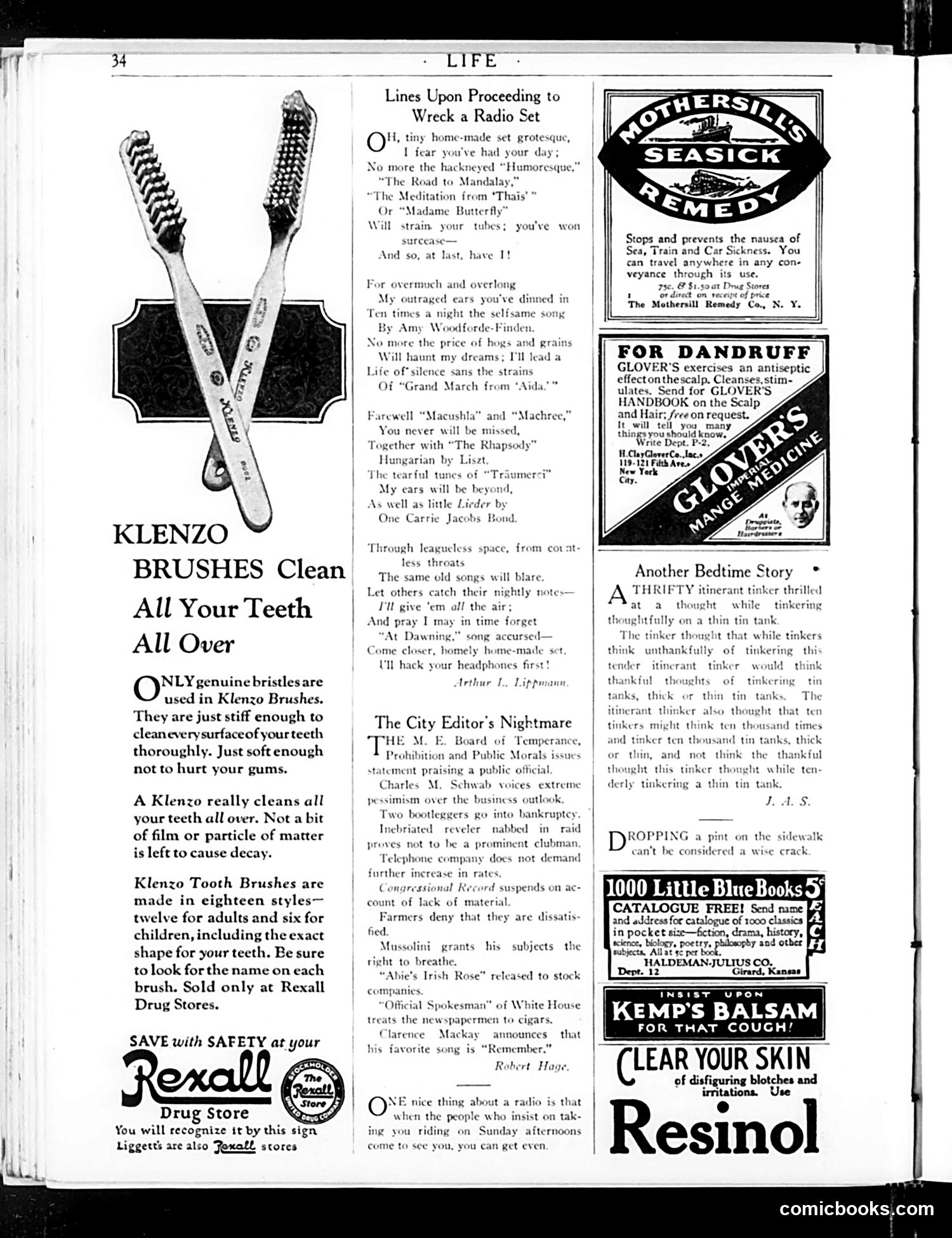
This page is primarily **commercial advertisements** with minimal satirical content. The main items are: **Klenzo Toothbrush ad** (left): Standard product advertisement emphasizing gentle-yet-effective cleaning, sold at Rexall Drug Stores. **"Lines Upon Proceeding to Wreck a Radio Set"** (center top): A humorous poem by Arthur L. Lippmann satirizing early radio broadcasts. The speaker celebrates destroying their homemade radio set to escape repetitive, sentimental popular songs of the era—specifically mentioning overplayed pieces like "Macushla," "The Road to Mandalay," and "Aida's Grand March." The satire mocks both the limited song rotation and listeners' forced tolerance of it. **"The City Editor's Nightmare"** (center): A brief satirical piece imagining impossible scenarios (bootleggers going bankrupt, Congress suspending publication for lack of material, Mussolini granting breathing rights)—mock absurdities reflecting 1920s cynicism about government and business. The remaining content comprises product advertisements (Mothersill's Seasickness Remedy, Glover's Dandruff Treatment, Kemp's Balsam, Resinol, and Little Blue Books catalog).
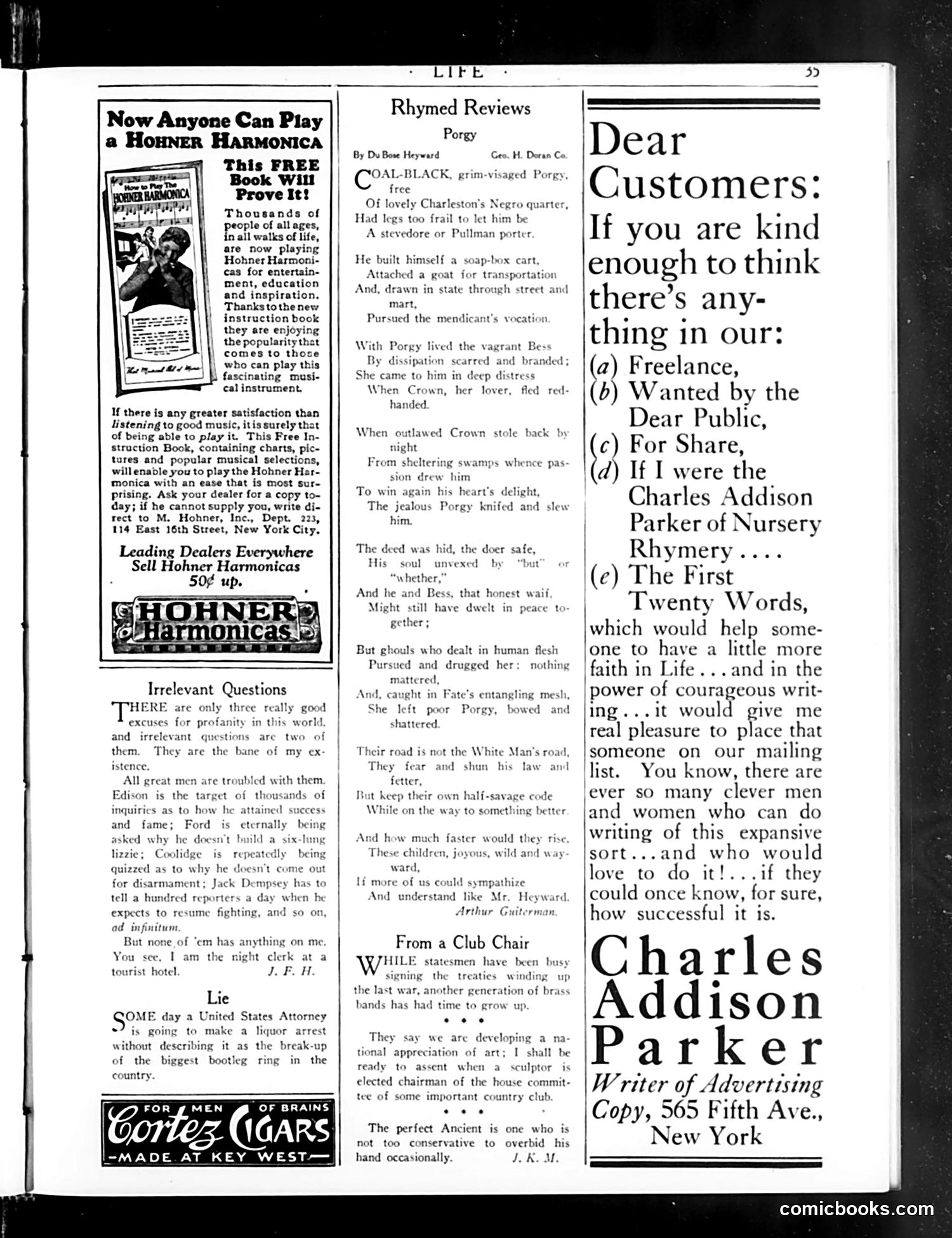
This page primarily contains **advertisements and literary content** rather than political cartoons. The main elements are: **Advertisements:** - Hohner Harmonica instruction book (top left) - Cortiez Cigars (bottom left) **Editorial/Literary Content:** - A poem reviewing Du Bose Heyward's novel *Porgy* (which would later inspire the opera *Porgy and Bess*)—the review sympathetically portrays Charleston's Black community and critiques racial inequality - "Irrelevant Questions" column—satire about famous men constantly pestered by the public with trivial inquiries - "Lie" column—brief commentary on how liquor arrests are sensationalized - "From a Club Chair"—short observations about post-WWI cultural trends - Charles Addison Parker's solicitation for writers The *Porgy* review is the most substantive content, presenting sympathetic (if paternalistic by modern standards) treatment of Black life and pointing out systemic disadvantages.
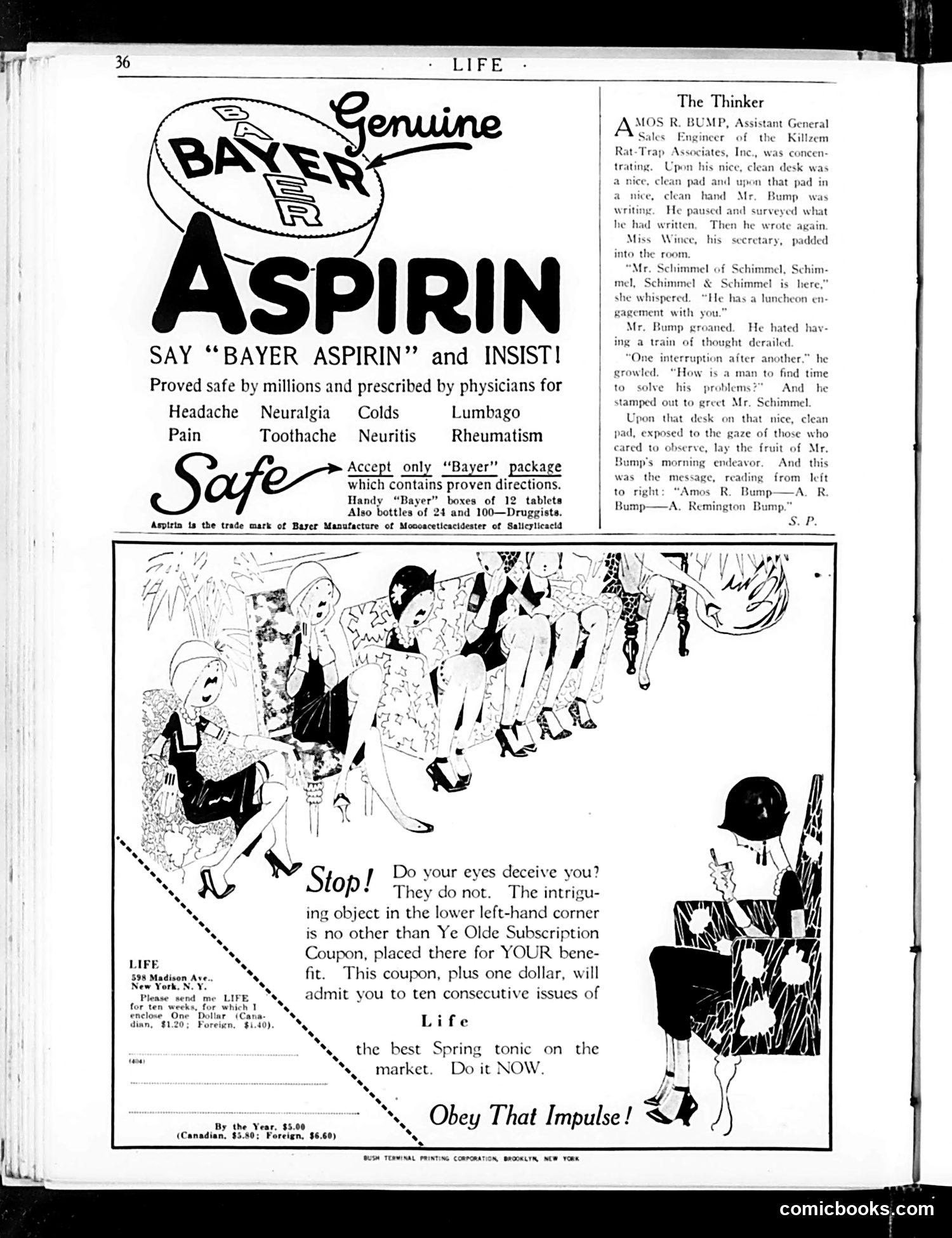
This page contains a short story excerpt about Amos R. Bump, an assistant engineer whose work concentration is interrupted by a visitor. The narrative's humor lies in the mundane office frustration—Bump's carefully organized desk and clear thoughts are disrupted by an unwanted lunch engagement. The page is primarily **advertising-driven**, featuring a large Bayer Aspirin advertisement promoting the product for common ailments, and a subscription pitch for *Life* magazine itself, humorously framed as an "impulse" purchase offer. The cartoon illustration (lower half) depicts fashionably dressed women in what appears to be a satirical social scene, accompanying the subscription appeal. The satire targets reader impulses and consumer habits typical of the 1920s-1930s advertising era—selling both pharmaceutical products and magazine subscriptions through appeals to anxiety and desire.
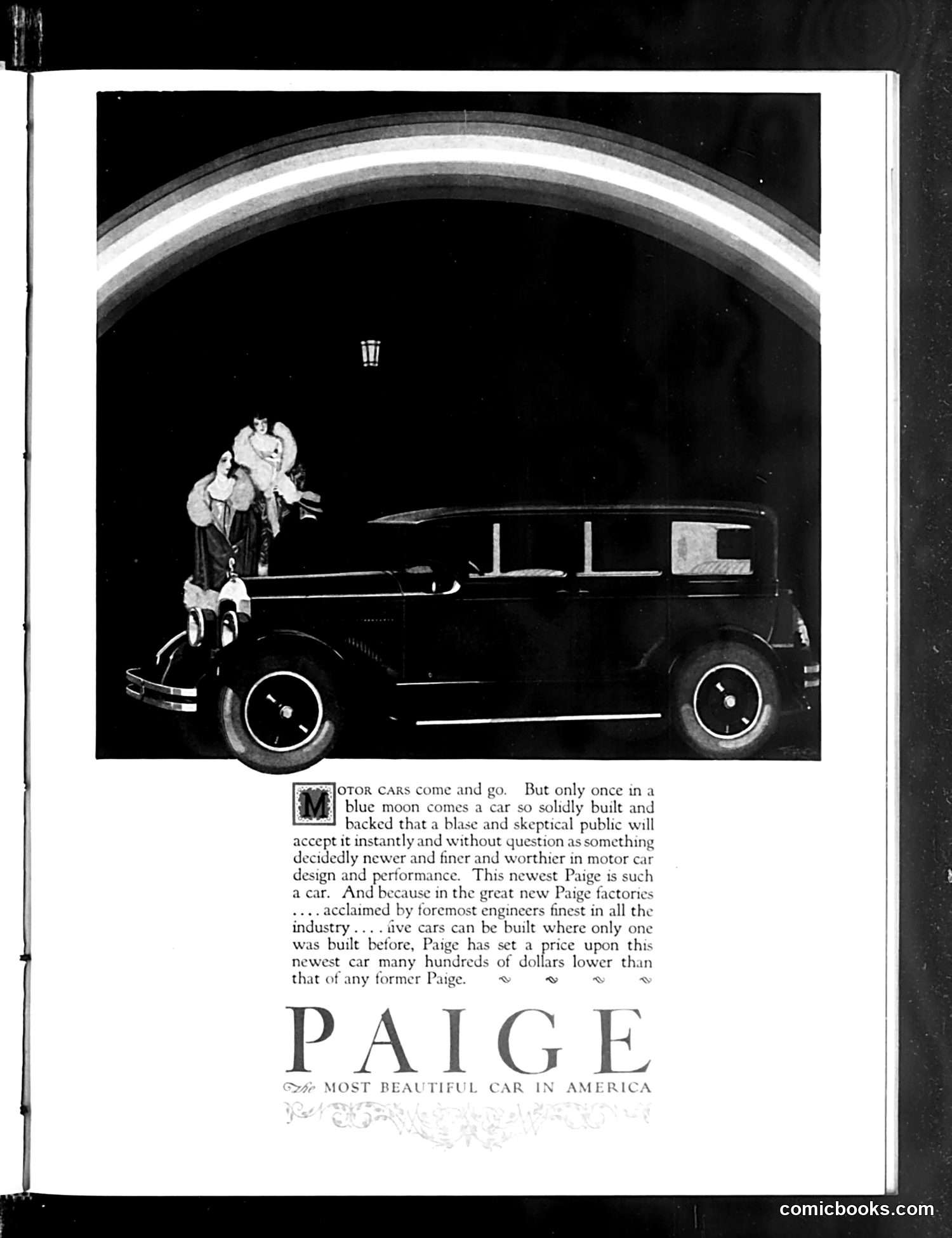
This is primarily a **car advertisement**, not a political cartoon. It's a Paige automobile ad from what appears to be the 1920s era. The image shows an elegantly dressed couple (woman in fur coat) standing beside a dark sedan under an arched structure, with a street lamp above. The advertisement's pitch emphasizes that Paige cars are "decidedly newer and finer" in design and performance. The key selling point is **efficiency**: the new Paige factories can produce five cars where only one was built before, allowing Paige to undercut competitors' prices by "many hundreds of dollars." This reflects the manufacturing innovations (likely mass production techniques) of the early automotive era. The sophisticated imagery—the well-dressed couple, the elegant car—targets middle to upper-middle class consumers, while the price advantage appeals to broader affordability concerns. There is no political satire present on this page.
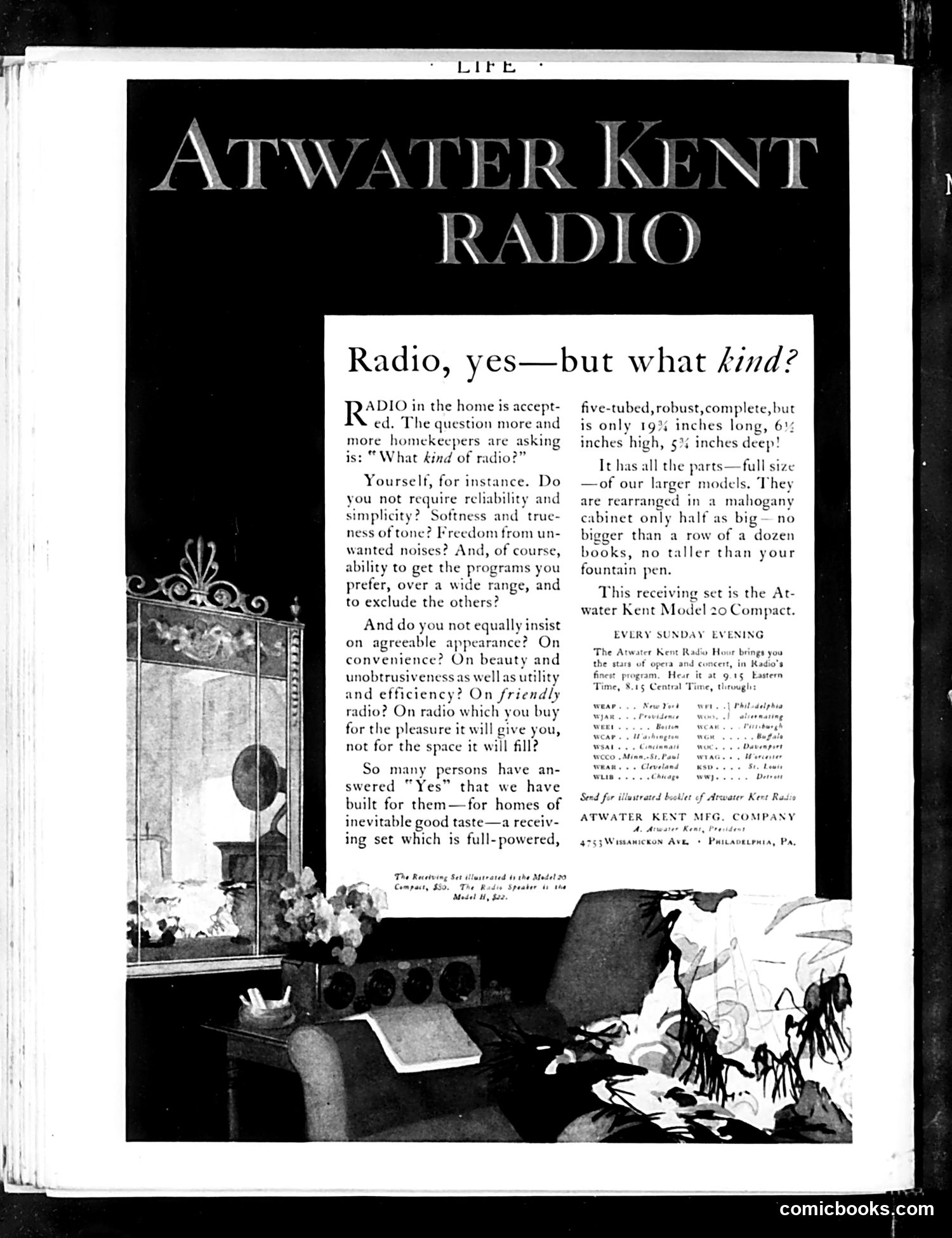
This is a **product advertisement**, not political satire. It promotes the Atwater Kent Model 20 Compact radio, a five-tubed receiver designed for home use. The "joke" is rhetorical: the ad asks "Radio, yes—but what *kind*?" to establish that consumers have specific needs (reliability, tone quality, appearance, convenience). The answer: Atwater Kent's compact model, which fits "no bigger than a row of a dozen books, no taller than your fountain pen." The advertisement emphasizes the radio's dual appeal—it delivers full technical performance while occupying minimal space in the home, addressing both practical and aesthetic concerns of "inevitable good taste." The page includes a schedule for "The Atwater Kent Radio Hour," a sponsored Sunday evening broadcast featuring opera and concert performers, distributed across multiple stations (WEAR, WCAR, WCCO, WLI, etc.). This reflects 1920s radio culture when receiving sets were furniture pieces and sponsored programming was emerging as a business model.