
Life, 1926-03-04 · page 12 of 40
Life — March 4, 1926 — page 12: what you’re looking at
What you’re looking at
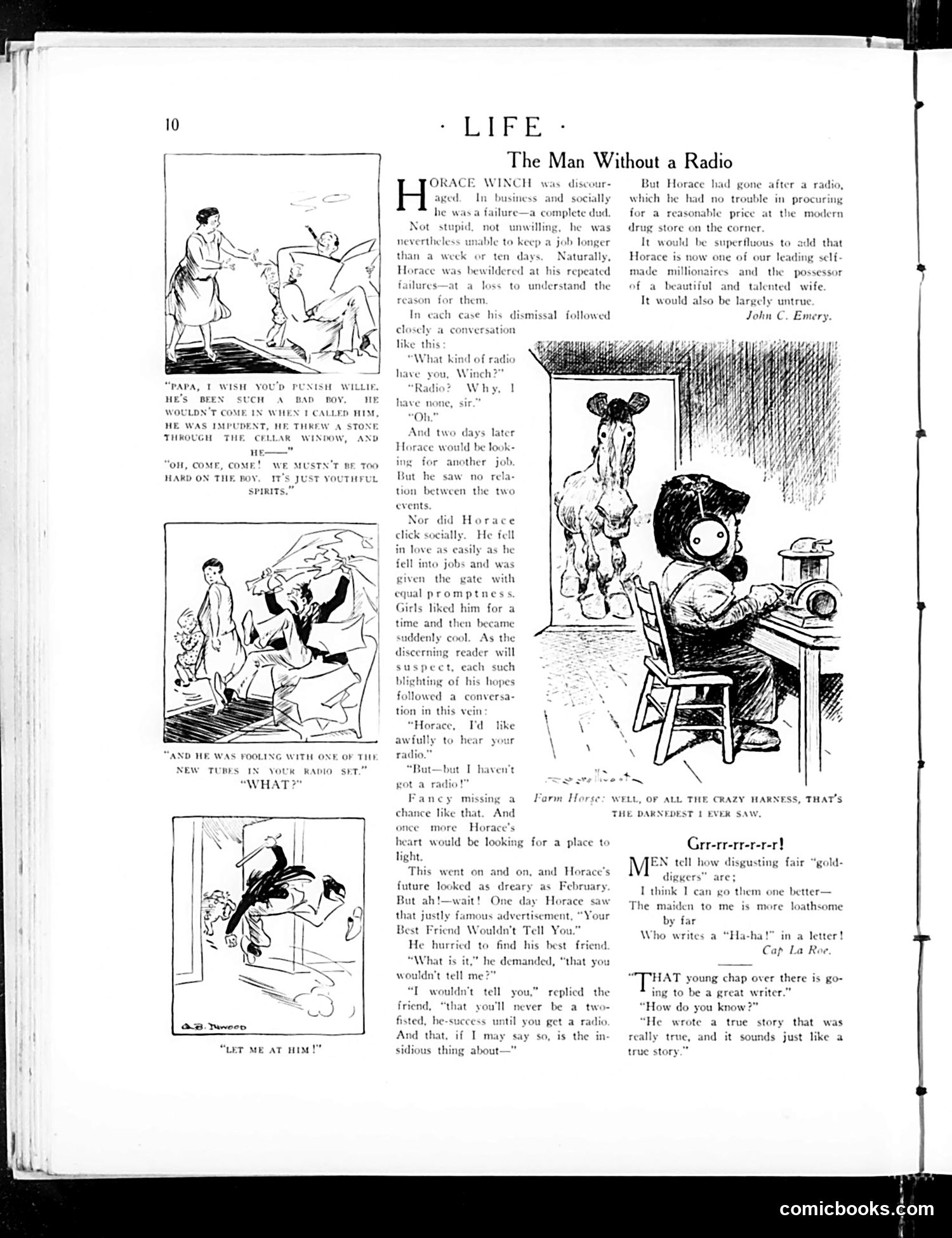
This satirical story mocks Horace Winch, a perpetually unemployed man whose repeated job failures stem from his lack of a radio. The narrative presents radio ownership as a status symbol essential for social and professional success in 1920s America. The cartoons illustrate Horace's downward spiral: his dismissals from jobs, his desperate search for employment, and his romantic difficulties—all apparently caused by his radio-less status. His friend's ultimatum—"success until you get a radio"—underscores the satire: the story ridicules how thoroughly radio had become embedded in American consumer culture and self-identity. The piece mocks both Horace's failure and society's materialistic values, suggesting that owning modern technology had become bizarrely central to respectability itself.
📄 Transcribed text from this page (OCR, searchable)
Machine-transcribed from the original scan — historical spelling and the odd misread are preserved.
10 - LIFE - — The Man Without a Radio ORACE WINCH was discour- Sut Horace had after a ra | = aged. In business and socially which he had no trouble in procuring he was a failure—a complete dud. for a reasonable price at the modern Not st nevertheles not ur ig. he was drug store on the corner be supertly than a week or ten days. Naturally, ildered at his repeated Ww one of our leading Horace was be Sand. the possessor dd the of a bea ul and talented wife. failures—at a loss to understa : reason for them It would also be largely untrue | In cach case his dismissal followed John C. Emery. closely a conversati like this “What kind of radio have you, Winch?” “Radio? Why, 1 “Oh.” And two days later “PAPA, T WISH YOU'D PUNISH WILLIF "S$ BEEN SUCH A BAD ROY, TE WOULDN'T COME IN WHEN 1 CALLED HIM, HE WAS IMPUDENT, HE THREW 4 STONE THROUGH THE CELLAR WINDOW, AND HE——”" ace would be look- for another job. “ou, F, COME! WE MUSTN'T RE TOO bs HAKD ON THE Boy, 1's Just YoutHFuL — But he saw no rela spirits,” tion between the two events. N id Horace k s cli ially. He fell in love as easily as he fell into jobs and was given the gate with equal promptness Girls liked him for a time and then became lenly cool. As the thing reader will eet, each such ing of his hopes ywed a conversa- tion in this vein “Horace, Vd like awiully to hear your “AND HE WAS POOLING WITH ONE OF THLE radio.” NEW TUBES IX YOUR RADIO. Seq.” “But—but 1 haven't “WHAT got a radio!” Fancy ing a Farm Horse: Wet, OF ALL THE CRAZY HARNESS, THAT'S chance like And THE DARNEDEST 1 EVER SAW. heart would be looking for a place to Grr-rrrrer-r-r! light MEN tell how disgusting fair ] This went on and on, and Horace’s ME ys are future looked as dreary as I think I can go them one better— But ah!—wait! One day Hc that justly famous advertiser Best Friend Wouldn't Tell You.” He hurried to find his best fri “What he demanded, “that yc wouldn't tell me?” “TH T young chap over there is go- “I wouldn't tell you,” replied the ig to be a great writer.” friend, “that you'll never be a two- The maiden to me is more loathsome by far Who writes a “Haha!” in a let Cap La Rov. How do you know?” sted, he-success until you get a radio. “He wrote a true story that was d that, if I may say so, is the in really true, and it sounds just like a “wet we aT nim!" sidious thing about—" true story.” re comicbooks.com i