
Life, 1926-03-04 · page 18 of 40
Life — March 4, 1926 — page 18: what you’re looking at
What you’re looking at
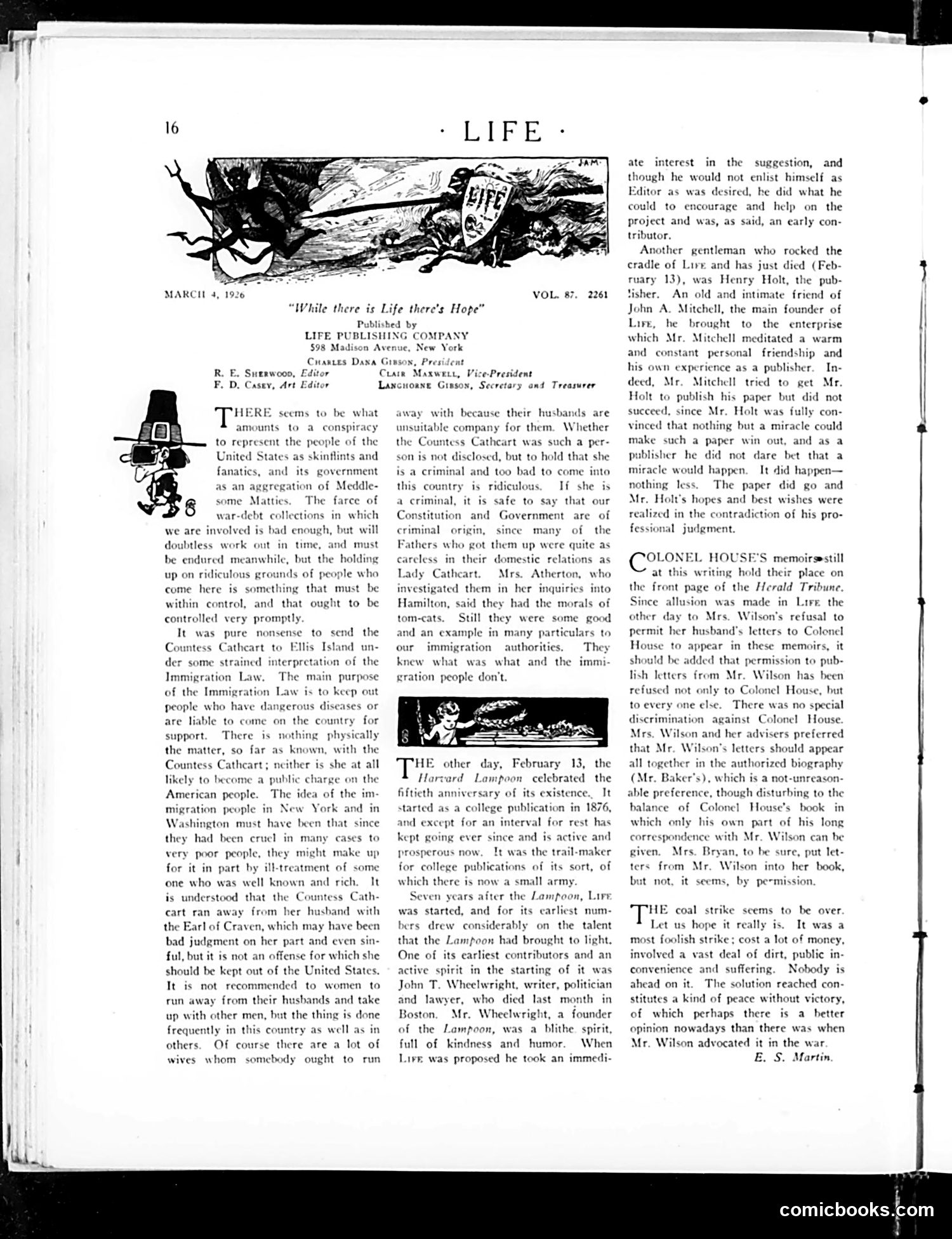
The visible cartoon depicts a figure wearing a Pilgrim hat labeled "LIFE," appearing to represent the magazine itself personified as an American founding figure. The image seems to comment on immigration and government policy. The text discusses the Countess Cathcart's legal troubles regarding immigration law violations and marital scandal. The editorial critiques how the U.S. government inconsistently enforces immigration restrictions while wealthy aristocratic figures face scrutiny. The passage suggests hypocrisy in immigration enforcement—that rule-breaking appears tolerated for some social classes while being strictly applied to others. The Pilgrim imagery likely invokes America's founding mythology ironically, contrasting ideals of liberty with selective enforcement of laws favoring the privileged.
📄 Transcribed text from this page (OCR, searchable)
Machine-transcribed from the original scan — historical spelling and the odd misread are preserved.
MARCI 4, 1926 “While there is Publi LIFE PUBLIS| VOL. 87. 2261 Life there's Hope” lished by HING COMPANY $98 Madison Avenue, New York Cuantes Dawa R. E. Suenwooo, Editor F. D. Casey, Art Editor HERE seems to be what amounts to a conspiracy to represent the people of the United States as skinflints and fanatics, and its government as an aggregation of Meddle- some Matties. The farce of war-debt collections in which doubtless work out in time, and must nwhile, but the hold: up on ridiculous grounds of people who be endured m fg come here is something that must be within control, and that ought to be controlled very promptly It was pure nonsense to send the Countess Cathcart to Ellis Island un- der some strained the interpretation ¢ Immigration Law. The main purpose of the Immigration L people who have dangerous diseases or w is to keep out are liable to come on the country for support. There is ne the matter, so far as known, with the hing physically Countess Catheart; neither is she at all likely to become a public charge on the American people. The idea of the im- migration people in New York and in Washington must have been that since they had been cruel in many cases to very poor people, they might make up for it in part by ill-treatment of some one who was well known and rich. It is understood that the Countess Cath- cart ran away from her husband with the Earl of Craven, which may have been bad judgment on her part and even sin- ful, but it is not an offense for which she should be kept out of the United States. It is not recommended to women to run away from their husbands and take up with other men, but the thing is done frequently in this country as well as in others. Of course there are a lot of wives whom somebody ought to run Lancuoane Gre: Ginsox, Preside Care Maxwett, Vice-President . Secretary ond Treasurer away with because their husbands are or them. Whether the Countess Catheart was such a per- son is not disclosed, but to hold that she is a criminal and too bad to come into unsuitable company this country is ridiculous. If she is a criminal, it is safe to say that our Constitution and Government are of of th t them up were quite as criminal origin, since many Fathers who g careless in their domestic relations as Lady Catheart. Mrs. Atherton, who investiga ed them in her inquiries i Hamilton, said they had the morals of tom-cats. Still they were some good and an example in many particulars to our immigration authorities. They knew what was what and the immi- gration people don't. HE other day, February 13, the Harvard Lampoon celebrated the fiftieth anniversary of its existence. It started as a college publication in 1876, and except for an interval for rest has kept going ever since and is active and p now, It was the trail-maker »sperou college publications of its sort, of which there is now a small army. Seven years after the Lampoon, Lire was started, and for its earliest num- bers drew considerably on the talent that the Lampoon had brought to light. One of its earliest contributors and an active spirit in the starting of it was John T. Wheelwright, writer, politician and lawyer, who died last month in Boston. Mr. Wheelwright, a founder of the Lampoon, was a blithe spirit, full of kindness and humor. When Lire was proposed he took an immedi- ate interest in the suggestion, and though he would not enlist himself as Editor as was desired, he did what he Id to encourage and help on the project and was, tributor. said, an early con- Another gentleman who rocked the cradle of Lire and has just died (Feb- ruary 13), was Henry Holt, the pub- tisher, An old and intimate friend of John A. Mitchell, the main founder of Lire, he brought to the enterprise which Mr. Mitchell meditated a warm and constant personal friendship and his own experience as a publisher. In- deed, Mr. Mitchell tried to get Mr. Holt to publish his paper but did not succeed, since Mr. Holt was fully con- vinced that nothing but a miracle could make such a paper win out, and as a publisher he did not dare bet that a miracle would happen. It did happen— nothing less. The paper did go and Mr. Holt’s hopes and best wishes were realized in the contradiction of his pro- fessional judgment. OLONEL HOU at this writing hold their place on the front page of the Herald Tribune Since allusion was made in Lire. the other day to Mrs. Wilson's refusal to permit her husband’s letters to Colonel He should be added that permission to pub- lish letters from Mr. Wilson has been refused not « memoirsestill to appear in these memoirs, it y to Colonel House, but ne else. There was no special yn against Colonel House. Mrs, Wilson and her advisers preferred that Mr. Wilson’s letters should appear all together in the authorized biography (Mr. Baker's), which is a not-unreason- able preference, though disturhing to the balance of Colonel House’s book in to every discrim: which only his own part of his long correspondence with Mr. Wilson can be given. Mrs. Bryan, to be sure, put let- ters from Mr. V her book, but not, it seems, by. permission ilson. int HE coal strike seems to be over. Let us hope it really is. It was a most foolish strike; cost a lot of money involved a vast deal of dirt, public in- convenience and suffering. Nobody is ahead on it. The solution reached con- stitutes a kind of peace without victory, of which perhaps there is a hbetter opinion nowadays than there was when Mr, Wilson advocated it in the war. E. S. Martin. comicbooks.com j } k