
A complete issue · 37 pages · 1925
Life — December 25, 1925
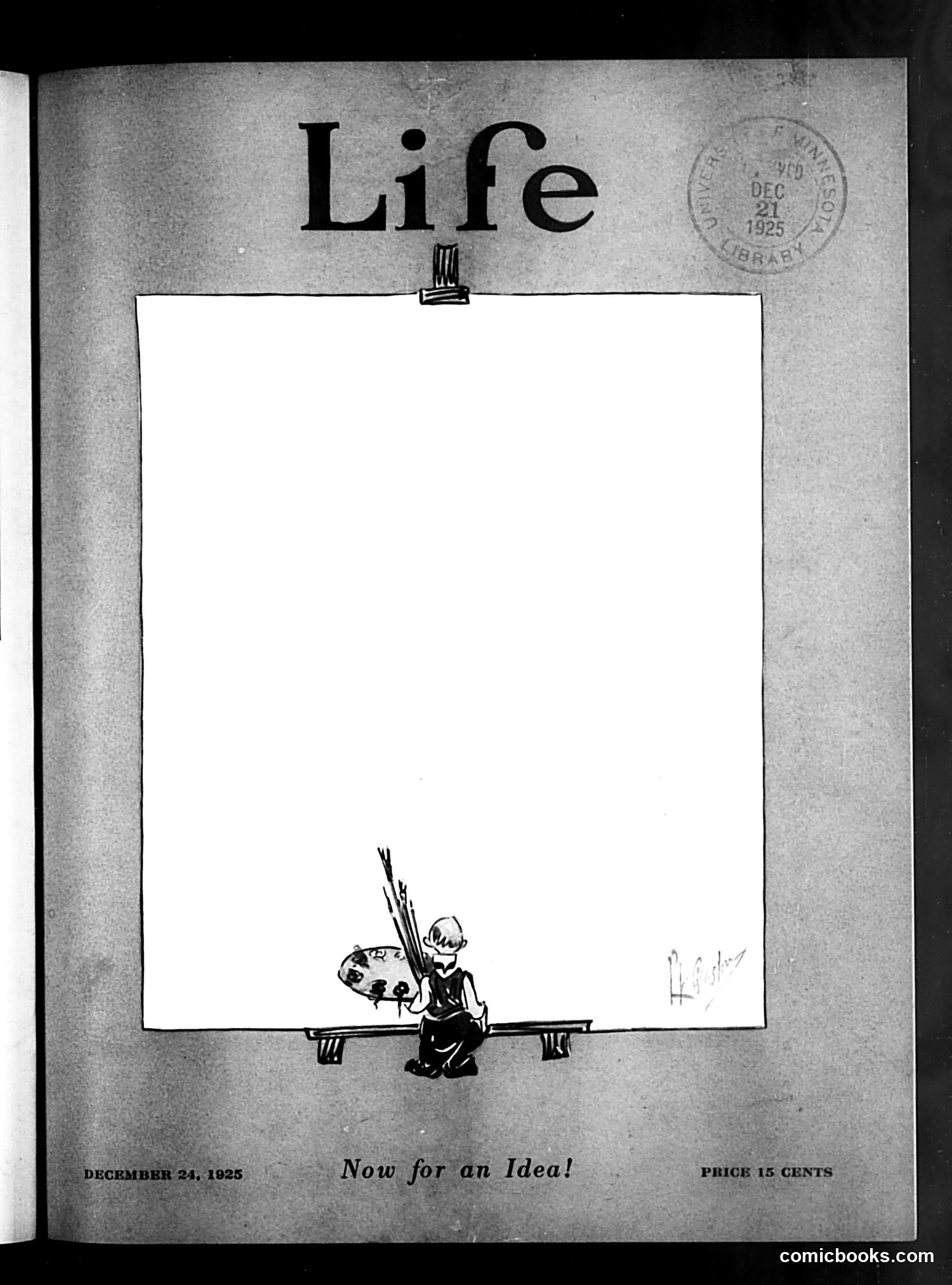
This is a cover for *Life* magazine's Christmas issue (priced at 15 cents). The central image shows a small figure—appearing to be a child or cherub—holding an artist's palette and paintbrush, sitting beneath a large blank white rectangle. The tagline reads "Now for an Ideal!" The artwork suggests this is a Christmas-themed cover inviting readers to imagine or create their ideal holiday gift or scenario. The blank space likely represents an opportunity for the viewer to mentally fill in their own desires or aspirations for the season. This was a common *Life* magazine approach: using minimalist imagery with suggestive captions to engage readers' imaginations rather than depicting explicit content.
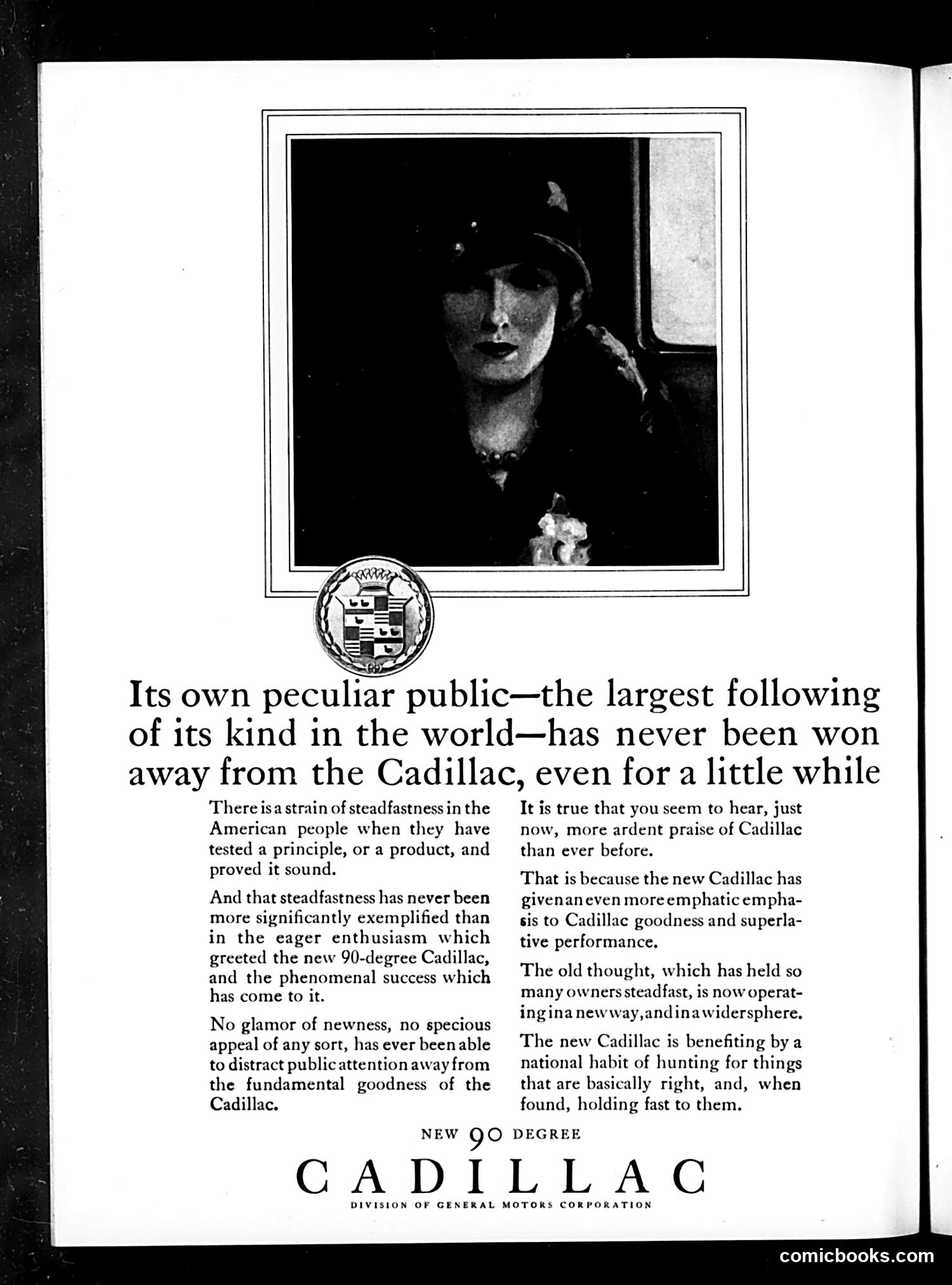
This is a Cadillac advertisement, not satire or political commentary. The page promotes Cadillac automobiles by claiming the brand has an unmatched, devoted following that remains loyal despite competition ("has never been won away from the Cadillac, even for a little while"). The advertisement argues that Americans possess "steadfastness" when they've tested and proven a product sound. It frames Cadillac's popularity as evidence of this national character trait—suggesting buyers stick with Cadillac because it represents fundamental American goodness and superiority. The photograph shows a woman in period dress (appears to be 1920s-30s era), though her specific identity is unclear from the image alone. She likely represents the aspirational Cadillac owner demographic. This is straightforward brand marketing emphasizing loyalty and quality, not satirical content.
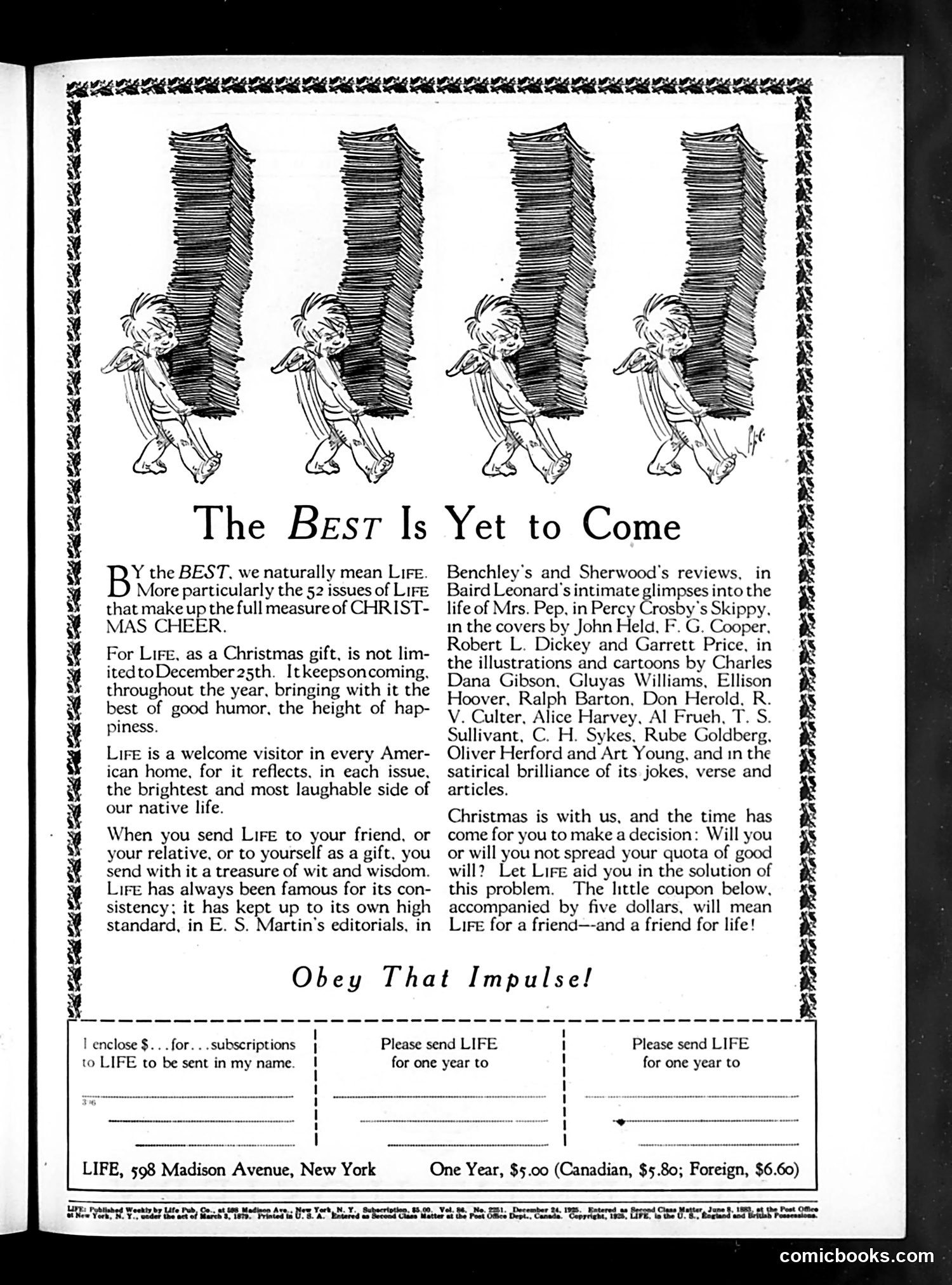
This is a subscription advertisement for *Life* magazine, presented as a Christmas gift promotion. The repeated cartoon image shows a small figure struggling to carry an enormous stack of papers or magazines—a visual metaphor for the weight and volume of content subscribers receive throughout the year. The ad argues that *Life* makes an ideal holiday gift because it provides year-round entertainment and humor. It emphasizes the magazine's reputation for wit and wisdom, referencing contributions from well-known humorists and illustrators of the era. The copy promises that a *Life* subscription delivers "a treasure of wit and wisdom" to recipients. The subscription coupon at bottom offers one year for $5.00 (with higher rates for Canadian and international delivery), making the economic pitch explicit.
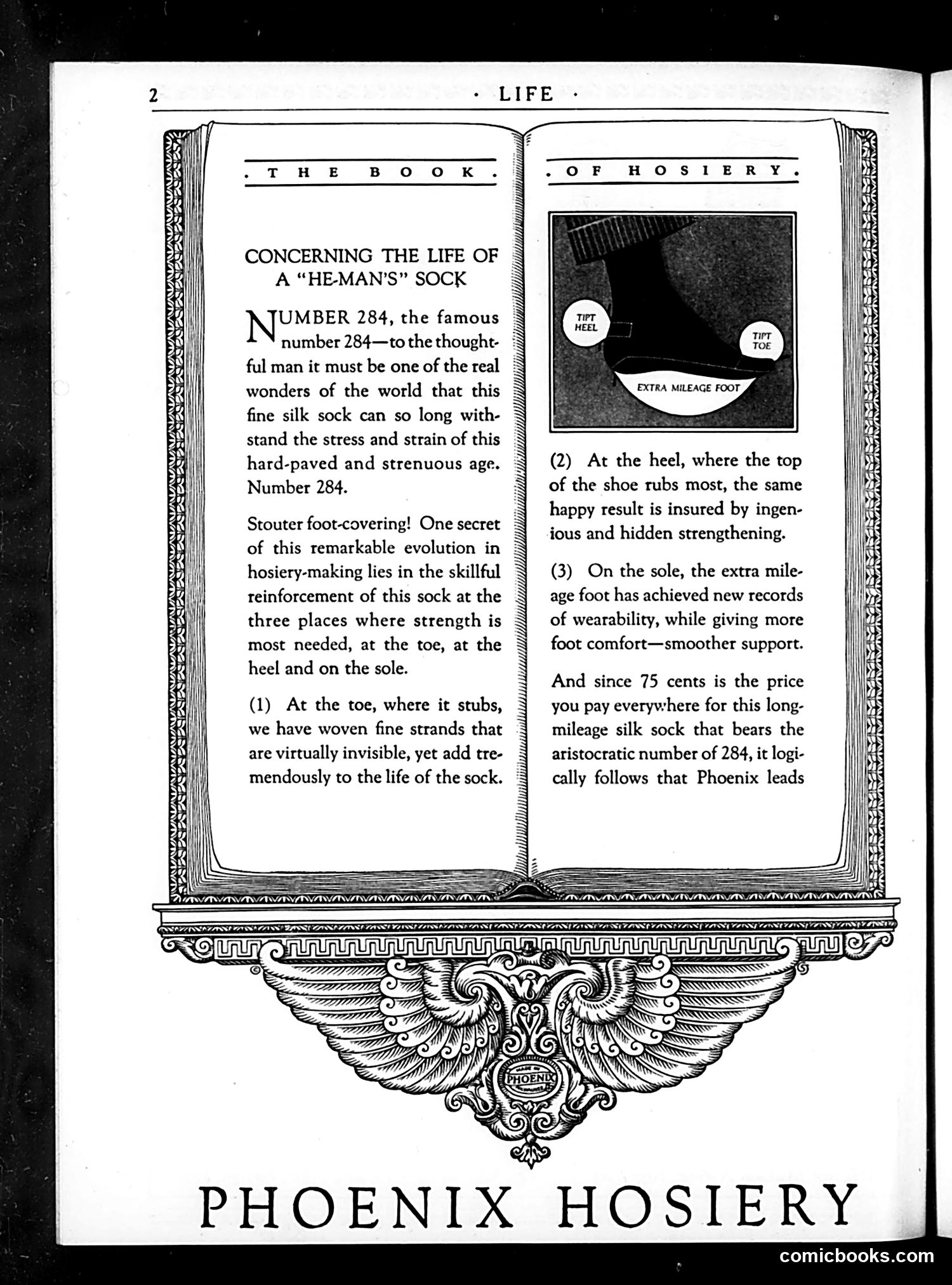
This page is **not a political cartoon or satire**—it's a straightforward advertisement for Phoenix Hosiery socks, specifically their "Number 284" product. The content explains to readers why this particular silk sock is durable. The text describes three reinforced areas (toe, heel, sole) that extend the sock's lifespan. The diagram on the right labels these reinforcement zones as "TIFF HEEL," "TIFF TOE," and "EXTRA MILEAGE FOOT." The advertisement emphasizes durability and comfort while noting the sock costs 75 cents everywhere. The "aristocratic number of 284" is simply a brand identifier and marketing point. **This is period advertising, not editorial satire or commentary.** Life magazine regularly featured full-page ads alongside its satirical content.
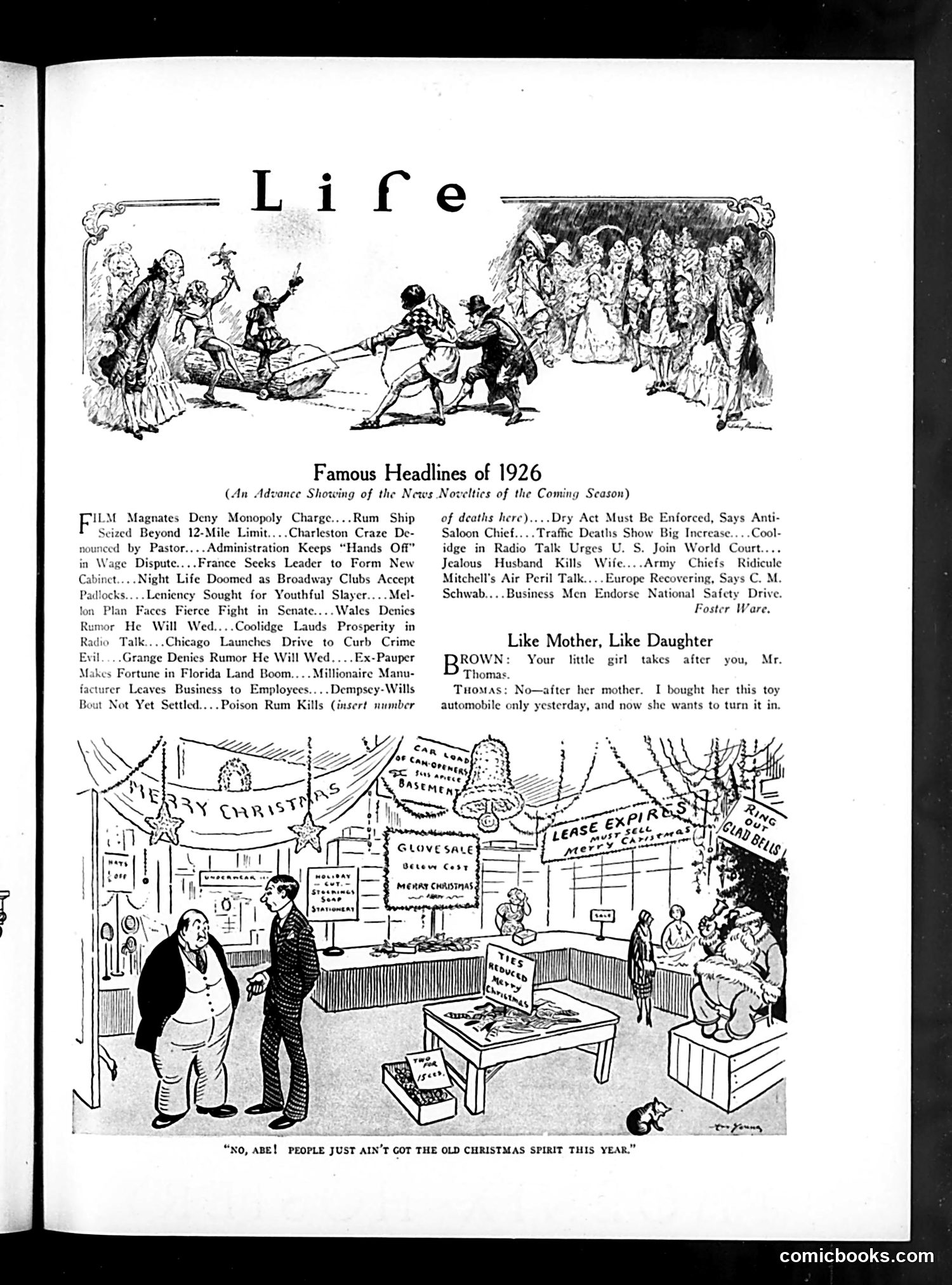
This page contains two distinct items: **"Famous Headlines of 1926"** lists sensational news stories from that year—murder, scandals, business controversies, and crime—reflecting public preoccupation with dramatic events. **"Like Mother, Like Daughter"** is a brief humor piece about a father frustrated when his young daughter immediately wants to trade in a toy automobile he just bought her. **The main cartoon** depicts a Depression-era store during Christmas, with "Merry Christmas" and sale signs visible. A large woman and thin man stand together while looking around at meager goods and sparse shoppers. The caption reads: "No, Abe! People just ain't got the old Christmas spirit this year." The satire critiques how economic hardship—evidenced by thin crowds and discount-driven sales—has replaced traditional holiday joy with financial anxiety. The contrast between festive decorations and empty shelves underscores consumer pessimism in 1926.
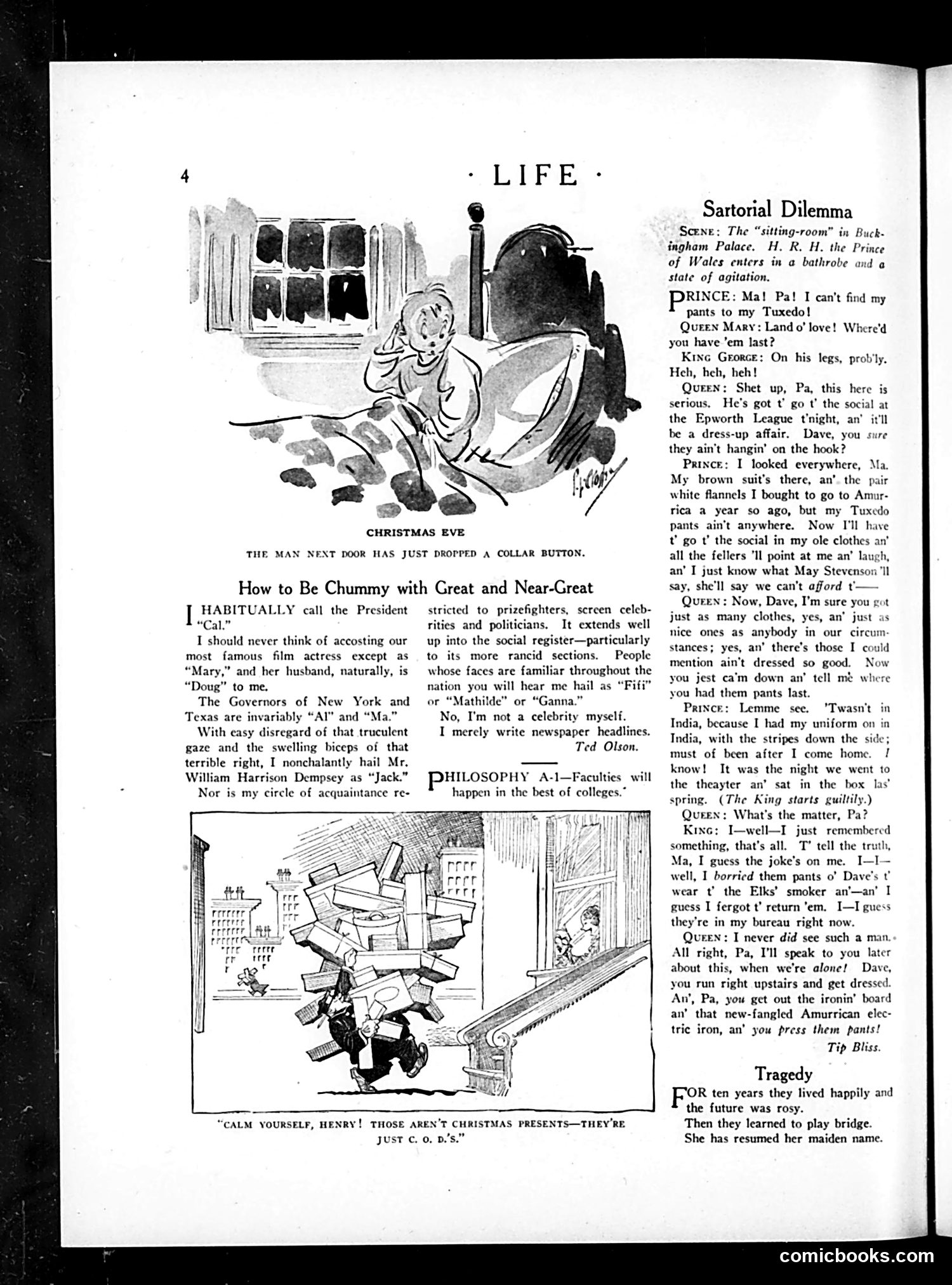
This page contains multiple satirical pieces from early 20th-century Life magazine: **"Sartorial Dilemma"** depicts a royal character (likely British royalty, given "Prince," "Queen Mary," and "King George") in a bathrobe crisis—he cannot find his formal Tuxedo pants before a social event. The humor targets upper-class anxieties about maintaining proper appearance and the absurdity of strict dress codes. **"How to Be Chummy with Great and Near-Great"** mocks newspaper journalists who habitually use nicknames for famous people ("Cal," "Fitz," "Mathilde") to seem familiar, despite having no actual acquaintance with them. **"Christmas Eve" cartoon** shows a chaotic domestic scene where Christmas presents have literally collapsed a person, satirizing consumer excess and holiday commercialism. **"Tragedy"** offers dark humor: a couple's happy marriage ends when they learn to play bridge—the card game destroys their relationship.
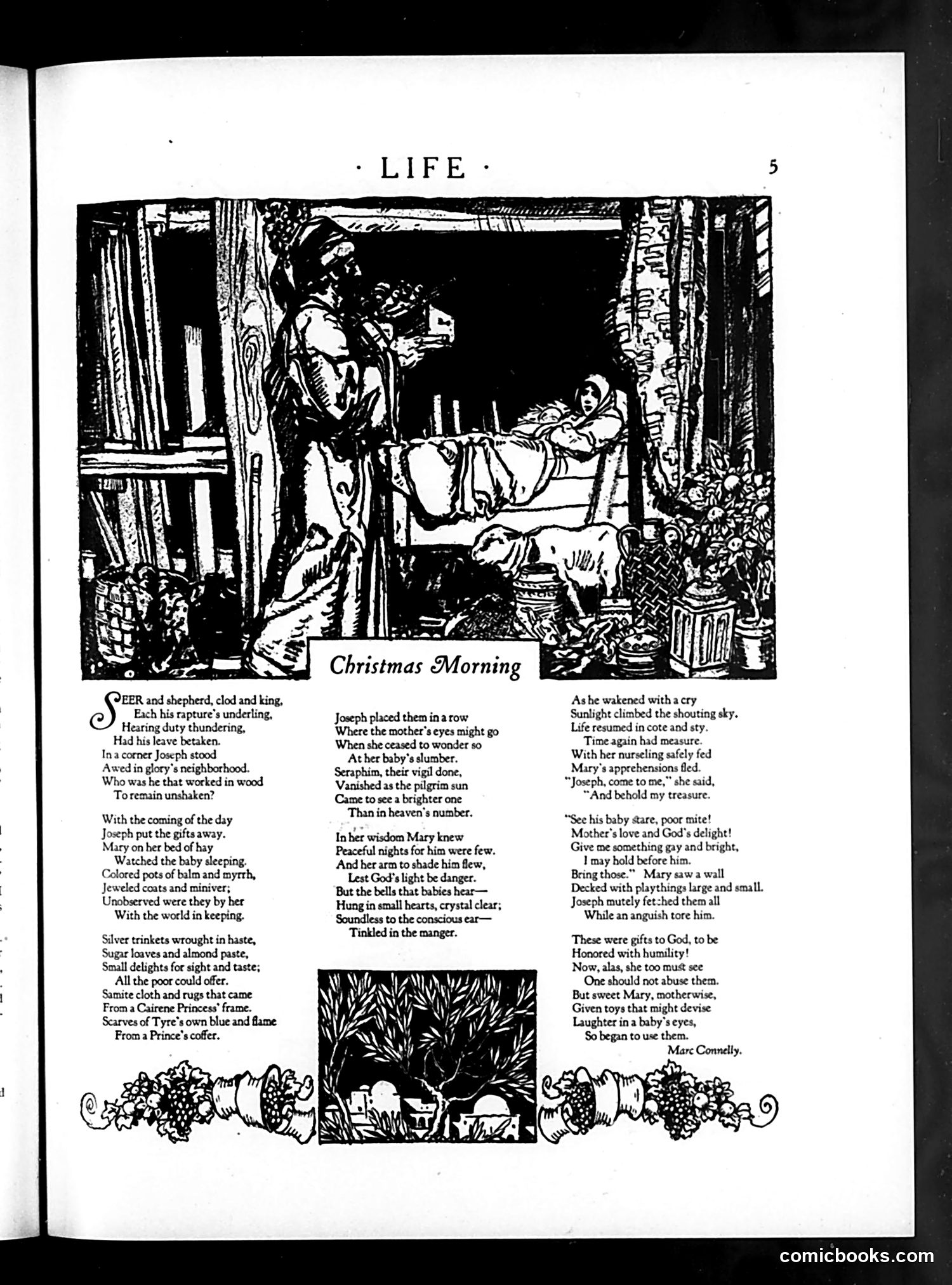
This page presents a sentimental Christmas poem rather than political satire. The illustrated narrative depicts the nativity scene—a shepherd and wise men visiting the Christ child in a manger, with Mary present. The poem celebrates the religious and domestic dimensions of Christmas: the humble birth, Mary's maternal joy, the gifts brought by visitors, and the spiritual significance of the occasion. The text emphasizes themes of peace, divine light, and humble devotion. The decorative elements (cornucopia, greenery) are purely festive. This represents Life magazine's occasional turn toward wholesome, non-satirical cultural content—in this case, a reverent literary treatment of Christmas traditions rather than social or political commentary.
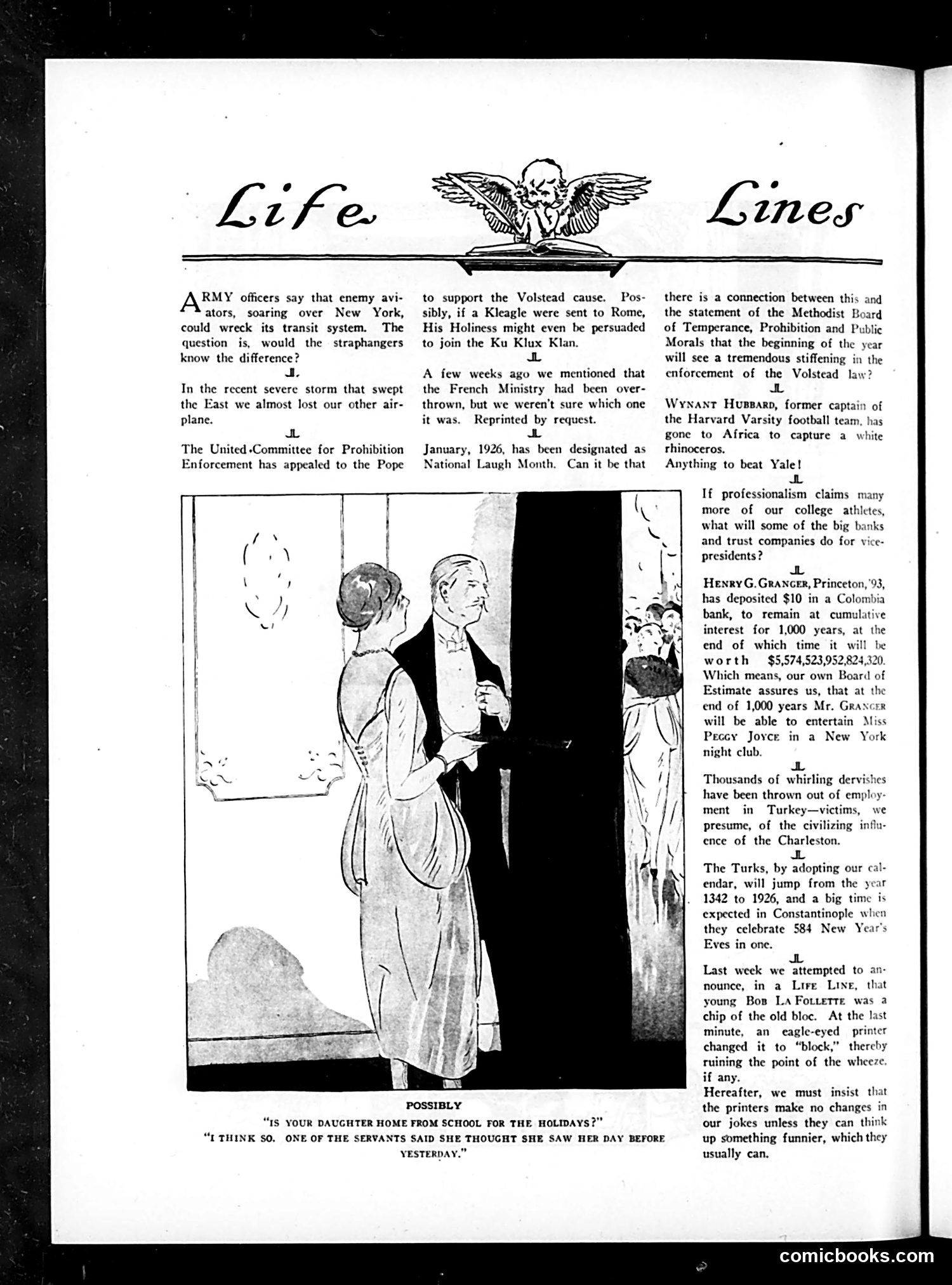
This page contains a satirical cartoon titled "POSSIBLY" depicting a domestic scene. A man in formal attire questions a woman about her daughter's early return from school, with the caption: "Is your daughter home from school for the holidays? I think so. One of the servants said she thought she saw her day before yesterday." The joke mocks wealthy households where parents are so distant from their children that they rely on servants to confirm their whereabouts—the daughter has been home for days without the parents noticing. This satirizes the disconnection and neglect common in affluent families who delegate childcare entirely to staff. The surrounding text discusses various contemporary issues: aviation safety, prohibition enforcement, and college athletes' professionalism, reflecting 1920s American concerns.
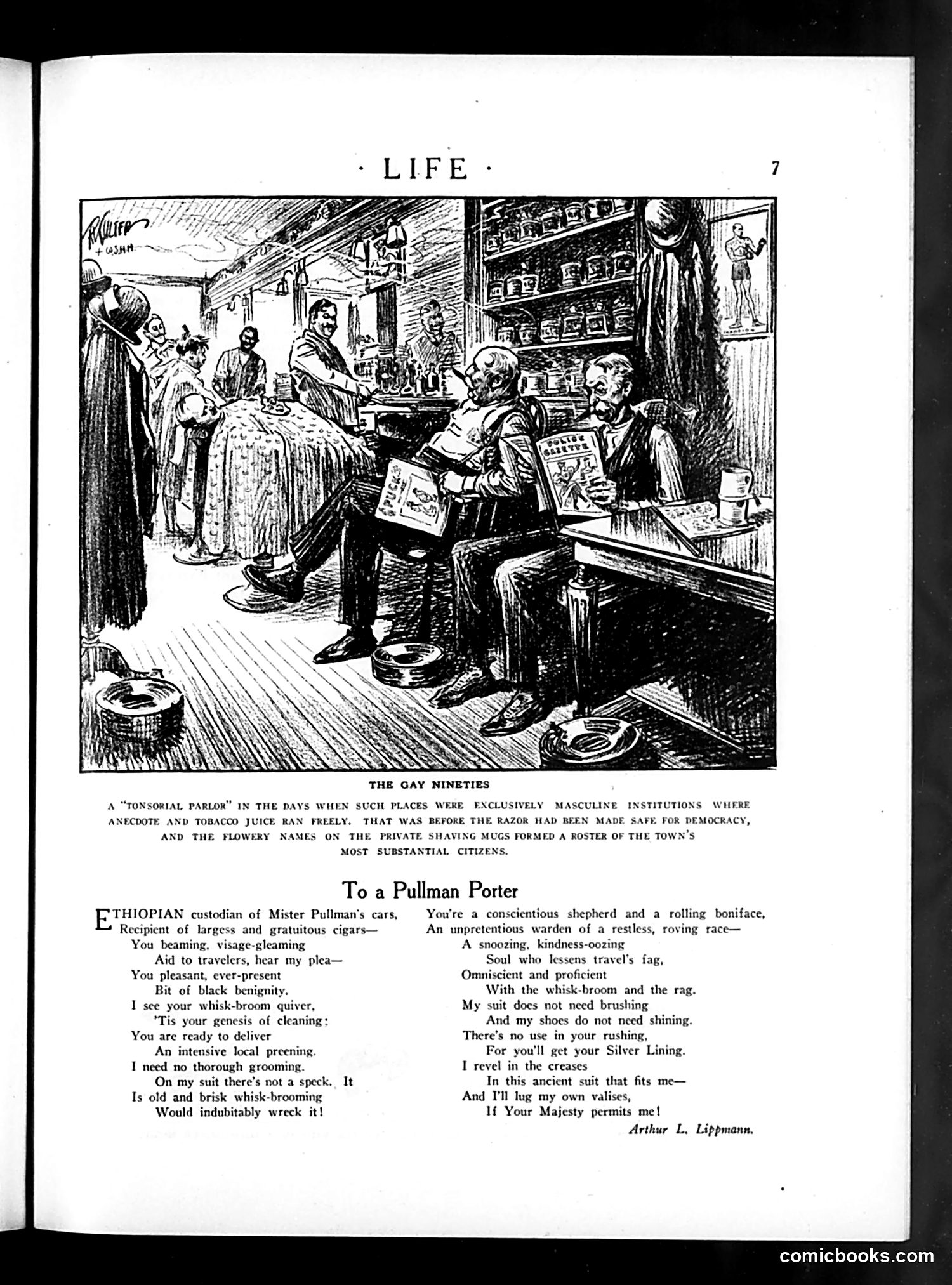
The illustration depicts a barbershop scene labeled "The Gay Nineties," showing men in a leisurely social setting. The caption explains this represents an era when such establishments were "exclusively masculine institutions where anecdote and tobacco juice ran freely" — before safety razors democratized shaving and private shaving mugs became common among prominent citizens. The satire contrasts past exclusivity with modern accessibility: barbershops were once male-only social clubs where prominent men gathered, but technological advancement (the safety razor) eliminated the need for professional shaving services, making the institution less socially significant. The accompanying poem by Arthur L. Lippmann humorously addresses a Pullman porter, celebrating his casual, unrushed demeanor as preferable to modern efficiency culture.
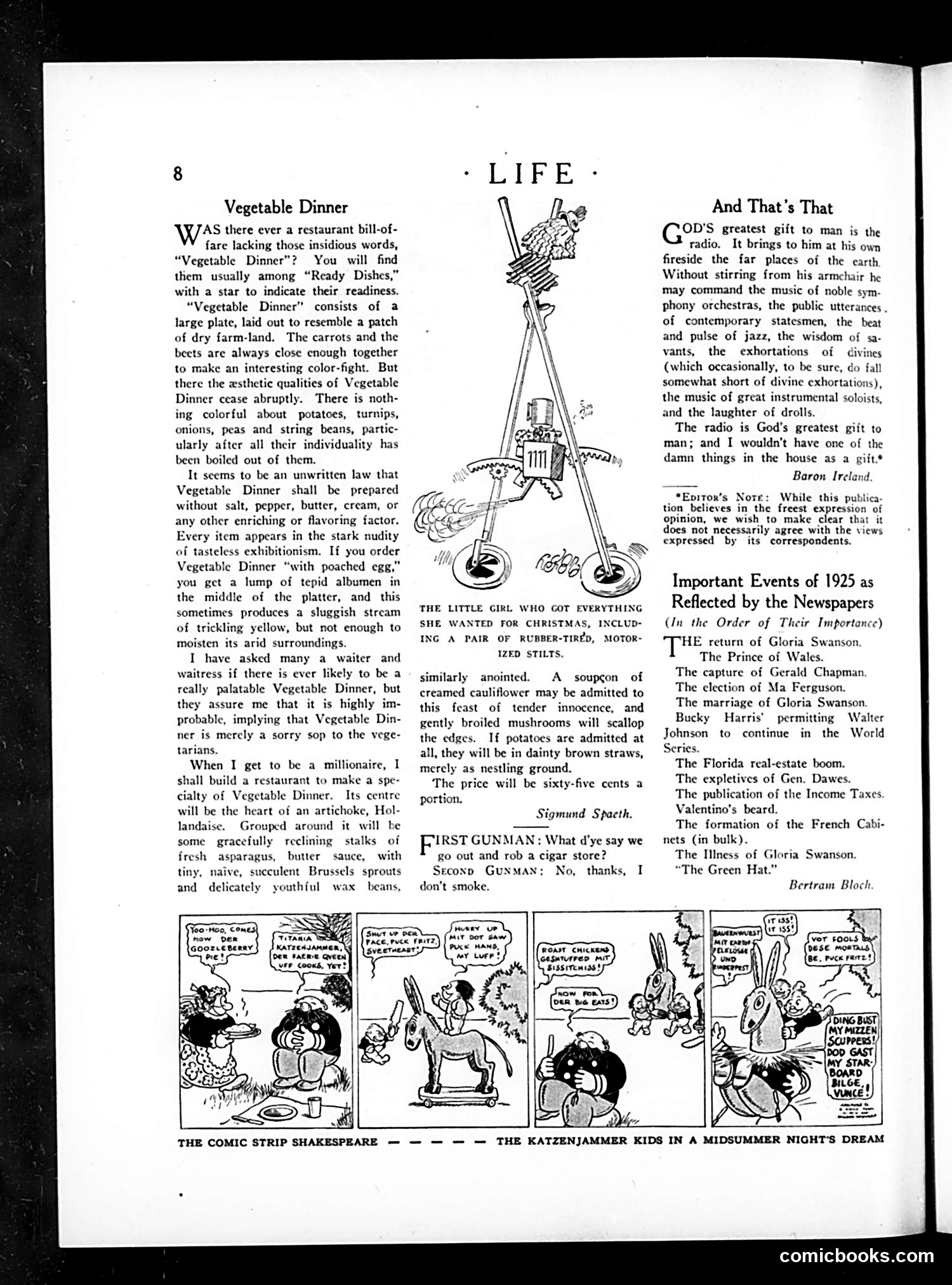
This page contains three separate satirical pieces: 1. **"Vegetable Dinner"** article by Sigmund Spaeth mocks the aesthetic pretensions of restaurants serving monotonous vegetable plates as haute cuisine. The satire targets food snobbery and overly elaborate presentation of simple ingredients. 2. **"And That's That"** by Baron Ireland humorously defends radio as God's greatest gift to mankind, sarcastically suggesting one wouldn't want "damn things in the house as a gift"—poking fun at radio's emerging ubiquity and invasiveness in American homes circa 1925. 3. **The bottom comic strip** titled "Shakespeare" and "The Katzenjammer Kids in a Midsummer Night's Dream" appears to be a comedic mashup, though specific details are unclear from the image quality. The page reflects 1920s American anxieties about technology, consumer culture, and dining trends.
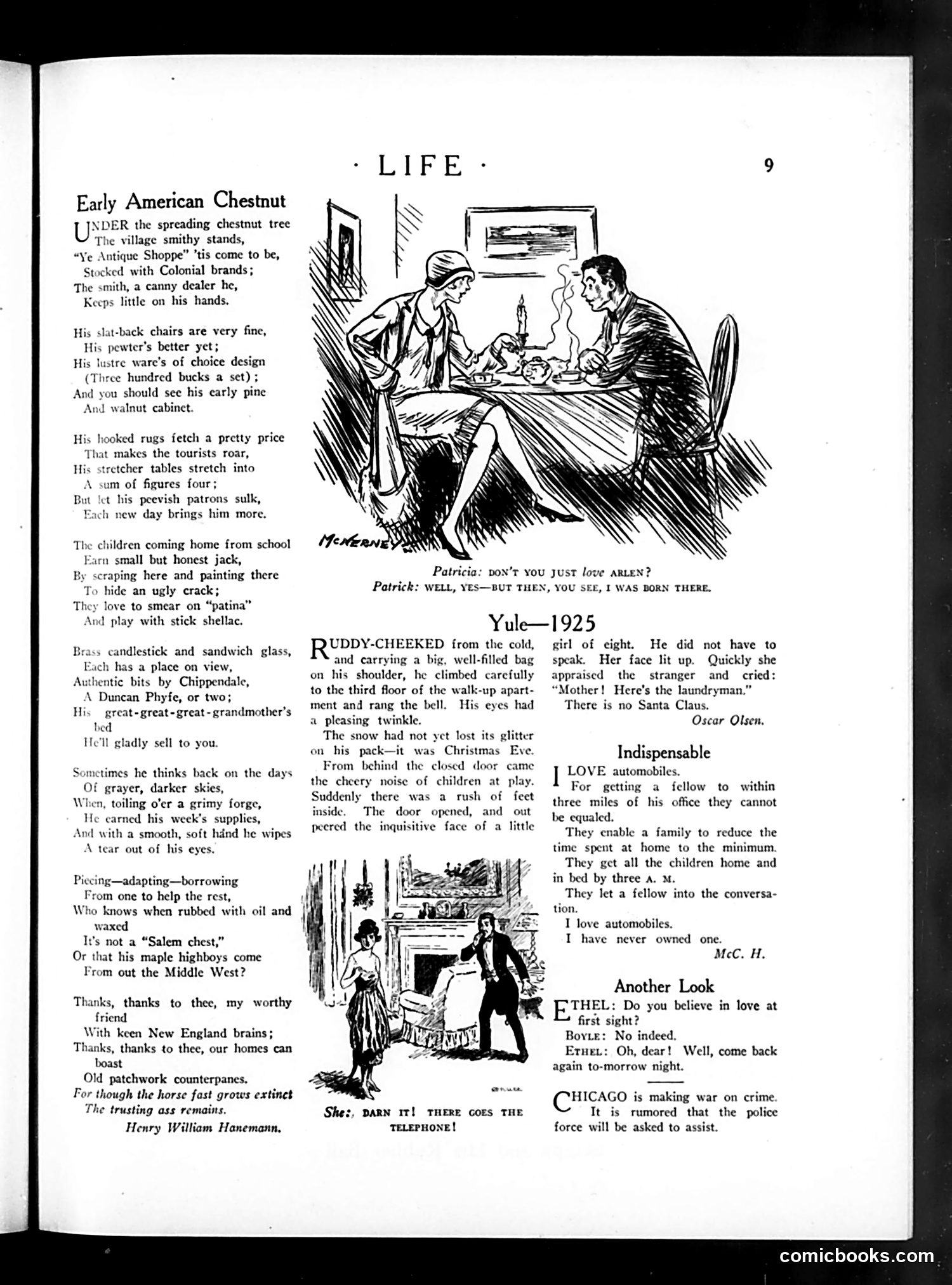
This page contains two distinct sections: **"Early American Chestnut"** (left): A poem celebrating a street vendor selling roasted chestnuts from under a tree, with detailed descriptions of his furniture, rugs, and merchandise. The poem humorously catalogs his wares and regular customers, ending with a sentimental reflection on his honest trade. **"Yule—1925"** (right): A short story about a poor boy named Ruddy delivering Christmas packages. The illustration shows him at a doorbell, where he encounters a child asking "Mother! Here's the handyman." This appears to comment on class distinctions and childhood innocence during the Depression era. **"Indispensable"** and **"Another Look"**: Brief humorous dialogue pieces about automobiles and romantic relationships, respectively. The page reflects 1920s American life, poverty, and social commentary through satirical verse and vignettes.
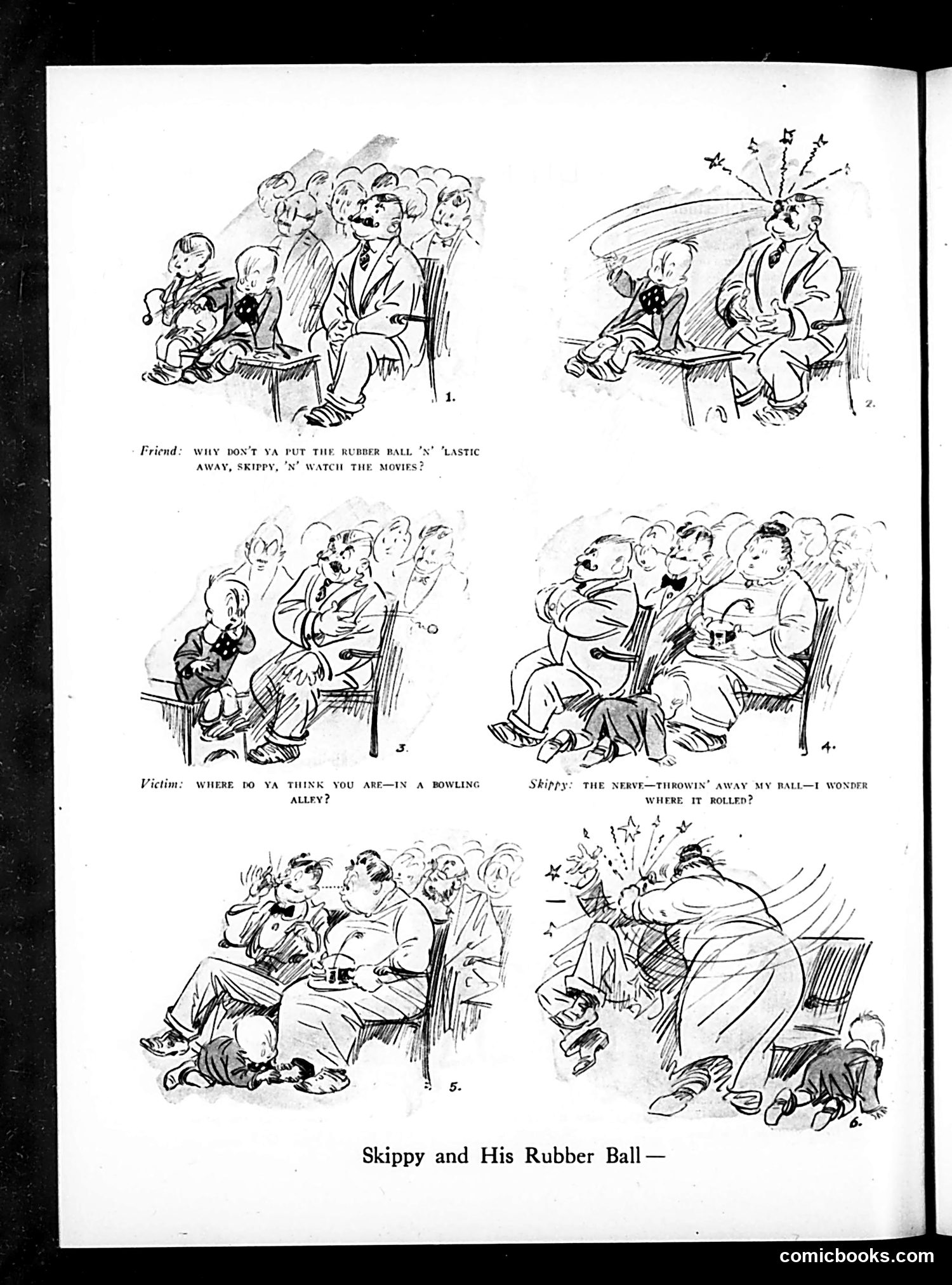
This is a six-panel comic strip (not political satire) about a character named Skippy and a rubber ball. The humor derives from a simple domestic scenario: a friend suggests Skippy put away his rubber ball and watch movies instead. Skippy refuses, and the subsequent panels show the chaos that ensues when he plays with the ball indoors—it bounces wildly, disrupts everyone (particularly upsetting someone called "the Serve"), and eventually hits an unseen victim hard enough to send them flying. The joke is slapstick physical comedy: the contrast between the reasonable suggestion and Skippy's stubborn refusal, followed by escalating destruction. This reflects early 20th-century comic strip humor emphasizing exaggerated consequences and mischievous children causing mayhem.
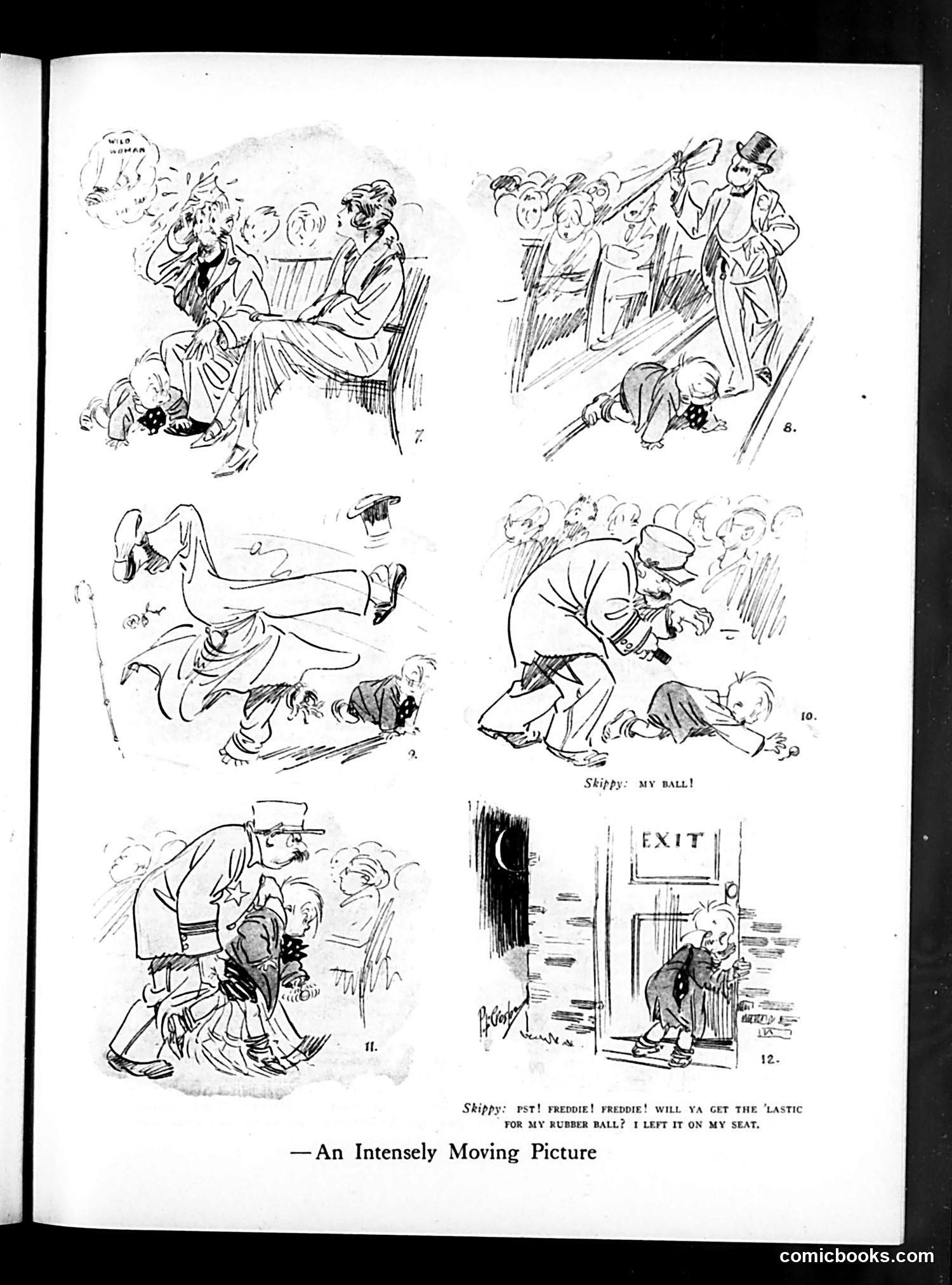
This is a sequential comic strip satirizing a theatrical experience, likely from the early 20th century. The narrative follows a character named "Skippy" who loses a rubber ball during a performance. The sequence shows: 1. Adults reacting emotionally to the play 2. Skippy crawling under seats searching for the ball 3. An adult being disturbed by the disruption 4. Skippy chasing the ball through the audience 5. Someone retrieving it near an EXIT sign The satire mocks how serious theatergoers become absorbed in dramatic performances while children remain oblivious to the "art," focused instead on practical concerns like lost toys. The irony is that Skippy's ball-hunting creates far more actual "movement" and disruption than the supposedly "intensely moving picture" on stage.
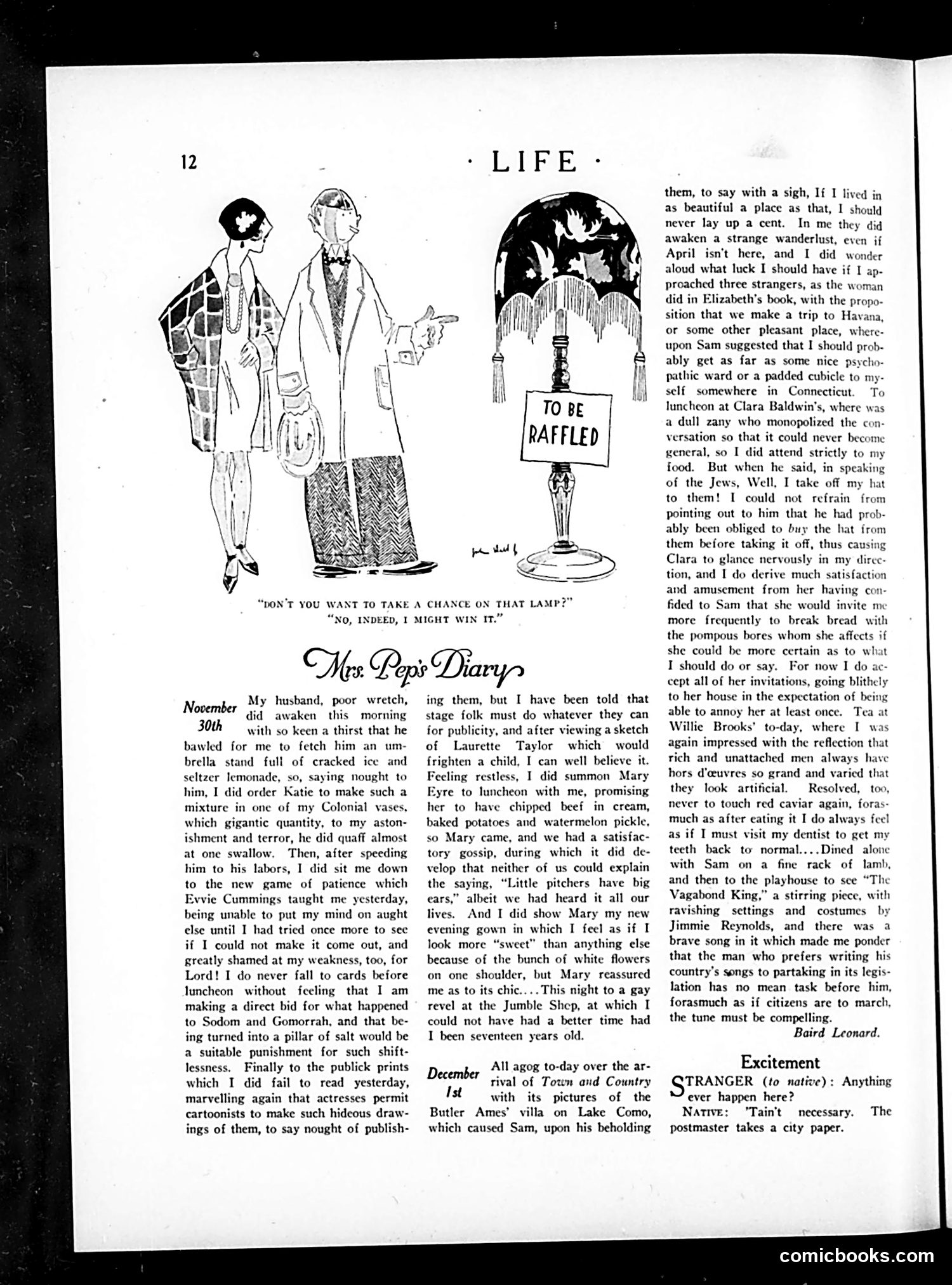
The cartoon depicts two fashionably dressed figures viewing a lamp marked "TO BE RAFFLED." The dialogue reads: "Don't you want to take a chance on that lamp?" / "No, indeed, I might win it." **The Satire:** This is a joke about social anxiety and unwanted social obligations. The humor lies in the paradox that winning the raffle would be worse than losing—suggesting the lamp is so ugly or undesirable that obtaining it would be a curse, not a prize. The cartoon satirizes both the desperation of raffle organizers trying to sell chances and the social pretense required to politely refuse without insulting the item being raffled. This reflects 1920s American social etiquette around fundraising and gift-giving, where direct honesty about not wanting something was considered rude.
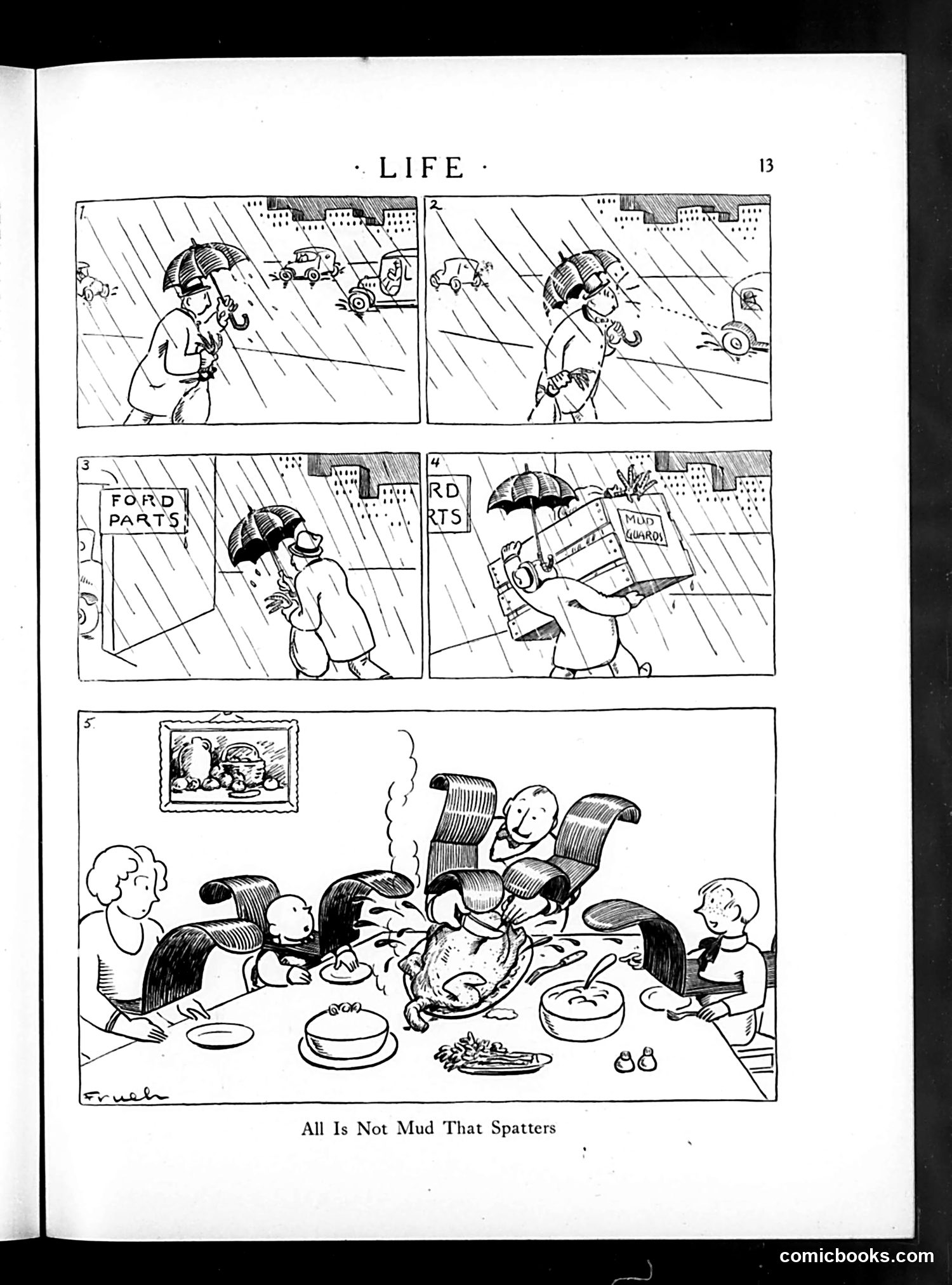
This page contains a six-panel comic strip followed by a single-panel cartoon. The strip depicts a person in rainy weather carrying an umbrella and encountering various urban hazards—splashing cars and muddy conditions. The character visits an auto parts store, then returns home covered in mud and grime. The final cartoon shows a family dinner scene where mud has apparently splattered everywhere—on the walls, furniture, and food. The title "All Is Not Mud That Spatters" plays on the proverb "all that glitters is not gold," suggesting that not every mess during rainy weather is actually mud (implying some might be worse substances, particularly from automobiles). The humor targets urban inconveniences and automobile culture's messy consequences on pedestrians and domestic life.
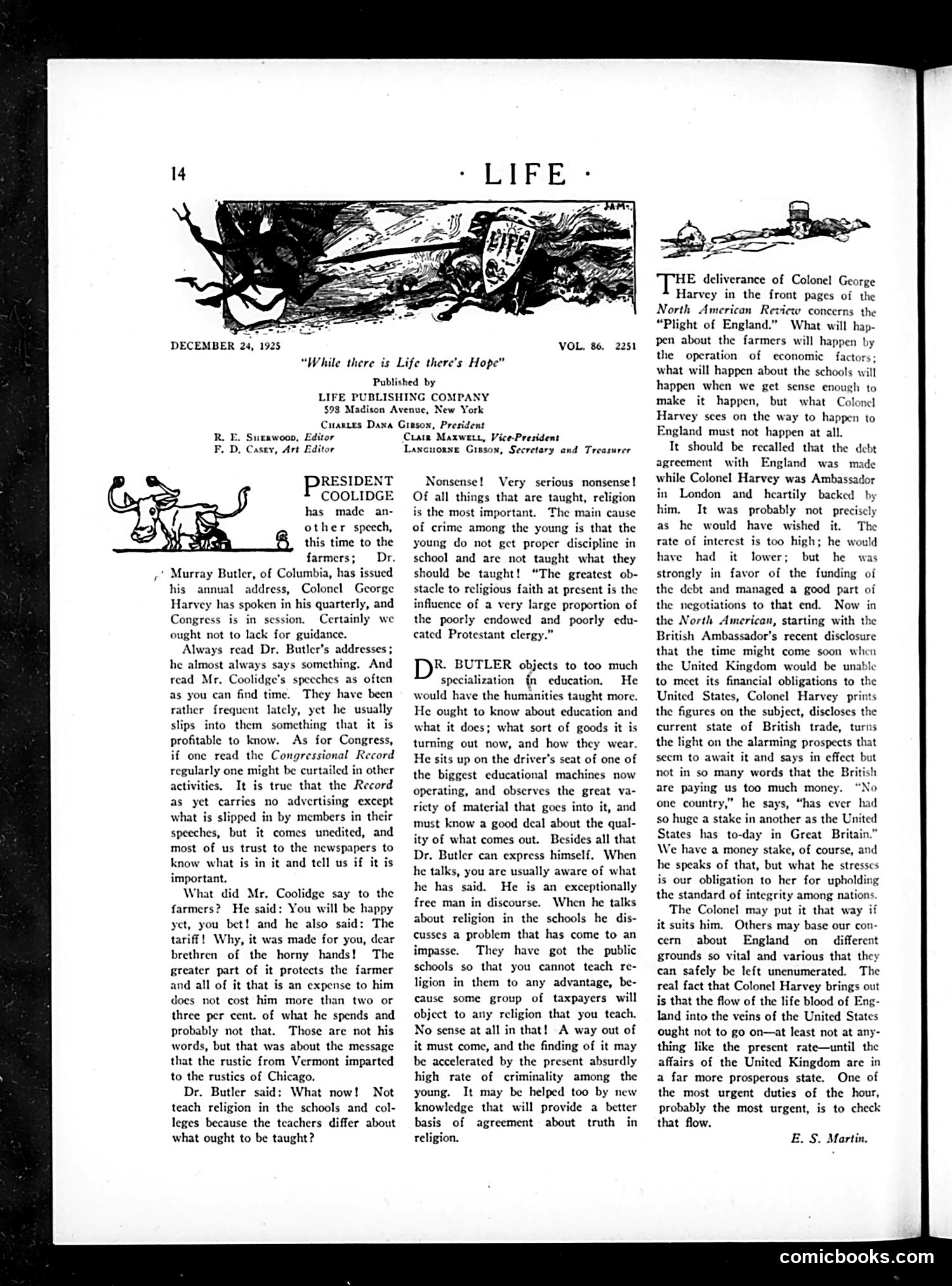
This page features an editorial discussion of Colonel George Harvey's recent North American Review article on England's economic difficulties (the "Plight of England"). The main cartoon shows a farmer sitting beside a dead or dying horse, illustrating rural hardship—likely referencing agricultural depression affecting American farmers during the 1920s. The text critiques President Coolidge and Dr. Murray Butler for their positions on education and religion in schools. The author (E.S. Martin) argues against Butler's objection to teaching religion, suggesting it contributes to youth crime. The piece also discusses British financial troubles and Anglo-American economic relationships. The editorial takes a relatively conservative stance on education policy while commenting on transatlantic financial concerns during the post-WWI period.
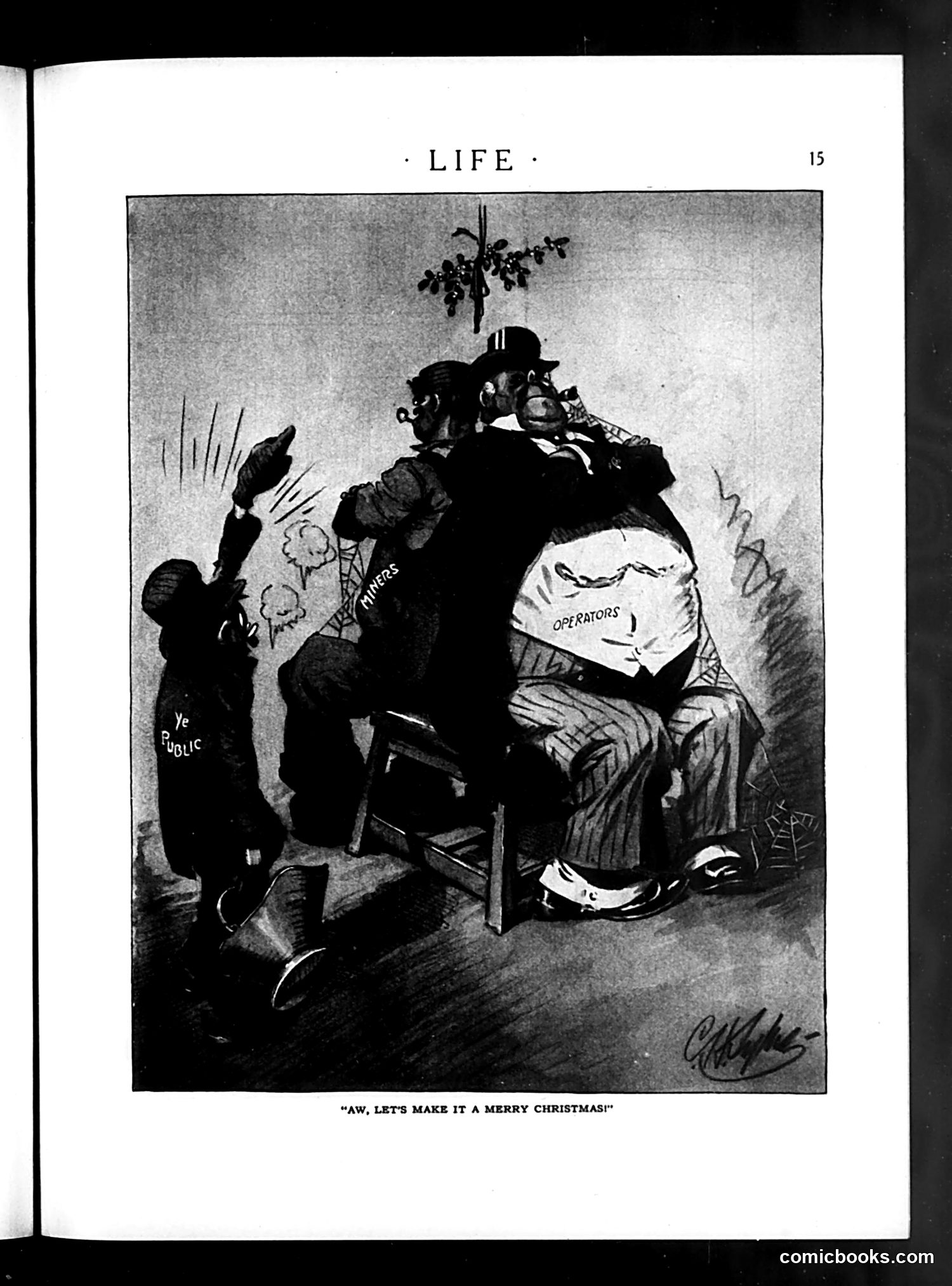
This satirical cartoon depicts a Christmas scene with labeled figures representing different groups. A small figure labeled "Ye Public" raises a hand in protest while central figures labeled "Miners" and "Operators" sit together under mistletoe. A large sack labeled "Operators" sits nearby. The cartoon's caption—"Aw, Let's Make It a Merry Christmas!"—suggests ironic commentary on labor relations. The "Ye Public" figure appears excluded from holiday cheer, while miners and operators (coal industry management) are positioned together. The visual metaphor suggests the public bears the burden (the heavy sack) while labor and management negotiate, leaving ordinary citizens disadvantaged during what should be a unified holiday moment. This likely references a specific coal industry labor dispute affecting public welfare.
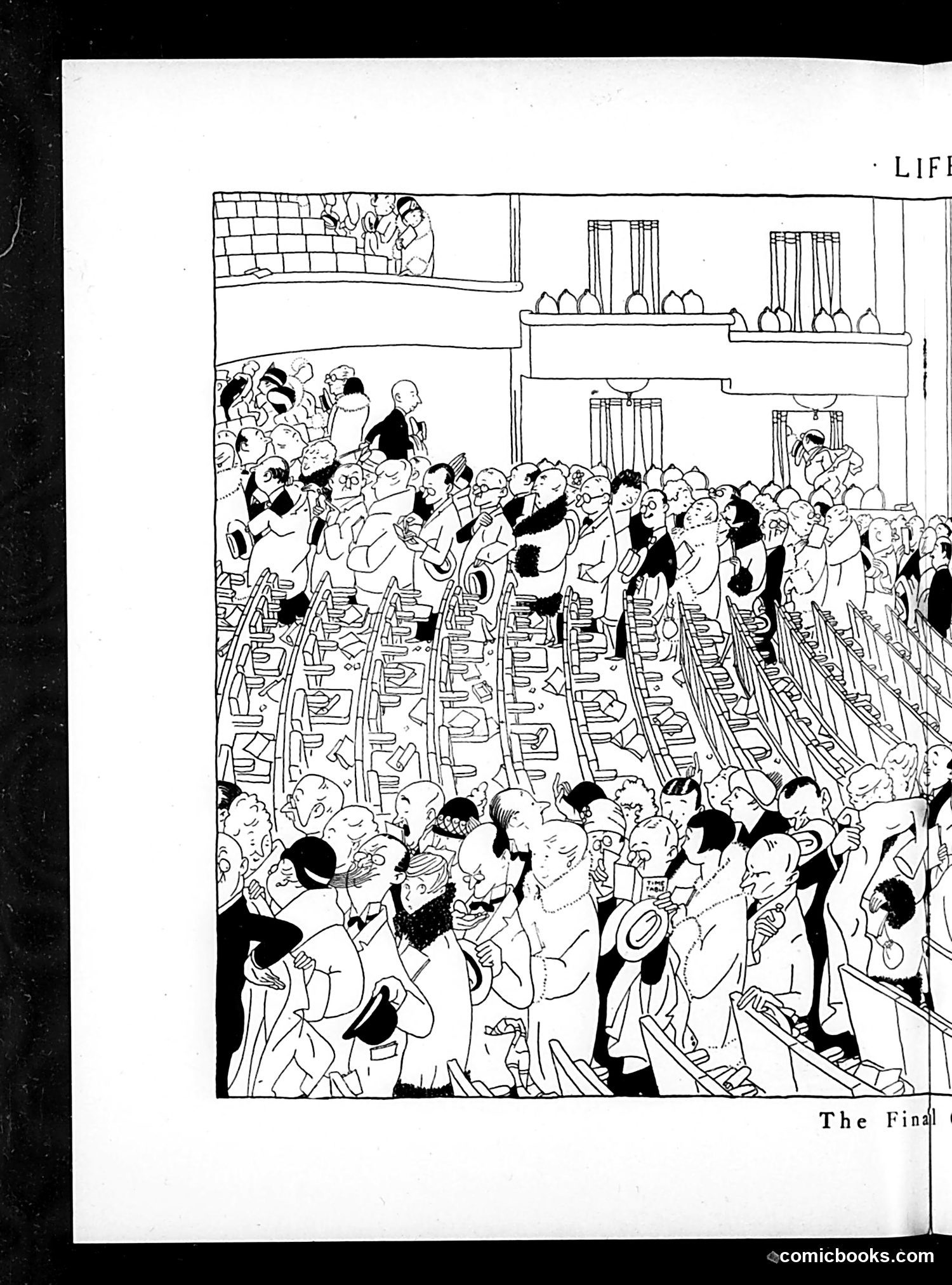
This political cartoon depicts a massive, crowded auditorium or concert hall filled with formally-dressed attendees. The scene shows what appears to be a significant public gathering or performance event, with multiple levels of seating and numerous figures engaged in animated conversation or observation. The caption reads "The Final," suggesting this represents some conclusive or climactic event. Without additional context about the specific issue date or surrounding articles, the exact subject is unclear. However, the sardonic tone typical of Life magazine suggests satire regarding either a major social gathering, political convention, performance, or similar public spectacle that warranted critical commentary about crowd behavior, pretension, or social conformity during the early-to-mid 20th century.
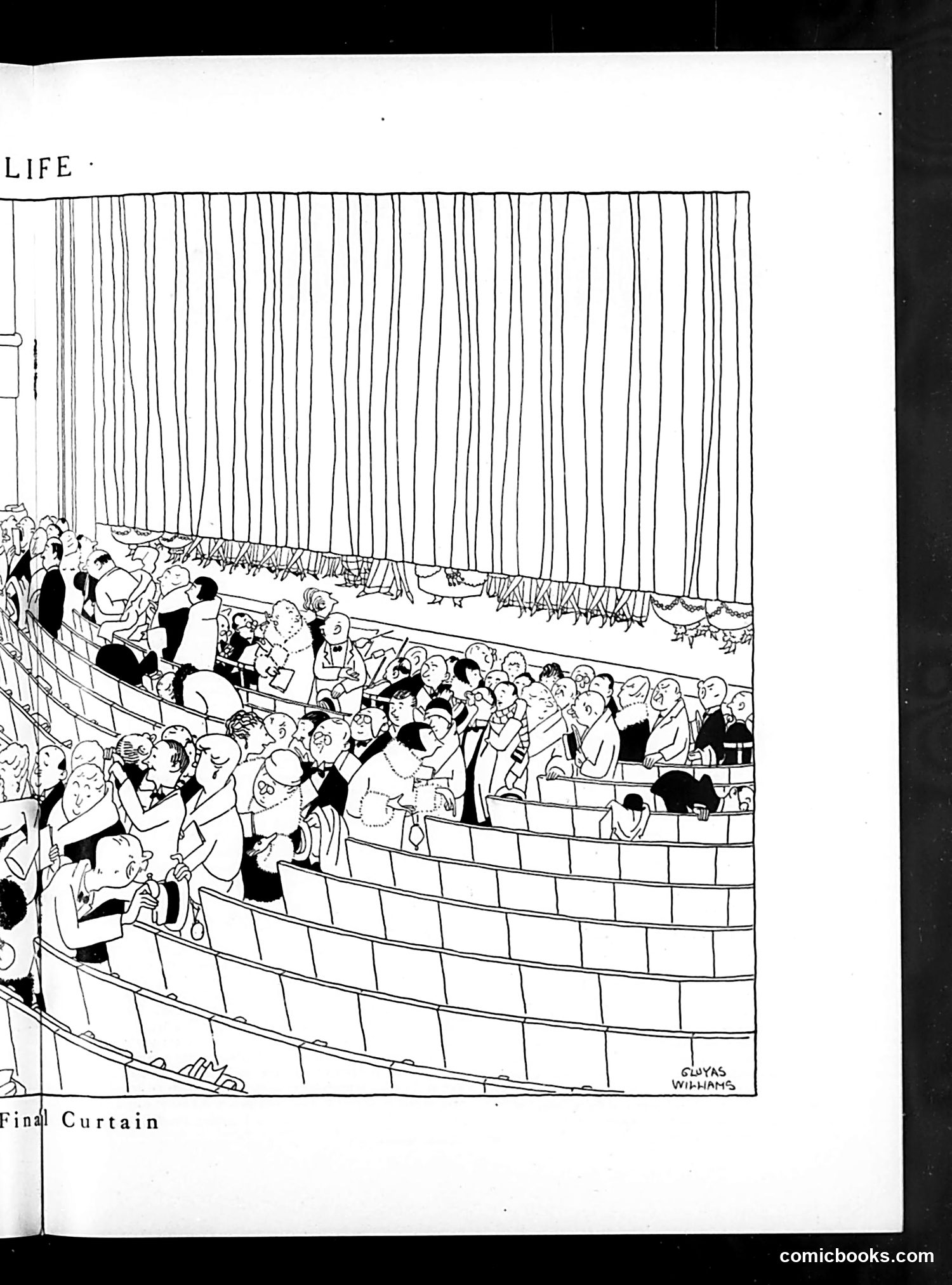
This cartoon depicts a theater audience seated in tiered boxes watching a performance. The stage curtain is drawn, suggesting the show has ended or is about to conclude. The artist is credited as "Gloyas Williams." The satirical point appears to be commentary on theater-going or cultural performance, though without additional context from the magazine's publication date, the specific target of the satire is unclear. The detailed rendering of the well-dressed audience members and their varied expressions suggests social observation—possibly mocking pretension, artificiality, or the theater-going experience itself. The title "Final Curtain" could reference endings, conclusions, or finality in some contemporary event or cultural moment that Life magazine's readers would have recognized at the time of publication.
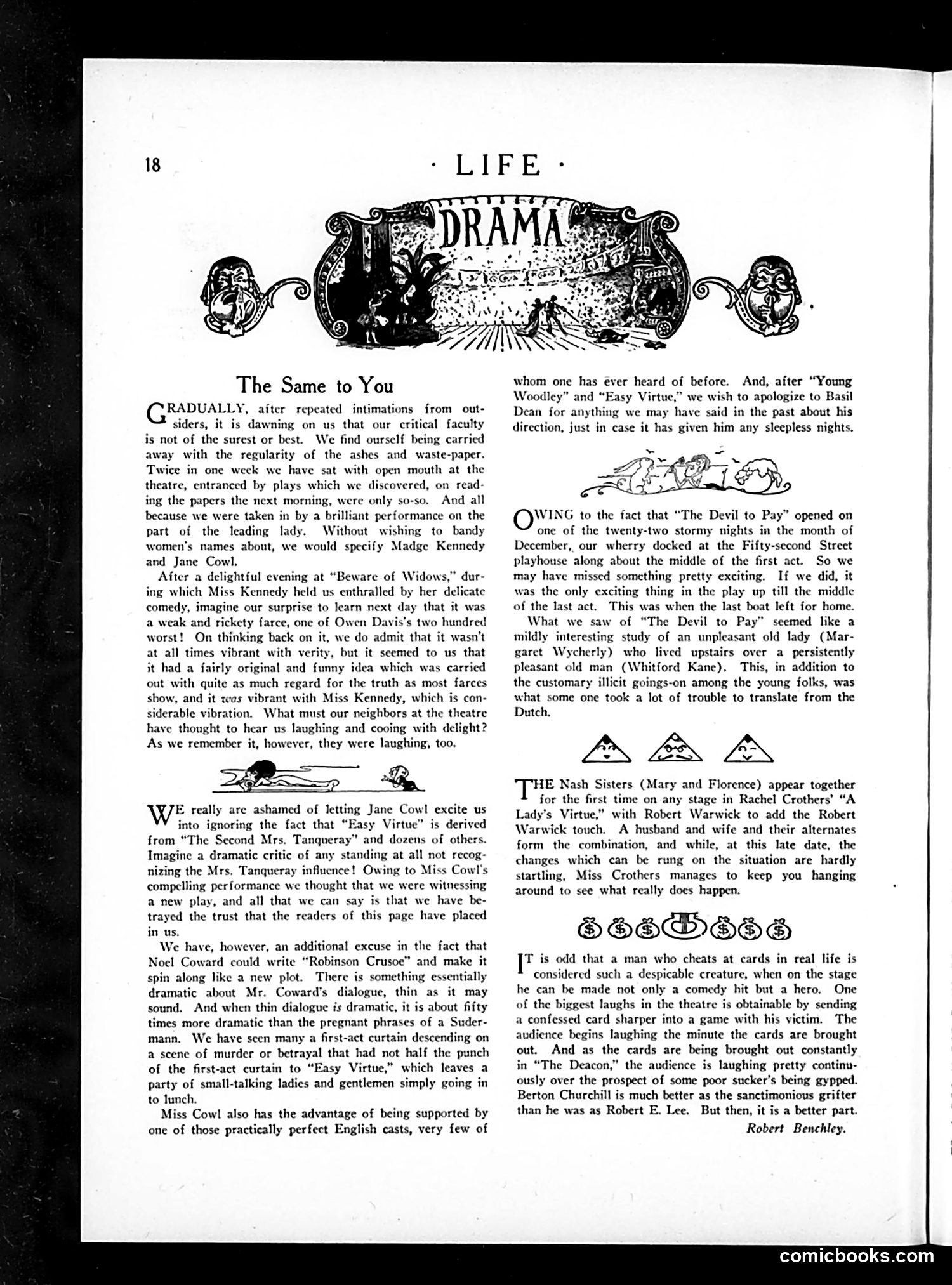
This page offers theatrical criticism about Broadway plays and their stars. The author confesses a problem: prominent actresses like **Madge Kennedy** and **Jane Cowl** deliver such brilliant performances that critics overlook weak writing underneath. The specific examples cited are: "Beware of Widows" (Kennedy in Owen Davis's "rickety farce"), "Easy Virtue" (Cowl's performance of a derivative plot based on "The Second Mrs. Tanqueray"), and "The Devil to Pay" (featuring Margaret Wycherly and Whitford Kane). The critic also praises playwright **Noel Coward's** dialogue as genuinely dramatic despite being thin. The satire targets theater critics' susceptibility to star power over substance—they admit being fooled into enthusiasm for mediocre plays by exceptional acting. The mention of **Basil Dean's** direction and the **Nash Sisters** indicates contemporary theater personalities whose reputations the author revises based on these experiences.
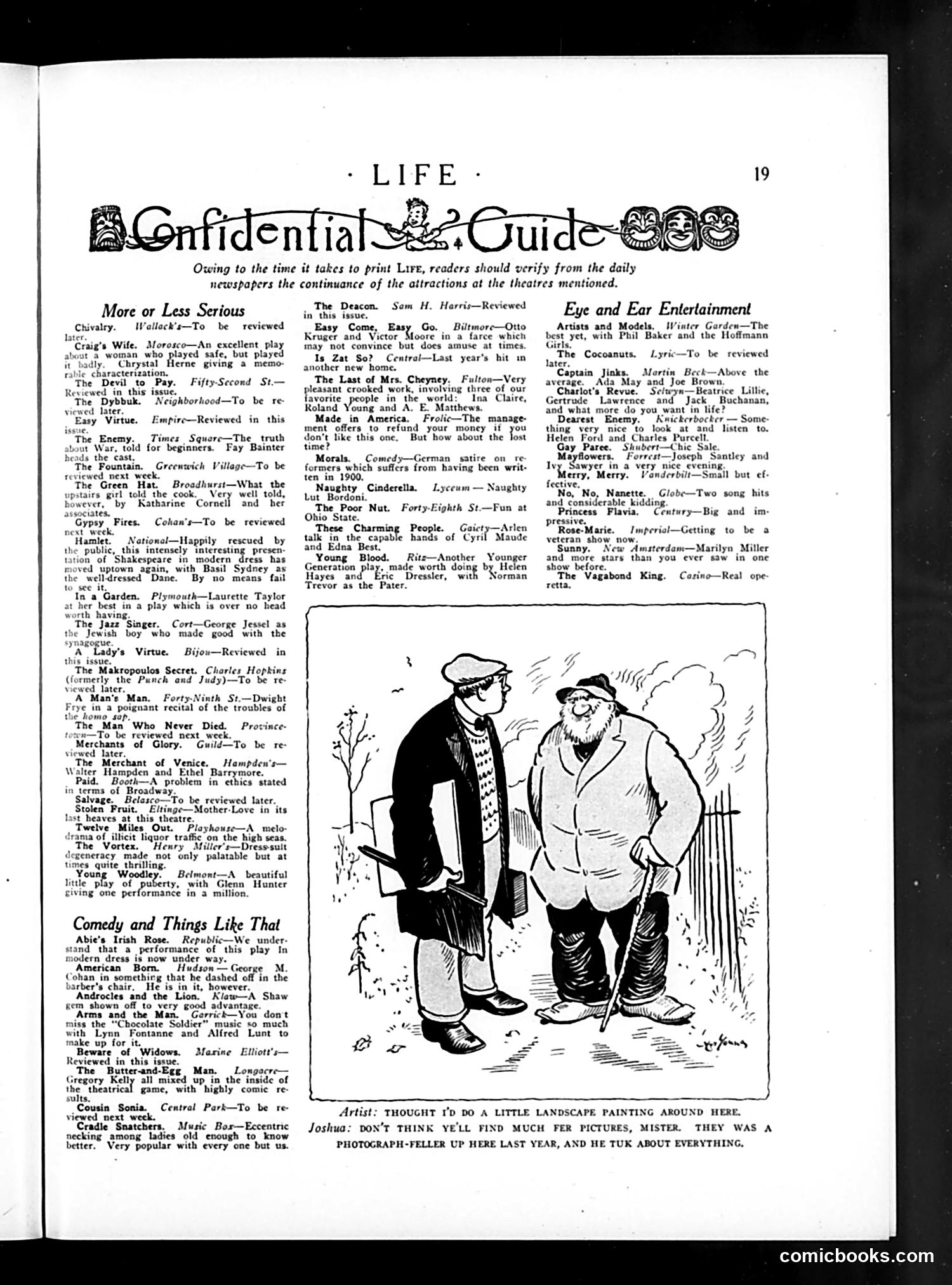
This is a theater review page from Life magazine's "Confidential Guide" section. The main cartoon depicts two men—one thin and artistically dressed, one portly and working-class—debating whether to add landscape paintings. The artist proposes adding scenic backdrop work; Joshua (the stockier figure) dismisses the idea, noting that last year a photographer replaced pictures with actual photographs, which "tuk about everything." The joke satirizes the shift from painted theatrical scenery to photographic realism in early 1920s theater production. The cartoon mocks artistic pretension while celebrating practical photography's superiority—a topical commentary on modernization in theatrical staging. The page lists current Broadway productions with brief critical assessments, indicating which will be reviewed in upcoming issues. Notable entries include productions starring Basil Sydney, Glenn Hunter, and Lynn Fontanne, reflecting the theatrical landscape of the early 1920s.
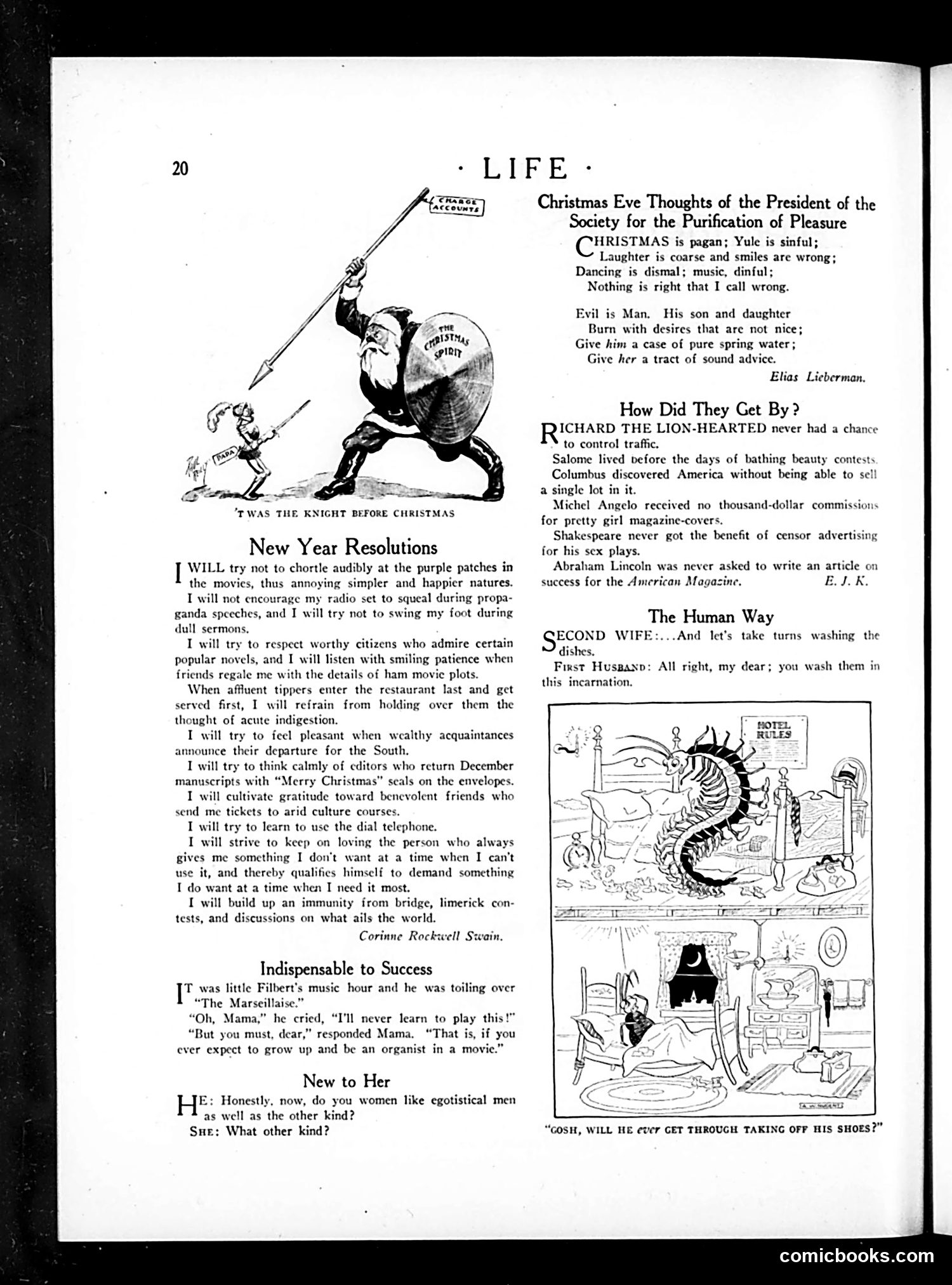
This page contains early 20th-century American satirical humor targeting social pretension and hypocrisy. **"Christmas Eve Thoughts"** mocks puritanical moralists (the "Society for the Purification of Pleasure") who condemn harmless pleasures like dancing and laughter as sinful, while imposing joyless restrictions on others. **"New Year Resolutions"** satirizes urbane irritations: pretentious movie-goers, obsequious restaurant service, wealthy social climbers, rejecting editors, and the universal awkwardness of unwanted gifts. **"How Did They Get By?"** points out that historical figures succeeded without modern advertising, censorship boards, or magazine self-promotion—implying contemporary society over-relies on marketing and media manipulation. **"The Human Way"** depicts marital compromise through a cartoon where a husband accepts doing dishes, satirizing changing domestic expectations. The overall tone criticizes social snobbery, commercialism, and rigid moralism while celebrating ordinary human resilience and humor.
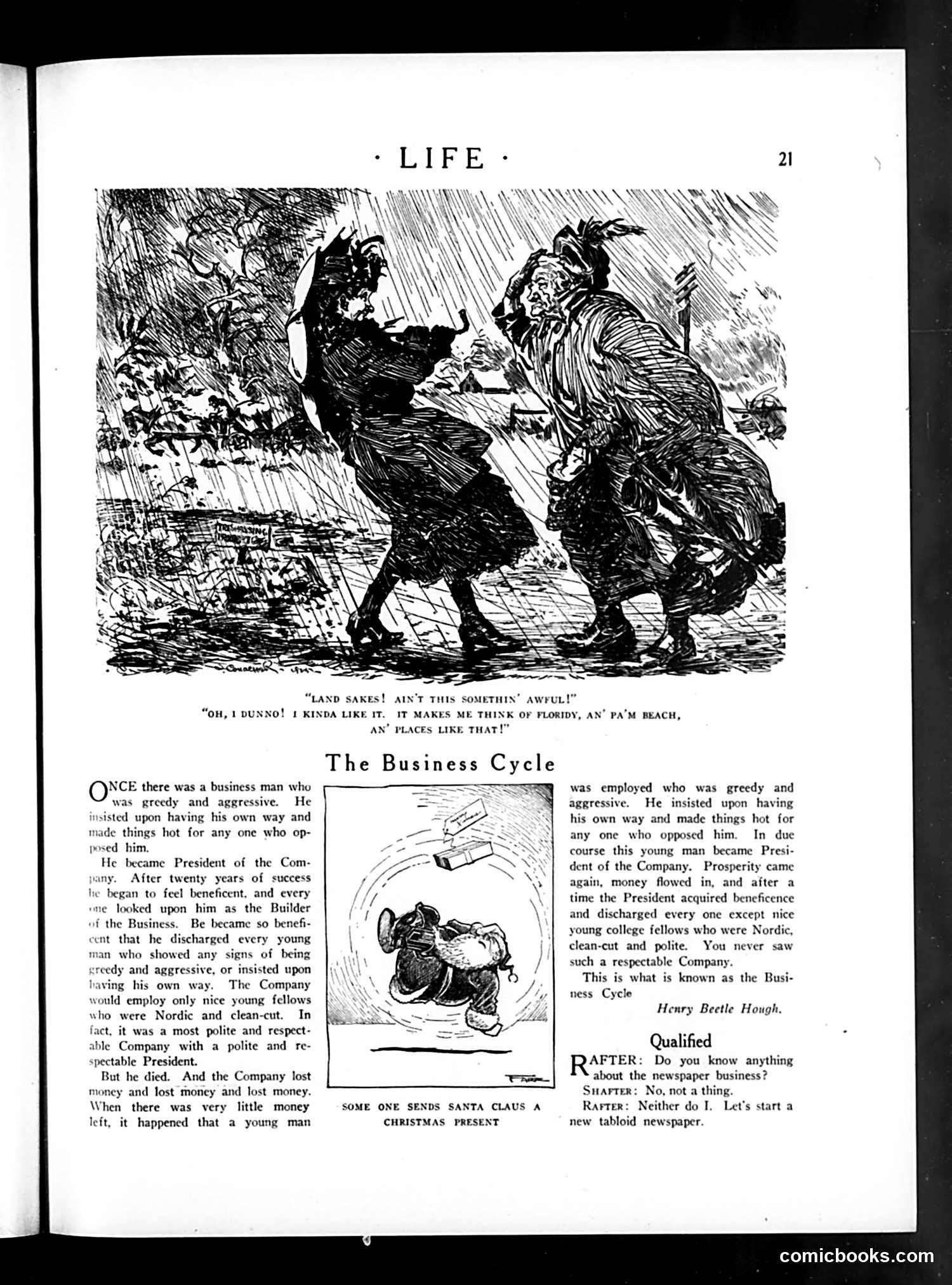
This page contains two satirical pieces mocking American business culture and entrepreneurship. **"The Business Cycle"** (main story) critiques corporate hypocrisy through ironic repetition. A greedy, aggressive businessman builds a company through ruthlessness, then—once successful—becomes "beneficent" and fires anyone showing the same ambition that made him rich. After his death, the company fails until another aggressive young man takes over and repeats the cycle. The satire suggests that companies require cutthroat ambition to succeed, yet successful leaders paradoxically reject those qualities in others, creating inevitable decline. **"Qualified"** (bottom) is a brief joke mocking incompetence in new media. Two men admit knowing nothing about newspapers, then decide to start a tabloid anyway—ridiculing both the low barriers to entry in sensationalist journalism and the unqualified people launching publications. The top cartoon appears unrelated, showing figures in conversation, likely another separate humorous piece.
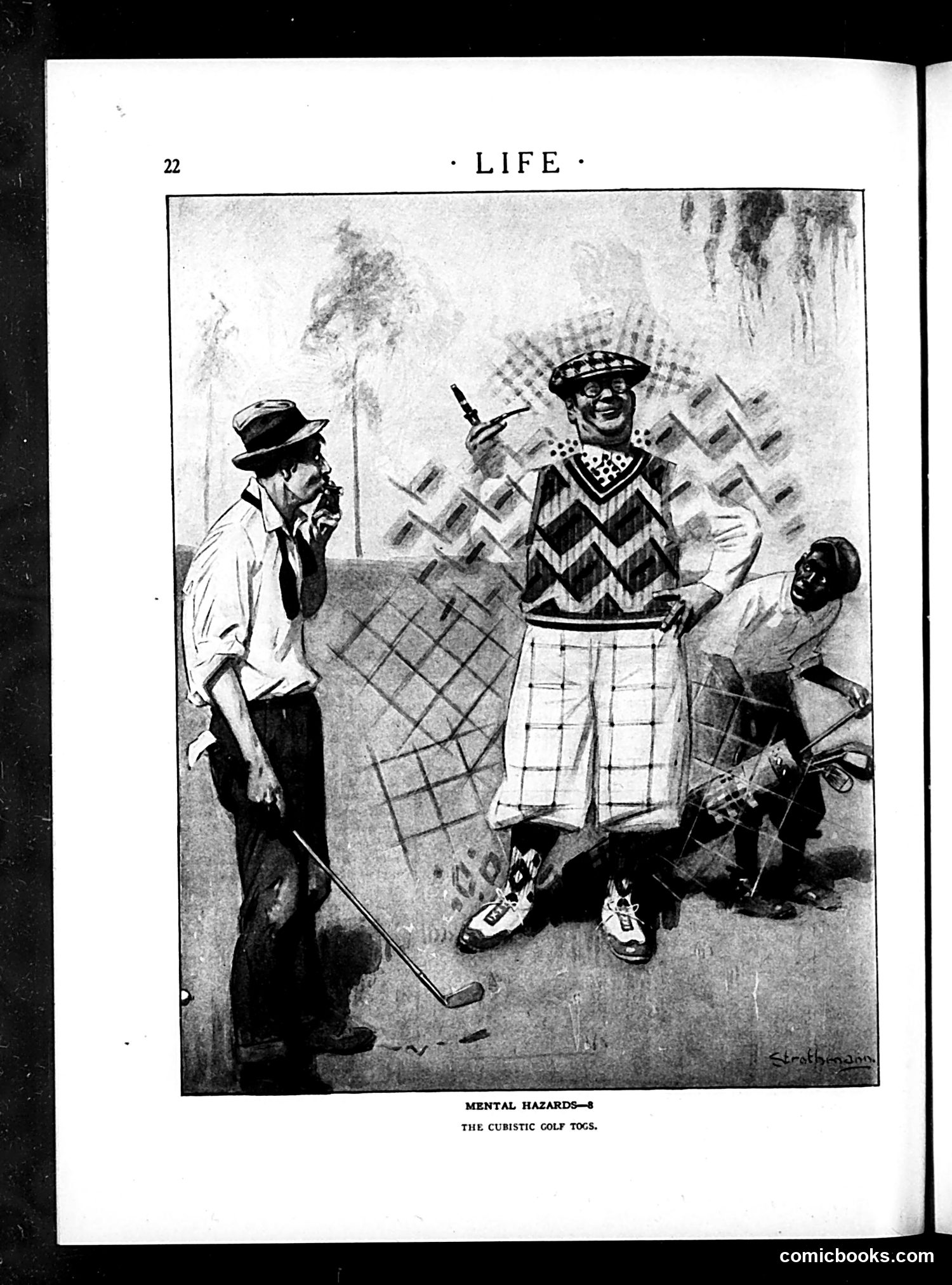
This satirical cartoon mocks the fashion trend of wearing boldly patterned, geometrically-designed golf clothing. The central figure displays exaggerated cubist patterns—a diamond-patterned sweater and checkered pants—that appear deliberately ridiculous. The onlookers' expressions suggest bewilderment or disapproval at this extreme style choice. The humor targets two things: the "cubist" art movement's influence on mainstream fashion, and the pretentious adoption of avant-garde aesthetics in recreational sportswear. By calling these outfits "mental hazards," the cartoon suggests that such garish, geometrically-complex clothing might actually distract or confuse golfers (and observers). The exaggerated caricatures emphasize the absurdity of applying high-art concepts to casual golf attire.
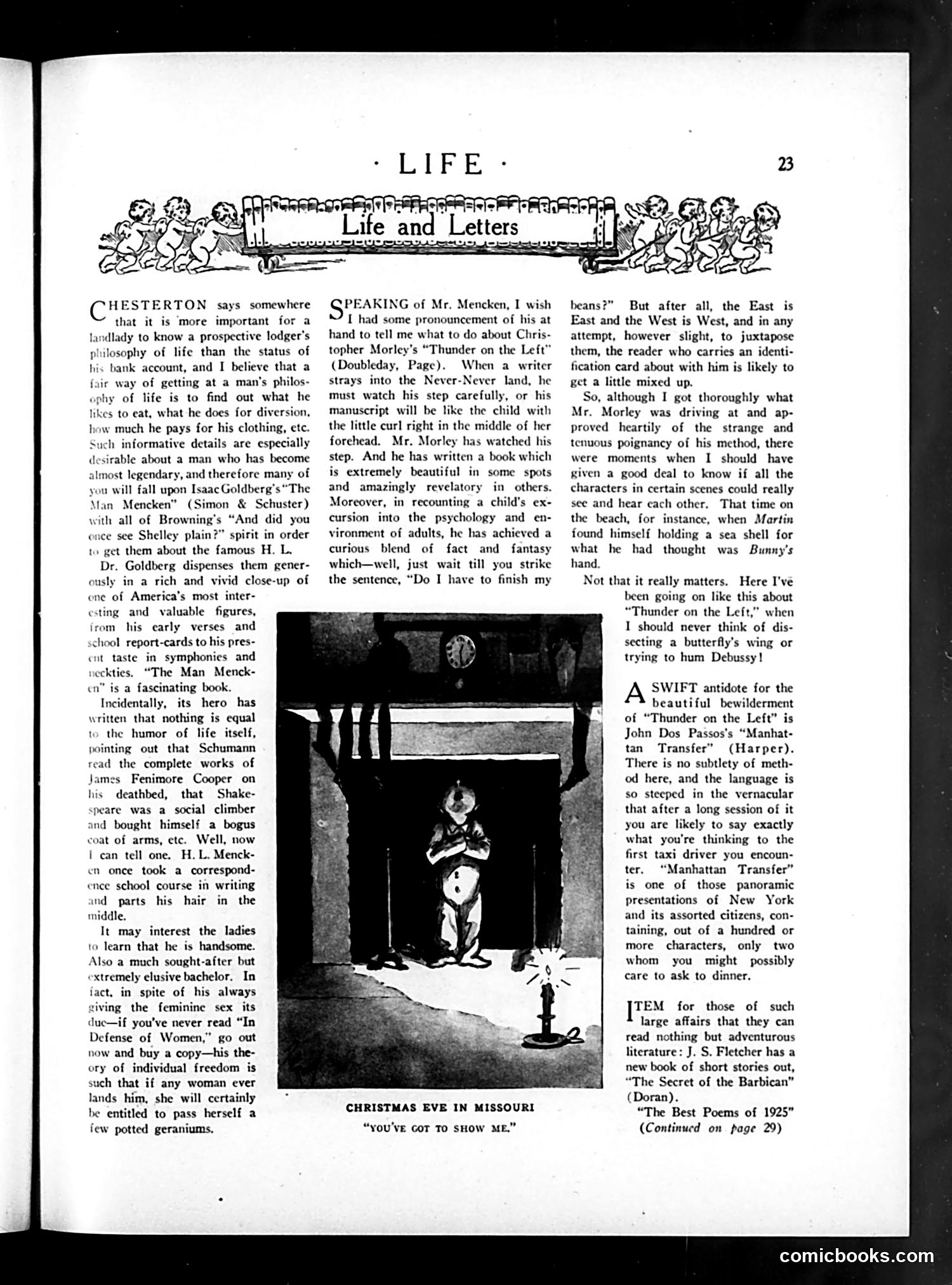
This page combines book reviews with a photograph captioned "Christmas Eve in Missouri — 'You've Got to Show Me.'" **The photograph** depicts what appears to be a child on Christmas Eve, likely illustrating the Missouri saying "show me" (skepticism/demand for proof rather than belief). The image supports the reviewer's discussion of Christopher Morley's *Thunder on the Left*, a fantasy novel about a child's encounter with adult psychology. **The reviews discuss:** - Isaac Goldberg's biography of H.L. Mencken, a prominent American social critic - Morley's novel, praised for blending "fact and fantasy" but criticized for potentially confusing readers about what characters can perceive - Dos Passos's *Manhattan Transfer*, described as a stark, vernacular-heavy antidote to Morley's dreamlike quality **The satire** is gentle—poking fun at Mencken's legendary status while revealing mundane details (he parts his hair in the middle), and gently mocking readers who demand literal logic from experimental fiction. The "show me" caption reflects skepticism about fantastical narrative methods.
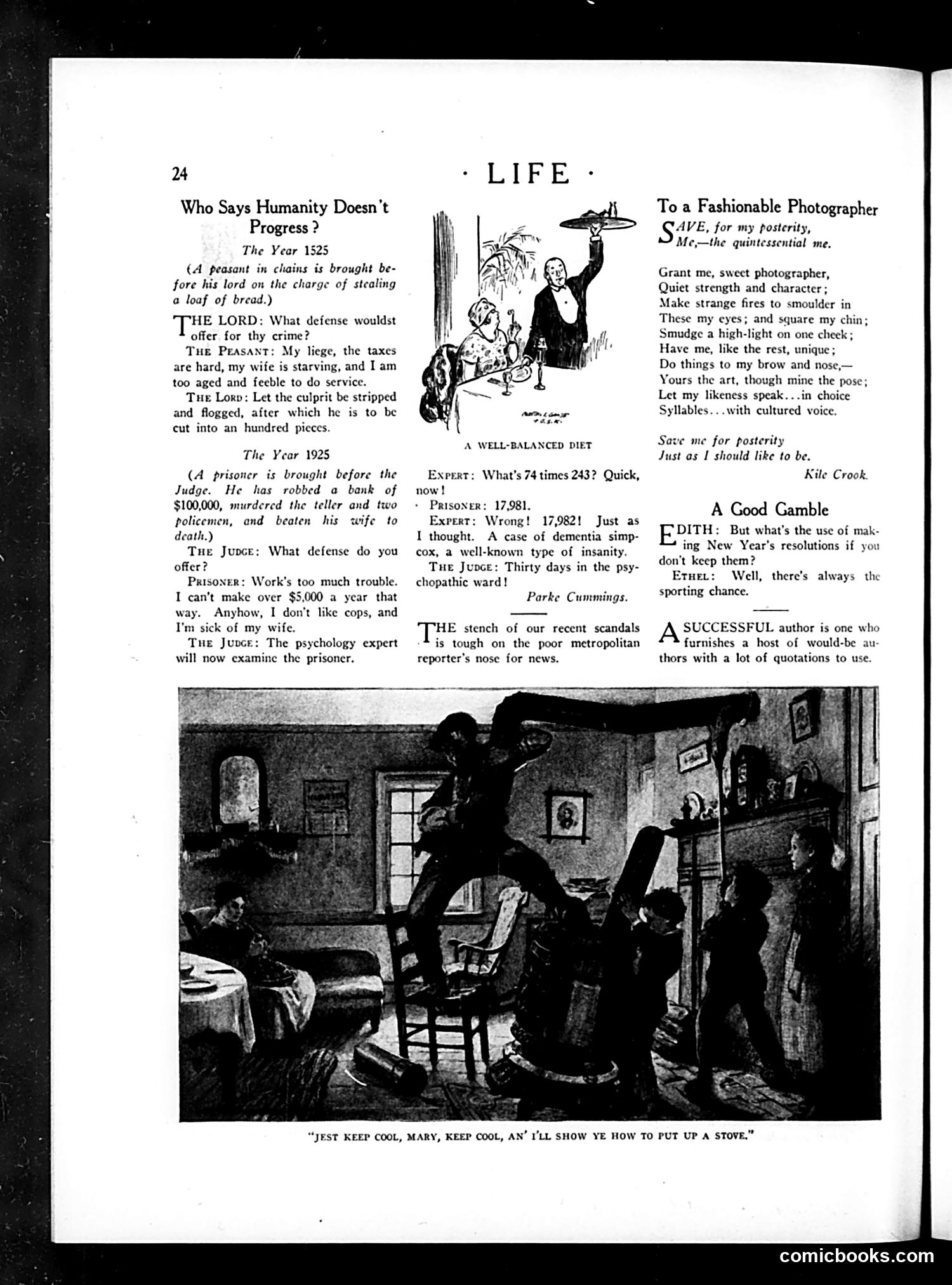
This satirical comparison contrasts medieval and modern justice systems to argue that progress is illusory. In 1525, a starving peasant stealing bread receives brutal execution. In 1925, a wealthy bank robber who murders multiple people and abuses his wife receives only 30 days in a psychiatric ward—after a psychologist diagnoses him with "dementia simplex" based on a math error, suggesting psychological excuses replace accountability. The joke's bitter point: modern society claims enlightenment, yet substitutes pseudo-scientific explanations for actual punishment of serious crimes. The wealthy criminal escapes justice through psychology and technicalities, while the hungry medieval peasant faced death. The satire critiques both 1920s faith in psychology and class-based leniency in the justice system.
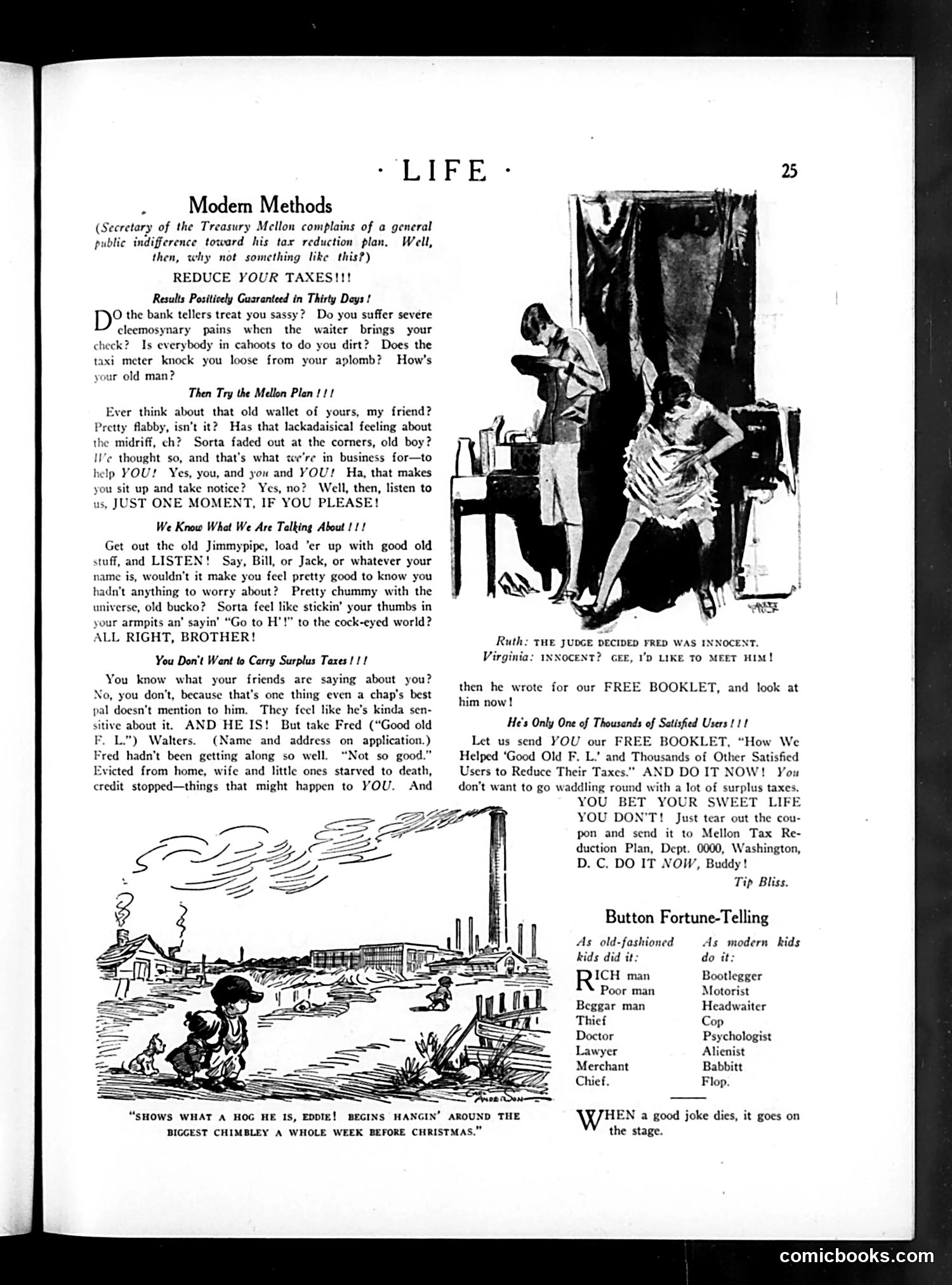
This page satirizes Secretary of the Treasury Andrew Mellon's tax reduction proposals through mock advertising. The cartoon mimics aggressive sales pitches ("REDUCE YOUR TAXES!!!") to lampoon what Life viewed as Mellon's ineffective or disingenuous approach to his own tax policy. The humor centers on using a "customer testimonial" format: a man named Fred, evicted and destitute, supposedly improved his life by writing for Mellon's "free booklet." The judge's verdict that Fred was "innocent"—sardonically reframed as grounds to meet him—undercuts any credibility. The satire suggests Mellon's tax proposals are more promotional gimmickry than genuine economic relief. The accompanying illustrations (a hobo scene, button fortune-telling comparing old and modern professions) reinforce themes of economic struggle and social displacement during this period.
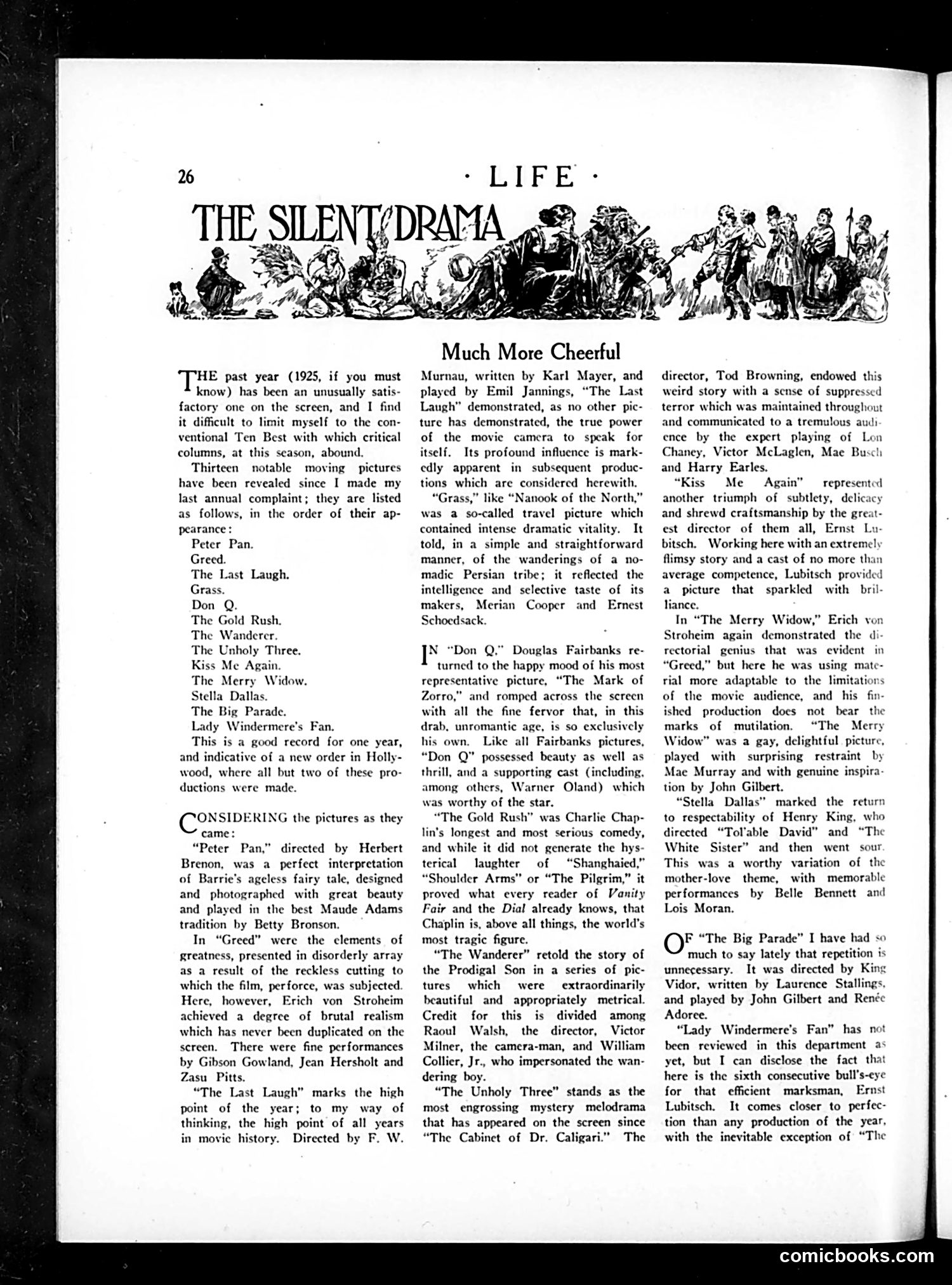
This is a film criticism column from *Life* magazine (1925), not a political cartoon. The author reviews thirteen notable motion pictures from 1925, ranking them by quality. Key context: Silent films dominated cinema; directors like F.W. Murnau, Charlie Chaplin, and Erich von Stroheim were innovating the medium. The critic praises "The Last Laugh" as cinema's highest achievement, noting how the camera itself tells the story without intertitles. Notable films discussed include: - *The Gold Rush* (Chaplin) — praised for its tragic depth - *Greed* (von Stroheim) — admired despite heavy studio editing - *Don Q* (Fairbanks) — adventure-swashbuckling entertainment - *Peter Pan* — faithful literary adaptation The tone is enthusiastic about Hollywood's recent output, noting "a new order" in filmmaking quality. The author distinguishes between commercial entertainment (Fairbanks) and artistic achievement (Murnau), establishing early critical hierarchies that persist today.
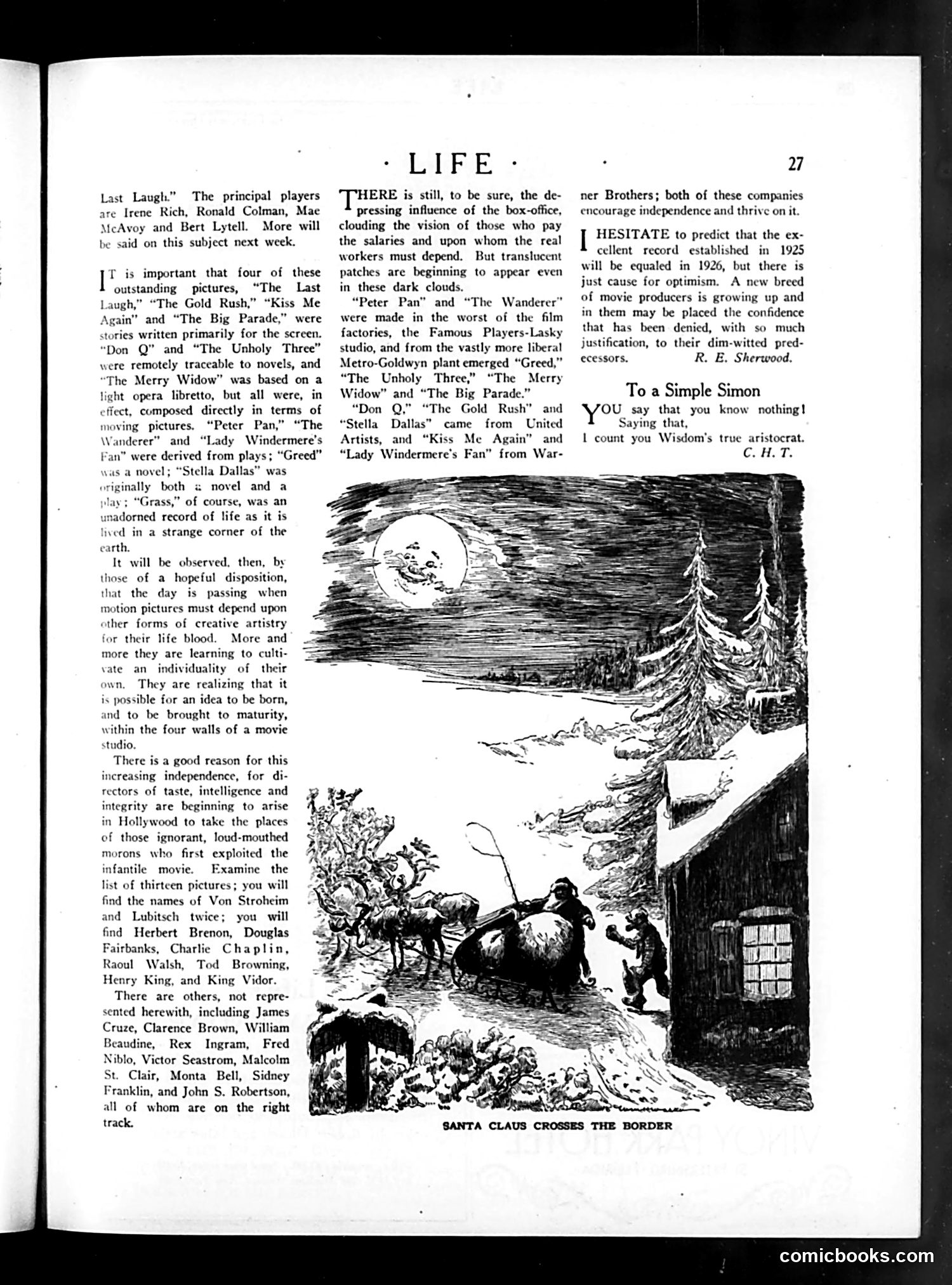
This page discusses the artistic maturation of 1920s cinema, arguing that film is becoming an independent creative medium rather than merely adapting stage plays and novels. The article celebrates directors like Chaplin, Von Stroheim, and King Vidor who are elevating the industry beyond "ignorant, loud-mouthed morons" who initially exploited film's "infantile" appeal. The illustration titled "Santa Claus Crosses the Border" appears to be a whimsical ink drawing showing Santa with his reindeer traveling across a winter landscape—likely a reference to either holiday-themed cinema or possibly commentary on cross-border cultural exchange during the era of silent film's international influence. The page includes a short humorous verse ("To a Simple Simon") praising wisdom through self-awareness. Overall, this reflects 1925-era optimism about Hollywood's artistic evolution and the growing respectability of motion pictures as a serious art form independent of theatrical traditions.
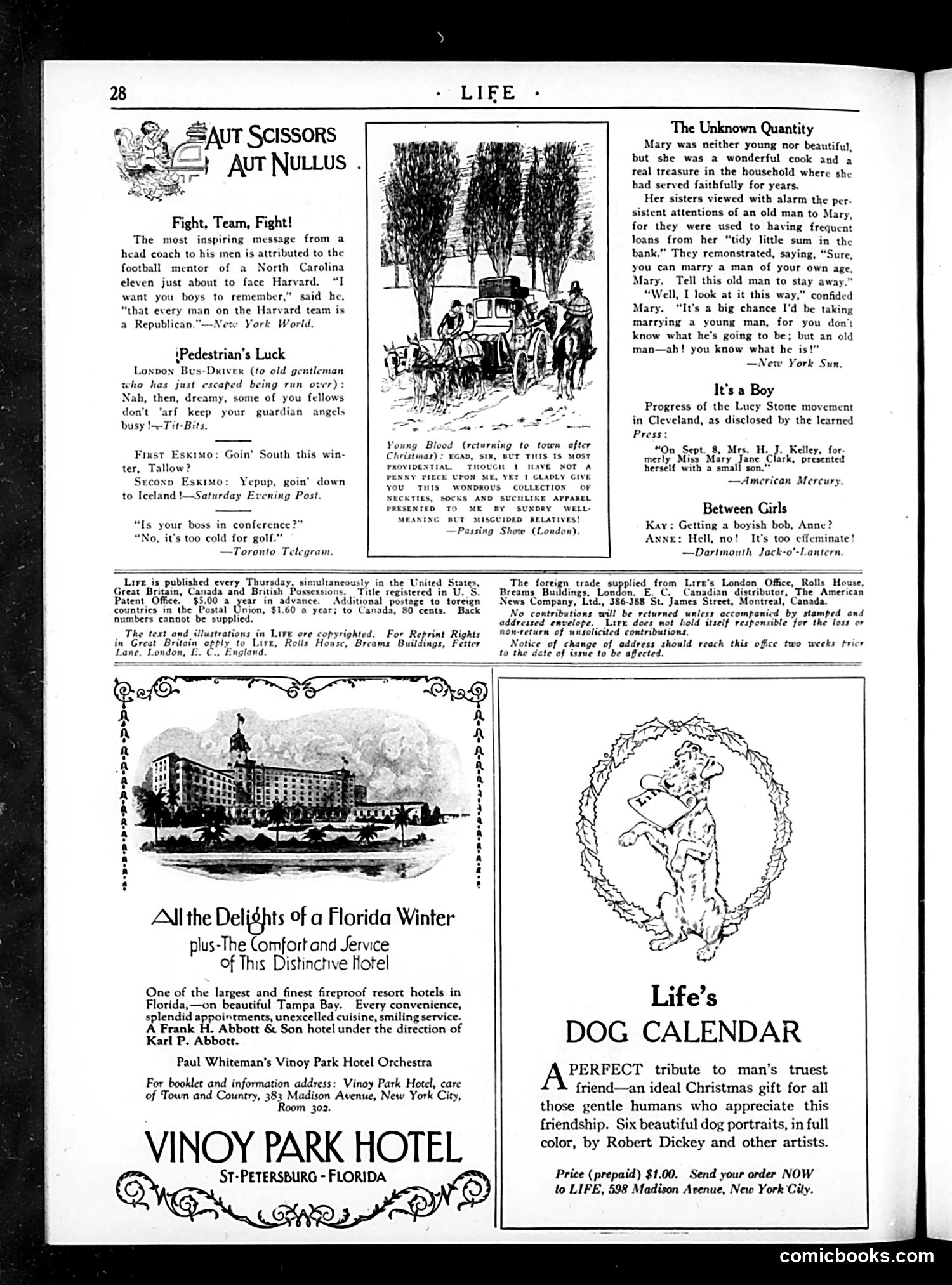
This page from *Life* magazine contains several brief satirical items typical of the publication's humor format: **"Fight, Team, Fight!"** mocks a football coach's pre-game pep talk, where he motivates his team by claiming every Harvard player is a Republican—implying this partisan label is itself a weakness or insult. **"Pedestrian's Luck"** is a London bus driver anecdote about narrowly avoiding hitting an elderly man, joking that guardians of careless pedestrians must be constantly busy. The remaining items are short humorous quips about winter travel, boss availability, and holiday gift-giving from relatives. **"Between Girls"** references the "Lucy Stone movement"—the women's suffrage/women's rights movement—as two young women discuss fashionable bobbed hairstyles, with one dismissing the style as "too effeminate." The page is primarily **advertising and filler content**. The satirical items are brief, topical jokes rather than substantial political commentary, reflecting *Life*'s early 20th-century style of light social humor.
This page contains **advertising and correspondence**, not political cartoons. The main content is a **letter from Charles Addison Parker**, an advertising copywriter, promoting his services to other advertisers. Parker uses self-deprecating humor about the "Parkeresque way" of advertising—suggesting his style is distinctive enough that competitors might imitate it. He's essentially asking clients to hire *him* directly rather than competitors copying his approach. The **"Now's the Time" section** is satirical commentary listing historical figures who lacked modern conveniences (Moses without a saxophone, Napoleon without a radio). This mocks contemporary obsession with technology and modern amenities. The **Louvain Library Fund appeal** describes Belgium's library destroyed in WWI (1914), requesting American donations for reconstruction—reflecting post-war charitable efforts. The remaining content is **product advertising** for Gastrogen Tablets (antacid) and mentions of published poetry collections. The page reflects 1920s concerns: advertising culture, post-war reconstruction philanthropy, and commercial patent medicines.
This page is primarily **advertising**, not satire. The main featured content is a Stuart's Dyspepsia Tablets advertisement using a testimonial format popular in the 1920s. The ad presents a speaker claiming a single tablet neutralizes effects of heavy banquets—a humorous exaggeration meant to sell the product. The pitch appeals to digestive anxiety: you can eat richly without consequences if you use Stuart's tablets. The surrounding content includes brief humor anecdotes (Doug Fairbanks's theatrical debut, a football vendor named Charlie, an actress's story about a maid losing her "instinct"/sense of smell). These are filler pieces typical of *Life* magazine's format. The advertisements clustered around the page—for cruises, cigars, and stomach bitters—reflect consumer goods marketed to affluent readers. This represents early-20th-century American advertising's focus on remedying "modern" ailments of overindulgence through commercial products.
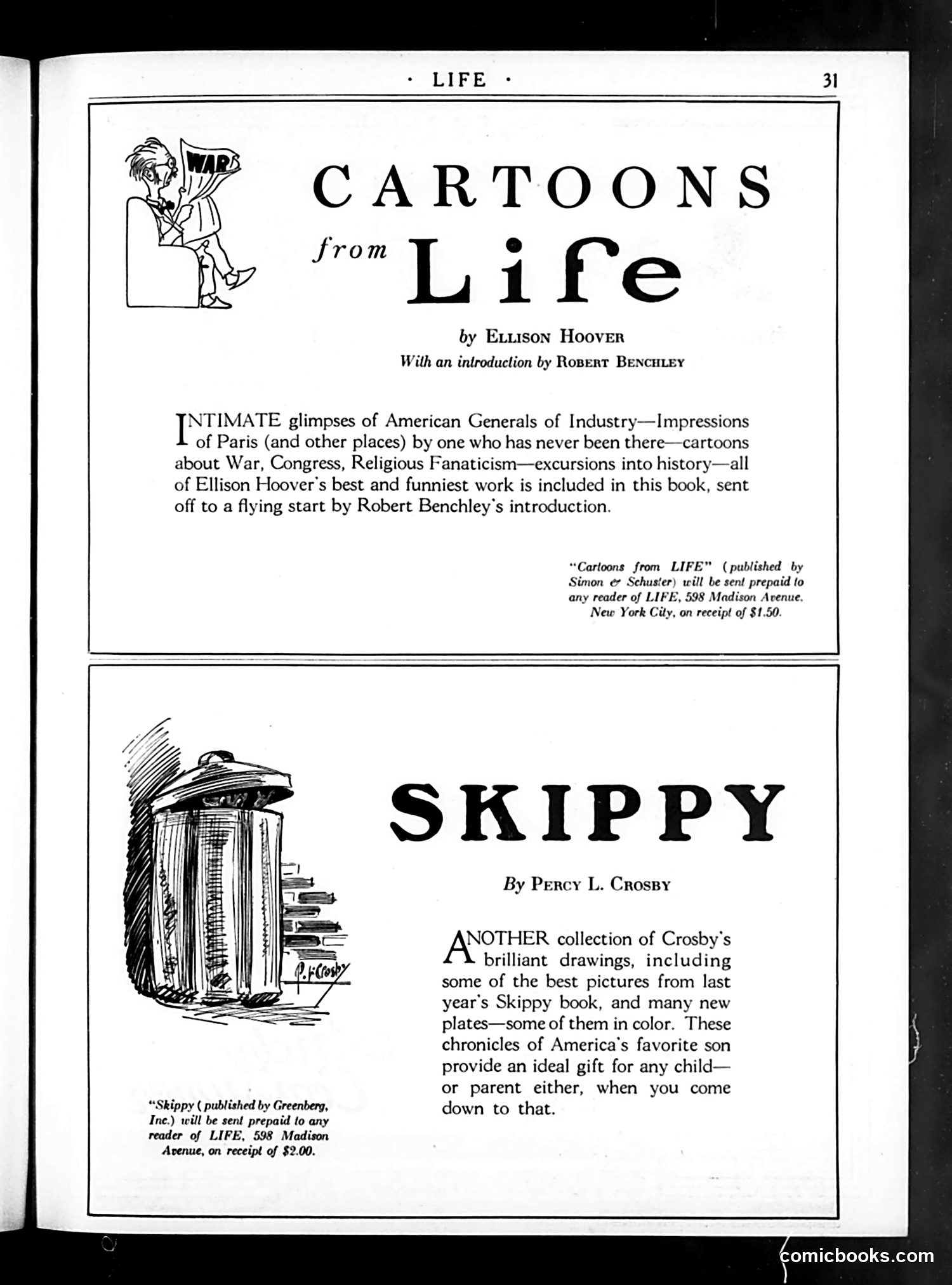
This is primarily an **advertising page** from Life magazine, not satirical content itself. It features two book advertisements: 1. **"Cartoons from Life"** by Ellison Hoover (introduction by Robert Benchley): Promotes a collection of Hoover's satirical cartoons covering "American Generals of Industry," Paris, War, Congress, and Religious Fanaticism. The specific targets aren't visible on this page, but the description suggests topical social and political satire typical of 1920s-30s Life magazine. 2. **"Skippy"** by Percy L. Crosby: Advertises a children's comic collection featuring "America's favorite son"—referring to the popular comic strip character Skippy, known for mischievous boy humor. Both ads are selling books via mail-order to Life readers, priced at $1.50 and $2.00 respectively. The page functions as **product promotion** rather than editorial satire or political commentary.
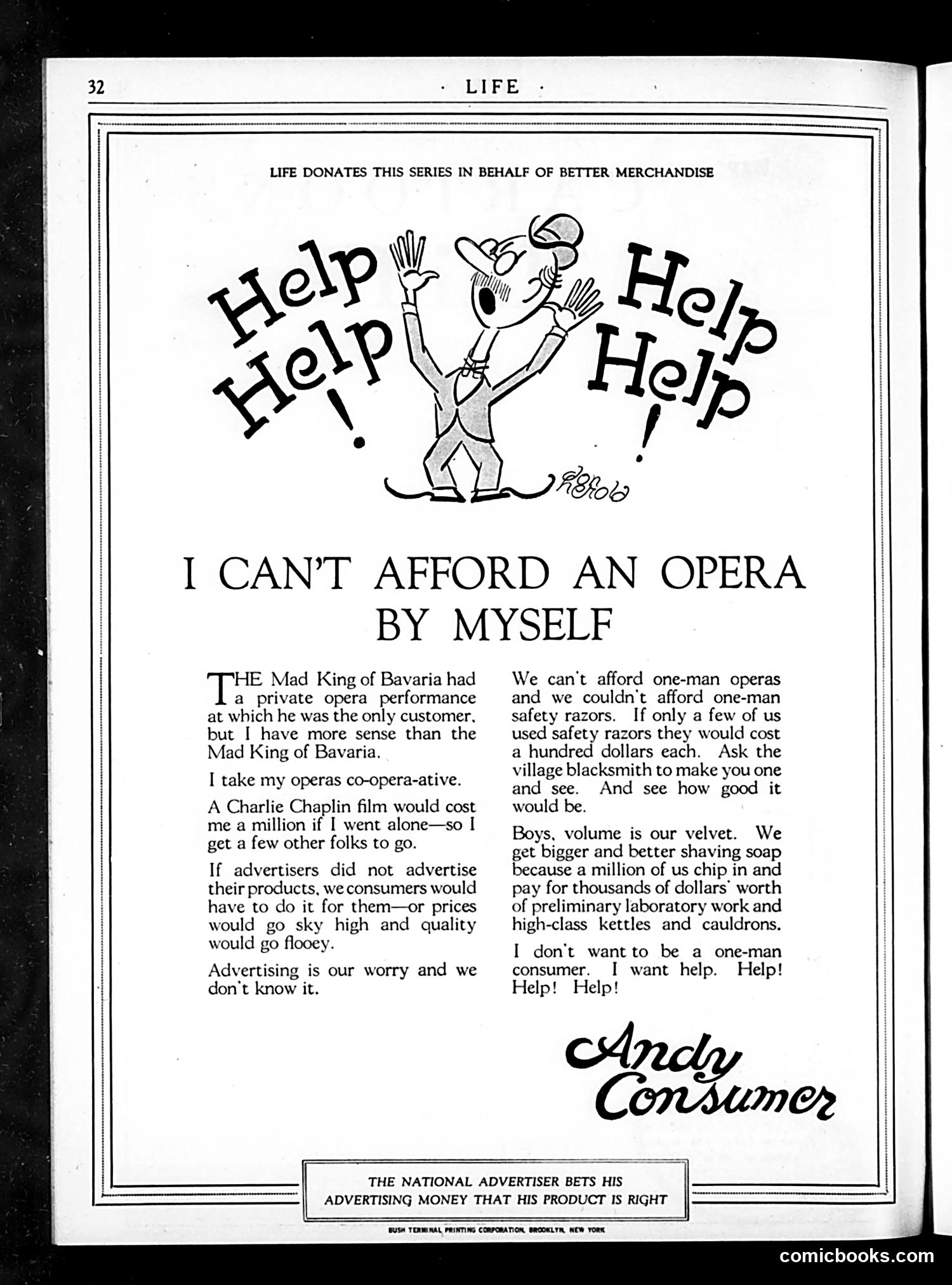
This is a pro-advertising editorial disguised as consumer advocacy. The "Andy Consumer" character argues that mass consumption, enabled by advertising, benefits ordinary people through economies of scale. He uses humorous examples: a private opera (referencing King Ludwig II of Bavaria's extravagant isolation) would be ruinously expensive, but shared cultural experiences become affordable. Similarly, safety razors cost $100 each if one person bears the R&D costs alone, but mass production—driven by advertising that creates demand—distributes expenses across millions. The satire's irony is subtle: Andy presents himself as the consumer's advocate while actually defending advertising industry interests. He claims consumers "don't know" advertising is their "worry," yet argues they benefit from it. The message: advertising creates mass markets that make quality goods cheap. The cartoon's "Help! Help!" visual gag emphasizes this dependence on collective consumption. This reflects early 20th-century arguments justifying advertising as economically beneficial rather than manipulative.
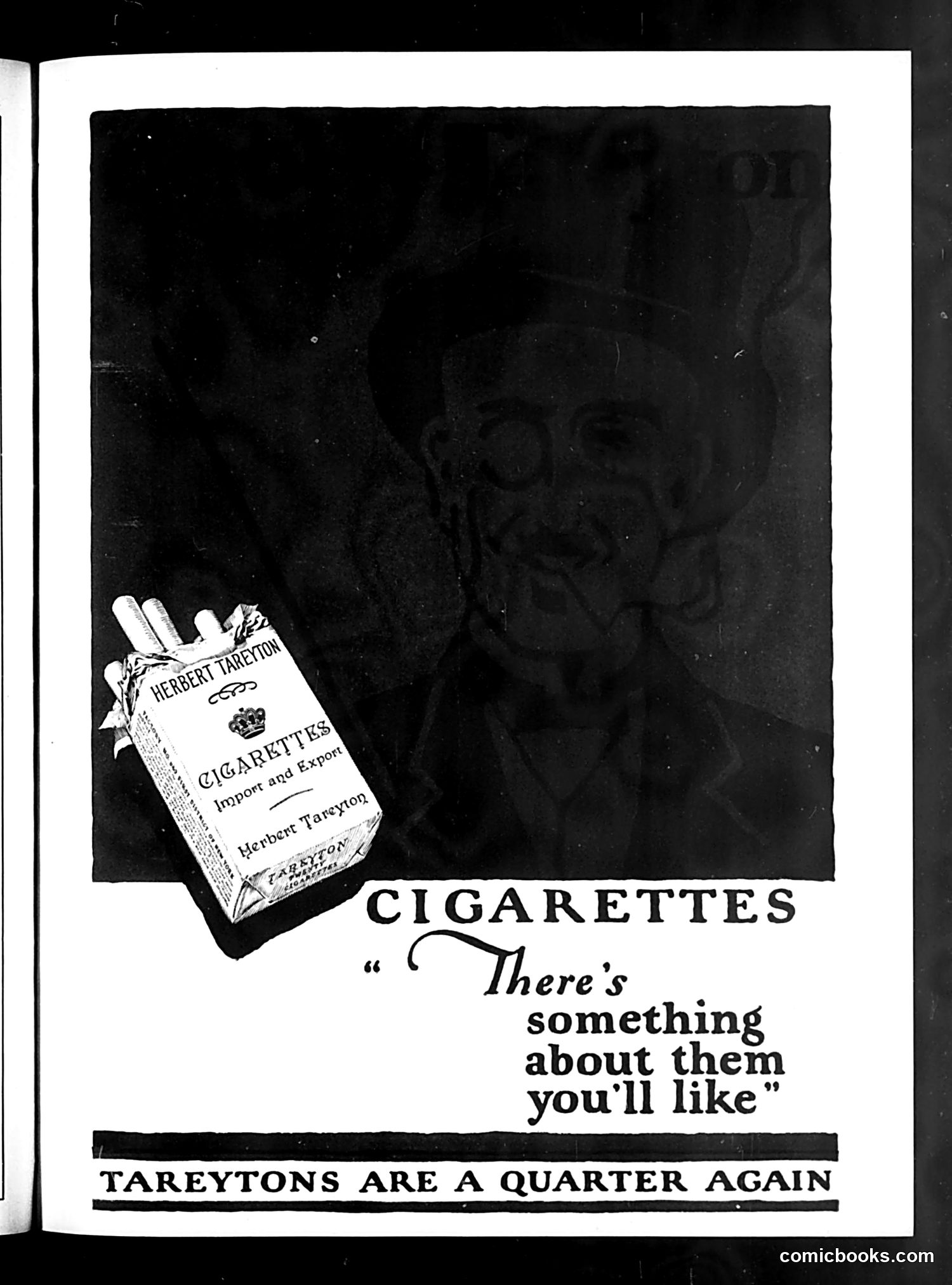
This is a **cigarette advertisement**, not political satire or a cartoon. It promotes Herbert Tareyton cigarettes, manufactured by Herbert Tareyton. The ad features a cigarette package and includes the slogan "There's something about them you'll like." The bottom headline states "TAREYTONS ARE A QUARTER AGAIN"—likely indicating a price point or a marketing claim about value. The dark background image appears decorative rather than satirical. There is no political commentary, caricature, or social satire present on this page—it's straightforward commercial advertising from the early-to-mid 20th century, when such tobacco ads regularly appeared in mainstream publications without health warnings.
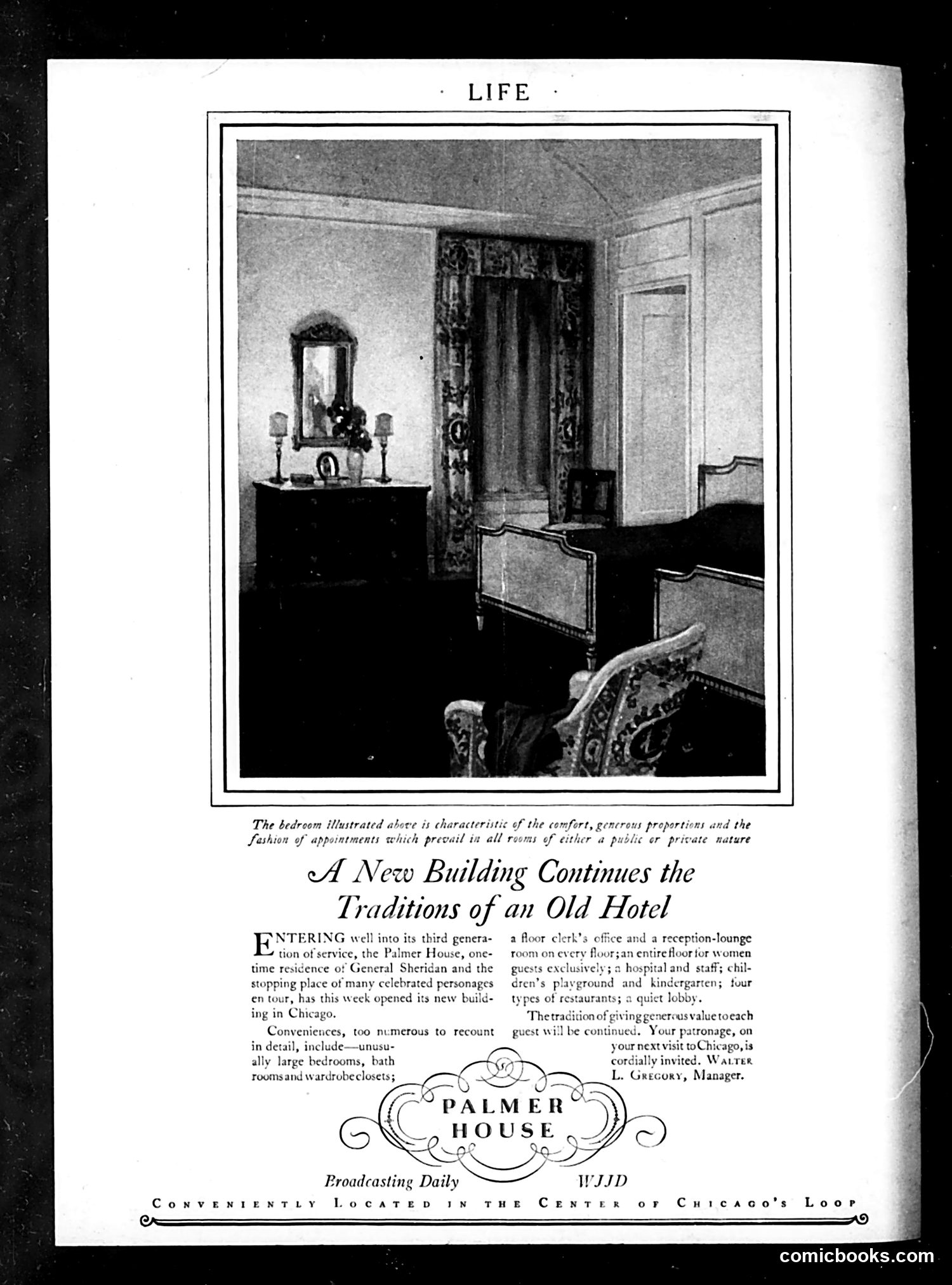
This is not a cartoon or satirical content—it's a **hotel advertisement** from Life magazine. The page promotes the **Palmer House**, a prestigious Chicago hotel entering its third generation of operation. The text notes its historical significance as a former residence of General Sheridan and a stopping place for celebrated guests. The accompanying bedroom photograph illustrates the hotel's amenities: large rooms, multiple bathrooms, spacious closets, and luxury furnishings typical of upscale hotels of the era. The advertisement emphasizes modern conveniences—floor clerks' offices, reception lounges, separate facilities for women guests, children's areas, and restaurants. This represents straightforward early-20th-century hotel marketing in a prestigious national magazine, highlighting comfort and status. There is no satire or political commentary present—simply advertising copy inviting readers to visit the Palmer House on their next Chicago trip, signed by manager Walter L. Gregory.

I can see this is a mostly blank or very dark page from Life magazine with minimal visible content. The image quality is extremely poor—almost entirely black with only a white border on the left side visible. There is no discernible cartoon, illustration, text, or satirical content that I can reliably identify or read. Without being able to see the actual content clearly, I cannot explain what figures, caricatures, political references, or jokes may be present on this page. This appears to be either a scanning error, a blank page, or a page so degraded that its original content is not legible in this reproduction. To provide accurate historical analysis, a clearer image would be necessary.