
Life, 1925-12-25 · page 20 of 37
Life — December 25, 1925 — page 20: what you’re looking at
What you’re looking at
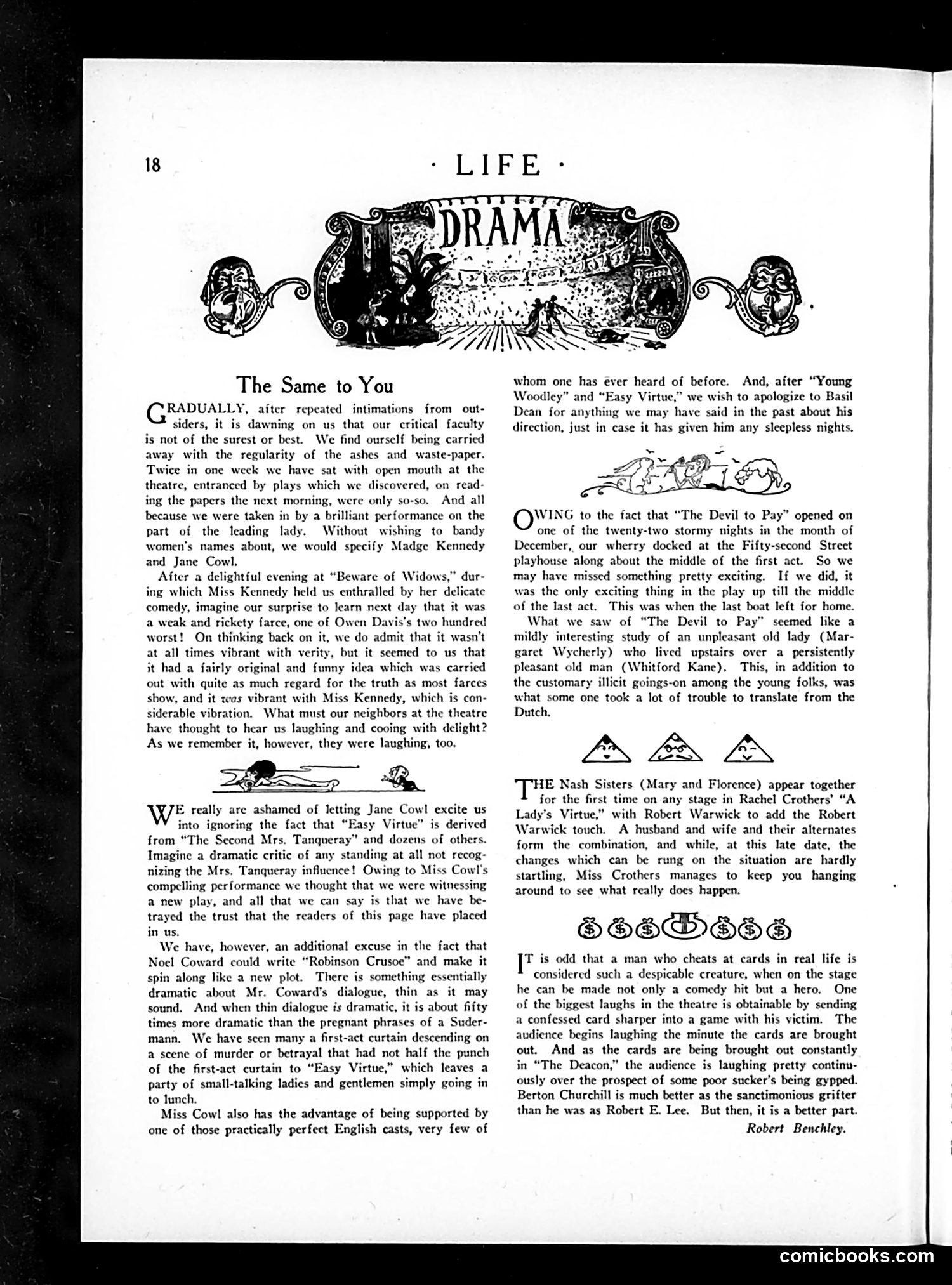
This page offers theatrical criticism about Broadway plays and their stars. The author confesses a problem: prominent actresses like **Madge Kennedy** and **Jane Cowl** deliver such brilliant performances that critics overlook weak writing underneath. The specific examples cited are: "Beware of Widows" (Kennedy in Owen Davis's "rickety farce"), "Easy Virtue" (Cowl's performance of a derivative plot based on "The Second Mrs. Tanqueray"), and "The Devil to Pay" (featuring Margaret Wycherly and Whitford Kane). The critic also praises playwright **Noel Coward's** dialogue as genuinely dramatic despite being thin. The satire targets theater critics' susceptibility to star power over substance—they admit being fooled into enthusiasm for mediocre plays by exceptional acting. The mention of **Basil Dean's** direction and the **Nash Sisters** indicates contemporary theater personalities whose reputations the author revises based on these experiences.
📄 Transcribed text from this page (OCR, searchable)
Machine-transcribed from the original scan — historical spelling and the odd misread are preserved.
The Same to You RADUALLY, after repeated intimations from out- siders, it is dawning on us that our critical faculty is not of the surest or best. We find ourself being carried away with the regularity of the ashes and waste-paper. Twice in one week we have sat with open mouth at the theatre, entranced by plays which we discovered, on read- ing the papers the next morning, were only so-so. And all because we were taken in by a brilliant performance on the part of the leading lady. Without wishing to bandy women’s names about, we would specify Madge Kennedy and Jane Cowl. After a delightful evening at “Beware of Widows,” dur- ing which Miss Kennedy held us enthralled by her delicate comedy, imagine our surprise to learn next day that it was a weak and rickety farce, one of Owen Davis's two hundred worst! On thinking back on it, we do admit that it wasn’t at all times vibrant with verity, but it seemed to us that it had a fairly original and funny idea which was carried out with quite as much regard for the truth as most farces show, and it was vibrant with Miss Kennedy, which is con- siderable vibration. What must our neighbors at the theatre have thought to hear us laughing and cooing with delight? As we remember it, however, they were laughing, too. really are ashamed of letting Jane Cowl excite us into ignoring the fact that “Easy Virtue” is derived from “The Second Mrs. Tanqueray” and dozens of others. Imagine a dramatic critic of any standing at all not recog- nizing the Mrs. Tanqueray influence! Owing to Miss Cowl's compelling performance we thought that we were witnessing a new play, and all that we can say is that we have be- trayed the trust that the readers of this page have placed in us. We have, however, an additional excuse in the fact that Noel Coward could write “Robinson Crusoe” and make it spin along like a new plot. There is something essentially dramatic about Mr. Coward’s dialogue, thin as it may sound. And when thin dialogue is dramatic, it is about fifty times more dramatic than the pregnant phrases of a Suder- mann. We have scen many a first-act curtain descending on a scene of murder or betrayal that had not half the punch of the first-act curtain to “Easy Virtue,” which leaves a party of small-talking ladies and gentlemen simply going in to lunch. Miss Cowl also has the advantage of being supported by one of those practically perfect English casts, very few of W whom one has éver heard of before. And, after “Young Woodley” and “Easy Virtue,” we wish to apologize to Basil Dean for anything we may have said in the past about his direction, just in case it has given him any sleepless nights. WING to the fact that “The Devil to Pay” opened on one of the twenty-two stormy nights in the month of December, our wherry docked at the Fifty-second Street playhouse along about the middle of the first act. So we may have missed something pretty exciting. If we did, it was the only exciting thing in the play up till the middle of the last act. This was when the last boat left for home. What we saw of “The Devil to Pay” seemed like a mildly interesting study of an unpleasant old lady (Mar- garet Wycherly) who lived upstairs over a_ persistently pleasant old man (Whitford Kane). This, in addition to the customary illicit goings-on among the young folks, was what some one took a lot of trouble to translate from the BAS E Nash Sisters (Mary and Florence) appear together for the first time on any stage in Rachel Crothers’ “A Lady’s Virtue,” with Robert Warwick to add the Robert Warwick touch. A husband and wife and their alternates form the combination, and while, at this late date, the changes which can be rung on the situation are hardly startling, Miss Crothers manages to keep you hanging around to see what really does happen. NN NC DONONE) T is odd that a man who cheats at cards in real life is considered such a despicable creature, when on the stage he can be made not only a comedy hit but a hero. One of the biggest laughs in the theatre is obtainable by sending a confessed card sharper into a game with his victim. The audience begins laughing the minute the cards are brought out. And as the cards are being brought out constantly in “The Deacon,” the audience is laughing pretty continu- ously over the prospect of some poor sucker’s being gypped. Berton Churchill is much better as the sanctimonious grifter than he was as Robert E. Lee. But then, it is a better part. Robert Benchley. comicbooks.com