
Life, 1925-12-25 · page 16 of 37
Life — December 25, 1925 — page 16: what you’re looking at
What you’re looking at
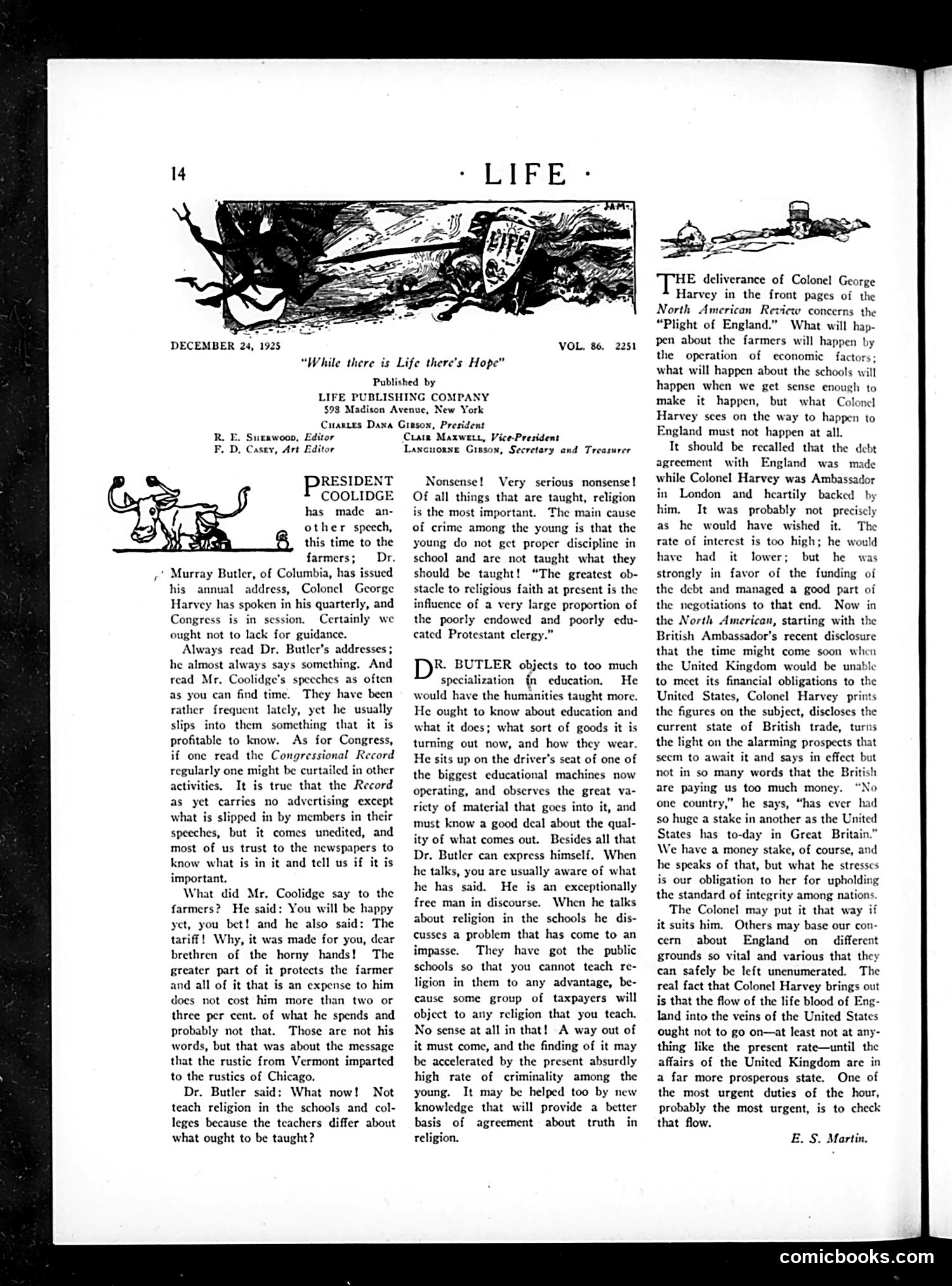
This page features an editorial discussion of Colonel George Harvey's recent North American Review article on England's economic difficulties (the "Plight of England"). The main cartoon shows a farmer sitting beside a dead or dying horse, illustrating rural hardship—likely referencing agricultural depression affecting American farmers during the 1920s. The text critiques President Coolidge and Dr. Murray Butler for their positions on education and religion in schools. The author (E.S. Martin) argues against Butler's objection to teaching religion, suggesting it contributes to youth crime. The piece also discusses British financial troubles and Anglo-American economic relationships. The editorial takes a relatively conservative stance on education policy while commenting on transatlantic financial concerns during the post-WWI period.
📄 Transcribed text from this page (OCR, searchable)
Machine-transcribed from the original scan — historical spelling and the odd misread are preserved.
DECEMBER 24, 1925 “While there is Life there’s Hope” Published by LIFE PUBLISHING COMPANY $98 Madison Avenue, New York Citartes Dana Gissox, President R. E. Surawoop, Editor F. D, Casey, Art Editor RESIDENT COOLIDGE has made an- other speech, this time to the farmers; Dr. * Murray Butler, of Columbia, has issued his annual address, Colonel George Harvey has spoken in his quarterly, and Congress is in session. Certainly we ought not to lack for guidance. Always read Dr. Butler's addresses ; he almost always says something. And read Mr. Coolidge’s speeches as often as you can find time. They have been rather frequent lately, yet he usually slips into them something that it is profitable to know. As for Congress, if one read the Congressional Record regularly one might be curtailed in other activities. It is true that the Record as yet carries no advertising except what is slipped in by members in their speeches, but it comes unedited, and most of us trust to the newspapers to know what is in it and tell us if it is important. What did Mr. Coolidge say to the farmers? He said: You will be happy yet, you bet! and he also said: The tariff! Why, it was made for you, dear brethren of the horny hands! The greater part of it protects the farmer and all of it that is an expense to him docs not cost him more than two or three per cent. of what he spends and probably not that. Those are not his words, but that was about the message that the rustic from Vermont imparted to the rustics of Chicago. Dr. Butler said: What now! Not teach religion in the schools and col- leges because the teachers differ about what ought to be taught? Crate Maxwett, Vice-President Laxcuorne Ginson, Secretary end Treasurer Nonsense! Very serious nonsense! Of all things that are taught, religion is the most important. The main cause of crime among the young is that the young do not get proper discipline in school and are not taught what they should be taught! “The greatest ob- stacle to religious faith at present is the influence of a very large proportion of the poorly endowed and poorly edu- cated Protestant clergy.” R. BUTLER objects to too much specialization {n education. He would have the humanities taught more. He ought to know about education and what it does; what sort of goods it is turning out now, and how they wear. He sits up on the driver's seat of one of the biggest educational machines now operating, and observes the great va- ricty of material that gocs into it, and must know a good deal about the qual- ity of what comes out. Besides all that Dr. Butler can express himself. When he talks, you are usually aware of what he has said. He is an exceptionally free man in discourse. When he talks about religion in the schools he dis- cusses a problem that has come to an impasse. They have got the public schools so that you cannot teach re- ligion in them to any advantage, be- cause some group of taxpayers will object to any religion that you teach. No sense at all in that! A way out of it must come, and the finding of it may be accelerated by the present absurdly high rate of criminality among the young. It may be helped too by new knowledge that will provide a better basis of agreement about truth in religion. Te deliverance of Colonel George Harvey in the front pages of the North American Review concerns the “Plight of England.” What will hap- pen about the farmers will happen by the operation of economic factors: what will happen about the schools will happen when we get sense enough to make it happen, but what Colonel Harvey sces on the way to happen to England must not happen at all. It should be recalled that the debt agreement with England was made while Colonel Harvey was Ambassador in London and heartily backed by him. It was probably not precisely as he would have wished it. The rate of interest is too high; he would have had it lower; but he was strongly in favor of the funding of the debt and managed a good part of the negotiations to that end. Now in the North American, starting with the British Ambassador's recent disclosure that the time might come soon when the United Kingdom would be unable to mect its financial obligations to the United States, Colonel Harvey prints the figures on the subject, discloses the current state of British trade, turns the light on the alarming prospects that seem to await it and says in effect but not in so many words that the Briti are paying us too much money. “No one country,” he says, “has ever had so huge a stake in another as the United States has to-day in Great Britain.” We have a money stake, of course, and he speaks of that, but what he stresses is our obligation to her for upholding the standard of integrity among nations. The Colonel may put it that way if it suits him. Others may base our con- cern about England on different grounds so vital and various that they can safely be left unenumerated. The real fact that Colonel Harvey brings out is that the flow of the life blood of Eng- land into the veins of the United States ought not to go on—at least not at any- thing like the present rate—until the affairs of the United Kingdom are in a far more prosperous state. One of the most urgent duties of the hour, probably the most urgent, is to check that flow. E. S. Martin, comicbooks.com