
Life, 1925-12-25 · page 29 of 37
Life — December 25, 1925 — page 29: what you’re looking at
What you’re looking at
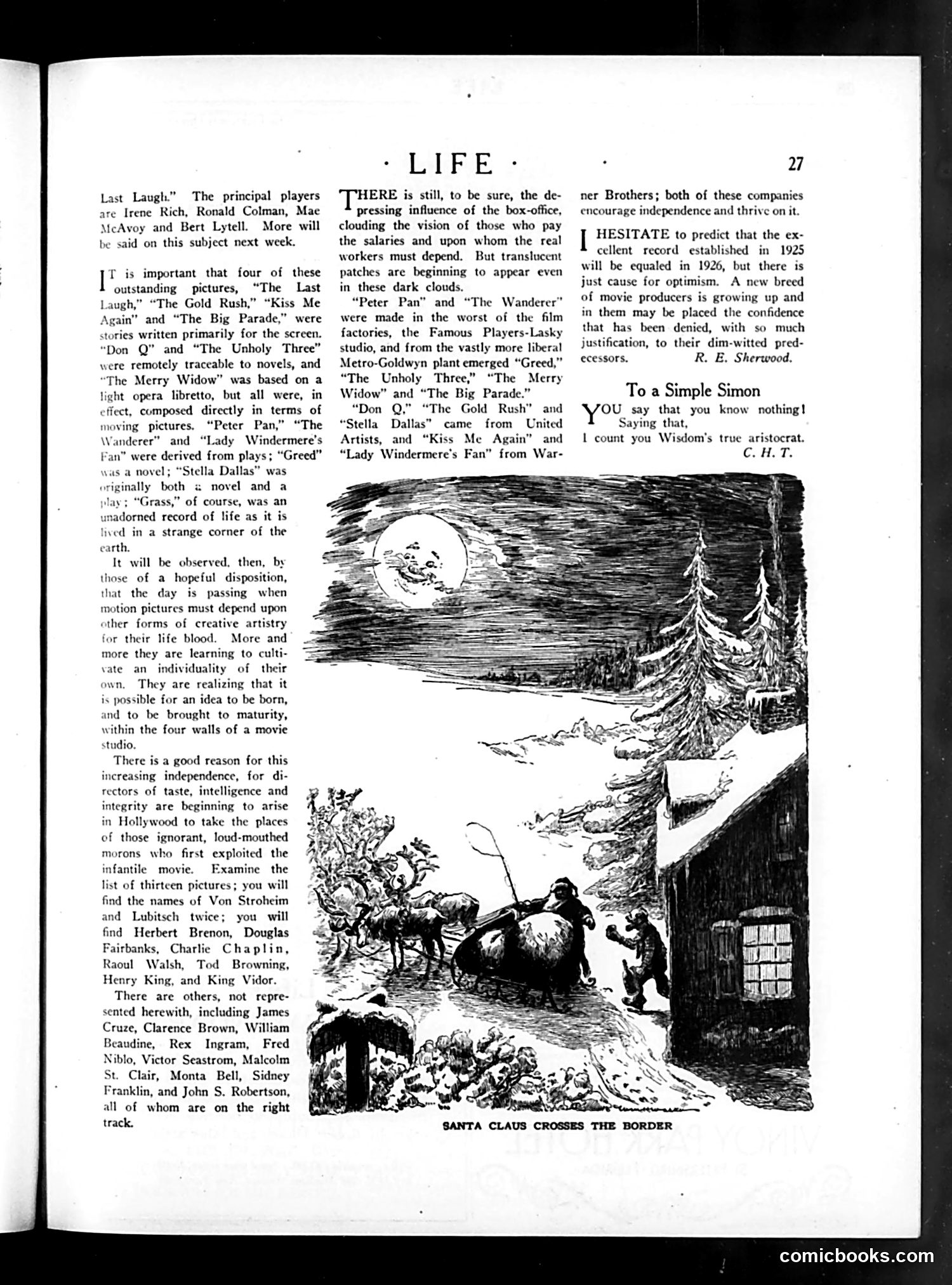
This page discusses the artistic maturation of 1920s cinema, arguing that film is becoming an independent creative medium rather than merely adapting stage plays and novels. The article celebrates directors like Chaplin, Von Stroheim, and King Vidor who are elevating the industry beyond "ignorant, loud-mouthed morons" who initially exploited film's "infantile" appeal. The illustration titled "Santa Claus Crosses the Border" appears to be a whimsical ink drawing showing Santa with his reindeer traveling across a winter landscape—likely a reference to either holiday-themed cinema or possibly commentary on cross-border cultural exchange during the era of silent film's international influence. The page includes a short humorous verse ("To a Simple Simon") praising wisdom through self-awareness. Overall, this reflects 1925-era optimism about Hollywood's artistic evolution and the growing respectability of motion pictures as a serious art form independent of theatrical traditions.
📄 Transcribed text from this page (OCR, searchable)
Machine-transcribed from the original scan — historical spelling and the odd misread are preserved.
Last Laugh.” The principal players are Irene Rich, Ronald Colman, Mae McAvoy and Bert Lytell. More will be said on this subject next week. [ is important that four of these outstanding pictures, “The Last Laugh,” “The Gold Rush,” “Kiss Me ain” and “The Big Parade,” were ies written primarily for the screen. Don Q” and “The Unholy Three” were remotely traceable to novels, and “The Merry Widow” was based on a light opera libretto, but all were, in effect, composed directly in terms of moving pictures. “Peter Pan,” “The Wanderer” and “Lady Windermere’s Fan” were derived from plays; “Greed” vas a novel; “Stella Dallas” was inally both = novel and a ; “Grass,” of course, was an dorned record of life as it is ved in a strange corner of the earth. It will be observed, then, by those of a hopeful disposition, that the day is passing when motion pictures must depend upon other forms of creative artistry for their life blood. More and more they are learning to culti- vate an individuality of their own, They are realizing that it is possible for an idea to be born, and to be brought to maturity, within the four walls of a movie studio. There is a good reason for this increasing independence, for di- rectors of taste, intelligence and integrity are beginning to arise in Hollywood to take the places of those ignorant, loud-mouthed morons who first exploited the infantile movie. Examine the list of thirteen pictures; you will find the names of Von Stroheim and Lubitsch twice; you will find Herbert Brenon, Douglas Fairbanks, Charlie Chaplin, Raoul Walsh, Tod Browning, Henry King, and King Vidor. There are others, not repre- sented herewith, including James Cruze, Clarence Brown, William Beaudine, Rex Ingram, Fred Niblo, Victor Seastrom, Malcolm St. Clair, Monta Bell, Sidney Franklin, and John S. Robertson, all of whom are on the right track. "DARE » ERE is still, to be sure, the de- pressing influence of the box-office, clouding the vision of those who pay the salaries and upon whom the real workers must depend. But translucent patches are beginning to appear even in these dark clouds. “Peter Pan” and “The Wanderer” were made in the worst of the film factories, the Famous Players-Lasky studio, and from the vastly more liberal Metro-Goldwyn plant emerged “Greed,” “The Unholy Three,” “The Merry Widow” and “The Big Parade.” “Don Q,” “The Gold Rush” and “Stella Dallas” came from United Artists, and “Kiss Me Again” and “Lady Windermere’s Fan” from War- 27 ner Brothers; both of these companies encourage independence and thrive on it. HESITATE to predict that the ex- cellent record established in 1925 will be equaled in 1926, but there is just cause for optimism. A new breed of movie producers is growing up and in them may be placed the confidence that has been denied, with so much justification, to their dim-witted pred- ecessors. R. E. Sherwood. To a Simple Simon ‘OU say that you know nothing! Saying that, 1 count you Wisdom’s true aristocrat. C. HLT. SANTA CLAUS CROSSES THE BORDER comicbooks.com