
Life, 1925-12-25 · page 28 of 37
Life — December 25, 1925 — page 28: what you’re looking at
What you’re looking at
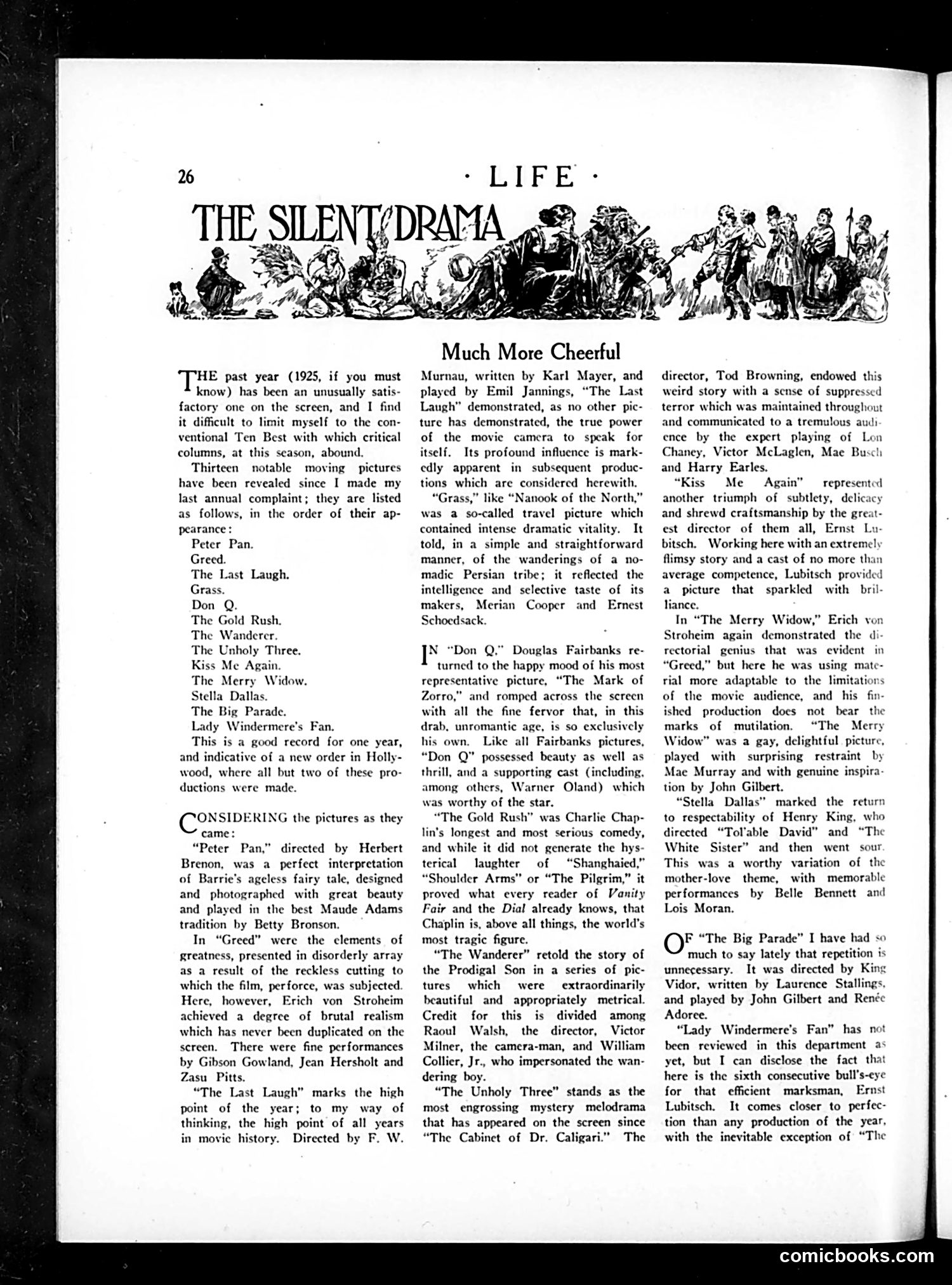
This is a film criticism column from *Life* magazine (1925), not a political cartoon. The author reviews thirteen notable motion pictures from 1925, ranking them by quality. Key context: Silent films dominated cinema; directors like F.W. Murnau, Charlie Chaplin, and Erich von Stroheim were innovating the medium. The critic praises "The Last Laugh" as cinema's highest achievement, noting how the camera itself tells the story without intertitles. Notable films discussed include: - *The Gold Rush* (Chaplin) — praised for its tragic depth - *Greed* (von Stroheim) — admired despite heavy studio editing - *Don Q* (Fairbanks) — adventure-swashbuckling entertainment - *Peter Pan* — faithful literary adaptation The tone is enthusiastic about Hollywood's recent output, noting "a new order" in filmmaking quality. The author distinguishes between commercial entertainment (Fairbanks) and artistic achievement (Murnau), establishing early critical hierarchies that persist today.
📄 Transcribed text from this page (OCR, searchable)
Machine-transcribed from the original scan — historical spelling and the odd misread are preserved.
'HE past year (1925, if you must know) has been an unusually satis- factory one on the screen, and I find it difficult to limit myself to the con- ventional Ten Best with which critical columns, at this season, abound. Thirteen notable moving _ pictures have been revealed since I made my last annual complaint; they are listed as follows, in the order of their ap- pearance : Peter Pan. Greed. The Last Laugh. Grass. Don Q. The Gold Rush. The Wanderer, The Unholy Three. Kiss Me Again. The Merry Widow. Stella Dallas. The Big Parade. Lady Windermere’s Fan. This is a good record for one year, and indicative of a new order in Holly- wood, where all but two of these pro- ductions were made. CONSIDERING the pictures as they came: “Peter Pan,” directed by Herbert Brenon, was a perfect interpretation of Barrie’s ageless fairy tale, designed and photographed with great beauty and played in the best Maude Adams tradition by Betty Bronson. In “Greed” were the clements of greatness, presented in disorderly array as a result of the reckless cutting to which the film, perforce, was subjected. Here, however, Erich von Stroheim achieved a degree of brutal realism which has never been duplicated on the screen. There were fine performances by Gibson Gowland, Jean Hersholt and Zasu Pitts. “The Last Laugh” marks the high point of the year; to my way of thinking, the high point of all years in movie history. Directed by F. W. Much More Cheerful Murnau, written by Karl Mayer, and played by Emil Jannings, “The Last Laugh” demonstrated, as no other pic- ture has demonstrated, the true power of the movie camera to speak for itself. Its profound influence is mark- edly apparent in subsequent produc- tions which are considered herewith. “Grass,” like “Nanook of the North,” was a so-called travel picture which contained intense dramatic vitality. It told, in a simple and straightforward manner, of the wanderings of a no- madic Persian tribe; it reflected the intelligence and selective taste of its makers, Merian Cooper and Ernest Schoedsack. N “Don Q,” Douglas Fairbanks re- turned to the happy mood of his most representative picture, “The Mark of Zorro,” and romped across the screcn with all the fine fervor that, in this drab, unromantic age, is so exclusively Like all Fairbanks pictures, “Don Q” possessed beauty as well as thrill, and a supporting cast (including, among others, Warner Oland) which was worthy of the star. “The Gold Rush” was Charlie Chap- lin's longest and most serious comedy, and while it did not generate the hys- terical laughter of “Shanghaied,” “Shoulder Arms” or “The Pilgrim,” it proved what every reader of Vanity Fair and the Dial already knows, that Chaplin is, above all things, the world’s most tragic figure. “The Wanderer” retold the story of the Prodigal Son in a series of pic- tures which were extraordinarily beautiful and appropriately metrical. Credit for this is divided among Raoul Walsh, the director, Victor Milner, the camera-man, and William Collier, Jr., who impersonated the wan- dering boy. “The Unholy Three” stands as the most engrossing mystery melodrama that has appeared on the screen since “The Cabinet of Dr. Caligari.” The his own. director, Tod Browning, endowed this weird story with a sense of suppressed terror which was maintained throughout and communicated to a tremulous audi ence by the expert playing of Lon Chaney, Victor McLaglen, Mae Buscli and Harry Earles. “Kiss Me Again” — represented another triumph of subtlety, delicacy and shrewd craftsmanship by the great- est director of them all, Ernst Lu- bitsch. Working here with an extremely flimsy story and a cast of no more than average competence, Lubitsch provided a picture that sparkled with bril- liance. In “The Merry Widow,” Erich von Stroheim again demonstrated the di- rectorial genius that was evident in “Greed,” but here he was using mate- rial more adaptable to the limitations of the movie audience, and his fin- ished production does not bear the marks of mutilation. “The Merry Widow” was a gay, delightful picture, played with surprising restraint by Mae Murray and with genuine inspira- tion by John Gilbert. “Stella Dallas” marked the return to respectability of Henry King, who directed “Tol'able David" and “The White Sister” and then went This was a worthy variation of the mother-love theme, with memorable performances by Belle Bennett and Lois Moran. sour F “The Big Parade” I have had so much to say lately that repetition is unnecessary. It was directed by King Vidor, written by Laurence Stallings, and played by John Gilbert and Renée Adoree. “Lady Windermere’s Fan" has not been reviewed in this department as yet, but I can disclose the fact that here is the sixth consecutive bull’s-eye for that efficient marksman, Ernst Lubitsch. It comes closer to perfec- tion than any production of the year, with the inevitable exception of “The comicbooks.com